
All Topics  
Mount St. Helens

 
Mount St. Helens

   Email Print
   Bookmark   Link


Mount St. Helens


Mount St. Helens is an active stratovolcano
Stratovolcano

A stratovolcano, sometimes called a composite volcano, is a tall, Volcanic cone volcano with many layers of hardened lava, tephra, and volcanic ash....
 located in Skamania County
Skamania County, Washington

Skamania County is a county located in the U.S. state of Washington. Its name derives from the Chinookan word for swift water, a reference to the Columbia River....
, Washington
Washington

Washington is a U.S. state in the Pacific Northwest region of the United States. Washington was carved out of the western part of Washington Territory which had been ceded by Britain in 1846 by the Oregon Treaty as settlement of the Oregon Boundary Dispute....
, in the Pacific Northwest
Pacific Northwest

The Pacific Northwest is a region in the northwest of North America . There are several partially overlapping definitions but the term Pacific Northwest should not be confused with the Northwest Territory or the Northwest Territories of Canada....
 region of the United States. It is south of Seattle
Seattle, Washington

Seattle is the most populous city in the US state of Washington and the Northwestern United States. The encompassing Seattle metropolitan area is the 15th largest in the United States, and the largest in the Pacific Northwest....
 and northeast of Portland, Oregon
Portland, Oregon

Portland is a city located in the Northwestern United States United States, near the confluence of the Willamette River and Columbia River rivers in the state of Oregon....
. Mount St. Helens takes its English name from the British
United Kingdom

The United Kingdom of Great Britain and Northern Ireland, commonly known as the United Kingdom , the UK or Britain,is a sovereign state located off the northwestern coast of continental Europe....
 diplomat Lord St Helens
Alleyne Fitzherbert, 1st Baron St Helens

Alleyne FitzHerbert, 1st Baron St Helens Privy Council of Great Britain was a British diplomat and a friend of explorer George Vancouver, who named Mount St....
, a friend of explorer George Vancouver
George Vancouver

Captain George Vancouver Royal Navy was an officer in the Royal Navy, best known for his Vancouver Expedition, including the shores of the modern day Alaska, British Columbia, Washington and Oregon....
 who made a survey of the area in the late 18th century.


Discussion
Ask a question about 'Mount St. Helens'
Start a new discussion about 'Mount St. Helens'
Answer questions from other users
Full Discussion Forum


Encyclopedia


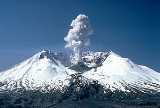
Sthelens1
Mount St. Helens is an active stratovolcano
Stratovolcano

A stratovolcano, sometimes called a composite volcano, is a tall, Volcanic cone volcano with many layers of hardened lava, tephra, and volcanic ash....
 located in Skamania County
Skamania County, Washington

Skamania County is a county located in the U.S. state of Washington. Its name derives from the Chinookan word for swift water, a reference to the Columbia River....
, Washington
Washington

Washington is a U.S. state in the Pacific Northwest region of the United States. Washington was carved out of the western part of Washington Territory which had been ceded by Britain in 1846 by the Oregon Treaty as settlement of the Oregon Boundary Dispute....
, in the Pacific Northwest
Pacific Northwest

The Pacific Northwest is a region in the northwest of North America . There are several partially overlapping definitions but the term Pacific Northwest should not be confused with the Northwest Territory or the Northwest Territories of Canada....
 region of the United States. It is south of Seattle
Seattle, Washington

Seattle is the most populous city in the US state of Washington and the Northwestern United States. The encompassing Seattle metropolitan area is the 15th largest in the United States, and the largest in the Pacific Northwest....
 and northeast of Portland, Oregon
Portland, Oregon

Portland is a city located in the Northwestern United States United States, near the confluence of the Willamette River and Columbia River rivers in the state of Oregon....
. Mount St. Helens takes its English name from the British
United Kingdom

The United Kingdom of Great Britain and Northern Ireland, commonly known as the United Kingdom , the UK or Britain,is a sovereign state located off the northwestern coast of continental Europe....
 diplomat Lord St Helens
Alleyne Fitzherbert, 1st Baron St Helens

Alleyne FitzHerbert, 1st Baron St Helens Privy Council of Great Britain was a British diplomat and a friend of explorer George Vancouver, who named Mount St....
, a friend of explorer George Vancouver
George Vancouver

Captain George Vancouver Royal Navy was an officer in the Royal Navy, best known for his Vancouver Expedition, including the shores of the modern day Alaska, British Columbia, Washington and Oregon....
 who made a survey of the area in the late 18th century. The volcano is located in the Cascade Range
Cascade Range

The Cascade Range is a major mountain range of western North America, extending from southern British Columbia through Washington and Oregon to Northern California....
 and is part of the Cascade Volcanic Arc
Cascade Volcanoes

The Cascade Volcanoes are a number of volcanoes in a volcanic arc in western North America, extending from southwestern British Columbia through Washington and Oregon to Northern California, a distance of well over 700 mi ....
, a segment of the Pacific Ring of Fire
Pacific Ring of Fire

The Pacific Ring of Fire is an area of frequent earthquakes and volcanic eruptions encircling the basin of the Pacific Ocean. In a 40,000 km horseshoe shape, it is associated with a nearly continuous series of oceanic trenches, volcanic arcs, and volcanic belts and/or plate movements....
 that includes over 160 active volcano
Volcano

A volcano is an opening, or rupture, in a planet's surface or Crust , which allows hot, molten rock, ash, and gases to escape from below the surface....
es. This volcano is well known for its ash
Volcanic ash

Volcanic ash consists of small tephra, which are bits of pulverized rock and glass created by volcano eruptions, less than in diameter. There are three mechanisms of volcanic ash formation: gas release under decompression causing magmatic eruptions; thermal contraction from chilling on contact with water causing phreatomagmatic eruptions...
 explosions and pyroclastic flow
Pyroclastic flow

A pyroclastic flow is a common and devastating result of some volcano. The flows are fast-moving currents of hot gas and rock , which travel away from the volcano at speeds generally as great as 450 mi/h ....
s.

Mount St. Helens is most famous for its catastrophic eruption
1980 eruption of Mount St. Helens

File:sthelens1.jpgThe 1980 eruption of Mount St. Helens, a stratovolcano located in Washington state, in the United States, was a major plinian eruption....
 on May 18, 1980, at 8:32am PDT which was the deadliest and most economically destructive volcanic event in the history of the United States. Fifty-seven people were killed; 250 homes, 47 bridges, of railways, and of highway were destroyed. The eruption caused a massive debris avalanche, reducing the elevation of the mountain's summit from to and replacing it with a wide horseshoe
Horseshoe

File:Horseshoes.JPGA horseshoe is a U-shaped item made of metal or of modern synthetic materials, nail ed or Polymethyl methacrylated to the hooves of horses and some other draught animals....
-shaped crater. The debris avalanche was up to in volume. The Mount St. Helens National Volcanic Monument
Mount St. Helens National Volcanic Monument

Mount St. Helens National Volcanic Monument is a U.S. National Monument that includes the area around Mount St. Helens in Washington. It was established on August 27, 1982 by U.S....
 was created to preserve the volcano and allow for its aftermath to be scientifically studied.

As with most other volcanoes in the Cascade Range, Mount St. Helens is a large eruptive cone consisting of lava
Lava

Lava is molten Rock expelled by a volcano during an eruption. When first expelled from a volcanic vent, it is a liquid at temperatures from 700 ?C to 1,200 ?C ....
 rock interlayered with ash, pumice
Pumice

File:Pumice stone444.jpgFile:Pumice stone detail444.jpgPumice is a textural term for a volcanic rock that is a solidified frothy lava typically created when super-heated, highly pressurized rock is violently ejected from a volcano....
, and other deposits. The mountain includes layers of basalt
Basalt

Basalt is a common extrusive volcanic rock. It is usually gray to black and fine-grained due to rapid cooling of lava at the surface of a planet....
 and andesite
Andesite

Andesite is an igneous rock, volcanic rock, of Igneous rock#Chemical classification, with aphanitic to porphyritic texture. The mineral assemblage is typically dominated by plagioclase plus pyroxene and/or hornblende....
 through which several domes
Lava dome

In volcanology, a lava dome or plug dome is a roughly circular mound-shaped protrusion resulting from the slow eruption of felsic lava from a volcano, or from multiple lava episodes of different magma types....
 of dacite
Dacite

Dacite is an igneous rock, volcanic rock with a high iron content. It is intermediate in compositions between andesite and rhyolite, and, like andesite, it consists mostly of plagioclase feldspar with biotite, hornblende, and pyroxene ....
 lava have erupted. The largest of the dacite domes formed the previous summit, and off its northern flank sat the smaller Goat Rocks dome. Both were destroyed in the 1980 eruption.

Shaken by an earthquake measuring 5.1 on the Richter scale, the north face of this tall symmetrical mountain collapsed in a massive rock debris avalanche. Nearly of forest was blown down or buried beneath volcanic deposits. At the same time a mushroom-shaped column of ash rose thousands of feet skyward and drifted downwind, turning day into night as dark, gray ash fell over eastern Washington and beyond. The eruption lasted 9 hours, but Mount St. Helens and the surrounding landscape were dramatically changed within moments.

Geographic setting and description


General

St Helens and Nearby Area From Space
Mount St. Helens is west of Mount Adams
Mount Adams (Washington)

Mount Adams is a potentially active volcanostratovolcano in the Cascade Range and the second-highest mountain in the U.S. state of Washington....
, in the western part of the Cascade Range. These "sister and brother" volcanic mountains are approximately from Mount Rainier
Mount Rainier

Mount Rainier is an activestratovolcano in Pierce County, Washington, located southeast of Seattle, Washington, Washington, in the United States....
, the highest of Cascade volcanoes. Mount Hood
Mount Hood

Mount Hood, called Wy'east by the Multnomah , is a stratovolcano in the Cascade Volcanoes of northern Oregon, in the Pacific Northwest region of the United States....
, the nearest major volcanic peak in Oregon
Oregon

Oregon is a U.S. state in the Pacific Northwest region of the United States. The area was inhabited by many indigenous tribes before the arrival of traders, explorers and settlers....
, is southeast of Mount St. Helens.

Mount St. Helens is geologically young compared to the other major Cascade volcanoes. It formed only within the past 40,000 years, and the pre-1980 summit cone began rising about 2,200 years ago. The volcano is considered the most active in the Cascades within the Holocene
Holocene

The Holocene is a geological Epoch which began approximately 11,700 years ago . According to traditional geological thinking, the Holocene continues to the present....
 epoch (the last 10,000 or so years).

Prior to the 1980 eruption, Mount St. Helens was the fifth-highest peak in Washington. It stood out prominently from surrounding hills because of the symmetry and extensive snow and ice cover of the pre-1980 summit cone, earning it the nickname "Fuji-san of America" ("Mount Fuji
Mount Fuji

is the highest mountain in Japan at . Along with Mount Tate and Mount Haku, it is one of Japan's "Three Holy Mountains" . An active volcano that last erupted in 1707?08, Mount Fuji straddles the boundary of Shizuoka Prefecture and Yamanashi Prefecture Prefectures of Japan just west of Tokyo, from which it can be seen on a clear day....
 of America"). The peak rose more than above its base, where the lower flanks merge with adjacent ridges. The mountain is across at its base, which is at an altitude of on the northeastern side and elsewhere. At the pre-eruption tree line, the width of the cone was .

Stream
Stream

A stream is a body of water less than 60 feet wide with a current , confined within a stream bed and stream banks. Depending on its locale or certain characteristics, a stream may be referred to as brook, beck, Burn , creek, crick, kill, lick , rill, river syke, bayou, rivu...
s that originate on the volcano enter three main river systems: the Toutle River
Toutle River

The Toutle River is a river in southwestern Washington State, in the Pacific Northwest region of the United States. It rises on the flanks of Mount St....
 on the north and northwest, the Kalama River on the west, and the Lewis River
Lewis River (Washington)

The Lewis River is a tributary of the Columbia River, about long, in southwestern Washington in the United States. It drains part of the Cascade Range north of the Columbia River....
 on the south and east. The streams are fed by abundant rain and snow. The average annual rainfall is , and the snowpack on the mountain's upper slopes can reach . The Lewis River is impounded by three dam
Dam

A dam is a barrier that Reservoirs surface water or underground streams. Dams generally serve the primary purpose of retaining water, while other structures such as floodgates, levees, and Dike are used to manage or prevent water flow into specific land regions....
s for hydroelectric power generation. The southern and eastern sides of the volcano drain into an upstream impoundment, the Swift Reservoir, which is directly south of the volcano's peak.

Although Mount St. Helens is in Skamania County, Washington, the best access routes to the mountain run through Cowlitz County
Cowlitz County, Washington

Cowlitz County is a county located in the U.S. state of Washington. As of July 2007 its population was 100,467 It forms the Longview, Washington, Metropolitan Statistical Area which encompasses all of Cowlitz County....
 to the west. State Route 504, locally known as the Spirit Lake Memorial Highway, connects with the heavily traveled Interstate 5 at Exit 49, to the west of the mountain. That major north-south highway
Highway

A highway is a main road intended for travel by the public between important destinations, such as city and towns. Highway designs vary widely and can range from a two-lane road without margins to a multi-lane, grade separated freeway....
 skirts the low-lying cities of Castle Rock
Castle Rock, Washington

Castle Rock is a city in Cowlitz County, Washington, Washington, United States. It is part of the 'Longview, Washington Metropolitan Statistical Area'....
, Longview
Longview, Washington

Longview is a city in Cowlitz County, Washington, Washington, United States. It is the principal city of the 'Longview, Washington Metropolitan Statistical Area' which encompasses all of Cowlitz County....
 and Kelso
Kelso, Washington

Kelso is a city in Cowlitz County, Washington, Washington, United States. The population was 11,895 at the 2000 United States Census. It is part of the 'Longview, Washington Metropolitan Statistical Area'....
 along the Cowlitz River
Cowlitz River

The Cowlitz River is a river in the state of Washington in the United States, a tributary of the Columbia River. Its tributaries drain a large region including the slopes of Mount Rainier, Mount Adams , and Mount St....
, and passes through the Vancouver, Washington
Vancouver, Washington

Vancouver is a city on the north bank of the Columbia River in the U.S. state of Washington and the county seat of Clark County, Washington. According to the Washington State Office of Financial Management's April 1, 2008 estimate, the city has a population of 162,400, making it the fourth largest city in the state....
-Portland, Oregon
Portland, Oregon

Portland is a city located in the Northwestern United States United States, near the confluence of the Willamette River and Columbia River rivers in the state of Oregon....
 metropolitan area
Metropolitan area

A metropolitan area is a large population center consisting of a large metropolis and its adjacent zone of influence, or of more than one closely adjoining neighboring central city and their zone of influence....
 less than to the southwest. The community nearest the volcano is Cougar, Washington
Cougar, Washington

Cougar is a former town, and now unincorporated area, in Cowlitz County, Washington, Washington, United States. The population was 122 at the United States Census, 1990; it was not measured in United States Census, 2000....
, in the Lewis River valley south-southwest of the peak. Gifford Pinchot National Forest
Gifford Pinchot National Forest

Gifford Pinchot National Forest is a U.S. National Forest located in southern Washington, USA. With an area of 1.3 million acres , it extends 116 km along the western slopes of Cascade Range from Mount Rainier National Park to the Columbia River....
 surrounds Mount St. Helens.

Crater Glacier and other new rock glaciers

During the winter of 1980–1981, a new glacier
Glacier

A glacier is a large, slow-moving mass of ice, formed from compacted layers of snow, that slowly deforms and flows in response to gravity and high pressure....
 appeared. Now officially named Crater Glacier
Crater Glacier

The Crater Glacier is a geologically young glacier that is located on Mount Saint Helens, in the U.S. state of Washington. The glacier formed after the 1980 eruption of Mount St....
, it was formerly known as the Tulutson Glacier. Shadowed by the crater walls and fed by heavy snowfall and repeated snow avalanches, it grew rapidly ( per year in thickness). By 2004, it covered about , and was divided by the dome into a western and eastern lobe. Typically, by late summer, the glacier looks dark from rockfall from the crater walls and ash from eruptions. As of 2006, the ice had an average thickness of and a maximum of , nearly as deep as the much older and larger Carbon Glacier
Carbon Glacier

Carbon Glacier is an album by Laura Veirs, released in 2004....
 of Mount Rainier. The ice is all post–1980, making the glacier very young geologically. However, the volume of the new glacier is about the same as all the pre–1980 glaciers combined.

With the recent volcanic activity starting in 2004, the glacier lobes were pushed aside and upward by the growth of new volcanic domes. The surface of the glacier, once mostly uncrevassed, turned into a chaotic jumble of icefall
Icefall

An icefall is a portion of some glaciers characterized by rapid flow and a chaotic crevassed surface. Perhaps the most conspicuous consequence of glacier flow, icefalls occur where the glacier bed steepens and/or narrows....
s heavily criss-crossed with crevasse
Crevasse

A crevasse is a fracture in a glacier caused by a large tensile stress at or near the glacier's surface. Accelerations in glacier speed cause extension and can initiate a crevasse....
s and serac
Serac

A serac is a block or column of ice formed by intersecting crevasses on a glacier. Often house-sized or larger, they are dangerous to mountaineers since they may topple with little warning....
s caused by movement of the crater floor. The new domes have almost separated the Crater Glacier into an eastern and western lobe. Despite the volcanic activity, the termini of the glacier have still advanced, with a slight advance on the western lobe and a more considerable advance on the more shaded eastern lobe. Due to the advance, two lobes of the glacier joined together in late-May 2008 and thus the glacier completely surrounds the lava domes. In addition, since 2004, new glaciers have formed on the crater wall above Crater Glacier feeding rock and ice onto its surface below; there are two rock glaciers to the north of the eastern lobe of Crater Glacier.

Human history


Importance to Native Americans

Traces of ancient campsites have been found in the Gifford Pinchot National Forest
Gifford Pinchot National Forest

Gifford Pinchot National Forest is a U.S. National Forest located in southern Washington, USA. With an area of 1.3 million acres , it extends 116 km along the western slopes of Cascade Range from Mount Rainier National Park to the Columbia River....
, which surrounds the monument. Dating of these sites reveals that people have lived in this area for at least 6,500 years. Throughout human history, Mount St. Helens eruptions have had a dramatic effect on the lives of local inhabitants. Work by archaeologists has shown that a massive eruption 3,500 years ago buried native settlements with a thick layer of pumice
Pumice

File:Pumice stone444.jpgFile:Pumice stone detail444.jpgPumice is a textural term for a volcanic rock that is a solidified frothy lava typically created when super-heated, highly pressurized rock is violently ejected from a volcano....
. As a result, people abandoned the area for nearly 2,000 years. Later, members of the Cowlitz
Cowlitz (tribe)

The Cowlitz are a group of Native Americans of the United States peoples from what is now western Washington state in the United States. The Cowlitz tribe actually consists of two distinct groups: the Upper Cowlitz, or Taidnapam, and the Lower Cowlitz, or Kawlic....
, Taidnapam, Klickitat, Upper Chinook
Chinookan

Chinookan refers to several groups of Native Americans in the United States in the Pacific Northwest region of the United States. In the early 19th century, the Chinookan peoples lived along the lower and middle Columbia River in present-day Oregon and Washington....
, and Yakama
Yakama

The Confederated Tribes and Bands of the Yakama Nation, or simply Yakama Nation , is a Native Americans in the United States group with nearly 10,000 enrolled members, living in Washington....
 tribes moved seasonally over the land, harvesting huckleberries
Vaccinium parvifolium

Red Huckleberry is a species of Vaccinium native to the Pacific Northwest of North America, where it is common in forests from southeastern Alaska and British Columbia south through Washington and Oregon to central California....
 and hunting salmon
Salmon

Salmon is the common name for several species of fish of the family Salmonidae. Several other fish in the family are called trout,the difference is often attributed to the migratory life of the salmon as compared to the residential behaviour of trout, this holds true for the Atlantic salmon....
, elk
Elk

Elk may refer to:* Various species of deer:** European Elk , also known as Moose** North American Elk , also known as Wapiti** Indian Elk , also known as sambar ...
, and deer
Deer

Deer are the ruminant mammals forming the family Cervidae . A number of broadly similar animals from related families within the order even-toed ungulate are often also called deer....
.

St Helens Before 1980 Eruption

Local legends
American Indian
Indigenous peoples of the Americas

The indigenous peoples of the Americas are the pre-Columbian inhabitants of the Americas, their descendants, and many ethnic groups who identify with those peoples....
 lore contains numerous legends to explain the eruptions of Mount St. Helens and other Cascade volcanoes. The most famous of these is the Bridge of the Gods
Bridge of the Gods (geologic event)

The original Bridge of the Gods was created during the eighteenth century by the Bonneville Slide, a major landslide which dammed the Columbia River, near present-day Cascade Locks, Oregon in the Pacific Northwest of the United States....
 legend told by the Klickitats. In their tale, the chief of all the gods, Tyhee Saghalie and his two sons, Pahto (also called Klickitat) and Wy'east, traveled down the Columbia River
Columbia River

The Columbia River is the largest river in the Pacific Northwest region of North America. It is named after the Columbia Rediviva, the first ship from the western world known to have traveled up the river....
 from the Far North in search for a suitable area to settle.

They came upon an area that is now called The Dalles and thought they had never seen a land so beautiful. The sons quarreled over the land, so to solve the dispute their father shot two arrows from his mighty bow — one to the north and the other to the south. Pahto followed the arrow to the north and settled there while Wy'east did the same for the arrow to the south. Saghalie then built Tanmahawis, the Bridge of the Gods, so his family could meet periodically.

When the two sons of the Saghalie fell in love with a beautiful maiden named Loowit, she could not choose between them. The two young chiefs fought over her, burying villages and forests in the process. The area was devastated and the earth shook so violently that the huge bridge fell into the river, creating the cascade
Cascade

A cascade is a type of waterfall or a series of waterfalls.Cascade may also refer to:...
s of the Columbia River Gorge
Columbia River Gorge

The Columbia River Gorge is a canyon of the Columbia River in the Pacific Northwest of the United States. Up to deep, the canyon stretches for over as the river winds westward through the Cascade Range forming the boundary between the State of Washington to the north and Oregon to the south....
.

For punishment, Saghalie struck down each of the lovers and transformed them into great mountains where they fell. Wy'east, with his head lifted in pride, became the volcano known today as Mount Hood. Pahto, with his head bent toward his fallen love, was turned into Mount Adams. The fair Loowit became Mount St. Helens, known to the Klickitats as Louwala-Clough, which means "smoking or fire mountain" in their language (the Sahaptin
Sahaptin people

The Sahaptin people are a Native Americans in the United States people that inhabited territory along the Columbia River. The Nez Perce tribe is one of the major Sahaptin groups....
 called the mountain Loowit).

Exploration by Europeans

Royal Navy
Royal Navy

The Royal Navy of the United Kingdom is the oldest of the British Armed Forces . From the mid-18th century until well into the 20th century, it was the most powerful navy in the world, playing a key part in establishing the British Empire as the dominant world power from 1815 until the early 1940s....
 Commander George Vancouver
George Vancouver

Captain George Vancouver Royal Navy was an officer in the Royal Navy, best known for his Vancouver Expedition, including the shores of the modern day Alaska, British Columbia, Washington and Oregon....
 and the officers of HMS Discovery
HMS Discovery (1789)

HMS Discovery was a Royal Navy ship best known as the lead ship in George Vancouver's exploration of the west coast of North America in his 1791-1795 expedition....
 made the Europeans' first recorded sighting of Mount St. Helens on May 19, 1792, while surveying the northern Pacific Ocean
Pacific Ocean

The Pacific Ocean is the largest of the Earth's oceanic divisions. Its name is derived from the Latin name Mare Pacificum, "peaceful sea", bestowed upon it by the Portugal explorer Ferdinand Magellan....
 coast. Vancouver named the mountain for British diplomat Alleyne Fitzherbert, 1st Baron St Helens
Alleyne Fitzherbert, 1st Baron St Helens

Alleyne FitzHerbert, 1st Baron St Helens Privy Council of Great Britain was a British diplomat and a friend of explorer George Vancouver, who named Mount St....
 on October 20, 1792, as it came into view when the Discovery passed into the mouth of the Columbia River.

Years later, explorers, traders, and missionaries heard reports of an erupting volcano in the area. Geologists and historians determined much later that the eruption took place in 1800, marking the beginning of the 57-year-long Goat Rocks Eruptive Period (see geology section). Alarmed by the "dry snow," the Nespelem tribe of northeastern Washington danced and prayed rather than collecting food and suffered during that winter from starvation.

In late 1805 and early 1806, members of the Lewis and Clark Expedition
Lewis and Clark Expedition

The Lewis and Clark Expedition , headed by Meriwether Lewis and William Clark , was the first United States overland expedition to the Pacific coast and back....
 spotted Mount St. Helens from the Columbia River but did not report either an ongoing eruption or recent evidence of one. They did however report the presence of quicksand
Quicksand

Quicksand is a colloid hydrogel consisting of fine granular matter , clay, and brine. In the name, as in that of Mercury , "quick" does not mean "fast," but "living" ....
 and clogged channel conditions at the mouth of the Sandy River
Sandy River (Oregon)

The Sandy River is a tributary of the Columbia River in northwestern Oregon in the United States. Measured by a United States Geological Survey gauge downstream of the Sandy's confluence with the Bull Run Watershed, from the mouth, the river's average discharge is ....
 near Portland, suggesting an eruption by Mount Hood
Mount Hood

Mount Hood, called Wy'east by the Multnomah , is a stratovolcano in the Cascade Volcanoes of northern Oregon, in the Pacific Northwest region of the United States....
 sometime in the previous decades.

European settlement and use of the area


The area's first non-aboriginal inhabitants were European fur trade
Fur trade

The fur trade is a worldwide industry dealing in the acquisition and sale of animal fur....
rs and trappers. Most of these men worked for the fur trading enterprise of the British-owned Hudson's Bay Company
Hudson's Bay Company

The Hudson's Bay Company , abbreviated HBC, is the oldest commercial corporation in North America and is one of the oldest in the world. The company was incorporated by British royal charter in 1670 as The Governor and Company of Adventurers of England trading into Hudson's Bay; it is now domiciled in Canada and has adopted the mo...
. In the early 1890s, Ole' Peterson set up housekeeping at Cougar Flats, on the Upper Lewis River. He was a true hermit
Hermit

A hermit is a person who lives to some greater or lesser degree in solitude and/or isolation from society.In Christianity the term was originally applied to a Christian who lives the eremitic life out of a religious conviction, namely the Catholic spirituality#Desert spirituality of the Old Testament ....
 — preferring to keep to himself, and enjoying the quiet solitude of nature.

Also in the early 1890s, a mining district north of Spirit Lake
Spirit Lake (Washington)

Spirit Lake is a lake north of Mount St. Helens in Washington. The lake was a popular tourist destination for many years until the 1980 eruption of Mount St....
 was established. By 1911, over 400 mining claims had been filed. However, the minerals were never found in profitable quantities, and though much effort was spent in attempting to build a road or railroad into the district, by 1911, it was clear that there were no veins of precious minerals rich enough to offset the high transportation costs.

The first authenticated eyewitness report of a volcanic eruption was made in March 1835 by Meredith Gairdner, while working for the Hudson's Bay Company stationed at Fort Vancouver
Fort Vancouver

Fort Vancouver was a 19th century fur trade outpost along the Columbia River that served as the headquarters of the Hudson's Bay Company in the company's Columbia District ....
. He sent an account to the Edinburgh New Philosophical Journal, which published his letter in January 1836. James Dwight Dana
James Dwight Dana

James Dwight Dana was an United States geologist, mineralogist and zoologist. He made important studies of mountain-building, volcano activity, and the origin and structure of continents and oceans....
 of Yale University
Yale University

Yale University is a private university in New Haven, Connecticut. Founded in 1701 as the Collegiate School, Yale is the Colonial Colleges institution of higher education in the United States and is a member of the Ivy League....
, while sailing with the United States Exploring Expedition
United States Exploring Expedition

The United States Exploring Expedition was an exploring and surveying expedition of the Pacific Ocean conducted by the United States Navy from 1838?1842....
, saw the quiescent peak from off the mouth of the Columbia River in 1841. Another member of the expedition later described "cellular basaltic lavas" at the mountain's base.

In late fall or early winter of 1842, nearby settlers and missionaries witnessed the so-called "Great Eruption." This small-volume outburst created large ash clouds, and mild explosions followed for 15 years. The eruptions of this period were likely phreatic
Phreatic eruption

A Phreatic eruption, also called an ultravulcanian eruption, occurs when rising magma makes contact with ground water or surface water. The extreme temperature of the magma causes near-instantaneous evaporation to steam resulting in an explosion of steam, water, ash, rock, and volcanic bombs....
 (steam
Steam

In physical chemistry, and in engineering, steam refers to vaporized water. It is a pure, completely invisible gaseous phase . At standard temperature and pressure, pure steam occupies about 1,600 times the volume of an equal mass of liquid water....
 explosions). Josiah Parrish in Champoeg, Oregon
Champoeg, Oregon

Champoeg is a former town in the U.S. state of Oregon. Now a ghost town, it was an important settlement in the Willamette Valley in the early 1840s....
 witnessed Mount St. Helens in eruption on November 22, 1842. Ash from this eruption may have reached The Dalles, Oregon
The Dalles, Oregon

The Dalles is a city in Wasco County, Oregon, Oregon, United States, and the county seat of Wasco County. The name of the city comes from the French word dalle , what the French Canadian employees of the North West Company called the now-inundated rapids of the Columbia River between the present-day city and Celilo Falls....
, 48 miles (80 km) southeast of the volcano.

In October 1843, future California
California

California is a U.S. state on the West Coast of the United States of the United States, along the Pacific Ocean. It is bordered by Oregon to the north, Nevada to the east, Arizona to the southeast, and to the south the Mexico state of Baja California....
 governor Peter H. Burnett
Peter Hardeman Burnett

Peter Hardeman Burnett was an United States politician and the first state Governor of California, serving from December 20, 1849 to January 9 1851....
 recounted a story of an aboriginal American man who badly burned his foot and leg in lava or hot ash while hunting for deer. The likely apocryphal story went that the injured man sought treatment at Fort Vancouver, but the contemporary fort commissary steward, Napolean McGilvery, disclaimed knowledge of the incident. British lieutenant Henry J. Warre sketched the eruption in 1845, and two years later Canadian painter Paul Kane
Paul Kane

Paul Kane was an Irish people-Canada painter, famous for his paintings of First Nations peoples in the Canadian West and other Native Americans in the United Statess in the Oregon Country....
 created watercolors of the gently smoking mountain. Warre's work showed erupting material from a vent about a third of the way down from the summit on the mountain's west or northwest side (possibly at Goat Rocks), and one of Kane's field sketches shows smoke emanating from about the same location.

On April 17, 1857, the Republican, a Steilacoom, Washington
Steilacoom, Washington

Steilacoom is a town in Pierce County, Washington, Washington, United States. The population was 6,049 at the 2000 United States Census. Steilacoom is on the coast of Puget Sound, on a branch not visible on the map to the right....
 newspaper, reported that "Mount St. Helens, or some other mount to the southward, is seen ... to be in a state of eruption". The lack of a significant ash layer associated with this event indicates that it was a small eruption. This was the first reported volcanic activity since 1854.

Before the 1980 eruption, Spirit Lake
Spirit Lake (Washington)

Spirit Lake is a lake north of Mount St. Helens in Washington. The lake was a popular tourist destination for many years until the 1980 eruption of Mount St....
 offered year-round recreational activities. In the summer there was boating
Boating

Boating, the leisurely activity of traveling by boat typically refers to the recreational use of boats whether power boats, Sailing, or yachts , focused on the travel itself, as well as sports activities, such as fishing or waterskiing....
, swimming
Swimming

Swimming is the movement by humans or animals through water, usually without artificial assistance. Swimming is an activity that can be both useful and recreational....
, and camping
Camping

Camping is an outdoor recreational activity.The participants, known as campers, get away from urban areas, their home region or civilization and enjoy nature while spending one or more nights, usually at a campsite....
, while in the winter there was skiing
Skiing

Snow skiing is a group of sports using skis as primary equipment. Skis are used in conjunction with ski boots that connect to the ski with use of a ski bindings....
.

Human impact from the 1980 eruption


St. Helens catastrophically erupted on May 18, 1980. After many months of lead-up activity, including the growth of a huge bulge on the north part of the mountain, a moderate earthquake caused the entire north flank of the mountain to slide away in the largest landslide in recorded history. The newly-exposed hot and pressurized rock in the volcano responded by producing the largest historic volcanic eruption in the 48 contiguous U.S. states. (See the Geology section for more detail.)

During the lead-up to the 1980 eruption of Mount St. Helens
1980 eruption of Mount St. Helens

File:sthelens1.jpgThe 1980 eruption of Mount St. Helens, a stratovolcano located in Washington state, in the United States, was a major plinian eruption....
, 83-year-old Harry R. Truman, who had lived near the mountain for 54 years, became famous when he decided not to evacuate before the impending eruption, despite repeated pleas by local authorities. His body was never found after the eruption. Fifty-seven people were killed or never found. Had the eruption occurred one day later, when loggers would have been at work, rather than on a Sunday, the death toll would almost certainly have been much higher.

Msh80 David Johnston At Camp 05 17 80 Med
Among the victims of the 1980 eruption was 30-year-old volcanologist David A. Johnston
David A. Johnston

David Alexander Johnston was a volcanologist with the United States Geological Survey . Johnston was manning an observation post about 6 miles from the volcano Mount St....
, who was stationed on the nearby Coldwater Ridge. Moments before his position was hit by the hot ash cloud, Johnston uttered his famous last words: "Vancouver! Vancouver! This is it!" Johnston's body was never found.

U.S. President
President of the United States

The President of the United States is the head of state and head of government of the United States and is the highest political official in the United States by influence and recognition....
 Jimmy Carter
Jimmy Carter

James Earl "Jimmy" Carter, Jr. served as the List of Presidents of the United States President of the United States from 1977 to 1981 and was the recipient of the 2002 Nobel Peace Prize....
 surveyed the damage and said "Someone said this area looked like a moonscape. But the moon looks more like a golf course compared to what's up there." A film crew, led by Seattle filmmaker Otto Seiber, was dropped by helicopter
Helicopter

A helicopter is an aircraft that is Lift and propelled by one or more horizontal plane Helicopter rotors, each rotor consisting of two or more rotor blades....
 on St. Helens on May 23 to document the destruction. Their compass
Compass

A compass, magnetic compass or mariner's compass is a navigational instrument for determining direction relative to the earth's magnetic poles....
es, however, spun in circles and they quickly became lost. A second eruption occurred on May 25, but the crew survived and was rescued two days later by National Guard
United States National Guard

The National Guard of the United States is a Military reserve force composed of U.S. state National Guard militia members or units under federally recognized active or inactive Military of the United States service for the United States ....
 helicopter pilots. Their film, The Eruption of Mount St. Helens, later became a popular documentary.

Protection and later history

Mt St Helens Johnston Ridge 25 Years Later
In 1982, President Ronald Reagan
Ronald Reagan

Ronald Wilson Reagan was the List of Presidents of the United States President of the United States and the 33rd Governor of California . Born in Illinois, Reagan moved to Los Angeles, California in the 1930s, where he was an actor, president of the Screen Actors Guild , and a spokesman for General Electric ....
 and the U.S. Congress established the Mount St. Helens National Volcanic Monument
Mount St. Helens National Volcanic Monument

Mount St. Helens National Volcanic Monument is a U.S. National Monument that includes the area around Mount St. Helens in Washington. It was established on August 27, 1982 by U.S....
, a area around the mountain and within the Gifford Pinchot National Forest
Gifford Pinchot National Forest

Gifford Pinchot National Forest is a U.S. National Forest located in southern Washington, USA. With an area of 1.3 million acres , it extends 116 km along the western slopes of Cascade Range from Mount Rainier National Park to the Columbia River....
.

Following the 1980 eruption, the area was left to gradually return to its natural state. In 1987, the U.S. Forest Service
United States Forest Service

The USDA Forest Service is an agency of the United States Department of Agriculture that administers the nation's 155 United States National Forest and 20 United States National Grassland....
 reopened the mountain to climbing. It remained open until 2004 when renewed activity
2004 and later volcanic activity of Mount St. Helens

The 2004?2008 volcanic activity of Mount St. Helens has been documented as a continuous eruption with a gradual extrusion of magma at the Mount St....
 caused the closure of the area around the mountain (see Geology section for more detail).

Most notable was the closure of the Monitor Ridge trail, which previously let up to 100 permitted hikers per day climb to the summit. However, on July 21, 2006, the mountain was again opened to climbers.


Geologic history


Ancestral stages of eruptive activity


The early eruptive stages of Mount St. Helens are known as the "Ape Canyon Stage" (around 40–35,000 years ago), the "Cougar Stage" (ca. 20–18,000 years ago), and the "Swift Creek Stage" (roughly 13–8,000 years ago). The modern period, since about 2500 BCE, is called the "Spirit Lake Stage." Collectively, the pre-Spirit Lake stages are known as the "ancestral stages." The ancestral and modern stages differ primarily in the composition of the erupted lavas; ancestral lavas consisted of a characteristic mixture of dacite
Dacite

Dacite is an igneous rock, volcanic rock with a high iron content. It is intermediate in compositions between andesite and rhyolite, and, like andesite, it consists mostly of plagioclase feldspar with biotite, hornblende, and pyroxene ....
 and andesite
Andesite

Andesite is an igneous rock, volcanic rock, of Igneous rock#Chemical classification, with aphanitic to porphyritic texture. The mineral assemblage is typically dominated by plagioclase plus pyroxene and/or hornblende....
, while modern lava is very diverse (ranging from olivine
Olivine

The mineral olivine is a magnesium iron Silicate minerals with the formula 2siliconoxygen4. It is one of the most common minerals on Earth, and has also been identified in meteorites and on the Moon, Mars, and comet Wild 2....
 basalt
Basalt

Basalt is a common extrusive volcanic rock. It is usually gray to black and fine-grained due to rapid cooling of lava at the surface of a planet....
 to andesite and dacite).

St. Helens started its growth in the Pleistocene
Pleistocene

The Pleistocene is the epoch from 1.8 million to 10,000 years Before Present covering the world's recent period of repeated glaciations. The name pleistocene is derived from the Greek and ....
 37,600 years ago, during the Ape Canyon stage, with dacite and andesite eruptions of hot pumice and ash. 36,000 years ago a large mudflow
Lahar

A lahar is a type of mudflow or landslide composed of pyroclastic material and water that flows down from a volcano, typically along a river valley....
 cascaded down the volcano; mudflows were significant forces in all of St. Helens' eruptive cycles. The Ape Canyon eruptive period ended around 35,000 years ago and was followed by 17,000 years of relative quiet. Parts of this ancestral cone were fragmented and transported by glacier
Glacier

A glacier is a large, slow-moving mass of ice, formed from compacted layers of snow, that slowly deforms and flows in response to gravity and high pressure....
s 14,000 to 18,000 years ago during the last glacial period of the current ice age
Ice age

The general term "ice age" or, more precisely, "glacial age" denotes a geological period of long-term reduction in the temperature of the Earth's surface and atmosphere, resulting in an expansion of continental ice sheets, polar ice sheets and alpine glaciers....
.

The second eruptive period, the Cougar Stage, started 20,000 years ago and lasted for 2,000 years. Pyroclastic flow
Pyroclastic flow

A pyroclastic flow is a common and devastating result of some volcano. The flows are fast-moving currents of hot gas and rock , which travel away from the volcano at speeds generally as great as 450 mi/h ....
s of hot pumice and ash along with dome
Lava dome

In volcanology, a lava dome or plug dome is a roughly circular mound-shaped protrusion resulting from the slow eruption of felsic lava from a volcano, or from multiple lava episodes of different magma types....
 growth occurred during this period. Another 5,000 years of dormancy followed, only to be upset by the beginning of the Swift Creek eruptive period, typified by pyroclastic flows, dome growth and blanketing of the countryside with tephra
Tephra

Tephra is air-fall material produced by a Volcano regardless of composition or fragment size. Tephra is typically Rhyolite in composition, as most explosive volcanoes are the product of the more viscosity felsic or high silica magmas....
. Swift Creek ended 8,000 years ago.

Smith Creek and Pine Creek eruptive periods

A dormancy of about 4,000 years was broken around 2500 BCE with the start of the Smith Creek eruptive period, when eruptions of large amounts of ash and yellowish-brown pumice covered thousands of square miles. An eruption in 1900 BCE was the largest known eruption from St. Helens during the Holocene
Holocene

The Holocene is a geological Epoch which began approximately 11,700 years ago . According to traditional geological thinking, the Holocene continues to the present....
 epoch, judged by the volume of one of the tephra layers from that period. This eruptive period lasted until about 1600 BCE and left deep deposits of material distant in what is now Mt. Rainier National Park. Trace deposits have been found as far northeast as Banff National Park
Banff National Park

Banff National Park is Canada's oldest National Parks of Canada, established in 1885 in the Canadian Rockies. The park, located 110-180 kilometres west of Calgary in the province of Alberta, encompasses 6,641 square kilometres of mountainous terrain, with numerous glaciers and ice fields, dense pinophyta forest, and alpine landscapes...
 in Alberta
Alberta

Alberta is one of Canada Canadian Prairies Provinces and territories of Canada. It became a province on September 1, 1905.Alberta is located in western Canada, bounded by the provinces of British Columbia to the west and Saskatchewan to the east, the Northwest Territories to the north, and the U.S....
, and as far southeast as eastern Oregon
Oregon

Oregon is a U.S. state in the Pacific Northwest region of the United States. The area was inhabited by many indigenous tribes before the arrival of traders, explorers and settlers....
. All told there may have been up to of material ejected in this cycle. Some 400 years of dormancy followed.

St. Helens came alive again around 1200 BCE — the Pine Creek eruptive period. This lasted until about 800 BCE and was characterized by smaller-volume eruptions. Numerous dense, nearly red hot pyroclastic flows sped down St. Helens' flanks and came to rest in nearby valleys. A large mudflow partly filled of the Lewis River valley sometime between 1000 BCE and 500 BCE.

Castle Creek and Sugar Bowl eruptive periods

The next eruptive period, the Castle Creek period, began about 400 BCE, and is characterized by a change in composition of St. Helens' lava, with the addition of olivine
Olivine

The mineral olivine is a magnesium iron Silicate minerals with the formula 2siliconoxygen4. It is one of the most common minerals on Earth, and has also been identified in meteorites and on the Moon, Mars, and comet Wild 2....
 and basalt
Basalt

Basalt is a common extrusive volcanic rock. It is usually gray to black and fine-grained due to rapid cooling of lava at the surface of a planet....
. The pre-1980 summit cone started to form during the Castle Creek period. Significant lava flows in addition to the previously much more common fragmented and pulverized lavas and rocks (tephra
Tephra

Tephra is air-fall material produced by a Volcano regardless of composition or fragment size. Tephra is typically Rhyolite in composition, as most explosive volcanoes are the product of the more viscosity felsic or high silica magmas....
) distinguished this period. Large lava flows of andesite and basalt covered parts of the mountain, including one around the year 100 BCE that traveled all the way into the Lewis and Kalama river valleys. Others, such as Cave Basalt (known for its system of lava tube
Lava tube

Lava tubes are natural conduits through which lava travels beneath the surface of a lava flow, expelled by a volcano during an eruption. They can be actively draining lava from a source, or can be extinct, meaning the lava flow has ceased and the rock has cooled and left a long, cave-like channel....
s), flowed up to from their vents. During the first century, mudflows moved down the Toutle and Kalama river valleys and may have reached the Columbia River
Columbia River

The Columbia River is the largest river in the Pacific Northwest region of North America. It is named after the Columbia Rediviva, the first ship from the western world known to have traveled up the river....
. Another 400 years of dormancy
Dormancy

Dormancy is a period in an Organism Biological life cycle when growth, development, and physical activity is temporarily suspended. This minimizes metabolism and therefore helps an organism to conserve energy....
 ensued.

The Sugar Bowl eruptive period was short and markedly different from other periods in Mount St. Helens history. It produced the only unequivocal laterally directed blast known from Mount St. Helens before the 1980 eruptions. During Sugar Bowl time, the volcano first erupted quietly to produce a dome, then erupted violently at least twice producing a small volume of tephra, directed-blast deposits, pyroclastic flows, and lahars.

Kalama and Goat Rocks eruptive periods


Roughly 700 years of dormancy were broken about 1480, when large amounts of pale gray dacite pumice and ash started to erupt, beginning the Kalama period. The eruption in 1480 was several times larger than the May 18, 1980 eruption. In 1482, another large eruption rivaling the 1980 eruption in volume is known to have occurred. Ash and pumice piled northeast of the volcano to a thickness of ; away, the ash was deep. Large pyroclastic flows and mudflows subsequently rushed down St. Helens' west flanks and into the Kalama River drainage system.

This 150-year period next saw the eruption of less silica-rich lava in the form of andesitic ash that formed at least eight alternating light- and dark-colored layers. Blocky andesite lava then flowed from St. Helens' summit crater down the volcano's southeast flank. Later, pyroclastic flows raced down over the andesite lava and into the Kalama River valley. It ended with the emplacement of a dacite dome several hundred feet (~200 m) high at the volcano's summit, which filled and overtopped an explosion crater already at the summit. Large parts of the dome's sides broke away and mantled parts of the volcano's cone with talus
Scree

Scree, also called talus, is a term given to an accumulation of broken Rock fragments at the base of crags, mountain cliffs, or valley shoulders....
. Lateral explosions excavated a notch in the southeast crater wall. St. Helens reached its greatest height and achieved its highly symmetrical form by the time the Kalama eruptive cycle ended, about 1647. 150 years of quiet returned to the volcano.

The 57-year eruptive period that started in 1800 was named after the Goat Rocks dome, and is the first time that both oral and written records exist. Like the Kalama period, the Goat Rocks period started with an explosion of dacite
Dacite

Dacite is an igneous rock, volcanic rock with a high iron content. It is intermediate in compositions between andesite and rhyolite, and, like andesite, it consists mostly of plagioclase feldspar with biotite, hornblende, and pyroxene ....
 tephra
Tephra

Tephra is air-fall material produced by a Volcano regardless of composition or fragment size. Tephra is typically Rhyolite in composition, as most explosive volcanoes are the product of the more viscosity felsic or high silica magmas....
, followed by an andesite lava flow, and culminated with the emplacement of a dacite dome. The 1800 eruption probably rivalled the 1980 eruption in size, although it did not result in massive destruction of the cone. The ash drifted northeast over central and eastern Washington
Washington

Washington is a U.S. state in the Pacific Northwest region of the United States. Washington was carved out of the western part of Washington Territory which had been ceded by Britain in 1846 by the Oregon Treaty as settlement of the Oregon Boundary Dispute....
, northern Idaho
Idaho

The State of Idaho is a U.S. state in the Pacific Northwest region of the United States of America. The state's largest city and Capital is Boise, Idaho....
, and western Montana
Montana

Montana is a U.S. state in the Western United States. The western third of the state contains numerous mountain ranges; other 'island' ranges are found in the central third of the state, for a total of 77 named ranges of the Rocky Mountains....
. There were at least a dozen reported small eruptions of ash from 1831 to 1857, including a fairly large one in 1842. The vent was apparently at or near Goat Rocks on the northeast flank. Goat Rocks dome was the site of the bulge in the 1980 eruption, and it was obliterated in the major eruption event on May 18, 1980 that destroyed the entire north face and top of the mountain.

Modern eruptive period


1980 to 2001 activity

Phreatic


On March 20, 1980, Mount St. Helens experienced a magnitude
Richter magnitude scale

The Richter magnitude scale, or more correctly local magnitude ML scale, assigns a single number to quantify the amount of moment magnitude scale#Radiated seismic energy released by an earthquake....
 4.2 earthquake
Earthquake

An earthquake is the result of a sudden release of energy in the Earth's crust that creates seismic waves. Earthquakes are recorded with a seismometer, also known as a seismograph....
. Steam venting started on March 27. By the end of April, the north side of the mountain started to bulge. With little warning, a second earthquake of magnitude 5.1 May 18 triggered a massive collapse of the north face of the mountain. It was the largest known debris avalanche in recorded history. The magma
Magma

Magma is molten Rock that is found beneath the surface of the Earth, and may also exist on other terrestrial planets. Besides molten rock, magma may also contain suspended crystals and gas bubbles....
 inside of St. Helens burst forth into a large-scale pyroclastic flow
Pyroclastic flow

A pyroclastic flow is a common and devastating result of some volcano. The flows are fast-moving currents of hot gas and rock , which travel away from the volcano at speeds generally as great as 450 mi/h ....
 that flattened vegetation and buildings over . On the Volcanic Explosivity Index
Volcanic Explosivity Index

The Volcanic Explosivity Index was devised by Christopher G. Newhall of the U.S. Geological Survey and Stephen Self at the University of Hawaii at Manoa in 1982 to provide a relative measure of the explosiveness of volcano eruptions....
 scale, the eruption was rated a five (a Plinian eruption
Plinian eruption

Plinian eruptions are volcanic eruptions marked by their similarity to the eruption of Vesuvius in AD 79 that killed Pliny the Elder.Plinian eruptions are marked by columns of smoke and ash extending high into the stratosphere....
).

The collapse of the northern flank of St. Helens mixed with ice, snow, and water to create lahar
Lahar

A lahar is a type of mudflow or landslide composed of pyroclastic material and water that flows down from a volcano, typically along a river valley....
s (volcanic mudflows). The lahars flowed many miles down the Toutle and Cowlitz Rivers, destroying bridges and lumber camps. A total of of material was transported south into the Columbia River
Columbia River

The Columbia River is the largest river in the Pacific Northwest region of North America. It is named after the Columbia Rediviva, the first ship from the western world known to have traveled up the river....
 by the mudflows.

For more than nine hours, a vigorous plume of ash erupted, eventually reaching 12 to 16 miles (20 to 27 km) above sea level. The plume moved eastward at an average speed of with ash reaching Idaho
Idaho

The State of Idaho is a U.S. state in the Pacific Northwest region of the United States of America. The state's largest city and Capital is Boise, Idaho....
 by noon.

By about 5:30 p.m. on May 18, the vertical ash column declined in stature, and less severe outbursts continued through the night and for the next several days. The St. Helens May 18 eruption released 24 megatons of thermal energy; it ejected more than of material. The removal of the north side of the mountain reduced St. Helens' height by about and left a crater one to wide and deep, with its north end open in a huge breach. The eruption killed 57 people, nearly 7,000 big game animals (deer
Deer

Deer are the ruminant mammals forming the family Cervidae . A number of broadly similar animals from related families within the order even-toed ungulate are often also called deer....
, elk
Elk

Elk may refer to:* Various species of deer:** European Elk , also known as Moose** North American Elk , also known as Wapiti** Indian Elk , also known as sambar ...
, and bear
Bear

Bears are mammals of the family Ursidae. Bears are classified as caniforms, or doglike carnivorans, with the pinnipeds being their closest living relatives....
), and an estimated 12 million fish from a hatchery. It destroyed or extensively damaged over 200 homes, of highway
Highway

A highway is a main road intended for travel by the public between important destinations, such as city and towns. Highway designs vary widely and can range from a two-lane road without margins to a multi-lane, grade separated freeway....
 and of railways.

Between 1980 and 1986, activity continued at Mount St. Helens, with a new lava dome
Lava dome

In volcanology, a lava dome or plug dome is a roughly circular mound-shaped protrusion resulting from the slow eruption of felsic lava from a volcano, or from multiple lava episodes of different magma types....
 forming in the crater. Numerous small explosions and dome-building eruptions occurred. From December 7, 1989 to January 6, 1990, and from November 5, 1990 to February 14, 1991, the mountain erupted with sometimes huge clouds of ash.

2004 to 2008 activity

Whaleback 2 22 05
Magma reached the surface of the volcano about October 11, 2004, resulting in the building of a new lava dome on the existing dome's south side. This new dome continued to grow throughout 2005 and into 2006. Several transient features were observed, such as the "whaleback," which comprised long shafts of solidified magma being extruded by the pressure of magma beneath. These features are fragile and break down soon after they are formed. On July 2, 2005, the tip of the whaleback broke off, causing a rockfall that sent ash and dust several hundred meters into the air.

Mount St. Helens showed significant activity on March 8, 2005, when a plume of steam and ash emerged—visible from Seattle. This relatively minor eruption was a release of pressure consistent with ongoing dome building. The release was accompanied by a magnitude 2.5 earthquake.

Another feature to emerge from the dome is called the "fin" or "slab." Approximately half the size of a football field, the large, cooled volcanic rock was being forced upward as quickly as per day. In mid-June 2006, the slab was crumbling in frequent rockfalls, although it was still being extruded. The height of the dome was , still below the height reached in July 2005 when the whaleback collapsed.

On October 22, 2006, at 3:13 p.m. PST, a magnitude 3.5 earthquake broke loose Spine 7. The collapse and avalanche of the lava dome sent an ash plume over the western rim of the crater; the ash plume then rapidly dissipated.

On December 19, 2006, a large white plume of condensing steam was observed, leading some media people to assume there had been a small eruption. However, the Cascades Volcano Observatory of the USGS does not mention any significant ash plume. The volcano has been in continuous eruption since October 2004, but this eruption has in large part consisted of a gradual extrusion of lava forming a dome in the crater.

On January 16, 2008, steam began seeping from a fracture atop the lava dome. Associated seismic activity is the most noteworthy since 2004. Scientists have suspended activities in the crater and the mountain flanks, but the risk of a major eruption is deemed low. During the end of January, the eruption paused; no more lava was being extruded from the lava dome. On July 10, 2008 it was determined that the eruption had ended after more than six months of no volcanic activity.

See also

  • Geology of the Pacific Northwest
    Geology of the Pacific Northwest

    The geology of the Pacific Northwest refers to the study of the composition , structure, physical properties and the processes that shape the Pacific Northwest region of the United States and Canada....
  • Cascade Volcanoes
    Cascade Volcanoes

    The Cascade Volcanoes are a number of volcanoes in a volcanic arc in western North America, extending from southwestern British Columbia through Washington and Oregon to Northern California, a distance of well over 700 mi ....
  • Silver Lake (Washington)
    Silver Lake (Washington)

    Silver Lake, in Washington, United States, is both a marsh and unincorporated area located about west of Mount St. Helens. It is home to a trail, and the visitor center for the Mount St....


External links


  • A collection of Links and local information to lodging, restaurants, visitor centers, helicopter tours, climbing permits, gifts, volcanocam, weather, hiking, at Mt. Helens Volcano.
  • links to webcams, live video feeds and news sites to monitor Mount St. Helens
  • from the United States Geological Survey
    United States Geological Survey

    The United States Geological Survey is a scientific agency of the United States government. The scientists of the USGS study the landscape of the United States, its natural resources, and the natural hazards that threaten it....
     website
  • image of Mount St. Helens automatically updated approximately every five minutes from the U.S. Forest Service
    United States Forest Service

    The USDA Forest Service is an agency of the United States Department of Agriculture that administers the nation's 155 United States National Forest and 20 United States National Grassland....
    . It is located at Johnston Ridge and is able to view the new dome, even at night when the glow of new magma may be visible via the camera's infrared capabilities.
  • (most aerial) from the United States Geological Survey
    United States Geological Survey

    The United States Geological Survey is a scientific agency of the United States government. The scientists of the USGS study the landscape of the United States, its natural resources, and the natural hazards that threaten it....
  • :
    • This collection contains photographs of Mount St. Helens, post-eruption, taken over the span of three years to provide a look at both the human and the scientific sides of studying the eruption of a volcano.
    • This collection consists of 235 photographs in a study of plant habitats following the May 18, 1980 eruption of Mount St. Helens.
  • Recorded southwest of the mountain. Believed to be the only audio recording of the eruption.