

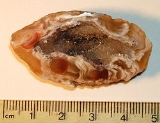
Chalcedony

Encyclopedia
Chalcedony is a cryptocrystalline
form of silica, composed of very fine intergrowths of the minerals quartz
and moganite
. These are both silica minerals, but they differ in that quartz has a trigonal crystal structure, while moganite is monoclinic. Chalcedony's standard chemical structure
(based on the chemical structure of quartz) is SiO2 (Silicon Dioxide).
Chalcedony has a waxy luster, and may be semitransparent or translucent. It can assume a wide range of colors, but those most commonly seen are white to gray, grayish-blue or a shade of brown ranging from pale to nearly black.
The name "chalcedony" comes from the Latin
calcedonius, the word used to translate the Greek word khalkedon, found only once, in the Book of Revelation
; according to the OED a connection with the town of Chalcedon
in Asia Minor
is "very doubtful". There is no reason to assume that the precious stone referred to by this name in the Bible is the same as what is now understood by the name.
s are in fact forms of chalcedony. The more notable varieties of chalcedony are as follows:
 Agate
Agate
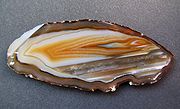
is a variety of chalcedony with multi-colored curved or angular banding. Fire agate shows iridescent phenomena on a brown background; iris agate shows exceptional iridescence when light (especially pinpointed light) is shone through the stone. Landscape agate is chalcedony with a number of different mineral impurities making the stone resemble landscapes.
 Aventurine
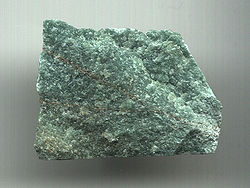
is a form of chalcedony, characterised by its translucency and the presence of platy mineral
inclusion
s that give a shimmering or glistening effect termed aventurescence
. Chrome-bearing fuchsite (a variety of muscovite
mica
) is the classic inclusion, and gives a silvery green or blue sheen. Oranges and browns are attributed to hematite
or goethite
.
.jpg) Carnelian
Carnelian
(also spelled cornelian) is a clear-to-translucent reddish-brown variety of chalcedony. Its hue may vary from a pale orange, to an intense almost-black coloration. Similar to carnelian is sard
, which is brown rather than red.
(also spelled chrysophrase) is a green variety of chalcedony, which has been colored by nickel oxide
. (The darker varieties of chrysoprase are also referred to as prase. However, the term prase is also used to describe green quartz
, and to a certain extent is a color-descriptor, rather than a rigorously defined mineral variety.)
.jpg) Heliotrope
Heliotrope
is a green variety of chalcedony, containing red inclusions of iron oxide
. These inclusions resemble drops of blood
, giving heliotrope its alternative name of bloodstone. A similar variety, in which the spots are yellow instead of red is known as plasma.
 Moss agate
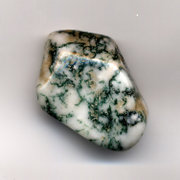
contains green filament-like inclusions, giving it the superficial appearance of moss
or blue cheese
. There is also tree agate which is similar to moss agate except it is solid white with green filaments whereas moss agate usually has a transparent background, so the "moss" appears in 3D. It is not a true form of agate, as it lacks agate's defining feature of concentric banding.
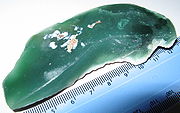 Mtorolite is a green variety of chalcedony, which has been colored by chromium
. Also known as chrome chalcedony
, It is principally found in Zimbabwe
.
is a variant of agate with black and white banding. Similarly, agate with brown, orange, red and white banding is known as sardonyx.
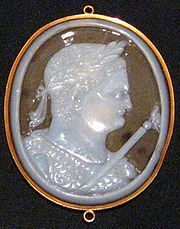 As early as the Bronze Age
chalcedony was in use in the Mediterranean region; for example, on Minoan
Crete
at the Palace of Knossos
, chalcedony seal
s have been recovered dating to circa 1800 BC. People living along the Central Asia
n trade routes used various forms of chalcedony, including carnelian
, to carve intaglios, ring bezels (the upper faceted portion of a gem projecting from the ring setting), and beads that show strong Greco-Roman influence.
Fine examples of first century objects made from chalcedony, possibly Kushan, were found in recent years at Tillya-tepe in north-western Afghanistan
. Hot wax would not stick to it so it was often used to make seal
impressions.
The term chalcedony is derived from the name of the ancient Greek town Chalkedon in Asia Minor
, in modern English usually spelled Chalcedon
, today the Kadıköy
district of Istanbul
.
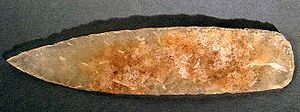 At least three varieties of chalcedony were used in the Jewish High Priest's Breastplate. (Moses' brother Aaron wore the Breastplate, with inscribed gems representing the twelve tribes of Israel). The Breastplate included jasper, chrysoprase and sardonyx, and there is some debate as to whether other agates were also used.
In the 19th century Idar-Oberstein
became the world's largest chalcedony processing center, in particular agates. Most of these agates were sourced in Latin America, in particular Brazil. Originally the agate carving industry around Idar and Oberstein was driven by local deposits that were mined in the 15th century. Several factors contributed to the re-emergence of Idar-Oberstein as agate center of the world: ships brought agate nodules back as ballast, thus providing extremely cheap transport. Also, cheap labor and a superior knowledge of chemistry allowing them to dye the agates in any color with processes that were kept secret helped.
Each mill in Idar Oberstein had four or five grindstones. These were of red sandstone, obtained from Zweibrücken; and two men ordinarily worked together at the same stone.
. More recently however, it has been shown to also contain a monoclinic polymorph of quartz
, known as moganite
. The fraction, by mass, of moganite within a typical chalcedony sample may vary from less than 5% to over 20%. The existence of moganite was once regarded as dubious, but it is now officially recognised by the International Mineralogical Association
.
Cryptocrystalline
Cryptocrystalline is a rock texture made up of such minute crystals that its crystalline nature is only vaguely revealed even microscopically in thin section by transmitted polarized light. Among the sedimentary rocks, chert and flint are cryptocrystalline. Carbonado, a form of diamond, is also...
form of silica, composed of very fine intergrowths of the minerals quartz
Quartz
Quartz is the second-most-abundant mineral in the Earth's continental crust, after feldspar. It is made up of a continuous framework of SiO4 silicon–oxygen tetrahedra, with each oxygen being shared between two tetrahedra, giving an overall formula SiO2. There are many different varieties of quartz,...
and moganite
Moganite
Moganite is a silicate mineral with the chemical formula SiO2 that was discovered in 1984. It crystallises in the monoclinic crystal system...
. These are both silica minerals, but they differ in that quartz has a trigonal crystal structure, while moganite is monoclinic. Chalcedony's standard chemical structure
Chemical structure
A chemical structure includes molecular geometry, electronic structure and crystal structure of molecules. Molecular geometry refers to the spatial arrangement of atoms in a molecule and the chemical bonds that hold the atoms together. Molecular geometry can range from the very simple, such as...
(based on the chemical structure of quartz) is SiO2 (Silicon Dioxide).
Chalcedony has a waxy luster, and may be semitransparent or translucent. It can assume a wide range of colors, but those most commonly seen are white to gray, grayish-blue or a shade of brown ranging from pale to nearly black.
The name "chalcedony" comes from the Latin
Latin
Latin is an Italic language originally spoken in Latium and Ancient Rome. It, along with most European languages, is a descendant of the ancient Proto-Indo-European language. Although it is considered a dead language, a number of scholars and members of the Christian clergy speak it fluently, and...
calcedonius, the word used to translate the Greek word khalkedon, found only once, in the Book of Revelation
Book of Revelation
The Book of Revelation is the final book of the New Testament. The title came into usage from the first word of the book in Koine Greek: apokalupsis, meaning "unveiling" or "revelation"...
; according to the OED a connection with the town of Chalcedon
Chalcedon
Chalcedon , sometimes transliterated as Chalkedon) was an ancient maritime town of Bithynia, in Asia Minor, almost directly opposite Byzantium, south of Scutari . It is now a district of the city of Istanbul named Kadıköy...
in Asia Minor
Asia Minor
Asia Minor is a geographical location at the westernmost protrusion of Asia, also called Anatolia, and corresponds to the western two thirds of the Asian part of Turkey...
is "very doubtful". There is no reason to assume that the precious stone referred to by this name in the Bible is the same as what is now understood by the name.
Varieties
Chalcedony occurs in a wide range of varieties. Many semi-precious gemstoneGemstone
A gemstone or gem is a piece of mineral, which, in cut and polished form, is used to make jewelry or other adornments...
s are in fact forms of chalcedony. The more notable varieties of chalcedony are as follows:
Agate
Agate
Agate is a microcrystalline variety of silica, chiefly chalcedony, characterised by its fineness of grain and brightness of color. Although agates may be found in various kinds of rock, they are classically associated with volcanic rocks and can be common in certain metamorphic rocks.-Etymology...
is a variety of chalcedony with multi-colored curved or angular banding. Fire agate shows iridescent phenomena on a brown background; iris agate shows exceptional iridescence when light (especially pinpointed light) is shone through the stone. Landscape agate is chalcedony with a number of different mineral impurities making the stone resemble landscapes.
Aventurine
Aventurine
Aventurine is a form of quartz, characterised by its translucency and the presence of platy mineral inclusions that give a shimmering or glistening effect termed aventurescence....
is a form of chalcedony, characterised by its translucency and the presence of platy mineral
Mineral
A mineral is a naturally occurring solid chemical substance formed through biogeochemical processes, having characteristic chemical composition, highly ordered atomic structure, and specific physical properties. By comparison, a rock is an aggregate of minerals and/or mineraloids and does not...
inclusion
Inclusion (mineral)
In mineralogy, an inclusion is any material that is trapped inside a mineral during its formation.In gemology, an inclusion is a characteristic enclosed within a gemstone, or reaching its surface from the interior....
s that give a shimmering or glistening effect termed aventurescence
Aventurescence
In gemology, aventurescence is an optical reflectance effect seen in certain gems. The effect amounts to a metallic glitter, arising from minute, preferentially oriented mineral platelets within the material. These platelets are so numerous that they also influence the material's body colour...
. Chrome-bearing fuchsite (a variety of muscovite
Muscovite
Muscovite is a phyllosilicate mineral of aluminium and potassium with formula KAl22, or 236. It has a highly-perfect basal cleavage yielding remarkably-thin laminæ which are often highly elastic...
mica
Mica
The mica group of sheet silicate minerals includes several closely related materials having highly perfect basal cleavage. All are monoclinic, with a tendency towards pseudohexagonal crystals, and are similar in chemical composition...
) is the classic inclusion, and gives a silvery green or blue sheen. Oranges and browns are attributed to hematite
Hematite
Hematite, also spelled as haematite, is the mineral form of iron oxide , one of several iron oxides. Hematite crystallizes in the rhombohedral system, and it has the same crystal structure as ilmenite and corundum...
or goethite
Goethite
Goethite , named after the German polymath Johann Wolfgang von Goethe, is an iron bearing oxide mineral found in soil and other low-temperature environments. Goethite has been well known since prehistoric times for its use as a pigment. Evidence has been found of its use in paint pigment samples...
.
Carnelian
Carnelian
Carnelian is a brownish-red mineral which is commonly used as a semi-precious gemstone. Similar to carnelian is sard, which is generally harder and darker...
(also spelled cornelian) is a clear-to-translucent reddish-brown variety of chalcedony. Its hue may vary from a pale orange, to an intense almost-black coloration. Similar to carnelian is sard
Carnelian
Carnelian is a brownish-red mineral which is commonly used as a semi-precious gemstone. Similar to carnelian is sard, which is generally harder and darker...
, which is brown rather than red.
Chrysoprase
ChrysopraseChrysoprase
Chrysoprase, chrysophrase or chrysoprasus is a gemstone variety of chalcedony that contains small quantities of nickel. Its color is normally apple-green, but varies to deep green. The darker varieties of chrysoprase are also referred to as prase...
(also spelled chrysophrase) is a green variety of chalcedony, which has been colored by nickel oxide
Nickel(II) oxide
Nickel oxide is the chemical compound with the formula NiO. It is notable as being the only well characterized oxide of nickel . The mineralogical form of NiO, bunsenite, is very rare. It is classified as a basic metal oxide...
. (The darker varieties of chrysoprase are also referred to as prase. However, the term prase is also used to describe green quartz
Quartz
Quartz is the second-most-abundant mineral in the Earth's continental crust, after feldspar. It is made up of a continuous framework of SiO4 silicon–oxygen tetrahedra, with each oxygen being shared between two tetrahedra, giving an overall formula SiO2. There are many different varieties of quartz,...
, and to a certain extent is a color-descriptor, rather than a rigorously defined mineral variety.)
Heliotrope
Heliotrope (mineral)
The mineral heliotrope, also known as bloodstone, is a form of chalcedony . The "classic" bloodstone is green chalcedony with red inclusions of iron oxide or red jasper...
is a green variety of chalcedony, containing red inclusions of iron oxide
Iron oxide
Iron oxides are chemical compounds composed of iron and oxygen. All together, there are sixteen known iron oxides and oxyhydroxides.Iron oxides and oxide-hydroxides are widespread in nature, play an important role in many geological and biological processes, and are widely utilized by humans, e.g.,...
. These inclusions resemble drops of blood
Blood
Blood is a specialized bodily fluid in animals that delivers necessary substances such as nutrients and oxygen to the cells and transports metabolic waste products away from those same cells....
, giving heliotrope its alternative name of bloodstone. A similar variety, in which the spots are yellow instead of red is known as plasma.
Moss agate
Moss agate
thumb|Moss agate pebble, 1 inch long.Moss agate is a semi-precious gemstone formed from silicon dioxide. This mineral is commonly found in limestone and granite. It is a form of agate which includes minerals of a green colour embedded in the chalcedony, forming filaments and other patterns...
contains green filament-like inclusions, giving it the superficial appearance of moss
Moss
Mosses are small, soft plants that are typically 1–10 cm tall, though some species are much larger. They commonly grow close together in clumps or mats in damp or shady locations. They do not have flowers or seeds, and their simple leaves cover the thin wiry stems...
or blue cheese
Blue cheese
Blue cheese is a general classification of cow's milk, sheep's milk, or goat's milk cheeses that have had cultures of the mold Penicillium added so that the final product is spotted or veined throughout with blue, blue-gray or blue-green mold, and carries a distinct smell, either from that or...
. There is also tree agate which is similar to moss agate except it is solid white with green filaments whereas moss agate usually has a transparent background, so the "moss" appears in 3D. It is not a true form of agate, as it lacks agate's defining feature of concentric banding.
Mtorolite
Chromium
Chromium is a chemical element which has the symbol Cr and atomic number 24. It is the first element in Group 6. It is a steely-gray, lustrous, hard metal that takes a high polish and has a high melting point. It is also odorless, tasteless, and malleable...
. Also known as chrome chalcedony
Chrome chalcedony
Chrome chalcedony is an green variety of the mineral chalcedony, colored by small quantities of chromium.It is most commonly found in Zimbabwe, where it is known as Mtorolite, Mtorodite, or Matorolite.-Chemical composition:...
, It is principally found in Zimbabwe
Zimbabwe
Zimbabwe is a landlocked country located in the southern part of the African continent, between the Zambezi and Limpopo rivers. It is bordered by South Africa to the south, Botswana to the southwest, Zambia and a tip of Namibia to the northwest and Mozambique to the east. Zimbabwe has three...
.
Onyx
OnyxOnyx
Onyx is a banded variety of chalcedony. The colors of its bands range from white to almost every color . Commonly, specimens of onyx contain bands of black and/or white.-Etymology:...
is a variant of agate with black and white banding. Similarly, agate with brown, orange, red and white banding is known as sardonyx.
History
Bronze Age
The Bronze Age is a period characterized by the use of copper and its alloy bronze as the chief hard materials in the manufacture of some implements and weapons. Chronologically, it stands between the Stone Age and Iron Age...
chalcedony was in use in the Mediterranean region; for example, on Minoan
Minoan civilization
The Minoan civilization was a Bronze Age civilization that arose on the island of Crete and flourished from approximately the 27th century BC to the 15th century BC. It was rediscovered at the beginning of the 20th century through the work of the British archaeologist Arthur Evans...
Crete
Crete
Crete is the largest and most populous of the Greek islands, the fifth largest island in the Mediterranean Sea, and one of the thirteen administrative regions of Greece. It forms a significant part of the economy and cultural heritage of Greece while retaining its own local cultural traits...
at the Palace of Knossos
Knossos
Knossos , also known as Labyrinth, or Knossos Palace, is the largest Bronze Age archaeological site on Crete and probably the ceremonial and political centre of the Minoan civilization and culture. The palace appears as a maze of workrooms, living spaces, and store rooms close to a central square...
, chalcedony seal
Minoan seal-stones
Minoan seal-stones are gemstones, or near-gem-quality stones produced in the Minoan civilization. They were found in quantity at specific sites, for example the Citadel of Mycenae....
s have been recovered dating to circa 1800 BC. People living along the Central Asia
Central Asia
Central Asia is a core region of the Asian continent from the Caspian Sea in the west, China in the east, Afghanistan in the south, and Russia in the north...
n trade routes used various forms of chalcedony, including carnelian
Carnelian
Carnelian is a brownish-red mineral which is commonly used as a semi-precious gemstone. Similar to carnelian is sard, which is generally harder and darker...
, to carve intaglios, ring bezels (the upper faceted portion of a gem projecting from the ring setting), and beads that show strong Greco-Roman influence.
Fine examples of first century objects made from chalcedony, possibly Kushan, were found in recent years at Tillya-tepe in north-western Afghanistan
Afghanistan
Afghanistan , officially the Islamic Republic of Afghanistan, is a landlocked country located in the centre of Asia, forming South Asia, Central Asia and the Middle East. With a population of about 29 million, it has an area of , making it the 42nd most populous and 41st largest nation in the world...
. Hot wax would not stick to it so it was often used to make seal
Seal (device)
A seal can be a figure impressed in wax, clay, or some other medium, or embossed on paper, with the purpose of authenticating a document ; but the term can also mean the device for making such impressions, being essentially a mould with the mirror image of the design carved in sunken- relief or...
impressions.
The term chalcedony is derived from the name of the ancient Greek town Chalkedon in Asia Minor
Asia Minor
Asia Minor is a geographical location at the westernmost protrusion of Asia, also called Anatolia, and corresponds to the western two thirds of the Asian part of Turkey...
, in modern English usually spelled Chalcedon
Chalcedon
Chalcedon , sometimes transliterated as Chalkedon) was an ancient maritime town of Bithynia, in Asia Minor, almost directly opposite Byzantium, south of Scutari . It is now a district of the city of Istanbul named Kadıköy...
, today the Kadıköy
Kadiköy
Kadıköy is a large, populous, and cosmopolitan district of İstanbul, Turkey on the Asian side of the Sea of Marmara, facing the historic city centre on the European side of the Bosporus...
district of Istanbul
Istanbul
Istanbul , historically known as Byzantium and Constantinople , is the largest city of Turkey. Istanbul metropolitan province had 13.26 million people living in it as of December, 2010, which is 18% of Turkey's population and the 3rd largest metropolitan area in Europe after London and...
.
In the 19th century Idar-Oberstein
Idar-Oberstein
Idar-Oberstein is a town in the Birkenfeld district in Rhineland-Palatinate, Germany. As a Große kreisangehörige Stadt , it assumes some of the responsibilities that for smaller municipalities in the district are assumed by the district administration...
became the world's largest chalcedony processing center, in particular agates. Most of these agates were sourced in Latin America, in particular Brazil. Originally the agate carving industry around Idar and Oberstein was driven by local deposits that were mined in the 15th century. Several factors contributed to the re-emergence of Idar-Oberstein as agate center of the world: ships brought agate nodules back as ballast, thus providing extremely cheap transport. Also, cheap labor and a superior knowledge of chemistry allowing them to dye the agates in any color with processes that were kept secret helped.
Each mill in Idar Oberstein had four or five grindstones. These were of red sandstone, obtained from Zweibrücken; and two men ordinarily worked together at the same stone.
Structure
Chalcedony was once thought to be a fibrous variety of cryptocrystalline quartzQuartz
Quartz is the second-most-abundant mineral in the Earth's continental crust, after feldspar. It is made up of a continuous framework of SiO4 silicon–oxygen tetrahedra, with each oxygen being shared between two tetrahedra, giving an overall formula SiO2. There are many different varieties of quartz,...
. More recently however, it has been shown to also contain a monoclinic polymorph of quartz
Quartz
Quartz is the second-most-abundant mineral in the Earth's continental crust, after feldspar. It is made up of a continuous framework of SiO4 silicon–oxygen tetrahedra, with each oxygen being shared between two tetrahedra, giving an overall formula SiO2. There are many different varieties of quartz,...
, known as moganite
Moganite
Moganite is a silicate mineral with the chemical formula SiO2 that was discovered in 1984. It crystallises in the monoclinic crystal system...
. The fraction, by mass, of moganite within a typical chalcedony sample may vary from less than 5% to over 20%. The existence of moganite was once regarded as dubious, but it is now officially recognised by the International Mineralogical Association
International Mineralogical Association
The International Mineralogical Association is an international group of 38 national societies. The goal is to promote the science of mineralogy and to standardize the nomenclature of the 4000 plus known mineral species...
.
Solubility
Chalcedony is more soluble than quartz under low-temperature conditions, despite the two minerals being chemically identical. This is thought to be because chalcedony is extremely finely grained (cryptocrystalline), and so has a very high surface area to volume ratio. It has also been suggested that the higher solubility is due to the moganite component.Solubility of quartz and chalcedony in pure water
This table gives equilibrium concentrations of total dissolved silicon as calculated by PHREEQC using the llnl.dat database.| Temperature | Quartz Solubility (mg/L) | Chalcedony Solubility (mg/L) |
|---|---|---|
| 0.01°C | 0.68 | 1.34 |
| 25.0°C | 2.64 | 4.92 |
| 50.0°C | 6.95 | 12.35 |
| 75.0°C | 14.21 | 24.23 |
| 100.0°C | 24.59 | 40.44 |