


Black Country

Encyclopedia
The Black Country is a loosely defined area of the English
West Midlands conurbation
, to the north and west of (but not inclusive of) Birmingham
, and to the south and east of Wolverhampton
. During the industrial revolution
in the 19th century this area had become one of the most intensely industrialised in the nation. The South Staffordshire coal mines, the coal coking operations, and the iron
foundries
and steel mill
s that used the local coal to fire their furnaces, produced a level of air pollution
that had few equals anywhere in the world.
The Black Country is relatively recent as a concept and identity, the expression deriving from the 1840s. It is popularly believed that the area got its name because of pollution from these heavy industries that covered the area in black soot. There is an anecdote (of dubious authenticity) about Queen Victoria
ordering the blinds lowered on her carriage as the royal train passed through. However, historians suggest that it is more likely that the name existed even before the Industrial Revolution
; outcroppings of black coal scarred the surface of the local heath, and the presence of coal so near the surface rendered the local soil very black.
The bounds of the Black Country, however, are controversial, and the whole of Wolverhampton
is included by some and not at all by others. A common definition of the Black Country encompasses the three Metropolitan Borough
s of Dudley
, Sandwell
and Walsall
. The town of Dudley
is sometimes referred to as being the Black Country's (unofficial) capital.
An older, more precise, de facto definition uses geology and follows the outcroppings of the South Staffordshire "thick" coal seam known locally as the "thirty foot seam", as bounded by the eastern and western boundary faults and on the north by the Bentley fault which divides the South Staffordshire
coalfield from the adjoining Cannock Chase
coalfield. Near Halesowen
and Stourbridge
, the coal seams outcropped, providing a southern boundary. The outcropping coal made the soil black over large areas and gave rise to the local name. On this basis parts of Walsall, Wolverhampton and Stourbridge are not part of the Black Country but West Bromwich
is, although here the thirty foot seam is at relative depth. These delineations are still of importance locally.
A useful guide for outsiders is to regard the M5
and M6 motorway
s as the eastern boundary but this, even using the 21st century definition, is only approximately correct as Smethwick
is to the east of it and most of Walsall lies north east of the M6 motorway. The definition is simply wrong using the older geological definition.
The Black Country proper has coalesced into a single conurbation, but is unusual in that it has no single centre, having grown up from a number of historic market towns and industrial villages that have coalesced during the 20th century. It remains essentially polyfocal with many of the towns and villages remaining recognisable communities and in some cases resenting having been subsumed into a metropolitan borough whose centre is elsewhere.
The Black Country lies wholly within the West Midlands County
, but was divided between the ancient counties of Staffordshire
and Worcestershire
. The ancient parish (and pre-1966 municipal borough) of Dudley was a detached part of Worcestershire
within Staffordshire, whilst until 1845, much of the parish of Halesowen, including Oldbury
and Warley Salop (but not Cradley or Warley Wigorn) was a detached part of Shropshire
.
Since 1974, the Black Country has been administered by the four local authories of Dudley
, Wolverhampton
, Sandwell
and Walsall
, but had previously consisted of several smaller boroughs and urban districts. In 1966, Dudley took in most of Sedgley and Brierley Hill, while Coseley was split between Dudley and Wolverhampton, which in turn took in Tettenhall, Wednesfield and Bilston. West Bromwich annexed most of Tipton and Wednesbury, while parts of Tipton and Dudley were annexed into the new borough of Warley which mainly consisted of Oldbury, Smethwick and Rowley Regis. Dudley expanded further in 1974 to incorporate Halesowen and Stourbridge, while West Bromwich and Warley merged at this time to form Sandwell.
Walsall, on the other hand, took in the neighbouring towns of Darlaston and Willenhall in 1966, and expanded further in 1974 when Aldridge-Brownhills (a district generally not regarded as part of the Black Country) was incorporated into it.
The Black Country comprises parts of the towns of Bilston
, Blackheath
, Brierley Hill
, Brownhills
, Coseley
, Cradley, Cradley Heath
, Darlaston
, Dudley
, Gornal
, Great Bridge
, Halesowen
, Kingswinford
, Lye
, Netherton
, Oldbury
, Old Hill
, Toll End
, Dudley Port, Quarry Bank
, Rowley Regis
, Sedgley
, Smethwick
, Stourbridge
, Tipton
, Wall Heath
, Walsall
, Warley
, Wednesbury
, Wednesfield
, West Bromwich
, Willenhall
and Wordsley
. and Bradley
(princes end tipton)
in a seam 30 feet (9 m) thick, the thickest seam in Great Britain
, which outcropped in various places. Many people had an agricultural smallholding and supplemented their income by working as nailers or smiths, an example of a phenomenon known to economic historians as proto-industrialisation.
In 1642 at the start of the Civil War
, Charles I
failed to capture the two arsenals of Portsmouth and Hull, which although in cities loyal to Parliament were located in counties loyal to him. As he had failed to capture the arsenals, Charles did not possess any supply of swords, pikes, guns, or shot; all these the Black Country could and did provide. From Stourbridge
came shot, from Dudley
cannon. The numberless small forges which then existed on every brook in the north of Worcestershire turned out successive supplies of sword blades and pike heads. It was said that among the many causes of anger Charles had against Birmingham was that one of the best sword makers of the day, a man named Robert Porter
, who lived and made his blades in Worcestershire, but sold them in Birmingham, refused at any price to supply swords for "that man of blood
" (A Puritan nickname for King Charles), or any of his adherents. As an offset to this sword maker, the Royalists had among their adherents Colonel Dud Dudley, who had invented a means of smelting iron by the use of coke, and who claimed he could turn out "all sorts of bar iron fit for making of muskets, carbines, and iron for great bolts", both more cheaply, more speedily and more excellent than could be done in any other way. His method was employed on the King's behalf.
By the 19th century or early 20th century, many villages had their characteristic manufacture, but earlier occupations were less concentrated. Some of these concentrations are less ancient than sometimes supposed. For example, chain making in Cradley Heath seems only to have begun in about the 1820s, and the Lye
holloware
industry is even more recent.
Prior to the Industrial Revolution
, coal and limestone
were worked only on a modest scale for local consumption, but during the Industrial Revolution by the opening of canals, such as the Birmingham Canal Navigations
, Stourbridge Canal
and the Dudley Canal
(the Dudley Canal Line No 1 and the Dudley Tunnel
) opened up the mineral wealth of the area to exploitation. Advances in the use of coke
for the production in iron enabled iron production (hitherto limited by the supply of charcoal
) to expand rapidly.
By Victorian
times, the Black Country was one of the most heavily industrialised areas in Britain, and it became known for its pollution
, particularly from iron and coal industries and their many associated smaller businesses. This led to the expansion of local railways
and coal mine lines. The line running from Stourbridge to Walsall via Dudley Port and Wednesbury
closed in the 1960s, but the Birmingham to Wolverhampton line via Tipton
is still a major transport route.
The anchor
s and chain
s for the ill-fated liner RMS Titanic were manufactured in the Black Country in the area of Netherton
. Three anchors and accompanying chains were manufactured; and the set weighed in at 100 ton
s. The centre anchor alone weighed 12 tons and was pulled through Netherton on its journey to the ship by 20 shire horse
s.
The area soon gained notoriety. Charles Dickens
's novel The Old Curiosity Shop
, written in 1841, described how the area's local factory chimneys "Poured out their plague of smoke, obscured the light, and made foul the melancholy air". In 1862, Elihu Burritt
, the American Consul in Birmingham, described the region as "black by day and red by night", because of the smoke and grime generated by the intense manufacturing activity and the glow from furnaces at night. Early 20th Century representations of the region can be found in the Mercian novels of Francis Brett Young, most notably My Brother Jonathan
(1928).
It is said that J. R. R. Tolkien
based the grim region of Mordor
on the heavily industrialised Black Country area in his famed novel The Lord of the Rings
. Indeed, in the Elvish Sindarin
language, Mor-Dor means Dark (or Black) Land, and is sometimes even referred to within the novel as "The Black Country".
The 20th century saw a decline in coal mining in the Black Country, with the last colliery in the region - Baggeridge Colliery
near Sedgley
- closing on 2 March 1968, marking the end of an era after some 300 years of mass coal mining in the region, though a small number of open cast mines remained in use for a few years afterwards.
. Clean air legislation has meant that the Black Country is no longer black. The area still maintains some manufacturing, but on a much smaller scale than historically. Chainmaking is still a viable industry in the Cradley Heath area where the majority of the chain for the Ministry of Defence
and the Admiralty fleet is made in modern factories.
Much but not all of the area now suffers from high unemployment
and parts of it are amongst the most economically deprived communities in the UK. This is particularly true in parts of the boroughs of Sandwell, Walsall and Wolverhampton. According to the Government's 2007 Index of Deprivation (ID 2007), Sandwell is the third most deprived authority in the West Midlands region, after Birmingham and Stoke-on-Trent, and the 14th most deprived of the UK's 354 districts. Wolverhampton is the fourth most deprived district in the West Midlands, and the 28th most deprived nationally. Walsall is the fifth most deprived district in the West Midlands region, and the 45th most deprived in the country.
Dudley fares better, but still has pockets of deprivation. Overall Dudley is the 100th most deprived district of the UK, but the second most affluent of the seven metropolitan districts of the West Midlands, with Solihull coming top.
As with many urban areas in the UK, there is also a significant ethnic minority population in parts: in Sandwell, 22.6 per cent of the population are from ethnic minorities, and in Wolverhampton the figure is 23.5 per cent. However, in Walsall 84.6 per cent of the population is described as white, while in Dudley 92 per cent of the population is white. Resistance to mass immigration in the 1950s, 1960s and 1970s led to the slogan "Keep the Black Country white!".
The Black Country suffered its biggest economic blows in the late 1970s and early 1980s, when unemployment soared largely because of the closure of historic large factories including the Round Oak Steel Works at Brierley Hill
and the Patent Shaft steel plant at Wednesbury
. Unemployment rose drastically across the country during this period as part of prime minister Margaret Thatcher's
battle against inflation as well as the modernisation process of Britain's industrial climate, but these areas were designated as Enterprise Zones and within a few years had been redeveloped. Round Oak and the surrounding farmland was developed as the Merry Hill Shopping Centre and Waterfront commercial and leisure complex, while the Patent Shaft site was developed as an industrial estate.
The Black Country Living Museum
in Dudley recreates life in the Black Country in the early 20th century, and is a popular tourist attraction
.
Evidence of this area beginning to grow once again can be found in the fact that a new Jaguar-Land Rover factory is set to be built near Wolverhampton.
The Black Country now has its own tartan
, designed by Philip Tibbetts from Halesowen.
Thus while a single example of Black Country dialect is hard to give, as different areas of the Black Country differ with colloquialisms, examples include "babby" for baby, "alf baerked" for stupid, "argy-bargy" for fight, and "bostin" to mean "very good".
The word endings with 'en' are still noticeable in conversation as in 'gooen' for going, callen for calling. The vowel 'a' is pronounced as 'o' as in 'sond' for sand, 'hond' for hand, 'opple' for apple, 'sponner' for spanner, and 'mon' for man. Other pronunciations are 'winder' for window, 'fer' for far, and 'loff' for laugh.
The traditional Black Country dialect preserves many archaic traits of Early Modern English
and even Middle English
, and can be very confusing for outsiders. Thee, Thy and Thou are still in use, as is the case in parts of Yorkshire
and Lancashire
. "'Ow B'ist", meaning "How are you?" is a greeting contracted from "How be-est thou?", with the typical answering being "'Bay too bah", meaning "I am not too bad" contracted from "I be not too bad". "I haven't seen her" becomes "I ay sid 'er". Black Country dialect often uses "ar" where other parts of England use "yes" (this is common as far away as Yorkshire). Similarly, the local version of "you" is pronounced ˈ , rhyming with "now". The local pronunciation "goo" (elsewhere "go") or "gooin'" is similar to that elsewhere in the Midlands. It is quite common for broad Black Country speakers to say agooin where others say going.
Despite the close proximity, many inhabitants of the Black Country resist hints at any relationship to people living in Birmingham, which may be called "Brum-a-jum" (Birmingham's colloquial name is Brummagem, a corruption of its older name of Bromwicham and hence West Bromwich) or Birminam (missing the g and h out and saying it the way it's spelt). Residents of Birmingham (Brummies) meanwhile often refer to their Black Country neighbours as "Yam Yams", a reference to the use of "Yow am" (or yow'm) instead of "You are".
The dialect's perception was boosted in 2008, due to an internet video, The Black Country Alphabet, which described the whole alphabet in Black Country speak. Yet this in itself is quite misleading as a quality example of the dialect. For example, 'ow am ya?' is mainly used in the Wolverhampton area of the Black Country, which is only a small portion of the area, while 'ow bin ya?' is used by most.
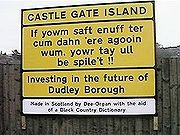 A road sign containing local dialect was placed at the A461/A459/A4037 junction in 1997 before the construction of a traffic island on the site. The sign read, in translation, "If you're soft enough (stupid) to come down here on your way home, your tea (supper) will be spoilt." This island was completed in 1998 and was the first phase of the Dudley Southern By-Pass
which was opened on 15 October 1999.
has its own local station called 107.7 The Wolf
. Both Beacon and Gold (formerly Radio WABC) have broadcast since 1976 from transmitter sites from Turner's Hill in neighbouring Rowley Regis
, with the studios being located in Wolverhampton. 102.5 The 'Bridge has broadcast since 2008 and its studios are based in Stourbridge.
The Express and Star is one of the region's two daily newspapers, publishing eleven local editions from its Wolverhampton headquarters and its five district offices (for example the Dudley edition is considerably different in content from the Wolverhampton or Stafford editions). It is the biggest selling regional paper in the UK. Incidentally the Express and Star, traditionally a Black Country paper has expanded to the point where they sell copies from vendors in Birmingham
city centre.
The Black Country Mail - a local edition of the Birmingham Mail
- is the region's other daily newspaper. Its regional base is in Walsall
town centre. Established in 1973, from a site in High Street, Cradley Heath
, the Black Country Bugle
has also contributed to the regions past history. It started as a fortnightly publication, but due to its widespread appeal, now appears on a weekly basis.
Recently the 'Black Country Alphabet and Black Country Christmas Song' by the Black Country Tee-Shirts company have helped to demonstrate the accent and dialect further across the country.
In September 2009 a group of Black Country film-makers showcased a variety of video poems about the area and its cultural identity (Known collectively as "Black Country Cinema"). The films were exhibited at Wolverhampton's Light House Media Centre
. Local film and digital media agency Screen West Midlands referred to the event as “Personal, Instinctual & Organic Video Poetry of everyday life.” The event was a way of embracing the Black Country's distinctive cultural characteristics in the medium of film.
England
England is a country that is part of the United Kingdom. It shares land borders with Scotland to the north and Wales to the west; the Irish Sea is to the north west, the Celtic Sea to the south west, with the North Sea to the east and the English Channel to the south separating it from continental...
West Midlands conurbation
West Midlands conurbation
The West Midlands conurbation is the name given to the large conurbation that includes the cities of Birmingham and Wolverhampton and the large towns of Dudley, Walsall, West Bromwich, Solihull, Stourbridge, Halesowen in the English West Midlands....
, to the north and west of (but not inclusive of) Birmingham
Birmingham
Birmingham is a city and metropolitan borough in the West Midlands of England. It is the most populous British city outside the capital London, with a population of 1,036,900 , and lies at the heart of the West Midlands conurbation, the second most populous urban area in the United Kingdom with a...
, and to the south and east of Wolverhampton
Wolverhampton
Wolverhampton is a city and metropolitan borough in the West Midlands, England. For Eurostat purposes Walsall and Wolverhampton is a NUTS 3 region and is one of five boroughs or unitary districts that comprise the "West Midlands" NUTS 2 region...
. During the industrial revolution
Industrial Revolution
The Industrial Revolution was a period from the 18th to the 19th century where major changes in agriculture, manufacturing, mining, transportation, and technology had a profound effect on the social, economic and cultural conditions of the times...
in the 19th century this area had become one of the most intensely industrialised in the nation. The South Staffordshire coal mines, the coal coking operations, and the iron
Iron
Iron is a chemical element with the symbol Fe and atomic number 26. It is a metal in the first transition series. It is the most common element forming the planet Earth as a whole, forming much of Earth's outer and inner core. It is the fourth most common element in the Earth's crust...
foundries
Foundry
A foundry is a factory that produces metal castings. Metals are cast into shapes by melting them into a liquid, pouring the metal in a mold, and removing the mold material or casting after the metal has solidified as it cools. The most common metals processed are aluminum and cast iron...
and steel mill
Steel mill
A steel mill or steelworks is an industrial plant for the manufacture of steel.Steel is an alloy of iron and carbon. It is produced in a two-stage process. First, iron ore is reduced or smelted with coke and limestone in a blast furnace, producing molten iron which is either cast into pig iron or...
s that used the local coal to fire their furnaces, produced a level of air pollution
Air pollution
Air pollution is the introduction of chemicals, particulate matter, or biological materials that cause harm or discomfort to humans or other living organisms, or cause damage to the natural environment or built environment, into the atmosphere....
that had few equals anywhere in the world.
The Black Country is relatively recent as a concept and identity, the expression deriving from the 1840s. It is popularly believed that the area got its name because of pollution from these heavy industries that covered the area in black soot. There is an anecdote (of dubious authenticity) about Queen Victoria
Victoria of the United Kingdom
Victoria was the monarch of the United Kingdom of Great Britain and Ireland from 20 June 1837 until her death. From 1 May 1876, she used the additional title of Empress of India....
ordering the blinds lowered on her carriage as the royal train passed through. However, historians suggest that it is more likely that the name existed even before the Industrial Revolution
Industrial Revolution
The Industrial Revolution was a period from the 18th to the 19th century where major changes in agriculture, manufacturing, mining, transportation, and technology had a profound effect on the social, economic and cultural conditions of the times...
; outcroppings of black coal scarred the surface of the local heath, and the presence of coal so near the surface rendered the local soil very black.
The bounds of the Black Country, however, are controversial, and the whole of Wolverhampton
Wolverhampton
Wolverhampton is a city and metropolitan borough in the West Midlands, England. For Eurostat purposes Walsall and Wolverhampton is a NUTS 3 region and is one of five boroughs or unitary districts that comprise the "West Midlands" NUTS 2 region...
is included by some and not at all by others. A common definition of the Black Country encompasses the three Metropolitan Borough
Metropolitan borough
A metropolitan borough is a type of local government district in England, and is a subdivision of a metropolitan county. Created in 1974 by the Local Government Act 1972, metropolitan boroughs are defined in English law as metropolitan districts, however all of them have been granted or regranted...
s of Dudley
Metropolitan Borough of Dudley
The Metropolitan Borough of Dudley is a metropolitan borough in the West Midlands of England. It was created in 1974, and is made up of the towns of Dudley , Stourbridge , Halesowen, Brierley Hill, Amblecote, Sedgley and Coseley...
, Sandwell
Sandwell
Sandwell is a metropolitan borough of the West Midlands with a population of around 289,100, and an area of . The borough is named after Sandwell Priory, and spans a densely populated part of both the Black Country, and the West Midlands conurbation, encompassing the urban towns of Blackheath,...
and Walsall
Metropolitan Borough of Walsall
The Metropolitan Borough of Walsall is a local government district in the Black Country part of the West Midlands, England, with the status of a metropolitan borough. It is named after its largest settlement, Walsall, but covers a larger area which also includes the towns of Aldridge, Brownhills,...
. The town of Dudley
Dudley
Dudley is a large town in the West Midlands county of England. At the 2001 census , the Dudley Urban Sub Area had a population of 194,919, making it the 26th largest settlement in England, the second largest town in the United Kingdom behind Reading, and the largest settlement in the UK without...
is sometimes referred to as being the Black Country's (unofficial) capital.
An older, more precise, de facto definition uses geology and follows the outcroppings of the South Staffordshire "thick" coal seam known locally as the "thirty foot seam", as bounded by the eastern and western boundary faults and on the north by the Bentley fault which divides the South Staffordshire
South Staffordshire
South Staffordshire is a local government district in Staffordshire, England. The district lies to the north and west of Wolverhampton and the West Midlands, bordering Shropshire to the west and Worcestershire to the south...
coalfield from the adjoining Cannock Chase
Cannock Chase
Cannock Chase is a mixed area of countryside in the county of Staffordshire, England. The area has been designated as the Cannock Chase Area of Outstanding Natural Beauty. The Chase gives its name to the Cannock Chase local government district....
coalfield. Near Halesowen
Halesowen
Halesowen is a town in the Metropolitan Borough of Dudley, in the West Midlands, England.The population, as measured by the United Kingdom Census 2001, was 55,273...
and Stourbridge
Stourbridge
Stourbridge is a town within the Metropolitan Borough of Dudley, in the West Midlands of England. Historically part of Worcestershire, Stourbridge was a centre of glass making, and today includes the suburbs of Amblecote, Lye, Norton, Oldswinford, Pedmore, Wollaston, Wollescote and Wordsley The...
, the coal seams outcropped, providing a southern boundary. The outcropping coal made the soil black over large areas and gave rise to the local name. On this basis parts of Walsall, Wolverhampton and Stourbridge are not part of the Black Country but West Bromwich
West Bromwich
West Bromwich is a town within the Metropolitan Borough of Sandwell, in the West Midlands, England. It is north west of Birmingham lying on the A41 London-to-Birkenhead road. West Bromwich is part of the Black Country...
is, although here the thirty foot seam is at relative depth. These delineations are still of importance locally.
A useful guide for outsiders is to regard the M5
M5 motorway
The M5 is a motorway in England. It runs from a junction with the M6 at West Bromwich near Birmingham to Exeter in Devon. Heading south-west, the M5 runs east of West Bromwich and west of Birmingham through Sandwell Valley...
and M6 motorway
M6 motorway
The M6 motorway runs from junction 19 of the M1 at the Catthorpe Interchange, near Rugby via Birmingham then heads north, passing Stoke-on-Trent, Manchester, Preston, Carlisle and terminating at the Gretna junction . Here, just short of the Scottish border it becomes the A74 which continues to...
s as the eastern boundary but this, even using the 21st century definition, is only approximately correct as Smethwick
Smethwick
Smethwick is a town in the Metropolitan Borough of Sandwell, in the West Midlands of England. It is situated on the edge of the city of Birmingham, within the historic boundaries of Staffordshire, Worcestershire and Warwickshire....
is to the east of it and most of Walsall lies north east of the M6 motorway. The definition is simply wrong using the older geological definition.
The Black Country proper has coalesced into a single conurbation, but is unusual in that it has no single centre, having grown up from a number of historic market towns and industrial villages that have coalesced during the 20th century. It remains essentially polyfocal with many of the towns and villages remaining recognisable communities and in some cases resenting having been subsumed into a metropolitan borough whose centre is elsewhere.
The Black Country lies wholly within the West Midlands County
West Midlands (county)
The West Midlands is a metropolitan county in western central England with a 2009 estimated population of 2,638,700. It came into existence as a metropolitan county in 1974 after the passage of the Local Government Act 1972, formed from parts of Staffordshire, Worcestershire and Warwickshire. The...
, but was divided between the ancient counties of Staffordshire
Staffordshire
Staffordshire is a landlocked county in the West Midlands region of England. For Eurostat purposes, the county is a NUTS 3 region and is one of four counties or unitary districts that comprise the "Shropshire and Staffordshire" NUTS 2 region. Part of the National Forest lies within its borders...
and Worcestershire
Worcestershire
Worcestershire is a non-metropolitan county, established in antiquity, located in the West Midlands region of England. For Eurostat purposes it is a NUTS 3 region and is one of three counties that comprise the "Herefordshire, Worcestershire and Warwickshire" NUTS 2 region...
. The ancient parish (and pre-1966 municipal borough) of Dudley was a detached part of Worcestershire
Worcestershire
Worcestershire is a non-metropolitan county, established in antiquity, located in the West Midlands region of England. For Eurostat purposes it is a NUTS 3 region and is one of three counties that comprise the "Herefordshire, Worcestershire and Warwickshire" NUTS 2 region...
within Staffordshire, whilst until 1845, much of the parish of Halesowen, including Oldbury
Oldbury, West Midlands
Oldbury is a town in the West Midlands in England. It is a part of the Black Country and the administrative centre of the borough of Sandwell.-Local government:...
and Warley Salop (but not Cradley or Warley Wigorn) was a detached part of Shropshire
Shropshire
Shropshire is a county in the West Midlands region of England. For Eurostat purposes, the county is a NUTS 3 region and is one of four counties or unitary districts that comprise the "Shropshire and Staffordshire" NUTS 2 region. It borders Wales to the west...
.
Since 1974, the Black Country has been administered by the four local authories of Dudley
Metropolitan Borough of Dudley
The Metropolitan Borough of Dudley is a metropolitan borough in the West Midlands of England. It was created in 1974, and is made up of the towns of Dudley , Stourbridge , Halesowen, Brierley Hill, Amblecote, Sedgley and Coseley...
, Wolverhampton
Wolverhampton
Wolverhampton is a city and metropolitan borough in the West Midlands, England. For Eurostat purposes Walsall and Wolverhampton is a NUTS 3 region and is one of five boroughs or unitary districts that comprise the "West Midlands" NUTS 2 region...
, Sandwell
Sandwell
Sandwell is a metropolitan borough of the West Midlands with a population of around 289,100, and an area of . The borough is named after Sandwell Priory, and spans a densely populated part of both the Black Country, and the West Midlands conurbation, encompassing the urban towns of Blackheath,...
and Walsall
Metropolitan Borough of Walsall
The Metropolitan Borough of Walsall is a local government district in the Black Country part of the West Midlands, England, with the status of a metropolitan borough. It is named after its largest settlement, Walsall, but covers a larger area which also includes the towns of Aldridge, Brownhills,...
, but had previously consisted of several smaller boroughs and urban districts. In 1966, Dudley took in most of Sedgley and Brierley Hill, while Coseley was split between Dudley and Wolverhampton, which in turn took in Tettenhall, Wednesfield and Bilston. West Bromwich annexed most of Tipton and Wednesbury, while parts of Tipton and Dudley were annexed into the new borough of Warley which mainly consisted of Oldbury, Smethwick and Rowley Regis. Dudley expanded further in 1974 to incorporate Halesowen and Stourbridge, while West Bromwich and Warley merged at this time to form Sandwell.
Walsall, on the other hand, took in the neighbouring towns of Darlaston and Willenhall in 1966, and expanded further in 1974 when Aldridge-Brownhills (a district generally not regarded as part of the Black Country) was incorporated into it.
The Black Country comprises parts of the towns of Bilston
Bilston
Bilston is a town in the English county of West Midlands, situated in the southeastern corner of the City of Wolverhampton. Three wards of Wolverhampton City Council cover the town: Bilston East and Bilston North, which almost entirely comprise parts of the historic Borough of Bilston, and...
, Blackheath
Blackheath, West Midlands
Blackheath is a town in the Metropolitan Borough of Sandwell, West Midlands, England.-Establishment:Before 1841, Bleak Heath or Blake Heath was a small group of farm houses and inns on the turnpike road from Oldbury to Halesowen, within Rowley Regis...
, Brierley Hill
Brierley Hill
Brierley Hill is a town and electoral ward of the Metropolitan Borough of Dudley, West Midlands, England. It is one of the larger Black Country towns with a population of 9,631 and is heavily industrialised, best known for glass and steel manufacturing, although the industry has declined...
, Brownhills
Brownhills
Brownhills is a town in the West Midlands, England. Located on the edge of Cannock Chase near the large artificial lake Chasewater, it is north-east of Walsall and a similar distance south-west of Lichfield. It is part of the Metropolitan Borough of Walsall and the Aldridge-Brownhills...
, Coseley
Coseley
Coseley is a town located mostly within the Metropolitan Borough of Dudley in the English West Midlands. Part of the Black Country, it lies south east of Wolverhampton and north of Dudley....
, Cradley, Cradley Heath
Cradley Heath
Cradley Heath is a town in the Black Country, located in Sandwell metropolitan borough, England. The name is usually pronounced "Craid-ley", not "Crad-ley", but in the Black Country accent, it may even sound like "Craig-ley Aith"...
, Darlaston
Darlaston
Darlaston is a town in the Metropolitan Borough of Walsall in the West Midlands of England.-History:Archaeological evidence of the history of Darlaston has been destroyed by The de Darlaston family owned Darlaston and lived in the manor between the 12th century and 15th century. When the de...
, Dudley
Dudley
Dudley is a large town in the West Midlands county of England. At the 2001 census , the Dudley Urban Sub Area had a population of 194,919, making it the 26th largest settlement in England, the second largest town in the United Kingdom behind Reading, and the largest settlement in the UK without...
, Gornal
Gornal, West Midlands
Gornal is an area of the Metropolitan Borough of Dudley, in the West Midlands of England. Gornal encompasses three areas: Upper Gornal, Lower Gornal and Gornalwood; and is located to the northwest of Dudley...
, Great Bridge
Great Bridge, West Midlands
Great Bridge is a village in the Metropolitan Borough of Sandwell. It is situated in Tipton, near the border of West Bromwich, and it is within the metropolitan county of the West Midlands.-Origins and history:...
, Halesowen
Halesowen
Halesowen is a town in the Metropolitan Borough of Dudley, in the West Midlands, England.The population, as measured by the United Kingdom Census 2001, was 55,273...
, Kingswinford
Kingswinford
Kingswinford is a suburban area in the West Midlands.Historically within Staffordshire, the area is mentioned in the Domesday Book its name relates to a ford for the King's swine - Latin Swinford Regis. The current significance is probably in tourism, education and housing...
, Lye
Lye, West Midlands
Lye is a suburban area of the Black Country in England, between Halesowen and Stourbridge in Dudley Metropolitan Borough, West Midlands. It was formerly a village in the parish of Oldswinford, Worcestershire...
, Netherton
Netherton, West Midlands
Netherton is a town in the West Midlands within the Metropolitan Borough of Dudley. It lies around south of the town of Dudley and north of Cradley Heath...
, Oldbury
Oldbury, West Midlands
Oldbury is a town in the West Midlands in England. It is a part of the Black Country and the administrative centre of the borough of Sandwell.-Local government:...
, Old Hill
Old Hill
Old Hill is a locality in the metropolitan borough of Sandwell in West Midlands, England. It is a district of Cradley Heath.-General description:...
, Toll End
Toll End
-Toll End:Toll End is a residential area of Tipton in the West Midlands of England. It was developed during the 19th century during the Industrial Revolution which saw previously rural Tipton developed as one of the most prolific manufacturing and mining towns in the country...
, Dudley Port, Quarry Bank
Quarry Bank
Quarry Bank is a village in the Metropolitan Borough of Dudley, West Midlands, England, which exists within the Brierley Hill DY5 postal district.Locally, the name is often pronounced, "Quarry Bonk"...
, Rowley Regis
Rowley Regis
Rowley Regis is a town in the Sandwell metropolitan borough of the West Midlands county and a part of the Black Country in the United Kingdom. Being part of the Black Country, locals speak with the traditional dialect, though in a form regarded by many as the quickest and the hardest to...
, Sedgley
Sedgley
Sedgley is an urban village within the West Midlands county of England. Historically a part of Staffordshire, Sedgley was formerly an ancient manor composed of several smaller villages, including Gornal, Gospel End, Woodsetton, Ettingshall, Coseley and Brierley...
, Smethwick
Smethwick
Smethwick is a town in the Metropolitan Borough of Sandwell, in the West Midlands of England. It is situated on the edge of the city of Birmingham, within the historic boundaries of Staffordshire, Worcestershire and Warwickshire....
, Stourbridge
Stourbridge
Stourbridge is a town within the Metropolitan Borough of Dudley, in the West Midlands of England. Historically part of Worcestershire, Stourbridge was a centre of glass making, and today includes the suburbs of Amblecote, Lye, Norton, Oldswinford, Pedmore, Wollaston, Wollescote and Wordsley The...
, Tipton
Tipton
Tipton is a town in the Sandwell borough of the West Midlands, England, with a population of around 47,000. Tipton is located about halfway between Birmingham and Wolverhampton. It is a part of the West Midlands conurbation and is a part of the Black Country....
, Wall Heath
Wall Heath
-Geography:Wall Heath is a small village on the western fringe of the Black Country and the West Midlands conurbation in the United Kingdom. It is located on the A449 road, approximately seven miles south of Wolverhampton and 9 miles North of Kidderminster....
, Walsall
Walsall
Walsall is a large industrial town in the West Midlands of England. It is located northwest of Birmingham and east of Wolverhampton. Historically a part of Staffordshire, Walsall is a component area of the West Midlands conurbation and part of the Black Country.Walsall is the administrative...
, Warley
Warley, West Midlands
Warley is a place in the metropolitan borough of Sandwell in the West Midlands of the United Kingdom.A civil parish of Warley was created in 1884 by the merger of the Warley Salop parish with parts of the parishes of Warley Wigorn, Ridgacre and Oldbury.In 1908 the parish was abolished, becoming...
, Wednesbury
Wednesbury
Wednesbury is a market town in England's Black Country, part of the Sandwell metropolitan borough in West Midlands, near the source of the River Tame. Similarly to the word Wednesday, it is pronounced .-Pre-Medieval and Medieval times:...
, Wednesfield
Wednesfield
Wednesfield lies at , and is located to the northeast of Wolverhampton city centre on the northern fringe of the West Midlands conurbation...
, West Bromwich
West Bromwich
West Bromwich is a town within the Metropolitan Borough of Sandwell, in the West Midlands, England. It is north west of Birmingham lying on the A41 London-to-Birkenhead road. West Bromwich is part of the Black Country...
, Willenhall
Willenhall
Willenhall is a town in the Black Country area of the West Midlands of England, with a population of approximately 40,000. It is situated between Wolverhampton and Walsall, historically in the county of Staffordshire...
and Wordsley
Wordsley
Wordsley with Buckpool is a village south of Kingswinford although is the most northern suburb of Stourbridge in the West Midlands, England. Wordsley still retains its rural character because it abuts open countryside...
. and Bradley
(princes end tipton)
History
Industrialisation in the Black Country area goes back a long way. It was already an area where metal working was important as far back as the 16th century, due to the presence of iron ore and of coalCoal
Coal is a combustible black or brownish-black sedimentary rock usually occurring in rock strata in layers or veins called coal beds or coal seams. The harder forms, such as anthracite coal, can be regarded as metamorphic rock because of later exposure to elevated temperature and pressure...
in a seam 30 feet (9 m) thick, the thickest seam in Great Britain
Great Britain
Great Britain or Britain is an island situated to the northwest of Continental Europe. It is the ninth largest island in the world, and the largest European island, as well as the largest of the British Isles...
, which outcropped in various places. Many people had an agricultural smallholding and supplemented their income by working as nailers or smiths, an example of a phenomenon known to economic historians as proto-industrialisation.
In 1642 at the start of the Civil War
English Civil War
The English Civil War was a series of armed conflicts and political machinations between Parliamentarians and Royalists...
, Charles I
Charles I of England
Charles I was King of England, King of Scotland, and King of Ireland from 27 March 1625 until his execution in 1649. Charles engaged in a struggle for power with the Parliament of England, attempting to obtain royal revenue whilst Parliament sought to curb his Royal prerogative which Charles...
failed to capture the two arsenals of Portsmouth and Hull, which although in cities loyal to Parliament were located in counties loyal to him. As he had failed to capture the arsenals, Charles did not possess any supply of swords, pikes, guns, or shot; all these the Black Country could and did provide. From Stourbridge
Stourbridge
Stourbridge is a town within the Metropolitan Borough of Dudley, in the West Midlands of England. Historically part of Worcestershire, Stourbridge was a centre of glass making, and today includes the suburbs of Amblecote, Lye, Norton, Oldswinford, Pedmore, Wollaston, Wollescote and Wordsley The...
came shot, from Dudley
Dudley
Dudley is a large town in the West Midlands county of England. At the 2001 census , the Dudley Urban Sub Area had a population of 194,919, making it the 26th largest settlement in England, the second largest town in the United Kingdom behind Reading, and the largest settlement in the UK without...
cannon. The numberless small forges which then existed on every brook in the north of Worcestershire turned out successive supplies of sword blades and pike heads. It was said that among the many causes of anger Charles had against Birmingham was that one of the best sword makers of the day, a man named Robert Porter
Robert Porter
Robert Porter may refer to:* Sir Robert Porter , in Northern Ireland* Robert Harold Porter , member of Canadian Parliament from Alberta* Sir Robert Ker Porter , archaeologist and diplomat...
, who lived and made his blades in Worcestershire, but sold them in Birmingham, refused at any price to supply swords for "that man of blood
Charles Stuart, that man of blood
Charles Stuart, that man of blood was a phrase used by Independents, during the English Civil War to describe King Charles IThe phrase is derived from the Bible:and other verses were used to justify regicide:-Windsor Castle prayer meeting:...
" (A Puritan nickname for King Charles), or any of his adherents. As an offset to this sword maker, the Royalists had among their adherents Colonel Dud Dudley, who had invented a means of smelting iron by the use of coke, and who claimed he could turn out "all sorts of bar iron fit for making of muskets, carbines, and iron for great bolts", both more cheaply, more speedily and more excellent than could be done in any other way. His method was employed on the King's behalf.
By the 19th century or early 20th century, many villages had their characteristic manufacture, but earlier occupations were less concentrated. Some of these concentrations are less ancient than sometimes supposed. For example, chain making in Cradley Heath seems only to have begun in about the 1820s, and the Lye
Lye, West Midlands
Lye is a suburban area of the Black Country in England, between Halesowen and Stourbridge in Dudley Metropolitan Borough, West Midlands. It was formerly a village in the parish of Oldswinford, Worcestershire...
holloware
Holloware
Holloware is a term that refers to table service items such as sugar bowls, creamers, coffee pots, teapots, soup tureens, hot food covers, water pitchers, platters, butter pat plates and other metal items that went with the china on a table. It does not include flatware. Holloware was constructed...
industry is even more recent.
Prior to the Industrial Revolution
Industrial Revolution
The Industrial Revolution was a period from the 18th to the 19th century where major changes in agriculture, manufacturing, mining, transportation, and technology had a profound effect on the social, economic and cultural conditions of the times...
, coal and limestone
Limestone
Limestone is a sedimentary rock composed largely of the minerals calcite and aragonite, which are different crystal forms of calcium carbonate . Many limestones are composed from skeletal fragments of marine organisms such as coral or foraminifera....
were worked only on a modest scale for local consumption, but during the Industrial Revolution by the opening of canals, such as the Birmingham Canal Navigations
Birmingham Canal Navigations
Birmingham Canal Navigations is a network of navigable canals connecting Birmingham, Wolverhampton, and the eastern part of the Black Country...
, Stourbridge Canal
Stourbridge Canal
The Stourbridge Canal is a canal in the West Midlands of England. It links the Staffordshire and Worcestershire Canal with the Dudley Canal, and hence, via the Birmingham Canal Navigations, to Birmingham and the Black Country.-History:The Stourbridge and Dudley canals were originally proposed as a...
and the Dudley Canal
Dudley Canal
The Dudley Canal is a canal passing though Dudley in the West Midlands of England. The canal is part of the English and Welsh connected network of navigable inland waterways, and in particular forms part of the popular Stourport Ring narrowboat cruising route....
(the Dudley Canal Line No 1 and the Dudley Tunnel
Dudley Tunnel
Dudley Tunnel is a canal tunnel on the Dudley Canal Line No 1, England. At about long, it is now the second longest canal tunnel on the UK canal network today....
) opened up the mineral wealth of the area to exploitation. Advances in the use of coke
Coke (fuel)
Coke is the solid carbonaceous material derived from destructive distillation of low-ash, low-sulfur bituminous coal. Cokes from coal are grey, hard, and porous. While coke can be formed naturally, the commonly used form is man-made.- History :...
for the production in iron enabled iron production (hitherto limited by the supply of charcoal
Charcoal
Charcoal is the dark grey residue consisting of carbon, and any remaining ash, obtained by removing water and other volatile constituents from animal and vegetation substances. Charcoal is usually produced by slow pyrolysis, the heating of wood or other substances in the absence of oxygen...
) to expand rapidly.
By Victorian
Victorian era
The Victorian era of British history was the period of Queen Victoria's reign from 20 June 1837 until her death on 22 January 1901. It was a long period of peace, prosperity, refined sensibilities and national self-confidence...
times, the Black Country was one of the most heavily industrialised areas in Britain, and it became known for its pollution
Pollution
Pollution is the introduction of contaminants into a natural environment that causes instability, disorder, harm or discomfort to the ecosystem i.e. physical systems or living organisms. Pollution can take the form of chemical substances or energy, such as noise, heat or light...
, particularly from iron and coal industries and their many associated smaller businesses. This led to the expansion of local railways
Rail transport
Rail transport is a means of conveyance of passengers and goods by way of wheeled vehicles running on rail tracks. In contrast to road transport, where vehicles merely run on a prepared surface, rail vehicles are also directionally guided by the tracks they run on...
and coal mine lines. The line running from Stourbridge to Walsall via Dudley Port and Wednesbury
Wednesbury
Wednesbury is a market town in England's Black Country, part of the Sandwell metropolitan borough in West Midlands, near the source of the River Tame. Similarly to the word Wednesday, it is pronounced .-Pre-Medieval and Medieval times:...
closed in the 1960s, but the Birmingham to Wolverhampton line via Tipton
Tipton
Tipton is a town in the Sandwell borough of the West Midlands, England, with a population of around 47,000. Tipton is located about halfway between Birmingham and Wolverhampton. It is a part of the West Midlands conurbation and is a part of the Black Country....
is still a major transport route.
The anchor
Anchor
An anchor is a device, normally made of metal, that is used to connect a vessel to the bed of a body of water to prevent the vessel from drifting due to wind or current. The word derives from Latin ancora, which itself comes from the Greek ἄγκυρα .Anchors can either be temporary or permanent...
s and chain
Chain
A chain is a sequence of connected links.Chain may also refer to:Chain may refer to:* Necklace - a jewelry which is worn around the neck* Mail , a type of armor made of interlocking chain links...
s for the ill-fated liner RMS Titanic were manufactured in the Black Country in the area of Netherton
Netherton, West Midlands
Netherton is a town in the West Midlands within the Metropolitan Borough of Dudley. It lies around south of the town of Dudley and north of Cradley Heath...
. Three anchors and accompanying chains were manufactured; and the set weighed in at 100 ton
Ton
The ton is a unit of measure. It has a long history and has acquired a number of meanings and uses over the years. It is used principally as a unit of weight, and as a unit of volume. It can also be used as a measure of energy, for truck classification, or as a colloquial term.It is derived from...
s. The centre anchor alone weighed 12 tons and was pulled through Netherton on its journey to the ship by 20 shire horse
Shire horse
The Shire horse is a breed of draught horse or draft horse . The breed comes in many colours, including black, bay and grey. They are a tall breed, with mares standing and over and stallions standing and over. The breed has an enormous capacity for weight pulling, and Shires have held the world...
s.
The area soon gained notoriety. Charles Dickens
Charles Dickens
Charles John Huffam Dickens was an English novelist, generally considered the greatest of the Victorian period. Dickens enjoyed a wider popularity and fame than had any previous author during his lifetime, and he remains popular, having been responsible for some of English literature's most iconic...
's novel The Old Curiosity Shop
The Old Curiosity Shop
The Old Curiosity Shop is a novel by Charles Dickens. The plot follows the life of Nell Trent and her grandfather, both residents of The Old Curiosity Shop in London....
, written in 1841, described how the area's local factory chimneys "Poured out their plague of smoke, obscured the light, and made foul the melancholy air". In 1862, Elihu Burritt
Elihu Burritt
Elihu Burritt was an American philanthropist and social activist.-Biography:He was born December 8, 1810, in the town of New Britain, Connecticut....
, the American Consul in Birmingham, described the region as "black by day and red by night", because of the smoke and grime generated by the intense manufacturing activity and the glow from furnaces at night. Early 20th Century representations of the region can be found in the Mercian novels of Francis Brett Young, most notably My Brother Jonathan
My Brother Jonathan
My Brother Jonathan is a 1948 British drama film directed by Harold French. It starred Michael Denison, Dulcie Gray, and James Robertson Justice....
(1928).
It is said that J. R. R. Tolkien
J. R. R. Tolkien
John Ronald Reuel Tolkien, CBE was an English writer, poet, philologist, and university professor, best known as the author of the classic high fantasy works The Hobbit, The Lord of the Rings, and The Silmarillion.Tolkien was Rawlinson and Bosworth Professor of Anglo-Saxon at Pembroke College,...
based the grim region of Mordor
Mordor
In J. R. R. Tolkien's fictional universe of Middle-earth, Mordor or Morhdorh was the dwelling place of Sauron, in the southeast of northwestern Middle-earth to the East of Anduin, the great river. Orodruin, a volcano in Mordor, was the destination of the Fellowship of the Ring in the quest to...
on the heavily industrialised Black Country area in his famed novel The Lord of the Rings
The Lord of the Rings
The Lord of the Rings is a high fantasy epic written by English philologist and University of Oxford professor J. R. R. Tolkien. The story began as a sequel to Tolkien's earlier, less complex children's fantasy novel The Hobbit , but eventually developed into a much larger work. It was written in...
. Indeed, in the Elvish Sindarin
Sindarin
Sindarin is a fictional language devised by J. R. R. Tolkien, and used in his secondary world, often called Middle-earth.Sindarin is one of the many languages spoken by the immortal Elves, called the Eledhrim or Edhellim in Sindarin....
language, Mor-Dor means Dark (or Black) Land, and is sometimes even referred to within the novel as "The Black Country".
The 20th century saw a decline in coal mining in the Black Country, with the last colliery in the region - Baggeridge Colliery
Baggeridge Colliery
Baggeridge Colliery was a colliery located in Sedgley, Staffordshire , England.- Black Country Pit :It was opened in 1899, adjacent to Gospel End Village more than a mile west of Sedgley village centre, and on its closure on 2 March 1968 was the last remaining pit in the Black Country, marking the...
near Sedgley
Sedgley
Sedgley is an urban village within the West Midlands county of England. Historically a part of Staffordshire, Sedgley was formerly an ancient manor composed of several smaller villages, including Gornal, Gospel End, Woodsetton, Ettingshall, Coseley and Brierley...
- closing on 2 March 1968, marking the end of an era after some 300 years of mass coal mining in the region, though a small number of open cast mines remained in use for a few years afterwards.
The Black Country today
The heavy industry which once dominated the Black Country has now largely gone. The 20th century saw a decline in coalmining and the industry finally came to an end in 1968 with the closure of Baggeridge Colliery near SedgleySedgley
Sedgley is an urban village within the West Midlands county of England. Historically a part of Staffordshire, Sedgley was formerly an ancient manor composed of several smaller villages, including Gornal, Gospel End, Woodsetton, Ettingshall, Coseley and Brierley...
. Clean air legislation has meant that the Black Country is no longer black. The area still maintains some manufacturing, but on a much smaller scale than historically. Chainmaking is still a viable industry in the Cradley Heath area where the majority of the chain for the Ministry of Defence
Ministry of Defence (United Kingdom)
The Ministry of Defence is the United Kingdom government department responsible for implementation of government defence policy and is the headquarters of the British Armed Forces....
and the Admiralty fleet is made in modern factories.
Much but not all of the area now suffers from high unemployment
Unemployment
Unemployment , as defined by the International Labour Organization, occurs when people are without jobs and they have actively sought work within the past four weeks...
and parts of it are amongst the most economically deprived communities in the UK. This is particularly true in parts of the boroughs of Sandwell, Walsall and Wolverhampton. According to the Government's 2007 Index of Deprivation (ID 2007), Sandwell is the third most deprived authority in the West Midlands region, after Birmingham and Stoke-on-Trent, and the 14th most deprived of the UK's 354 districts. Wolverhampton is the fourth most deprived district in the West Midlands, and the 28th most deprived nationally. Walsall is the fifth most deprived district in the West Midlands region, and the 45th most deprived in the country.
Dudley fares better, but still has pockets of deprivation. Overall Dudley is the 100th most deprived district of the UK, but the second most affluent of the seven metropolitan districts of the West Midlands, with Solihull coming top.
As with many urban areas in the UK, there is also a significant ethnic minority population in parts: in Sandwell, 22.6 per cent of the population are from ethnic minorities, and in Wolverhampton the figure is 23.5 per cent. However, in Walsall 84.6 per cent of the population is described as white, while in Dudley 92 per cent of the population is white. Resistance to mass immigration in the 1950s, 1960s and 1970s led to the slogan "Keep the Black Country white!".
The Black Country suffered its biggest economic blows in the late 1970s and early 1980s, when unemployment soared largely because of the closure of historic large factories including the Round Oak Steel Works at Brierley Hill
Brierley Hill
Brierley Hill is a town and electoral ward of the Metropolitan Borough of Dudley, West Midlands, England. It is one of the larger Black Country towns with a population of 9,631 and is heavily industrialised, best known for glass and steel manufacturing, although the industry has declined...
and the Patent Shaft steel plant at Wednesbury
Wednesbury
Wednesbury is a market town in England's Black Country, part of the Sandwell metropolitan borough in West Midlands, near the source of the River Tame. Similarly to the word Wednesday, it is pronounced .-Pre-Medieval and Medieval times:...
. Unemployment rose drastically across the country during this period as part of prime minister Margaret Thatcher's
Margaret Thatcher
Margaret Hilda Thatcher, Baroness Thatcher, was Prime Minister of the United Kingdom from 1979 to 1990...
battle against inflation as well as the modernisation process of Britain's industrial climate, but these areas were designated as Enterprise Zones and within a few years had been redeveloped. Round Oak and the surrounding farmland was developed as the Merry Hill Shopping Centre and Waterfront commercial and leisure complex, while the Patent Shaft site was developed as an industrial estate.
The Black Country Living Museum
Black Country Living Museum
The Black Country Living Museum is an open-air museum of rebuilt historic buildings, located in Dudley in the West Midlands of England. The museum occupies a urban heritage park in the shadow of Dudley Castle in the centre of the Black Country conurbation...
in Dudley recreates life in the Black Country in the early 20th century, and is a popular tourist attraction
Tourist attraction
A tourist attraction is a place of interest where tourists visit, typically for its inherent or exhibited cultural value, historical significance, natural or built beauty, or amusement opportunities....
.
Evidence of this area beginning to grow once again can be found in the fact that a new Jaguar-Land Rover factory is set to be built near Wolverhampton.
The Black Country now has its own tartan
Tartan
Tartan is a pattern consisting of criss-crossed horizontal and vertical bands in multiple colours. Tartans originated in woven wool, but now they are made in many other materials. Tartan is particularly associated with Scotland. Scottish kilts almost always have tartan patterns...
, designed by Philip Tibbetts from Halesowen.
Black Country dialect
In common with most parts of the UK, the extent to which the Black country accent and dialect are used varies from person to person and across the Black Country itself, with some elements of the dialect being stronger in some towns than others. Local dialect was, and probably still is to a lesser degree quite distinctive between the different towns and villages of the Black Country. Although most outsiders to the Black Country cannot tell this difference, Black Country folk can quite fiercely defend the difference between the accents.Thus while a single example of Black Country dialect is hard to give, as different areas of the Black Country differ with colloquialisms, examples include "babby" for baby, "alf baerked" for stupid, "argy-bargy" for fight, and "bostin" to mean "very good".
The word endings with 'en' are still noticeable in conversation as in 'gooen' for going, callen for calling. The vowel 'a' is pronounced as 'o' as in 'sond' for sand, 'hond' for hand, 'opple' for apple, 'sponner' for spanner, and 'mon' for man. Other pronunciations are 'winder' for window, 'fer' for far, and 'loff' for laugh.
The traditional Black Country dialect preserves many archaic traits of Early Modern English
Early Modern English
Early Modern English is the stage of the English language used from about the end of the Middle English period to 1650. Thus, the first edition of the King James Bible and the works of William Shakespeare both belong to the late phase of Early Modern English...
and even Middle English
Middle English
Middle English is the stage in the history of the English language during the High and Late Middle Ages, or roughly during the four centuries between the late 11th and the late 15th century....
, and can be very confusing for outsiders. Thee, Thy and Thou are still in use, as is the case in parts of Yorkshire
Yorkshire
Yorkshire is a historic county of northern England and the largest in the United Kingdom. Because of its great size in comparison to other English counties, functions have been increasingly undertaken over time by its subdivisions, which have also been subject to periodic reform...
and Lancashire
Lancashire
Lancashire is a non-metropolitan county of historic origin in the North West of England. It takes its name from the city of Lancaster, and is sometimes known as the County of Lancaster. Although Lancaster is still considered to be the county town, Lancashire County Council is based in Preston...
. "'Ow B'ist", meaning "How are you?" is a greeting contracted from "How be-est thou?", with the typical answering being "'Bay too bah", meaning "I am not too bad" contracted from "I be not too bad". "I haven't seen her" becomes "I ay sid 'er". Black Country dialect often uses "ar" where other parts of England use "yes" (this is common as far away as Yorkshire). Similarly, the local version of "you" is pronounced ˈ , rhyming with "now". The local pronunciation "goo" (elsewhere "go") or "gooin'" is similar to that elsewhere in the Midlands. It is quite common for broad Black Country speakers to say agooin where others say going.
Despite the close proximity, many inhabitants of the Black Country resist hints at any relationship to people living in Birmingham, which may be called "Brum-a-jum" (Birmingham's colloquial name is Brummagem, a corruption of its older name of Bromwicham and hence West Bromwich) or Birminam (missing the g and h out and saying it the way it's spelt). Residents of Birmingham (Brummies) meanwhile often refer to their Black Country neighbours as "Yam Yams", a reference to the use of "Yow am" (or yow'm) instead of "You are".
The dialect's perception was boosted in 2008, due to an internet video, The Black Country Alphabet, which described the whole alphabet in Black Country speak. Yet this in itself is quite misleading as a quality example of the dialect. For example, 'ow am ya?' is mainly used in the Wolverhampton area of the Black Country, which is only a small portion of the area, while 'ow bin ya?' is used by most.
Dudley Southern By-Pass
The Dudley Southern By-Pass is a major road located in Dudley, a large town in the West Midlands of England.It was first proposed in 1987 due to growing traffic congestion in Dudley town centre, but the go-ahead was not given until 1993, with preliminary work beginning in 1994 with the clearance of...
which was opened on 15 October 1999.
Media
The Black Country is home to three radio stations - Beacon Radio, Gold and 102.5 The 'Bridge, while the city of WolverhamptonWolverhampton
Wolverhampton is a city and metropolitan borough in the West Midlands, England. For Eurostat purposes Walsall and Wolverhampton is a NUTS 3 region and is one of five boroughs or unitary districts that comprise the "West Midlands" NUTS 2 region...
has its own local station called 107.7 The Wolf
107.7 The Wolf
107.7 The Wolf is a British Independent Local Radio station based in Wolverhampton that serves the city and its surrounding area. The studios and transmitter are at Mander House in the centre of Wolverhampton...
. Both Beacon and Gold (formerly Radio WABC) have broadcast since 1976 from transmitter sites from Turner's Hill in neighbouring Rowley Regis
Rowley Regis
Rowley Regis is a town in the Sandwell metropolitan borough of the West Midlands county and a part of the Black Country in the United Kingdom. Being part of the Black Country, locals speak with the traditional dialect, though in a form regarded by many as the quickest and the hardest to...
, with the studios being located in Wolverhampton. 102.5 The 'Bridge has broadcast since 2008 and its studios are based in Stourbridge.
The Express and Star is one of the region's two daily newspapers, publishing eleven local editions from its Wolverhampton headquarters and its five district offices (for example the Dudley edition is considerably different in content from the Wolverhampton or Stafford editions). It is the biggest selling regional paper in the UK. Incidentally the Express and Star, traditionally a Black Country paper has expanded to the point where they sell copies from vendors in Birmingham
Birmingham
Birmingham is a city and metropolitan borough in the West Midlands of England. It is the most populous British city outside the capital London, with a population of 1,036,900 , and lies at the heart of the West Midlands conurbation, the second most populous urban area in the United Kingdom with a...
city centre.
The Black Country Mail - a local edition of the Birmingham Mail
Birmingham Mail
The Birmingham Mail is a tabloid newspaper based in Birmingham, UK but distributed around Birmingham, The Black Country, Solihull, Warwickshire and parts of Worcestershire and Staffordshire. The newspaper, which was re-branded from the Birmingham Evening Mail in October 2005, is one of the biggest...
- is the region's other daily newspaper. Its regional base is in Walsall
Walsall
Walsall is a large industrial town in the West Midlands of England. It is located northwest of Birmingham and east of Wolverhampton. Historically a part of Staffordshire, Walsall is a component area of the West Midlands conurbation and part of the Black Country.Walsall is the administrative...
town centre. Established in 1973, from a site in High Street, Cradley Heath
Cradley Heath
Cradley Heath is a town in the Black Country, located in Sandwell metropolitan borough, England. The name is usually pronounced "Craid-ley", not "Crad-ley", but in the Black Country accent, it may even sound like "Craig-ley Aith"...
, the Black Country Bugle
Black Country Bugle
The Black Country Bugle is a nostalgic newspaper, set up by Derek Beasley, former chairman of Halesowen Harriers, which serves the Black Country region of England and has been in circulation since April 1972. The paper is published weekly by Staffordshire Newspapers...
has also contributed to the regions past history. It started as a fortnightly publication, but due to its widespread appeal, now appears on a weekly basis.
Recently the 'Black Country Alphabet and Black Country Christmas Song' by the Black Country Tee-Shirts company have helped to demonstrate the accent and dialect further across the country.
In September 2009 a group of Black Country film-makers showcased a variety of video poems about the area and its cultural identity (Known collectively as "Black Country Cinema"). The films were exhibited at Wolverhampton's Light House Media Centre
Light House Media Centre
Light House Media Centre, often simply referred to as Light House, is a cinema, gallery and media hub for Wolverhampton and the surrounding area. Light House is located within the historic former Chubb Locks Factory in the city centre...
. Local film and digital media agency Screen West Midlands referred to the event as “Personal, Instinctual & Organic Video Poetry of everyday life.” The event was a way of embracing the Black Country's distinctive cultural characteristics in the medium of film.
See also
- Pays NoirPays NoirThe Pays Noir refers to a region of Belgium, centered on Charleroi in the province of Hainaut in Wallonia so named for the geological presence of coal...
, Sillon industrielSillon industrielThe sillon industriel is the former industrial backbone of Wallonia and thus of Belgium. It runs across Wallonia, passing from Dour, in Borinage, in the west, to Verviers in the east, through Mons, La Louvière, Charleroi, Namur, Huy, and Liège, following the valleys of the rivers Haine, Sambre,...
, Flemish DiamondFlemish DiamondThe Flemish Diamond is one of the larger European metropolitan regions, situated in the central provinces of Flanders and the capital region of Belgium.Herman Deweerdt : Het is zeker waar dat de Vlaamse ruit een centrum van economische activiteit is en dus een zeer belangrijke basis vormt voor de...
similar early industrialising regions of Belgium and the Netherlands.
Further reading
- Raybould, T.J. (1973). The Economic Emergence of the Black Country: A Study of the Dudley Estate. Newton Abbot: David & CharlesDavid & CharlesDavid & Charles is a publisher. The company was founded - and is still based - in the market town of Newton Abbot, in Devon, UK, on 1 April 1960 by David St John Thomas and Charles Hadfield. It first made its name publishing titles on Britain's canals and railways...
. ISBN 0-7153-5995-9. - Rowlands, M. B. (1975). Masters and Men in the West Midlands metalware trades before the industrial revolution. Manchester: Manchester University Press.
- Gale, W. K. V. (1966). The Black Country Iron Industry: a technical history London: The Iron and Steel Institute.
- Higgs, L. (2004) A Description of Grammatical Features and Their Variation in the Black Country Dialect Schwabe Verlag Basel.
- Led Zeppelin (1975). "Black Country WomanBlack Country Woman"Black Country Woman" is the fourteenth song on English rock band Led Zeppelin's 1975 album Physical Graffiti. It was originally intended to be part of the Houses of the Holy album, which had been released two years earlier....
", Physical GraffitiPhysical GraffitiPhysical Graffiti is the sixth studio album by the English rock band Led Zeppelin, released on 24 February 1975 as a double album. Recording sessions for the album were initially disrupted when bassist/keyboardist John Paul Jones considered leaving the band...
.
External links
- Black Country Dialect
- The Black Country 1911 Encyclopædia Britannica article
- BBC Black Country BBC website for Dudley, Sandwell, Walsall and Wolverhampton
- Black Country History Catalogue of Museums and Archives in the Black Country
- distinctly black country a network for understanding yesterday's landscape today