

Cardiff Bay

Encyclopedia
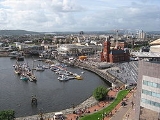
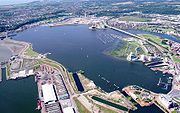
Cardiff Bay is the area created by the Cardiff Barrage in South Cardiff
, the capital of Wales. The regeneration of Cardiff Bay is now widely regarded as one of the most successful regeneration projects in the United Kingdom. The Bay is supplied by two rivers (Taff
and Ely
) to form a 500 acres (2 km²) freshwater lake round the former dockland area south of the city centre
. The Bay was formerly tidal, with access to the sea limited to a couple of hours each side of high water but now provides 24 hour access through three locks.
development by being the means of exporting coal
from the South Wales Valleys
to the rest of the world, helping to power the industrial age. The coal mining
industry helped fund the building of Cardiff
into the Capital city
of Wales and helped the Third Marquis of Bute
, who owned the docks, become the richest man in the world at the time.
As Cardiff exports grew, so did its population; dockworkers and sailors from across the world settled in neighbourhoods close to the docks, known as Tiger Bay
, and communities from up to 45 different nationalities, including Norwegian, Somali
, Yemen
i, Spanish
, Italian
, Caribbean
and Irish
helped create the unique multicultural character of the area.
After the Second World War most of the industry closed down and became derelict. But, in 1999, new life was injected into the area by the building of the Cardiff Bay Barrage
, one of the most controversial building projects of the day but also one of the most successful.
The Cardiff Bay Development Corporation
(CBDC) was created in 1987 to stimulate the redevelopment of 1,100 hectare
s (2,700 acre
s) of derelict land. The Development Corporation aimed to attract private capital by spending public money to improve the area. Despite opposition by environmentalist
s and wildlife organisations, the mudflat
s at the mouths of the River Taff
and River Ely
were inundated, with loss of habitat for wading birds. The Barrage has created several new habitats for freshwater species with the wetlands
to the south of the Hamadryad
Park.
When the Development Corporation was wound up in on 31 March 2000, it had achieved many of its objectives. The whole area was unrecognisable from ten years before. Much private land was now open to the public, particularly around the inner harbour and the north side of Roath basin. Work is progressing to complete a 13 kilometre walkway around the Bay and the Barrage has created a world-class environment. In addition, the development has enabled land in the city centre
to be redeveloped for higher-value uses.
The development of "something like 1,250 apartments a year" however might cause future problems. As at 2008 up to one third were not occupied. Critics such as Lorraine Barrett
(AM Labour
, Cardiff South and Penarth) say, the flat complexes will not help to build up a community and too little attention has been paid to develop affordable housing. With the recent falls in property values, sales in the area have become problematic. Therefore landlords might be more willing to rent their places out to "people who may not be suited to that type of living."
Connecting the Bay area to the centre of Cardiff was a primary goal when plans to develop the docklands were first mooted. Original plans included a grand boulevard (similar to where Lloyd George Avenue
is located now) with high density commercial and residential units straddling both sides. This would have created significant demand for quality public transport provisions facilitating connections to the new Bay area but public transport was often of poor quality and, but there are now much improved connections through the Cardiff Bus
BayCar
service and rail service from Cardiff Queen Street to Cardiff Bay railway station
.
is a 5-star luxury
hotel
with commanding views of the Bay and Penarth. Built by Rocco Forte in 2000, the hotel was sold in 2007 to Principal-Haley hotels.
was built in 1897 and designed by William Frame, who studied under William Burgess It was formerly the headquarters of the Bute Dock Company.
is the National Assembly for Wales
building which includes the debating chamber and committee rooms.
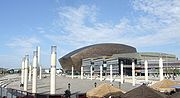
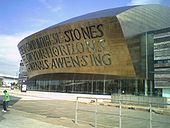 The Wales Millennium Centre
is home to the Welsh National Opera
.
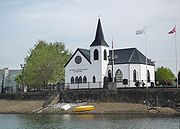
, is a rescued historic wooden church that was rebuilt in 1992 and operates as a registered self funded not for profit charity. It is managed by Cardiff Harbour Authority
and is as a venue for small concerts, art exhibitions, conferences, meetings and celebrations. .
When living in Cardiff as a child, the famous children's author Roald Dahl
attended this church.
 A refurbished Victorian dockside building houses Craft in the Bay
, the home of the Makers Guild in Wales.
is an educational science & discovery centre, which also includes a science theatre and planetarium.
 Roald Dahl Plass
is a large open amphitheatre style plaza frequently used as a venue for carnivals and festivals all year round.
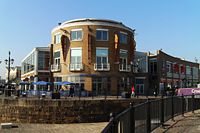
comprises a mix of restaurants, bars, cafés, shops and services located on the waterfront

 Cardiff Bay was used as the high-tech urban setting for the Ninth Doctor
Doctor Who
episode Boom Town
and for the Torchwood spinoff, whose makers deliberately avoided stereotypical portrayals of Wales in order to portray Cardiff as it is today, a modern urban centre. In the Torchwood series, there is a giant underground base, secretly under-neath the Bay named "The Hub" from where the Torchwood team work. There is also a lift from the hub into the plaza with a perception filter making anyone who stands on the spot "Not noticed". Roald Dahl Plass
features prominently.
Also the Tenth Doctor
Doctor Who
Christmas Special (2006), "The Runaway Bride
" made use of office buildings in the Cardiff Bay.
is northeast of Mermaid Quay and is served by shuttle services to Cardiff Queen Street railway station
.
Cardiff Bus
operates the following services to the Bay:
The Bay lies off the A4232
before the Butetown tunnels and is linked to the city centre by Lloyd George Avenue
and Bute Street
.
The Pont y Werin
pedestrian and cycle bridge opened in July 2010, completing a six and a half mile circular route around Cardiff Bay and Penarth.
A cycle hire system, similar to those in other large cities, launched in September 2009, and includes 70 bikes and 35 hire points (initially 7) around the centre and the south of the city. The current stations are: Central Station; Cardiff Bay Station; County Hall; Cardiff Bay Visitors’ Centre; Churchill Way; City Hall and eastern Queen Street. It is necessary to register before using bike. The first half an hour is free after which a small hourly fee is payable.
Cardiff
Cardiff is the capital, largest city and most populous county of Wales and the 10th largest city in the United Kingdom. The city is Wales' chief commercial centre, the base for most national cultural and sporting institutions, the Welsh national media, and the seat of the National Assembly for...
, the capital of Wales. The regeneration of Cardiff Bay is now widely regarded as one of the most successful regeneration projects in the United Kingdom. The Bay is supplied by two rivers (Taff
River Taff
The River Taff is a large river in Wales. It rises as two rivers in the Brecon Beacons — the Taf Fechan and the Taf Fawr — before joining to form the Taff north of Merthyr Tydfil...
and Ely
River Ely
The River Ely is a river in South Wales flowing generally south east, from Tonyrefail to the capital city of Cardiff.-Course of the river:...
) to form a 500 acres (2 km²) freshwater lake round the former dockland area south of the city centre
Cardiff city centre
Cardiff city centre is the central business district of Cardiff, Wales. The area is tightly bounded by the River Taff to the west, the Civic centre to the north and railway lines and two railway stations - Central and Queen Street - to the south and east respectively...
. The Bay was formerly tidal, with access to the sea limited to a couple of hours each side of high water but now provides 24 hour access through three locks.
History
Cardiff Bay played a major part in Cardiff’sCardiff
Cardiff is the capital, largest city and most populous county of Wales and the 10th largest city in the United Kingdom. The city is Wales' chief commercial centre, the base for most national cultural and sporting institutions, the Welsh national media, and the seat of the National Assembly for...
development by being the means of exporting coal
Coal
Coal is a combustible black or brownish-black sedimentary rock usually occurring in rock strata in layers or veins called coal beds or coal seams. The harder forms, such as anthracite coal, can be regarded as metamorphic rock because of later exposure to elevated temperature and pressure...
from the South Wales Valleys
South Wales Valleys
The South Wales Valleys are a number of industrialised valleys in South Wales, stretching from eastern Carmarthenshire in the west to western Monmouthshire in the east and from the Heads of the Valleys in the north to the lower-lying, pastoral country of the Vale of Glamorgan and the coastal plain...
to the rest of the world, helping to power the industrial age. The coal mining
Coal mining
The goal of coal mining is to obtain coal from the ground. Coal is valued for its energy content, and since the 1880s has been widely used to generate electricity. Steel and cement industries use coal as a fuel for extraction of iron from iron ore and for cement production. In the United States,...
industry helped fund the building of Cardiff
Cardiff
Cardiff is the capital, largest city and most populous county of Wales and the 10th largest city in the United Kingdom. The city is Wales' chief commercial centre, the base for most national cultural and sporting institutions, the Welsh national media, and the seat of the National Assembly for...
into the Capital city
Capital City
Capital City was a television show produced by Euston Films which focused on the lives of investment bankers in London living and working on the corporate trading floor for the fictional international bank Shane-Longman....
of Wales and helped the Third Marquis of Bute
John Crichton-Stuart, 3rd Marquess of Bute
John Patrick Crichton-Stuart, 3rd Marquess of Bute KT, KSG, KGCHS was a landed aristocrat, industrial magnate, antiquarian, scholar, philanthropist and architectural patron.-Early life:...
, who owned the docks, become the richest man in the world at the time.
As Cardiff exports grew, so did its population; dockworkers and sailors from across the world settled in neighbourhoods close to the docks, known as Tiger Bay
Tiger Bay
Tiger Bay was the local name for an area of Cardiff which covered Butetown and Cardiff Docks. It was re-branded as Cardiff Bay following the building of the Cardiff Barrage which dams the tidal rivers Ely and Taff to create a body of water.-History:...
, and communities from up to 45 different nationalities, including Norwegian, Somali
Somali people
Somalis are an ethnic group located in the Horn of Africa, also known as the Somali Peninsula. The overwhelming majority of Somalis speak the Somali language, which is part of the Cushitic branch of the Afro-Asiatic language family...
, Yemen
Yemen
The Republic of Yemen , commonly known as Yemen , is a country located in the Middle East, occupying the southwestern to southern end of the Arabian Peninsula. It is bordered by Saudi Arabia to the north, the Red Sea to the west, and Oman to the east....
i, Spanish
Spanish people
The Spanish are citizens of the Kingdom of Spain. Within Spain, there are also a number of vigorous nationalisms and regionalisms, reflecting the country's complex history....
, Italian
Italian people
The Italian people are an ethnic group that share a common Italian culture, ancestry and speak the Italian language as a mother tongue. Within Italy, Italians are defined by citizenship, regardless of ancestry or country of residence , and are distinguished from people...
, Caribbean
Caribbean
The Caribbean is a crescent-shaped group of islands more than 2,000 miles long separating the Gulf of Mexico and the Caribbean Sea, to the west and south, from the Atlantic Ocean, to the east and north...
and Irish
Irish people
The Irish people are an ethnic group who originate in Ireland, an island in northwestern Europe. Ireland has been populated for around 9,000 years , with the Irish people's earliest ancestors recorded having legends of being descended from groups such as the Nemedians, Fomorians, Fir Bolg, Tuatha...
helped create the unique multicultural character of the area.
After the Second World War most of the industry closed down and became derelict. But, in 1999, new life was injected into the area by the building of the Cardiff Bay Barrage
Cardiff Bay Barrage
The Cardiff Bay Barrage lies across the mouth of Cardiff Bay, Wales between Queen Alexandra Dock and Penarth Head. It was one of the largest civil engineering projects in Europe during construction in the 1990s.-History:...
, one of the most controversial building projects of the day but also one of the most successful.
Development
The Cardiff Bay Development Corporation
Cardiff Bay Development Corporation
The Cardiff Bay Development Corporation was set up by the United Kingdom Government on 3 April 1987 to redevelop of one sixth of the area of Cardiff to create Cardiff Bay.-Objectives:...
(CBDC) was created in 1987 to stimulate the redevelopment of 1,100 hectare
Hectare
The hectare is a metric unit of area defined as 10,000 square metres , and primarily used in the measurement of land. In 1795, when the metric system was introduced, the are was defined as being 100 square metres and the hectare was thus 100 ares or 1/100 km2...
s (2,700 acre
Acre
The acre is a unit of area in a number of different systems, including the imperial and U.S. customary systems. The most commonly used acres today are the international acre and, in the United States, the survey acre. The most common use of the acre is to measure tracts of land.The acre is related...
s) of derelict land. The Development Corporation aimed to attract private capital by spending public money to improve the area. Despite opposition by environmentalist
Environmentalist
An environmentalist broadly supports the goals of the environmental movement, "a political and ethical movement that seeks to improve and protect the quality of the natural environment through changes to environmentally harmful human activities"...
s and wildlife organisations, the mudflat
Mudflat
Mudflats or mud flats, also known as tidal flats, are coastal wetlands that form when mud is deposited by tides or rivers. They are found in sheltered areas such as bays, bayous, lagoons, and estuaries. Mudflats may be viewed geologically as exposed layers of bay mud, resulting from deposition of...
s at the mouths of the River Taff
River Taff
The River Taff is a large river in Wales. It rises as two rivers in the Brecon Beacons — the Taf Fechan and the Taf Fawr — before joining to form the Taff north of Merthyr Tydfil...
and River Ely
River Ely
The River Ely is a river in South Wales flowing generally south east, from Tonyrefail to the capital city of Cardiff.-Course of the river:...
were inundated, with loss of habitat for wading birds. The Barrage has created several new habitats for freshwater species with the wetlands
Cardiff Bay Wetlands Reserve
Cardiff Bay Wetlands Reserve is located in Cardiff Bay in the city of Cardiff. It covers an area of approximately 8 hectares . The area was officially opened as a wildlife reserve on 25 July 2002 in what was previously an area of Site of Special Scientific Interest up until the opening of the...
to the south of the Hamadryad
Hamadryad
Hamadryads are Greek mythological beings that live in trees. They are a particular type of dryad, which in turn are a particular type of nymph. Hamadryads are born bonded to a particular tree. Some believe that hamadryads are the actual tree, while normal dryads are simply the entities, or...
Park.
When the Development Corporation was wound up in on 31 March 2000, it had achieved many of its objectives. The whole area was unrecognisable from ten years before. Much private land was now open to the public, particularly around the inner harbour and the north side of Roath basin. Work is progressing to complete a 13 kilometre walkway around the Bay and the Barrage has created a world-class environment. In addition, the development has enabled land in the city centre
Cardiff city centre
Cardiff city centre is the central business district of Cardiff, Wales. The area is tightly bounded by the River Taff to the west, the Civic centre to the north and railway lines and two railway stations - Central and Queen Street - to the south and east respectively...
to be redeveloped for higher-value uses.
The development of "something like 1,250 apartments a year" however might cause future problems. As at 2008 up to one third were not occupied. Critics such as Lorraine Barrett
Lorraine Barrett
Lorraine Barrett is a former Welsh Labour & Co-operative Member of the National Assembly for Wales for Cardiff South and Penarth and an Assembly Commissioner since 2007...
(AM Labour
Labour Party (UK)
The Labour Party is a centre-left democratic socialist party in the United Kingdom. It surpassed the Liberal Party in general elections during the early 1920s, forming minority governments under Ramsay MacDonald in 1924 and 1929-1931. The party was in a wartime coalition from 1940 to 1945, after...
, Cardiff South and Penarth) say, the flat complexes will not help to build up a community and too little attention has been paid to develop affordable housing. With the recent falls in property values, sales in the area have become problematic. Therefore landlords might be more willing to rent their places out to "people who may not be suited to that type of living."
Connecting the Bay area to the centre of Cardiff was a primary goal when plans to develop the docklands were first mooted. Original plans included a grand boulevard (similar to where Lloyd George Avenue
Lloyd George Avenue
Lloyd George Avenue is an avenue in Cardiff, Wales. Roughly one mile long, the road links the Inner Harbour of Cardiff Bay to Cardiff city centre and forms part of the A470 road. It runs parallel to Bute Street and the Butetown Branch Line...
is located now) with high density commercial and residential units straddling both sides. This would have created significant demand for quality public transport provisions facilitating connections to the new Bay area but public transport was often of poor quality and, but there are now much improved connections through the Cardiff Bus
Cardiff Bus
Cardiff Bus is the dominant operator of bus services in Cardiff, Wales and the surrounding area, including Barry and Penarth. Its hub is Cardiff central bus station...
BayCar
Baycar
Baycar is a bus service in Cardiff, serving the city centre and Cardiff Bay.The service forms part of the wider Cardiff Bus network, but is unique in that the entire Baycar bus system includes its own branded vehicles, bus shelters and boards.-History:The service was introduced in 2006 to connect...
service and rail service from Cardiff Queen Street to Cardiff Bay railway station
Cardiff Bay railway station
Cardiff Bay railway station , formerly Cardiff Bute Road, is a station serving the Cardiff Bay and Butetown areas of Cardiff. It is the southern terminus of the Butetown Branch Line 1 mile south of ....
.
Notable buildings
St David's Hotel
The St David's Hotel and SpaSt David's Hotel & Spa
St David's Hotel & Spa is a five-star hotel situated in Cardiff, Wales, just off the A4232 road, and close to Cardiff Bay railway station. It was the first five-star hotel in Wales. The building features a sweeping sail-topped roof and a lofty atrium lobby....
is a 5-star luxury
Star (classification)
Stars are often used as symbols for classification purposes. They are used by reviewers for ranking things such as movies, TV shows, restaurants, and hotels. For example, one to five stars is commonly employed to categorize hotels.-Restaurant ratings:...
hotel
Hotel
A hotel is an establishment that provides paid lodging on a short-term basis. The provision of basic accommodation, in times past, consisting only of a room with a bed, a cupboard, a small table and a washstand has largely been replaced by rooms with modern facilities, including en-suite bathrooms...
with commanding views of the Bay and Penarth. Built by Rocco Forte in 2000, the hotel was sold in 2007 to Principal-Haley hotels.
The Pierhead Building
The PierheadPierhead Building
The Pierhead Building is a Grade 1 listed building of the National Assembly for Wales in Cardiff Bay, Wales. It stands as one of the city of Cardiff's most familiar landmarks and was built in 1897 as the headquarters for the Bute Dock Company....
was built in 1897 and designed by William Frame, who studied under William Burgess It was formerly the headquarters of the Bute Dock Company.
The Senedd
The SeneddSenedd
The Senedd , also known as the National Assembly building, houses the debating chamber and three committee rooms for the National Assembly for Wales in Cardiff. The Senedd building was opened by Queen Elizabeth II on 1 March 2006 and the total cost was £69.6 million, which included £49.7M in...
is the National Assembly for Wales
National Assembly for Wales
The National Assembly for Wales is a devolved assembly with power to make legislation in Wales. The Assembly comprises 60 members, who are known as Assembly Members, or AMs...
building which includes the debating chamber and committee rooms.
Wales Millennium Centre
Wales Millennium Centre
Wales Millennium Centre is an arts centre located in the Cardiff Bay area of Cardiff, Wales. The site covers a total area of . Phase 1 of the building was opened during the weekend of the 26–28 November 2004 and phase 2 opened on 22 January 2009 with an inaugural concert...
is home to the Welsh National Opera
Welsh National Opera
Welsh National Opera is an opera company founded in Cardiff, Wales in 1943. The WNO tours Wales, the United Kingdom and the rest of the world extensively. Annually, it gives more than 120 performances of eight main stage operas to a combined audience of around 150,000 people...
.
Norwegian Church
The Norwegian Church Arts CentreNorwegian Church, Cardiff
The Norwegian Church in the Cardiff Bay area of the city of Cardiff, Wales, is a historic church building and formerly a place of worship for the Norwegian community in Cardiff....
, is a rescued historic wooden church that was rebuilt in 1992 and operates as a registered self funded not for profit charity. It is managed by Cardiff Harbour Authority
Cardiff Harbour Authority
The Cardiff Harbour Authority was formed as part of Cardiff Council on 1 April 2000. It took over responsibility from Cardiff Bay Development Corporation for management of the barrage, the inland bay and the River Taff and Ely....
and is as a venue for small concerts, art exhibitions, conferences, meetings and celebrations. .
When living in Cardiff as a child, the famous children's author Roald Dahl
Roald Dahl
Roald Dahl was a British novelist, short story writer, fighter pilot and screenwriter.Born in Wales to Norwegian parents, he served in the Royal Air Force during the Second World War, in which he became a flying ace and intelligence agent, rising to the rank of Wing Commander...
attended this church.
Craft in the Bay
Craft in the Bay
Located on the “Flourish” at the south end of Lloyd George Avenue, the Craft in the Bay Gallery consists of the award winning refurbished “D” Shed, a grade II listed maritime warehouse together with a modern extension...
, the home of the Makers Guild in Wales.
Techniquest
TechniquestTechniquest
Techniquest is a Welsh science and discovery centre. It has locations in Cardiff Bay, Glyndŵr University in Wrexham, Llanberis in Gwynedd, and the Adventure Center in Narberth, Pembrokeshire....
is an educational science & discovery centre, which also includes a science theatre and planetarium.
Roald Dahl Plass
Roald Dahl Plass
Roald Dahl Plass is a public plaza in Cardiff Bay, part of Cardiff, Wales. It is named after Cardiff-born author Roald Dahl, and is located on the coast along the south of the city centre. The square is home to the Senedd and the Wales Millennium Centre, a performing arts centre...
is a large open amphitheatre style plaza frequently used as a venue for carnivals and festivals all year round.
Mermaid Quay
Mermaid QuayMermaid Quay
Mermaid Quay is a waterfront shopping and leisure district in Cardiff Bay, Cardiff, Wales. The 14,000 sq m development was opened in 1999, and includes restaurants, bars, cafes and shops.- Eating & Drinking at Mermaid Quay :...
comprises a mix of restaurants, bars, cafés, shops and services located on the waterfront
Water-based attractions
- Cardiff Bay Wetland Reserve - which has rare birds and a boardwalk leading to a viewing platform
- Cardiff WaterbusCardiff WaterbusThe Cardiff Waterbus celebrated its 10 year anniversary in April 2010. The fleet have clocked up 50,000 miles since operating on the routes, carrying an estimated 1,000,000 passengers.-External links:**...
- which offers a public transport service and tourist cruises - Cardiff Bay BarrageCardiff Bay BarrageThe Cardiff Bay Barrage lies across the mouth of Cardiff Bay, Wales between Queen Alexandra Dock and Penarth Head. It was one of the largest civil engineering projects in Europe during construction in the 1990s.-History:...
- accessible via the Water Bus and by road, and free to explore and also has guided tours - Lightship 2000Lightship 2000Lightship 2000 is a restored old red Lightvessel with a cafe and chapel on board situated in Cardiff Bay. During the redevelopment of Cardiff Bay, the Cardiff Bay Development Corporation called together the churches in Cardiff to discuss the role of Christianity in the Bay...
- a restored old red Helwick LightvesselLightvesselA lightvessel, or lightship, is a ship which acts as a lighthouse. They are used in waters that are too deep or otherwise unsuitable for lighthouse construction...
with a cafe and chapel on board. - Queen Alexandra Dock
- Cardiff International PoolCardiff International PoolThe Cardiff International Pool is a sport facility located in the Cardiff International Sports Village in Cardiff, capital of Wales. It opened to the public on 12 January 2008 and was officially opened on 26 February 2008 by Duncan Goodhew....
- Cardiff International White WaterCardiff International White WaterCardiff International White Water is an Olympic standard white water rafting centre based at the Cardiff International Sports Village in Cardiff Bay....
- Cardiff Sailing Centre - A council run watersports facility based on Cardiff Bay BarrageCardiff Bay BarrageThe Cardiff Bay Barrage lies across the mouth of Cardiff Bay, Wales between Queen Alexandra Dock and Penarth Head. It was one of the largest civil engineering projects in Europe during construction in the 1990s.-History:...
- Cardiff Yacht Club - dinghy racing and cruising, yacht racing and cruising, sea fishing and rowing- Recognised RYA training Centre for Sailing and Powerboating.
- Cardiff Bay Yacht Club - premier watersports club in South Wales
- Cardiff City Rowing Club
Commercial and residential
- Style-conscious shops, bars and restaurants at Mermaid QuayMermaid QuayMermaid Quay is a waterfront shopping and leisure district in Cardiff Bay, Cardiff, Wales. The 14,000 sq m development was opened in 1999, and includes restaurants, bars, cafes and shops.- Eating & Drinking at Mermaid Quay :...
. - Cardiff Bay Retail ParkCardiff Bay Retail ParkThe Cardiff Bay Retail Park in Grangetown, Cardiff was once the site of the Ferry Road Landfill Site. It was built in around 1998. It is currently home to businesses which include Asda and British Home Stores, Boots Group and Argos. There have been many turnovers in businesses, yet new phases are...
- Mischief's Cafe Bar, a cafe bar and live music venue.
- The Coal Exchange (aka The Exchange Centre), a venue for staged events.
- Harry Ramsden'sHarry Ramsden'sHarry Ramsden's is a fast food restaurant chain based in the United Kingdom which offers fish and chips and assorted themed dishes. The business has 35 owned and franchised outlets throughout the UK and Ireland and serves around four million meals annually....
fish and chip bar - a large, prominent building. - Cardiff Bay Ice Rink
- Cardiff International Sports VillageCardiff International Sports VillageCardiff International Sports Village is located in Cardiff Bay in the city of Cardiff, Wales. It is one of the largest regeneration projects currently in the UK...
- The Red Dragon CentreRed Dragon CentreThe Red Dragon Centre is an indoor entertainment complex in southern Cardiff, the capital of Wales.The complex features restaurants, cafés, an Old Orleans restaurant, a Hollywood Bowl with arcade amusements, an Odeon multiplex cinema, a Doctor Who visitor centre , a casino and an on-site car park...
(formerly Atlantic Wharf Leisure Village), a leisure and entertainment complex with a Doctor WhoDoctor WhoDoctor Who is a British science fiction television programme produced by the BBC. The programme depicts the adventures of a time-travelling humanoid alien known as the Doctor who explores the universe in a sentient time machine called the TARDIS that flies through time and space, whose exterior...
exhibit.
Appearances in the media
Ninth Doctor
The Ninth Doctor is the ninth incarnation of the protagonist of the long-running BBC television science-fiction series Doctor Who. He is played by Christopher Eccleston....
Doctor Who
Doctor Who
Doctor Who is a British science fiction television programme produced by the BBC. The programme depicts the adventures of a time-travelling humanoid alien known as the Doctor who explores the universe in a sentient time machine called the TARDIS that flies through time and space, whose exterior...
episode Boom Town
Boom Town (Doctor Who)
"Boom Town" is an episode in the British science fiction television series Doctor Who, which was first broadcast on 4 June 2005. The Doctor, Rose and Jack travel to modern-day Cardiff and meet up with Rose's boyfriend, Mickey...
and for the Torchwood spinoff, whose makers deliberately avoided stereotypical portrayals of Wales in order to portray Cardiff as it is today, a modern urban centre. In the Torchwood series, there is a giant underground base, secretly under-neath the Bay named "The Hub" from where the Torchwood team work. There is also a lift from the hub into the plaza with a perception filter making anyone who stands on the spot "Not noticed". Roald Dahl Plass
Roald Dahl Plass
Roald Dahl Plass is a public plaza in Cardiff Bay, part of Cardiff, Wales. It is named after Cardiff-born author Roald Dahl, and is located on the coast along the south of the city centre. The square is home to the Senedd and the Wales Millennium Centre, a performing arts centre...
features prominently.
Also the Tenth Doctor
Tenth Doctor
The Tenth Doctor is the tenth incarnation of the protagonist of the long-running BBC television science-fiction series Doctor Who. He is played by David Tennant, who appears in three series, as well as eight specials...
Doctor Who
Doctor Who
Doctor Who is a British science fiction television programme produced by the BBC. The programme depicts the adventures of a time-travelling humanoid alien known as the Doctor who explores the universe in a sentient time machine called the TARDIS that flies through time and space, whose exterior...
Christmas Special (2006), "The Runaway Bride
The Runaway Bride (Doctor Who)
"The Runaway Bride" is a special episode of the long-running British science fiction television series Doctor Who, starring David Tennant as the Tenth Doctor...
" made use of office buildings in the Cardiff Bay.
Transport
Cardiff Bay railway stationCardiff Bay railway station
Cardiff Bay railway station , formerly Cardiff Bute Road, is a station serving the Cardiff Bay and Butetown areas of Cardiff. It is the southern terminus of the Butetown Branch Line 1 mile south of ....
is northeast of Mermaid Quay and is served by shuttle services to Cardiff Queen Street railway station
Cardiff Queen Street railway station
Cardiff Queen Street railway station is Wales' second busiest railway station in Cardiff, Wales. It is one of 20 stations in the city and two in the city centre, the other being Cardiff Central...
.
Cardiff Bus
Cardiff Bus
Cardiff Bus is the dominant operator of bus services in Cardiff, Wales and the surrounding area, including Barry and Penarth. Its hub is Cardiff central bus station...
operates the following services to the Bay:
- 1 - Bay Circle clockwise: Grangetown-Leckwith-Canton-Fairwater-Llandaff-Gabalfa-Heath-Penylan-Roath-Tremorfa-Central Station
- 2 - Bay Circle anticlockwise: as above but reversed
- 6 - BaycarBaycarBaycar is a bus service in Cardiff, serving the city centre and Cardiff Bay.The service forms part of the wider Cardiff Bus network, but is unique in that the entire Baycar bus system includes its own branded vehicles, bus shelters and boards.-History:The service was introduced in 2006 to connect...
: Queen Street station via Central Station - 8 - City Centre via Grangetown
- 11 - Pengam Green via Central Station and Tremorfa
- 35/36 - Gabalfa via Central Station, Cathays and Heath
The Bay lies off the A4232
A4232 road
The A4232, which is also known either as the Peripheral Distributor Road or the Cardiff Link Road , is a distributor road in Cardiff, the capital of Wales....
before the Butetown tunnels and is linked to the city centre by Lloyd George Avenue
A470 road
The A470 is a major long-distance connective spine road in Wales, running from Cardiff on the south coast to Llandudno on the north coast. It covers approximately 186 miles , over a zig-zagging route through the entirety of the country's mountainous central region, including the Brecon Beacons and...
and Bute Street
Bute Street (Cardiff)
Bute Street is a street in Cardiff, Wales. It links Cardiff Bay and Butetown with Cardiff city centre. It now has no road number...
.
The Pont y Werin
Pont y Werin
Pont y Werin is a pedestrian and cyclist bridge spanning the River Ely between Cardiff Bay and Penarth, Wales....
pedestrian and cycle bridge opened in July 2010, completing a six and a half mile circular route around Cardiff Bay and Penarth.
A cycle hire system, similar to those in other large cities, launched in September 2009, and includes 70 bikes and 35 hire points (initially 7) around the centre and the south of the city. The current stations are: Central Station; Cardiff Bay Station; County Hall; Cardiff Bay Visitors’ Centre; Churchill Way; City Hall and eastern Queen Street. It is necessary to register before using bike. The first half an hour is free after which a small hourly fee is payable.
Gallery
See also
- Tiger BayTiger BayTiger Bay was the local name for an area of Cardiff which covered Butetown and Cardiff Docks. It was re-branded as Cardiff Bay following the building of the Cardiff Barrage which dams the tidal rivers Ely and Taff to create a body of water.-History:...
- ButetownButetownButetown is a community in the south of the city of Cardiff, the capital of Wales. It was originally a model housing estate built in the early nineteenth century by John Crichton-Stuart, 2nd Marquess of Bute, for whose title the area was named...
- List of places in Cardiff
- Penarth MarinaPenarth MarinaPenarth Marina is situated in the sheltered waters of Cardiff Bay, near Cardiff, the capital city of Wales.Penarth Marina is built around the basin of the historic Penarth Docks and has 350 berths....
- CardiffCardiffCardiff is the capital, largest city and most populous county of Wales and the 10th largest city in the United Kingdom. The city is Wales' chief commercial centre, the base for most national cultural and sporting institutions, the Welsh national media, and the seat of the National Assembly for...