Tonsure

Encyclopedia
Christianity
Christianity is a monotheistic religion based on the life and teachings of Jesus as presented in canonical gospels and other New Testament writings...
churches of cutting or shaving the hair
Hair
Hair is a filamentous biomaterial, that grows from follicles found in the dermis. Found exclusively in mammals, hair is one of the defining characteristics of the mammalian class....
from the scalp
Scalp
The scalp is the anatomical area bordered by the face anteriorly and the neck to the sides and posteriorly.-Layers:It is usually described as having five layers, which can conveniently be remembered as a mnemonic:...
of clerics, monastics, and, in the Eastern Orthodox Church
Eastern Orthodox Church
The Orthodox Church, officially called the Orthodox Catholic Church and commonly referred to as the Eastern Orthodox Church, is the second largest Christian denomination in the world, with an estimated 300 million adherents mainly in the countries of Belarus, Bulgaria, Cyprus, Georgia, Greece,...
, all baptized
Baptism
In Christianity, baptism is for the majority the rite of admission , almost invariably with the use of water, into the Christian Church generally and also membership of a particular church tradition...
members. Tonsure, usually qualified by the name of the religion concerned, is now sometimes used more generally for such cutting or shaving for monks, devotees, or mystics of other religions as a symbol of their renunciation of worldly fashion and esteem, e.g., by Buddhist novices and monk
Bhikkhu
A Bhikkhu or Bhikṣu is an ordained male Buddhist monastic. A female monastic is called a Bhikkhuni Nepali: ). The life of Bhikkhus and Bhikkhunis is governed by a set of rules called the patimokkha within the vinaya's framework of monastic discipline...
s, and some Hindu
Hindu
Hindu refers to an identity associated with the philosophical, religious and cultural systems that are indigenous to the Indian subcontinent. As used in the Constitution of India, the word "Hindu" is also attributed to all persons professing any Indian religion...
streams.
History and development
The origin of the tonsure remains unclear, but it certainly was not widely known in antiquity. There were three forms of tonsure known in the 7th and 8th centuries:- The Oriental, which claimed the authority of Saint Paul the ApostlePaul of TarsusPaul the Apostle , also known as Saul of Tarsus, is described in the Christian New Testament as one of the most influential early Christian missionaries, with the writings ascribed to him by the church forming a considerable portion of the New Testament...
(Acts 18:18) and consisted of shaving the whole head. This was observed in the Eastern churchesEastern ChristianityEastern Christianity comprises the Christian traditions and churches that developed in the Balkans, Eastern Europe, Asia Minor, the Middle East, Northeastern Africa, India and parts of the Far East over several centuries of religious antiquity. The term is generally used in Western Christianity to...
, including the Eastern Orthodox ChurchEastern Orthodox ChurchThe Orthodox Church, officially called the Orthodox Catholic Church and commonly referred to as the Eastern Orthodox Church, is the second largest Christian denomination in the world, with an estimated 300 million adherents mainly in the countries of Belarus, Bulgaria, Cyprus, Georgia, Greece,...
and the Eastern Catholic Churches. Hence Theodore of TarsusTheodore of TarsusTheodore was the eighth Archbishop of Canterbury, best known for his reform of the English Church and establishment of a school in Canterbury....
, who had acquired his learning in ByzantineByzantineByzantine usually refers to the Roman Empire during the Middle Ages.Byzantine may also refer to:* A citizen of the Byzantine Empire, or native Greek during the Middle Ages...
Asia MinorAnatoliaAnatolia is a geographic and historical term denoting the westernmost protrusion of Asia, comprising the majority of the Republic of Turkey...
and bore this tonsure, had to allow his hair to grow for four months before he could be tonsured after the Roman fashion, and then ordained Archbishop of CanterburyArchbishop of CanterburyThe Archbishop of Canterbury is the senior bishop and principal leader of the Church of England, the symbolic head of the worldwide Anglican Communion, and the diocesan bishop of the Diocese of Canterbury. In his role as head of the Anglican Communion, the archbishop leads the third largest group...
by Pope VitalianPope VitalianPope Saint Vitalianus was Pope of the Catholic Church from July 30, 657, until January 27, 672.He was born in Segni, Lazio, the son of Anastasius.-Reign:...
in 668. - The CelticCeltic ChristianityCeltic Christianity or Insular Christianity refers broadly to certain features of Christianity that were common, or held to be common, across the Celtic-speaking world during the Early Middle Ages...
, the exact shape of which is unclear from the sources, but in some way involved shaving the head from ear to ear. The shape may have been semicircular, arcing forward from a line between the ears, but another popular suggestion, less borne out in the sources, proposes that the entire forehead was shaved back to the ears. More recently a triangular shape, with one point at the front of the head going back to a line between the ears, has been suggested. The Celtic tonsure was worn in IrelandIrelandIreland is an island to the northwest of continental Europe. It is the third-largest island in Europe and the twentieth-largest island on Earth...
and Great BritainGreat BritainGreat Britain or Britain is an island situated to the northwest of Continental Europe. It is the ninth largest island in the world, and the largest European island, as well as the largest of the British Isles...
and was connected to the distinct set of practices known as Celtic ChristianityCeltic ChristianityCeltic Christianity or Insular Christianity refers broadly to certain features of Christianity that were common, or held to be common, across the Celtic-speaking world during the Early Middle Ages...
. It was greatly despised by those affiliated with the Roman custom, who considered it unorthodoxOrthodoxyThe word orthodox, from Greek orthos + doxa , is generally used to mean the adherence to accepted norms, more specifically to creeds, especially in religion...
and associated it with the damned Simon MagusSimon MagusSimon the Sorcerer or Simon the Magician, in Latin Simon Magus, was a Samaritan magus or religious figure and a convert to Christianity, baptised by Philip the Apostle, whose later confrontation with Peter is recorded in . The sin of simony, or paying for position and influence in the church, is...
. Some sources have also suggested links between this tonsure and that worn by druids in the Pre-Roman Iron Age . - The RomanWestern Roman EmpireThe Western Roman Empire was the western half of the Roman Empire after its division by Diocletian in 285; the other half of the Roman Empire was the Eastern Roman Empire, commonly referred to today as the Byzantine Empire....
: this consisted of shaving only the top of the head, so as to allow the hair to grow in the form of a crownCrown (headgear)A crown is the traditional symbolic form of headgear worn by a monarch or by a deity, for whom the crown traditionally represents power, legitimacy, immortality, righteousness, victory, triumph, resurrection, honour and glory of life after death. In art, the crown may be shown being offered to...
. This is claimed to have originated with Saint PeterSaint PeterSaint Peter or Simon Peter was an early Christian leader, who is featured prominently in the New Testament Gospels and the Acts of the Apostles. The son of John or of Jonah and from the village of Bethsaida in the province of Galilee, his brother Andrew was also an apostle...
, and is the practice of the Latin Rite of the Catholic Church.
Eastern Christianity
The following two sub-sections consist of quotes from Saint Germanus I, Patriarch of Constantinople (715-730):Clerical Tonsure
The double crown inscribed on the head of the priest through tonsure represents the precious head of the chief-apostle Peter. When he was sent out in the teaching and preaching of the Lord, his head was shaved by those who did not believe his word, as if in mockery. The Teacher Christ blessed this head, changed dishonor into honor, ridicule into praise. He placed on it a crown made not out of precious stones, but one which shines more than gold, topaz, or precious stone – with the stone and rock of faith. Peter, the most-holy, the summit, beauty, and crown of the twelve stones, which are the apostles, is the hierarch of Christ.
Monastic Tonsure
The total tonsuring of the head is in imitation of the holy Apostle James, brother of the Lord, and the Apostle Paul, and of the rest.
Clerical Tonsure
In the Latin or Western Rite of the Catholic Church, "first tonsure" was, in medieval times, and generally through 1972, the rite of inducting someone into the clergy
Clergy
Clergy is the generic term used to describe the formal religious leadership within a given religion. A clergyman, churchman or cleric is a member of the clergy, especially one who is a priest, preacher, pastor, or other religious professional....
and qualifying him for the civil benefits once enjoyed by clerics. Tonsure was a prerequisite for receiving the minor
Minor orders
The minor orders are the lowest ranks in the Christian clergy. The most recognized minor orders are porter, lector, exorcist, and acolyte. In the Latin rite Catholic Church, the minor orders were in most cases replaced by "instituted" ministries of lector and acolyte, though communities that use...
and major orders
Major orders
The term major orders or sacred orders was a part of the clerical terminology of the Roman Catholic Church until shortly after the Second Vatican Council, when the use widely disappeared due to reform of the clerical structure. During the Counter-reformation, the Council of Trent issued a decree...
. Failing to maintain tonsure was the equivalent of attempting to abandon one's clerical state, and in the 1917 Code of Canon Law, any cleric in minor orders (or simply tonsured) who did not resume the tonsure within a month after being warned by his Ordinary
Ordinary
In those hierarchically organised churches of Western Christianity which have an ecclesiastical law system, an ordinary is an officer of the church who by reason of office has ordinary power to execute the church's laws...
, lost the clerical state. Over time, the appearance of tonsure varied, ending up for non-monastic clergy as generally consisting of a symbolic cutting of a few tufts of hair at first tonsure in the Sign of the Cross and in wearing a bare spot on the back of the head which varied according to the degree of orders. It was not supposed to be less than the size of a communicant's host, even for a tonsuratus, someone simply tonsured, and the approximate size for a priest's tonsure was the size of a priest's host. Countries that were not Catholic had exceptions to this rule, especially in the English-speaking world. In England and America
Americas
The Americas, or America , are lands in the Western hemisphere, also known as the New World. In English, the plural form the Americas is often used to refer to the landmasses of North America and South America with their associated islands and regions, while the singular form America is primarily...
, for example, the bare spot was dispensed with, likely because of the persecutions that could arise from being a part of the Catholic clergy, but the ceremonious cutting of the hair in the first clerical tonsure was always required. In accordance with Pope Paul VI
Pope Paul VI
Paul VI , born Giovanni Battista Enrico Antonio Maria Montini , reigned as Pope of the Catholic Church from 21 June 1963 until his death on 6 August 1978. Succeeding Pope John XXIII, who had convened the Second Vatican Council, he decided to continue it...
's motu proprio
Motu proprio
A motu proprio is a document issued by the Pope on his own initiative and personally signed by him....
Ministeria quaedam of 15 August 1972, "first tonsure is no longer conferred".
Monastic Tonsure
Apart from this general clerical tonsure, some Western Rite
Latin liturgical rites
Latin liturgical rites used within that area of the Catholic Church where the Latin language once dominated were for many centuries no less numerous than the liturgical rites of the Eastern autonomous particular Churches. Their number is now much reduced...
monastic orders, for example Carthusian
Carthusian
The Carthusian Order, also called the Order of St. Bruno, is a Roman Catholic religious order of enclosed monastics. The order was founded by Saint Bruno of Cologne in 1084 and includes both monks and nuns...
s and Trappist
TRAPPIST
TRAPPIST is Belgian robotic telescope in Chile which came online in 2010, and is an acronym for TRAnsiting Planets and PlanetesImals Small Telescope, so named in homage to Trappist beer produced in the Belgian region. Situated high in the Chilean mountains at La Silla Observatory, it is actually...
s, employed a very full version of tonsure, shaving the head entirely bald and keeping only a narrow ring of short hair, sometimes called "the monastic crown" (see "Roman tonsure", above), from the time of entrance into the monastic novitiate
Novitiate
Novitiate, alt. noviciate, is the period of training and preparation that a novice monastic or member of a religious order undergoes prior to taking vows in order to discern whether they are called to the religious life....
for all monks, whether destined for service as priests or brothers.
Eastern Christianity
Today in Eastern Orthodoxy and in the Eastern Catholic Churches of Byzantine RiteByzantine Rite
The Byzantine Rite, sometimes called the Rite of Constantinople or Constantinopolitan Rite is the liturgical rite used currently by all the Eastern Orthodox Churches, by the Greek Catholic Churches , and by the Protestant Ukrainian Lutheran Church...
, there are three types of tonsure: baptism
Baptism
In Christianity, baptism is for the majority the rite of admission , almost invariably with the use of water, into the Christian Church generally and also membership of a particular church tradition...
al, monastic
Monk
A monk is a person who practices religious asceticism, living either alone or with any number of monks, while always maintaining some degree of physical separation from those not sharing the same purpose...
, and clerical
Ordination
In general religious use, ordination is the process by which individuals are consecrated, that is, set apart as clergy to perform various religious rites and ceremonies. The process and ceremonies of ordination itself varies by religion and denomination. One who is in preparation for, or who is...
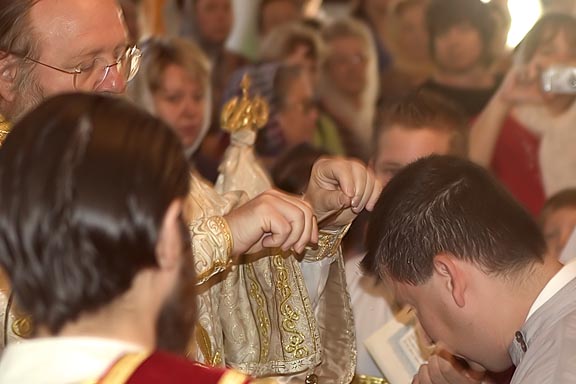
. It always consists of the cutting of four locks of hair in a cruciform pattern: at the front of head as the celebrant says "In the Name of the Father", at the back of head at the words "and the Son", and on either side of the head at the words "and the Holy Spirit". In all cases, the hair is allowed to grow back; the tonsure as such is not adopted as a hairstyle.
Baptismal Tonsure
Baptismal tonsure is performed during the rite of Holy Baptism as a first sacrificial
Sacrifice
Sacrifice is the offering of food, objects or the lives of animals or people to God or the gods as an act of propitiation or worship.While sacrifice often implies ritual killing, the term offering can be used for bloodless sacrifices of cereal food or artifacts...
offering by the newly baptized. This tonsure is always performed, whether the one being baptized is an infant or an adult.
Monastic Tonsure
Monastic tonsure (of which there are three grades: Rassophore, Stavrophore and the Great Schema), is the rite of initiation into the monastic state, symbolic of cutting off of self-will. Orthodox monks traditionally never cut their hair or beards after receiving the monastic tonsure as a sign of the consecration of their lives to God (reminiscent of the Vow of the Nazirite
Nazirite
In the Hebrew Bible, a nazirite or nazarite, , refers to one who voluntarily took a vow described in . The term "nazirite" comes from the Hebrew word nazir meaning "consecrated" or "separated"...
).
Clerical Tonsure
Clerical tonsure is the equivalent of the "first tonsure" in the Latin church. It is done immediately prior to ordination to the minor order of reader but is not repeated at subsequent ordinations. This led to a once common usage that one was, for instance, "tonsured a reader", although technically the tonsure occurs prior to the prayer of ordination within the ordination rite.
Clerical Tonsure
Since the issuing of Ministeria quaedam in 1972, certain institutes have been authorized to use the first clerical tonsure, such as the Priestly Fraternity of St. Peter
Priestly Fraternity of St. Peter
The Priestly Fraternity of St. Peter is a traditionalist Catholic Society of Apostolic Life of priests and seminarians in good standing with the Holy See.-Canonical status:...
(1988), the Institute of Christ the King Sovereign Priest
Institute of Christ the King Sovereign Priest
The Institute of Christ the King Sovereign Priest is a society of priests in the Catholic Church that celebrates the Liturgy in Latin in accordance with its constitutions and founding documents. Its goals are to preserve and patronize traditional Latin Rite liturgical art and music...
(1990), and the Personal Apostolic Administration of Saint John Mary Vianney
Personal Apostolic Administration of Saint John Mary Vianney
The Personal Apostolic Administration of Saint John Mary Vianney was established on 18 January 2002 by Pope John Paul II for traditionalist Catholic clergy and laity within the Diocese of Campos in Brazil. It is the only Personal Apostolic Administration in existence...
(2001).
Although the tonsure itself is obsolete, the wearing of a skull cap, called a zuchetto, in church to keep the head warm, which the fuller form of clerical tonsure led to, still survives. The zuchetto is worn by the pope
Pope
The Pope is the Bishop of Rome, a position that makes him the leader of the worldwide Catholic Church . In the Catholic Church, the Pope is regarded as the successor of Saint Peter, the Apostle...
(in white), cardinals
Cardinal (Catholicism)
A cardinal is a senior ecclesiastical official, usually an ordained bishop, and ecclesiastical prince of the Catholic Church. They are collectively known as the College of Cardinals, which as a body elects a new pope. The duties of the cardinals include attending the meetings of the College and...
(in red) and bishop
Bishop
A bishop is an ordained or consecrated member of the Christian clergy who is generally entrusted with a position of authority and oversight. Within the Catholic Church, Eastern Orthodox, Oriental Orthodox Churches, in the Assyrian Church of the East, in the Independent Catholic Churches, and in the...
s (in purple) both during and outside of formal religious ceremonies. Priests may wear a simple black zuchetto, only outside of religious services, though this is almost never seen except as a practical garment used for warmth by some monks. Some priests who held special titles (certain ranks of monsignori and some canons, for instance) formerly wore black zuchettos with red or purple piping, but this too has fallen out of use except in a few, extremely rare cases.
Monastic Tonsure
Some monastic orders and individual monasteries still maintain the tradition of a monastic tonsure. While not required, it is still a common practice of Latin Rite friars, such as the Franciscan Missionaries of the Eternal Word.
Merovingians
Among the Merovingians, whose rulers were the "long-haired kings", the ancient custom remained that an unsuccessful pretenderPretender
A pretender is one who claims entitlement to an unavailable position of honour or rank. Most often it refers to a former monarch, or descendant thereof, whose throne is occupied or claimed by a rival, or has been abolished....
or a dethroned king would be tonsured. Then he had to retire to a monastery, but sometimes this lasted only until his hair grew back. Thus Grimoald the Elder
Grimoald the Elder
Grimoald I , called the Elder , was the Mayor of the Palace of Austrasia from 643 to 656. He was the son of Pepin of Landen and Itta....
, the son of Pippin of Landen
Pippin of Landen
Pepin of Landen , also called the Elder or the Old, was the Mayor of the Palace of Austrasia under the Merovingian king Dagobert I from 623 to 629...
, and Dagobert II
Dagobert II
Dagobert II was the king of Austrasia , the son of Sigebert III and Chimnechild of Burgundy. The Feast Date of St Dagobert II is 23 December -Biography:...
's guardian, seized the throne for his own son and had Dagobert tonsured, thus marking him unfit for kingship, and exiled.
Byzantine Empire
The practice of tonsure, coupled with castration, was common for deposed emperors and their sons in Byzantium from around the 8th century, prior to which disfigurement, usually by blinding, was the normal practice.Buddhism
In BuddhismBuddhism
Buddhism is a religion and philosophy encompassing a variety of traditions, beliefs and practices, largely based on teachings attributed to Siddhartha Gautama, commonly known as the Buddha . The Buddha lived and taught in the northeastern Indian subcontinent some time between the 6th and 4th...
, tonsure is a part of the rite of pabbajja
Pabbajja
Pabbajja literally means "to go forth" and refers to when a layperson leaves home to live the life of a Buddhist renunciate among a community of monks . This generally involves preliminary ordination as a novice...
and also a part of becoming a monk. This involves shaving head and face. This tonsure is renewed as often as required to keep the head cleanly shaven.
Hinduism
In HinduismHinduism
Hinduism is the predominant and indigenous religious tradition of the Indian Subcontinent. Hinduism is known to its followers as , amongst many other expressions...
, the underlying concept is that hair is a symbolic offering to the gods, representing a real sacrifice of beauty, and in return, the offerers are given blessings in proportion to their sacrifice.
Hair cutting
Hairstyle
A hairstyle, hairdo, or haircut refers to the styling of hair, usually on the human head. The fashioning of hair can be considered an aspect of personal grooming, fashion, and cosmetics, although practical, cultural, and popular considerations also influence some hairstyles.-History of...
(Sanskrit
Sanskrit
Sanskrit , is a historical Indo-Aryan language and the primary liturgical language of Hinduism, Jainism and Buddhism.Buddhism: besides Pali, see Buddhist Hybrid Sanskrit Today, it is listed as one of the 22 scheduled languages of India and is an official language of the state of Uttarakhand...
chuda karma, chuda karana) is one of the traditional saṃskāra
Samskara
Samskara may refer to:* Saṃskāra, Hindu rites* Saṃskāra , in Buddhism, mental and volitional formations* Samskara , a technique in ayurvedic medicine...
s performed for young children:
"According to the teaching of the revealed texts, the Chudakarman (tonsure) must be performed, for the sake of spiritual merit, by all twice-born
Dvija
Dvija is one of the members of the first three varnas in Hindu Dharma. Brahmins, Kshatriyas and Vaishyas are included in Dvija.The first birth is physical. The second occurs when one uptakes fulfilling a role in society...
men in the first or third year."
In some traditions, the head is shaved completely, while in others a small tuft of hair called sikha
Sikha
The sikha or shikha is a Sanskrit word that refers to a long tuft, or lock of hair left on top or on the back of the shaven head of a male Orthodox Hindu...
is left.
In some South India
South India
South India is the area encompassing India's states of Andhra Pradesh, Karnataka, Kerala and Tamil Nadu as well as the union territories of Lakshadweep and Pondicherry, occupying 19.31% of India's area...
n temples like Tirumala, Palani
Palani
Palani is a city and a municipality in the Dindigul district of the South Indian state of Tamil Nadu, located about 100 km South of Coimbatore City and 60 km west of Dindigul...
and Tiruttani
Tiruttani
Tiruttani is a town in the Indian state of Tamil Nadu. It is one of the main tourist centre in Thiruvallur district about 84 km from Chennai. Thiruthani Murugan Temple is one of the six abodes of Lord Muruga. Tiruttani is 15 km from Andhra Pradesh state...
, it is customary for pilgrims to shave their heads in or near the temple of the god they are visiting.
There has been an Indian custom to perform tonsure on widows after their husbands' deaths. It is not uncommon to tonsure the head of a child after the death of a parent (usually the father). It is also usual for male relatives, especially the first-born son of the dead father, to have his head shaved in mourning
Mourning
Mourning is, in the simplest sense, synonymous with grief over the death of someone. The word is also used to describe a cultural complex of behaviours in which the bereaved participate or are expected to participate...
. The corpse, too, often receives the tonsure after death.
K. Jamanadas has argued that tonsure was originally a Buddhist custom and that Brahmanic practices always considered tonsure inauspicious.
Tonsure in the Hindu culture serves multiple purposes and is used as a symbol. One of its most prominent, and original, purposes was to show one's love for the gods by washing away one's past and starting anew. This was done by women as well as by men. However, over the course of thousands of years, tonsure has found new purposes. It can denote one's social class or personal standing. For example, someone with a closely shaved head is practicing celibacy.
It can be also be used for punishment or to show that someone is an outcast in society because of a law he has broken. A social outcast will have a partly shaved head, while men that are ardently religious will shave their heads leaving only a sikha. Additionally, tonsure can be used for punishing people for severe crimes. For example in mid-June 2009, a Hindu woman and her two sons were accused of killing her husband. They were then beaten in public and shaved bald, symbolic of social ostracizing. There are many other cases of tonsure being used for this purpose. However, when this is done the people are shaved clean, leaving them completely bald. In historical Hindu mythology, heads and moustaches of enemies have been shaved as a humiliation.
Islam
It is customary (but not required) for men who complete the hajjHajj
The Hajj is the pilgrimage to Mecca, Saudi Arabia. It is one of the largest pilgrimages in the world, and is the fifth pillar of Islam, a religious duty that must be carried out at least once in their lifetime by every able-bodied Muslim who can afford to do so...
to shave their heads as a reminder that they have been washed clean of all prior sins. Women (and some men) cut only a lock of hair rather than shaving the entire head. The word tonsure is used less often to describe these Islamic practices.
See also
- BedeBedeBede , also referred to as Saint Bede or the Venerable Bede , was a monk at the Northumbrian monastery of Saint Peter at Monkwearmouth, today part of Sunderland, England, and of its companion monastery, Saint Paul's, in modern Jarrow , both in the Kingdom of Northumbria...
- BuddhismBuddhismBuddhism is a religion and philosophy encompassing a variety of traditions, beliefs and practices, largely based on teachings attributed to Siddhartha Gautama, commonly known as the Buddha . The Buddha lived and taught in the northeastern Indian subcontinent some time between the 6th and 4th...
- MonasticismMonasticismMonasticism is a religious way of life characterized by the practice of renouncing worldly pursuits to fully devote one's self to spiritual work...
- Mundan ceremonyMundan ceremonyThe Chudakarana or the Mundana , is the eighth of the sixteen Hindu saṃskāras , in which a child receives his/her first haircut....
- NunNunA nun is a woman who has taken vows committing her to live a spiritual life. She may be an ascetic who voluntarily chooses to leave mainstream society and live her life in prayer and contemplation in a monastery or convent...
- Religious orderReligious orderA religious order is a lineage of communities and organizations of people who live in some way set apart from society in accordance with their specific religious devotion, usually characterized by the principles of its founder's religious practice. The order is composed of initiates and, in some...
- Rule of St BenedictRule of St BenedictThe Rule of Saint Benedict is a book of precepts written by St. Benedict of Nursia for monks living communally under the authority of an abbot. Since about the 7th century it has also been adopted by communities of women...
- SikhaSikhaThe sikha or shikha is a Sanskrit word that refers to a long tuft, or lock of hair left on top or on the back of the shaven head of a male Orthodox Hindu...