


Summorum Pontificum

Encyclopedia
Pope Benedict XVI
Benedict XVI is the 265th and current Pope, by virtue of his office of Bishop of Rome, the Sovereign of the Vatican City State and the leader of the Catholic Church as well as the other 22 sui iuris Eastern Catholic Churches in full communion with the Holy See...
, issued "motu proprio
Motu proprio
A motu proprio is a document issued by the Pope on his own initiative and personally signed by him....
" (i.e. on his own initiative). The document specified the rules, for the Latin Rite of the Catholic Church, for celebrating Mass
Mass (liturgy)
"Mass" is one of the names by which the sacrament of the Eucharist is called in the Roman Catholic Church: others are "Eucharist", the "Lord's Supper", the "Breaking of Bread", the "Eucharistic assembly ", the "memorial of the Lord's Passion and Resurrection", the "Holy Sacrifice", the "Holy and...
according to the "Missal
Roman Missal
The Roman Missal is the liturgical book that contains the texts and rubrics for the celebration of the Mass in the Roman Rite of the Catholic Church.-Situation before the Council of Trent:...
promulgated by John XXIII
Pope John XXIII
-Papal election:Following the death of Pope Pius XII in 1958, Roncalli was elected Pope, to his great surprise. He had even arrived in the Vatican with a return train ticket to Venice. Many had considered Giovanni Battista Montini, Archbishop of Milan, a possible candidate, but, although archbishop...
in 1962" (the form known as the Tridentine Mass
Tridentine Mass
The Tridentine Mass is the form of the Roman Rite Mass contained in the typical editions of the Roman Missal that were published from 1570 to 1962. It was the most widely celebrated Mass liturgy in the world until the introduction of the Mass of Paul VI in December 1969...
), and for administering most of the sacraments
Sacraments of the Catholic Church
The Sacraments of the Catholic Church are, the Roman Catholic Church teaches, "efficacious signs of grace, instituted by Christ and entrusted to the Church, by which divine life is dispensed to us. The visible rites by which the sacraments are celebrated signify and make present the graces proper...
in the form they had before the liturgical reforms following the Second Vatican Council
Second Vatican Council
The Second Vatican Council addressed relations between the Roman Catholic Church and the modern world. It was the twenty-first Ecumenical Council of the Catholic Church and the second to be held at St. Peter's Basilica in the Vatican. It opened under Pope John XXIII on 11 October 1962 and closed...
.
The document, dated 7 July 2007 and in force since 14 September 2007, was released along with a letter in which Pope Benedict explained his reasons for issuing it.
The document replaced the motu proprio
Motu proprio
A motu proprio is a document issued by the Pope on his own initiative and personally signed by him....
Ecclesia Dei
Ecclesia Dei
Ecclesia Dei or Ecclesia Dei adflicta is the incipit of the motu proprio of 2 July 1988 that Pope John Paul II issued in reaction to the consecration, in spite of an express prohibition by the Holy See, of four bishops by Archbishop Marcel Lefebvre and Bishop Antônio de Castro Mayer in Ecône,...
of 1988, which allowed individual bishops to establish places where Mass could be said using the 1962 Missal
Missal
A missal is a liturgical book containing all instructions and texts necessary for the celebration of Mass throughout the year.-History:Before the compilation of such books, several books were used when celebrating Mass...
. It granted greater freedom to use the Tridentine liturgy in its 1962 form, stating that all priests may freely celebrate Mass with the 1962 Missal privately, without having to ask for permission from anyone. It also provided that pastors (parish priests) and rectors of churches should willingly accept requests from stable groups who adhere to the preceding liturgical tradition ("ubi coetus fidelium traditioni liturgicae antecedenti adhaerentium continenter exsistit" - Article 5) for permission for a qualified priest to celebrate Mass for them using the 1962 Missal, and should "ensure that the welfare of these faithful harmonises with the ordinary pastoral care of the parish, under the guidance of the bishop".
In his accompanying letter, Pope Benedict explained that his action was aimed at broadly and generously providing for the rituals which nourished the faithful for centuries and at "coming to an interior reconciliation in the heart of the Church" with Traditionalist Catholic
Traditionalist Catholic
Traditionalist Catholics are Roman Catholics who believe that there should be a restoration of many or all of the liturgical forms, public and private devotions and presentations of Catholic teachings which prevailed in the Catholic Church before the Second Vatican Council...
s in disagreement with the Holy See
Holy See
The Holy See is the episcopal jurisdiction of the Catholic Church in Rome, in which its Bishop is commonly known as the Pope. It is the preeminent episcopal see of the Catholic Church, forming the central government of the Church. As such, diplomatically, and in other spheres the Holy See acts and...
, such as the members of the Society of St. Pius X
Society of St. Pius X
The Society of Saint Pius X is an international Traditionalist Catholic organisation, founded in 1970 by the French archbishop Marcel Lefebvre...
. He stated that, while it had first been thought that interest in the Tridentine Mass would disappear with the older generation that had grown up with it, some young persons too have "felt its attraction and found in it a form of encounter with the mystery of the Eucharist particularly suited to them." In view of fears expressed while the document was in preparation, he took pains to emphasize that his decision in no way detracts from the authority of the Second Vatican Council
Second Vatican Council
The Second Vatican Council addressed relations between the Roman Catholic Church and the modern world. It was the twenty-first Ecumenical Council of the Catholic Church and the second to be held at St. Peter's Basilica in the Vatican. It opened under Pope John XXIII on 11 October 1962 and closed...
and that, not only for juridical reasons, but also because the requisite "degree of liturgical formation and some knowledge of the Latin language" are not found very often, the Mass of Paul VI
Mass of Paul VI
The Mass of Pope Paul VI is the liturgy of the Catholic Mass of the Roman Rite promulgated by Paul VI in 1969, after the Second Vatican Council...
remains the "normal" or "ordinary" form of the Roman Rite
Roman Rite
The Roman Rite is the liturgical rite used in the Diocese of Rome in the Catholic Church. It is by far the most widespread of the Latin liturgical rites used within the Western or Latin autonomous particular Church, the particular Church that itself is also called the Latin Rite, and that is one of...
Eucharistic liturgy.
Summary of Summorum Pontificum
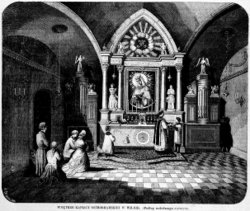
In the document, he stated that "the typical edition of the Roman Missal promulgated by Bl. John XXIII in 1962 was never abrogated" and that "in Masses celebrated without the people, each Catholic priest
Priesthood (Catholic Church)
The ministerial orders of the Catholic Church include the orders of bishops, deacons and presbyters, which in Latin is sacerdos. The ordained priesthood and common priesthood are different in function and essence....
of the Latin rite, whether secular or regular, may use the Roman Missal published by Bl. Pope John XXIII in 1962, or the Roman Missal promulgated by Pope Paul VI in 1970, and may do so on any day with the exception of the Easter Triduum
Easter Triduum
Easter Triduum, Holy Triduum, or Paschal Triduum is the period of three days that begins with the Mass of the Lord's Supper on the evening of Maundy Thursday and ends with evening prayer on Easter Sunday...
. (Therefore, priests may offer only public traditional Latin Masses/liturgies on Maundy Thursday, Good Friday and Holy Saturday.) For such celebrations, with either one Missal or the other, the priest has no need for permission from the Apostolic See or from his Ordinary." These Masses may "be attended by faithful who, of their own free will, ask to be admitted."
Regarding public Masses, the Pope asked parish priests and rectors of churches to permit celebration of a Tridentine Mass on Sundays and feasts
Calendar of saints
The calendar of saints is a traditional Christian method of organizing a liturgical year by associating each day with one or more saints and referring to the feast day of said saint...
in parishes
Parish (Catholic Church)
In the Roman Catholic Church, a parish is the lowest ecclesiastical geographical subdivision: from ecclesiastical province to diocese to deanery to parish.-Requirements:A parish needs two things under common law to become a parish...
at the request of a "stable group of faithful who adhere to the earlier liturgical tradition". He also authorised parish priests, "if the good of souls would seem to require it", to permit use of the earlier ritual for the administration of Baptism
Baptism
In Christianity, baptism is for the majority the rite of admission , almost invariably with the use of water, into the Christian Church generally and also membership of a particular church tradition...
s, Marriage
Catholic marriage
Catholic marriage, also called matrimony, is a "covenant by which a man and a woman establish between themselves a partnership of the whole of life and which is ordered by its nature to the good of the spouses and the procreation and education of offspring...
, Penance
Sacrament of Penance (Catholic Church)
In the teachings of the Roman Catholic Church, the Sacrament of Penance and Reconciliation is the method by which individual men and women may be freed from sins committed after receiving the sacrament of Baptism...
, and the Anointing of the Sick
Anointing of the Sick
Anointing of the Sick, known also by other names, is distinguished from other forms of religious anointing or "unction" in that it is intended, as its name indicates, for the benefit of a sick person...
and bishops, on the same condition, to use the earlier Pontifical
Roman Pontifical
The Roman Pontifical or Pontifical, also referred to in Latin as the Pontificale or Pontificale Romanum, is the Roman Catholic liturgical book that contains the rites performed by bishops....
in administering Confirmation
Confirmation (Catholic Church)
Confirmation is one of the seven sacraments through which Catholics pass in the process of their religious upbringing. According to Catholic doctrine, in this sacrament they receive the Holy Spirit and become adult members of the Catholic Church....
.
Bishops are encouraged to establish "personal parishes" or appoint chaplains for administering the sacraments according to the old form. (Even before the motu proprio, bishops, especially in the United States, occasionally established non-territorial parishes or oratories in which Mass and the sacraments are administered according to the old liturgy. For example, one of the largest such communities in the United States is the Oratory of Saint Francis de Sales in Saint Louis, established two years before Summorum Pontificum by Archbishop Raymond Burke.) The role of the Pontifical Commission Ecclesia Dei
Pontifical Commission Ecclesia Dei
The Pontifical Commission Ecclesia Dei is a commission of the Catholic Church established by Pope John Paul II's motu proprio Ecclesia Dei of 2 July 1988 for the care of those former followers of Archbishop Marcel Lefebvre who broke with him as a result of his consecration of four priests of his...
is confirmed, and recourse may be had to it to solve all difficulties, including by "a bishop
Bishop (Catholic Church)
In the Catholic Church, a bishop is an ordained minister who holds the fullness of the sacrament of Holy Orders and is responsible for teaching the Catholic faith and ruling the Church....
who desires to make provision for requests of lay faithful
Laity
In religious organizations, the laity comprises all people who are not in the clergy. A person who is a member of a religious order who is not ordained legitimate clergy is considered as a member of the laity, even though they are members of a religious order .In the past in Christian cultures, the...
... but is for various reasons prevented from doing so."
The Pope clarified that, as a result of his motu proprio, "the last version of the Missale Romanum prior to the Council, which was published with the authority of Pope John XXIII in 1962 and used during the Council will now be able to be used as a Forma extraordinaria of the liturgical celebration", but that "the Missal published by Paul VI and then republished in two subsequent editions by John Paul II, obviously is and continues to be the normal Form – the Forma ordinaria – of the Eucharistic Liturgy"; and that: "It is clearly seen that the new Missal will certainly remain the ordinary Form of the Roman Rite, not only on account of the juridical norms, but also because of the actual situation of the communities of the faithful."
The document allows what some traditionalists would call the novelty of proclaiming the Scripture readings in the vernacular language in Masses celebrated in the presence of the people (article 6), and in the accompanying letter the Pope said that "new Saints and some of the new Prefaces can and should be inserted in the old Missal", a matter that he committed for study to the Pontifical Commission Ecclesia Dei
Pontifical Commission Ecclesia Dei
The Pontifical Commission Ecclesia Dei is a commission of the Catholic Church established by Pope John Paul II's motu proprio Ecclesia Dei of 2 July 1988 for the care of those former followers of Archbishop Marcel Lefebvre who broke with him as a result of his consecration of four priests of his...
. The debate in the vernacular matter is whether the Epistle and Gospel could be omitted in Latin and replaced with the vernacular, or whether Article 6 merely codified the long-standing practice of the celebrant re-reading the Epistle and Gospel in the vernacular from the pulpit after they have been completed in Latin by the priest and/or deacon and subdeacon.
Summary of the accompanying letter
In his cover letterCover letter
A cover letter, covering letter, motivation letter, motivational letter or a letter of motivation is a letter of introduction attached to, or accompanying another document such as a résumé or curriculum vitae.- For employment :...
to the bishops, Pope Benedict declared unfounded two fears that had been expressed with regard to the change that he was making: that the change would detract from the authority of the Second Vatican Council; and that it would lead to disarray or even divisions within parish communities.
He recognised that "there have been exaggerations and at times social aspects unduly linked to the attitude of the faithful attached to the ancient Latin liturgical tradition." To avoid the situation whereby the desire to recover the old form of liturgy "occurred above all because in many places celebrations were not faithful to the prescriptions of the new Missal
Mass of Paul VI
The Mass of Pope Paul VI is the liturgy of the Catholic Mass of the Roman Rite promulgated by Paul VI in 1969, after the Second Vatican Council...
, but the latter actually was understood as authorising or even requiring creativity, which frequently led to deformations of the liturgy which were hard to bear ... caus(ing) deep pain to individuals totally rooted in the faith of the Church", he recommended faithful observance of the Missal of Paul VI: "The most sure guarantee that the Missal of Paul VI can unite parish communities and be loved by them consists in its being celebrated with great reverence in harmony with the liturgical directives. This will bring out the spiritual richness and the theological depth of this Missal."
Interior reconciliation
Benedict cited "interior reconciliation in the heart of the Church" as a "positive reason" for the motu proprio. Traditionalist groupsTraditionalist Catholic
Traditionalist Catholics are Roman Catholics who believe that there should be a restoration of many or all of the liturgical forms, public and private devotions and presentations of Catholic teachings which prevailed in the Catholic Church before the Second Vatican Council...
, such as the Society of St. Pius X
Society of St. Pius X
The Society of Saint Pius X is an international Traditionalist Catholic organisation, founded in 1970 by the French archbishop Marcel Lefebvre...
, whose founder Archbishop Marcel Lefebvre
Marcel Lefebvre
Marcel François Marie Joseph Lefebvre was a French Roman Catholic archbishop. Following a career as an Apostolic Delegate for West Africa and Superior General of the Holy Ghost Fathers, he took the lead in opposing the changes within the Church associated with the Second Vatican Council.In 1970,...
was excommunicated
Excommunication
Excommunication is a religious censure used to deprive, suspend or limit membership in a religious community. The word means putting [someone] out of communion. In some religions, excommunication includes spiritual condemnation of the member or group...
in 1988 following the Ecône Consecrations
Ecône Consecrations
The Écône consecrations were a set of episcopal consecrations that took place in Écône, Switzerland, on 30 June 1988. They were performed by Roman Catholic Archbishop Marcel Lefebvre and Bishop Antonio de Castro Meyer, and the priests raised to the episcopacy were four members of Lefebvre's Society...
, set permission to use the Tridentine Mass as a preliminary condition for engaging in any doctrinal
Doctrine
Doctrine is a codification of beliefs or a body of teachings or instructions, taught principles or positions, as the body of teachings in a branch of knowledge or belief system...
dialogue
Dialogue
Dialogue is a literary and theatrical form consisting of a written or spoken conversational exchange between two or more people....
with the Holy See.
Benedict, who himself led discussions with the SSPX during his tenure as Prefect
Prefect
Prefect is a magisterial title of varying definition....
of the Congregation for the Doctrine of the Faith
Congregation for the Doctrine of the Faith
The Congregation for the Doctrine of the Faith , previously known as the Supreme Sacred Congregation of the Roman and Universal Inquisition , and after 1904 called the Supreme...
, gave as a reason for making the effort represented by his motu proprio the regretted fact that, "over the centuries ... at critical moments when divisions were coming about, not enough was done by the Church's leaders to maintain or regain reconciliation and unity" and "omissions on the part of the Church have had their share of blame for the fact that these divisions were able to harden." But he pointed out, in the same cover letter, that, "needless to say, in order to experience full communion, the priests of the communities adhering to the former usage
Communities using the Tridentine Mass
A list of priestly societies and religious institutes using a pre-1970 version of the Roman Missal some but not all are in communion with the Holy See. These groups are dedicated to preserving older liturgical rites of the Roman Catholic Mass...
cannot, as a matter of principle, exclude celebrating according to the new books. The total exclusion of the new rite would not in fact be consistent with the recognition of its value and holiness." Thus, while opening the door to the Tridentine Mass, the Pope expects the SSPX to acknowledge the legitimacy of the Mass of Paul VI
Mass of Paul VI
The Mass of Pope Paul VI is the liturgy of the Catholic Mass of the Roman Rite promulgated by Paul VI in 1969, after the Second Vatican Council...
. SSPX Superior General, Bishop Fellay
Bernard Fellay
Bernard Fellay, SSPX is a bishop and superior general of the Traditionalist Catholic Society of St. Pius X. In 1988, the Roman Catholic Church declared Fellay automatically excommunicated through being consecrated a bishop by Archbishop Marcel Lefebvre, an act that the Holy See described as...
wrote, "The letter which accompanies the Motu Proprio does not hide however the difficulties that still remain." Fellay then stated that the Society is eager "after the decree of excommunication which still affects its bishops has been withdrawn—to consider more serenely the disputed doctrinal issues."
After saying in his letter to bishops, with which he accompanied the motu proprio, that "in the movement led by Archbishop Lefebvre, fidelity to the old Missal became an external mark of identity", Pope Benedict added: "The reasons for the break which arose over this, however, were at a deeper level."
Appeal of the ancient form
Apart from the question of reconciliation with traditionalist groups, the Pope also mentioned that, immediately after the promulgation of the new form of the Mass, it was presumed that "requests for the use of the 1962 Missal would be limited to the older generation which had grown up with it", but recognizes that "in the meantime it has clearly been demonstrated that young persons too have discovered this liturgical form, felt its attraction and found in it a form of encounter with the Mystery of the Most Holy Eucharist, particularly suited to them." Due to this continuing appeal of the ancient form of the Mass across generational groups it was felt that cases should no longer be decided on a case-by-case basis, and that, instead the need had arisen for "clearer juridical regulation which had not been foreseen" in the past.The Pope stressed: "There is no contradiction between the two editions of the Roman Missal. In the history of the liturgy there is growth and progress, but no rupture. What earlier generations held as sacred, remains sacred and great for us too, and it cannot be all of a sudden entirely forbidden or even considered harmful. It behooves all of us to preserve the riches which have developed in the Church’s faith and prayer, and to give them their proper place." He continued by demanding recognition also of the "value and holiness" of celebration according to the new books.
Conditions for use of the 1962 Missal
The conditions for the use of the 1962 Missal previously in force are replaced by the following:- In Masses celebrated without the people, each Catholic priest of the Latin rite, whether secular or religious, may use the Roman Missal published by Bl. Pope John XXIII in 1962, or the Roman Missal promulgated by Pope Paul VI in 1970, and may do so on any day with the exception of the Easter Triduum (when private Masses are not allowed). For such celebrations, with either one Missal or the other, the priest has no need for permission from the Apostolic See or from his Ordinary. Celebrations of Mass as mentioned above may—observing all the norms of law—also be attended by faithful who, of their own free will, ask to be admitted. (Articles 2 and 4)
- In parishes, where there is a stable group of faithful who adhere to the earlier liturgical tradition, the pastor should willingly accept their requests to celebrate the Mass according to the rite of the Roman Missal published in 1962, and ensure that the welfare of these faithful harmonises with the ordinary pastoral care of the parish, under the guidance of the bishop in accordance with canon 392, avoiding discord and favouring the unity of the whole Church. In churches that are not parish or conventual churches, it is the duty of the Rector of the church to grant this permission. (Article 5 §1 and §5)
- Celebration in accordance with the Missal of Bl. John XXIII may take place on working days; while on Sundays and feast days one such celebration may also be held. (Article 5 §2)
- For faithful and priests who request it, the pastor should also allow celebrations in this extraordinary form for special circumstances such as marriages, funerals or occasional celebrations, e.g. pilgrimages. (Article 5 §3)
- The priest whom the pastor or the rector of a church admits to use the Missal of Bl. John XXIII must be qualified to do so and not juridically impeded (for instance by being suspended a divinis). (Article 5 §4)
- Communities of Institutes of consecrated life and of Societies of apostolic life of either pontifical or diocesan right, wishing to celebrate Mass in accordance with the edition of the Roman Missal promulgated in 1962, for conventual or "community" celebration in their oratories, may do so. For a community or an entire Institute or Society to do so permanently, the major superior must decide in accordance with canon law and statutes of the Institute or Society. (Article 3)
In an interview on Vatican Radio
Vatican Radio
Vatican Radio is the official broadcasting service of the Vatican.Set up in 1931 by Guglielmo Marconi, today its programs are offered in 47 languages, and are sent out on short wave , medium wave, FM, satellite and the Internet. The Jesuit Order has been charged with the management of Vatican...
, the then Cardinal President of the Pontifical Commission Ecclesia Dei
Pontifical Commission Ecclesia Dei
The Pontifical Commission Ecclesia Dei is a commission of the Catholic Church established by Pope John Paul II's motu proprio Ecclesia Dei of 2 July 1988 for the care of those former followers of Archbishop Marcel Lefebvre who broke with him as a result of his consecration of four priests of his...
Darío Castrillón Hoyos commented that "priests can decide, without permission from the Holy See or the bishop, to celebrate the Mass in the ancient rite. And this holds true for all priests. It is the parish priests who must open the doors to those priests that, having the faculty [to do so], go to celebrate. It is not therefore necessary to ask any other permission."
Article 2 of the motu proprio applies, without distinction, to priests of the Latin Rite, all of whom are therefore authorized to use, in Masses celebrated without the people, either the older (1962) or the newer (1970) form of the Roman Rite, even if they are also authorized to use another Latin liturgical rite, such as the Ambrosian Rite
Ambrosian Rite
Ambrosian Rite, also called the Milanese Rite, is a Catholic liturgical Western Rite. The rite is named after Saint Ambrose, a bishop of Milan in the fourth century...
. It does not apply to priests of the Eastern Catholic Churches. It concerns only the Roman Rite and does not deal with use of older forms of other Latin liturgical rites, which is a matter for the authorities charged with regulating those rites.
With letter 13/2007 of 20 January 2010 the Pontifical Council Ecclesia Dei responded positively to a question whether a parish priest (pastor) or another priest may on his own initiative publicly celebrate the extraordinary form, along with the customary regular use of the new form, "so that the faithful, both young and old, can familiarize themselves with the old rites and benefit from their perceptible beauty and transcendence". Although the Council accompanied this response with the observation that a stable group of the faithful attached to the older form has a right to assist at Mass in the extraordinary form, a website that published the response interpreted it as not requiring the existence of such a stable group.
History
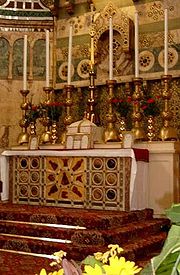
Mass (liturgy)
"Mass" is one of the names by which the sacrament of the Eucharist is called in the Roman Catholic Church: others are "Eucharist", the "Lord's Supper", the "Breaking of Bread", the "Eucharistic assembly ", the "memorial of the Lord's Passion and Resurrection", the "Holy Sacrifice", the "Holy and...
is the Catholic Church's Eucharist celebration, whose basic form dates back to the earliest Apostolic Fathers
Apostolic Fathers
The Apostolic Fathers are a small number of Early Christian authors who lived and wrote in the second half of the first century and the first half of the second century. They are acknowledged as leaders in the early church, although their writings were not included in the New Testament...
. It has undergone various developments in its practice, especially in the early centuries. In response to Sacrosanctum Concilium
Sacrosanctum Concilium
Sacrosanctum Concilium, the Constitution on the Sacred Liturgy, is one of the constitutions of the Second Vatican Council. It was approved by the assembled bishops by a vote of 2,147 to 4 and promulgated by Pope Paul VI on December 4, 1963...
, the 1963 document of the Second Vatican Council
Second Vatican Council
The Second Vatican Council addressed relations between the Roman Catholic Church and the modern world. It was the twenty-first Ecumenical Council of the Catholic Church and the second to be held at St. Peter's Basilica in the Vatican. It opened under Pope John XXIII on 11 October 1962 and closed...
, the Mass of the Roman Rite was systematically revised, leading to the publication, in 1970, of Pope Paul VI's revision of the Roman Missal
Roman Missal
The Roman Missal is the liturgical book that contains the texts and rubrics for the celebration of the Mass in the Roman Rite of the Catholic Church.-Situation before the Council of Trent:...
, which some Traditionalist Catholics claimed constituted a rupture with what went before. Pope Benedict XVI does not share this view, stating in the letter that accompanied Summorum Pontificum: "There is no contradiction between the two editions of the Roman Missal. In the history of the liturgy there is growth and progress, but no rupture." But some traditionalists opposed the use of the new form of the liturgy and demanded what they called a universal indult
Universal indult
Universal indult is a term that was used primarily by traditionalist Catholics in a very specific sense. Since an indult signifies a favour granted to an individual or limited group, a similar measure applied to every member of a particular class of persons would in reality be a change of the law,...
whereby all priests would be allowed to use the former rite even publicly without seeking any specific authorisation.
For more than a year before the publication of Summorum Pontificum Vatican officials, such as Cardinal Castrillón Hoyos, President
President
A president is a leader of an organization, company, trade union, university, or country.Etymologically, a president is one who presides, who sits in leadership...
of the Pontifical Commission Ecclesia Dei, indicated that Pope Benedict XVI had decided to issue a document on the matter. As the date on which it was in fact issued approached, these declarations became more precise. The views of bishops in various countries and also of traditionalist groups were sought on the various drafts.
On the part of the bishops, two fears were expressed, which Pope Benedict mentioned in the letter to bishops with which he accompanied his motu proprio, declaring them unfounded. One was fear that the document detracts from the authority of the Second Vatican Council, by calling into question one of the Council's essential decisions, namely the liturgical reform. The other was fear that the possibility of a wider use of the 1962 Missal would lead to disarray or even divisions within parish communities. On the latter fear, the Pope commented that "the use of the old Missal presupposes a certain degree of liturgical formation and some knowledge of the Latin language; neither of these is found very often", and that accordingly "it is clearly seen that the new Missal will certainly remain the ordinary Form of the Roman Rite."
Cardinal Castrillón Hoyos, President of the Pontifical Commission Ecclesia Dei
Pontifical Commission Ecclesia Dei
The Pontifical Commission Ecclesia Dei is a commission of the Catholic Church established by Pope John Paul II's motu proprio Ecclesia Dei of 2 July 1988 for the care of those former followers of Archbishop Marcel Lefebvre who broke with him as a result of his consecration of four priests of his...
, the body charged with overseeing the implementation of the motu proprio Summorum Pontificum, commented on the worry that some have expressed, even after publication of the motu proprio, "that a small minority of believers may impose the mass of Saint Pius V on the parish". He stated: "Those who say that obviously haven't read the motu proprio. It's clear that no parish priest will be obliged to celebrate the mass of Saint Pius V. Only that if a group of the faithful, having a priest disposed to say it, asks to celebrate this mass, the parish priest or the rector of the church can't oppose it."
Reactions
The document was well received by supporters of the Tridentine Mass, but was also criticised by some Catholics and Jewish leaders.Reactions by Catholic bishops
Most internal official reactions emphasised the wish of unity and reconciliation within the Church. Archbishop José Horacio GomezJosé Horacio Gomez
José Horacio Gómez is a Mexican-born prelate of the Roman Catholic Church in the United States, currently serving as the Archbishop of Los Angeles. He previously served as Auxiliary Bishop of Denver from 2001–2004 and as Archbishop of San Antonio from 2004–2010.Born in Monterrey, Mexico, Gómez was...
of San Antonio said in a press statement that he believed the letter "will open up great possibilities for reconciliation and unity with those who have shown great devotion to the Roman liturgy prior to the reform of 1970." ... "People will be able to more clearly see the growth and progress we have realized since Vatican II, while at the same time preserving the rich heritage and legacy of the Church." Cardinal Cormac Murphy-O'Connor, archbishop of Westminster
Westminster
Westminster is an area of central London, within the City of Westminster, England. It lies on the north bank of the River Thames, southwest of the City of London and southwest of Charing Cross...
, said: "On behalf of the bishops of England and Wales, I welcome the Holy Father's call for unity within the Church and especially toward those who are very attached to celebrating the Mass according to the Missal of 1962. The Bishops' Conference of Scotland
Bishops' Conference of Scotland
The Bishops' Conference of Scotland is an episcopal conference for Roman Catholic bishops in Scotland and is based in Airdrie. The conference is primarily made up of the presiding bishops of Scotland's eight dioceses as well as bishops who have retired....
said in a statement that the document "reflects the pastoral concern" of Benedict XVI "for those who find themselves drawn to that form of the Eucharistic celebration"..."a pastoral concern which the bishops of Scotland share." sharing the Pope's "concern about the unity of the Church."
An atypical reaction was that of Chile
Chile
Chile ,officially the Republic of Chile , is a country in South America occupying a long, narrow coastal strip between the Andes mountains to the east and the Pacific Ocean to the west. It borders Peru to the north, Bolivia to the northeast, Argentina to the east, and the Drake Passage in the far...
an bishop Juan Ignacio González Errázuriz
Juan Ignacio González Errázuriz
Juan Ignacio González Errázuriz is the Roman Catholic bishop of San Bernardo, Chile. He is a member of the Prelature of Opus Dei.-References:...
, who said the document was aimed not so much at "putting an end to the schism of Archbishop Lefebvre and his followers" as at promoting unity among Chinese Catholics. However, even the parts of the Catholic Church in China that were under the control of the Government-created Chinese Patriotic Catholic Association
Chinese Patriotic Catholic Association
The Chinese Patriotic Catholic Association , abbreviated CPA, CPCA, or CCPA, is an association of people, established in 1957 by the People's Republic of China's Religious Affairs Bureau to exercise state supervision over mainland China's Catholics...
had for years already been using the revised form of the Mass and in the vernacular, not the Tridentine Mass in Latin.
Italian bishop Luca Brandolini
Luca Brandolini
Luca Brandolini, CM is an Italian prelate of the Roman Catholic Church who currently serves as Bishop of Sora-Aquino-Pontecorvo.-Biography:...
said, "This is the saddest moment in my life as a man, priest and bishop. It's a day of mourning, not just for me but for the many people who worked for the Second Vatican Council. A reform for which many people worked, with great sacrifice and only inspired by the desire to renew the Church, has now been cancelled." However, he declared, "I will obey the Holy Father, because I am a bishop and because I care for the Holy Father".
Others expressed concern that the loosening of the restrictions for celebration of the Mass would cause practical problems for parish priests who might be pressured to offer the Mass according to the 1962 Missal, and that such pressure would "seem like a standard aimed at testing the priests' loyalty to the pope." Cardinal Castrillón responded to this concern by pointing out that the motu proprio does not oblige any priest to use the 1962 Missal: all that the parish priest or rector of a church is asked to do is to permit a stable group adhering to the earlier tradition and who have a priest disposed to use that Missal to celebrate Mass in the church. Only a limited number of priests actually know how to celebrate the Tridentine Mass, and a shortage of priest
Priest shortage
A priest shortage is the situation of a reduced number of priests in religions, especially the Roman Catholic Church.In 2008, 49,631 parishes in the world had no resident priest pastor. While the number of Catholics in the world nearly doubled between 1970 and 2008, growing from 653 Million to...
s means that many priests already have full schedules on weekends. In response to these concerns, a number of Bishops announced their intentions to issue guidance on how best to implement Summorum Pontificum in their dioceses in line with the motu proprio's rule that "Priests who use the Missal of Bl. John XXIII must be qualified to do so". One of these was Bishop Donald W. Trautman
Donald Walter Trautman
Donald Walter Trautman is an American prelate of the Roman Catholic Church who serves as Bishop of Erie.-Biography:Donald Trautman was born in Buffalo, New York, and attended Niagara University in Lewiston. He studied theology under Karl Rahner at the University of Innsbruck in Austria, from...
of the Diocese of Erie, Pennsylvania
Roman Catholic Diocese of Erie
The Roman Catholic Diocese of Erie is a Roman Catholic diocese in western Pennsylvania. It was founded on July 29, 1853. It is one of seven suffragan sees in Pennsylvania that make up the Ecclesiastical Province of Philadelphia, which is headed by the Roman Catholic Archdiocese of Philadelphia.-...
, who indicated that those priests who celebrate such a Mass would first need to show that they have the requisite knowledge of its rubrics and of Latin
Latin
Latin is an Italic language originally spoken in Latium and Ancient Rome. It, along with most European languages, is a descendant of the ancient Proto-Indo-European language. Although it is considered a dead language, a number of scholars and members of the Christian clergy speak it fluently, and...
.
Reactions of traditionalist Catholic groups
Various advocates for the Tridentine Mass voiced cautious optimism for the future and prepared for the practical aspects of the decision. In a statement, The Latin Mass Society of IrelandLatin Mass Society of Ireland
The Latin Mass Society of Ireland, founded in 1999, is a Roman Catholic society based in Ireland that is dedicated to the preservation of the traditional Tridentine Mass as one of the forms of the Church's liturgy and to making it more widely available...
said: "We are very grateful to the Pope for enriching the life of the Church in this way and for enhancing legitimate liturgical diversity. In doing this Pope Benedict is building on the foundation laid by his predecessor Pope John Paul II
Pope John Paul II
Blessed Pope John Paul II , born Karol Józef Wojtyła , reigned as Pope of the Catholic Church and Sovereign of Vatican City from 16 October 1978 until his death on 2 April 2005, at of age. His was the second-longest documented pontificate, which lasted ; only Pope Pius IX ...
in his 1988 motu proprio Ecclesia Dei Adflicta
Ecclesia Dei
Ecclesia Dei or Ecclesia Dei adflicta is the incipit of the motu proprio of 2 July 1988 that Pope John Paul II issued in reaction to the consecration, in spite of an express prohibition by the Holy See, of four bishops by Archbishop Marcel Lefebvre and Bishop Antônio de Castro Mayer in Ecône,...
. The Latin Mass Society of England and Wales
Latin Mass Society of England and Wales
The Latin Mass Society of England and Wales is a Roman Catholic society based in England and Wales that is dedicated to making the Traditional Latin Mass more widely available...
said: "Thirty-seven years ago, the Latin Mass Society was denounced by The Universe
The Universe (newspaper)
The Universe is a newspaper for Roman Catholics in Britain and Ireland. It was founded on 8th December 1860 and has been in continuous publication since...
newspaper for its attachment to the Traditional Latin Rite under the banner headline, 'Latin Madness'. Today, the loyalty, determination and sufferings of the Traditional faithful have been vindicated by Pope Benedict XVI's wise and pastoral motu proprio. This [decision] puts an end to the discrimination, marginalisation and exclusion which, too often, Traditional Catholics have suffered. ... However, now is the time for the 'interior reconciliation in the heart of the Church' for which Pope Benedict calls." The Catholic publishing house Baronius Press
Baronius Press
Baronius Press is a traditional Catholic book publisher with headquarters in London, England. It was founded in Glasgow, Scotland in 2003 by former St Austin Press editor, Ashley Paver and other young Catholics who had previously worked in publishing and printing...
warmly welcomed the motu proprio and prepared to publish a special printing of their edition of the 1962 Missal around the date of the coming into effect of Summorum Pontificum.
Some traditionalist Catholics criticized Summorum Pontificum for not going far enough, for insisting on accepting the Pauline Mass as the ordinary or normal form of the Roman Rite, and they saw the authorisation to use the 1962 Missal as a ruse to get traditionalists to compromise themselves.
Writer Damian Thompson, Editor-in-chief of the Catholic Herald, Telegraph journalist and blogger, wrote on 16 November 2007 that, as a result of the publication of Pope Benedict's document of 7 July 2007, "Cardinal Murphy-O'Connor was most displeased. Last week he hit back with a 'commentary' on Summorum Pontificum. According to Murphy-O'Connor, the ruling leaves the power of local bishops untouched. In fact, it removes the bishops' power to block the ancient liturgy; the cardinal is misrepresenting its contents."
Cardinal Murphy-O'Connor's words as quoted by Thompson echo those of Pope Benedict, who wrote to the bishops: "I very much wish to stress that these new norms do not in any way lessen your own authority and responsibility, either for the liturgy or for the pastoral care of your faithful"; and he invited them "to send to the Holy See an account of your experiences, three years after this Motu Proprio has taken effect. If truly serious difficulties come to light, ways to remedy them can be sought."
Thompson believed that Pope Benedict had a low opinion of the English bishops, and on 5 November 2007 suggested that three of them were in the mind of the Secretary of the Congregation for Divine Worship and the Discipline of the Sacraments
Congregation for Divine Worship and the Discipline of the Sacraments
The Congregation for Divine Worship and the Discipline of the Sacraments is the congregation of the Roman Curia that handles most affairs relating to liturgical practices of the Latin Catholic Church as distinct from the Eastern Catholic Churches and also some technical matters relating to the...
, Malcolm Ranjith
Malcolm Ranjith
Albert Malcolm Ranjith Patabendige Don , often known simply as Malcolm Ranjith or Albert Malcolm Ranjith is a Cardinal of the Holy Roman Church who serves as the de facto primate of Sri Lanka...
, when he remarked that the document Summorum Pontificum, which had come into force on 14 September, had met with "criticisms and opposition, even from theologians, liturgists, priests, Bishops, and even Cardinals", and that "there have been, by some dioceses, even interpretative documents which inexplicably aim to limit the Pope's motu proprio. These actions mask behind them, on one hand, prejudices of an ideological kind and, on the other, pride, one of the gravest sins. I repeat: I invite all to obey the Pope."
Making a comparison between bishops attending a Mass
Mass (liturgy)
"Mass" is one of the names by which the sacrament of the Eucharist is called in the Roman Catholic Church: others are "Eucharist", the "Lord's Supper", the "Breaking of Bread", the "Eucharistic assembly ", the "memorial of the Lord's Passion and Resurrection", the "Holy Sacrifice", the "Holy and...
celebrated by a visiting cardinal and attendance at the launch of a new book, Thompson also "passed on a rumour" that Pope Benedict was annoyed at the absence of any English bishop at the Pontifical High Mass
Pontifical High Mass
In the context of the Tridentine Mass of the Roman Catholic Church, a Pontifical High Mass, also called Solemn Pontifical Mass, is a Solemn or High Mass celebrated by a bishop using certain prescribed ceremonies. The term is also used among Anglo-Catholic Anglicans.-Origins:In the early Church,...
that Cardinal Darío Castrillón Hoyos, head of Ecclesia Dei
Pontifical Commission Ecclesia Dei
The Pontifical Commission Ecclesia Dei is a commission of the Catholic Church established by Pope John Paul II's motu proprio Ecclesia Dei of 2 July 1988 for the care of those former followers of Archbishop Marcel Lefebvre who broke with him as a result of his consecration of four priests of his...
, celebrated in Cardinal Murphy-O'Connor's own Westminster Cathedral
Westminster Cathedral
Westminster Cathedral in London is the mother church of the Catholic community in England and Wales and the Metropolitan Church and Cathedral of the Archbishop of Westminster...
on 14 June 2008.
After the Mass, Cardinal Castrillón Hoyos spoke with journalists. To an unnamed conservative journalist who insisted vehemently that some bishops in England were denying permission for the old Mass to be celebrated in their dioceses, the cardinal said such cases were few. He also met with Cardinal Murphy-O'Connor and, according to a statement issued by the English cardinal's office, "Cardinal Castrillón expressed his gratitude to his fellow cardinal for the generous way which the bishops of England and Wales had responded to an indult from Pope Paul VI allowing traditionalists to celebrate the old rite and for their reception of Pope Benedict's motu proprio."
FSSP
The Priestly Fraternity of St. PeterPriestly Fraternity of St. Peter
The Priestly Fraternity of St. Peter is a traditionalist Catholic Society of Apostolic Life of priests and seminarians in good standing with the Holy See.-Canonical status:...
(FSSP), which exclusively celebrates the Traditional Latin Mass, "rejoice[d] at the publication of the Motu Proprio Summorum Pontificum. In reaffirming the essential place of the liturgy itself in the transmission of the faith, in stating that the Missal of Blessed John XXIII may be used by all priests, and especially in encouraging the use of all four liturgical book
Liturgical book
A liturgical book is a book published by the authority of a church, that contains the text and directions for the liturgy of its official religious services.-Roman Catholic:...
s in force in 1962, the text opens to the whole Church the treasures of these rites." The motu proprio was issued on the first anniversary of the election of the Fraternity's current superior general, Fr. The Fraternity further announced that it would "continue to look to serve the needs of the Church, and hopes that the success of the chapels and parishes already erected in the last 19 years in so many dioceses will provide encouraging examples for the document's implementation. Our deepest gratitude to His Holiness Pope Benedict XVI. Dominus conservet eum, et vivificet eum."
SSPX
The Priestly Society of Saint Pius X, which was consulted by Pope Benedict during the process, said in a statement that it "extends its deep gratitude to (Pope Benedict) for this great spiritual benefit" and "rejoices to see the Church thus regain her liturgical Tradition, and give the possibility of a free access to the treasure of the Traditional Mass ... (for those) who had so far been deprived of it". The Society, however, points out that "difficulties still remain". It wishes that the "favorable climate established by the Holy See" will "make it possible to consider more serenely the disputed doctrinal issues" and that the decree of excommunication which still affects its bishops be withdrawn.Jewish reaction
The Jewish Anti-Defamation LeagueAnti-Defamation League
The Anti-Defamation League is an international non-governmental organization based in the United States. Describing itself as "the nation's premier civil rights/human relations agency", the ADL states that it "fights anti-Semitism and all forms of bigotry, defends democratic ideals and protects...
(ADL) attacked the document, because the text of the Good Friday Prayer for the Jews in the 1962 Missal includes a request to God to "lift the veil" from Jewish hearts and to show mercy, according to one translation, "even to the Jews" (or "also to the Jews"), and refers to "the blindness of that people" (to Christ).ADL head calls pope's Tridentine Mass letter a "theological setback". Catholic News Service In reply to such criticisms, Dr John Newton, editor of Baronius Press
Baronius Press
Baronius Press is a traditional Catholic book publisher with headquarters in London, England. It was founded in Glasgow, Scotland in 2003 by former St Austin Press editor, Ashley Paver and other young Catholics who had previously worked in publishing and printing...
, pointed out that the prayer draws heavily on 2 Corinthians chapters 3 and 4, and the invocation for God to "lift the veil from their hearts" is a direct quote from . Other objections were raised in the mistaken belief that the pre-1960 form of the Prayer for the Jews that was included in the original form of the Tridentine Mass
Tridentine Mass
The Tridentine Mass is the form of the Roman Rite Mass contained in the typical editions of the Roman Missal that were published from 1570 to 1962. It was the most widely celebrated Mass liturgy in the world until the introduction of the Mass of Paul VI in December 1969...
was being restored, a form that spoke of "the faithless Jews" (pro perfidis Iudaeis, which some interpreted as meaning "the perfidious Jews". Pope John XXIII replaced this prayer in 1959, so that it does not appear in the missal permitted by Summorum Pontificum. The American Jewish Committee
American Jewish Committee
The American Jewish Committee was "founded in 1906 with the aim of rallying all sections of American Jewry to defend the rights of Jews all over the world...
(AJC) stated in a press release:
- We acknowledge that the Church's liturgy is an internal Catholic matter and this motu proprio from Pope Benedict XVI is based on the permission given by John Paul II in 1988 and thus, on principle, is nothing new. However we are naturally concerned about how wider use of this Tridentine liturgy may impact upon how Jews are perceived and treated. We appreciate that the motu proprio actually limits the use of the Latin Mass in the days prior to Easter, which addresses the reference in the Good Friday liturgy concerning the Jews," Rosen added. "However, it is still not clear that this qualification applies to all situations and we have called on the Vatican to contradict the negative implications that some in the Jewish community and beyond have drawn concerning the motu proprio."
In response to such continued complaints, Pope Benedict XVI in 2008 replaced the prayer in the 1962 Missal with a newly composed prayer that makes no mention of blindness or darkness.
Universae Ecclesiae
With the approval of Pope Benedict XVI, the Pontifical Commission Ecclesia DeiPontifical Commission Ecclesia Dei
The Pontifical Commission Ecclesia Dei is a commission of the Catholic Church established by Pope John Paul II's motu proprio Ecclesia Dei of 2 July 1988 for the care of those former followers of Archbishop Marcel Lefebvre who broke with him as a result of his consecration of four priests of his...
issued the instruction Universae Ecclesiae of 30 April 2011, feast of Saint Pius V
Pope Pius V
Pope Saint Pius V , born Antonio Ghislieri , was Pope from 1566 to 1572 and is a saint of the Catholic Church. He is chiefly notable for his role in the Council of Trent, the Counter-Reformation, and the standardization of the Roman liturgy within the Latin Church...
, to clarify some aspects of Summorum Pontificum.
The normative part of the document (nn.12-35) contains 23 brief points on various arguments. It reaffirms the competence of the diocesan bishops in implementing the Motu proprio, recalling that in the event of a dispute about the celebration in forma extraordinaria
Extraordinary form of the Roman Rite
"An extraordinary form of the Roman Rite" is a phrase used in Pope Benedict XVI's motu proprio Summorum Pontificum to describe the liturgy of the 1962 Roman Missal, widely referred to as the "Tridentine Mass"...
judgement falls to the Ecclesia Dei Commission. It clarifies the concept of coetus fidelium (in short "group of faithful") stabiliter existens ("stable") whose desire to participate in the celebration of the forma extraordinaria must be welcomed and accepted by pastors. While leaving the assessment of the number of people required for its establishment to the wise judgement of pastors, it states that the group does not necessarily have to be composed of persons belonging to a single parish, but may result from people who come together from different parishes or even from other dioceses. While always taking into account compliance with wider pastoral needs, the Instruction proposes a spirit of "generous welcome" towards groups of faithful who request the forma extraordinaria or priests who request to occasionally celebrate in such a form with some of the faithful. The clarification (n.19) according to which the faithful who request the celebration in forma extraordinaria "must not in any way support or belong to groups that show themselves to be contrary to the validity or legitimacy of forma ordinaria " and/or authority of the Pope, is most important. This would be in flagrant contradiction to the motu proprio’s very aim of "reconciliation". Priests must have a sufficient knowledge of Latin and know the rite to be celebrated. Bishops are therefore encouraged to make proper formation for this purpose available in seminaries, and the possibility of recourse, if there are no other suitable priests, to the collaboration of priests from the Institutes set up by the "Ecclesia Dei" Commission (which normally use the forma extraordinaria) is also indicated. The use of the 1962 forms of conferring Holy Orders is permitted only in those institutes that exclusively celebrate the 1962 Missal
Communities using the Tridentine Mass
A list of priestly societies and religious institutes using a pre-1970 version of the Roman Missal some but not all are in communion with the Holy See. These groups are dedicated to preserving older liturgical rites of the Roman Catholic Mass...
that are under the Pontifical Commission Ecclesia Dei.
The instruction is structured as follows:
I. Introduction
II. The Responsibilities of the Pontifical Commission Ecclesia Dei
III. Specific Norms
- The Competence of Diocesan Bishops
- The coetus fidelium (cf. Motu Proprio Summorum Pontificum, art. 5 § 1)
- Sacerdos idoneus (“Qualified Priest”) (cf. Motu Proprio Summorum Pontificum, art 5 § 4)
- Liturgical and Ecclesiastical Discipline
- Confirmation and Holy Orders
- Breviarium Romanum
- The Sacred Triduum
- The Rites of Religious Orders
- Pontificale Romanum and the Rituale Romanum
Article 8 specified the aims of Summorum Pontificum as:
- offering to all the faithful the Roman Liturgy in the Usus Antiquior, considered as a precious treasure to be preserved;
- effectively guaranteeing and ensuring the use of the forma extraordinaria for all who ask for it, given that the use of the 1962 Roman Liturgy is a faculty generously granted for the good of the faithful and therefore is to be interpreted in a sense favourable to the faithful who are its principal addressees;
- promoting reconciliation at the heart of the Church.
Other sections include:
On diocesan bishops:
14. It is the task of the Diocesan Bishop to undertake all necessary measures to ensure respect for the forma extraordinaria of the Roman Rite, according to the Motu Proprio Summorum Pontificum.
On the coetus fidelium ("group of the faithful"):
19. The faithful who ask for the celebration of the forma extraordinaria must not in any way support or belong to groups which show themselves to be against the validity or legitimacy of the Holy Mass or the Sacraments celebrated in the forma ordinaria or against the Roman Pontiff as Supreme Pastor of the Universal Church.
The head of the Holy See's Press Office, Father Federico Lombardi
Federico Lombardi
Federico Lombardi, SJ is an Italian Roman Catholic priest and the current director of the Holy See Press Office.-Early life and ordination:...
called this clarification "most important".
On sacerdos idoneus
20. With respect to the question of the necessary requirements for a priest to be held idoneus ("qualified") to celebrate in the forma extraordinaria, the following is hereby stated:
- Every Catholic priest who is not impeded by Canon Law is to be considered idoneus ("qualified") for the celebration of the Holy Mass in the forma extraordinaria.
- Regarding the use of the Latin language, a basic knowledge is necessary, allowing the priest to pronounce the words correctly and understand their meaning.
- Regarding knowledge of the execution of the Rite, priests are presumed to be qualified who present themselves spontaneously to celebrate the forma extraordinaria, and have celebrated it previously.
21. Ordinaries are asked to offer their clergy the possibility of acquiring adequate preparation for celebrations in the forma extraordinaria. This applies also to Seminaries, where future priests should be given proper formation, including study of Latin and, where pastoral needs suggest it, the opportunity to learn the forma extraordinaria of the Roman Rite.
On norms of law later than 1962:
27. With regard to the disciplinary norms connected to celebration, the ecclesiastical discipline contained in the Code of Canon Law of 1983 applies.
28. Furthermore, by virtue of its character of special law, within its own area, the Motu Proprio Summorum Pontificum derogates from those provisions of law, connected with the sacred Rites, promulgated from 1962 onwards and incompatible with the rubrics of the liturgical books in effect in 1962.
This has been interpreted as ruling out extraordinary ministers of Holy Communion, female altar servers, etc.
On the Triduum Sacrum:
33. If there is a qualified priest, a coetus fidelium (“group of faithful”), which follows the older liturgical tradition, can also celebrate the Sacred Triduum in the forma extraordinaria. When there is no church or oratory designated exclusively for such celebrations, the parish priest or Ordinary, in agreement with the qualified priest, should find some arrangement favourable to the good of souls, not excluding the possibility of a repetition of the celebration of the Sacred Triduum in the same church.
Official documents
Summorum Pontificum Summorum Pontificum Cover letter Summorum Pontificum and cover letter, along with analysis and commentary from the United States Conference of Catholic BishopsUnited States Conference of Catholic Bishops
The United States Conference of Catholic Bishops is the episcopal conference of the Catholic Church in the United States. Founded in 1966 as the joint National Conference of Catholic Bishops and United States Catholic Conference, it is composed of all active and retired members of the Catholic...
Universae Ecclesiae: Instruction of Ecclesia Dei
Ecclesia Dei
Ecclesia Dei or Ecclesia Dei adflicta is the incipit of the motu proprio of 2 July 1988 that Pope John Paul II issued in reaction to the consecration, in spite of an express prohibition by the Holy See, of four bishops by Archbishop Marcel Lefebvre and Bishop Antônio de Castro Mayer in Ecône,...
on Summorum Pontificum
Responses from traditionalist Catholic organizations
- Press Release from the Superior General of the SSPX
- News from the Priestly Fraternity of St. Peter
- Press Release from the Institute of Christ the King Sovereign Priest
Commentary
- Twenty Questions on the Apostolic Letter Summorum Pontificum United States Conference of Catholic Bishops
- Nova et Vetera
- Commentary on the text of the document by Jimmy Akin Il Summorum Pontificum, un anno dopo
- Woods, Thomas E., Sacred Then and Sacred Now: The Return of the Old Latin Mass (Roman Catholic Books 2008 ISBN 9780979354021)
- Aillet, Marc, The old Mass and the new : explaining the motu proprio Summorum Pontificum of Pope Benedict XVI (Ignatius Press 2010 ISBN 9781586173623)