

Antimension

Encyclopedia
Altar
An altar is any structure upon which offerings such as sacrifices are made for religious purposes. Altars are usually found at shrines, and they can be located in temples, churches and other places of worship...
in many Eastern Christian
Eastern Christianity
Eastern Christianity comprises the Christian traditions and churches that developed in the Balkans, Eastern Europe, Asia Minor, the Middle East, Northeastern Africa, India and parts of the Far East over several centuries of religious antiquity. The term is generally used in Western Christianity to...
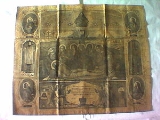
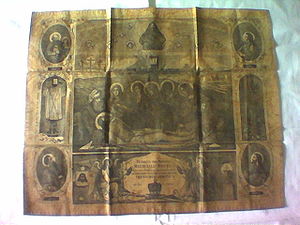
liturgical traditions. It is a rectangular piece of cloth, either linen or silk, typically decorated with representations of the Descent of Christ from the Cross
Descent from the Cross
The Descent from the Cross , or Deposition of Christ, is the scene, as depicted in art, from the Gospels' accounts of Joseph of Arimathea and Nicodemus taking Christ down from the cross after his crucifixion . In Byzantine art the topic became popular in the 9th century, and in the West from the...
, the four Evangelists
Four Evangelists
In Christian tradition the Four Evangelists are Matthew, Mark, Luke, and John, the authors attributed with the creation of the four Gospel accounts in the New Testament that bear the following titles:*Gospel according to Matthew*Gospel according to Mark...
, and inscriptions related to the Passion
Passion (Christianity)
The Passion is the Christian theological term used for the events and suffering – physical, spiritual, and mental – of Jesus in the hours before and including his trial and execution by crucifixion...
. A small relic
Relic
In religion, a relic is a part of the body of a saint or a venerated person, or else another type of ancient religious object, carefully preserved for purposes of veneration or as a tangible memorial...
of a martyr
Martyr
A martyr is somebody who suffers persecution and death for refusing to renounce, or accept, a belief or cause, usually religious.-Meaning:...
is sewn into it.
It is not permitted to celebrate the Eucharist
Eucharist
The Eucharist , also called Holy Communion, the Sacrament of the Altar, the Blessed Sacrament, the Lord's Supper, and other names, is a Christian sacrament or ordinance...
without an antimins. The antimins is kept in the centre of the Holy Table (altar) and is unfolded only during the Divine Liturgy
Divine Liturgy
Divine Liturgy is the common term for the Eucharistic service of the Byzantine tradition of Christian liturgy. As such, it is used in the Eastern Orthodox and Eastern Catholic Churches. Armenian Christians, both of the Armenian Apostolic Church and of the Armenian Catholic Church, use the same term...
, before the Anaphora
Anaphora (liturgy)
The Anaphora is the most solemn part of the Divine liturgy, Mass, or other Christian Communion rite where the offerings of bread and wine are consecrated as the body and blood of Christ. This is the usual name for this part of the Liturgy in Eastern Christianity, but it is more often called the...
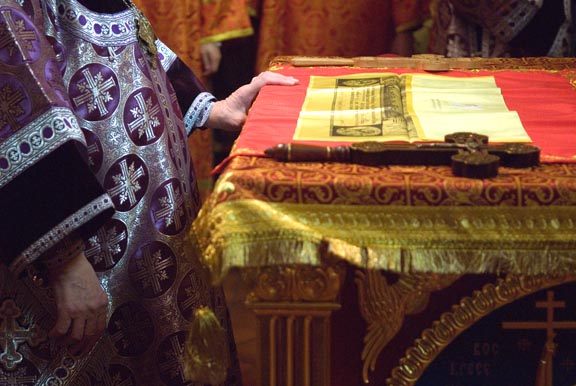
. At the end of the Liturgy, the antimins is folded in thirds, and then in thirds again, so that when it is unfolded the creases form a cross (see picture, left). When folded, the antimins sits in the center of another slightly larger cloth, the eiliton (Slavonic: Ilitón)—similar to the western corporal
Corporal (liturgy)
The Corporal is a square white linen cloth, now usually somewhat smaller than the breadth of an altar, upon which the chalice and paten, and also the ciborium containing the smaller hosts for the Communion of the laity, are placed during the celebration of the Eucharist .-History:It may fairly be...
, except it is usually red in colour—which is then folded around it in the same manner (3 x 3), encasing it completely. A flattened natural sponge is also kept inside the antimins, which is used to collect any crumbs which might fall onto the Holy Table. When the antimins and eiliton are folded, the Gospel Book is laid on top of them.
The antimins must be consecrated and signed by a bishop
Bishop
A bishop is an ordained or consecrated member of the Christian clergy who is generally entrusted with a position of authority and oversight. Within the Catholic Church, Eastern Orthodox, Oriental Orthodox Churches, in the Assyrian Church of the East, in the Independent Catholic Churches, and in the...
. The antimins, together with the chrism remain the property of the bishop, and are the means by which a bishop indicates his permission for the Holy Mysteries (Sacraments) to be celebrated in his absence. It is, in effect, the church's licence to hold divine services. If a bishop were to withdraw his permission to serve the Mysteries, he would do so by taking the antimins and chrism back. Whenever a bishop visits a church or monastery under his jurisdiction, he will enter the altar (sanctuary) and inspect the antimins to be sure that it has been properly cared for, and that it is in fact the one that he issued.
Besides the bishop, no one is allowed to touch an antimins except a priest or deacon; and because it is a consecrated object, they should be vested when they do so—the deacon should be fully vested, and the priest should vest in at least epitrachil (stole) and epimanikia
Epimanikia
Epimanikia are liturgical vestments of the Eastern Orthodox Church and Eastern Catholic Churches. They are cuffs made of thickened fabric, usually brocade, that lace onto the wrists of a bishop, priest, or deacon...
(cuffs).
The antimins is a substitute altar. A priest may celebrate the Eucharist on the antimins even if there is no properly consecrated altar. In emergencies, war and persecution, the antimins thus serves a very important pastoral need. Formerly if the priest celebrated at a consecrated altar, the sacred elements were placed only on the eiliton. However, in current practice the priest always uses the antimins, even on a consecrated altar that has relics sealed in it.
At the Divine Liturgy, during the Ektenia
Ektenia
Ektenia , often called simply Litany, is a prayerful petition in the Eastern Orthodox/Eastern Catholic liturgy...
s (Litanies) that precede the Great Entrance, the eiliton is opened fully and the antimins is opened three-quarters of the way, leaving the top portion folded. Then, during the Ektenia of the Catechumen
Catechumen
In ecclesiology, a catechumen , “‘down’” + ἠχή , “‘sound’”) is one receiving instruction from a catechist in the principles of the Christian religion with a view to baptism...
s, when the deacon
Deacon
Deacon is a ministry in the Christian Church that is generally associated with service of some kind, but which varies among theological and denominational traditions...
says, "That He (God) may reveal unto them (the catechumens) the Gospel of righteousness," the priest unfolds the last portion of the antimins, revealing the mystery of Christ's death and resurrection. After the Entrance, the chalice
Chalice (cup)
A chalice is a goblet or footed cup intended to hold a drink. In general religious terms, it is intended for drinking during a ceremony.-Christian:...
and diskos are placed on the antimins and the Gifts (bread and wine) are consecrated. The antimins remains unfolded until after all have received Holy Communion and the chalice and diskos are taken back to the Prothesis
Prothesis (altar)
The Prothesis is the place in the sanctuary in which the Liturgy of Preparation takes place in the Eastern Orthodox and Greek-Catholic Churches....
(Table of Oblation). The deacon (or, if there is no deacon, the priest) must very carefully inspect the antimins to be sure there are no crumbs left on it, and then it is folded up, the eiliton is folded, and the Gospel Book placed on top of it.
Oriental Orthodox Practice
A wooden tablet, the ţablîtho, is the liturgical equivalent of the antimins in the churches of Syriac traditionSyriac Christianity
Syriac or Syrian Christianity , the Syriac-speaking Christians of Mesopotamia, comprises multiple Christian traditions of Eastern Christianity. With a history going back to the 1st Century AD, in modern times it is represented by denominations primarily in the Middle East and in Kerala, India....
. However, it is no longer used by the Antiochian Orthodox Church
Antiochian Orthodox Church
The Greek Orthodox Church of Antioch, also known as the Greek Orthodox Patriarchate of Antioch and All the East and the Antiochian Orthodox Church , is an autocephalous Greek Orthodox Church within the wider communion of Orthodox Christianity...
(which follows the liturgical practice of Constantinople, and thus uses the antimins) or the Assyrian Church of the East
Assyrian Church of the East
The Assyrian Church of the East, officially the Holy Apostolic Catholic Assyrian Church of the East ʻIttā Qaddishtā w-Shlikhāitā Qattoliqi d-Madnĕkhā d-Āturāyē), is a Syriac Church historically centered in Mesopotamia. It is one of the churches that claim continuity with the historical...
and Chaldean Catholic Church
Chaldean Catholic Church
The Chaldean Catholic Church , is an Eastern Syriac particular church of the Catholic Church, maintaining full communion with the Bishop of Rome and the rest of the Catholic Church...
.
In the Ethiopian Tawahedo Church, the tâbot
Tabot
Tabot , is a Ge'ez word referring to a replica of the Tablets of Law, onto which the Biblical Ten Commandments were inscribed, used in the practices of the Ethiopian Orthodox Church. Tabot can also refer to a replica of the Ark of the Covenant...
is functionally similar to the tablitho. However, this word is also used in the Ge'ez language
Ge'ez language
Ge'ez is an ancient South Semitic language that developed in the northern region of Ethiopia and southern Eritrea in the Horn of Africa...
to describe the Ark of the Covenant
Ark of the Covenant
The Ark of the Covenant , also known as the Ark of the Testimony, is a chest described in Book of Exodus as solely containing the Tablets of Stone on which the Ten Commandments were inscribed...
. The Ark is symbolically represented by the manbara tâbôt ('throne of the Ark'), a casket that sits on the altar. The tâbot itself, the wooden tablet, is taken out before the anaphora, and symbolizes the giving of the Ten Commandments
Ten Commandments
The Ten Commandments, also known as the Decalogue , are a set of biblical principles relating to ethics and worship, which play a fundamental role in Judaism and most forms of Christianity. They include instructions to worship only God and to keep the Sabbath, and prohibitions against idolatry,...
.
See also
- Consecration of an Antimins
- ThabilithoThabilithoIn the Syrian Orthodox Church a thabilitho is a wooden slab placed at the center of the altar and is covered with cloth. During Holy Qurbana the paten and chalice are placed over it. It is consecrated with chrism by a bishop during the consecration of a church...
- TabotTabotTabot , is a Ge'ez word referring to a replica of the Tablets of Law, onto which the Biblical Ten Commandments were inscribed, used in the practices of the Ethiopian Orthodox Church. Tabot can also refer to a replica of the Ark of the Covenant...
- Altar stoneAltar stoneAn altar stone is a piece of natural stone containing relics in a cavity and intended to serve as the essential part of an altar for the celebration of Mass in the Latin Church. Consecration by a bishop of the same rite was required...
- Corporal (liturgy)Corporal (liturgy)The Corporal is a square white linen cloth, now usually somewhat smaller than the breadth of an altar, upon which the chalice and paten, and also the ciborium containing the smaller hosts for the Communion of the laity, are placed during the celebration of the Eucharist .-History:It may fairly be...
External links
- Antimins being opened on the Holy Table
- Consecration of an antimens during Consecration of a Church (Photos)
- Consecration of an antimens as a separate service (Photos)
- Antimens open on the altar the red eiliton is noticeable around the edges, and the sponge is in the upper right-hand corner
- Antimensium article in the Catholic EncyclopediaCatholic EncyclopediaThe Catholic Encyclopedia, also referred to as the Old Catholic Encyclopedia and the Original Catholic Encyclopedia, is an English-language encyclopedia published in the United States. The first volume appeared in March 1907 and the last three volumes appeared in 1912, followed by a master index...
.jpg)