
All Topics  
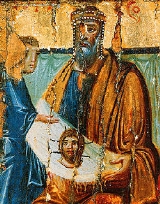
Image of Edessa

 
Image of Edessa

   Email Print
   Bookmark   Link


Image of Edessa


According to Christian
Christian

A Christian is a person who adheres to Christianity, a Monotheism#Christian view religion centered on the life and teachings of Jesus and interpreted by Christians to have been prophesied in the Hebrew Bible/Old Testament....
 legend, the Image of Edessa, (known to Orthodox
Eastern Orthodox Church

The Eastern Orthodox Church is the second largest single Christian communion in the world with an estimated 225 million members worldwide. It is considered by its adherents to be the Four Marks of the Church established by Jesus Christ and his Apostles nearly 2000 years ago....
 Christians as the Holy Mandylion, a Byzantine Greek word not applied in any other context), was a holy relic consisting of a square or rectangle of cloth upon which a miraculous image of the face of Jesus
Jesus

Jesus of Nazareth , also known as Jesus Christ, is the central figure of Christianity and is revered by most Christian churches as the Son of God and the Incarnation ....
 was imprinted — the first icon
Icon

An 'icon' is a religious work of art, most commonly a painting, from Eastern Christianity. More broadly the term is used in a wide number of contexts for an image, picture, or representation; it is a sign or likeness that stands for an object by signifying or representing it either concretely or by analogy, as in semiotics; by extension, ...
 ("image").

According to the legend, King Abgar of Edessa
Abgar V of Edessa

Abgar V or Abgarus V of Edessa was a Assyrian/Chaldean/Syriac people historical ruler of the kingdom of Osroene, holding his capital at Edessa, Mesopotamia....
 wrote to Jesus, asking him to come cure him of an illness.


Discussion
Ask a question about 'Image of Edessa'
Start a new discussion about 'Image of Edessa'
Answer questions from other users
Full Discussion Forum


Recent Posts


Encyclopedia


Abgarwithimageofedessa10thcentury
According to Christian
Christian

A Christian is a person who adheres to Christianity, a Monotheism#Christian view religion centered on the life and teachings of Jesus and interpreted by Christians to have been prophesied in the Hebrew Bible/Old Testament....
 legend, the Image of Edessa, (known to Orthodox
Eastern Orthodox Church

The Eastern Orthodox Church is the second largest single Christian communion in the world with an estimated 225 million members worldwide. It is considered by its adherents to be the Four Marks of the Church established by Jesus Christ and his Apostles nearly 2000 years ago....
 Christians as the Holy Mandylion, a Byzantine Greek word not applied in any other context), was a holy relic consisting of a square or rectangle of cloth upon which a miraculous image of the face of Jesus
Jesus

Jesus of Nazareth , also known as Jesus Christ, is the central figure of Christianity and is revered by most Christian churches as the Son of God and the Incarnation ....
 was imprinted — the first icon
Icon

An 'icon' is a religious work of art, most commonly a painting, from Eastern Christianity. More broadly the term is used in a wide number of contexts for an image, picture, or representation; it is a sign or likeness that stands for an object by signifying or representing it either concretely or by analogy, as in semiotics; by extension, ...
 ("image").

According to the legend, King Abgar of Edessa
Abgar V of Edessa

Abgar V or Abgarus V of Edessa was a Assyrian/Chaldean/Syriac people historical ruler of the kingdom of Osroene, holding his capital at Edessa, Mesopotamia....
 wrote to Jesus, asking him to come cure him of an illness. Abgar received an answering letter from Jesus, declining the invitation, but promising a future visit by one of his disciples. Along with the letter went a likeness of Jesus. This legend was first recorded in the early fourth century by Eusebius of Caesarea
Eusebius of Caesarea

Eusebius of Caesarea became the bishop of Caesarea Maritima c 314. He is often referred to as the Father of Church History because of his work in recording the history of the early Christianity church, especially Chronicon and Church_History_....
, who said that he had transcribed and translated the actual letter in the Syriac chancery documents of the king of Edessa. Instead, the apostle
Seventy Disciples

The Seventy Disciples or Seventy-two Disciples were early Disciple of Jesus mentioned in the Gospel of Luke . According to Luke, the only gospel in which they appear, Jesus appointed them and sent them out in pairs to spread his message....
 "Thaddaeus
Thaddeus of Edessa

Thaddeus was one of the Seventy Apostles of Christ, not to be confused with Saint Jude of the Twelve Apostles.Thaddeus of the Seventy Disciples was born as a Jew in Edessa, Mesopotamia....
" is said to have come to Edessa, bearing the words of Jesus, by the virtues of which the king was miraculously healed.

The first record of the existence of a physical image was in the sixth century, in the ancient city of Edessa
Edessa

Edessa may refer to:*Edessa, Greece*Edessa, Mesopotamia, now Sanliurfa, Turkey*County of Edessa, a crusader state*Osroene, an ancient kingdom and province of the Roman Empire...
 (now Urfa). The image was moved to Constantinople
Constantinople

Constantinople was the empire capital of the Roman Empire , the Byzantine Empire , the Latin Empire , and the Ottoman Empire . Strategically located between the Golden Horn and the Sea of Marmara at the point where Europe meets Asia, Byzantine Constantinople had been the capital of a Christendom empire, successor to ancient ancient Greece...
 in the tenth Century. The cloth disappeared from Constantinople during the Fourth Crusade
Fourth Crusade

The Fourth Crusade was originally designed to conquer Islam Jerusalem by means of an invasion through Egypt. Instead, in April 1204, the Crusaders of Western Europe invaded and conquered the Christianity city of Constantinople, capital of the Byzantine Empire....
 (Sack of Constantinople) in 1204, reappearing as a relic in King Louis IX of France
Louis IX of France

Louis IX , commonly Saint Louis, was List of French monarchs from 1226 to his death. He was also Counts of Artois from 1226 to 1237. Born at Poissy, near Paris, he was a member of the House of Capet and the son of Louis VIII of France and Blanche of Castile....
's Sainte Chapelle in Paris
Paris

Paris is the Capital of France and the country's largest city. It is situated on the river Seine, in northern France, at the heart of the ?le-de-France Regions of France ....
. It finally disappeared in the French Revolution
French Revolution

The French Revolution was a period of political and social upheaval and radical change in the history of France, during which the French governmental structure, previously an absolute monarchy with feudalism for the aristocracy and Roman Catholic Church clergy, underwent radical change to forms based on Age of Enlightenment principles of cit...
.

The vicissitudes of the Edessa image between the first century and its location in his own time are not reported by Eusebius. The materials, according to the scholar Robert Eisenman
Robert Eisenman

Robert H. Eisenman is an USA archaeology and Bible. He is most famous for his controversial work on the Dead Sea Scrolls and the origins of Christianity....
, "are very widespread in the Syriac sources with so many multiple developments and divergences that it is hard to believe they could all be based on Eusebius' poor efforts" (Eisenman 1997:862).

The Eastern Orthodox Church have a feast of this icon on August 16 (August 29 in N.S.), which commemorates its transition from Edessa to Constantinople.

History of the legend

The story of the Mandylion is the product of centuries of development. The first version is found in Eusebius
Eusebius of Caesarea

Eusebius of Caesarea became the bishop of Caesarea Maritima c 314. He is often referred to as the Father of Church History because of his work in recording the history of the early Christianity church, especially Chronicon and Church_History_....
' History of the Church (1.13.5-1.13.22). Eusebius claimed that he had transcribed and translated the actual letter in the Syriac chancery documents of the king of Edessa. This records a letter written by King Abgar of Edessa to Jesus, asking him to come cure him of an illness. Jesus replies by letter, saying that when he had completed his earthly mission and ascended to heaven, he would send a disciple to heal Abgar (and does so). At this stage, there is no mention of an image of Jesus.

In AD 384, Egeria, a pilgrim from either Gaul or Spain, was given a personal tour by the Bishop of Edessa, who gave her many marvellous accounts of miracles that had saved Edessa from the Persians and put into her hands transcripts of the correspondence of Abgarus and Jesus, with embellishments. Part of her accounts of her travels, in letters to her sisterhood, survive. "She naïvely supposed that this version was more complete than the shorter letter which she had read in a translation at home, presumably one brought back to the Far West by an earlier pilgrim" (Palmer 1998). Her escorted tour, accompanied by a translator, was thorough; the bishop is quoted: "Now let us go to the gate where the messenger Ananias came in with the letter of which I have been telling you." (Palmer). There was however, no mention of any image reported by Egeria, who spent three days inspecting every corner of Edessa and the environs.

The next stage of development appears in the Doctrine of Addai
Doctrine of Addai

The Doctrine of Addai is a controversial book about Saint Addai.The story of how Abgar V of Edessa and Jesus had corresponded was first recounted in the 4th century by the church historian Eusebius of Caesarea in his Church History and it was retold in elaborated form by Ephrem the Syrian....
 [Thaddeus], c. 400, which introduces a court painter among a delegation sent by Abgar to Jesus, who paints a portrait of Jesus to take back to his master:
"When Hannan, the keeper of the archives, saw that Jesus spoke thus to him, by virtue of being the king's painter, he took and painted a likeness of Jesus with choice paints, and brought with him to Abgar the king, his master. And when Abgar the king saw the likeness, he received it with great joy, and placed it with great honor in one of his palatial houses." (Doctrine of Addai 13)


Thus we can trace the development of the legend from a letter, but no image in Eusebius, to an image painted by a court painter in Addai; then to a miracle caused by the letter in Procopius, which becomes a miracle caused by a miraculously-created image supernaturally made when Jesus pressed a cloth to his wet face in Evagrius.

The later legend of the image recounts that because the successors of Abgar reverted to paganism, the bishop placed the miraculous image inside a wall, and setting a burning lamp before the image, he sealed them up behind a tile; that the image was later found again, after a vision, on the very night of the Persian invasion, and that not only had it miraculously reproduced itself on the tile, but the same lamp was still burning before it; further, that the bishop of Edessa used a fire into which oil flowing from the image was poured to destroy the Persians.

This long-developing legend of a miraculous first image of Jesus that appeared on a cloth he pressed to his wet face, was adopted by the Eastern Orthodox church not as legend, but as historical fact. Countless reproductions of what was considered to be the image were painted as icons; in the nineteenth century they were carried as khorugv
Khorugv

Khor?gv , is a religious Banner used liturgically in the Eastern Orthodox Church and Eastern Catholic Churches Churches.The khorugv or banner consists of an icon of Jesus Christ, the Theotokos or a saint, either painted or embroidered on a rectangular piece of cloth....
s by the Russian armies. According to Robin Cormack, almost every Byzantine church contained a representation of the image by the beginning of the Iconoclastic period. Because the miraculous image of the later legend was believed to be not made by humans but by God, it is called acheiropoietos
Acheiropoieta

Acheiropoieta , literally "not-handmade"; singular acheiropoieton), or Icons Not Made by Hand , are a particular kind of icon, ones that are alleged to have come into existence miraculously, not by a human painter....
 in Greek -- "Not Made by Hands." John of Damascus
John of Damascus

John of Damascus was a monk and Priesthood from Damascus. He was born and raised in that city, and died at his monastery Mar Saba.He was a polymath whose fields of interest and contribution included law, theology, philosophy, and music....
 (died 749) mentions the image in his anti-iconoclastic work On Holy Images, quoting a tradition that Abgarus had requested an image of Jesus and Jesus himself put a cloth to his face to produce the image. The cloth is described as being a "strip", or oblong cloth, rather than a square, as other accounts hold.

History of the physical image

The image itself is said to have surfaced in 525, during a flood
Flood

A flood is an overflow of an expanse of water that submerges land, a deluge. In the sense of "flowing water", the word may also be applied to the inflow of the tide....
 of the Daisan, a tributary stream of the Euphrates
Euphrates

The Euphrates is the western of the two great rivers that define Mesopotamia which flows from Anatolia....
 that passed by Edessa. This flood is mentioned in the writings of the court historian Procopius of Caesarea. In the course of the reconstruction work, a cloth bearing the facial features of a man was discovered hidden in the wall above one of the gates of Edessa.

By 544, when Procopius recorded the recovery of Edessa from the Persians, he attributed the event to the letter sent from Jesus to Abgar. In a further elaboration, in 593 Evagrius
Evagrius

Evagrius or Euagrius may refer to:*Evagrius of Constantinople , bishop of Constantinople*Evagrius of Antioch , bishop of Antioch*Evagrius Ponticus , Christian mystic...
 attributed the same event to a "God-made image," a miraculous imprint of the face of Jesus upon a cloth. It was this last and latest stage of the legend that became accepted in Eastern Orthodoxy.

Evagrius Scholasticus

Evagrius Scholasticus was an ecclesiastical historian, who wrote six books, covering a period of 163 years, from the Second Council of Ephesus in 431 to the 12th year of the emperor Maurice ....
 mentions in his Ecclesiastical History the image of Edessa discovered in 544, that was "created by God, and not produced by the hands of man". This idea of an icon that was Acheiropoietos
Acheiropoieta

Acheiropoieta , literally "not-handmade"; singular acheiropoieton), or Icons Not Made by Hand , are a particular kind of icon, ones that are alleged to have come into existence miraculously, not by a human painter....
 (??e???p???t??, literally "not-made-by-hand") is a separate enrichment of the original legend: similar legends of supernatural origins have accrued to other Orthodox icons.

The Holy Mandylion disappeared again after the Sassanian
Sassanid Empire

The Sassanid Empire or Sassanian Dynasty is the name of the last pre-Islamic Iranian empire. It was one of the two main powers in Western Asia for a period of more than 400 years....
s conquered Edessa
Edessa

Edessa may refer to:*Edessa, Greece*Edessa, Mesopotamia, now Sanliurfa, Turkey*County of Edessa, a crusader state*Osroene, an ancient kingdom and province of the Roman Empire...
 in 609. An Arab legend, related to historian Andrew Palmer when he visited Urfa (Edessa) in 1999, relates that the towel or burial cloth(mendil) of Jesus was thrown into a well in what is today the city's Great Mosque. The Christian tradition is at variance with this, recounting how in 944 it was exchanged for a group of Muslim prisoners— at that time the Image of Edessa was taken to Constantinople
Constantinople

Constantinople was the empire capital of the Roman Empire , the Byzantine Empire , the Latin Empire , and the Ottoman Empire . Strategically located between the Golden Horn and the Sea of Marmara at the point where Europe meets Asia, Byzantine Constantinople had been the capital of a Christendom empire, successor to ancient ancient Greece...
 where it was received amidst great celebration by emperor Romanus I, who deposited it in the chapel of the Great Palace of Constantinople
Great Palace of Constantinople

The Byzantine Empire Great Palace of Constantinople, , also known as the Sacred Palace , was a large palace complex, located in the south-eastern end of the peninsula where the city lies....
. It remained there until the Crusaders sacked the city in 1204 and carried off many of its treasures to western Europe - though the "Image of Edessa" is not mentioned in this context in any contemporary document. A small part of this relic, or one believed to be the same, was one of the large group sold by Baldwin II of Constantinople
Baldwin II of Constantinople

Baldwin II of Courtenay was the last emperor of the Latin Empire of Constantinople.He was a younger son of Yolanda of Flanders, sister of the first two emperors, Baldwin I of Constantinople and Henry of Flanders....
 to Louis IX of France
Louis IX of France

Louis IX , commonly Saint Louis, was List of French monarchs from 1226 to his death. He was also Counts of Artois from 1226 to 1237. Born at Poissy, near Paris, he was a member of the House of Capet and the son of Louis VIII of France and Blanche of Castile....
 in 1241 and housed in the Sainte Chapelle in Paris (two documentary inventories: year 1534 (Gerard of St. Quentin de l´Isle/Paris) and year 1740) until it disappeared during the French Revolution
French Revolution

The French Revolution was a period of political and social upheaval and radical change in the history of France, during which the French governmental structure, previously an absolute monarchy with feudalism for the aristocracy and Roman Catholic Church clergy, underwent radical change to forms based on Age of Enlightenment principles of cit...
 (not to be confused with the Sainte Chapelle at Chambery
Chambéry

Chamb?ry is the capital of the Departments of France of Savoie, France. It has been the historical capital of the Savoy region since the 13th century, when Amadeus V of Savoy made it his seat of power....
, home for a period of the Shroud of Turin).

Links with the Shroud of Turin

Journalist Ian Wilson
Ian Wilson

Ian Wilson may refer to:* Ian Wilson , Australian* Ian Wilson , Irish* Ian Wilson , English* Ian Wilson , Christianity, history & science author...
 has put forward a theory that the object venerated as the Mandylion from the sixth to the thirteenth centuries was in fact the Shroud of Turin, folded in four, and enclosed in an oblong frame so that only the face was visible.

For support, he refers to documents in the Vatican Library
Vatican Library

The Vatican Library , is the library of the Holy See, currently located in Vatican City. It is one of the oldest libraries in the world and contains one of the most significant collections of historical texts....
 and the University of Leiden, Netherlands, which seem to suggest the presence of another image at Edessa. A tenth century codex, Codex Vossianus Latinus Q 69 found by Gino Zaninotto in the Vatican Library
Vatican Library

The Vatican Library , is the library of the Holy See, currently located in Vatican City. It is one of the oldest libraries in the world and contains one of the most significant collections of historical texts....
 contains an eighth-century account saying that an imprint of Christ's whole body was left on a canvas kept in a church in Edessa: it quotes a man called Smera in Constantinople: "King Abgar received a cloth on which one can see not only a face but the whole body" (in Latin
Latin

Latin is an Italic language, historically spoken in Latium and Ancient Rome. Through the Military history of the Roman Empire, Latin spread throughout the Mediterranean and a large part of Europe....
: [non tantum] faciei figuram sed totius corporis figuram cernere poteris).

This image is apparently not the same as the Mandylion whose widely-disseminated and familiar iconic image is of a face alone. Byzantine reports however mention "one original and two copies".

Surviving images

Two images survive today which are associated with the Mandylion.

Holy Face of Genoa

This image is kept in the modest Church of St Bartholomew of The Armenians, Genoa
Genoa

Genoa is a city and an important seaport in northern Italy, the capital of the Province of Genoa and of the region of Liguria. The city has a population of about 610,000 and the urban area has a population of about 900,000....
, where it was donated to the city’s 14th century Doge Leonardo Montaldo by the Byzantine Emperor John V Palaeologus.

It has been the subject of a detailed 1969 study by Colette Dufour Bozzo, who dated the outer frame to the late 14th century, while the inner frame and the image itself are believed by some to have originated earlier. Bozzo found that the image was imprinted on a cloth that had been pasted onto a wooden board.

The similarity of the image with the Veil of Veronica
Veil of Veronica

The Veil of Veronica, or Sudarium , often called simply "The Veronica" and known in Italian as the Volto Santo or Holy Face is a Catholic relic, which, according to legend, bears the likeness of the Face of Jesus not made by human hand ....
 suggests a link between the two traditions.

Holy Face of San Silvestro

39bmandylion
This image was kept in Rome’s church of S. Silvestro up to 1870 and is now kept in the Matilda chapel in the Vatican. It is housed in a Baroque frame donated by one Sister Dionora Chiarucci in 1623 . The earliest evidence of its existence is 1517, when the nuns were forbidden to exhibit it to avoid competition with the Veronica.

Like the Genoa image, it is painted on board and therefore is likely to be a copy.

It was exhibited at Germany’s Expo 2000 in the pavilion of the Holy See.

See also

  • Acheiropoieta
    Acheiropoieta

    Acheiropoieta , literally "not-handmade"; singular acheiropoieton), or Icons Not Made by Hand , are a particular kind of icon, ones that are alleged to have come into existence miraculously, not by a human painter....
    : images 'Not made by Hands'
  • Shroud of Turin
    Shroud of Turin

    The Shroud of Turin is a linen cloth bearing the image of a man who appears to have been physically traumatized in a manner consistent with crucifixion....
  • Relics attributed to Jesus
    Relics attributed to Jesus

    There are many relics attributed to Jesus that people believe or believed to be authentic relics of the Gospel accounts.The Shroud of Turin is perhaps the best-known relic; its authenticity was questioned due to radiocarbon dating, performed in 1988, the accuracy of which has itself been subsequently questioned....
  • Images of Jesus
    Images of Jesus

    The depiction of Jesus in art took several centuries to reach a conventional standardized form for his physical appearance, which has subsequently remained largely stable since that time....
  • Veil of Veronica
    Veil of Veronica

    The Veil of Veronica, or Sudarium , often called simply "The Veronica" and known in Italian as the Volto Santo or Holy Face is a Catholic relic, which, according to legend, bears the likeness of the Face of Jesus not made by human hand ....
    , the other "true image" (vera icon)


External links

  • summer, 1998
  • Ancient and modern references.