


Province of Pomerania

Encyclopedia
The Province of Pomerania was a province
of the Kingdom of Prussia
and the Free State of Prussia from 1815 until 1945. Afterwards its territory became part of Allied-occupied Germany and Poland.
It was created from the former Prussian Province of Pomerania
, which consisted of Farther Pomerania
and southern Vorpommern, and former Swedish Pomerania
. It resembled the territory of the former Duchy of Pomerania
, which after the Peace of Westphalia
in 1648 had been split between Brandenburg-Prussia
and Sweden
. Also, the districts of Schivelbein and Dramburg, formerly belonging to the Neumark
, were merged into the new province.
While in the Kingdom of Prussia, the province was heavily influenced by the reforms of Karl August von Hardenberg
and Otto von Bismarck
. The Industrial Revolution
had an impact primarily on the Stettin area and the infrastructure, while most of the province retained a rural and agricultural character. Since 1850, the net migration rate
was negative; Pomeranians
emigrated primarily to Berlin
, the West German industrial regions and overseas.
After World War I
, democracy
and the women's right to vote
were introduced to the province. After Wilhelm II's abdication, it was part of the Free State of Prussia. The economic situation worsened due to the consequences of World War I and worldwide recession
. As in the previous Kingdom of Prussia, Pomerania was a stronghold of the nationalist conservatives
who continued in the Weimar Republic.
In 1933, the Nazis established a totalitarian regime
, concentrating the province's administration in the hands of their Gauleiter
, and implementing Gleichschaltung
. The German invasion of Poland in 1939 was launched in part from Pomeranian soil. Jewish and Polish populations (whose minorities lived in the region) were classified as subhuman
by German state during the war and subject to repressions, slave work and executions. Opponents were arrested and executed; Jews
who by 1940 had not emigrated were all deported to the Lublin reservation
.
Besides the air raids conducted since 1943, World War II
reached the province in early 1945 with the East Pomeranian Offensive
and the Battle of Berlin
, both launched and won by the Soviet Union
's Red Army
. Insufficient evacuation left the population subject to murder, war rape
, and plunder by the successors.
When the war was over, the Oder-Neisse line
cut the province in two unequal parts. The smaller western part became part of the East German state of Mecklenburg-Vorpommern. The larger eastern part was attached to post-war Poland
as Szczecin Voivodship. After the war, ethnic Germans were expelled from Poland
and the area was re-settled with Poles
. Nowadays most of the territory of the province lies within the West Pomeranian Voivodeship
, which share the same city — now Szczecin
— as its capital.
Until 1932, the province was subdivided into the government regions (Regierungsbezirk
) Köslin (Eastern part, Farther Pomerania), Stettin (Southwestern part, Altvorpommern), and Stralsund (Northwestern part, Neuvorpommern). The Stralsund region was merged into the Stettin region in 1932. In 1938, Grenzmark Posen-Westpreußen (Southeastern part, created from the former Prussian province
Grenzmark Posen-Westpreußen) was merged into the province. The provincial capital was Stettin (now Szczecin), the Regierungsbezirk capitals were Köslin (now Koszalin), Stettin, Stralsund
and Schneidemühl (now Pila), respectively.
In 1905 the Province of Pomerania had 1,684,326 inhabitants, among them 1,616,550 Protestants, 50,206 Catholics, and 9,660 Jews. There lived 14,162 inhabitants (1900) the native language of whom was Polish (at the border to West Prussia
), and 310 (at the Lake Leba and at the Lake Garde) whose native language was Kashubian
. The area of the province amounted to 30,120 square kilometers. In 1925, the province had an area of 30,208 square kilometers, with a population of 1,878,780 inhabitants.
 Although there had been a Prussian Province of Pomerania before, the Province of Pomerania was newly constituted in 1815, based on the "Decree concerning improved establishement of provincial offices" , issued by Karl August von Hardenberg
on April 30, and the integration of Swedish Pomerania
, handed over to Prussia on October 23.
The Hardenberg decree reformed all Prussian territories, which hence formed ten (later eight) provinces with similar administration. After the implementation of the reform, the new Province of Pomerania consisted basically of her predecessor and Swedish Pomerania, but also of the Dramburg and Schivelbein counties.
The province was headed by a "superior president" ("Oberpräsident") with his seat in the capital Stettin. It was subdivided into government regions (Regierungsbezirk
) headed by a president ("Regierungspräsident"). Initially, two such regions were planned (Regierungsbezirk Stettin, comprising Western Pomerania, and Regierungsbezirk Köslin, comprising Farther Pomerania
). Hardenberg however, who as the Prussian chief diplomat had settled the terms of session of Swedish Pomerania with Sweden
at the Congress of Vienna
, had assured to leave the local constitution in place when the treaty was signed on June 7, 1815. This circumstance led to a creation of a third government region, Regierungsbezirk Stralsund, for the former Swedish Pomerania at the expense of the Stettin region.
In early 1818, Oberpräsident Johann August Sack had reformed the county ("Kreis") shapes, yet adopted the former shape in most cases. Köslin government region comprised nine counties, Stettin government region thirteen, and Stralsund government region four (identical with the previous Swedish Amt districts).
The new parliament (Landtag
) assembled first on October 3, 1824. Based on two laws of June 5 and July, 1823, the Landtag was constituted by 25 lords and knights, 16 representatives of the towns, and eight from the rural communities.
Subordinate to the provincial Landtag were two Kommunallandtag assemblies, one for former Swedish Pomerania (Western Pomerania north of the Peene
river) and one for the former Prussian part.
The counties each assembled a Kreisstand, where the knights of the county had a vote each and towns also just one vote.
Throughout its existence, the province was a stronghold of the conservative parties.
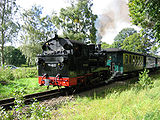
 In the 19th century, the first overland routes ("Chaussee") and railways were introduced in Pomerania. In 1848, 126,8 Prussian miles of new streets had been built. On October 12, 1840, construction of the Berlin
-Stettin railway began, which was finished on August 15, 1843. Other railways followed: Stettin-Köslin (1859), Angermünde
-Stralsund
and Züssow
-Wolgast
(1863), Stettin- Stolp (1869), and a connection with Danzig (1870).
In rural areas, many narrow-gauge railways were built for faster transport of crops. The first gas, water, and power plants were built. Streets and canalisation of the towns were modernized.
The construction of narrow-gauge railways was enhanced by a special decree of July 28, 1892, implementing Prussian financial aid programs. In 1900, the total of narrow-gauge railways had passed the 1,000 kilometer threshold.
From 1910 to 1912, most of the province was supplied with electricity
as the main lines were build. Plants were built since 1898.
The Swine and lower Oder
rivers, the major water route to Stettin, were deepened to 5 meters and shortened by a canal (Kaiserfahrt) in 1862. In Stettin, heavy industry was settled, making it the only industrial center of the province.
Stettin was connected to Berlin
by the Berlin-Stettin waterway in 1914 after eight years of construction. The other traditional waterways and ports of the province however declined. Exceptions were only the port of Swinemünde, which was used by the navy, and the port of Stolpmünde, from which parts of the Farther Pomerania
n exports were shipped, and the port of Sassnitz
, which was built in 1895 for railway ferries to Scandinavia
.
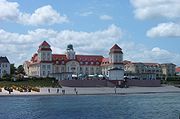
With the infrastructural improvements, mass tourism
to the Baltic coast
started. The tourist resort ("Ostseebad") Binz
had 80 visitors in 1870, 10,000 in 1900, and 22,000 in 1910. The same phenomenon occurred in other tourist resorts.
 Already in 1807, Prussia issued a decree ("Steinsches Oktoberedikt") abolishing serfdom
. Hardenberg
issued a decree on September 14, 1811, defining the terms by which serfs were to be released ("Hardenbergsches Regulierungsedikt"). This could either be done by monetary payment or by releasing title to the land to the former lord. These reforms were applied during the early years of the province's existence. The so-called "regulation" was applied to 10,744 peasants until 1838, who paid their former lords 724,954 Taler and handed over 255,952 hectar of farmland to bail themselves out.
Tumults arose in 1847 in the towns of Stettin and Köslin due to food shortages, as a result, prices for some foods were fixed.
On March 2, 1850, a law was passed settling the conditions on which peasants and farmers could capitalize their property rights and feudal service duties
, and thus get a long-term credit (41 to 56 years to pay back). This law made way for the establishment of "Rentenbank" credit houses and "Rentengut" farms. Subsequently, the previous rural structure changed dramatically as farmers, who used this credit to bail out their feudal duties, were now able to self determine how to use their land (so-called "regulated" peasants and farmers, "regulierte Bauern"). This was not possible before, when the jurisdiction had sanctioned the use of farmland and feudal services according not to property rights, but to social status within rural communities and estates.
From 1891 to 1910, 4,731 "Rentengut" farms were set up, most (2,690) with a size of 10 to 25 hectar.
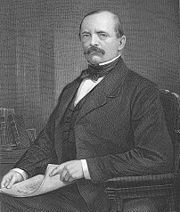 Otto von Bismarck
inherited from his father the Farther Pomerania
n estates Külz
, Jarchlin
and Kniephof
. Aiming at a farming career, he studied agriculture at the academy in Greifswald
-Eldena. From 1867 to 1874, he bought and expanded the Varzin estates.
In 1869, Friedrich Albrecht Graf zu Eulenburg drafted a county reform ("Kreisreform") that was promoted by Bismarck. The reform passed the House of Lords on December 7, 1872. Most important, the reform cut the linkage between noble status and the right to vote, the latter now depended on property (one had to be above a certain tax threshold) and not on status, aiming against the overrepresentation of the knights compared to burgher
s.
On June 29, 1875, a new constitution for the province was passed ("Provinzialordnung"), which entered into force in 1876. It redefined the responsibilities of the provincial administration (headed by the Oberpräsident) and the self-administrative institutions ("Provinzialverband", comprising the provincial parliament ("Provinziallandtag"), a "Landeshauptmann" (head) and a "Landesausschuß" (commission)). The Provinzialverband was financed directly from the Prussian state budget. The Landtag was responsible for streets, welfare, education, and culture. Landownership was not a criterion to become elected anymore. The provincial Landtag (Provinziallandtag) was elected by the county representative assemblies ("Kreistag" for counties, "Stadtverordnetenversammlung" for town districts) for a six years' term. A subordinate Kommunallandtag only existed for Regierungsbezirk Stralsund, until it was abolished in 1881.
In 1891, a county reform was passed, allowing more communal self-government. Municipalities hence elected a "Gemeindevorstand" (head) and a "Gemeindevertretung" (communal parliament). Gutsbezirk districts, i.e. estates not included in counties, could be merged or dissolved.
, no battles took place in the province.
Nevertheless, the war had an impact on society, economy, and administration. During the war, the provincial administrative institutions were subordinate to the military and headed by military officials. Mobilization
resulted in work force shortage affecting all non-war-related industry, construction, and agriculture. Women, minors and POWs partially replaced the drafted men. Import and fishing declined when the ports were blocked. With the war going on, food shortages occurred, especially in the winter of 1916/17. Also coal, gas, and electricity were at times unavailable.
When the Treaty of Versailles
entered into force on January 10, 1920, the province's eastern frontier became the border to the newly created Second Polish Republic
, comprising most of Pomerelia
in the so-called Polish Corridor
. Minor border adjustments followed, where 9,5 km2 of the province became Polish and 74 km2 of former West Prussia
(parts of the former counties of Neustadt in Westpreußen and Karthaus
) were merged into the province.
was forced to resign, the province became part of the Free State of Prussia within the Weimar Republic
.
on November 9, Stettin, Greifswald
, Pasewalk
, Stargard
, and Swinemünde on November 10, Barth, Bütow
, Neustettin, Köslin, and Stolp on November 11). On January 5, 1919, "Workers' and Soldiers' Counsils" ("Arbeiter- und Soldatenräte") were in charge of most of the province (231 towns and rural municipalities). The revolution was peaceful, no riots are reported. The councils were led by Social Democrats
, who cooperated with the provincial administration. Of the 21 Landrat officials, only five were replaced, while of the three heads of the government regions ("Regierungspräsident") two were replaced (in Stralsund and Köslin) in 1919.
On November 12, 1918, a decree was issued allowing farmworkers' unions to negotiate with farmers (Junker
s). The decree further regulated work time and wages for farmworkers.
On May 15, 1919, street fights and plunder occurred following Communist assemblies in Stettin. The revolt was put down by the military. In late August, strikes of farmworkers occurred in the counties of Neustettin and Belgard. The power of the counsils however declined, only a few were left in the larger towns in 1920.
Pommerscher Landbund units participated in the nationalist Kapp Putsch
in Berlin
, 1920.
Members of the "Iron Division" ("Eiserne Division"), a dissolved Freikorps in the Baltic
, reorganized in Pomerania, where the Junker
s hosted them on their estates as a private army.
Also, counter-revolutionary Pomeranians formed Freikorps
participating in fights in the Ruhr area
.
constitution for her provinces. The constitution granted a number of civil rights
to the Prussian population and enhanced the self-government of the provinces.
The provincial and county parliaments (Landtag and Kreistag) were hence elected directly by the population, including women, in free and secret votes.
The "Provinzialverband", which included all self-governmental institutions of the province such as the provincial parliament ("Provinziallandtag"), gained influence on the formerly Berlin
-led provincial government: The Provinzialverband would hence elect the "Oberpräsident" (head of the administration) and appoint representatives for the Reichsrat
assembly in Berlin. Furthermore, the Provinzialverband officials could hence self determine how to spend the money they received from Berlin.
was cut off from Danzig by the corridor. Former markets and supplies in the now Polish territories became unavailable.
Farther Pomeranian farmers had sold their products primarily to the eastern provinces, that were now part of the Second Polish Republic
. Due to high transport costs, the markets in the West were unavailable too. The farmers reacted by modernizing their equipment, improving the quality of their products, and applying new technical methods. As a consequence, more than half of the farmers were severely indebted in 1927. The government reacted with the Osthilfe program, and granted credits to favourable conditions.
Stettin particularly suffered from a post-war change in trade routes. Before the territorial changes, it had been on the export route from the Katowice
(Kattowitz) industrial region in now Polish Upper Silesia
. Poland changed this export route to a new inner-Polish railway
connecting Katowice with the new-build port of Gdynia
within the corridor.
As a counter-measure, Prussia invested in the Stettin port since 1923. While initially successful, a new economical recession
led to the closure of one of Stettin's major shipyard, AG Vulcan Stettin, in 1927.
The province also reacted to the availability of new traffic vehicles. Roads were developed due to the upcoming cars and buses, four towns got electric street cars, and an international airport was built in Altdamm near Stettin.
The Pomeranian agriculture underwent a crisis. Programs were started to regain soil that had turned into swamps during the wartime, and even to establish new settlements by setting up settlement societies. The results were mixed. On the one hand, 130,858 hectare of farmland were settled with 8,734 new-build settlements until 1933. The settlers originated in Pomerania itself, Saxony
, and Thuringia
, also refugees from the former Province of Posen
settled in the province. On the other hand, people left the rural communities en masse and turned to Pomeranian and other urban centers (Landflucht
). In 1925, 50.7% of the Pomeranians worked in agricultural professions, this percentage dropped to 38.2% in 1933.
With the economic recession
, unemployment rates reached 12% in 1933, compared to an overall 19% in the empire.
, politics in the province was dominated by the nationalist conservative DNVP (German National People's Party); an entity composed of nationalists, monarchists, radical volkisch
and anti-semitic elements, and supported by Pan-German League
an old organisation believing in superiority of German people over others. The Nazi party (NSDAP) did not have any significant success at elections, nor did it have a substantial amount of members. The Pomeranian Nazi party was founded by students of the University of Greifswald in 1922, when the NSDAP was officially forbidden. The university's rector Theodor Vahlen
became Gauleiter
(head of the provincial party) in 1924. Soon afterwards, he was fired by the university and went bankrupt. In 1924, the party had 330 members, and in December 1925, 297 members. The party was not present in all of the province. The members were concentrated mainly in Western Pomerania and internally divided. Vahlen retired from the Gauleiter position in 1927 and was replaced by Walther von Corswandt, a Pomeranian knight estate holder.
Corswandt led the party from his estate in Kuntzow. In the 1928 Reichstag
elections, the Nazis got 1,5% of the votes in Pomerania. Party property was partially pawned. In 1929, the party gained 4,1% of the votes. Corswandt was fired after conflicts with the party's leadership and replaced with Wilhelm von Karpenstein, one of the former students who formed the Pomeranian Nazi party in 1922 and since 1929 lawywer in Greifswald
. He moved the headquarters to Stettin and replaced many of the party officials predominantly with young radicals. In the Reichstag elections of September 14, 1930, the party gained a significant 24,3% of the Pomeranian votes and thus became the second strongest party, the strongest still being the DNVP, which however was internally divided in the early 1930s.
In the elections of July 1932, the Nazis gained 48% of the Pomeranian votes, while the DNVP dropped to 15,8%. In March 1933, the NSDAP gained 56,3%.
maltreated their victims. The Pomeranian SA in 1933 had grown to 100,000 members.
Oberpräsident von Halfern retired in 1933, and with him one third of the Landrat and Oberbürgermeister (mayor) officials.
Also in 1933, an election was held for a new provincial parliament, which then had a Nazi majority. Decrees were issued that shifted all issues formerly in responsibility of the parliament to the "Provinzialausschuß" commission, and furthermore, shifted the power to decide on these issues from the "Provinzialausschuß" to the "Oberpräsident" official, although he had to hear the "Provinzialrat" commission before. Once the power was shifted to the Oberpräsident with the Provinzialrat as an advisor, all organs of the "Provinzialverband" ("Provinziallandtag" (parliament), "Provinzialausschuß and all other commissions), the former self-administration of the province, were dissolved except for the downgraded Provinzialrat, which assembled about once a year without making use of its advisory rights. The "Landeshauptmann" position, the Provinzialverband's head, was not abolished. From 1933, Landeshauptmann would be a Nazi who was acting in line with the Oberpräsident. The law entered into force on April 1, 1934.
In 1934, many of the heads of the Pomeranian Nazi-movement were exchanged. SA leader Peter von Heydebreck
was shot in Stadelheim
near Munich
due to his friendship to Röhm
. Gauleiter von Karpenstein was arrested for two years and banned from Pomerania due to conflicts with the NSDAP headquarters. His substitute, Franz Schwede-Coburg, replaced most of Karpenstein's staff with Corswant's earlier staff, friends of him from Bavaria
, and SS. From the 27 Kreisleiter
officials, 23 were forced out of office by Schwede-Coburg, who became Gauleiter on July 21, and Oberpräsident on July 28, 1934.
As in all of Nazi Germany
, the Nazis established totalitarian control
over the province by Gleichschaltung
.
When the Nazis started to terrorize Jews, many emigrated. Twenty weeks after the Nazis seized power, the number of Jewish Pomeranians had already dropped by eight percent.
Besides the repressions Jews had to endure in all Nazi Germany
, including the destruction of the Pomeranian synagogue
s on November 9, 1938 (Reichskristallnacht), all male Stettin Jews were deported to Oranienburg concentration camp
after this event and kept there for several weeks.
On February 12 and 13, 1940, 1,000 to 1,300 Pomeranian Jews, regardless of sex, age and health, were deported from Stettin to the Piaski ghetto in the Lublin-Lipowa Reservation, that had been set up following the Nisko Plan
in occupied Poland. Among the deported were intermarried non-Jewish women. The deportation was carried out in an inhumane manner. Despite low temperatures, the carriages were not heated. No food had been allowed to be taken along. The property left behind was liquidated. Up to 300 people perished from the deportation itself. In the Lublin area under Kurt Engel's regime, the people were subjected to inhumane treatment, starvation and outright murder. Only a few survived the war.
Peter Simonstein Cullman in "History of the Jewish Community of Schneidemühl: 1641 to the Holocaust," Bergenfield, NJ : Avotaynu, 2006; ISBN 1-886223-27-0; DS135.P62P4728 2006) proves, based on historical facts (see below), that the Jews of Schneidemühl were not deported together with the Jews of Stettin (who were subsequently sent to Piaski, near Lublin in Poland)", based on material in the archives of Reichsvereinigung der Juden in Deutschland
(cf. file 75 C Re1, No. 483, Bundesarchiv Berlin, and USHMM Archives: RG-14.003M; Acc. 1993.A.059). Contrary to erroneous reports in various published sources in the post-war years, it has now been established without a doubt that, while the deportations of the Jews of Schneidemühl had indeed been planned by the Gestapo to coincide with the terrible events that occurred in Stettin — those actions were NOT carried out together. The deportations of all Jews from the Gau were primarily planned on orders of the notorious Gauleiter of Pomerania, Franz Schwede-Coburg, in cahoots with several Nazi authorities of Schneidemühl. The Gauleiter’s personal goal was to be the first in the Reich to declare his Gau Judenrein — cleansed of Jews". [Doc. 795 of the Trial of Adolf Eichmann.
The following events took place in Schneidemühl: "On 15 February 1940 an order had been issued by the Gestapo in Schneidemühl that the Jews of that town should get ready to be deported within a week, ostensibly to the Generalgouvernement in Eastern Poland. When Dr. Hildegard Böhme of the Reichsvereinigung had become aware of Gauleiter Schwede-Coburg’s plan — and fearing a repetition of the events on the scale of the Stettin deportations — her timely and tireless intervention on behalf of the Reichsvereinigung with the RSHA in Berlin resulted in a modification of the planned deportations of Schneidemühl’s Jews. The Stapo, the State police in Schneidemühl, however, played its own part in the planned round-up of the city’s Jews by giving in to the local Nazi Party cadre and to the orders of the city’s fanatic Mayor Friedrich Rogausch, in concert with the Gauleiter. The latter two are known to have planned a Schneidemühl-Aktion as a revenge for the earlier interference by the Reichsvereinigung in the Stettin deportations. Thus on Wednesday, 21 February 1940 — merely one week after the Stettin deportations — one hundred and sixty Jews were arrested in Schneidemühl, while mass arrests of Jews took place concurrently within an 80 km radius of Schneidemühl, in the surrounding administrative districts of Köslin, Stettin and the former Grenzmark Posen-Westpreussen, whereby three hundred and eighty-four Jews were seized by the Gestapo. In total 544 Jews were arrested during the entire Aktion in and around Schneidemühl. Those rounded up ranged from two-year-old children to ninety-year-old men. Surviving documents give a grim account of the subsequent Odyssey of those arrested. By then it had been decreed in Berlin that the victims of the round-up should not be sent to Poland but be kept within the so-called Altreich, i.e. within Germany's borders of 1937. Over the following eighteen months most of the arrested became ensnared in the Nazi's maw — on a journey of terminal despair. Only one young woman from Schneidemühl survived the hell of Auschwitz-Birkenau and the death marches of mid-January 1945."
A number of the Poles in Szczecin
(Stettin) were members of the Union of Poles in Germany
, a Polish scouts team was established there as well, in addition to a Polish school where the Polish language
was taught.
Repressions intensified after Adolf Hitler
came to power and led to closing of the school. Members of Polish community who took part in cultural and political activities were persecuted and even murdered. In 1938 the head of Stettin’s Union of Poles unit Stanisław Borkowski was imprisoned in Oranienburg
. In 1939, all Polish organisations in Stettin were disbanded by the authorities. During the war, two teachers from Polish school: Golisz and Omieczyński were murdered.
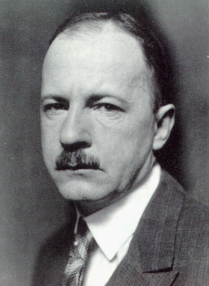 Resistance groups formed in the economical centers, especially in Stettin, from where most arrests were reported.
Resistance is also reported from members of the nationalist conservative DNVP. The monarchist Herbert von Bismarck-Lasbeck was forced out of office in 1933. The newspaper Pommersche Tagespost was banned in 1935 after printing an article of monarchist Hans Joachim von Rohr
(1888–1971). In 1936, four members of the DNVP were tried for founding a monarchist organization.
Other DNVP members, who had addressed their opposition already before 1933, were arrested multiple times after the Nazis had taken over. Ewald Kleist-Schmenzin, Karl Magnus von Knebel-Doberitz, and Karl von Zitzewitz were active resistants.
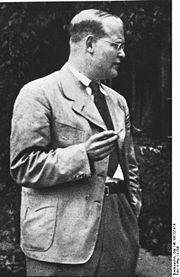 Within the Pomeranian provincial subsection
of the Evangelical Church of the old-Prussian Union, resistance was organized within the Pfarrernotbund
(150 members in late 1933) and Confessing Church
("Bekennende Kirche"), the successor organization, headed by Reinold von Thadden-Trieglaff. In March 1935, 55 priests were arrested. The Confessing Church maintained a preachers' seminar headed by Dietrich Bonhoeffer
in Zingst
, which moved to Finkenwalde in 1935 and to Köslin and Groß Schlönwitz in 1940. Within the Catholic Church, the most prominent resistance member was Greifswald
priest Alfons Wachsmann, who was executed in 1944.
After the failed assassination attempt of Hitler on July 20, 1944, Gestapo
arrested thirteen Pomeranian nobles and one burgher, all knight estate owners. Of those, Ewald von Kleist-Schmenzin
had contacted Winston Churchill
in 1938 to inform about the work of the German opposition to the Nazis, and was executed in April 1945. Karl von Zitzewitz had connections to the Kreisauer Kreis group. Among the other arrested were Malte von Veltheim Fürst zu Putbus, who died in a concentration camp, as well as Alexander von Kameke and Oscar Caminecci-Zettuhn, who both were executed.
on September 1, 1939, which marked the beginning of World War II
, was in part mounted from the province's soil. General Guderian
's 19th army corps attacked from the Schlochau and Preußisch Friedland areas, which since 1938 belonged to the province ("Grenzmark Posen-Westpreußen").
According to Kozłowski & Krzywicki (1988), around 56,000 Polish POWs were located in Pomerania after the invasion, and soon Germany stripped them of their status(against international law) turning them into forced labourers
;in April 1940 they were 82.417 of them in Pomerania, with the number reaching 116.330 Polish forced labourers in 1944 September
Because the invasion of Poland (and later the Soviet Union
) was a success and the battle front moved far more east (Blitzkrieg
), the province was not the site of battles in the first years of the war.
Since 1943, the province became a target of allied air raids. The first attack was launched against Stettin on April 21, 1943, and left 400 dead. On August 17/18, the British RAF launched an attack on Peenemünde
, where Wernher von Braun
and his staff had developed and tested the world's first ballistic missile
s. In October, Anklam
was a target. Throughout 1944 and early 1945, Stettin's industrial and residential areas were targets of air raids. Stralsund
was a target in October 1944.
Despite these raids, the province was regarded "safe" compared to other areas of the Third Reich, and thus became a shelter for evacuees primarily from hard hit Berlin
and the West German industrial centers.
After the war had turned back on Germany, the Pomeranian Wall
was renovated in the summer of 1944, and in the fall all men between sixteen and sixty years of age who had not yet been drafted were enrolled into Volkssturm
units.
The province of Pomerania became a battlefield on January 26, 1945, when in the pretext of the Red Army
's East Pomeranian Offensive
Soviet tanks entered the province near Schneidemühl, which surrendered on February 13.
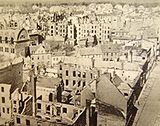 On February 14, the remnants of German Army Group Vistula
("Heeresgruppe Weichsel") had managed to set up a frontline roughly at the province's southern frontier, and launched a counterattack (Operation Solstice
, "Sonnenwende") on February 15, that however stalled already on February 18. On February 24, the Second Belorussian Front launched the East Pomeranian Offensive
and despite heavy resistance primarily in the Rummelsburg
area took eastern Farther Pomerania
until March 10. On March 1, the First Belorussian Front had launched an offensive from the Stargard
and Märkisch Friedland area and succeeded in taking northwestern Farther Pomerania within five days. Cut off corps group Tettau
retreated to Dievenow
as a moving pocket
until March 11. Thus, German-held central Farther Pomerania was cut off, and taken after the Battle of Kolberg (March 4 to March 18).
The fast advances of the Red Army during the East Pomeranian Offensive
caught the civilian Farther Pomeranian population by surprise. The land route to the west was blocked since early March. Evacuation orders were issued not at all or much too late. The only way out of Farther Pomerania was via the ports of Stolpmünde, from which 18,300 were evacuated, Rügenwalde, from which 4,300 were evacuated, and Kolberg, which had been declared fortress and from which before the end of the Battle of Kolberg some 70,000 were evacuated. Those left behind became victims of murder, war rape
, and plunder. On March 6, the USAF shelled Swinemünde, where thousands of refugees were stranded, killing an estimated 25,000.
abandoned the last bridgehead on the Oder
rivers eastern bank, the Altdamm area. The frontline then ran along Dievenow
and lower Oder, and was held by the 3rd panzer army commanded by general Hasso von Manteuffel
. After another four days of fighting, the Red Army
managed to break through and cross the Oder between Stettin and Gartz (Oder), thus starting the northern theater of the Battle of Berlin on March 24. Stettin was abandoned the next day.
Throughout April, the Second Belorussian Front led by general Konstantin Rokossovsky
advanced through Western Pomerania. Demmin
and Greifswald
surrendered on April 30.
In Demmin, more than 1,000 people committed
mass suicides
after the Red Army had conquered the town facing only modest resistance. Coroner lists show that most drowned in the nearby River Tollense
and River Peene
, while others poisoned themselves.
This was fueled by atrocities - rapes, pillage and executions - committed by Red Army soldiers after the Peene-bridge had been destroyed by retreating German troops. 80 percent of the town was destroyed in the first 3 days after its conquest.
In the first days of May, Wehrmacht
abandoned Usedom
and Wollin islands, and on May 5, the last German troops departed from Sassnitz
on the island of Rügen
. Two days later, Wehrmacht surrendered unconditionally to the Red Army.
By the terms of the Potsdam agreement
, Western Pomerania east of the Oder-Neisse line
became part of Poland
. This line left the Oder
river north of Gartz (Oder) and included the Stettin and Swinemünde area (Stettiner Zipfel) into the Polish state. The remaining German population was expelled
and the area was resettled with Poles. Western Pomerania west of the Oder-Neisse line was merged with Mecklenburg
to constitute the state of Mecklenburg-Vorpommern in the Soviet Occupation Zone of Germany, that in 1949 became the German Democratic Republic
(GDR). Vorpommern was soon dropped from the federal state's name, and after the GDR states were abolished, the coastal Western Pomeranian Landkreis districts became part of Bezirk Rostock whereas the mainland Landkreis districts became part of Bezirk Neubrandenburg.
In 1990, after the GDR communist system was overthrown
, the state of Mecklenburg-Vorpommern was recreated, with Vorpommern being a non-administrative region. The districts Vorpommern-Rügen
and Vorpommern-Greifswald
constitute most of the German part of former Pomerania, but these districts also contain some former Mecklenburg
ian territory, and a small part of former Pomerania is now part of Brandenburg
. Due to this, the old Pomeranian border disappeared from the map and today is only prevailed by the border of the Pomeranian Evangelical Church
. The part of the province of Pomerania which had become Polish was re-organized as Szczecin Voivodeship
after the war, from which the eastern part was split off as Koszalin Voivodeship
in 1950. Slupsk Voivodeship
was split off from this voivodeship in 1975, there were also territorial exchanges with neighboring voivodeships. Since 1999, the area of the former province of Pomerania is included in the West Pomeranian Voivodeship
(Zachodniopomorskie, bulk) and Pomeranian Voivodeship
(western part around Slupsk
, formerly Stolp).
(Hinterpommern) along with the smaller region of Lauenburg and Bütow Land
(easternmost part).
These parts of Pomerania were integrated into the Brandenburg-Prussia
n Province of Pomerania (1653-1815) already after the Thirty Years' War
. During the war, the noble House of Pomerania
(Griffins), ruling the Duchy of Pomerania
since the 1120s, went extinct in the male line with the death of Bogislaw XIV in 1637. Throughout the existence of the Griffin duchy, Brandenburg had claimed overlordship and was asserted of Pomerania inheritance in numerous treaties. Yet, Sweden
had been one of the most important players in the war and as such, she was awarded some of her territorial gains in Pomerania after the war by the Peace of Westphalia, thwartening Brandenburg-Prussia's ambitions for inheritance of the whole former Duchy of Pomerania. This led to tensions between Brandenburg-Prussia and Sweden in Pomerania until Sweden lost her Western Pomeranian possessions in 1720 (Stettin government region) and 1815 (Stralsund government region).
Landkreis Lauenburg-Bütow comprised the Lauenburg and Bütow Land
, a Pomerelia
n borderland with a somewhat different history than the rest of Pomerania. It was in 1846 dissolved into smaller administrative units. In contrast to ethnic German Pomerania, this area also had a Kashubian
population.
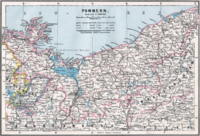 Landkreis Fürstenthum comprised the earlier secular possessions of the Roman Catholic Diocese of Kammin
bishops, and was ruled by the Pomeranian dukes since the aftermath of the Reformation
. Until 1872, the area kept its territorial integrity, before it was dissolved into smaller administrative units.
. From 1815, the Stettin government region comprised only the southern parts of Vorpommern ("Altvorpommern", i.e. south of the Peene
river). This part had been Swedish only until 1720, thereafter it was merged into the Prussian Province of Pomerania (1653-1815). "Neuvorpommern" (north of the river) was administered as Regierungsbezirk Stralsund until it was merged into Regierungsbezirk Stettin in 1932.
Stettin, the former ducal residence
, was made capital of the province and also was the administrative center of the Regierungsbezirk Stettin.
The reason for creating a Regierungsbezirk as small as Stralsund was that Neuvorpommern had a somewhat different history than the rest of Pomerania. This region, consisting of the island of Rügen
and the adjacted mainland between the Recknitz
and Peene
rivers, made up the Rani
and Danish
Principality of Rugia
in the Middle ages
. Although it was inherited by the Pomeranian dukes in 1325, the region was for some time goverened as the splinter duchy of Pomerania-Barth. While a part of Swedish Pomerania
, Denmark
maintained her old claims and occupied the area in 1715 during the Great Northern War
. Yet, the Danes were forced to return it to Sweden by the 1720 Treaty of Stockholm (Great Northern War)
. In the 1813 Treaty of Kiel
, Denmark again gained nominal overlordship, yet was unable to pay her war reparations to Sweden and awarded her claim to Prussia
in the 1815 Congress of Vienna
along with her debts in exchange for the Duchy of Lauenburg.
The name Neuvorpommern (New Western Pomerania) originates in that era, to distinguish the Western Pomeranian areas south of the Peene River gained by Prussia in 1720 (Altvorpommern, Old Western Pomerania) from the northern regions gained in 1815 and to replace the outdated term Principality of Rugia.
When merged into the province in 1815, Neuvorpommern was guaranteed her constitution to be left in place. The administration was led by the former Swedish general governour, prince Malte von Putbus, until "Regierungsbezirk Stralsund" was officially created in 1818. Prussian law (Allgemeines Preußisches Landrecht and Preußisches Stadtrecht) was not enforced, and the Swedish jurisdiction with the court in Greifswald
was left in place.
Regierungsbezirk Stralsund was fused into Regierungsbezirk Stettin in 1932.
Posen-West-Prussia.
Following World War I
, most of the Prussian provinces Posen
and West Prussia
became part of the Second Polish Republic
. The remainders of these provinces formed the province of Posen-West Prussia, combining small German-settled regions all along the new German-Polish border (Grenzmark meaning border march). In 1938, this province was dissolved and partitioned between Pomerania, Brandenburg
and Silesia
. The Pomeranian share was extended by Landkreis Neustettin and Landkreis Dramburg, formally administered by Regierungsbezirk Stettin.
During World War II
, it became a battlefield and was occupied by the Red Army
in early 1945. By the terms of the Potsdam agreement
, the Grenzmark became part of Poland
. The German population was expelled
and the area was resettled with Poles.
Until 1841, immigration to the province was higher than emigration. This trend reversed since 1850. However, the population grew further due to high birth rates.
Between 1871 and 1914, the prime characteristic of the province's demography was migration from the rural areas, first to urban centers ("Landflucht"), then to destinations in other German provinces and oversees (Ostflucht
). Despite the emigration during this time span, the population increased by 300,000 people.
Between 1871 and 1880, 61,700 people emigrated to America.
Between 1881 and 1890, 132,100 people emigrated to America; 95,000 of these emigrated between 1881 and 1885.
Between 1891 and 1900, 56,700 people emigrated to America.
Between 1871 and 1895, 242,505 people emigrated from the province, primarily from 1880 to 1885 (95,000 emigrants).
Between 1880 and 1910, 426,000 more people emigrated than immigrated. Emigrants came primarily from rural areas, which they left for economic reasons; prime destinations were Ruhr area
and Berlin
(Ostflucht
).
Most people emigrated from Regierungsbezirk Köslin, where the population numbers of 1880 were only reached again in 1899.
The Province of Pomerania was one of the three provinces (the other two were West Prussia
and Province of Posen
) responsible for most of the German emigrants who went oversees. Imperial Commissioners for emigration ("Reichskommissar für Auswanderung") organized emigration from Hamburg
, Bremen
, Stettin, and Swinemünde. Emigration to oversees ended in 1893, when in America the free availability of soil claims ended.
Polish seasonal workers were employed in Pomeranian agriculture since the 1890s, initially to replace the emigrants. In 1910, 7921 Poles lived steadily in the province. In 1912, 12,000 seasonal workers were employed in agriculture, in 1914 their number increased to 42,000.
On October 1, 1938, the bulk of the former Province of Posen-West Prussia was merged into the Province of Pomerania, adding an area of 5,787 km2 with a population of 251,000.
On October 15, Stettin's city limits were expanded to an area of 460 km2, housing 383,000 people.
During the Soviet conquest of Farther Pomerania
and the subsequent expulsions of Germans
until 1950, 498,000 people from the part of the province east of the Oder-Neisse line
died, making up for 26,4% of the former population. Of the 498,000 dead, 375,000 were civilians, and 123,000 were Wehrmacht
soldiers. Low estimates give a million expellees from the then Polish part of the province in 1945 and the following years. Only 7,100 km2 remained with Germany, about a fourth of the province's size before 1938 and a fifth of the size thereafter.
Provinces of Prussia
The Provinces of Prussia constituted the main administrative divisions of Prussia. Following the dissolution of the Holy Roman Empire in 1806 and the Congress of Vienna in 1815 the various princely states in Germany gained their nominal sovereignty, but the reunification process that culminated in...
of the Kingdom of Prussia
Kingdom of Prussia
The Kingdom of Prussia was a German kingdom from 1701 to 1918. Until the defeat of Germany in World War I, it comprised almost two-thirds of the area of the German Empire...
and the Free State of Prussia from 1815 until 1945. Afterwards its territory became part of Allied-occupied Germany and Poland.
It was created from the former Prussian Province of Pomerania
Province of Pomerania (1653–1815)
The Province of Pomerania was a province of Brandenburg-Prussia, the later Kingdom of Prussia. After the Thirty Years' War, the province consisted of Farther Pomerania. Subsequently, the Lauenburg and Bütow Land, Draheim, and Swedish Pomerania south of the Peene river were joined into the province...
, which consisted of Farther Pomerania
Farther Pomerania
Farther Pomerania, Further Pomerania, Transpomerania or Eastern Pomerania , which before the German-Polish border shift of 1945 comprised the eastern part of the Duchy, later Province of Pomerania, roughly stretching from the Oder River in the West to Pomerelia in the East...
and southern Vorpommern, and former Swedish Pomerania
Swedish Pomerania
Swedish Pomerania was a Dominion under the Swedish Crown from 1630 to 1815, situated on what is now the Baltic coast of Germany and Poland. Following the Polish War and the Thirty Years' War, Sweden held extensive control over the lands on the southern Baltic coast, including Pomerania and parts...
. It resembled the territory of the former Duchy of Pomerania
Duchy of Pomerania
The Duchy of Pomerania was a duchy in Pomerania on the southern coast of the Baltic Sea, ruled by dukes of the House of Pomerania ....
, which after the Peace of Westphalia
Peace of Westphalia
The Peace of Westphalia was a series of peace treaties signed between May and October of 1648 in Osnabrück and Münster. These treaties ended the Thirty Years' War in the Holy Roman Empire, and the Eighty Years' War between Spain and the Dutch Republic, with Spain formally recognizing the...
in 1648 had been split between Brandenburg-Prussia
Brandenburg-Prussia
Brandenburg-Prussia is the historiographic denomination for the Early Modern realm of the Brandenburgian Hohenzollerns between 1618 and 1701. Based in the Electorate of Brandenburg, the main branch of the Hohenzollern intermarried with the branch ruling the Duchy of Prussia, and secured succession...
and Sweden
Sweden
Sweden , officially the Kingdom of Sweden , is a Nordic country on the Scandinavian Peninsula in Northern Europe. Sweden borders with Norway and Finland and is connected to Denmark by a bridge-tunnel across the Öresund....
. Also, the districts of Schivelbein and Dramburg, formerly belonging to the Neumark
Neumark
Neumark comprised a region of the Prussian province of Brandenburg, Germany.Neumark may also refer to:* Neumark, Thuringia* Neumark, Saxony* Neumark * Nowe Miasto Lubawskie or Neumark, a town in Poland, situated at river Drwęca...
, were merged into the new province.
While in the Kingdom of Prussia, the province was heavily influenced by the reforms of Karl August von Hardenberg
Karl August von Hardenberg
Karl August Fürst von Hardenberg was a Prussian statesman and Prime Minister of Prussia. While during his late career he acquiesced to reactionary policies, earlier in his career he implemented a variety of Liberal reforms...
and Otto von Bismarck
Otto von Bismarck
Otto Eduard Leopold, Prince of Bismarck, Duke of Lauenburg , simply known as Otto von Bismarck, was a Prussian-German statesman whose actions unified Germany, made it a major player in world affairs, and created a balance of power that kept Europe at peace after 1871.As Minister President of...
. The Industrial Revolution
Industrial Revolution
The Industrial Revolution was a period from the 18th to the 19th century where major changes in agriculture, manufacturing, mining, transportation, and technology had a profound effect on the social, economic and cultural conditions of the times...
had an impact primarily on the Stettin area and the infrastructure, while most of the province retained a rural and agricultural character. Since 1850, the net migration rate
Net migration rate
Net migration rate is the difference of immigrants and emigrants of an area in a period of time, divided per 1,000 inhabitants...
was negative; Pomeranians
Pomeranians (German people)
For other uses, see PomeranianPomeranians are a German people living in Pomerania. In the High Middle Ages, Germans from what is today Northwestern Germany, Danes, Dutch and Flemish people migrated to Pomerania during the Ostsiedlung, gradually outnumbering and assimilating the West Slavic tribes...
emigrated primarily to Berlin
Berlin
Berlin is the capital city of Germany and is one of the 16 states of Germany. With a population of 3.45 million people, Berlin is Germany's largest city. It is the second most populous city proper and the seventh most populous urban area in the European Union...
, the West German industrial regions and overseas.
After World War I
World War I
World War I , which was predominantly called the World War or the Great War from its occurrence until 1939, and the First World War or World War I thereafter, was a major war centred in Europe that began on 28 July 1914 and lasted until 11 November 1918...
, democracy
Democracy
Democracy is generally defined as a form of government in which all adult citizens have an equal say in the decisions that affect their lives. Ideally, this includes equal participation in the proposal, development and passage of legislation into law...
and the women's right to vote
Women's suffrage
Women's suffrage or woman suffrage is the right of women to vote and to run for office. The expression is also used for the economic and political reform movement aimed at extending these rights to women and without any restrictions or qualifications such as property ownership, payment of tax, or...
were introduced to the province. After Wilhelm II's abdication, it was part of the Free State of Prussia. The economic situation worsened due to the consequences of World War I and worldwide recession
Recession
In economics, a recession is a business cycle contraction, a general slowdown in economic activity. During recessions, many macroeconomic indicators vary in a similar way...
. As in the previous Kingdom of Prussia, Pomerania was a stronghold of the nationalist conservatives
German National People's Party
The German National People's Party was a national conservative party in Germany during the time of the Weimar Republic. Before the rise of the NSDAP it was the main nationalist party in Weimar Germany composed of nationalists, reactionary monarchists, völkisch, and antisemitic elements, and...
who continued in the Weimar Republic.
In 1933, the Nazis established a totalitarian regime
Totalitarianism
Totalitarianism is a political system where the state recognizes no limits to its authority and strives to regulate every aspect of public and private life wherever feasible...
, concentrating the province's administration in the hands of their Gauleiter
Gauleiter
A Gauleiter was the party leader of a regional branch of the NSDAP or the head of a Gau or of a Reichsgau.-Creation and Early Usage:...
, and implementing Gleichschaltung
Gleichschaltung
Gleichschaltung , meaning "coordination", "making the same", "bringing into line", is a Nazi term for the process by which the Nazi regime successively established a system of totalitarian control and tight coordination over all aspects of society. The historian Richard J...
. The German invasion of Poland in 1939 was launched in part from Pomeranian soil. Jewish and Polish populations (whose minorities lived in the region) were classified as subhuman
Subhuman
- Biology :* Any of the extinct or living members of the clade Hominoidea other than Homo or alternatively just H. sapiens sapiens.-Music:* subHuman , a 2007 music album by Recoil...
by German state during the war and subject to repressions, slave work and executions. Opponents were arrested and executed; Jews
Jews
The Jews , also known as the Jewish people, are a nation and ethnoreligious group originating in the Israelites or Hebrews of the Ancient Near East. The Jewish ethnicity, nationality, and religion are strongly interrelated, as Judaism is the traditional faith of the Jewish nation...
who by 1940 had not emigrated were all deported to the Lublin reservation
Nisko Plan
The Nisko Plan, also Lublin Plan or Nisko-Lublin Plan , was developed in September 1939 by the Nazi German Schutzstaffel as a "territorial solution to the Jewish Question"...
.
Besides the air raids conducted since 1943, World War II
World War II
World War II, or the Second World War , was a global conflict lasting from 1939 to 1945, involving most of the world's nations—including all of the great powers—eventually forming two opposing military alliances: the Allies and the Axis...
reached the province in early 1945 with the East Pomeranian Offensive
East Pomeranian Offensive
The East Pomeranian Strategic Offensive operation was an offensive by the Red Army in its fight against the German Wehrmacht on the Eastern Front...
and the Battle of Berlin
Battle of Berlin
The Battle of Berlin, designated the Berlin Strategic Offensive Operation by the Soviet Union, was the final major offensive of the European Theatre of World War II....
, both launched and won by the Soviet Union
Soviet Union
The Soviet Union , officially the Union of Soviet Socialist Republics , was a constitutionally socialist state that existed in Eurasia between 1922 and 1991....
's Red Army
Red Army
The Workers' and Peasants' Red Army started out as the Soviet Union's revolutionary communist combat groups during the Russian Civil War of 1918-1922. It grew into the national army of the Soviet Union. By the 1930s the Red Army was among the largest armies in history.The "Red Army" name refers to...
. Insufficient evacuation left the population subject to murder, war rape
War rape
War rapes are rapes committed by soldiers, other combatants or civilians during armed conflict or war, or during military occupation, distinguished from sexual assaults and rape committed amongst troops in military service...
, and plunder by the successors.
When the war was over, the Oder-Neisse line
Oder-Neisse line
The Oder–Neisse line is the border between Germany and Poland which was drawn in the aftermath of World War II. The line is formed primarily by the Oder and Lusatian Neisse rivers, and meets the Baltic Sea west of the seaport cities of Szczecin and Świnoujście...
cut the province in two unequal parts. The smaller western part became part of the East German state of Mecklenburg-Vorpommern. The larger eastern part was attached to post-war Poland
Poland
Poland , officially the Republic of Poland , is a country in Central Europe bordered by Germany to the west; the Czech Republic and Slovakia to the south; Ukraine, Belarus and Lithuania to the east; and the Baltic Sea and Kaliningrad Oblast, a Russian exclave, to the north...
as Szczecin Voivodship. After the war, ethnic Germans were expelled from Poland
Flight and expulsion of Germans from Poland during and after World War II
The flight and expulsion of Germans from Poland was the largest of a series of flights and expulsions of Germans in Europe during and after World War II...
and the area was re-settled with Poles
Poles
thumb|right|180px|The state flag of [[Poland]] as used by Polish government and diplomatic authoritiesThe Polish people, or Poles , are a nation indigenous to Poland. They are united by the Polish language, which belongs to the historical Lechitic subgroup of West Slavic languages of Central Europe...
. Nowadays most of the territory of the province lies within the West Pomeranian Voivodeship
West Pomeranian Voivodeship
West Pomeranian Voivodeship, , is a voivodeship in northwestern Poland. It borders on Pomeranian Voivodeship to the east, Greater Poland Voivodeship to the southeast, Lubusz Voivodeship to the south, the German federal-state of Mecklenburg-West Pomerania to the west, and the Baltic Sea to the north...
, which share the same city — now Szczecin
Szczecin
Szczecin , is the capital city of the West Pomeranian Voivodeship in Poland. It is the country's seventh-largest city and the largest seaport in Poland on the Baltic Sea. As of June 2009 the population was 406,427....
— as its capital.
Until 1932, the province was subdivided into the government regions (Regierungsbezirk
Regierungsbezirk
In Germany, a Government District, in German: Regierungsbezirk – is a subdivision of certain federal states .They are above the Kreise, Landkreise, and kreisfreie Städte...
) Köslin (Eastern part, Farther Pomerania), Stettin (Southwestern part, Altvorpommern), and Stralsund (Northwestern part, Neuvorpommern). The Stralsund region was merged into the Stettin region in 1932. In 1938, Grenzmark Posen-Westpreußen (Southeastern part, created from the former Prussian province
Provinces of Prussia
The Provinces of Prussia constituted the main administrative divisions of Prussia. Following the dissolution of the Holy Roman Empire in 1806 and the Congress of Vienna in 1815 the various princely states in Germany gained their nominal sovereignty, but the reunification process that culminated in...
Grenzmark Posen-Westpreußen) was merged into the province. The provincial capital was Stettin (now Szczecin), the Regierungsbezirk capitals were Köslin (now Koszalin), Stettin, Stralsund
Stralsund
- Main sights :* The Brick Gothic historic centre is a UNESCO World Heritage Site.* The heart of the old town is the Old Market Square , with the Gothic Town Hall . Behind the town hall stands the imposing Nikolaikirche , built in 1270-1360...
and Schneidemühl (now Pila), respectively.
In 1905 the Province of Pomerania had 1,684,326 inhabitants, among them 1,616,550 Protestants, 50,206 Catholics, and 9,660 Jews. There lived 14,162 inhabitants (1900) the native language of whom was Polish (at the border to West Prussia
West Prussia
West Prussia was a province of the Kingdom of Prussia from 1773–1824 and 1878–1919/20 which was created out of the earlier Polish province of Royal Prussia...
), and 310 (at the Lake Leba and at the Lake Garde) whose native language was Kashubian
Kashubian language
Kashubian or Cassubian is one of the Lechitic languages, a subgroup of the Slavic languages....
. The area of the province amounted to 30,120 square kilometers. In 1925, the province had an area of 30,208 square kilometers, with a population of 1,878,780 inhabitants.
Creation and administration of the province within the Kingdom of Prussia
Karl August von Hardenberg
Karl August Fürst von Hardenberg was a Prussian statesman and Prime Minister of Prussia. While during his late career he acquiesced to reactionary policies, earlier in his career he implemented a variety of Liberal reforms...
on April 30, and the integration of Swedish Pomerania
Swedish Pomerania
Swedish Pomerania was a Dominion under the Swedish Crown from 1630 to 1815, situated on what is now the Baltic coast of Germany and Poland. Following the Polish War and the Thirty Years' War, Sweden held extensive control over the lands on the southern Baltic coast, including Pomerania and parts...
, handed over to Prussia on October 23.
The Hardenberg decree reformed all Prussian territories, which hence formed ten (later eight) provinces with similar administration. After the implementation of the reform, the new Province of Pomerania consisted basically of her predecessor and Swedish Pomerania, but also of the Dramburg and Schivelbein counties.
The province was headed by a "superior president" ("Oberpräsident") with his seat in the capital Stettin. It was subdivided into government regions (Regierungsbezirk
Regierungsbezirk
In Germany, a Government District, in German: Regierungsbezirk – is a subdivision of certain federal states .They are above the Kreise, Landkreise, and kreisfreie Städte...
) headed by a president ("Regierungspräsident"). Initially, two such regions were planned (Regierungsbezirk Stettin, comprising Western Pomerania, and Regierungsbezirk Köslin, comprising Farther Pomerania
Farther Pomerania
Farther Pomerania, Further Pomerania, Transpomerania or Eastern Pomerania , which before the German-Polish border shift of 1945 comprised the eastern part of the Duchy, later Province of Pomerania, roughly stretching from the Oder River in the West to Pomerelia in the East...
). Hardenberg however, who as the Prussian chief diplomat had settled the terms of session of Swedish Pomerania with Sweden
Sweden
Sweden , officially the Kingdom of Sweden , is a Nordic country on the Scandinavian Peninsula in Northern Europe. Sweden borders with Norway and Finland and is connected to Denmark by a bridge-tunnel across the Öresund....
at the Congress of Vienna
Congress of Vienna
The Congress of Vienna was a conference of ambassadors of European states chaired by Klemens Wenzel von Metternich, and held in Vienna from September, 1814 to June, 1815. The objective of the Congress was to settle the many issues arising from the French Revolutionary Wars, the Napoleonic Wars,...
, had assured to leave the local constitution in place when the treaty was signed on June 7, 1815. This circumstance led to a creation of a third government region, Regierungsbezirk Stralsund, for the former Swedish Pomerania at the expense of the Stettin region.
In early 1818, Oberpräsident Johann August Sack had reformed the county ("Kreis") shapes, yet adopted the former shape in most cases. Köslin government region comprised nine counties, Stettin government region thirteen, and Stralsund government region four (identical with the previous Swedish Amt districts).
The new parliament (Landtag
Landtag
A Landtag is a representative assembly or parliament in German-speaking countries with some legislative authority.- Name :...
) assembled first on October 3, 1824. Based on two laws of June 5 and July, 1823, the Landtag was constituted by 25 lords and knights, 16 representatives of the towns, and eight from the rural communities.
Subordinate to the provincial Landtag were two Kommunallandtag assemblies, one for former Swedish Pomerania (Western Pomerania north of the Peene
Peene
The Peene is a river in Germany. The Westpeene, Kleine Peene and Ostpeene flow into the Kummerower See, and from there as Peene proper to Anklam and into the Oder Lagoon....
river) and one for the former Prussian part.
The counties each assembled a Kreisstand, where the knights of the county had a vote each and towns also just one vote.
Throughout its existence, the province was a stronghold of the conservative parties.
Infrastructure
Berlin
Berlin is the capital city of Germany and is one of the 16 states of Germany. With a population of 3.45 million people, Berlin is Germany's largest city. It is the second most populous city proper and the seventh most populous urban area in the European Union...
-Stettin railway began, which was finished on August 15, 1843. Other railways followed: Stettin-Köslin (1859), Angermünde
Angermünde
Angermünde is a town in the district of Uckermark in the state of Brandenburg, Germany. It is located on the Mündesee, 43 miles northeast of Berlin on the Berlin–Szczecin railway...
-Stralsund
Stralsund
- Main sights :* The Brick Gothic historic centre is a UNESCO World Heritage Site.* The heart of the old town is the Old Market Square , with the Gothic Town Hall . Behind the town hall stands the imposing Nikolaikirche , built in 1270-1360...
and Züssow
Züssow
Züssow is a municipality in the Vorpommern-Greifswald district, in Mecklenburg-Vorpommern, Germany.-Transport:Züssow railway station connects Züssow with Stralsund, Greifswald Angermünde, Eberswalde and Berlin. The station is also served by ICE, EuroCity and Intercity services connecting the area...
-Wolgast
Wolgast
Wolgast is a town in the district of Vorpommern-Greifswald, in Mecklenburg-Vorpommern, Germany. It is situated on the bank of the river Peenestrom, vis-a-vis the island of Usedom that can be accessed by road and railway via a bascule bridge...
(1863), Stettin- Stolp (1869), and a connection with Danzig (1870).
In rural areas, many narrow-gauge railways were built for faster transport of crops. The first gas, water, and power plants were built. Streets and canalisation of the towns were modernized.
The construction of narrow-gauge railways was enhanced by a special decree of July 28, 1892, implementing Prussian financial aid programs. In 1900, the total of narrow-gauge railways had passed the 1,000 kilometer threshold.
From 1910 to 1912, most of the province was supplied with electricity
Electricity
Electricity is a general term encompassing a variety of phenomena resulting from the presence and flow of electric charge. These include many easily recognizable phenomena, such as lightning, static electricity, and the flow of electrical current in an electrical wire...
as the main lines were build. Plants were built since 1898.
The Swine and lower Oder
Oder
The Oder is a river in Central Europe. It rises in the Czech Republic and flows through western Poland, later forming of the border between Poland and Germany, part of the Oder-Neisse line...
rivers, the major water route to Stettin, were deepened to 5 meters and shortened by a canal (Kaiserfahrt) in 1862. In Stettin, heavy industry was settled, making it the only industrial center of the province.
Stettin was connected to Berlin
Berlin
Berlin is the capital city of Germany and is one of the 16 states of Germany. With a population of 3.45 million people, Berlin is Germany's largest city. It is the second most populous city proper and the seventh most populous urban area in the European Union...
by the Berlin-Stettin waterway in 1914 after eight years of construction. The other traditional waterways and ports of the province however declined. Exceptions were only the port of Swinemünde, which was used by the navy, and the port of Stolpmünde, from which parts of the Farther Pomerania
Farther Pomerania
Farther Pomerania, Further Pomerania, Transpomerania or Eastern Pomerania , which before the German-Polish border shift of 1945 comprised the eastern part of the Duchy, later Province of Pomerania, roughly stretching from the Oder River in the West to Pomerelia in the East...
n exports were shipped, and the port of Sassnitz
Sassnitz
Sassnitz is a town on the Jasmund peninsula, Rügen Island, in the Federal State of Mecklenburg-Vorpommern, Germany. The population as of 2007 was 10,747....
, which was built in 1895 for railway ferries to Scandinavia
Scandinavia
Scandinavia is a cultural, historical and ethno-linguistic region in northern Europe that includes the three kingdoms of Denmark, Norway and Sweden, characterized by their common ethno-cultural heritage and language. Modern Norway and Sweden proper are situated on the Scandinavian Peninsula,...
.
With the infrastructural improvements, mass tourism
Tourism
Tourism is travel for recreational, leisure or business purposes. The World Tourism Organization defines tourists as people "traveling to and staying in places outside their usual environment for not more than one consecutive year for leisure, business and other purposes".Tourism has become a...
to the Baltic coast
Baltic Sea
The Baltic Sea is a brackish mediterranean sea located in Northern Europe, from 53°N to 66°N latitude and from 20°E to 26°E longitude. It is bounded by the Scandinavian Peninsula, the mainland of Europe, and the Danish islands. It drains into the Kattegat by way of the Øresund, the Great Belt and...
started. The tourist resort ("Ostseebad") Binz
Binz
Binz is the largest seaside resort on the German island of Rügen. It is situated between the Prorer Wiek and the Schmachter See in the south-east of the island. To the north of Binz stretches the Schmale Heide , a tongue of land which joins the Muttland region of Rügen to the Jasmund peninsula...
had 80 visitors in 1870, 10,000 in 1900, and 22,000 in 1910. The same phenomenon occurred in other tourist resorts.
Agricultural reform
Serfdom
Serfdom is the status of peasants under feudalism, specifically relating to Manorialism. It was a condition of bondage or modified slavery which developed primarily during the High Middle Ages in Europe and lasted to the mid-19th century...
. Hardenberg
Karl August von Hardenberg
Karl August Fürst von Hardenberg was a Prussian statesman and Prime Minister of Prussia. While during his late career he acquiesced to reactionary policies, earlier in his career he implemented a variety of Liberal reforms...
issued a decree on September 14, 1811, defining the terms by which serfs were to be released ("Hardenbergsches Regulierungsedikt"). This could either be done by monetary payment or by releasing title to the land to the former lord. These reforms were applied during the early years of the province's existence. The so-called "regulation" was applied to 10,744 peasants until 1838, who paid their former lords 724,954 Taler and handed over 255,952 hectar of farmland to bail themselves out.
Tumults arose in 1847 in the towns of Stettin and Köslin due to food shortages, as a result, prices for some foods were fixed.
On March 2, 1850, a law was passed settling the conditions on which peasants and farmers could capitalize their property rights and feudal service duties
Serfdom
Serfdom is the status of peasants under feudalism, specifically relating to Manorialism. It was a condition of bondage or modified slavery which developed primarily during the High Middle Ages in Europe and lasted to the mid-19th century...
, and thus get a long-term credit (41 to 56 years to pay back). This law made way for the establishment of "Rentenbank" credit houses and "Rentengut" farms. Subsequently, the previous rural structure changed dramatically as farmers, who used this credit to bail out their feudal duties, were now able to self determine how to use their land (so-called "regulated" peasants and farmers, "regulierte Bauern"). This was not possible before, when the jurisdiction had sanctioned the use of farmland and feudal services according not to property rights, but to social status within rural communities and estates.
From 1891 to 1910, 4,731 "Rentengut" farms were set up, most (2,690) with a size of 10 to 25 hectar.
Bismarck era administrative reforms
Otto von Bismarck
Otto Eduard Leopold, Prince of Bismarck, Duke of Lauenburg , simply known as Otto von Bismarck, was a Prussian-German statesman whose actions unified Germany, made it a major player in world affairs, and created a balance of power that kept Europe at peace after 1871.As Minister President of...
inherited from his father the Farther Pomerania
Farther Pomerania
Farther Pomerania, Further Pomerania, Transpomerania or Eastern Pomerania , which before the German-Polish border shift of 1945 comprised the eastern part of the Duchy, later Province of Pomerania, roughly stretching from the Oder River in the West to Pomerelia in the East...
n estates Külz
Kulice, West Pomeranian Voivodeship
Kulice is a village in the administrative district of Gmina Nowogard, within Goleniów County, West Pomeranian Voivodeship, in north-western Poland. It lies approximately east of Nowogard, north-east of Goleniów, and north-east of the regional capital Szczecin...
, Jarchlin
Jarchlino
Jarchlino is a village in the administrative district of Gmina Nowogard, within Goleniów County, West Pomeranian Voivodeship, in north-western Poland. It lies approximately east of Nowogard, north-east of Goleniów, and north-east of the regional capital Szczecin.Before 1945 the area was part...
and Kniephof
Konarzewo, Goleniów County
Konarzewo is a village in the administrative district of Gmina Nowogard, within Goleniów County, West Pomeranian Voivodeship, in north-western Poland...
. Aiming at a farming career, he studied agriculture at the academy in Greifswald
Greifswald
Greifswald , officially, the University and Hanseatic City of Greifswald is a town in northeastern Germany. It is situated in the state of Mecklenburg-Vorpommern, at an equal distance of about from Germany's two largest cities, Berlin and Hamburg. The town borders the Baltic Sea, and is crossed...
-Eldena. From 1867 to 1874, he bought and expanded the Varzin estates.
In 1869, Friedrich Albrecht Graf zu Eulenburg drafted a county reform ("Kreisreform") that was promoted by Bismarck. The reform passed the House of Lords on December 7, 1872. Most important, the reform cut the linkage between noble status and the right to vote, the latter now depended on property (one had to be above a certain tax threshold) and not on status, aiming against the overrepresentation of the knights compared to burgher
Bourgeoisie
In sociology and political science, bourgeoisie describes a range of groups across history. In the Western world, between the late 18th century and the present day, the bourgeoisie is a social class "characterized by their ownership of capital and their related culture." A member of the...
s.
On June 29, 1875, a new constitution for the province was passed ("Provinzialordnung"), which entered into force in 1876. It redefined the responsibilities of the provincial administration (headed by the Oberpräsident) and the self-administrative institutions ("Provinzialverband", comprising the provincial parliament ("Provinziallandtag"), a "Landeshauptmann" (head) and a "Landesausschuß" (commission)). The Provinzialverband was financed directly from the Prussian state budget. The Landtag was responsible for streets, welfare, education, and culture. Landownership was not a criterion to become elected anymore. The provincial Landtag (Provinziallandtag) was elected by the county representative assemblies ("Kreistag" for counties, "Stadtverordnetenversammlung" for town districts) for a six years' term. A subordinate Kommunallandtag only existed for Regierungsbezirk Stralsund, until it was abolished in 1881.
In 1891, a county reform was passed, allowing more communal self-government. Municipalities hence elected a "Gemeindevorstand" (head) and a "Gemeindevertretung" (communal parliament). Gutsbezirk districts, i.e. estates not included in counties, could be merged or dissolved.
World War I
During the First World WarWorld War I
World War I , which was predominantly called the World War or the Great War from its occurrence until 1939, and the First World War or World War I thereafter, was a major war centred in Europe that began on 28 July 1914 and lasted until 11 November 1918...
, no battles took place in the province.
Nevertheless, the war had an impact on society, economy, and administration. During the war, the provincial administrative institutions were subordinate to the military and headed by military officials. Mobilization
Mobilization
Mobilization is the act of assembling and making both troops and supplies ready for war. The word mobilization was first used, in a military context, in order to describe the preparation of the Prussian army during the 1850s and 1860s. Mobilization theories and techniques have continuously changed...
resulted in work force shortage affecting all non-war-related industry, construction, and agriculture. Women, minors and POWs partially replaced the drafted men. Import and fishing declined when the ports were blocked. With the war going on, food shortages occurred, especially in the winter of 1916/17. Also coal, gas, and electricity were at times unavailable.
When the Treaty of Versailles
Treaty of Versailles
The Treaty of Versailles was one of the peace treaties at the end of World War I. It ended the state of war between Germany and the Allied Powers. It was signed on 28 June 1919, exactly five years after the assassination of Archduke Franz Ferdinand. The other Central Powers on the German side of...
entered into force on January 10, 1920, the province's eastern frontier became the border to the newly created Second Polish Republic
Second Polish Republic
The Second Polish Republic, Second Commonwealth of Poland or interwar Poland refers to Poland between the two world wars; a period in Polish history in which Poland was restored as an independent state. Officially known as the Republic of Poland or the Commonwealth of Poland , the Polish state was...
, comprising most of Pomerelia
Pomerelia
Pomerelia is a historical region in northern Poland. Pomerelia lay in eastern Pomerania: on the southern shore of the Baltic Sea and west of the Vistula and its delta. The area centered on the city of Gdańsk at the mouth of the Vistula...
in the so-called Polish Corridor
Polish Corridor
The Polish Corridor , also known as Danzig Corridor, Corridor to the Sea or Gdańsk Corridor, was a territory located in the region of Pomerelia , which provided the Second Republic of Poland with access to the Baltic Sea, thus dividing the bulk of Germany from the province of East...
. Minor border adjustments followed, where 9,5 km2 of the province became Polish and 74 km2 of former West Prussia
West Prussia
West Prussia was a province of the Kingdom of Prussia from 1773–1824 and 1878–1919/20 which was created out of the earlier Polish province of Royal Prussia...
(parts of the former counties of Neustadt in Westpreußen and Karthaus
Karthaus
Karthaus may refer to the following:*Karthaus Township, Pennsylvania, a township in Clearfield County*Kartuzy, a town in Poland, known in German as Karthaus*Olaf Karthaus, a German polymer chemist...
) were merged into the province.
Province of the Free State of Prussia
After the KaiserKaiser
Kaiser is the German title meaning "Emperor", with Kaiserin being the female equivalent, "Empress". Like the Russian Czar it is directly derived from the Latin Emperors' title of Caesar, which in turn is derived from the personal name of a branch of the gens Julia, to which Gaius Julius Caesar,...
was forced to resign, the province became part of the Free State of Prussia within the Weimar Republic
Weimar Republic
The Weimar Republic is the name given by historians to the parliamentary republic established in 1919 in Germany to replace the imperial form of government...
.
German Revolution of 1918–1919
During the German Revolution of 1918–1919, revolutionary councils of soldiers and workers took over the Pomeranian towns (StralsundStralsund
- Main sights :* The Brick Gothic historic centre is a UNESCO World Heritage Site.* The heart of the old town is the Old Market Square , with the Gothic Town Hall . Behind the town hall stands the imposing Nikolaikirche , built in 1270-1360...
on November 9, Stettin, Greifswald
Greifswald
Greifswald , officially, the University and Hanseatic City of Greifswald is a town in northeastern Germany. It is situated in the state of Mecklenburg-Vorpommern, at an equal distance of about from Germany's two largest cities, Berlin and Hamburg. The town borders the Baltic Sea, and is crossed...
, Pasewalk
Pasewalk
Pasewalk is a town in the Vorpommern-Greifswald district, in the state of Mecklenburg-Vorpommern in Germany. Located on the Uecker river, it is the capital of the former Uecker-Randow district, and the seat of the Uecker-Randow-Tal Amt of which it is not part.Pasewalk became a town during the 12th...
, Stargard
Stargard
Starogard or Stargard means old fort or old city in the Pomeranian language, and gard is Old Slavic, Old Germanic, Old Baltic, and Old Finnic for castle or fortification...
, and Swinemünde on November 10, Barth, Bütow
Bütow
Bütow is a municipality in the Mecklenburgische Seenplatte district, in Mecklenburg-Vorpommern, Germany....
, Neustettin, Köslin, and Stolp on November 11). On January 5, 1919, "Workers' and Soldiers' Counsils" ("Arbeiter- und Soldatenräte") were in charge of most of the province (231 towns and rural municipalities). The revolution was peaceful, no riots are reported. The councils were led by Social Democrats
Social Democratic Party of Germany
The Social Democratic Party of Germany is a social-democratic political party in Germany...
, who cooperated with the provincial administration. Of the 21 Landrat officials, only five were replaced, while of the three heads of the government regions ("Regierungspräsident") two were replaced (in Stralsund and Köslin) in 1919.
On November 12, 1918, a decree was issued allowing farmworkers' unions to negotiate with farmers (Junker
Junker
A Junker was a member of the landed nobility of Prussia and eastern Germany. These families were mostly part of the German Uradel and carried on the colonization and Christianization of the northeastern European territories during the medieval Ostsiedlung. The abbreviation of Junker is Jkr...
s). The decree further regulated work time and wages for farmworkers.
On May 15, 1919, street fights and plunder occurred following Communist assemblies in Stettin. The revolt was put down by the military. In late August, strikes of farmworkers occurred in the counties of Neustettin and Belgard. The power of the counsils however declined, only a few were left in the larger towns in 1920.
Counter-revolution
Conservative and right-wing groups evolved in opposition to the revolutions' achievements. Landowners formed the Pommerscher Landbund in February 1919, which by 1921 had 120,000 members and from the beginning was supplied with arms by the 2nd army corps in Stettin. Paramilitias ("Einwohnerwehr") formed throughout the spring of 1919.Pommerscher Landbund units participated in the nationalist Kapp Putsch
Kapp Putsch
The Kapp Putsch — or more accurately the Kapp-Lüttwitz Putsch — was a 1920 coup attempt during the German Revolution of 1918–1919 aimed at overthrowing the Weimar Republic...
in Berlin
Berlin
Berlin is the capital city of Germany and is one of the 16 states of Germany. With a population of 3.45 million people, Berlin is Germany's largest city. It is the second most populous city proper and the seventh most populous urban area in the European Union...
, 1920.
Members of the "Iron Division" ("Eiserne Division"), a dissolved Freikorps in the Baltic
Freikorps in the Baltic
After 1918, the term Freikorps was used for the paramilitary organizations that sprang up around the German Empire, including in the Baltic states as soldiers returned in defeat from World War I...
, reorganized in Pomerania, where the Junker
Junker
A Junker was a member of the landed nobility of Prussia and eastern Germany. These families were mostly part of the German Uradel and carried on the colonization and Christianization of the northeastern European territories during the medieval Ostsiedlung. The abbreviation of Junker is Jkr...
s hosted them on their estates as a private army.
Also, counter-revolutionary Pomeranians formed Freikorps
Freikorps
Freikorps are German volunteer military or paramilitary units. The term was originally applied to voluntary armies formed in German lands from the middle of the 18th century onwards. Between World War I and World War II the term was also used for the paramilitary organizations that arose during...
participating in fights in the Ruhr area
Ruhr Area
The Ruhr, by German-speaking geographers and historians more accurately called Ruhr district or Ruhr region , is an urban area in North Rhine-Westphalia, Germany. With 4435 km² and a population of some 5.2 million , it is the largest urban agglomeration in Germany...
.
Constitution of 1920
In 1920 (changed in 1921 and 1924), the Free State of Prussia adopted a democraticDemocracy
Democracy is generally defined as a form of government in which all adult citizens have an equal say in the decisions that affect their lives. Ideally, this includes equal participation in the proposal, development and passage of legislation into law...
constitution for her provinces. The constitution granted a number of civil rights
Civil rights
Civil and political rights are a class of rights that protect individuals' freedom from unwarranted infringement by governments and private organizations, and ensure one's ability to participate in the civil and political life of the state without discrimination or repression.Civil rights include...
to the Prussian population and enhanced the self-government of the provinces.
The provincial and county parliaments (Landtag and Kreistag) were hence elected directly by the population, including women, in free and secret votes.
The "Provinzialverband", which included all self-governmental institutions of the province such as the provincial parliament ("Provinziallandtag"), gained influence on the formerly Berlin
Berlin
Berlin is the capital city of Germany and is one of the 16 states of Germany. With a population of 3.45 million people, Berlin is Germany's largest city. It is the second most populous city proper and the seventh most populous urban area in the European Union...
-led provincial government: The Provinzialverband would hence elect the "Oberpräsident" (head of the administration) and appoint representatives for the Reichsrat
Reichsrat
There was a Reichsrat * Reichsrat * Reichsrat , in the Austrian part of Austria-Hungary * Reichsrat -See also:...
assembly in Berlin. Furthermore, the Provinzialverband officials could hence self determine how to spend the money they received from Berlin.
Economy
The border changes however caused a severe decline in the province's economy. Farther PomeraniaFarther Pomerania
Farther Pomerania, Further Pomerania, Transpomerania or Eastern Pomerania , which before the German-Polish border shift of 1945 comprised the eastern part of the Duchy, later Province of Pomerania, roughly stretching from the Oder River in the West to Pomerelia in the East...
was cut off from Danzig by the corridor. Former markets and supplies in the now Polish territories became unavailable.
Farther Pomeranian farmers had sold their products primarily to the eastern provinces, that were now part of the Second Polish Republic
Second Polish Republic
The Second Polish Republic, Second Commonwealth of Poland or interwar Poland refers to Poland between the two world wars; a period in Polish history in which Poland was restored as an independent state. Officially known as the Republic of Poland or the Commonwealth of Poland , the Polish state was...
. Due to high transport costs, the markets in the West were unavailable too. The farmers reacted by modernizing their equipment, improving the quality of their products, and applying new technical methods. As a consequence, more than half of the farmers were severely indebted in 1927. The government reacted with the Osthilfe program, and granted credits to favourable conditions.
Stettin particularly suffered from a post-war change in trade routes. Before the territorial changes, it had been on the export route from the Katowice
Katowice
Katowice is a city in Silesia in southern Poland, on the Kłodnica and Rawa rivers . Katowice is located in the Silesian Highlands, about north of the Silesian Beskids and about southeast of the Sudetes Mountains.It is the central district of the Upper Silesian Metropolis, with a population of 2...
(Kattowitz) industrial region in now Polish Upper Silesia
Upper Silesia
Upper Silesia is the southeastern part of the historical and geographical region of Silesia. Since the 9th century, Upper Silesia has been part of Greater Moravia, the Duchy of Bohemia, the Piast Kingdom of Poland, again of the Lands of the Bohemian Crown and the Holy Roman Empire, as well as of...
. Poland changed this export route to a new inner-Polish railway
Polish Coal Trunk-Line
The Coal Trunk-Line is one of the most important rail connections in Poland.It crosses the central part of the country, from the coal mines and steelworks of Upper Silesia in the South to the Baltic Sea port of Gdynia in the North. The line is used mostly by freight trains: passenger connections...
connecting Katowice with the new-build port of Gdynia
Gdynia
Gdynia is a city in the Pomeranian Voivodeship of Poland and an important seaport of Gdańsk Bay on the south coast of the Baltic Sea.Located in Kashubia in Eastern Pomerania, Gdynia is part of a conurbation with the spa town of Sopot, the city of Gdańsk and suburban communities, which together...
within the corridor.
As a counter-measure, Prussia invested in the Stettin port since 1923. While initially successful, a new economical recession
Recession
In economics, a recession is a business cycle contraction, a general slowdown in economic activity. During recessions, many macroeconomic indicators vary in a similar way...
led to the closure of one of Stettin's major shipyard, AG Vulcan Stettin, in 1927.
The province also reacted to the availability of new traffic vehicles. Roads were developed due to the upcoming cars and buses, four towns got electric street cars, and an international airport was built in Altdamm near Stettin.
The Pomeranian agriculture underwent a crisis. Programs were started to regain soil that had turned into swamps during the wartime, and even to establish new settlements by setting up settlement societies. The results were mixed. On the one hand, 130,858 hectare of farmland were settled with 8,734 new-build settlements until 1933. The settlers originated in Pomerania itself, Saxony
Saxony
The Free State of Saxony is a landlocked state of Germany, contingent with Brandenburg, Saxony Anhalt, Thuringia, Bavaria, the Czech Republic and Poland. It is the tenth-largest German state in area, with of Germany's sixteen states....
, and Thuringia
Thuringia
The Free State of Thuringia is a state of Germany, located in the central part of the country.It has an area of and 2.29 million inhabitants, making it the sixth smallest by area and the fifth smallest by population of Germany's sixteen states....
, also refugees from the former Province of Posen
Province of Posen
The Province of Posen was a province of Prussia from 1848–1918 and as such part of the German Empire from 1871 to 1918. The area was about 29,000 km2....
settled in the province. On the other hand, people left the rural communities en masse and turned to Pomeranian and other urban centers (Landflucht
Landflucht
Landflucht , also known as rural exodus, refers to the mass migration of peasants into the cities that occurred in Germany in the late 19th century.-Background:...
). In 1925, 50.7% of the Pomeranians worked in agricultural professions, this percentage dropped to 38.2% in 1933.
With the economic recession
Recession
In economics, a recession is a business cycle contraction, a general slowdown in economic activity. During recessions, many macroeconomic indicators vary in a similar way...
, unemployment rates reached 12% in 1933, compared to an overall 19% in the empire.
Pomeranian Nazi movement before 1933
Throughout the existence of the Weimar RepublicWeimar Republic
The Weimar Republic is the name given by historians to the parliamentary republic established in 1919 in Germany to replace the imperial form of government...
, politics in the province was dominated by the nationalist conservative DNVP (German National People's Party); an entity composed of nationalists, monarchists, radical volkisch
Völkisch movement
The volkisch movement is the German interpretation of the populist movement, with a romantic focus on folklore and the "organic"...
and anti-semitic elements, and supported by Pan-German League
Pan-German League
The Pan-German League was an extremist, ultra-nationalist political interest organization which was officially founded in 1891, a year after the Zanzibar Treaty was signed. It was concerned with a host of issues, concentrating on imperialism, anti-semitism, the so called Polish Question, and...
an old organisation believing in superiority of German people over others. The Nazi party (NSDAP) did not have any significant success at elections, nor did it have a substantial amount of members. The Pomeranian Nazi party was founded by students of the University of Greifswald in 1922, when the NSDAP was officially forbidden. The university's rector Theodor Vahlen
Theodor Vahlen
Karl Theodor Vahlen was an Austrian-born mathematician who was an ardent supporter of the Nazi Party. He was a member of both the SA and SS.- Career :...
became Gauleiter
Gauleiter
A Gauleiter was the party leader of a regional branch of the NSDAP or the head of a Gau or of a Reichsgau.-Creation and Early Usage:...
(head of the provincial party) in 1924. Soon afterwards, he was fired by the university and went bankrupt. In 1924, the party had 330 members, and in December 1925, 297 members. The party was not present in all of the province. The members were concentrated mainly in Western Pomerania and internally divided. Vahlen retired from the Gauleiter position in 1927 and was replaced by Walther von Corswandt, a Pomeranian knight estate holder.
Corswandt led the party from his estate in Kuntzow. In the 1928 Reichstag
Reichstag (Weimar Republic)
The Reichstag was the parliament of Weimar Republic .German constitution commentators consider only the Reichstag and now the Bundestag the German parliament. Another organ deals with legislation too: in 1867-1918 the Bundesrat, in 1919–1933 the Reichsrat and from 1949 on the Bundesrat...
elections, the Nazis got 1,5% of the votes in Pomerania. Party property was partially pawned. In 1929, the party gained 4,1% of the votes. Corswandt was fired after conflicts with the party's leadership and replaced with Wilhelm von Karpenstein, one of the former students who formed the Pomeranian Nazi party in 1922 and since 1929 lawywer in Greifswald
Greifswald
Greifswald , officially, the University and Hanseatic City of Greifswald is a town in northeastern Germany. It is situated in the state of Mecklenburg-Vorpommern, at an equal distance of about from Germany's two largest cities, Berlin and Hamburg. The town borders the Baltic Sea, and is crossed...
. He moved the headquarters to Stettin and replaced many of the party officials predominantly with young radicals. In the Reichstag elections of September 14, 1930, the party gained a significant 24,3% of the Pomeranian votes and thus became the second strongest party, the strongest still being the DNVP, which however was internally divided in the early 1930s.
In the elections of July 1932, the Nazis gained 48% of the Pomeranian votes, while the DNVP dropped to 15,8%. In March 1933, the NSDAP gained 56,3%.
Nazi government since 1933
Immediately after their gain of power, the Nazis began arresting their opponents. In March 1933, 200 people were arrested, this number rose to 600 during the following months. In Stettin-Bredow, at the site of the bankrupt Vulcan shipyards, the Nazis set up a short-lived "wild" concentration camp from October 1933 to March 1934, where SASturmabteilung
The Sturmabteilung functioned as a paramilitary organization of the National Socialist German Workers' Party . It played a key role in Adolf Hitler's rise to power in the 1920s and 1930s...
maltreated their victims. The Pomeranian SA in 1933 had grown to 100,000 members.
Oberpräsident von Halfern retired in 1933, and with him one third of the Landrat and Oberbürgermeister (mayor) officials.
Also in 1933, an election was held for a new provincial parliament, which then had a Nazi majority. Decrees were issued that shifted all issues formerly in responsibility of the parliament to the "Provinzialausschuß" commission, and furthermore, shifted the power to decide on these issues from the "Provinzialausschuß" to the "Oberpräsident" official, although he had to hear the "Provinzialrat" commission before. Once the power was shifted to the Oberpräsident with the Provinzialrat as an advisor, all organs of the "Provinzialverband" ("Provinziallandtag" (parliament), "Provinzialausschuß and all other commissions), the former self-administration of the province, were dissolved except for the downgraded Provinzialrat, which assembled about once a year without making use of its advisory rights. The "Landeshauptmann" position, the Provinzialverband's head, was not abolished. From 1933, Landeshauptmann would be a Nazi who was acting in line with the Oberpräsident. The law entered into force on April 1, 1934.
In 1934, many of the heads of the Pomeranian Nazi-movement were exchanged. SA leader Peter von Heydebreck
Peter von Heydebreck
Hans-Adam Otto von Heydebreck, called Peter von Heydebreck was a German Freikorps- and SA leader, member of the Reichstag and a national socialist....
was shot in Stadelheim
Stadelheim
* Stadelheim Prison in Munich's Giesing district** Cell 70 of Stadelheim Prison* Stadelheim Transmitter was a medium-wave broadcast transmitter in Munich-Stadelheim...
near Munich
Munich
Munich The city's motto is "" . Before 2006, it was "Weltstadt mit Herz" . Its native name, , is derived from the Old High German Munichen, meaning "by the monks' place". The city's name derives from the monks of the Benedictine order who founded the city; hence the monk depicted on the city's coat...
due to his friendship to Röhm
Rohm
ROHM Semiconductor is a Japanese electronic parts supplier based in Kyoto, Japan. ROHM was incorporated as Toyo Electronics Industry Corporation by Kenichiro Sato on September 17, 1958. The name was officially changed to Rohm in 1981 and then changed again to "ROHM Semiconductor" in January of...
. Gauleiter von Karpenstein was arrested for two years and banned from Pomerania due to conflicts with the NSDAP headquarters. His substitute, Franz Schwede-Coburg, replaced most of Karpenstein's staff with Corswant's earlier staff, friends of him from Bavaria
Bavaria
Bavaria, formally the Free State of Bavaria is a state of Germany, located in the southeast of Germany. With an area of , it is the largest state by area, forming almost 20% of the total land area of Germany...
, and SS. From the 27 Kreisleiter
Kreisleiter
Kreisleiter was a Nazi Party political rank and title which existed as a political rank between 1930 and 1945 and as a Nazi Party title from as early as 1928...
officials, 23 were forced out of office by Schwede-Coburg, who became Gauleiter on July 21, and Oberpräsident on July 28, 1934.
As in all of Nazi Germany
Nazi Germany
Nazi Germany , also known as the Third Reich , but officially called German Reich from 1933 to 1943 and Greater German Reich from 26 June 1943 onward, is the name commonly used to refer to the state of Germany from 1933 to 1945, when it was a totalitarian dictatorship ruled by...
, the Nazis established totalitarian control
Totalitarianism
Totalitarianism is a political system where the state recognizes no limits to its authority and strives to regulate every aspect of public and private life wherever feasible...
over the province by Gleichschaltung
Gleichschaltung
Gleichschaltung , meaning "coordination", "making the same", "bringing into line", is a Nazi term for the process by which the Nazi regime successively established a system of totalitarian control and tight coordination over all aspects of society. The historian Richard J...
.
Deportation of the Pomeranian Jews
In 1933, about 7,800 Jews lived in Pomerania, of which a third lived in Stettin. The other two thirds were living all over the province, Jewish communities numbering more than 200 people were in Stettin, Kolberg, Lauenburg, and Stolp.When the Nazis started to terrorize Jews, many emigrated. Twenty weeks after the Nazis seized power, the number of Jewish Pomeranians had already dropped by eight percent.
Besides the repressions Jews had to endure in all Nazi Germany
Nazi Germany
Nazi Germany , also known as the Third Reich , but officially called German Reich from 1933 to 1943 and Greater German Reich from 26 June 1943 onward, is the name commonly used to refer to the state of Germany from 1933 to 1945, when it was a totalitarian dictatorship ruled by...
, including the destruction of the Pomeranian synagogue
Synagogue
A synagogue is a Jewish house of prayer. This use of the Greek term synagogue originates in the Septuagint where it sometimes translates the Hebrew word for assembly, kahal...
s on November 9, 1938 (Reichskristallnacht), all male Stettin Jews were deported to Oranienburg concentration camp
Oranienburg concentration camp
Oranienburg concentration camp was one of the first detention facilities established by the Nazis when they gained power in 1933. It held the Nazis' political opponents from the Berlin region, mostly members of the Communist Party of Germany and social-democrats, as well as a number of homosexual...
after this event and kept there for several weeks.
On February 12 and 13, 1940, 1,000 to 1,300 Pomeranian Jews, regardless of sex, age and health, were deported from Stettin to the Piaski ghetto in the Lublin-Lipowa Reservation, that had been set up following the Nisko Plan
Nisko Plan
The Nisko Plan, also Lublin Plan or Nisko-Lublin Plan , was developed in September 1939 by the Nazi German Schutzstaffel as a "territorial solution to the Jewish Question"...
in occupied Poland. Among the deported were intermarried non-Jewish women. The deportation was carried out in an inhumane manner. Despite low temperatures, the carriages were not heated. No food had been allowed to be taken along. The property left behind was liquidated. Up to 300 people perished from the deportation itself. In the Lublin area under Kurt Engel's regime, the people were subjected to inhumane treatment, starvation and outright murder. Only a few survived the war.
Peter Simonstein Cullman in "History of the Jewish Community of Schneidemühl: 1641 to the Holocaust," Bergenfield, NJ : Avotaynu, 2006; ISBN 1-886223-27-0; DS135.P62P4728 2006) proves, based on historical facts (see below), that the Jews of Schneidemühl were not deported together with the Jews of Stettin (who were subsequently sent to Piaski, near Lublin in Poland)", based on material in the archives of Reichsvereinigung der Juden in Deutschland
Reichsvereinigung der Juden in Deutschland
The Reichsvereinigung der Juden in Deutschland was an administrative branch subject to the Reich's government, represented by its Reichssicherheitshauptamt...
(cf. file 75 C Re1, No. 483, Bundesarchiv Berlin, and USHMM Archives: RG-14.003M; Acc. 1993.A.059). Contrary to erroneous reports in various published sources in the post-war years, it has now been established without a doubt that, while the deportations of the Jews of Schneidemühl had indeed been planned by the Gestapo to coincide with the terrible events that occurred in Stettin — those actions were NOT carried out together. The deportations of all Jews from the Gau were primarily planned on orders of the notorious Gauleiter of Pomerania, Franz Schwede-Coburg, in cahoots with several Nazi authorities of Schneidemühl. The Gauleiter’s personal goal was to be the first in the Reich to declare his Gau Judenrein — cleansed of Jews". [Doc. 795 of the Trial of Adolf Eichmann.
The following events took place in Schneidemühl: "On 15 February 1940 an order had been issued by the Gestapo in Schneidemühl that the Jews of that town should get ready to be deported within a week, ostensibly to the Generalgouvernement in Eastern Poland. When Dr. Hildegard Böhme of the Reichsvereinigung had become aware of Gauleiter Schwede-Coburg’s plan — and fearing a repetition of the events on the scale of the Stettin deportations — her timely and tireless intervention on behalf of the Reichsvereinigung with the RSHA in Berlin resulted in a modification of the planned deportations of Schneidemühl’s Jews. The Stapo, the State police in Schneidemühl, however, played its own part in the planned round-up of the city’s Jews by giving in to the local Nazi Party cadre and to the orders of the city’s fanatic Mayor Friedrich Rogausch, in concert with the Gauleiter. The latter two are known to have planned a Schneidemühl-Aktion as a revenge for the earlier interference by the Reichsvereinigung in the Stettin deportations. Thus on Wednesday, 21 February 1940 — merely one week after the Stettin deportations — one hundred and sixty Jews were arrested in Schneidemühl, while mass arrests of Jews took place concurrently within an 80 km radius of Schneidemühl, in the surrounding administrative districts of Köslin, Stettin and the former Grenzmark Posen-Westpreussen, whereby three hundred and eighty-four Jews were seized by the Gestapo. In total 544 Jews were arrested during the entire Aktion in and around Schneidemühl. Those rounded up ranged from two-year-old children to ninety-year-old men. Surviving documents give a grim account of the subsequent Odyssey of those arrested. By then it had been decreed in Berlin that the victims of the round-up should not be sent to Poland but be kept within the so-called Altreich, i.e. within Germany's borders of 1937. Over the following eighteen months most of the arrested became ensnared in the Nazi's maw — on a journey of terminal despair. Only one young woman from Schneidemühl survived the hell of Auschwitz-Birkenau and the death marches of mid-January 1945."
Repressions against Polish minority
Grzęda (1994) says that in 1910, according to German data, 10.500 Poles lived in the Stettin (Szczecin) area, and that in his view the number was most likely reduced. Fenske (1993) and Buchholz et al. (1999) say that in 1910, 7921 Poles lived steadily in the province; Skóra (2001) says that in 1925, according to German data, 5,914 Poles lived in the province (1,104 in the Stettin and 4,226 in the Köslin government regions), while the Polish consul "boldy assumed" that over 9000 Poles lived in the province. Wynot (1996) says that during the interwar era, between 22,500 and 27,000 Poles lived "along the border of the Poznan/Pomorze region", the majority of whom were peasants, with a small number of shopkeepers and craftsmen. In addition, "a colony of about 2,000 workers" existed in StettinA number of the Poles in Szczecin
Szczecin
Szczecin , is the capital city of the West Pomeranian Voivodeship in Poland. It is the country's seventh-largest city and the largest seaport in Poland on the Baltic Sea. As of June 2009 the population was 406,427....
(Stettin) were members of the Union of Poles in Germany
Union of Poles in Germany
Union of Poles in Germany is an organisation of the Polish minority in Germany, founded in 1922. In 1924, the union initiated collaboration between other minorities, including Sorbs, Danes, Frisians and Lithuanians, under the umbrella organization Association of National Minorities in Germany....
, a Polish scouts team was established there as well, in addition to a Polish school where the Polish language
Polish language
Polish is a language of the Lechitic subgroup of West Slavic languages, used throughout Poland and by Polish minorities in other countries...
was taught.
Repressions intensified after Adolf Hitler
Adolf Hitler
Adolf Hitler was an Austrian-born German politician and the leader of the National Socialist German Workers Party , commonly referred to as the Nazi Party). He was Chancellor of Germany from 1933 to 1945, and head of state from 1934 to 1945...
came to power and led to closing of the school. Members of Polish community who took part in cultural and political activities were persecuted and even murdered. In 1938 the head of Stettin’s Union of Poles unit Stanisław Borkowski was imprisoned in Oranienburg
Oranienburg
Oranienburg is a town in Brandenburg, Germany. It is the capital of the district of Oberhavel.- Geography :Oranienburg is a town located on the banks of the Havel river, 35 km north of the centre of Berlin.- Division of the town :...
. In 1939, all Polish organisations in Stettin were disbanded by the authorities. During the war, two teachers from Polish school: Golisz and Omieczyński were murdered.
Resistance
Resistance is also reported from members of the nationalist conservative DNVP. The monarchist Herbert von Bismarck-Lasbeck was forced out of office in 1933. The newspaper Pommersche Tagespost was banned in 1935 after printing an article of monarchist Hans Joachim von Rohr
Hans Joachim von Rohr
Hans Joachim von Rohr was a German politician with the German National People's Party.-Biography:...
(1888–1971). In 1936, four members of the DNVP were tried for founding a monarchist organization.
Other DNVP members, who had addressed their opposition already before 1933, were arrested multiple times after the Nazis had taken over. Ewald Kleist-Schmenzin, Karl Magnus von Knebel-Doberitz, and Karl von Zitzewitz were active resistants.
Pomeranian Evangelical Church
The Pomeranian Evangelical Church is a Protestant church body in the German state of Mecklenburg-Vorpommern, serving the citizens living in Hither Pomerania. It combines Lutheran and Reformed traditions...
of the Evangelical Church of the old-Prussian Union, resistance was organized within the Pfarrernotbund
Pfarrernotbund
The Pfarrernotbund was an organisation founded on 11 September 1933 to unite German evangelical theologians, pastors and church office-holders against the introduction of the Aryan paragraph into the 28 Protestant regional church bodies and the Deutsche Evangelische Kirche and against the...
(150 members in late 1933) and Confessing Church
Confessing Church
The Confessing Church was a Protestant schismatic church in Nazi Germany that arose in opposition to government-sponsored efforts to nazify the German Protestant church.-Demographics:...
("Bekennende Kirche"), the successor organization, headed by Reinold von Thadden-Trieglaff. In March 1935, 55 priests were arrested. The Confessing Church maintained a preachers' seminar headed by Dietrich Bonhoeffer
Dietrich Bonhoeffer
Dietrich Bonhoeffer was a German Lutheran pastor, theologian and martyr. He was a participant in the German resistance movement against Nazism and a founding member of the Confessing Church. He was involved in plans by members of the Abwehr to assassinate Adolf Hitler...
in Zingst
Zingst
Zingst Peninsula is the easternmost portion of the three-part Fischland-Darß-Zingst Peninsula, located in Mecklenburg-Vorpommern, Germany between the cities Rostock and Stralsund on the southern coast of the Baltic Sea. The area is part of the Pomeranian coast...
, which moved to Finkenwalde in 1935 and to Köslin and Groß Schlönwitz in 1940. Within the Catholic Church, the most prominent resistance member was Greifswald
Greifswald
Greifswald , officially, the University and Hanseatic City of Greifswald is a town in northeastern Germany. It is situated in the state of Mecklenburg-Vorpommern, at an equal distance of about from Germany's two largest cities, Berlin and Hamburg. The town borders the Baltic Sea, and is crossed...
priest Alfons Wachsmann, who was executed in 1944.
After the failed assassination attempt of Hitler on July 20, 1944, Gestapo
Gestapo
The Gestapo was the official secret police of Nazi Germany. Beginning on 20 April 1934, it was under the administration of the SS leader Heinrich Himmler in his position as Chief of German Police...
arrested thirteen Pomeranian nobles and one burgher, all knight estate owners. Of those, Ewald von Kleist-Schmenzin
Ewald von Kleist-Schmenzin
Ewald von Kleist-Schmenzin was a lawyer, a conservative politician, resistance fighter in Nazi Germany and a member of the July 20 Plot.- Biography :...
had contacted Winston Churchill
Winston Churchill
Sir Winston Leonard Spencer-Churchill, was a predominantly Conservative British politician and statesman known for his leadership of the United Kingdom during the Second World War. He is widely regarded as one of the greatest wartime leaders of the century and served as Prime Minister twice...
in 1938 to inform about the work of the German opposition to the Nazis, and was executed in April 1945. Karl von Zitzewitz had connections to the Kreisauer Kreis group. Among the other arrested were Malte von Veltheim Fürst zu Putbus, who died in a concentration camp, as well as Alexander von Kameke and Oscar Caminecci-Zettuhn, who both were executed.
First war years
The invasion of Poland by the Nazi GermanyNazi Germany
Nazi Germany , also known as the Third Reich , but officially called German Reich from 1933 to 1943 and Greater German Reich from 26 June 1943 onward, is the name commonly used to refer to the state of Germany from 1933 to 1945, when it was a totalitarian dictatorship ruled by...
on September 1, 1939, which marked the beginning of World War II
World War II
World War II, or the Second World War , was a global conflict lasting from 1939 to 1945, involving most of the world's nations—including all of the great powers—eventually forming two opposing military alliances: the Allies and the Axis...
, was in part mounted from the province's soil. General Guderian
Guderian
Guderian may refer to:People with the surname Guderian:*Heinz Guderian, a military theorist and innovative General of the German Army during the Second World War....
's 19th army corps attacked from the Schlochau and Preußisch Friedland areas, which since 1938 belonged to the province ("Grenzmark Posen-Westpreußen").
According to Kozłowski & Krzywicki (1988), around 56,000 Polish POWs were located in Pomerania after the invasion, and soon Germany stripped them of their status(against international law) turning them into forced labourers
Forced labor in Germany during World War II
The use of forced labour in Nazi Germany and throughout German-occupied Europe during World War II took place on an unprecedented scale. It was a vital part of the German economic exploitation of conquered territories. It also contributed to the mass extermination of populations in German-occupied...
;in April 1940 they were 82.417 of them in Pomerania, with the number reaching 116.330 Polish forced labourers in 1944 September
Because the invasion of Poland (and later the Soviet Union
Soviet Union
The Soviet Union , officially the Union of Soviet Socialist Republics , was a constitutionally socialist state that existed in Eurasia between 1922 and 1991....
) was a success and the battle front moved far more east (Blitzkrieg
Blitzkrieg
For other uses of the word, see: Blitzkrieg Blitzkrieg is an anglicized word describing all-motorised force concentration of tanks, infantry, artillery, combat engineers and air power, concentrating overwhelming force at high speed to break through enemy lines, and, once the lines are broken,...
), the province was not the site of battles in the first years of the war.
Since 1943, the province became a target of allied air raids. The first attack was launched against Stettin on April 21, 1943, and left 400 dead. On August 17/18, the British RAF launched an attack on Peenemünde
Peenemünde
The Peenemünde Army Research Center was founded in 1937 as one of five military proving grounds under the Army Weapons Office ....
, where Wernher von Braun
Wernher von Braun
Wernher Magnus Maximilian, Freiherr von Braun was a German rocket scientist, aerospace engineer, space architect, and one of the leading figures in the development of rocket technology in Nazi Germany during World War II and in the United States after that.A former member of the Nazi party,...
and his staff had developed and tested the world's first ballistic missile
Ballistic missile
A ballistic missile is a missile that follows a sub-orbital ballistic flightpath with the objective of delivering one or more warheads to a predetermined target. The missile is only guided during the relatively brief initial powered phase of flight and its course is subsequently governed by the...
s. In October, Anklam
Anklam
Anklam is a town in the Western Pomerania region of Mecklenburg-Vorpommern, Germany. It is situated on the banks of the Peene river, just 8 km from its mouth in the Kleines Haff, the western part of the Stettin Lagoon. Anklam has a population of 14,603 and was the capital of the former...
was a target. Throughout 1944 and early 1945, Stettin's industrial and residential areas were targets of air raids. Stralsund
Stralsund
- Main sights :* The Brick Gothic historic centre is a UNESCO World Heritage Site.* The heart of the old town is the Old Market Square , with the Gothic Town Hall . Behind the town hall stands the imposing Nikolaikirche , built in 1270-1360...
was a target in October 1944.
Despite these raids, the province was regarded "safe" compared to other areas of the Third Reich, and thus became a shelter for evacuees primarily from hard hit Berlin
Berlin
Berlin is the capital city of Germany and is one of the 16 states of Germany. With a population of 3.45 million people, Berlin is Germany's largest city. It is the second most populous city proper and the seventh most populous urban area in the European Union...
and the West German industrial centers.
After the war had turned back on Germany, the Pomeranian Wall
Pomeranian Wall
Pomeranian Wall, Pomeranian Line or Pomeranian Position was a line of fortifications constructed by Nazi Germany in the Pomeranian lakeland region. It was constructed in two phases. In the years 1930-1935 it was constructed as a light defensive position in case of an attack from the Second Polish...
was renovated in the summer of 1944, and in the fall all men between sixteen and sixty years of age who had not yet been drafted were enrolled into Volkssturm
Volkssturm
The Volkssturm was a German national militia of the last months of World War II. It was founded on Adolf Hitler's orders on October 18, 1944 and conscripted males between the ages of 16 to 60 years who were not already serving in some military unit as part of a German Home Guard.-Origins and...
units.
The province of Pomerania became a battlefield on January 26, 1945, when in the pretext of the Red Army
Red Army
The Workers' and Peasants' Red Army started out as the Soviet Union's revolutionary communist combat groups during the Russian Civil War of 1918-1922. It grew into the national army of the Soviet Union. By the 1930s the Red Army was among the largest armies in history.The "Red Army" name refers to...
's East Pomeranian Offensive
East Pomeranian Offensive
The East Pomeranian Strategic Offensive operation was an offensive by the Red Army in its fight against the German Wehrmacht on the Eastern Front...
Soviet tanks entered the province near Schneidemühl, which surrendered on February 13.
East Pomeranian Offensive
Army Group Vistula
Army Group Vistula was an Army Group of the Wehrmacht, formed on January 24, 1945. It was put together from elements of Army Group A , Army Group Centre , and a variety of new or ad-hoc formations...
("Heeresgruppe Weichsel") had managed to set up a frontline roughly at the province's southern frontier, and launched a counterattack (Operation Solstice
Operation Solstice
Operation Solstice , also known as Unternehmen Husarenritt or the "Stargard tank battle", was one of the last German armoured offensive operations on the Eastern Front in World War II....
, "Sonnenwende") on February 15, that however stalled already on February 18. On February 24, the Second Belorussian Front launched the East Pomeranian Offensive
East Pomeranian Offensive
The East Pomeranian Strategic Offensive operation was an offensive by the Red Army in its fight against the German Wehrmacht on the Eastern Front...
and despite heavy resistance primarily in the Rummelsburg
Rummelsburg
Rummelsburg is a German locality in the borough of Lichtenberg, Berlin.-History:The locality was founded in 1669 and on January 30, 1889 became a rural municipality, with the name of Boxhagen-Rummelsburg...
area took eastern Farther Pomerania
Farther Pomerania
Farther Pomerania, Further Pomerania, Transpomerania or Eastern Pomerania , which before the German-Polish border shift of 1945 comprised the eastern part of the Duchy, later Province of Pomerania, roughly stretching from the Oder River in the West to Pomerelia in the East...
until March 10. On March 1, the First Belorussian Front had launched an offensive from the Stargard
Stargard
Starogard or Stargard means old fort or old city in the Pomeranian language, and gard is Old Slavic, Old Germanic, Old Baltic, and Old Finnic for castle or fortification...
and Märkisch Friedland area and succeeded in taking northwestern Farther Pomerania within five days. Cut off corps group Tettau
Tettau
Tettau is a municipality in the district of Kronach in Bavaria in Germany....
retreated to Dievenow
Dievenow
Dievenow may refer to*Dievenow, the German and pre-1945 name of the Dziwna strait*Dievenow or Berg-Dievenow, the German and pre-1945 names of Dziwnów*Wald-Dievenow or Klein Dievenow, the German and pre-1945 names of Dziwnówek...
as a moving pocket
Salients, re-entrants and pockets
A salient is a battlefield feature that projects into enemy territory. The salient is surrounded by the enemy on three sides, making the troops occupying the salient vulnerable. The enemy's line facing a salient is referred to as a re-entrant...
until March 11. Thus, German-held central Farther Pomerania was cut off, and taken after the Battle of Kolberg (March 4 to March 18).
The fast advances of the Red Army during the East Pomeranian Offensive
East Pomeranian Offensive
The East Pomeranian Strategic Offensive operation was an offensive by the Red Army in its fight against the German Wehrmacht on the Eastern Front...
caught the civilian Farther Pomeranian population by surprise. The land route to the west was blocked since early March. Evacuation orders were issued not at all or much too late. The only way out of Farther Pomerania was via the ports of Stolpmünde, from which 18,300 were evacuated, Rügenwalde, from which 4,300 were evacuated, and Kolberg, which had been declared fortress and from which before the end of the Battle of Kolberg some 70,000 were evacuated. Those left behind became victims of murder, war rape
War rape
War rapes are rapes committed by soldiers, other combatants or civilians during armed conflict or war, or during military occupation, distinguished from sexual assaults and rape committed amongst troops in military service...
, and plunder. On March 6, the USAF shelled Swinemünde, where thousands of refugees were stranded, killing an estimated 25,000.
Battle of Berlin
On March 20, WehrmachtWehrmacht
The Wehrmacht – from , to defend and , the might/power) were the unified armed forces of Nazi Germany from 1935 to 1945. It consisted of the Heer , the Kriegsmarine and the Luftwaffe .-Origin and use of the term:...
abandoned the last bridgehead on the Oder
Oder
The Oder is a river in Central Europe. It rises in the Czech Republic and flows through western Poland, later forming of the border between Poland and Germany, part of the Oder-Neisse line...
rivers eastern bank, the Altdamm area. The frontline then ran along Dievenow
Dievenow
Dievenow may refer to*Dievenow, the German and pre-1945 name of the Dziwna strait*Dievenow or Berg-Dievenow, the German and pre-1945 names of Dziwnów*Wald-Dievenow or Klein Dievenow, the German and pre-1945 names of Dziwnówek...
and lower Oder, and was held by the 3rd panzer army commanded by general Hasso von Manteuffel
Hasso von Manteuffel
Hasso-Eccard Freiherr von Manteuffel was a German soldier and liberal politician of the 20th century.He served in both world wars, and during World War II was a distinguished general...
. After another four days of fighting, the Red Army
Red Army
The Workers' and Peasants' Red Army started out as the Soviet Union's revolutionary communist combat groups during the Russian Civil War of 1918-1922. It grew into the national army of the Soviet Union. By the 1930s the Red Army was among the largest armies in history.The "Red Army" name refers to...
managed to break through and cross the Oder between Stettin and Gartz (Oder), thus starting the northern theater of the Battle of Berlin on March 24. Stettin was abandoned the next day.
Throughout April, the Second Belorussian Front led by general Konstantin Rokossovsky
Konstantin Rokossovsky
Konstantin Rokossovskiy was a Polish-origin Soviet career officer who was a Marshal of the Soviet Union, as well as Marshal of Poland and Polish Defence Minister, who was famously known for his service in the Eastern Front, where he received high esteem for his outstanding military skill...
advanced through Western Pomerania. Demmin
Demmin
Demmin is a town in the Mecklenburgische Seenplatte district, Mecklenburg-Western Pomerania, Germany. It was the capital of the former district Demmin.- Name :...
and Greifswald
Greifswald
Greifswald , officially, the University and Hanseatic City of Greifswald is a town in northeastern Germany. It is situated in the state of Mecklenburg-Vorpommern, at an equal distance of about from Germany's two largest cities, Berlin and Hamburg. The town borders the Baltic Sea, and is crossed...
surrendered on April 30.
In Demmin, more than 1,000 people committed
Mass suicide in Demmin
On May 1, 1945, hundreds of people committed mass suicide in the town of Demmin, in the Province of Pomerania , Germany. The suicides occurred during a mass panic that was provoked by atrocities committed by soldiers of the Soviet Red Army, who had sacked the town the day before...
mass suicides
Suicide
Suicide is the act of intentionally causing one's own death. Suicide is often committed out of despair or attributed to some underlying mental disorder, such as depression, bipolar disorder, schizophrenia, alcoholism, or drug abuse...
after the Red Army had conquered the town facing only modest resistance. Coroner lists show that most drowned in the nearby River Tollense
Tollense
The Tollense is a river in Mecklenburg-Vorpommern in northeastern Germany, right tributary of the Peene. The river starts as the outflow of the lake Tollensesee in Neubrandenburg...
and River Peene
Peene
The Peene is a river in Germany. The Westpeene, Kleine Peene and Ostpeene flow into the Kummerower See, and from there as Peene proper to Anklam and into the Oder Lagoon....
, while others poisoned themselves.
This was fueled by atrocities - rapes, pillage and executions - committed by Red Army soldiers after the Peene-bridge had been destroyed by retreating German troops. 80 percent of the town was destroyed in the first 3 days after its conquest.
In the first days of May, Wehrmacht
Wehrmacht
The Wehrmacht – from , to defend and , the might/power) were the unified armed forces of Nazi Germany from 1935 to 1945. It consisted of the Heer , the Kriegsmarine and the Luftwaffe .-Origin and use of the term:...
abandoned Usedom
Usedom
Usedom is a Baltic Sea island on the border between Germany and Poland. It is situated north of the Szczecin Lagoon estuary of the River Oder in Pomerania...
and Wollin islands, and on May 5, the last German troops departed from Sassnitz
Sassnitz
Sassnitz is a town on the Jasmund peninsula, Rügen Island, in the Federal State of Mecklenburg-Vorpommern, Germany. The population as of 2007 was 10,747....
on the island of Rügen
Rügen
Rügen is Germany's largest island. Located in the Baltic Sea, it is part of the Vorpommern-Rügen district of Mecklenburg-Vorpommern.- Geography :Rügen is located off the north-eastern coast of Germany in the Baltic Sea...
. Two days later, Wehrmacht surrendered unconditionally to the Red Army.
Dissolution of the province
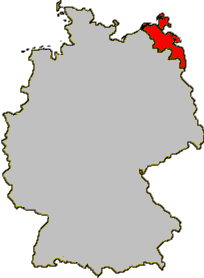 |
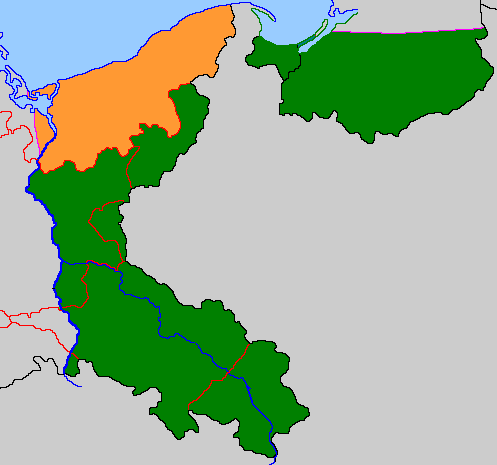 |
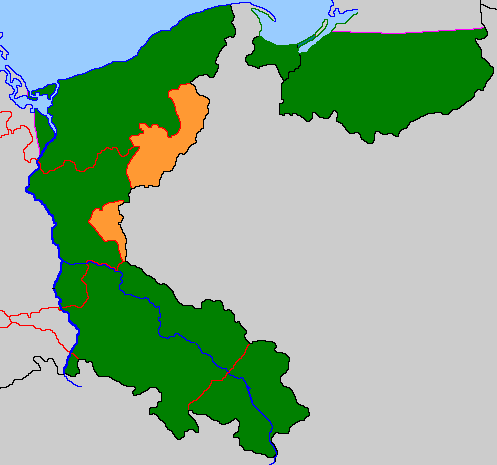 |
By the terms of the Potsdam agreement
Potsdam Agreement
The Potsdam Agreement was the Allied plan of tripartite military occupation and reconstruction of Germany—referring to the German Reich with its pre-war 1937 borders including the former eastern territories—and the entire European Theatre of War territory...
, Western Pomerania east of the Oder-Neisse line
Oder-Neisse line
The Oder–Neisse line is the border between Germany and Poland which was drawn in the aftermath of World War II. The line is formed primarily by the Oder and Lusatian Neisse rivers, and meets the Baltic Sea west of the seaport cities of Szczecin and Świnoujście...
became part of Poland
Poland
Poland , officially the Republic of Poland , is a country in Central Europe bordered by Germany to the west; the Czech Republic and Slovakia to the south; Ukraine, Belarus and Lithuania to the east; and the Baltic Sea and Kaliningrad Oblast, a Russian exclave, to the north...
. This line left the Oder
Oder
The Oder is a river in Central Europe. It rises in the Czech Republic and flows through western Poland, later forming of the border between Poland and Germany, part of the Oder-Neisse line...
river north of Gartz (Oder) and included the Stettin and Swinemünde area (Stettiner Zipfel) into the Polish state. The remaining German population was expelled
Expulsion of Germans after World War II
The later stages of World War II, and the period after the end of that war, saw the forced migration of millions of German nationals and ethnic Germans from various European states and territories, mostly into the areas which would become post-war Germany and post-war Austria...
and the area was resettled with Poles. Western Pomerania west of the Oder-Neisse line was merged with Mecklenburg
Mecklenburg
Mecklenburg is a historical region in northern Germany comprising the western and larger part of the federal-state Mecklenburg-Vorpommern...
to constitute the state of Mecklenburg-Vorpommern in the Soviet Occupation Zone of Germany, that in 1949 became the German Democratic Republic
German Democratic Republic
The German Democratic Republic , informally called East Germany by West Germany and other countries, was a socialist state established in 1949 in the Soviet zone of occupied Germany, including East Berlin of the Allied-occupied capital city...
(GDR). Vorpommern was soon dropped from the federal state's name, and after the GDR states were abolished, the coastal Western Pomeranian Landkreis districts became part of Bezirk Rostock whereas the mainland Landkreis districts became part of Bezirk Neubrandenburg.
In 1990, after the GDR communist system was overthrown
Die Wende
marks the complete process of the change from socialism and planned economy to market economy and capitalism in East Germany around the years 1989 and 1990. It encompasses several processes and events which later have become synonymous with the overall process...
, the state of Mecklenburg-Vorpommern was recreated, with Vorpommern being a non-administrative region. The districts Vorpommern-Rügen
Vorpommern-Rügen
Vorpommern-Rügen is a district in the north of Mecklenburg-Vorpommern, Germany. It is bounded by the Baltic Sea and the districts Vorpommern-Greifswald, Mecklenburgische Seenplatte and Rostock...
and Vorpommern-Greifswald
Vorpommern-Greifswald
Vorpommern-Greifswald is a district in the east of Mecklenburg-Vorpommern, Germany. It is bounded by the districts Mecklenburgische Seenplatte, Vorpommern-Rügen, the Baltic Sea, Poland and the state Brandenburg...
constitute most of the German part of former Pomerania, but these districts also contain some former Mecklenburg
Mecklenburg
Mecklenburg is a historical region in northern Germany comprising the western and larger part of the federal-state Mecklenburg-Vorpommern...
ian territory, and a small part of former Pomerania is now part of Brandenburg
Brandenburg
Brandenburg is one of the sixteen federal-states of Germany. It lies in the east of the country and is one of the new federal states that were re-created in 1990 upon the reunification of the former West Germany and East Germany. The capital is Potsdam...
. Due to this, the old Pomeranian border disappeared from the map and today is only prevailed by the border of the Pomeranian Evangelical Church
Pomeranian Evangelical Church
The Pomeranian Evangelical Church is a Protestant church body in the German state of Mecklenburg-Vorpommern, serving the citizens living in Hither Pomerania. It combines Lutheran and Reformed traditions...
. The part of the province of Pomerania which had become Polish was re-organized as Szczecin Voivodeship
Szczecin Voivodeship
Szczecin Voivodeship was a unit of administrative division and local government in Poland in the years 1975–1998, superseded by West Pomeranian Voivodeship.----Statistics :*Area: 10.000 km²...
after the war, from which the eastern part was split off as Koszalin Voivodeship
Koszalin Voivodeship
Koszalin Voivodeship – a unit of administrative division and local government in Poland in the years 1975–98, superseded by West Pomeranian Voivodeship. Capital city: Koszalin Area: 8.500 km² Statistics :...
in 1950. Slupsk Voivodeship
Slupsk Voivodeship
Słupsk Voivodeship was a unit of administrative division and local government in Poland from 1975 to 1998, previously part of Szczecin Voivodeship and Koszalin Voivodeship , superseded by Pomeranian Voivodeship and West Pomeranian Voivodeship...
was split off from this voivodeship in 1975, there were also territorial exchanges with neighboring voivodeships. Since 1999, the area of the former province of Pomerania is included in the West Pomeranian Voivodeship
West Pomeranian Voivodeship
West Pomeranian Voivodeship, , is a voivodeship in northwestern Poland. It borders on Pomeranian Voivodeship to the east, Greater Poland Voivodeship to the southeast, Lubusz Voivodeship to the south, the German federal-state of Mecklenburg-West Pomerania to the west, and the Baltic Sea to the north...
(Zachodniopomorskie, bulk) and Pomeranian Voivodeship
Pomeranian Voivodeship
Pomeranian Voivodeship, or Pomerania Province , is a voivodeship, or province, in north-central Poland. It comprises most of Pomerelia , as well as an area east of the Vistula River...
(western part around Slupsk
Slupsk
Słupsk is a city in the Pomeranian Voivodeship, in the northern part of Poland. Before 1 January 1999, it was the capital of the separate Słupsk Voivodeship. It is also a part of the historic region of Pomerania....
, formerly Stolp).
Köslin government region (Farther Pomerania)
The Köslin government region (Regierungsbezirk Köslin) was the administrative name for the region of Farther PomeraniaFarther Pomerania
Farther Pomerania, Further Pomerania, Transpomerania or Eastern Pomerania , which before the German-Polish border shift of 1945 comprised the eastern part of the Duchy, later Province of Pomerania, roughly stretching from the Oder River in the West to Pomerelia in the East...
(Hinterpommern) along with the smaller region of Lauenburg and Bütow Land
Lauenburg and Bütow Land
Lauenburg and Bütow Land formed a historical region in eastern in eastern Pomerania. Composed of two districts centered around the towns of Lauenburg and Bütow , it was on the western periphery of Pomerelia...
(easternmost part).
These parts of Pomerania were integrated into the Brandenburg-Prussia
Brandenburg-Prussia
Brandenburg-Prussia is the historiographic denomination for the Early Modern realm of the Brandenburgian Hohenzollerns between 1618 and 1701. Based in the Electorate of Brandenburg, the main branch of the Hohenzollern intermarried with the branch ruling the Duchy of Prussia, and secured succession...
n Province of Pomerania (1653-1815) already after the Thirty Years' War
Thirty Years' War
The Thirty Years' War was fought primarily in what is now Germany, and at various points involved most countries in Europe. It was one of the most destructive conflicts in European history....
. During the war, the noble House of Pomerania
House of Pomerania
The House of Griffins or House of Pomerania, , also known as House of Greifen; House of Gryf, was a dynasty of Royal dukes that ruled the Duchy of Pomerania from the 12th century until 1637, after their power was temporarily derivated to Prussian Royal House...
(Griffins), ruling the Duchy of Pomerania
Duchy of Pomerania
The Duchy of Pomerania was a duchy in Pomerania on the southern coast of the Baltic Sea, ruled by dukes of the House of Pomerania ....
since the 1120s, went extinct in the male line with the death of Bogislaw XIV in 1637. Throughout the existence of the Griffin duchy, Brandenburg had claimed overlordship and was asserted of Pomerania inheritance in numerous treaties. Yet, Sweden
Sweden
Sweden , officially the Kingdom of Sweden , is a Nordic country on the Scandinavian Peninsula in Northern Europe. Sweden borders with Norway and Finland and is connected to Denmark by a bridge-tunnel across the Öresund....
had been one of the most important players in the war and as such, she was awarded some of her territorial gains in Pomerania after the war by the Peace of Westphalia, thwartening Brandenburg-Prussia's ambitions for inheritance of the whole former Duchy of Pomerania. This led to tensions between Brandenburg-Prussia and Sweden in Pomerania until Sweden lost her Western Pomeranian possessions in 1720 (Stettin government region) and 1815 (Stralsund government region).
Landkreis Lauenburg-Bütow comprised the Lauenburg and Bütow Land
Lauenburg and Bütow Land
Lauenburg and Bütow Land formed a historical region in eastern in eastern Pomerania. Composed of two districts centered around the towns of Lauenburg and Bütow , it was on the western periphery of Pomerelia...
, a Pomerelia
Pomerelia
Pomerelia is a historical region in northern Poland. Pomerelia lay in eastern Pomerania: on the southern shore of the Baltic Sea and west of the Vistula and its delta. The area centered on the city of Gdańsk at the mouth of the Vistula...
n borderland with a somewhat different history than the rest of Pomerania. It was in 1846 dissolved into smaller administrative units. In contrast to ethnic German Pomerania, this area also had a Kashubian
Kashubians
Kashubians/Kaszubians , also called Kashubs, Kashubes, Kaszubians, Kassubians or Cassubians, are a West Slavic ethnic group in Pomerelia, north-central Poland. Their settlement area is referred to as Kashubia ....
population.
Roman Catholic Diocese of Kammin
The Bishopric of Cammin was both a former Roman Catholic diocese in the Duchy of Pomerania from 1140 to 1544, and a secular territory in the Kolberg area from 1248 to 1650....
bishops, and was ruled by the Pomeranian dukes since the aftermath of the Reformation
Protestant Reformation
The Protestant Reformation was a 16th-century split within Western Christianity initiated by Martin Luther, John Calvin and other early Protestants. The efforts of the self-described "reformers", who objected to the doctrines, rituals and ecclesiastical structure of the Roman Catholic Church, led...
. Until 1872, the area kept its territorial integrity, before it was dissolved into smaller administrative units.
Subdivisions
- urban districts (Stadtkreis):
- Stolp: population 27.293 (1900); 50.377 (1939)
- Köslin: split off Landkreis Köslin in 1923, population 33.479 (1939)
- Kolberg: split off Landkreis Kolberg-Körlin in1920, population 36.617 (1939)
- rural districts (Landkreis):
- Landkreis Belgard (Persante): population 47.097 (1900); 79.183 (1939)
- Landkreis Dramburg: population 35.863 (1900);
- Landkreis Fürstenthum (1816–1872), 1872 divided into
- Landkreis Bublitz: population 20.916 (1900); in 1932 merged into Landkreis Köslin
- Landkreis Kolberg-KörlinLandkreis Kolberg-KörlinKolberg-Körlin was a Landkreis in the Prussian Province of Pomerania between 1872 and 1945...
: population 57.871 (1900); 38.785 (1939) - Landkreis Köslin: population population 48.678 (1900); 80.287 (1939)
- Landkreis Greifenberg i. Pom.: until 1939 administered by Regierungsbezirk Stettin, population 47.891 (1939)
- Landkreis Lauenburg-Bütow (the Lauenburg and Bütow LandLauenburg and Bütow LandLauenburg and Bütow Land formed a historical region in eastern in eastern Pomerania. Composed of two districts centered around the towns of Lauenburg and Bütow , it was on the western periphery of Pomerelia...
), 1846 divided into:- Landkreis Bütow: population 26.021 (1900); 28.018 (1939)
- Landkreis Lauenburg i. Pom.: population 45.986 (1900); 63.985 (1939)
- Landkreis Neustettin: population 76.101 (1900); since 1938 administered by Regierungsbezirk Grenzmark Posen-Westpreußen
- Regenwalde: 49.668 (1939), until 1938 administered by Regierungsbezirk Stettin
- Landkreis Rummelsburg i. Pom.: population 33.785 (1900); 40.692 (1939)
- Landkreis Schivelbein: population 19.656 (1900); in 1932 merged into Landkreis Belgard (Persante)
- Landkreis Schlawe i. Pom.: population 73.206 (1900); 78.363 (1939)
- Landkreis StolpLandkreis StolpLandkreis Stolp was an administrative district of the Prussian Province of Pomerania in Germany, existing from 1816 to 1945. On 1 January 1945 it comprised 193 communities around the city of Stolp .- Literature :...
: population 75.310 (1900); 83.009 (1939)
Stettin government region (Western Pomerania)
The Stettin government region (Regierungsbezirk Stettin) since 1932 comprised the region of Western Pomerania (Vorpommern, Hither Pomerania), the former Swedish PomeraniaSwedish Pomerania
Swedish Pomerania was a Dominion under the Swedish Crown from 1630 to 1815, situated on what is now the Baltic coast of Germany and Poland. Following the Polish War and the Thirty Years' War, Sweden held extensive control over the lands on the southern Baltic coast, including Pomerania and parts...
. From 1815, the Stettin government region comprised only the southern parts of Vorpommern ("Altvorpommern", i.e. south of the Peene
Peene
The Peene is a river in Germany. The Westpeene, Kleine Peene and Ostpeene flow into the Kummerower See, and from there as Peene proper to Anklam and into the Oder Lagoon....
river). This part had been Swedish only until 1720, thereafter it was merged into the Prussian Province of Pomerania (1653-1815). "Neuvorpommern" (north of the river) was administered as Regierungsbezirk Stralsund until it was merged into Regierungsbezirk Stettin in 1932.
Stettin, the former ducal residence
Pomeranian Dukes' Castle, Szczecin
The Ducal Castle in Szczecin, Poland, was the seat of the dukes of Pomerania-Stettin of the House of Pomerania , who ruled the Duchy of Pomerania from 1121 to 1637.-History:...
, was made capital of the province and also was the administrative center of the Regierungsbezirk Stettin.
Subdivisions
- urban districts (Stadtkreis):
- GreifswaldGreifswaldGreifswald , officially, the University and Hanseatic City of Greifswald is a town in northeastern Germany. It is situated in the state of Mecklenburg-Vorpommern, at an equal distance of about from Germany's two largest cities, Berlin and Hamburg. The town borders the Baltic Sea, and is crossed...
: until 1932 administered by Regierungsbezirk Stralsund, population 37.051 (1939) - Stargard (Pommern): split off Landkreis Saatzig in 1901, population 39.760 (1939)
- Stettin: population 210.702 (1900); 382.984 (1939)
- StralsundStralsund- Main sights :* The Brick Gothic historic centre is a UNESCO World Heritage Site.* The heart of the old town is the Old Market Square , with the Gothic Town Hall . Behind the town hall stands the imposing Nikolaikirche , built in 1270-1360...
: until 1932 administered by Regierungsbezirk Stralsund, population 52.931 (1939)
- Greifswald
- rural districts (Landkreis):
- Landkreis Anklam: population 32.693 (1900); 39.527 (1939)
- Landkreis Cammin i. Pom.: population 42.485 (1900); 45.694 (1939)
- Landkreis Demmin: population 48.090 (1900); 54.769 (1939)
- Landkreis Franzburg-Barth (Capital: Barth): until 1932 administered by Regierungsbezirk Stralsund, population 55.542 (1939)
- Landkreis Greifenberg i. Pom.: population 37.483 (1900); after 1939 administered by Regierungsbezirk Köslin
- Landkreis Greifenhagen: population 48.258 (1900); 69.326 (1939)
- Landkreis Greifswald: until 1932 administered by Regierungsbezirk Stralsund, population 39.207 (1939)
- Landkreis Grimmen: until 1932 administered by Regierungsbezirk Stralsund, population 42.259 (1939)
- Landkreis Naugard: population 52.777 (1900); 61.320 (1939)
- Landkreis Pyritz: population 42.686 (1900); 48.418 (1939)
- Landkreis Randow: population 94.859 (1900); partitioned in 1939 by Stadtkreis Stettin, Landkreis Greifenhagen, Landkreis Ueckermünde, and Landkreis Naugard
- Landkreis Rügen (Capital: Bergen auf RügenBergen auf RügenBergen auf Rügen is the capital of the former district of Rügen in the middle of the island of Rügen in Mecklenburg-Vorpommern, Germany. Since 1 January 2005, Bergen has moreover been the administrative seat of the Amt of Bergen auf Rügen, which with a population of over 23,000 is...
): until 1932 administered by Regierungsbezirk Stralsund, population 62.261 (1939) - Landkreis Regenwalde: population 44.954 (1900);
- Landkreis Saatzig (Capital: Stargard (Pommern)): population 69.762 (1900); 43.258 (1939)
- Landkreis Ueckermünde: population 56.767 (1900); 79.996 (1939)
- Landkreis Usedom-Wollin (Capital: Swinemünde): population 52.193 (1900); 83. 479 (1939)
Stralsund government region (Northwest)
The Stralsund government region (Regierungsbezirk Stralsund) comprised the Western Pomeranian region of Neuvorpommern.The reason for creating a Regierungsbezirk as small as Stralsund was that Neuvorpommern had a somewhat different history than the rest of Pomerania. This region, consisting of the island of Rügen
Rügen
Rügen is Germany's largest island. Located in the Baltic Sea, it is part of the Vorpommern-Rügen district of Mecklenburg-Vorpommern.- Geography :Rügen is located off the north-eastern coast of Germany in the Baltic Sea...
and the adjacted mainland between the Recknitz
Recknitz
The Recknitz is a river in Mecklenburg-Vorpommern in northeastern Germany. The Recknitz's glacial valley stretches as far south as the heights at Glasewitz near Güstrow. The river has no definite source, but rather builds up from streams and drainage ditches...
and Peene
Peene
The Peene is a river in Germany. The Westpeene, Kleine Peene and Ostpeene flow into the Kummerower See, and from there as Peene proper to Anklam and into the Oder Lagoon....
rivers, made up the Rani
Rani (Slavic tribe)
The Rani or Rujani were a West Slavic tribe based on the island of Rugia and the southwestern mainland across the Strelasund in what is today northeastern Germany....
and Danish
Denmark
Denmark is a Scandinavian country in Northern Europe. The countries of Denmark and Greenland, as well as the Faroe Islands, constitute the Kingdom of Denmark . It is the southernmost of the Nordic countries, southwest of Sweden and south of Norway, and bordered to the south by Germany. Denmark...
Principality of Rugia
Principality of Rugia
The Principality of Rugia or Principality of Rügen was a Danish principality consisting of the island of Rügen and the adjacent mainland from 1168 until 1325. It was governed by a local dynasty of princes of the Wizlawiden dynasty...
in the Middle ages
Middle Ages
The Middle Ages is a periodization of European history from the 5th century to the 15th century. The Middle Ages follows the fall of the Western Roman Empire in 476 and precedes the Early Modern Era. It is the middle period of a three-period division of Western history: Classic, Medieval and Modern...
. Although it was inherited by the Pomeranian dukes in 1325, the region was for some time goverened as the splinter duchy of Pomerania-Barth. While a part of Swedish Pomerania
Swedish Pomerania
Swedish Pomerania was a Dominion under the Swedish Crown from 1630 to 1815, situated on what is now the Baltic coast of Germany and Poland. Following the Polish War and the Thirty Years' War, Sweden held extensive control over the lands on the southern Baltic coast, including Pomerania and parts...
, Denmark
Denmark
Denmark is a Scandinavian country in Northern Europe. The countries of Denmark and Greenland, as well as the Faroe Islands, constitute the Kingdom of Denmark . It is the southernmost of the Nordic countries, southwest of Sweden and south of Norway, and bordered to the south by Germany. Denmark...
maintained her old claims and occupied the area in 1715 during the Great Northern War
Great Northern War
The Great Northern War was a conflict in which a coalition led by the Tsardom of Russia successfully contested the supremacy of the Swedish Empire in northern Central Europe and Eastern Europe. The initial leaders of the anti-Swedish alliance were Peter I the Great of Russia, Frederick IV of...
. Yet, the Danes were forced to return it to Sweden by the 1720 Treaty of Stockholm (Great Northern War)
Treaty of Stockholm (Great Northern War)
With the death of Charles XII of Sweden in 1718 it was obvious that the Great Northern War was coming to a close. His successor Frederick I began negotiating the Treaty of Stockholm, which refers to the two treaties signed in 1719 and 1720 that ended the war between Sweden on one side and Hanover...
. In the 1813 Treaty of Kiel
Treaty of Kiel
The Treaty of Kiel or Peace of Kiel was concluded between the United Kingdom of Great Britain and Ireland and the Kingdom of Sweden on one side and the Kingdoms of Denmark and Norway on the other side on 14 January 1814 in Kiel...
, Denmark again gained nominal overlordship, yet was unable to pay her war reparations to Sweden and awarded her claim to Prussia
Prussia
Prussia was a German kingdom and historic state originating out of the Duchy of Prussia and the Margraviate of Brandenburg. For centuries, the House of Hohenzollern ruled Prussia, successfully expanding its size by way of an unusually well-organized and effective army. Prussia shaped the history...
in the 1815 Congress of Vienna
Congress of Vienna
The Congress of Vienna was a conference of ambassadors of European states chaired by Klemens Wenzel von Metternich, and held in Vienna from September, 1814 to June, 1815. The objective of the Congress was to settle the many issues arising from the French Revolutionary Wars, the Napoleonic Wars,...
along with her debts in exchange for the Duchy of Lauenburg.
The name Neuvorpommern (New Western Pomerania) originates in that era, to distinguish the Western Pomeranian areas south of the Peene River gained by Prussia in 1720 (Altvorpommern, Old Western Pomerania) from the northern regions gained in 1815 and to replace the outdated term Principality of Rugia.
When merged into the province in 1815, Neuvorpommern was guaranteed her constitution to be left in place. The administration was led by the former Swedish general governour, prince Malte von Putbus, until "Regierungsbezirk Stralsund" was officially created in 1818. Prussian law (Allgemeines Preußisches Landrecht and Preußisches Stadtrecht) was not enforced, and the Swedish jurisdiction with the court in Greifswald
Greifswald
Greifswald , officially, the University and Hanseatic City of Greifswald is a town in northeastern Germany. It is situated in the state of Mecklenburg-Vorpommern, at an equal distance of about from Germany's two largest cities, Berlin and Hamburg. The town borders the Baltic Sea, and is crossed...
was left in place.
Regierungsbezirk Stralsund was fused into Regierungsbezirk Stettin in 1932.
Subdivisions
- urban districts (Stadtkreis):
- StralsundStralsund- Main sights :* The Brick Gothic historic centre is a UNESCO World Heritage Site.* The heart of the old town is the Old Market Square , with the Gothic Town Hall . Behind the town hall stands the imposing Nikolaikirche , built in 1270-1360...
: split off Landkreis Franzburg-Barth in 1874, population 31.076 (1900) - GreifswaldGreifswaldGreifswald , officially, the University and Hanseatic City of Greifswald is a town in northeastern Germany. It is situated in the state of Mecklenburg-Vorpommern, at an equal distance of about from Germany's two largest cities, Berlin and Hamburg. The town borders the Baltic Sea, and is crossed...
: split off Landkreis Greifswald in 1913
- Stralsund
- rural districts (Landkreis):
- Landkreis Franzburg-Barth: population 41.704 (1900)
- Landkreis Greifswald: population 61.840 (1900)
- Landkreis Grimmen: population 35.540 (1900)
- Landkreis Rügen (capital Bergen auf RügenBergen auf RügenBergen auf Rügen is the capital of the former district of Rügen in the middle of the island of Rügen in Mecklenburg-Vorpommern, Germany. Since 1 January 2005, Bergen has moreover been the administrative seat of the Amt of Bergen auf Rügen, which with a population of over 23,000 is...
): population 46.270 (1900)
Posen-West Prussia government region
The Posen-West Prussia government region (Regierungsbezirk Grenzmark Posen-Westpreußen) was created of the northern part (Schneidemühl government region) of the former Prussian provinceProvinces of Prussia
The Provinces of Prussia constituted the main administrative divisions of Prussia. Following the dissolution of the Holy Roman Empire in 1806 and the Congress of Vienna in 1815 the various princely states in Germany gained their nominal sovereignty, but the reunification process that culminated in...
Posen-West-Prussia.
Following World War I
World War I
World War I , which was predominantly called the World War or the Great War from its occurrence until 1939, and the First World War or World War I thereafter, was a major war centred in Europe that began on 28 July 1914 and lasted until 11 November 1918...
, most of the Prussian provinces Posen
Province of Posen
The Province of Posen was a province of Prussia from 1848–1918 and as such part of the German Empire from 1871 to 1918. The area was about 29,000 km2....
and West Prussia
West Prussia
West Prussia was a province of the Kingdom of Prussia from 1773–1824 and 1878–1919/20 which was created out of the earlier Polish province of Royal Prussia...
became part of the Second Polish Republic
Second Polish Republic
The Second Polish Republic, Second Commonwealth of Poland or interwar Poland refers to Poland between the two world wars; a period in Polish history in which Poland was restored as an independent state. Officially known as the Republic of Poland or the Commonwealth of Poland , the Polish state was...
. The remainders of these provinces formed the province of Posen-West Prussia, combining small German-settled regions all along the new German-Polish border (Grenzmark meaning border march). In 1938, this province was dissolved and partitioned between Pomerania, Brandenburg
Province of Brandenburg
The Province of Brandenburg was a province of the Kingdom of Prussia and the Free State of Prussia from 1815 to 1946.-History:The first people who are known to have inhabited Brandenburg were the Suevi. They were succeeded by the Slavonians, whom Henry II conquered and converted to Christianity in...
and Silesia
Province of Silesia
The Province of Silesia was a province of the Kingdom of Prussia from 1815 to 1919.-Geography:The territory comprised the bulk of the former Bohemian crown land of Silesia and the County of Kladsko, which King Frederick the Great had conquered from the Austrian Habsburg Monarchy in the 18th...
. The Pomeranian share was extended by Landkreis Neustettin and Landkreis Dramburg, formally administered by Regierungsbezirk Stettin.
During World War II
World War II
World War II, or the Second World War , was a global conflict lasting from 1939 to 1945, involving most of the world's nations—including all of the great powers—eventually forming two opposing military alliances: the Allies and the Axis...
, it became a battlefield and was occupied by the Red Army
Red Army
The Workers' and Peasants' Red Army started out as the Soviet Union's revolutionary communist combat groups during the Russian Civil War of 1918-1922. It grew into the national army of the Soviet Union. By the 1930s the Red Army was among the largest armies in history.The "Red Army" name refers to...
in early 1945. By the terms of the Potsdam agreement
Potsdam Agreement
The Potsdam Agreement was the Allied plan of tripartite military occupation and reconstruction of Germany—referring to the German Reich with its pre-war 1937 borders including the former eastern territories—and the entire European Theatre of War territory...
, the Grenzmark became part of Poland
Poland
Poland , officially the Republic of Poland , is a country in Central Europe bordered by Germany to the west; the Czech Republic and Slovakia to the south; Ukraine, Belarus and Lithuania to the east; and the Baltic Sea and Kaliningrad Oblast, a Russian exclave, to the north...
. The German population was expelled
Expulsion of Germans after World War II
The later stages of World War II, and the period after the end of that war, saw the forced migration of millions of German nationals and ethnic Germans from various European states and territories, mostly into the areas which would become post-war Germany and post-war Austria...
and the area was resettled with Poles.
Subdivisions
- urban districts (Stadtkreis):
- Schneidemühl
- rural districts (Landkreis):
- Landkreis Arnswalde
- Landkreis Deutsch Krone
- Landkreis Dramburg
- Landkreis Flatow
- Landkreis Friedeberg Nm.
- Netzekreis (capital: Schönlanke)
- Landkreis Neustettin
- Landkreis Schlochau
Demographics
- 1818: The province with an estimated area of 540 (Prussian) square miles had a population of 630,000. The Prussian state official ("Staatsminister") von Beyme stated in his report, that the province was in a "low state of population and culture".
Until 1841, immigration to the province was higher than emigration. This trend reversed since 1850. However, the population grew further due to high birth rates.
- 1850: 1,255,900 inhabitants, predominantly Protestants, 11,100 CatholicsRoman Catholic ChurchThe Catholic Church, also known as the Roman Catholic Church, is the world's largest Christian church, with over a billion members. Led by the Pope, it defines its mission as spreading the gospel of Jesus Christ, administering the sacraments and exercising charity...
, 9,700 JewsJewsThe Jews , also known as the Jewish people, are a nation and ethnoreligious group originating in the Israelites or Hebrews of the Ancient Near East. The Jewish ethnicity, nationality, and religion are strongly interrelated, as Judaism is the traditional faith of the Jewish nation...
and 100 Mennonites.
- 1858: 1,125,000 people, 28% of whom lived in towns.
- 1871: 1,431,492 people, 68,7% of those lived in communities with less than 2,000 inhabitants.
- 1875: 1,445,852 people lived in the province, then with an area of 30,131 km2. Of those, 685,147 lived in Regierungsbezirk Stettin, and 554,201 in Regierungsbezirk Köslin.
- 1890: 1,520,889 people, 62,3% of those lived in communities with less than 2,000 inhabitants, and 7,6% in Stettin. Among them were 1,476,300 Protestants, 27,476 CatholicsRoman Catholic ChurchThe Catholic Church, also known as the Roman Catholic Church, is the world's largest Christian church, with over a billion members. Led by the Pope, it defines its mission as spreading the gospel of Jesus Christ, administering the sacraments and exercising charity...
, 4,587 persons belonging to other Christian religious groups, 200 dissidents and 12,246 JewsJewsThe Jews , also known as the Jewish people, are a nation and ethnoreligious group originating in the Israelites or Hebrews of the Ancient Near East. The Jewish ethnicity, nationality, and religion are strongly interrelated, as Judaism is the traditional faith of the Jewish nation...
; 1,519,397 were citizens of the German EmpireGerman EmpireThe German Empire refers to Germany during the "Second Reich" period from the unification of Germany and proclamation of Wilhelm I as German Emperor on 18 January 1871, to 1918, when it became a federal republic after defeat in World War I and the abdication of the Emperor, Wilhelm II.The German...
, 758 came from foreign territories attached to the empire, and 734 did not belong to any of these groups. With the exception of 10,666 persons composed of Poles, Kashubians and Masurians, all people of the Province used GermanGerman languageGerman is a West Germanic language, related to and classified alongside English and Dutch. With an estimated 90 – 98 million native speakers, German is one of the world's major languages and is the most widely-spoken first language in the European Union....
as their native language.
Between 1871 and 1914, the prime characteristic of the province's demography was migration from the rural areas, first to urban centers ("Landflucht"), then to destinations in other German provinces and oversees (Ostflucht
Ostflucht
The Ostflucht was a movement by residents of the former eastern territories of Germany, such as East Prussia, West Prussia, Silesia and Province of Posen beginning around 1850, to the more industrialized western German Rhine and Ruhr provinces...
). Despite the emigration during this time span, the population increased by 300,000 people.
Between 1871 and 1880, 61,700 people emigrated to America.
Between 1881 and 1890, 132,100 people emigrated to America; 95,000 of these emigrated between 1881 and 1885.
Between 1891 and 1900, 56,700 people emigrated to America.
Between 1871 and 1895, 242,505 people emigrated from the province, primarily from 1880 to 1885 (95,000 emigrants).
Between 1880 and 1910, 426,000 more people emigrated than immigrated. Emigrants came primarily from rural areas, which they left for economic reasons; prime destinations were Ruhr area
Ruhr Area
The Ruhr, by German-speaking geographers and historians more accurately called Ruhr district or Ruhr region , is an urban area in North Rhine-Westphalia, Germany. With 4435 km² and a population of some 5.2 million , it is the largest urban agglomeration in Germany...
and Berlin
Berlin
Berlin is the capital city of Germany and is one of the 16 states of Germany. With a population of 3.45 million people, Berlin is Germany's largest city. It is the second most populous city proper and the seventh most populous urban area in the European Union...
(Ostflucht
Ostflucht
The Ostflucht was a movement by residents of the former eastern territories of Germany, such as East Prussia, West Prussia, Silesia and Province of Posen beginning around 1850, to the more industrialized western German Rhine and Ruhr provinces...
).
Most people emigrated from Regierungsbezirk Köslin, where the population numbers of 1880 were only reached again in 1899.
The Province of Pomerania was one of the three provinces (the other two were West Prussia
West Prussia
West Prussia was a province of the Kingdom of Prussia from 1773–1824 and 1878–1919/20 which was created out of the earlier Polish province of Royal Prussia...
and Province of Posen
Province of Posen
The Province of Posen was a province of Prussia from 1848–1918 and as such part of the German Empire from 1871 to 1918. The area was about 29,000 km2....
) responsible for most of the German emigrants who went oversees. Imperial Commissioners for emigration ("Reichskommissar für Auswanderung") organized emigration from Hamburg
Hamburg
-History:The first historic name for the city was, according to Claudius Ptolemy's reports, Treva.But the city takes its modern name, Hamburg, from the first permanent building on the site, a castle whose construction was ordered by the Emperor Charlemagne in AD 808...
, Bremen
Bremen
The City Municipality of Bremen is a Hanseatic city in northwestern Germany. A commercial and industrial city with a major port on the river Weser, Bremen is part of the Bremen-Oldenburg metropolitan area . Bremen is the second most populous city in North Germany and tenth in Germany.Bremen is...
, Stettin, and Swinemünde. Emigration to oversees ended in 1893, when in America the free availability of soil claims ended.
- 1905: Of 1,684,326 inhabitants 1,616,550 were Protestants, 50,206 Roman Catholics and 9660 JewsJewsThe Jews , also known as the Jewish people, are a nation and ethnoreligious group originating in the Israelites or Hebrews of the Ancient Near East. The Jewish ethnicity, nationality, and religion are strongly interrelated, as Judaism is the traditional faith of the Jewish nation...
, (1900) 14,162 Polish speakers (at the West PrussiaWest PrussiaWest Prussia was a province of the Kingdom of Prussia from 1773–1824 and 1878–1919/20 which was created out of the earlier Polish province of Royal Prussia...
n border) and 310 KashubianKashubian languageKashubian or Cassubian is one of the Lechitic languages, a subgroup of the Slavic languages....
speakers (at the Lakes LebaseeLebaseeLebasee may refer to:-*Łebsko Lake , a cargo ship launched in 1996...
and Gardescher See).
- 1907: 440,000 people born in the province lived in other areas of Germany.
- 1910: 1,716,921 inhabitants, 55,3% of those lived in communities with less than 2,000 inhabitants, and 13,7% in Stettin. Of those, the majority was Protestant (1,637,299; i.e. 95,36%), 56,298 were Roman Catholics (3,27%), less than one percent were Old LutheransOld LutheransOld Lutherans refers to those German Lutherans who refused to join the Prussian Union in the 1830s and 1840s.Attempted suppression of the Old Lutherans led many to immigrate to Australia and the United States, resulting in the creation of significant Lutheran denominations in those countries.The...
(primarily in the CamminCamminCammin may refer to:*Cammin, Bad Doberan, a municipality in the district of Bad Doberan, Mecklenburg-Vorpommern, Germany*Cammin, Mecklenburg-Strelitz, a municipality in the district of Mecklenburg-Strelitz, Mecklenburg-Vorpommern, Germany...
and GreifenbergGreifenbergGreifenberg is a municipality in the district of Landsberg in Bavaria in Germany.-External links:*Webpage of the local Shooting Club "Schmied von Kochel"...
counties), and 8862 were Jews (0,52%)
Polish seasonal workers were employed in Pomeranian agriculture since the 1890s, initially to replace the emigrants. In 1910, 7921 Poles lived steadily in the province. In 1912, 12,000 seasonal workers were employed in agriculture, in 1914 their number increased to 42,000.
- 1919: On October 8, 1919, the province had 1,787,179 inhabitants. This population had increased by 160,000 in 1925.
On October 1, 1938, the bulk of the former Province of Posen-West Prussia was merged into the Province of Pomerania, adding an area of 5,787 km2 with a population of 251,000.
On October 15, Stettin's city limits were expanded to an area of 460 km2, housing 383,000 people.
During the Soviet conquest of Farther Pomerania
Farther Pomerania
Farther Pomerania, Further Pomerania, Transpomerania or Eastern Pomerania , which before the German-Polish border shift of 1945 comprised the eastern part of the Duchy, later Province of Pomerania, roughly stretching from the Oder River in the West to Pomerelia in the East...
and the subsequent expulsions of Germans
Flight and expulsion of Germans from Poland during and after World War II
The flight and expulsion of Germans from Poland was the largest of a series of flights and expulsions of Germans in Europe during and after World War II...
until 1950, 498,000 people from the part of the province east of the Oder-Neisse line
Oder-Neisse line
The Oder–Neisse line is the border between Germany and Poland which was drawn in the aftermath of World War II. The line is formed primarily by the Oder and Lusatian Neisse rivers, and meets the Baltic Sea west of the seaport cities of Szczecin and Świnoujście...
died, making up for 26,4% of the former population. Of the 498,000 dead, 375,000 were civilians, and 123,000 were Wehrmacht
Wehrmacht
The Wehrmacht – from , to defend and , the might/power) were the unified armed forces of Nazi Germany from 1935 to 1945. It consisted of the Heer , the Kriegsmarine and the Luftwaffe .-Origin and use of the term:...
soldiers. Low estimates give a million expellees from the then Polish part of the province in 1945 and the following years. Only 7,100 km2 remained with Germany, about a fourth of the province's size before 1938 and a fifth of the size thereafter.