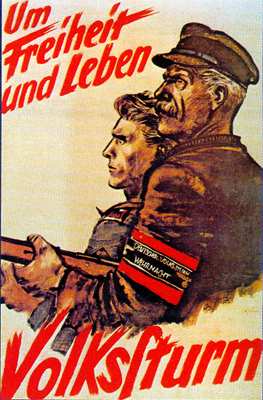
Volkssturm

Encyclopedia
The Volkssturm (ˈfɔlks.ʃtʊɐ̯m, lit. "storm of the people"; "People's Army" or "National Militia") was a German
national militia
of the last months of World War II
. It was founded on Adolf Hitler
's orders on October 18, 1944 and conscripted males between the ages of 16 to 60 years who were not already serving in some military unit as part of a German Home Guard
.
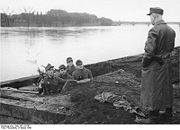 The new Volkssturm drew inspiration from the old Prussian Landsturm
of 1813–15, that fought in the liberation wars against Napoleon, mainly as guerrilla forces. Plans to form a Landsturm national militia in Eastern Germany as a last resort to boost fighting strength initially came from Oberkommando des Heeres
chief General Heinz Guderian
in 1944. Because the Wehrmacht
was lacking manpower to stop the Soviet advance
, men in jobs not deemed necessary or previously deemed unfit for military service were now called under arms. The Volkssturm had existed, on paper, since approximately 1925, however it was only after Hitler ordered Martin Bormann
to recruit six million men for this militia that the group became a physical reality. The intended strength of six million was never attained.
Goebbels
and other propagandists depicted the Volkssturm as an outburst of enthusiasm and will to resist. It did create some morale, but this was undermined by their visible lack of uniforms and weaponry for the fight. Nazi themes of death, transcendence, and commemoration were given full play to encourage the fight.
In order for these militia units to be effective, Hitler and Bormann counted not only on strength in numbers, but also in fanaticism. During the early stages of Volkssturm planning, it became apparent that if militia units lacked morale they would lack combat effectiveness. To achieve the envisaged fanaticism, Volkssturm units were placed under direct command of the local Nazi party, meaning local Gau- and Kreis
leiters. The new Volkssturm was also to become a nation-wide organization, with Heinrich Himmler
, as Replacement Army Commander, responsible for armament and training. Though normally under party control, Volkssturm units were placed under Wehrmacht
command when engaging in action.
With the Nazi Party in charge of organizing the Volkssturm, each Gauleiter, or Nazi Party District Leader, was charged with the leadership, enrollment, and organization of the Volkssturm in their district. The largest Volkssturm unit seems to have corresponded to the next smaller territorial subdivision of the Nazi Party organization—the Kreis.
The basic unit was a battalion
of 642 men. Units were mostly composed of members of the Hitler Youth
, invalids, the elderly, or men who had previously been considered unfit for military service.
Municipal organization:
Each Gauleiter and Kreisleiter, had a Volkssturm Chief of Staff to assist in handling militia problems.

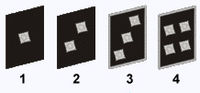 The Volkssturm "uniform" was only a black armband with words Deutscher Volkssturm Wehrmacht with a series of silver
collar pips pinned to the wearer's collar. These were characteristically derived from the rank insignia
of the various paramilitary organizations of the Nazi Party, which had control over them, and not of the regular Wehrmacht
. Although the German government tried to issue as many of its members as possible with military uniforms of all sort, ranging from field gray to camouflage, these could not be provided to all its members, thus many members of the Volkssturm wore makeshift paramilitary uniforms or uniforms from their civilian jobs (such as train conductors of the Reichsbahn). The simple paramilitary insignia of the Volkssturm were as follows:
By January 1945, this lack of official uniform produced considerable worry among the population that the members could be shot if captured, since they were not wearing uniforms as mandated by the Geneva Convention.

 Typically, members of the Volkssturm received only very basic military training. It included a brief indoctrination and training on the use of basic weapons such as the Karabiner 98k
rifle
and Panzerfaust
. Because of continuous fighting and weapon shortages, weapon training was often very minimal. There was also a lack of instructors, meaning that weapons training was sometimes done by World War I-veterans drafted into service themselves. Often Volkssturm members had to familiarize themselves with their weapons when in actual combat.
There was no standardization of any kind and units were issued only what equipment was available. This was true of every form of equipment—Volkssturm members were required to bring their own uniforms and culinary equipment etc. This resulted in the units looking very ragged and, instead of boosting civilian morale, it often reminded people of Germany's desperate state. Armament was equally diverse, while some Karabiner 98k
s were on hand, members were also issued older Gewehr 98
s and 19th-century Gewehr 71s
as well as Dreyse M1907
pistols in addition to a plethora of Soviet, Belgian, French, Italian and other weapons that had been captured by German forces during the war. The Germans had also developed cheap but effective Volkssturm-weapons, like MP 3008
machine pistols, Volkssturmgewehr 1-5
rifles and VMG-27 light machine guns. These were completely stamped and machine-pressed constructions (it has to be remembered that in the 1940s industrial processes were much cruder than today, so a firearm needed great amounts of semi-artisanal work to be fine-tuned and be actually reliable). Being armed with leftovers compounded their ineffectiveness; the large number of different ammunition types also put a strain on an already burdened logistics system; the Gewehr 71s used a different type of ammunition than the two 98's rifles. In the last few months of the war, the shortages of modern firearms led to the use of weapons such as shotguns and even muskets and crossbows taken from museums.
When units had completed their training and received armament, members took a customary oath to Hitler and were then dispatched into combat. Unlike most English-speaking countries, Germany had universal military service for all young men for several generations, so many of the older members would have had at least basic military training when they served in the German Army and, as noted before, many would have been veterans of the First World War. Volkssturm units were supposed to be used only in their own districts, but many were sent directly to the front lines. Their most extensive use was during the Battle of Berlin
, during which Volkssturm units fought in many parts of the city. This battle was particularly devastating to its formations, however, since many members fought to the death out of fear of being captured by the Soviets. Another important Volkssturm battle was the Battle of Königsberg
.
Other nations:
Germany
Germany , officially the Federal Republic of Germany , is a federal parliamentary republic in Europe. The country consists of 16 states while the capital and largest city is Berlin. Germany covers an area of 357,021 km2 and has a largely temperate seasonal climate...
national militia
Militia
The term militia is commonly used today to refer to a military force composed of ordinary citizens to provide defense, emergency law enforcement, or paramilitary service, in times of emergency without being paid a regular salary or committed to a fixed term of service. It is a polyseme with...
of the last months of World War II
World War II
World War II, or the Second World War , was a global conflict lasting from 1939 to 1945, involving most of the world's nations—including all of the great powers—eventually forming two opposing military alliances: the Allies and the Axis...
. It was founded on Adolf Hitler
Adolf Hitler
Adolf Hitler was an Austrian-born German politician and the leader of the National Socialist German Workers Party , commonly referred to as the Nazi Party). He was Chancellor of Germany from 1933 to 1945, and head of state from 1934 to 1945...
's orders on October 18, 1944 and conscripted males between the ages of 16 to 60 years who were not already serving in some military unit as part of a German Home Guard
Militia
The term militia is commonly used today to refer to a military force composed of ordinary citizens to provide defense, emergency law enforcement, or paramilitary service, in times of emergency without being paid a regular salary or committed to a fixed term of service. It is a polyseme with...
.
Origins and organization
Landsturm
German-speaking countries used the word Landsturm to refer to third-class infantry or militias.- 1813 :King Frederick William III of Prussia established the Prussian Landsturm as irregular military forces on 21 April 1813 by royal edict – the decree appeared in the preussische Gesetzesammlung...
of 1813–15, that fought in the liberation wars against Napoleon, mainly as guerrilla forces. Plans to form a Landsturm national militia in Eastern Germany as a last resort to boost fighting strength initially came from Oberkommando des Heeres
Oberkommando des Heeres
The Oberkommando des Heeres was Nazi Germany's High Command of the Army from 1936 to 1945. The Oberkommando der Wehrmacht commanded OKH only in theory...
chief General Heinz Guderian
Heinz Guderian
Heinz Wilhelm Guderian was a German general during World War II. He was a pioneer in the development of armored warfare, and was the leading proponent of tanks and mechanization in the Wehrmacht . Germany's panzer forces were raised and organized under his direction as Chief of Mobile Forces...
in 1944. Because the Wehrmacht
Wehrmacht
The Wehrmacht – from , to defend and , the might/power) were the unified armed forces of Nazi Germany from 1935 to 1945. It consisted of the Heer , the Kriegsmarine and the Luftwaffe .-Origin and use of the term:...
was lacking manpower to stop the Soviet advance
Eastern Front (World War II)
The Eastern Front of World War II was a theatre of World War II between the European Axis powers and co-belligerent Finland against the Soviet Union, Poland, and some other Allies which encompassed Northern, Southern and Eastern Europe from 22 June 1941 to 9 May 1945...
, men in jobs not deemed necessary or previously deemed unfit for military service were now called under arms. The Volkssturm had existed, on paper, since approximately 1925, however it was only after Hitler ordered Martin Bormann
Martin Bormann
Martin Ludwig Bormann was a prominent Nazi official. He became head of the Party Chancellery and private secretary to Adolf Hitler...
to recruit six million men for this militia that the group became a physical reality. The intended strength of six million was never attained.
Goebbels
Goebbels
Goebbels, alternatively Göbbels, is a common surname in the western areas of Germany. It is probably derived from the Old Low German word gibbler, meaning brewer...
and other propagandists depicted the Volkssturm as an outburst of enthusiasm and will to resist. It did create some morale, but this was undermined by their visible lack of uniforms and weaponry for the fight. Nazi themes of death, transcendence, and commemoration were given full play to encourage the fight.
In order for these militia units to be effective, Hitler and Bormann counted not only on strength in numbers, but also in fanaticism. During the early stages of Volkssturm planning, it became apparent that if militia units lacked morale they would lack combat effectiveness. To achieve the envisaged fanaticism, Volkssturm units were placed under direct command of the local Nazi party, meaning local Gau- and Kreis
Kreis
Kreis is the German word for circle, and also refers to a type of country subdivision.*In Germany, a Kreis is a district or county*In Prussia, a Kreis was a district or county...
leiters. The new Volkssturm was also to become a nation-wide organization, with Heinrich Himmler
Heinrich Himmler
Heinrich Luitpold Himmler was Reichsführer of the SS, a military commander, and a leading member of the Nazi Party. As Chief of the German Police and the Minister of the Interior from 1943, Himmler oversaw all internal and external police and security forces, including the Gestapo...
, as Replacement Army Commander, responsible for armament and training. Though normally under party control, Volkssturm units were placed under Wehrmacht
Wehrmacht
The Wehrmacht – from , to defend and , the might/power) were the unified armed forces of Nazi Germany from 1935 to 1945. It consisted of the Heer , the Kriegsmarine and the Luftwaffe .-Origin and use of the term:...
command when engaging in action.
With the Nazi Party in charge of organizing the Volkssturm, each Gauleiter, or Nazi Party District Leader, was charged with the leadership, enrollment, and organization of the Volkssturm in their district. The largest Volkssturm unit seems to have corresponded to the next smaller territorial subdivision of the Nazi Party organization—the Kreis.
The basic unit was a battalion
Battalion
A battalion is a military unit of around 300–1,200 soldiers usually consisting of between two and seven companies and typically commanded by either a Lieutenant Colonel or a Colonel...
of 642 men. Units were mostly composed of members of the Hitler Youth
Hitler Youth
The Hitler Youth was a paramilitary organization of the Nazi Party. It existed from 1922 to 1945. The HJ was the second oldest paramilitary Nazi group, founded one year after its adult counterpart, the Sturmabteilung...
, invalids, the elderly, or men who had previously been considered unfit for military service.
Municipal organization:
- A Battalion in every KreisKreisKreis is the German word for circle, and also refers to a type of country subdivision.*In Germany, a Kreis is a district or county*In Prussia, a Kreis was a district or county...
(roughly equivalent to a U.S. county; there were 920 kreise in Greater Germany) - A Kompanie (company) in every Ortsgruppe (roughly equivalent to a U.S. Congressional districtCongressional districtA congressional district is “a geographical division of a state from which one member of the House of Representatives is elected.”Congressional Districts are made up of three main components, a representative, constituents, and the specific land area that both the representative and the...
) - A Zug (platoon) in every Zelle (literally "a cell"; roughly equivalent to a U.S. precinctPrecinctA precinct is a space enclosed by the walls or other boundaries of a particular place or building, or by an arbitrary and imaginary line drawn around it. The term has several different uses...
) - A Gruppe (squad) in every Block (city block)
Each Gauleiter and Kreisleiter, had a Volkssturm Chief of Staff to assist in handling militia problems.
Uniforms and insignia
Silver
Silver is a metallic chemical element with the chemical symbol Ag and atomic number 47. A soft, white, lustrous transition metal, it has the highest electrical conductivity of any element and the highest thermal conductivity of any metal...
collar pips pinned to the wearer's collar. These were characteristically derived from the rank insignia
Nazi party paramilitary ranks
Nazi party paramilitary ranks were pseudo-military titles which were used by the National Socialist German Workers Party between the years of 1920 and 1945...
of the various paramilitary organizations of the Nazi Party, which had control over them, and not of the regular Wehrmacht
Wehrmacht
The Wehrmacht – from , to defend and , the might/power) were the unified armed forces of Nazi Germany from 1935 to 1945. It consisted of the Heer , the Kriegsmarine and the Luftwaffe .-Origin and use of the term:...
. Although the German government tried to issue as many of its members as possible with military uniforms of all sort, ranging from field gray to camouflage, these could not be provided to all its members, thus many members of the Volkssturm wore makeshift paramilitary uniforms or uniforms from their civilian jobs (such as train conductors of the Reichsbahn). The simple paramilitary insignia of the Volkssturm were as follows:
| Volkssturm Rank | Translation | Comparative military rank |
| Bataillonsführer Bataillonsführer Bataillonsführer is a German paramilitary title that has existed since the First World War. Originally, the title of Bataillonsführer was held by the officer commanding an infantry battalion Bataillonsführer is a German paramilitary title that has existed since the First World War. Originally,... |
Battalion leader | Major Major Major is a rank of commissioned officer, with corresponding ranks existing in almost every military in the world.When used unhyphenated, in conjunction with no other indicator of rank, the term refers to the rank just senior to that of an Army captain and just below the rank of lieutenant colonel. ... |
| Kompanieführer Kompanieführer Kompanieführer is a German paramilitary title that has existed since the First World War. Originally, the title of Kompanieführer was held by the officer commanding an infantry company Kompanieführer is a German paramilitary title that has existed since the First World War. Originally, the title... |
Company leader | Captain Captain (OF-2) The army rank of captain is a commissioned officer rank historically corresponding to command of a company of soldiers. The rank is also used by some air forces and marine forces. Today a captain is typically either the commander or second-in-command of a company or artillery battery... |
| Zugführer Zugführer Zugführer was a paramilitary title of Nazi Germany which is most often associated with the Volkssturm. Translated as "Platoon Leader", a Zugführer of the Volkssturm would oversee a platoon sized formation of Volkssturmmann.... |
Platoon leader Platoon leader A platoon leader or platoon commander is the officer in command of a platoon. This person is usually a junior officer — a second or first lieutenant, or an equivalent rank. The officer is usually assisted by a platoon sergeant... |
Lieutenant Lieutenant A lieutenant is a junior commissioned officer in many nations' armed forces. Typically, the rank of lieutenant in naval usage, while still a junior officer rank, is senior to the army rank... |
| Gruppenführer Gruppenführer Gruppenführer was an early paramilitary rank of the Nazi Party, first created in 1925 as a senior rank of the SA.-SS rank:... |
Squad Squad In military terminology, a squad is a small military unit led by a non-commissioned officer that is subordinate to an infantry platoon. In countries following the British Army tradition this organization is referred to as a section... leader |
Corporal Corporal Corporal is a rank in use in some form by most militaries and by some police forces or other uniformed organizations. It is usually equivalent to NATO Rank Code OR-4.... |
| Volkssturmmann Volkssturmmann Volkssturmmann was a paramiltiary rank of the Volkssturm, the German militia created to defend the German homeland in the last months of World War II. The rank of Volkssturmmann carried no special uniform or insignia and the title was merely held by any person who was drafted to serve in the... |
People's Storm Trooper | Private Private (rank) A Private is a soldier of the lowest military rank .In modern military parlance, 'Private' is shortened to 'Pte' in the United Kingdom and other Commonwealth countries and to 'Pvt.' in the United States.Notably both Sir Fitzroy MacLean and Enoch Powell are examples of, rare, rapid career... |
By January 1945, this lack of official uniform produced considerable worry among the population that the members could be shot if captured, since they were not wearing uniforms as mandated by the Geneva Convention.
Training and impact
Karabiner 98k
The Karabiner 98 Kurz was a bolt action rifle chambered for the 8x57mm IS/7.92×57mm IS cartridge that was adopted as the standard service rifle in 1935 by the German Wehrmacht. It was one of the final developments in the long line of Mauser military rifles...
rifle
Rifle
A rifle is a firearm designed to be fired from the shoulder, with a barrel that has a helical groove or pattern of grooves cut into the barrel walls. The raised areas of the rifling are called "lands," which make contact with the projectile , imparting spin around an axis corresponding to the...
and Panzerfaust
Panzerfaust
The Panzerfaust was an inexpensive, recoilless German anti-tank weapon of World War II. It consisted of a small, disposable preloaded launch tube firing a high explosive anti-tank warhead, operated by a single soldier...
. Because of continuous fighting and weapon shortages, weapon training was often very minimal. There was also a lack of instructors, meaning that weapons training was sometimes done by World War I-veterans drafted into service themselves. Often Volkssturm members had to familiarize themselves with their weapons when in actual combat.
There was no standardization of any kind and units were issued only what equipment was available. This was true of every form of equipment—Volkssturm members were required to bring their own uniforms and culinary equipment etc. This resulted in the units looking very ragged and, instead of boosting civilian morale, it often reminded people of Germany's desperate state. Armament was equally diverse, while some Karabiner 98k
Karabiner 98k
The Karabiner 98 Kurz was a bolt action rifle chambered for the 8x57mm IS/7.92×57mm IS cartridge that was adopted as the standard service rifle in 1935 by the German Wehrmacht. It was one of the final developments in the long line of Mauser military rifles...
s were on hand, members were also issued older Gewehr 98
Gewehr 98
The Gewehr 98 is a German bolt action Mauser rifle firing the 8x57mm cartridge from a 5 round internal clip-loaded magazine that was the German service rifle from 1898 to 1935, when it was replaced by the Karabiner 98k. It was hence the main rifle of the German infantry during World War I...
s and 19th-century Gewehr 71s
Mauser Model 1871
The Mauser Model 1871 adopted as the Gewehr 71 or Infanterie-Gewehr 71 was the first of millions of rifles manufactured to the designs of Paul Mauser and Wilhelm Mauser of the Mauser company.During 1870-71 trials with many different rifles took place, with the "M1869 Bavarian Werder" being the...
as well as Dreyse M1907
Dreyse M1907
The Dreyse Model 1907 is a semi-automatic pistol designed by Louis Schmeisser. The gun was named after Nikolaus von Dreyse, the designer of the Dreyse Needle Gun...
pistols in addition to a plethora of Soviet, Belgian, French, Italian and other weapons that had been captured by German forces during the war. The Germans had also developed cheap but effective Volkssturm-weapons, like MP 3008
MP 3008
The 9 mm MP 3008 was a German substitute standard submachine gun manufactured toward the end of World War II in early 1945....
machine pistols, Volkssturmgewehr 1-5
Volkssturmgewehr 1-5
The Volkssturmgewehr 1-5 is a set of 5 rifle designs developed by Nazi Germany during the last months of World War II...
rifles and VMG-27 light machine guns. These were completely stamped and machine-pressed constructions (it has to be remembered that in the 1940s industrial processes were much cruder than today, so a firearm needed great amounts of semi-artisanal work to be fine-tuned and be actually reliable). Being armed with leftovers compounded their ineffectiveness; the large number of different ammunition types also put a strain on an already burdened logistics system; the Gewehr 71s used a different type of ammunition than the two 98's rifles. In the last few months of the war, the shortages of modern firearms led to the use of weapons such as shotguns and even muskets and crossbows taken from museums.
When units had completed their training and received armament, members took a customary oath to Hitler and were then dispatched into combat. Unlike most English-speaking countries, Germany had universal military service for all young men for several generations, so many of the older members would have had at least basic military training when they served in the German Army and, as noted before, many would have been veterans of the First World War. Volkssturm units were supposed to be used only in their own districts, but many were sent directly to the front lines. Their most extensive use was during the Battle of Berlin
Battle of Berlin
The Battle of Berlin, designated the Berlin Strategic Offensive Operation by the Soviet Union, was the final major offensive of the European Theatre of World War II....
, during which Volkssturm units fought in many parts of the city. This battle was particularly devastating to its formations, however, since many members fought to the death out of fear of being captured by the Soviets. Another important Volkssturm battle was the Battle of Königsberg
Battle of Königsberg
The Battle of Königsberg , was one of the last operations of the East Prussian Offensive during World War II. In four days of violent urban warfare, Soviet forces of the 1st Baltic Front and the 3rd Belorussian Front captured the city of Königsberg...
.
Notable members
- Ernst TiburzyErnst TiburzyErnst Tiburzy was a German Volkssturm-Bataillonsführer who received the Knight's Cross to the Iron Cross for his performance fighting alone and the destruction of five or nine T-34s with Panzerfausts during the defense of Königsberg on February 10, 1945...
, received the Knight's Cross of the Iron CrossKnight's Cross of the Iron CrossThe Knight's Cross of the Iron Cross was a grade of the 1939 version of the 1813 created Iron Cross . The Knight's Cross of the Iron Cross was the highest award of Germany to recognize extreme battlefield bravery or successful military leadership during World War II...
. - Helmut Ficher, Iron cross holder Age 14.
- Otto Herzog, Knight's Cross holder.
- Hans ModrowHans ModrowHans Modrow is a German politician, best known as the last communist premier of East Germany. He currently is the honorary Chairman of the Left Party....
, Premier of East Germany. - Karl Pakebusch, Knight's Cross holder.
- Otto DixOtto DixWilhelm Heinrich Otto Dix was a German painter and printmaker, noted for his ruthless and harshly realistic depictions of Weimar society and the brutality of war. Along with George Grosz, he is widely considered one of the most important artists of the Neue Sachlichkeit.-Early life and...
, Modernist painter and World War I veteran.
See also
- German ArmyGerman ArmyThe German Army is the land component of the armed forces of the Federal Republic of Germany. Following the disbanding of the Wehrmacht after World War II, it was re-established in 1955 as the Bundesheer, part of the newly formed West German Bundeswehr along with the Navy and the Air Force...
- Werwolf Guerrillas
- WehrmachtWehrmachtThe Wehrmacht – from , to defend and , the might/power) were the unified armed forces of Nazi Germany from 1935 to 1945. It consisted of the Heer , the Kriegsmarine and the Luftwaffe .-Origin and use of the term:...
- VolkspistoleVolkspistoleThe Volkspistole was an emergency German pistol design that was assembled from simple steel pressings with a minimum of machined parts. Only prototypes were produced before the end of World War II. These prototypes had an unusual locking system that directed the propellant gases forward to retard...
- MP 3008MP 3008The 9 mm MP 3008 was a German substitute standard submachine gun manufactured toward the end of World War II in early 1945....
- Volkssturmgewehr 1-5Volkssturmgewehr 1-5The Volkssturmgewehr 1-5 is a set of 5 rifle designs developed by Nazi Germany during the last months of World War II...
- VMG-27
- Einstossflammenwerfer 46Einstossflammenwerfer 46The Einstossflammenwerfer 46 was a flamethrower designed in Germany during the second half of World War II and introduced in 1944; it was engineered to be both cheap and easily mass-produced...
- WachdienstWachdienstThe Wachdienst was an auxiliary organisation erected by the Third Reich in Germany during the last months of World War II, in 1945. The service was created to assist local authorities in rural areas, among other things, and elderly men in Germany, mostly farmers and other rural labourers, were...
- LandwehrLandwehrLandwehr, or Landeswehr, is a German language term used in referring to certain national armies, or militias found in nineteenth- and early twentieth-century Europe. In different context it refers to large scale, low strength fortifications...
- VolksgrenadierVolksgrenadierVolksgrenadier was the name given to a type of German Army division formed in the Autumn of 1944 after the double loss of Army Group Center to the Soviets in Operation Bagration and the Fifth Panzer Army to the Allies in Normandy. The name itself was intended to build morale, appealing at once to...
Other nations:
- Volunteer Fighting Corps (Japan)
- Black Brigades (Italy)Black BrigadesBlack Brigades were one of the Fascist paramilitary groups operating in the Italian Social Republic , during the final years of World War II, and after the signing of the Italian Armistice in 1943...
- Home Guard (United Kingdom)