

Old Lutherans

Encyclopedia
Old Lutherans refers to those German Lutherans
who refused to join the Prussian Union (Evangelical Christian Church)
in the 1830s and 1840s.
Attempted suppression of the Old Lutherans led many to immigrate to Australia
and the United States
, resulting in the creation of significant Lutheran denominations
in those countries.
The legacy of Old Lutherans also survives in Lutheran denominations in modern Germany
.
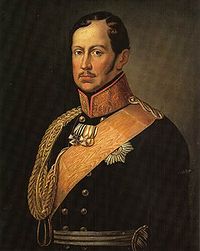 In 1799 King Frederick William III of Prussia
issued a decree for a new common liturgical Agenda
(service book) to be published, for use in both the Lutheran and Reformed
congregations. To accomplish this, a commission to prepare a common agenda was formed.
After more than 20 years of effort, a common liturgical agenda was finally published in 1821. The agenda was not well received by many Lutherans, as it was seen to compromise in the wording of the Words of Institution
, to the point where the Real Presence
of Christ
in the Eucharist
was not proclaimed.
The Protestant
congregations were directed in 1822 to use only the newly formulated agenda for worship. This met with strong objections and non-compliance from Lutheran pastors around Prussia.
The liturgical agenda was subsequently modified to appease many of the objections of the dissenting Lutherans, and in 1830 Frederick William ordered all Protestant congregations in Prussia to celebrate the Lord's Supper
using the new agenda.
Rather than having the unifying effect that Frederick William desired, the decree created a great deal of dissent among Lutheran congregations.
In a compromise with dissenters, who had now earned the name “Old Lutherans”, in 1834 Frederick William issued a decree which stated that Union would only be in the areas of governance and liturgy, but the respective congregations could retain their confessional identities. In addition to this, dissenters were forbidden from organizing sectarian groups.
In defiance of this decree, a number of Lutheran pastors and congregations continued to use the old liturgical agenda and sacramental rites of the Lutheran church.
Becoming aware of this defiance, officials sought out those who acted against the decree. Pastors who were caught were suspended from their ministry. If suspended pastors were caught acting in a pastoral role, they were imprisoned.
Among the leaders of the Old Lutherans was Johann Gottfried Scheibel
(1783-1843). Scheibel was a professor of theology
in Breslau from 1818 until 1830 when he was suspended from his post for his dissenting views.
Scheibel came to prominence as a leader of the Old Lutherans in the dissent against the Prussian Union. He spoke, preached and wrote against the Union, which consequently resulted in suspension from his post as theological professor.
Undaunted, Scheibel continued in his dissent as he moved to new cities. He was at Dresden
in 1832 where he was ordered to leave that same year. He moved to Hermsdorf
, where likewise he was asked to leave in 1836, then on to Glauchau
and Nuremberg
.
He died at Nuremberg about the time that he was being restored to his post as professor at Breslau.
 After Scheibel, Eduard Huschke became the leader of Old Lutherans. Other famous Old Lutherans included Henrik Steffens
, H. E. F. Guericke, Kahnis
and Rudolf Rocholl.
Union also caused a confessional Lutheran
counter-reaction called Neo-Lutheranism
.
Upon Frederick William's death in 1840, persecution of the Old Lutherans eased substantially. However, Old Lutherans continued to find themselves marginalized, especially the clergy who did not have many of the same rights and support accorded to clergy of the Union church.
Old Lutherans formed several synod
s, which through various mergers eventually resulted in the present-day Independent Evangelical-Lutheran Church
(SELK).
, who arrived in 1838 with Pastor
August Kavel
. These immigrants created three settlements at Klemzig
, Hahndorf
, and Glen Osmond
. In 1841, a second wave of Prussian immigrants arrived, led by Pastor Gotthard Fritzsche
. His group settled in Lobethal
and Bethanien
.
The Lutherans in Western Australia established the Killalpaninna Mission (Bethesda
) Station at Cooper's Creek. Johann Flierl
, the pioneer missionary of German New Guinea
, served there for seven years (1878-1885). When he left for Kaiser-Wilhelmsland in 1885, his cousin, also named Johann Flierl, replaced him at the mission.
There have been five waves of migration into the Lutheran Church in New Zealand:
In the 1840s people came from Germany.
In the 1860s a second wave of migrants from Germany settled in Marton in the Rangitikei. Some had first settled in Australia.
In the 1870s significant numbers arrived from Denmark and the rest of Scandinavia.
In the years after World War II many came from Europe.
In the last 10-15 years there has been an influx of people from Africa, Asia and other parts of the world.
Lutheran missionaries first arrived in New Zealand in 1843, just three years after the signing of the Treaty of Waitangi.
The first Lutheran Missionaries arrived in Otago in January 1843. They found that the Wesleyan and Anglican Mission Societies were already well established in New Zealand. They therefore took up the suggestion that they move to the Chatham Islands where they arrived on the 20th February of that year. As someone said, they had "...faith in their souls and next to nothing in their pockets."
In June of the same year, 1843, a shipload of German migrants arrived in Nelson. They settled in what is now Upper Moutere and built a church. There is still a thriving Lutheran congregation worshipping on this site.
In the 1860s a number of German people arrived in the Rangitikei. They convinced others from German speaking communities in South Australia to join them. Most initially settled along Pukepapa Road in Marton, which is still the location of the St Martin's Lutheran Church.
In the 1870s other Lutheran migrants arrived in New Zealand including large numbers from Scandinavia who settled in the Wairarapa, Manawatu and Hawkes Bay regions. Norsewood and Dannevirke owe their origins to these settlers.
as well during this time period. Among them was a group from Prussia
of about 1000 Old Lutherans. They were from Erfurt
, Magdeburg
and the surrounding area, led by J. A. A. Grabau
. They emigrated to the United States in summer 1839. Grabau and his friends founded the "Synod of Lutherans immigrated from Prussia", afterward called Buffalo Synod.
Thousands of other Old Lutherans settled in the Midwest and Upper Midwest of the United States during this period. In addition to Old Lutherans there were also Neo-Lutheran immigrants from the German Kingdom of Saxony
, where there was not evangelical union. Lutheran pastor Martin Stephan
and nearly 1100 other Saxon Lutherans left for the United States in November 1838, eventually settling in and around St. Louis, Missouri
. These were the predecessors to the Lutheran Church-Missouri Synod.
Lutheranism
Lutheranism is a major branch of Western Christianity that identifies with the theology of Martin Luther, a German reformer. Luther's efforts to reform the theology and practice of the church launched the Protestant Reformation...
who refused to join the Prussian Union (Evangelical Christian Church)
Prussian Union (Evangelical Christian Church)
The Prussian Union was the merger of the Lutheran Church and the Reformed Church in Prussia, by a series of decrees – among them the Unionsurkunde – by King Frederick William III...
in the 1830s and 1840s.
Attempted suppression of the Old Lutherans led many to immigrate to Australia
Australia
Australia , officially the Commonwealth of Australia, is a country in the Southern Hemisphere comprising the mainland of the Australian continent, the island of Tasmania, and numerous smaller islands in the Indian and Pacific Oceans. It is the world's sixth-largest country by total area...
and the United States
United States
The United States of America is a federal constitutional republic comprising fifty states and a federal district...
, resulting in the creation of significant Lutheran denominations
Christian denomination
A Christian denomination is an identifiable religious body under a common name, structure, and doctrine within Christianity. In the Orthodox tradition, Churches are divided often along ethnic and linguistic lines, into separate churches and traditions. Technically, divisions between one group and...
in those countries.
The legacy of Old Lutherans also survives in Lutheran denominations in modern Germany
Germany
Germany , officially the Federal Republic of Germany , is a federal parliamentary republic in Europe. The country consists of 16 states while the capital and largest city is Berlin. Germany covers an area of 357,021 km2 and has a largely temperate seasonal climate...
.
The Prussian Union
Frederick William III of Prussia
Frederick William III was king of Prussia from 1797 to 1840. He was in personal union the sovereign prince of the Principality of Neuchâtel .-Early life:...
issued a decree for a new common liturgical Agenda
Agenda (liturgy)
The name Agenda is given, particularly in the Lutheran Church, to the official books dealing with the forms andceremonies of divine service.- The Term; its Equivalents Before the Reformation :...
(service book) to be published, for use in both the Lutheran and Reformed
Reformed churches
The Reformed churches are a group of Protestant denominations characterized by Calvinist doctrines. They are descended from the Swiss Reformation inaugurated by Huldrych Zwingli but developed more coherently by Martin Bucer, Heinrich Bullinger and especially John Calvin...
congregations. To accomplish this, a commission to prepare a common agenda was formed.
After more than 20 years of effort, a common liturgical agenda was finally published in 1821. The agenda was not well received by many Lutherans, as it was seen to compromise in the wording of the Words of Institution
Words of Institution
The Words of Institution are words echoing those of Jesus himself at his Last Supper that, when consecrating bread and wine, Christian Eucharistic liturgies include in a narrative of that event...
, to the point where the Real Presence
Real Presence
Real Presence is a term used in various Christian traditions to express belief that in the Eucharist, Jesus Christ is really present in what was previously just bread and wine, and not merely present in symbol, a figure of speech , or by his power .Not all Christian traditions accept this dogma...
of Christ
Christ
Christ is the English term for the Greek meaning "the anointed one". It is a translation of the Hebrew , usually transliterated into English as Messiah or Mashiach...
in the Eucharist
Eucharist
The Eucharist , also called Holy Communion, the Sacrament of the Altar, the Blessed Sacrament, the Lord's Supper, and other names, is a Christian sacrament or ordinance...
was not proclaimed.
The Protestant
Protestantism
Protestantism is one of the three major groupings within Christianity. It is a movement that began in Germany in the early 16th century as a reaction against medieval Roman Catholic doctrines and practices, especially in regards to salvation, justification, and ecclesiology.The doctrines of the...
congregations were directed in 1822 to use only the newly formulated agenda for worship. This met with strong objections and non-compliance from Lutheran pastors around Prussia.
The liturgical agenda was subsequently modified to appease many of the objections of the dissenting Lutherans, and in 1830 Frederick William ordered all Protestant congregations in Prussia to celebrate the Lord's Supper
Eucharist
The Eucharist , also called Holy Communion, the Sacrament of the Altar, the Blessed Sacrament, the Lord's Supper, and other names, is a Christian sacrament or ordinance...
using the new agenda.
Rather than having the unifying effect that Frederick William desired, the decree created a great deal of dissent among Lutheran congregations.
In a compromise with dissenters, who had now earned the name “Old Lutherans”, in 1834 Frederick William issued a decree which stated that Union would only be in the areas of governance and liturgy, but the respective congregations could retain their confessional identities. In addition to this, dissenters were forbidden from organizing sectarian groups.
In defiance of this decree, a number of Lutheran pastors and congregations continued to use the old liturgical agenda and sacramental rites of the Lutheran church.
Becoming aware of this defiance, officials sought out those who acted against the decree. Pastors who were caught were suspended from their ministry. If suspended pastors were caught acting in a pastoral role, they were imprisoned.
Among the leaders of the Old Lutherans was Johann Gottfried Scheibel
Johann Gottfried Scheibel
Johann Gottfried Scheibel was a Lutheran leader.-Education and Ministry:Johann Scheibel was born in Breslau, Silesia, and studied at the University of Halle from 1801 to 1804. He went on from there to be the assistant minister at St Elisabeth's church in Breslau from 1804 to 1818...
(1783-1843). Scheibel was a professor of theology
Theology
Theology is the systematic and rational study of religion and its influences and of the nature of religious truths, or the learned profession acquired by completing specialized training in religious studies, usually at a university or school of divinity or seminary.-Definition:Augustine of Hippo...
in Breslau from 1818 until 1830 when he was suspended from his post for his dissenting views.
Scheibel came to prominence as a leader of the Old Lutherans in the dissent against the Prussian Union. He spoke, preached and wrote against the Union, which consequently resulted in suspension from his post as theological professor.
Undaunted, Scheibel continued in his dissent as he moved to new cities. He was at Dresden
Dresden
Dresden is the capital city of the Free State of Saxony in Germany. It is situated in a valley on the River Elbe, near the Czech border. The Dresden conurbation is part of the Saxon Triangle metropolitan area....
in 1832 where he was ordered to leave that same year. He moved to Hermsdorf
Hermsdorf
Hermsdorf may refer to the following places:*in Germany:**Hermsdorf, Brandenburg, in the Oberspreewald-Lausitz district, Brandenburg**Hermsdorf, Saxony-Anhalt, in the Börde district, Saxony-Anhalt**Hermsdorf, Saxony, in the Weißeritzkreis district, Saxony...
, where likewise he was asked to leave in 1836, then on to Glauchau
Glauchau
Glauchau is a town in Germany, in Saxony, on the right bank of the Mulde, 7 miles north of Zwickau and 17 miles west of Chemnitz by rail. It is part of the Zwickau district....
and Nuremberg
Nuremberg
Nuremberg[p] is a city in the German state of Bavaria, in the administrative region of Middle Franconia. Situated on the Pegnitz river and the Rhine–Main–Danube Canal, it is located about north of Munich and is Franconia's largest city. The population is 505,664...
.
He died at Nuremberg about the time that he was being restored to his post as professor at Breslau.
Henrik Steffens
Henrik Steffens , was a Norwegian-born Danish philosopher, scientist, and poet.He was born at Stavanger, Norway. At the age of fourteen he went with his parents to Copenhagen, where he studied theology and natural science...
, H. E. F. Guericke, Kahnis
Karl Friedrich August Kahnis
Karl Friedrich August Kahnis was a German Neo-Lutheran theologian.- Early life:From a poor background, Kahnis was educated at the gymnasium of his native town Greiz, and after acting as private tutor for several years began the study of theology at Halle. He was at first an ardent Hegelian, but he...
and Rudolf Rocholl.
Union also caused a confessional Lutheran
Confessional Lutheran
Confessional Lutheran is a name used by certain Lutheran Christians to designate themselves as those who accept the doctrines taught in the Book of Concord of 1580 in their entirety, because they believe them to be completely faithful to the teachings of the Bible...
counter-reaction called Neo-Lutheranism
Neo-Lutheranism
Neo-Lutheranism was a 19th century revival movement within Lutheranism which began with the Pietist driven Erweckung, or Awakening, and developed in reaction against theological rationalism and pietism...
.
Upon Frederick William's death in 1840, persecution of the Old Lutherans eased substantially. However, Old Lutherans continued to find themselves marginalized, especially the clergy who did not have many of the same rights and support accorded to clergy of the Union church.
Old Lutherans formed several synod
Synod
A synod historically is a council of a church, usually convened to decide an issue of doctrine, administration or application. In modern usage, the word often refers to the governing body of a particular church, whether its members are meeting or not...
s, which through various mergers eventually resulted in the present-day Independent Evangelical-Lutheran Church
Independent Evangelical-Lutheran Church
The Independent Evangelical-Lutheran Church is a confessional Lutheran church body of Germany. It is a member of the European Lutheran Conference and a member of the International Lutheran Council . The SELK synod has about 36,000 members in 200 congregations...
(SELK).
Immigration to Australia, New Zealand and America
By 1835 many dissenting Old Lutheran groups were looking to emigration as a means to finding religious freedom. Some groups emigrated to Australia and the United States in the years leading up to 1841.Australian and New Zealand migration
The first Lutherans to come to Australia in any significant number were immigrants from PrussiaGerman settlement in Australia
German settlement in Australia began in large numbers in 1838, with the arrival of immigrants from Prussia to Adelaide, South Australia. German immigrants became prominent in settling South Australia and Queensland...
, who arrived in 1838 with Pastor
Pastor
The word pastor usually refers to an ordained leader of a Christian congregation. When used as an ecclesiastical styling or title, this role may be abbreviated to "Pr." or often "Ps"....
August Kavel
August Kavel
August Ludwig Christian Kavel . Pastor Kavel was a founder of Lutheranism in Australia.-Training and Early Ministry:Kavel was born in Berlin, Germany 1798...
. These immigrants created three settlements at Klemzig
Klemzig, South Australia
Klemzig is a suburb of Adelaide in the City of Port Adelaide Enfield. It is the location of the first settlement of German emigrants to Australia in the 19th century and is named after a village near the city of Zuellichau in southeastern Brandenburg in the German state of Prussia, where they...
, Hahndorf
Hahndorf, South Australia
Hahndorf is a small town about 30 minutes drive out of Adelaide, South Australia along the South Eastern Freeway . The town was settled by Lutheran migrants largely from in and around a small village then named "Kay" in Prussia, many of whom were aboard the Zebra...
, and Glen Osmond
Glen Osmond, South Australia
Glen Osmond is a small suburb of Adelaide, South Australia in the City of Burnside located in the foothills of the Adelaide Hills.-References:...
. In 1841, a second wave of Prussian immigrants arrived, led by Pastor Gotthard Fritzsche
Gotthard Fritzsche
Gotthard Daniel Fritzsche[p] was one of the first founding pastors of Lutheranism to emigrate to Australia. He was born in Liebenwerda, Germany, and migrated to Australia in 1841. From 1842-1863, he was pastor of the Evangelical Lutheran Church...
. His group settled in Lobethal
Lobethal, South Australia
Lobethal is a town in the Adelaide Hills area of South Australia. It is located in the Adelaide Hills Council local government area, and is nestled on the banks of a creek between the hills and up the sides of the valley. It was once the centre of the Adelaide Hills wool processing industry, which...
and Bethanien
Bethany, South Australia
Bethany is a small village located about 2 km south east of Tanunda in the Barossa Valley. It was originally named Bethanien, but was changed during World War I in an attempt to remove all German place names from Australia....
.
The Lutherans in Western Australia established the Killalpaninna Mission (Bethesda
Bethesda
Bethesda , originally referring to the Pool of Bethesda in Jerusalem , may also refer to:-United States:*Bethesda, Davidson County, North Carolina...
) Station at Cooper's Creek. Johann Flierl
Johann Flierl
Johann Flierl , was a pioneer Lutheran missionary in New Guinea. He established mission schools and organized the construction of roads and communication between otherwise remote interior locations. Under his leadership, Lutheran evangelicalism flourished in New Guinea...
, the pioneer missionary of German New Guinea
German New Guinea
German New Guinea was the first part of the German colonial empire. It was a protectorate from 1884 until 1914 when it fell to Australia following the outbreak of the First World War. It consisted of the northeastern part of New Guinea and several nearby island groups...
, served there for seven years (1878-1885). When he left for Kaiser-Wilhelmsland in 1885, his cousin, also named Johann Flierl, replaced him at the mission.
There have been five waves of migration into the Lutheran Church in New Zealand:
In the 1840s people came from Germany.
In the 1860s a second wave of migrants from Germany settled in Marton in the Rangitikei. Some had first settled in Australia.
In the 1870s significant numbers arrived from Denmark and the rest of Scandinavia.
In the years after World War II many came from Europe.
In the last 10-15 years there has been an influx of people from Africa, Asia and other parts of the world.
Lutheran missionaries first arrived in New Zealand in 1843, just three years after the signing of the Treaty of Waitangi.
The first Lutheran Missionaries arrived in Otago in January 1843. They found that the Wesleyan and Anglican Mission Societies were already well established in New Zealand. They therefore took up the suggestion that they move to the Chatham Islands where they arrived on the 20th February of that year. As someone said, they had "...faith in their souls and next to nothing in their pockets."
In June of the same year, 1843, a shipload of German migrants arrived in Nelson. They settled in what is now Upper Moutere and built a church. There is still a thriving Lutheran congregation worshipping on this site.
In the 1860s a number of German people arrived in the Rangitikei. They convinced others from German speaking communities in South Australia to join them. Most initially settled along Pukepapa Road in Marton, which is still the location of the St Martin's Lutheran Church.
In the 1870s other Lutheran migrants arrived in New Zealand including large numbers from Scandinavia who settled in the Wairarapa, Manawatu and Hawkes Bay regions. Norsewood and Dannevirke owe their origins to these settlers.
North American migrations
Numerous waves of Old Lutherans immigrated to the United StatesUnited States
The United States of America is a federal constitutional republic comprising fifty states and a federal district...
as well during this time period. Among them was a group from Prussia
Prussia
Prussia was a German kingdom and historic state originating out of the Duchy of Prussia and the Margraviate of Brandenburg. For centuries, the House of Hohenzollern ruled Prussia, successfully expanding its size by way of an unusually well-organized and effective army. Prussia shaped the history...
of about 1000 Old Lutherans. They were from Erfurt
Erfurt
Erfurt is the capital city of Thuringia and the main city nearest to the geographical centre of Germany, located 100 km SW of Leipzig, 150 km N of Nuremberg and 180 km SE of Hannover. Erfurt Airport can be reached by plane via Munich. It lies in the southern part of the Thuringian...
, Magdeburg
Magdeburg
Magdeburg , is the largest city and the capital city of the Bundesland of Saxony-Anhalt, Germany. Magdeburg is situated on the Elbe River and was one of the most important medieval cities of Europe....
and the surrounding area, led by J. A. A. Grabau
Johannes Andreas August Grabau
Johannes Andreas August Grabau was an influential German-American Old Lutheran pastor and theologian. He is usually mentioned as J.A.A. Grabau....
. They emigrated to the United States in summer 1839. Grabau and his friends founded the "Synod of Lutherans immigrated from Prussia", afterward called Buffalo Synod.
Thousands of other Old Lutherans settled in the Midwest and Upper Midwest of the United States during this period. In addition to Old Lutherans there were also Neo-Lutheran immigrants from the German Kingdom of Saxony
Kingdom of Saxony
The Kingdom of Saxony , lasting between 1806 and 1918, was an independent member of a number of historical confederacies in Napoleonic through post-Napoleonic Germany. From 1871 it was part of the German Empire. It became a Free state in the era of Weimar Republic in 1918 after the end of World War...
, where there was not evangelical union. Lutheran pastor Martin Stephan
Martin Stephan
Martin Stephan was pastor of St. John Lutheran Church in Dresden, Germany during the early 19th century. He organized the Saxon emigration to the United States in the early 19th century.- Biography :...
and nearly 1100 other Saxon Lutherans left for the United States in November 1838, eventually settling in and around St. Louis, Missouri
St. Louis, Missouri
St. Louis is an independent city on the eastern border of Missouri, United States. With a population of 319,294, it was the 58th-largest U.S. city at the 2010 U.S. Census. The Greater St...
. These were the predecessors to the Lutheran Church-Missouri Synod.
External links
- Germany, Lutheran Free Churches in from Christian CyclopediaChristian CyclopediaChristian Cyclopedia is a one-volume compendium of theological data, ranging from ancient figures to contemporary events. It is published by Concordia Publishing House. It should not be confused with The Lutheran Cyclopedia , edited by Henry Eyster Jacobs and Charles A.W...
- Lutherans. II Separate Lutherans. 1. In Prussia from Schaff-Herzog Encyclopedia of Religious KnowledgeSchaff-Herzog Encyclopedia of Religious KnowledgeThe Schaff–Herzog Encyclopedia of Religious Knowledge is a religious encyclopedia. It is based on an earlier German encyclopedia, the Realencyklopädie für protestantische Theologie und Kirche. Like the Realencyklopädie, it focuses on Christianity from a primarily Protestant point of...