


Forced labor in Germany during World War II

Encyclopedia
Nazi Germany
Nazi Germany , also known as the Third Reich , but officially called German Reich from 1933 to 1943 and Greater German Reich from 26 June 1943 onward, is the name commonly used to refer to the state of Germany from 1933 to 1945, when it was a totalitarian dictatorship ruled by...
and throughout German-occupied Europe during World War II
World War II
World War II, or the Second World War , was a global conflict lasting from 1939 to 1945, involving most of the world's nations—including all of the great powers—eventually forming two opposing military alliances: the Allies and the Axis...
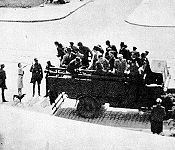
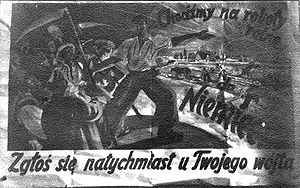
took place on an unprecedented scale. It was a vital part of the German economic exploitation of conquered territories. It also contributed to the mass extermination of populations in German-occupied Europe. The Nazi Germans abducted approximately 12 million people from almost twenty European countries; about two thirds of whom came from the Eastern Europe
Eastern Europe
Eastern Europe is the eastern part of Europe. The term has widely disparate geopolitical, geographical, cultural and socioeconomic readings, which makes it highly context-dependent and even volatile, and there are "almost as many definitions of Eastern Europe as there are scholars of the region"...
. Many workers died as a result of their living conditions, mistreatment, malnutrition, or became civilian casualties of war
Casualties of War
Casualties of War is a 1989 war drama directed by Brian De Palma, with a screenplay by David Rabe, based on the actual events of the incident on Hill 192 in 1966 during the Vietnam War. It starred Michael J. Fox and Sean Penn....
. At its peak the forced labourers comprised 20% of the German work force. Countings deaths and turnover, about 15 million men and women were forced laborers at one point or another during the war.
The liberation of Germany in 1945 freed 11 million foreigners, called "displaced persons"—chiefly forced laborers and POWs. In addition to POWs, the Germans had seized 2.8 million Soviet
Soviet Union
The Soviet Union , officially the Union of Soviet Socialist Republics , was a constitutionally socialist state that existed in Eurasia between 1922 and 1991....
workers to labor in factories in Germany. Returning them home was a high priority for the Allies. However, in the case of Russians and Ukrainians, returning often meant suspicion, prison, or death. The United Nations Relief and Rehabilitation Administration
United Nations Relief and Rehabilitation Administration
The United Nations Relief and Rehabilitation Administration was an international relief agency, largely dominated by the United States but representing 44 nations. Founded in 1943, it became part of the United Nations in 1945, was especially active in 1945 and 1946, and largely shut down...
(UNRRA), Red Cross
International Red Cross and Red Crescent Movement
The International Red Cross and Red Crescent Movement is an international humanitarian movement with approximately 97 million volunteers, members and staff worldwide which was founded to protect human life and health, to ensure respect for all human beings, and to prevent and alleviate human...
, and military operations provided food, clothing, shelter, and assistance in returning home. In all, 5.2 million foreign workers and POWs were repatriated to the Soviet Union, 1.6 million to Poland, 1.5 million to France, and 900,000 to Italy, along with 300,000 to 400,000 each to Yugoslavia, Czechoslovakia, the Netherlands, Hungary, and Belgium.
Forced workers
Lebensraum
was one of the major political ideas of Adolf Hitler, and an important component of Nazi ideology. It served as the motivation for the expansionist policies of Nazi Germany, aiming to provide extra space for the growth of the German population, for a Greater Germany...
strongly emphasized the conquest of new lands in the East, known as Generalplan Ost
Generalplan Ost
Generalplan Ost was a secret Nazi German plan for the colonization of Eastern Europe. Implementing it would have necessitated genocide and ethnic cleansing to be undertaken in the Eastern European territories occupied by Germany during World War II...
, and the exploitation of these lands to provide cheap goods and labour to Germany. Even before the war, Nazi Germany
Nazi Germany
Nazi Germany , also known as the Third Reich , but officially called German Reich from 1933 to 1943 and Greater German Reich from 26 June 1943 onward, is the name commonly used to refer to the state of Germany from 1933 to 1945, when it was a totalitarian dictatorship ruled by...
maintained a supply of slave labour
Slavery
Slavery is a system under which people are treated as property to be bought and sold, and are forced to work. Slaves can be held against their will from the time of their capture, purchase or birth, and deprived of the right to leave, to refuse to work, or to demand compensation...
. This practice started from the early days of labour camps of "undesirables" , such as the homeless, homosexual, criminals, political dissident
Dissident
A dissident, broadly defined, is a person who actively challenges an established doctrine, policy, or institution. When dissidents unite for a common cause they often effect a dissident movement....
s, communists
Communism
Communism is a social, political and economic ideology that aims at the establishment of a classless, moneyless, revolutionary and stateless socialist society structured upon common ownership of the means of production...
, Jews, and anyone whom the regime wanted out of the way. During World War II
World War II
World War II, or the Second World War , was a global conflict lasting from 1939 to 1945, involving most of the world's nations—including all of the great powers—eventually forming two opposing military alliances: the Allies and the Axis...
the Nazis operated several categories of Arbeitslager
Arbeitslager
Arbeitslager is a German language word which means labor camp.The German government under Nazism used forced labor extensively, starting in the 1930s but most especially during World War II....
(labour camps) for different categories of inmates. Prisoners in Nazi labour camps were worked to death on short rations and in bad conditions, or killed if they became unable to work. Many died as a direct result of forced labour under the Nazis.

Manual labour
Manual labour , manual or manual work is physical work done by people, most especially in contrast to that done by machines, and also to that done by working animals...
was a resource in high demand, as much of the work that today would be done with machines
Mechanization
Mechanization or mechanisation is providing human operators with machinery that assists them with the muscular requirements of work or displaces muscular work. In some fields, mechanization includes the use of hand tools...
was still a manual affair in the 1930s and 1940s—shovel
Shovel
A shovel is a tool for digging, lifting, and moving bulk materials, such as soil, coal, gravel, snow, sand, or ore. Shovels are extremely common tools that are used extensively in agriculture, construction, and gardening....
ing, material handling
Material handling
-Material Handling Industry:Material Handling is the movement, storage, control and protection of materials, goods and products throughout the process of manufacturing, distribution, consumption and disposal. The focus is on the methods, mechanical equipment, systems and related controls used to...
, machining
Machining
Conventional machining is a form of subtractive manufacturing, in which a collection of material-working processes utilizing power-driven machine tools, such as saws, lathes, milling machines, and drill presses, are used with a sharp cutting tool to physical remove material to achieve a desired...
, and many others. As the war progressed, the use of slave labour experienced massive growth. Prisoners of war
Prisoner of war
A prisoner of war or enemy prisoner of war is a person, whether civilian or combatant, who is held in custody by an enemy power during or immediately after an armed conflict...
and civilian "undesirables" were brought in from occupied territories. Millions of Jews, Slavs
Slavic peoples
The Slavic people are an Indo-European panethnicity living in Eastern Europe, Southeast Europe, North Asia and Central Asia. The term Slavic represents a broad ethno-linguistic group of people, who speak languages belonging to the Slavic language family and share, to varying degrees, certain...
and other conquered peoples were used as slave labourers by German corporations, such as Thyssen
Fritz Thyssen
Friedrich "Fritz" Thyssen was a German businessman born into one of Germany's leading industrial families.-Youth:Thyssen was born in Mülheim in the Ruhr area...
, Krupp
Krupp
The Krupp family , a prominent 400-year-old German dynasty from Essen, have become famous for their steel production and for their manufacture of ammunition and armaments. The family business, known as Friedrich Krupp AG Hoesch-Krupp, was the largest company in Europe at the beginning of the 20th...
, IG Farben
IG Farben
I.G. Farbenindustrie AG was a German chemical industry conglomerate. Its name is taken from Interessen-Gemeinschaft Farbenindustrie AG . The company was formed in 1925 from a number of major companies that had been working together closely since World War I...
, and even the German subsidiaries of foreign firms, such as Fordwerke (a subsidiary of the Ford Motor Company
Ford Motor Company
Ford Motor Company is an American multinational automaker based in Dearborn, Michigan, a suburb of Detroit. The automaker was founded by Henry Ford and incorporated on June 16, 1903. In addition to the Ford and Lincoln brands, Ford also owns a small stake in Mazda in Japan and Aston Martin in the UK...
) and Adam Opel AG
Opel
Adam Opel AG, generally shortened to Opel, is a German automobile company founded by Adam Opel in 1862. Opel has been building automobiles since 1899, and became an Aktiengesellschaft in 1929...
(a subsidiary of General Motors
General Motors
General Motors Company , commonly known as GM, formerly incorporated as General Motors Corporation, is an American multinational automotive corporation headquartered in Detroit, Michigan and the world's second-largest automaker in 2010...
). Once the war had begun, the foreign subsidiaries were seized and nationalized
Nationalization
Nationalisation, also spelled nationalization, is the process of taking an industry or assets into government ownership by a national government or state. Nationalization usually refers to private assets, but may also mean assets owned by lower levels of government, such as municipalities, being...
by the Nazi-controlled German state, and work conditions there deteriorated as they did throughout German industry. About 12 million forced labourers, most of whom were Eastern Europe
Eastern Europe
Eastern Europe is the eastern part of Europe. The term has widely disparate geopolitical, geographical, cultural and socioeconomic readings, which makes it highly context-dependent and even volatile, and there are "almost as many definitions of Eastern Europe as there are scholars of the region"...
ans, were employed in the German war economy inside Nazi Germany throughout the war. The German need for slave labor grew to the point, that even children were kidnapped to work in an operation called the Heu-Aktion
Heu-Aktion
Heu-Aktion was the name of an Nazi German operation where 40,000 to 50,000 Polish, Belarusian and Ukrainian children aged 10 to 14 were kidnapped by the German military and transported to Germany as slave labourers. The term "heu-aktion" means "collective harvesting of hay". After arriving in...
.
More than 2,000 German companies profited from slave labour during the Nazi era, including Deutsche Bank
Deutsche Bank
Deutsche Bank AG is a global financial service company with its headquarters in Frankfurt, Germany. It employs more than 100,000 people in over 70 countries, and has a large presence in Europe, the Americas, Asia Pacific and the emerging markets...
and Siemens
Siemens
Siemens may refer toSiemens, a German family name carried by generations of telecommunications industrialists, including:* Werner von Siemens , inventor, founder of Siemens AG...
.
Classifications
A class system was created amongst Fremdarbeiter ("foreign workers") brought to Germany to work for the Reich. The system was based on layers of increasingly less privileged workers, starting with well paid workers from Germany's allies or neutral countries to slave labourers from conquered untermenschUntermensch
Untermensch is a term that became infamous when the Nazi racial ideology used it to describe "inferior people", especially "the masses from the East," that is Jews, Gypsies, Poles along with other Slavic people like the Russians, Serbs, Belarussians and Ukrainians...
populations (the Nazi German term for people that they considered subhuman).
- Gastarbeitnehmer ("guest workers") - Workers from Germanic, Scandinavian countries, Italy or other German allies (Romania, Bulgaria, Hungary). This was a very small group, only about 1% of foreign workers in Germany came from countries that were neutral or allied to Germany.
- Zwangsarbeiter (forced workers)
- Militärinternierte ("military interneesInternmentInternment is the imprisonment or confinement of people, commonly in large groups, without trial. The Oxford English Dictionary gives the meaning as: "The action of 'interning'; confinement within the limits of a country or place." Most modern usage is about individuals, and there is a distinction...
") For example, almost all Polish non-officer prisoners of war (c. 300,000) were forced to work in Germany. In 1944 there were almost 2 million prisoners of war employed as forced labourers in Germany.
- Militärinternierte ("military internees
-
- ZivilarbeiterZivilarbeiterZivilarbeiter refers primarily to Polish prisoners from the General Government , used during WWII as forced laborers in Germany. Poles were conscripted on the basis of the Polish decrees ....
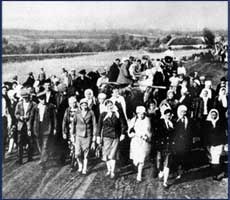
("civilian workers"). Primarily Polish prisoners from the "General GovernmentGeneral GovernmentThe General Government was an area of Second Republic of Poland under Nazi German rule during World War II; designated as a separate region of the Third Reich between 1939–1945...
. They were regulated by strict Polish decreesPolish decreesPolish decrees, Polish directives or decrees on Poles refer to the decrees of the Nazi Germany government announced on 8 March 1940 during World War II. They concerned the Polish laborers used during WWII as forced laborers in Germany, regulating their working and living conditions...
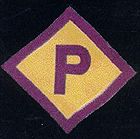
: they received lower wages and could not use public conveniences (such as public transport) or visit many public spaces and businesses (for example they could not attend German church services, swimming pools, or restaurants); they had to work longer hours than Germans; they received smaller food rations; they were subject to a curfewCurfewA curfew is an order specifying a time after which certain regulations apply. Examples:# An order by a government for certain persons to return home daily before a certain time...
; they often were denied holidays and had to work seven days a week; they could not enter a marriage without permission; they could not possess money or objects of value, bicycles, cameras, or lighterLighterA lighter is a portable device used to generate a flame. It consists of a metal or plastic container filled with a flammable fluid or pressurized liquid gas, a means of ignition, and some provision for extinguishing the flame.- History :...
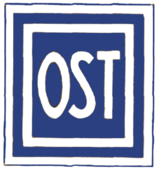
s; and they were required to wear a sign, the "Polish P", on their clothing. In 1939 there were about 300,000 of them in Germany; In 1944 there were about 2,8 m Polish Zivilarbeiter in Germany (approximately 10% of Generalgouvernement workforce) and a similar number of workers in this category from other countries. - Ostarbeiter ("Eastern workers") Former Soviet civil workers primarily from Ukraine. They were marked with a sign OST ("East"), had to live in camps that were fenced with barbed wire and under guard, and were particularly exposed to the arbitrariness of the Gestapo and the industrial plant guards. Estimates put the number of OST Arbeiters between 3 million and 5.5 million.
- Zivilarbeiter
In general, foreign labourers from Western Europe had similar gross earnings and were subject to similar taxation as German workers. In contrast, the central and eastern European forced labourers received at most about one-half the gross earnings paid to German workers and much fewer social benefits. Forced labourers who were prisoners of labour or concentration camps received little if any wage and benefits. The deficiency in net earnings of central and eastern European forced labourers (versus forced labourers from western countries) is illustrated by the wage savings forced labourers were able to transfer to their families at home or abroad (see table).
Repeated efforts were made to propagate Volkstum, racial consciousness, to prevent sexual relations between Germans and any foreign workers. Pamphlets, for instance, enjoined all German women to avoid sexual intercourse with all foreign workers brought to Germany as a danger to their blood. Women who disobeyed were imprisoned. Even fraternization with the workers was regarded as dangerous, and targeted with pamphlet campaigns in 1940–1942. The soldiers in the Wehrmacht
Wehrmacht
The Wehrmacht – from , to defend and , the might/power) were the unified armed forces of Nazi Germany from 1935 to 1945. It consisted of the Heer , the Kriegsmarine and the Luftwaffe .-Origin and use of the term:...
and SS officers were exempt from any such restrictions. It is estimated that at least 34,140 Eastern European women apprehended in Łapankas (military kidnapping raids), were forced to serve them as sex slaves in German military brothels
German military brothels in World War II
In World War II, the German military brothels were set up by the Third Reich throughout most of occupied Europe, for the use by their soldiers in the Wehrmacht and for the SS officers. These establishments were sometimes set up via existing brothels which they took over in the West, but generally...
and camp brothels
German camp brothels in World War II
In World War II Nazi Germany established brothels in the concentration camps to create an incentive for prisoners to collaborate, although these institutions were used mostly by Kapos, "prisoner functionaries" and criminal element, because real inmates, penniless and emaciated, were usually too...
during the Third Reich. In Warsaw
Warsaw
Warsaw is the capital and largest city of Poland. It is located on the Vistula River, roughly from the Baltic Sea and from the Carpathian Mountains. Its population in 2010 was estimated at 1,716,855 residents with a greater metropolitan area of 2,631,902 residents, making Warsaw the 10th most...
alone, there were five such establishments set up under military guard in September 1942, with over 20 rooms each. Alcohol was not allowed in there, unlike on the western front, and the victims underwent genital checkup once a week.
Numbers
Operation Sealion
Operation Sea Lion was Germany's plan to invade the United Kingdom during the Second World War, beginning in 1940. To have had any chance of success, however, the operation would have required air and naval supremacy over the English Channel...
.
| Countries | Number | % of total | Transfers per labourer in Reichsmarks |
|---|---|---|---|
| Occupied Eastern Europe | 4,183,000 | 64.8 | c. 15 |
| Czechoslovakia | 248,000 | 5.4 | |
| Poland | 1,400,000 | 21.7 | 33.5 |
| Yugoslavia | 270,000 | 4.2 | |
| USSR | 2,165,000 | 33.6 | 4 |
| Occupied Western Europe | 2,175,000 | 33.7 | c. 700 |
| France (except Alsace-Lorraine) | 1,100,000 | 17.1 | 487 |
| Norway | 2,000 | 0.0 | |
| Denmark | 23,000 | 0.4 | |
| Netherlands | 350,000 | 5.4 | |
| Belgium | 500,000 | 7.8 | 913 |
| Greece | 20,000 | 0.3 | |
| Italy | 180,000 | 2.8 | 1,471 |
| German allies and neutral countries | 82,000 | 1.4 | |
| Hungary | 25,000 | 0.4 | |
| Bulgaria | 35,000 | 0.5 | |
| Romania | 6,000 | 0.1 | |
| Spain | 8,000 | 0.1 | |
| Switzerland | 18,000 | 0.3 |
Organisation Todt
The Organisation TodtOrganisation Todt
The Todt Organisation, was a Third Reich civil and military engineering group in Germany named after its founder, Fritz Todt, an engineer and senior Nazi figure...
was a Third Reich
Nazi Germany
Nazi Germany , also known as the Third Reich , but officially called German Reich from 1933 to 1943 and Greater German Reich from 26 June 1943 onward, is the name commonly used to refer to the state of Germany from 1933 to 1945, when it was a totalitarian dictatorship ruled by...
civil
Civil engineering
Civil engineering is a professional engineering discipline that deals with the design, construction, and maintenance of the physical and naturally built environment, including works like roads, bridges, canals, dams, and buildings...
and military engineer
Military engineer
In military science, engineering refers to the practice of designing, building, maintaining and dismantling military works, including offensive, defensive and logistical structures, to shape the physical operating environment in war...
ing group in Germany eponymously named for its founder, Fritz Todt
Fritz Todt
Fritz Todt was a German engineer and senior Nazi figure, the founder of Organisation Todt. He died in a plane crash during World War II.- Life :Todt was born in Pforzheim to a father who owned a small factory...
, an engineer and senior Nazi
Nazism
Nazism, the common short form name of National Socialism was the ideology and practice of the Nazi Party and of Nazi Germany...
figure. The organization was responsible for a huge range of engineering projects both in pre-World War II
World War II
World War II, or the Second World War , was a global conflict lasting from 1939 to 1945, involving most of the world's nations—including all of the great powers—eventually forming two opposing military alliances: the Allies and the Axis...
Germany
Germany
Germany , officially the Federal Republic of Germany , is a federal parliamentary republic in Europe. The country consists of 16 states while the capital and largest city is Berlin. Germany covers an area of 357,021 km2 and has a largely temperate seasonal climate...
, and in Germany itself and occupied territories from France
France
The French Republic , The French Republic , The French Republic , (commonly known as France , is a unitary semi-presidential republic in Western Europe with several overseas territories and islands located on other continents and in the Indian, Pacific, and Atlantic oceans. Metropolitan France...
to Russia
Russia
Russia or , officially known as both Russia and the Russian Federation , is a country in northern Eurasia. It is a federal semi-presidential republic, comprising 83 federal subjects...
during the war, and became notorious for using forced labour. Most of the so-called "volunteer" Soviet POW workers were consumed by the Organisation Todt. The history of the organization falls fairly neatly into three phases:
- A pre-war period from 1933–1938 during which the predecessor of Organisation Todt, the office of General Inspector of German Roadways (Generalinspektor für das deutsche Straßenwesen), was primarily responsibility for the construction of the German Autobahn network. The organisation was able to draw on "conscripted" - i.e., compulsory - labour, from within Germany, through the Reich Labour Service (ReichsarbeitsdienstReichsarbeitsdienstThe Reichsarbeitsdienst was an institution established by Nazi Germany as an agency to reduce unemployment, similar to the relief programs in other countries. During the Second World War it was an auxiliary formation which provided support for the Wehrmacht.The RAD was formed during July 1934 as...
, RAD). - The period from 1938, when the Organisation Todt proper was founded until 1942, when the huge increase in the demand for labour created by the various military and paramilitary projects was met by a series of expansions of the laws on compulsory service, which ultimately obligated all Germans to arbitrarily determined (i.e. effectively unlimited) compulsory labour for the state: Zwangsarbeit. From 1938-40, Over 1.75 million Germans were conscripted into labour service. From 1940-42, Organization Todt began its reliance on Gastarbeitnehmer (guest workers), Militärinternierte (military interneesInternmentInternment is the imprisonment or confinement of people, commonly in large groups, without trial. The Oxford English Dictionary gives the meaning as: "The action of 'interning'; confinement within the limits of a country or place." Most modern usage is about individuals, and there is a distinction...
), Zivilarbeiter (civilian workersZivilarbeiterZivilarbeiter refers primarily to Polish prisoners from the General Government , used during WWII as forced laborers in Germany. Poles were conscripted on the basis of the Polish decrees ....
), Ostarbeiter (Eastern workers) and Hilfswillige ("volunteer") POW workers. - The period from 1942 until the end of the war, with approximately 1.4 million labourers in the service of the Organisation Todt. Overall, 1% were Germans rejected from military service and 1.5% were concentration camp prisoners; the rest were prisoners of war and compulsory labourers from occupied countries. All were effectively treated as slaves and existed in the complete and arbitrary service of a ruthless totalitarian state. Many did not survive the work or the war.
Extreme cases: extermination through labour
Ghetto
A ghetto is a section of a city predominantly occupied by a group who live there, especially because of social, economic, or legal issues.The term was originally used in Venice to describe the area where Jews were compelled to live. The term now refers to an overcrowded urban area often associated...
s, before they were shipped off to extermination camps. The Nazis also operated concentration camps
Nazi concentration camps
Nazi Germany maintained concentration camps throughout the territories it controlled. The first Nazi concentration camps set up in Germany were greatly expanded after the Reichstag fire of 1933, and were intended to hold political prisoners and opponents of the regime...
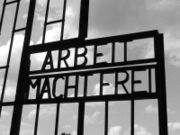
, some of which provided free forced labour for industrial and other jobs while others existed purely for the extermination of their inmates. Ironically, at the entrances to a number of camps a German
German language
German is a West Germanic language, related to and classified alongside English and Dutch. With an estimated 90 – 98 million native speakers, German is one of the world's major languages and is the most widely-spoken first language in the European Union....
phrase meaning "work brings freedom" (Arbeit macht frei
Arbeit macht frei
"'" is a German phrase, literally "work makes free," meaning "work sets you free" or "work liberates". The slogan is known for having been placed over the entrances to a number of Nazi concentration camps during the Holocaust, including most infamously Auschwitz I, where it was made by prisoners...
) was placed. A notable example of labour-concentration camp is the Mittelbau-Dora
Mittelbau-Dora
Mittelbau-Dora was a Nazi Germany labour camp that provided workers for the Mittelwerk V-2 rocket factory in the Kohnstein, situated near Nordhausen, Germany....
labour camp complex that serviced the production of the V-2 rocket
V-2 rocket
The V-2 rocket , technical name Aggregat-4 , was a ballistic missile that was developed at the beginning of the Second World War in Germany, specifically targeted at London and later Antwerp. The liquid-propellant rocket was the world's first long-range combat-ballistic missile and first known...
. Extermination through labour
Extermination through labour
Extermination through labor is a principle that guided the operation of the Nazi concentration camp system, defined as the willful or accepted killing of forced laborers or prisoners through excessive heavy labor, malnutrition and inadequate care....
was a Nazi German World War II
World War II
World War II, or the Second World War , was a global conflict lasting from 1939 to 1945, involving most of the world's nations—including all of the great powers—eventually forming two opposing military alliances: the Allies and the Axis...
principle that regulated the aims and purposes of most of their labour and concentration camps. The rule demanded that the inmates of German World War II camps be forced to work for the German war industry with only basic tools and minimal food rations until totally exhausted.
Controversy over compensation
To facilitate the economy after the war, certain categories of the victims of Nazism were excluded from compensation from the German Government; those were the groups with the least amount of political pressure they could have brought to bear, and many forced labourers from the Eastern Europe fall into that category. There has been little initiative on the part of the German government or business to compensate the forced labourers from the war period.As stated in the London Debt Agreement of 1953:
To this date, there are arguments that such settlement has never been fully carried out and that Germany post-war development has been greatly aided, while the development of victim countries stalled.
A prominent example of a group which received almost no compensation for their time as forced labourer in Nazi Germany are the Polish forced labourers. According to the Potsdam Agreements of 1945, the Poles were to receive reparations
War reparations
War reparations are payments intended to cover damage or injury during a war. Generally, the term war reparations refers to money or goods changing hands, rather than such property transfers as the annexation of land.- History :...
not from Germany itself, but from the Soviet Union
Soviet Union
The Soviet Union , officially the Union of Soviet Socialist Republics , was a constitutionally socialist state that existed in Eurasia between 1922 and 1991....
share of those repatriations; due to the Soviet pressure on the Polish communist government, the Poles agreed to a system of repayment that de facto meant that few Polish victims received any sort of adequate compensation (comparable to the victims in Western Europe or Soviet Union itself). Most of the Polish share of repatriations was "given" to Poland by Soviet Union under the Comecon
Comecon
The Council for Mutual Economic Assistance , 1949–1991, was an economic organisation under hegemony of Soviet Union comprising the countries of the Eastern Bloc along with a number of communist states elsewhere in the world...
framework, which was not only highly inefficient, but benefited Soviet Union much more than Poland. Under further Soviet pressure (related to the London Agreement on German External Debts), in 1953 the People's Republic of Poland
People's Republic of Poland
The People's Republic of Poland was the official name of Poland from 1952 to 1990. Although the Soviet Union took control of the country immediately after the liberation from Nazi Germany in 1944, the name of the state was not changed until eight years later...
renounced its right to further claims of reparations from the successor states of the Third Reich. Only after the fall of communism in Poland in 1989/1990 did the Polish government try to renegotiate the issue of repatriations, but found little support in this from the German side and none from the Soviet (later, Russian) side.
The total number of forced labourers under the Third Reich who were still alive as of August 1999 was 2.3 million. The German Forced Labour Compensation Programme was established in 2000; a forced labour fund paid out more than 4.37 billion euros to close to 1.7 million of then-living victims around the world (one-off payments of between 2,500 to 7,500 euro
Euro
The euro is the official currency of the eurozone: 17 of the 27 member states of the European Union. It is also the currency used by the Institutions of the European Union. The eurozone consists of Austria, Belgium, Cyprus, Estonia, Finland, France, Germany, Greece, Ireland, Italy, Luxembourg,...
s). Germany Chancellor Angela Merkel
Angela Merkel
Angela Dorothea Merkel is the current Chancellor of Germany . Merkel, elected to the Bundestag from Mecklenburg-Vorpommern, has been the chairwoman of the Christian Democratic Union since 2000, and chairwoman of the CDU-CSU parliamentary coalition from 2002 to 2005.From 2005 to 2009 she led a...
stated in 2007 that "Many former forced labourers have finally received the promised humanitarian aid"; she also conceded that before the fund was established nothing had gone directly to the forced labourers. German president Horst Koehler stated
- It was an initiative that was urgently needed along the journey to peace and reconciliation... At least, with these symbolic payments, the suffering of the victims has been publicly acknowledged after decades of being forgotten.
See also
- BaudienstBaudienstBaudienst , full name Polnischer Baudienst im Generalgouvernement , was the labour battalion created in Nazi-occupied Poland . Baudienst was subordinate to the Reichsarbeitsdienst Baudienst (from German, lit. "building service" or "construction service"), full name Polnischer Baudienst im...
, German (In English, building service or construction service); full name - Polnischer Baudienst im Generalgouvernement, German (In English, Polish Service of Construction in the General Government) - TotaleinsatzTotaleinsatzTotaleinsatz was a colloquial term of young Czechs for Forced labour under German rule during World War II. 400,000 Czechs worked as forced labour in Germany. This was a subset of the Arbeitseinsatz for German men but with ambiguity as to the status of Czechs under the "Protectorate" of Bohemia...
, position of 400,000 Czechs under the Arbeitseinsatz programme. - ArbeitseinsatzArbeitseinsatzArbeitseinsatz was forced labour during World War II when German men were called up for military service and German authorities rounded up labourers, some from Germany but more from the occupied territories, to fill in the vacancies...
, forced labour deployment (Zwangsarbeit) - Deutsche WirtschaftsbetriebeDeutsche WirtschaftsbetriebeDeutsche Wirtschaftsbetriebe , generally abbreviated DWB was a project launched by the Allgemeine SS to profit from the use of Nazi concentration camp inmates as slave labor.- Holding company for Nazi concerns :...
, German (In English, DWB - German Economic Enterprises) - Forced labor of Germans after World War IIForced labor of Germans after World War IIForced labour of Germans after World War II refers to the Allied use of German civilians and captured soldiers for forced labor in years following World War II ....
- Forced labour of Germans in the Soviet Union
- Hunger PlanHunger PlanThe Hunger Plan was an economic management scheme that was put in place to ensure that Germans were given priority over food supplies, at the expense of everyone else. This plan was featured as part of the planning phase of the Wehrmacht invasion of the Soviet Union in 1941...
- Kidnapping of Polish children by Nazi GermanyKidnapping of Polish children by Nazi GermanyKidnapping of Eastern European children by Nazi Germany , part of the Generalplan Ost , involved taking children from Eastern Europe and moving them to Nazi Germany for the purpose of Germanization, or conversion into Germans....
- Organisation TodtOrganisation TodtThe Todt Organisation, was a Third Reich civil and military engineering group in Germany named after its founder, Fritz Todt, an engineer and senior Nazi figure...
- Service du travail obligatoireService du travail obligatoireThe Service du travail obligatoire was the forced enlistment and deportation of hundreds of thousands of French workers to Nazi Germany in order to work as forced labour for the German war effort during World War II....
, French (In English, STO - Compulsory Work Service) - Sexual enslavement by Nazi Germany in World War II
- Italian military interneesItalian military interneesItalian military internees was the official name given by Germany to the Italian soldiers captured, rounded up and deported in the territories of the Third Reich in Operation Achse in the days immediately following the Armistice between Italy and Allied armed forces .After disarmament by the...
- Generalplan OstGeneralplan OstGeneralplan Ost was a secret Nazi German plan for the colonization of Eastern Europe. Implementing it would have necessitated genocide and ethnic cleansing to be undertaken in the Eastern European territories occupied by Germany during World War II...
Further reading
- Homze, Edward L. Foreign Labor in Nazi Germany (Princeton UP 1967)
- Mazower, Mark. Hitler's Empire: How the Nazis Ruled Europe (2009) ch 10
- Ruhs, Florian. "Foreign Workers in the Second World War. The Ordeal of Slovenians in Germany", aventinus nova" # 32 (2011).
External links
- Compensation for Forced Labour in World War II: The German Compensation Law of 2 August 2000
- Forced Labor document from Yad VashemYad VashemYad Vashem is Israel's official memorial to the Jewish victims of the Holocaust, established in 1953 through the Yad Vashem Law passed by the Knesset, Israel's parliament....
- United States Holocaust Memorial Museum Symposium (2002): Forced and Slave Labour in Nazi-Dominated Europe, 1933 to 1945
- International Red Cross
- Nazi Forced Labor Documentation Center in Berlin-Schoeneweide