
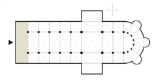
The
narthex of a church is the entrance or lobby area, located at the end of the
naveIn Romanesque and Gothic Christian abbey, cathedral basilica and church architecture, the nave is the central approach to the high altar, the main body of the church. "Nave" was probably suggested by the keel shape of its vaulting...
, at the far end from the church's main
altarAn altar is any structure upon which offerings such as sacrifices are made for religious purposes. Altars are usually found at shrines, and they can be located in temples, churches and other places of worship...
. Traditionally the narthex was a part of the church building, but was not considered part of the church proper. It was either an indoor area separated from the nave by a screen or rail, or an external structure such as a porch.
Etymology
Traditionally the word comes from
narthex (Medieval Latin from Classical Greek
narthex νάρθηξ 1.
fennelFennel is a plant species in the genus Foeniculum . It is a member of the family Apiaceae . It is a hardy, perennial, umbelliferous herb, with yellow flowers and feathery leaves...
, 2.
scourgeA scourge is a whip or lash, especially a multi-thong type used to inflict severe corporal punishment or self-mortification on the back.-Description:...
) and was the place for penitents. In modern Greek
narthekas (νάρθηκας) no longer has this meaning and is either the porch of a church, as English, or the brace of a sprained wrist or sling of a broken arm. In English the narthex is now the porch outside the church at the west end, formerly it was a part of the church itself.
Purpose
The purpose of the narthex was to allow those not eligible for admittance into the general congregation (particularly
catechumenIn ecclesiology, a catechumen , “‘down’” + ἠχή , “‘sound’”) is one receiving instruction from a catechist in the principles of the Christian religion with a view to baptism...
s and penitents) to hear and partake in the service. The narthex would often include a
baptismal fontA baptismal font is an article of church furniture or a fixture used for the baptism of children and adults.-Aspersion and affusion fonts:...
so that infants or adults could be baptized there before entering the nave, and to remind other believers of their baptisms as they gathered to worship. The narthex is thus traditionally a place of penitence, and in
Eastern ChristianityEastern Christianity comprises the Christian traditions and churches that developed in the Balkans, Eastern Europe, Asia Minor, the Middle East, Northeastern Africa, India and parts of the Far East over several centuries of religious antiquity. The term is generally used in Western Christianity to...
some penitential services, such as the
Little HoursThe Little Hours are the fixed daytime hours of prayer in the Divine Office of Christians, in both Western Christianity and the Eastern Orthodox Church. These Hours are called 'little' due to their shorter and simpler structure compared to the Night Hours...
during
Holy WeekHoly Week in Christianity is the last week of Lent and the week before Easter...
are celebrated there, rather than in the main body of the church. In the
Russian Orthodox ChurchThe Russian Orthodox Church or, alternatively, the Moscow Patriarchate The ROC is often said to be the largest of the Eastern Orthodox churches in the world; including all the autocephalous churches under its umbrella, its adherents number over 150 million worldwide—about half of the 300 million...
funerals are traditionally held in the narthex.
Later reforms removed the requirement to exclude people from services who were not full members of the congregation, which in some traditions obviated the narthex. Church architects continued, however, to build a room before the entrance of the nave. This room could be called an inside
vestibuleA vestibule is a lobby, entrance hall, or passage between the entrance and the interior of a building.The same term can apply to structures in modern or ancient roman architecture. In modern architecture vestibule typically refers to a small room or hall between an entrance and the interior of...
(if it is architecturally part of the nave structure) or a porch (if it is a distinct, external structure). Some traditions still call this area the narthex as it represents the point of entry into the church, even if everyone is admitted to the nave itself.
In traditional
Byzantine architectureByzantine architecture is the architecture of the Byzantine Empire. The empire gradually emerged as a distinct artistic and cultural entity from what is today referred to as the Roman Empire after AD 330, when the Roman Emperor Constantine moved the capital of the Roman Empire east from Rome to...
, the narthex is divided into two distinct structures: an
endonarthex (inner narthex), between the outer porch and the body of the church proper separated from the nave and aisles by a wall, arcade, colonnade, or screen; and an
exonarthex (outer narthex) outside the main façade of the church, usually part of a
colonnadeIn classical architecture, a colonnade denotes a long sequence of columns joined by their entablature, often free-standing, or part of a building....
d or
arcadedAn arcade is a succession of arches, each counterthrusting the next, supported by columns or piers or a covered walk enclosed by a line of such arches on one or both sides. In warmer or wet climates, exterior arcades provide shelter for pedestrians....
atriumIn modern architecture, an atrium is a large open space, often several stories high and having a glazed roof and/or large windows, often situated within a larger multistory building and often located immediately beyond the main entrance doors...
or quadriporticus (
quadrangleIn architecture, a quadrangle is a space or courtyard, usually rectangular in plan, the sides of which are entirely or mainly occupied by parts of a large building. The word is probably most closely associated with college or university campus architecture, but quadrangles may be found in other...
). The exonarthex may be either open on the western end or enclosed, with a door leading to the outside (as in the
Chora ChurchThe Church of the Holy Saviour in Chora is considered to be one of the most beautiful examples of a Byzantine church. The church is situated in Istanbul, in the Edirnekapı neighborhood, which lies in the western part of the municipality of Fatih...
). The endoonarthex and exonarthex have distinct liturgical functions. For instance, the procession at the
Paschal VigilThe Easter Vigil, also called the Paschal Vigil or the Great Vigil of Easter, is a service held in many Christian churches as the first official celebration of the Resurrection of Jesus. Historically, it is during this service that people are baptized and that adult catechumens are received into...
will end up at the exonarthex for the reading of the Resurrection
GospelA gospel is an account, often written, that describes the life of Jesus of Nazareth. In a more general sense the term "gospel" may refer to the good news message of the New Testament. It is primarily used in reference to the four canonical gospels of Matthew, Mark, Luke, and John...
, while certain penitential services are traditionally chanted in the endonarthex.
In some Eastern Orthodox
templeA temple is a structure reserved for religious or spiritual activities, such as prayer and sacrifice, or analogous rites. A templum constituted a sacred precinct as defined by a priest, or augur. It has the same root as the word "template," a plan in preparation of the building that was marked out...
s (churches), the narthex will be referred to as the
trapeza (refectory), because in ancient times, tables would be set up there after the
Divine LiturgyDivine Liturgy is the common term for the Eucharistic service of the Byzantine tradition of Christian liturgy. As such, it is used in the Eastern Orthodox and Eastern Catholic Churches. Armenian Christians, both of the Armenian Apostolic Church and of the Armenian Catholic Church, use the same term...
for the faithful to eat a common meal, similar to the
agape feastThe term Agape or Love feast was used of certain religious meals among early Christians that seem originally to have been closely related to the Eucharist...
of the early church. To this day, this is where the faithful will bring their baskets at
PaschaEaster is the central feast in the Christian liturgical year. According to the Canonical gospels, Jesus rose from the dead on the third day after his crucifixion. His resurrection is celebrated on Easter Day or Easter Sunday...
(Easter) for the priest to bless the Paschal foods which they will then take back to their homes for the festive
break-fastBreakfast is the first meal taken after rising from a night's sleep, most often eaten in the early morning before undertaking the day's work...
. Traditionally, the narthex is where candles and
prosphoraA prosphoron is a small loaf of leavened bread used in Orthodox Christian and Greek Catholic liturgies. The plural form is prosphora...
will be sold for offering during Divine Services.
The doorway leading from the narthex to the nave is sometimes referred to as the "Royal Doors", because in major cathedrals (
catholicaCatholicon may refer to:* Catholicon, the conventual church at the centre of an abbey* Katholikon, the primary church in an Orthodox or Eastern Catholic monastery* Catholicon , part of the Holy Liturgy of Mor Yakub of the Syriac Orthodox Church...
) there were several sets of doors leading into the nave, the central one being reserved only for the use of the Emperor.
On feast days there will be a
processionA procession is an organized body of people advancing in a formal or ceremonial manner.-Procession elements:...
to the narthex, followed by intercessory prayers, called the
LitiyThe Litiy or Litiyá is a procession, followed by intercessions, which takes place during the All-Night Vigil in the Eastern Orthodox Church and those Eastern Catholic Churches which follow the Byzantine Rite. Whenever there is a Litiy there is also an Artoklasia...
.
In Armenia the local style of narthex is known as a
gavitA gavit or zhamatun is often contiguous to the west of a church in a Medieval Armenian monastery. It served as narthex , mausoleum and assembly room.-History:...
.
Note
By convention, ecclesiastical floor plans are shown map-fashion, with north to the top and the liturgical east to the right. Therefore, some may refer to the narthex as being at the western end of the floor plan. This is done for symbolic reasons, as scriptures say to look for Christ appearing in the East, thus the location of the altar is known as the liturgical East, regardless of the actual cardinal directions.