

Waldensians

Encyclopedia
| Waldensian Evangelical Church Waldensian Evangelical Church The Waldensian Evangelical Church is an Italian historical Protestant denomination.After Protestant Reformation, the small church absorbed Calvinist theology and became the Italian branch of Reformed churches.... |
|
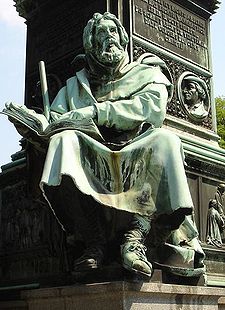 Statue of Peter Waldo Peter Waldo Peter Waldo, Valdo, or Waldes , also Pierre Vaudès or de Vaux, is credited as the founder of the Waldensians, a Christian spiritual movement of the Middle Ages, descendants of which still exist in various regions of southern Europe... at the Luther Memorial at Worms, Germany Worms, Germany Worms is a city in Rhineland-Palatinate, Germany, on the Rhine River. At the end of 2004, it had 85,829 inhabitants.Established by the Celts, who called it Borbetomagus, Worms today remains embattled with the cities Trier and Cologne over the title of "Oldest City in Germany." Worms is the only... . |
|
| Founders: | Peter Waldo Peter Waldo Peter Waldo, Valdo, or Waldes , also Pierre Vaudès or de Vaux, is credited as the founder of the Waldensians, a Christian spiritual movement of the Middle Ages, descendants of which still exist in various regions of southern Europe... |
|---|---|
| Founding date: | about 1177; in 1532 acceded to Franco-Swiss Protestant Reform |
| Headquarters: | Torre Pellice Torre Pellice Torre Pellice is a comune in the Province of Turin in the Italian region Piedmont, located about 45 km southwest of Turin. It is crossed by the Pellice river.... , Piemonte, Italy |
| Countries: | Primarily Italy, France, Germany and South America. |
| Website: | www.chiesavaldese.org |
Waldensians, Waldenses or Vaudois are names for a Christian movement of the later Middle Ages
Middle Ages
The Middle Ages is a periodization of European history from the 5th century to the 15th century. The Middle Ages follows the fall of the Western Roman Empire in 476 and precedes the Early Modern Era. It is the middle period of a three-period division of Western history: Classic, Medieval and Modern...
, descendants of which still exist in various regions, primarily in North-Western Italy
Italy
Italy , officially the Italian Republic languages]] under the European Charter for Regional or Minority Languages. In each of these, Italy's official name is as follows:;;;;;;;;), is a unitary parliamentary republic in South-Central Europe. To the north it borders France, Switzerland, Austria and...
. There is considerable uncertainty about the earlier history of the Waldenses because of a lack of extant source material. They were persecuted as heretical in the 12th century onwards, and endured near-annihilation in the 17th century. There are active congregations in Europe, South America, and North America. The contemporary and historic Waldensian spiritual heritage describes itself as proclaiming the Gospel, serving the marginalized, promoting social justice, fostering inter-religious work, and advocating respect for religious diversity and freedom of conscience.
Modern Waldensians are gathered in the Waldensian Evangelical Church
Waldensian Evangelical Church
The Waldensian Evangelical Church is an Italian historical Protestant denomination.After Protestant Reformation, the small church absorbed Calvinist theology and became the Italian branch of Reformed churches....
.
General description
In 1179, some Waldensians went to Rome, where Pope Alexander IIIPope Alexander III
Pope Alexander III , born Rolando of Siena, was Pope from 1159 to 1181. He is noted in history for laying the foundation stone for the Notre Dame de Paris.-Church career:...
forbade explanation or critical interpretation (exegesis) without authorization from the local clergy. They disobeyed and began to preach according to their own understanding of the scriptures.
Waldensians were divided by three types of activity: Sandaliati, who received sacred orders and were to prove the heresiarch
Heresiarch
A heresiarch is a founder or leader of a heretical doctrine or movement, as considered by those who claim to maintain an orthodox religious tradition or doctrine...
s wrong; Doctores, who instructed and trained missionaries; and Novellani, who preached to the general population. They were also called Insabbatati, Sabati, Inzabbatati for keeping the Sabbath and/or rejecting all religious festivals. They were also sometimes called Sabotiers, which some sources state was due to the unusual type of sabot
Clog (shoe)
A clog is a type of footwear made in part or completely from wood.The Oxford English Dictionary defines a clog as a "thick piece of wood", and later as a "wooden soled overshoe" and a "shoe with a thick wooden sole"....
they used as footwear.
Seen by the Roman Catholic Church as unorthodox, they were formally declared heretics
Heresy
Heresy is a controversial or novel change to a system of beliefs, especially a religion, that conflicts with established dogma. It is distinct from apostasy, which is the formal denunciation of one's religion, principles or cause, and blasphemy, which is irreverence toward religion...
by Pope Lucius III
Pope Lucius III
Pope Lucius III , born Ubaldo, was pope from 1 September 1181 to his death.A native of the independent republic of Lucca, he was born ca. 1100 as Ubaldo, son of Orlando. He is commonly referred to as a member of the aristocratic family of Allucingoli, but this is not proven...
in 1184 at the Synod of Verona
Synod of Verona
The Synod of Verona was held in 1184 under the auspices of Pope Lucius III. It is most notable for condemning the Waldensians under the charge of witchcraft; the charge was later amended to include heresy....
, and by Pope Innocent III
Pope Innocent III
Pope Innocent III was Pope from 8 January 1198 until his death. His birth name was Lotario dei Conti di Segni, sometimes anglicised to Lothar of Segni....
during the Fourth Lateran Council in 1215. In 1211, more than 80 Waldensians were burned as heretics at Strasbourg
Strasbourg
Strasbourg is the capital and principal city of the Alsace region in eastern France and is the official seat of the European Parliament. Located close to the border with Germany, it is the capital of the Bas-Rhin département. The city and the region of Alsace are historically German-speaking,...
, beginning several centuries of persecution
Medieval Inquisition
The Medieval Inquisition is a series of Inquisitions from around 1184, including the Episcopal Inquisition and later the Papal Inquisition...
that nearly destroyed the movement. Part of their legacy is recognized as works of the writer Henri Arnaud. The Waldensian Church of Italy has survived to the present day.
Ancient origins asserted and refuted
Some groups of Mennonites, Baptists, Seventh-day Adventists, and other Protestants have claimed that the Waldenses' history extends back to the Apostles. Some Waldenses claimed for their churches an Apostolic origin, but this is far from universal. The supporters of the ancient origin claim the Waldenses' name did not in fact come from Peter Waldo but from the area in which they lived. They claim Peter Waldo in fact got his name by association with the Waldenses. This thought was current in the early 19th century:- "Some Protestants, on this occasion, have fallen into the snare that was set for them...It is absolutely false, that these churches were ever found by Peter Waldo...it is a pure forgery."
- "It is not true, that Waldo gave this name to the inhabitants of the valleys: they were called Waldenses, or Vaudes, before his time, from the valleys in which they dwelt."
- "On the other hand, he "was called Valdus, or Waldo, because he received his religious notions from the inhabitants of the valleys."
Other supposed founders for an ancient origin included Claudius, Bishop of Turin
Claudius of Turin
Claudius of Turin was the Catholic bishop of Turin from 817 until his death. He was a courtier of Louis the Pious and was a writer during the Carolingian Renaissance. He is most noted for teaching iconoclasm, a radical idea at that time in Latin Church, and for some teachings that prefigured...
(died 840) and Berengarius of Tours (died 1088). Many scholars have contested these claims, asserting that the Waldensians were followers of Peter Waldo
Peter Waldo
Peter Waldo, Valdo, or Waldes , also Pierre Vaudès or de Vaux, is credited as the founder of the Waldensians, a Christian spiritual movement of the Middle Ages, descendants of which still exist in various regions of southern Europe...
. Likewise, the modern Waldensian churches themselves claim their movement began with Peter Waldo.
The Alexandrine
Alexandrine
An alexandrine is a line of poetic meter comprising 12 syllables. Alexandrines are common in the German literature of the Baroque period and in French poetry of the early modern and modern periods. Drama in English often used alexandrines before Marlowe and Shakespeare, by whom it was supplanted...
La Nòbla Leiçon written in Old Occitan ("The Noble Lesson"), has traditionally been thought to have been composed in 1100, but scholars now date it to between 1190 and 1240.
Origins in the Middle Ages
According to modern scholars and the Waldensians themselves, the Waldensians began with Peter Waldo, who began to preach on the streets of LyonLyon
Lyon , is a city in east-central France in the Rhône-Alpes region, situated between Paris and Marseille. Lyon is located at from Paris, from Marseille, from Geneva, from Turin, and from Barcelona. The residents of the city are called Lyonnais....
in 1177.
Peter Waldo preached without permission of the Roman Catholic Church and by the early 1180s he and his followers were excommunicated
Excommunication
Excommunication is a religious censure used to deprive, suspend or limit membership in a religious community. The word means putting [someone] out of communion. In some religions, excommunication includes spiritual condemnation of the member or group...
and forced from Lyon. The Roman Catholic Church declared them heretics — stating the group's principal error was "contempt for ecclesiastical power". The Waldensians were also accused by the Catholic Church of teaching "innumerable errors".
Waldo and his followers developed a system whereby they would go from town to town and meet secretly with small groups of Waldensians. There they would confess sins and hold service. A traveling Waldensian preacher was known as a barba. The group would shelter and house the barba and help make arrangements to move on to the next town in secret.
Catholic response to Waldensians
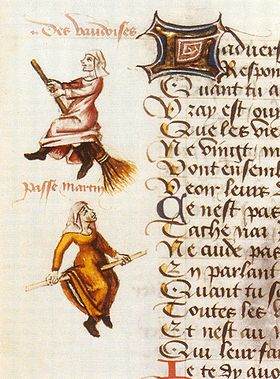
Schism (religion)
A schism , from Greek σχίσμα, skhísma , is a division between people, usually belonging to an organization or movement religious denomination. The word is most frequently applied to a break of communion between two sections of Christianity that were previously a single body, or to a division within...
in 1184 in France and heretics more widely in 1215 by Pope Innocent III
Pope Innocent III
Pope Innocent III was Pope from 8 January 1198 until his death. His birth name was Lotario dei Conti di Segni, sometimes anglicised to Lothar of Segni....
during the Fourth Council of the Lateran
Fourth Council of the Lateran
The Fourth Council of the Lateran was convoked by Pope Innocent III with the papal bull of April 19, 1213, and the Council gathered at Rome's Lateran Palace beginning November 11, 1215. Due to the great length of time between the Council's convocation and meeting, many bishops had the opportunity...
's anathema
Anathema
Anathema originally meant something lifted up as an offering to the gods; it later evolved to mean:...
. The rejection by the Church radicalized the movement; in terms of ideology the Waldensians became more obviously anti-Catholic—rejecting the authority of the clergy.
Much of what is known about the Waldensians comes from reports from Reinerius Saccho (died 1259), a former Cathar who converted to Catholicism and wrote two reports for the Inquisition
Medieval Inquisition
The Medieval Inquisition is a series of Inquisitions from around 1184, including the Episcopal Inquisition and later the Papal Inquisition...
, Summa de Catharis et Pauperibus de Lugduno (roughly) "Of the Sects of Modern Heretics" (1254) Waldo possibly died in the early 13th century, possibly in Germany, but he was never captured, and his fate remains uncertain.
Reformation
When the news of the ReformationProtestant Reformation
The Protestant Reformation was a 16th-century split within Western Christianity initiated by Martin Luther, John Calvin and other early Protestants. The efforts of the self-described "reformers", who objected to the doctrines, rituals and ecclesiastical structure of the Roman Catholic Church, led...
reached the Waldensian Valleys, the Tavola Valdese decided to seek fellowship with the nascent Protestantism. A Synod held 1526 in Laus, a town in Chisone valley, decided to send envoys to examine the new movement.
In 1532 they met with German and Swiss Protestants and ultimately adapted their beliefs to those of the Reformed Church. Moreover, the Waldensian absorption into Protestantism led to their transformation from a group on the edge of Catholicism that shared many Catholic beliefs into a Protestant church adhering to the theology of John Calvin
John Calvin
John Calvin was an influential French theologian and pastor during the Protestant Reformation. He was a principal figure in the development of the system of Christian theology later called Calvinism. Originally trained as a humanist lawyer, he broke from the Roman Catholic Church around 1530...
, which differed much from the beliefs of Peter Waldo. From that moment the Church became the Italian branch of Reformed churches
Reformed churches
The Reformed churches are a group of Protestant denominations characterized by Calvinist doctrines. They are descended from the Swiss Reformation inaugurated by Huldrych Zwingli but developed more coherently by Martin Bucer, Heinrich Bullinger and especially John Calvin...
.
The Swiss and French Reformed churches sent William Farel
William Farel
William Farel , né Guilhem Farel, 1489 in Gap, Dauphiné, in south-eastern France, was a French evangelist, and a founder of the Reformed Church in the cantons of Neuchâtel, Berne, Geneva, and Vaud in Switzerland...
and Anthony Saunier to attend the Synod of Chanforan, which convened in October, 12th 1532. Farel invited them to join the Reformation and to leave secrecy. A Confession of Faith, with Reformed doctrines, was formulated and the Waldensians decided to worship openly in French.
The French Bible translated by Pierre Robert Olivétan
Pierre Robert Olivétan
Pierre Robert Olivétan was the first to translate the Bible into the French language starting from the Hebrew and Greek texts. He was a cousin of John Calvin, who wrote a Latin preface for the translation, often called the Olivetan Bible....
with the help of Calvin
John Calvin
John Calvin was an influential French theologian and pastor during the Protestant Reformation. He was a principal figure in the development of the system of Christian theology later called Calvinism. Originally trained as a humanist lawyer, he broke from the Roman Catholic Church around 1530...
and published at Neuchâtel in 1535 was based in part on a New Testament in the Waldensian vernacular. The cost of its publication was defrayed by the churches in Waldensia who collected the sum of 1500 gold crowns for this purpose.
Massacre of Mérindol (1545)
Outside the Piedmont, the Waldenses joined the local Protestant churches in Bohemia, France, and Germany. After they came out of clandestinity and reports were made of seditionSedition
In law, sedition is overt conduct, such as speech and organization, that is deemed by the legal authority to tend toward insurrection against the established order. Sedition often includes subversion of a constitution and incitement of discontent to lawful authority. Sedition may include any...
on their part, the French king, Francis I
Francis I of France
Francis I was King of France from 1515 until his death. During his reign, huge cultural changes took place in France and he has been called France's original Renaissance monarch...
issued on 1 January 1545 the "Arrêt de Mérindol", and armed an army against the Waldensians of Provence
Provence
Provence ; Provençal: Provença in classical norm or Prouvènço in Mistralian norm) is a region of south eastern France on the Mediterranean adjacent to Italy. It is part of the administrative région of Provence-Alpes-Côte d'Azur...
. The leaders in the 1545 massacres were Jean Maynier d'Oppède, First President of the parlement of Provence
Provence
Provence ; Provençal: Provença in classical norm or Prouvènço in Mistralian norm) is a region of south eastern France on the Mediterranean adjacent to Italy. It is part of the administrative région of Provence-Alpes-Côte d'Azur...
, and the military commander Antoine Escalin des Aimars
Antoine Escalin des Aimars
Antoine Escalin des Aimars , also known as Captain Polin or Captain Paulin, later Baron de La Garde, was French ambassador to the Ottoman Empire from 1541 to 1547, and "Général des Galères" from 1544.-Italian Wars:Polin was noticed by Guillaume du Bellay as a valuable officer of the French Army...
who was returning from the Italian Wars
Italian Wars
The Italian Wars, often referred to as the Great Italian Wars or the Great Wars of Italy and sometimes as the Habsburg–Valois Wars, were a series of conflicts from 1494 to 1559 that involved, at various times, most of the city-states of Italy, the Papal States, most of the major states of Western...
with 2,000 veterans, the Bandes de Piémont. Deaths in the Massacre of Mérindol
Massacre of Mérindol
The Massacre of Mérindol took place in 1545, when Francis I of France ordered the Waldensians of the city of Mérindol to be punished for dissident religious activities.-Arrêt de Mérindol:...
ranged from hundreds to thousands, depending on the estimates, and several villages were devastated.
The treaty of 5 June 1561 granted amnesty to the Protestants of the Valleys, including liberty of conscience and freedom to worship
Freedom of religion
Freedom of religion is a principle that supports the freedom of an individual or community, in public or private, to manifest religion or belief in teaching, practice, worship, and observance; the concept is generally recognized also to include the freedom to change religion or not to follow any...
. Prisoners were released and fugitives were permitted to return home. The Reformation was also somewhat beneficial to the Vaudois, with the religious reformers showing them respect, but they still suffered in the French Wars of Religion
French Wars of Religion
The French Wars of Religion is the name given to a period of civil infighting and military operations, primarily fought between French Catholics and Protestants . The conflict involved the factional disputes between the aristocratic houses of France, such as the House of Bourbon and House of Guise...
(1562–1598).
As early as 1631, Protestants scholars began to regard the Waldensians as early forerunners of the Reformation, in a manner that is similar to how the followers of John Wycliffe
John Wycliffe
John Wycliffe was an English Scholastic philosopher, theologian, lay preacher, translator, reformer and university teacher who was known as an early dissident in the Roman Catholic Church during the 14th century. His followers were known as Lollards, a somewhat rebellious movement, which preached...
and Jan Hus
Jan Hus
Jan Hus , often referred to in English as John Hus or John Huss, was a Czech priest, philosopher, reformer, and master at Charles University in Prague...
- who were also persecuted by Roman Catholic authorities - were viewed.
Later history
In 1655 the Duke of SavoyCharles Emmanuel II, Duke of Savoy
Charles Emmanuel II was the Duke of Savoy from 1638 to 1675 and under regency of his mother Christine Marie of France until 1663. He was also Marquis of Saluzzo, Count of Aosta, Geneva, Moriana and Nice, as well as claimant king of Cyprus and Jerusalem...
commanded the Vaudois to attend Mass or remove to the upper valleys, giving them twenty days in which to sell their lands. In a most severe winter these targets of persecution, old men, women, little children and the sick "waded through the icy waters, climbed the frozen peaks, and at length reached the homes of their impoverished brethren of the upper Valleys, where they were warmly received." There they found refuge and rest. Deceived by false reports of Vaudois resistance, the Duke sent an army. On 24 April 1655, at 4 a.m., the signal was given for a general massacre, the horrors of which can be detailed only in small part.
The massacre was so brutal it aroused indignation throughout Europe. Oliver Cromwell
Oliver Cromwell
Oliver Cromwell was an English military and political leader who overthrew the English monarchy and temporarily turned England into a republican Commonwealth, and served as Lord Protector of England, Scotland, and Ireland....
, then ruler in England, began petitioning on behalf of the Vaudois, writing letters, raising contributions, calling a general fast in England and threatening to send military forces to the rescue. The massacre prompted John Milton
John Milton
John Milton was an English poet, polemicist, a scholarly man of letters, and a civil servant for the Commonwealth of England under Oliver Cromwell...
's famous poem on the Waldenses, "On the Late Massacre in Piedmont
On the Late Massacre in Piedmont
On the Late Massacre in Piedmont is a sonnet by the English poet John Milton inspired by the massacre of Waldensians in Piedmont by the Charles Emmanuel II, Duke of Savoy in April 1655.-The sonnet:Avenge, O Lord, thy slaughtered saints, whose bones...
". The resistance which lasted into the 1660s was then led by a farmer, Josué Janavel.
_2.jpg)
Louis XIV of France
Louis XIV , known as Louis the Great or the Sun King , was a Bourbon monarch who ruled as King of France and Navarre. His reign, from 1643 to his death in 1715, began at the age of four and lasted seventy-two years, three months, and eighteen days...
revoked the Edict of Nantes
Edict of Nantes
The Edict of Nantes, issued on 13 April 1598, by Henry IV of France, granted the Calvinist Protestants of France substantial rights in a nation still considered essentially Catholic. In the Edict, Henry aimed primarily to promote civil unity...
, which had guaranteed freedom of religion to his Protestant subjects in France. The cousin of Louis, The Duke of Savoy, Victor Amadeus II
Victor Amadeus II of Sardinia
Victor Amadeus II was Duke of Savoy from 1675 to 1730. He also held the titles of marquis of Saluzzo, duke of Montferrat, prince of Piedmont, count of Aosta, Moriana and Nizza. Louis XIV organised his marriage in order to maintain French influence in the Duchy but Victor Amadeus soon broke away...
followed his uncle in removing the protection of Protestants in the Piedmont
Piedmont
Piedmont is one of the 20 regions of Italy. It has an area of 25,402 square kilometres and a population of about 4.4 million. The capital of Piedmont is Turin. The main local language is Piedmontese. Occitan is also spoken by a minority in the Occitan Valleys situated in the Provinces of...
. In the renewed persecution, an edict decreed that all inhabitants of the Valleys should publicly announce their error in religion within fifteen days under penalty of death and banishment and the destruction of all the Vaudois churches. Armies of French and Piedmontese soldiers invaded the Valleys, laying them waste and perpetrating cruelties upon the inhabitants. A pastor Henri Arnaud sought help from William of Orange. He gathered a band of followers in Switzerland; and in 1689 made an attempt to regain their homes in the valleys.
After the French Revolution, the Waldenses of Piedmont were assured liberty of conscience and, in 1848, the ruler of Savoy, King Charles Albert of Sardinia
Charles Albert of Sardinia
Charles Albert was the King of Piedmont-Sardinia from 1831 to 1849. He succeeded his distant cousin Charles Felix, and his name is bound with the first Italian statute and the First War of Independence...
granted them
civil rights. Copies of the Romaunt version of the Gospel of John
Gospel of John
The Gospel According to John , commonly referred to as the Gospel of John or simply John, and often referred to in New Testament scholarship as the Fourth Gospel, is an account of the public ministry of Jesus...
were preserved in Paris and Dublin. The manuscripts were used as the basis of a work by Gilly published in 1848, in which it was related to the history of the New Testament in use by the Waldensians. A group of Waldensians settled in the United States at Valdese, North Carolina
Valdese, North Carolina
Valdese is a town in Burke County, North Carolina, United States. The population was 4,485 at the 2000 census. It is part of the Hickory–Lenoir–Morganton Metropolitan Statistical Area.-Geography:Valdese is located at ....
. Waldensian companies dominated Turin's chocolate industry for the latter half of the nineteenth century and are generally credited with the invention of gianduja (chocolate)
Gianduja (chocolate)
Gianduja is a sweet chocolate containing about 30% hazelnut paste, invented in Turin by Caffarel in 1852. It takes its name from Gianduja, a Carnival and marionette character who represents the archetypal Piedmontese, a native of the Italian region where hazelnut confectionery is common.Some...
.
Later denominations such as Anabaptist
Anabaptist
Anabaptists are Protestant Christians of the Radical Reformation of 16th-century Europe, and their direct descendants, particularly the Amish, Brethren, Hutterites, and Mennonites....
s and Baptists also began to point to the Waldensians as an example of earlier Christians who were not a part of the Roman Catholic Church, and held beliefs they interpreted to be similar to their own. The Mennonite
Mennonite
The Mennonites are a group of Christian Anabaptist denominations named after the Frisian Menno Simons , who, through his writings, articulated and thereby formalized the teachings of earlier Swiss founders...
book Martyrs Mirror
Martyrs Mirror
The Martyrs Mirror or The Bloody Theater, first published in 1660 in Dutch by Thieleman J. van Braght, documents the stories and testimonies of Christian martyrs, especially Anabaptists...
lists them in this regard as it attempts to trace the history of believer's baptism back to the apostles. James Aitken Wylie (1808–1890) likewise believed that the Waldensians preserved the apostolic faith during the Middle Ages
Middle Ages
The Middle Ages is a periodization of European history from the 5th century to the 15th century. The Middle Ages follows the fall of the Western Roman Empire in 476 and precedes the Early Modern Era. It is the middle period of a three-period division of Western history: Classic, Medieval and Modern...
. Still later, Seventh-day Adventist
Seventh-day Adventist Church
The Seventh-day Adventist Church is a Protestant Christian denomination distinguished by its observance of Saturday, the original seventh day of the Judeo-Christian week, as the Sabbath, and by its emphasis on the imminent second coming of Jesus Christ...
Ellen G. White
Ellen G. White
Ellen Gould White was a prolific author and an American Christian pioneer. She, along with other Sabbatarian Adventist leaders, such as Joseph Bates and her husband James White, would form what is now known as the Seventh-day Adventist Church.Ellen White reported to her fellow believers her...
taught that the Waldenses were preservers of biblical truth during the so-called Great Apostasy
Great Apostasy
The Great Apostasy is a term used by some religious groups to describe a general fallen state of traditional Christianity, especially the Papacy, because it allowed the traditional Roman mysteries and deities of solar monism such as Mithras and Sol Invictus and idol worship back into the church,...
of the Roman Catholic Church
Roman Catholic Church
The Catholic Church, also known as the Roman Catholic Church, is the world's largest Christian church, with over a billion members. Led by the Pope, it defines its mission as spreading the gospel of Jesus Christ, administering the sacraments and exercising charity...
. She believed that the Waldenses kept the seventh-day Sabbath, engaged in widespread missionary activity, and "planted the seeds of the Reformation" in Europe. Based on the Catechism of the Waldenses they believed in keeping the ten commandments.
Some Waldensians families joined Anabaptism. A group from North Italy fled to Switzerland for religious protection and then to Pennsylvania later on after becoming followers of Menno Simons
Menno Simons
Menno Simons was an Anabaptist religious leader from the Friesland region of the Low Countries. Simons was a contemporary of the Protestant Reformers and his followers became known as Mennonites...
. Some later migrated north to Canada, where some of the communities still exist.
Today, the Waldensian Church is included in the Alliance of Reformed Churches of the Presbyterian Order.
Italy

Charles Albert of Sardinia
Charles Albert was the King of Piedmont-Sardinia from 1831 to 1849. He succeeded his distant cousin Charles Felix, and his name is bound with the first Italian statute and the First War of Independence...
's granting a constitution (the Statuto Albertino
Statuto Albertino
The Statuto Albertino or Albertine Statute was the constitution that King Charles Albert conceded to the Kingdom of Piedmont-Sardinia in Italy on 4 March 1848...
).
Subsequently the Waldensian Evangelical Church
Waldensian Evangelical Church
The Waldensian Evangelical Church is an Italian historical Protestant denomination.After Protestant Reformation, the small church absorbed Calvinist theology and became the Italian branch of Reformed churches....
, as it became known, developed and spread through the Italian peninsula.
The Waldensian church was able to gain converts by building schools in some of the poorer regions of Italy, including Sicily. There is still a Waldensian church in the town of Grotte, Province of Agrigento
Province of Agrigento
Agrigento is a province in the autonomous island region of Sicily in Italy. It has an area of 3,042 km², and a total population of 454,370...
at the southwest part of the island.
During the Nazi occupation of North Italy in the Second World War, Italian Waldensians were active in saving Jews
Jews
The Jews , also known as the Jewish people, are a nation and ethnoreligious group originating in the Israelites or Hebrews of the Ancient Near East. The Jewish ethnicity, nationality, and religion are strongly interrelated, as Judaism is the traditional faith of the Jewish nation...
faced with imminent extermination, hiding many of them in the same mountain valley where their own Waldensian ancestors had found refuge in earlier generations.
In 1975 the Waldensian Church joined the Italian Methodist Church
Italian Methodist Church
The Italian Methodist Church was a non-episcopal Methodist church which was integrated in 1975 into the Waldensian Evangelical Church, in order to form the Union of Methodist and Waldensian Churches.-See also:*Waldensians*Christianity in Italy...
to form the Union of Waldensian and Methodist Churches, which is a member of the World Council of Churches
World Council of Churches
The World Council of Churches is a worldwide fellowship of 349 global, regional and sub-regional, national and local churches seeking unity, a common witness and Christian service. It is a Christian ecumenical organization that is based in the Ecumenical Centre in Geneva, Switzerland...
, of the World Alliance of Reformed Churches
World Alliance of Reformed Churches
The World Alliance of Reformed Churches is a fellowship of more than 200 churches with roots in the 16th-century Reformation, and particularly in the theology of John Calvin...
and of the World Methodist Council
World Methodist Council
The World Methodist Council, founded in 1881, is an association of churches in the Methodist tradition which comprises most of the world's Wesleyan denominations.- Extension and organization:...
. It has 50,000 members (45,000 Waldensians, of whom 30,000 in Italy and some 15,000 divided between Argentina and Uruguay, and 5,000 Methodists).
South America
The first Waldensian settlers from Italy arrived in South America in 1856 and today the Waldensian Church of the Río de La PlataRío de la Plata
The Río de la Plata —sometimes rendered River Plate in British English and the Commonwealth, and occasionally rendered [La] Plata River in other English-speaking countries—is the river and estuary formed by the confluence of the Uruguay River and the Paraná River on the border between Argentina and...
(which forms a united church with the Waldensian Evangelical Church) has approximately 40 congregations and 15,000 members shared between Uruguay
Uruguay
Uruguay ,officially the Oriental Republic of Uruguay,sometimes the Eastern Republic of Uruguay; ) is a country in the southeastern part of South America. It is home to some 3.5 million people, of whom 1.8 million live in the capital Montevideo and its metropolitan area...
and Argentina
Argentina
Argentina , officially the Argentine Republic , is the second largest country in South America by land area, after Brazil. It is constituted as a federation of 23 provinces and an autonomous city, Buenos Aires...
.
United States of America
Since colonial times there have been Waldensians who found freedom on American shores, as marked by the presence of them in New JerseyNew Jersey
New Jersey is a state in the Northeastern and Middle Atlantic regions of the United States. , its population was 8,791,894. It is bordered on the north and east by the state of New York, on the southeast and south by the Atlantic Ocean, on the west by Pennsylvania and on the southwest by Delaware...
and Delaware
Delaware
Delaware is a U.S. state located on the Atlantic Coast in the Mid-Atlantic region of the United States. It is bordered to the south and west by Maryland, and to the north by Pennsylvania...
. Many Waldensians, having escape persecution in their homelands by making their way to the tolerant Dutch Republic, went to start anew in the New Netherland
New Netherland
New Netherland, or Nieuw-Nederland in Dutch, was the 17th-century colonial province of the Republic of the Seven United Netherlands on the East Coast of North America. The claimed territories were the lands from the Delmarva Peninsula to extreme southwestern Cape Cod...
colony. In the late 19th century many Italians, among them Waldensians, emigrated to the United States. They founded communities in New York City, Chicago, Monett
Monett, Missouri
Monett is a city in Monett Township in Barry County and Pierce Township in Lawrence County, Missouri, United States. The population was 8,873 at the 2010 census...
, Galveston
Galveston, Texas
Galveston is a coastal city located on Galveston Island in the U.S. state of Texas. , the city had a total population of 47,743 within an area of...
and Rochester
Rochester, New York
Rochester is a city in Monroe County, New York, south of Lake Ontario in the United States. Known as The World's Image Centre, it was also once known as The Flour City, and more recently as The Flower City...
. The Monett congregation was the first to be established in the United States, in 1875, by some 40 settlers who had formed the original South American settlement in Uruguay in the 1850s, and who had fled violence in the Uruguayan countryside, traveling first back to Europe then across the Northern Atlantic to New York and by train to southern Missouri. Waldensians living in the Cottian Alps region of Northern Italy continued to migrate to Monett until the early 1900s, augmenting the original colony, and founded another, larger settlement in Valdese, North Carolina
Valdese, North Carolina
Valdese is a town in Burke County, North Carolina, United States. The population was 4,485 at the 2000 census. It is part of the Hickory–Lenoir–Morganton Metropolitan Statistical Area.-Geography:Valdese is located at ....
in 1893. Both the Monett and Valdese congregations use the name Waldensian Presbyterian Church.
In 1906, through the initiative of church forces in New York City, Waldensian interest groups were invited to coalesce into a new entity, The American Waldensian Aid Society (AWS), organized "to collect funds and apply the same to the aid of the Waldensian Church in Italy and elsewhere…and to arouse and maintain interest throughout the US in the work of said Church…" Today, this organization continues as the American Waldensian Society. The American Waldensian Society recently marked its Centennial with a conference and celebrations in New York City.
By the 1920s most of the Waldensian churches and missions merged into the Presbyterian Church
Presbyterian Church (USA)
The Presbyterian Church , or PC, is a mainline Protestant Christian denomination in the United States. Part of the Reformed tradition, it is the largest Presbyterian denomination in the U.S...
due to the cultural assimilation of the second and third generations.
The work of the American Waldensian Society continues in the United States today. The mission of the American Waldensian Society is to foster dialogue and partnership among Waldensian Churches in Italy and South America and Christian churches within North America in order to promote a compelling vision of Waldensian Christian witness for North America.
The vision of the society is to be a passionate witness in North America to the contemporary and historic Waldensian spiritual heritage: to Proclaim the Gospel; to Serve among the Marginalized; to Promote Social Justice; to Foster Inter-religious Work; and to Advocate Respect for Religious Diversity and Freedom of Conscience. As such, the society is committed to: Tell the Story; Encourage ‘Crossings’; and Provide Financial Support.
There exists a group under the name "The Old Waldensian Church (of Anabaptists and Nasranis)" that claim to have originally come from the Italian organization but after coming to America has maintained independence from church organizations or government incorporation including any tax exemption status. Once a sizable Church they have dwindled today to a very small group in Ohio and another in Pennsylvania.
The most well known Waldensian Churches in America were in New York, Monett, Missouri and in Valdese, North Carolina. There is no longer a church in New York City.
The American Waldensian Society assists churches, organizations and families in the promotion of Waldensian history and culture. The society is friend to those who work to preserve their millennial heritage among their descendants. For example, over the course of 41 years, the Old Colony Players in Valdese, North Carolina
Valdese, North Carolina
Valdese is a town in Burke County, North Carolina, United States. The population was 4,485 at the 2000 census. It is part of the Hickory–Lenoir–Morganton Metropolitan Statistical Area.-Geography:Valdese is located at ....
, have staged " From this Day Forward", an outdoor drama telling the story of the Waldenses and the founding of Valdese.
The Waldensian Presbyterian churches in the United States and the American Waldensian Society have links with the Italian-based Waldensian Evangelical Church
Waldensian Evangelical Church
The Waldensian Evangelical Church is an Italian historical Protestant denomination.After Protestant Reformation, the small church absorbed Calvinist theology and became the Italian branch of Reformed churches....
, but, unlike the South American Waldensian communities, they are independent from it.
Germany
In 1698 approximately 3,000-3,200 Waldenses fled from Italy and came to South Rhine valley. Most of them returned to their PiedmontPiedmont
Piedmont is one of the 20 regions of Italy. It has an area of 25,402 square kilometres and a population of about 4.4 million. The capital of Piedmont is Turin. The main local language is Piedmontese. Occitan is also spoken by a minority in the Occitan Valleys situated in the Provinces of...
valleys, but those who remained in Germany were assimilated by the State Churches (Lutheran and Reformed) and 10 congregations exist today as part of the Evangelische Kirche in Deutschland.
Today
The present Waldensian Church considers itself to be a Christian Protestant church of the Reformed tradition originally framed by Huldrych ZwingliHuldrych Zwingli
Ulrich Zwingli was a leader of the Reformation in Switzerland. Born during a time of emerging Swiss patriotism and increasing criticism of the Swiss mercenary system, he attended the University of Vienna and the University of Basel, a scholarly centre of humanism...
and John Calvin
John Calvin
John Calvin was an influential French theologian and pastor during the Protestant Reformation. He was a principal figure in the development of the system of Christian theology later called Calvinism. Originally trained as a humanist lawyer, he broke from the Roman Catholic Church around 1530...
. It recognizes as its doctrinal standard the confession of faith published in 1655 and based on the Reformed confession of 1559. It admits only two sacraments, baptism and the Lord's Supper. Supreme authority in the body is exercised by an annual synod, and the affairs of the individual congregations are administered by a consistory under the presidency of the pastor.
Over the centuries, Waldensian churches have been established in countries as far away from France as Uruguay and the United States. However, most historians agree with Audisio, who says that “Waldensianism came to an end at the time of the Reformation,” when it was “swallowed up” by Protestantism.
Historic doctrine
In 1229 the Catholic Church completed its Crusade against the Catharism, or Albigenses, in the south of France. The Waldenses next became objects of such efforts. The Inquisition would soon be turned against the church’s other opponents. This caused the Waldenses to go underground. By 1230 they no longer preached in public. Gabriel Audisio explains: “Rather than going to seek new sheep ..., they devoted themselves to looking after the converted, maintaining them in their faith in the face of outside pressure and persecution.” He adds that “preaching remained essential but had completely changed in practice.”See also
- Waldensian Evangelical ChurchWaldensian Evangelical ChurchThe Waldensian Evangelical Church is an Italian historical Protestant denomination.After Protestant Reformation, the small church absorbed Calvinist theology and became the Italian branch of Reformed churches....
- Union of Methodist and Waldensian ChurchesUnion of Methodist and Waldensian ChurchesThe Union of Methodist and Waldensian Churches is an Italian united church.It was founded in 1975 with the union of the Waldensian Evangelical Church and the Italian Methodist Church....
- List of Italian religious minority politicians
- Henri Arnaud, writer, pastor, and soldier
- John Jacob AstorJohn Jacob AstorJohn Jacob Astor , born Johann Jakob Astor, was a German-American business magnate and investor who was the first prominent member of the Astor family and the first multi-millionaire in the United States...
, American merchant and trader - Italo CalvinoItalo CalvinoItalo Calvino was an Italian journalist and writer of short stories and novels. His best known works include the Our Ancestors trilogy , the Cosmicomics collection of short stories , and the novels Invisible Cities and If on a winter's night a traveler .Lionised in Britain and the United States,...
, writer - Luigi ComenciniLuigi ComenciniLuigi Comencini was an Italian film director. Together with Dino Risi, Ettore Scola and Mario Monicelli, he was considered among the masters of the commedia all'italiana genre....
, film director - Durand of HuescaDurand of HuescaDurand of Huesca was a Spanish Waldensian, who converted in 1207 to Catholicism. He became a Catholic theologian, author of a Liber Antihaeresis against the Cathars...
, early follower of Peter WaldoPeter WaldoPeter Waldo, Valdo, or Waldes , also Pierre Vaudès or de Vaux, is credited as the founder of the Waldensians, a Christian spiritual movement of the Middle Ages, descendants of which still exist in various regions of southern Europe...
(later re-converted to Catholicism) - Paolo FerreroPaolo FerreroPaolo Ferrero is an Italian politician, member of the Communist Refoundation Party and former Italian Minister of Social Solidarity in the Prodi II Cabinet.-Career:...
, politician - Riccardo IllyRiccardo Illy-Biography:Riccardo Illy was born in Trieste, Friuli-Venezia Giulia. His name shows Hungarian origins.As a young man he worked as a skiing instructor at Piancavallo and a sailing instructor at Monfalcone. He married Rossana Bettini, food and wine journalist, when he was very young...
, politician - Lucio MalanLucio MalanLucio Malan is an Italian politician.Malan was born in Luserna San Giovanni, Turin. He earned his BA in Literature at the University of Turin, then he obtained a master's degree in history at University of Nevada Las Vegas, where Lucio Malan was also tutor-assistant.Lucio Malan is member of the...
, politician - Domenico MaselliDomenico MaselliDomenico Maselli is an Italian politician and pastor. He is President of the Federation of Evangelical Churches in Italy. He is member of the Waldensian Evangelical Church and pastor of Lucca.- Background :...
, politician and pastor - Giovanni MorelliGiovanni MorelliGiovanni Morelli was an Italian art critic and political figure. As an art historian, he developed the "Morellian" technique of scholarship, identifying the characteristic "hands" of painters through scrutiny of diagnostic minor details that revealed artists' scarcely conscious shorthand and...
, art historian - Adriano OlivettiAdriano OlivettiAdriano Olivetti was an Italian entrepreneur, the son of the founder of Olivetti, Camillo Olivetti....
, industrialist (Waldensian mother, became Catholic as an adult) - Rosario OlivoRosario OlivoRosario Olivo is an Italian politician.A long-time member of the Italian Socialist Party , he joined the Labour Federation in 1994 and the Democrats of the Left in 1998....
, politician - Frederick Henry Snow PendletonFrederick Henry Snow PendletonFrederick Henry Snow Pendleton was a priest in the Church of England during the Victorian Era.-Early years:Pendleton, born on 13 September 1818, was educated at the university of Ghent and at St. Aidan's College, Birkenhead. After being ordained in the diocese of Winchester, he served as curate of...
, Anglican protector in South America - Valdo SpiniValdo SpiniValdo Spini is an Italian politician and writer.A long-time member of the Italian Socialist Party , in 1994 he founded the Labour Federation , of which he was leader until FL merged into the Democrats of the Left . Since then, he was a leading member of the Socialist faction within DS. .Elected MP...
, politician and writer
Further reading
- Audisio, Gabriel, The Waldensian Dissent: Persecution and Survival, c.1170–c.1570, (1999) Cambridge Medieval Textbooks. Cambridge: Cambridge University Press, ISBN 0-521-55984-7
- Cameron, Euan, The Waldenses: Rejections of Holy Church in Medieval Europe, (2001) ISBN 0-631-22497-1, ISBN 978-0-631-22497-6
- Comba, Emilio, History of the Waldenses of Italy, from their origin to the Reformation, (1978) ISBN 0-404-16119-7
- Muston, Alexis, The Israel of the Alps : a complete history of the Waldenses and their colonies : prepared in great part from unpublished documents, (1978) ISBN 0-404-16140-5
- Wylie, James Aitken, History of the Waldenses, (c.1860) ISBN 1-57258-185-9, online ebook
- Arnold, Eberhard, The Early Anabaptists, (1984) Plough Publishing House, ISBN 978-0874861921
External links
- American Waldensian Society, North America
- Iglesia Valdense, South America
- Waldenses at Global Anabaptist Mennonite Encyclopedia OnlineGlobal Anabaptist Mennonite Encyclopedia OnlineThe Global Anabaptist Mennonite Encyclopedia Online is an online encyclopedia of topics relating to Mennonites and Anabaptism. The mission of the project is to provide free, reliable, English-language information on anabaptist-related topics....
- Waldenservereinigung, Germany
- Waldensian History, A Brief Sketch, by Ronald F. Malan, M.A.
- Waldensians: Medieval Reformers, Waldensian history from a Reformed perspective
- The Waldensians chapter from the book The Great Controversy by Ellen White