


Infant baptism

Encyclopedia
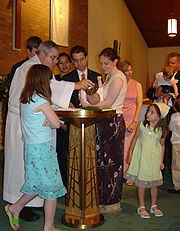
Baptism
In Christianity, baptism is for the majority the rite of admission , almost invariably with the use of water, into the Christian Church generally and also membership of a particular church tradition...
infants or young child
Child
Biologically, a child is generally a human between the stages of birth and puberty. Some vernacular definitions of a child include the fetus, as being an unborn child. The legal definition of "child" generally refers to a minor, otherwise known as a person younger than the age of majority...
ren. In theological
Theology
Theology is the systematic and rational study of religion and its influences and of the nature of religious truths, or the learned profession acquired by completing specialized training in religious studies, usually at a university or school of divinity or seminary.-Definition:Augustine of Hippo...
discussions, the practice is sometimes referred to as paedobaptism or pedobaptism from the Greek pais meaning "child." The practice is sometimes contrasted with what is called "believer's baptism", or credobaptism, from the Latin word credo meaning "I believe," which is the religious practice of baptising only individuals who personally confess faith in Jesus
Jesus
Jesus of Nazareth , commonly referred to as Jesus Christ or simply as Jesus or Christ, is the central figure of Christianity...
, therefore excluding underage children. Infant baptism is also called christening.
Most Christians
Christianity
Christianity is a monotheistic religion based on the life and teachings of Jesus as presented in canonical gospels and other New Testament writings...
practise infant baptism. Denominations
Christian denomination
A Christian denomination is an identifiable religious body under a common name, structure, and doctrine within Christianity. In the Orthodox tradition, Churches are divided often along ethnic and linguistic lines, into separate churches and traditions. Technically, divisions between one group and...
that practise infant baptism include the Roman Catholic Church
Roman Catholic Church
The Catholic Church, also known as the Roman Catholic Church, is the world's largest Christian church, with over a billion members. Led by the Pope, it defines its mission as spreading the gospel of Jesus Christ, administering the sacraments and exercising charity...
, the Eastern Orthodox Church
Eastern Orthodox Church
The Orthodox Church, officially called the Orthodox Catholic Church and commonly referred to as the Eastern Orthodox Church, is the second largest Christian denomination in the world, with an estimated 300 million adherents mainly in the countries of Belarus, Bulgaria, Cyprus, Georgia, Greece,...
, Oriental Orthodoxy
Oriental Orthodoxy
Oriental Orthodoxy is the faith of those Eastern Christian Churches that recognize only three ecumenical councils — the First Council of Nicaea, the First Council of Constantinople and the First Council of Ephesus. They rejected the dogmatic definitions of the Council of Chalcedon...
, Armenian Apostolic Church
Armenian Apostolic Church
The Armenian Apostolic Church is the world's oldest National Church, is part of Oriental Orthodoxy, and is one of the most ancient Christian communities. Armenia was the first country to adopt Christianity as its official religion in 301 AD, in establishing this church...
, Assyrian Church of the East
Assyrian Church of the East
The Assyrian Church of the East, officially the Holy Apostolic Catholic Assyrian Church of the East ʻIttā Qaddishtā w-Shlikhāitā Qattoliqi d-Madnĕkhā d-Āturāyē), is a Syriac Church historically centered in Mesopotamia. It is one of the churches that claim continuity with the historical...
, the Anglican churches, Lutherans
Lutheranism
Lutheranism is a major branch of Western Christianity that identifies with the theology of Martin Luther, a German reformer. Luther's efforts to reform the theology and practice of the church launched the Protestant Reformation...
, Presbyterians
Presbyterianism
Presbyterianism refers to a number of Christian churches adhering to the Calvinist theological tradition within Protestantism, which are organized according to a characteristic Presbyterian polity. Presbyterian theology typically emphasizes the sovereignty of God, the authority of the Scriptures,...
, Methodist
Methodism
Methodism is a movement of Protestant Christianity represented by a number of denominations and organizations, claiming a total of approximately seventy million adherents worldwide. The movement traces its roots to John Wesley's evangelistic revival movement within Anglicanism. His younger brother...
s, some Church of the Nazarene
Church of the Nazarene
The Church of the Nazarene is an evangelical Christian denomination that emerged from the 19th century Holiness movement in North America with its members colloquially referred to as Nazarenes. It is the largest Wesleyan-holiness denomination in the world. At the end of 2010, the Church of the...
, the Reformed Church in America
Reformed Church in America
The Reformed Church in America is a mainline Reformed Protestant denomination in Canada and the United States. It has about 170,000 members, with the total declining in recent decades. From its beginning in 1628 until 1819, it was the North American branch of the Dutch Reformed Church. In 1819, it...
, the United Church of Canada
United Church of Canada
The United Church of Canada is a Protestant Christian denomination in Canada. It is the largest Protestant church and, after the Roman Catholic Church, the second-largest Christian church in Canada...
, the United Church of Christ
United Church of Christ
The United Church of Christ is a mainline Protestant Christian denomination primarily in the Reformed tradition but also historically influenced by Lutheranism. The Evangelical and Reformed Church and the Congregational Christian Churches united in 1957 to form the UCC...
(UCC), and the Continental Reformed
Reformed churches
The Reformed churches are a group of Protestant denominations characterized by Calvinist doctrines. They are descended from the Swiss Reformation inaugurated by Huldrych Zwingli but developed more coherently by Martin Bucer, Heinrich Bullinger and especially John Calvin...
.
Groups within the Protestant
Protestantism
Protestantism is one of the three major groupings within Christianity. It is a movement that began in Germany in the early 16th century as a reaction against medieval Roman Catholic doctrines and practices, especially in regards to salvation, justification, and ecclesiology.The doctrines of the...
tradition that reject infant baptism include the Baptists, Apostolic Christians, Disciples of Christ
Christian Church (Disciples of Christ)
The Christian Church is a Mainline Protestant denomination in North America. It is often referred to as The Christian Church, The Disciples of Christ, or more simply as The Disciples...
and the Churches of Christ, most Pentecostals
Pentecostalism
Pentecostalism is a diverse and complex movement within Christianity that places special emphasis on a direct personal experience of God through the baptism in the Holy Spirit, has an eschatological focus, and is an experiential religion. The term Pentecostal is derived from Pentecost, the Greek...
, Mennonite
Mennonite
The Mennonites are a group of Christian Anabaptist denominations named after the Frisian Menno Simons , who, through his writings, articulated and thereby formalized the teachings of earlier Swiss founders...
s, Amish
Amish
The Amish , sometimes referred to as Amish Mennonites, are a group of Christian church fellowships that form a subgroup of the Mennonite churches...
, Plymouth Brethren
Plymouth Brethren
The Plymouth Brethren is a conservative, Evangelical Christian movement, whose history can be traced to Dublin, Ireland, in the late 1820s. Although the group is notable for not taking any official "church name" to itself, and not having an official clergy or liturgy, the title "The Brethren," is...
, Seventh-day Adventists
Seventh-day Adventist Church
The Seventh-day Adventist Church is a Protestant Christian denomination distinguished by its observance of Saturday, the original seventh day of the Judeo-Christian week, as the Sabbath, and by its emphasis on the imminent second coming of Jesus Christ...
, most non-denominational churches
Non-denominational Christianity
In Christianity, nondenominational institutions or churches are those not formally aligned with an established denomination, or that remain otherwise officially autonomous. This, however, does not preclude an identifiable standard among such congregations...
, and other Arminian
Arminianism
Arminianism is a school of soteriological thought within Protestant Christianity based on the theological ideas of the Dutch Reformed theologian Jacobus Arminius and his historic followers, the Remonstrants...
denominations. Infant baptism is also excluded by Jehovah's Witnesses
Jehovah's Witnesses
Jehovah's Witnesses is a millenarian restorationist Christian denomination with nontrinitarian beliefs distinct from mainstream Christianity. The religion reports worldwide membership of over 7 million adherents involved in evangelism, convention attendance of over 12 million, and annual...
, Christadelphians
Christadelphians
Christadelphians is a Christian group that developed in the United Kingdom and North America in the 19th century...
, and Latter Day Saints
Latter Day Saint movement
The Latter Day Saint movement is a group of independent churches tracing their origin to a Christian primitivist movement founded by Joseph Smith, Jr. in the late 1820s. Collectively, these churches have over 14 million members...
.
Ceremony
The exact details of the baptismal ceremonyCeremony
A ceremony is an event of ritual significance, performed on a special occasion. The word may be of Etruscan origin.-Ceremonial occasions:A ceremony may mark a rite of passage in a human life, marking the significance of, for example:* birth...
vary among Christian denomination
Christian denomination
A Christian denomination is an identifiable religious body under a common name, structure, and doctrine within Christianity. In the Orthodox tradition, Churches are divided often along ethnic and linguistic lines, into separate churches and traditions. Technically, divisions between one group and...
s. Many follow a prepared ceremony, called a rite
Rite
A rite is an established, ceremonious, usually religious act. Rites in this sense fall into three major categories:* rites of passage, generally changing an individual's social status, such as marriage, baptism, or graduation....
or liturgy
Liturgy
Liturgy is either the customary public worship done by a specific religious group, according to its particular traditions or a more precise term that distinguishes between those religious groups who believe their ritual requires the "people" to do the "work" of responding to the priest, and those...
. In a typical ceremony, parents or godparent
Godparent
A godparent, in many denominations of Christianity, is someone who sponsors a child's baptism. A male godparent is a godfather, and a female godparent is a godmother...
s bring their child to their congregation's priest
Priest
A priest is a person authorized to perform the sacred rites of a religion, especially as a mediatory agent between humans and deities. They also have the authority or power to administer religious rites; in particular, rites of sacrifice to, and propitiation of, a deity or deities...
or minister. The rite used would be the same as that denomination's rite for adults, i.e., by pouring water (affusion
Affusion
Affusion is a method of baptism where water is poured on the head of the person being baptized. The word "affusion" comes from the Latin affusio, meaning "to pour on" . Affusion is one of three or four methods of baptism, in addition to the greater wetting of total immersion baptism and...
), or others by sprinkling water (aspersion
Aspersion
Aspersion , in a religious context, is the act of sprinkling with water, especially holy water. Aspersion is a method used in baptism as an alternative to immersion or affusion...
). Eastern Orthodox
Eastern Orthodox Church
The Orthodox Church, officially called the Orthodox Catholic Church and commonly referred to as the Eastern Orthodox Church, is the second largest Christian denomination in the world, with an estimated 300 million adherents mainly in the countries of Belarus, Bulgaria, Cyprus, Georgia, Greece,...
and Eastern Catholic traditions normally practice total immersion and baptise babies in a font
Baptismal font
A baptismal font is an article of church furniture or a fixture used for the baptism of children and adults.-Aspersion and affusion fonts:...
and this practice is also the first method listed in the Baptismal ritual of the Roman Catholic
Roman Catholic Church
The Catholic Church, also known as the Roman Catholic Church, is the world's largest Christian church, with over a billion members. Led by the Pope, it defines its mission as spreading the gospel of Jesus Christ, administering the sacraments and exercising charity...
although pouring is the standard practice within the Latin branch of Catholicism. Catholic and Orthodox churches do not sprinkle. At the moment of baptism, the minister utters the words "I baptise you (or, 'The servant of God (name) is baptized') in the name of the Father, and of the Son, and of the Holy Spirit" (see Matthew 28:19
Great Commission
The Great Commission, in Christian tradition, is the instruction of the resurrected Jesus Christ to his disciples, that they spread his teachings to all the nations of the world. It has become a tenet in Christian theology emphasizing missionary work, evangelism, and baptism...
).
Although it is not required, many parents and godparents choose to dress the baby in a white gown called a christening gown
Baptismal clothing
Baptismal clothing is apparel worn by Christian proselytes during the ceremony of baptism.-Eastern Orthodoxy:...
for the Baptism ceremony. Christening gowns often become treasured keepsakes that are used by many other children in the family and handed down from generation to generation. Traditionally, this gown is white or slightly off white and made with much lace, trim and intricate detail. In the past, a gown was used for both boys and girls; in the present day it has become more common to dress children in a Baptismal outfit. Also normally made of white fabric, the outfit consists of a romper
Romper suit
A romper suit is a one-piece garment worn by children and sometimes women. Somewhat similar to a coverall, it is loose fitting and usually has shorter legs that may be gathered at the end. Puffed pants are particularly associated with rompers...
with a vest or other accessories.
These clothes are often kept as a memento after the ceremony.
It is a naval tradition to baptize children using the ship's bell as a baptismal font and to engrave their names of the children on the naval bell afterwards. Tracking down and searching for an individual's name on a specific bell from a ship may be a difficult and time-consuming task. Christening information from the bells held by the Canadian Forces
Canadian Forces
The Canadian Forces , officially the Canadian Armed Forces , are the unified armed forces of Canada, as constituted by the National Defence Act, which states: "The Canadian Forces are the armed forces of Her Majesty raised by Canada and consist of one Service called the Canadian Armed Forces."...
Base Esquimalt Museum has been entered into a searchable data archive that is accessible to any interested web site visitors.
History
Scholars disagree on the date when infant baptism was first practiced. Some believe that 1st-century Christians did not practice it, noting the lack of any explicit evidence of paedobaptism. Others, noting the lack of any explicit evidence of exclusion of paedobaptism, believe that they did, understanding biblical references to individuals "and [her] household" being baptized as well as "the promise to you and your children" as including small children and infants.While the earliest extra-biblical directions for baptism, which occurs in the Didache
Didache
The Didache or The Teaching of the Twelve Apostles is a brief early Christian treatise, dated by most scholars to the late first or early 2nd century...
(c. 100), speaks to the baptism of adults, rather than young children, since it requires that the person to be baptised should fast, writings of the 2nd and early 3rd century indicate that some Christians baptized infants too. Irenaeus
Irenaeus
Saint Irenaeus , was Bishop of Lugdunum in Gaul, then a part of the Roman Empire . He was an early church father and apologist, and his writings were formative in the early development of Christian theology...
(c. 130–202) speaks not only of children but even of infants being "born again to God" and three passages of Origen
Origen
Origen , or Origen Adamantius, 184/5–253/4, was an early Christian Alexandrian scholar and theologian, and one of the most distinguished writers of the early Church. As early as the fourth century, his orthodoxy was suspect, in part because he believed in the pre-existence of souls...
(185–c. 254) mention infant baptism as traditional and customary. Tertullian
Tertullian
Quintus Septimius Florens Tertullianus, anglicised as Tertullian , was a prolific early Christian author from Carthage in the Roman province of Africa. He is the first Christian author to produce an extensive corpus of Latin Christian literature. He also was a notable early Christian apologist and...
(c. 155–230) too, while advising postponement of baptism until after marriage, mentions that it was customary to baptise infants, with sponsors speaking on their behalf. The Apostolic Tradition
Apostolic Tradition
The Apostolic Tradition is an early Christian treatise which belongs to genre of the Church Orders. It has been described as of "incomparable importance as a source of information about church life and liturgy in the third century".Re-discovered in the 19th century, it was given the name of...
, attributed to Hippolytus of Rome (died 235), describes how to perform the ceremony of baptism; it states that children were baptised first, and if any of them could not answer for themselves, their parents or someone else from their family was to answer for them.
From at least the 3rd century onward Christians baptized infants as standard practice, although some preferred to postpone baptism until late in life, so as to ensure forgiveness for all their preceding sins.
Theology
The basic theology of Christian denominations often varies (see Material principle). For this reason, the meaning of baptism itself and infant baptism in particular depends greatly upon the Christian traditionTradition
A tradition is a ritual, belief or object passed down within a society, still maintained in the present, with origins in the past. Common examples include holidays or impractical but socially meaningful clothes , but the idea has also been applied to social norms such as greetings...
to which the baptismal candidate belongs.
Agreements among paedobaptists
While there is debatable scriptural evidence (such as that in Colossians 2:11-12), paedobaptists believe that infant baptism is the New Testament counterpart to circumcisionCircumcision
Male circumcision is the surgical removal of some or all of the foreskin from the penis. The word "circumcision" comes from Latin and ....
. In the Old Testament, all male converts to Judaism
Judaism
Judaism ) is the "religion, philosophy, and way of life" of the Jewish people...
, male infants born to Jewish parents, and male servants were circumcised as ceremony of initiation
Initiation
Initiation is a rite of passage ceremony marking entrance or acceptance into a group or society. It could also be a formal admission to adulthood in a community or one of its formal components...
into the Jewish community. Paedobaptists believe that baptism has replaced Old Testament circumcision and is the religious ceremony of initiation into the Christian community. Beyond this, very little is agreed on the subject among Christian denominations.
During the medieval and Reformation
Protestant Reformation
The Protestant Reformation was a 16th-century split within Western Christianity initiated by Martin Luther, John Calvin and other early Protestants. The efforts of the self-described "reformers", who objected to the doctrines, rituals and ecclesiastical structure of the Roman Catholic Church, led...
eras, infant baptism was seen as a way to incorporate new-born babies into the secular community as well as inducting them into the Christian faith.
Differences among paedobaptists
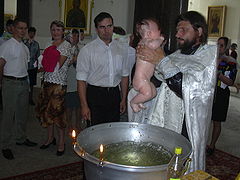
Roman Catholic Church
The Roman Catholic ChurchRoman Catholic Church
The Catholic Church, also known as the Roman Catholic Church, is the world's largest Christian church, with over a billion members. Led by the Pope, it defines its mission as spreading the gospel of Jesus Christ, administering the sacraments and exercising charity...
considers baptism, even for an infant, so important that "parents are obliged to see that their infants are baptised within the first few weeks" and, "if the infant is in danger of death, it is to be baptised without any delay." It declares: "The practice of infant Baptism is an immemorial tradition of the Church. There is explicit testimony to this practice from the second century on, and it is quite possible that, from the beginning of the apostolic preaching, when whole 'households' received baptism, infants may also have been baptized." It notes that, "when the first direct evidence of infant Baptism appears in the second century, it is never presented as an innovation," that 2nd-century Irenaeus treated baptism of infants as a matter of course, and that, "at a Synod of African Bishops, St. Cyprian stated that 'God's mercy and grace should not be refused to anyone born', and the Synod, recalling that 'all human beings' are 'equal', whatever be 'their size or age', declared it lawful to baptize children 'by the second or third day after their birth'." In the 17th and 18th centuries, many infants were baptised on the day of their birth as in the cases of Francoise-Athenais, Marquise de Montespan
Françoise-Athénaïs, marquise de Montespan
Françoise Athénaïs de Rochechouart de Mortemart, marquise of Montespan , better known as Madame de Montespan, was the most celebrated maîtresse en titre of King Louis XIV of France, by whom she had seven children....
, Jeanne Du Barry and Marie Anne de Cupis de Camargo
Marie Anne de Cupis de Camargo
Marie Anne de Cupis de Camargo sometimes known simply as La Gorda Camargo, was a French/Belgian dancer...
. Infant baptism is seen as showing very clearly that salvation is an unmerited favour from God, not the fruit of human effort. "Born with a fallen human nature and tainted by original sin, children also have need of the new birth in Baptism to be freed from the power of darkness and brought into the realm of the freedom of the children of God, to which all men are called... The Church and the parents would deny a child the priceless grace of becoming a child of God were they not to confer Baptism shortly after birth."
The Church has no official teaching regarding the fate of infants who die without Baptism, and theologians of the Church hold various views (for instance, some have asserted that they go to Limbo, which has never been official Catholic doctrine). "The Church entrusts these infants to the mercy of God."
The Congregation for the Doctrine of the Faith
Congregation for the Doctrine of the Faith
The Congregation for the Doctrine of the Faith , previously known as the Supreme Sacred Congregation of the Roman and Universal Inquisition , and after 1904 called the Supreme...
issued on 20 October 1980 an instruction on infant baptism, whose purpose was "to recall the principal points of doctrine in this field which justify the Church's constant practice down the centuries and demonstrate its permanent value in spite of the difficulties raised today". The document then indicated some general guidelines for pastoral action.
The document recalled that infant baptism has long been considered of apostolic origin and that the first direct evidence of its practice, dating from the 2nd century, does not present it as an innovation. It then responded to objections that baptism should follow faith, that the person baptised should consciously receive the grace of the sacrament, that the person should freely accept baptism, that infant baptism is unsuitable in a society marked by instability of values and conflicts of ideas, and that the practice is inimical to a missionary outlook on the part of the Church.
The instruction then gave guidelines for pastoral practice, based on two principles. The major principle is that baptism, as the sign and means of God's love that precedes any action on our part and that frees from original sin and communicates divine life, must not be delayed. The subordinate principle is that assurances must be given that the gift thus granted can grow by authentic education in the faith and Christian life. If these assurances are not really serious, there can be grounds for delaying baptism. If they are certainly absent, the sacrament should even be refused.
Accordingly, the rules for involvement on the part of practising Christian parents must be supplemented with other considerations in the case of "families with little faith or non-Christian families". If these request that a child of theirs be baptised, there must be assurances that the child will be given the benefit of the Christian upbringing required by the sacrament. Examples of such assurances are "the choice of godparents who will take sincere care of the child, or the support of the community". If there is satisfactory assurance, i.e. "any pledge giving a well-founded hope for the Christian upbringing of the children", then "the priest cannot refuse to celebrate the sacrament without delay, as in the case of children of Christian families". If there is insufficient assurance, "it will be prudent to delay baptism", while keeping contact with the parents in the hope of securing the required conditions for celebrating the sacrament. As a last resort, enrollment of the child in a course of catechetical instruction on reaching school age, can be offered in lieu of immediate celebration of baptism.
Other ancient Christian Churches
The Eastern Orthodox ChurchEastern Orthodox Church
The Orthodox Church, officially called the Orthodox Catholic Church and commonly referred to as the Eastern Orthodox Church, is the second largest Christian denomination in the world, with an estimated 300 million adherents mainly in the countries of Belarus, Bulgaria, Cyprus, Georgia, Greece,...
, Oriental Orthodoxy
Oriental Orthodoxy
Oriental Orthodoxy is the faith of those Eastern Christian Churches that recognize only three ecumenical councils — the First Council of Nicaea, the First Council of Constantinople and the First Council of Ephesus. They rejected the dogmatic definitions of the Council of Chalcedon...
and the Assyrian Church of the East
Assyrian Church of the East
The Assyrian Church of the East, officially the Holy Apostolic Catholic Assyrian Church of the East ʻIttā Qaddishtā w-Shlikhāitā Qattoliqi d-Madnĕkhā d-Āturāyē), is a Syriac Church historically centered in Mesopotamia. It is one of the churches that claim continuity with the historical...
also insist on the need to have infants baptized as soon as is practicable after birth. For them too baptism is not merely a symbol but actually conveys grace
Divine grace
In Christian theology, grace is God’s gift of God’s self to humankind. It is understood by Christians to be a spontaneous gift from God to man - "generous, free and totally unexpected and undeserved" - that takes the form of divine favour, love and clemency. It is an attribute of God that is most...
. Baptism is a sacrament
Sacrament
A sacrament is a sacred rite recognized as of particular importance and significance. There are various views on the existence and meaning of such rites.-General definitions and terms:...
because it is an "instrument" instituted by Jesus Christ to impart grace to its recipients. Infants are traditionally baptized on the eighth day, recalling the biblical injunction to circumcise
Circumcision
Male circumcision is the surgical removal of some or all of the foreskin from the penis. The word "circumcision" comes from Latin and ....
on the eighth day. However, this is not mandatory. In many of these churches, the Sacred Mystery of Chrismation
Chrismation
Chrismation is the name given in Eastern Orthodox, Oriental Orthodox and Eastern Catholic churches, as well as in the Assyrian Church of the East, Anglican, and in Lutheran initiation rites, to the Sacrament or Sacred Mystery more commonly known in the West as confirmation, although Italian...
(Confirmation) is administered by the priest immediately after baptism. Holy Communion
Infant communion
Infant Communion refers to the practice of giving the Eucharist, often in the form of consecrated wine, to infants and children. This practice is standard in the Eastern Orthodox Church and the Eastern Catholic Churches; here, communion is given at the Divine Liturgy to all baptized and chrismated...
, in the form of consecrated wine and bread, is also given to infants after they are baptized.
Lutherans
Lutherans practice infant baptism because they believe that God mandates it. They adduce biblical passages such as Matthew 28:19Great Commission
The Great Commission, in Christian tradition, is the instruction of the resurrected Jesus Christ to his disciples, that they spread his teachings to all the nations of the world. It has become a tenet in Christian theology emphasizing missionary work, evangelism, and baptism...
, Mark 10:13-15, 16:16, John 3:3-7, Acts 2:38-39 in support of their position. For them baptism is a "means of grace" through which God creates and strengthens "saving faith" as the "washing of regeneration" (Titus 3:5) in which infants and adults are reborn (John 3:3-7): "baptismal regeneration." Since the creation of faith is exclusively God's work, it does not depend on the actions of the one baptized, whether infant or adult. Even though baptized infants cannot articulate that faith, Lutherans believe that it is present all the same. Because it is faith alone that receives these divine gifts, Lutherans confess that baptism "works forgiveness of sins, delivers from death and the devil, and gives eternal salvation to all who believe this, as the words and promises of God declare." In the special section on infant baptism in his Large Catechism
Luther's Large Catechism
Luther's Large Catechism consisted of works written by Martin Luther and compiled Christian canonical texts, published in April of 1529. This book was addressed particularly to clergymen to aid them in teaching their congregations...
Luther argues that infant baptism is God-pleasing because persons so baptized were reborn and sanctified by the Holy Spirit.
Methodists
Methodists contend that infant baptism has spiritual value for the infant. John WesleyJohn Wesley
John Wesley was a Church of England cleric and Christian theologian. Wesley is largely credited, along with his brother Charles Wesley, as founding the Methodist movement which began when he took to open-air preaching in a similar manner to George Whitefield...
, the founder of Methodism
Methodism
Methodism is a movement of Protestant Christianity represented by a number of denominations and organizations, claiming a total of approximately seventy million adherents worldwide. The movement traces its roots to John Wesley's evangelistic revival movement within Anglicanism. His younger brother...
, held that baptism is a means of grace, but it was symbolic. Methodists view baptism in water as symbolic and believe that it does not regenerate the baptized nor cleanse them from sin.
Wesley's own views of infant baptism shifted over time as he put more emphasis on salvation by faith and new birth by faith alone. This has fueled much debate within Methodism over the purpose of infant baptism, though most agree it should be continued. Wesley and the Methodists would agree with the Reformed or Presbyterian denominations that infant baptism is symbolic.
Infant baptism is particularly illustrative of the Methodist doctrine of prevenient grace
Prevenient grace
Prevenient grace is a Christian theological concept rooted in Augustinian theology. It is embraced primarily by Arminian Christians who are influenced by the theology of Jacob Arminius or John Wesley. Wesley typically referred to it in 18th century language as prevenient grace...
. The principle is that The Fall of Man
The Fall of Man
In Christian doctrine, the Fall of Man, or simply the Fall, refers to the transition of the first humans from a state of innocent obedience to God to a state of guilty disobedience to God. In Genesis chapter 2, Adam and Eve live at first with God in a paradise, but the serpent tempts them into...
ruined the human soul to such an extent that nobody wants a relationship with God. In order for humans to even want to be able to choose, God must empower their will (so that they may choose Christ) which he does by means of prevenient grace. Thus God takes the very first step in salvation, preceding any human effort or decision. Methodists justify infant baptism by this principle of prevenient grace, often arguing that infant baptism is God's promise or declaration to the infant that calls that infant to (eventually) believe in God's promises (God's Word) for salvation. When the individual believes in Jesus they will profess their faith before the church, often using a ritual called confirmation in which the Holy Spirit is invoked with the laying on of hands. Methodists also use infant baptism symbolically, as an illustration of God approaching the helpless. They see the ceremony additionally as a celebration of God's prevenient grace.
Presbyterian and Continental Reformed churches
Presbyterian and Reformed Christians believe that baptism is a symbol, as a wedding ring is a symbol of marriage. The grace it conveys, however, is not justifying grace. Baptism, according to this tradition, does not produce Christians, but identifies the child as a member of the covenant community. Being a member of the covenant community does not guarantee salvation; though it does provide the child with many benefits, including that of one's particular congregation consenting to assist in the raising of that child in "the way he should go, (so that) when he is old he will not turn from it."Presbyterian and many Reformed Christians see infant baptism as the New Testament
New Testament
The New Testament is the second major division of the Christian biblical canon, the first such division being the much longer Old Testament....
form of circumcision in the Jewish covenant (Joshua
Book of Joshua
The Book of Joshua is the sixth book in the Hebrew Bible and of the Old Testament. Its 24 chapters tell of the entry of the Israelites into Canaan, their conquest and division of the land under the leadership of Joshua, and of serving God in the land....
24:15). Circumcision did not create faith in the 8-day-old Jewish boy. It merely marked him as a member of God's covenant people Israel. Likewise, baptism
Baptism
In Christianity, baptism is for the majority the rite of admission , almost invariably with the use of water, into the Christian Church generally and also membership of a particular church tradition...
doesn’t create faith; it is a sign of membership in the visible covenant community.
Presbyterian and Reformed Christians consider children of professing Christians to be members of the visible Church (the covenant community). They do not necessarily consider them to be members of a particular church (a local congregation), nor of the universal Church (the set of all true believers who make up the invisible church). A profession of faith is required for the former, and true faith is required for the latter.
Contrasts between Infant and Adult Baptism
The disagreement about infant baptism is grounded in differing theological views at a more basic level. Christians disagree about infant baptism because they disagree about the nature of faith, the role of baptism, the means of salvation, the nature of grace, and the function of the sacraments. Pedobaptism and credobaptism are positions which bubble up from theological views at a more fundamental level of one's theological system.- If baptism is a sign that a person is a member of God's covenant community, and if the children of believers are members of that community, it follows that the children of believers should receive the sign that they are members of God's covenant community by being baptized, as an infant is entitled to a passport that indicates the child as a member of a particular country.
- Believers and the children of believers become members of God's covenant community (or church) through baptism.
- It is believed by Christians that in the heart of a baptized child, faith as a gift or grace from God, as distinct from an act by the person, is made present.
- It is believed by Christians that baptism is not merely a symbol and that it has a real effect, conveying divine graceDivine graceIn Christian theology, grace is God’s gift of God’s self to humankind. It is understood by Christians to be a spontaneous gift from God to man - "generous, free and totally unexpected and undeserved" - that takes the form of divine favour, love and clemency. It is an attribute of God that is most...
.
Arguments for infant baptism
Paedobaptists do not completely agree on the reasons for baptizing infants, and offer different reasons in support of the practice. Among the arguments made in support of the practice are:Argument based on parallel with circumcision
Some supporters of infant baptism argue that circumcision is the sign of the covenant God made with Abraham and should be received by all the members of his covenant. The children of members of Abraham's covenant are themselves members of Abraham's covenant. Christians are members of Abraham's covenant Therefore, the children of Christians are members of Abraham's covenant. Since baptism is the New Testament form of circumcision, the children of Christians should receive the sign of the covenant by being baptized.Covenant theology
Presbyterian and ReformedReformed churches
The Reformed churches are a group of Protestant denominations characterized by Calvinist doctrines. They are descended from the Swiss Reformation inaugurated by Huldrych Zwingli but developed more coherently by Martin Bucer, Heinrich Bullinger and especially John Calvin...
Christians base their case for infant baptism on Covenant theology
Covenant Theology
Covenant theology is a conceptual overview and interpretive framework for understanding the overall flow of the Bible...
. Covenant theology
Covenant Theology
Covenant theology is a conceptual overview and interpretive framework for understanding the overall flow of the Bible...
is a broad interpretative framework used to understand the Bible. Reformed Baptist
Reformed Baptist
Reformed Baptists are Baptists that hold to a Calvinist soteriology. They can trace their history through the early modern Particular Baptists of England. The first Reformed Baptist church was formed in the 1630s...
s are in many ways Reformed
Reformed churches
The Reformed churches are a group of Protestant denominations characterized by Calvinist doctrines. They are descended from the Swiss Reformation inaugurated by Huldrych Zwingli but developed more coherently by Martin Bucer, Heinrich Bullinger and especially John Calvin...
yet, as their name suggests, adhere to Believers Baptism.
According to Covenant theology
Covenant Theology
Covenant theology is a conceptual overview and interpretive framework for understanding the overall flow of the Bible...
God makes two basic covenants
Covenant (religion)
In Abrahamic religions, a covenant is a formal alliance or agreement made by God with that religious community or with humanity in general. This sort of covenant is an important concept in Judaism and Christianity, derived in the first instance from the biblical covenant tradition.An example of a...
, or agreements, with humans. The first one, the Covenant of Works
Works
Works may refer to:* An author's or artist's body of work of art* Engineering structures, projects, and so on, including:** Earthworks , created through moving soil or unformed rock...
is an agreement that bases man's relationship with God on human obedience and morality. The covenant was made with Adam
Adam and Eve
Adam and Eve were, according to the Genesis creation narratives, the first human couple to inhabit Earth, created by YHWH, the God of the ancient Hebrews...
in the Garden of Eden
Garden of Eden
The Garden of Eden is in the Bible's Book of Genesis as being the place where the first man, Adam, and his wife, Eve, lived after they were created by God. Literally, the Bible speaks about a garden in Eden...
. Adam broke this covenant so God replaced it with a second more durable covenant—the Covenant of Grace. The Covenant of Grace is an agreement that bases man's relationship with God on God's grace and generosity. The Covenant of Works failed because it was based on human performance. The Covenant of Grace is durable because it is based on God's performance.
All the covenants that God makes with humans after the Fall
The Fall of Man
In Christian doctrine, the Fall of Man, or simply the Fall, refers to the transition of the first humans from a state of innocent obedience to God to a state of guilty disobedience to God. In Genesis chapter 2, Adam and Eve live at first with God in a paradise, but the serpent tempts them into...
, (e.g. with Noah, Abraham, Moses, and David) are really just different forms of the Covenant of Grace. They may appear to be different but are fundamentally the same covenant. The underlying Covenant of Grace stays the same even though the external forms changes. Consequently, Covenant theologians see in Old Testament Israel the people of God (the church) before Christ was born. For the Covenant theologian, therefore, there is only one people of God—the church.
According to Presbyterian and Reformed
Reformed churches
The Reformed churches are a group of Protestant denominations characterized by Calvinist doctrines. They are descended from the Swiss Reformation inaugurated by Huldrych Zwingli but developed more coherently by Martin Bucer, Heinrich Bullinger and especially John Calvin...
Christians, this theological framework is important to the Biblical case for infant baptism because it provides a reason for thinking there is strong continuity between the Old and New Testaments. It provides a bridge linking the two Testaments together.
Covenant Theologians claim that the New Testament
New Testament
The New Testament is the second major division of the Christian biblical canon, the first such division being the much longer Old Testament....
book of Hebrews
Hebrews
Hebrews is an ethnonym used in the Hebrew Bible...
demonstrates that much of Israel's worship has been replaced by the person and work of Christ. The result is that some important forms of worship in the Old Testament have New Testament equivalents. The Passover festival, for example, was replaced by the Lord's Supper (or Eucharist).
It is across the bridge of Covenant Theology that the sign of Abraham's covenant, circumcision, walks into the New Testament. The sign of the Covenant changes its external form to reflect new spiritual realties. It was a bloody sign in the Old Testament but because Christ has shed His blood, it has been transformed into a bloodless sign, i.e. washing with water. Passover was a bloody form of Old Testament worship and also transitions into the New Testament in the bloodless form of bread and wine.
Covenant theologians point out that the external sign of the covenant in the Old Testament was circumcision. Circumcision was performed upon the male children of Israelites to signify their external membership in God's people, not as a guarantee of true faith; the Old Testament records many Israelites who turned from God and were punished, showing that their hearts were not truly set on serving God. So while all male Israelites had the sign of the covenant performed on them in a once off ceremony soon after birth, such a signifier was external only and not a true indicator of whether or not they would later exhibit true faith in Yahweh.
In the New Testament, circumcision is no longer seen as mandatory for God's people. However there is compelling evidence to suggest that the Old Testament circumcision rite has been replaced by baptism. For instance: "In Him you were also circumcised with the circumcision made without hands, by putting off the body of the sins of the flesh, by the circumcision of Christ, buried with Him in baptism." (Colossians 2:11-12a)
Some paedobaptists, then, think the analogy of baptism to circumcision correctly points to children, since the historic Israelite application of circumcision was to infants, not to adult converts, of which there were few. Covenant theology, then, identifies baptism less as a statement of faith than as an assumption of identity; that is to say that infant baptism is a sign of covenantal inclusion.
Corroborating evidence
Paedobaptists point to a number of passages in the New TestamentNew Testament
The New Testament is the second major division of the Christian biblical canon, the first such division being the much longer Old Testament....
which seem to corroborate the above argument.
Household baptisms
In the Old Testament, if the head of a household converted to Judaism, all the males in the house, even the infants, were circumcised. Some paedobaptists argue this pattern continues into the New Testament. Reference is made, for example, to baptizing a person and their whole household – the households of Lydia
Lydia
Lydia was an Iron Age kingdom of western Asia Minor located generally east of ancient Ionia in the modern Turkish provinces of Manisa and inland İzmir. Its population spoke an Anatolian language known as Lydian....
, Crispus
Crispus
Flavius Julius Crispus , also known as Flavius Claudius Crispus and Flavius Valerius Crispus, was a Caesar of the Roman Empire. He was the first-born son of Constantine I and Minervina.-Birth:...
, and Stephanas are mentioned by name Acts 16:14-15, 18:8; 1 Cor 1:16.
Paedobaptists challenge credobaptists on this point: Why would a whole household be baptized just because the head of the house had faith? Shouldn’t they baptize each member of the family as they come to individual faith? Household baptism implies that the rules for membership in Abraham's covenant have continued into the New Testament, the main difference is the sign of the covenant.
Credobaptists counter with verses such as John 4:53, Acts 16:34 and Acts 18:8 in which entire households are said to have "believed." As such, the paedobaptist assumption is that household baptisms mentioned in the Bible involved infants, presumably incapable of personal belief.
Original sin
Paedobaptists also point to Psalm 51, which reads, in part, "surely I was sinful from birth," as indication that infants are sinful (vid. original sin
Original sin
Original sin is, according to a Christian theological doctrine, humanity's state of sin resulting from the Fall of Man. This condition has been characterized in many ways, ranging from something as insignificant as a slight deficiency, or a tendency toward sin yet without collective guilt, referred...
) and are thus in need of forgiveness that they too might have salvation.
Credobaptists would admit that infants are in need of salvation but paedobaptists push the point a step further by arguing that it makes no theological sense for infants to need salvation but for God to make no provision for them to be saved (See 1 Cor 7:14 where Paul says that the children of a believer are holy - separated - and therefore, perhaps, would not need baptising even if baptism saved). Some Credobaptists who agree to the Psalm 51 interpretation, argue that even though infants are sinful they are not accountable, because of the "age of accountability." Although many theologians would argue that an "age of accountability" is nowhere mentioned in the Bible.
An alternative viewpoint of some credobaptists is that since all Christians are predestined to salvation (John 15:16, 1 Cor.1:27, Eph.1:4, 1 Pt.2:4), God will not allow his elect to die before receiving their need, even if they are in old age (Luke 2:25-35), an argument whose relation to baptism whether of infants or adults is unclear, unless it means that infants who die without coming to explicit belief and baptism are not among God's elect.
Another Credobaptist position is called predispositionalism. This suggests that baptism is only a mature response to eternal life, and that infants generate their inner response to God's presence. Ie those who warm to him would, if dying in infancy, be with him eternally; contra-wise those who chilled to him. This aligns to the idea of individual faith/welcome (Jhn.1:14). Its point of determinism predates the age of evangelism, which it holds is still valid in crystallising predisposition into maturing faith in this life. It considers shades of meaning in the keyword salvation. Other approaches to death in infancy are in John Sander's No Other Name, and include postmortem evangelism.
Peter's speech
According to the Book of Acts in the New Testament, Peter declared in his sermon to the Jews that they should all be baptised. They and their children, and everyone whom God calls, no matter how far away.
Peter replied, "Repent and be baptised, every one of you, in the name of Jesus Christ for the forgiveness of your sins. And you will receive the gift of the Holy Spirit. The promise is for you and your children and for all who are far off–for all whom the Lord our God will call." (Acts 2:38-39, NIV)
Credobaptists counter that only those who believe, and children who believe are recipients of the promise. Otherwise, all children of Adam would be saved (i.e. Universalism)
Arguments against infant baptism
- Circumcision was a sign and seal of physical birth, and baptism is a sign and seal of new birth (born again)
- John the Baptist baptized people who were also required to be circumcised.
- Baptism always has the prerequisite of repentance and faith, which are impossible for an infant.
- Infants do not have faith. Hebrews 11:6, Romans 10:17
- The Lord's Supper and Baptism are both sacraments and are the same sign and seal, since the Lord Supper may not be given to unbelievers, neither should baptism. 1 Cor 11:28
- The New CovenantNew CovenantThe New Covenant is a concept originally derived from the Hebrew Bible. The term "New Covenant" is used in the Bible to refer to an epochal relationship of restoration and peace following a period of trial and judgment...
is not purely an expansion of the Old CovenantOld CovenantThe Old Covenant was the name of the agreement which effected the union of Iceland and Norway. It is also known as Gissurarsáttmáli, named after Gissur Þorvaldsson, the Icelandic chieftain who worked to promote it. The name "Old Covenant", however, is probably due to historical confusion...
because the PhariseesPhariseesThe Pharisees were at various times a political party, a social movement, and a school of thought among Jews during the Second Temple period beginning under the Hasmonean dynasty in the wake of...
and all who did not have faith in Jesus are excluded from the New Covenant, but were acceptable under the old. - Some claim that there is no evidence that the early church performed (or excluded) paedobaptism, and only that it performed credo baptism by immersion
- Baptism represents more than just physical washing, but being clean and good standing before God, and therefore regenerate. Romans 6.
- Baptism is for the remission of sins, and infants are not capable of repenting.
Some opponents of paedobaptism point out that Jesus himself was baptized at the age of 30.
They also point to the two (out of five) Great Commission
Great Commission
The Great Commission, in Christian tradition, is the instruction of the resurrected Jesus Christ to his disciples, that they spread his teachings to all the nations of the world. It has become a tenet in Christian theology emphasizing missionary work, evangelism, and baptism...
passages that speak of baptism. They see as giving exclusive instructions about who is to be baptized: "Go therefore and make disciples of all nations, baptizing them in the name of the Father and of the Son and of the Holy Spirit, teaching them to observe all things that I have commanded you" (verses 19-20, NKJV). They interpret this as referring to three successive stages, with baptism following on becoming a disciple (which is beyond the power of an infant), and instruction following on baptism, not preceding it.
Pedobaptists point out that the passage is ambiguous enough to interpret that a person becomes a disciple directly through baptism, meaning children could be baptized.
The Great Commission passage speaks of believing: "He who believes and is baptized will be saved; but he who does not believe will be condemned" (verse 16, NKJV). This, they say, excludes infants, whom they see as incapable of believing.
If pedobaptists accept this text as canonical, they can still point out that the second clause mentions believing, but not baptism. Therefore, one could be baptized and still not be a believer. They argue that this may not exclude infant baptism, but rather corroborate it, since it indicates that one baptized as an infant who rejects the faith is not saved against their will. Pedobaptists who accept this passage may also point out that although belief and baptism are both mentioned, there is no order implied. In return, opposers declare that baptism is for those who already believe and are able to state their belief, which infants cannot do. In Peter's address to adults, "Repent and be baptized" , they see repentance as a prerequisite, and this requires a mature understanding of sin and a decision to turn away from sin. However, St. Peter was speaking to those who were already adults, not to infants. Pedobaptists claim that it would follow that his instructions are meant for adults and not for infants. Indeed, adult candidates for baptism are required by most branches that practice pedobaptism to make a confession of faith before baptism. Some point to or as evidence that each individual must make a mature decision regarding baptism. See Believer's Baptism
Believer's baptism
Believer's baptism is the Christian practice of baptism as this is understood by many Protestant churches, particularly those that descend from the Anabaptist tradition...
.
Some oppose baptism of children as ostensibly incorporating them into the church without their own consent.
Denominations that do not accept infant baptism as valid generally require those who join them, after being baptized as infants elsewhere, to be "rebaptized," or rather to be baptized for the first time. They deny that they in fact rebaptize, saying that Christians are to be baptized only once, but as believers, and they reject the term "Anabaptist" (i.e. Rebaptizer) as a description of them.
Denominations and religious groups opposed to paedobaptism
Trinitarian Christian denominations that oppose infant baptism include Baptists, Christian Church (Disciples of Christ)Christian Church (Disciples of Christ)
The Christian Church is a Mainline Protestant denomination in North America. It is often referred to as The Christian Church, The Disciples of Christ, or more simply as The Disciples...
, Christian Churches/Churches of Christ, and Churches of Christ, Anabaptists such as Mennonite
Mennonite
The Mennonites are a group of Christian Anabaptist denominations named after the Frisian Menno Simons , who, through his writings, articulated and thereby formalized the teachings of earlier Swiss founders...
and Amish
Amish
The Amish , sometimes referred to as Amish Mennonites, are a group of Christian church fellowships that form a subgroup of the Mennonite churches...
, Schwarzenau Brethren
Schwarzenau Brethren
The Schwarzenau Brethren, originated in Germany, the outcome of the Radical Pietist ferment of the late 17th and early 18th century. Hopeful of the imminent return of Christ, the founding Brethren abandoned the established Reformed and Lutheran churches, forming a new church in 1708 when their...
/German Baptists, Seventh-Day Adventists, some Methodists and most Pentecostals. Several nontrinitarian religious groups also oppose infant baptism, including Christadelphians
Christadelphians
Christadelphians is a Christian group that developed in the United Kingdom and North America in the 19th century...
, Jehovah's Witnesses
Jehovah's Witnesses
Jehovah's Witnesses is a millenarian restorationist Christian denomination with nontrinitarian beliefs distinct from mainstream Christianity. The religion reports worldwide membership of over 7 million adherents involved in evangelism, convention attendance of over 12 million, and annual...
, the Church of Jesus Christ of Latter-Day Saints
Church of Jesus Christ of Latter-day Saints
The Church of Jesus Christ of Latter-day Saints traces its current dispensation beginnings to Joseph Smith, Jr. on April 6, 1830 in Western New York. Initial converts were drawn to the church in part because of the newly published Book of Mormon, a self-described chronicle of indigenous American...
and the Community of Christ
Community of Christ
The Community of Christ, known from 1872 to 2001 as the Reorganized Church of Jesus Christ of Latter Day Saints , is an American-based international Christian church established in April 1830 that claims as its mission "to proclaim Jesus Christ and promote communities of joy, hope, love, and peace"...
.
Religious groups that oppose infant baptism have sometimes been persecuted by paedobaptist churches. During the Reformation, Anabaptists were persecuted by Lutheran, Calvinist, Anglican and Catholic regimes. The English government imposed restrictions on Baptists in Britain
United Kingdom
The United Kingdom of Great Britain and Northern IrelandIn the United Kingdom and Dependencies, other languages have been officially recognised as legitimate autochthonous languages under the European Charter for Regional or Minority Languages...
and Ireland
Ireland
Ireland is an island to the northwest of continental Europe. It is the third-largest island in Europe and the twentieth-largest island on Earth...
during the 17th century. The Russian Orthodox Church
Russian Orthodox Church
The Russian Orthodox Church or, alternatively, the Moscow Patriarchate The ROC is often said to be the largest of the Eastern Orthodox churches in the world; including all the autocephalous churches under its umbrella, its adherents number over 150 million worldwide—about half of the 300 million...
repressed Baptists prior to the 1917 revolution, and sought restrictions on Baptists and Pentecostals after being re-established after the fall of Communism.
B.R. White describes the motivations behind persecution of the Anabaptists during the Reformation as follows:
Other Christians saw the baptism of each new-born baby into the secular parish community and close links between church and state as the divinely-ordained means of holding society together. Hence many other Christians saw the Anabaptists as subversive of all order. Consequently, from the earliest days, they were sharply persecuted and leaders were soon executed.
Note: Christian Scientists, Quakers and the Salvation Army
Salvation Army
The Salvation Army is a Protestant Christian church known for its thrift stores and charity work. It is an international movement that currently works in over a hundred countries....
cannot be classified as specifically opposing infant baptism, since they generally do not observe baptism in any form.
Confirmation
For Roman Catholics, Confirmation is a sacrament that "confirms" or "strengthens" (the original meaning of the word "confirm") the grace of BaptismBaptism
In Christianity, baptism is for the majority the rite of admission , almost invariably with the use of water, into the Christian Church generally and also membership of a particular church tradition...
, by conferring an increase and deepening of that grace.
For some other Christians the ceremony of Confirmation is a matter not of "being confirmed" but of "confirming" the baptismal vows taken on one's behalf when an infant. This is the essential significance of the Lutheran non-sacramental ceremony called in German "Konfirmation," but in English "affirmation of baptism" (see Confirmation (Lutheran Church)
Confirmation (Lutheran Church)
Confirmation in the Lutheran Church is a public profession of faith prepared for by long and careful instruction. In English, it is called "affirmation of baptism", and is a mature and public profession of the faith which "marks the completion of the congregation's program of confirmation...
).
In Eastern Christianity
Eastern Christianity
Eastern Christianity comprises the Christian traditions and churches that developed in the Balkans, Eastern Europe, Asia Minor, the Middle East, Northeastern Africa, India and parts of the Far East over several centuries of religious antiquity. The term is generally used in Western Christianity to...
, including the Eastern Catholic Churches, the sacrament of Confirmation is conferred immediately after baptism, and there is obviously no renewal of baptismal promises. In the Latin-Rite (i.e. Western) Catholic Church, the sacrament
Sacraments of the Catholic Church
The Sacraments of the Catholic Church are, the Roman Catholic Church teaches, "efficacious signs of grace, instituted by Christ and entrusted to the Church, by which divine life is dispensed to us. The visible rites by which the sacraments are celebrated signify and make present the graces proper...
is to be conferred at about the age of discretion (generally taken to be about 7), unless the Episcopal Conference
Episcopal Conference
In the Roman Catholic Church, an Episcopal Conference, Conference of Bishops, or National Conference of Bishops is an official assembly of all the bishops of a given territory...
has decided on a different age, or there is danger of death or, in the judgement of the minister, a grave reason suggests otherwise (canon 891 of the Code of Canon Law). The renewal of baptismal promises by those receiving the sacrament in the Western Catholic Church is incidental to the rite and not essentially different from the solemn renewal of their baptismal promises that is asked of all members of this Church each year at the Easter Vigil
Easter Vigil
The Easter Vigil, also called the Paschal Vigil or the Great Vigil of Easter, is a service held in many Christian churches as the first official celebration of the Resurrection of Jesus. Historically, it is during this service that people are baptized and that adult catechumens are received into...
service. Only in French-speaking countries has there been a development of ceremonies, quite distinct from the sacrament of Confirmation, for young Catholics to profess their faith publicly, in line with their age.
The Anglican Book of Common Prayer
Book of Common Prayer
The Book of Common Prayer is the short title of a number of related prayer books used in the Anglican Communion, as well as by the Continuing Anglican, "Anglican realignment" and other Anglican churches. The original book, published in 1549 , in the reign of Edward VI, was a product of the English...
requires that all who are to be confirmed should first know and understand the Creed
Creed
A creed is a statement of belief—usually a statement of faith that describes the beliefs shared by a religious community—and is often recited as part of a religious service. When the statement of faith is longer and polemical, as well as didactic, it is not called a creed but a Confession of faith...
, the Lord's Prayer
Lord's Prayer
The Lord's Prayer is a central prayer in Christianity. In the New Testament of the Christian Bible, it appears in two forms: in the Gospel of Matthew as part of the discourse on ostentation in the Sermon on the Mount, and in the Gospel of Luke, which records Jesus being approached by "one of his...
, and the Ten Commandments, and be able to answer the other questions in the Church Catechism
Catechism
A catechism , i.e. to indoctrinate) is a summary or exposition of doctrine, traditionally used in Christian religious teaching from New Testament times to the present...
. Confirmation enables those who have been baptized as infants, when they are of age to do so, openly before the church, to take upon themselves and confirm the promises made on their behalf by their godparents.
See also
- Anabaptists
- BaptismBaptismIn Christianity, baptism is for the majority the rite of admission , almost invariably with the use of water, into the Christian Church generally and also membership of a particular church tradition...
- Believers baptism
- Sacraments of InitiationSacraments of InitiationThe Sacraments of Initiation are those events in which one comes to be one of Christ's Faithful, according to the Catechism of the Catholic Church....
- Infant communionInfant communionInfant Communion refers to the practice of giving the Eucharist, often in the form of consecrated wine, to infants and children. This practice is standard in the Eastern Orthodox Church and the Eastern Catholic Churches; here, communion is given at the Divine Liturgy to all baptized and chrismated...
- William Wall (theologian)William Wall (theologian)William Wall was a British priest in the Church of England who wrote extensively on the doctrine of infant baptism. He was generally an apologist for the English church and sought to maintain peace between it and the Anabaptists.He was born in Kent, got his BA from Queen's College, Oxford in 1667...
Support
- What About Holy Baptism? by Dr. A.L. Barry (Lutheran perspective)
- Baptism by Francis Schaeffer (Evangelical Presbyterian perspective)
- Infant Baptism by Greg Johnson (Evangelical Presbyterian perspective)
- INFANT BAPTISM: How My Mind Has Changed by Dr. Dennis E. Johnson (Conservative Presbyterian perspective)
- JEREMIAH 31: INFANT BAPTISM IN THE NEW COVENANT by Dr. Richard Pratt (Evangelical Presbyterian perspective)
- } (Reformed Presbyterian perspective)
- Instruction on Infant Baptism (Roman Catholic Church)
- Infant Baptism Catholic Answers guide, with ImprimaturImprimaturAn imprimatur is, in the proper sense, a declaration authorizing publication of a book. The term is also applied loosely to any mark of approval or endorsement.-Catholic Church:...
- Early Teachings of Infant Baptism teachings on Baptism by the Church FathersChurch FathersThe Church Fathers, Early Church Fathers, Christian Fathers, or Fathers of the Church were early and influential theologians, eminent Christian teachers and great bishops. Their scholarly works were used as a precedent for centuries to come...
, with ImprimaturImprimaturAn imprimatur is, in the proper sense, a declaration authorizing publication of a book. The term is also applied loosely to any mark of approval or endorsement.-Catholic Church:... - Infant Baptism (by Jordan Bajis, Greek Orthodox Archdiocese of America website)
- Infant Baptism by Canon Tom Gordon (Orthodox Anglican perspective)
- By Water and the Spirit (United Methodist perspective)
- Donatist, Anabaptist, and Presbyterian Confusion: Infant Baptism Among Evangelicals by Nollie Malabuyo (Conservative Reformed Presbyterian perspective)
- Infant Baptism discussed at www.CatholicBridge.com (Roman Catholic perspective)
- Baptism, Confirmation and the Affirmation of Baptismal Faith (Anglican Church perspective)
Opposition
Brunson, Hal. 2007 The Rickety Bridge and the Broken Mirror: Two Parables of Paedobaptism and One Parable of the Death of Jesus Christ. ISBN 0-595-43816-4- Infant Baptism in the Global Anabaptist Mennonite Encyclopedia Online
- A Scriptural Critique of Infant Baptism by Pastor John MacArthur
- The Assemblies of God on Baptism