


Disruption of 1843

Encyclopedia
Schism (religion)
A schism , from Greek σχίσμα, skhísma , is a division between people, usually belonging to an organization or movement religious denomination. The word is most frequently applied to a break of communion between two sections of Christianity that were previously a single body, or to a division within...
within the established
State religion
A state religion is a religious body or creed officially endorsed by the state...
Church of Scotland
Church of Scotland
The Church of Scotland, known informally by its Scots language name, the Kirk, is a Presbyterian church, decisively shaped by the Scottish Reformation....
, in which 450 ministers of the Church broke away, over the issue of the Church's relationship with the State, to form the Free Church of Scotland
Free Church of Scotland (1843-1900)
The Free Church of Scotland is a Scottish denomination which was formed in 1843 by a large withdrawal from the established Church of Scotland in a schism known as the "Disruption of 1843"...
. It came at the end of a bitter conflict within the established Church, and had huge effects not only within the Church, but also upon Scottish
Scotland
Scotland is a country that is part of the United Kingdom. Occupying the northern third of the island of Great Britain, it shares a border with England to the south and is bounded by the North Sea to the east, the Atlantic Ocean to the north and west, and the North Channel and Irish Sea to the...
civic life.
The issues
Despite being 'the national ChurchNational church
National church is a concept of a Christian church associated with a specific ethnic group or nation state. The idea was notably discussed during the 19th century, during the emergence of modern nationalism....
of the Scottish people' as recognised by Acts of Parliament, the Church of Scotland, particularly under John Knox
John Knox
John Knox was a Scottish clergyman and a leader of the Protestant Reformation who brought reformation to the church in Scotland. He was educated at the University of St Andrews or possibly the University of Glasgow and was ordained to the Catholic priesthood in 1536...
and later Andrew Melville
Andrew Melville
Andrew Melville was a Scottish scholar, theologian and religious reformer. His fame encouraged scholars from the European Continent to study at Glasgow and St Andrews.-Early life and early education:...
(and unlike the Church of England
Church of England
The Church of England is the officially established Christian church in England and the Mother Church of the worldwide Anglican Communion. The church considers itself within the tradition of Western Christianity and dates its formal establishment principally to the mission to England by St...
), had always claimed an inherent right to exercise independent spiritual jurisdiction over her own affairs. To some extent, this right was recognised by the Claim of Right
Claim of Right Act 1689
The Claim of Right is an Act passed by the Parliament of Scotland in April 1689. It is one of the key documents of Scottish constitutional law.-Background:...
of 1689, which brought to an end royal and parliamentary interference in the order and worship of the Church. This was ratified by the Act of Union in 1707.
However, the right of 'patronage', that is the right of a wealthy patron to install a minister of his or her choice into a parish, became a point of contention between those who held that this infringed on the spiritual independence of the church, and those who regarded it as a matter of property under the state's jurisdiction. As early as 1712 this right of patronage had been restored in Scotland, in spite of the remonstrances of the Church. For many years afterwards the General Assembly
Presbyterian polity
Presbyterian polity is a method of church governance typified by the rule of assemblies of presbyters, or elders. Each local church is governed by a body of elected elders usually called the session or consistory, though other terms, such as church board, may apply...
sought redress of the grievance, but the dominant 'moderate' party within the church acted in such a way as to avoid any confrontation with the state.
The 'Ten Years' Conflict'
In 1834, however, the EvangelicalEvangelicalism
Evangelicalism is a Protestant Christian movement which began in Great Britain in the 1730s and gained popularity in the United States during the series of Great Awakenings of the 18th and 19th century.Its key commitments are:...
party attained a majority in the General Assembly for the first time in a century. One of their actions was to pass the Veto Act, which gave parishioners the right to reject a minister nominated by their patron. The intention was to prevent the intrusion of ministers on unwilling people, and to restore the importance of the congregational 'call'. But the effect of the act was to polarize positions in the church, and set it on a collision course with the state.
The first test came with the Auchterarder case of 1834. The parish of Auchterarder
Auchterarder
Auchterarder is a small town located north of the Ochil Hills in Perth and Kinross, Scotland, and home to the famous Gleneagles Hotel. The 1.5 mile long High Street of Auchterarder gave the town its popular name of "Lang Toon"....
unanimously rejected the patron's nominee — and the Presbytery refused to proceed with his ordination and induction. The rejected individual, Robert Young, appealed to the Court of Session
Court of Session
The Court of Session is the supreme civil court of Scotland, and constitutes part of the College of Justice. It sits in Parliament House in Edinburgh and is both a court of first instance and a court of appeal....
which, in 1838, by an 8–5 majority, held that in passing the Veto Act, the Church had acted ultra vires
Ultra vires
Ultra vires is a Latin phrase meaning literally "beyond the powers", although its standard legal translation and substitute is "beyond power". If an act requires legal authority and it is done with such authority, it is...
, and had infringed the statutory rights of patrons. If that had been all, then the Church might have rescinded the Act, but the Court of Session went on to rule that the established Church was a creation of the State and derived its legitimacy by Act of Parliament
Act of Parliament
An Act of Parliament is a statute enacted as primary legislation by a national or sub-national parliament. In the Republic of Ireland the term Act of the Oireachtas is used, and in the United States the term Act of Congress is used.In Commonwealth countries, the term is used both in a narrow...
. This directly contradicted the Church's Confession of Faith and its own self-understanding. As Burleigh puts it 'The notion of the Church as an independent community governed by its own officers and capable of entering into a compact with the state was repudiated' (p. 342). The question now moved from the issue of patronage, to the issue of the Church's spiritual independence. An appeal to the House of Lords
House of Lords
The House of Lords is the upper house of the Parliament of the United Kingdom. Like the House of Commons, it meets in the Palace of Westminster....
was rejected.
Other cases exacerbated the problem. The Presbytery of Dunkeld
Dunkeld
Dunkeld is a small town in Strathtay, Perth and Kinross, Scotland. It is about 15 miles north of Perth on the eastern side of the A9 road into the Scottish Highlands and on the opposite side of the Tay from the Victorian village of Birnam. Dunkeld and Birnam share a railway station, on the...
was summoned before the Court of Session
Court of Session
The Court of Session is the supreme civil court of Scotland, and constitutes part of the College of Justice. It sits in Parliament House in Edinburgh and is both a court of first instance and a court of appeal....
for proceeding with an ordination despite a court interdict. In 1839, the General Assembly suspended seven ministers from Strathbogie
Strathbogie
Strathbogie may refer to:* Strathbogie, the old name of Huntly in Scotland, and the strath to the south of it.* Strathbogie, Victoria, Australia* Shire of Strathbogie, Victoria, Australia* Strathbogie Ranges, Victoria, Australia...
for proceeding with an induction in Marnoch in defiance of Assembly orders. In 1841, the seven were deposed for acknowledging the superiority of the secular court in spiritual matters.
In response to the threat, the Evangelicals presented to parliament a Claim, Declaration and Protest anent the Encroachments of the Court of Session. It recognised the jurisdiction of the civil courts over the endowments given by the state to the established Church, but resolved to give up these privileges rather than see the 'Crown Rights of the Redeemer' (i.e. the spiritual independence of the church) compromised. This was rejected in January 1843, leading to the Disruption in May of that year.
The Disruption
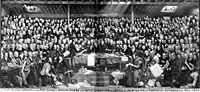
On 18 May 1843, 121 ministers and 73 elders led by Dr David Welsh, the retiring Moderator, left the Church of Scotland General Assembly at the Church of St. Andrew in George Street, EdinburghEdinburgh
Edinburgh is the capital city of Scotland, the second largest city in Scotland, and the eighth most populous in the United Kingdom. The City of Edinburgh Council governs one of Scotland's 32 local government council areas. The council area includes urban Edinburgh and a rural area...
, to form the Free Church of Scotland
Free Church of Scotland (1843-1900)
The Free Church of Scotland is a Scottish denomination which was formed in 1843 by a large withdrawal from the established Church of Scotland in a schism known as the "Disruption of 1843"...
. After Dr Welsh read a Protest, they walked out and down the hill to the Tanfield Hall at Canonmills
Canonmills
Canonmills is a suburb of Edinburgh, the capital of Scotland. It is south-east of the Royal Botanic Gardens at Inverleith.It lies in low-lying ground north of Edinburgh's New Town on ground that was uneconomic to connect to the higher New Town street levels....
where their first meeting, the Disruption Assembly, was then held with Thomas Chalmers
Thomas Chalmers
Thomas Chalmers , Scottish mathematician, political economist, divine and a leader of the Free Church of Scotland, was born at Anstruther in Fife.-Overview:...
the first Moderator. A further meeting was held on 23 May for the Signing of the Act of Separation by the ministers. Eventually 474 of the about 1200 ministers adhered.
In leaving the established Church, however, they did not reject the principle of establishment. As Chalmers declared 'Though we quit the Establishment, we go out on the Establishment principle; we quit a vitiated Establishment but would rejoice in returning to a pure one. We are advocates for a national recognition of religion — and we are not voluntaries.'
Perhaps a third of the Evangelicals, the 'Middle party', remained within the established Church — wishing to preserve its unity. But for those who left, the issue was clear. It was not the democratizing of the Church (although concern with power for ordinary people was a movement sweeping Europe at the time), but whether the Church was sovereign within its own domain. Jesus Christ and not the King or Parliament was to be its sole head. The Disruption was basically a spiritual phenomenon — and for its proponents it stood in a direct line with the Reformation
Scottish Reformation
The Scottish Reformation was Scotland's formal break with the Papacy in 1560, and the events surrounding this. It was part of the wider European Protestant Reformation; and in Scotland's case culminated ecclesiastically in the re-establishment of the church along Reformed lines, and politically in...
and the National Covenants.
Splitting the Church had major implications. Those who left forfeited livings, manses and pulpits, and had, without the aid of the establishment, to found and finance a national Church from scratch. This was done with remarkable energy, zeal and sacrifice. Another implication was that the church they left was more tolerant of doctrinal views.
In fact, most of the principles, on which the protesters went out, were conceded by Parliament by 1929, clearing the way for the re-union of that year, but the national Church of Scotland never fully regained its position after the schism.
Photographic portraiture
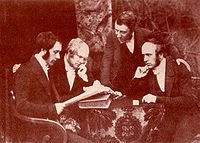
David Octavius Hill
The Scottish painter and arts activist David Octavius Hill collaborated with the engineer and photographer Robert Adamson between 1843 and 1847 to pioneer many aspects of photography in Scotland.-Early life:...
was present at the Disruption Assembly and decided to record the scene. He received encouragement from another spectator, the physicist Sir David Brewster
David Brewster
Sir David Brewster KH PRSE FRS FSA FSSA MICE was a Scottish physicist, mathematician, astronomer, inventor, writer and university principal.-Early life:...
who suggested using the new invention, photography, to get likenesses of all the ministers present, and introduced Hill to the photographer Robert Adamson
Robert Adamson (photographer)
Robert Adamson, was a Scottish pioneer photographer.Adamson was born in St. Andrews, he was hired in 1843 by David Octavius Hill , a painter of romantic Scottish landscapes. He was commissioned to make a group portrait of the 470 clergymen who founded the Free Church of Scotland. Hill required...
. Subsequently a series of photographs were taken of those who had been present, and the 5 foot x 11 foot 4 inches (1.53m x 3.45m) painting was eventually completed in 1866. It includes some associated with the Disruption but not ministers or elders. Meanwhile the partnership of Hill and Adamson pioneered the art of photography in Scotland.
See also
- Religion in the United KingdomReligion in the United KingdomReligion in the United Kingdom and the states that pre-dated the UK, was dominated by forms of Christianity for over 1,400 years. Although a majority of citizens still identify with Christianity in many surveys, regular church attendance has fallen dramatically since the middle of the 20th century,...
- History of ScotlandHistory of ScotlandThe history of Scotland begins around 10,000 years ago, when humans first began to inhabit what is now Scotland after the end of the Devensian glaciation, the last ice age...
- Church of ScotlandChurch of ScotlandThe Church of Scotland, known informally by its Scots language name, the Kirk, is a Presbyterian church, decisively shaped by the Scottish Reformation....
- Free Church of Scotland (1843-1900)Free Church of Scotland (1843-1900)The Free Church of Scotland is a Scottish denomination which was formed in 1843 by a large withdrawal from the established Church of Scotland in a schism known as the "Disruption of 1843"...