
Home      Discussion      Topics      Dictionary      Almanac
Signup       Login
John Witherspoon

John Witherspoon

Overview
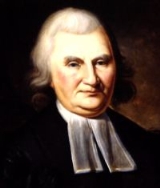
John Witherspoon (February 15, 1723 – November 15, 1794) was a signatory of the United States Declaration of Independence
United States Declaration of Independence
The United States Declaration of Independence is a statement adopted by the Continental Congress on July 4, 1776, which announced that the thirteen American colonies then at war with Great Britain were now independent states, and thus no longer a part of the British Empire...

 as a representative of New Jersey
New Jersey
New Jersey is a state in the Mid-Atlantic region of the United States. It is bordered on the north by New York, and to the east by the Hudson River, Upper New York Bay, the Kill Van Kull, Newark Bay, the Arthur Kill, Raritan Bay, Sandy Hook Bay, Westchester County, New York City, Long Island, and...

. He was both the only active clergyman and college president to sign the Declaration.

John Witherspoon was born at Gifford
Gifford, East Lothian
Gifford is a village in the parish of Yester in East Lothian, Scotland. It lies approximately 4 miles south of Haddington and 25 miles east of Edinburgh.-History:...

, a parish of Yester, in East Lothian
East Lothian
East Lothian is one of 32 unitary council areas in Scotland, UK, and a lieutenancy Area. It borders the City of Edinburgh, Scottish Borders and Midlothian. Its administrative centre is Haddington, although its largest town is Musselburgh....

, Scotland
Scotland
Scotland is a country that is part of the United Kingdom. Occupying the northern third of the island of Great Britain, it shares a border with England to the south and is bounded by the North Sea to the east, the Atlantic Ocean to the north and west, and the North Channel and Irish Sea to the...

, as the eldest child of the Reverend James Alexander Witherspoon and Anne Walker, a descendant of John Welsh of Ayr
John Welsh of Ayr
John Welsh was a Scottish Presbyterian leader.He was born in Dumfriesshire and, after a wayward youth, attended the University of Edinburgh and obtained his MA in 1588. He became a minister in Selkirk, and prior to 1596 and leaving Selkirk, Rev. Welsh married Elizabeth, a daughter of John Knox...

 and John Knox
John Knox
John Knox was a Scottish clergyman and leader of the Protestant Reformation who is considered the founder of the Presbyterian denomination. He was educated at the University of St Andrews and worked as a notary-priest. Influenced by early church reformers such as George Wishart, he joined the...

. He attended the Haddington
Haddington, East Lothian
Haddington is a town and former Royal Burgh in East Lothian, Scotland. It is the main administrative, cultural and geographical centre for East Lothian, which was known officially as Haddingtonshire before 1921. It lies approximately east of Edinburgh...

 Grammar School, and obtained a Master of Arts
Master of Arts (Scotland)
A Master of Arts in Scotland can refer to an undergraduate academic degree in humanities and social sciences awarded by the ancient universities of Scotland – St Andrews University, the University of Glasgow, the University of Aberdeen and Edinburgh University. In addition, the University of Dundee...

 from the University of Edinburgh
University of Edinburgh
The University of Edinburgh founded in 1582, is an internationally renowned centre for teaching and research in Edinburgh, Scotland, UK. It is the sixth university to be established in the British Isles, making it one of the ancient universities of the United Kingdom.The university is amongst the...

 in 1739.
Discussion
Ask a question about 'John Witherspoon'
Start a new discussion about 'John Witherspoon'
Answer questions from other users
Full Discussion Forum
 
Encyclopedia
John Witherspoon (February 15, 1723 – November 15, 1794) was a signatory of the United States Declaration of Independence
United States Declaration of Independence
The United States Declaration of Independence is a statement adopted by the Continental Congress on July 4, 1776, which announced that the thirteen American colonies then at war with Great Britain were now independent states, and thus no longer a part of the British Empire...

 as a representative of New Jersey
New Jersey
New Jersey is a state in the Mid-Atlantic region of the United States. It is bordered on the north by New York, and to the east by the Hudson River, Upper New York Bay, the Kill Van Kull, Newark Bay, the Arthur Kill, Raritan Bay, Sandy Hook Bay, Westchester County, New York City, Long Island, and...

. He was both the only active clergyman and college president to sign the Declaration.

Early life and ministry in Scotland


John Witherspoon was born at Gifford
Gifford, East Lothian
Gifford is a village in the parish of Yester in East Lothian, Scotland. It lies approximately 4 miles south of Haddington and 25 miles east of Edinburgh.-History:...

, a parish of Yester, in East Lothian
East Lothian
East Lothian is one of 32 unitary council areas in Scotland, UK, and a lieutenancy Area. It borders the City of Edinburgh, Scottish Borders and Midlothian. Its administrative centre is Haddington, although its largest town is Musselburgh....

, Scotland
Scotland
Scotland is a country that is part of the United Kingdom. Occupying the northern third of the island of Great Britain, it shares a border with England to the south and is bounded by the North Sea to the east, the Atlantic Ocean to the north and west, and the North Channel and Irish Sea to the...

, as the eldest child of the Reverend James Alexander Witherspoon and Anne Walker, a descendant of John Welsh of Ayr
John Welsh of Ayr
John Welsh was a Scottish Presbyterian leader.He was born in Dumfriesshire and, after a wayward youth, attended the University of Edinburgh and obtained his MA in 1588. He became a minister in Selkirk, and prior to 1596 and leaving Selkirk, Rev. Welsh married Elizabeth, a daughter of John Knox...

 and John Knox
John Knox
John Knox was a Scottish clergyman and leader of the Protestant Reformation who is considered the founder of the Presbyterian denomination. He was educated at the University of St Andrews and worked as a notary-priest. Influenced by early church reformers such as George Wishart, he joined the...

. He attended the Haddington
Haddington, East Lothian
Haddington is a town and former Royal Burgh in East Lothian, Scotland. It is the main administrative, cultural and geographical centre for East Lothian, which was known officially as Haddingtonshire before 1921. It lies approximately east of Edinburgh...

 Grammar School, and obtained a Master of Arts
Master of Arts (Scotland)
A Master of Arts in Scotland can refer to an undergraduate academic degree in humanities and social sciences awarded by the ancient universities of Scotland – St Andrews University, the University of Glasgow, the University of Aberdeen and Edinburgh University. In addition, the University of Dundee...

 from the University of Edinburgh
University of Edinburgh
The University of Edinburgh founded in 1582, is an internationally renowned centre for teaching and research in Edinburgh, Scotland, UK. It is the sixth university to be established in the British Isles, making it one of the ancient universities of the United Kingdom.The university is amongst the...

 in 1739. He remained at the University to study divinity.

Witherspoon was opposed to the Jacobite rising
Jacobite rising
The Jacobite Risings were a series of uprisings, rebellions, and wars in the kingdoms of England, Scotland , and Ireland occurring between 1688 and 1746...

 of 1745-46. Following the Jacobite victory at the Battle of Falkirk (1746)
Battle of Falkirk (1746)
During the Second Jacobite Rising, the Battle of Falkirk Muir was the last noteworthy Jacobite success.-Overview:...

, he was briefly imprisoned at Doune Castle
Doune Castle
Doune Castle is a late 14th century stronghold near the village of Doune, in the Stirling district of central Scotland. The castle is sited on a wooded bend where the Ardoch Burn flows into the River Teith, across a bridge from the village. It lies north-west of Stirling, where the Teith flows...

, which had a long-term impact on his health.

He became a Church of Scotland
Church of Scotland
The Church of Scotland , known informally by its Scots language name, The Kirk, is a Presbyterian church, decisively shaped by the Scottish Reformation....

 (Presbyterian) minister at Beith
Beith
Beith is a town in North Ayrshire, Scotland.One of its various claims to fame is that a signatory of the American Declaration of Independence, the Rev...

, Ayrshire
Ayrshire
Ayrshire is a registration county, and former administrative county in south-west Scotland, located on the shores of the Firth of Clyde. Its principal towns include Ayr, Kilmarnock and Irvine. The town of Troon on the coast has hosted the British Open Golf Championship twice in the last seven...

 (1745-1758), where he married Elizabeth Montgomery. They had ten children, only five surviving to adulthood.

From 1758-1768, he was minister of the Laigh kirk, Paisley
Laigh kirk, Paisley
The Laigh Kirk, Paisley is a congregation of the Church of Scotland and the original Burgh church of Paisley.-History:The Laigh Kirk was founded in 1738 as a response to the burgeoning population in the town, and as a consequence of the dilapidated state of Paisley Abbey...

 (Low Kirk). Witherspoon became prominent within the Church as an Evangelical opponent of the Moderate Party
Moderate Party (Scotland)
Moderates, in church terms is, normally, though not exclusively, used to refer to an important party of clerics in the Church of Scotland during the 18th century. They are often contrasted with Evangelicals, though this is very much a simplification...

. During his two pastorates he wrote three well-known works on theology
Theology
The term "theology" literally means the study of God, deriving from the Greek word theos, meaning 'God', and the suffix -ology from the Greek word logos meaning "discourse", "theory", or "reasoning"...

, notably the satire "Ecclesiastical Characteristics" (1753) opposing the philosophical influence of Francis Hutcheson
Francis Hutcheson (philosopher)
Francis Hutcheson was a philosopher born in Ireland to a family of Scottish Presbyterians who became one of the founding fathers of the Scottish Enlightenment.-Beginnings:...

. He was awarded a Doctorate of Divinity from the University of St Andrews
University of St Andrews
The University of St Andrews is the oldest university in Scotland and third oldest in the English-speaking world, having been founded between 1410 and 1413...

, Fife
Fife
Fife is a council area of Scotland, situated between the Firth of Tay and the Firth of Forth, with inland boundaries to Perth and Kinross and Clackmannanshire. It was originally one of the Pictish kingdoms, known as Fib, and is still commonly known as the Kingdom of Fife within Scotland.It is a...

.

Princeton


At the urging of Benjamin Rush
Benjamin Rush
Benjamin Rush was a Founding Father of the United States. Rush lived in the state of Pennsylvania and was a physician, writer, educator, humanitarian and a devout Christian, as well as the founder of Dickinson College in Carlisle, PennsylvaniaRush was a signatory of the Declaration of...

 and Richard Stockton
Richard Stockton (1730-1781)
Richard Stockton was an American lawyer, jurist, legislator, and a signer of the Declaration of Independence.-Early life:...

, whom he met in Paisley
Paisley
Paisley is a town and a former burgh in the west-Central Lowlands of Scotland. It is situated on the northern edge of the Gleniffer Braes, straddling the banks of the River Cart...

, Witherspoon finally accepted another invitation (he had earlier turned one down in 1766) to become President and head professor of the small Presbyterian College of New Jersey
Princeton University
Princeton University a private university located in Princeton, New Jersey, United States. The school is one of the eight universities of the Ivy League and is considered one of the Colonial Colleges....

 in Princeton. To fulfill this, he and his family emigrated to New Jersey
New Jersey
New Jersey is a state in the Mid-Atlantic region of the United States. It is bordered on the north by New York, and to the east by the Hudson River, Upper New York Bay, the Kill Van Kull, Newark Bay, the Arthur Kill, Raritan Bay, Sandy Hook Bay, Westchester County, New York City, Long Island, and...

 in 1768 at the age of 45. He became the sixth President of the college, later known as Princeton University
Princeton University
Princeton University a private university located in Princeton, New Jersey, United States. The school is one of the eight universities of the Ivy League and is considered one of the Colonial Colleges....

.

Some of the courses he taught personally were Eloquence or Belles Lettres, Chronology (history), and Divinity. Of his courses, none was more important than Moral Philosophy (a required course), which Witherspoon considered vital for ministers, lawyers, and those holding positions in government (magistrate
Magistrate
A magistrate is a judicial officer; in ancient Rome, the word magistratus denoted one of the highest government officers with judicial and executive powers. Today, in common law systems, a magistrate has limited law enforcement and administration authority...

s). He was firm but good-humored in his leadership. Witherspoon instituted a number of reforms, including modeling the syllabus
Syllabus
A syllabus , is an outline and summary of topics to be covered in an education or training course. It is descriptive...

 and university
University
A university is an institution of higher education and research, which grants academic degrees in a variety of subjects. A university provides both undergraduate education and postgraduate education...

 structure after that used at the University of St Andrews
University of St Andrews
The University of St Andrews is the oldest university in Scotland and third oldest in the English-speaking world, having been founded between 1410 and 1413...

 and other Scottish universities. Witherspoon was very popular among both faculty and students, among them James Madison
James Madison
James Madison was an American politician and political philosopher who served as the fourth President of the United States , and was one of the Founding Fathers of the United States....

 and Aaron Burr
Aaron Burr
Aaron Burr, Jr. was an American politician, Revolutionary War participant, and adventurer. He served as the third Vice President of the United States , under Thomas Jefferson....

.

Upon his arrival at then College of New Jersey at Princeton, Witherspoon found the school in debt, instruction had become weak, and the library collection did not meet current student needs. At once he began fund-raising locally and back home in Scotland, added three hundred of his own books to the library, and began the purchase of scientific equipment: the Rittenhouse orrery, many maps and a "terrestial" globe. He also firmed up entrance requirements. These things helped the school be more on par with Harvard and Yale
YALE
RapidMiner is an environment for machine learning and data mining experiments. It allows experiments to be made up of a large number of arbitrarily nestable operators, described in XML files which are created with RapidMiner's graphical user interface...

. According to Herbert Hovenkamp, his most lasting contribution was the initiation of the Scottish Common-Sense Realism
Scottish School of Common Sense
The Scottish School of Common Sense was a school of philosophy that flourished in Scotland in the late 18th and early 19th centuries. Its roots can be found in responses to the writings of such philosophers as John Locke, George Berkeley and David Hume, where its most prominent members were, among...

, which he had learned by reading Thomas Reid
Thomas Reid
Thomas Reid , Scottish philosopher, and a contemporary of David Hume, was the founder of the Scottish School of Common Sense, and played an integral role in the Scottish Enlightenment...

 and two of his expounders Dugald Stewart
Dugald Stewart
Dugald Stewart , Scottish philosopher, was born in Edinburgh. His father, Matthew Stewart , was professor of mathematics in the University of Edinburgh .-Life and works:...

 and James Beattie
James Beattie (writer)
Professor James Beattie was a Scottish scholar and writer.He was born the son of a shopkeeper and small farmer at Laurencekirk in the Mearns, and educated at Aberdeen University. In 1760, he was appointed Professor of moral philosophy there as a result of the interest of his intimate friend,...

.

As the College's primary occupation at the time was training ministers, Witherspoon was a major leader of the early Presbyterian church in America.  Witherspoon also helped to organize Nassau Presbyterian Church
Nassau Presbyterian Church
The Nassau Presbyterian Church is located at 61 Nassau Street in the Borough of Princeton, New Jersey, United States. The church operates the Princeton Cemetery. The current pastor is The Reverend Dr. David A. Davis.-First church:...

 in Princeton, N.J.

Revolutionary War


As a native Scotsman, long wary of the power of the British Crown, Witherspoon soon came to support the Revolution
American Revolution
The American Revolution is the political upheaval during the last half of the 18th century in which thirteen of Britain's colonies in North America at first rejected the governance of the Parliament of Great Britain, and later the British monarchy itself, to become the sovereign United States of...

, joining the Committee of Correspondence
Committee of correspondence
The committees of correspondence were bodies organized by the local governments of the Thirteen Colonies before the American Revolution for the purposes of coordinating written communication outside of the colony. These served an important role in the Revolution, by disseminating the colonial...

 and Safety in early 1774. His 1776 sermon "The Dominion of Providence over the Passions of Men" was published in many editions and he was elected to the Continental Congress
Continental Congress
The Continental Congress was a convention of delegates from the Thirteen Colonies that became the governing body of the United States during the American Revolution...

 as part of the New Jersey
New Jersey
New Jersey is a state in the Mid-Atlantic region of the United States. It is bordered on the north by New York, and to the east by the Hudson River, Upper New York Bay, the Kill Van Kull, Newark Bay, the Arthur Kill, Raritan Bay, Sandy Hook Bay, Westchester County, New York City, Long Island, and...

 delegation and, in July 1776, voted for the Resolution for Independence
Lee Resolution
right|thumb|[[Richard Henry Lee]] proposed the resolution on [[June 7]], [[1776]].The Lee Resolution, also known as the resolution of independence, was an act of the Second Continental Congress declaring the Thirteen Colonies to be independent of the British Empire...

. In answer to an objection that the country was not yet ready for independence
Independence
Independence is the self-government of a nation, country, or state by its residents and population, or some portion thereof, generally exercising sovereignty....

, according to tradition he replied that it "was not only ripe for the measure, but in danger of rotting for the want of it." 
Witherspoon served in Congress from June 1776 until November 1782 and became one of its most influential members and a workhorse of prodigious energy. He served on over 100 committees, most notably the powerful standing committees, the board of war and the committee on secret correspondence or foreign affairs. He spoke often in debate; helped draft the Articles of Confederation
Articles of Confederation
The Articles of Confederation and Perpetual Union, commonly referred to as the Articles of Confederation, was the first constitution of the United States of America and legally established the union of the states. The Second Continental Congress appointed a committee to draft the Articles in June...

; helped organize the executive departments; played a major role in shaping foreign policy; and drew up the instructions for the peace commissioners. He fought against the flood of paper money, and opposed the issuance of bonds without provision for their amortization. "No business can be done, some say, because money is scarce," he wrote. He also served twice in the New Jersey Legislature
New Jersey Legislature
The New Jersey Legislature is the legislative branch of the government of the U.S. state of New Jersey. In its current form, as defined by the New Jersey Constitution of 1947, the Legislature consists of two houses: the General Assembly and the Senate...

, and strongly supported the adoption of the United States Constitution
United States Constitution
The Constitution of the United States of America is the supreme law of the United States. It is the foundation and source of the legal authority underlying the existence of the United States of America and the federal government of the United States...

 during the New Jersey ratification debates.

In November 1778, as British forces neared, Witherspoon closed and evacuated the College of New Jersey. The main building, Nassau Hall, was badly damaged and his papers and personal notes were lost. Witherspoon was responsible for its rebuilding after the war, which caused him great personal and financial difficulty.

Death and burial


Witherspoon had suffered eye injuries and was blind by 1792. He died in 1794 on his farm Tusculum
Tusculum
Tusculum is the classical Roman name of a major ancient Alban Hills city, in the Latium region of Italy.-Location:The ruins of Tusculum are situated on the Tuscolo hill, on the north edge of the outer crater ring of the Alban volcano...

, just outside of Princeton, and is buried in the Princeton Cemetery
Princeton Cemetery
Princeton Cemetery is located in Borough of Princeton, New Jersey. It is owned by the Nassau Presbyterian Church. John F. Hageman in his 1878 history of Princeton, New Jersey refers to the cemetery as: "The Westminster Abbey of the United States."...

. He was 71 when he died.

Legacy


Witherspoon has been viewed as being "not a profound scholar" but "an able college president".

Ideals that Witherspoon preached from the pulpit and ideas that he taught in the classroom lived on after his death. From among his students came 37 judges, three of whom made it to the U.S. Supreme Court; 10 Cabinet officers; 12 members of the Continental Congress, 28 U.S. senators, and 49 United States congressmen. One student, Aaron Burr
Aaron Burr
Aaron Burr, Jr. was an American politician, Revolutionary War participant, and adventurer. He served as the third Vice President of the United States , under Thomas Jefferson....

, became Vice President under Thomas Jefferson
Thomas Jefferson
Thomas Jefferson was the third President of the United States , the principal author of the Declaration of Independence , and one of the most influential Founding Fathers for his promotion of the ideals of republicanism in the United States...

 in the contested election of 1800. One of Burr's classmates was James Madison, who authored many of the Federalist Papers
Federalist Papers
The Federalist Papers are a series of 85 articles advocating the ratification of the United States Constitution. Seventy-seven of the essays were published serially in The Independent Journal and The New York Packet between October 1787 and August 1788...

 arguing for passage of the United States Constitution
United States Constitution
The Constitution of the United States of America is the supreme law of the United States. It is the foundation and source of the legal authority underlying the existence of the United States of America and the federal government of the United States...

, and later became the 4th President. These men and many other alumni had a tremendous influence on the young republic. When the General Assembly of the Presbyterian Church in America met in 1789, 52 of the 188 delegates had studied under Witherspoon. The limited-government philosophy of most of these men was due in large measure to Witherspoon's influence.

The President's House
President's House (Princeton)
The President's House, also known as Maclean House, was built to serve as the home of the President of the College of New Jersey, which later became Princeton University. It was completed in 1756, the same year as Nassau Hall...

 in Princeton, New Jersey, his home from 1768 to 1779 is a U.S. National Historic Landmark
National Historic Landmark
A National Historic Landmark is a building, site, structure, object, or district, that is officially recognized by the United States government for its historical significance. All NHLs are listed in the National Register of Historic Places...

. A bronze statue at Princeton University
Princeton University
Princeton University a private university located in Princeton, New Jersey, United States. The school is one of the eight universities of the Ivy League and is considered one of the Colonial Colleges....

 by Scottish sculptor Alexander Stoddart
Alexander Stoddart
-Life:Although born in Edinburgh, Stoddart grew up in Paisley and continues to work there.He attended Glasgow School of Art from 1976 to 1980 and then continued postgraduate studies at the University of Glasgow. He is Honorary Professor in the Department of Arts and Media at the University of Paisley...

 is the twin of one outside The University of the West of Scotland, Paisley
Paisley
Paisley is a town and a former burgh in the west-Central Lowlands of Scotland. It is situated on the northern edge of the Gleniffer Braes, straddling the banks of the River Cart...

, Scotland
Scotland
Scotland is a country that is part of the United Kingdom. Occupying the northern third of the island of Great Britain, it shares a border with England to the south and is bounded by the North Sea to the east, the Atlantic Ocean to the north and west, and the North Channel and Irish Sea to the...

. In Princeton today, a University dormitory built in 1877, the street running north from the University's main gate, and the local public middle school
John Witherspoon Middle school
John Witherspoon Middle School is a middle school in Princeton, New Jersey. It is located across from Princeton High School. There are currently just under 700 students with a staff of approximately 70.It is the only public middle school in Princeton...

 all bear his name. Another statue stands near Dupont Circle
Dupont Circle
Dupont Circle is a traffic circle, neighborhood, and historic district in Northwest Washington, D.C. The traffic circle is located at the intersection of Massachusetts Avenue NW, Connecticut Avenue NW, New Hampshire Avenue NW, P Street NW, and 19th Street NW...

 in Washington, D.C.
Washington, D.C.
Washington, D.C. , formally the District of Columbia and commonly referred to as Washington, the District, or simply D.C., is the capital of the United States, founded on July 16, 1790...

, at the intersections of Connecticut Avenue, N and 18th Streets.

Paisley, Scotland honored Witherspoon's memory by naming a newly constructed street in the town center after him, in honor of his having lived in Paisley for a proportion of his adult life.

A son-in-law was Congressman David Ramsay
David Ramsay (congressman)
David Ramsay was an American physician and historian from Charleston, South Carolina. He served as a South Carolina delegate to the Continental Congress in 1782–1783 and again in 1785–1786. He was one of the first major historians of the American Revolution.The son of an Irish...

, who married Frances Witherspoon on 18 March 1783. Another daughter, Ann, married Samuel Stanhope Smith
Samuel Stanhope Smith
Samuel Stanhope Smith was a Presbyterian minister, founding president of Hampden-Sydney College and the seventh president of the College of New Jersey from 1795 to 1812....

, who succeeded Witherspoon as president of Princeton. There were many persons named Witherspoon who emigrated to America. Today, the only Witherspoons descended from the Rev. John Witherspoon in the male line also descend from John Witherspoon (b. 1790), his only Witherspoon grandson (both Frances Ramsey and Ann Smith also had sons). Reese Witherspoon
Reese Witherspoon
Laura Jeanne Reese Witherspoon , better known as Reese Witherspoon, is an American actress and film producer. In 1998 she appeared in three major movies: Overnight Delivery, Pleasantville, and Twilight. The following year, Witherspoon appeared in the critically acclaimed Election, which earned her...

, an American actress, is one of John Witherspoon's descendants.

The Witherspoon Society is a body of laypeople within the Presbyterian Church (USA)
Presbyterian Church (U.S.A.)
The Presbyterian Church or PC is a mainline Protestant Christian denomination in the United States. Part of the Reformed family of Protestantism, it is the largest Presbyterian denomination in the U.S...

 in existence since 1979 that is activist in liberal and progressive causes that takes its name from John Witherspoon.

External links