


Nomadic pastoralism

Encyclopedia
Nomadic pastoralism is a form of agriculture
where livestock
are herded
in order to find fresh pasture
s on which to graze following an irregular pattern of movement - in contrast with transhumance
where seasonal pastures are fix. The herded livestock may include cattle
, yak
s, sheep, goats, reindeer
, horse
s, donkey
s or camels, or mixtures of species. Nomadic pastoralism is commonly practised in regions with little arable land
, typically in the developing world. Of the estimated 30–40 million nomadic pastoralists worldwide, most are found in central Asia
and the Sahel
region of West Africa. Increasing numbers of stock may lead to overgrazing
of the area and desertification
if lands are not allowed to fully recover between one grazing period and the next. Increased enclosure
and fencing of land has reduced the amount of land available for this practice.
. During the revolution, humans began domesticating animals and plants for food and started forming cities. Nomadism generally has existed in symbiosis with such settled cultures trading animal products (meat, hides, wool, cheeses and other animal products) for manufactured items not produced by the nomadic herders.
Historically nomadic herder lifestyles have led to warrior-based cultures that have made them fearsome enemies of settled people. Tribal confederations built by charismatic nomadic leaders have sometimes held sway over huge areas as incipient state structures whose stability is dependent upon the distribution of taxes, tribute and plunder taken from settled populations.
In the past it was asserted that pastoral nomads left no presence archaeologically but this has now been challenged Pastoral nomadic sites are identified based on their location outside the zone of agriculture, the absence of grains or grain-processing equipment, limited and characteristic architecture, a predominance of sheep and goat bones, and by ethnographic analogy to modern pastoral nomadic peoples Juris Zahrins has proposed that pastoral nomadism began as a cultural lifestyle in the wake of the 6200 BC climatic crisis when Harifian
hunter-gatherers fused with Pre-Pottery Neolithic B
agriculturalists to produce a nomadic lifestyle based on animal domestication
, developing a circum-Arabian nomadic pastoral complex, and spreading Proto-Semitic languages.
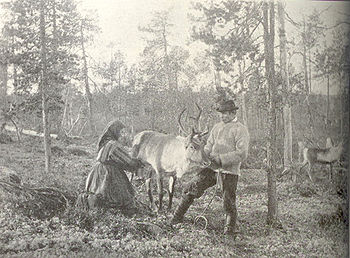 Often traditional nomad
ic groups settle into a regular seasonal pattern, which has been described by some anthropologists
as a form of transhumance. An example of a normal nomadic cycle in the northern hemisphere is:
 The movements in this example are about 180 to 200 km. Camps are established in the same place each year; often semi-permanent shelters are built in at least one place on this migration route.
In sub regions such as Chad, the nomadic pastoralist cycle is as follows:
In Chad, the sturdy villages are called hillé, the less sturdy villages are called dankhout and the tents ferik.
By contrast, pastoral nomads follow a seasonal migratory pattern which varies from year to year depending on grazing needs. Such nomadic societies create no permanent settlements, but live in tents or other movable dwellings the year round. Pastoralist nomads are often self-sufficient, producing their own food, shelter and other needs.
. It is found in areas of low rainfall such as the Arabian Peninsula
inhabited by Bedouin
s and Northeast Africa inhabited by Somalis
. Nomadic transhumance is also common in areas of harsh climate, such as Northern Europe
and Russia
inhabited by the indigenous Sami people
, Nenets people
and Chukchis.
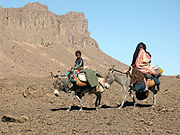 There are an estimated 30-40 million nomads in the world. Seminomadic pastoralists and pastoral nomads form a significant but declining minority in such countries as Saudi Arabia
(probably less than 3%), Iran
(4%), and Afghanistan
(at most 10%). They comprise less than 2% of the population in the countries of North Africa
except Libya
and Mauritania
.
The Mongols
in what is now Mongolia
, Russia
and China
, and the Tatars
or Turkic people of Eastern Europe
and Central Asia
were nomadic peoples who practised nomadic transhumance on harsh Asian steppe
s. Some remnants of these populations are nomadic to this day. In Mongolia, about 40% of the population continues to live a traditional nomadic lifestyle.
In the Middle Hills and Himalaya of Nepal
, people living above about 2,000 meters practice transhumance
and nomadic pastoralism because settled agriculture becomes less productive due to steep slopes, cooler temperatures and limited irrigation possibilities. Distances between summer and winter pasture may be short, for example in the vicinity of Pokhara
where a valley at about 800 meters elevation is less than 20 km. from alpine pastures just below the Annapurna
Himalaya, or distances may be 100 km or more. For example in Rapti zone
some 100 km west of Pokhara the Kham Magar
move their herds between winter pastures just north of India and summer pastures on the southern slopes of Dhaulagiri
Himalaya. In far western Nepal, ethnic Tibetans living in Dolpo and other valleys north among the high Himalaya moved their herds north to winter on the plains of the upper Brahmaputra
basin in Tibet
proper, until this practice was prohibited after China took over Tibet in 1950-51.
The nomadic Sami people
, an indigenous people of northern Finland
, Sweden
, Norway
, and the Kola Peninsula
of Russia
, practise a form of nomadic transhumance based on reindeer
. In the 14th and 15th century, when reindeer population was sufficiently reduced that Sami could not subsist on hunting alone, some Sami, organized along family lines, became reindeer herders. Each family has traditional territories on which they herd, arriving at roughly the same time each season. Only a small fraction of Sami have subsisted on reindeer herding over the past century; as the most colorful part of the population, they are well known. But as elsewhere in Europe, transhumance is dying out.
The Mesta
was an association of sheep owners, (Spanish nobility
and religious order
s) that had an important economic and political role in medieval Castile
. To preserve the rights of way of its transhumant herds through cañada
s, the Mesta acted against small peasants.
In Chad, nomadic pastoralists include the Zaghawa
, Kreda, and Mimi. Farther north in Egypt
and western Libya
, the Bedouins also practice pastoralism.
, for example, over 95% of cross-border trade is through unofficial channels and the unofficial trade of live cattle, camels, sheep and goats from Ethiopia
sold to Somalia
, Kenya
and Djibouti
generates an estimated total value of between US$250 and US$300 million annually (100 times more than the official figure). This trade helps lower food prices, increase food security, relieve border tensions and promote regional integration. However, there are also risks as the unregulated and undocumented nature of this trade runs risks, such as allowing disease to spread more easily across national borders. Furthermore, governments are unhappy with lost tax revenue and foreign exchange revenues.
There have been initiatives seeking to promote cross-border trade and also document it, in order to both stimulate regional growth and food security, but alo allow the effective vaccination of livestock. Initiatives include Regional Resilience Enhancement Against Drought (RREAD), the Enhanced Livelihoods in Mandera Triangle/Enhanced Livelihoods in Southern Ethiopia (ELMT/ELSE) as part of the Regional Enhanced Livelihoods in Pastoral Areas (RELPA) programme in East Africa, and the Regional Livelihoods Advocacy Project (REGLAP) funded by the European Commission Humanitarian Aid Office (ECHO).
Agriculture
Agriculture is the cultivation of animals, plants, fungi and other life forms for food, fiber, and other products used to sustain life. Agriculture was the key implement in the rise of sedentary human civilization, whereby farming of domesticated species created food surpluses that nurtured the...
where livestock
Livestock
Livestock refers to one or more domesticated animals raised in an agricultural setting to produce commodities such as food, fiber and labor. The term "livestock" as used in this article does not include poultry or farmed fish; however the inclusion of these, especially poultry, within the meaning...
are herded
Herding
Herding is the act of bringing individual animals together into a group , maintaining the group and moving the group from place to place—or any combination of those. While the layperson uses the term "herding", most individuals involved in the process term it mustering, "working stock" or...
in order to find fresh pasture
Pasture
Pasture is land used for grazing. Pasture lands in the narrow sense are enclosed tracts of farmland, grazed by domesticated livestock, such as horses, cattle, sheep or swine. The vegetation of tended pasture, forage, consists mainly of grasses, with an interspersion of legumes and other forbs...
s on which to graze following an irregular pattern of movement - in contrast with transhumance
Transhumance
Transhumance is the seasonal movement of people with their livestock between fixed summer and winter pastures. In montane regions it implies movement between higher pastures in summer and to lower valleys in winter. Herders have a permanent home, typically in valleys. Only the herds travel, with...
where seasonal pastures are fix. The herded livestock may include cattle
Cattle
Cattle are the most common type of large domesticated ungulates. They are a prominent modern member of the subfamily Bovinae, are the most widespread species of the genus Bos, and are most commonly classified collectively as Bos primigenius...
, yak
Yak
The yak, Bos grunniens or Bos mutus, is a long-haired bovine found throughout the Himalayan region of south Central Asia, the Tibetan Plateau and as far north as Mongolia and Russia. In addition to a large domestic population, there is a small, vulnerable wild yak population...
s, sheep, goats, reindeer
Reindeer
The reindeer , also known as the caribou in North America, is a deer from the Arctic and Subarctic, including both resident and migratory populations. While overall widespread and numerous, some of its subspecies are rare and one has already gone extinct.Reindeer vary considerably in color and size...
, horse
Horse
The horse is one of two extant subspecies of Equus ferus, or the wild horse. It is a single-hooved mammal belonging to the taxonomic family Equidae. The horse has evolved over the past 45 to 55 million years from a small multi-toed creature into the large, single-toed animal of today...
s, donkey
Donkey
The donkey or ass, Equus africanus asinus, is a domesticated member of the Equidae or horse family. The wild ancestor of the donkey is the African Wild Ass, E...
s or camels, or mixtures of species. Nomadic pastoralism is commonly practised in regions with little arable land
Arable land
In geography and agriculture, arable land is land that can be used for growing crops. It includes all land under temporary crops , temporary meadows for mowing or pasture, land under market and kitchen gardens and land temporarily fallow...
, typically in the developing world. Of the estimated 30–40 million nomadic pastoralists worldwide, most are found in central Asia
Central Asia
Central Asia is a core region of the Asian continent from the Caspian Sea in the west, China in the east, Afghanistan in the south, and Russia in the north...
and the Sahel
Sahel
The Sahel is the ecoclimatic and biogeographic zone of transition between the Sahara desert in the North and the Sudanian Savannas in the south.It stretches across the North African continent between the Atlantic Ocean and the Red Sea....
region of West Africa. Increasing numbers of stock may lead to overgrazing
Overgrazing
Overgrazing occurs when plants are exposed to intensive grazing for extended periods of time, or without sufficient recovery periods. It can be caused by either livestock in poorly managed agricultural applications, or by overpopulations of native or non-native wild animals.Overgrazing reduces the...
of the area and desertification
Desertification
Desertification is the degradation of land in drylands. Caused by a variety of factors, such as climate change and human activities, desertification is one of the most significant global environmental problems.-Definitions:...
if lands are not allowed to fully recover between one grazing period and the next. Increased enclosure
Enclosure
Enclosure or inclosure is the process which ends traditional rights such as mowing meadows for hay, or grazing livestock on common land. Once enclosed, these uses of the land become restricted to the owner, and it ceases to be common land. In England and Wales the term is also used for the...
and fencing of land has reduced the amount of land available for this practice.
Origin
Nomadic pastoralism was a result of the Neolithic revolutionNeolithic Revolution
The Neolithic Revolution was the first agricultural revolution. It was the transition from hunting and gathering to agriculture and settlement. Archaeological data indicates that various forms of plants and animal domestication evolved independently in 6 separate locations worldwide circa...
. During the revolution, humans began domesticating animals and plants for food and started forming cities. Nomadism generally has existed in symbiosis with such settled cultures trading animal products (meat, hides, wool, cheeses and other animal products) for manufactured items not produced by the nomadic herders.
Historically nomadic herder lifestyles have led to warrior-based cultures that have made them fearsome enemies of settled people. Tribal confederations built by charismatic nomadic leaders have sometimes held sway over huge areas as incipient state structures whose stability is dependent upon the distribution of taxes, tribute and plunder taken from settled populations.
In the past it was asserted that pastoral nomads left no presence archaeologically but this has now been challenged Pastoral nomadic sites are identified based on their location outside the zone of agriculture, the absence of grains or grain-processing equipment, limited and characteristic architecture, a predominance of sheep and goat bones, and by ethnographic analogy to modern pastoral nomadic peoples Juris Zahrins has proposed that pastoral nomadism began as a cultural lifestyle in the wake of the 6200 BC climatic crisis when Harifian
Harifian
The Harifian is a specialized regional cultural development of the Epipalaeolithic of the Negev Desert. It corresponds to the latest stages of the Natufian culture. Like the Natufian, it is characterized by semi-subterranean houses. These are often more elaborate than those found at Natufian sites...
hunter-gatherers fused with Pre-Pottery Neolithic B
Pre-Pottery Neolithic B
Pre-Pottery Neolithic B is a division of the Neolithic developed by Dame Kathleen Kenyon during her archaeological excavations at Jericho in the southern Levant region....
agriculturalists to produce a nomadic lifestyle based on animal domestication
Domestication
Domestication or taming is the process whereby a population of animals or plants, through a process of selection, becomes accustomed to human provision and control. In the Convention on Biological Diversity a domesticated species is defined as a 'species in which the evolutionary process has been...
, developing a circum-Arabian nomadic pastoral complex, and spreading Proto-Semitic languages.
Nomadic pattern
Nomad
Nomadic people , commonly known as itinerants in modern-day contexts, are communities of people who move from one place to another, rather than settling permanently in one location. There are an estimated 30-40 million nomads in the world. Many cultures have traditionally been nomadic, but...
ic groups settle into a regular seasonal pattern, which has been described by some anthropologists
Anthropology
Anthropology is the study of humanity. It has origins in the humanities, the natural sciences, and the social sciences. The term "anthropology" is from the Greek anthrōpos , "man", understood to mean mankind or humanity, and -logia , "discourse" or "study", and was first used in 1501 by German...
as a form of transhumance. An example of a normal nomadic cycle in the northern hemisphere is:
- Spring (early April to the end of June) — transition
- Summer (end of June to late September) — a higher plateau
- Autumn (mid-September to end of November) — transition
- Winter (from December to the end of March) — desertDesertA desert is a landscape or region that receives an extremely low amount of precipitation, less than enough to support growth of most plants. Most deserts have an average annual precipitation of less than...
plains
In sub regions such as Chad, the nomadic pastoralist cycle is as follows:
- In the rainy season, the groups live in a village intended for a comfortable stay. The villages are often made of sturdy material as clay. Old men and women remain in this village when the other people move the herds in the dry season.
- In the dry season, the people move their herds to southern villages with a more temporary character. They then move inland, where they stay in tent camps.
In Chad, the sturdy villages are called hillé, the less sturdy villages are called dankhout and the tents ferik.
By contrast, pastoral nomads follow a seasonal migratory pattern which varies from year to year depending on grazing needs. Such nomadic societies create no permanent settlements, but live in tents or other movable dwellings the year round. Pastoralist nomads are often self-sufficient, producing their own food, shelter and other needs.
Nomadic pastoralism around the world
Nomadic pastoralism was historically widespread throughout less fertile regions of EarthEarth
Earth is the third planet from the Sun, and the densest and fifth-largest of the eight planets in the Solar System. It is also the largest of the Solar System's four terrestrial planets...
. It is found in areas of low rainfall such as the Arabian Peninsula
Arabian Peninsula
The Arabian Peninsula is a land mass situated north-east of Africa. Also known as Arabia or the Arabian subcontinent, it is the world's largest peninsula and covers 3,237,500 km2...
inhabited by Bedouin
Bedouin
The Bedouin are a part of a predominantly desert-dwelling Arab ethnic group traditionally divided into tribes or clans, known in Arabic as ..-Etymology:...
s and Northeast Africa inhabited by Somalis
Somali people
Somalis are an ethnic group located in the Horn of Africa, also known as the Somali Peninsula. The overwhelming majority of Somalis speak the Somali language, which is part of the Cushitic branch of the Afro-Asiatic language family...
. Nomadic transhumance is also common in areas of harsh climate, such as Northern Europe
Northern Europe
Northern Europe is the northern part or region of Europe. Northern Europe typically refers to the seven countries in the northern part of the European subcontinent which includes Denmark, Estonia, Latvia, Lithuania, Norway, Finland and Sweden...
and Russia
Russia
Russia or , officially known as both Russia and the Russian Federation , is a country in northern Eurasia. It is a federal semi-presidential republic, comprising 83 federal subjects...
inhabited by the indigenous Sami people
Sami people
The Sami people, also spelled Sámi, or Saami, are the arctic indigenous people inhabiting Sápmi, which today encompasses parts of far northern Sweden, Norway, Finland, the Kola Peninsula of Russia, and the border area between south and middle Sweden and Norway. The Sámi are Europe’s northernmost...
, Nenets people
Nenets people
The Nenets are an indigenous people in Russia. According to the latest census in 2002, there are 41,302 Nenets in the Russian Federation, most of them living in the Yamalo-Nenets Autonomous Okrug and Nenets Autonomous Okrug...
and Chukchis.
Saudi Arabia
The Kingdom of Saudi Arabia , commonly known in British English as Saudi Arabia and in Arabic as as-Sa‘ūdiyyah , is the largest state in Western Asia by land area, constituting the bulk of the Arabian Peninsula, and the second-largest in the Arab World...
(probably less than 3%), Iran
Iran
Iran , officially the Islamic Republic of Iran , is a country in Southern and Western Asia. The name "Iran" has been in use natively since the Sassanian era and came into use internationally in 1935, before which the country was known to the Western world as Persia...
(4%), and Afghanistan
Afghanistan
Afghanistan , officially the Islamic Republic of Afghanistan, is a landlocked country located in the centre of Asia, forming South Asia, Central Asia and the Middle East. With a population of about 29 million, it has an area of , making it the 42nd most populous and 41st largest nation in the world...
(at most 10%). They comprise less than 2% of the population in the countries of North Africa
North Africa
North Africa or Northern Africa is the northernmost region of the African continent, linked by the Sahara to Sub-Saharan Africa. Geopolitically, the United Nations definition of Northern Africa includes eight countries or territories; Algeria, Egypt, Libya, Morocco, South Sudan, Sudan, Tunisia, and...
except Libya
Libya
Libya is an African country in the Maghreb region of North Africa bordered by the Mediterranean Sea to the north, Egypt to the east, Sudan to the southeast, Chad and Niger to the south, and Algeria and Tunisia to the west....
and Mauritania
Mauritania
Mauritania is a country in the Maghreb and West Africa. It is bordered by the Atlantic Ocean in the west, by Western Sahara in the north, by Algeria in the northeast, by Mali in the east and southeast, and by Senegal in the southwest...
.
The Mongols
Mongols
Mongols ) are a Central-East Asian ethnic group that lives mainly in the countries of Mongolia, China, and Russia. In China, ethnic Mongols can be found mainly in the central north region of China such as Inner Mongolia...
in what is now Mongolia
Mongolia
Mongolia is a landlocked country in East and Central Asia. It is bordered by Russia to the north and China to the south, east and west. Although Mongolia does not share a border with Kazakhstan, its western-most point is only from Kazakhstan's eastern tip. Ulan Bator, the capital and largest...
, Russia
Russia
Russia or , officially known as both Russia and the Russian Federation , is a country in northern Eurasia. It is a federal semi-presidential republic, comprising 83 federal subjects...
and China
China
Chinese civilization may refer to:* China for more general discussion of the country.* Chinese culture* Greater China, the transnational community of ethnic Chinese.* History of China* Sinosphere, the area historically affected by Chinese culture...
, and the Tatars
Tatars
Tatars are a Turkic speaking ethnic group , numbering roughly 7 million.The majority of Tatars live in the Russian Federation, with a population of around 5.5 million, about 2 million of which in the republic of Tatarstan.Significant minority populations are found in Uzbekistan, Kazakhstan,...
or Turkic people of Eastern Europe
Eastern Europe
Eastern Europe is the eastern part of Europe. The term has widely disparate geopolitical, geographical, cultural and socioeconomic readings, which makes it highly context-dependent and even volatile, and there are "almost as many definitions of Eastern Europe as there are scholars of the region"...
and Central Asia
Central Asia
Central Asia is a core region of the Asian continent from the Caspian Sea in the west, China in the east, Afghanistan in the south, and Russia in the north...
were nomadic peoples who practised nomadic transhumance on harsh Asian steppe
Steppe
In physical geography, steppe is an ecoregion, in the montane grasslands and shrublands and temperate grasslands, savannas, and shrublands biomes, characterized by grassland plains without trees apart from those near rivers and lakes...
s. Some remnants of these populations are nomadic to this day. In Mongolia, about 40% of the population continues to live a traditional nomadic lifestyle.
In the Middle Hills and Himalaya of Nepal
Nepal
Nepal , officially the Federal Democratic Republic of Nepal, is a landlocked sovereign state located in South Asia. It is located in the Himalayas and bordered to the north by the People's Republic of China, and to the south, east, and west by the Republic of India...
, people living above about 2,000 meters practice transhumance
Transhumance
Transhumance is the seasonal movement of people with their livestock between fixed summer and winter pastures. In montane regions it implies movement between higher pastures in summer and to lower valleys in winter. Herders have a permanent home, typically in valleys. Only the herds travel, with...
and nomadic pastoralism because settled agriculture becomes less productive due to steep slopes, cooler temperatures and limited irrigation possibilities. Distances between summer and winter pasture may be short, for example in the vicinity of Pokhara
Pokhara
Pokhara Sub-Metropolitan City is the second largest city of Nepal. Pokhara is city of close to 350,000 inhabitants in central Nepal located at 28.25°N, 83.99°E, which is the centre of the country from east to west or from north to south, 198 km west of Kathmandu or 90 km west of Mugling, and...
where a valley at about 800 meters elevation is less than 20 km. from alpine pastures just below the Annapurna
Annapurna
Annapurna is a section of the Himalayas in north-central Nepal that includes Annapurna I, thirteen additional peaks over and 16 more over ....
Himalaya, or distances may be 100 km or more. For example in Rapti zone
Rapti Zone
Rapti Anchal in the Mid-Western Development Region of Nepal. It is named after the West Rapti River which drains Rolpa, Pyuthan and part of Dang district. The remainder of Dang and part of Salyan are drained by the Babai. The remainder of Salyan and all of Rukum are drained by the Bheri.The...
some 100 km west of Pokhara the Kham Magar
Kham Magar
Kham Magar and Northern Magar are descriptive terms invented by academic linguists and anthropologists for a nationality in the Middle Hills of mid-western Nepal inhabiting highlands extending through eastern Rukum and northern Salyan, Rolpa and Pyuthan Districts in Rapti Zone as well as adjacent...
move their herds between winter pastures just north of India and summer pastures on the southern slopes of Dhaulagiri
Dhaulagiri
Dhaulagiri is Earth's seventh highest mountain at ; one of fourteen over eight thousand metres. Dhaulagiri was first climbed May 13, 1960 by a Swiss/Austrian expedition....
Himalaya. In far western Nepal, ethnic Tibetans living in Dolpo and other valleys north among the high Himalaya moved their herds north to winter on the plains of the upper Brahmaputra
Yarlung Zangbo River
Yarlung River is a watercourse that originates upstream from the South Tibet Valley and Yarlung Zangbo Grand Canyon, in Tibet. It then passes through the state of Arunachal Pradesh, India, where it is known as the Dihang....
basin in Tibet
Tibet
Tibet is a plateau region in Asia, north-east of the Himalayas. It is the traditional homeland of the Tibetan people as well as some other ethnic groups such as Monpas, Qiang, and Lhobas, and is now also inhabited by considerable numbers of Han and Hui people...
proper, until this practice was prohibited after China took over Tibet in 1950-51.
The nomadic Sami people
Sami people
The Sami people, also spelled Sámi, or Saami, are the arctic indigenous people inhabiting Sápmi, which today encompasses parts of far northern Sweden, Norway, Finland, the Kola Peninsula of Russia, and the border area between south and middle Sweden and Norway. The Sámi are Europe’s northernmost...
, an indigenous people of northern Finland
Finland
Finland , officially the Republic of Finland, is a Nordic country situated in the Fennoscandian region of Northern Europe. It is bordered by Sweden in the west, Norway in the north and Russia in the east, while Estonia lies to its south across the Gulf of Finland.Around 5.4 million people reside...
, Sweden
Sweden
Sweden , officially the Kingdom of Sweden , is a Nordic country on the Scandinavian Peninsula in Northern Europe. Sweden borders with Norway and Finland and is connected to Denmark by a bridge-tunnel across the Öresund....
, Norway
Norway
Norway , officially the Kingdom of Norway, is a Nordic unitary constitutional monarchy whose territory comprises the western portion of the Scandinavian Peninsula, Jan Mayen, and the Arctic archipelago of Svalbard and Bouvet Island. Norway has a total area of and a population of about 4.9 million...
, and the Kola Peninsula
Kola Peninsula
The Kola Peninsula is a peninsula in the far northwest of Russia. Constituting the bulk of the territory of Murmansk Oblast, it lies almost completely to the north of the Arctic Circle and is washed by the Barents Sea in the north and the White Sea in the east and southeast...
of Russia
Russia
Russia or , officially known as both Russia and the Russian Federation , is a country in northern Eurasia. It is a federal semi-presidential republic, comprising 83 federal subjects...
, practise a form of nomadic transhumance based on reindeer
Reindeer
The reindeer , also known as the caribou in North America, is a deer from the Arctic and Subarctic, including both resident and migratory populations. While overall widespread and numerous, some of its subspecies are rare and one has already gone extinct.Reindeer vary considerably in color and size...
. In the 14th and 15th century, when reindeer population was sufficiently reduced that Sami could not subsist on hunting alone, some Sami, organized along family lines, became reindeer herders. Each family has traditional territories on which they herd, arriving at roughly the same time each season. Only a small fraction of Sami have subsisted on reindeer herding over the past century; as the most colorful part of the population, they are well known. But as elsewhere in Europe, transhumance is dying out.
The Mesta
Mesta
The Mesta was a powerful association of sheep holders in the medieval Kingdom of Castile....
was an association of sheep owners, (Spanish nobility
Spanish nobility
Spanish nobles are persons who possess the legal status of hereditary nobility according to the laws and traditions of the Spanish monarchy. A system of titles and honours of Spain and of the former kingdoms that constitute it comprise the Spanish nobility...
and religious order
Religious order
A religious order is a lineage of communities and organizations of people who live in some way set apart from society in accordance with their specific religious devotion, usually characterized by the principles of its founder's religious practice. The order is composed of initiates and, in some...
s) that had an important economic and political role in medieval Castile
Kingdom of Castile
Kingdom of Castile was one of the medieval kingdoms of the Iberian Peninsula. It emerged as a political autonomous entity in the 9th century. It was called County of Castile and was held in vassalage from the Kingdom of León. Its name comes from the host of castles constructed in the region...
. To preserve the rights of way of its transhumant herds through cañada
Glen
A glen is a valley, typically one that is long, deep, and often glacially U-shaped; or one with a watercourse running through such a valley. Whittow defines it as a "Scottish term for a deep valley in the Highlands" that is "narrower than a strath."...
s, the Mesta acted against small peasants.
In Chad, nomadic pastoralists include the Zaghawa
Zaghawa
The Zaghawa are an ethnic group of eastern Chad and western Sudan, including Darfur.The Kanemite royal history, the Girgam, refers to the Zaghawa people as the Duguwa. Today, Zaghawa refer to themselves as the Beri, while the name "Zaghawa" comes from the nearby Arab peoples and became better known...
, Kreda, and Mimi. Farther north in Egypt
Egypt
Egypt , officially the Arab Republic of Egypt, Arabic: , is a country mainly in North Africa, with the Sinai Peninsula forming a land bridge in Southwest Asia. Egypt is thus a transcontinental country, and a major power in Africa, the Mediterranean Basin, the Middle East and the Muslim world...
and western Libya
Libya
Libya is an African country in the Maghreb region of North Africa bordered by the Mediterranean Sea to the north, Egypt to the east, Sudan to the southeast, Chad and Niger to the south, and Algeria and Tunisia to the west....
, the Bedouins also practice pastoralism.
Cross-Border Pastoralism
Sometimes nomadic pastoralists move their herds across international borders in search of new grazing or for trade. This cross-border activity can occasionally lead to tensions with national governments as this activity is often informal and beyond their control and regulation. In East AfricaEast Africa
East Africa or Eastern Africa is the easterly region of the African continent, variably defined by geography or geopolitics. In the UN scheme of geographic regions, 19 territories constitute Eastern Africa:...
, for example, over 95% of cross-border trade is through unofficial channels and the unofficial trade of live cattle, camels, sheep and goats from Ethiopia
Ethiopia
Ethiopia , officially known as the Federal Democratic Republic of Ethiopia, is a country located in the Horn of Africa. It is the second-most populous nation in Africa, with over 82 million inhabitants, and the tenth-largest by area, occupying 1,100,000 km2...
sold to Somalia
Somalia
Somalia , officially the Somali Republic and formerly known as the Somali Democratic Republic under Socialist rule, is a country located in the Horn of Africa. Since the outbreak of the Somali Civil War in 1991 there has been no central government control over most of the country's territory...
, Kenya
Kenya
Kenya , officially known as the Republic of Kenya, is a country in East Africa that lies on the equator, with the Indian Ocean to its south-east...
and Djibouti
Djibouti
Djibouti , officially the Republic of Djibouti , is a country in the Horn of Africa. It is bordered by Eritrea in the north, Ethiopia in the west and south, and Somalia in the southeast. The remainder of the border is formed by the Red Sea and the Gulf of Aden at the east...
generates an estimated total value of between US$250 and US$300 million annually (100 times more than the official figure). This trade helps lower food prices, increase food security, relieve border tensions and promote regional integration. However, there are also risks as the unregulated and undocumented nature of this trade runs risks, such as allowing disease to spread more easily across national borders. Furthermore, governments are unhappy with lost tax revenue and foreign exchange revenues.
There have been initiatives seeking to promote cross-border trade and also document it, in order to both stimulate regional growth and food security, but alo allow the effective vaccination of livestock. Initiatives include Regional Resilience Enhancement Against Drought (RREAD), the Enhanced Livelihoods in Mandera Triangle/Enhanced Livelihoods in Southern Ethiopia (ELMT/ELSE) as part of the Regional Enhanced Livelihoods in Pastoral Areas (RELPA) programme in East Africa, and the Regional Livelihoods Advocacy Project (REGLAP) funded by the European Commission Humanitarian Aid Office (ECHO).
See also
- Nomadism
- TranshumanceTranshumanceTranshumance is the seasonal movement of people with their livestock between fixed summer and winter pastures. In montane regions it implies movement between higher pastures in summer and to lower valleys in winter. Herders have a permanent home, typically in valleys. Only the herds travel, with...
- ScythiaScythiaIn antiquity, Scythian or Scyths were terms used by the Greeks to refer to certain Iranian groups of horse-riding nomadic pastoralists who dwelt on the Pontic-Caspian steppe...
- Eurasian nomadsEurasian nomadsEurasian nomads are a large group of peoples of the Eurasian Steppe. This generic title encompasses the ethnic groups inhabiting the steppes of Central Asia, Mongolia, and Eastern Europe. They domesticated the horse, and their economy and culture emphasizes horse breeding, horse riding, and a...