

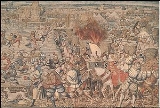
Battle of Pavia

Encyclopedia
The Battle of Pavia, fought on the morning of 24 February 1525, was the decisive engagement of the Italian War of 1521–26.
A Spanish-Imperial army under the nominal command of Charles de Lannoy
(and working in conjunction with the garrison
of Pavia
, commanded by Antonio de Leyva
) attacked the French army under the personal command of Francis I of France
in the great hunting preserve of Mirabello
outside the city walls. In the four-hour battle, the French army was split and defeated in detail. The French suffered massive casualties, including many of the chief nobles of France; Francis himself, captured by the Spanish troops, was imprisoned by Charles V
and forced to sign the humiliating Treaty of Madrid, surrendering significant territory to his captor. The outcome of the battle cemented Spanish Habsburg ascendancy in Italy.
at the start of the Italian War of 1521-26, had been forced to abandon it after their defeat at the Battle of Bicocca
in 1522. Determined to regain it, Francis ordered an invasion of the region in late 1523, under the command of Guillaume Gouffier, Seigneur de Bonnivet
; but Bonnivet was defeated by Imperial troops at the Battle of the Sesia and forced to withdraw to France.
Charles de Lannoy now launched an invasion of Provence
under the command of Fernando d'Avalos, Marquess of Pescara, and Charles III, Duke of Bourbon
(who had recently betrayed Francis and allied himself with the Emperor). While initially successful, the Imperial offensive lost valuable time during the Siege of Marseille and was forced to withdraw back to Italy by the arrival of Francis and the main French army at Avignon
.
In mid-October 1524, Francis himself crossed the Alps and advanced on Milan at the head of an army numbering more than 40,000. Bourbon and d'Avalos, their troops not yet recovered from the campaign in Provence, were in no position to offer serious resistance. The French army moved in several columns, brushing aside Imperial attempts to hold its advance, but failed to bring the main body of Imperial troops to battle. Nevertheless, Charles de Lannoy
, who had concentrated some 16,000 men to resist the 33,000 French troops closing on Milan, decided that the city could not be defended and withdrew to Lodi on October 26. Having entered Milan and installed Louis II de la Trémoille
as the governor, Francis (at the urging of Bonnivet and against the advice of his other senior commanders, who favored a more vigorous pursuit of the retreating Lannoy) advanced on Pavia
, where Antonio de Leyva
remained with a sizable Imperial garrison of about 9000.
.png) The main mass of French troops arrived at Pavia in the last days of October. By 2 November, Montmorency
The main mass of French troops arrived at Pavia in the last days of October. By 2 November, Montmorency
had crossed the Ticino River
and invested the city from the south, completing its encirclement. Inside were about 9,000 men, mainly mercenaries whom Antonio de Leyva was able to pay only by melting the church plate. A period of skirmishing and artillery bombardments followed, and several breaches had been made in the walls by mid-November. On 21 November, Francis attempted an assault on the city through two of the breaches, but was beaten back with heavy casualties; hampered by rainy weather and a lack of gunpowder, the French decided to wait for the defenders to starve.
In early December, a Spanish force commanded by Hugo de Moncada landed near Genoa
, intending to interfere in a conflict between pro-Valois and pro-Habsburg factions in the city. Francis dispatched a larger force under the Marquis of Saluzzo to intercept them. Confronted by the more numerous French and left without naval support by the arrival of a pro-Valois fleet commanded by Andrea Doria
, the Spanish troops surrendered. Francis then signed a secret agreement with Pope Clement VII, who pledged not to assist Charles in exchange for Francis's assistance with the conquest of Naples. Against the advice of his senior commanders, Francis detached a portion of his forces under the Duke of Albany and sent them south to aid the Pope. Lannoy attempted to intercept the expedition near Fiorenzuola, but suffered heavy casualties and was forced to return to Lodi by the intervention of the infamous Black Bands
of Giovanni de' Medici
, Italian mercenaries which had just entered French service. Medici then returned to Pavia with a supply train of gunpowder and shot gathered by the Duke of Ferrara; but the French position was simultaneously weakened by the departure of nearly 5,000 Grisons Swiss mercenaries
, who returned to their canton
s in order to defend them against marauding landsknechts.
In January 1525, Lannoy was reinforced by the arrival of Georg Frundsberg with 15,000 fresh landsknecht
s and renewed the offensive. D'Avalos captured the French outpost at Sant'Angelo
, cutting the lines of communication between Pavia and Milan, while a separate column of landsknechts advanced on Belgiojoso and, despite being briefly pushed back by a raid led by Medici and Bonnivet, occupied the town. By 2 February, Lannoy was only a few miles from Pavia. Francis had encamped the majority of his forces in the great walled park of Mirabello
outside the city walls, placing them between Leyva's garrison and the approaching relief army. Skirmishing and sallies by the garrison continued through the month of February. Medici was seriously wounded and withdrew to Piacenza
to recuperate, forcing Francis to recall much of the Milan garrison to offset the departure of the Black Band; but the fighting had little overall effect. On 21 February, the Imperial commanders, running low on supplies and mistakenly believing that the French forces were more numerous than their own, decided to launch an attack on Mirabello Castle in order to save face and demoralize the French sufficiently to ensure a safe withdrawal.
iers under the command of Alfonso d'Avalos
had entered the park and were rapidly advancing on Mirabello Castle, where they believed the French headquarters to be; simultaneously, Imperial light cavalry
spread out from the breach into the park, intending to intercept any French movements.
Meanwhile, a detachment of French cavalry under Charles Tiercelin encountered the Imperial cavalry and began a series of skirmishes with them. A mass of Swiss pikemen under Robert de la Marck, Seigneur de la Flourance moved up to assist them, overrunning a battery of Spanish artillery that had been dragged into the park. They missed De Vasto's arquebusiers—who had, by 6:30, emerged from the woods near the castle and swiftly overrun it—and blundered into 6,000 of Georg Frundsberg's landsknechts. By 7:00, a full-scale infantry battle had developed not far from the original breach.
, scattering the Spanish by 7:40.
Francis's precipitate advance, however, had not only masked the fire of the French artillery, but also pulled him away from the mass of French infantry, commanded by Richard de la Pole
, and by Francois de Lorraine
, who led the Black Band
of renegade Landsknecht pikemen (not to be confused with the Italian mercenary company of arquebusiers by the same name), which was 4,000 to 5,000 men strong. D'Avalos, left in command of the Spanish forces after Lannoy had followed the retreating cavalry, formed his men up at the edge of the woods and sent messengers to Bourbon, Frundsberg, and De Vasto requesting assistance.
Frundsberg had meanwhile mauled the heavily outnumbered Swiss infantry opposing him; Tiercelin and Flourance were unable to hold their troops together, and the French foot began to flee the field.
were surrounded and systematically killed. Richard de la Pole
and Lorraine, advancing to assist Francis, were met by Frundsberg's arriving landsknechts; the French infantry was broken and routed, and de la Pole and Lorraine were both killed. In a particularly bitter contest between Imperial and renegade Landsknechts, the Black Band was surrounded by Frundsberg's pikemen and exterminated where it stood. The French king fought on as his horse was killed from under him by Cesare Hercolani
, an Italian Condottiere.; surrounded by Spanish arquebusiers, he was taken prisoner and escorted from the field.
The exact nature of Francis's surrender—in particular, who exactly had taken him prisoner—is uncertain, with a variety of candidates ranging from Alonso Pita da Veiga
, Juan de Urbieta
and Diego Dávila to Lannoy himself being put forward by various historians. The fact of the matter was that, as documented in the article for Alonso Pita da Veiga
, at the time, no single individual was given credit for the capture of Francis I. The decree granting a coat of arms to Alonso Pita da Veiga for his deeds at the Battle of Pravia, was archived at the General Archive of Simanca (Archivo general de Simancas, legajo 388, rotulado de "Mercedes y Privilegios.’) and was issued by Emperor Charles V on 24 July 1529. In that decree, Charles V does not credit a single individual but, rather, a group of individuals that included Alonso Pita da Veiga: " ..... and in the same battle, you (Alonso Pita da Veiga) accomplished so much that you reached the person of said King (Francis I of France) and captured him, jointly with the other persons that captured him.” (" .... y en la misma batalla ficistes tanto que allegastes á la misma persona del dicho Rey, y fuistes en prenderle, juntamente con las otras personas que le prendieron ....")
Meanwhile, Antonio de Leyva had sortied with the garrison, overrunning the 3,000 Swiss under Montmorency that had been manning the siege lines. The remnants of the Swiss–both Montmorency's and Flourance's—tried to flee across the river, suffering massive casualties as they did. The French rearguard, under the Duke of Alençon, had taken no part in the battle; when the Duke realized what had occurred in the park, he quickly began to retreat towards Milan. By 9:00 in the morning, the battle was over.
, his mother:
Soon afterwards, he finally learned that the Duke of Albany had lost the larger part of his army to attrition and desertion, and had returned to France without ever having reached Naples. The broken remnants of the French forces, aside from a small garrison left to hold the Castel Sforzesco in Milan, retreated across the Alps under the nominal command of Charles IV of Alençon
, reaching Lyon
by March.
A Spanish-Imperial army under the nominal command of Charles de Lannoy
Charles de Lannoy
Charles de Lannoy was a soldier and statesman from the Low Countries in service of the Habsburg Emperors Maximilian I and Charles V of Spain....
(and working in conjunction with the garrison
Garrison
Garrison is the collective term for a body of troops stationed in a particular location, originally to guard it, but now often simply using it as a home base....
of Pavia
Pavia
Pavia , the ancient Ticinum, is a town and comune of south-western Lombardy, northern Italy, 35 km south of Milan on the lower Ticino river near its confluence with the Po. It is the capital of the province of Pavia. It has a population of c. 71,000...
, commanded by Antonio de Leyva
Antonio de Leyva
Antonio de Leyva, Duke of Terranova, Prince of Ascoli was a Spanish general during the Italian Wars. During the Italian War of 1521, he commanded Pavia during the siege of the city by Francis I of France, and took part in the Battle of Pavia in 1525...
) attacked the French army under the personal command of Francis I of France
Francis I of France
Francis I was King of France from 1515 until his death. During his reign, huge cultural changes took place in France and he has been called France's original Renaissance monarch...
in the great hunting preserve of Mirabello
Mirabello
-Places:Greece*Mirabello Bay, a bay in Lasithi Prefecture, CreteItaly*Mirabello, Emilia–Romagna, a comune in the Province of Ferrara*Mirabello Monferrato, a comune in the Province of Alessandria, Piedmont...
outside the city walls. In the four-hour battle, the French army was split and defeated in detail. The French suffered massive casualties, including many of the chief nobles of France; Francis himself, captured by the Spanish troops, was imprisoned by Charles V
Charles V, Holy Roman Emperor
Charles V was ruler of the Holy Roman Empire from 1519 and, as Charles I, of the Spanish Empire from 1516 until his voluntary retirement and abdication in favor of his younger brother Ferdinand I and his son Philip II in 1556.As...
and forced to sign the humiliating Treaty of Madrid, surrendering significant territory to his captor. The outcome of the battle cemented Spanish Habsburg ascendancy in Italy.
Prelude
The French, in possession of LombardyLombardy
Lombardy is one of the 20 regions of Italy. The capital is Milan. One-sixth of Italy's population lives in Lombardy and about one fifth of Italy's GDP is produced in this region, making it the most populous and richest region in the country and one of the richest in the whole of Europe...
at the start of the Italian War of 1521-26, had been forced to abandon it after their defeat at the Battle of Bicocca
Battle of Bicocca
The Battle of Bicocca or La Bicocca was fought on April 27, 1522, during the Italian War of 1521–26. A combined French and Venetian force under Odet de Foix, Vicomte de Lautrec, was decisively defeated by a Spanish-Imperial and Papal army under the overall command of Prospero Colonna...
in 1522. Determined to regain it, Francis ordered an invasion of the region in late 1523, under the command of Guillaume Gouffier, Seigneur de Bonnivet
Guillaume Gouffier, seigneur de Bonnivet
Guillaume Gouffier, seigneur de Bonnivet was a French soldier.The younger brother of Artus Gouffier, seigneur de Boisy, tutor of Francis I of France, Bonnivet was brought up with Francis, and after the young king's accession he became one of the most powerful of the royal favourites. In 1515 he...
; but Bonnivet was defeated by Imperial troops at the Battle of the Sesia and forced to withdraw to France.
Charles de Lannoy now launched an invasion of Provence
Provence
Provence ; Provençal: Provença in classical norm or Prouvènço in Mistralian norm) is a region of south eastern France on the Mediterranean adjacent to Italy. It is part of the administrative région of Provence-Alpes-Côte d'Azur...
under the command of Fernando d'Avalos, Marquess of Pescara, and Charles III, Duke of Bourbon
Charles III, Duke of Bourbon
Charles III, Duke of Bourbon was a French military leader, the Count of Montpensier and Dauphin of Auvergne. He commanded the Imperial troops of Holy Roman Emperor Charles V in what became known as the Sack of Rome in 1527, where he was killed.-Biography:Charles was born at Montpensier...
(who had recently betrayed Francis and allied himself with the Emperor). While initially successful, the Imperial offensive lost valuable time during the Siege of Marseille and was forced to withdraw back to Italy by the arrival of Francis and the main French army at Avignon
Avignon
Avignon is a French commune in southeastern France in the départment of the Vaucluse bordered by the left bank of the Rhône river. Of the 94,787 inhabitants of the city on 1 January 2010, 12 000 live in the ancient town centre surrounded by its medieval ramparts.Often referred to as the...
.
In mid-October 1524, Francis himself crossed the Alps and advanced on Milan at the head of an army numbering more than 40,000. Bourbon and d'Avalos, their troops not yet recovered from the campaign in Provence, were in no position to offer serious resistance. The French army moved in several columns, brushing aside Imperial attempts to hold its advance, but failed to bring the main body of Imperial troops to battle. Nevertheless, Charles de Lannoy
Charles de Lannoy
Charles de Lannoy was a soldier and statesman from the Low Countries in service of the Habsburg Emperors Maximilian I and Charles V of Spain....
, who had concentrated some 16,000 men to resist the 33,000 French troops closing on Milan, decided that the city could not be defended and withdrew to Lodi on October 26. Having entered Milan and installed Louis II de la Trémoille
Louis II de la Trémoille
thumb|Portrait of Louis II de la Trémoille by [[Domenico Ghirlandaio]] or one of his assistants.Louis II de la Trémoille was a French general. He served under three kings: Charles VIII, Louis XII, and Francis I...
as the governor, Francis (at the urging of Bonnivet and against the advice of his other senior commanders, who favored a more vigorous pursuit of the retreating Lannoy) advanced on Pavia
Pavia
Pavia , the ancient Ticinum, is a town and comune of south-western Lombardy, northern Italy, 35 km south of Milan on the lower Ticino river near its confluence with the Po. It is the capital of the province of Pavia. It has a population of c. 71,000...
, where Antonio de Leyva
Antonio de Leyva
Antonio de Leyva, Duke of Terranova, Prince of Ascoli was a Spanish general during the Italian Wars. During the Italian War of 1521, he commanded Pavia during the siege of the city by Francis I of France, and took part in the Battle of Pavia in 1525...
remained with a sizable Imperial garrison of about 9000.
Anne de Montmorency
Anne de Montmorency, duc de Montmorency, Honorary Knight of the Garter was a French soldier, statesman and diplomat. He became Marshal of France and Constable of France.-Early life:...
had crossed the Ticino River
Ticino River
The river Ticino is a left-bank tributary of the Po River. It has given its name to the Swiss canton through which its upper portion flows.-The course:...
and invested the city from the south, completing its encirclement. Inside were about 9,000 men, mainly mercenaries whom Antonio de Leyva was able to pay only by melting the church plate. A period of skirmishing and artillery bombardments followed, and several breaches had been made in the walls by mid-November. On 21 November, Francis attempted an assault on the city through two of the breaches, but was beaten back with heavy casualties; hampered by rainy weather and a lack of gunpowder, the French decided to wait for the defenders to starve.
In early December, a Spanish force commanded by Hugo de Moncada landed near Genoa
Genoa
Genoa |Ligurian]] Zena ; Latin and, archaically, English Genua) is a city and an important seaport in northern Italy, the capital of the Province of Genoa and of the region of Liguria....
, intending to interfere in a conflict between pro-Valois and pro-Habsburg factions in the city. Francis dispatched a larger force under the Marquis of Saluzzo to intercept them. Confronted by the more numerous French and left without naval support by the arrival of a pro-Valois fleet commanded by Andrea Doria
Andrea Doria
Andrea Doria was an Italian condottiere and admiral from Genoa.-Early life:Doria was born at Oneglia from the ancient Genoese family, the Doria di Oneglia branch of the old Doria, de Oria or de Auria family. His parents were related: Ceva Doria, co-lord of Oneglia, and Caracosa Doria, of the...
, the Spanish troops surrendered. Francis then signed a secret agreement with Pope Clement VII, who pledged not to assist Charles in exchange for Francis's assistance with the conquest of Naples. Against the advice of his senior commanders, Francis detached a portion of his forces under the Duke of Albany and sent them south to aid the Pope. Lannoy attempted to intercept the expedition near Fiorenzuola, but suffered heavy casualties and was forced to return to Lodi by the intervention of the infamous Black Bands
Black Bands
The Black Bands , sometimes referred to as the Black Bands of Giovanni, was a company of Italian mercenaries formed and commanded by Giovanni de' Medici during the Italian Wars; their name came from their black mourning colors for the death of Pope Leo X...
of Giovanni de' Medici
Giovanni dalle Bande Nere
Lodovico de Medici also known as Giovanni dalle Bande Nere was an Italian condottiero.-Biography:Giovanni was born in the Northern Italian town of Forlì to Giovanni de' Medici and Caterina Sforza, one of the most famous women of the Italian Renaissance.From an early age, he demonstrated great...
, Italian mercenaries which had just entered French service. Medici then returned to Pavia with a supply train of gunpowder and shot gathered by the Duke of Ferrara; but the French position was simultaneously weakened by the departure of nearly 5,000 Grisons Swiss mercenaries
Swiss mercenaries
Swiss mercenaries were notable for their service in foreign armies, especially the armies of the Kings of France, throughout the Early Modern period of European history, from the Later Middle Ages into the Age of the European Enlightenment...
, who returned to their canton
Canton (subnational entity)
A canton is a type of administrative division of a country. In general, cantons are relatively small in terms of area and population when compared to other administrative divisions such as counties, departments or provinces. Internationally the best-known cantons, and the most politically...
s in order to defend them against marauding landsknechts.
In January 1525, Lannoy was reinforced by the arrival of Georg Frundsberg with 15,000 fresh landsknecht
Landsknecht
Landsknechte were European, predominantly German mercenary pikemen and supporting foot soldiers from the late 15th to the late 16th century, and achieved the reputation for being the universal mercenary of Early modern Europe.-Etymology:The term is from German, Land "land, country" + Knecht...
s and renewed the offensive. D'Avalos captured the French outpost at Sant'Angelo
Sant'Angelo
-Religion:*Sant'Angelo is the Italian name for Saint Angelus of Jerusalem*Santo Ângelo, a Roman Catholic Diocese of Brazil- Brazil:*Santo Ângelo, a city in Rio Grande do Sul state*Santo Ângelo, a micro-region in Rio Grande do Sul state- Italy:...
, cutting the lines of communication between Pavia and Milan, while a separate column of landsknechts advanced on Belgiojoso and, despite being briefly pushed back by a raid led by Medici and Bonnivet, occupied the town. By 2 February, Lannoy was only a few miles from Pavia. Francis had encamped the majority of his forces in the great walled park of Mirabello
Mirabello
-Places:Greece*Mirabello Bay, a bay in Lasithi Prefecture, CreteItaly*Mirabello, Emilia–Romagna, a comune in the Province of Ferrara*Mirabello Monferrato, a comune in the Province of Alessandria, Piedmont...
outside the city walls, placing them between Leyva's garrison and the approaching relief army. Skirmishing and sallies by the garrison continued through the month of February. Medici was seriously wounded and withdrew to Piacenza
Piacenza
Piacenza is a city and comune in the Emilia-Romagna region of northern Italy. It is the capital of the province of Piacenza...
to recuperate, forcing Francis to recall much of the Milan garrison to offset the departure of the Black Band; but the fighting had little overall effect. On 21 February, the Imperial commanders, running low on supplies and mistakenly believing that the French forces were more numerous than their own, decided to launch an attack on Mirabello Castle in order to save face and demoralize the French sufficiently to ensure a safe withdrawal.
Battle
- The times given here are taken from Konstam'sAngus KonstamAngus Konstam is a Scottish author and historian. Born in Aberdeen, Scotland and raised on the Orkney Islands, he now resides in Edinburgh. He has written more than 60 books on Maritime History, Naval History, Historical Atlases, and other historical non-fiction.- Early life :Although born in...
reconstruction of the battle.
Movements in the dark
On the evening of 23 February, Lannoy's imperial troops, which had been encamped outside the east wall of the park, began their march north along the walls. At the same time, the Imperial artillery began a bombardment of the French siege lines—which had become routine during the extended siege—in order to conceal Lannoy's movement. Meanwhile, Imperial engineers quickly worked to create a breach in the park walls, at the Porta Pescarina near the village of San Genesio, through which the Imperial army could enter. By 5:00 in the morning, some 3,000 arquebusArquebus
The arquebus , or "hook tube", is an early muzzle-loaded firearm used in the 15th to 17th centuries. The word was originally modeled on the German hakenbüchse; this produced haquebute...
iers under the command of Alfonso d'Avalos
Alfonso d'Avalos
Alfonso d'Avalos d'Aquino, 4th Marchese di Pescara e del Vasto was a condottiero of Spanish-Italian origin.He was born in Ischia, the nephew of Francesco Ferdinando I d´Ávalos, inheriting his uncle titles after 1525, fighting the French and the Venetians by his side...
had entered the park and were rapidly advancing on Mirabello Castle, where they believed the French headquarters to be; simultaneously, Imperial light cavalry
Light cavalry
Light cavalry refers to lightly armed and lightly armored troops mounted on horses, as opposed to heavy cavalry, where the riders are heavily armored...
spread out from the breach into the park, intending to intercept any French movements.
Meanwhile, a detachment of French cavalry under Charles Tiercelin encountered the Imperial cavalry and began a series of skirmishes with them. A mass of Swiss pikemen under Robert de la Marck, Seigneur de la Flourance moved up to assist them, overrunning a battery of Spanish artillery that had been dragged into the park. They missed De Vasto's arquebusiers—who had, by 6:30, emerged from the woods near the castle and swiftly overrun it—and blundered into 6,000 of Georg Frundsberg's landsknechts. By 7:00, a full-scale infantry battle had developed not far from the original breach.
Francis attacks
A third mass of troops—the Spanish and Imperial heavy cavalry under Lannoy himself, as well as d'Avalos' Spanish infantry—had meanwhile been moving through the woods to the west, closer to where Francis was encamped. The French did not realize the magnitude of the Imperial attack for some time; but, by about 7:20, d'Avalos's advance had been spotted by a battery of French artillery, which commenced firing at the Spanish lines. This alerted Francis, who launched a charge against Lannoy's outnumbered cavalry with the entire force of French gendarmesGendarme (historical)
A gendarme was a heavy cavalryman of noble birth, primarily serving in the French army from the Late Medieval to the Early Modern periods of European History...
, scattering the Spanish by 7:40.
Francis's precipitate advance, however, had not only masked the fire of the French artillery, but also pulled him away from the mass of French infantry, commanded by Richard de la Pole
Richard de la Pole
Richard de la Pole was a pretender to the English crown. Commonly nicknamed White Rose, he was the last member of the House of York to actively and openly seek the crown of England...
, and by Francois de Lorraine
Francois de Lorraine
Francois de Lorraine was the Lord of Lambesc, and a commander in the French army under Francis I of France. He was son of René II, Duke of Lorraine and Phillipa of Guelders. He commanded the Black Band of renegade Landsknechts at the Battle of Pavia, and in the bitter combat that ensued between...
, who led the Black Band
Black Band (landsknechts)
The Black Band was a formation of 16th century mercenaries, largely pikemen, probably serving as Landsknechts. They fought in the French army for ten years, seeing service in several notable engagements, including the Battle of Marignano and the Battle of Pavia.- Origin :Some uncertainty exists...
of renegade Landsknecht pikemen (not to be confused with the Italian mercenary company of arquebusiers by the same name), which was 4,000 to 5,000 men strong. D'Avalos, left in command of the Spanish forces after Lannoy had followed the retreating cavalry, formed his men up at the edge of the woods and sent messengers to Bourbon, Frundsberg, and De Vasto requesting assistance.
Frundsberg had meanwhile mauled the heavily outnumbered Swiss infantry opposing him; Tiercelin and Flourance were unable to hold their troops together, and the French foot began to flee the field.
Endgame
By 8:00, a mass of Imperial pikemen and arquebusiers descended on the French cavalry from all sides. Lacking room to maneuver by the surrounding woods, the French gendarmesGendarme (historical)
A gendarme was a heavy cavalryman of noble birth, primarily serving in the French army from the Late Medieval to the Early Modern periods of European History...
were surrounded and systematically killed. Richard de la Pole
Richard de la Pole
Richard de la Pole was a pretender to the English crown. Commonly nicknamed White Rose, he was the last member of the House of York to actively and openly seek the crown of England...
and Lorraine, advancing to assist Francis, were met by Frundsberg's arriving landsknechts; the French infantry was broken and routed, and de la Pole and Lorraine were both killed. In a particularly bitter contest between Imperial and renegade Landsknechts, the Black Band was surrounded by Frundsberg's pikemen and exterminated where it stood. The French king fought on as his horse was killed from under him by Cesare Hercolani
Cesare Hercolani
Cesare Hercolani was an Italian condottiere, or mercenary leader.He was born in Forlì in 1499. The Hercolanis were a noble family, and Cesare became a venture captain under Charles V, Holy Roman Emperor....
, an Italian Condottiere.; surrounded by Spanish arquebusiers, he was taken prisoner and escorted from the field.
The exact nature of Francis's surrender—in particular, who exactly had taken him prisoner—is uncertain, with a variety of candidates ranging from Alonso Pita da Veiga
Alonso Pita da Veiga
Alonso Pita da Veiga, born in Ferrol in 15th century Galicia, Spain, was one of the most remarkable officers of the Spanish Tercios fighting under the orders of Count Fernando de Andrade in the Battle of Pavia , and in other battles of the Italian Wars between the years 1513-1525...
, Juan de Urbieta
Juan de Urbieta
Juan de Urbieta Berástegui y Lezo was an Spanish infantryman who became famous when he captured king Francis I of France near the end of the Battle of Pavia on 24 February, 1525.-Capture of King Francis I:...
and Diego Dávila to Lannoy himself being put forward by various historians. The fact of the matter was that, as documented in the article for Alonso Pita da Veiga
Alonso Pita da Veiga
Alonso Pita da Veiga, born in Ferrol in 15th century Galicia, Spain, was one of the most remarkable officers of the Spanish Tercios fighting under the orders of Count Fernando de Andrade in the Battle of Pavia , and in other battles of the Italian Wars between the years 1513-1525...
, at the time, no single individual was given credit for the capture of Francis I. The decree granting a coat of arms to Alonso Pita da Veiga for his deeds at the Battle of Pravia, was archived at the General Archive of Simanca (Archivo general de Simancas, legajo 388, rotulado de "Mercedes y Privilegios.’) and was issued by Emperor Charles V on 24 July 1529. In that decree, Charles V does not credit a single individual but, rather, a group of individuals that included Alonso Pita da Veiga: " ..... and in the same battle, you (Alonso Pita da Veiga) accomplished so much that you reached the person of said King (Francis I of France) and captured him, jointly with the other persons that captured him.” (" .... y en la misma batalla ficistes tanto que allegastes á la misma persona del dicho Rey, y fuistes en prenderle, juntamente con las otras personas que le prendieron ....")
Meanwhile, Antonio de Leyva had sortied with the garrison, overrunning the 3,000 Swiss under Montmorency that had been manning the siege lines. The remnants of the Swiss–both Montmorency's and Flourance's—tried to flee across the river, suffering massive casualties as they did. The French rearguard, under the Duke of Alençon, had taken no part in the battle; when the Duke realized what had occurred in the park, he quickly began to retreat towards Milan. By 9:00 in the morning, the battle was over.
Aftermath
The French defeat was decisive. Aside from Francis, a number of leading French nobles—including Montmorency and Flourance—had been captured; an even greater number—among them Bonnivet, Le Tremoille, La Palice, de la Pole, and Lorraine—had been killed in the fighting. Francis was taken to the fortress of Pizzighettone, where he penned his famous letter to Louise of SavoyLouise of Savoy
Louise of Savoy was a French noble, Duchess regnant of Auvergne and Bourbon, Duchess of Nemours, the mother of King Francis I of France...
, his mother:
Soon afterwards, he finally learned that the Duke of Albany had lost the larger part of his army to attrition and desertion, and had returned to France without ever having reached Naples. The broken remnants of the French forces, aside from a small garrison left to hold the Castel Sforzesco in Milan, retreated across the Alps under the nominal command of Charles IV of Alençon
Charles IV of Alençon
Charles IV of Alençon was the son of René of Alençon and the Blessed Margaret of Vaudémont.He succeeded his father in 1492 as Duke of Alençon and Count of Perche, and was also Count of Armagnac, Fézensac, Viscount of Rodez, Count of Fezensaguet, l'Isle-Jourdain, and Perdiac.In 1509 he married...
, reaching Lyon
Lyon
Lyon , is a city in east-central France in the Rhône-Alpes region, situated between Paris and Marseille. Lyon is located at from Paris, from Marseille, from Geneva, from Turin, and from Barcelona. The residents of the city are called Lyonnais....
by March.