
All Topics  
Landform


   Email Print
   Bookmark   Link


Landform


In the earth sciences and geology
Geology

Geology is the science and study of the solid and liquid matter that constitute the Earth. The field of geology encompasses the study of the composition, structural geology, physical properties, dynamics, and History of the Earth of Earth materials, and the processes by which they are formed, moved, and changed....
 sub-fields a landform or physical feature comprises a geomorphological
Geomorphology

Geomorphology is the scientific study of landforms and the processes that shape them. Geomorphologists seek to understand why landscapes look the way they do: to understand landform history and dynamics, and predict future changes through a combination of field observation, physical experiment, and numerical mathematical model....
 unit, and is largely defined by its surface form and location in the landscape, as part of the terrain
Terrain

Terrain, or relief, is the third or vertical dimension of land surface. When relief is described underwater, the term bathymetry is used....
, and as such, is typically an element of topography
Topography

Topography is the study of Earth's surface shape and features or those ofplanets, Natural satellite, and asteroids. It is also the description of such surface shapes and features ....
. Landform elements also include seascape and oceanic waterbody interface features such as bay
Bay

A bay is an area of water bordered by land on three sides. Bays generally have calm waters than the surrounding sea, due to the surrounding land blocking some ocean surface wave and often reducing winds....
s, peninsula
Peninsula

A peninsula is a piece of Landform that is nearly surrounded by water but connected to mainland via an isthmus. Word origin: Latin paeninsula : paene, almost + insula, island....
s, sea
SEA

See also: Sea and seasThe three-letter acronym SEA may refer to:People/organizations/businesses*Scientists and Engineers for America, a pro-science political advocacy group....
s and so forth, including sub-surface terrain features such as submersed mountain ranges
Mid-Atlantic Ridge

The Mid-Atlantic Ridge is a mid-ocean ridge, a divergent tectonics plate boundary located along the floor of the Atlantic Ocean, and the longest mountain range in the world....
, volcanoes, and the great ocean basins under the thin skin of water, for the whole earth is the province and domain of geology.


forms are categorised by characteristic physical attributes such as elevation, slope, orientation, stratification
Stratification

Stratification is the building up of layers, and can have several meanings*Social stratification, is the dividing of a society into levels based on wealth or Power ....
, rock exposure, and soil type.

Gross physical features or landforms include intuitive elements such as berm
Berm

A berm is a level space, shelf, or raised barrier separating two areas. Berm is a loanword from Dutch language....
s, mound
Mound

A mound is a general term for an artificial wikt:heaped pile of earth, gravel, sand, rock s, or debris. The most common use is in reference to natural earthen formation such as hills and mountains, particularly if they appear artificial....
s, hill
Hill

A hill is a landform that extends above the surrounding terrain, in a limited area. Hills often have a distinct Summit , although in areas with Escarpment a hill may refer to a particular section of scarp slope without a well-defined summit ....
s, ridge
Ridge

A ridge is a geological feature that features a continuous elevational crest for some distance. Ridges are usually termed hills or mountains as well, depending on size....
s, cliff
Cliff

In geography and geology, a cliff is a significant vertical, or near vertical, rock exposure. Cliffs are formed as erosion landforms due to the processes of erosion and weathering that produce them....
s, valley
Valley

In geology, a valley is a Depression with predominant extent in one direction. A very deep river valley may be called a canyon or gorge....
s, river
River

A river is a natural stream of water, usually freshwater, flowing toward an ocean, a lake, or another stream. In some cases a river flows into the ground or dries up completely before reaching another body of water....
s, peninsula
Peninsula

A peninsula is a piece of Landform that is nearly surrounded by water but connected to mainland via an isthmus. Word origin: Latin paeninsula : paene, almost + insula, island....
s and numerous other structural and size-scaled (i.e.


Discussion
Ask a question about 'Landform'
Start a new discussion about 'Landform'
Answer questions from other users
Full Discussion Forum


Recent Posts


Encyclopedia


In the earth sciences and geology
Geology

Geology is the science and study of the solid and liquid matter that constitute the Earth. The field of geology encompasses the study of the composition, structural geology, physical properties, dynamics, and History of the Earth of Earth materials, and the processes by which they are formed, moved, and changed....
 sub-fields a landform or physical feature comprises a geomorphological
Geomorphology

Geomorphology is the scientific study of landforms and the processes that shape them. Geomorphologists seek to understand why landscapes look the way they do: to understand landform history and dynamics, and predict future changes through a combination of field observation, physical experiment, and numerical mathematical model....
 unit, and is largely defined by its surface form and location in the landscape, as part of the terrain
Terrain

Terrain, or relief, is the third or vertical dimension of land surface. When relief is described underwater, the term bathymetry is used....
, and as such, is typically an element of topography
Topography

Topography is the study of Earth's surface shape and features or those ofplanets, Natural satellite, and asteroids. It is also the description of such surface shapes and features ....
. Landform elements also include seascape and oceanic waterbody interface features such as bay
Bay

A bay is an area of water bordered by land on three sides. Bays generally have calm waters than the surrounding sea, due to the surrounding land blocking some ocean surface wave and often reducing winds....
s, peninsula
Peninsula

A peninsula is a piece of Landform that is nearly surrounded by water but connected to mainland via an isthmus. Word origin: Latin paeninsula : paene, almost + insula, island....
s, sea
SEA

See also: Sea and seasThe three-letter acronym SEA may refer to:People/organizations/businesses*Scientists and Engineers for America, a pro-science political advocacy group....
s and so forth, including sub-surface terrain features such as submersed mountain ranges
Mid-Atlantic Ridge

The Mid-Atlantic Ridge is a mid-ocean ridge, a divergent tectonics plate boundary located along the floor of the Atlantic Ocean, and the longest mountain range in the world....
, volcanoes, and the great ocean basins under the thin skin of water, for the whole earth is the province and domain of geology.

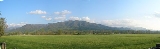
Cades Cove Panorama

Physical characteristics

Landforms are categorised by characteristic physical attributes such as elevation, slope, orientation, stratification
Stratification

Stratification is the building up of layers, and can have several meanings*Social stratification, is the dividing of a society into levels based on wealth or Power ....
, rock exposure, and soil type.

Gross physical features or landforms include intuitive elements such as berm
Berm

A berm is a level space, shelf, or raised barrier separating two areas. Berm is a loanword from Dutch language....
s, mound
Mound

A mound is a general term for an artificial wikt:heaped pile of earth, gravel, sand, rock s, or debris. The most common use is in reference to natural earthen formation such as hills and mountains, particularly if they appear artificial....
s, hill
Hill

A hill is a landform that extends above the surrounding terrain, in a limited area. Hills often have a distinct Summit , although in areas with Escarpment a hill may refer to a particular section of scarp slope without a well-defined summit ....
s, ridge
Ridge

A ridge is a geological feature that features a continuous elevational crest for some distance. Ridges are usually termed hills or mountains as well, depending on size....
s, cliff
Cliff

In geography and geology, a cliff is a significant vertical, or near vertical, rock exposure. Cliffs are formed as erosion landforms due to the processes of erosion and weathering that produce them....
s, valley
Valley

In geology, a valley is a Depression with predominant extent in one direction. A very deep river valley may be called a canyon or gorge....
s, river
River

A river is a natural stream of water, usually freshwater, flowing toward an ocean, a lake, or another stream. In some cases a river flows into the ground or dries up completely before reaching another body of water....
s, peninsula
Peninsula

A peninsula is a piece of Landform that is nearly surrounded by water but connected to mainland via an isthmus. Word origin: Latin paeninsula : paene, almost + insula, island....
s and numerous other structural and size-scaled (i.e. Pond
Pond

A pond is a body of water smaller than a lake, both being examples of terrain feature. Although the term pond is universally used to describe waterbodies that are smaller than lakes, an internationally recognised size cutoff has not yet been agreed, with values ranging from 2 hectares to 8 hectares used to distinguish the smaller from...
s vs. Lake
Lake

A lake is a terrain feature , a body of liquid on the surface of a world that is localized to the bottom of basin and moves slowly if it moves at all....
s, hill
Hill

A hill is a landform that extends above the surrounding terrain, in a limited area. Hills often have a distinct Summit , although in areas with Escarpment a hill may refer to a particular section of scarp slope without a well-defined summit ....
s vs. mountain
Mountain

A mountain is a landform that stretches above the surrounding land in a limited area usually in the form of a peak. A mountain is generally steeper than a hill....
s) elements including various kinds of inland and oceanic waterbodies
Waterbodies

Waterbodies is a Canadian band. Started in 2008 by Shane Turner & Mike McGean.Mike McGean - Vocals & GuitarJosh Korody - Bass & VocalsShane Turner - Percussion & Samples...
 and sub-surface features.

Hierarchy of classes

Ocean
Ocean

An ocean is a major body of Seawater, and a principal component of the hydrosphere. Approximately 71% of the Earth's surface is covered by ocean, a World Ocean that is customarily divided into several principal oceans and smaller seas....
s and continent
Continent

A continent is one of several large landmasses on Earth. They are generally identified by convention rather than any strict criteria, with seven regions commonly regarded as continents ? they are : Asia, Africa, North America, South America, Antarctica, Europe, and Australia ....
s exemplify the highest-order landforms. Landform elements are parts of a high-order landforms that can be further identified and systematically given a cohesive definition such as hill-tops, shoulders, saddles, foreslopes and backslopes.

Some generic landform elements including: pits, peaks, channels, ridges, passes, pools and plains, may be extracted from a digital elevation model
Digital elevation model

A digital elevation model is a digital representation of ground surface topography or terrain. It is also widely known as a digital terrain model ....
 using some automated techniques where the data has been gathered by modern satellites and stereoscopic aerial surveillance
Aerial photography

Aerial photography is the taking of photographs of the ground from an elevated position. The term usually refers to images in which the camera is not supported by a ground-based structure....
 cameras. Until recently, compiling the data found in such data sets required time consuming and expensive techniques of many man-hours.

Terrain
Terrain

Terrain, or relief, is the third or vertical dimension of land surface. When relief is described underwater, the term bathymetry is used....
 (or relief) is the third or vertical dimension of land surface. Topography
Topography

Topography is the study of Earth's surface shape and features or those ofplanets, Natural satellite, and asteroids. It is also the description of such surface shapes and features ....
 is the study of terrain, although the word is often used as a synonym for relief itself. When relief is described underwater
Underwater

Underwater is a term describing the realm below the surface of water where the water exists in a natural feature such as an ocean, sea, lake, pond, or river....
, the term bathymetry
Bathymetry

Bathymetry is the study of underwater depth, of the third dimension of lake or ocean floors. In other words, bathymetry is the underwater equivalent to hypsometry....
 is used. In cartography
Cartography

File:Mediterranean chart fourteenth century2.jpgCartography is the study and practice of making Geography Map. Combining science, aesthetics, and technique, cartography builds on the premise that we can model reality in ways that communicate spatial information effectively....
, many different techniques
Cartographic relief depiction

Terrain or relief is an essential aspect of physical geography, and as such its portrayal presents a central problem in cartography, and more recently geographic information system and 3D visualization ....
 are used to describe relief, including contour line
Contour line

A contour line of a Function of two variables is a curve along which the function has a constant value. In cartography, a contour line joins points of equal elevation above a given level, such as mean sea level....
s.

Elementary landforms (segments, facets, relief units) are the smallest homogeneous divisions of the land surface, at the given scale/resolution. These are areas with relatively homogenous morphometric properties, bounded by lines of discontinuity. A plateau or a hill can be observed at various scales ranging from few hundred meters to hundreds of kilometers. Hence, the spatial distribution of landforms is often scale-dependent as is the case for soils and geological strata.

A number of factors, ranging from plate tectonics
Plate tectonics

Plate tectonics describes the large scale motions of Earth's lithosphere. The theory encompasses the older concepts of continental drift, developed during the first decades of the 20th century by Alfred Wegener, and seafloor spreading, understood during the 1960s....
 to erosion
Erosion

For morphological image processing operations, see Erosion 'For use of in dermatopathology, see Erosion Erosion is the removal of solids in the natural environment....
 and deposition, can generate and affect landforms. Biological
Biology

Biology is a branch of the natural sciences concerned with the study of living organisms and their interaction with each other and their environment ....
 factors can also influence landforms— for example, note the role of vegetation
Vegetation

refers to the flora system of a specific region....
 in the development of dune
Dune

In physical geography, a dune is a hill of sand built by aeolian processes. Dunes are subject to different forms and sizes based on their interaction with the wind....
 systems and salt marshes, and the work of coral
Coral

Corals are marine organisms from the class Anthozoa and exist as small sea anemone?like polyps, typically in colonies of many identical individuals....
s and algae in the formation of coral reefs
Reef

In nautical terminology, a reef is a Rock , bar , or other feature lying beneath the surface of the water .Many reefs result from abiotic processes?deposition of sand, wave erosion planning down rock outcrops, and other natural processes?but the best-known reefs are the coral reefs of tropical waters developed through biotic processes do...
.

Landforms do not include man-made features, such as canal
Canal

Canals are artificial channels for water. There are two types of canals: Aqueduct canals, which are used for the conveyance and delivery of water, and waterways, which are navigable transportation canals used for passage of goods and people, often connected to existing lakes, rivers, or oceans....
s, port
Port

||-||-|-||-||-||-||-||-||-|}A port is a facility for receiving ships and transferring cargo. They are usually found at the edge of an ocean, sea, river, or lake....
s and many harbor
Harbor

A harbor or harbour , or haven, is a place where ships may shelter from the weather or are stored. Harbors can be man-made or natural....
s; and geographic features, such as desert
Désert

?D?sert? is ?milie Simon's debut single, released in October 2002. The song was a huge success both critically and commercially in her homeland....
s, forest
Forest

File:Stara planina suma.jpgA forest is an area with a high density of trees. There are many definitions of a forest, based on various criteria....
s, grassland
Grassland

Grasslands are areas where the vegetation is dominated by grasses and other herbaceous plants . However, sedge and rush families can also be found....
s, and impact craters
Impact crater

In the broadest sense, the term impact crater can be applied to any depression, natural or manmade, resulting from the high velocity impact of a projectile with larger body....
.

Many of the terms are not restricted to refer to features of the planet Earth
Earth

Earth is the third planet from the Sun. Earth is the largest of the terrestrial planets in the Solar System in diameter, mass and density. It is also referred to as the World and Wiktionary:Terra.Note that by International Astronomical Union convention, the term "Terra" is used for naming extensive land masses, rather...
, and can be used to describe surface features of other planets and similar objects in the Universe
Universe

The universe is defined as everything that physically exists: the entirety of space and time, all forms of matter, energy and momentum, and the physical laws and physical constants that govern them....
. Examples are mountains, polar caps, and valleys, which are found on all of the terrestrial planets.

See also

  • List of landforms
    List of landforms

    Landforms are categorised by characteristic physical attributes such as elevation, slope, orientation, stratification, rock exposure, and soil type....
  • Terrain
    Terrain

    Terrain, or relief, is the third or vertical dimension of land surface. When relief is described underwater, the term bathymetry is used....