
All Topics  
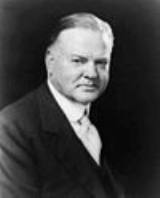
Herbert Hoover

 
Herbert Hoover

   Email Print
   Bookmark   Link


Herbert Hoover


Herbert Clark Hoover (August 10, 1874 – October 20, 1964) was the 31st
List of Presidents of the United States

File:WhiteHouseSouthFacade.JPGThe President of the United States is the head of state and the head of government of the United States. As chief of the executive branch and head of the Federal government of the United States as a whole, the presidency is the highest political office in the United States by influence and recognition....
 President of the United States
President of the United States

The President of the United States is the head of state and head of government of the United States and is the highest political official in the United States by influence and recognition....
 (1929–1933). Besides his political career, Hoover was a professional mining engineer and author
Author

An author is defined both as "the person who originates or gives existence to anything" and that authorship determines responsibility for what is created....
. As the United States Secretary of Commerce
United States Secretary of Commerce

The United States Secretary of Commerce is the head of the United States Department of Commerce concerned with business and industry; the Department states its mission to be "to foster, promote, and develop the foreign and domestic commerce." Until 1913 there was one United States Secretary of Commerce and Labor, uniting this department with...
 in the 1920s under Presidents Warren Harding and Calvin Coolidge
Calvin Coolidge

John Calvin Coolidge, Jr. was the List of Presidents of the United States President of the United States . A Republican Party lawyer from Vermont, Coolidge worked his way up the ladder of Massachusetts state politics, eventually becoming governor of that state....
, he promoted government intervention under the rubric "economic modernization". In the presidential election of 1928
United States presidential election, 1928

The United States presidential election of 1928 pitted History of the United States Republican Party Herbert Hoover against History of the United States Democratic Party Al Smith....
 Hoover easily won the Republican nomination
History of the United States Republican Party

The Republican Party is the second oldest currently existing political party in the United States....
 despite having no previous elected office experience.


Discussion
Ask a question about 'Herbert Hoover'
Start a new discussion about 'Herbert Hoover'
Answer questions from other users
Full Discussion Forum


Recent Posts


Quotations


A good many things go around in the dark besides Santa Claus.

Address to the John Marshall Republican Club, St. Louis, Missouri (December 16, 1935)

About the time we can make the ends meet, somebody moves the ends.

Quoted in obituaries (20 October 1964)

As a nation we must prevent hunger and cold to those of our people who are in honest difficulties.

Economic depression can not be cured by legislative action or executive pronouncement.

Honor is not the exclusive property of any political party.

Quoted in Christian Science Monitor (21 May 1964)

Im the only person of distinction whos ever had a depression named for him.

Quoted in An Uncommon Man (1984) by Richard Norton Smith


Encyclopedia


Herbert Clark Hoover (August 10, 1874 – October 20, 1964) was the 31st
List of Presidents of the United States

File:WhiteHouseSouthFacade.JPGThe President of the United States is the head of state and the head of government of the United States. As chief of the executive branch and head of the Federal government of the United States as a whole, the presidency is the highest political office in the United States by influence and recognition....
 President of the United States
President of the United States

The President of the United States is the head of state and head of government of the United States and is the highest political official in the United States by influence and recognition....
 (1929–1933). Besides his political career, Hoover was a professional mining engineer and author
Author

An author is defined both as "the person who originates or gives existence to anything" and that authorship determines responsibility for what is created....
. As the United States Secretary of Commerce
United States Secretary of Commerce

The United States Secretary of Commerce is the head of the United States Department of Commerce concerned with business and industry; the Department states its mission to be "to foster, promote, and develop the foreign and domestic commerce." Until 1913 there was one United States Secretary of Commerce and Labor, uniting this department with...
 in the 1920s under Presidents Warren Harding and Calvin Coolidge
Calvin Coolidge

John Calvin Coolidge, Jr. was the List of Presidents of the United States President of the United States . A Republican Party lawyer from Vermont, Coolidge worked his way up the ladder of Massachusetts state politics, eventually becoming governor of that state....
, he promoted government intervention under the rubric "economic modernization". In the presidential election of 1928
United States presidential election, 1928

The United States presidential election of 1928 pitted History of the United States Republican Party Herbert Hoover against History of the United States Democratic Party Al Smith....
 Hoover easily won the Republican nomination
History of the United States Republican Party

The Republican Party is the second oldest currently existing political party in the United States....
 despite having no previous elected office experience. To date, Hoover was the last cabinet secretary to be directly elected President of the United States. The nation was prosperous and optimistic at the time, leading to a landslide for Hoover over Democrat Al Smith
Al Smith

Alfred Emanuel Smith, Jr. , known in private and public life as Al Smith, was an American politician who was elected List of Governors of New York four times, and was the History of the United States Democratic Party United States presidential election, 1928....
, whom many voters distrusted because of his Roman Catholicism
Roman Catholic Church

The Roman Catholic Church, officially known as the Catholic Church is the world's largest Christianity Ecclesia , representing over half of all Christians and one-sixth of the world population....
.

Hoover deeply believed in the Efficiency Movement
Efficiency Movement

The Efficiency Movement was a major dimension of the Progressive Era in the United States. It flourished 1890-1932. Adherents argued that all aspects of the economy, society and government were riddled with waste and inefficiency....
 (a major component of the Progressive Era
Progressive Era

The Progressive Era in the United States was a period of reform which lasted from the 1890s to the 1920's.Responding to the changes brought about by industrialization,...
), arguing that a technical solution existed for every social and economic problem. That position was challenged by the stock market crash of 1929 that took place less than 8 months after Hoover's taking office, and the Great Depression
Great Depression

File:International depression.pngThe Great Depression was a worldwide economic Recession starting in most places in 1929 and ending at different times in the 1930s or early 1940s for different countries....
 that followed it which gained momentum in 1930. Hoover tried to combat the Depression with volunteer efforts and government action, none of which produced economic recovery during his term. The consensus among historians is that Hoover's defeat in the 1932 election
United States presidential election, 1932

The United States presidential election of 1932 took place as the effects of the 1929 Stock Market Crash and the Great Depression were being felt intensely across the country....
 was caused primarily by failure to end the downward spiral into deep Depression, compounded by popular opposition to prohibition
Prohibition in the United States

In the history of the United States, Prohibition is the period from 1920 to 1933, during which the sale, manufacture, and transportation of Alcoholic beverage for consumption were banned nationally as mandated in the Eighteenth Amendment to the United States Constitution....
. Other electoral liabilities were Hoover's lack of charisma in relating to voters, and his poor skills in working with politicians.

Family background and early life

Hoover was born on August 10, 1874 in West Branch
West Branch, Iowa

West Branch is a city in Cedar County, Iowa and Johnson County, Iowa counties in the U.S. state of Iowa. The population was 2,188 at the 2000 census....
, Iowa
Iowa

The State of Iowa is a U.S. state in the Midwestern region of the United States of America, an area often referred to as the "American Heartland." It is bordered by Minnesota to the north, Wisconsin and Illinois to the east, Nebraska and South Dakota to the west, and Missouri to the south....
. He was the first president to be born west of the Mississippi River
Mississippi River

The Mississippi River is the longest river in the United States, with a length of from its source in Lake Itasca in Minnesota to its mouth in the Gulf of Mexico....
. His father, Jesse Hoover, was a blacksmith
Blacksmith

A blacksmith is a person who processess iron or steel by forging the metal; i.e., by using tools to hammer, bend, cut, and otherwise shape it in its non-liquid form....
 and farm implement store owner, of German (Pfautz, Wehmeyer) and German-Swiss (Huber, Burkhart) descent. His mother, Hulda (Minthorn) Hoover, was of English and Irish (probably Scots-Irish) descent. Both were Quaker
Religious Society of Friends

The Religious Society of Friends, commonly known as the Quakers, was founded in England in the 17th century as a Christian denomination by people who were dissatisfied with the existing denominations and sects of Christianity....
s. His father died in 1880, and his mother in 1884, leaving Hoover an orphan at the age of 9. After a brief stay with one of his grandmothers in Kingsley, Iowa
Kingsley, Iowa

Kingsley is a city in Plymouth County, Iowa, Iowa, United States. The population was 1,245 at the 2000 census. In the 1880s Herbert Hoover lived in the Kingsley community for a short time, following the deaths of his parents....
, Herbert lived for the next 18 months with his uncle Allen Hoover in West Branch. In November 1885, he went to live in Newberg, Oregon
Newberg, Oregon

Newberg is a city in Yamhill County, Oregon, Oregon, United States. Located in the Portland metropolitan area, the city is home to George Fox University....
 with his uncle John Minthorn, whose own son had died the year before. For two and a half years, Herbert attended Friends Pacific Academy (now George Fox University
George Fox University

George Fox University is a Christian university of the liberal arts and sciences, and professional studies located in Newberg, Oregon, Oregon, United States....
), then subsequently worked as office boy in his uncle's real estate office in Salem
Salem, Oregon

Salem is the Capital of the U.S. state of Oregon, and the county seat of Marion County, Oregon. It is located in the center of the Willamette Valley alongside the Willamette River, which runs north through the city....
. Though he did not attend high school, the young Hoover attended night school and learned bookkeeping
Bookkeeping

Bookkeeping is the recording of the value of assets, liabilities, income, and expenses in the daybooks, journals, and ledgers, in which debit and credit entries are chronologically posted to record changes in value....
, typing, and math.

Hoover entered Stanford University
Stanford University

Leland Stanford Junior University, commonly referred to as Stanford University or Stanford, is a private university research university located in Stanford, California, California, United States....
 in 1891, the first year of the new California college. None of the first students were required to pay tuition. Hoover claimed to be the first student ever at Stanford, by virtue of having been the first person in the first class to sleep in the dormitory. While at the university, he was the student manager of both the baseball and football teams, and was a part of the inaugural Big Game
Big Game (football)

The Big Game is the annual American football game between University of California, Berkeley and Stanford University, which held in late November or early December....
 versus rival California
University of California, Berkeley

The University of California, Berkeley is a public university research university located in Berkeley, California, California, United States. The oldest of the ten major campuses affiliated with the University of California, Berkeley offers some 300 undergraduate and graduate degree programs in a wide range of disciplines....
 (Stanford won). Hoover graduated in 1895 with a degree in geology
Geology

Geology is the science and study of the solid and liquid matter that constitute the Earth. The field of geology encompasses the study of the composition, structural geology, physical properties, dynamics, and History of the Earth of Earth materials, and the processes by which they are formed, moved, and changed....
.

Mining engineer

Hoover went to Australia
Australia

Australia, officially the Commonwealth of Australia, is a country in the southern hemisphere comprising the Australia of the world's smallest continent, the major island of Tasmania, and numerous list of islands of Australia in the Indian Ocean and Pacific Oceans....
 in 1897 as an employee of Bewick, Moreing & Co., a London
London

London is the capital of both England and the United Kingdom, and the most populous municipality in the European Union. An important settlement for two millennia, History of London goes back to its founding by the Roman Empire....
-based mining company. He served as a geologist/mining engineer, leading a major program of expansion for the Sons of Gwalia
Sons of Gwalia

Sons of Gwalia is a Western Australian mining company which mines tantalum, spodumene, lithium and tin. The original "Sons of Gwalia" was a gold mine established in the late 19th century, and which gave its name to the nearby town of Gwalia....
 gold mine at Gwalia, Western Australia
Gwalia, Western Australia

Gwalia is a former gold-mining town located 233 kilometres north of Kalgoorlie, Western Australia and 828 kilometres east of Perth, Western Australia in Western Australia's Great Victoria Desert....
. Hoover worked at gold mines in Big Bell
Big Bell, Western Australia

Big Bell is a ghost town in Western Australia near the town of Cue, Western Australia.Mining ceased in 2003 and the plant was deconstructed and transported to the Westonia, Western Australia in 2007....
, Cue
Cue, Western Australia

Cue is a small town in the Mid West region of Western Australia, located 650 km north-east of Perth, Western Australia. At the 2006 Census in Australia, Cue had a population of 273....
, Leonora
Leonora, Western Australia

Leonora is a town in the Goldfields-Esperance region of Western Australia, located northeast of the state capital, Perth, Western Australia, and north of the city of Kalgoorlie, Western Australia....
, Menzies
Menzies, Western Australia

Menzies is a town located in the Goldfields-Esperance region of Western Australia, east-northeast of the state capital, Perth, Western Australia, and north-northwest of the city of Kalgoorlie, Western Australia....
 and Coolgardie
Coolgardie, Western Australia

Coolgardie is a small town in the Australian state of Western Australia, east of the state capital, Perth, Western Australia. It has a population of approximately 800 people....
.

Hoover married his Stanford sweetheart, Lou Henry
Lou Henry Hoover

Louise Henry Hoover was the wife of Herbert Hoover and First Lady of the United States.Born in Waterloo, Iowa, the daughter of Charles Delano Henry, a banker, and Florence Ida Weed, "Lou" grew up something of a tomboy in Waterloo, and in Whittier, California and Monterey, California....
, in 1899. They went to China, where Hoover worked for a private corporation as China's leading engineer. Hoover and his wife picked up Mandarin Chinese while he worked in China and used it during his tenure at the White House
White House

The White House is the official residence and principal workplace of the President of the United States. Located at 1600 Pennsylvania Avenue in Washington, D.C., it was built between 1792 and 1800 of white-painted Aquia sandstone in the late Georgian architecture and has been the executive residence of every U.S....
 when they didn't want to be overheard. The Boxer Rebellion
Boxer Rebellion

The Boxer Rebellion, or more properly Boxer Uprising, was a violent anti-foreign, anti-Christian movement by the "Righteous Fists of Harmony,? Yihe tuan or Society of Righteous and Harmonious Fists in China....
 trapped the Hoovers in Tianjin
Tianjin

is the third largest city of the People's Republic of China in terms of urban population. Administratively it is one of the four municipality that have Political divisions of China status, reporting directly to the central government....
 in June 1900. For almost a month the settlement was under heavy fire. The Hoovers had two sons, Herbert Clark (1903–1969) and Allan Henry (1907–1993).

Hoover was made a partner in Bewick, Moreing & Co. in 1901, and assumed responsibility for various Australian operations. In August–September 1905, Hoover achieved a technological innovation. When visiting the mines at Broken Hill, New South Wales
Broken Hill, New South Wales

Broken Hill is an isolated mining city and Local Government Areas of Australia in the far west of outback New South Wales, Australia. The world's largest mining company, BHP Billiton, has roots in the town....
, he noticed considerable zinc
Zinc

Zinc is a metallic chemical element with the symbol Zn and atomic number 30. It is a first-row transition metal of the group 12 element of the periodic table....
 in the Broken Hill lead-silver ore, which could not be recovered and was lost as tailings. Hoover devised a practical and profitable method to use the then-new froth flotation
Froth flotation

Froth flotation is a process for selectively separating hydrophobic materials from hydrophilic. This is used in several processing industries. Historically this was first used in the mining industry....
 process to treat these tailings and recover the zinc.

With William Baillieu
William Baillieu

William Lawrence Baillieu was an Australian financier and politician. He was a successful businessman, having developed significant business interests from his relatively humble beginnings....
 and others, he founded the Zinc Corporation
Rio Tinto Group

Rio Tinto is a multinational mining and resources group founded originally in 1873. It is the third-largest coal mining company in the world as of late 2008....
 (later, following various mergers, a part of Rio Tinto). Hoover also became notable as a mine manager when, in Western Australia, he recruited Italian immigrants as underground mine workers. He described Italians as "fully 20 per cent superior" to other miners. Hoover was determined to cut costs and undermine the growing strength of the Australian labor movement
Australian labour movement

The Australian labour movement has its origins in the early 19th century and includes both trade unions and politics. At its broadest, the movement can be defined as encompassing the industrial wing, the unions in Australia, and the political wing, the Australian Labor Party and minor parties....
. To this end, he said, "the rivalry between [the Italians] and the other men [was] of no small benefit."

In 1908, he became an independent mining consultant, traveling worldwide until the outbreak of World War I
World War I

World War I, or the First World War , was a global military conflict which involved the Great powers, organized into two opposing military alliances: the Allies of World War I and the Central Powers....
 in 1914. His lectures at Columbia
Columbia University

Columbia University in the City of New York , is a private university in the United States and a member of the Ivy League. Columbia's main campus lies in the Morningside Heights, Manhattan neighborhood in the borough of Manhattan, in New York City....
 and Stanford universities were published as Principles of Mining in 1909, which became a standard textbook. Hoover and his wife also published their English translation of the 1556 mining classic De re metallica
De re metallica

De re metallica is a book cataloging the state of the art of mining, refining, and smelting metals, published in 1556. The author was Georg Bauer, whose pen name was the Latinized Georgius Agricola....
 in 1912. This translation from the Latin of Renaissance
Renaissance

The Renaissance was a cultural movement that spanned roughly the 14th to the 17th century, beginning in Italy in the late Middle Ages and later spreading to the rest of Europe....
 author Georgius Agricola is still the most important scholarly version and provides its historical context. It is still in print and published by Dover Publications
Dover Publications

Dover Publications is an American book publisher founded in 1941 by Hayward Cirker and his wife, Blanche. It publishes primarily reissues, books no longer published by their original publishers ? often, but not always, books in the public domain....
.

Humanitarian

When World War I
World War I

World War I, or the First World War , was a global military conflict which involved the Great powers, organized into two opposing military alliances: the Allies of World War I and the Central Powers....
 started in August 1914, he helped organize the return of 120,000 Americans from Europe: tourists, students, businessmen, and others. Hoover led five hundred volunteers to distribute food, clothing, steamship tickets, and cash. "I did not realize it at the moment, but on August 3, 1914, my career was over forever. I was on the slippery road of public life." Hoover liked to say that the difference between dictatorship and democracy was simple: dictators organize from the top down, democracies from the bottom up.

Herberthooveratowu
Belgium
Belgium

* A small German-speaking Community of Belgium exists in eastern Wallonia. Belgium's linguistic diversity and related political and cultural conflicts are reflected in the history of Belgium and a complex Communities and regions of Belgium....
 faced a food crisis in fall 1914 after being invaded by Germany
Germany

Germany , officially the Federal Republic of Germany , is a country in Central Europe. It is bordered to the north by the North Sea, Denmark, and the Baltic Sea; to the east by Poland and the Czech Republic; to the south by Austria and Switzerland; and to the west by France, Luxembourg, Belgium, and the Netherlands....
. Hoover undertook an unprecedented relief effort with the Committee for Relief in Belgium (CRB). The official chairman was Emile Francqui
Emile Francqui

Emile Francqui was a Belgian soldier, diplomat and business man. Being an orphan, he was sent to the military school when he was 15 years old....
, but Hoover was the real head of operations. The CRB became, in effect, an independent republic of relief, with its own flag, navy, factories, mills, and railroads. Private donations and government grants supplied an $11-million-a-month budget.

For the next two years, Hoover worked 14-hour days from London, administering the distribution of over two and half million tons of food to nine million war victims. In an early form of shuttle diplomacy
Shuttle diplomacy

In diplomacy and international relations, shuttle diplomacy is the use of a third party to serve as an intermediary or mediator between two parties who do not talk directly....
, he crossed the North Sea
North Sea

The North Sea is a marginal sea, epeiric sea on the European continental shelf. The Dover Strait and the English Channel in the south and the Norwegian Sea in the north connect it to the Atlantic Ocean....
 forty times to meet with German authorities and persuade them to allow food shipments. He was an international hero. The Belgian city of Leuven
Leuven

Leuven is the capital of the province of Flemish Brabant in the Flanders, Belgium. It is located about 30 kilometers east of Brussels, with as other neighbouring cities Mechelen, Aarschot, Tienen, and Wavre....
 named a prominent square Hooverplein after him.

After the United States entered the war in April 1917, President Woodrow Wilson
Woodrow Wilson

Thomas Woodrow Wilson was the List of Presidents of the United States President of the United States. A devout Presbyterianism and leading intellectual of the Progressive Era, he served as President of Princeton University of Princeton University from 1902 to 1910, and then as the Governor of New Jersey from 1911 to 1913....
 appointed Hoover head of the U.S. Food Administration. Hoover believed "food will win the war." He established set days to encourage people to avoid eating particular foods in order to save them for soldiers' rations: meatless Mondays, wheatless Wednesdays, and "when in doubt, eat potatoes." This program helped reduce consumption of foodstuffs needed overseas and avoided rationing at home. It was dubbed "Hooverizing" by government publicists, in spite of Hoover's continual orders that publicity should not mention him by name.

After the war, as a member of the Supreme Economic Council
Supreme Economic Council

The Supreme Economic Council was established at the Paris Peace Conference, 1919 in February 1919 to advise the conference on economic measures to be taken pending the negotiation of peace....
 and head of the American Relief Administration
American Relief Administration

American Relief Administration was an United States Humanitarian aid mission to Europe and later Russian SFSR after World War I. Herbert Hoover, future president of the United States, was the program director....
, Hoover organized shipments of food for millions of starving people in Central Europe
Central Europe

Central Europe is the region lying between the variously and vaguely defined areas of Eastern Europe and Western Europe Europe. In addition, Northern Europe, Southern Europe and Southeastern Europe may variously delimit or overlap into Central Europe....
. He used a newly formed Quaker organization, the American Friends Service Committee
American Friends Service Committee

The American Friends Service Committee is a Religious Society of Friends affiliated organization which provides humanitarian relief and works for social justice, peace and reconciliation, human rights, and abolition of the death penalty....
, to carry out much of the logistical work in Europe.

Hoover provided food aid to the post-war German people. He also got relief to famine-stricken Bolshevik
Bolshevik

Bolsheviks, originally also Bolshevists were a faction of the Marxism Russian Social Democratic Labour Party which split apart from the Menshevik faction at the 2nd Congress of the RSDLP in 1903 and ultimately became the Communist Party of the Soviet Union....
-controlled areas in Russia
Russia

Russia , or the Russian Federation , is a list of countries spanning more than one continent country extending over much of northern Eurasia....
 in 1921, despite the opposition of Senator
United States Senate

The United States Senate is the upper house of the Bicameralism United States Congress, the lower house being the United States House of Representatives....
 Henry Cabot Lodge
Henry Cabot Lodge

This article is about Henry Cabot Lodge , a U.S. politician in the early twentieth century.Henry Cabot Lodge was an United States statesman, a United States Republican Party politician, and a noted historian....
 and other Republicans. When asked if he was not thus helping Bolshevism, Hoover retorted, "Twenty million people are starving. Whatever their politics, they shall be fed!" At war's end, the New York Times named Hoover one of the "Ten Most Important Living Americans".

Hoover confronted a world of political possibilities when he returned home in 1919. Democratic Party
Democratic Party (United States)

The Democratic Party is one of two major party contemporary political parties in the United States, along with the Republican Party . It is the oldest political party in continuous operation in the United States and it is one of the oldest parties in the world....
 leaders looked on him as a potential candidate for President. (President Wilson privately preferred Hoover as his successor.) "There could not be a finer one," asserted Franklin D. Roosevelt
Franklin D. Roosevelt

Franklin Delano Roosevelt , often referred to by his initials FDR, was the List of Presidents of the United States President of the United States....
, then a rising star from New York. Hoover briefly considered becoming a Democrat. But he believed that 1920 would be a Republican year, and didn't want to join a losing team. Also, Hoover confessed that he could not run for a party whose only member in his boyhood home had been the town drunk.

Hoover realized that he was in a unique position to collect information about the Great War and its aftermath. In 1919, he established the Hoover War Collection at Stanford University. He donated all the files of the Commission for Relief in Belgium, the U.S. Food Administration, and the American Relief Administration, and pledged $50,000 as an endowment. Scholars were sent to Europe to collect pamphlets, society publications, government documents, newspapers, posters, proclamations, and other ephemeral materials related to the war and the revolutions that followed it. The collection was later renamed the Hoover War Library and is now known as the Hoover Institution.

Secretary of Commerce

Hoovercommerce1926
Hoover rejected Democrat overtures in 1920. He had been a registered Republican before the war, though in 1912 he had supported Theodore Roosevelt
Theodore Roosevelt

Theodore Roosevelt , also known as T.R., and to the public as Teddy, was the List of Presidents of the United States President of the United States....
's "Bull Moose" Progressive Party
Progressive Party (United States, 1912)

In the United States, the Progressive Party of 1918 was a political party created by a split in the Republican Party in U.S. presidential election, 1912....
. Now he declared himself a Republican, and a candidate for the Presidency.

He placed his name on the ballot in the California
California

California is a U.S. state on the West Coast of the United States of the United States, along the Pacific Ocean. It is bordered by Oregon to the north, Nevada to the east, Arizona to the southeast, and to the south the Mexico state of Baja California....
 state primary
Primary election

A primary election , also referred to simply as a primary, is an election in which voters in a jurisdiction select candidates for a subsequent election....
, where he came close to beating popular Senator Hiram Johnson
Hiram Johnson

Hiram Warren Johnson was a leading United States progressivism and later isolationist politician from California; he served as Governor of California from 1911 to 1917, and as a United States Senate from 1917 to 1945....
. But having lost in his home state, Hoover was only a dark horse contender at the convention. Even when it deadlocked for several ballots between Illinois
Illinois

The State of Illinois is a U.S. state of the United States, the 21st to be admitted to the United States. Illinois is the most populous and demographically diverse Midwestern United States state and the fifth most populous state in the nation....
 Governor Frank Lowden and General Leonard Wood
Leonard Wood

Leonard Wood was a physician who served as the Chief of Staff of the United States Army, Military Governor of Cuba and Governor General of the Philippines....
, few delegates seriously considered Hoover as a compromise choice. Although he had personal misgivings about the capability of the nominee, Warren G. Harding
Warren G. Harding

Warren Gamaliel Harding was the List of Presidents of the United States President of the United States, serving from 1921 until his death from a heart attack or stroke, in 1923....
, Hoover publicly endorsed him, and made two speeches on Harding's behalf.

After being elected, Harding rewarded Hoover for his support, offering to appoint him either Secretary of the Interior
United States Secretary of the Interior

The United States Secretary of the Interior is the head of the United States Department of the Interior.The US Department of the Interior should not be confused with the concept of Interior Ministry as used in other countries....
 or Secretary of Commerce
United States Secretary of Commerce

The United States Secretary of Commerce is the head of the United States Department of Commerce concerned with business and industry; the Department states its mission to be "to foster, promote, and develop the foreign and domestic commerce." Until 1913 there was one United States Secretary of Commerce and Labor, uniting this department with...
. Hoover ultimately chose Commerce. Commerce had existed for just eight years, since the division of the earlier Department of Commerce and Labor
United States Department of Commerce and Labor

The United States Department of Commerce and Labor was a short-lived United States Cabinet department of the United States government of the United States, which was concerned with business, industry, and labour ....
. Commerce was considered a minor Cabinet post, with limited and somewhat vaguely defined responsibilities.

But Hoover aimed to change that, envisioning the Commerce Department as the hub of the nation's growth and stability. He demanded from Harding, and received, authority to help coordinate economic affairs throughout the government. He created a great many sub-departments and committees, overseeing and regulating everything from manufacturing statistics, the census, and radio to air travel. In some instances, he "seized" control of responsibilities from other Cabinet departments when he deemed that they were not carrying out their responsibilities well enough. Hoover became one of the most visible men in the country, often overshadowing Presidents Harding and Calvin Coolidge
Calvin Coolidge

John Calvin Coolidge, Jr. was the List of Presidents of the United States President of the United States . A Republican Party lawyer from Vermont, Coolidge worked his way up the ladder of Massachusetts state politics, eventually becoming governor of that state....
. Washington wags were soon referring to Hoover as "the Secretary of Commerce... and Under-Secretary of Everything Else!"

As secretary and later as President, Hoover revolutionized the relations between business and government. Rejecting the adversarial stance of Roosevelt
Theodore Roosevelt

Theodore Roosevelt , also known as T.R., and to the public as Teddy, was the List of Presidents of the United States President of the United States....
, Taft
William Howard Taft

William Howard Taft was the List of Presidents of the United States President of the United States, the tenth Chief Justice of the United States, a leader of the progressive conservative wing of the History of the United States Republican Party in the early 20th century, a pioneer in international arbitration and staunch advocate of world pe...
, and Wilson
Woodrow Wilson

Thomas Woodrow Wilson was the List of Presidents of the United States President of the United States. A devout Presbyterianism and leading intellectual of the Progressive Era, he served as President of Princeton University of Princeton University from 1902 to 1910, and then as the Governor of New Jersey from 1911 to 1913....
, he sought to make the Commerce Department a powerful service organization, empowered to forge cooperative voluntary partnerships between government and business. This philosophy is often called "associationalism
Associationalism

Associationalism is a political project where "human welfare and liberty are both best served when as many of the affairs of a society as possible are managed by voluntary and democratically self-governing associations"....
."

Many of Hoover's efforts as Commerce Secretary centered on the elimination of waste and the increase of efficiency in business and industry. This included reducing labor losses from trade disputes and seasonal fluctuations, reducing industrial losses from accident and injury, and reducing the amount of crude oil spilled during extraction and shipping. One major achievement was to promote progressive ideals in the areas of the standardization of products and designs. He energetically promoted international trade by opening offices overseas that gave advice and practical help to businessmen. Hoover was especially eager to promote Hollywood
Cinema of the United States

United States cinema has had a profound effect on cinema across the world since the early 20th century. Its history is sometimes separated into four main periods: the silent film era, Classical Hollywood cinema, New Hollywood, and the contemporary period ....
 films overseas.

His "Own Your Own Home" campaign was a collaboration to promote ownership of single-family dwellings, with groups such as the Better Houses in America movement, the Architects' Small House Service Bureau, and the Home Modernizing Bureau. He worked with bankers and the savings and loan industry to promote the new long-term home mortgage, which dramatically stimulated home construction.
Herbertclarkhoover
To date, Hoover was the last President to have held a full cabinet position.

Radio conferences

Hoover's radio conferences played a key role in the early organization, development and regulation of radio broadcasting. Hoover played a key role in major projects for navigation, irrigation of dry lands, electrical power, and flood control. As the new air transport industry developed, Hoover held a conference on aviation to promote codes and regulations. He became president of the American Child Health Organization, and he raised private funds to promote health education in schools and communities.

Although he continued to consider Harding ill-suited to be President, the two men nevertheless became friends. Hoover accompanied Harding on his final trip out West in 1923. It was Hoover who called for a specialist to tend to the ailing Chief Executive, and it was also Hoover who contacted the White House to inform them of the President's death. The Commerce Secretary headed the group of dignitaries accompanying Harding's body back to the capital.

By the end of Hoover's service as Secretary, he had raised the status of the Department of Commerce. This was reflected in its modern headquarters built during the Roosevelt Administration in the 1930s in the Federal Triangle in Washington D.C.

Traffic conferences

As Commerce secretary, Hoover also hosted two national conferences on street traffic, in 1924 and 1926 (a third convened in 1930, during Hoover's presidency). Collectively the meetings were called the National Conference on Street and Highway Safety. Hoover's chief objective was to address the growing casualty toll of traffic accidents, but the scope grew and soon embraced motor vehicle standards, rules of the road, and urban traffic control. He left the invited interest groups to negotiate agreements among themselves, which were then presented for adoption by states and localities. Because automotive trade associations were the best organized, many of the positions taken by the conferences reflected their interests. The conferences issued a model Uniform Vehicle Code for adoption by the states, and a Model Municipal Traffic Ordinance for adoption by cities. Both were widely influential, promoting greater uniformity between jurisdictions and tending to promote the automobile's priority in city streets.

Mississippi flood

The Great Mississippi River flood
Great Mississippi Flood of 1927

The Great Mississippi Flood of 1927 was the most destructive river flood in United States history....
 broke the banks and levee
Levee

A levee, lev?e, dike , embankment, floodbank or stopbank is a natural or artificial slope or wall to regulate water levels....
s of the lower Mississippi River in early 1927, resulting in flooding of millions of acres and leaving thousands of people homeless. Although such a disaster did not fall under the duties of the Commerce Department, the governors of six states along the Mississippi specifically asked for Herbert Hoover in the emergency. President Calvin Coolidge sent Hoover to mobilize state and local authorities, militia, army engineers, Coast Guard, and the American Red Cross
American Red Cross

The American Red Cross is a humanitarian organization that provides emergency assistance, disaster relief and education inside the United States, and is the designated U.S....
.

With a grant from the Rockefeller Foundation
Rockefeller Foundation

The Rockefeller Foundation is a prominent philanthropic organization and private foundation based at 420 Fifth Avenue, New York City. The preeminent institution established by the six-generation Rockefeller family, it was founded by John D....
, Hoover set up health units to work in the flooded regions for a year. These workers stamped out malaria
Malaria

Malaria is a Vector -borne infectious disease caused by protozoan parasites. It is widespread in Tropics and subtropical regions, including parts of the Americas, Asia, and Africa....
, pellagra
Pellagra

Pellagra is a vitamin deficiency disease caused by dietary lack of niacin and protein, especially proteins containing the essential amino acid tryptophan....
, and typhoid fever
Typhoid fever

Typhoid fever, also known as enteric fever, or commonly just typhoid, is an illness caused by the bacterium Salmonella typhi. Common worldwide, it is transmitted by the ingestion of food or water contaminated with feces from an infected person....
 from many areas. His work during the flood brought Herbert Hoover to the front page of newspapers almost everywhere, and he gained new accolades as a humanitarian. The great victory of his relief work, he stressed, was not that the government rushed in and provided all assistance. Rather, it was that much of the assistance available was provided instead by private citizens and organizations in response to Hoover's appeals. "I suppose I could have called in the Army
Army

An army , in the broadest sense, is the land-based armed forces of a nation. It may also include other branches of the military such as an air force....
 to help," he said, "but why should I, when I only had to call upon Main Street."

His reputation as a humanitarian from this endeavor was endangered by the inhumane treatment of African-Americans during the disaster. Knowing the potential ramifications on his presidential aspirations if such knowledge became public (and having no desire to help the afflicted African-Americans), Hoover struck a deal with Robert Moton
Robert Russa Moton

Robert Russa Moton was an African American educator and author. He served as an administrator at Hampton Institute and was named principal of Tuskegee Institute in 1915 after the death of Dr....
, the prominent African-American successor to Booker T. Washington
Booker T. Washington

Booker Taliaferro Washington was an American educator, orator, author and the dominant leader of the African-American community nationwide from the 1890s to his death....
 as president of the Tuskegee Institute. In exchange for keeping the suffering of African-Americans out of the public eye, Hoover promised unprecedented influence for African-Americans after he would be elected president. Moton agreed, and consistent with the accommodationist philosophy of Washington, worked actively to suppress information about mistreatment of blacks from being revealed to the media. Following election, Hoover broke his promises. This led to an African-American backlash in the 1932 election that shifted allegiance from the Republican party (the party of Lincoln and the Emancipation Proclamation
Emancipation Proclamation

The Emancipation Proclamation consists of two Executive order s issued by United States President Abraham Lincoln during the American Civil War....
) to the Democrats.

Presidential election of 1928


Republican primaries

When Coolidge declined to run for a second full term of office in 1927, Herbert Hoover became the leading Republican
History of the United States Republican Party

The Republican Party is the second oldest currently existing political party in the United States....
 candidate for the 1928 election, despite the fact Coolidge was lukewarm on Hoover (Coolidge often derided his ambitious and popular Commerce Secretary as "Wonder Boy"). His only real challenger was Frank Lowden. Hoover received much favorable press coverage in the months leading up to the convention. Lowden's campaign manager complained the newspapers were full of "nothing but advertisements for Herbert Hoover and Fletcher's Castoria
Castoria

Fletcher's Castoria, now known as Fletcher's Laxative, is an oral syrup containing a stimulant laxative and ingredients to soothe the stomach....
." Hoover’s reputation, experience, and public popularity coalesced to give him the nomination on the first ballot, with Senator
United States Senate

The United States Senate is the upper house of the Bicameralism United States Congress, the lower house being the United States House of Representatives....
 Charles Curtis
Charles Curtis

  Charles Curtis was a United States United States House of Representatives, a longtime United States Senate from Kansas elected to Senate Majority Leader, as well as the List of Vice Presidents of the United States Vice President of the United States....
 named as his running mate.

General election

He campaigned on the basis of efficiency and prosperity against Democratic candidate Alfred E. Smith. Smith was the target of anti-Catholicism
Anti-Catholicism

Anti-Catholicism is a generic term for discrimination, hostility or prejudice directed at the Catholic Church, its clergy or its members. The term also applies to the religious persecution of Catholics or to a "religious orientation opposed to Catholicism."...
 from some Protestant communities, much to Hoover's advantage. Both Hoover and Smith positioned themselves as pro-business, and each promised to improve conditions for farmers, reform immigration laws, and maintain America's isolationist foreign policy. Where they differed was on the Volstead Act
Volstead Act

The Volstead Act, which reinforced the prohibition of alcohol in the United States of America, was popularly named after Andrew Volstead, Chairman of the House Judiciary Committee, which oversaw its passage....
. Smith was a "wet" who called for its repeal, whereas Hoover gave public support for Prohibition
Prohibition

Prohibition of alcohol, often referred to simply as prohibition, also known as The Noble Experiment, refers to a sumptuary law which prohibits alcohol....
, calling it an experiment "noble in purpose." What few voters knew, however, was Hoover was lukewarm in his support for Volstead in private, and for years after work at the Commerce Department would stop by the Belgian Embassy for a visit with friends. While there, as it was technically foreign soil, he was able to enjoy an alcoholic drink before heading for home. Hoover used to grumble that all Prohibition successfully did was to force him to dispose of his celebrated wine cellar.

Prohibition provided a means for Hoover's supporters to attack the democratic candidate Al Smith. This was because the major attacks on Smith relied upon his being a Catholic. Because the First Amendment guarantees freedom of religion these attacks were frowned upon politically. Being labeled as an "anti-prohibitionist drunkard" was allowed politically. Hoover also relied on the support of the Women's Christian Temperance Union (WCTU) and the Anti-Saloon League to bolster prohibition.

Historians agree Hoover's national reputation and the booming economy, combined with the deep splits in the Democratic party over religion and prohibition, guaranteed his landslide victory of 58% of the vote. Hoover managed to crack the so-called "Solid South," winning such traditionally Democratic states as Florida
Florida

Florida is a U.S. state located in the Southeastern United States of the United States, bordering Alabama to the northwest and Georgia to the northeast....
, North Carolina
North Carolina

North Carolina is a U.S. state located on the Atlantic Seaboard in the southeastern United States. The state borders South Carolina and Georgia to the south, Tennessee to the west and Virginia to the north....
, Virginia
Virginia

The Commonwealth of Virginia is an United States U.S. state on the East Coast of the United States of the Southern United States. The state is known as the "Old Dominion" and sometimes as "Mother of Presidents", because it is the birthplace of Lists of United States Presidents by place of birth#By state....
, Texas
Texas

Texas is a U.S. state located in the South Central United States, nicknamed the Lone Star State. Texas is the second largest U.S. state in both area and population, spanning , and with a growing population of 24.3 million residents....
 and Tennessee
Tennessee

Tennessee is a U.S. state located in the Southern United States United States. In 1796, it became the sixteenth state to join the United States....
 from Smith. As advertising executive Bruce Barton put it, "Americans knew they may have more fun with Smith, but that they would make more money with Hoover."

Herbert Hoover's wife, Lou Henry Hoover
Lou Henry Hoover

Louise Henry Hoover was the wife of Herbert Hoover and First Lady of the United States.Born in Waterloo, Iowa, the daughter of Charles Delano Henry, a banker, and Florence Ida Weed, "Lou" grew up something of a tomboy in Waterloo, and in Whittier, California and Monterey, California....
, came to the White House, unlike her predecessors as First Ladies. She had already carved out a reputation of her own, having graduated from Stanford as the only woman in her class with a degree in geology. Although she had never practiced her profession formally, she remained very much a new woman of the post-World War I era: intelligent, robust, and possessed of a sense of female possibilities.

On poverty, Hoover promised: "We in America today are nearer to the final triumph over poverty than ever before in the history of any land." Within months, the Stock Market Crash of 1929 occurred, and the nation's economy spiraled downward into what became known as the Great Depression
Great Depression

File:International depression.pngThe Great Depression was a worldwide economic Recession starting in most places in 1929 and ending at different times in the 1930s or early 1940s for different countries....
.

Presidency 1929-1933

Hoover held a press conference for reporters on his first day in office, promising a "new phase of press relations." He told the group to elect a committee of journalists, who could recommend improvements to the White House press conference. Hoover declined to use a spokesman, instead asking reporters to directly quote him and giving them handouts with his statements ahead of time. In his first 120 days in office, he held more regular and frequent press conferences than any other President, before or since. He changed his press policies after the 1929 stock market crash, screening reporters and greatly reducing his availability.

Hoover invented his own sport
Hooverball

Hooverball is a medicine ball game invented by President of the United States Herbert Hoover's personal physician to help keep then-President Hoover fit....
 to keep fit while in the White House, a combination of volleyball
Volleyball

Volleyball is an Olympic Games team sport in which two teams of 6 active players are separated by a net. Each team tries to score points by grounding a ball on the other team's court under organized rules....
 and tennis
Tennis

Tennis is a sport played between two players or between two teams of two players each . Each player uses a strung racquet to strike a hollow rubber Tennis ball covered with felt over a net into the opponent's tennis court....
 which he played every morning.

Policies

After his successful election in November 1928, Hoover entered office with a plan for reform of the nation's regulatory system. A dedicated Progressive
Progressivism

The term progressive has varying meanings in different countries.In some countries, the word refers to left-wing politics. For instance, in the United States, the term progressive emerged in the late 19th century into the 20th century in reference to a more general response to the vast changes brought by industrialization: an alternativ...
 and Reformer
Reform movement

A reform movement is a kind of social movement that aims to make gradual change, or change in certain aspects of society rather than rapid or fundamental changes....
, Hoover saw the presidency as a vehicle for improving the conditions of all Americans by regulation and by encouraging volunteerism. Long before he entered politics he denounced laissez-faire
Laissez-faire

Laissez-faire is a term used to describe a policy of allowing events to take their own course. The term is a French language phrase literally meaning "let do"....
 thinking. As Commerce Secretary he had taken an active pro-regulation stance. As President, he helped push tariff and farm subsidy bills through Congress.

Hoover expanded civil service
Civil service

The term civil service has two distinct meanings:* Branch of governmental service in which individuals are hired on the basis of merit which is proven by the use of competitive examinations....
 coverage of Federal positions, canceled private oil leases on government lands, and by instructing the Justice Department
United States Department of Justice

The United States Department of Justice is a United States Cabinet department in the United States government of the United States designed to enforce the law and defend the interests of the United States according to the law and to ensure fair and impartial administration of justice for all Americans ....
 and the Internal Revenue Service
Internal Revenue Service

The Internal Revenue Service is the Federal government of the United States agency that collects taxes and enforces the tax law. It is an agency within the U.S....
 to go after gangsters for tax evasion, he enabled the prosecution of gangster Al Capone
Al Capone

Alphonse Gabriel "Al" Capone , commonly nicknamed "Scarface", was an Italian-American gangster who led a crime syndicate dedicated to smuggling and Rum-running of alcoholic beverage and other illegal activities during the Prohibition in the United States Era of the 1920s and 1930s....
. He appointed a commission which set aside 3 million acres (12,000 km²) of national park
National park

A national park is a reserve of land, usually declared and owned by a national government, protected from most human development and pollution....
s and 2.3 million acres (9,000 km²) of national forests; advocated tax reduction for low-income Americans (not enacted); closed certain tax loopholes for the wealthy; doubled the number of veteran's hospital facilities; negotiated a treaty on St. Lawrence Seaway (which failed in the U.S. Senate); wrote a Children's Charter that advocated protection of every child regardless of race or gender; built the San Francisco – Oakland Bay Bridge; created an antitrust division in the Justice Department
United States Department of Justice

The United States Department of Justice is a United States Cabinet department in the United States government of the United States designed to enforce the law and defend the interests of the United States according to the law and to ensure fair and impartial administration of justice for all Americans ....
; required air mail carriers to adopt stricter safety measures and improve service; proposed federal loans for urban slum clearances (not enacted); organized the Federal Bureau of Prisons
Federal Bureau of Prisons

The Federal Bureau of Prisons is a federal law enforcement agency subdivision of the United States United States Department of Justice and is responsible for the administration of the federal prison system....
; reorganized the Bureau of Indian Affairs
Bureau of Indian Affairs

The Bureau of Indian Affairs is an agency of the federal government of the United States within the United States Department of the Interior charged with the administration and management of 55.7 million acres of land held in trust by the United States for Native Americans in the United States, List of Native American Tribal Entities and A...
; instituted prison reform; proposed a federal Department of Education
United States Department of Education

The United States Department of Education is a United States Cabinet-level department of the United States government of the United States. Created by the Department of Education Organization Act , it was signed into law by President Jimmy Carter on October 17, 1979 and began operating on May 4, 1980....
 (not enacted); advocated fifty-dollar-per-month pensions for Americans over 65 (not enacted); chaired White House
White House

The White House is the official residence and principal workplace of the President of the United States. Located at 1600 Pennsylvania Avenue in Washington, D.C., it was built between 1792 and 1800 of white-painted Aquia sandstone in the late Georgian architecture and has been the executive residence of every U.S....
 conferences on child health, protection, homebuilding and homeownership; began construction of the Boulder Dam (later renamed Hoover Dam
Hoover Dam

Hoover Dam, originally known as Boulder Dam, is a concrete arch-gravity dam in the Black Canyon of the Colorado of the Colorado River , on the border between the United States U.S....
); and signed the Norris-La Guardia Act that limited judicial intervention in labor disputes.

Hoover's humanitarian and Quaker reputation, along with a vice-president of partial Native American
Native Americans in the United States

Native Americans in the United States are the Indigenous peoples of the Americas from the regions of North America now encompassed by the continental United States United States, including parts of Alaska and the island state of Hawaii....
 descent, gave special meaning to his Indian policies. His Quaker upbringing influenced his views that Native Americans needed to achieve economic self-sufficiency. As President, he appointed Charles J. Rhoads as commissioner of Indian affairs. Hoover supported Rhoads' commitment to Indian assimilation and sought to minimize the federal role in Indian affairs. His goal was to have Indians acting as individuals (not as tribes) and to assume the responsibilities of citizenship granted with the Indian Citizenship Act of 1924
Indian Citizenship Act of 1924

The Indian Citizenship Act of 1924, also known as the Snyder Act, was proposed by Representative Homer P. Snyder of New York and granted full U.S....
.

On November 19, 1928, Hoover embarked on a seven-week goodwill tour
Goodwill tour

A goodwill tour is a term used to indicate a tour by someone or something famous to a series of places, with the purpose of showing friendship for the places on the tour and exhibiting the item or person to places visited....
 of several Latin American nations to explain his economic and trade policies to other nations in the Western hemisphere. While in Argentina
Argentina

Argentina, officially the Argentine Republic , is a country in South America, constituted as a federation of 23 provinces and an autonomous city....
, he escaped an assassination attempt by Argentine anarchists led by Severino Di Giovanni
Severino Di Giovanni

Severino Di Giovanni , an Italian anarchist, moved to Argentina, where he became the best-known anarchist figure in that country for his violent acts in support of Sacco and Vanzetti and Militant anti-fascism....
, who attempted to blow up the railroad car in which he was traveling. The plotters had an itinerary of Hoover's rail journey, complete with dates and times of arrival, but the bomber was arrested before he could place the explosives on the rails. Hoover himself never mentioned the incident, and his complimentary remarks on Argentina were well-received in both the host country and in the press.

In foreign relations, Hoover began formulating what would later become Roosevelt's Good Neighbor policy
Good Neighbor policy

The "Good Neighbor" policy was the foreign policy of the administration of United States President Franklin D. Roosevelt toward the countries of Latin America....
 following the 1930 release of the Clark Memorandum
Clark Memorandum

The Clark Memorandum on the Monroe Doctrine or Clark Memorandum, written on December 17, 1928 by Calvin Coolidge?s United States Deputy Secretary of State J....
, by withdrawing American troops from Nicaragua
Nicaragua

Nicaragua officially the Republic of Nicaragua , is a representative democracy republic. It is the largest state in Central America with an area of 130,000 km2, about the size of the state of New York....
 and Haiti
Haiti

Haiti , officially the Republic of Haiti , is a Haitian Creole language- and French language-speaking Caribbean country. Along with the Dominican Republic, it occupies the island of Hispaniola, in the Greater Antilles archipelago....
; he also proposed an arms embargo on Latin America
Latin America

Latin America is a region of the Americas where Romance languages ? particularly Spanish language and Portuguese language, and variably French language ? are primarily spoken....
 and a one-third reduction of the world's naval power, which was called the Hoover Plan. The Roosevelt Corollary
Roosevelt Corollary

The Roosevelt Corollary was a substantial amendment to the Monroe Doctrine by United States President of the United States Theodore Roosevelt in 1904....
 ceased being part of U.S. foreign policy. In response to the Japan
Japan

Japan is an island country in East Asia. Located in the Pacific Ocean, it lies to the east of the Sea of Japan, People's Republic of China, North Korea, South Korea and Russia, stretching from the Sea of Okhotsk in the north to the East China Sea and Taiwan in the south....
ese invasion of Manchuria
Manchuria

Manchuria is a historical name given to a vast geographic region in northeast Asia. Depending on the definition of its extent, Manchuria either falls entirely within People's Republic of China, or is divided between China and Russia....
, he and Secretary of State Henry Stimson outlined the Hoover-Stimson Doctrine
Stimson Doctrine

The Stimson Doctrine is a policy of the United States Federal government of the United States, enunciated in a note of January 7 1932 to Japan and China, of non-diplomatic recognition of international territorial changes affected by force....
 that said the United States would not recognize territories gained by force.

During his presidency, Hoover mediated between Chile
Chile

Chile, officially the Republic of Chile , is a country in South America occupying a long and narrow coastal strip wedged between the Andes mountains and the Pacific Ocean....
 and Peru
Peru

Peru , officially the Republic of Peru , is a country in western South America. It is bordered on the north by Ecuador and Colombia, on the east by Brazil, on the southeast by Bolivia, on the south by Chile, and on the west by the Pacific Ocean....
 to solve a conflict on the sovereignty of Arica
Arica, Chile

Arica is a port city in northern Chile, located only 18 km south of the border with Peru....
 and Tacna
Tacna

|-| align=center colspan=2 | City nickname: "La Ciudad Heroica"|-| align=center colspan=2 | |-|Founded|June 25, 1875...
 that in 1883 by the Treaty of Ancón
Treaty of Ancón

The Treaty of Anc?n was signed by Peru and Chile on 20 October 1883, in the Anc?n District near Lima. It was intended to settle the two nations' remaining territorial differences at the conclusion of their involvement in the War of the Pacific and to stabilise post-bellum relations between them....
 had been awarded to Chile for ten years, to be followed by a plebiscite that had never happened. By the Tacna-Arica compromise
Tacna-Arica compromise

The Tacna Arica compromise was a series of documents that settled the territorial dispute of both Tacna and Arica provinces.The controversy was a direct legacy of the War of the Pacific , a confrontation that involved Chile against Peru and Bolivia....
 at the Treaty of Lima in 1929, Chile kept Arica, and Peru regained Tacna.

Great Depression

Hoover's stance on the economy was based largely on volunteerism
Volunteerism

Volunteerism is the willingness of people to work on behalf of others without being motivated by financial or material gain. Volunteers may have special training as rescuers, guides, assistants, teachers, missionaries, amateur radio operators, writers, and in other positions....
. From before his entry to the presidency, he was a proponent of the concept that public-private cooperation was the way to achieve high long-term growth. Hoover feared that too much intervention or coercion by the government would destroy individuality and self-reliance, which he considered to be important American values. Those ideals, as well as the economy, were put to the test with the onset of The Great Depression
Great Depression in the United States

The Great Depression in the United States began on "Black Tuesday" with the Wall Street Crash of 1929 and rapidly spread worldwide. The market crash marked the beginning of a decade of high unemployment, poverty, low profits, deflation, plunging farm incomes, and lost opportunities for economic growth and personal advancement....
. At the outset of the Depression, Hoover claims in his memoirs that he rejected Treasury Secretary Mellon's suggested "leave-it-alone" approach. Critics, such as liberal economist Paul Krugman
Paul Krugman

Paul Robin Krugman is an United States economist, columnist, and author. He is a professor of economics and international affairs at Princeton University, a centenary professor at the London School of Economics, and an op-ed columnist for The New York Times....
, on the other hand, accuse Hoover of sharing Mellon's laissez-faire
Laissez-faire

Laissez-faire is a term used to describe a policy of allowing events to take their own course. The term is a French language phrase literally meaning "let do"....
 viewpoint. It is often inaccurately stated that Herbert Hoover did nothing while the world economy eroded. President Hoover made attempts to stop "the downward spiral" of the Great Depression. His policies, however, had little or no effect. As the economy quickly deteriorated in the early years of the Great Depression, Hoover declined to pursue legislative relief, believing that it would make people dependent on the federal government. Instead, he organized a number of voluntary measures with businesses, encouraged state and local government responses, and accelerated federal building projects. Only toward the end of his term did he support a series of legislative solutions.

In 1929, President Hoover authorized the Mexican Repatriation
Mexican Repatriation

The Mexican Repatriation was an voluntary and involuntary migration mainly taking place between 1929 and 1937, when an estimated 400-500,000 Mexicans left the US due to high unemployment, fear of deportation, encouragement by welfare agencies and the Mexican government....
 program. To combat rampant unemployment, the burden on municipal aid services, and remove people seen as usurpers of American jobs, the program was largely a forced migration
Forced migration

Forced migration refers to the coerced movement of a person or persons away from their home or home region. It often connotes violent coercion, and is used interchangeably with the terms "displacement" or forced displacement....
 of an estimated 500,000 Mexicans and Mexican Americans to Mexico
Mexico

The United Mexican States , commonly known as Mexico , is a federalism constitutionalism republic in North America. It is bordered on the north by the United States; on the south and west by the Pacific Ocean; on the southeast by Guatemala, Belize, and the Caribbean Sea; and on the east by the Gulf of Mexico....
. The program continued through 1937.

Congress approved the Smoot-Hawley Tariff Act
Smoot-Hawley Tariff Act

File:Smoot and Hawley standing together, April 11, 1929.jpgThe Smoot-Hawley Tariff Act...
 in 1930. The legislation, which raised tariffs on thousands of imported items, was signed into law by President Hoover in June 1930. The intent of the Act was to encourage the purchase of American-made products by increasing the cost of imported goods, while raising revenue for the federal government and protecting farmers. However, economic depression now spread through much of the world, and other nations increased tariffs on American-made goods in retaliation, reducing international trade, and worsening the Depression.

In 1931, Hoover issued the Hoover Moratorium
Hoover Moratorium

The Hoover Moratorium was a public statement issued by U.S. President Herbert Hoover on June 20 1931 in order to deal with a very serious banking collapse in Central Europe that threatened to cause a world-wide financial melt-down....
, calling for a one-year halt in reparation
World War I reparations

World War I reparations refers to the payments and transfers of property and equipment that Germany was forced to make under the Treaty of Versailles following its defeat during World War I....
 payments by Germany
Germany

Germany , officially the Federal Republic of Germany , is a country in Central Europe. It is bordered to the north by the North Sea, Denmark, and the Baltic Sea; to the east by Poland and the Czech Republic; to the south by Austria and Switzerland; and to the west by France, Luxembourg, Belgium, and the Netherlands....
 to France
France

France , officially the French Republic , is a country whose Metropolitan France is located in Western Europe and that also comprises various Overseas departments and territories of France....
 and in the payment of Allied war debts to the United States. The plan was met with much opposition, especially from France
France

France , officially the French Republic , is a country whose Metropolitan France is located in Western Europe and that also comprises various Overseas departments and territories of France....
, who saw significant losses to Germany during World War I
World War I

World War I, or the First World War , was a global military conflict which involved the Great powers, organized into two opposing military alliances: the Allies of World War I and the Central Powers....
. The Moratorium did little to ease economic declines. As the moratorium neared its expiration the following year, an attempt to find a permanent solution was made at the Lausanne Conference of 1932
Lausanne Conference of 1932

The Lausanne Conference was a 1932 meeting of representatives from Great Britain, Germany, and France that resulted in an agreement to suspend World War I reparations payments imposed on the defeated countries by the Treaty of Versailles....
. A working compromise was never established, and by the start of World War II
World War II

World War II, or the Second World War , was a global military conflict which involved a Participants in World War II, including all of the great powers, organised into two opposing military alliances: the Allies of World War II and the Axis powers....
, reparations had stopped completely.

President Hoover, in 1931, urged the major banks in the country to form a consortium known as the National Credit Corporation (NCC). The NCC was an excellent example of Hoover's belief in volunteerism as a mechanism in aiding the economy. Hoover encouraged the member banks of the NCC to provide loans to smaller banks in order to prevent them from collapsing. Unfortunately, the banks within the NCC were often reluctant to provide loans, usually requiring banks to provide their largest assets as collateral. It quickly became apparent that the NCC would be incapable of fixing the problems it was designed to solve, and it was abandoned in favor of the Reconstruction Finance Corporation
Reconstruction Finance Corporation

The Reconstruction Finance Corporation was an Independent agencies of the United States government chartered during the administration of Herbert Hoover in 1932....
.

By 1932, the Great Depression had spread across the globe. In the U.S., unemployment had reached 24.9%, a drought persisted in the agricultural heartland, businesses and families defaulted on record numbers of loans, and more than 5,000 banks had failed. Tens-of-thousands of Americans found themselves homeless and they began congregating in the numerous Hooverville
Hooverville

A Hooverville was the popular name for shanty towns built by homeless men during the Great Depression. They were named after the President of the United States at the time, Herbert Hoover, because he allegedly let the nation slide into depression....
s (also known as shanty town
Shanty town

Shanty towns are settlements of poverty people who live in improvised dwellings made from scrap materials—often plywood, Corrugated galvanised iron, and sheets of plastic....
s or tent cities
Tent City

The term tent city is used to describe a variety of temporary housing facilities made using tents. Informal tent cities may be set up without authorization by homelessness people or protesters....
) that had begun to appear across the country. The name 'Hooverville' was coined by their residents as a sign of their disappointment and frustration with the perceived lack of assistance from the federal government. In response, President Hoover and Congress approved the Federal Home Loan Bank Act
Federal Home Loan Bank Act

The Federal Home Loan Bank Act is a United States federal law passed in 1932 under President Herbert Hoover in order to lower the cost of home ownership....
, to spur new home construction, and reduce foreclosures. The plan seemed to work, as foreclosures dropped, but it was seen as too little, too late.

Prior to the start of the Depression, Hoover's first Treasury Secretary, Andrew Mellon, had proposed, and saw enacted, numerous tax cuts, which cut the top income tax rate from 73% to 24%. When combined with the sharp decline in incomes during the early depression, the result was a serious deficit in the federal budget. Congress, desperate to increase federal revenue, enacted the Revenue Act of 1932
Revenue Act of 1932

The Revenue Act of 1932 raised United States tax rates across the board, with the rate on top incomes rising from 25 percent to 63 percent. The estate tax was doubled and corporate taxes were raised by almost 15 percent....
. The Act increased taxes across the board, and the percentage increased with income, to near pre-1928 levels for top income earners. It also implemented a 13.75% tax on corporations.

The final attempt of the Hoover Administration to rescue the economy was the passage of the Emergency Relief and Construction Act
Emergency Relief and Construction Act

The Emergency Relief and Construction Act , was the United States's first major-relief legislation, enabled under Herbert Hoover and later adopted and expanded by Franklin D....
 which included funds for public works programs and the creation of the Reconstruction Finance Corporation
Reconstruction Finance Corporation

The Reconstruction Finance Corporation was an Independent agencies of the United States government chartered during the administration of Herbert Hoover in 1932....
 (RFC) in 1932. The RFC's initial goal was to provide government-secured loans to financial institutions, railroads and farmers. The RFC had minimal impact at the time, but was adopted by Franklin Delano Roosevelt and greatly expanded as part of his New Deal
New Deal

The New Deal was the name that United States President of the United States Franklin D. Roosevelt gave to a sequence of central economic planning and economic stimulus programs he initiated between 1933 and 1938 with the goal of giving aid to the unemployed, reform of business and financial practices, and recovery of the Economy of the Unite...
.

Economy

In order to pay for these and other government programs, Hoover agreed to one of the largest tax increases in American history. The Revenue Act of 1932
Revenue Act of 1932

The Revenue Act of 1932 raised United States tax rates across the board, with the rate on top incomes rising from 25 percent to 63 percent. The estate tax was doubled and corporate taxes were raised by almost 15 percent....
 raised income tax
Income tax

An income tax is a tax levied on the financial income of people, corporations, or other legal entities. Various income tax systems exist, with varying degrees of tax incidence....
 on the highest incomes from 25% to 63%. The estate tax was doubled and corporate tax
Corporate tax

Corporate tax refers to a tax levied by various jurisdictions on the profits made by Company or Voluntary association. It is a tax on the value of the corporation?s profits....
es were raised by almost 15%. Also, a "check tax" was included that placed a 2-cent tax (over 30 cents in today's dollars) on all bank checks. Economists William D. Lastrapes and George Selgin, conclude that the check tax was "an important contributing factor to that period's severe monetary contraction." Hoover also encouraged Congress to investigate the New York Stock Exchange
New York Stock Exchange

New York Stock Exchange is a stock exchange based in New York City, New York. It is the largest stock exchange in the world by United States dollar market capitalization of its listed companies' Security ....
, and this pressure resulted in various reforms.

Debt1929 50
For this reason, years later libertarians argued that Hoover's economics were statist
Statism

Statism is a term that may refer to any of the following:# Government having a major role in the the direction of the economy, both through state-owned enterprises and indirectly through the central planning of overall economy....
. Franklin D. Roosevelt
Franklin D. Roosevelt

Franklin Delano Roosevelt , often referred to by his initials FDR, was the List of Presidents of the United States President of the United States....
 blasted the Republican incumbent for spending and taxing too much, increasing national debt, raising tariffs and blocking trade, as well as placing millions on the dole of the government. Roosevelt attacked Hoover for "reckless and extravagant" spending, of thinking "that we ought to center control of everything in Washington as rapidly as possible," and of leading "the greatest spending administration in peacetime in all of history." Roosevelt's running mate, John Nance Garner
John Nance Garner

John Nance Garner IV nicknamed "Cactus Jack" was the 44th Speaker of the United States House of Representatives and the List of Vice Presidents of the United States Vice President of the United States ....
, accused the Republican of "leading the country down the path of socialism".

These policies pale beside the more drastic steps taken later as part of the New Deal
New Deal

The New Deal was the name that United States President of the United States Franklin D. Roosevelt gave to a sequence of central economic planning and economic stimulus programs he initiated between 1933 and 1938 with the goal of giving aid to the unemployed, reform of business and financial practices, and recovery of the Economy of the Unite...
. Hoover's opponents charge that his policies came too little, and too late, and did not work. Even as he asked Congress for legislation, he reiterated his view that while people must not suffer from hunger and cold, caring for them must be primarily a local and voluntary responsibility.

Even so, New Dealer Rexford Tugwell
Rexford Tugwell

Rexford Guy Tugwell was an agricultural economist who became part of Franklin D. Roosevelt's first "Brain Trust," a group of Columbia academics who helped develop policy recommendations leading up to Roosevelt's 1932 election as President....
 later remarked that although no one would say so at the time, "practically the whole New Deal was extrapolated from programs that Hoover started."

1932 campaign

Hoover Campaign
Although Hoover had come to detest the presidency, he agreed to run again in 1932, both as a matter of pride, but also because he feared that no other likely Republican candidate would deal with the depression without resorting to dangerously radical measures.

Hoover was nominated by the Republicans for a second term. He had originally planned to make only one or two major speeches, and to leave the rest of the campaigning to proxies, but when polls showed the entire Republican ticket facing a resounding defeat at the polls, Hoover agreed to an expanded schedule of public addresses. In his nine major radio addresses Hoover primarily defended his administration and his philosophy. The apologetic approach did not allow Hoover to refute Franklin Roosevelt's charge that he was personally responsible for the depression.

In his campaigns around the country, Hoover was faced with perhaps the most hostile crowds any sitting president had ever faced. In addition to having his train and motorcades pelted with eggs and rotten fruit, he was often heckled while speaking, and on several occasions, the Secret Service
United States Secret Service

The United States Secret Service is a United States Federal government of the United States law enforcement agency that falls under the United States Department of Homeland Security....
 halted attempts to kill Hoover by disgruntled citizens, including capturing one man nearing Hoover carrying sticks of dynamite, and another actually already having removed several spikes from the rails in front of the President's train. He lost the election by a huge margin, winning only six out of 48 states.

After the defeat, Hoover's attempts to reach out to Roosevelt to help calm investors and begin to resolve the economic problems facing the country were rebuffed; since Roosevelt was not inaugurated until March 1933, this "guaranteed that Roosevelt took the oath of office amid such an atmosphere of crisis that Hoover had become the most hated man in America."

Bonus Army
Thousands of World War I
World War I

World War I, or the First World War , was a global military conflict which involved the Great powers, organized into two opposing military alliances: the Allies of World War I and the Central Powers....
 veterans and their families demonstrated and camped out in Washington, D.C., during June 1932, calling for immediate payment of a bonus that had been promised by the Adjusted Service Certificate Law
Adjusted Service Certificate Law

The Adjusted Service Certificate Law is a United States federal law passed in 1924 that granted veterans of World War I "bonus" certificates the following year that would be redeemable after a maturation period of 20 years for United States dollar1 dollar in cash for each day served in the United States and $1.25 dollars for each day served a...
 in 1924 for payment in 1945. Although offered money by Congress to return home, some members of the "Bonus army
Bonus Army

The self-named Bonus Expeditionary Force was an assemblage of some 43,000 marchers ? 17,000 World War I veterans, their families, and affiliated groups, who protested in Washington, D.C., in spring and summer of 1932....
" remained. Washington police attempted to remove the demonstrators from their camp, but they were outnumbered and thereby unsuccessful. Shots were fired by the police in a futile attempt to attain order, and two protesters were killed while many officers were injured. Hoover sent U.S. Army forces led by General Douglas MacArthur
Douglas MacArthur

General of the Army Douglas MacArthur, Order of the Bath was an United States General officer, United Nations general and Field Marshal of the Philippine Army....
 and helped by lower ranking officers Dwight D. Eisenhower
Dwight D. Eisenhower

Dwight David ?Ike? Eisenhower was the List of Presidents of the United States President of the United States from 1953 until 1961 and a General of the Army in the United States Army....
 and George S. Patton
George S. Patton

George Smith Patton, Jr. was a distinguished though controversial United States Army officer.Commissioned in the army in 1909, Patton participated in the Pancho Villa Expedition to capture Pancho Villa in 1916-17....
 to stop a march. MacArthur, believing he was fighting a communist revolution, chose to clear out the camp with military force. In the ensuing clash, hundreds of civilians were injured. Hoover had actually sent orders that the Army was to not move on the encampment, but MacArthur chose to ignore the command. Hoover was incensed, but refused to reprimand MacArthur. The entire incident was another devastating negative for Hoover in the 1932 election. That led New York governor and Democratic presidential candidate Franklin Roosevelt to declare of Hoover: "There is nothing inside the man but jelly!"

Hoover suffered a large defeat at the election, obtaining 39.7% of the popular vote to Roosevelt's 57.4%. Hoover's popular vote was reduced by 26% from his result in the 1928 election. In the electoral college
Electoral college

An electoral college is a set of Votings who are selected to elect a candidate to a particular office. Often these represent different organizations or entity, with each organization or entity represented by a particular number of electors or with votes weighted in a particular way....
 he carried only Pennsylvania
Pennsylvania

The Commonwealth of Pennsylvania , often colloquially referred to as PA by natives and Northeasterners, is a U.S. state located in the Northeastern United States and Mid-Atlantic States regions of the United States....
, Delaware
Delaware

Delaware is a U.S. state located on the East Coast of the United States in the Mid-Atlantic States region of the United States. The state takes its name from Thomas West, 3rd Baron De La Warr, a British nobleman and Virginia's first colonial governor, after whom Cape Henlopen was originally named....
, and a handful of Northeast states and lost 59 - 472. The Democrats also extended their control over the U.S. House and gained control of the U.S. Senate.

Administration and cabinet

Hhover
OFFICENAMETERM
President
President of the United States

The President of the United States is the head of state and head of government of the United States and is the highest political official in the United States by influence and recognition....
Herbert Hoover1929–1933
Vice President
Vice President of the United States

The Vice President of the United States is the holder of a public office in the United States of America created by the Constitution of the United States....
Charles Curtis
Charles Curtis

  Charles Curtis was a United States United States House of Representatives, a longtime United States Senate from Kansas elected to Senate Majority Leader, as well as the List of Vice Presidents of the United States Vice President of the United States....
1929–1933
Secretary of State
United States Secretary of State

The United States Secretary of State is the head of the United States Department of State, concerned with foreign affairs. The Secretary is a member of the President's United States Cabinet and the highest-ranking cabinet secretary both in United States presidential line of succession and United States order of precedence....
Henry L. Stimson
Henry L. Stimson

Henry Lewis Stimson was an American statesman, who served as United States Secretary of War, Governor-General of the Philippines of the Philippines, and United States Secretary of State....
1929–1933
Secretary of the Treasury
United States Secretary of the Treasury

The United States Secretary of the Treasury is the head of the United States Department of the Treasury, concerned with finance and monetary matters, and, until 2003, some issues of national security and defense....
Andrew Mellon1929–1932
 Ogden L. Mills
Ogden L. Mills

Ogden Livingston Mills was an United States businessman and politician....
1932–1933
Secretary of War
United States Secretary of War

File:Swearing in of Secretary Dwight Davis.jpgThe Secretary of War was a member of the United States President of the United States United States Cabinet, beginning with George Washington's administration....
James W. Good1929
 Patrick J. Hurley
Patrick J. Hurley

Patrick Jay Hurley was an American soldier, statesman, and diplomat.He has since been known as ??? in China, a transliteration of his last name....
1929–1933
Attorney GeneralWilliam D. Mitchell
William D. Mitchell

William DeWitt Mitchell was appointed to the position of U.S. Solicitor General by Calvin Coolidge in June 5, 1925, which he held until he was appointed to the position of U.S....
1929–1933
Postmaster GeneralWalter F. Brown
Walter Folger Brown

Walter Folger Brown , the son of James Marshall and Lavinia Folger Brown, was United States Postmaster General from 1929 through 1933 under Herbert Hoover....
1929–1933
Secretary of the Navy
United States Secretary of the Navy

The United States Secretary of the Navy is the civilian head of the United States Department of the Navy. The position was a member of the President of the United States United States Cabinet until 1947, when the Navy, Army, and newly created Air Force were placed in the United States Department of Defense and the Secretary of the Navy was...
Charles F. Adams
Charles Francis Adams III

Charles Francis Adams III was the United States Secretary of the Navy under Herbert Hoover and well-known as a yachtsman.A scion of the Adams political family that gave the country two presidents, Charles Francis was born in Quincy, Massachusetts....
1929–1933
Secretary of the Interior
United States Secretary of the Interior

The United States Secretary of the Interior is the head of the United States Department of the Interior.The US Department of the Interior should not be confused with the concept of Interior Ministry as used in other countries....
Ray L. Wilbur1929–1933
Secretary of Agriculture
United States Secretary of Agriculture

The United States Secretary of Agriculture is the head of the United States Department of Agriculture. The current secretary is Tom Vilsack, who was confirmed by the U.S....
Arthur M. Hyde
Arthur M. Hyde

Arthur Mastick Hyde was an United States United States Republican Party politician who served as Governor of Missouri and United States Secretary of Agriculture....
1929–1933
Secretary of Commerce
United States Secretary of Commerce

The United States Secretary of Commerce is the head of the United States Department of Commerce concerned with business and industry; the Department states its mission to be "to foster, promote, and develop the foreign and domestic commerce." Until 1913 there was one United States Secretary of Commerce and Labor, uniting this department with...
Robert P. Lamont
Robert P. Lamont

Robert Patterson Lamont was United States Secretary of Commerce March 5, 1929 to August 7, 1932 during the administration of Herbert Hoover. He was commerce secretary during difficult times for commerce, as a result of the Great Depression....
1929–1932
 Roy D. Chapin
Roy D. Chapin

Roy Dikeman Chapin was an American industrialist and automaker. He also served as the United States Secretary of Commerce from August 8, 1932, to March 3, 1933, in the last months of the administration of President Herbert Hoover....
1932–1933
Secretary of Labor
United States Secretary of Labor

The United States Secretary of Labor is the head of the United States Department of Labor who exercises control over the department and enforces and suggests laws involving unions, the workplace and all other issues involving any form of business-person controversies....
James J. Davis
James J. Davis

James John Davis was an United States steel worker and Republican Party politician in Pittsburgh, Pennsylvania. He served as United States Secretary of Labor and represented Pennsylvania in the United States Senate....
1929–1930
 William N. Doak
William N. Doak

William Nuckles Doak was an American labor leader who served as United States Secretary of Labor from December 9 1930, to March 4 1933, under Herbert Hoover....
1930–1933


Supreme Court appointments

Hoover appointed the following Justices to the Supreme Court of the United States
Supreme Court of the United States

The Supreme Court of the United States is the highest judicial body in the United States, and leads the federal United States federal courts. It consists of the Chief Justice of the United States and eight Associate Justice of the Supreme Court of the United States, who are nominated by the President of the United States and confirmed with th...
:

  • Charles Evans Hughes
    Charles Evans Hughes

    Charles Evans Hughes Sr. was a lawyer and United States Republican Party politician from the State of New York. He served as Governor of New York , United States Secretary of State , Associate Justice of the Supreme Court of the United States and Chief Justice of the United States ....
     (Chief Justice
    Chief Justice of the United States

    The Chief Justice of the United States is the head of the United States federal courts and the chief judge of the Supreme Court of the United States....
    ) – 1930
  • Owen Josephus Roberts
    Owen Josephus Roberts

    Owen Josephus Roberts was an Associate Justice of the United States Supreme Court for fifteen years. He also led the fact-finding commission that investigated the attack on Pearl Harbor....
     – 1930
  • Benjamin Nathan Cardozo – 1932


Hoover broke party lines to appoint the Democrat Cardozo. He explained that he "was one of the ancient believers that the Supreme Court should have a strong minority of the opposition's party and that all appointments should be made from experienced jurists. When the vacancy came... [Hoover] canvassed all the possible Democratic jurists and immediately concluded that Justice Cardozo was the right man and appointed him."

Post-presidency

Hoover departed from Washington in March 1933 with some bitterness, disappointed both that he had been repudiated by the voters and unappreciated for his best efforts. The Hoovers went first to New York City, where they stayed for a while in the Waldorf-Astoria Hotel
Waldorf-Astoria Hotel

File:Waldorf-Astoria 1904-1908b.jpgThe Waldorf-Astoria Hotel is a famously luxurious hotel in New York. It has been housed in two historic landmark buildings in New York City....
. Later that same spring, the Hoovers returned to California
California

California is a U.S. state on the West Coast of the United States of the United States, along the Pacific Ocean. It is bordered by Oregon to the north, Nevada to the east, Arizona to the southeast, and to the south the Mexico state of Baja California....
 to live at their home in Palo Alto.

Books Fishing for Fun
Herbert Hoover liked to get behind the wheel of his car, accompanied only by his wife, or a friend (former Presidents did not get Secret Service
United States Secret Service

The United States Secret Service is a United States Federal government of the United States law enforcement agency that falls under the United States Department of Homeland Security....
 protection until the 1960s), and drive for hundreds or thousands of miles on wandering journeys, visiting Western mining camps or small towns where he often went unrecognized, or heading up to the mountains, or deep into the woods, to go fishing in relative solitude. A year before his death, his own fishing days behind him, he published Fishing For Fun — And To Wash Your Soul, the last of his more than sixteen books.

Although many of his friends and supporters called upon Hoover to speak out against Franklin Delano Roosevelt's (FDR) "New Deal
New Deal

The New Deal was the name that United States President of the United States Franklin D. Roosevelt gave to a sequence of central economic planning and economic stimulus programs he initiated between 1933 and 1938 with the goal of giving aid to the unemployed, reform of business and financial practices, and recovery of the Economy of the Unite...
" and to assume his place as the voice of the "loyal opposition", he refused to do so for many years after leaving the White House, and he largely kept himself out of the public spotlight until late in 1934. However, that did not stop rumors from springing up about him, often fanned by Democratic politicians who found the former President to be a convenient scapegoat
Scapegoat

The scapegoat was a goat that was driven off into the wilderness as part of the ceremonies of Yom Kippur, the Day of Atonement, in Judaism during the times of the Temple in Jerusalem....
. One rumor had it that he had attempted to flee the country in a yacht with $5 million in gold, another that the Federal Bureau of Investigation
Federal Bureau of Investigation

The Federal Bureau of Investigation is the primary unit in the United States United States Department of Justice, serving as both a Law enforcement agency body and a domestic intelligence agency....
 had arrested him and placed him in protective custody "for his own safety."

The relationship between Hoover and Roosevelt was one of the most strained between Presidents ever. While Hoover had little good to say about his successor, there was little he could do. FDR, however, supposedly could and did engage in various petty official acts aimed at his predecessor, ranging from dropping him from the White House birthday greetings message list to having Hoover's name struck from the Hoover Dam
Hoover Dam

Hoover Dam, originally known as Boulder Dam, is a concrete arch-gravity dam in the Black Canyon of the Colorado of the Colorado River , on the border between the United States U.S....
 along the Colorado River
Colorado River

The Colorado River is a river in the southwestern United States and northwestern Mexico, approximately 1,450 mi long, draining a part of the arid regions on the western slope of the Rocky Mountains....
 border, which would officially be known only as Boulder Dam for many years to come.

In 1936, Hoover entertained hopes of receiving the Republican presidential nomination once again, and thus facing Roosevelt in a rematch. However, although he retained strong support among some delegates, there was never much hope of his being selected. He publicly endorsed the nominee, Kansas
Kansas

The State of Kansas is a Midwestern U.S. state in the Central United States of the United States of America, an area often referred to as the United States "Heartland"....
 Governor Alf Landon
Alf Landon

Alfred "Alf" Mossman Landon was an United States History of the United States Republican Party politician, who served as Governor of Kansas from 1933–1937....
, although privately he worried that Landon was too willing to accept the New Deal policies. But Hoover might as well have been the nominee, since the Democrats virtually ignored Landon, and they ran against the former President himself, constantly attacking him in speeches and warning that a Landon victory would put Hoover back in the White House as the secret power "behind the throne". Roosevelt won 46 of the 48 states, burying Landon in the Electoral College
Electoral college

An electoral college is a set of Votings who are selected to elect a candidate to a particular office. Often these represent different organizations or entity, with each organization or entity represented by a particular number of electors or with votes weighted in a particular way....
, and the Republican Party
Republican Party (United States)

The Republican Party is one of the two major party contemporary political parties in the United States, along with the Democratic Party . It is often called the Grand Old Party or the GOP....
 in Congress in another landslide.

Although Hoover's reputation was at its low point, circumstances would now begin to develop that would help rehabilitate his name and restore him to a position of prominence in the life of the nation. Roosevelt overreached on his Supreme Court packing
Judiciary Reorganization Bill of 1937

File:FDR in 1933.jpgThe Judiciary Reorganization Bill of 1937, frequently called the Court-packing plan, was a legislative initiative to add more justices to the Supreme Court proposed by President of the United States Franklin D....
 plan, and a further financial recession in 1937 and 1938 tarnished his image of invincibility.

By 1940, Hoover was again being spoken of as the possible nominee of the party. Although he trailed in the polls behind Thomas Dewey
Thomas Dewey

Thomas Edmund Dewey was the List of Governors of New York and the unsuccessful Republican Party candidate for the President of the United States in United States presidential election, 1944 and United States presidential election, 1948....
, Arthur Vandenberg, and his own former protege, Robert A. Taft, he still had considerable first-ballot delegate strength, and it was believed that if the convention deadlocked between the leading candidates, the party might turn to him as its compromise. However, the convention nominated the utility company president Wendell Willkie
Wendell Willkie

Wendell Lewis Willkie was a corporate lawyer in the United States and the United States Republican Party nominee for the United States presidential election, 1940, despite having never held a prior elected political office....
, who had supported Roosevelt in 1932 but turned against him after the creation of the Tennessee Valley Authority
Tennessee Valley Authority

The Tennessee Valley Authority is a federally owned corporation in the United States created by congressional charter in May 1933 to provide navigation, Flood, electricity generation, fertilizer manufacturing, and economic development in the Tennessee Valley, a region particularly impacted by the Great Depression....
 forced him to sell his company. Hoover dutifully supported Willkie, although he despaired that the nominee endorsed a platform that, to Hoover, was little more than the New Deal in all but name. Following 1940, Hoover never again considered holding public office, even when the opportunity to return seemingly presented itself.

The road to war and World War II

With the outbreak of war in Europe in 1939, Hoover joined with the majority of Americans to declare for neutrality from the conflict. Like many, he initially believed that the Allies would be able to contain Hitler's Germany
Germany

Germany , officially the Federal Republic of Germany , is a country in Central Europe. It is bordered to the north by the North Sea, Denmark, and the Baltic Sea; to the east by Poland and the Czech Republic; to the south by Austria and Switzerland; and to the west by France, Luxembourg, Belgium, and the Netherlands....
. When the Nazis overran France
France

France , officially the French Republic , is a country whose Metropolitan France is located in Western Europe and that also comprises various Overseas departments and territories of France....
 and then had Britain held in a stalemate, many Americans saw Britain as on the verge of collapse. Nonetheless, Hoover declared that it would be folly for the United States to declare war on Germany and to rush to save the United Kingdom
United Kingdom

The United Kingdom of Great Britain and Northern Ireland, commonly known as the United Kingdom , the UK or Britain,is a sovereign state located off the northwestern coast of continental Europe....
. Rather, he held, it was far wiser for this nation to devote itself to building up its own defenses, and to wash its hands of the mess in Europe
Europe

Europe is, conventionally, one of the world's seven continents. Comprising the westernmost peninsula of Eurasia, Europe is generally divided from Asia to its east by the water divide of the Ural Mountains, the Ural , the Caspian Sea, and by the Caucasus Mountains to the southeast....
. He called for a "Fortress America" concept, in which the United States
United States

The United States of America is a Federal government constitutional republic comprising U.S. state and a federal district. The country is situated mostly in central North America, where its Contiguous United States and Washington, D.C., the Capital districts and territories, lie between the Pacific Ocean and Atlantic Oceans, Borders of the U...
, protected on the East and on the West by vast oceans patrolled by its Navy and its Air Corps (the USAAF), could adequately repel any attack on the Americas
Americas

The Americas are the region of the Western hemisphere that consists of the continents of North America and South America with their associated islands and regions....
. Hoover publicly opposed Roosevelt's peacetime draft of men
Conscription in the United States

Conscription in the United States has been employed several times, usually during war but also during the nominal peace of the Cold War. The United States discontinued the draft in 1973, moving to an all-volunteer United States Military, thus there is currently no mandatory conscription....
, the Lend-Lease Program
Lend-Lease

Lend-Lease was the name of the program under which the United States supplied the United Kingdom, the Soviet Union, Republic of China, Free France and other Allies of World War II with vast amounts of materiel between 1941 and 1945 in return for, in the case of Britain, military bases in Newfoundland and Labrador, Bermuda, and the British W...
, and the "shoot on sight" command that FDR gave the U.S. Navy should it cross paths with any German U-boats in the shipping lanes between the United States and the U.K., viewing them all as threats to America's official neutrality.

With the entry of the United States into the war on December 7, 1941, with the Japanese attack on Pearl Harbor
Pearl Harbor

Pearl Harbor is a harbor on the island of Oahu, Hawaii, west of Honolulu, Hawaii. Much of the harbor and surrounding lands is a United States Navy deep-water naval base....
, Hawaii
Hawaii

File:Pahoehoe and Aa flows at Hawaii.jpgThe State of Hawaii is a U.S. state in the United States, located on an archipelago in the central Pacific Ocean southwest of the continental United States, southeast of Japan, and northeast of Australia....
, Hoover swept aside all feelings of neutrality, and he called for total victory. He offered himself to the government in any capacity necessary, but the Roosevelt Administration did not call upon him to serve.

Post-World War II

Kennedy Hoover
Based on Hoover's previous experience with Germany
Germany

Germany , officially the Federal Republic of Germany , is a country in Central Europe. It is bordered to the north by the North Sea, Denmark, and the Baltic Sea; to the east by Poland and the Czech Republic; to the south by Austria and Switzerland; and to the west by France, Luxembourg, Belgium, and the Netherlands....
 at the end of World War I, in 1946 President Harry S. Truman
Harry S. Truman

Harry S. Truman was the List of Presidents of the United States President of the United States . As the List of Vice Presidents of the United States Vice President of the United States, he succeeded Franklin D....
 selected Hoover to tour Germany in order to ascertain the food status of the occupied nation. Hoover toured what was to become West Germany
West Germany

West Germany was the common English name for the Germany , from its formation in May 1949 to German reunification in October 1990, when East Germany was dissolved and its States of Germany became part of the Federal Republic, ending the more than 40-year division of Germany....
 in Field Marshal Hermann Göring
Hermann Göring

Hermann Wilhelm G?ring was a Germany politician, military leader and a leading member of the Nazi Party. Among many offices, he was Hitler's designated successor and commander of the Luftwaffe ....
's old train coach and produced a number of reports
The President's Economic Mission to Germany and Austria

"The President's Economic Mission to Germany and Austria" was a series of reports commissioned by U.S. President Harry S. Truman and written by former U.S....
 sharply critical of U.S. occupation policy. The economy of Germany had "sunk to the lowest level in a hundred years." He stated in one report:
"There is the illusion that the New Germany left after the annexation
Historical Eastern Germany

The former eastern territories of Germany describes collectively those provinces or regions east of the Oder-Neisse line, which were International recognition as the territory of Germany after the formation of the German Empire in 1871, and were lost by Germany during and after the World War....
s can be reduced to a 'pastoral state'. It cannot be done unless we exterminate or move 25,000,000 people out of it.".


As the Cold War
Cold War

The Cold War was the continuing state of conflict, tension and competition that existed between a number of world powers, including the United States, the Soviet Union, People's Republic of China, France, United Kingdom and those countries' respective allies from the mid-1940s to the early 1990s....
 approached and deepened, Hoover expressed reservations about some of the activities of the American Friends Service Committee
American Friends Service Committee

The American Friends Service Committee is a Religious Society of Friends affiliated organization which provides humanitarian relief and works for social justice, peace and reconciliation, human rights, and abolition of the death penalty....
, which he previously had strongly supported.

On Hoover’s initiative, a school meals program in the American and British occupation zones of Germany was begun on April 14, 1947. The program served 3.5 million children aged six through 18. A total of 40,000 tons of American food was provided during the Hooverspeisung (Hoover meals).

In 1947, President Harry S. Truman
Harry S. Truman

Harry S. Truman was the List of Presidents of the United States President of the United States . As the List of Vice Presidents of the United States Vice President of the United States, he succeeded Franklin D....
 appointed Hoover to a commission
Government agency

A government agency is a permanent or semi-permanent organization in the machinery of government that is responsible for the oversight and administration of specific functions, such as an intelligence agency....
, which elected him chairman, to reorganize the executive departments. This became known as the Hoover Commission
Hoover Commission

Note: This article is about the two commissions, 1947-1949 and 1953-1955, headed by former President Herbert Hoover to recommend administrative changes to promote efficiency in the United States Government....
. He was appointed chairman of a similar commission by President Dwight D. Eisenhower
Dwight D. Eisenhower

Dwight David ?Ike? Eisenhower was the List of Presidents of the United States President of the United States from 1953 until 1961 and a General of the Army in the United States Army....
 in 1953. Both found numerous inefficiencies and ways to reduce waste, but Hoover was disappointed that the government did not enact most of the recommendations that the commissions had made.

In 1949, the New York
New York

The State of New York is a U.S. state in the Mid-Atlantic States and Northeastern United States regions of the United States and is the nation's List of U.S....
 State Governor Thomas E. Dewey offered Hoover a seat in the U.S. Senate, to fulfill an unexpired term, but Hoover declined it.

Following WW II, Hoover became friends with President Harry S. Truman
Harry S. Truman

Harry S. Truman was the List of Presidents of the United States President of the United States . As the List of Vice Presidents of the United States Vice President of the United States, he succeeded Franklin D....
. Hoover joked that they were for many years the sole members of the "trade union" of former Presidents (since Calvin Coolidge
Calvin Coolidge

John Calvin Coolidge, Jr. was the List of Presidents of the United States President of the United States . A Republican Party lawyer from Vermont, Coolidge worked his way up the ladder of Massachusetts state politics, eventually becoming governor of that state....
 and Roosevelt were dead already).

Throughout the Cold War
Cold War

The Cold War was the continuing state of conflict, tension and competition that existed between a number of world powers, including the United States, the Soviet Union, People's Republic of China, France, United Kingdom and those countries' respective allies from the mid-1940s to the early 1990s....
, Hoover, always an opponent of Marxism
Marxism

Marxism is the political philosophy and practice derived from the work of Karl Marx and Friedrich Engels. Marxism holds at its core a Marxist analysis of Critique of capitalism and a theory of social change....
, became even more outspokenly anti-Communist. Despite his advancing years, he continued to work nearly full-time both on his writing (among his literary works is The Ordeal of Woodrow Wilson, a bestseller, and the first time one former President had ever written a biography about another), as well as overseeing the Hoover Institution
Hoover Institution

The Hoover Institution on War, Revolution and Peace is a public policy think tank and library founded in 1919 by future U.S. president Herbert Hoover....
 at Stanford University
Stanford University

Leland Stanford Junior University, commonly referred to as Stanford University or Stanford, is a private university research university located in Stanford, California, California, United States....
, which housed not only his own professional papers, but also those of a number of other former high ranking governmental and military servants. He also threw himself into fund-raising for the Boys Clubs (now the Boys & Girls Clubs of America), which became his pet charity.

In 1960, he appeared at his final Republican National Convention. Since the 1948 convention, he had been feted as the guest of "farewell" ceremonies (the unspoken assumption being that the aging former President might not survive until the next convention). Joking to the delegates, he said, "Apparently, my last three good-byes didn't take." Although he lived to see the 1964 convention, ill health prevented him from attending. The Presidential nominee Barry Goldwater
Barry Goldwater

Barry Morris Goldwater was a five-term United States Senate from Arizona and the History of the United States Republican Party's nominee for President of the United States in the U.S....
 acknowledged Hoover's absence in his acceptance speech.

Hoover died at the age of 90 in New York City
New York City

The City of New York is the List of United States cities by population in the United States, while the New York metropolitan area ranks among the List of urban areas by population....
 at 11:35 a.m. on October 20, 1964, 31 years and seven months after leaving office. He had outlived by 20 years his wife, Lou Henry Hoover, who had died in 1944, and he was the last living member of both the Harding
Warren G. Harding

Warren Gamaliel Harding was the List of Presidents of the United States President of the United States, serving from 1921 until his death from a heart attack or stroke, in 1923....
 and Coolidge
Calvin Coolidge

John Calvin Coolidge, Jr. was the List of Presidents of the United States President of the United States . A Republican Party lawyer from Vermont, Coolidge worked his way up the ladder of Massachusetts state politics, eventually becoming governor of that state....
 administrations. By the time of his death, he had rehabilitated his image. His birthplace in Iowa, as well as a home he lived in as a child in Oregon, became National Landmarks during his lifetime. His Rapidan fishing camp
Rapidan Camp

Rapidan Camp in Shenandoah National Park in Madison County, Virginia was built by U.S. President Herbert Hoover and his wife Lou Henry Hoover, and served as their rustic retreat throughout Hoover's administration from 1929 to 1933....
 in Virginia, which he had donated to the government in 1933, is now a National Historic Landmark within the Shenandoah National Park
Shenandoah National Park

Shenandoah National Park encompasses part of the Blue Ridge Mountains in the U.S. state of Virginia. This national park is long and narrow, with the broad Shenandoah River and valley on the west side, and the rolling hills of the Virginia Piedmont on the east....
. As of 2008, he had the longest retirement of any President. Hoover and his wife are buried at the Herbert Hoover Presidential Library and Museum
Herbert Hoover Presidential Library and Museum

The Herbert Hoover Presidential Library and Museum is the Presidential library of Herbert Hoover, the 31st President of the United States. Located in West Branch, Iowa next to the Herbert Hoover National Historic Site, the library is one of twelve presidential libraries run by the National Archives and Records Administration....
 in West Branch, Iowa
West Branch, Iowa

West Branch is a city in Cedar County, Iowa and Johnson County, Iowa counties in the U.S. state of Iowa. The population was 2,188 at the 2000 census....
. Hoover was honored with a state funeral
State funeral

A state funeral is a public funeral ceremony held to honour heads of state or other important people of national significance. They usually include much pomp and ceremony....
, the last of three in a span of 12 months, coming as it did just after the deaths of President John F. Kennedy
John F. Kennedy

John Fitzgerald "Jack" Kennedy , often referred to by his initials JFK, was the List of Presidents of the United States President of the United States, serving from 1961 until John F....
 and General Douglas MacArthur
Douglas MacArthur

General of the Army Douglas MacArthur, Order of the Bath was an United States General officer, United Nations general and Field Marshal of the Philippine Army....
.

Heritage and memorials

The Herbert Hoover Presidential Library and Museum is the Presidential library of Herbert Hoover, the 31st President of the United States. Located in West Branch, Iowa
West Branch, Iowa

West Branch is a city in Cedar County, Iowa and Johnson County, Iowa counties in the U.S. state of Iowa. The population was 2,188 at the 2000 census....
 next to the Herbert Hoover National Historic Site, the library is one of twelve presidential libraries run by the National Archives and Records Administration
National Archives and Records Administration

The United States National Archives and Records Administration is an Independent agencies of the United States government charged with preserving and documenting government and historical records and with increasing public access to those documents....
. The Lou Henry and Herbert Hoover House
Lou Henry and Herbert Hoover House

The Lou Henry and Herbert Hoover House, located on the campus of Stanford University in Palo Alto, California, USA, is a large, rambling house, resembling "blocks piled up." It was designed by Lou Henry Hoover, wife of Herbert Hoover, 31st President of the United States....
, built in 1919 in Palo Alto, California
Palo Alto, California

Palo Alto is a California charter city located in the northwest corner of Santa Clara County, California, in the San Francisco Bay Area of California, United States....
, is now the official residence of the president of Stanford University
Stanford University

Leland Stanford Junior University, commonly referred to as Stanford University or Stanford, is a private university research university located in Stanford, California, California, United States....
, and a National Historic Landmark
National Historic Landmark

A National Historic Landmark is a building, :wiktionary:site, structure, object, or district, that is officially recognized by the Federal government of the United States for its historical significance....
. Hoover's rustic rural presidential retreat, Rapidan Camp
Rapidan Camp

Rapidan Camp in Shenandoah National Park in Madison County, Virginia was built by U.S. President Herbert Hoover and his wife Lou Henry Hoover, and served as their rustic retreat throughout Hoover's administration from 1929 to 1933....
 (also known as Camp Hoover) in the Shenandoah National Park
Shenandoah National Park

Shenandoah National Park encompasses part of the Blue Ridge Mountains in the U.S. state of Virginia. This national park is long and narrow, with the broad Shenandoah River and valley on the west side, and the rolling hills of the Virginia Piedmont on the east....
, Virginia
Virginia

The Commonwealth of Virginia is an United States U.S. state on the East Coast of the United States of the Southern United States. The state is known as the "Old Dominion" and sometimes as "Mother of Presidents", because it is the birthplace of Lists of United States Presidents by place of birth#By state....
, has recently been restored and opened to the public. The Hoover Dam
Hoover Dam

Hoover Dam, originally known as Boulder Dam, is a concrete arch-gravity dam in the Black Canyon of the Colorado of the Colorado River , on the border between the United States U.S....
 was also firmly named in his honor, eventually.

On December 10, 2008, Hoover's great-granddaughter Margaret Hoover
Margaret Hoover

Margaret Hoover is an American feminist, political commentator, political strategist, and blogger. She is the great-granddaughter of former President Herbert Hoover....
 and Senate of Puerto Rico
Senate of Puerto Rico

The Senate of Puerto Rico is the upper house of the Legislative Assembly of Puerto Rico, the state legislature of Puerto Rico. The Senate is composed of 27 senators, representing eight constituent senatorial districts across the commonwealth, with two senators elected per district; an additional eleven senators are elected at-large....
 President Kenneth McClintock
Kenneth McClintock

Kenneth D. McClintock-Hern?ndez is the current Secretary of State of Puerto Rico of Puerto Rican people and Irish-American descent. As Secretary of State, he serves as the territory's Lieutenant Governor....
 unveiled a life-sized bronze statue of the 31st President of the United States
President of the United States

The President of the United States is the head of state and head of government of the United States and is the highest political official in the United States by influence and recognition....
 at Puerto Rico's Territorial Capitol. The statue is one of seven honoring Presidents who have visited the United States territory during their term of office.

One line in the All in the Family
All in the Family

All in the Family is an United States situation comedy that was originally broadcast on the CBS television network from January 12, 1971 to April 8, 1979....
 theme song — an ironic exercise in pre-New Deal nostalgia — says "Mister, we could use a man like Herbert Hoover again."

Media


See also

  • United States presidential election, 1928
    United States presidential election, 1928

    The United States presidential election of 1928 pitted History of the United States Republican Party Herbert Hoover against History of the United States Democratic Party Al Smith....
  • United States presidential election, 1932
    United States presidential election, 1932

    The United States presidential election of 1932 took place as the effects of the 1929 Stock Market Crash and the Great Depression were being felt intensely across the country....
  • Hoover-Minthorn House
    Hoover-Minthorn House

    The Hoover-Minthorn House is a museum in Newberg, Oregon, Oregon, United States, created from the house of Herbert Hoover, thirty-first President of the United States....
  • Hoover Institution
    Hoover Institution

    The Hoover Institution on War, Revolution and Peace is a public policy think tank and library founded in 1919 by future U.S. president Herbert Hoover....
  • Herbert Hoover Presidential Library and Museum
    Herbert Hoover Presidential Library and Museum

    The Herbert Hoover Presidential Library and Museum is the Presidential library of Herbert Hoover, the 31st President of the United States. Located in West Branch, Iowa next to the Herbert Hoover National Historic Site, the library is one of twelve presidential libraries run by the National Archives and Records Administration....
  • Hooverball
    Hooverball

    Hooverball is a medicine ball game invented by President of the United States Herbert Hoover's personal physician to help keep then-President Hoover fit....
     - sport created by Hoover's physician, played nearly every morning of his presidency on the White House lawn
  • Herbert Hoover National Historic Site
  • Rapidan Camp
    Rapidan Camp

    Rapidan Camp in Shenandoah National Park in Madison County, Virginia was built by U.S. President Herbert Hoover and his wife Lou Henry Hoover, and served as their rustic retreat throughout Hoover's administration from 1929 to 1933....
     - Hoover's presidential retreat and fishing camp in Virginia
    Virginia

    The Commonwealth of Virginia is an United States U.S. state on the East Coast of the United States of the Southern United States. The state is known as the "Old Dominion" and sometimes as "Mother of Presidents", because it is the birthplace of Lists of United States Presidents by place of birth#By state....
  • Hooverville
    Hooverville

    A Hooverville was the popular name for shanty towns built by homeless men during the Great Depression. They were named after the President of the United States at the time, Herbert Hoover, because he allegedly let the nation slide into depression....
  • Historical rankings of United States Presidents
    Historical rankings of United States Presidents

    In political science, historical rankings of United States Presidents are surveys conducted in order to construct rankings of the success of individuals who have served as President of the United States....


Further reading


Primary sources

  • Myers, William Starr and Walter H. Newton, eds. The Hoover Administration; a documented narrative. 1936.
  • Hawley, Ellis, ed. Herbert Hoover: Containing the Public Messages, Speeches, and Statements of the President, 4 vols. (1974–1977)
  • Hoover, Herbert Clark and Lou Henry Hoover, trans., De Re Metallica, by Agricola, G., The Mining magazine, London, 1912
  • Hoover, Herbert C. The Challenge to Liberty, 1934
  • Hoover, Herbert C. Addresses Upon The American Road, 1933-1938, 1938
  • Hoover, Herbert C. Addresses Upon The American Road, 1940-41, (1941)
  • Hoover, Herbert C. The Problems of Lasting Peace, with Hugh Gibson, 1942
  • Hoover, Herbert C. Addresses Upon The American Road, 1945-48, (1949)
  • Hoover, Herbert C. Memoirs. New York, 1951–52. 3 vol; v. 1. Years of adventure, 1874–1920; v. 2. The Cabinet and the Presidency, 1920–1933; v. 3. The Great Depression, 1929–1941.
  • Dwight M. Miller and Timothy Walch, eds; Herbert Hoover and Franklin D. Roosevelt: A Documentary History. Greenwood Press. 1998.


Secondary sources


Biographies

  • Best, Gary Dean. The Politics of American Individualism: Herbert Hoover in Transition, 1918-1921 (1975)
  • Bornet, Vaughn Davis, An Uncommon President. In: Herbert Hoover Reassessed. (1981), pp. 71-88.
  • Burner, David. Herbert Hoover: A Public Life. (1979). one-volume scholarly biography.
  • Gelfand, Lawrence E. ed., Herbert Hoover: The Great War and Its Aftermath, 1914-1923 (1979).
  • Hatfield, Mark. ed. Herbert Hoover Reassessed (2002).
  • Hawley, Ellis. Herbert Hoover as Secretary of Commerce: Studies in New Era Thought and Practice (1981). A major reinterpretation.
  • Hawley, Ellis. Herbert Hoover and the Historians (1989).
  • Hoff-Wilson, Joan. Herbert Hoover: Forgotten Progressive. (1975). short biography
  • Lloyd, Craig. Aggressive Introvert: A Study of Herbert Hoover and Public Relations Management, 1912-1932 (1973).
  • Nash, George H. The Life of Herbert Hoover: The Engineer 1874-1914 (1983), the definitive scholarly biography.
    • Life of Herbert Hoover: The Humanitarian, 1914-1917 (1988), vol. 2.
    • The Life of Herbert Hoover: Master of Emergencies, 1917-1918 (1996), vol. 3
  • Nash, Lee, ed. Understanding Herbert Hoover: Ten Perspectives (1987).
  • Smith, Gene. The Shattered Dream: Herbert Hoover and the Great Depression (1970).
  • Smith, Richard Norton. An Uncommon Man: The Triumph of Herbert Hoover, (1987) full-length scholarly biography.
  • Walch, Timothy. ed. Uncommon Americans: The Lives and Legacies of Herbert and Lou Henri Hoover Praeger, 2003.
  • Wert, Hal Elliott. Hoover, The Fishing President: Portrait of the Private Man and his Life Outdoors (2005). ISBN 0-8117-0099-2.


Scholarly studies

  • via University of Virginia
    University of Virginia

    The University of Virginia is a public university research university located in Charlottesville, Virginia, founded by Thomas Jefferson. Conceived by 1800 and established in 1819, it is the only university in the United States to be designated a World Heritage Site by UNESCO, an honor it shares with nearby Monticello....
    .
  • Barber, William J. From New Era to New Deal: Herbert Hoover, the Economists, and American Economic Policy, 1921-1933. (1985).
  • Barry, John M. Rising Tide: The Great Mississippi Flood of 1927 and How It Changed America (1998), Hoover played a major role.
  • Britten, Thomas A. "Hoover and the Indians: the Case for Continuity in Federal Indian Policy, 1900-1933" Historian 1999 61(3): 518-538. ISSN 0018-2370
  • Calder, James D. The Origins and Development of Federal Crime Control Policy: Herbert Hoover's Initiatives Praeger, 1993.
  • Carcasson, Martin. "Herbert Hoover and the Presidential Campaign of 1932: the Failure of Apologia" Presidential Studies Quarterly 1998 28(2): 349-365.
  • Clements, Kendrick A. Hoover, Conservation, and Consumerism: Engineering the Good Life. U. Press of Kansas, 2000.
  • DeConde, Alexander. Herbert Hoover's Latin American Policy. (1951).
  • Dodge, Mark M., ed. Herbert Hoover and the Historians. (1989).
  • Doenecke, Justus D. "Anti-Interventionism of Herbert Hoover" Journal of Libertarian Studies, Summer 1987, 8(2), pp. 311-340.
  • Fausold, Martin L. The Presidency of Herbert C. Hoover. (1985) standard scholarly overview.
  • Fausold Martin L. and George Mazuzan, eds. The Hoover Presidency: A Reappraisal (1974).
  • Ferrell, Robert H. American Diplomacy in the Great Depression: Hoover-Stimson Foreign Policy, 1929-1933. (1957).
  • Goodman, Mark and Gring, Mark. "The Ideological Fight over Creation of the Federal Radio Commission in 1927" Journalism History 2000 26(3): 117-124.
  • Hamilton, David E. From New Day to New Deal: American Farm Policy from Hoover to Roosevelt, 1928-1933. (1991).
  • Hart, David M. "Herbert Hoover's Last Laugh: the Enduring Significance of the 'Associative State' in the United States." Journal of Policy History 1998 10(4): 419-444.
  • Hawley, Ellis. "Herbert Hoover, the Commerce Secretariat, and the Vision of an 'Associative State,' 1921-1928." Journal of American History 61 (1974): 116-140.
  • Houck, Davis W. "Rhetoric as Currency: Herbert Hoover and the 1929 Stock Market Crash" Rhetoric & Public Affairs 2000 3(2): 155-181. ISSN 1094-8392
  • Hutchison, Janet. "Building for Babbitt: the State and the Suburban Home Ideal" Journal of Policy History 1997 9(2): 184-210
  • Lichtman, Allan J. Prejudice and the Old Politics: The Presidential Election of 1928 (1979).
  • Lisio, Donald J. The President and Protest: Hoover, MacArthur, and the Bonus Riot, 2d ed. (1994).
  • Lisio, Donald J. Hoover, Blacks, and Lily-whites: A Study of Southern Strategies (1985)
  • Malin, James C. The United States after the World War. 1930. extensive coverage of Hoover's Commerce Dept. policies
  • Olson, James S. Herbert Hoover and the Reconstruction Finance Corporation, 1931-1933 (1977).
  • Robinson, Edgar Eugene and Vaughn Davis Bornet. Herbert Hoover: President of the United States. (1976).
  • Romasco, Albert U. The Poverty of Abundance: Hoover, the Nation, the Depression (1965).
  • Schwarz, Jordan A. The Interregnum of Despair: Hoover, Congress, and the Depression. (1970). Hostile to Hoover.
  • Stoff, Michael B. "Herbert Hoover: 1929-1933." The American Presidency: The Authoritative Reference. New York, New York: Houghton Mifflin Company (2004), 332-343.
  • Sobel, Robert
    Robert Sobel

    Robert Sobel was an United States professor of history at Hofstra University, and a well-known and prolific writer of business histories. He was also a chess Master, who represented the United States at the 1957 and 1958 Student chess Olympiads; he defeated thirteen-year-old future World Champion Bobby Fischer at Montreal 1956....
     Herbert Hoover and the Onset of the Great Depression 1929-1930 (1975).
  • Tracey, Kathleen. Herbert Hoover—A Bibliography. His Writings and Addresses (1977).
  • Wilbur, Ray Lyman, and Arthur Mastick Hyde. The Hoover Policies. (1937). In depth description of his administration by two cabinet members.
  • Wueschner, Silvano A. Charting Twentieth-Century Monetary Policy: Herbert Hoover and Benjamin Strong, 1917-1927. Greenwood, 1999.


External links

  • Herbert Hoover's 1946 - 1947 factfinding mission to Germany. ,
  • by B. C. Mossman and M. W. Stark