


South West Pacific Area

Encyclopedia
Allies of World War II
The Allies of World War II were the countries that opposed the Axis powers during the Second World War . Former Axis states contributing to the Allied victory are not considered Allied states...
supreme military command in the South West Pacific Theatre of World War II
South West Pacific theatre of World War II
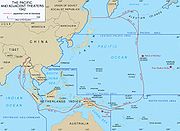
The South West Pacific Theatre, technically the South West Pacific Area, between 1942 and 1945, was one of two designated area commands and war theatres enumerated by the Combined Chiefs of Staff of World War II in the Pacific region....
. It was one of four major Allied commands in the Pacific theatres
Pacific War
The Pacific War, also sometimes called the Asia-Pacific War refers broadly to the parts of World War II that took place in the Pacific Ocean, its islands, and in East Asia, then called the Far East...
of World War II
World War II
World War II, or the Second World War , was a global conflict lasting from 1939 to 1945, involving most of the world's nations—including all of the great powers—eventually forming two opposing military alliances: the Allies and the Axis...
, during 1942–45. SWPA included the Philippines
Philippines
The Philippines , officially known as the Republic of the Philippines , is a country in Southeast Asia in the western Pacific Ocean. To its north across the Luzon Strait lies Taiwan. West across the South China Sea sits Vietnam...
, Borneo
Borneo
Borneo is the third largest island in the world and is located north of Java Island, Indonesia, at the geographic centre of Maritime Southeast Asia....
, the Dutch East Indies
Dutch East Indies
The Dutch East Indies was a Dutch colony that became modern Indonesia following World War II. It was formed from the nationalised colonies of the Dutch East India Company, which came under the administration of the Netherlands government in 1800....
(excluding Sumatra
Sumatra
Sumatra is an island in western Indonesia, westernmost of the Sunda Islands. It is the largest island entirely in Indonesia , and the sixth largest island in the world at 473,481 km2 with a population of 50,365,538...
), Australia
Australia
Australia , officially the Commonwealth of Australia, is a country in the Southern Hemisphere comprising the mainland of the Australian continent, the island of Tasmania, and numerous smaller islands in the Indian and Pacific Oceans. It is the world's sixth-largest country by total area...
, the Territory of New Guinea
New Guinea
New Guinea is the world's second largest island, after Greenland, covering a land area of 786,000 km2. Located in the southwest Pacific Ocean, it lies geographically to the east of the Malay Archipelago, with which it is sometimes included as part of a greater Indo-Australian Archipelago...
(including the Bismarck Archipelago
Bismarck Archipelago
The Bismarck Archipelago is a group of islands off the northeastern coast of New Guinea in the western Pacific Ocean and is part of the Islands Region of Papua New Guinea.-History:...
), the western part of the Solomon Islands
Solomon Islands
Solomon Islands is a sovereign state in Oceania, east of Papua New Guinea, consisting of nearly one thousand islands. It covers a land mass of . The capital, Honiara, is located on the island of Guadalcanal...
and some neighbouring territories. The supreme commander, General Douglas MacArthur
Douglas MacArthur
General of the Army Douglas MacArthur was an American general and field marshal of the Philippine Army. He was a Chief of Staff of the United States Army during the 1930s and played a prominent role in the Pacific theater during World War II. He received the Medal of Honor for his service in the...
, was in charge of primarily United States
United States
The United States of America is a federal constitutional republic comprising fifty states and a federal district...
and Australian forces. Dutch
Netherlands
The Netherlands is a constituent country of the Kingdom of the Netherlands, located mainly in North-West Europe and with several islands in the Caribbean. Mainland Netherlands borders the North Sea to the north and west, Belgium to the south, and Germany to the east, and shares maritime borders...
, Filipino
Commonwealth of the Philippines
The Commonwealth of the Philippines was a designation of the Philippines from 1935 to 1946 when the country was a commonwealth of the United States. The Commonwealth was created by the Tydings-McDuffie Act, which was passed by the U.S. Congress in 1934. When Manuel L...
, British
United Kingdom
The United Kingdom of Great Britain and Northern IrelandIn the United Kingdom and Dependencies, other languages have been officially recognised as legitimate autochthonous languages under the European Charter for Regional or Minority Languages...
and other Allied forces also served in the SWPA.
Origins
The name "South West Pacific Area" appears to have originated in BritishUnited Kingdom
The United Kingdom of Great Britain and Northern IrelandIn the United Kingdom and Dependencies, other languages have been officially recognised as legitimate autochthonous languages under the European Charter for Regional or Minority Languages...
military circles in 1941, purely in reference to British forces under the short-lived American-British-Dutch-Australian Command
American-British-Dutch-Australian Command
The American-British-Dutch-Australian Command, or ABDACOM, was a short-lived, supreme command for all Allied forces in South East Asia, in early 1942, during the Pacific War in World War II...
(ABDA). The rapid Japan
Japan
Japan is an island nation in East Asia. Located in the Pacific Ocean, it lies to the east of the Sea of Japan, China, North Korea, South Korea and Russia, stretching from the Sea of Okhotsk in the north to the East China Sea and Taiwan in the south...
ese advance through the Dutch East Indies effectively divided the "ABDA Area" in two, and in late February 1942, ABDA was wound up at the recommendation of its commander, the British General Archibald Wavell, who—as Commander in Chief in India—retained responsibility for Allied operations in Burma
Burma Campaign
The Burma Campaign in the South-East Asian Theatre of World War II was fought primarily between British Commonwealth, Chinese and United States forces against the forces of the Empire of Japan, Thailand, and the Indian National Army. British Commonwealth land forces were drawn primarily from...
and Sumatra
Sumatra
Sumatra is an island in western Indonesia, westernmost of the Sunda Islands. It is the largest island entirely in Indonesia , and the sixth largest island in the world at 473,481 km2 with a population of 50,365,538...
(which fell to the Japanese on 28 March 1942), and against Japanese held Singapore
Singapore
Singapore , officially the Republic of Singapore, is a Southeast Asian city-state off the southern tip of the Malay Peninsula, north of the equator. An island country made up of 63 islands, it is separated from Malaysia by the Straits of Johor to its north and from Indonesia's Riau Islands by the...
, Malaya
British Malaya
British Malaya loosely described a set of states on the Malay Peninsula and the Island of Singapore that were brought under British control between the 18th and the 20th centuries...
and Thailand
Thailand
Thailand , officially the Kingdom of Thailand , formerly known as Siam , is a country located at the centre of the Indochina peninsula and Southeast Asia. It is bordered to the north by Burma and Laos, to the east by Laos and Cambodia, to the south by the Gulf of Thailand and Malaysia, and to the...
.
On March 24, 1942, the newly-formed British-US Combined Chiefs of Staff
Combined Chiefs of Staff
The Combined Chiefs of Staff was the supreme military command for the western Allies during World War II. It was a body constituted from the British Chiefs of Staff Committee and the American Joint Chiefs of Staff....
issued a directive designating the Pacific theater an area of American strategic responsibility. Six days later the US Joint Chiefs of Staff
Joint Chiefs of Staff
The Joint Chiefs of Staff is a body of senior uniformed leaders in the United States Department of Defense who advise the Secretary of Defense, the Homeland Security Council, the National Security Council and the President on military matters...
(JCS) divided the Pacific theater into three areas: the Pacific Ocean Areas (POA), the Southwest Pacific Area
South West Pacific Area
South West Pacific Area was the name given to the Allied supreme military command in the South West Pacific Theatre of World War II. It was one of four major Allied commands in the Pacific theatres of World War II, during 1942–45...
(SWPA), and the South East Asia Command
South East Asia Command
South East Asia Command was the body set up to be in overall charge of Allied operations in the South-East Asian Theatre during World War II.-Background:...
. Therefore most of the Pacific Ocean
Pacific Ocean
The Pacific Ocean is the largest of the Earth's oceanic divisions. It extends from the Arctic in the north to the Southern Ocean in the south, bounded by Asia and Australia in the west, and the Americas in the east.At 165.2 million square kilometres in area, this largest division of the World...
and its islands fell under a separate Allied command, Pacific Ocean Areas
Pacific Ocean Areas
Pacific Ocean Areas was a major Allied military command in the Pacific Ocean theater of World War II. It was one of four major Allied commands during the Pacific War, and one of two United States commands in the Pacific Theater of Operations. Admiral Chester W. Nimitz of the U.S...
, headed by US Admiral Chester Nimitz
Chester Nimitz
Fleet Admiral Chester William Nimitz, GCB, USN was a five-star admiral in the United States Navy. He held the dual command of Commander in Chief, United States Pacific Fleet , for U.S. naval forces and Commander in Chief, Pacific Ocean Areas , for U.S...
.
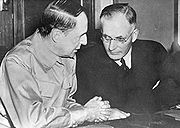
Douglas MacArthur
General of the Army Douglas MacArthur was an American general and field marshal of the Philippine Army. He was a Chief of Staff of the United States Army during the 1930s and played a prominent role in the Pacific theater during World War II. He received the Medal of Honor for his service in the...
was elevated to the post of Supreme Commander Southwest Pacific Area, although he preferred to use the more conventional title of Commander in Chief
Commander-in-Chief
A commander-in-chief is the commander of a nation's military forces or significant element of those forces. In the latter case, the force element may be defined as those forces within a particular region or those forces which are associated by function. As a practical term it refers to the military...
(CinC). As the Japanese surrounded US and Filipino
Philippines
The Philippines , officially known as the Republic of the Philippines , is a country in Southeast Asia in the western Pacific Ocean. To its north across the Luzon Strait lies Taiwan. West across the South China Sea sits Vietnam...
forces in the Philippines, MacArthur was ordered by US President Franklin D. Roosevelt to leave his headquarters on Corregidor
Corregidor
Corregidor Island, locally called Isla ng Corregidor, is a lofty island located at the entrance of Manila Bay in southwestern part of Luzon Island in the Philippines. Due to this location, Corregidor was fortified with several coastal artillery and ammunition magazines to defend the entrance of...
, and to relocate to Melbourne, Australia.
On April 17, the Australian government, led by Prime Minister
Prime minister
A prime minister is the most senior minister of cabinet in the executive branch of government in a parliamentary system. In many systems, the prime minister selects and may dismiss other members of the cabinet, and allocates posts to members within the government. In most systems, the prime...
John Curtin
John Curtin
John Joseph Curtin , Australian politician, served as the 14th Prime Minister of Australia. Labor under Curtin formed a minority government in 1941 after the crossbench consisting of two independent MPs crossed the floor in the House of Representatives, bringing down the Coalition minority...
, directed Australian personnel to treat orders from MacArthur as equivalent its own. In fact, for most of 1942 and 1943, MacArthur commanded more Australian than U.S. personnel. He also commanded some Dutch forces which had retreated to Australia. Some British, New Zealand
New Zealand
New Zealand is an island country in the south-western Pacific Ocean comprising two main landmasses and numerous smaller islands. The country is situated some east of Australia across the Tasman Sea, and roughly south of the Pacific island nations of New Caledonia, Fiji, and Tonga...
and other national forces also came under MacArthur's command.
One result of the division of the Pacific theatre
Pacific Theater of Operations
The Pacific Theater of Operations was the World War II area of military activity in the Pacific Ocean and the countries bordering it, a geographic scope that reflected the operational and administrative command structures of the American forces during that period...
into two separate Allied/U.S. commands was that each competed for scarce resources in an economy-of-force theater, and each was headed by a commander in chief (CinC) from a different service. In particular, the division of the Solomon Islands
Solomon Islands
Solomon Islands is a sovereign state in Oceania, east of Papua New Guinea, consisting of nearly one thousand islands. It covers a land mass of . The capital, Honiara, is located on the island of Guadalcanal...
caused problems, since the battles of the Solomon Islands campaign
Solomon Islands campaign
The Solomon Islands campaign was a major campaign of the Pacific War of World War II. The campaign began with Japanese landings and occupation of several areas in the British Solomon Islands and Bougainville, in the Territory of New Guinea, during the first six months of 1942...
in 1942–1943 ranged over the whole region, with the main Japan
Japan
Japan is an island nation in East Asia. Located in the Pacific Ocean, it lies to the east of the Sea of Japan, China, North Korea, South Korea and Russia, stretching from the Sea of Okhotsk in the north to the East China Sea and Taiwan in the south...
ese bases in SWPA and the main Allied bases in POA.
Command
.jpg)
Jayapura
Jayapura City is the capital of Papua province, Indonesia, on the island of New Guinea. It is situated on Yos Sudarso Bay . Its approximate population in 2002 was 200,000....
in August 1944, Leyte
Leyte
Leyte is a province of the Philippines located in the Eastern Visayas region. Its capital is Tacloban City and occupies the northern three-quarters of the Leyte Island. Leyte is located west of Samar Island, north of Southern Leyte and south of Biliran...
in October 1944, and Manila
Manila
Manila is the capital of the Philippines. It is one of the sixteen cities forming Metro Manila.Manila is located on the eastern shores of Manila Bay and is bordered by Navotas and Caloocan to the north, Quezon City to the northeast, San Juan and Mandaluyong to the east, Makati on the southeast,...
in April 1945.
The Australian Army
Australian Army
The Australian Army is Australia's military land force. It is part of the Australian Defence Force along with the Royal Australian Navy and the Royal Australian Air Force. While the Chief of Defence commands the Australian Defence Force , the Army is commanded by the Chief of Army...
CinC, General Sir Thomas Blamey
Thomas Blamey
Field Marshal Sir Thomas Albert Blamey GBE, KCB, CMG, DSO, ED was an Australian general of the First and Second World Wars, and the only Australian to date to attain the rank of field marshal....
, was appointed Commander, Allied Land Forces. In practice, however, MacArthur preferred to control land operations himself, through "task forces", the most important of which were New Guinea Force
New Guinea Force
New Guinea Force was a military command unit for Australian, territory of Papua and territory of New Guinea troops serving in the New Guinea campaign during World War II. Formed in April 1942 it was responsible for planning and directing all operations within the territory up until October 1944,...
, formed in 1942, and Alamo Force, formed in 1943, around which was built the U.S. Sixth Army
U.S. Sixth Army
The Sixth United States Army is a field army of the United States Army.-History:It was first activated in January 1943, commanded by Lieutenant General Walter Krueger. Under the code name Alamo Force, it assumed control of the majority of US Army units involved in Operation Cartwheel, the campaign...
. On the arrival of this formation in SWPA in February 1943, MacArthur revived U.S. Army Forces Far East
U.S. Army Forces Far East
USAFFE included the Philippine Department, Philippine Army , and the Far East Air Force. USAFFE Headquarters was created on July 26, 1941, at No.1, Calle Victoria, Manila, Luzon, the Philippines, with Major General MacArthur as commander. The Chief of Staff was Lieutenant General Richard K...
(USAFFE) as an administrative command. The result was that Blamey did not command of the vast majority of U.S. land forces in the theatre after that time, although his post was not abolished.
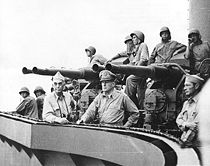
Arthur S. Carpender
Arthur Schuyler Carpender , nicknamed "Chips", was an American vice admiral during World War II commanding US naval forces in the Southwest Pacific.-Family:...
, who also became commander of the U.S. 7th Fleet when it was formed on March 15, 1943. They were junior in rank to both the Australian Chief of the Naval Staff (CNS), Admiral Sir Guy Royle, and the Dutch naval commander, Vice Admiral Conrad Emil Lambert Helfrich
Conrad Emil Lambert Helfrich
Luitenant-Admiraal Conrad Emil Lambert Helfrich, GNL, KCB of the Royal Netherlands Navy was a leading Dutch naval figure of World War II. He was born in Semarang....
. However, Royle agreed to serve under the Allied Naval Forces as commander of the Southwest Pacific Sea Frontier (Australian coastal waters). MacArthur was not the superior of his U.S. Navy commanders—they were answerable to Admiral Ernest King
Ernest King
Fleet Admiral Ernest Joseph King was Commander in Chief, United States Fleet and Chief of Naval Operations during World War II. As COMINCH, he directed the United States Navy's operations, planning, and administration and was a member of the Joint Chiefs of Staff. He was the U.S...
, the Commander in Chief, United States Fleet
United States Fleet
The United States Fleet was an organization in the United States Navy from 1922 until after World War II. The abbreviation CINCUS, pronounced "sink us", was used for Commander-in-Chief, United States Fleet. This title was disposed of and officially replaced by COMINCH in December 1941 . This...
, and MacArthur was embarrassed when the Navy Department
United States Department of the Navy
The Department of the Navy of the United States of America was established by an Act of Congress on 30 April 1798, to provide a government organizational structure to the United States Navy and, from 1834 onwards, for the United States Marine Corps, and when directed by the President, of the...
replaced Carpender with Vice Admiral Thomas C. Kinkaid
Thomas C. Kinkaid
Thomas Cassin Kinkaid was an admiral in the United States Navy during World War II. He built a reputation as a "fighting admiral" in the aircraft carrier battles of 1942 and commanded the Allied forces in the Aleutian Islands Campaign...
without informing him or consulting the Australian government.
In early 1944, MacArthur declined a suggestion, from Australian leaders, that the Australian I Corps be used in the forthcoming campaign to re-take the Philippines, in its own area of responsibility. MacArthur suggested instead that one Australian division be used, but this was not accepted.
In September 1944, MacArthur discarded the task force concept for the land forces, and assumed direct control of the U.S. Sixth Army
U.S. Sixth Army
The Sixth United States Army is a field army of the United States Army.-History:It was first activated in January 1943, commanded by Lieutenant General Walter Krueger. Under the code name Alamo Force, it assumed control of the majority of US Army units involved in Operation Cartwheel, the campaign...
, U.S. Eighth Army
U.S. Eighth Army
The Eighth United States Army – often unofficially abbreviated EUSA – is the commanding formation of all US Army troops in South Korea.-World War II:...
, Australian First Army
Australian First Army
The name First Army was applied to at least two different Australian Army formations during World War II, both of them associated with Lieutenant General John Lavarack. In 1939, the name was used for a "skeleton", Militia formation based at Toowoomba, Queensland and comprising the 4th Division, 3rd...
, Australian I Corps
Australian I Corps
I Corps of the Australian Army was its main frontline corps during World War II. Various Australian and other Allied divisions came under its control at different times. In 1940–42, the corps was based in the Mediterranean Theatre...
and U.S. XIV Corps.
.jpg)
George Kenney
George Churchill Kenney was a United States Army Air Forces general during World War II. He was commander of the Allied air forces in the Southwest Pacific Area from August 1942 until 1945.-Early life:...
commanded the Allied Air Forces. Initially, he combined this with command of the U.S. Fifth Air Force
Fifth Air Force
The Fifth Air Force is a numbered air force of the United States Air Force Pacific Air Forces . It is headquartered at Yokota Air Base, Japan....
. When the U.S. Thirteenth Air Force
Thirteenth Air Force
The Thirteenth Air Force is a numbered air force of the United States Air Force Pacific Air Forces . It is headquartered at Hickam Air Force Base on the island of Oahu, Hawaii. 13 AF has never been stationed in the continental United States...
was transferred from the South Pacific Area
South Pacific Area
The South Pacific Area was a multinational U.S.-led military command active during World War II. It was a part of the U.S. Pacific Ocean Areas under Admiral Chester Nimitz.Instructions to the senior U.S...
in 1944, he created the U.S. Far East Air Force to control them both. Kenney consolidated Royal Australian Air Force
Royal Australian Air Force
The Royal Australian Air Force is the air force branch of the Australian Defence Force. The RAAF was formed in March 1921. It continues the traditions of the Australian Flying Corps , which was formed on 22 October 1912. The RAAF has taken part in many of the 20th century's major conflicts...
(RAAF) units under his command into the RAAF Command under Air Vice Marshal William Bostock
William Bostock
Air Vice Marshal William Dowling Bostock CB, DSO, OBE was a senior commander in the Royal Australian Air Force. During World War II he led RAAF Command, the Air Force's main operational formation, with responsibility for the defence of Australia and air offensives against Japanese targets in the...
. The RAAF Chief of the Air Staff, Air Vice Marshal George Jones
George Jones (RAAF officer)
Air Marshal Sir George Jones KBE, CB, DFC was a senior commander in the Royal Australian Air Force . He rose from private soldier in World War I to Air Marshal in 1948, and served as Chief of the Air Staff from 1942 to 1952, the longest continuous tenure of any RAAF chief...
, was outside Kenney's command. A controversy erupted in May 1943 when Jones removed all RAAF air transport units from Kenney's control. An appeal from MacArthur to Prime Minister Curtin failed to get them back and the result was that Jones, Royle and Blamey were ordered to provide GHQ with detailed lists of units assigned to SWPA, which in the case of the land forces, had often been ambiguous.
Forces from the SWPA were to have made up a significant proportion of the Allied units set aside for the proposed invasion of Japan
Operation Downfall
Operation Downfall was the Allied plan for the invasion of Japan near the end of World War II. The operation was cancelled when Japan surrendered after the atomic bombing of Hiroshima and Nagasaki and the Soviet Union's declaration of war against Japan. The operation had two parts: Operation...
, scheduled to take place from November 1945.
Major campaigns in the theatre
- Philippines campaign, 1942Battle of the Philippines (1941-42)The Philippines Campaign or the Battle of the Philippines was the invasion of the Philippines by Japan in 1941–1942 and the defense of the islands by Filipino and United States forces....
- New Guinea campaignNew Guinea campaignThe New Guinea campaign was one of the major military campaigns of World War II.Before the war, the island of New Guinea was split between:...
, 1942–45 - Philippines campaign, 1944-45
- Borneo campaign, 1945
Command structure (combat units)
Ranks cited are those on assumption of each position.General
General
A general officer is an officer of high military rank, usually in the army, and in some nations, the air force. The term is widely used by many nations of the world, and when a country uses a different term, there is an equivalent title given....
Douglas MacArthur
Douglas MacArthur
General of the Army Douglas MacArthur was an American general and field marshal of the Philippine Army. He was a Chief of Staff of the United States Army during the 1930s and played a prominent role in the Pacific theater during World War II. He received the Medal of Honor for his service in the...
, Philippine Army
Philippine Army
The Philippine Army is the ground arm of the Armed Forces of the Philippines . Its official name in Tagalog is Hukbong Katihan ng Pilipinas. On July 23, 2010, President Benigno Aquino III appointed Maj. Gen...
/U.S. Army, Supreme Commander (1942–45)
- Lieutenant General George BrettGeorge Brett (military)George Howard Brett was a United States Army Air Forces General during World War II. An Early Bird of Aviation, Brett served as a staff officer in World War I...
, Deputy Commander & Commander of Allied Air Forces (until August 4, 1942; not replaced) - Staff officers (all U.S. Army)
- Major GeneralMajor GeneralMajor general or major-general is a military rank used in many countries. It is derived from the older rank of sergeant major general. A major general is a high-ranking officer, normally subordinate to the rank of lieutenant general and senior to the ranks of brigadier and brigadier general...
Richard K. SutherlandRichard K. SutherlandRichard Kerens Sutherland was a Lieutenant General of the US Army and General of the Army Douglas MacArthur's Chief of Staff in the South West Pacific Area during World War II.-Early life:...
(Chief of Staff)- Brigadier GeneralBrigadier GeneralBrigadier general is a senior rank in the armed forces. It is the lowest ranking general officer in some countries, usually sitting between the ranks of colonel and major general. When appointed to a field command, a brigadier general is typically in command of a brigade consisting of around 4,000...
Richard J. Marshall (Deputy Chief of Staff)
- Brigadier General
- Major General
US Army Forces Far East (1941–1945)
- Lieutenant GeneralLieutenant GeneralLieutenant General is a military rank used in many countries. The rank traces its origins to the Middle Ages where the title of Lieutenant General was held by the second in command on the battlefield, who was normally subordinate to a Captain General....
Jonathan Mayhew Wainwright IVJonathan Mayhew Wainwright IVJonathan Mayhew "Skinny" Wainwright IV was a career American army officer and the commander of Allied forces in the Philippines at the time of their surrender to the Empire of Japan during World War II...
(U.S. Army), Wainwright held the position until the Allied surrender on May 6, 1942, after which it was vacant.
Allied Land Forces (1942–45)
Australian ArmyAustralian Army
The Australian Army is Australia's military land force. It is part of the Australian Defence Force along with the Royal Australian Navy and the Royal Australian Air Force. While the Chief of Defence commands the Australian Defence Force , the Army is commanded by the Chief of Army...
officers, except where stated.
- GeneralGeneralA general officer is an officer of high military rank, usually in the army, and in some nations, the air force. The term is widely used by many nations of the world, and when a country uses a different term, there is an equivalent title given....
Sir Thomas BlameyThomas BlameyField Marshal Sir Thomas Albert Blamey GBE, KCB, CMG, DSO, ED was an Australian general of the First and Second World Wars, and the only Australian to date to attain the rank of field marshal....
, Allied Land Forces
New Guinea Force (1942–44)
-
- Major General Basil MorrisBasil MorrisMajor General Basil Moorhouse Morris CBE, DSO was an Australian Army officer. He was the Australian military administrator at Port Moresby at the start of the Imperial Japanese advance along the Kokoda Track after the invasion of Buna-Gona and successfully delayed the Japanese advance until Second...
(May 19, 1941 to July 31, 1942) - Lieutenant GeneralLieutenant GeneralLieutenant General is a military rank used in many countries. The rank traces its origins to the Middle Ages where the title of Lieutenant General was held by the second in command on the battlefield, who was normally subordinate to a Captain General....
Sydney RowellSydney RowellLieutenant General Sir Sydney Fairbairn Rowell, KBE, CB was an Australian soldier who served as Chief of the General Staff from 17 April 1950 to 15 December 1954...
(August 1, 1942 to September 23, 1942) - General Sir Thomas Blamey (in direct command) (September 23, 1942 to October 1, 1943)
- Lieutenant General Edmund HerringEdmund HerringLieutenant General Sir Edmund Francis Herring, KCMG, KBE, DSO, MC, KStJ, ED, QC was an Australian Army officer during the Second World War, Lieutenant Governor of Victoria, and Chief Justice of the Supreme Court of Victoria.A Rhodes scholar, Herring was at New College, Oxford, when the First World...
(October 1, 1942 to January 29, 1943) - Lieutenant General Sir Iven MackayIven Giffard MackayLieutenant General Sir Iven Giffard Mackay KBE, CMG, DSO & Bar, VD was a senior Australian soldier who served in both World Wars. A graduate of the University of Sydney, Mackay taught physics there from 1910 until 1914, when he joined the Australian Imperial Force...
(acting) (January 30, 1943 to May 21, 1943) - Lieutenant General Sir Edmund Herring (May 23, 1943 to August 28, 1943)
- General Sir Thomas BlameyThomas BlameyField Marshal Sir Thomas Albert Blamey GBE, KCB, CMG, DSO, ED was an Australian general of the First and Second World Wars, and the only Australian to date to attain the rank of field marshal....
(in direct command) (August 28, 1943 to September 23, 1943) - Lieutenant General Sir Iven Mackay, (September 23, 1943 to January 20, 1944)
- Lieutenant General Sir Leslie MorsheadLeslie MorsheadLieutenant General Sir Leslie James Morshead KCB, KBE, CMG, DSO, ED was an Australian soldier, teacher, businessman, and farmer, with a distinguished military career that spanned both world wars...
(January 20, 1944 to May 5, 1944) - Lieutenant General Stanley SavigeStanley SavigeLieutenant General Sir Stanley George Savige, KBE, CB, DSO, MC, ED , was an Australian Army soldier and officer who served in World War I and World War II, rising to the rank of lieutenant general....
(May 6, 1944 to October 1, 1944)
- Major General Basil Morris
Australian First Army (1942–45)
-
- Lieutenant General John LavarackJohn LavarackLieutenant General Sir John Dudley Lavarack KCMG, KCVO, KBE, CB, DSO was an Australian soldier who was Governor of Queensland from 1 October 1946 to 4 December 1957, the first Australian-born governor of that state....
, (1942–1944) - Lieutenant General Vernon SturdeeVernon SturdeeLieutenant General Sir Vernon Ashton Hobart Sturdee KBE, CB, DSO was an Australian Army commander who served two terms as Chief of the General Staff...
, (1944–1945)
- Lieutenant General John Lavarack
Australian Second Army (1942–45)
-
- Lieutenant General Sir Iven Mackay, (1942–1944)
- Lieutenant General Sir Leslie Morshead, (1944–1945)
- Major General Herbert Lloyd, (1945)
U.S. Sixth Army (1943–45)
- Lieutenant General Walter KruegerWalter KruegerWalter Krueger was an American soldier of German descent and General in the first half of the 20th century. He is best known for his command of the Sixth United States Army in the South West Pacific Area during World War II...
, U.S. Sixth ArmyU.S. Sixth ArmyThe Sixth United States Army is a field army of the United States Army.-History:It was first activated in January 1943, commanded by Lieutenant General Walter Krueger. Under the code name Alamo Force, it assumed control of the majority of US Army units involved in Operation Cartwheel, the campaign...
(a.k.a. Alamo Force, in theatre from June 1, 1943 to September, 1944)
U.S. Eighth Army (1944–45)
- Lieutenant General Robert Eichelberger, U.S. Eighth ArmyU.S. Eighth ArmyThe Eighth United States Army – often unofficially abbreviated EUSA – is the commanding formation of all US Army troops in South Korea.-World War II:...
(formed 1944)
Allied Air Forces
United States Army Air ForcesUnited States Army Air Forces
The United States Army Air Forces was the military aviation arm of the United States of America during and immediately after World War II, and the direct predecessor of the United States Air Force....
officers, except where stated.
- Lieutenant General George Brett, Allied Air Forces (until August 4, 1942)
- Lieutenant General George KenneyGeorge KenneyGeorge Churchill Kenney was a United States Army Air Forces general during World War II. He was commander of the Allied air forces in the Southwest Pacific Area from August 1942 until 1945.-Early life:...
, Allied Air Forces (from August 4, 1942)
1942–44
U.S. Fifth Air ForceFifth Air Force
The Fifth Air Force is a numbered air force of the United States Air Force Pacific Air Forces . It is headquartered at Yokota Air Base, Japan....
- Controlled Allied air operations in the Northeastern Area (New Guinea, including islands)
- Lieutenant General C. Kenney
RAAF Command
RAAF Command
RAAF Command was the main operational arm of the Royal Australian Air Force during World War II. The command was established in September 1942 and by April 1943 comprised 27 squadrons, including units from the Netherlands, the United Kingdom and the United States, as well as Australia...
- Controlled Allied air operations in the Northwestern Area (Australia and the Dutch East Indies).
- Air Vice Marshal William BostockWilliam BostockAir Vice Marshal William Dowling Bostock CB, DSO, OBE was a senior commander in the Royal Australian Air Force. During World War II he led RAAF Command, the Air Force's main operational formation, with responsibility for the defence of Australia and air offensives against Japanese targets in the...
, Royal Australian Air ForceRoyal Australian Air ForceThe Royal Australian Air Force is the air force branch of the Australian Defence Force. The RAAF was formed in March 1921. It continues the traditions of the Australian Flying Corps , which was formed on 22 October 1912. The RAAF has taken part in many of the 20th century's major conflicts...
.
- Air Vice Marshal William Bostock
1944–45
U.S. Far East Air ForcePhilippines area and southern islands of Japan.
Lieutenant General George Kenney
- U.S. Fifth Air Force
Major General Ennis Whitehead
Ennis Whitehead
Ennis Clement Whitehead was an early United States Army aviator and a United States Army Air Forces general during World War II. Whitehead joined the U. S. Army after the United States entered World War I in 1917...
- U.S. Thirteenth Air ForceThirteenth Air ForceThe Thirteenth Air Force is a numbered air force of the United States Air Force Pacific Air Forces . It is headquartered at Hickam Air Force Base on the island of Oahu, Hawaii. 13 AF has never been stationed in the continental United States...
(from Pacific Ocean Areas)
Lieutenant General Hubert R. Harmon
Hubert R. Harmon
Lieutenant General Hubert Reilly Harmon , after a distinguished combat career in World War II, was instrumental in developing plans for the establishment of the United States Air Force Academy...
(1944)
Major General St. Clair Streett
St. Clair Streett
St. Clair Streett , known as "Bill", was a United States Air Force major general and writer who first organized and led the Strategic Air Command . Streett served as aide to air power advocate General Billy Mitchell, and was viewed by General of the Air Force Henry H...
(1944–45)
Major General Paul Wurtsmith
Paul Wurtsmith
Paul Bernard Wurtsmith was a United States Army Air Forces general during World War II.Enlisting in the United States Army Air Corps as a flying cadet in 1927, was commissioned in 1928. Over the next 13 years, he served in instruction and command positions...
(1945)
- U.S. Seventh Air ForceSeventh Air ForceThe Seventh Air Force is a numbered air force of the United States Air Force Pacific Air Forces . It is headquartered at Osan Air Base, Republic of Korea....
(from POA, mid-1945)
Major General Thomas D. White
Thomas D. White
General Thomas Dresser White was the fourth Chief of Staff of the United States Air Force.White was born in Walker, Minnesota, in 1901...
RAAF Command
Allied operations in Australia, Dutch East Indies and the Territory of New Guinea.
Air Vice Marshal William Bostock
Allied Naval Forces
U.S. Navy officers, except where stated.- Vice Admiral Herbert F. Leary, Allied Naval Forces, April 20, 1942 – September 11, 1942
- Vice Admiral Arthur S. CarpenderArthur S. CarpenderArthur Schuyler Carpender , nicknamed "Chips", was an American vice admiral during World War II commanding US naval forces in the Southwest Pacific.-Family:...
, Allied Naval Forces, February 19, 1943 – November 26, 1943; and Commander, U.S. 7th Fleet, (from March 15, 1943) - Vice Admiral Thomas C. KinkaidThomas C. KinkaidThomas Cassin Kinkaid was an admiral in the United States Navy during World War II. He built a reputation as a "fighting admiral" in the aircraft carrier battles of 1942 and commanded the Allied forces in the Aleutian Islands Campaign...
, November 26, 1943 – September 2, 1945; and Commander U.S. 7th Fleet
Southwest Pacific Sea Frontier
- Australian coastal waters
- AdmiralAdmiralAdmiral is the rank, or part of the name of the ranks, of the highest naval officers. It is usually considered a full admiral and above vice admiral and below admiral of the fleet . It is usually abbreviated to "Adm" or "ADM"...
Guy Royle (Royal NavyRoyal NavyThe Royal Navy is the naval warfare service branch of the British Armed Forces. Founded in the 16th century, it is the oldest service branch and is known as the Senior Service...
)
- Admiral
See also
- U.S. I CorpsU.S. I CorpsI Corps is a corps of the United States Army headquartered in Joint Base Lewis-McChord, Washington. It is a major formation of United States Army Forces Command....
- Australian I CorpsAustralian I CorpsI Corps of the Australian Army was its main frontline corps during World War II. Various Australian and other Allied divisions came under its control at different times. In 1940–42, the corps was based in the Mediterranean Theatre...
- Australian II CorpsAustralian II CorpsThe Australian II Corps was an Australian Army corps. II Corps was established in early 1942 to command Australian Army units deployed to protect the Sydney region and later commanded operational units in New Guinea, Bougainville and New Britain...
- Maroubra ForceMaroubra ForceMaroubra Force was the name given to the Australian infantry force that defended Port Moresby, Papua New Guinea from the Japanese, and was involved in the Kokoda Track Campaign of the Pacific War, World War II...
- Australian First Tactical Air ForceAustralian First Tactical Air ForceThe Australian First Tactical Air Force was formed on 25 October 1944 by the Royal Australian Air Force . Its purpose was to provide a mobile force of fighter and ground attack aircraft that could support Allied army and naval units fighting the Empire of Japan in the South West Pacific Area...
External links
- Prof. David Horner, 2002, "The Evolution of Australian Higher Command Arrangements" (Australian Department of Defence)
- U.S. Army in World War II "Organization and Command of the Pacific" published by the United States Army Center of Military History
- Maj. Jonathan B. Wills, 1997, "How Southwest Pacific Area Operations in WWII Influenced the Royal Australian Air Force" (U.S. Air Force)