


Ryukyu Islands

Encyclopedia
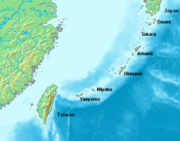
The , also known as the , is a chain of islands in the western Pacific
, on the eastern limit of the East China Sea
and to the southwest of the island of Kyushu
in Japan
. From about 1829 until the mid 20th century, they were alternately called Luchu, Loochoo, or Lewchew, akin to the Mandarin pronunciation Liuqiu
. They stretch southwest from the Japanese island of Kyushu
to within 120 kilometres (74.6 mi) of the island of Taiwan
.
The islands are administratively divided into the Satsunan Islands to the north, belonging to Kagoshima Prefecture
, and Ryūkyū Shotō
to the south, belonging to Okinawa Prefecture
. Yoron Island is the southernmost island of the Satsunan Islands, and Yonaguni
is the southernmost of the Ryukyu Islands. The largest of the islands is .
The islands have a subtropical climate with mild winters and hot summers. Precipitation
is very high, and is affected by the rainy season and typhoons.
The archipelago
is home to the Ryukyuan languages
. The original languages are native to each island and distinct from one another.
(the southern half), as opposed to islands of the same group located in Kagoshima Prefecture
(the northern half).
Modern usage of the word in Japanese, however, is usually replaced by the word , which is considered its synonym. When referring to the region in the broad sense, the Nansei Islands are sometimes referred to as , literally "Amami-Okinawa Region", or variations thereof. For example, the Japanese train timetables uses variations of Nansei Shotō, Okinawa, Amami, etc., but completely avoids using the word Ryūkyū.
in Japan
), the word "Ryukyu" was spelled Luchu, Loo-choo, or Lewchew. These spellings were based on the Chinese pronunciation of the characters for "Ryukyu", which in Mandarin is Liúqiú.

The Ryukyu Kingdom
was once an independent kingdom occupying the island chain, from Yonaguni Island
in the southwest to Amami Ōshima
in the north.
In 1609, Shimazu Tadatsune
, Lord of Satsuma
, invaded the Ryūkyū Kingdom with a fleet of 13 junks and 2,500 samurai
, thereby establishing suzerainty
over the islands. They faced little opposition from the Ryukyuans, who lacked any significant military capabilities, and who were ordered by King Shō Nei
to surrender peacefully rather than suffer the loss of precious lives. After that, the kings of the Ryukyus paid tribute to the Japanese shogun
as well as the Chinese emperor. In 1655, the tribute relations between Ryukyu and Qing were formally approved by the shogunate. In 1874, the Ryukyus terminated tribute relations with China.
In 1872, the Japanese government established the Ryukyu han under the jurisdiction of the Foreign Ministry. In 1875, jurisdiction over the Ryukyus changed from the Foreign Ministry to the Home Ministry.
In 1879, the Meiji government announced the annexation of the Ryukyus, establishing it as Okinawa Prefecture
and forcing the Ryukyu king to move to Tokyo.
When China signed the Treaty of Shimonoseki
after its 1895 defeat in the First Sino-Japanese War
, the Chinese officially abandoned its claims to the Ryukyus.
Military activity on the island, before and during World War II, especially the Battle of Okinawa
, had a devastating effect on the Okinawan people. A huge loss of civilian life left many feeling that they were being mistreated by both the Japanese and American military. Okinawa remains the poorest prefecture in Japan to this day.
US military control over Okinawa began in 1945 with establishment of the Okinawa Advisory Council. In 1952, the US was formally granted control over Ryukyu Islands south of 29°N latitude, and other Pacific islands, under the San Francisco Peace Treaty
between the Allied Powers and Japan. The Okinawa Advisory Council eventually became the government of the Ryukyu Islands
which existed from 1952 to 1972. Sovereignty
reverted to Japan in 1972.
On February 27, 2010, at 5:31 a.m. local time, a magnitude 7.0 earthquake occurred 80 kilometres (49.7 mi) east-southeast of Naha at a depth of 22 kilometres (13.7 mi), but no major damage was reported. At least eight recorded aftershocks were reported, with magnitude up to 5.3
Today, there are a number of issues arising from Ryukyuan history. Some Ryukyuans and some Japanese feel that people from the Ryukyus are different from the majority Yamato people
. Some natives of the Ryukyus claim that the central government is discriminating against the islanders by allowing so many American soldiers to be stationed on bases in Okinawa with a minimal presence on the mainland. Additionally, there is some discussion of secession
from Japan.
Many popular singers and musical groups come from the Ryukyus. These include the pop groups Begin
(ビギン) and Orange Range
, as well as singers Namie Amuro
and Gackt
, among many others.
are known for their longevity
. The Okinawa Centenarian Study
attributes this phenomenon to a combination of diet, exercise, and lifestyle practices.
Since the most recent Japanese invasion
in 1879, Japanese has become the main language on the Ryukyus, especially on Uchinā
(Okinawa-honto), through discrimination
in education. Middle-aged or younger people tend not to speak a Ryukyuan language as fluently as Japanese, if at all.
ecoregion
. The flora and fauna of the islands have much in common with Taiwan
, the Philippines
, and Southeast Asia
, and are part of the Indomalaya
ecozone
.
s of the Ryukyus are one of the World Wildlife Fund's Global 200
ecoregions. The reefs are endangered by sedimentation
and eutrophication
, mostly a result of agriculture
, as well as damage from fishing
.
 This list is based on present day Japanese geographic names:
For some of the island names above, the suffix -jima, -shima, and -gashima can be interchanged, omitted, or appended. The suffix means "island." In general, the islands are listed from north to south where possible.
"Shotō" is replaced with "Islands" in the list except for Ryūkyū Shotō (琉球諸島), since the term "Ryukyu Islands" already exists in English. The Japanese term refers only to the islands that comprise Okinawa Prefecture, while the English term refers to the entire chain of islands between Kyushu
and Taiwan
. Ryūkyū Rettō (琉球列島) refers to what was once the territory of the former kingdom, which are the Amami Islands, Okinawa Islands, Miyako Islands, and Yaeyama Islands.
Pacific Ocean
The Pacific Ocean is the largest of the Earth's oceanic divisions. It extends from the Arctic in the north to the Southern Ocean in the south, bounded by Asia and Australia in the west, and the Americas in the east.At 165.2 million square kilometres in area, this largest division of the World...
, on the eastern limit of the East China Sea
East China Sea
The East China Sea is a marginal sea east of China. It is a part of the Pacific Ocean and covers an area of 1,249,000 km² or 750,000 square miles.-Geography:...
and to the southwest of the island of Kyushu
Kyushu
is the third largest island of Japan and most southwesterly of its four main islands. Its alternate ancient names include , , and . The historical regional name is referred to Kyushu and its surrounding islands....
in Japan
Japan
Japan is an island nation in East Asia. Located in the Pacific Ocean, it lies to the east of the Sea of Japan, China, North Korea, South Korea and Russia, stretching from the Sea of Okhotsk in the north to the East China Sea and Taiwan in the south...
. From about 1829 until the mid 20th century, they were alternately called Luchu, Loochoo, or Lewchew, akin to the Mandarin pronunciation Liuqiu
Liuqiu
Liuqiu or Lewchew was the name given by the Chinese to islands in the East China Sea and nearby waters, sometimes in mythical or legendary contexts...
. They stretch southwest from the Japanese island of Kyushu
Kyushu
is the third largest island of Japan and most southwesterly of its four main islands. Its alternate ancient names include , , and . The historical regional name is referred to Kyushu and its surrounding islands....
to within 120 kilometres (74.6 mi) of the island of Taiwan
Taiwan
Taiwan , also known, especially in the past, as Formosa , is the largest island of the same-named island group of East Asia in the western Pacific Ocean and located off the southeastern coast of mainland China. The island forms over 99% of the current territory of the Republic of China following...
.
The islands are administratively divided into the Satsunan Islands to the north, belonging to Kagoshima Prefecture
Kagoshima Prefecture
is a prefecture of Japan located on the island of Kyushu. The capital is the city of Kagoshima.- Geography :Kagoshima Prefecture is located at the southwest tip of Kyushu and includes a chain of islands stretching further to the southwest for a few hundred kilometers...
, and Ryūkyū Shotō
Ryūkyū Shotō
is a geographic division of Japan refers to the islands of Ryukyu Islands under administration of Okinawa Prefecture.The Okinawa Prefecture is an archipelagic island prefecture.-Major islands:...
to the south, belonging to Okinawa Prefecture
Okinawa Prefecture
is one of Japan's southern prefectures. It consists of hundreds of the Ryukyu Islands in a chain over long, which extends southwest from Kyūshū to Taiwan. Okinawa's capital, Naha, is located in the southern part of Okinawa Island...
. Yoron Island is the southernmost island of the Satsunan Islands, and Yonaguni
Yonaguni
is one of the Yaeyama Islands. It is the westernmost inhabited island of Japan and lies from the east coast of Taiwan, between the East China Sea and the Pacific Ocean proper....
is the southernmost of the Ryukyu Islands. The largest of the islands is .
The islands have a subtropical climate with mild winters and hot summers. Precipitation
Precipitation (meteorology)
In meteorology, precipitation In meteorology, precipitation In meteorology, precipitation (also known as one of the classes of hydrometeors, which are atmospheric water phenomena is any product of the condensation of atmospheric water vapor that falls under gravity. The main forms of precipitation...
is very high, and is affected by the rainy season and typhoons.
The archipelago
Archipelago
An archipelago , sometimes called an island group, is a chain or cluster of islands. The word archipelago is derived from the Greek ἄρχι- – arkhi- and πέλαγος – pélagos through the Italian arcipelago...
is home to the Ryukyuan languages
Ryukyuan languages
The Ryukyuan languages are spoken in the Ryukyu Islands, and make up a subgroup of the Japonic, itself controversially a subgroup of Altaic....
. The original languages are native to each island and distinct from one another.
Japanese
In Japanese, the definition of the , literally meaning "Ryukyu Islands", is somewhat different from the English definition of the word. In Japanese, the term Ryūkyū Shotō is used to refer to the part of the Nansei Islands which is in Okinawa PrefectureOkinawa Prefecture
is one of Japan's southern prefectures. It consists of hundreds of the Ryukyu Islands in a chain over long, which extends southwest from Kyūshū to Taiwan. Okinawa's capital, Naha, is located in the southern part of Okinawa Island...
(the southern half), as opposed to islands of the same group located in Kagoshima Prefecture
Kagoshima Prefecture
is a prefecture of Japan located on the island of Kyushu. The capital is the city of Kagoshima.- Geography :Kagoshima Prefecture is located at the southwest tip of Kyushu and includes a chain of islands stretching further to the southwest for a few hundred kilometers...
(the northern half).
Modern usage of the word in Japanese, however, is usually replaced by the word , which is considered its synonym. When referring to the region in the broad sense, the Nansei Islands are sometimes referred to as , literally "Amami-Okinawa Region", or variations thereof. For example, the Japanese train timetables uses variations of Nansei Shotō, Okinawa, Amami, etc., but completely avoids using the word Ryūkyū.
English
In English, until well into the late 19th century (Meiji periodMeiji period
The , also known as the Meiji era, is a Japanese era which extended from September 1868 through July 1912. This period represents the first half of the Empire of Japan.- Meiji Restoration and the emperor :...
in Japan
Japan
Japan is an island nation in East Asia. Located in the Pacific Ocean, it lies to the east of the Sea of Japan, China, North Korea, South Korea and Russia, stretching from the Sea of Okhotsk in the north to the East China Sea and Taiwan in the south...
), the word "Ryukyu" was spelled Luchu, Loo-choo, or Lewchew. These spellings were based on the Chinese pronunciation of the characters for "Ryukyu", which in Mandarin is Liúqiú.
History
The Ryukyu Kingdom
Ryukyu Kingdom
The Ryūkyū Kingdom was an independent kingdom which ruled most of the Ryukyu Islands from the 15th century to the 19th century. The Kings of Ryūkyū unified Okinawa Island and extended the kingdom to the Amami Islands in modern-day Kagoshima Prefecture, and the Sakishima Islands near Taiwan...
was once an independent kingdom occupying the island chain, from Yonaguni Island
Yonaguni
is one of the Yaeyama Islands. It is the westernmost inhabited island of Japan and lies from the east coast of Taiwan, between the East China Sea and the Pacific Ocean proper....
in the southwest to Amami Ōshima
Amami Oshima
is a semi-tropical island in the Amami Islands, which is part of the larger Nansei Islands in Japan. Ōshima literally means big island, and it is the largest of the Amami Islands. It lies roughly halfway between the islands of Okinawa and Kyūshū. Briefly part of the Ryūkyū Kingdom, in 1624 it was...
in the north.
In 1609, Shimazu Tadatsune
Shimazu Tadatsune
was a tozama daimyo of Satsuma, the first to hold it as a formal fief under the Tokugawa shogunate, and the first Japanese to rule over the Ryūkyū Kingdom...
, Lord of Satsuma
Satsuma Province
was an old province of Japan that is now the western half of Kagoshima Prefecture on the island of Kyūshū. Its abbreviation is Sasshū .During the Sengoku Period, Satsuma was a fief of the Shimazu daimyo, who ruled much of southern Kyūshū from their castle at Kagoshima city.In 1871, with the...
, invaded the Ryūkyū Kingdom with a fleet of 13 junks and 2,500 samurai
Samurai
is the term for the military nobility of pre-industrial Japan. According to translator William Scott Wilson: "In Chinese, the character 侍 was originally a verb meaning to wait upon or accompany a person in the upper ranks of society, and this is also true of the original term in Japanese, saburau...
, thereby establishing suzerainty
Suzerainty
Suzerainty occurs where a region or people is a tributary to a more powerful entity which controls its foreign affairs while allowing the tributary vassal state some limited domestic autonomy. The dominant entity in the suzerainty relationship, or the more powerful entity itself, is called a...
over the islands. They faced little opposition from the Ryukyuans, who lacked any significant military capabilities, and who were ordered by King Shō Nei
Sho Nei
' was king of the Ryūkyū Kingdom from 1587–1620. He reigned during the 1609 invasion of Ryūkyū and was the first king of Ryūkyū to be a vassal to the Shimazu clan of Satsuma, a Japanese feudal domain....
to surrender peacefully rather than suffer the loss of precious lives. After that, the kings of the Ryukyus paid tribute to the Japanese shogun
Shogun
A was one of the hereditary military dictators of Japan from 1192 to 1867. In this period, the shoguns, or their shikken regents , were the de facto rulers of Japan though they were nominally appointed by the emperor...
as well as the Chinese emperor. In 1655, the tribute relations between Ryukyu and Qing were formally approved by the shogunate. In 1874, the Ryukyus terminated tribute relations with China.
In 1872, the Japanese government established the Ryukyu han under the jurisdiction of the Foreign Ministry. In 1875, jurisdiction over the Ryukyus changed from the Foreign Ministry to the Home Ministry.
In 1879, the Meiji government announced the annexation of the Ryukyus, establishing it as Okinawa Prefecture
Okinawa Prefecture
is one of Japan's southern prefectures. It consists of hundreds of the Ryukyu Islands in a chain over long, which extends southwest from Kyūshū to Taiwan. Okinawa's capital, Naha, is located in the southern part of Okinawa Island...
and forcing the Ryukyu king to move to Tokyo.
When China signed the Treaty of Shimonoseki
Treaty of Shimonoseki
The Treaty of Shimonoseki , known as the Treaty of Maguan in China, was signed at the Shunpanrō hall on April 17, 1895, between the Empire of Japan and Qing Empire of China, ending the First Sino-Japanese War. The peace conference took place from March 20 to April 17, 1895...
after its 1895 defeat in the First Sino-Japanese War
First Sino-Japanese War
The First Sino-Japanese War was fought between Qing Dynasty China and Meiji Japan, primarily over control of Korea...
, the Chinese officially abandoned its claims to the Ryukyus.
Military activity on the island, before and during World War II, especially the Battle of Okinawa
Battle of Okinawa
The Battle of Okinawa, codenamed Operation Iceberg, was fought on the Ryukyu Islands of Okinawa and was the largest amphibious assault in the Pacific War of World War II. The 82-day-long battle lasted from early April until mid-June 1945...
, had a devastating effect on the Okinawan people. A huge loss of civilian life left many feeling that they were being mistreated by both the Japanese and American military. Okinawa remains the poorest prefecture in Japan to this day.
US military control over Okinawa began in 1945 with establishment of the Okinawa Advisory Council. In 1952, the US was formally granted control over Ryukyu Islands south of 29°N latitude, and other Pacific islands, under the San Francisco Peace Treaty
Treaty of San Francisco
The Treaty of Peace with Japan , between Japan and part of the Allied Powers, was officially signed by 48 nations on September 8, 1951, at the War Memorial Opera House in San Francisco, California...
between the Allied Powers and Japan. The Okinawa Advisory Council eventually became the government of the Ryukyu Islands
Government of the Ryukyu Islands
The was the government in Okinawa, Japan after World War II until 1972.-Outline:After the Battle of Okinawa in World War II, the armed forces of the United States occupied Okinawa and set up a local government. In 1952, Japan signed the Treaty of San Francisco and admitted the control of Okinawa...
which existed from 1952 to 1972. Sovereignty
Sovereignty
Sovereignty is the quality of having supreme, independent authority over a geographic area, such as a territory. It can be found in a power to rule and make law that rests on a political fact for which no purely legal explanation can be provided...
reverted to Japan in 1972.
On February 27, 2010, at 5:31 a.m. local time, a magnitude 7.0 earthquake occurred 80 kilometres (49.7 mi) east-southeast of Naha at a depth of 22 kilometres (13.7 mi), but no major damage was reported. At least eight recorded aftershocks were reported, with magnitude up to 5.3
Today, there are a number of issues arising from Ryukyuan history. Some Ryukyuans and some Japanese feel that people from the Ryukyus are different from the majority Yamato people
Yamato people
is a name for the dominant native ethnic group of Japan. It is a term that came to be used around the late 19th century to distinguish the residents of the mainland Japan from other minority ethnic groups who have resided in the peripheral areas of Japan, such as the Ainu, Ryukyuan, Nivkh, Ulta, as...
. Some natives of the Ryukyus claim that the central government is discriminating against the islanders by allowing so many American soldiers to be stationed on bases in Okinawa with a minimal presence on the mainland. Additionally, there is some discussion of secession
Ryukyu independence movement
The or Republic of the Ryūkyūs is a movement for the independence of Okinawa and the surrounding islands , from Japan. The movement emerged in 1945, after the end of the Pacific War...
from Japan.
Many popular singers and musical groups come from the Ryukyus. These include the pop groups Begin
Begin (band)
is a Japanese pop group from Ishigaki Island in the Yaeyama Islands of Okinawa Prefecture, Japan. Their sound contains many elements of traditional Ryukyuan folk music, and prominently features the sanshin.-History:...
(ビギン) and Orange Range
Orange Range
is a 5-member Okinawan alternative rock band, based in Okinawa, Japan. Formed in 2001, the band began with Spice Music and later signed with Sony Music Japan's gr8! records division in 2003. The group left gr8! records in 2010 to start their own label, Super Echo....
, as well as singers Namie Amuro
Namie Amuro
is a Japanese R&B and pop singer, entertainer, and former actress who at the height of her popularity was referred to as the "Teen Queen" and the title "Queen of Japanese Pop Music". Born in Naha, Okinawa, Amuro debuted at the age of 14 as an idol in the girl group Super Monkey's...
and Gackt
Gackt
is a Japanese singer-songwriter, actor, voice actor and author. Usually referred to by his mononymous stage name, he is known for his career as a solo artist and as the former vocalist for the defunct visual kei rock band Malice Mizer....
, among many others.
Historical description of the 'Loo-Choo' islands
An article in the 1878 edition of the 'Globe Encyclopaedia of Universal Information' described the islands as:Loo-Choo, Lu-Tchu, or Lieu-Baeu, a group of thirty-six islands stretching from Japan to Formosa, in 20°-27° 40' N. lat., 126" :o'-!29° 5' E. long., and tributary to Japan. The largest, Tsju San ('middle island') is about 60 miles long and 12 broad; others are Sannan in the S. and Sanbok in the N. Nawa, the chief port of Tsju San, is open to foreign commerce. The islands enjoy a magnificent climate, and are highly cultivated and very productive. Among its products are tea, rice, sugar, tobacco, camphor, fruits, silk, cotton, paper, porcelain, and lacquered ware. The small people seem a link between the Chinese and Japanese.
People
The RyukyuansRyukyuans
The are the indigenous peoples of the Ryukyu Islands between the islands of Kyūshū and Taiwan. The generally recognized subgroups of Ryukyuans are Amamians, Okinawans, Miyakoans, Yaeyamans, and Yonagunians. Geographically, they live in either Okinawa Prefecture or Kagoshima Prefecture...
are known for their longevity
Longevity
The word "longevity" is sometimes used as a synonym for "life expectancy" in demography or known as "long life", especially when it concerns someone or something lasting longer than expected ....
. The Okinawa Centenarian Study
Okinawa Centenarian Study
The Okinawa Centenarian Study is a study of the elderly people of Okinawa, Japan. The study, funded by Japan's ministry of health, is the largest of its kind ever carried out...
attributes this phenomenon to a combination of diet, exercise, and lifestyle practices.
Since the most recent Japanese invasion
Invasion
An invasion is a military offensive consisting of all, or large parts of the armed forces of one geopolitical entity aggressively entering territory controlled by another such entity, generally with the objective of either conquering, liberating or re-establishing control or authority over a...
in 1879, Japanese has become the main language on the Ryukyus, especially on Uchinā
Okinawa Island
Okinawa Island is the largest of the Okinawa Islands and the Ryukyu Islands of Japan, and is home to Naha, the capital of Okinawa Prefecture. The island has an area of...
(Okinawa-honto), through discrimination
Discrimination
Discrimination is the prejudicial treatment of an individual based on their membership in a certain group or category. It involves the actual behaviors towards groups such as excluding or restricting members of one group from opportunities that are available to another group. The term began to be...
in education. Middle-aged or younger people tend not to speak a Ryukyuan language as fluently as Japanese, if at all.
Nansei Islands subtropical evergreen forests
The Ryukyu Islands are recognized by ecologists as a distinct subtropical moist broadleaf forestTropical and subtropical moist broadleaf forests
Tropical and subtropical moist broadleaf forests , also known as tropical moist forests, are a tropical and subtropical forest biome....
ecoregion
Ecoregion
An ecoregion , sometimes called a bioregion, is an ecologically and geographically defined area that is smaller than an ecozone and larger than an ecosystem. Ecoregions cover relatively large areas of land or water, and contain characteristic, geographically distinct assemblages of natural...
. The flora and fauna of the islands have much in common with Taiwan
Taiwan
Taiwan , also known, especially in the past, as Formosa , is the largest island of the same-named island group of East Asia in the western Pacific Ocean and located off the southeastern coast of mainland China. The island forms over 99% of the current territory of the Republic of China following...
, the Philippines
Philippines
The Philippines , officially known as the Republic of the Philippines , is a country in Southeast Asia in the western Pacific Ocean. To its north across the Luzon Strait lies Taiwan. West across the South China Sea sits Vietnam...
, and Southeast Asia
Southeast Asia
Southeast Asia, South-East Asia, South East Asia or Southeastern Asia is a subregion of Asia, consisting of the countries that are geographically south of China, east of India, west of New Guinea and north of Australia. The region lies on the intersection of geological plates, with heavy seismic...
, and are part of the Indomalaya
Indomalaya
The Indomalaya ecozone is one of the eight ecozones that cover the planet's land surface. It extends across most of South and Southeast Asia and into the southern parts of East Asia....
ecozone
Ecozone
An ecozone is the broadest biogeographic division of the Earth's land surface, based on distributional patterns of terrestrial organisms.Ecozones delineate large areas of the Earth's surface within which organisms have been evolving in relative isolation over long periods of time, separated from...
.
Coral reefs
The coral reefCoral reef
Coral reefs are underwater structures made from calcium carbonate secreted by corals. Coral reefs are colonies of tiny living animals found in marine waters that contain few nutrients. Most coral reefs are built from stony corals, which in turn consist of polyps that cluster in groups. The polyps...
s of the Ryukyus are one of the World Wildlife Fund's Global 200
Global 200
The Global 200 is the list of ecoregions identified by the World Wildlife Fund as priorities for conservation. According to the WWF, an ecoregion is defined as a "relatively large unit of land or water containing a characteristic set of natural communities that share a large majority of their...
ecoregions. The reefs are endangered by sedimentation
Sedimentation
Sedimentation is the tendency for particles in suspension to settle out of the fluid in which they are entrained, and come to rest against a barrier. This is due to their motion through the fluid in response to the forces acting on them: these forces can be due to gravity, centrifugal acceleration...
and eutrophication
Eutrophication
Eutrophication or more precisely hypertrophication, is the movement of a body of water′s trophic status in the direction of increasing plant biomass, by the addition of artificial or natural substances, such as nitrates and phosphates, through fertilizers or sewage, to an aquatic system...
, mostly a result of agriculture
Agriculture
Agriculture is the cultivation of animals, plants, fungi and other life forms for food, fiber, and other products used to sustain life. Agriculture was the key implement in the rise of sedentary human civilization, whereby farming of domesticated species created food surpluses that nurtured the...
, as well as damage from fishing
Fishing
Fishing is the activity of trying to catch wild fish. Fish are normally caught in the wild. Techniques for catching fish include hand gathering, spearing, netting, angling and trapping....
.
Major islands
- Nansei Islands
- Satsunan Islands (The Northern Half)
- Ōsumi Islands with:
- TanegashimaTanegashimais an island lying to the south of Kyushu, in southern Japan, and is part of Kagoshima Prefecture. The island is the second largest of the Ōsumi Islands....
, YakushimaYakushima, one of the Ōsumi Islands, is an island of about 500 km² and roughly 15,000 islanders to the south of Kyūshū in Kagoshima Prefecture, Japan. The Vincennes Strait separates it from Tanegashima. The highest point on the island is Miyanoura-dake at 1,935 metres...
, Kuchinoerabujima, Mageshima in the North-Eastern Group, - Takeshima, IojimaIojima, Kagoshima, also known as Satsuma Iōjima and Tokara Iōjima, is an island in the Ōsumi island chain located in the northern part of the Satsunan Islands. Along with Takeshima and Kuroshima, it makes up the three-island village of Mishima, Kagoshima Prefecture, Japan.Iōjima is in length from east to west...
, Kuroshima in the North-Western Group.
- Tanegashima
- Tokara IslandsTokara IslandsThe Tokara Islands is a group of islands in part of the Satsunan Islands, which is part of the Nansei Islands. The whole island group belongs to Toshima Village, Kagoshima Prefecture, Japan....
(The Shichi-tō): KuchinoshimaKuchinoshimais a volcanic island located in the Tokara Islands, part of the Nansei Islands, Japan. It is one of the islands in Toshima village. The island had 140 inhabitants as of 2004....
, NakanoshimaNakanoshima (Kagoshima)is a volcanic island located in the Tokara Islands, part of the Nansei Islands, Japan. It is the largest and most populous island of the islands in Toshima village. The island had 167 inhabitants as of 2004....
, Gajajima, SuwanosejimaSuwanosejimais a volcanic island with a population of about fifty located in the Tokara Islands, part of the Nansei Islands, Japan. It is 8 km long and is one of the most active volcanoes in Japan. It belongs to the village of Toshima in Kagoshima District, Kagoshima, Japan...
, AkusekijimaAkusekijimais a volcanic island located in the Tokara Islands in part of the Nansei Islands, Japan. Most of the island is surrounded by steep cliffs. Access to the island is limited to the "Ferry Toshima", which only runs twice a week and takes 11 hours from Kagoshima....
, Tairajima, Kodakarajima, TakarajimaTakarajima, literally "treasure island", is one of the Tokara Islands, belonging to Kagoshima Prefecture. Population: 116. Area: 7.14 km².... - Amami IslandsAmami IslandsThe are a group of islands that is part of the Satsunan Islands, which are then part of the Nansei Islands. The islands are part of Kagoshima Prefecture, in the Kyūshū region of Japan...
: Amami ŌshimaAmami Oshimais a semi-tropical island in the Amami Islands, which is part of the larger Nansei Islands in Japan. Ōshima literally means big island, and it is the largest of the Amami Islands. It lies roughly halfway between the islands of Okinawa and Kyūshū. Briefly part of the Ryūkyū Kingdom, in 1624 it was...
, Kikaigashima, Kakeromajima, Yoroshima, Ukeshima, TokunoshimaTokunoshimais an island in the Amami Islands of southwestern Japan. Administatively it belongs to Kagoshima Prefecture. Three towns are located on the island: Tokunoshima, Isen, and Amagi...
, OkinoerabujimaOkinoerabujimais an island in the political boundaries of Ōshima District, Kagoshima Prefecture, Japan and in the Amami Islands.Two towns, Wadomari and China, govern portions of the island.Okinoerabu Airport, in Wadomari, is located on the island.-References:...
, YoronjimaYoronjimais one of the Amami Islands of Japan. Yoron lies 22 km north of Hedo Point, the northernmost point on Okinawa Island. Situated along the line between the East China Sea and the Pacific Ocean, it is the southernmost island in Kagoshima Prefecture. It is also informally known as...
- Ōsumi Islands with:
- Ryūkyū ShotōRyūkyū Shotōis a geographic division of Japan refers to the islands of Ryukyu Islands under administration of Okinawa Prefecture.The Okinawa Prefecture is an archipelagic island prefecture.-Major islands:...
(The Southern Half)- Okinawa IslandsOkinawa IslandsOkinawa Islands are a group of islands that belongs to Okinawa Prefecture. Okinawa Prefecture makes up a portion of the Ryukyu Islands. The prefectural capital Naha, as well as most of the population, exists on the largest island, Okinawa Island...
(The Central Group or Ryukyu proper): Okinawa IslandOkinawa IslandOkinawa Island is the largest of the Okinawa Islands and the Ryukyu Islands of Japan, and is home to Naha, the capital of Okinawa Prefecture. The island has an area of...
(aka. Okinawan mainland, Okinawa hontō), KumejimaKumejima, Okinawais a town located in Shimajiri District, Okinawa, Japan. The town is on the islands of Kumejima, Ōjima, Ōhajima, Torishima, and Iōtorishima. Among the islands, only Kumejima and Ōjima are populated....
, Iheyajima, Izenajima, Agunijima, IejimaIejimaIe jima is an island in Okinawa Prefecture, Japan, lying a few kilometers off the Motobu Peninsula of Okinawa Honto, Okinawa Islands. It measures 20 km around and has a population of 5,055...
, Iwo Tori Shima (Iōtorishima)- Kerama Islands: Tokashikijima, Zamamijima, AkajimaAkajimais an island in the Pacific Ocean and is part of the Kerama Islands group in Okinawa Prefecture, Japan.The island is commonly known as Aka or Akashima and is located some 15 miles to the southwest of Okinawa Island...
, Gerumajima - Daitō IslandsDaito IslandsDaitō Islands are three islands that lie about east of Okinawa. From north to south, the islands are:* Data from 2004 Nov 20, 08:55 version of Japanese Wikipedia...
: Kita daitōKita Daito, also spelled as Kita Daitō or Kita-Daitō, is one of the Daitō Islands in Japan. It is the home of Kitadaitō village.Kitadaitō is 400 km from the nearest major inhabited land mass. Food is delivered once a week by boat. Fishing is a key source of food and recreation for the inhabitants.The...
, Minami daitō, Oki daitōOki Daito, also spelled as Oki Daitō or Oki-Daitō, previously known as , is an uninhabited island in the Daitō island group southeast of Okinawa, Japan. It belongs to Kitadaitō Village. It was formally incorporated into Japan in 1900....
- Kerama Islands: Tokashikijima, Zamamijima, Akajima
- Sakishima IslandsSakishima IslandsThe are an island chain located at the southernmost end of the Japanese Archipelago. They are part of the Nansei Islands and include the Miyako Islands and the Yaeyama Islands...
("Further Isles")- Miyako IslandsMiyako IslandsThe are a group of islands in Okinawa Prefecture, Japan, east of the Yaeyama Islands.-Islands grouping:*Japanese Archipelago**Nansei Islands***Ryūkyū Shotō****Sakishima Islands*****Miyako Islands-Inhabited islands:*Miyako Islands...
: Miyakojima, Ikema, Ogami, Irabu, Shimoji, KurimaKurimaKurima is a village and municipality in the Bardejov District in the Prešov Region of north-east Slovakia.-Geography:The municipality lies at an altitude of 214 metres and covers an area of 15.89km².It has a population of about 1065 people...
, Minna, TaramaTarama, Okinawais a village located in Miyako District, Okinawa, Japan. The village consists of Tarama Island and Minna Island between Ishigaki Island and Miyako Island.... - Yaeyama IslandsYaeyama IslandsThe Yaeyama Islands are a group of islands in Okinawa Prefecture, Japan.The isles are the remotest part of Japan from the main islands and contains Japan's most southern and most western inhabited islands.The islands form the southern part of the volcanic Nansei Islands...
: IriomoteIriomoteIriomote is the largest of the Yaeyama Islands and the second largest in Okinawa Prefecture after Okinawa Island itself....
, Ishigaki, TaketomiTaketomiTaketomi is an island in the Yaeyama District of Okinawa Prefecture, Japan. Located a ten-minute boat ride away from Ishigaki island, this island has a village in the center, also named Taketomi. Taketomi has a population of approximately 361 and an area of 6.32 km²...
, KohamaKohamajima, or Kohama Island, is an island in the Yaeyama Islands group at the southwestern end of the Nansei Islands chain, and part of Taketomi, Yaeyama District, Okinawa Prefecture, Japan. The island has an area of 7.84km², with a surrounding area of 16.6km²...
, KuroshimaKuroshima, Taketomi, Okinawathumb|Kuroshima LighthouseKuroshima , also known as "Kuro Island", is an island in Taketomi Town, Okinawa, part of the Yaeyama archipelago...
, Aragusuku, HatomaHatomaHatoma is a small island of the Yaeyama Islands, barely 1 kilometer in diameter. It is under the administration of Taketomi District, Okinawa Prefecture, Japan. In local language, the island's name is pronounced Patuma.- Geography :Hatoma is located just north of Iriomote...
, Yubujima, HaterumaHaterumaHateruma is an island in the Yaeyama District of Okinawa Prefecture, Japan. Part of the town Taketomi, it is the southern-most inhabited island in Japan at 24°2’25” north latitude, 123°47’16” east longitude...
, YonaguniYonaguniis one of the Yaeyama Islands. It is the westernmost inhabited island of Japan and lies from the east coast of Taiwan, between the East China Sea and the Pacific Ocean proper.... - Senkaku IslandsSenkaku IslandsThe , also known as the Diaoyu Islands or Diaoyutai Islands or the Pinnacle Islands, are a group of disputed uninhabited islands in the East China Sea...
(claimed by the two ChinasTwo ChinasThe term Two Chinas refers to the two states with "China" in their official names: People's Republic of China , commonly known as "China", established in 1949, controlling mainland China and two special administrative regions, Hong Kong and Macau...
, PRCPeople's Republic of ChinaChina , officially the People's Republic of China , is the most populous country in the world, with over 1.3 billion citizens. Located in East Asia, the country covers approximately 9.6 million square kilometres...
and ROCRepublic of ChinaThe Republic of China , commonly known as Taiwan , is a unitary sovereign state located in East Asia. Originally based in mainland China, the Republic of China currently governs the island of Taiwan , which forms over 99% of its current territory, as well as Penghu, Kinmen, Matsu and other minor...
): Uotsurijima, Kuba Jima, Taisho Jima, Kita Kojima, Minami Kojima
- Miyako Islands
- Okinawa Islands
- Satsunan Islands (The Northern Half)
For some of the island names above, the suffix -jima, -shima, and -gashima can be interchanged, omitted, or appended. The suffix means "island." In general, the islands are listed from north to south where possible.
"Shotō" is replaced with "Islands" in the list except for Ryūkyū Shotō (琉球諸島), since the term "Ryukyu Islands" already exists in English. The Japanese term refers only to the islands that comprise Okinawa Prefecture, while the English term refers to the entire chain of islands between Kyushu
Kyushu
is the third largest island of Japan and most southwesterly of its four main islands. Its alternate ancient names include , , and . The historical regional name is referred to Kyushu and its surrounding islands....
and Taiwan
Taiwan
Taiwan , also known, especially in the past, as Formosa , is the largest island of the same-named island group of East Asia in the western Pacific Ocean and located off the southeastern coast of mainland China. The island forms over 99% of the current territory of the Republic of China following...
. Ryūkyū Rettō (琉球列島) refers to what was once the territory of the former kingdom, which are the Amami Islands, Okinawa Islands, Miyako Islands, and Yaeyama Islands.
See also
- History of Ryukyu Islands
- PechinPechinThe is an Okinawan term for the warrior class of the former Ryūkyū Kingdom , the class equivalent of the Japanese Samurai...
(Ryukyuan/Okinawan Samurai) - Ryukyu independence movementRyukyu independence movementThe or Republic of the Ryūkyūs is a movement for the independence of Okinawa and the surrounding islands , from Japan. The movement emerged in 1945, after the end of the Pacific War...
- Ryukyuan music
- Ryukyuan religionRyukyuan religionRyukyuan religion is the indigenous belief system of the Ryukyu Islands. While specific legends and traditions may vary slightly from place to place and island to island, the Ryukyuan religion is generally characterized by ancestor worship and the respecting of relationships between the living, the...
- RyukyuansRyukyuansThe are the indigenous peoples of the Ryukyu Islands between the islands of Kyūshū and Taiwan. The generally recognized subgroups of Ryukyuans are Amamians, Okinawans, Miyakoans, Yaeyamans, and Yonagunians. Geographically, they live in either Okinawa Prefecture or Kagoshima Prefecture...
(Ryukyuan people)