
All Topics  
Mariner program

 
Mariner Program

   Email Print
   Bookmark   Link


Mariner program


The Mariner program was a program conducted by the American
United States

The United States of America is a Federal government constitutional republic comprising U.S. state and a federal district. The country is situated mostly in central North America, where its Contiguous United States and Washington, D.C., the Capital districts and territories, lie between the Pacific Ocean and Atlantic Oceans, Borders of the U...
 space agency NASA
NASA

The National Aeronautics and Space Administration is an agency of the Federal government of the United States, responsible for the nation's public list of space agencies....
 that launched a series of robotic interplanetary probes
Space probe

A robotic spacecraft is a spacecraft with no humans on board, that is usually under telerobotic control. A robotic spacecraft designed to make scientific research measurements is often called a space probe....
 designed to investigate Mars
MARS

In cryptography, MARS is a block cipher that was IBM's submission to the Advanced Encryption Standard process. MARS was selected as an AES finalist in August 1999, after the AES2 conference in March 1999, where it was voted as the fifth and last finalist algorithm....
, Venus
Venus

Venus is the second-closest planet to the Sun, orbiting it every 224.7 Earth days. The planet is named after Venus , the Roman mythology goddess of love....
 and Mercury
Mercury (planet)

Mercury is the innermost and smallest planet in the Solar System, orbiting the Sun once every 88 days. The orbit of Mercury has the highest Orbital eccentricity of all the Solar System planets, and it has the smallest axial tilt....
. The program included a number of firsts, including the first planetary flyby, the first pictures from another planet, the first planetary orbiter
Orbiter

An orbiter is a space probe that orbits a planet or natural satellite without landing on it in order to study its surface from a distance....
, and the first gravity assist
Gravitational slingshot

In orbital mechanics and aerospace engineering, a gravitational slingshot, gravity assist or swing-by is the use of the relative movement and gravity of a planet or other celestial body to alter the path and speed of a spacecraft, typically in order to save fuel, time, and expense....
 maneuver.

Of the ten vehicles in the Mariner series, seven were successful and three were lost.


Discussion
Ask a question about 'Mariner program'
Start a new discussion about 'Mariner program'
Answer questions from other users
Full Discussion Forum


Encyclopedia


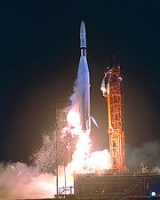
Atlas Agena With Mariner 1
The Mariner program was a program conducted by the American
United States

The United States of America is a Federal government constitutional republic comprising U.S. state and a federal district. The country is situated mostly in central North America, where its Contiguous United States and Washington, D.C., the Capital districts and territories, lie between the Pacific Ocean and Atlantic Oceans, Borders of the U...
 space agency NASA
NASA

The National Aeronautics and Space Administration is an agency of the Federal government of the United States, responsible for the nation's public list of space agencies....
 that launched a series of robotic interplanetary probes
Space probe

A robotic spacecraft is a spacecraft with no humans on board, that is usually under telerobotic control. A robotic spacecraft designed to make scientific research measurements is often called a space probe....
 designed to investigate Mars
MARS

In cryptography, MARS is a block cipher that was IBM's submission to the Advanced Encryption Standard process. MARS was selected as an AES finalist in August 1999, after the AES2 conference in March 1999, where it was voted as the fifth and last finalist algorithm....
, Venus
Venus

Venus is the second-closest planet to the Sun, orbiting it every 224.7 Earth days. The planet is named after Venus , the Roman mythology goddess of love....
 and Mercury
Mercury (planet)

Mercury is the innermost and smallest planet in the Solar System, orbiting the Sun once every 88 days. The orbit of Mercury has the highest Orbital eccentricity of all the Solar System planets, and it has the smallest axial tilt....
. The program included a number of firsts, including the first planetary flyby, the first pictures from another planet, the first planetary orbiter
Orbiter

An orbiter is a space probe that orbits a planet or natural satellite without landing on it in order to study its surface from a distance....
, and the first gravity assist
Gravitational slingshot

In orbital mechanics and aerospace engineering, a gravitational slingshot, gravity assist or swing-by is the use of the relative movement and gravity of a planet or other celestial body to alter the path and speed of a spacecraft, typically in order to save fuel, time, and expense....
 maneuver.

Of the ten vehicles in the Mariner series, seven were successful and three were lost. The planned Mariner 11 and Mariner 12 vehicles evolved into Voyager 1
Voyager 1

The spacecraft is a 722-kilogram Robotic spacecraft space probe of the outer Solar System and beyond, launched September 5, 1977. It remains operational, currently pursuing its extended mission to locate and study the boundaries of the Solar System, including the Kuiper belt and beyond....
 and Voyager 2
Voyager 2

The spacecraft is an Unmanned space mission interplanetary space probe launched on August 20, 1977. Identical in form to its sister Voyager program craft Voyager 1, Voyager 2 followed a slower trajectory that allowed it to be kept in the ecliptic so that it could be sent to Uranus and Neptune by means of gravity assist during...
 of the Voyager program
Voyager program

The Voyager program is a series of U.S. unmanned space missions that consists of a pair of unmanned scientific Space probes, Voyager 1 and Voyager 2....
, while the Viking 1
Viking 1

Viking 1 was the first of two spacecraft sent to Mars as part of NASA's Viking program, and holds the record for the longest Mars surface mission of 6 years and 116 days ....
 and Viking 2
Viking 2

The Viking 2 mission was part of the Viking program to Mars , and consisted of an orbiter and a lander essentially identical to that of the Viking 1 mission....
 Mars orbiters were enlarged versions of the Mariner 9
Mariner 9

Mariner 9 was a NASA space probe orbiter that helped in the exploration of Mars and was part of the Mariner program. Mariner 9 was launched toward Mars on May 30, 1971 from Cape Canaveral Air Force Station and reached the planet on November 13 of the same year, becoming the first spacecraft to orbit another planet ? only narrowly beating So...
 spacecraft. Other Mariner-based spacecraft, launched since Voyager, included the Magellan probe to Venus, and the Galileo
Galileo spacecraft

Galileo was an unmanned spacecraft sent by NASA to study the planet Jupiter and its natural satellites. Named after the astronomer and Renaissance pioneer Galileo Galilei, it was launched on October 18, 1989 by the Space Shuttle Atlantis on the STS-34 mission....
 probe to Jupiter
Jupiter

Jupiter is the fifth planet from the Sun and the Solar system by size planet within the Solar System. It is two and a half times as massive as all of the other planets in our Solar System combined....
. A second-generation Mariner spacecraft, called the Mariner Mark II
Mariner Mark II

Mariner Mark II was NASA's planned family of unmanned spacecraft for the exploration of the outer solar system that were to be developed and operated by JPL between 1990 through the year 2010....
 series, eventually evolved into the Cassini-Huygens
Cassini-Huygens

Cassini?Huygens is a joint NASA/European Space Agency robotic spacecraft mission currently studying the planet Saturn and Saturn's natural satellites....
 probe, now in orbit around Saturn
Saturn

Saturn is the sixth planet from the Sun and the second largest planet in the Solar System, after Jupiter. Saturn, along with Jupiter, Uranus and Neptune, is classified as a gas giant....
.

Basic layout

All Mariner spacecraft were based on a hexagonal or octagonal "bus", which housed all of the electronics, and to which all components were attached, such as antennae, cameras, propulsion, and power sources. All of the Mariners launched after Mariner 2
Mariner 2

Mariner 2 , a space probe to Venus, was the first successful spacecraft in the NASA Mariner program. It was a simplified version of the Block I spacecraft of the Ranger program and an exact copy of Mariner 1....
 had four solar panels for power, except for Mariner 10
Mariner 10

Mariner 10 was a Robotic spacecraft space probe launched on November 3, 1973 to fly by the planets Mercury and Venus. It was launched approximately 2 years after Mariner 9 and was the last spacecraft in the Mariner program ....
, which had two, and Mariner 2
Mariner 2

Mariner 2 , a space probe to Venus, was the first successful spacecraft in the NASA Mariner program. It was a simplified version of the Block I spacecraft of the Ranger program and an exact copy of Mariner 1....
, which was based on the Ranger
Ranger program

The Ranger program was a series of unmanned space missions by the United States in the 1960s whose objective was to obtain the first close-up images of the surface of the Moon....
 Lunar probe. Additionally, all except Mariner 1
Mariner 1

Mariner 1 was the first spacecraft of the Mariner program. Launched on July 22, 1962 as a Venus Planetary flyby mission, a range safety officer ordered its destructive abort at 09:26:16 UT, 293 seconds after launch....
, Mariner 2
Mariner 2

Mariner 2 , a space probe to Venus, was the first successful spacecraft in the NASA Mariner program. It was a simplified version of the Block I spacecraft of the Ranger program and an exact copy of Mariner 1....
 and Mariner 5
Mariner 5

Mariner 5 was a spacecraft of the Mariner program that carried a complement of experiments to probe Venus' atmosphere by radio occultation, measure the hydrogen Lyman-alpha spectrum, and sample the solar particles and magnetic field fluctuations above the planet....
 had TV cameras.

The first five Mariners were launched on Atlas-Agena
Atlas-Agena

The Atlas-Agena was an United States expendable launch system derived from the SM-65 Atlas missile. It was a member of the Atlas family of rockets, and was used for 119 orbital launches between 1960 and 1978....
 rocket
Rocket

A rocket or rocket vehicle is a missile, aircraft or other vehicle which obtains thrust by the Reaction of the rocket to the ejection of fast moving fluid exhaust from a rocket engine....
s, while the last five used the Atlas-Centaur
Atlas-Centaur

The Atlas-Centaur was an United States expendable launch system derived from the SM-65 Atlas missile. It was a member of the Atlas family of rockets, and was used for 61 orbital launches between 1962 and 1983....
. All Mariner-based probes after Mariner 10
Mariner 10

Mariner 10 was a Robotic spacecraft space probe launched on November 3, 1973 to fly by the planets Mercury and Venus. It was launched approximately 2 years after Mariner 9 and was the last spacecraft in the Mariner program ....
 used the Titan IIIE
Titan III

The Titan IIIC was a space booster used by the United States Air Force. It was launched from Cape Canaveral Air Force Station, FL., and Vandenberg Air Force Base, CA....
, Titan IV
Titan IV

The Titan IV family of space boosters were used by the U.S. Air Force. They were rocket launch from Cape Canaveral Air Force Station, Florida, and Vandenberg Air Force Base, California....
 unmanned rockets or the Space Shuttle
Space Shuttle

NASA's Space Shuttle, officially called the Space Transportation System , is the spacecraft currently used by the United States government for its human spaceflight missions....
 with a solid-fueled Inertial Upper Stage
Inertial Upper Stage

The Inertial Upper Stage , originally known as the Interim Upper Stage, is a two-stage solid-fueled booster rocket developed by the U.S. Air Force for the launching of large payloads from either a Titan III rocket or from the payload bay of the Space Shuttle....
 and multiple planetary flybys.

Mariners 1 and 2

Mariner 1
Mariner 1

Mariner 1 was the first spacecraft of the Mariner program. Launched on July 22, 1962 as a Venus Planetary flyby mission, a range safety officer ordered its destructive abort at 09:26:16 UT, 293 seconds after launch....
 was intended to fly by Venus. The spacecraft was launched on July 22, 1962, but was destroyed approximately 5 minutes after liftoff by the Air Force Range Safety Officer
Range Safety Officer

In the field of rocketry, Range Safety Officer is a generic term referring to an individual who monitors the performance of rockets in flight, and who is responsible for their remote destruction if it should be judged that they pose a hazard....
 when its malfunctioning Atlas-Agena
Atlas-Agena

The Atlas-Agena was an United States expendable launch system derived from the SM-65 Atlas missile. It was a member of the Atlas family of rockets, and was used for 119 orbital launches between 1960 and 1978....
 rocket went off course. Mariner 2
Mariner 2

Mariner 2 , a space probe to Venus, was the first successful spacecraft in the NASA Mariner program. It was a simplified version of the Block I spacecraft of the Ranger program and an exact copy of Mariner 1....
 was built as a backup to Mariner 1 and was launched on August 27, 1962, sending it on a 3½-month flight to Venus. The mission was a success and Mariner 2 became the first spacecraft to fly by another planet.
  • Mission: Venus flyby
  • Mass: 203 kg (446 lb)
  • Sensors: microwave
    Microwave

    Microwaves are electromagnetic radiation with wavelengths ranging from 1 mm to 1 m, or frequency between 0.3 hertz and 300 GHz....
     and infrared
    Infrared

    Infrared radiation is electromagnetic radiation whose wavelength is longer than that of visible light , but shorter than that of terahertz radiation and microwaves ....
     radiometers, cosmic dust, solar plasma
    Plasma (physics)

    In physics and chemistry, plasma is a partially ionized gas, in which a certain proportion of electrons are free rather than being bound to an atom or molecule....
     and high-energy radiation
    Radiation

    In physics, radiation describes any process in which energy emitted by one body travels through a medium or through space, ultimately to be absorbed by another body....
    , magnetic field
    Magnetic field

    A magnetism field is a vector field which can exert a magnetic force on moving electric charges and on magnetic dipoles . When placed in a magnetic field, magnetic dipoles tend to align their axes parallel to the magnetic field....
    s
Status:
  • Mariner 1 - Destroyed shortly after liftoff.
  • Mariner 2 - Defunct. Trapped in a Heliocentric orbit
    Heliocentric orbit

    A heliocentric orbit is an orbit around the Sun. In our Solar System, all planets, comets, and asteroids are in such orbits, as are many artificial Space probe and pieces of Space debris....
    .


Mariners 3 and 4


Mariner 3 and 4
Mariner 3
Mariner 3

Mariner 3 and Mariner 4 were identical spacecraft of the Mariner program designed to carry out the first flybys of Mars and obtain photographs of the planet's surface....
 and Mariner 4
Mariner 4

Mariner 4 was the Mariner program, launched on November 28, 1964, intended for planetary exploration in a flyby mode and performed the first successful planetary flyby of the planet Mars, returning the first pictures of the Martian surface....
 were Mars flyby missions. Mariner 3
Mariner 3

Mariner 3 and Mariner 4 were identical spacecraft of the Mariner program designed to carry out the first flybys of Mars and obtain photographs of the planet's surface....
 was lost when the launch vehicle's nose fairing failed to jettison. Its sister ship, Mariner 4
Mariner 4

Mariner 4 was the Mariner program, launched on November 28, 1964, intended for planetary exploration in a flyby mode and performed the first successful planetary flyby of the planet Mars, returning the first pictures of the Martian surface....
, launched on November 28, 1964, was the first successful flyby of the planet
Planet

A planet , as 2006 definition of planet by the International Astronomical Union , is a celestial body orbiting a star or Stellar evolution#Stellar remnants that is massive enough to be rounded by its own gravity, is not massive enough to cause thermonuclear fusion, and has cleared the neighbourhood of planetesimals....
 Mars
MARS

In cryptography, MARS is a block cipher that was IBM's submission to the Advanced Encryption Standard process. MARS was selected as an AES finalist in August 1999, after the AES2 conference in March 1999, where it was voted as the fifth and last finalist algorithm....
 and gave the first glimpse of Mars
MARS

In cryptography, MARS is a block cipher that was IBM's submission to the Advanced Encryption Standard process. MARS was selected as an AES finalist in August 1999, after the AES2 conference in March 1999, where it was voted as the fifth and last finalist algorithm....
 at close range.
  • Mission: Mars
    MARS

    In cryptography, MARS is a block cipher that was IBM's submission to the Advanced Encryption Standard process. MARS was selected as an AES finalist in August 1999, after the AES2 conference in March 1999, where it was voted as the fifth and last finalist algorithm....
     flyby
  • Mass: 261 kg (575 lb)
  • Sensors: camera
    Camera

    A camera is a device that records images, either as a still photograph or as moving images known as videos or movies. The term comes from the camera obscura , an early mechanism of projecting images where an entire room functioned as a real-time imaging system; the modern camera evolved from the camera obscura....
     with digital tape recorder (about 20 pictures), cosmic dust
    Cosmic dust

    Cosmic dust is a type of dust composed of particles in space which are a few molecules to 0.1 mm in size. Cosmic dust can be further distinguished by its astronomical location; for example: intergalactic dust, interstellar dust , interplanetary dust and circumplanetary dust ....
    , solar plasma, trapped radiation, cosmic rays, magnetic fields, radio occultation and celestial mechanics
Status:
  • Mariner 3 - Malfunctioned. Trapped in a Heliocentric orbit
    Heliocentric orbit

    A heliocentric orbit is an orbit around the Sun. In our Solar System, all planets, comets, and asteroids are in such orbits, as are many artificial Space probe and pieces of Space debris....
    .
  • Mariner 4 - Unknown. Communications lost after bombardment by micrometeoroids.


Mariner 5


Mariner05
The Mariner 5
Mariner 5

Mariner 5 was a spacecraft of the Mariner program that carried a complement of experiments to probe Venus' atmosphere by radio occultation, measure the hydrogen Lyman-alpha spectrum, and sample the solar particles and magnetic field fluctuations above the planet....
 spacecraft was launched to Venus
Venus

Venus is the second-closest planet to the Sun, orbiting it every 224.7 Earth days. The planet is named after Venus , the Roman mythology goddess of love....
 on June 14, 1967 and arrived in the vicinity of the planet in October 1967. It carried a complement of experiments to probe Venus
Venus

Venus is the second-closest planet to the Sun, orbiting it every 224.7 Earth days. The planet is named after Venus , the Roman mythology goddess of love....
' atmosphere
Atmosphere

An atmosphere is a layer of gases that may surround a material body of sufficient mass, by the gravity of the body, and are retained for a longer duration if gravity is high and the atmosphere's temperature is low....
 with radio waves
Radio waves

Radio waves are Electromagnetic radiation occurring on the radio frequency portion of the electromagnetic spectrum....
, scan its brightness in ultraviolet light, and sample the solar particles and magnetic field
Magnetic field

A magnetism field is a vector field which can exert a magnetic force on moving electric charges and on magnetic dipoles . When placed in a magnetic field, magnetic dipoles tend to align their axes parallel to the magnetic field....
 fluctuations above the planet.
  • Mission: Venus
    Venus

    Venus is the second-closest planet to the Sun, orbiting it every 224.7 Earth days. The planet is named after Venus , the Roman mythology goddess of love....
     flyby
  • Mass: 245 kg (540 lb)
  • Sensors: ultraviolet photometer, cosmic dust, solar plasma, trapped radiation, cosmic rays, magnetic fields, radio occultation and celestial mechanics
Status: Mariner 5 - Defunct. Trapped in a Heliocentric orbit
Heliocentric orbit

A heliocentric orbit is an orbit around the Sun. In our Solar System, all planets, comets, and asteroids are in such orbits, as are many artificial Space probe and pieces of Space debris....
.

Mariners 6 and 7


Mariner 67
Mariners 6 and 7
Mariner 6 and 7

As part of the wider Mariner program, in 1969 Mariner 6 and Mariner 7 completed the first dual mission to Mars, flying over the equator and south polar regions and analysing atmosphere and surface with remote sensors as well as recording and relaying hundreds of pictures....
 were identical teammates in a two-spacecraft mission to Mars. Mariner 6 was launched on February 24, 1969, followed by Mariner 7 on March 21, 1969. They flew over the equator and southern hemisphere of the planet Mars
MARS

In cryptography, MARS is a block cipher that was IBM's submission to the Advanced Encryption Standard process. MARS was selected as an AES finalist in August 1999, after the AES2 conference in March 1999, where it was voted as the fifth and last finalist algorithm....
.
  • Mission: Mars
    MARS

    In cryptography, MARS is a block cipher that was IBM's submission to the Advanced Encryption Standard process. MARS was selected as an AES finalist in August 1999, after the AES2 conference in March 1999, where it was voted as the fifth and last finalist algorithm....
     flybys
  • Mass 413 kg (908 lb)
  • Sensors: wide- and narrow-angle cameras with digital tape recorder, infrared spectrometer and radiometer, ultraviolet spectrometer, radio occultation and celestial mechanics.
Status:
  • Mariner 6 - Defunct. Trapped in a Heliocentric orbit
    Heliocentric orbit

    A heliocentric orbit is an orbit around the Sun. In our Solar System, all planets, comets, and asteroids are in such orbits, as are many artificial Space probe and pieces of Space debris....
    .
  • Mariner 7 - Defunct. Trapped in a Heliocentric orbit
    Heliocentric orbit

    A heliocentric orbit is an orbit around the Sun. In our Solar System, all planets, comets, and asteroids are in such orbits, as are many artificial Space probe and pieces of Space debris....
    .


Mariners 8 and 9


Mariner09
Mariner 8
Mariner 8

Mariner-H, also commonly known as Mariner 8, was part of the Mariner Mars 71 project. It was intended to go into Mars orbit and return images and data....
 and Mariner 9
Mariner 9

Mariner 9 was a NASA space probe orbiter that helped in the exploration of Mars and was part of the Mariner program. Mariner 9 was launched toward Mars on May 30, 1971 from Cape Canaveral Air Force Station and reached the planet on November 13 of the same year, becoming the first spacecraft to orbit another planet ? only narrowly beating So...
 were identical sister craft designed to map the Martian surface simultaneously, but Mariner 8 was lost in a launch vehicle failure. Its identical sister craft, Mariner 9, was launched in May 1971 and became the first artificial satellite of Mars. It entered Martian orbit in November 1971 and began photographing the surface and analyzing the atmosphere with its infrared and ultraviolet instruments.
  • Mission: orbit Mars
  • Mass 998 kg (2,200 lb)
  • Sensors: wide- and narrow-angle cameras with digital tape recorder, infrared spectrometer and radiometer, ultraviolet spectrometer, radio occultation and celestial mechanics
Status:
  • Mariner 8 - Destroyed in a launch vehicle failure.
  • Mariner 9 - Shut off. In Areocentric (Mars) orbit until at least 2022 when it will fall out of orbit and into the Martian atmosphere.


Mariner 10


Mariner10
The Mariner 10
Mariner 10

Mariner 10 was a Robotic spacecraft space probe launched on November 3, 1973 to fly by the planets Mercury and Venus. It was launched approximately 2 years after Mariner 9 and was the last spacecraft in the Mariner program ....
 spacecraft launched on November 3, 1973 and was the first to use a gravity assist trajectory, accelerating as it entered the gravitational influence of Venus, then being flung by the planet's gravity onto a slightly different course to reach Mercury. It was also the first spacecraft to encounter two planets at close range, and for 33 years the only spacecraft to photograph Mercury in closeup.
  • Mission: Venus and Mercury flybys
  • Mass: 433 kg (952 lb)
  • Sensors: twin narrow-angle cameras with digital tape recorder, ultraviolet spectrometer, infrared radiometer, solar plasma, charged particles, magnetic fields, radio occultation and celestial mechanics
Status: Mariner 10 - Defunct. Trapped in Heliocentric orbit
Heliocentric orbit

A heliocentric orbit is an orbit around the Sun. In our Solar System, all planets, comets, and asteroids are in such orbits, as are many artificial Space probe and pieces of Space debris....
.