


Deep Space Network

Encyclopedia
The Deep Space Network, or DSN, is a world-wide network of large antennas and communication facilities that supports interplanetary spacecraft
missions. It also performs radio
and radar astronomy
observations for the exploration of the solar system
and the universe
, and supports selected Earth
-orbiting missions. DSN is part of the NASA
Jet Propulsion Laboratory
(JPL). Other similar networks include ESTRACK
of the European Space Agency
, the Soviet Deep Space Network
, the Indian Deep Space Network
, and the Chinese Deep Space Network
.
(LEO). Deep space missions are visible for long periods of time from a large portion of the Earth's surface, and so require few stations (the DSN has only three main sites). These few stations, however, require huge antennas, ultra-sensitive receivers, and powerful transmitters in order to transmit and receive over the vast distances involved.
Deep space is defined in two different ways. The first is when a mission gets sufficiently far from Earth that it is always in view of one of the tracking stations. This distance, about 20-30,000 km or 10-16,000 miles, was the definition used during Apollo and early days of the DSN. The more modern definition is from the International Telecommunications Union, which sets aside various frequency bands for deep space and near Earth use. According to this definition, deep space starts at a distance of 2,000,000 km from the Earth's surface.
The forerunner of the DSN was established in January 1958, when JPL, then under contract to the U.S. Army, deployed portable radio tracking stations in Nigeria, Singapore, and California to receive telemetry
and plot the orbit of the Army-launched Explorer 1, the first successful U.S. satellite
. NASA
was officially established on October 1, 1958, to consolidate the separately developing space-exploration programs of the US Army, US Navy, and US Air Force into one civilian organization.
On December 3, 1958, JPL was transferred from the US Army to NASA and given responsibility for the design and execution of lunar and planetary exploration programs using remotely-controlled spacecraft. Shortly after the transfer NASA established the concept of the Deep Space Network as a separately managed and operated communications system that would accommodate all deep space
missions, thereby avoiding the need for each flight project to acquire and operate its own specialized space communications network. The DSN was given responsibility for its own research, development, and operation in support of all of its users. Under this concept, it has become a world leader in the development of low-noise receivers; large parabolic-dish antennas; tracking, telemetry, and command systems; digital signal processing; and deep space navigation.
The largest antennas of the DSN are often called on during spacecraft emergencies. Almost all spacecraft are designed so normal operation can be conducted on the smaller (and more economical) antennas of the DSN, but during an emergency the use of the largest antennas is crucial. This is because a troubled spacecraft may be forced to use less than its normal transmitter power, attitude control
problems may preclude the use of high-gain antenna
s, and recovering every bit of telemetry is critical to assessing the health of the spacecraft and planning the recovery. The most famous example is the Apollo 13
mission, where limited battery power and inability to use the spacecraft's high gain antennas reduced signal levels below the capability of the Manned Space Flight Network
, and the use of the biggest DSN antennas (and the Australian Parkes Observatory
radio telescope) was critical to saving the lives of the astronauts. While Apollo was also a US mission, DSN provides this emergency service to other space agencies as well, in a spirit of inter-agency and international cooperation. For example, the recovery of the Solar and Heliospheric Observatory
(SOHO) mission of the European Space Agency
(ESA) would not have been possible without the use of the largest DSN facilities.
, although primary responsibility was held by the Manned Space Flight Network
. The DSN designed the MSFN stations for lunar communication and provided a second antenna at each MSFN site (the MSFN sites were near the DSN sites for just this reason). Two antennas at each site were needed both for redundancy and because the beam widths of the large antennas needed were too small to encompass both the lunar orbiter and the lander at the same time. DSN also supplied some larger antennas as needed, in particular for television broadcasts from the Moon, and emergency communications such as Apollo 13.
From a NASA report describing how the DSN and MSFN cooperated for Apollo:
The details of this cooperation and operation are available in a two-volume technical report from JPL.
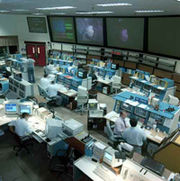 DSN currently consists of three deep-space communications facilities placed approximately 120 degrees apart around the Earth. They are:
Each facility is situated in semi-mountainous, bowl-shaped terrain to help shield against radio frequency interference. The strategic 120-degree placement permits constant observation of spacecraft as the Earth rotates, and helps to make the DSN the largest and most sensitive scientific telecommunications system in the world.
The antennas at all three DSN Complexes communicate directly with the Deep Space Operations Center (DSOC) located at the JPL facilities in Pasadena, California. DSOC personnel monitor and direct operations, and oversee the quality of spacecraft telemetry and navigation data delivered to network users. In addition to the DSN complexes and the operations center, a ground communications facility provides communications that link the three complexes to the operations center at JPL, to space flight control centers in the United States and overseas, and to scientists around the world.
NASA's
scientific investigation of the Solar System is being accomplished mainly through the use of unmanned spacecraft
. The DSN provides the vital two-way communications link that guides and controls these machines, and brings back the images and new scientific information they collect. All DSN antennas are steerable, high-gain, parabolic reflector
antennas.
The antennas and data delivery systems make it possible to:
(Caltech). The Interplanetary Network Directorate (IND) manages the program within JPL and is charged with the development and operation of it. The IND is considered to be JPL's focal point for all matters relating to telecommunications, interplanetary navigation, information systems, information technology, computing, software engineering, and other relevant technologies. While the IND is best known for its duties relating to the Deep Space Network, the organization also maintains the JPL Advanced Multi-Mission Operations System
(AMMOS) and JPL's Institutional Computing and Information Services (ICIS).
ITT Systems is under a 5 year contract to JPL for the DSN Operations and Maintenance. ITT has responsibility for managing the Goldstone complex, operating the DSOC, and for DSN Operations, Mission Planning, Operations Engineering, and Logistics.http://www.itt.com/press-releases/NewsView.aspx?NewsID=10
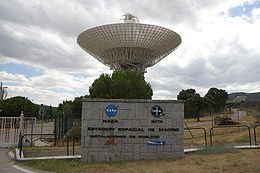
 Each complex consists of at least four deep space terminals equipped with ultra-sensitive receiving systems and large parabolic-dish antennas. There are:
Five of the 34 metres (111.5 ft) beam waveguide antennas were added to the system in the late 1990s. Three were located at Goldstone, and one each at Canberra and Madrid. A second 34 metres (111.5 ft) beam waveguide antenna (the network's sixth) was completed at the Madrid complex in 2004.
In order to meet the current and future needs of deep space communication services, a number of new Deep Space Station antennas needs to be built at the existing Deep Space Network sites. At the Canberra Deep Space Communication Complex the first of these antennas are currently under construction. The first of the new antennas will be coming online by 2014 to 2016.http://www.cdscc.nasa.gov/Pages/antennas.html
The ability to array several antennas was incorporated to improve the data returned from the Voyager 2
Neptune encounter, and extensively used for the Galileo spacecraft
, when the high gain antenna did not deploy correctly.
The DSN array currently available since the Galileo mission can link the 70 metres (229.7 ft) dish antenna at the Deep Space Network complex in Goldstone, California, with an identical antenna located in Australia, in addition to two 34 metres (111.5 ft) antennas at the Canberra complex. The California and Australia sites were used concurrently to pick up communications with Galileo.
Arraying of antennas within the three DSN locations is also used. For example, a 70 metres (229.7 ft) dish antenna can be arrayed with a 34-meter dish. For especially vital missions, like Voyager 2, the Canberra 70 metres (229.7 ft) dish can be arrayed with the Parkes Radio Telescope in Australia; and the Goldstone 70-meter dish can be arrayed with the Very Large Array
of antennas in New Mexico. Also, two or more 34 metres (111.5 ft) dishes at one DSN location are commonly arrayed together.
All the stations are remotely operated from a centralized Signal Processing Center at each complex. These Centers house the electronic subsystems that point and control the antennas, receive and process the telemetry data, transmit commands, and generate the spacecraft navigation data. Once the data is processed at the complexes, it is transmitted to JPL for further processing and for distribution to science teams over a modern communications network.
 There are a number of limitations to the current DSN, and a number of challenges going forward.
Related Sources and Topics
Other Deep Space Networks and Antennas
Spacecraft
A spacecraft or spaceship is a craft or machine designed for spaceflight. Spacecraft are used for a variety of purposes, including communications, earth observation, meteorology, navigation, planetary exploration and transportation of humans and cargo....
missions. It also performs radio
Radio astronomy
Radio astronomy is a subfield of astronomy that studies celestial objects at radio frequencies. The initial detection of radio waves from an astronomical object was made in the 1930s, when Karl Jansky observed radiation coming from the Milky Way. Subsequent observations have identified a number of...
and radar astronomy
Radar astronomy
Radar astronomy is a technique of observing nearby astronomical objects by reflecting microwaves off target objects and analyzing the echoes. This research has been conducted for six decades. Radar astronomy differs from radio astronomy in that the latter is a passive observation and the former an...
observations for the exploration of the solar system
Solar System
The Solar System consists of the Sun and the astronomical objects gravitationally bound in orbit around it, all of which formed from the collapse of a giant molecular cloud approximately 4.6 billion years ago. The vast majority of the system's mass is in the Sun...
and the universe
Universe
The Universe is commonly defined as the totality of everything that exists, including all matter and energy, the planets, stars, galaxies, and the contents of intergalactic space. Definitions and usage vary and similar terms include the cosmos, the world and nature...
, and supports selected Earth
Earth
Earth is the third planet from the Sun, and the densest and fifth-largest of the eight planets in the Solar System. It is also the largest of the Solar System's four terrestrial planets...
-orbiting missions. DSN is part of the NASA
NASA
The National Aeronautics and Space Administration is the agency of the United States government that is responsible for the nation's civilian space program and for aeronautics and aerospace research...
Jet Propulsion Laboratory
Jet Propulsion Laboratory
Jet Propulsion Laboratory is a federally funded research and development center and NASA field center located in the San Gabriel Valley area of Los Angeles County, California, United States. The facility is headquartered in the city of Pasadena on the border of La Cañada Flintridge and Pasadena...
(JPL). Other similar networks include ESTRACK
ESTRACK
The European Space Operations Centre operates a number of ground-based space-tracking stations for the European Space Agency known as the European Space Tracking network. The stations support various ESA spacecraft and facilitate communications between ground operators and scientific probes such...
of the European Space Agency
European Space Agency
The European Space Agency , established in 1975, is an intergovernmental organisation dedicated to the exploration of space, currently with 18 member states...
, the Soviet Deep Space Network
Soviet Deep Space Network
The Soviet Deep Space Network is a network of large antennas and communication facilities that supports interplanetary spacecraft missions, and radio and radar astronomy observations for the exploration of the solar system and the universe. It was built to support the space missions of the Soviet...
, the Indian Deep Space Network
Indian Deep Space Network
The Indian Deep Space Network is a network of large antennas and communication facilities that supports the interplanetary spacecraft missions of India. It is located at Byalalu, a village about 100 km from Bangalore, India. It was officially inaugurated on 17 October 2008 by ISRO chairman...
, and the Chinese Deep Space Network
Chinese Deep Space Network
The Chinese Deep Space Network is a network of large antennas and communication facilities that supports the lunar and interplanetary spacecraft missions of China....
.
Deep Space Networks
Tracking vehicles in deep space is quite different from tracking missions in low Earth orbitLow Earth orbit
A low Earth orbit is generally defined as an orbit within the locus extending from the Earth’s surface up to an altitude of 2,000 km...
(LEO). Deep space missions are visible for long periods of time from a large portion of the Earth's surface, and so require few stations (the DSN has only three main sites). These few stations, however, require huge antennas, ultra-sensitive receivers, and powerful transmitters in order to transmit and receive over the vast distances involved.
Deep space is defined in two different ways. The first is when a mission gets sufficiently far from Earth that it is always in view of one of the tracking stations. This distance, about 20-30,000 km or 10-16,000 miles, was the definition used during Apollo and early days of the DSN. The more modern definition is from the International Telecommunications Union, which sets aside various frequency bands for deep space and near Earth use. According to this definition, deep space starts at a distance of 2,000,000 km from the Earth's surface.
History
- See History of the Deep Space NetworkHistory of the Deep Space NetworkThe forerunner of the DSN was established in January 1958, when JPL, then under contract to the U.S. Army, deployed portable radio tracking stations in Nigeria, Singapore, and California to receive telemetry and plot the orbit of the Army-launched Explorer 1, the first successful U.S...
The forerunner of the DSN was established in January 1958, when JPL, then under contract to the U.S. Army, deployed portable radio tracking stations in Nigeria, Singapore, and California to receive telemetry
Telemetry
Telemetry is a technology that allows measurements to be made at a distance, usually via radio wave transmission and reception of the information. The word is derived from Greek roots: tele = remote, and metron = measure...
and plot the orbit of the Army-launched Explorer 1, the first successful U.S. satellite
Satellite
In the context of spaceflight, a satellite is an object which has been placed into orbit by human endeavour. Such objects are sometimes called artificial satellites to distinguish them from natural satellites such as the Moon....
. NASA
NASA
The National Aeronautics and Space Administration is the agency of the United States government that is responsible for the nation's civilian space program and for aeronautics and aerospace research...
was officially established on October 1, 1958, to consolidate the separately developing space-exploration programs of the US Army, US Navy, and US Air Force into one civilian organization.
On December 3, 1958, JPL was transferred from the US Army to NASA and given responsibility for the design and execution of lunar and planetary exploration programs using remotely-controlled spacecraft. Shortly after the transfer NASA established the concept of the Deep Space Network as a separately managed and operated communications system that would accommodate all deep space
Deep space exploration
Deep space exploration is the term used for the exploration of deep space and which is usually described as being quite distant away from Earth, within or away from the solar system....
missions, thereby avoiding the need for each flight project to acquire and operate its own specialized space communications network. The DSN was given responsibility for its own research, development, and operation in support of all of its users. Under this concept, it has become a world leader in the development of low-noise receivers; large parabolic-dish antennas; tracking, telemetry, and command systems; digital signal processing; and deep space navigation.
The largest antennas of the DSN are often called on during spacecraft emergencies. Almost all spacecraft are designed so normal operation can be conducted on the smaller (and more economical) antennas of the DSN, but during an emergency the use of the largest antennas is crucial. This is because a troubled spacecraft may be forced to use less than its normal transmitter power, attitude control
Attitude dynamics and control
Spacecraft flight dynamics is the science of space vehicle performance, stability, and control. It requires analysis of the six degrees of freedom of the vehicle's flight, which are similar to those of aircraft: translation in three dimensional axes; and its orientation about the vehicle's center...
problems may preclude the use of high-gain antenna
High-gain antenna
A high-gain antenna is an antenna with a focused, narrow radiowave beam width. This narrow beam width allows more precise targeting of the radio signal - also known as a directional antenna...
s, and recovering every bit of telemetry is critical to assessing the health of the spacecraft and planning the recovery. The most famous example is the Apollo 13
Apollo 13
Apollo 13 was the seventh manned mission in the American Apollo space program and the third intended to land on the Moon. The craft was launched on April 11, 1970, at 13:13 CST. The landing was aborted after an oxygen tank exploded two days later, crippling the service module upon which the Command...
mission, where limited battery power and inability to use the spacecraft's high gain antennas reduced signal levels below the capability of the Manned Space Flight Network
Manned Space Flight Network
The Manned Space Flight Network was a set of tracking stations built to support the American space efforts of Mercury, Gemini, Apollo and Skylab...
, and the use of the biggest DSN antennas (and the Australian Parkes Observatory
Parkes Observatory
The Parkes Observatory is a radio telescope observatory, 20 kilometres north of the town of Parkes, New South Wales, Australia. It was one of several radio antennas used to receive live, televised images of the Apollo 11 moon landing on 20 July 1969....
radio telescope) was critical to saving the lives of the astronauts. While Apollo was also a US mission, DSN provides this emergency service to other space agencies as well, in a spirit of inter-agency and international cooperation. For example, the recovery of the Solar and Heliospheric Observatory
Solar and Heliospheric Observatory
The Solar and Heliospheric Observatory is a spacecraft built by a European industrial consortium led by Matra Marconi Space that was launched on a Lockheed Martin Atlas IIAS launch vehicle on December 2, 1995 to study the Sun, and has discovered over 2100 comets. It began normal operations in May...
(SOHO) mission of the European Space Agency
European Space Agency
The European Space Agency , established in 1975, is an intergovernmental organisation dedicated to the exploration of space, currently with 18 member states...
(ESA) would not have been possible without the use of the largest DSN facilities.
DSN and the Apollo program
Although normally tasked with tracking unmanned spacecraft, the Deep Space Network (DSN) also contributed to the communication and tracking of Apollo missions to the MoonMoon
The Moon is Earth's only known natural satellite,There are a number of near-Earth asteroids including 3753 Cruithne that are co-orbital with Earth: their orbits bring them close to Earth for periods of time but then alter in the long term . These are quasi-satellites and not true moons. For more...
, although primary responsibility was held by the Manned Space Flight Network
Manned Space Flight Network
The Manned Space Flight Network was a set of tracking stations built to support the American space efforts of Mercury, Gemini, Apollo and Skylab...
. The DSN designed the MSFN stations for lunar communication and provided a second antenna at each MSFN site (the MSFN sites were near the DSN sites for just this reason). Two antennas at each site were needed both for redundancy and because the beam widths of the large antennas needed were too small to encompass both the lunar orbiter and the lander at the same time. DSN also supplied some larger antennas as needed, in particular for television broadcasts from the Moon, and emergency communications such as Apollo 13.
From a NASA report describing how the DSN and MSFN cooperated for Apollo:
The details of this cooperation and operation are available in a two-volume technical report from JPL.
General information
- the Goldstone Deep Space Communications ComplexGoldstone Deep Space Communications ComplexThe Goldstone Deep Space Communications Complex — commonly called the Goldstone Observatory — is located in California's Mojave Desert. Operated by ITT Corporation for the Jet Propulsion Laboratory, its main purpose is to track and communicate with space missions. It includes the Pioneer...
outside of BarstowBarstow, CaliforniaBarstow is a city in San Bernardino County, California, United States. The population was 22,639 at the 2010 census, up from 21,119 at the 2000 census. Barstow is located north of San Bernardino....
, California, United States. For details of Goldstone's contribution to the early days of space probe tracking, see Project Space Track; - the Madrid Deep Space Communication ComplexMadrid Deep Space Communication ComplexThe Madrid Deep Space Communications Complex is a ground station located in Robledo de Chavela, Spain, and operated by Ingenieria y Servicios Aeroespaciales, S.A. for Instituto Nacional de Técnica Aeroespacial.-Deep Space Network:...
, 60 kilometres (37.3 mi) west of MadridMadridMadrid is the capital and largest city of Spain. The population of the city is roughly 3.3 million and the entire population of the Madrid metropolitan area is calculated to be 6.271 million. It is the third largest city in the European Union, after London and Berlin, and its metropolitan...
, Spain; and - the Canberra Deep Space Communications Complex (CDSCC)Canberra Deep Space Communication ComplexThe Canberra Deep Space Communication Complex is a ground station that is located in Australia at Tidbinbilla in the Paddys River valley, about half an hour's drive out of Canberra in the Australian Capital Territory. The complex is part of the Deep Space Network run by NASA's Jet Propulsion...
in the Australian Capital TerritoryAustralian Capital TerritoryThe Australian Capital Territory, often abbreviated ACT, is the capital territory of the Commonwealth of Australia and is the smallest self-governing internal territory...
, 40 kilometres (24.9 mi) southwest of CanberraCanberraCanberra is the capital city of Australia. With a population of over 345,000, it is Australia's largest inland city and the eighth-largest city overall. The city is located at the northern end of the Australian Capital Territory , south-west of Sydney, and north-east of Melbourne...
, Australia near the Tidbinbilla Nature ReserveTidbinbilla Nature ReserveTidbinbilla Nature Reserve, on the fringe of Namadgi National Park, is a short drive from the city of Canberra, Australia. The reserve covers an area of approximately 54.50 km² and consists of a large valley floor, the Tidbinbilla Mountain and the Gibraltar range...
.
Each facility is situated in semi-mountainous, bowl-shaped terrain to help shield against radio frequency interference. The strategic 120-degree placement permits constant observation of spacecraft as the Earth rotates, and helps to make the DSN the largest and most sensitive scientific telecommunications system in the world.
The antennas at all three DSN Complexes communicate directly with the Deep Space Operations Center (DSOC) located at the JPL facilities in Pasadena, California. DSOC personnel monitor and direct operations, and oversee the quality of spacecraft telemetry and navigation data delivered to network users. In addition to the DSN complexes and the operations center, a ground communications facility provides communications that link the three complexes to the operations center at JPL, to space flight control centers in the United States and overseas, and to scientists around the world.
NASA's
NASA
The National Aeronautics and Space Administration is the agency of the United States government that is responsible for the nation's civilian space program and for aeronautics and aerospace research...
scientific investigation of the Solar System is being accomplished mainly through the use of unmanned spacecraft
Unmanned spacecraft
Unmanned spacecraft are spacecraft without people on board, and probably includes unmanned resupply spacecraft, space probes, and most space observatories. A difference between robotic spacecraft and unmanned spacecraft, is that unmanned spacecraft is inclusive to non-robotic unmanned spacecraft,...
. The DSN provides the vital two-way communications link that guides and controls these machines, and brings back the images and new scientific information they collect. All DSN antennas are steerable, high-gain, parabolic reflector
Parabolic reflector
A parabolic reflector is a reflective device used to collect or project energy such as light, sound, or radio waves. Its shape is that of a circular paraboloid, that is, the surface generated by a parabola revolving around its axis...
antennas.
The antennas and data delivery systems make it possible to:
- Acquire telemetryTelemetryTelemetry is a technology that allows measurements to be made at a distance, usually via radio wave transmission and reception of the information. The word is derived from Greek roots: tele = remote, and metron = measure...
data from spacecraft. - Transmit commands to spacecraft.
- Upload software modifications to spacecraft.
- Track spacecraft position and velocity.
- Perform Very Long Baseline InterferometryVery Long Baseline InterferometryVery Long Baseline Interferometry is a type of astronomical interferometry used in radio astronomy. It allows observations of an object that are made simultaneously by many telescopes to be combined, emulating a telescope with a size equal to the maximum separation between the telescopes.Data...
observations. - Measure variations in radio waves for radio science experiments.
- Gather science data.
- Monitor and control the performance of the network.
Management
The network is a NASA facility and is managed and operated for NASA by JPL, which is part of the California Institute of TechnologyCalifornia Institute of Technology
The California Institute of Technology is a private research university located in Pasadena, California, United States. Caltech has six academic divisions with strong emphases on science and engineering...
(Caltech). The Interplanetary Network Directorate (IND) manages the program within JPL and is charged with the development and operation of it. The IND is considered to be JPL's focal point for all matters relating to telecommunications, interplanetary navigation, information systems, information technology, computing, software engineering, and other relevant technologies. While the IND is best known for its duties relating to the Deep Space Network, the organization also maintains the JPL Advanced Multi-Mission Operations System
Advanced Multi-Mission Operations System
The Advanced Multi-Mission Operations System is a common set of services and tools created by the Interplanetary Network Directorate, a division of the Jet Propulsion Laboratory, for use in JPL's operation of spacecraft...
(AMMOS) and JPL's Institutional Computing and Information Services (ICIS).
ITT Systems is under a 5 year contract to JPL for the DSN Operations and Maintenance. ITT has responsibility for managing the Goldstone complex, operating the DSOC, and for DSN Operations, Mission Planning, Operations Engineering, and Logistics.http://www.itt.com/press-releases/NewsView.aspx?NewsID=10
Antennas
- One 34 metres (111.5 ft) diameter High Efficiency antenna.
- One or more 34 metres (111.5 ft) Beam waveguide antennaBeam waveguide antennaA beam waveguide antenna is a specific variety of parabolic dish that sends the transmitted or received signal from a stationary transmitter or receiver to a movable dish by means of a beam waveguide. With a conventional parabolic antenna, the transmitter or receiver is mounted at the focus, and...
s (three at the Goldstone ComplexGoldstone Deep Space Communications ComplexThe Goldstone Deep Space Communications Complex — commonly called the Goldstone Observatory — is located in California's Mojave Desert. Operated by ITT Corporation for the Jet Propulsion Laboratory, its main purpose is to track and communicate with space missions. It includes the Pioneer...
, two at the Robledo de Chavela complex (near MadridMadridMadrid is the capital and largest city of Spain. The population of the city is roughly 3.3 million and the entire population of the Madrid metropolitan area is calculated to be 6.271 million. It is the third largest city in the European Union, after London and Berlin, and its metropolitan...
), and one at the Canberra Complex). - One 26 metres (85.3 ft) antenna.
- One 70 metres (229.7 ft) antenna.
Five of the 34 metres (111.5 ft) beam waveguide antennas were added to the system in the late 1990s. Three were located at Goldstone, and one each at Canberra and Madrid. A second 34 metres (111.5 ft) beam waveguide antenna (the network's sixth) was completed at the Madrid complex in 2004.
In order to meet the current and future needs of deep space communication services, a number of new Deep Space Station antennas needs to be built at the existing Deep Space Network sites. At the Canberra Deep Space Communication Complex the first of these antennas are currently under construction. The first of the new antennas will be coming online by 2014 to 2016.http://www.cdscc.nasa.gov/Pages/antennas.html
Current signal processing capabilities
The general capabilities of the DSN have not substantially changed since the beginning of the Voyager Interstellar Mission in the early 1990s. However, many advancements in digital signal processing, arraying and error correction have been adopted by the DSN.The ability to array several antennas was incorporated to improve the data returned from the Voyager 2
Voyager 2
The Voyager 2 spacecraft is a 722-kilogram space probe launched by NASA on August 20, 1977 to study the outer Solar System and eventually interstellar space...
Neptune encounter, and extensively used for the Galileo spacecraft
Galileo spacecraft
Galileo was an unmanned spacecraft sent by NASA to study the planet Jupiter and its moons. Named after the astronomer and Renaissance pioneer Galileo Galilei, it was launched on October 18, 1989 by the Space Shuttle Atlantis on the STS-34 mission...
, when the high gain antenna did not deploy correctly.
The DSN array currently available since the Galileo mission can link the 70 metres (229.7 ft) dish antenna at the Deep Space Network complex in Goldstone, California, with an identical antenna located in Australia, in addition to two 34 metres (111.5 ft) antennas at the Canberra complex. The California and Australia sites were used concurrently to pick up communications with Galileo.
Arraying of antennas within the three DSN locations is also used. For example, a 70 metres (229.7 ft) dish antenna can be arrayed with a 34-meter dish. For especially vital missions, like Voyager 2, the Canberra 70 metres (229.7 ft) dish can be arrayed with the Parkes Radio Telescope in Australia; and the Goldstone 70-meter dish can be arrayed with the Very Large Array
Very Large Array
The Very Large Array is a radio astronomy observatory located on the Plains of San Agustin, between the towns of Magdalena and Datil, some fifty miles west of Socorro, New Mexico, USA...
of antennas in New Mexico. Also, two or more 34 metres (111.5 ft) dishes at one DSN location are commonly arrayed together.
All the stations are remotely operated from a centralized Signal Processing Center at each complex. These Centers house the electronic subsystems that point and control the antennas, receive and process the telemetry data, transmit commands, and generate the spacecraft navigation data. Once the data is processed at the complexes, it is transmitted to JPL for further processing and for distribution to science teams over a modern communications network.
Network limitations and challenges
- There is only one DSN site in the Southern HemisphereSouthern HemisphereThe Southern Hemisphere is the part of Earth that lies south of the equator. The word hemisphere literally means 'half ball' or "half sphere"...
, Canberra.http://www.cdscc.nasa.gov/Pages/trackingtoday.html There are no other DSN network dishes in South America or Southern Africa, so the DSN coverage of the Southern Hemisphere is limited. - The need to support "legacy" missions that have remained operational beyond their original lifetimes but are still returning scientific data. Programs such as VoyagerVoyager programThe Voyager program is a U.S program that launched two unmanned space missions, scientific probes Voyager 1 and Voyager 2. They were launched in 1977 to take advantage of a favorable planetary alignment of the late 1970s...
have been operating long past their original mission termination date. They also need some of the largest antennas. - The DSN has deferred maintenance of its 70m antennas. In general the DSN has deferred major upkeep events of its antennas since the 1990s, when it comes to replacing major components. This causes problems as it leave the antennas out of service for months at a time. Furthermore, the antennas are reaching the end of their lives. At some point many of the DSN antennas will need to be replaced. The leading candidate is an array of smaller dishes.
- By 2020, the DSN may be required to support twice the number of missions it was supporting in 2005. The 2007–present global economic crisis has limited the number of new missions somewhat. However, due to decay and lack of replacement of the existing antennas increased mission support will continue to be an ongoing problem.
See also
Extended NASA missions- Mars Exploration Rovers
- Opportunity roverOpportunity roverOpportunity, MER-B , is a robotic rover on the planet Mars, active since 2004. It is the remaining rover in NASA's ongoing Mars Exploration Rover Mission...
- Spirit roverSpirit roverSpirit, MER-A , is a robotic rover on Mars, active from 2004 to 2010. It was one of two rovers of NASA's ongoing Mars Exploration Rover Mission. It landed successfully on Mars at 04:35 Ground UTC on January 4, 2004, three weeks before its twin, Opportunity , landed on the other side of the planet...
- Opportunity rover
- Voyager programVoyager programThe Voyager program is a U.S program that launched two unmanned space missions, scientific probes Voyager 1 and Voyager 2. They were launched in 1977 to take advantage of a favorable planetary alignment of the late 1970s...
(Helosheath & Heliopause)- Voyager 1Voyager 1The Voyager 1 spacecraft is a 722-kilogram space probe launched by NASA in 1977, to study the outer Solar System and eventually interstellar space. Operating for as of today , the spacecraft receives routine commands and transmits data back to the Deep Space Network. At a distance of as of...
- Voyager 2Voyager 2The Voyager 2 spacecraft is a 722-kilogram space probe launched by NASA on August 20, 1977 to study the outer Solar System and eventually interstellar space...
- Voyager 1
- Cassini–Huygens (Saturn)
Related Sources and Topics
- Space NetworkSpace NetworkSpace Network is a NASA program that combines space and ground elements to support spacecraft communications in Earth vicinity. The SN Project Office at Goddard Space Flight Center manages the SN, which consists of:...
- Near Earth NetworkNear Earth NetworkThe Near Earth Network provides orbital communications support for Near-Earth orbiting customer platforms via various NASA ground stations.NASA's NEN consists of ground stations in:...
- Space Communications and Navigation ProgramSpace Communications and Navigation ProgramThe Space Communications and Navigation program places the three prime NASA space communications networks, Space Network , Near Earth Network , and the Deep Space Network , under one Management and Systems Engineering umbrella. It was established in 2006...
(SCaN) - Tracking and Data Relay SatelliteTracking and Data Relay SatelliteA Tracking and Data Relay Satellite is a type of communications satellite that forms part of the Tracking and Data Relay Satellite System used by NASA and other United States government agencies for communications to and from independent "User Platforms" such as satellites, balloons, aircraft,...
- List of observatories
- List of radio telescopes
Other Deep Space Networks and Antennas
- Indian Deep Space NetworkIndian Deep Space NetworkThe Indian Deep Space Network is a network of large antennas and communication facilities that supports the interplanetary spacecraft missions of India. It is located at Byalalu, a village about 100 km from Bangalore, India. It was officially inaugurated on 17 October 2008 by ISRO chairman...
- ESTRACKESTRACKThe European Space Operations Centre operates a number of ground-based space-tracking stations for the European Space Agency known as the European Space Tracking network. The stations support various ESA spacecraft and facilitate communications between ground operators and scientific probes such...
- Usuda Deep Space CenterUsuda Deep Space CenterUsuda Deep Space Center is a facility of the Japan Aerospace Exploration Agency It is a spacecraft tracking stationopened in October, 1984. The main feature of the station is a 64 meter beam waveguide antenna...
- Chinese Deep Space NetworkChinese Deep Space NetworkThe Chinese Deep Space Network is a network of large antennas and communication facilities that supports the lunar and interplanetary spacecraft missions of China....
External links and further reading
- NASA/Caltech JPL DSN – official site.
- Basics of Space Flight – Chapter 18. Deep Space Network
- Deep Space Communications and Navigation Series – a series of books published by Wiley detailing specifics on the Deep Space Network, JPL's site on DESCANSO, Wiley's Site
- Douglas J. Mudgway, Big Dish: Building America's Deep Space Connection to the Planets, University of Florida Press, 2005 ISBN 0-8130-2805-1.
- (PDF) April 2006 GAO report NASA's Deep Space Network: Current Management Structure Is Not Conducive to Effectively Matching Resources with Future Requirements
- An Early NASA Pioneer Still on the Job in Deep Space
- ESA and NASA extend ties with major new cross-support agreement, on ESA Spacecraft Operations site; retrieved October 19, 2007