


Planetary ring

Encyclopedia
A planetary ring is a ring of cosmic dust
and other small particles orbit
ing around a planet
in a flat disc-shaped region.
The most notable planetary rings known in Earth's solar system are those around
Saturn
, but the other three gas giant
s of the solar system
(Jupiter
, Uranus
and Neptune
) possess ring systems of their own.
Reports in March 2008 have suggested that the Saturnian moon Rhea
may have its own tenuous ring system
, which would make it the only moon known to possess a ring system. A later study published in 2010 revealed that imaging of Rhea from the Cassini mission was inconsistent with the predicted properties of the rings, suggesting that some other mechanism is responsible for the magnetic effects that had led to the ring hypothesis.
that was within the Roche limit
of the planet and thus could not coalesce to form moons; from the debris of a moon
that was disrupted by a large impact; or from the debris of a moon that was disrupted by tidal stresses when it passed within the planet's Roche limit. Most rings were thought to be unstable and to dissipate over the course of tens or hundreds of millions of years, but it now appears that Saturn's rings might be quite old, dating to the early days of the Solar system.
The composition of ring particles varies; they may be silicate or icy dust. Larger rocks and boulders may also be present, and in 2007 tidal effects from eight 'moonlets' only a few hundred meters across were detected within Saturn's rings.
Sometimes rings will have "shepherd" moons, small moons that orbit near the outer edges of rings or within gaps in the rings. The gravity of shepherd moons serves to maintain a sharply defined edge to the ring; material that drifts closer to the shepherd moon's orbit is either deflected back into the body of the ring, ejected from the system, or accreted onto the moon itself.
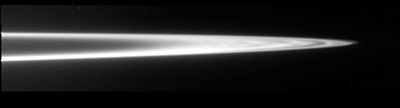
Several of Jupiter
's small innermost moons, namely Metis
and Adrastea
, are within Jupiter's ring system and are also within Jupiter's Roche limit
. It is possible that these rings are composed of material that is being pulled off of these two bodies by Jupiter's tidal force
s, possibly facilitated by impacts of ring material on their surfaces.
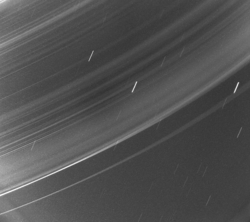
Uranus' Epsilon ring
also has two shepherd satellites, Cordelia
and Ophelia
, acting as inner and outer shepherds respectively. Both moons are well within Uranus' synchronous orbit radius, and their orbits are therefore slowly decaying due to tidal deceleration.
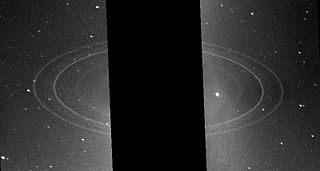
Neptune's rings are very unusual in that they first appeared to be composed of incomplete arcs in Earth-based observations, but Voyager 2
's images showed them to be complete rings with bright clumps. It is thought that the gravitational influence of the shepherd moon Galatea
and possibly other as-yet undiscovered shepherd moons are responsible for this clumpiness.
Pluto is not known to have any ring systems. However, some astronomers think that the New Horizons
probe might find a ring system when it visits in 2015.
It is also predicted that Phobos
, a moon of Mars, will break up and form into a planetary ring in about 50 million years due to its low orbit.
Cosmic dust
Cosmic dust is a type of dust composed of particles in space which are a few molecules to 0.1 µm in size. Cosmic dust can be further distinguished by its astronomical location; for example: intergalactic dust, interstellar dust, interplanetary dust and circumplanetary dust .In our own Solar...
and other small particles orbit
Orbit
In physics, an orbit is the gravitationally curved path of an object around a point in space, for example the orbit of a planet around the center of a star system, such as the Solar System...
ing around a planet
Planet
A planet is a celestial body orbiting a star or stellar remnant that is massive enough to be rounded by its own gravity, is not massive enough to cause thermonuclear fusion, and has cleared its neighbouring region of planetesimals.The term planet is ancient, with ties to history, science,...
in a flat disc-shaped region.
The most notable planetary rings known in Earth's solar system are those around
Rings of Saturn
The rings of Saturn are the most extensive planetary ring system of any planet in the Solar System. They consist of countless small particles, ranging in size from micrometres to metres, that form clumps that in turn orbit about Saturn...
Saturn
Saturn
Saturn is the sixth planet from the Sun and the second largest planet in the Solar System, after Jupiter. Saturn is named after the Roman god Saturn, equated to the Greek Cronus , the Babylonian Ninurta and the Hindu Shani. Saturn's astronomical symbol represents the Roman god's sickle.Saturn,...
, but the other three gas giant
Gas giant
A gas giant is a large planet that is not primarily composed of rock or other solid matter. There are four gas giants in the Solar System: Jupiter, Saturn, Uranus, and Neptune...
s of the solar system
Solar System
The Solar System consists of the Sun and the astronomical objects gravitationally bound in orbit around it, all of which formed from the collapse of a giant molecular cloud approximately 4.6 billion years ago. The vast majority of the system's mass is in the Sun...
(Jupiter
Rings of Jupiter
The planet Jupiter has a system of rings, known as the rings of Jupiter or the Jovian ring system. It was the third ring system to be discovered in the Solar System, after those of Saturn and Uranus. It was first observed in 1979 by the Voyager 1 space probe and thoroughly investigated in the 1990s...
, Uranus
Rings of Uranus
The planet Uranus has a system of rings intermediate in complexity between the more extensive set around Saturn and the simpler systems around Jupiter and Neptune. The rings of Uranus were discovered on March 10, 1977, by James L. Elliot, Edward W. Dunham, and Douglas J. Mink...
and Neptune
Rings of Neptune
The rings of Neptune consist primarily of five principal rings predicted in 1984 by André Brahic and imaged in 1989 by the Voyager 2 spacecraft...
) possess ring systems of their own.
Reports in March 2008 have suggested that the Saturnian moon Rhea
Rhea (moon)
Rhea is the second-largest moon of Saturn and the ninth largest moon in the Solar System. It was discovered in 1672 by Giovanni Domenico Cassini.-Name:Rhea is named after the Titan Rhea of Greek mythology, "mother of the gods"...
may have its own tenuous ring system
Rings of Rhea
The Saturnian moon Rhea may have a tenuous ring system consisting of three narrow, relatively dense bands within a particulate disk. This would be the first discovery of rings around a moon...
, which would make it the only moon known to possess a ring system. A later study published in 2010 revealed that imaging of Rhea from the Cassini mission was inconsistent with the predicted properties of the rings, suggesting that some other mechanism is responsible for the magnetic effects that had led to the ring hypothesis.
Overview
There are three ways that planetary rings (the rings around planets) have been proposed to have formed: from material of the protoplanetary diskProtoplanetary disk
A protoplanetary disk is a rotating circumstellar disk of dense gas surrounding a young newly formed star, a T Tauri star, or Herbig Ae/Be star...
that was within the Roche limit
Roche limit
The Roche limit , sometimes referred to as the Roche radius, is the distance within which a celestial body, held together only by its own gravity, will disintegrate due to a second celestial body's tidal forces exceeding the first body's gravitational self-attraction...
of the planet and thus could not coalesce to form moons; from the debris of a moon
Natural satellite
A natural satellite or moon is a celestial body that orbits a planet or smaller body, which is called its primary. The two terms are used synonymously for non-artificial satellites of planets, of dwarf planets, and of minor planets....
that was disrupted by a large impact; or from the debris of a moon that was disrupted by tidal stresses when it passed within the planet's Roche limit. Most rings were thought to be unstable and to dissipate over the course of tens or hundreds of millions of years, but it now appears that Saturn's rings might be quite old, dating to the early days of the Solar system.
The composition of ring particles varies; they may be silicate or icy dust. Larger rocks and boulders may also be present, and in 2007 tidal effects from eight 'moonlets' only a few hundred meters across were detected within Saturn's rings.
Sometimes rings will have "shepherd" moons, small moons that orbit near the outer edges of rings or within gaps in the rings. The gravity of shepherd moons serves to maintain a sharply defined edge to the ring; material that drifts closer to the shepherd moon's orbit is either deflected back into the body of the ring, ejected from the system, or accreted onto the moon itself.
Several of Jupiter
Jupiter
Jupiter is the fifth planet from the Sun and the largest planet within the Solar System. It is a gas giant with mass one-thousandth that of the Sun but is two and a half times the mass of all the other planets in our Solar System combined. Jupiter is classified as a gas giant along with Saturn,...
's small innermost moons, namely Metis
Metis (moon)
Metis , also known as ', is the innermost moon of Jupiter. It was discovered in 1979 in images taken by Voyager 1, and was named in 1983 after the first wife of Zeus, Metis...
and Adrastea
Adrastea (moon)
Adrastea , also known as ', is the second by distance, and the smallest of the four inner moons of Jupiter. It was discovered in Voyager 2 probe photographs taken in 1979, making it the first natural satellite to be discovered from images taken by an interplanetary spacecraft, rather than...
, are within Jupiter's ring system and are also within Jupiter's Roche limit
Roche limit
The Roche limit , sometimes referred to as the Roche radius, is the distance within which a celestial body, held together only by its own gravity, will disintegrate due to a second celestial body's tidal forces exceeding the first body's gravitational self-attraction...
. It is possible that these rings are composed of material that is being pulled off of these two bodies by Jupiter's tidal force
Tidal force
The tidal force is a secondary effect of the force of gravity and is responsible for the tides. It arises because the gravitational force per unit mass exerted on one body by a second body is not constant across its diameter, the side nearest to the second being more attracted by it than the side...
s, possibly facilitated by impacts of ring material on their surfaces.
Uranus' Epsilon ring
Rings of Uranus
The planet Uranus has a system of rings intermediate in complexity between the more extensive set around Saturn and the simpler systems around Jupiter and Neptune. The rings of Uranus were discovered on March 10, 1977, by James L. Elliot, Edward W. Dunham, and Douglas J. Mink...
also has two shepherd satellites, Cordelia
Cordelia (moon)
Cordelia is the innermost moon of Uranus. It was discovered from the images taken by Voyager 2 on January 20, 1986, and was given the temporary designation S/1986 U 7. It was not detected again until the Hubble Space Telescope observed it in 1997...
and Ophelia
Ophelia (moon)
Ophelia is a moon of Uranus. It was discovered from the images taken by Voyager 2 on January 20, 1986, and was given the temporary designation S/1986 U 8. It was not seen until the Hubble Space Telescope recovered it in 2003. Ophelia was named after the daughter of Polonius, Ophelia, in...
, acting as inner and outer shepherds respectively. Both moons are well within Uranus' synchronous orbit radius, and their orbits are therefore slowly decaying due to tidal deceleration.
Neptune's rings are very unusual in that they first appeared to be composed of incomplete arcs in Earth-based observations, but Voyager 2
Voyager 2
The Voyager 2 spacecraft is a 722-kilogram space probe launched by NASA on August 20, 1977 to study the outer Solar System and eventually interstellar space...
's images showed them to be complete rings with bright clumps. It is thought that the gravitational influence of the shepherd moon Galatea
Galatea (moon)
Galatea , also known as Neptune VI, is the fourth closest inner satellite of Neptune. It is named after Galatea, one of the Nereids of Greek legend.Galatea was discovered in late July 1989 from the images taken by the Voyager 2 probe...
and possibly other as-yet undiscovered shepherd moons are responsible for this clumpiness.
Pluto is not known to have any ring systems. However, some astronomers think that the New Horizons
New Horizons
New Horizons is a NASA robotic spacecraft mission currently en route to the dwarf planet Pluto. It is expected to be the first spacecraft to fly by and study Pluto and its moons, Charon, Nix, Hydra and S/2011 P 1. Its estimated arrival date at the Pluto-Charon system is July 14th, 2015...
probe might find a ring system when it visits in 2015.
It is also predicted that Phobos
Phobos (moon)
Phobos is the larger and closer of the two natural satellites of Mars. Both moons were discovered in 1877. With a mean radius of , Phobos is 7.24 times as massive as Deimos...
, a moon of Mars, will break up and form into a planetary ring in about 50 million years due to its low orbit.
Visual comparison
See also
- Rings of JupiterRings of JupiterThe planet Jupiter has a system of rings, known as the rings of Jupiter or the Jovian ring system. It was the third ring system to be discovered in the Solar System, after those of Saturn and Uranus. It was first observed in 1979 by the Voyager 1 space probe and thoroughly investigated in the 1990s...
- Rings of SaturnRings of SaturnThe rings of Saturn are the most extensive planetary ring system of any planet in the Solar System. They consist of countless small particles, ranging in size from micrometres to metres, that form clumps that in turn orbit about Saturn...
- Rings of UranusRings of UranusThe planet Uranus has a system of rings intermediate in complexity between the more extensive set around Saturn and the simpler systems around Jupiter and Neptune. The rings of Uranus were discovered on March 10, 1977, by James L. Elliot, Edward W. Dunham, and Douglas J. Mink...
- Rings of NeptuneRings of NeptuneThe rings of Neptune consist primarily of five principal rings predicted in 1984 by André Brahic and imaged in 1989 by the Voyager 2 spacecraft...
- Rings of RheaRings of RheaThe Saturnian moon Rhea may have a tenuous ring system consisting of three narrow, relatively dense bands within a particulate disk. This would be the first discovery of rings around a moon...