

.gif)
Charon (moon)

Encyclopedia
Charon is the largest satellite
of the dwarf planet
Pluto
. It was discovered in 1978 at the United States Naval Observatory Flagstaff Station
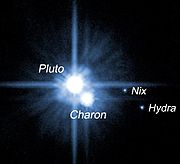
. Following the 2005 discovery of two other natural satellites of Pluto (Nix
and Hydra
), Charon may also be referred to as (134340) Pluto I. The New Horizons
mission is scheduled to visit Charon and Pluto in July 2015.
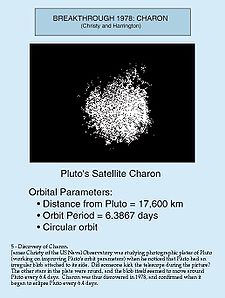
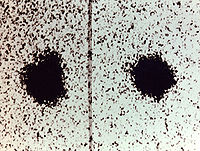 Charon was discovered by astronomer James Christy on June 22, 1978, when he was examining highly magnified images of Pluto
on photographic plate
s taken a couple of months earlier. Christy noticed that a slight elongation appeared periodically. The discovery was announced on July 7, 1978. Later, the bulge was confirmed on plates dating back to April 29, 1965.
Subsequent observations of Pluto determined that the bulge was due to a smaller accompanying body. The periodicity of the bulge corresponded to Pluto's rotation period, which was previously known from Pluto's light curve
. This indicated a synchronous orbit
, which strongly suggested that the bulge effect was real and not spurious.
All doubts were erased when Pluto and Charon entered a five-year period of mutual eclipses and transits
between 1985 and 1990. This occurs when the Pluto–Charon orbital plane
is edge-on as seen from Earth, which only happens at two intervals in Pluto's 248-year orbital period. It was fortuitous that one of these intervals happened to occur so soon after Charon's discovery.
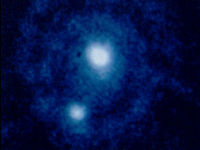
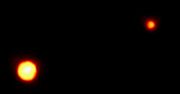 Images showing Pluto and Charon resolved into separate disks were taken for the first time by the Hubble Space Telescope
in the 1990s. Later, the development of adaptive optics
made it possible to resolve Pluto and Charon into separate disks using ground-based telescopes.
and methane
ices, the Charonian surface appears to be dominated by less volatile
water ice, and also appears to have no atmosphere. In 2007, observations by the Gemini Observatory
of patches of ammonia hydrates and water crystals on the surface of Charon suggested the presence of active cryo-geysers. (See also Cryovolcano
.) Mutual eclipses of Pluto and Charon in the 1980s allowed astronomers to take spectra of Pluto and then the combined spectrum of the pair. By subtracting Pluto's spectrum from the total, astronomers were able to spectroscopically
determine the surface composition of Charon.
Charon's volume and mass allow calculation of its density from which it can be determined that Charon is largely an icy body and contains less rock by proportion than its partner Pluto. This supports the idea that Charon was created by a giant impact into Pluto's icy mantle. There are two conflicting theories about Charon's internal structure: some scientists believe it to be a differentiated body like Pluto with a rocky core and an icy mantle while others believe Charon to be of uniform composition throughout. Evidence in support of the former position was found in 2007, when observations by the Gemini Observatory
of patches of ammonia hydrates and water crystals on the surface of Charon suggested the presence of active cryo-geysers. The fact that the ice was still in crystalline form suggested it had been recently deposited, as solar radiation would have degraded older ice to an amorphous state after roughly thirty thousand years.
Photometric mapping of Charon's surface shows a latitudinal trend in albedo
, with a bright equator band and darker poles. In particular the south polar region seems darker than the north.
 Charon and Pluto revolve about each other every 6.387 days. The two objects are gravitationally locked
, so each keeps the same face towards the other. The average distance between Charon and Pluto is 19570 kilometres (12,160.3 mi). The discovery of Charon allowed astronomers to accurately calculate the mass of the Plutonian system, and mutual occultation
s revealed their sizes. However, neither indicated the two bodies' individual masses, which could only be estimated, until the discovery of Pluto's outer moons in late 2005. Details in the orbits of the outer moons reveal that Charon has approximately 11.65% of the mass of Pluto. This shows it to have a density of 1.65 ± 0.06 g/cm3, suggesting a composition of 55 ± 5% "rock" to 45% ice, whereas Pluto is somewhat denser and about 70% "rock".
Simulation work published in 2005 by Robin Canup suggested that Charon could have been formed by a giant impact
around 4.5 billion
years ago, much like the Earth
and Moon
. In this model a large Kuiper belt
object struck Pluto at high velocity, destroying itself and blasting off much of Pluto's outer mantle
, and Charon coalesced from the debris. However, such an impact should result in an icier Charon and rockier Pluto than scientists have found. It is now thought that Pluto and Charon may have been two bodies that collided before going into orbit about each other. The collision would have been violent enough to boil off volatile ices like methane but not violent enough to have destroyed either body.
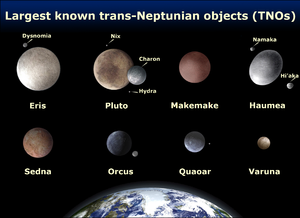
 The center of mass (barycenter) of the Pluto–Charon system lies outside either body. Since neither object truly orbits the other, and Charon has 11.6% the mass of Pluto, it has been argued that Charon should be considered to be part of a binary system. However, the International Astronomical Union
(IAU) describes Charon simply as a satellite of Pluto.
In a draft proposal for the 2006 redefinition of the term, the IAU proposed that a planet be defined as a body that orbits the sun that is large enough for gravitational forces to render the object (nearly) spherical. Under this proposal, Charon would have been classified as a planet, since the draft explicitly defined a planetary satellite as one in which the barycenter lies within the major body. In the final definition, Pluto was reclassified as a dwarf planet
, but the formal definition of a planetary satellite was not decided upon. Charon is not in the list of dwarf planets currently recognized by the IAU. Had the draft proposal been accepted, even Earth's moon would have been classified as a planet in billions of years when the tidal acceleration
that is gradually moving the Moon away from the Earth takes the Moon far enough away that the center of mass of the system no longer lies within the Earth.
The moons Nix
, Hydra
and S/2011 P1 also orbit the same barycenter, but they are not large enough to be spherical, and they are simply considered to be satellites of Pluto.
 Although colleagues at the Naval Observatory
proposed Persephone
, Christy stuck with Charon after discovering it coincidentally refers to a Greek mythological figure: Charon
is the ferryman of the dead, closely associated in myth with the god Hades, whom the Romans identified with their god Pluto
. Official adoption of the name by the IAU
would wait until late 1985 and was announced on January 3, 1986.
There is minor debate over the preferred pronunciation of the name. The practice of following the classical pronunciation established for the mythological ferryman Charon is used by major English-language dictionaries such as the Merriam-Webster and Oxford English Dictionary. These indicate only one pronunciation of "Charon" when referring specifically to Pluto's moon: with an initial "k" sound. Speakers of languages other than English, and many English-speaking astronomers as well, follow this pronunciation.
However, Christy himself pronounced the ch in the moon's name as sh (IPA [ʃ]), after his wife Charlene. Because of this, as an acknowledgement of Christy and sometimes as an in-joke
or shibboleth
, the initial sh pronunciation is common among astronomers when speaking English,
and this is the prescribed pronunciation at NASA and of the New Horizons Pluto mission team.
Natural satellite
A natural satellite or moon is a celestial body that orbits a planet or smaller body, which is called its primary. The two terms are used synonymously for non-artificial satellites of planets, of dwarf planets, and of minor planets....
of the dwarf planet
Dwarf planet
A dwarf planet, as defined by the International Astronomical Union , is a celestial body orbiting the Sun that is massive enough to be spherical as a result of its own gravity but has not cleared its neighboring region of planetesimals and is not a satellite...
Pluto
Pluto
Pluto, formal designation 134340 Pluto, is the second-most-massive known dwarf planet in the Solar System and the tenth-most-massive body observed directly orbiting the Sun...
. It was discovered in 1978 at the United States Naval Observatory Flagstaff Station
United States Naval Observatory Flagstaff Station
The United States Naval Observatory Flagstaff Station , is a scientific astronomical observatory operated as a Navy Echelon V command and the national dark-sky observing Facility/observatory subordinate to the United States Naval Observatory . USNO and NOFS are commands within the CNMOC claimancy,...
. Following the 2005 discovery of two other natural satellites of Pluto (Nix
Nix (moon)
Nix is a natural satellite of Pluto. It was discovered along with Hydra in June 2005, and is to be visited along with Pluto by the New Horizons mission in July 2015.- Discovery :...
and Hydra
Hydra (moon)
Hydra is the second outermost known natural satellite of Pluto. It was discovered along with Nix in June 2005, and is to be visited along with Pluto by the New Horizons mission in July 2015.- Discovery :...
), Charon may also be referred to as (134340) Pluto I. The New Horizons
New Horizons
New Horizons is a NASA robotic spacecraft mission currently en route to the dwarf planet Pluto. It is expected to be the first spacecraft to fly by and study Pluto and its moons, Charon, Nix, Hydra and S/2011 P 1. Its estimated arrival date at the Pluto-Charon system is July 14th, 2015...
mission is scheduled to visit Charon and Pluto in July 2015.
Discovery
Pluto
Pluto, formal designation 134340 Pluto, is the second-most-massive known dwarf planet in the Solar System and the tenth-most-massive body observed directly orbiting the Sun...
on photographic plate
Photographic plate
Photographic plates preceded photographic film as a means of photography. A light-sensitive emulsion of silver salts was applied to a glass plate. This form of photographic material largely faded from the consumer market in the early years of the 20th century, as more convenient and less fragile...
s taken a couple of months earlier. Christy noticed that a slight elongation appeared periodically. The discovery was announced on July 7, 1978. Later, the bulge was confirmed on plates dating back to April 29, 1965.
Subsequent observations of Pluto determined that the bulge was due to a smaller accompanying body. The periodicity of the bulge corresponded to Pluto's rotation period, which was previously known from Pluto's light curve
Light curve
In astronomy, a light curve is a graph of light intensity of a celestial object or region, as a function of time. The light is usually in a particular frequency interval or band...
. This indicated a synchronous orbit
Synchronous orbit
A synchronous orbit is an orbit in which an orbiting body has a period equal to the average rotational period of the body being orbited , and in the same direction of rotation as that body.-Properties:...
, which strongly suggested that the bulge effect was real and not spurious.
All doubts were erased when Pluto and Charon entered a five-year period of mutual eclipses and transits
Solar eclipses on Pluto
Solar eclipses on Pluto are caused when one of its four natural satellites – Charon, Nix, Hydra, and P4 – passes in front of the Sun, blocking its light....
between 1985 and 1990. This occurs when the Pluto–Charon orbital plane
Orbital plane (astronomy)
All of the planets, comets, and asteroids in the solar system are in orbit around the Sun. All of those orbits line up with each other making a semi-flat disk called the orbital plane. The orbital plane of an object orbiting another is the geometrical plane in which the orbit is embedded...
is edge-on as seen from Earth, which only happens at two intervals in Pluto's 248-year orbital period. It was fortuitous that one of these intervals happened to occur so soon after Charon's discovery.
Observations
Hubble Space Telescope
The Hubble Space Telescope is a space telescope that was carried into orbit by a Space Shuttle in 1990 and remains in operation. A 2.4 meter aperture telescope in low Earth orbit, Hubble's four main instruments observe in the near ultraviolet, visible, and near infrared...
in the 1990s. Later, the development of adaptive optics
Adaptive optics
Adaptive optics is a technology used to improve the performance of optical systems by reducing the effect of wavefront distortions. It is used in astronomical telescopes and laser communication systems to remove the effects of atmospheric distortion, and in retinal imaging systems to reduce the...
made it possible to resolve Pluto and Charon into separate disks using ground-based telescopes.
Physical characteristics
Charon's diameter is about 1207 kilometres (750 mi), just over half that of Pluto, with a surface area of 4580000 square kilometres (1,768,347.9 sq mi). Unlike Pluto, which is covered with nitrogenNitrogen
Nitrogen is a chemical element that has the symbol N, atomic number of 7 and atomic mass 14.00674 u. Elemental nitrogen is a colorless, odorless, tasteless, and mostly inert diatomic gas at standard conditions, constituting 78.08% by volume of Earth's atmosphere...
and methane
Methane
Methane is a chemical compound with the chemical formula . It is the simplest alkane, the principal component of natural gas, and probably the most abundant organic compound on earth. The relative abundance of methane makes it an attractive fuel...
ices, the Charonian surface appears to be dominated by less volatile
Volatiles
In planetary science, volatiles are that group of chemical elements and chemical compounds with low boiling points that are associated with a planet's or moon's crust and/or atmosphere. Examples include nitrogen, water, carbon dioxide, ammonia, hydrogen, and methane, all compounds of C, H, O...
water ice, and also appears to have no atmosphere. In 2007, observations by the Gemini Observatory
Gemini Observatory
The Gemini Observatory is an astronomical observatory consisting of two telescopes at sites in Hawai‘i and Chile. Together, the twin Gemini telescopes provide almost complete coverage of both the northern and southern skies...
of patches of ammonia hydrates and water crystals on the surface of Charon suggested the presence of active cryo-geysers. (See also Cryovolcano
Cryovolcano
A cryovolcano is a volcano that erupts volatiles such as water, ammonia or methane, instead of molten rock. Collectively referred to as cryomagma or ice-volcanic melt, these substances are usually liquids and form plumes, but can also be in vapour form...
.) Mutual eclipses of Pluto and Charon in the 1980s allowed astronomers to take spectra of Pluto and then the combined spectrum of the pair. By subtracting Pluto's spectrum from the total, astronomers were able to spectroscopically
Spectrometer
A spectrometer is an instrument used to measure properties of light over a specific portion of the electromagnetic spectrum, typically used in spectroscopic analysis to identify materials. The variable measured is most often the light's intensity but could also, for instance, be the polarization...
determine the surface composition of Charon.
Charon's volume and mass allow calculation of its density from which it can be determined that Charon is largely an icy body and contains less rock by proportion than its partner Pluto. This supports the idea that Charon was created by a giant impact into Pluto's icy mantle. There are two conflicting theories about Charon's internal structure: some scientists believe it to be a differentiated body like Pluto with a rocky core and an icy mantle while others believe Charon to be of uniform composition throughout. Evidence in support of the former position was found in 2007, when observations by the Gemini Observatory
Gemini Observatory
The Gemini Observatory is an astronomical observatory consisting of two telescopes at sites in Hawai‘i and Chile. Together, the twin Gemini telescopes provide almost complete coverage of both the northern and southern skies...
of patches of ammonia hydrates and water crystals on the surface of Charon suggested the presence of active cryo-geysers. The fact that the ice was still in crystalline form suggested it had been recently deposited, as solar radiation would have degraded older ice to an amorphous state after roughly thirty thousand years.
Photometric mapping of Charon's surface shows a latitudinal trend in albedo
Albedo
Albedo , or reflection coefficient, is the diffuse reflectivity or reflecting power of a surface. It is defined as the ratio of reflected radiation from the surface to incident radiation upon it...
, with a bright equator band and darker poles. In particular the south polar region seems darker than the north.
Orbital characteristics
Tidal locking
Tidal locking occurs when the gravitational gradient makes one side of an astronomical body always face another; for example, the same side of the Earth's Moon always faces the Earth. A tidally locked body takes just as long to rotate around its own axis as it does to revolve around its partner...
, so each keeps the same face towards the other. The average distance between Charon and Pluto is 19570 kilometres (12,160.3 mi). The discovery of Charon allowed astronomers to accurately calculate the mass of the Plutonian system, and mutual occultation
Occultation
An occultation is an event that occurs when one object is hidden by another object that passes between it and the observer. The word is used in astronomy . It can also refer to any situation wherein an object in the foreground blocks from view an object in the background...
s revealed their sizes. However, neither indicated the two bodies' individual masses, which could only be estimated, until the discovery of Pluto's outer moons in late 2005. Details in the orbits of the outer moons reveal that Charon has approximately 11.65% of the mass of Pluto. This shows it to have a density of 1.65 ± 0.06 g/cm3, suggesting a composition of 55 ± 5% "rock" to 45% ice, whereas Pluto is somewhat denser and about 70% "rock".
Simulation work published in 2005 by Robin Canup suggested that Charon could have been formed by a giant impact
Giant impact hypothesis
The giant impact hypothesis states that the Moon was created out of the debris left over from a collision between the young Earth and a Mars-sized body. The colliding body is sometimes called Theia for the mythical Greek Titan who was the mother of Selene, the goddess of the moon.The giant impact...
around 4.5 billion
1000000000 (number)
1,000,000,000 is the natural number following 999,999,999 and preceding 1,000,000,001.In scientific notation, it is written as 109....
years ago, much like the Earth
Earth
Earth is the third planet from the Sun, and the densest and fifth-largest of the eight planets in the Solar System. It is also the largest of the Solar System's four terrestrial planets...
and Moon
Moon
The Moon is Earth's only known natural satellite,There are a number of near-Earth asteroids including 3753 Cruithne that are co-orbital with Earth: their orbits bring them close to Earth for periods of time but then alter in the long term . These are quasi-satellites and not true moons. For more...
. In this model a large Kuiper belt
Kuiper belt
The Kuiper belt , sometimes called the Edgeworth–Kuiper belt, is a region of the Solar System beyond the planets extending from the orbit of Neptune to approximately 50 AU from the Sun. It is similar to the asteroid belt, although it is far larger—20 times as wide and 20 to 200 times as massive...
object struck Pluto at high velocity, destroying itself and blasting off much of Pluto's outer mantle
Mantle (geology)
The mantle is a part of a terrestrial planet or other rocky body large enough to have differentiation by density. The interior of the Earth, similar to the other terrestrial planets, is chemically divided into layers. The mantle is a highly viscous layer between the crust and the outer core....
, and Charon coalesced from the debris. However, such an impact should result in an icier Charon and rockier Pluto than scientists have found. It is now thought that Pluto and Charon may have been two bodies that collided before going into orbit about each other. The collision would have been violent enough to boil off volatile ices like methane but not violent enough to have destroyed either body.
Classification as a moon or dwarf planet
International Astronomical Union
The International Astronomical Union IAU is a collection of professional astronomers, at the Ph.D. level and beyond, active in professional research and education in astronomy...
(IAU) describes Charon simply as a satellite of Pluto.
In a draft proposal for the 2006 redefinition of the term, the IAU proposed that a planet be defined as a body that orbits the sun that is large enough for gravitational forces to render the object (nearly) spherical. Under this proposal, Charon would have been classified as a planet, since the draft explicitly defined a planetary satellite as one in which the barycenter lies within the major body. In the final definition, Pluto was reclassified as a dwarf planet
Dwarf planet
A dwarf planet, as defined by the International Astronomical Union , is a celestial body orbiting the Sun that is massive enough to be spherical as a result of its own gravity but has not cleared its neighboring region of planetesimals and is not a satellite...
, but the formal definition of a planetary satellite was not decided upon. Charon is not in the list of dwarf planets currently recognized by the IAU. Had the draft proposal been accepted, even Earth's moon would have been classified as a planet in billions of years when the tidal acceleration
Tidal acceleration
Tidal acceleration is an effect of the tidal forces between an orbiting natural satellite , and the primary planet that it orbits . The "acceleration" is usually negative, as it causes a gradual slowing and recession of a satellite in a prograde orbit away from the primary, and a corresponding...
that is gradually moving the Moon away from the Earth takes the Moon far enough away that the center of mass of the system no longer lies within the Earth.
The moons Nix
Nix (moon)
Nix is a natural satellite of Pluto. It was discovered along with Hydra in June 2005, and is to be visited along with Pluto by the New Horizons mission in July 2015.- Discovery :...
, Hydra
Hydra (moon)
Hydra is the second outermost known natural satellite of Pluto. It was discovered along with Nix in June 2005, and is to be visited along with Pluto by the New Horizons mission in July 2015.- Discovery :...
and S/2011 P1 also orbit the same barycenter, but they are not large enough to be spherical, and they are simply considered to be satellites of Pluto.
Name
Charon was originally known by the temporary designation S/1978 P 1, according to the then recently instituted convention. On June 24, 1978, Christy first suggested the name Charon as a scientific-sounding version of his wife Charlene's nickname, "Char."United States Naval Observatory
The United States Naval Observatory is one of the oldest scientific agencies in the United States, with a primary mission to produce Positioning, Navigation, and Timing for the U.S. Navy and the U.S. Department of Defense...
proposed Persephone
Persephone
In Greek mythology, Persephone , also called Kore , is the daughter of Zeus and the harvest-goddess Demeter, and queen of the underworld; she was abducted by Hades, the god-king of the underworld....
, Christy stuck with Charon after discovering it coincidentally refers to a Greek mythological figure: Charon
Charon (mythology)
In Greek mythology, Charon or Kharon is the ferryman of Hades who carries souls of the newly deceased across the rivers Styx and Acheron that divided the world of the living from the world of the dead. A coin to pay Charon for passage, usually an obolus or danake, was sometimes placed in or on...
is the ferryman of the dead, closely associated in myth with the god Hades, whom the Romans identified with their god Pluto
Pluto (mythology)
In ancient Greek religion and myth, Pluto was a name for the ruler of the underworld; the god was also known as Hades, a name for the underworld itself...
. Official adoption of the name by the IAU
International Astronomical Union
The International Astronomical Union IAU is a collection of professional astronomers, at the Ph.D. level and beyond, active in professional research and education in astronomy...
would wait until late 1985 and was announced on January 3, 1986.
There is minor debate over the preferred pronunciation of the name. The practice of following the classical pronunciation established for the mythological ferryman Charon is used by major English-language dictionaries such as the Merriam-Webster and Oxford English Dictionary. These indicate only one pronunciation of "Charon" when referring specifically to Pluto's moon: with an initial "k" sound. Speakers of languages other than English, and many English-speaking astronomers as well, follow this pronunciation.
However, Christy himself pronounced the ch in the moon's name as sh (IPA [ʃ]), after his wife Charlene. Because of this, as an acknowledgement of Christy and sometimes as an in-joke
In-joke
An in-joke, also known as an inside joke or in joke, is a joke whose humour is clear only to people who are in a particular social group, occupation, or other community of common understanding...
or shibboleth
Shibboleth
A shibboleth is a custom, principle, or belief distinguishing a particular class or group of people, especially a long-standing one regarded as outmoded or no longer important...
, the initial sh pronunciation is common among astronomers when speaking English,
and this is the prescribed pronunciation at NASA and of the New Horizons Pluto mission team.
External links
- Charon Profile at NASA's Solar System Exploration site
- James W. ChristyJames W. ChristyJames Walter Christy is an American astronomer.On June 22, 1978 while working at the United States Naval Observatory, he discovered that Pluto had a moon, which he named Charon shortly afterwards...
and Robert S. HarringtonRobert Sutton HarringtonRobert Sutton Harrington was an American astronomer who worked at the United States Naval Observatory . Harrington was born near Newport News, Virginia. His father was an archaeologist. He was married to Betty-Jean Maycock in 1976, with two daughters, Amy and Ann.Harrington worked at the USNO....
, "The satellite of Pluto," The Astronomical Journal 83 (1978) 1005 - Marc W. BuieMarc W. BuieMarc W. Buie is an astronomer at Lowell Observatory in Flagstaff, Arizona. He grew up in Baton Rouge, Louisiana and went on to get a B.S. in Physics from Louisiana State University in 1980. After that he switched fields and earned his Ph.D. in Planetary Science from the University of Arizona in...
, Phases of Charon as seen from Pluto, Lowell ObservatoryLowell ObservatoryLowell Observatory is an astronomical observatory in Flagstaff, Arizona. Lowell Observatory was established in 1894, placing it among the oldest observatories in the United States, and was designated a National Historic Landmark in 1965.... - Buie, Surface of Charon and Pluto
- Hubble reveals new map of Pluto, BBCBBCThe British Broadcasting Corporation is a British public service broadcaster. Its headquarters is at Broadcasting House in the City of Westminster, London. It is the largest broadcaster in the world, with about 23,000 staff...
News, September 12, 2005 - IAU Circular No. 3241 describing the discovery
- Measuring the Size of a Small, Frost World (ESOESOESO, as a three-letter abbreviation, may stand for:* European Southern Observatory* Ensemble Studios Online* English Symphony Orchestra* Edmonton Symphony Orchestra* Executive Stock Options...
press release January 2006) - M. J. Person et al.: Charon’s Radius and Density from the Combined Data Sets of the 2005 July 11 Occultation (submitted to the Astronomical JournalAstronomical JournalThe Astronomical Journal is a peer-reviewed monthly scientific journal owned by the American Astronomical Society and currently published by Institute of Physics Publishing. It is one of the premier journals for astronomy in the world...
, February 3, 2006) - Cryovolcanism on Charon and other Kuiper Belt Objects