

Heliosphere

Encyclopedia
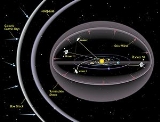
The heliosphere is a bubble in space
"blown" into the interstellar medium
(the hydrogen and helium gas that permeates the galaxy
) by the solar wind
. Although electrically neutral atoms from interstellar volume can penetrate this bubble, virtually all of the material in the heliosphere emanates from the Sun
itself. It was thought for decades that it extends in a long comet-like heliotail, but in 2009 data from the Cassini and IBEX
show a different shape. However, depiction of the heliotail is still common. Another change is that the heliosheath area is not smooth but filled with magnetic bubbles.NASA 2011
For the first ten billion kilometres of its radius, the solar wind travels at over a million km per hour. As it begins to drop out with the interstellar medium
, it slows down before finally ceasing altogether. The point where the solar wind slows down is the termination shock; then there is the heliosheath area; then the point where the interstellar medium and solar wind pressures balance is called the heliopause; the point where the interstellar medium, traveling in the opposite direction, slows down as it collides with the heliosphere is the bow shock.
As of June 2011, the heliosheath area is thought to be filled with magnetic bubbles (each about 1 AU
wide), creating a "foamy zone". The theory helps explain in situ
heliosphere measurements by the two Voyager probes.
ized atoms from the solar corona
) and fields (in particular, magnetic field
s). As the Sun rotate
s once in approximately 27 days, the magnetic field transported by the solar wind
gets wrapped into a spiral. Variations in the Sun's magnetic field are carried outward by the solar wind and can produce magnetic storm
s in the Earth's own magnetosphere
.
In March 2005, it was reported that measurements by the Solar Wind Anisotropies (SWAN) instrument onboard the Solar and Heliospheric Observatory
(SOHO) have shown that the heliosphere, the solar wind-filled volume which prevents the solar system from becoming embedded in the local (ambient) interstellar medium, is not axisymmetrical, but is distorted, very likely under the effect of the local galactic magnetic field.

 The heliospheric current sheet
is a ripple in the heliosphere created by the Sun's rotating magnetic field. Extending throughout the heliosphere, it is considered the largest structure in the Solar System and is said to resemble a "ballerina's skirt".
, this supersonic wind must slow down to meet the gases in the interstellar medium
. This takes place in several stages:
 The termination shock is the point in the heliosphere where the solar wind slows down to subsonic speed (relative to the star) because of interactions with the local interstellar medium
. This causes compression, heating, and a change in the magnetic field
. In our solar system
the termination shock is believed to be 75 to 90 astronomical unit
s from the Sun. In 2004, Voyager 1
crossed the Sun
's termination shock followed by Voyager 2
in 2007.
The shock arises because solar wind particles are emitted from stars at about 400 km/s, while the speed of sound (in the interstellar medium) is about 100 km/s. (The exact speed depends on the density, which fluctuates considerably.) The interstellar medium, although very low in density, nonetheless has a constant pressure associated with it; the pressure from the solar wind decreases with the square of the distance from the star. As one moves far enough away from the star, the pressure from the interstellar medium becomes sufficient to slow the solar wind down to below its speed of sound; this causes a shock wave
.
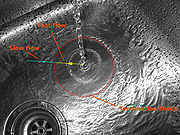
Other termination shocks can be seen in terrestrial systems; perhaps the easiest may be seen by simply running a water tap
into a sink
creating a hydraulic jump
. Upon hitting the floor of the sink, the flowing water spreads out at a speed that is higher than the local wave speed
, forming a disk of shallow, rapidly diverging flow (analogous to the tenuous, supersonic solar wind). Around the periphery of the disk, a shock front or wall of water forms; outside the shock front, the water moves slower than the local wave speed (analogous to the subsonic interstellar medium).
Going outward from the Sun, the termination shock is followed by the heliopause where solar wind particles are stopped by the interstellar medium, then the bow shock
past which particles from the interstellar medium are no longer excited.
Evidence presented at a meeting of the American Geophysical Union
in May 2005 by Dr. Ed Stone suggests that the Voyager 1
spacecraft passed termination shock in December 2004, when it was about 94 AU from the Sun, by virtue of the change in magnetic readings taken from the craft. In contrast, Voyager 2
began detecting returning particles when it was only 76 AU from the Sun, in May 2006. This implies that the heliosphere may be irregularly shaped, bulging outwards in the Sun's northern hemisphere and pushed inward in the south.
The Interstellar Boundary Explorer
(IBEX) mission gathered more data on the solar system's termination shock.
is approximately 80 to 100 astronomical unit
s (AU) at its closest point; however, the heliosheath is shaped like the coma
of a comet, and trails several times that distance in the direction opposite to the Sun's path through space. Scientific results in 2009 showed that model may be incorrect. At its windward side, its thickness is estimated to be between 10 and 100 AU.
The current mission of the Voyager 1
and Voyager 2
space probes includes studying the heliosheath. In late 2010, Voyager 1 reached a region of the heliosheath where the solar wind's radial velocity is zero (i.e., it is flowing sideways relative to the Sun). In 2011, astronomers announced that the Voyagers had determined that the heliosheath is not smooth, but is filled with 100 million-mile-wide bubbles created by the impact of the solar wind and the interstellar medium. Voyager 1 and 2 began detecting evidence for the bubbles in 2007 and 2008, respectively. The probably sausage-shaped bubbles are formed by magnetic reconnection
between oppositely oriented sectors of the solar magnetic field as the solar wind slows down. They probably represent self-contained structures that have detached from the interplanetary magnetic field
.
's solar wind
is stopped by the interstellar medium
; where the solar wind's strength is no longer great enough to push back the stellar wind
s of the surrounding stars. Voyager 1 is expected to cross the heliopause by 2014. The crossing of the heliopause should be signaled by a sharp drop in the temperature of charged particles.
Another hypothesis suggests that the heliopause could be smaller on the side of the solar system facing the Sun's orbital motion through the galaxy. It may also vary depending on the current velocity of the solar wind and the local density of the interstellar medium. It is known to lie far outside the orbit of Neptune
. The current mission of the Voyager 1 and 2
spacecraft is to find and study the termination shock, heliosheath, and heliopause. Voyager 1 reached the termination shock on May 23–24, 2005, and Voyager 2 reached it on August 30, 2007 according to NASA
. Meanwhile, the Interstellar Boundary Explorer
(IBEX) mission is attempting to image the heliopause from Earth orbit within two years of its 2008 launch. Initial results (October 2009) from IBEX suggest that previous assumptions are insufficiently cognisant of the true complexities of the heliopause.
When particles emitted by the sun bump into the interstellar ones, they slow down while releasing energy. Many particles accumulate in and around the heliopause, highly energised by their negative acceleration, creating a shock wave.
An alternative definition is that the heliopause is the magnetopause
between the solar system's magnetosphere
and the galaxy's plasma currents.
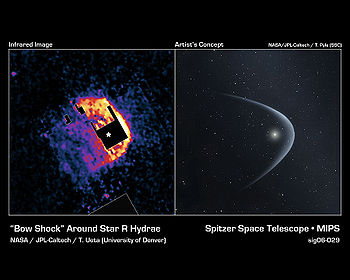
also has a bow shock
produced in its travels within the interstellar medium
, as shown in the figure. The shock is named from its resemblance to the wake left by a ship's bow and is formed for similar reasons, though of plasma instead of water. Bow shocks will occur if the interstellar medium is moving supersonically "toward" the sun, since its solar wind moves "away" from the sun supersonically. When the interstellar wind hits the heliosphere it slows and creates a region of turbulence. NASA
's Robert Nemiroff and Jerry Bonnell believe the solar bow shock may lie at around 230 AU from the Sun.
This phenomenon has been observed by NASA's orbital GALEX
telescope. The red giant star Mira
in the constellation Cetus
has been shown to have both a cometlike debris tail of ejecta from the star, and a distinct bowshock preceding it in the direction of its movement through space (at over 130 kilometers per second).
such as Pioneer 10
, Pioneer 11
, Voyager 1
and Voyager 2
are traveling outward through the solar system
and will eventually pass through the heliopause.
) maps suggest that the interaction is controlled more by particle pressure and magnetic field energy density.
For a video of the revised no-tail model see here. The new shape from the data is thought more like a spherical bubble, than a cometary shape.
(IBEX), launched in October 2008, revealed a previously unpredicted "very narrow ribbon that is two to three times brighter than anything else in the sky." Initial interpretations suggest that "the interstellar environment has far more influence on structuring the heliosphere than anyone previously believed"
"No one knows what is creating the ENA (energetic neutral atoms) ribbon, but everyone agrees that it means the textbook picture of the heliosphere—in which the solar system's enveloping pocket filled with the solar wind's charged particles is plowing through the onrushing "galactic wind" of the interstellar medium in the shape of a comet—is wrong."
"The IBEX results are truly remarkable! What we are seeing in these maps does not match with any of the previous theoretical models of this region. It will be exciting for scientists to review these (ENA
) maps and revise the way we understand our heliosphere and how it interacts with the galaxy."
In October 2010, significant changes were detected in the ribbon after 6 months, based on the second set of IBEX observations.
Outer space
Outer space is the void that exists between celestial bodies, including the Earth. It is not completely empty, but consists of a hard vacuum containing a low density of particles: predominantly a plasma of hydrogen and helium, as well as electromagnetic radiation, magnetic fields, and neutrinos....
"blown" into the interstellar medium
Interstellar medium
In astronomy, the interstellar medium is the matter that exists in the space between the star systems in a galaxy. This matter includes gas in ionic, atomic, and molecular form, dust, and cosmic rays. It fills interstellar space and blends smoothly into the surrounding intergalactic space...
(the hydrogen and helium gas that permeates the galaxy
Galaxy
A galaxy is a massive, gravitationally bound system that consists of stars and stellar remnants, an interstellar medium of gas and dust, and an important but poorly understood component tentatively dubbed dark matter. The word galaxy is derived from the Greek galaxias , literally "milky", a...
) by the solar wind
Solar wind
The solar wind is a stream of charged particles ejected from the upper atmosphere of the Sun. It mostly consists of electrons and protons with energies usually between 1.5 and 10 keV. The stream of particles varies in temperature and speed over time...
. Although electrically neutral atoms from interstellar volume can penetrate this bubble, virtually all of the material in the heliosphere emanates from the Sun
Sun
The Sun is the star at the center of the Solar System. It is almost perfectly spherical and consists of hot plasma interwoven with magnetic fields...
itself. It was thought for decades that it extends in a long comet-like heliotail, but in 2009 data from the Cassini and IBEX
Interstellar Boundary Explorer
Interstellar Boundary Explorer is a NASA satellite that will make the first map of the boundary between the Solar System and interstellar space. The mission is part of NASA's Small Explorer program. The IBEX satellite was launched with a Pegasus-XL rocket on October 19, 2008, at 17:47:23 UTC...
show a different shape. However, depiction of the heliotail is still common. Another change is that the heliosheath area is not smooth but filled with magnetic bubbles.NASA 2011
For the first ten billion kilometres of its radius, the solar wind travels at over a million km per hour. As it begins to drop out with the interstellar medium
Interstellar medium
In astronomy, the interstellar medium is the matter that exists in the space between the star systems in a galaxy. This matter includes gas in ionic, atomic, and molecular form, dust, and cosmic rays. It fills interstellar space and blends smoothly into the surrounding intergalactic space...
, it slows down before finally ceasing altogether. The point where the solar wind slows down is the termination shock; then there is the heliosheath area; then the point where the interstellar medium and solar wind pressures balance is called the heliopause; the point where the interstellar medium, traveling in the opposite direction, slows down as it collides with the heliosphere is the bow shock.
As of June 2011, the heliosheath area is thought to be filled with magnetic bubbles (each about 1 AU
Au
-Science:*Absorbance Units, a reporting unit in spectroscopy*Astronomical unit, the average distance between the Earth and the Sun *Atomic units, a system of units convenient for atomic physics and other fields...
wide), creating a "foamy zone". The theory helps explain in situ
In situ
In situ is a Latin phrase which translated literally as 'In position'. It is used in many different contexts.-Aerospace:In the aerospace industry, equipment on board aircraft must be tested in situ, or in place, to confirm everything functions properly as a system. Individually, each piece may...
heliosphere measurements by the two Voyager probes.
Solar wind
The solar wind consists of particles (ionIon
An ion is an atom or molecule in which the total number of electrons is not equal to the total number of protons, giving it a net positive or negative electrical charge. The name was given by physicist Michael Faraday for the substances that allow a current to pass between electrodes in a...
ized atoms from the solar corona
Corona
A corona is a type of plasma "atmosphere" of the Sun or other celestial body, extending millions of kilometers into space, most easily seen during a total solar eclipse, but also observable in a coronagraph...
) and fields (in particular, magnetic field
Magnetic field
A magnetic field is a mathematical description of the magnetic influence of electric currents and magnetic materials. The magnetic field at any given point is specified by both a direction and a magnitude ; as such it is a vector field.Technically, a magnetic field is a pseudo vector;...
s). As the Sun rotate
Rotation
A rotation is a circular movement of an object around a center of rotation. A three-dimensional object rotates always around an imaginary line called a rotation axis. If the axis is within the body, and passes through its center of mass the body is said to rotate upon itself, or spin. A rotation...
s once in approximately 27 days, the magnetic field transported by the solar wind
Solar wind
The solar wind is a stream of charged particles ejected from the upper atmosphere of the Sun. It mostly consists of electrons and protons with energies usually between 1.5 and 10 keV. The stream of particles varies in temperature and speed over time...
gets wrapped into a spiral. Variations in the Sun's magnetic field are carried outward by the solar wind and can produce magnetic storm
Geomagnetic storm
A geomagnetic storm is a temporary disturbance of the Earth's magnetosphere caused by a disturbance in the interplanetary medium. A geomagnetic storm is a major component of space weather and provides the input for many other components of space weather...
s in the Earth's own magnetosphere
Magnetosphere
A magnetosphere is formed when a stream of charged particles, such as the solar wind, interacts with and is deflected by the intrinsic magnetic field of a planet or similar body. Earth is surrounded by a magnetosphere, as are the other planets with intrinsic magnetic fields: Mercury, Jupiter,...
.
In March 2005, it was reported that measurements by the Solar Wind Anisotropies (SWAN) instrument onboard the Solar and Heliospheric Observatory
Solar and Heliospheric Observatory
The Solar and Heliospheric Observatory is a spacecraft built by a European industrial consortium led by Matra Marconi Space that was launched on a Lockheed Martin Atlas IIAS launch vehicle on December 2, 1995 to study the Sun, and has discovered over 2100 comets. It began normal operations in May...
(SOHO) have shown that the heliosphere, the solar wind-filled volume which prevents the solar system from becoming embedded in the local (ambient) interstellar medium, is not axisymmetrical, but is distorted, very likely under the effect of the local galactic magnetic field.
Heliospheric current sheet
Heliospheric current sheet
The heliospheric current sheet is the surface within the Solar System where the polarity of the Sun's magnetic field changes from north to south. This field extends throughout the Sun's equatorial plane in the heliosphere. The shape of the current sheet results from the influence of the Sun's...
is a ripple in the heliosphere created by the Sun's rotating magnetic field. Extending throughout the heliosphere, it is considered the largest structure in the Solar System and is said to resemble a "ballerina's skirt".
Outer structure
The heliosphere's outer structure is determined by the interactions between the solar wind and the winds of interstellar space. The solar wind streams away from the Sun in all directions at speeds of several hundred km/s (about 1,000,000 mph) in the Earth's vicinity. At some distance from the Sun, well beyond the orbit of NeptuneNeptune
Neptune is the eighth and farthest planet from the Sun in the Solar System. Named for the Roman god of the sea, it is the fourth-largest planet by diameter and the third largest by mass. Neptune is 17 times the mass of Earth and is slightly more massive than its near-twin Uranus, which is 15 times...
, this supersonic wind must slow down to meet the gases in the interstellar medium
Interstellar medium
In astronomy, the interstellar medium is the matter that exists in the space between the star systems in a galaxy. This matter includes gas in ionic, atomic, and molecular form, dust, and cosmic rays. It fills interstellar space and blends smoothly into the surrounding intergalactic space...
. This takes place in several stages:
- The solar wind is traveling at supersonicSupersonicSupersonic speed is a rate of travel of an object that exceeds the speed of sound . For objects traveling in dry air of a temperature of 20 °C this speed is approximately 343 m/s, 1,125 ft/s, 768 mph or 1,235 km/h. Speeds greater than five times the speed of sound are often...
speeds within the solar system. At the termination shock, a standing shock waveShock waveA shock wave is a type of propagating disturbance. Like an ordinary wave, it carries energy and can propagate through a medium or in some cases in the absence of a material medium, through a field such as the electromagnetic field...
, the solar wind falls below its speed of sound and becomes subsonicSpeed of soundThe speed of sound is the distance travelled during a unit of time by a sound wave propagating through an elastic medium. In dry air at , the speed of sound is . This is , or about one kilometer in three seconds or approximately one mile in five seconds....
. - It was previously held that, once subsonic, the solar wind might be affected by the ambient flow of the interstellar medium: Its pressures were theorized to cause the solar wind to form a nose on one side and comet-like heliotail behind the Sun. The area is called the heliosheath. However, scientific results in 2009 showed that this model is incorrect. In 2011, it is thought to be filled with a magnetic bubble "foam".
- The outer surface of the heliosheath, where the heliosphere meets the interstellar medium, is called the heliopause. This is the edge of the entire heliosphere. Scientific results in 2009 adjusted this model.
- The heliopause causes turbulence in the interstellar medium as the sun orbits the Galactic CenterGalactic CenterThe Galactic Center is the rotational center of the Milky Way galaxy. It is located at a distance of 8.33±0.35 kpc from the Earth in the direction of the constellations Sagittarius, Ophiuchus, and Scorpius where the Milky Way appears brightest...
. The bow shockBow shockA bow shock is the area between a magnetosphere and an ambient medium. For stars, this is typically the boundary between their stellar wind and the interstellar medium....
, outside the heliopause, is a turbulent region caused by the pressure of the advancing heliopause against the interstellar mediumInterstellar mediumIn astronomy, the interstellar medium is the matter that exists in the space between the star systems in a galaxy. This matter includes gas in ionic, atomic, and molecular form, dust, and cosmic rays. It fills interstellar space and blends smoothly into the surrounding intergalactic space...
.
Termination shock
Interstellar medium
In astronomy, the interstellar medium is the matter that exists in the space between the star systems in a galaxy. This matter includes gas in ionic, atomic, and molecular form, dust, and cosmic rays. It fills interstellar space and blends smoothly into the surrounding intergalactic space...
. This causes compression, heating, and a change in the magnetic field
Magnetic field
A magnetic field is a mathematical description of the magnetic influence of electric currents and magnetic materials. The magnetic field at any given point is specified by both a direction and a magnitude ; as such it is a vector field.Technically, a magnetic field is a pseudo vector;...
. In our solar system
Solar System
The Solar System consists of the Sun and the astronomical objects gravitationally bound in orbit around it, all of which formed from the collapse of a giant molecular cloud approximately 4.6 billion years ago. The vast majority of the system's mass is in the Sun...
the termination shock is believed to be 75 to 90 astronomical unit
Astronomical unit
An astronomical unit is a unit of length equal to about or approximately the mean Earth–Sun distance....
s from the Sun. In 2004, Voyager 1
Voyager 1
The Voyager 1 spacecraft is a 722-kilogram space probe launched by NASA in 1977, to study the outer Solar System and eventually interstellar space. Operating for as of today , the spacecraft receives routine commands and transmits data back to the Deep Space Network. At a distance of as of...
crossed the Sun
Sun
The Sun is the star at the center of the Solar System. It is almost perfectly spherical and consists of hot plasma interwoven with magnetic fields...
's termination shock followed by Voyager 2
Voyager 2
The Voyager 2 spacecraft is a 722-kilogram space probe launched by NASA on August 20, 1977 to study the outer Solar System and eventually interstellar space...
in 2007.
The shock arises because solar wind particles are emitted from stars at about 400 km/s, while the speed of sound (in the interstellar medium) is about 100 km/s. (The exact speed depends on the density, which fluctuates considerably.) The interstellar medium, although very low in density, nonetheless has a constant pressure associated with it; the pressure from the solar wind decreases with the square of the distance from the star. As one moves far enough away from the star, the pressure from the interstellar medium becomes sufficient to slow the solar wind down to below its speed of sound; this causes a shock wave
Shock wave
A shock wave is a type of propagating disturbance. Like an ordinary wave, it carries energy and can propagate through a medium or in some cases in the absence of a material medium, through a field such as the electromagnetic field...
.
Other termination shocks can be seen in terrestrial systems; perhaps the easiest may be seen by simply running a water tap
Tap (valve)
A tap is a valve controlling release of liquids or gas. In the British Isles and most of the Commonwealth, the word is used for any everyday type of valve, particularly the fittings that control water supply to bathtubs and sinks. In the U.S., the term "tap" is more often used for beer taps,...
into a sink
Sink
A sink is a bowl-shaped plumbing fixture used for washing hands, for dishwashing or other purposes. Sinks generally have taps that supply hot and cold water and may include a spray feature to be used for faster rinsing...
creating a hydraulic jump
Hydraulic jump
A hydraulic jump is a phenomenon in the science of hydraulics which is frequently observed in open channel flow such as rivers and spillways. When liquid at high velocity discharges into a zone of lower velocity, a rather abrupt rise occurs in the liquid surface...
. Upon hitting the floor of the sink, the flowing water spreads out at a speed that is higher than the local wave speed
Wave speed
Wave speed is a wave property, which may refer to absolute value of:*phase velocity, the velocity at which a wave phase propagates at a certain frequency...
, forming a disk of shallow, rapidly diverging flow (analogous to the tenuous, supersonic solar wind). Around the periphery of the disk, a shock front or wall of water forms; outside the shock front, the water moves slower than the local wave speed (analogous to the subsonic interstellar medium).
Going outward from the Sun, the termination shock is followed by the heliopause where solar wind particles are stopped by the interstellar medium, then the bow shock
Bow shock
A bow shock is the area between a magnetosphere and an ambient medium. For stars, this is typically the boundary between their stellar wind and the interstellar medium....
past which particles from the interstellar medium are no longer excited.
Evidence presented at a meeting of the American Geophysical Union
American Geophysical Union
The American Geophysical Union is a nonprofit organization of geophysicists, consisting of over 50,000 members from over 135 countries. AGU's activities are focused on the organization and dissemination of scientific information in the interdisciplinary and international field of geophysics...
in May 2005 by Dr. Ed Stone suggests that the Voyager 1
Voyager 1
The Voyager 1 spacecraft is a 722-kilogram space probe launched by NASA in 1977, to study the outer Solar System and eventually interstellar space. Operating for as of today , the spacecraft receives routine commands and transmits data back to the Deep Space Network. At a distance of as of...
spacecraft passed termination shock in December 2004, when it was about 94 AU from the Sun, by virtue of the change in magnetic readings taken from the craft. In contrast, Voyager 2
Voyager 2
The Voyager 2 spacecraft is a 722-kilogram space probe launched by NASA on August 20, 1977 to study the outer Solar System and eventually interstellar space...
began detecting returning particles when it was only 76 AU from the Sun, in May 2006. This implies that the heliosphere may be irregularly shaped, bulging outwards in the Sun's northern hemisphere and pushed inward in the south.
The Interstellar Boundary Explorer
Interstellar Boundary Explorer
Interstellar Boundary Explorer is a NASA satellite that will make the first map of the boundary between the Solar System and interstellar space. The mission is part of NASA's Small Explorer program. The IBEX satellite was launched with a Pegasus-XL rocket on October 19, 2008, at 17:47:23 UTC...
(IBEX) mission gathered more data on the solar system's termination shock.
Heliosheath
The heliosheath is the region of the heliosphere beyond the termination shock. Here the wind is slowed, compressed and made turbulent by its interaction with the interstellar medium. Its distance from the SunSun
The Sun is the star at the center of the Solar System. It is almost perfectly spherical and consists of hot plasma interwoven with magnetic fields...
is approximately 80 to 100 astronomical unit
Astronomical unit
An astronomical unit is a unit of length equal to about or approximately the mean Earth–Sun distance....
s (AU) at its closest point; however, the heliosheath is shaped like the coma
Coma (cometary)
frame|right|The [[153P/Ikeya-Zhang|comet Ikeya-Zhang]] exhibiting a bright, condensed coma In astronomy, a coma is the nebulous envelope around the nucleus of a comet. It is formed when the comet passes close to the Sun on its highly elliptical orbit; as the comet warms, parts of it sublimate...
of a comet, and trails several times that distance in the direction opposite to the Sun's path through space. Scientific results in 2009 showed that model may be incorrect. At its windward side, its thickness is estimated to be between 10 and 100 AU.
The current mission of the Voyager 1
Voyager 1
The Voyager 1 spacecraft is a 722-kilogram space probe launched by NASA in 1977, to study the outer Solar System and eventually interstellar space. Operating for as of today , the spacecraft receives routine commands and transmits data back to the Deep Space Network. At a distance of as of...
and Voyager 2
Voyager 2
The Voyager 2 spacecraft is a 722-kilogram space probe launched by NASA on August 20, 1977 to study the outer Solar System and eventually interstellar space...
space probes includes studying the heliosheath. In late 2010, Voyager 1 reached a region of the heliosheath where the solar wind's radial velocity is zero (i.e., it is flowing sideways relative to the Sun). In 2011, astronomers announced that the Voyagers had determined that the heliosheath is not smooth, but is filled with 100 million-mile-wide bubbles created by the impact of the solar wind and the interstellar medium. Voyager 1 and 2 began detecting evidence for the bubbles in 2007 and 2008, respectively. The probably sausage-shaped bubbles are formed by magnetic reconnection
Magnetic reconnection
Magnetic reconnection is a physical process in highly conducting plasmas in which the magnetic topology is rearranged and magnetic energy is converted to kinetic energy, thermal energy, and particle acceleration...
between oppositely oriented sectors of the solar magnetic field as the solar wind slows down. They probably represent self-contained structures that have detached from the interplanetary magnetic field
Interplanetary Magnetic Field
The interplanetary magnetic field is the term for the solar magnetic field carried by the solar wind among the planets of the Solar System....
.
Heliopause
The heliopause is the theoretical boundary where the SunSun
The Sun is the star at the center of the Solar System. It is almost perfectly spherical and consists of hot plasma interwoven with magnetic fields...
's solar wind
Solar wind
The solar wind is a stream of charged particles ejected from the upper atmosphere of the Sun. It mostly consists of electrons and protons with energies usually between 1.5 and 10 keV. The stream of particles varies in temperature and speed over time...
is stopped by the interstellar medium
Interstellar medium
In astronomy, the interstellar medium is the matter that exists in the space between the star systems in a galaxy. This matter includes gas in ionic, atomic, and molecular form, dust, and cosmic rays. It fills interstellar space and blends smoothly into the surrounding intergalactic space...
; where the solar wind's strength is no longer great enough to push back the stellar wind
Stellar wind
A stellar wind is a flow of neutral or charged gas ejected from the upper atmosphere of a star. It is distinguished from the bipolar outflows characteristic of young stars by being less collimated, although stellar winds are not generally spherically symmetric.Different types of stars have...
s of the surrounding stars. Voyager 1 is expected to cross the heliopause by 2014. The crossing of the heliopause should be signaled by a sharp drop in the temperature of charged particles.
Hypotheses
According to one hypothesis, there exists a region of hot hydrogen known as the hydrogen wall between the bow shock and the heliopause. The wall is composed of interstellar material interacting with the edge of the heliosphere.Another hypothesis suggests that the heliopause could be smaller on the side of the solar system facing the Sun's orbital motion through the galaxy. It may also vary depending on the current velocity of the solar wind and the local density of the interstellar medium. It is known to lie far outside the orbit of Neptune
Neptune
Neptune is the eighth and farthest planet from the Sun in the Solar System. Named for the Roman god of the sea, it is the fourth-largest planet by diameter and the third largest by mass. Neptune is 17 times the mass of Earth and is slightly more massive than its near-twin Uranus, which is 15 times...
. The current mission of the Voyager 1 and 2
Voyager 2
The Voyager 2 spacecraft is a 722-kilogram space probe launched by NASA on August 20, 1977 to study the outer Solar System and eventually interstellar space...
spacecraft is to find and study the termination shock, heliosheath, and heliopause. Voyager 1 reached the termination shock on May 23–24, 2005, and Voyager 2 reached it on August 30, 2007 according to NASA
NASA
The National Aeronautics and Space Administration is the agency of the United States government that is responsible for the nation's civilian space program and for aeronautics and aerospace research...
. Meanwhile, the Interstellar Boundary Explorer
Interstellar Boundary Explorer
Interstellar Boundary Explorer is a NASA satellite that will make the first map of the boundary between the Solar System and interstellar space. The mission is part of NASA's Small Explorer program. The IBEX satellite was launched with a Pegasus-XL rocket on October 19, 2008, at 17:47:23 UTC...
(IBEX) mission is attempting to image the heliopause from Earth orbit within two years of its 2008 launch. Initial results (October 2009) from IBEX suggest that previous assumptions are insufficiently cognisant of the true complexities of the heliopause.
When particles emitted by the sun bump into the interstellar ones, they slow down while releasing energy. Many particles accumulate in and around the heliopause, highly energised by their negative acceleration, creating a shock wave.
An alternative definition is that the heliopause is the magnetopause
Magnetopause
The magnetopause is the abrupt boundary between a magnetosphere and the surrounding plasma. For planetary science, the magnetopause is the boundary between the planet’s magnetic field and the solar wind. The location of the magnetopause is determined by the balance between the pressure of the...
between the solar system's magnetosphere
Magnetosphere
A magnetosphere is formed when a stream of charged particles, such as the solar wind, interacts with and is deflected by the intrinsic magnetic field of a planet or similar body. Earth is surrounded by a magnetosphere, as are the other planets with intrinsic magnetic fields: Mercury, Jupiter,...
and the galaxy's plasma currents.
Bow shock
It is hypothesized that the SunSun
The Sun is the star at the center of the Solar System. It is almost perfectly spherical and consists of hot plasma interwoven with magnetic fields...
also has a bow shock
Bow shock
A bow shock is the area between a magnetosphere and an ambient medium. For stars, this is typically the boundary between their stellar wind and the interstellar medium....
produced in its travels within the interstellar medium
Interstellar medium
In astronomy, the interstellar medium is the matter that exists in the space between the star systems in a galaxy. This matter includes gas in ionic, atomic, and molecular form, dust, and cosmic rays. It fills interstellar space and blends smoothly into the surrounding intergalactic space...
, as shown in the figure. The shock is named from its resemblance to the wake left by a ship's bow and is formed for similar reasons, though of plasma instead of water. Bow shocks will occur if the interstellar medium is moving supersonically "toward" the sun, since its solar wind moves "away" from the sun supersonically. When the interstellar wind hits the heliosphere it slows and creates a region of turbulence. NASA
NASA
The National Aeronautics and Space Administration is the agency of the United States government that is responsible for the nation's civilian space program and for aeronautics and aerospace research...
's Robert Nemiroff and Jerry Bonnell believe the solar bow shock may lie at around 230 AU from the Sun.
This phenomenon has been observed by NASA's orbital GALEX
GALEX
The Galaxy Evolution Explorer is an orbiting ultraviolet space telescope launched on April 28, 2003. A Pegasus rocket placed the craft into a nearly circular orbit at an altitude of and an inclination to the Earth's equator of 29 degrees....
telescope. The red giant star Mira
Mira
Mira also known as Omicron Ceti , is a red giant star estimated 200-400 light years away in the constellation Cetus. Mira is a binary star, consisting of the red giant Mira A along with Mira B. Mira A is also an oscillating variable star and was the first non-supernova variable star discovered,...
in the constellation Cetus
Cetus
Cetus is a constellation. Its name refers to Cetus, a sea monster in Greek mythology, although it is often called 'the whale' today. Cetus is located in the region of the sky that contains other water-related constellations such as Aquarius, Pisces, and Eridanus.-Ecliptic:Although Cetus is not...
has been shown to have both a cometlike debris tail of ejecta from the star, and a distinct bowshock preceding it in the direction of its movement through space (at over 130 kilometers per second).
Early planetary probes
The precise distance to, and shape of the heliopause is still uncertain. Interplanetary/interstellar spacecraftSpacecraft
A spacecraft or spaceship is a craft or machine designed for spaceflight. Spacecraft are used for a variety of purposes, including communications, earth observation, meteorology, navigation, planetary exploration and transportation of humans and cargo....
such as Pioneer 10
Pioneer 10
Pioneer 10 is a 258-kilogram robotic space probe that completed the first interplanetary mission to Jupiter, and became the first spacecraft to achieve escape velocity from the Solar System. The project was managed by the NASA Ames Research Center and the contract for the construction of the...
, Pioneer 11
Pioneer 11
Pioneer 11 is a 259-kilogram robotic space probe launched by NASA on April 6, 1973 to study the asteroid belt, the environment around Jupiter and Saturn, solar wind, cosmic rays, and eventually the far reaches of the solar system and heliosphere...
, Voyager 1
Voyager 1
The Voyager 1 spacecraft is a 722-kilogram space probe launched by NASA in 1977, to study the outer Solar System and eventually interstellar space. Operating for as of today , the spacecraft receives routine commands and transmits data back to the Deep Space Network. At a distance of as of...
and Voyager 2
Voyager 2
The Voyager 2 spacecraft is a 722-kilogram space probe launched by NASA on August 20, 1977 to study the outer Solar System and eventually interstellar space...
are traveling outward through the solar system
Solar System
The Solar System consists of the Sun and the astronomical objects gravitationally bound in orbit around it, all of which formed from the collapse of a giant molecular cloud approximately 4.6 billion years ago. The vast majority of the system's mass is in the Sun...
and will eventually pass through the heliopause.
- It is believed that Voyager 1Voyager 1The Voyager 1 spacecraft is a 722-kilogram space probe launched by NASA in 1977, to study the outer Solar System and eventually interstellar space. Operating for as of today , the spacecraft receives routine commands and transmits data back to the Deep Space Network. At a distance of as of...
crossed the termination shock and entered the heliosheath in the middle of December 2004, at a distance of 94 AUAstronomical unitAn astronomical unit is a unit of length equal to about or approximately the mean Earth–Sun distance....
. An earlier report that this had occurred as early as August 2002 (at 85 AU) is now generally believed to have been premature. - However, Voyager 2Voyager 2The Voyager 2 spacecraft is a 722-kilogram space probe launched by NASA on August 20, 1977 to study the outer Solar System and eventually interstellar space...
crossed the termination shock on August 30, 2007 at 84 AU, showing evidence of denting in the heliosphere, believed to be caused by an interstellar magnetic field.
Cassini results
Rather than a comet-like shape, the heliosphere appears to be bubble-shaped according to data from Cassini's Ion and Neutral Camera (MIMI / INCA). Rather than being dominated by the collisions between the solar wind and the interstellar medium, the INCA (ENAEnergetic neutral atom
Energetic neutral atom imaging, often described as "seeing with atoms", is a technology used to create global images of otherwise invisible phenomena in the magnetospheres of planets and at the boundary of the heliosphere - the far flung outer edge of the solar system.ENA images are constructed...
) maps suggest that the interaction is controlled more by particle pressure and magnetic field energy density.
For a video of the revised no-tail model see here. The new shape from the data is thought more like a spherical bubble, than a cometary shape.
Interstellar Boundary Explorer results
Initial data from Interstellar Boundary ExplorerInterstellar Boundary Explorer
Interstellar Boundary Explorer is a NASA satellite that will make the first map of the boundary between the Solar System and interstellar space. The mission is part of NASA's Small Explorer program. The IBEX satellite was launched with a Pegasus-XL rocket on October 19, 2008, at 17:47:23 UTC...
(IBEX), launched in October 2008, revealed a previously unpredicted "very narrow ribbon that is two to three times brighter than anything else in the sky." Initial interpretations suggest that "the interstellar environment has far more influence on structuring the heliosphere than anyone previously believed"
"No one knows what is creating the ENA (energetic neutral atoms) ribbon, but everyone agrees that it means the textbook picture of the heliosphere—in which the solar system's enveloping pocket filled with the solar wind's charged particles is plowing through the onrushing "galactic wind" of the interstellar medium in the shape of a comet—is wrong."
"The IBEX results are truly remarkable! What we are seeing in these maps does not match with any of the previous theoretical models of this region. It will be exciting for scientists to review these (ENA
Energetic neutral atom
Energetic neutral atom imaging, often described as "seeing with atoms", is a technology used to create global images of otherwise invisible phenomena in the magnetospheres of planets and at the boundary of the heliosphere - the far flung outer edge of the solar system.ENA images are constructed...
) maps and revise the way we understand our heliosphere and how it interacts with the galaxy."
In October 2010, significant changes were detected in the ribbon after 6 months, based on the second set of IBEX observations.
Gallery of out-dated visions
Depictions based on outdated scientific model as of 2009. Issues include the heliotail and heliosheath magnetic bubble "foam".See also
- Heliospheric current sheetHeliospheric current sheetThe heliospheric current sheet is the surface within the Solar System where the polarity of the Sun's magnetic field changes from north to south. This field extends throughout the Sun's equatorial plane in the heliosphere. The shape of the current sheet results from the influence of the Sun's...
- Space weatherSpace weatherSpace weather is the concept of changing environmental conditions in near-Earth space or thespace from the Sun's atmosphere to the Earth's atmosphere. It is distinct from the concept ofweather within the Earth's planetary atmosphere...
- Coronal mass ejectionCoronal mass ejectionA coronal mass ejection is a massive burst of solar wind, other light isotope plasma, and magnetic fields rising above the solar corona or being released into space....
- Solar flareSolar flareA solar flare is a sudden brightening observed over the Sun surface or the solar limb, which is interpreted as a large energy release of up to 6 × 1025 joules of energy . The flare ejects clouds of electrons, ions, and atoms through the corona into space. These clouds typically reach Earth a day...
- Fermi glowFermi glowThe Fermi glow are ultraviolet-glowing particles, mostly hydrogen, originating from the Solar System's Bow shock, created when light from stars and the Sun enter the region between the heliopause and the interstellar medium and undergo Fermi acceleration, bouncing around the transition area several...
- Interstellar mediumInterstellar mediumIn astronomy, the interstellar medium is the matter that exists in the space between the star systems in a galaxy. This matter includes gas in ionic, atomic, and molecular form, dust, and cosmic rays. It fills interstellar space and blends smoothly into the surrounding intergalactic space...
- Stellar system
- Voyager ProgramVoyager programThe Voyager program is a U.S program that launched two unmanned space missions, scientific probes Voyager 1 and Voyager 2. They were launched in 1977 to take advantage of a favorable planetary alignment of the late 1970s...
- Interstellar Boundary ExplorerInterstellar Boundary ExplorerInterstellar Boundary Explorer is a NASA satellite that will make the first map of the boundary between the Solar System and interstellar space. The mission is part of NASA's Small Explorer program. The IBEX satellite was launched with a Pegasus-XL rocket on October 19, 2008, at 17:47:23 UTC...
(IBEX) - Tom KrimigisStamatios KrimigisStamatios M. Krimigis is a Greek-American scientist in space exploration. He has contributed to the majority of the United States' unmanned space exploration programs of the Solar system and beyond. He has contributed to exploration missions to almost every planet of our solar system...
Further reading
- "Cassini Data Helps Redraw Shape of Our Solar System" 2010
- Publications in Refereed Journals
- Voyager Interstellar Mission Objectives
- The Heliosphere (Cosmicopia)
- NASA GALEX (Galaxy evolution Explorer) homepage at Caltech
- The Solar and Heliospheric Research Group at the University of Michigan
- A Big Surprise from the Edge of the Solar System (NASA 06.09.11)
Pre-2009 links
Warning, links prior to 2009 Cassini & IBEX revisions- The Heliosphere, MIT Space Plasma Group
- UI's Don Gurnett Says Voyager 1 Is Approaching Edge Of Solar System December 8, 2003 Univ. of Iowa Press release
- NASANASAThe National Aeronautics and Space Administration is the agency of the United States government that is responsible for the nation's civilian space program and for aeronautics and aerospace research...
's Interstellar Probe (2000) - CNN: NASA: Voyager I enters solar system's final frontier – May 25, 2005
- New Scientist: Voyager 1 reaches the edge of the solar system – May 25, 2005
- Surprises from the Edge of the Solar System – Voyager 1 Newest Findings as of September 2006
- The heliospheric hydrogen wall and astrospheres
- Heliosphere, has a diagram.
- Heliosphere Astronomy CastAstronomy CastAstronomy Cast is an educational nonprofit podcast discussing various topics in the field of astronomy. The specific subject matter of each episode shifts from week to week, ranging from planets and stars to cosmology and mythbusting...
episode #65, includes full transcript.