

Radioisotope thermoelectric generator

Encyclopedia

Electrical generator
In electricity generation, an electric generator is a device that converts mechanical energy to electrical energy. A generator forces electric charge to flow through an external electrical circuit. It is analogous to a water pump, which causes water to flow...
that obtains its power from radioactive decay
Radioactive decay
Radioactive decay is the process by which an atomic nucleus of an unstable atom loses energy by emitting ionizing particles . The emission is spontaneous, in that the atom decays without any physical interaction with another particle from outside the atom...
. In such a device, the heat
Heat
In physics and thermodynamics, heat is energy transferred from one body, region, or thermodynamic system to another due to thermal contact or thermal radiation when the systems are at different temperatures. It is often described as one of the fundamental processes of energy transfer between...
released by the decay of a suitable radioactive material is converted into electricity
Electricity
Electricity is a general term encompassing a variety of phenomena resulting from the presence and flow of electric charge. These include many easily recognizable phenomena, such as lightning, static electricity, and the flow of electrical current in an electrical wire...
by the Seebeck effect using an array of thermocouple
Thermocouple
A thermocouple is a device consisting of two different conductors that produce a voltage proportional to a temperature difference between either end of the pair of conductors. Thermocouples are a widely used type of temperature sensor for measurement and control and can also be used to convert a...
s.
RTGs can be considered as a type of battery
Battery (electricity)
An electrical battery is one or more electrochemical cells that convert stored chemical energy into electrical energy. Since the invention of the first battery in 1800 by Alessandro Volta and especially since the technically improved Daniell cell in 1836, batteries have become a common power...
and have been used as power sources in satellite
Satellite
In the context of spaceflight, a satellite is an object which has been placed into orbit by human endeavour. Such objects are sometimes called artificial satellites to distinguish them from natural satellites such as the Moon....
s, space probe
Space probe
A robotic spacecraft is a spacecraft with no humans on board, that is usually under telerobotic control. A robotic spacecraft designed to make scientific research measurements is often called a space probe. Many space missions are more suited to telerobotic rather than crewed operation, due to...
s and unmanned remote facilities, such as a series of lighthouses built by the former Soviet Union inside the Arctic Circle. RTGs are usually the most desirable power source for robotic or unmaintained situations needing a few hundred watts
Watts
-People:*Watts , the surname of several people*Watts S. Humphrey , American software engineer often called the father of software quality*Watts , a Canadian record producer-Fictional characters:*Watts family in EastEnders...
(or less) of power for durations too long for fuel cell
Fuel cell
A fuel cell is a device that converts the chemical energy from a fuel into electricity through a chemical reaction with oxygen or another oxidizing agent. Hydrogen is the most common fuel, but hydrocarbons such as natural gas and alcohols like methanol are sometimes used...
s, batteries, or generators to provide economically, and in places where solar cell
Solar cell
A solar cell is a solid state electrical device that converts the energy of light directly into electricity by the photovoltaic effect....
s are not practical. Safe use of RTGs requires containment of the radioisotopes long after the productive life of the unit.
History
Transit (satellite)
The TRANSIT system, also known as NAVSAT , was the first satellite navigation system to be used operationally. The system was primarily used by the U.S...
.
One of the first terrestrial uses of RTGs was in 1966 by the US Navy at the uninhabited Fairway Rock Island
Fairway Rock
Fairway Rock is a small islet in the Bering Strait, located southeast of the Diomede Islands and west of Alaska's Cape Prince of Wales. It has an area of 0.3 km² . Known to Eskimo natives of the Bering Strait region in prehistory, Fairway was documented by James Cook in 1778 and named by...
in Alaska, where it remained in use until its removal in 1995.
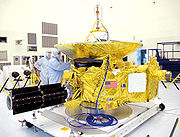
A common application of RTGs is as power sources on spacecraft. Systems for Nuclear Auxiliary Power (SNAP) units were used especially for probes that travel far enough from the Sun that solar panels
Photovoltaic module
A solar panel is a packaged, connected assembly of solar cells, also known as photovoltaic cells...
are no longer viable. As such they were used with Pioneer 10
Pioneer 10
Pioneer 10 is a 258-kilogram robotic space probe that completed the first interplanetary mission to Jupiter, and became the first spacecraft to achieve escape velocity from the Solar System. The project was managed by the NASA Ames Research Center and the contract for the construction of the...
, Pioneer 11
Pioneer 11
Pioneer 11 is a 259-kilogram robotic space probe launched by NASA on April 6, 1973 to study the asteroid belt, the environment around Jupiter and Saturn, solar wind, cosmic rays, and eventually the far reaches of the solar system and heliosphere...
, Voyager 1
Voyager 1
The Voyager 1 spacecraft is a 722-kilogram space probe launched by NASA in 1977, to study the outer Solar System and eventually interstellar space. Operating for as of today , the spacecraft receives routine commands and transmits data back to the Deep Space Network. At a distance of as of...
, Voyager 2
Voyager 2
The Voyager 2 spacecraft is a 722-kilogram space probe launched by NASA on August 20, 1977 to study the outer Solar System and eventually interstellar space...
, Galileo, Ulysses
Ulysses probe
Ulysses is a decommissioned robotic space probe that was designed to study the Sun as a joint venture of NASA and the European Space Agency . The spacecraft was originally named Odysseus, because of its lengthy and indirect trajectory to near Solar distance...
, Cassini
Cassini-Huygens
Cassini–Huygens is a joint NASA/ESA/ASI spacecraft mission studying the planet Saturn and its many natural satellites since 2004. Launched in 1997 after nearly two decades of gestation, it includes a Saturn orbiter and an atmospheric probe/lander for the moon Titan, although it has also returned...
, New Horizons
New Horizons
New Horizons is a NASA robotic spacecraft mission currently en route to the dwarf planet Pluto. It is expected to be the first spacecraft to fly by and study Pluto and its moons, Charon, Nix, Hydra and S/2011 P 1. Its estimated arrival date at the Pluto-Charon system is July 14th, 2015...
and the Mars Science Laboratory . In addition, RTGs were used to power the two Viking
Viking program
The Viking program consisted of a pair of American space probes sent to Mars, Viking 1 and Viking 2. Each spacecraft was composed of two main parts, an orbiter designed to photograph the surface of Mars from orbit, and a lander designed to study the planet from the surface...
landers and for the scientific experiments left on the Moon by the crews of Apollo 12
Apollo 12
Apollo 12 was the sixth manned flight in the American Apollo program and the second to land on the Moon . It was launched on November 14, 1969 from the Kennedy Space Center, Florida, four months after Apollo 11. Mission commander Charles "Pete" Conrad and Lunar Module Pilot Alan L...
through 17
Apollo 17
Apollo 17 was the eleventh and final manned mission in the American Apollo space program. Launched at 12:33 a.m. EST on December 7, 1972, with a three-member crew consisting of Commander Eugene Cernan, Command Module Pilot Ronald Evans, and Lunar Module Pilot Harrison Schmitt, Apollo 17 remains the...
(SNAP 27s). Because Apollo 13 was aborted, its RTG now rests in the South Pacific ocean
Pacific Ocean
The Pacific Ocean is the largest of the Earth's oceanic divisions. It extends from the Arctic in the north to the Southern Ocean in the south, bounded by Asia and Australia in the west, and the Americas in the east.At 165.2 million square kilometres in area, this largest division of the World...
, in the vicinity of the Tonga Trench
Tonga Trench
The Tonga Trench is located in the South Pacific Ocean and is deep at its deepest point, known as the Horizon Deep.The Tonga Trench is a convergent plate boundary. The trench lies at the northern end of the Kermadec-Tonga Subduction Zone, an active subduction zone where the Pacific Plate is being...
. RTGs were also used for the Nimbus
Nimbus program
The Nimbus satellites were second-generation U.S. robotic spacecraft used for meteorological research and development. The spacecraft were designed to serve as stabilized, Earth-oriented platforms for the testing of advanced systems to sense and collect atmospheric science data...
, Transit
Transit (satellite)
The TRANSIT system, also known as NAVSAT , was the first satellite navigation system to be used operationally. The system was primarily used by the U.S...
and LES
Lincoln Experimental Satellite
Lincoln Experimental Satellite refers to a series of satellites designed and built by Lincoln Laboratory at MIT between 1965 and 1976, under USAF sponsorship, for testing devices and techniques for satellite communication....
satellites. By comparison, only a few space vehicles have been launched using full-fledged nuclear reactor
Nuclear reactor
A nuclear reactor is a device to initiate and control a sustained nuclear chain reaction. Most commonly they are used for generating electricity and for the propulsion of ships. Usually heat from nuclear fission is passed to a working fluid , which runs through turbines that power either ship's...
s: the Soviet RORSAT
RORSAT
Radar Ocean Reconnaissance SATellite or RORSAT is the western name given to the Soviet Upravlyaemyj Sputnik Aktivnyj satellites. These satellites were launched between 1967 and 1988 to monitor NATO and merchant vessels using active radar...
series and the American SNAP-10A
SNAP-10A
SNAP-10A was the first and so far only known launch of a U.S. nuclear reactor into space . The Systems Nuclear Auxiliary Power Program reactor was developed under the SNAPSHOT program overseen by the U.S...
.
In addition to spacecraft, the Soviet Union
Soviet Union
The Soviet Union , officially the Union of Soviet Socialist Republics , was a constitutionally socialist state that existed in Eurasia between 1922 and 1991....
constructed many unmanned lighthouses and navigation beacons powered by RTGs. Powered by strontium-90 (90Sr)
Strontium-90
Strontium-90 is a radioactive isotope of strontium, with a half-life of 28.8 years.-Radioactivity:Natural strontium is nonradioactive and nontoxic, but 90Sr is a radioactivity hazard...
, they are very reliable and provide a steady source of power. Critics argue that they could cause environmental and security problems as leakage or theft of the radioactive material could pass unnoticed for years, particularly as the locations of some of these lighthouses are no longer known due to poor record keeping. In one instance, the radioactive compartments were opened by a thief. In another case, three woodsmen in Georgia
Georgia (country)
Georgia is a sovereign state in the Caucasus region of Eurasia. Located at the crossroads of Western Asia and Eastern Europe, it is bounded to the west by the Black Sea, to the north by Russia, to the southwest by Turkey, to the south by Armenia, and to the southeast by Azerbaijan. The capital of...
came across two ceramic RTG heat sources that had been stripped of their shielding; two of the three were later hospitalized with severe radiation burns after carrying the sources on their backs. The units were eventually recovered and isolated.
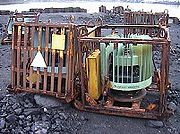
There are approximately 1,000 such RTGs in Russia. All of them have long exhausted their 10-year engineered life spans. They are likely no longer functional, and may be in need of dismantling. Some of them have become the prey of metal hunters, who strip the RTGs' metal casings, regardless of the risk of radioactive contamination.
The United States Air Force
United States Air Force
The United States Air Force is the aerial warfare service branch of the United States Armed Forces and one of the American uniformed services. Initially part of the United States Army, the USAF was formed as a separate branch of the military on September 18, 1947 under the National Security Act of...
uses RTGs to power remote sensing stations for Top-ROCC and Save-Igloo radar systems predominantly located in Alaska
Alaska
Alaska is the largest state in the United States by area. It is situated in the northwest extremity of the North American continent, with Canada to the east, the Arctic Ocean to the north, and the Pacific Ocean to the west and south, with Russia further west across the Bering Strait...
.
In the past, small "plutonium cells" (very small 238Pu-powered RTGs) were used in implanted heart pacemakers
Artificial pacemaker
A pacemaker is a medical device that uses electrical impulses, delivered by electrodes contacting the heart muscles, to regulate the beating of the heart...
to ensure a very long "battery life". , about 90 were still in use. When the wearer dies and if the generator is not removed before cremation
Cremation
Cremation is the process of reducing bodies to basic chemical compounds such as gasses and bone fragments. This is accomplished through high-temperature burning, vaporization and oxidation....
, the device will be subject to great heat. The plutonium dioxide is a stable solid which is normally sintered
Sintering
Sintering is a method used to create objects from powders. It is based on atomic diffusion. Diffusion occurs in any material above absolute zero, but it occurs much faster at higher temperatures. In most sintering processes, the powdered material is held in a mold and then heated to a temperature...
in air at a temperature much higher than that used in the cremation of human remains, and so is unlikely to be dispersed.
Although not strictly RTGs, similar units called radioisotope heater units are also used by various spacecraft including the Russian Lunokhod moon rover (using a Polonium 210 heat generator), and the Mars Exploration Rovers, Galileo and Cassini
Cassini-Huygens
Cassini–Huygens is a joint NASA/ESA/ASI spacecraft mission studying the planet Saturn and its many natural satellites since 2004. Launched in 1997 after nearly two decades of gestation, it includes a Saturn orbiter and an atmospheric probe/lander for the moon Titan, although it has also returned...
. These devices use small samples of radioactive material to produce heat directly, instead of electricity.
Design
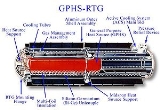
The design of an RTG is simple by the standards of nuclear technologyNuclear technology
Nuclear technology is technology that involves the reactions of atomic nuclei. Among the notable nuclear technologies are nuclear power, nuclear medicine, and nuclear weapons...
: the main component is a sturdy container of a radioactive material (the fuel). Thermocouple
Thermocouple
A thermocouple is a device consisting of two different conductors that produce a voltage proportional to a temperature difference between either end of the pair of conductors. Thermocouples are a widely used type of temperature sensor for measurement and control and can also be used to convert a...
s are placed in the walls of the container, with the outer end of each thermocouple connected to a heat sink
Heat sink
A heat sink is a term for a component or assembly that transfers heat generated within a solid material to a fluid medium, such as air or a liquid. Examples of heat sinks are the heat exchangers used in refrigeration and air conditioning systems and the radiator in a car...
. Radioactive decay of the fuel produces heat which flows through the thermocouples to the heat sink, generating electricity in the process.
A thermocouple is a thermoelectric device that converts thermal energy
Energy
In physics, energy is an indirectly observed quantity. It is often understood as the ability a physical system has to do work on other physical systems...
directly into electrical energy using the Seebeck effect. It is made of two kinds of metal (or semiconductors) that can both conduct electricity. They are connected to each other in a closed loop. If the two junctions are at different temperature
Temperature
Temperature is a physical property of matter that quantitatively expresses the common notions of hot and cold. Objects of low temperature are cold, while various degrees of higher temperatures are referred to as warm or hot...
s, an electric current will flow in the loop.
Fuels
Criteria
The radioactive material used in RTGs must have several characteristics:- It should produce high energy radiation. Energy release per decay is proportional to power production per moleMole (unit)The mole is a unit of measurement used in chemistry to express amounts of a chemical substance, defined as an amount of a substance that contains as many elementary entities as there are atoms in 12 grams of pure carbon-12 , the isotope of carbon with atomic weight 12. This corresponds to a value...
. Alpha decayAlpha decayAlpha decay is a type of radioactive decay in which an atomic nucleus emits an alpha particle and thereby transforms into an atom with a mass number 4 less and atomic number 2 less...
s in general release about 10 times as much energy as the beta decayBeta decayIn nuclear physics, beta decay is a type of radioactive decay in which a beta particle is emitted from an atom. There are two types of beta decay: beta minus and beta plus. In the case of beta decay that produces an electron emission, it is referred to as beta minus , while in the case of a...
of strontium-90 or cesium-137. - Radiation must be of a type easily absorbed and transferred into thermal radiation, preferably alpha radiationAlpha particleAlpha particles consist of two protons and two neutrons bound together into a particle identical to a helium nucleus, which is classically produced in the process of alpha decay, but may be produced also in other ways and given the same name...
. Beta radiationBeta particleBeta particles are high-energy, high-speed electrons or positrons emitted by certain types of radioactive nuclei such as potassium-40. The beta particles emitted are a form of ionizing radiation also known as beta rays. The production of beta particles is termed beta decay...
can give off considerable amounts of gamma/X-ray radiation through bremsstrahlungBremsstrahlungBremsstrahlung is electromagnetic radiation produced by the deceleration of a charged particle when deflected by another charged particle, typically an electron by an atomic nucleus. The moving particle loses kinetic energy, which is converted into a photon because energy is conserved. The term is...
secondary radiation production, thus requiring heavy shielding. Isotopes must not produce significant amounts of gamma, neutron radiationNeutron radiationNeutron radiation is a kind of ionizing radiation which consists of free neutrons. A result of nuclear fission or nuclear fusion, it consists of the release of free neutrons from atoms, and these free neutrons react with nuclei of other atoms to form new isotopes, which, in turn, may produce...
or penetrating radiation in general through other decay modes or decay chainDecay chainIn nuclear science, the decay chain refers to the radioactive decay of different discrete radioactive decay products as a chained series of transformations...
products. - The half-lifeHalf-lifeHalf-life, abbreviated t½, is the period of time it takes for the amount of a substance undergoing decay to decrease by half. The name was originally used to describe a characteristic of unstable atoms , but it may apply to any quantity which follows a set-rate decay.The original term, dating to...
must be long enough that it will release energy at a relatively continuous rate for a reasonable amount of time. The amount of energy released per time (powerPower (physics)In physics, power is the rate at which energy is transferred, used, or transformed. For example, the rate at which a light bulb transforms electrical energy into heat and light is measured in watts—the more wattage, the more power, or equivalently the more electrical energy is used per unit...
) of a given quantity is inversely proportional to half-life. An isotope with twice the half-life and the same energy per decay will release power at half the rate, per moleMole (unit)The mole is a unit of measurement used in chemistry to express amounts of a chemical substance, defined as an amount of a substance that contains as many elementary entities as there are atoms in 12 grams of pure carbon-12 , the isotope of carbon with atomic weight 12. This corresponds to a value...
. Typical half-lives for radioisotopes used in RTGs are therefore several decades, although isotopes with shorter half-lives could be used for specialized applications. - For spaceflight use, the fuel must produce a large amount of power per massMassMass can be defined as a quantitive measure of the resistance an object has to change in its velocity.In physics, mass commonly refers to any of the following three properties of matter, which have been shown experimentally to be equivalent:...
and volumeVolumeVolume is the quantity of three-dimensional space enclosed by some closed boundary, for example, the space that a substance or shape occupies or contains....
(densityDensityThe mass density or density of a material is defined as its mass per unit volume. The symbol most often used for density is ρ . In some cases , density is also defined as its weight per unit volume; although, this quantity is more properly called specific weight...
). Density and weight are not as important for terrestrial use, unless there are size restrictions.
The decay energyDecay energyThe decay energy is the energy released by a radioactive decay. Radioactive decay is the process in which an unstable atomic nucleus loses energy by emitting ionizing particles and radiation...
can be calculated if the energy of radioactive radiation or the mass loss before and after radioactive decay is known.
Selection of isotopes
The first two criteria limit the number of possible fuels to fewer than 30 atomic isotopes within the entire table of nuclidesTable of nuclides
The tables listed below provide information on the basic properties of all nuclides.* Neutron + Element 1 - Element 24 * Element 25 - Element 48 * Element 49 - Element 72...
. Plutonium-238
Plutonium-238
-External links:**...
, curium-244
Curium
Curium is a synthetic chemical element with the symbol Cm and atomic number 96. This radioactive transuranic element of the actinide series was named after Marie Skłodowska-Curie and her husband Pierre Curie. Curium was first intentionally produced and identified in summer 1944 by the group of...
and strontium-90
Strontium-90
Strontium-90 is a radioactive isotope of strontium, with a half-life of 28.8 years.-Radioactivity:Natural strontium is nonradioactive and nontoxic, but 90Sr is a radioactivity hazard...
are the most often cited candidate isotopes, but other isotopes such as polonium-210, promethium-147, caesium-137
Caesium-137
Caesium-137 is a radioactive isotope of caesium which is formed as a fission product by nuclear fission.It has a half-life of about 30.17 years, and decays by beta emission to a metastable nuclear isomer of barium-137: barium-137m . Caesium-137 is a radioactive isotope of caesium which is formed...
, cerium
Cerium
Cerium is a chemical element with the symbol Ce and atomic number 58. It is a soft, silvery, ductile metal which easily oxidizes in air. Cerium was named after the dwarf planet . Cerium is the most abundant of the rare earth elements, making up about 0.0046% of the Earth's crust by weight...
-144, ruthenium-106, cobalt-60
Cobalt-60
Cobalt-60, , is a synthetic radioactive isotope of cobalt. Due to its half-life of 5.27 years, is not found in nature. It is produced artificially by neutron activation of . decays by beta decay to the stable isotope nickel-60...
, curium
Curium
Curium is a synthetic chemical element with the symbol Cm and atomic number 96. This radioactive transuranic element of the actinide series was named after Marie Skłodowska-Curie and her husband Pierre Curie. Curium was first intentionally produced and identified in summer 1944 by the group of...
-242 and thulium
Thulium
Thulium is a chemical element that has the symbol Tm and atomic number 69. Thulium is the second least abundant of the lanthanides . It is an easily workable metal with a bright silvery-gray luster...
isotopes have also been studied.
238Pu, 90Sr
Plutonium-238Plutonium-238
-External links:**...
has the lowest shielding requirements and longest half-life. Only three candidate isotopes meet the last criterion (not all are listed above) and need less than 25 mm of lead
Lead
Lead is a main-group element in the carbon group with the symbol Pb and atomic number 82. Lead is a soft, malleable poor metal. It is also counted as one of the heavy metals. Metallic lead has a bluish-white color after being freshly cut, but it soon tarnishes to a dull grayish color when exposed...
shielding to keep radiation. 238Pu (the best of these three) needs less than 2.5 mm, and in many cases no shielding is needed in a 238Pu RTG, as the casing itself is adequate.
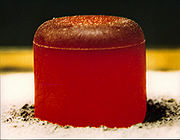
238Pu has become the most widely used fuel for RTGs, in the form of plutonium(IV) oxide (PuO2). 238Pu has a half-life of 87.7 years, reasonable power density and exceptionally low gamma and neutron radiation levels.
Some Russian terrestrial RTGs have used strontium-90
Strontium-90
Strontium-90 is a radioactive isotope of strontium, with a half-life of 28.8 years.-Radioactivity:Natural strontium is nonradioactive and nontoxic, but 90Sr is a radioactivity hazard...
; this isotope has a shorter half-life, much lower power density and produces gamma radiation, but is cheaper.
210Po
Some prototype RTGs, first built in 1958 by USA Atomic Energy Commission, have used polonium-210. This isotope provides phenomenal power density because of its high radioactive activity, but has limited use because of its very short half-life of 138 days, again because of its high activity. A kilogram of pure 210Po in the form of a cube would be about 48 mm (about 2 inches) on a side and emit about 140kWDecay energy
The decay energy is the energy released by a radioactive decay. Radioactive decay is the process in which an unstable atomic nucleus loses energy by emitting ionizing particles and radiation...
. The heat of melting
Enthalpy of fusion
The enthalpy of fusion is the change in enthalpy resulting from heating one mole of a substance to change its state from a solid to a liquid. The temperature at which this occurs is the melting point....
is about 60kJ/kg, the heat of evaporation about 10 times larger. If there is no efficient cooling, the self heating power is sufficient for melting and then partly vaporizing itself.
242Cm, 244Cm, 241Am
Curium-242 and curium-244 have also been studied as well, but require heavy shielding for gamma and neutron radiation produced from spontaneous fissionSpontaneous fission
Spontaneous fission is a form of radioactive decay characteristic of very heavy isotopes. Because the nuclear binding energy reaches a maximum at a nuclear mass greater than about 60 atomic mass units , spontaneous breakdown into smaller nuclei and single particles becomes possible at heavier masses...
.
Americium-241 is a potential candidate isotope with a longer half-life than 238Pu: 241Am has a half-life of 432 years and could hypothetically power a device for centuries. However, the power density of 241Am is only 1/4 that of 238Pu, and 241Am produces more penetrating radiation through decay chain products than 238Pu and needs about 18 mm worth of lead shielding. Even so, its shielding requirements in an RTG are the second lowest of all possible isotopes: only 238Pu requires less. With a current global shortage of 238Pu, a closer look is being given to 241Am.
Life span
Thermal energy
Thermal energy is the part of the total internal energy of a thermodynamic system or sample of matter that results in the system's temperature....
into electrical energy degrade as well; at the beginning of 2001, the power generated by the Voyager RTGs had dropped to 315 W for Voyager 1 and to 319 W for Voyager 2. Therefore in early 2001, the RTGs were working at about 67% of their original capacity instead of the expected 83.4%.
This life span was of particular importance during the Galileo mission. Originally intended to launch in 1986, it was delayed by the Space Shuttle Challenger
Space Shuttle Challenger
Space Shuttle Challenger was NASA's second Space Shuttle orbiter to be put into service, Columbia having been the first. The shuttle was built by Rockwell International's Space Transportation Systems Division in Downey, California...
accident. Because of this unforeseen event, the probe had to sit in storage for 4 years before launching in 1989. Subsequently, its RTGs had decayed somewhat, necessitating replanning the power budget for the mission.
Efficiency
RTGs use thermoelectric couples or "thermocouples" to convert heat from the radioactive material into electricity. Thermocouples, though very reliable and long-lasting, are very inefficient; efficiencies above 10% have never been achieved and most RTGs have efficiencies between 3–7%. Thermoelectric materials in space missions to date have included silicon germanium alloys, lead telluride and tellurides of antimony, germanium and silver (TAGS). Studies have been done on improving efficiency by using other technologies to generate electricity from heat. Achieving higher efficiency would mean less radioactive fuel is needed to produce the same amount of power, and therefore a lighter overall weight for the generator. This is a critically important factor in spaceflight launch cost considerations.A thermionic converter
Thermionic converter
A thermionic converter consists of a hot electrode which thermionically emits electrons over a potential energy barrier to a cooler electrode, producing a useful electric power output...
– an energy conversion device which relies on the principle of thermionic emission—can achieve efficiencies between 10–20%, but requires higher temperatures than those at which standard RTGs run. Some prototype 210Po RTGs have used thermionics, and potentially other extremely radioactive isotopes could also provide power by this means, but short half-lives make these unfeasible. Several space-bound nuclear reactors have used thermionics, but nuclear reactors are usually too heavy to use on most space probes.
Thermophotovoltaic cells work by the same principles as a photovoltaic cell, except that they convert infrared
Infrared
Infrared light is electromagnetic radiation with a wavelength longer than that of visible light, measured from the nominal edge of visible red light at 0.74 micrometres , and extending conventionally to 300 µm...
light emitted by a hot surface rather than visible light into electricity. Thermophotovoltaic cells have an efficiency slightly higher than thermocouples and can be overlaid on top of thermocouples, potentially doubling efficiency. Systems with radioisotope generators simulated by electric heaters have demonstrated efficiencies of 20%, but have not been tested with actual radioisotopes. Some theoretical thermophotovoltaic cell designs have efficiencies up to 30%, but these have yet to be built or confirmed. Thermophotovoltaic cells and silicon thermocouples degrade faster than thermocouples, especially in the presence of ionizing radiation.
Dynamic generators can provide power at more than 4 times the conversion efficiency of RTGs. NASA and DOE have been developing a next-generation radioisotope-fueled power source called the Stirling Radioisotope Generator
Stirling Radioisotope Generator
The Stirling radioisotope generator is based on a Stirling engine powered by a large radioisotope heater unit. The hot end of the Stirling converter reaches high temperature and heated helium drives the piston, heat being rejected at the cold end of the engine. A generator or alternator converts...
(SRG) that uses free-piston Stirling engine
Stirling engine
A Stirling engine is a heat engine operating by cyclic compression and expansion of air or other gas, the working fluid, at different temperature levels such that there is a net conversion of heat energy to mechanical work....
s coupled to linear alternators to convert heat to electricity. SRG prototypes demonstrated an average efficiency of 23%. Greater efficiency can be achieved by increasing the temperature ratio between the hot and cold ends of the generator. The use of non-contacting moving parts, non-degrading flexural bearings
Flexure bearing
A flexure bearing is a bearing which allows motion by bending a load element.A typical flexure bearing is just one part, joining two other parts. For example, a hinge may be made by attaching a long strip of a flexible element to a door and to the door frame...
, and a lubrication-free and hermetically sealed environment have, in test units, demonstrated no appreciable degradation over years of operation. Experimental results demonstrate that an SRG could continue running for decades without maintenance. Vibration can be eliminated as a concern by implementation of dynamic balancing or use of dual-opposed piston movement. Potential applications of a Stirling radioisotope power system include exploration and science missions to deep-space, Mars, and the Moon.
Safety

Radioactive contamination
RTGs may pose a risk of radioactive contaminationRadioactive contamination
Radioactive contamination, also called radiological contamination, is radioactive substances on surfaces, or within solids, liquids or gases , where their presence is unintended or undesirable, or the process giving rise to their presence in such places...
: if the container holding the fuel leaks, the radioactive material may contaminate the environment.
For spacecraft, the main concern is that if an accident were to occur during launch or a subsequent passage of a spacecraft close to Earth, harmful material could be released into the atmosphere; and their use in spacecraft and elsewhere has attracted controversy.
However, this event is not considered likely with current RTG cask designs. For instance, the environmental impact study for the Cassini-Huygens probe launched in 1997 estimated the probability of contamination accidents at various stages in the mission. The probability of an accident occurring which caused radioactive release from one or more of its 3 RTGs (or from its 129 radioisotope heater unit
Radioisotope heater unit
Radioisotope heater units are small devices that provide heat through radioactive decay. They are similar to tiny radioisotope thermoelectric generators , and normally provide about one watt of heat each, derived from the decay of a few grams of plutonium 238, although other radioactive isotopes...
s) during the first 3.5 minutes following launch was estimated at 1 in 1,400; the chances of a release later in the ascent into orbit were 1 in 476; after that the likelihood of an accidental release fell off sharply to less than 1 in a million. If an accident which had the potential to cause contamination occurred during the launch phases (such as the spacecraft failing to reach orbit), the probability of contamination actually being caused by the RTGs was estimated at about 1 in 10. In any event, the launch was successful and Cassini-Huygens reached Saturn
Saturn
Saturn is the sixth planet from the Sun and the second largest planet in the Solar System, after Jupiter. Saturn is named after the Roman god Saturn, equated to the Greek Cronus , the Babylonian Ninurta and the Hindu Shani. Saturn's astronomical symbol represents the Roman god's sickle.Saturn,...
.
The plutonium 238 used in these RTGs has a half-life
Half-life
Half-life, abbreviated t½, is the period of time it takes for the amount of a substance undergoing decay to decrease by half. The name was originally used to describe a characteristic of unstable atoms , but it may apply to any quantity which follows a set-rate decay.The original term, dating to...
of 87.74 years, in contrast to the 24,110 year half-life of plutonium 239 used in nuclear weapons and reactors
Nuclear reactor
A nuclear reactor is a device to initiate and control a sustained nuclear chain reaction. Most commonly they are used for generating electricity and for the propulsion of ships. Usually heat from nuclear fission is passed to a working fluid , which runs through turbines that power either ship's...
. A consequence of the shorter half-life is that plutonium 238 is about 275 times more radioactive than plutonium 239 (i.e. 17.3 Ci
Curie
The curie is a unit of radioactivity, defined asThis is roughly the activity of 1 gram of the radium isotope 226Ra, a substance studied by the pioneers of radiology, Marie and Pierre Curie, for whom the unit was named. In addition to the curie, activity can be measured using an SI derived unit,...
/g
Gram
The gram is a metric system unit of mass....
compared to 0.063 Ci/g). For instance, 3.6 kg
Kilogram
The kilogram or kilogramme , also known as the kilo, is the base unit of mass in the International System of Units and is defined as being equal to the mass of the International Prototype Kilogram , which is almost exactly equal to the mass of one liter of water...
of plutonium 238 undergoes the same number of radioactive decays per second as 1 tonne of plutonium 239. Since the morbidity of the two isotopes in terms of absorbed radioactivity is almost exactly the same, plutonium 238 is around 275 times more toxic by weight than plutonium 239.
The alpha radiation emitted by either isotope will not penetrate the skin, but it can irradiate internal organs if plutonium is inhaled or ingested. Particularly at risk is the skeleton
Skeleton
The skeleton is the body part that forms the supporting structure of an organism. There are two different skeletal types: the exoskeleton, which is the stable outer shell of an organism, and the endoskeleton, which forms the support structure inside the body.In a figurative sense, skeleton can...
, the surface of which is likely to absorb the isotope, and the liver
Liver
The liver is a vital organ present in vertebrates and some other animals. It has a wide range of functions, including detoxification, protein synthesis, and production of biochemicals necessary for digestion...
, where the isotope will collect and become concentrated.
There have been at least six known accidents involving RTG-powered spacecraft:
- The first one was a launch failure on 21 April 1964 in which the U.S. Transit-5BN-3Transit (satellite)The TRANSIT system, also known as NAVSAT , was the first satellite navigation system to be used operationally. The system was primarily used by the U.S...
navigation satellite failed to achieve orbit and burnt up on re-entry north of MadagascarMadagascarThe Republic of Madagascar is an island country located in the Indian Ocean off the southeastern coast of Africa...
. The 17,000 Ci (630 TBqBecquerelThe becquerel is the SI-derived unit of radioactivity. One Bq is defined as the activity of a quantity of radioactive material in which one nucleus decays per second. The Bq unit is therefore equivalent to an inverse second, s−1...
) plutonium metal fuel in its SNAPSystems Nuclear Auxiliary Power ProgramThe Systems Nuclear Auxiliary Power program was a program of experimental radioisotope thermoelectric generators and space nuclear reactors flown during the 1960s by NASA.-Odd-numbered SNAPs: radioisotope thermoelectric generators:...
-9a RTG was injected into the atmosphere over the Southern Hemisphere where it burnt up, and traces of plutonium 238 were detected in the area a few months later. - The second was the Nimbus B-1 weather satellite whose launch vehicle was deliberately destroyed shortly after launch on 21 May 1968 because of erratic trajectory. Launched from the Vandenberg Air Force BaseVandenberg Air Force BaseVandenberg Air Force Base is a United States Air Force Base, located approximately northwest of Lompoc, California. It is under the jurisdiction of the 30th Space Wing, Air Force Space Command ....
, its SNAP-19 RTG containing relatively inert plutonium dioxidePlutonium dioxidePlutonium oxide is the chemical compound with the formula PuO2. This high melting point solid is a principal compound of plutonium. It can vary in color from yellow to olive green, depending on the particle size, temperature and method of production....
was recovered intact from the seabed in the Santa Barbara ChannelSanta Barbara ChannelThe Santa Barbara Channel is a portion of the Pacific Ocean which separates the mainland of California from the northern Channel Islands. It is generally south of the city of Santa Barbara, and west of the city of Ventura....
five months later and no environmental contamination was detected. - Two more were failures of Soviet CosmosCosmos (satellite)Kosmos is a designation given to a large number of satellites operated by the Soviet Union and subsequently Russia. Kosmos 1, the first spacecraft to be given a Kosmos designation, was launched on March 16, 1962....
missions containing RTG-powered lunar rovers in 1969, both of which released radioactivity as they burned up. - There were also five failures involving Soviet or Russian spacecraft which were carrying nuclear reactors rather than RTGs between 1973 and 1993 (see RORSATRORSATRadar Ocean Reconnaissance SATellite or RORSAT is the western name given to the Soviet Upravlyaemyj Sputnik Aktivnyj satellites. These satellites were launched between 1967 and 1988 to monitor NATO and merchant vessels using active radar...
). - The failure of the Apollo 13Apollo 13Apollo 13 was the seventh manned mission in the American Apollo space program and the third intended to land on the Moon. The craft was launched on April 11, 1970, at 13:13 CST. The landing was aborted after an oxygen tank exploded two days later, crippling the service module upon which the Command...
mission in April 1970 meant that the Lunar Module reentered the atmosphere carrying an RTG and burnt up over FijiFijiFiji , officially the Republic of Fiji , is an island nation in Melanesia in the South Pacific Ocean about northeast of New Zealand's North Island...
. It carried a SNAP-27 RTG containing 44,500 curies (1,650 TBq) of plutonium dioxide which survived reentry into the Earth's atmosphere intact, as it was designed to do, the trajectory being arranged so that it would plunge into 6–9 kilometers of water in the Tonga trenchTonga TrenchThe Tonga Trench is located in the South Pacific Ocean and is deep at its deepest point, known as the Horizon Deep.The Tonga Trench is a convergent plate boundary. The trench lies at the northern end of the Kermadec-Tonga Subduction Zone, an active subduction zone where the Pacific Plate is being...
in the Pacific OceanPacific OceanThe Pacific Ocean is the largest of the Earth's oceanic divisions. It extends from the Arctic in the north to the Southern Ocean in the south, bounded by Asia and Australia in the west, and the Americas in the east.At 165.2 million square kilometres in area, this largest division of the World...
. The absence of plutonium 238 contamination in atmospheric and seawater sampling confirmed the assumption that the cask is intact on the seabed. The cask is expected to contain the fuel for at least 10 half-lives (i.e. 870 years). The US Department of Energy has conducted seawater tests and determined that the graphite casing, which was designed to withstand reentry, is stable and no release of plutonium should occur. Subsequent investigations have found no increase in the natural background radiation in the area. The Apollo 13 accident represents an extreme scenario because of the high re-entry velocities of the craft returning from cislunar space. This accident has served to validate the design of later-generation RTGs as highly safe.
To minimize the risk of the radioactive material being released, the fuel is stored in individual modular units with their own heat shielding. They are surrounded by a layer of iridium
Iridium
Iridium is the chemical element with atomic number 77, and is represented by the symbol Ir. A very hard, brittle, silvery-white transition metal of the platinum family, iridium is the second-densest element and is the most corrosion-resistant metal, even at temperatures as high as 2000 °C...
metal and encased in high-strength graphite
Graphite
The mineral graphite is one of the allotropes of carbon. It was named by Abraham Gottlob Werner in 1789 from the Ancient Greek γράφω , "to draw/write", for its use in pencils, where it is commonly called lead . Unlike diamond , graphite is an electrical conductor, a semimetal...
blocks. These two materials are corrosion- and heat-resistant. Surrounding the graphite blocks is an aeroshell, designed to protect the entire assembly against the heat of reentering the Earth's atmosphere. The plutonium fuel is also stored in a ceramic form that is heat-resistant, minimising the risk of vaporization and aerosolization. The ceramic is also highly insoluble
Solubility
Solubility is the property of a solid, liquid, or gaseous chemical substance called solute to dissolve in a solid, liquid, or gaseous solvent to form a homogeneous solution of the solute in the solvent. The solubility of a substance fundamentally depends on the used solvent as well as on...
.
The most recent accident involving a spacecraft RTG was the failure of the Russian Mars 96
Mars 96
Mars 96 was a failed Mars mission launched in 1996 to investigate Mars by the Russian Space Forces and not directly related to the Soviet Mars probe program of the same name. After failure of the second fourth-stage burn, the probe assembly re-entered the Earth's atmosphere, breaking up over a...
probe launch on 16 November 1996. The two RTGs onboard carried in total 200 g of plutonium and are assumed to have survived reentry as they were designed to do. They are thought to now lie somewhere in a northeast-southwest running oval 320 km long by 80 km wide which is centred 32 km east of Iquique
Iquique
Iquique is a port city and commune in northern Chile, capital of both the Iquique Province and Tarapacá Region. It lies on the Pacific coast, west of the Atacama Desert and the Pampa del Tamarugal. It had a population of 216,419 as of the 2002 census...
, Chile
Chile
Chile ,officially the Republic of Chile , is a country in South America occupying a long, narrow coastal strip between the Andes mountains to the east and the Pacific Ocean to the west. It borders Peru to the north, Bolivia to the northeast, Argentina to the east, and the Drake Passage in the far...
.
Many Beta-M
Beta-M
Some Soviet era lighthouses and beacons were unique insofar as they were powered by radioisotope thermoelectric generators called the Beta-M. It was capable of generating 10 watts of electricity, almost enough to power a 12 watt fluorescent light bulb with light output equivalent to a 60 watt bulb...
RTGs produced by the Soviet Union to power lighthouse
Lighthouse
A lighthouse is a tower, building, or other type of structure designed to emit light from a system of lamps and lenses or, in older times, from a fire, and used as an aid to navigation for maritime pilots at sea or on inland waterways....
s and beacon
Beacon
A beacon is an intentionally conspicuous device designed to attract attention to a specific location.Beacons can also be combined with semaphoric or other indicators to provide important information, such as the status of an airport, by the colour and rotational pattern of its airport beacon, or of...
s have become orphaned sources
Orphan source
An orphan source is a self-contained radioactive source that is no longer under proper regulatory control.The United States Nuclear Regulatory Commission defines an orphan source more exactly as:...
of radiation. Several of these units have been illegally dismantled for scrap metal resulting in the complete exposure of the Sr-90 source, fallen into the ocean, or have defective shielding due to poor design or physical damage. The US Department of Defense cooperative threat reduction program has expressed concern that material from the Beta-M RTGs can be used by terrorists to construct a dirty bomb
Dirty bomb
A dirty bomb is a speculative radiological weapon that combines radioactive material with conventional explosives. The purpose of the weapon is to contaminate the area around the explosion with radioactive material, hence the attribute "dirty"....
.
28 U.S. space missions have safely flown radioisotope energy sources since 1961.
Nuclear fission
RTGs and nuclear powerNuclear power
Nuclear power is the use of sustained nuclear fission to generate heat and electricity. Nuclear power plants provide about 6% of the world's energy and 13–14% of the world's electricity, with the U.S., France, and Japan together accounting for about 50% of nuclear generated electricity...
reactors use very different nuclear reactions. Nuclear power reactors use controlled nuclear fission
Nuclear fission
In nuclear physics and nuclear chemistry, nuclear fission is a nuclear reaction in which the nucleus of an atom splits into smaller parts , often producing free neutrons and photons , and releasing a tremendous amount of energy...
. When an atom of U-235 or Pu-239 fuel fissions, neutrons are released that trigger additional fissions in a chain reaction
Chain reaction
A chain reaction is a sequence of reactions where a reactive product or by-product causes additional reactions to take place. In a chain reaction, positive feedback leads to a self-amplifying chain of events....
at a rate that can be controlled with neutron absorbers. This is an advantage in that power can be varied with demand or shut off entirely for maintenance. It is also a disadvantage in that care is needed to avoid uncontrolled operation at dangerously high power levels.
Chain reactions do not occur in RTGs, so heat is produced at a fully predictable and steadily decreasing rate that depends only on the amount of fuel isotope and its half-life. An accidental power excursion is impossible. On the other hand, heat generation cannot be varied with demand or shut off when not needed. Auxiliary power supplies (such as rechargeable batteries) may be needed to meet peak demand, and adequate cooling must be provided at all times including the prelaunch and early flight phases of a space mission.
There are no nuclear proliferation
Nuclear proliferation
Nuclear proliferation is a term now used to describe the spread of nuclear weapons, fissile material, and weapons-applicable nuclear technology and information, to nations which are not recognized as "Nuclear Weapon States" by the Treaty on the Nonproliferation of Nuclear Weapons, also known as the...
risks associated with plutonium-238. The same properties, primarily its high specific power, that make it a desirable RTG fuel make it useless in nuclear weapons. Pu-238 is fissionable, not fissile. It will occasionally spontaneously fission instead of undergoing alpha decay or it can be induced to fission with an external source of fast neutrons produced by various fusion
Nuclear fusion
Nuclear fusion is the process by which two or more atomic nuclei join together, or "fuse", to form a single heavier nucleus. This is usually accompanied by the release or absorption of large quantities of energy...
reactions, but it cannot sustain the chain-reaction needed in a nuclear weapon fission primary. Because of its relatively high spontaneous fission rate compared with that of the fissile bomb fuel isotope Pu-239, its presence even as a contaminant would degrade performance by increasing the likelihood of a fizzle
Fizzle (nuclear test)
In nuclear weapons, a fizzle occurs when the testing of a nuclear bomb fails to meet its expected yield. The reason for the failure can be linked to improper bomb design, poor construction, or lack of expertise. All countries that have had a nuclear weapons testing program have experienced fizzles...
, a low yield caused by premature initiation of the chain reaction before optimum conditions have been reached. Any significant amounts of Pu-238 would also generate heat that would have to be continually dissipated until the bomb was used.
Pu-238 could in principle be used as the tertiary stage to boost the yield of a fission-fusion-fission (thermonuclear) weapon, but there is no reason to use it in this way. Natural or even depleted uranium
Depleted uranium
Depleted uranium is uranium with a lower content of the fissile isotope U-235 than natural uranium . Uses of DU take advantage of its very high density of 19.1 g/cm3...
will also fission with fast fusion neutrons, is far more readily available, and generates essentially no heat in storage.
Pu-238 could conceivably be used in a radiological or dirty bomb
Dirty bomb
A dirty bomb is a speculative radiological weapon that combines radioactive material with conventional explosives. The purpose of the weapon is to contaminate the area around the explosion with radioactive material, hence the attribute "dirty"....
to exploit the significant public fear of plutonium.
RTG for interstellar probes
RTG have been proposed for use on realistic interstellar precursor missions and interstellar probeInterstellar probe
An interstellar probe is a space probe that has left—or is expected to leave—the Solar System and enter interstellar space, typically defined as the region beyond the heliopause...
s. An example of this is the Innovative Interstellar Explorer
Innovative Interstellar Explorer
Innovative Interstellar Explorer was a NASA "Vision Mission" study funded by NASA following a proposal under NRA-03-OSS-01 on 11 September 2003. This study has focused on the elusive quest to reach and measure the interstellar medium, the "undiscovered country" outside of the influence of the...
(2003–current) proposal from NASA.
A RTG using 241Am was proposed for this type of mission in 2002. This could support mission extensions up to 1000 years on the interstellar probe, because the power output would be more stable in the long-term than plutonium. Other isotopes for RTG were also examined in the study, looking at traits such as watt/gram, half-life, and decay products. An interstellar probe proposal from 1999 suggested using three advanced radioisotope power source (ARPS).
The RTG electricity can be used for powering scientific instruments and communication to Earth on the probes. One mission proposed using the electricity to power ion engines, calling this method radioisotope electric propulsion (REP).
Models
A typical RTG is powered by radiative decay and features electricity from thermoelectric conversion, but for the sake of knowledge, some systems with some variations on that concept are included here:Space
MHW = Multi-Hundred Watt| Name & Model | Used On (# of RTGs per User) | Maximum output | Radio- isotope |
Max fuel used (kg) |
Mass (kg) | |
|---|---|---|---|---|---|---|
| Electrical (W Watt The watt is a derived unit of power in the International System of Units , named after the Scottish engineer James Watt . The unit, defined as one joule per second, measures the rate of energy conversion.-Definition:... ) |
Heat (W) | |||||
| ASRG Advanced Stirling Radioisotope Generator The Advanced Stirling Radioisotope Generator is a radioisotope power system using Stirling power conversion technology currently being developed under joint sponsorship by the United States Department of Energy and NASA for potential future space missions... * |
prototype design (not launched), Discovery Program Discovery Program NASA's Discovery Program is a series of lower-cost, highly-focused American scientific space missions that are exploring the Solar System. It was founded in 1992 to implement then-NASA Administrator Daniel S. Goldin's vision of "faster, better, cheaper" planetary missions... |
~140 (2x70) | ~500 | 238Pu Plutonium-238 -External links:**... |
~1 | ~34 |
| MMRTG Multi-Mission Radioisotope Thermoelectric Generator Multi-Mission Radioisotope Thermoelectric Generator are a type of Radioisotope Thermoelectric Generator developed for NASA space missions including manned ones such as the Apollo program as well as unmanned ones ranging from Viking 1 through the Mars Science Laboratory... |
MSL/Curiosity rover Mars Science Laboratory The Mars Science Laboratory is a National Aeronautics and Space Administration mission with the aim to land and operate a rover named Curiosity on the surface of Mars. The MSL was launched November 26, 2011, at 10:02 EST and is scheduled to land on Mars at Gale Crater between August 6 and 20, 2012... |
~110 | ~2000 | 238Pu | ~4 | <45 |
| GPHS-RTG GPHS-RTG GPHS-RTG or General Purpose Heat Source Radioisotope Thermoelectric Generator. These are a specific American design of Radioisotope Thermoelectric Generator used on space missions GPHS-RTG or General Purpose Heat Source Radioisotope Thermoelectric Generator. These are a specific American design of... |
Cassini (3) Cassini-Huygens Cassini–Huygens is a joint NASA/ESA/ASI spacecraft mission studying the planet Saturn and its many natural satellites since 2004. Launched in 1997 after nearly two decades of gestation, it includes a Saturn orbiter and an atmospheric probe/lander for the moon Titan, although it has also returned... , New Horizons (1) New Horizons New Horizons is a NASA robotic spacecraft mission currently en route to the dwarf planet Pluto. It is expected to be the first spacecraft to fly by and study Pluto and its moons, Charon, Nix, Hydra and S/2011 P 1. Its estimated arrival date at the Pluto-Charon system is July 14th, 2015... , Galileo (2), Ulysses (1) Ulysses probe Ulysses is a decommissioned robotic space probe that was designed to study the Sun as a joint venture of NASA and the European Space Agency . The spacecraft was originally named Odysseus, because of its lengthy and indirect trajectory to near Solar distance... |
300 | 4400 | 238Pu | 7.8 | 55.9–57.8 |
| MHW-RTG | LES-8/9 Lincoln Experimental Satellite Lincoln Experimental Satellite refers to a series of satellites designed and built by Lincoln Laboratory at MIT between 1965 and 1976, under USAF sponsorship, for testing devices and techniques for satellite communication.... , Voyager 1 (3) Voyager 1 The Voyager 1 spacecraft is a 722-kilogram space probe launched by NASA in 1977, to study the outer Solar System and eventually interstellar space. Operating for as of today , the spacecraft receives routine commands and transmits data back to the Deep Space Network. At a distance of as of... , Voyager 2 (3) Voyager 2 The Voyager 2 spacecraft is a 722-kilogram space probe launched by NASA on August 20, 1977 to study the outer Solar System and eventually interstellar space... |
160 | 2400 | 238Pu | ~4.5 | 37.7 |
| SNAP-3B Systems Nuclear Auxiliary Power Program The Systems Nuclear Auxiliary Power program was a program of experimental radioisotope thermoelectric generators and space nuclear reactors flown during the 1960s by NASA.-Odd-numbered SNAPs: radioisotope thermoelectric generators:... |
Transit-4A Transit (satellite) The TRANSIT system, also known as NAVSAT , was the first satellite navigation system to be used operationally. The system was primarily used by the U.S... (1) |
2.7 | 52.5 | 238Pu | ? | 2.1 |
| SNAP-9A | Transit 5BN1/2 Transit (satellite) The TRANSIT system, also known as NAVSAT , was the first satellite navigation system to be used operationally. The system was primarily used by the U.S... (1) |
25 | 525 | 238Pu | ~1 | 12.3 |
| SNAP-19 | Nimbus-3 Nimbus program The Nimbus satellites were second-generation U.S. robotic spacecraft used for meteorological research and development. The spacecraft were designed to serve as stabilized, Earth-oriented platforms for the testing of advanced systems to sense and collect atmospheric science data... (2), Pioneer 10 (4) Pioneer 10 Pioneer 10 is a 258-kilogram robotic space probe that completed the first interplanetary mission to Jupiter, and became the first spacecraft to achieve escape velocity from the Solar System. The project was managed by the NASA Ames Research Center and the contract for the construction of the... , Pioneer 11 (4) Pioneer 11 Pioneer 11 is a 259-kilogram robotic space probe launched by NASA on April 6, 1973 to study the asteroid belt, the environment around Jupiter and Saturn, solar wind, cosmic rays, and eventually the far reaches of the solar system and heliosphere... |
40.3 | 525 | 238Pu | ~1 | 13.6 |
| modified SNAP-19 | Viking 1 (2), Viking 2 (2) Viking program The Viking program consisted of a pair of American space probes sent to Mars, Viking 1 and Viking 2. Each spacecraft was composed of two main parts, an orbiter designed to photograph the surface of Mars from orbit, and a lander designed to study the planet from the surface... |
42.7 | 525 | 238Pu | ~1 | 15.2 |
| SNAP-27 | Apollo 12–17 Project Apollo The Apollo program was the spaceflight effort carried out by the United States' National Aeronautics and Space Administration , that landed the first humans on Earth's Moon. Conceived during the Presidency of Dwight D. Eisenhower, Apollo began in earnest after President John F... ALSEP (1) |
73 | 1,480 | 238Pu | 3.8 | 20 |
| Buk (BES-5)** | RORSAT RORSAT Radar Ocean Reconnaissance SATellite or RORSAT is the western name given to the Soviet Upravlyaemyj Sputnik Aktivnyj satellites. These satellites were launched between 1967 and 1988 to monitor NATO and merchant vessels using active radar... s (1) |
3000 | 100,000 | 235U | 30 | ~1000 |
| SNAP-10A*** | SNAP-10A SNAP-10A SNAP-10A was the first and so far only known launch of a U.S. nuclear reactor into space . The Systems Nuclear Auxiliary Power Program reactor was developed under the SNAPSHOT program overseen by the U.S... (1) |
600 | 30,000 | Enriched uranium | 431 | |
Stirling engine
A Stirling engine is a heat engine operating by cyclic compression and expansion of air or other gas, the working fluid, at different temperature levels such that there is a net conversion of heat energy to mechanical work....
power device that runs on radioisotope (see stirling radioisotope generator
Stirling Radioisotope Generator
The Stirling radioisotope generator is based on a Stirling engine powered by a large radioisotope heater unit. The hot end of the Stirling converter reaches high temperature and heated helium drives the piston, heat being rejected at the cold end of the engine. A generator or alternator converts...
)
Terrestrial
| Name & Model | Use | Maximum output | Radioisotope | Max fuel used (kg) |
Mass (kg) | |
|---|---|---|---|---|---|---|
| Electrical (W) | Heat (W) | |||||
| Beta-M Beta-M Some Soviet era lighthouses and beacons were unique insofar as they were powered by radioisotope thermoelectric generators called the Beta-M. It was capable of generating 10 watts of electricity, almost enough to power a 12 watt fluorescent light bulb with light output equivalent to a 60 watt bulb... |
Obsolete Soviet unmanned lighthouses & beacons | 10 | 230 | 90Sr Strontium-90 Strontium-90 is a radioactive isotope of strontium, with a half-life of 28.8 years.-Radioactivity:Natural strontium is nonradioactive and nontoxic, but 90Sr is a radioactivity hazard... |
0.26 | 560 |
| Efir-MA | 30 | 720 | ? | ? | 1250 | |
| IEU-1 | 80 | 2200 | ? | ? | 2500 | |
| IEU-2 | 14 | 580 | ? | ? | 600 | |
| Gong | 18 | 315 | ? | ? | 600 | |
| Gorn | 60 | 1100 | 90Sr | ? | 1050 | |
| IEU-2M | 20 | 690 | ? | ? | 600 | |
| IEU-1M | 120 (180) | 2200 (3300) | ? | ? | 2(3) × 1050 | |
| Sentinel 25 |
9–20 | SrTiOJ | 0.54 | 907–1814 | ||
| Sentinel 100F | 53 | Sr2Ti04 | 1.77 | 1234 | ||
Nuclear power systems in space
Known spacecraft/nuclear power systems and their fate. Systems face a variety of fates, for example, Apollo's SNAP-27 were left on the Moon. Some other spacecraft also have small radioisotope heaters, for example each of the Mars Exploration Rovers have a 1 watt radioisotope heater.| Name and/or model | Fate/Location |
|---|---|
| MSL/Curiosity rover MMRTG Multi-Mission Radioisotope Thermoelectric Generator Multi-Mission Radioisotope Thermoelectric Generator are a type of Radioisotope Thermoelectric Generator developed for NASA space missions including manned ones such as the Apollo program as well as unmanned ones ranging from Viking 1 through the Mars Science Laboratory... (1) |
en route to Mars |
| Apollo 12 SNAP-27 ALSEP | Lunar surface (Ocean of Storms Oceanus Procellarum Oceanus Procellarum is a vast lunar mare on the western edge of the near side of the Earth's Moon. Its name derives from the old superstition that its appearance during the second quarter heralded bad weather... ) |
| Apollo 13 SNAP-27 ALSEP | Earth re-entry (over Pacific) |
| Apollo 14 SNAP-27 ALSEP | Lunar surface |
| Apollo 15 SNAP-27 ALSEP | Lunar surface |
| Apollo 16 SNAP-27 ALSEP | Lunar surface |
| Apollo 17 SNAP-27 ALSEP | Lunar surface |
| Transit 5BN-1 SNAP-9A (1) | Earth orbit? |
| Transit 5BN-2 SNAP-9A (1) | Earth orbit? |
| Transit 5BN-3 SNAP-9A (1) | Earth re-entry 1964 |
| Transit-4A SNAP-3B (1) | Earth orbit? |
| Nimbus-B SNAP-19 (2) | Recovered after crash |
| Nimbus-3 SNAP-19 (2) | Earth re-entry 1972 |
| Pioneer 10 Pioneer 10 Pioneer 10 is a 258-kilogram robotic space probe that completed the first interplanetary mission to Jupiter, and became the first spacecraft to achieve escape velocity from the Solar System. The project was managed by the NASA Ames Research Center and the contract for the construction of the... SNAP-19 (4) |
Ejected from Solar System |
| Pioneer 11 Pioneer 11 Pioneer 11 is a 259-kilogram robotic space probe launched by NASA on April 6, 1973 to study the asteroid belt, the environment around Jupiter and Saturn, solar wind, cosmic rays, and eventually the far reaches of the solar system and heliosphere... SNAP-19 (4) |
Ejected from Solar System |
| Viking 1 Viking 1 Viking 1 was the first of two spacecraft sent to Mars as part of NASA's Viking program. It was the first spacecraft to successfully land on Mars and perform its mission, and until May 19, 2010 held the record for the second longest Mars surface mission of 6 years and 116 days .- Mission :Following... lander modified SNAP-19 |
Mars surface |
| Viking 2 Viking 2 The Viking 2 mission was part of the American Viking program to Mars, and consisted of an orbiter and a lander essentially identical to that of the Viking 1 mission. The Viking 2 lander operated on the surface for 1,281 Mars days and was turned off on 11 April 1980 when its batteries failed... lander modified SNAP-19 |
Mars surface |
| Cassini GPHS-RTG (3) | Orbiting Saturn Saturn Saturn is the sixth planet from the Sun and the second largest planet in the Solar System, after Jupiter. Saturn is named after the Roman god Saturn, equated to the Greek Cronus , the Babylonian Ninurta and the Hindu Shani. Saturn's astronomical symbol represents the Roman god's sickle.Saturn,... |
| New Horizons New Horizons New Horizons is a NASA robotic spacecraft mission currently en route to the dwarf planet Pluto. It is expected to be the first spacecraft to fly by and study Pluto and its moons, Charon, Nix, Hydra and S/2011 P 1. Its estimated arrival date at the Pluto-Charon system is July 14th, 2015... GPHS-RTG (1) |
Ejected from Solar System |
| Galileo GPHS-RTG (2), | Jupiter atmospheric entry |
| Ulysses GPHS-RTG(1) | Heliocentric orbit |
| LES-8 MHW-RTG | Earth orbit |
| LES-9 MHW-RTG | Earth orbit |
| Voyager 1 Voyager 1 The Voyager 1 spacecraft is a 722-kilogram space probe launched by NASA in 1977, to study the outer Solar System and eventually interstellar space. Operating for as of today , the spacecraft receives routine commands and transmits data back to the Deep Space Network. At a distance of as of... MHW-RTG(3) |
Ejected from Solar System |
| Voyager 2 Voyager 2 The Voyager 2 spacecraft is a 722-kilogram space probe launched by NASA on August 20, 1977 to study the outer Solar System and eventually interstellar space... MHW-RTG (3) |
Ejected from Solar System |
| SNAP-10A SNAP-10A SNAP-10A was the first and so far only known launch of a U.S. nuclear reactor into space . The Systems Nuclear Auxiliary Power Program reactor was developed under the SNAPSHOT program overseen by the U.S... |
Earth orbit (900+ km altitude) |
| Cosmos 469 BES-5 Buk | |
| Cosmos 516 | High orbited 1972 |
| Cosmos 626 | Earth orbit |
| Cosmos 954 Cosmos 954 Kosmos 954 was a Soviet Radar Ocean Reconnaissance Satellite with an onboard nuclear reactor. The satellite was launched on September 18, 1977 and was designed to track nuclear submarines... |
Earth re-entry 1978 (over Canada) |
| Cosmos 1176 | 11788/11971 Earth orbit 870-970 km |
| Cosmos 1402 Cosmos 1402 Kosmos 1402 was a Soviet spy satellite that failed to achieve its correct orbit. Normally, such satellites burn up harmlessly in the Earth's atmosphere upon re-entry. However, Kosmos 1402 was nuclear powered. A similar satellite, Kosmos 954, crashed in Canada's Northwest Territories in... |
Earth re-entry 1983 (South Atlantic) |
| Cosmos 1607 | High orbited 1985 |
| Cosmos 1670 | High orbited 1985 |
| Cosmos 1677 | High orbited 1985 |
| Cosmos 1682 | High orbited 1986 |
| Cosmos 1736 | High orbited 1986 |
| Cosmos 1771 | High orbited 1986 |
| Cosmos 1818 TEU-5 Topol | Earth orbit |
| Cosmos 1860 | |
| Cosmos 1867 TEU-5 Topol | |
| Cosmos 1900 | High orbited 1987 |
| Cosmos 1932 | Earth orbit 800-900 km |
See also
- Radioactive isotope
- Atomic batteryAtomic batteryThe terms atomic battery, nuclear battery, tritium battery and radioisotope generator are used to describe a device which uses the emissions from a radioactive isotope to generate electricity. Like nuclear reactors they generate electricity from atomic energy, but differ in that they do not use a...
- BetavoltaicsBetavoltaicsBetavoltaics are generators of electrical current, in effect a form of battery, which use energy from a radioactive source emitting beta particles . A common source used is the hydrogen isotope, tritium...
- Optoelectric nuclear batteryOptoelectric nuclear batteryAn opto-electric nuclear battery is a device that converts nuclear energy into light, which it then uses to generate electrical energy. A beta-emitter such as technetium-99 or strontium-90 is suspended in a gas or liquid containing luminescent gas molecules of the excimer type, constituting a "dust...
- Radioisotope heater units
- Alkali-metal thermal to electric converterAlkali-metal thermal to electric converterThe alkali metal thermoelectric converter is a thermally regenerative electrochemical device for the direct conversion of heat to electrical energy...
External links
- NASA JPL briefing, Expanding Frontiers with Radioisotope Power Systems – gives RTG information and a link to a longer presentation
- SpaceViews: The Cassini RTG Debate
- Stirling Radioisotope Generator
- DOE contributions – good links
- Idaho National Laboratory – Producer of RTGs