

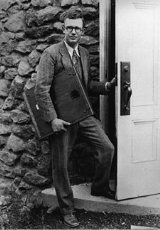
Clyde Tombaugh

Encyclopedia
Clyde William Tombaugh (February 4, 1906January 17, 1997) was an American
astronomer
. Although he is best known for discovering the dwarf planet
Pluto
in 1930, the first object to be discovered in what would later be identified as the Kuiper Belt
, Tombaugh also discovered many asteroid
s; he also called for serious scientific research of unidentified flying object
s.
. After his family moved to Burdett, Kansas
, Tombaugh's plans for attending college were frustrated when a hail
storm ruined their crops. Starting in 1926, he built several telescope
s with lenses and mirrors he ground himself. He sent drawings of Jupiter
and Mars
, as well as his telescopes to the Lowell Observatory
. These resulted in a job offer. Tombaugh was employed at the Lowell Observatory
from 1929 to 1945.
Following his discovery of Pluto, Tombaugh earned bachelor's and master's degrees in astronomy from the University of Kansas
in 1936 and 1938. During World War II
he taught naval personnel navigation at Northern Arizona University
. He worked at White Sands Missile Range
in the early 1950s, and taught astronomy at New Mexico State University
from 1955 until his retirement in 1973. He died in Las Cruces, New Mexico
in 1997, aged 90. He was survived by his widow, Patricia and their children: daughter Annette and son Alden. Tombaugh was the great-uncle of Los Angeles Dodgers pitcher Clayton Kershaw
. Tombaugh was an active Unitarian-Universalist.
The asteroid
1604 Tombaugh
, discovered in 1931, is named after him. He discovered hundreds of asteroids, beginning with 2839 Annette in 1929, mostly as a by-product of his search for Pluto and his searches for other celestial objects. Tombaugh named some of them after his wife, children and grandchildren. The Royal Astronomical Society
awarded him the Jackson-Gwilt Medal
in 1931.
Approximately one ounce of his ashes is being carried on the New Horizons
spacecraft, launched in 2006 for a flyby of Pluto in 2015. The container includes the inscription: "Interned herein are remains of American Clyde W. Tombaugh, discoverer of Pluto and the solar system's 'third zone'. Adelle and Muron's boy, Patricia's husband, Annette and Alden's father, astronomer, teacher, punster, and friend: Clyde W. Tombaugh (1906–1997)".
 While a young researcher working for the Lowell Observatory
in Flagstaff, Arizona
, Tombaugh was given the job to perform a systematic search for a trans-Neptunian
planet (also called Planet X
), which had been predicted by Percival Lowell
and William Pickering
.
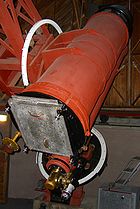
Tombaugh used the observatory's 13-inch astrograph
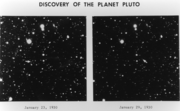
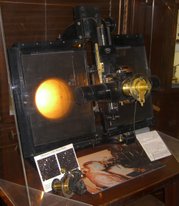
to take photographs of the same section of sky several nights apart. He then used a blink comparator
to compare the different images. When he shifted between the two images, a moving object, such as a planet, would appear to jump from one position to another, while the more distant objects such as stars would appear stationary. Tombaugh noticed such a moving object in his search, near the place predicted by Lowell, and subsequent observations showed it to have an orbit beyond that of Neptune. This ruled out classification as an asteroid, and they decided this was the ninth planet that Lowell had predicted. The discovery was made on Tuesday, February 18, 1930, using images taken the previous month. The name "Pluto" was reportedly suggested by Venetia Burney, then an 11-year-old English
school girl, who died in April 2009, having lived to see the reclassification of Pluto as a dwarf planet. It won out over numerous other suggestions partly because it was named after the Roman
god of the underworld because he was able to render himself invisible and because Percival Lowell
's initials PL formed the first 2 letters. The name Pluto was officially adopted on May 1, 1930.
 Following the discovery, starting in the 1990s, of other Kuiper belt
objects, Pluto began to be seen not as a planet orbiting alone at 40 AU
, but as the largest of a group of icy bodies in that region of space. After it was shown that at least one such body was larger than Pluto, on August 24, 2006 the International Astronomical Union
(IAU) reclassified Pluto, grouping it with two similarly sized "dwarf planet
s" rather than with the eight "classical planets".
Tombaugh's widow Patricia stated after the IAU's decision that while Clyde may have been disappointed with the change since he had resisted attempts to remove Pluto's planetary status in his lifetime, he would have accepted the decision now if he were alive. She noted that he "was a scientist. He would understand they had a real problem when they start finding several of these things flying around the place."
existed near the ecliptic
. No more Trans-Neptunian objects were discovered until , in 1992.
However, more recently the relatively bright object has been discovered. It has a relatively high orbital inclination
, but at the time of Tombaugh's discovery of Pluto, Makemake was only a few degrees from the ecliptic near the border of Taurus
and Auriga
at an apparent magnitude of 16. This position was also very near the galactic equator, making it almost impossible to find such an object within the dense concentration of background stars of the Milky Way
.
 Tombaugh discovered nearly 800 asteroid
s during his search for Pluto and years of follow-up searches looking for another candidate for the postulated Planet X. Tombaugh is also credited with the discovery of comet C/1931 AN, though its orbit is currently unknown. He also discovered hundreds of variable star
s, as well as star cluster
s, galaxy cluster
s, and a galaxy supercluster
.
s and to support the extraterrestrial hypothesis
. On August 20, 1949, Tombaugh saw several UFOs near Las Cruces, New Mexico
. He described them as six to eight rectangular lights, stating: "I doubt that the phenomenon was any terrestrial reflection, because... nothing of the kind has ever appeared before or since... I was so unprepared for such a strange sight that I was really petrified with astonishment." Another sighting by Tombaugh a year or two later while at a White Sands observatory was of an object of −6 magnitude, four times brighter than Venus at its brightest, going from the zenith to the southern horizon in about 3 seconds. The object executed the same maneuvers as in Tombaugh's first sighting.
Tombaugh later reported having seen three of the mysterious green fireballs
, which suddenly appeared over New Mexico in late 1948 and continued at least through the early 1950s. Despite this, the final report of Project Twinkle
— see external link — claimed that he "... never observed an unexplainable aerial object despite his continuous and extensive observations of the sky."
In 1956 Tombaugh had the following to say about his various sightings: "I have seen three objects in the last seven years which defied any explanation of known phenomenon, such as Venus, atmospheric optic, meteors or planes. I am a professional, highly skilled, professional astronomer. In addition I have seen three green fireballs which were unusual in behavior from normal green fireballs... I think that several reputable scientists are being unscientific in refusing to entertain the possibility of extraterrestrial
origin and nature."
Shortly after this in January 1957, in an Associated Press
article in the Alamogordo Daily News
titled "Celestial Visitors May Be Invading Earth's Atmosphere," Tombaugh was again quoted on his sightings and opinion about them. "Although our own solar system is believed to support no other life than on Earth, other stars in the galaxy may have hundreds of thousands of habitable worlds. Races on these worlds may have been able to utilize the tremendous amounts of power required to bridge the space between the stars..." Tombaugh stated that he had observed celestial phenomena which he could not explain, but has seen none personally since 1951 or 1952. "These things, which do appear to be directed, are unlike any other phenomena I ever observed. Their apparent lack of obedience to the ordinary laws of celestial motion gives credence."
In 1949, Tombaugh had also told the Naval missile director at White Sands Missile Range
, Commander Robert McLaughlin, that he had seen a bright flash on Mars in August 1941, which he now attributed to an atomic blast. Tombaugh also noted that the first atomic bomb tested in New Mexico would have lit up the dark side of the Earth like a neon sign and that Mars was coincidentally quite close at the time, the implication apparently being that the atomic test would have been visible from Mars.
In June 1952, Dr. J. Allen Hynek
, an astronomer acting as a scientific consultant to the Air Force's Project Blue Book
UFO study, secretly conducted a survey of fellow astronomers on UFO sightings and attitudes while attending an astronomy convention. Tombaugh and four other astronomers, including Dr. Lincoln LaPaz
of the University of New Mexico, told Hynek about their sightings. Tombaugh also told Hynek that his telescopes were at the Air Force's disposal for taking photos of UFOs, if he was properly alerted.
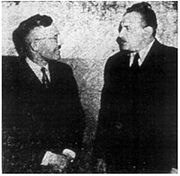 Tombaugh's offer may have led to his involvement in a search for near-Earth satellite
s, first announced in late 1953 and sponsored by the Army Office of Ordnance Research. Another public statement was made on the search in March 1954 (photo at right), emphasizing the rationale that such an orbiting object would serve as a natural space station
. However, according to Donald Keyhoe
, later director of the National Investigations Committee on Aerial Phenomena
(NICAP), the real reason for the sudden search was because two near-Earth orbiting objects had been picked up on new long-range radar in the summer of 1953, according to his Pentagon
source.
By May 1954, Keyhoe was making public statements that his sources told him the search had indeed been successful, and either one or two objects had been found. However, the story did not break until August 23, 1954, when Aviation Week magazine stated that two satellites had been found only 400 and 600 miles out. They were termed "natural satellites" and implied that they had been recently captured, despite this being a virtual impossibility. The next day, the story was in many major newspapers. Dr. LaPaz was implicated in the discovery in addition to Tombaugh. LaPaz had earlier conducted secret investigations on behalf of the Air Force on the green fireballs
and other unidentified aerial phenomena over New Mexico. LaPaz vehemently denied his involvement in the search, although the New York Times reported on August 29 that a source close to the project said that the story was true and LaPaz was indeed involved, in fact had been the one to spot and identify the objects as natural rather than artificial satellites. The same source denied the search had anything to do with flying saucers.
However, both LaPaz and Tombaugh were to issue public denials that anything had been found. The October 1955 issue of Popular Mechanics
magazine reported: "Professor Tombaugh is closemouthed about his results. He won't say whether or not any small natural satellites have been discovered. He does say, however, that newspaper reports of 18 months ago announcing the discovery of natural satellites at 400 and 600 miles out are not correct. He adds that there is no connection between the search program and the reports of so-called flying saucers."
At a meteor conference in Los Angeles in 1957, Tombaugh reiterated that his four year search for "natural satellites" had been unsuccessful. In 1959, Tombaugh was to issue a final report stating that nothing had been found in his search. His personal 16-inch telescope
was reassembled and dedicated on September 17, 2009 at Rancho Hidalgo, New Mexico (near Animas, New Mexico
, adjacent to Astronomy 's new observatory.
United States
The United States of America is a federal constitutional republic comprising fifty states and a federal district...
astronomer
Astronomer
An astronomer is a scientist who studies celestial bodies such as planets, stars and galaxies.Historically, astronomy was more concerned with the classification and description of phenomena in the sky, while astrophysics attempted to explain these phenomena and the differences between them using...
. Although he is best known for discovering the dwarf planet
Dwarf planet
A dwarf planet, as defined by the International Astronomical Union , is a celestial body orbiting the Sun that is massive enough to be spherical as a result of its own gravity but has not cleared its neighboring region of planetesimals and is not a satellite...
Pluto
Pluto
Pluto, formal designation 134340 Pluto, is the second-most-massive known dwarf planet in the Solar System and the tenth-most-massive body observed directly orbiting the Sun...
in 1930, the first object to be discovered in what would later be identified as the Kuiper Belt
Kuiper belt
The Kuiper belt , sometimes called the Edgeworth–Kuiper belt, is a region of the Solar System beyond the planets extending from the orbit of Neptune to approximately 50 AU from the Sun. It is similar to the asteroid belt, although it is far larger—20 times as wide and 20 to 200 times as massive...
, Tombaugh also discovered many asteroid
Asteroid
Asteroids are a class of small Solar System bodies in orbit around the Sun. They have also been called planetoids, especially the larger ones...
s; he also called for serious scientific research of unidentified flying object
Unidentified flying object
A term originally coined by the military, an unidentified flying object is an unusual apparent anomaly in the sky that is not readily identifiable to the observer as any known object...
s.
Biography
Tombaugh was born in Streator, IllinoisStreator, Illinois
Streator is a city in LaSalle and partially in Livingston counties in the U.S. state of Illinois. The city is situated on the Vermilion River approximately southwest of Chicago, Illinois in the prairie and farm land of north-central Illinois. It is the center of the geographic region known as...
. After his family moved to Burdett, Kansas
Burdett, Kansas
Burdett is a city in Pawnee County, Kansas, United States. As of the 2010 census, the city population was 247.-Geography:Burdett is located at . According to the United States Census Bureau, the city has a total area of , all of it land.-Demographics:As of the census of 2000, there were 256...
, Tombaugh's plans for attending college were frustrated when a hail
Hail
Hail is a form of solid precipitation. It consists of balls or irregular lumps of ice, each of which is referred to as a hail stone. Hail stones on Earth consist mostly of water ice and measure between and in diameter, with the larger stones coming from severe thunderstorms...
storm ruined their crops. Starting in 1926, he built several telescope
Telescope
A telescope is an instrument that aids in the observation of remote objects by collecting electromagnetic radiation . The first known practical telescopes were invented in the Netherlands at the beginning of the 1600s , using glass lenses...
s with lenses and mirrors he ground himself. He sent drawings of Jupiter
Jupiter
Jupiter is the fifth planet from the Sun and the largest planet within the Solar System. It is a gas giant with mass one-thousandth that of the Sun but is two and a half times the mass of all the other planets in our Solar System combined. Jupiter is classified as a gas giant along with Saturn,...
and Mars
Mars
Mars is the fourth planet from the Sun in the Solar System. The planet is named after the Roman god of war, Mars. It is often described as the "Red Planet", as the iron oxide prevalent on its surface gives it a reddish appearance...
, as well as his telescopes to the Lowell Observatory
Lowell Observatory
Lowell Observatory is an astronomical observatory in Flagstaff, Arizona. Lowell Observatory was established in 1894, placing it among the oldest observatories in the United States, and was designated a National Historic Landmark in 1965....
. These resulted in a job offer. Tombaugh was employed at the Lowell Observatory
Lowell Observatory
Lowell Observatory is an astronomical observatory in Flagstaff, Arizona. Lowell Observatory was established in 1894, placing it among the oldest observatories in the United States, and was designated a National Historic Landmark in 1965....
from 1929 to 1945.
Following his discovery of Pluto, Tombaugh earned bachelor's and master's degrees in astronomy from the University of Kansas
University of Kansas
The University of Kansas is a public research university and the largest university in the state of Kansas. KU campuses are located in Lawrence, Wichita, Overland Park, and Kansas City, Kansas with the main campus being located in Lawrence on Mount Oread, the highest point in Lawrence. The...
in 1936 and 1938. During World War II
World War II
World War II, or the Second World War , was a global conflict lasting from 1939 to 1945, involving most of the world's nations—including all of the great powers—eventually forming two opposing military alliances: the Allies and the Axis...
he taught naval personnel navigation at Northern Arizona University
Northern Arizona University
Northern Arizona University is a public university located in Flagstaff, Arizona, United States. It is accredited by the North Central Association of Colleges and Schools, and has 39 satellite campuses in the state of Arizona. The university offers both undergraduate and graduate degrees.As of...
. He worked at White Sands Missile Range
White Sands Missile Range
White Sands Missile Range is a rocket range of almost in parts of five counties in southern New Mexico. The largest military installation in the United States, WSMR includes the and the WSMR Otera Mesa bombing range...
in the early 1950s, and taught astronomy at New Mexico State University
New Mexico State University
New Mexico State University at Las Cruces , is a major land-grant university in Las Cruces, New Mexico, United States...
from 1955 until his retirement in 1973. He died in Las Cruces, New Mexico
Las Cruces, New Mexico
Las Cruces, also known as "The City of the Crosses", is the county seat of Doña Ana County, New Mexico, United States. The population was 97,618 in 2010 according to the 2010 Census, making it the second largest city in the state....
in 1997, aged 90. He was survived by his widow, Patricia and their children: daughter Annette and son Alden. Tombaugh was the great-uncle of Los Angeles Dodgers pitcher Clayton Kershaw
Clayton Kershaw
Clayton Edward Kershaw is a left-handed pitcher for the Los Angeles Dodgers of Major League Baseball.In 2011, Kershaw won the Pitching Triple Crown and the National League Cy Young Award, becoming the youngest pitcher to accomplish either of these feats since Dwight Gooden in 1985...
. Tombaugh was an active Unitarian-Universalist.
The asteroid
Asteroid
Asteroids are a class of small Solar System bodies in orbit around the Sun. They have also been called planetoids, especially the larger ones...
1604 Tombaugh
1604 Tombaugh
1604 Tombaugh is an asteroid discovered by Carl Otto Lampland on March 24, 1931 at the Lowell Observatory in Flagstaff, Arizona. It was named after Clyde W. Tombaugh, who discovered the dwarf planet Pluto in 1930. The asteroid's original designation was 1931 FH.-External links:*...
, discovered in 1931, is named after him. He discovered hundreds of asteroids, beginning with 2839 Annette in 1929, mostly as a by-product of his search for Pluto and his searches for other celestial objects. Tombaugh named some of them after his wife, children and grandchildren. The Royal Astronomical Society
Royal Astronomical Society
The Royal Astronomical Society is a learned society that began as the Astronomical Society of London in 1820 to support astronomical research . It became the Royal Astronomical Society in 1831 on receiving its Royal Charter from William IV...
awarded him the Jackson-Gwilt Medal
Jackson-Gwilt Medal
The Jackson-Gwilt Medal of the Royal Astronomical Society has been awarded regularly since 1897 for the invention, improvement, or development of astronomical instrumentation or techniques; for achievement in observational astronomy; or for achievement in research into the history of astronomy.The...
in 1931.
Approximately one ounce of his ashes is being carried on the New Horizons
New Horizons
New Horizons is a NASA robotic spacecraft mission currently en route to the dwarf planet Pluto. It is expected to be the first spacecraft to fly by and study Pluto and its moons, Charon, Nix, Hydra and S/2011 P 1. Its estimated arrival date at the Pluto-Charon system is July 14th, 2015...
spacecraft, launched in 2006 for a flyby of Pluto in 2015. The container includes the inscription: "Interned herein are remains of American Clyde W. Tombaugh, discoverer of Pluto and the solar system's 'third zone'. Adelle and Muron's boy, Patricia's husband, Annette and Alden's father, astronomer, teacher, punster, and friend: Clyde W. Tombaugh (1906–1997)".
Discovery of Pluto
Lowell Observatory
Lowell Observatory is an astronomical observatory in Flagstaff, Arizona. Lowell Observatory was established in 1894, placing it among the oldest observatories in the United States, and was designated a National Historic Landmark in 1965....
in Flagstaff, Arizona
Flagstaff, Arizona
Flagstaff is a city located in northern Arizona, in the southwestern United States. In 2010, the city's population was 65,870. The population of the Metropolitan Statistical Area was at 134,421 in 2010. It is the county seat of Coconino County...
, Tombaugh was given the job to perform a systematic search for a trans-Neptunian
Trans-Neptunian object
A trans-Neptunian object is any minor planet in the Solar System that orbits the Sun at a greater distance on average than Neptune.The first trans-Neptunian object to be discovered was Pluto in 1930...
planet (also called Planet X
Planet X
Following the discovery of the planet Neptune in 1846, there was considerable speculation that another planet might exist beyond its orbit. The search began in the mid-19th century but culminated at the start of the 20th with Percival Lowell's quest for Planet X...
), which had been predicted by Percival Lowell
Percival Lowell
Percival Lawrence Lowell was a businessman, author, mathematician, and astronomer who fueled speculation that there were canals on Mars, founded the Lowell Observatory in Flagstaff, Arizona, and formed the beginning of the effort that led to the discovery of Pluto 14 years after his death...
and William Pickering
William Henry Pickering
William Henry Pickering was an American astronomer, brother of Edward Charles Pickering. He was elected a Fellow of the American Academy of Arts and Sciences in 1883.-Work:...
.
Tombaugh used the observatory's 13-inch astrograph
Astrograph
An astrograph is a telescope designed for the sole purpose of astrophotography. Astrographs are usually used in wide field surveys of the night sky as well as detection of objects such as asteroids, meteors, and comets.-Design:...
to take photographs of the same section of sky several nights apart. He then used a blink comparator
Blink comparator
A blink comparator was a viewing apparatus used by astronomers to find differences between two photographs of the night sky shot using optical telescopes such as astrographs. It permitted rapidly switching from viewing one photograph to viewing the other, "blinking" back and forth between the two...
to compare the different images. When he shifted between the two images, a moving object, such as a planet, would appear to jump from one position to another, while the more distant objects such as stars would appear stationary. Tombaugh noticed such a moving object in his search, near the place predicted by Lowell, and subsequent observations showed it to have an orbit beyond that of Neptune. This ruled out classification as an asteroid, and they decided this was the ninth planet that Lowell had predicted. The discovery was made on Tuesday, February 18, 1930, using images taken the previous month. The name "Pluto" was reportedly suggested by Venetia Burney, then an 11-year-old English
England
England is a country that is part of the United Kingdom. It shares land borders with Scotland to the north and Wales to the west; the Irish Sea is to the north west, the Celtic Sea to the south west, with the North Sea to the east and the English Channel to the south separating it from continental...
school girl, who died in April 2009, having lived to see the reclassification of Pluto as a dwarf planet. It won out over numerous other suggestions partly because it was named after the Roman
Roman mythology
Roman mythology is the body of traditional stories pertaining to ancient Rome's legendary origins and religious system, as represented in the literature and visual arts of the Romans...
god of the underworld because he was able to render himself invisible and because Percival Lowell
Percival Lowell
Percival Lawrence Lowell was a businessman, author, mathematician, and astronomer who fueled speculation that there were canals on Mars, founded the Lowell Observatory in Flagstaff, Arizona, and formed the beginning of the effort that led to the discovery of Pluto 14 years after his death...
's initials PL formed the first 2 letters. The name Pluto was officially adopted on May 1, 1930.
Kuiper belt
The Kuiper belt , sometimes called the Edgeworth–Kuiper belt, is a region of the Solar System beyond the planets extending from the orbit of Neptune to approximately 50 AU from the Sun. It is similar to the asteroid belt, although it is far larger—20 times as wide and 20 to 200 times as massive...
objects, Pluto began to be seen not as a planet orbiting alone at 40 AU
Astronomical unit
An astronomical unit is a unit of length equal to about or approximately the mean Earth–Sun distance....
, but as the largest of a group of icy bodies in that region of space. After it was shown that at least one such body was larger than Pluto, on August 24, 2006 the International Astronomical Union
International Astronomical Union
The International Astronomical Union IAU is a collection of professional astronomers, at the Ph.D. level and beyond, active in professional research and education in astronomy...
(IAU) reclassified Pluto, grouping it with two similarly sized "dwarf planet
Dwarf planet
A dwarf planet, as defined by the International Astronomical Union , is a celestial body orbiting the Sun that is massive enough to be spherical as a result of its own gravity but has not cleared its neighboring region of planetesimals and is not a satellite...
s" rather than with the eight "classical planets".
Tombaugh's widow Patricia stated after the IAU's decision that while Clyde may have been disappointed with the change since he had resisted attempts to remove Pluto's planetary status in his lifetime, he would have accepted the decision now if he were alive. She noted that he "was a scientist. He would understand they had a real problem when they start finding several of these things flying around the place."
Further search
Tombaugh continued searching for some years after the discovery of Pluto, and the lack of further discoveries left him satisfied that no other object of a comparable apparent magnitudeApparent magnitude
The apparent magnitude of a celestial body is a measure of its brightness as seen by an observer on Earth, adjusted to the value it would have in the absence of the atmosphere...
existed near the ecliptic
Ecliptic
The ecliptic is the plane of the earth's orbit around the sun. In more accurate terms, it is the intersection of the celestial sphere with the ecliptic plane, which is the geometric plane containing the mean orbit of the Earth around the Sun...
. No more Trans-Neptunian objects were discovered until , in 1992.
However, more recently the relatively bright object has been discovered. It has a relatively high orbital inclination
Inclination
Inclination in general is the angle between a reference plane and another plane or axis of direction.-Orbits:The inclination is one of the six orbital parameters describing the shape and orientation of a celestial orbit...
, but at the time of Tombaugh's discovery of Pluto, Makemake was only a few degrees from the ecliptic near the border of Taurus
Taurus (constellation)
Taurus is one of the constellations of the zodiac. Its name is a Latin word meaning 'bull', and its astrological symbol is a stylized bull's head:...
and Auriga
Auriga (constellation)
Auriga is a constellation in the northern sky. Its name is Latin for 'charioteer' and its stars form a shape that has been associated with the pointed helmet of a charioteer. It was one of the 48 constellations listed by the 2nd century astronomer Ptolemy, and remains among the 88 modern...
at an apparent magnitude of 16. This position was also very near the galactic equator, making it almost impossible to find such an object within the dense concentration of background stars of the Milky Way
Milky Way
The Milky Way is the galaxy that contains the Solar System. This name derives from its appearance as a dim un-resolved "milky" glowing band arching across the night sky...
.
Asteroids discovered
Asteroid
Asteroids are a class of small Solar System bodies in orbit around the Sun. They have also been called planetoids, especially the larger ones...
s during his search for Pluto and years of follow-up searches looking for another candidate for the postulated Planet X. Tombaugh is also credited with the discovery of comet C/1931 AN, though its orbit is currently unknown. He also discovered hundreds of variable star
Variable star
A star is classified as variable if its apparent magnitude as seen from Earth changes over time, whether the changes are due to variations in the star's actual luminosity, or to variations in the amount of the star's light that is blocked from reaching Earth...
s, as well as star cluster
Star cluster
Star clusters or star clouds are groups of stars. Two types of star clusters can be distinguished: globular clusters are tight groups of hundreds of thousands of very old stars which are gravitationally bound, while open clusters, more loosely clustered groups of stars, generally contain less than...
s, galaxy cluster
Galaxy groups and clusters
Galaxy groups and clusters are the largest known gravitationally bound objects to have arisen thus far in the process of cosmic structure formation. They form the densest part of the large scale structure of the universe...
s, and a galaxy supercluster
Supercluster
Superclusters are large groups of smaller galaxy groups and clusters and are among the largest known structures of the cosmos. They are so large that they are not gravitationally bound and, consequently, partake in the Hubble expansion.-Existence:...
.
| Designation | Discovery |
|---|---|
| 2839 Annette 2839 Annette 2839 Annette is a main-belt asteroid discovered on October 5, 1929 by Clyde Tombaugh at the Lowell Observatory, Flagstaff during his search for Pluto. It is named after his daughter Annette.- External links :*... |
October 5, 1929 |
| 2941 Alden 2941 Alden 2941 Alden is a main belt asteroid discovered on December 24, 1930 by Tombaugh, C. W. at Lowell Observatory. It is named for his son, Alden- External links :*... |
December 24, 1930 |
| 3310 Patsy 3310 Patsy 3310 Patsy is a main-belt asteroid discovered on October 9, 1931 by C. W. Tombaugh at Flagstaff .- External links :*... |
October 9, 1931 |
| 3583 Burdett 3583 Burdett 3583 Burdett is a main-belt asteroid discovered on October 5, 1929 by Tombaugh, C. W. at Flagstaff . It is named after Burdett, Kansas, where Tombaugh spent a large part of his youth.- External links :... |
October 5, 1929 |
| 3754 Kathleen 3754 Kathleen 3754 Kathleen is a main-belt asteroid discovered on March 16, 1931 by C. W. Tombaugh at Flagstaff .It has a common main belt albedo of 0.06, and thus is 53 km in diameter.- External links :* from JPL /... |
March 16, 1931 |
| 3775 Ellenbeth 3775 Ellenbeth 3775 Ellenbeth is a main-belt asteroid discovered on October 6, 1931 by Tombaugh, C. W. at Flagstaff .- External links :*... |
October 6, 1931 |
| 3824 Brendalee 3824 Brendalee 3824 Brendalee is a main-belt asteroid discovered on October 5, 1929 by Tombaugh, C. W. at Flagstaff .- External links :*... |
October 5, 1929 |
| 4510 Shawna 4510 Shawna 4510 Shawna is a main-belt asteroid discovered on December 13, 1930 by Clyde W. Tombaugh at Flagstaff.- External links :*... |
December 13, 1930 |
| 4755 Nicky 4755 Nicky 4755 Nicky is a main-belt asteroid discovered on October 6, 1931 by C. W. Tombaugh at Flagstaff.-External links:*... |
October 6, 1931 |
| 5701 Baltuck 5701 Baltuck 5701 Baltuck is a main-belt asteroid discovered on October 26, 1929 by C. W. Tombaugh at the Lowell Observatory.- External links :*... |
November 3, 1929 |
| (6618) 1936 SO | September 16, 1936 |
| (7101) 1930 UX | October 17, 1930 |
| 7150 McKellar 7150 McKellar 7150 McKellar is a main-belt minor planet. It was discovered by Clyde Tombaugh at the Lowell Observatory in Flagstaff, Arizona, on October 11, 1929. It is named for Andrew McKellar, a Canadian astronomer who discovered the temperature of interstellar space to be about 2.7 K in 1941.-External... |
October 11, 1929 |
| October 10, 1931 |
Interest in UFOs
Tombaugh was probably the most eminent astronomer to have reported seeing unidentified flying objectUnidentified flying object
A term originally coined by the military, an unidentified flying object is an unusual apparent anomaly in the sky that is not readily identifiable to the observer as any known object...
s and to support the extraterrestrial hypothesis
Extraterrestrial hypothesis
The extraterrestrial hypothesis is the hypothesis that some unidentified flying objects are best explained as being extraterrestrial life or non-human aliens from other planets occupying physical spacecraft visiting Earth.-Etymology:...
. On August 20, 1949, Tombaugh saw several UFOs near Las Cruces, New Mexico
Las Cruces, New Mexico
Las Cruces, also known as "The City of the Crosses", is the county seat of Doña Ana County, New Mexico, United States. The population was 97,618 in 2010 according to the 2010 Census, making it the second largest city in the state....
. He described them as six to eight rectangular lights, stating: "I doubt that the phenomenon was any terrestrial reflection, because... nothing of the kind has ever appeared before or since... I was so unprepared for such a strange sight that I was really petrified with astonishment." Another sighting by Tombaugh a year or two later while at a White Sands observatory was of an object of −6 magnitude, four times brighter than Venus at its brightest, going from the zenith to the southern horizon in about 3 seconds. The object executed the same maneuvers as in Tombaugh's first sighting.
Tombaugh later reported having seen three of the mysterious green fireballs
Green Fireballs
Green fireballs are a type of unidentified flying object which have been sighted in the sky since the late 1940s . Early sightings primarily occurred in the southwestern United States, particularly in New Mexico...
, which suddenly appeared over New Mexico in late 1948 and continued at least through the early 1950s. Despite this, the final report of Project Twinkle
Green Fireballs
Green fireballs are a type of unidentified flying object which have been sighted in the sky since the late 1940s . Early sightings primarily occurred in the southwestern United States, particularly in New Mexico...
— see external link — claimed that he "... never observed an unexplainable aerial object despite his continuous and extensive observations of the sky."
In 1956 Tombaugh had the following to say about his various sightings: "I have seen three objects in the last seven years which defied any explanation of known phenomenon, such as Venus, atmospheric optic, meteors or planes. I am a professional, highly skilled, professional astronomer. In addition I have seen three green fireballs which were unusual in behavior from normal green fireballs... I think that several reputable scientists are being unscientific in refusing to entertain the possibility of extraterrestrial
Extraterrestrial life
Extraterrestrial life is defined as life that does not originate from Earth...
origin and nature."
Shortly after this in January 1957, in an Associated Press
Associated Press
The Associated Press is an American news agency. The AP is a cooperative owned by its contributing newspapers, radio and television stations in the United States, which both contribute stories to the AP and use material written by its staff journalists...
article in the Alamogordo Daily News
Alamogordo Daily News
Alamogordo Daily News, founded in 1898, is a daily newspaper published in Alamogordo, New Mexico. It carries local news as well as syndicated content from Associated Press and others.- History :...
titled "Celestial Visitors May Be Invading Earth's Atmosphere," Tombaugh was again quoted on his sightings and opinion about them. "Although our own solar system is believed to support no other life than on Earth, other stars in the galaxy may have hundreds of thousands of habitable worlds. Races on these worlds may have been able to utilize the tremendous amounts of power required to bridge the space between the stars..." Tombaugh stated that he had observed celestial phenomena which he could not explain, but has seen none personally since 1951 or 1952. "These things, which do appear to be directed, are unlike any other phenomena I ever observed. Their apparent lack of obedience to the ordinary laws of celestial motion gives credence."
In 1949, Tombaugh had also told the Naval missile director at White Sands Missile Range
White Sands Missile Range
White Sands Missile Range is a rocket range of almost in parts of five counties in southern New Mexico. The largest military installation in the United States, WSMR includes the and the WSMR Otera Mesa bombing range...
, Commander Robert McLaughlin, that he had seen a bright flash on Mars in August 1941, which he now attributed to an atomic blast. Tombaugh also noted that the first atomic bomb tested in New Mexico would have lit up the dark side of the Earth like a neon sign and that Mars was coincidentally quite close at the time, the implication apparently being that the atomic test would have been visible from Mars.
In June 1952, Dr. J. Allen Hynek
J. Allen Hynek
Dr. Josef Allen Hynek was a United States astronomer, professor, and ufologist. He is perhaps best remembered for his UFO research. Hynek acted as scientific adviser to UFO studies undertaken by the U.S. Air Force under three consecutive names: Project Sign , Project Grudge , and Project Blue Book...
, an astronomer acting as a scientific consultant to the Air Force's Project Blue Book
Project Blue Book
Project Blue Book was one of a series of systematic studies of unidentified flying objects conducted by the United States Air Force. Started in 1952, it was the second revival of such a study...
UFO study, secretly conducted a survey of fellow astronomers on UFO sightings and attitudes while attending an astronomy convention. Tombaugh and four other astronomers, including Dr. Lincoln LaPaz
Lincoln LaPaz
Lincoln LaPaz was an American astronomer from the University of New Mexico and a pioneer in the study of meteors.He was born in Wichita, Kansas on February 12, 1897 to Charles Melchior LaPaz and Emma Josephine . He earned his Bachelor of Arts in 1920 in mathematics at Fairmont College and also...
of the University of New Mexico, told Hynek about their sightings. Tombaugh also told Hynek that his telescopes were at the Air Force's disposal for taking photos of UFOs, if he was properly alerted.
Near-Earth satellite search
Satellite
In the context of spaceflight, a satellite is an object which has been placed into orbit by human endeavour. Such objects are sometimes called artificial satellites to distinguish them from natural satellites such as the Moon....
s, first announced in late 1953 and sponsored by the Army Office of Ordnance Research. Another public statement was made on the search in March 1954 (photo at right), emphasizing the rationale that such an orbiting object would serve as a natural space station
Space station
A space station is a spacecraft capable of supporting a crew which is designed to remain in space for an extended period of time, and to which other spacecraft can dock. A space station is distinguished from other spacecraft used for human spaceflight by its lack of major propulsion or landing...
. However, according to Donald Keyhoe
Donald Keyhoe
Donald Edward Keyhoe was an American Marine Corps naval aviator, writer of many aviation articles and stories in a variety of leading publications, and manager of the promotional tours of aviation pioneers, especially of Charles Lindbergh.In the 1950s he became well-known as an UFO researcher,...
, later director of the National Investigations Committee on Aerial Phenomena
National Investigations Committee On Aerial Phenomena
The National Investigations Committee On Aerial Phenomena was a civilian unidentified flying object research group active in the United States from the 1950s to the 1980s.-Overview:...
(NICAP), the real reason for the sudden search was because two near-Earth orbiting objects had been picked up on new long-range radar in the summer of 1953, according to his Pentagon
The Pentagon
The Pentagon is the headquarters of the United States Department of Defense, located in Arlington County, Virginia. As a symbol of the U.S. military, "the Pentagon" is often used metonymically to refer to the Department of Defense rather than the building itself.Designed by the American architect...
source.
By May 1954, Keyhoe was making public statements that his sources told him the search had indeed been successful, and either one or two objects had been found. However, the story did not break until August 23, 1954, when Aviation Week magazine stated that two satellites had been found only 400 and 600 miles out. They were termed "natural satellites" and implied that they had been recently captured, despite this being a virtual impossibility. The next day, the story was in many major newspapers. Dr. LaPaz was implicated in the discovery in addition to Tombaugh. LaPaz had earlier conducted secret investigations on behalf of the Air Force on the green fireballs
Green Fireballs
Green fireballs are a type of unidentified flying object which have been sighted in the sky since the late 1940s . Early sightings primarily occurred in the southwestern United States, particularly in New Mexico...
and other unidentified aerial phenomena over New Mexico. LaPaz vehemently denied his involvement in the search, although the New York Times reported on August 29 that a source close to the project said that the story was true and LaPaz was indeed involved, in fact had been the one to spot and identify the objects as natural rather than artificial satellites. The same source denied the search had anything to do with flying saucers.
However, both LaPaz and Tombaugh were to issue public denials that anything had been found. The October 1955 issue of Popular Mechanics
Popular Mechanics
Popular Mechanics is an American magazine first published January 11, 1902 by H. H. Windsor, and has been owned since 1958 by the Hearst Corporation...
magazine reported: "Professor Tombaugh is closemouthed about his results. He won't say whether or not any small natural satellites have been discovered. He does say, however, that newspaper reports of 18 months ago announcing the discovery of natural satellites at 400 and 600 miles out are not correct. He adds that there is no connection between the search program and the reports of so-called flying saucers."
At a meteor conference in Los Angeles in 1957, Tombaugh reiterated that his four year search for "natural satellites" had been unsuccessful. In 1959, Tombaugh was to issue a final report stating that nothing had been found in his search. His personal 16-inch telescope
Telescope
A telescope is an instrument that aids in the observation of remote objects by collecting electromagnetic radiation . The first known practical telescopes were invented in the Netherlands at the beginning of the 1600s , using glass lenses...
was reassembled and dedicated on September 17, 2009 at Rancho Hidalgo, New Mexico (near Animas, New Mexico
Animas, New Mexico
Animas is an unincorporated community in west central Hidalgo County, New Mexico, United States, in the southwestern corner of the state. It lies at the intersection of State Roads 9 and 338 south of the city of Lordsburg, the county seat of Hidalgo County. Its elevation is 4,406 feet , and...
, adjacent to Astronomy 's new observatory.
Sources
- Falk, Dan, "More than a one-hit wonder", Astronomy, February 2006, 40–45.
- David H. LevyDavid H. LevyDavid H. Levy is a Canadian astronomer and science writer most famous for his co-discovery in 1993 of Comet Shoemaker–Levy 9, which collided with the planet Jupiter in 1994.-Biography:...
Clyde Tombaugh: Discoverer of the Planet Pluto (Tucson, Ariz.: University of Arizona Press, 1991). ISBN 0816511489; also Sky Publishing Corporation, March 2006
External links
- Many biographical articles on Clyde Tombaugh
- Quote from Tombaugh on UFOs
- UFO activities of Tombaugh
- Academic paper on Tombaugh's UFO activities and near-earth satellite search
- Final report of Project Twinkle
- Illinois proposes a Pluto Day and reinstate Pluto as a Planet in honor of C. Tombaugh: Illinois General Assembly, Senate Resolution SR0046 2/26/2009