
All Topics  
Flash memory

 
Flash Memory

   Email Print
   Bookmark   Link


Flash memory


Flash memory is a non-volatile
Non-volatile memory

Non-volatile memory, nonvolatile memory, NVM or non-volatile storage, is computer memory that can retain the stored information even when not powered....
 computer memory
Computer storage

Computer data storage, often called storage or memory, refers to computer components, devices, and recording medium that retain digital data used for computing for some interval of time....
 that can be electrically erased and reprogrammed. It is a technology that is primarily used in memory card
Memory card

A memory card or flash memory card is a solid-state electronic flash memory data storage device used with digital cameras, Personal Digital Assistant and Mobile computers, telephones, music players, video game consoles, and other electronics....
s and USB flash drive
USB flash drive

A USB flash drive consists of a Flash memory#NAND memories-type flash memory data storage device integrated with a USB interface. USB flash drives are typically removable and rewritable, much smaller than a floppy disk , and most USB flash drives weigh less than an ounce ....
s for general storage and transfer of data between computers and other digital products. It is a specific type of EEPROM
EEPROM

EEPROM stands for Electrically Erasable Programmable Read-Only Memory and is a type of non-volatile memory used in computers and other electronic devices to store small amounts of data that must be saved when power is removed, e.g., calibration tables or device configuration....
 (Electrically Erasable Programmable Read-Only Memory) that is erased and programmed in large blocks; in early flash the entire chip had to be erased at once.


Discussion
Ask a question about 'Flash memory'
Start a new discussion about 'Flash memory'
Answer questions from other users
Full Discussion Forum


Encyclopedia


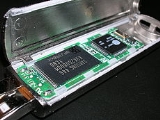
Dscn0411
Flash memory is a non-volatile
Non-volatile memory

Non-volatile memory, nonvolatile memory, NVM or non-volatile storage, is computer memory that can retain the stored information even when not powered....
 computer memory
Computer storage

Computer data storage, often called storage or memory, refers to computer components, devices, and recording medium that retain digital data used for computing for some interval of time....
 that can be electrically erased and reprogrammed. It is a technology that is primarily used in memory card
Memory card

A memory card or flash memory card is a solid-state electronic flash memory data storage device used with digital cameras, Personal Digital Assistant and Mobile computers, telephones, music players, video game consoles, and other electronics....
s and USB flash drive
USB flash drive

A USB flash drive consists of a Flash memory#NAND memories-type flash memory data storage device integrated with a USB interface. USB flash drives are typically removable and rewritable, much smaller than a floppy disk , and most USB flash drives weigh less than an ounce ....
s for general storage and transfer of data between computers and other digital products. It is a specific type of EEPROM
EEPROM

EEPROM stands for Electrically Erasable Programmable Read-Only Memory and is a type of non-volatile memory used in computers and other electronic devices to store small amounts of data that must be saved when power is removed, e.g., calibration tables or device configuration....
 (Electrically Erasable Programmable Read-Only Memory) that is erased and programmed in large blocks; in early flash the entire chip had to be erased at once. Flash memory costs far less than byte-programmable EEPROM and therefore has become the dominant technology wherever a significant amount of non-volatile, solid state
Solid state (electronics)

Solid-state electronic components, devices, and systems are based entirely on the semiconductor, such as transistors, microprocessor chips, and the bubble memory....
 storage is needed. Example applications include PDA
Personal digital assistant

A personal digital assistant is a handheld computer, also known as a palmtop computer. Newer PDAs also have both color screens and audio capabilities, enabling them to be used as mobile phones, , web browsers, or portable media players....
s (personal digital assistants), laptop computers, digital audio player
Digital audio player

A digital audio player, more commonly referred to as an MP3 player, is a consumer electronics device that stores, organizes and plays audio file formats....
s, digital camera
Digital camera

A digital camera is a camera that takes video or still photographs, or both, digitally by recording digital image via an electronics .Many compact digital still cameras can record sound and moving video as well as still photographs....
s and mobile phone
Mobile phone

A mobile phone is a long-range, electronic device used for mobile voice or data communication over a network of specialized base stations known as cell sites....
s. It has also gained popularity in the game console market, where it is often used instead of EEPROM
EEPROM

EEPROM stands for Electrically Erasable Programmable Read-Only Memory and is a type of non-volatile memory used in computers and other electronic devices to store small amounts of data that must be saved when power is removed, e.g., calibration tables or device configuration....
s or battery-powered SRAM for game save data.

Flash memory is non-volatile
Non-volatile memory

Non-volatile memory, nonvolatile memory, NVM or non-volatile storage, is computer memory that can retain the stored information even when not powered....
, which means that no power is needed to maintain the information stored in the chip. In addition, flash memory offers fast read access time
Access time

Access time is the time delay or Latency between a request to an electronic system, and the access being completed or the requested data returned....
s (although not as fast as volatile DRAM
Dynamic random access memory

Dynamic random access memory is a type of random access memory that stores each bit of data in a separate capacitor within an integrated circuit....
 memory used for main memory in PCs) and better kinetic shock resistance than hard disk
Hard disk

A hard disk drive , commonly referred to as a hard drive, hard disk, or fixed disk drive, is a non-volatile storage device which stores digitally encoded data on rapidly rotating hard disk platters with magnetic surfaces....
s. These characteristics explain the popularity of flash memory in portable devices. Another feature of flash memory is that when packaged in a "memory card," it is enormously durable, being able to withstand intense pressure, extremes of temperature, and even immersion in water.

Although technically a type of EEPROM
EEPROM

EEPROM stands for Electrically Erasable Programmable Read-Only Memory and is a type of non-volatile memory used in computers and other electronic devices to store small amounts of data that must be saved when power is removed, e.g., calibration tables or device configuration....
, the term "EEPROM" is generally used to refer specifically to non-flash EEPROM which is erasable in small blocks, typically bytes. Because erase cycles are slow, the large block sizes used in flash memory erasing give it a significant speed advantage over old-style EEPROM when writing large amounts of data.

History

Flash memory (both NOR
Nor

selfref|For the Wikipedia policy, see...
 and NAND
Nand

NAND may stand for:*Logical NAND , a binary operation in logic.**NAND gate, an electronic gate that implements a logical NAND....
 types) was invented by Dr. Fujio Masuoka
Fujio Masuoka

Dr. is the inventor of flash memory. He joined Toshiba in 1971. There he also developed SAMOS memory. Dr. Masuoka was excited mostly by the idea of non-volatile memory, memory that would last even when power was turned off....
 while working for Toshiba
Toshiba

is a multinational corporation list of conglomerates manufacturing company, headquartered in Tokyo, Japan. The company's main business is in Infrastructure, Consumer Products, and Electronic devices and components....
 circa 1980. According to Toshiba, the name "flash" was suggested by Dr. Masuoka's colleague, Mr. Shoji Ariizumi, because the erasure process of the memory contents reminded him of a flash
Flash (photography)

A flash is a device used in photography that produces an instantaneous flash of Lighting light at a color temperature of about 5500 K to help illuminate a scene....
 of a camera. Dr. Masuoka presented the invention at the IEEE 1984 International Electron Devices Meeting (IEDM) held in San Francisco
San Francisco, California

The City and County of San Francisco is the fourth most populous city in California and the List of United States cities by population in the United States, with a 2007 estimated population of 799,183....
, California
California

California is a U.S. state on the West Coast of the United States of the United States, along the Pacific Ocean. It is bordered by Oregon to the north, Nevada to the east, Arizona to the southeast, and to the south the Mexico state of Baja California....
.

Intel saw the massive potential of the invention and introduced the first commercial NOR type flash chip in 1988. NOR-based flash has long erase and write times, but provides full address and data buses, allowing random access
Random access

In computer science, random access is the ability to access an arbitrary element of a sequence in equal time. The opposite is sequential access, where a remote element takes longer time to access....
 to any memory location. This makes it a suitable replacement for older ROM
Read-only memory

Read-only memory is a class of computer storage media used in computers and other electronic devices. Because data stored in ROM cannot be modified , it is mainly used to distribute firmware ....
 chips, which are used to store program code that rarely needs to be updated, such as a computer's BIOS
BIOS

In computing, the Basic Input/Output System , also known as the System BIOS, is a de facto standard defining a firmware interface for IBM PC Compatible computers....
 or the firmware
Firmware

Firmware is a term sometimes used to denote the fixed, usually rather small, programs that internally control various electronic devices. Typical examples range from end user products such as remote controls or calculators, via computer parts and devices like harddisks, keyboard s, TFT screens or memory cards, all the way to scientific instr...
 of set-top box
Set-top box

A set-top box or set-top unit is a information appliance that connects to a television and an external source of signal , turning the signal into content which is then displayed on the television screen....
es. Its endurance is 10,000 to 1,000,000 erase cycles. NOR-based flash was the basis of early flash-based removable media; CompactFlash
CompactFlash

CompactFlash is a mass storage device format used in portable electronic devices. For storage, CompactFlash typically uses flash memory in a standardized enclosure....
 was originally based on it, though later cards moved to less expensive NAND flash.

Toshiba
Toshiba

is a multinational corporation list of conglomerates manufacturing company, headquartered in Tokyo, Japan. The company's main business is in Infrastructure, Consumer Products, and Electronic devices and components....
 announced NAND flash at the 1987 International Electron Devices Meeting. It has faster erase and write times, and requires a smaller chip area per cell, thus allowing greater storage densities and lower costs per bit than NOR flash; it also has up to ten times the endurance of NOR flash. However, the I/O interface of NAND flash does not provide a random-access external address bus. Rather, data must be read on a block-wise basis, with typical block sizes of hundreds to thousands of bits. This made NAND flash unsuitable as a drop-in replacement for program ROM since most microprocessors and microcontrollers required byte-level random access. In this regard NAND flash is similar to other secondary storage devices such as hard disk
Hard disk

A hard disk drive , commonly referred to as a hard drive, hard disk, or fixed disk drive, is a non-volatile storage device which stores digitally encoded data on rapidly rotating hard disk platters with magnetic surfaces....
s and optical media, and is thus very suitable for use in mass-storage devices such as memory card
Memory card

A memory card or flash memory card is a solid-state electronic flash memory data storage device used with digital cameras, Personal Digital Assistant and Mobile computers, telephones, music players, video game consoles, and other electronics....
s. The first NAND-based removable media format was SmartMedia
SmartMedia

SmartMedia is a flash memory memory card standard owned by Toshiba, with capacities ranging from 0.5 MB to 128 MB. SmartMedia memory cards are no longer manufactured, and there have been no new devices designed for use with SmartMedia for many years....
, and many others have followed, including MultiMediaCard
MultiMediaCard

The MultiMediaCard is a flash memory memory card standard. Unveiled in 1997 by Siemens AG and SanDisk, it is based on Toshiba's Flash memory#NAND memories, and is therefore much smaller than earlier systems based on Intel Flash memory#NOR memories such as CompactFlash....
, Secure Digital, Memory Stick
Memory Stick

Memory Stick is a removable flash memory memory card format, launched by Sony in October 1998 , and is also used in general to describe the whole family of Memory Sticks....
 and xD-Picture Card
XD-Picture Card

xD-Picture Card is a type of flash memory memory card, used mainly in digital cameras. xD originally stood for extreme Digital. The cards were developed by Olympus company and Fujifilm, and introduced into the market in July 2002....
. A new generation of memory card formats, including RS-MMC, miniSD and microSD
MicroSD

microSD is a format for removable flash memory cards. The SD stands for Secure Digital. It is commonly used in cellular phones, but also in handheld GPS devices, portable media players, digital audio players, expandable USB flash memory drives, and for Nintendo DS flashcards, along with digital cameras....
, and Intelligent Stick
Intelligent Stick

"Intelligent Stick" is a brand name for a USB flash drive memory card which was developed by the Power Quotient International company in 2002. Also called "I-Stick"....
, feature extremely small form factors. For example, the microSD card has an area of just over 1.5 cm², with a thickness of less than 1 mm; microSD capacities range from 64 MB to 16 GB, as of October 2008.

Principles of operation


Flash memory stores information in an array of memory cells made from floating-gate transistors. In traditional single-level cell
Single-level cell

Flash memory stores data in individual memory cells, which are made of floating-gate transistors. Traditionally, one bit of data was stored in each cell in so-called single-level cells, or SLC flash memory....
 (SLC) devices, each cell stores only one bit of information. Some newer flash memory, known as multi-level cell
Multi-level cell

In electronics, a multi-level cell is a memory element capable of storing more than a single bit of information.MLC NAND flash is a flash memory technology using multiple levels per cell to allow more bits to be stored as opposed to Single-level cell NAND flash technologies, which uses a single level per cell....
 (MLC) devices, can store more than one bit per cell by choosing between multiple levels of electrical charge to apply to the floating gates of its cells.

NOR flash


In NOR gate
NOR gate

The NOR gate is a digital logic gate that implements logical NOR - it behaves according to the truth table to the right. A HIGH output results if both the inputs to the gate are LOW ....
 flash, each cell resembles a standard MOSFET
MOSFET

The metal?oxide?semiconductor field-effect transistor is a device used to amplify or switch electronic signals. The basic principle of the device was first proposed by Julius Edgar Lilienfeld in 1925....
, except the transistor has two gates instead of one. On top is the control gate (CG), as in other MOS transistors, but below this there is a floating gate (FG) insulated all around by an oxide
Oxide

An oxide is a chemical compound contaning at least one oxygen atom as well as at least one other element. Most of the Earth's crust consists of oxides....
 layer. The FG is interposed between the CG and the MOSFET
MOSFET

The metal?oxide?semiconductor field-effect transistor is a device used to amplify or switch electronic signals. The basic principle of the device was first proposed by Julius Edgar Lilienfeld in 1925....
 channel. Because the FG is electrically isolated by its insulating layer, any electron
Electron

The electron is a subatomic particle that carries a negative electric charge. It has elementary particle and is believed to be a point particle....
s placed on it are trapped there and, under normal conditions, will not discharge for many years. When the FG holds a charge, it screens
Electric field screening

Screening is the damping of electric fields caused by the presence of mobile electric charge carriers. It is an important part of the behavior of charge-carrying fluids, such as ionized gases and electrical conduction electrons in semiconductors and metals....
 (partially cancels) the electric field
Electric field

In physics, the space surrounding an electric charge or in the presence of a time-varying magnetic field has a property called an electric field ....
 from the CG, which modifies the threshold voltage
Threshold voltage

The threshold voltage of a MOSFET is usually defined as the gate voltage where an inversion layer forms at the interface between the insulating layer and the substrate of the transistor....
 (VT) of the cell. During read-out, a voltage
Voltage

Electrical tension is the potential difference between two points of an electrical or electronic circuit, expressed in volts. It is the measurement of the potential for an electric field to cause an electric current in an electrical conductor....
 is applied to the CG, and the MOSFET channel will become conducting or remain insulating, depending on the VT of the cell, which is in turn controlled by charge on the FG. The current flow through the MOSFET channel is sensed and forms a binary code
Binary code

Binary code is the system of representing text or Instruction by the use of a two-numerical digit number system. This system is composed of only the number zero, representing the Off state, and the number one, representing on state, combined in groups of 8....
, reproducing the stored data
DATA

Debt, AIDS, Trade in Africa is a multinational Non-governmental organization founded in January 2002 in London by U2's Bono along with Robert Sargent Shriver III and activists from the Jubilee 2000 Drop the Debt campaign....
. In a multi-level cell device, which stores more than one bit
Bit

A bit is a binary numeral system numerical digit, taking a value of either 0 or 1. Binary digits are a basic unit of information Computer data storage and transmission in digital computing and digital information theory....
 per cell, the amount of current flow is sensed (rather than simply its presence or absence), in order to determine more precisely the level of charge on the FG.

Programming
A single-level NOR flash cell in its default state is logically equivalent to a binary "1" value, because current will flow through the channel under application of an appropriate voltage to the control gate. A NOR flash cell can be programmed, or set to a binary "0" value, by the following procedure:
  • an elevated on-voltage (typically >5 V) is applied to the CG
  • the channel is now turned on, so electrons can flow from the source to the drain (assuming an NMOS transistor)
  • the source-drain current is sufficiently high to cause some high energy electrons to jump through the insulating layer onto the FG, via a process called hot-electron injection
    Hot carrier injection

    Hot carriers injection is the phenomenon in solid-state devices or semiconductors where either an electron or a Electron hole gains sufficient kinetic energy to overcome a potential barrier, becoming a "hot electron", and then migrates to a different area of the device....

Erasing
To erase a NOR flash cell (resetting it to the "1" state), a large voltage of the opposite polarity is applied between the CG and source, pulling the electrons off the FG through quantum tunneling. Modern NOR flash memory chips are divided into erase segments (often called blocks or sectors). The erase operation can only be performed on a block-wise basis; all the cells in an erase segment must be erased together. Programming of NOR cells, however, can generally be performed one byte or word at a time.

Internal charge pumps
Despite the need for high programming and erasing voltages, virtually all flash chips today require only a single supply voltage, and produce the high voltages via on-chip charge pump
Charge pump

A charge pump is an electronic circuit that uses capacitors as energy storage elements to create either a higher or lower voltage power source. Charge pump circuits are capable of high Electrical efficiency, sometimes as high as 90-95% while being electrically simple circuits....
s.

NAND flash

NAND gate
Sheffer stroke

The Sheffer stroke, written "|" or "?", in the subject matter of boolean functions or propositional calculus, denotes a logical operation that is equivalent to the logical negation of the logical conjunction operation, expressed in ordinary language as "not both"....
 flash uses tunnel injection
Tunnel injection

Tunnel injection is the quantum tunneling effect, also called Fowler-Nordheim tunnel injection, when charge carriers are injected to an electric conductor through a thin layer of an electric insulator....
 for writing and tunnel release for erasing. NAND flash memory forms the core of the removable USB
Universal Serial Bus

In information technology, Universal Serial Bus is a Serial communications computer bus standard to electrical connector devices to a host computer....
 storage devices known as USB flash drive
USB flash drive

A USB flash drive consists of a Flash memory#NAND memories-type flash memory data storage device integrated with a USB interface. USB flash drives are typically removable and rewritable, much smaller than a floppy disk , and most USB flash drives weigh less than an ounce ....
s and most memory card
Memory card

A memory card or flash memory card is a solid-state electronic flash memory data storage device used with digital cameras, Personal Digital Assistant and Mobile computers, telephones, music players, video game consoles, and other electronics....
 formats available today.


Limitations


Block erasure

One limitation of flash memory is that although it can be read or programmed a byte or a word at a time in a random access fashion, it must be erased a "block" at a time. This generally sets all bits in the block to 1. Starting with a freshly erased block, any location within that block can be programmed. However, once a bit has been set to 0, only by erasing the entire block can it be changed back to 1. In other words, flash memory (specifically NOR flash) offers random-access read and programming operations, but cannot offer arbitrary random-access rewrite or erase operations. A location can, however, be rewritten as long as the new value's 0 bits are a superset of the over-written value's. For example, a nibble
Nibble

A nibble is the computing term for a four-bit aggregation, or half an octet . As a nibble contains 4 bits, there are sixteen possible values, so a nibble corresponds to a single hexadecimal digit ....
 value may be erased to 1111, then written as 1110. Successive writes to that nibble can change it to 1010, then 0010, and finally 0000. In practice few algorithms take advantage of this successive write capability and in general the entire block is erased and rewritten at once.

Although data structures in flash memory cannot be updated in completely general ways, this allows members to be "removed" by marking them as invalid. This technique may need to be modified for multi-level
Multi-level cell

In electronics, a multi-level cell is a memory element capable of storing more than a single bit of information.MLC NAND flash is a flash memory technology using multiple levels per cell to allow more bits to be stored as opposed to Single-level cell NAND flash technologies, which uses a single level per cell....
 devices, where one memory cell holds more than one bit.

Memory wear

Another limitation is that flash memory has a finite number of erase-write cycles. Most commercially available flash products are guaranteed to withstand around 100,000 write-erase-cycles, before the wear begins to deteriorate the integrity of the storage. The guaranteed cycle count may apply only to block zero (as is the case with TSOP
Thin small-outline package

Thin small-outline packages, or TSOPs are a type of surface mount IC package. They are notably very low-profile and have tight lead spacing ....
 NAND parts), or to all blocks (as in NOR). This effect is partially offset in some chip firmware or file system drivers by counting the writes and dynamically remapping blocks in order to spread write operations between sectors; this technique is called wear levelling
Wear levelling

Wear levelling is a technique for prolonging the service life of some kinds of erasable computer storage media, such as flash memory.The term has also been used by Western Digital to describe their hard disk preservation technique, but hard disks are not generally wear-levelled devices....
. Another approach is to perform write verification and remapping to spare sectors in case of write failure, a technique called bad block management (BBM). For portable consumer devices, these wearout management techniques typically extend the life of the flash memory beyond the life of the device itself, and some data loss may be acceptable in these applications. For high reliability data storage, however, it is not advisable to use flash memory that would have to go through a large number of programming cycles. This limitation is meaningless for 'read-only' applications such as thin clients and routers, which are only programmed once or at most a few times during their lifetime.

Low-level access

The low-level interface to flash memory chips differs from those of other memory types such as DRAM
Dram

Dram or DRAM may refer to:* Dram , an imperial unit of mass and volume* Armenian dram, a monetary unit* Dynamic random access memory* Database of Recorded American Music...
, ROM
Read-only memory

Read-only memory is a class of computer storage media used in computers and other electronic devices. Because data stored in ROM cannot be modified , it is mainly used to distribute firmware ....
, and EEPROM
EEPROM

EEPROM stands for Electrically Erasable Programmable Read-Only Memory and is a type of non-volatile memory used in computers and other electronic devices to store small amounts of data that must be saved when power is removed, e.g., calibration tables or device configuration....
, which support bit-alterability (both zero to one and one to zero) and random-access via externally accessible address bus
Address bus

An address bus is a computer bus that is used to specify a memory address. When a central processing unit or direct memory access-enabled device needs to read or write to a memory location, it specifies that memory location on the address bus ....
es.

While NOR memory provides an external address bus for read and program operations (and thus supports random-access); unlocking and erasing NOR memory must proceed on a block-by-block basis. With NAND flash memory, read and programming operations must be performed page-at-a-time while unlocking and erasing must happen in block-wise fashion.

NOR memories

Reading from NOR flash is similar to reading from random-access memory, provided the address and data bus are mapped correctly. Because of this, most microprocessors can use NOR flash memory as execute in place
Execute in place

In computer science, execute in place is a method of executing programs directly from long term storage rather than copying it into Random access memory....
 (XIP) memory, meaning that programs stored in NOR flash can be executed directly without the need to first copy the program into RAM. NOR flash may be programmed in a random-access manner similar to reading. Programming changes bits from a logical one to a zero. Bits that are already zero are left unchanged. Erasure must happen a block at a time, and resets all the bits in the erased block back to one. Typical block sizes are 64, 128, or 256 KB
Kilobyte

Kilobyte is a unit of Computer data storage equal to either 1,024 bytes or 1,000 bytes , depending on context.It is abbreviated in a number of ways: KB, kB, K and Kbyte....
.

Bad block management is a relatively new feature in NOR chips. In older NOR devices not supporting bad block management, the software or device driver
Device driver

In computing, a device driver or software driver is a computer program allowing higher-level computer programs to interact with a hardware device....
 controlling the memory chip must correct for blocks that wear out, or the device will cease to work reliably.

The specific commands used to lock, unlock, program, or erase NOR memories differ for each manufacturer. To avoid needing unique driver software for every device made, a special set of CFI
Common Flash Memory Interface

The Common Flash memory Interface is an open standard jointly developed by AMD, Intel, Sharp Corporation and Fujitsu. An overview about the specification is available at ....
 commands allow the device to identify itself and its critical operating parameters.

Apart from being used as random-access ROM, NOR memories can also be used as storage devices by taking advantage of random-access programming. Some devices offer read-while-write functionality so that code continues to execute even while a program or erase operation is occurring in the background. For sequential data writes, NOR flash chips typically have slow write speeds compared with NAND flash.

NAND memories

NAND flash architecture was introduced by Toshiba
Toshiba

is a multinational corporation list of conglomerates manufacturing company, headquartered in Tokyo, Japan. The company's main business is in Infrastructure, Consumer Products, and Electronic devices and components....
 in 1989. These memories are accessed much like block devices such as hard disk
Hard disk

A hard disk drive , commonly referred to as a hard drive, hard disk, or fixed disk drive, is a non-volatile storage device which stores digitally encoded data on rapidly rotating hard disk platters with magnetic surfaces....
s or memory card
Memory card

A memory card or flash memory card is a solid-state electronic flash memory data storage device used with digital cameras, Personal Digital Assistant and Mobile computers, telephones, music players, video game consoles, and other electronics....
s. Each block consists of a number of pages. The pages are typically 512 or 2,048 or 4,096 byte
Byte

A byte is a basic unit of measurement of Computer storage in computer science. In many computer architectures it is a Byte addressing memory address space....
s in size. Associated with each page are a few bytes (typically 12–16 bytes) that should be used for storage of an error detection and correction
Error detection and correction

In mathematics, computer science, telecommunication, and information theory, error detection and correction has great practical importance in maintaining data integrity across noisy channels and less-than-reliable storage media....
 checksum
Checksum

A checksum or hash sum is a fixed-size data computed from an arbitrary block of digital data for the purpose of error detection that may have been introduced during its telecommunications or computer storage....
.

Typical block sizes include:
  • 32 pages of 512 bytes each for a block size of 16 KB
  • 64 pages of 2,048 bytes each for a block size of 128 KB
  • 64 pages of 4,096 bytes each for a block size of 256 KB
  • 128 pages of 4,096 bytes each for a block size of 512 KB


While reading and programming is performed on a page basis, erasure can only be performed on a block basis. Another limitation of NAND flash is data in a block can only be written sequentially. Number of Operations (NOPs) is the number of times the sectors can be programmed. So far this number for MLC flash is always one whereas for SLC flash it is four.

NAND devices also require bad block management by the device driver software, or by a separate controller chip. SD cards, for example, include controller circuitry to perform bad block management and wear leveling. When a logical block is accessed by high-level software, it is mapped to a physical block by the device driver or controller. A number of blocks on the flash chip may be set aside for storing mapping tables to deal with bad blocks, or the system may simply check each block at power-up to create a bad block map in RAM. The overall memory capacity gradually shrinks as more blocks are marked as bad.

NAND relies on ECC
Error detection and correction

In mathematics, computer science, telecommunication, and information theory, error detection and correction has great practical importance in maintaining data integrity across noisy channels and less-than-reliable storage media....
 to compensate for bits that may spontaneously fail during normal device operation. This ECC may correct as little as one bit error in each 2048 bits, or up to 22 bits in each 2048 bits. If ECC cannot correct the error during read, it may still detect the error. When doing erase or program operations, the device can detect blocks that fail to program or erase and mark them bad. The data is then written to a different, good block, and the bad block map is updated.

Most NAND devices are shipped from the factory with some bad blocks which are typically identified and marked according to a specified bad block marking strategy. By allowing some bad blocks, the manufacturers achieve far higher yields than would be possible if all blocks had to be verified good. This significantly reduces NAND flash costs and only slightly decreases the storage capacity of the parts.

When executing software from NAND memories, virtual memory
Virtual memory

Virtual memory is a computer system technique which gives an application program the impression that it has contiguous working memory , while in fact it may be physically fragmented and may even overflow on to disk storage....
 strategies are often used: memory contents must first be paged
Paging

In computer operating systems that have their main memory divided into page , paging is a transfer of pages between main memory and an auxiliary store, such as hard disk drive....
 or copied into memory-mapped RAM and executed there (leading to the common combination of NAND + RAM). A memory management unit
Memory management unit

A memory management unit , sometimes called paged memory management unit , is a computer hardware component responsible for handling accesses to computer memory requested by the central processing unit ....
 (MMU) in the system is helpful, but this can also be accomplished with overlays
Overlay (programming)

In a general computing sense, overlaying means "replacement of a block of stored instructions or data with another" Overlaying is a computer programming method that allows programs to be larger than the central processing unit's main memory....
. For this reason, some systems will use a combination of NOR and NAND memories, where a smaller NOR memory is used as software ROM
Read-only memory

Read-only memory is a class of computer storage media used in computers and other electronic devices. Because data stored in ROM cannot be modified , it is mainly used to distribute firmware ....
 and a larger NAND memory is partitioned with a file system
File system

In computing, a file system is a method for store and organize computer files and the data they contain to make it easy to find and access them....
 for use as a nonvolatile data storage area.

NAND is best suited to systems requiring high capacity data storage. This type of flash architecture offers higher densities and larger capacities at lower cost with faster erase, sequential write, and sequential read speeds, sacrificing the random-access and execute in place advantage of the NOR architecture.

Standardization

A group called the Open NAND Flash Interface Working Group
Open NAND Flash Interface Working Group

The Open NAND Flash Interface Working Group, or ONFI, is a consortium of technology companies working to develop open standards for NAND flash flash memory chips and devices that communicate with them....
 (ONFI) has developed a standardized low-level interface for NAND flash chips. This allows interoperability between conforming NAND devices from different vendors. The ONFI specification version 1.0 was released on December 28, 2006. It specifies:
  • a standard physical interface (pinout
    Pinout

    In electronics, a pinout is a cross-reference between the contacts, or pins, of an electrical connector, and their functions....
    ) for NAND flash in TSOP
    Thin small-outline package

    Thin small-outline packages, or TSOPs are a type of surface mount IC package. They are notably very low-profile and have tight lead spacing ....
    -48, WSOP-48, LGA
    Land grid array

    The land grid array is a type of surface-mount packaging used for integrated circuits. It can be electrically connected to a Printed circuit board either by the use of a CPU socket or by soldering directly to the PCB....
    -52, and BGA
    Ball grid array

    A ball grid array is a type of surface-mount packaging used for integrated circuits....
    -63 packages
  • a standard command set for reading, writing, and erasing NAND flash chips
  • a mechanism for self-identification (comparable to the Serial Presence Detect
    Serial Presence Detect

    Serial Presence Detect refers to a standardized way to automatically access information about a Random access memory. It is the serial version of Parallel Presence Detect ....
    ion feature of SDRAM
    SDRAM

    SDRAM refers to synchronous dynamic random access memory, a term that is used to describe dynamic random access memory that has a synchronous interface....
     memory modules)


The ONFI group is supported by major NAND Flash manufacturers, including Hynix
Hynix

Hynix Semiconductor Inc. of South Korea is a memory semiconductor supplier of dynamic random access memory chips and flash memory chips. Formerly known as Hyundai Electronics, the company has manufacturing sites in Korea, the U.S., China and Taiwan....
, Intel, Micron Technology
Micron Technology

Micron Technology is a Multinational corporation based in Boise, Idaho, Idaho, USA, best known for producing many forms of semiconductor devices....
, and Numonyx
Numonyx

NumonyxTM is the name of a semiconductor company focused on Flash memory, which has been founded on March 31, 2008 by Intel Corporation, STMicroelectronics and ....
, as well as by major manufacturers of devices incorporating NAND flash chips.

A group of vendors, including Intel, Dell
Dell

Dell, Inc. is a multinational corporation technology corporation that develops, manufactures, sells, and supports personal computers and other computer-related products....
, and Microsoft
Microsoft

Microsoft Corporation is a multinational corporation computer technology corporation that develops, manufactures, licenses, and supports a wide range of computer software products for computing devices....
 formed a Non-Volatile Memory Host Controller Interface (NVMHCI) Working Group. The goal of the group is to provide standard software and hardware programming interfaces for nonvolatile memory subsystems, including the "flash cache" device connected to the PCI Express
PCI Express

Peripheral Component Interconnect Express , officially abbreviated as PCIe, is a computer expansion card standard designed to replace the older PCI Local Bus, PCI-X, and Accelerated Graphics Port standards....
 bus.

Distinction between NOR and NAND flash

NOR and NAND flash differ in two important ways:
  • the connections of the individual memory cells are different
  • the interface provided for reading and writing the memory is different (NOR allows random-access for reading, NAND allows only page access)
It is important to understand that these two are linked by the design choices made in the development of NAND flash. An important goal of NAND flash development was to reduce the chip area required to implement a given capacity of flash memory, and thereby to reduce cost per bit and increase maximum chip capacity so that flash memory could compete with magnetic storage
Magnetic storage

Magnetic storage and magnetic recording are terms from engineering referring to the storage of data on a magnetized medium. Magnetic storage uses different patterns of magnetization in a magnetizable material to store data and is a form of non-volatile memory....
 devices like hard disk
Hard disk

A hard disk drive , commonly referred to as a hard drive, hard disk, or fixed disk drive, is a non-volatile storage device which stores digitally encoded data on rapidly rotating hard disk platters with magnetic surfaces....
s.

NOR and NAND flash get their names from the structure of the interconnections between memory cells. In NOR flash, cells are connected in parallel to the bit lines
Bitline

In Semiconductor terminology the bitline is where a single storage site, is accessed when intersected with a word line ....
, allowing cells to be read and programmed individually. The parallel connection of cells resembles the parallel connection of transistors in a CMOS NOR
Nor

selfref|For the Wikipedia policy, see...
 gate. In NAND flash, cells are connected in series, resembling a NAND
Nand

NAND may stand for:*Logical NAND , a binary operation in logic.**NAND gate, an electronic gate that implements a logical NAND....
 gate, and preventing cells from being read and programmed individually: the cells connected in series must be read in series.

When NOR flash was developed, it was envisioned as a more economical and conveniently rewritable ROM than contemporary EPROM
EPROM

An EPROM, or Erasable Programmable Read Only Memory, is a type of memory integrated circuit that retains its data when its power supply is switched off....
, EAROM, and EEPROM
EEPROM

EEPROM stands for Electrically Erasable Programmable Read-Only Memory and is a type of non-volatile memory used in computers and other electronic devices to store small amounts of data that must be saved when power is removed, e.g., calibration tables or device configuration....
 memories. Thus random-access reading circuitry was necessary. However, it was expected that NOR flash ROM would be read much more often than written, so the write circuitry included was fairly slow and could only erase in a block-wise fashion; random-access write circuitry would add to the complexity and cost unnecessarily.

Because of the series connection and removal of wordline contacts, a large grid of NAND flash memory cells will occupy perhaps only 60% of the area of equivalent NOR cells (assuming the same CMOS
CMOS

Complementary metal?oxide?semiconductor , is a major class of integrated circuits. CMOS technology is used in microprocessors, microcontrollers, Static Random Access Memory, and other digital logic circuits....
 process resolution, e.g. 130 nm, 90 nm, 65 nm). NAND flash's designers realized that the area of a NAND chip, and thus the cost, could be further reduced by removing the external address and data bus circuitry. Instead, external devices could communicate with NAND flash via sequential-accessed command and data registers, which would internally retrieve and output the necessary data. This design choice made random-access of NAND flash memory impossible, but the goal of NAND flash was to replace hard disk
Hard disk

A hard disk drive , commonly referred to as a hard drive, hard disk, or fixed disk drive, is a non-volatile storage device which stores digitally encoded data on rapidly rotating hard disk platters with magnetic surfaces....
s, not to replace ROMs.

Write Endurance

The write endurance of SLC Floating Gate NOR flash is typically equal or greater than that of NAND flash, while MLC NOR & NAND Flash have similar Endurance capabilities. Example Endurance cycle ratings listed in datasheets for NAND and NOR Flash are provided.
  • SLC NAND Flash is typically rated at about 100K cycles (Samsung OneNAND KFW4G16Q2M)
  • MLC NAND Flash is typically rated at about 5K-10K cycles (Samsung K9G8G08U0M)
  • SLC Floating Gate NOR Flash has typical Endurance rating of 100K to 1,000K cycles (Numonyx M58BW 100K; Spansion S29CD016J 1000K)
  • MLC Floating Gate NOR has typical Endurance rating of 100K cycles (Numonyx J3 Flash)


Flash file systems


Because of the particular characteristics of flash memory, it is best used with either a controller to perform wear-levelling and error correction or specifically designed flash file system
File system

In computing, a file system is a method for store and organize computer files and the data they contain to make it easy to find and access them....
s, which spread writes over the media and deal with the long erase times of NOR flash blocks. The basic concept behind flash file systems is: When the flash store is to be updated, the file system will write a new copy of the changed data over to a fresh block, remap the file pointers, then erase the old block later when it has time.

In practice, flash file systems are only used for "Memory Technology Device
Memory Technology Device

A Memory Technology Device is a type of embedded flash memory that:* consists of eraseblocks rather than Cluster like in hard drives.* eraseblocks are large compared to hard drive's sector size ....
s" ("MTD"), which are embedded flash memories that do not have a controller. Removable flash memory card
Memory card

A memory card or flash memory card is a solid-state electronic flash memory data storage device used with digital cameras, Personal Digital Assistant and Mobile computers, telephones, music players, video game consoles, and other electronics....
s and USB flash drive
USB flash drive

A USB flash drive consists of a Flash memory#NAND memories-type flash memory data storage device integrated with a USB interface. USB flash drives are typically removable and rewritable, much smaller than a floppy disk , and most USB flash drives weigh less than an ounce ....
s have built-in controllers to perform wear-levelling and error correction so use of a specific flash file system does not add any benefit. These removable flash memory devices use the FAT
File Allocation Table

File Allocation Table or FAT is a computer file system architecture now widely used on most computer systems and most memory cards, such as those used with digital cameras....
 file system to allow universal compatibility with computers, cameras, PDAs and other portable devices with memory card slots or ports.

Capacity

Multiple chips are often arrayed to achieve higher capacities for use in consumer electronic devices such as multimedia players or GPS. The capacity of flash chips generally follows Moore's Law
Moore's Law

Moore's law describes a long-term trend in the history of computing hardware. Since the invention of the integrated circuit in 1958, the number of transistors that can be placed inexpensively on an integrated circuit has increased exponential growth, doubling approximately every two years....
 because they are manufactured with many of the same integrated circuits techniques and equipment.

Consumer flash drives typically have sizes measured in powers of two (e.g. 512 MB
Megabyte

Megabyte is a SI prefix-multiple of the unit byte for digital information computer storage or transmission and is equal to 106 bytes....
, 8 GB). This includes SSD
Solid-state drive

A solid-state drive is a data storage device that uses Solid-state Computer storage to store persistent data. An SSD emulates a hard disk drive interface, thus easily replacing it in most applications....
s as hard drive replacements, even though traditional hard drives tend to use decimal units
SI prefix

An SI prefix is a name or associated symbol that precedes a basic unit of measure to form a decimal multiple . The abbreviation SI is from the French language name Syst?me International d?Unit?s ....
. Thus, a 64 GB SSD is actually 64 × 10243 bytes. In reality, most users will have slightly less capacity than this available, due to the space taken by filesystem metadata.

In 2005, Toshiba
Toshiba

is a multinational corporation list of conglomerates manufacturing company, headquartered in Tokyo, Japan. The company's main business is in Infrastructure, Consumer Products, and Electronic devices and components....
 and SanDisk
SanDisk

SanDisk Corporation is an United States multinational corporation which designs and markets flash memory card products. SanDisk was founded in 1988 by Eli Harari and Sanjay Mehrotra, non-volatile memory technology experts....
 developed a NAND
Nand

NAND may stand for:*Logical NAND , a binary operation in logic.**NAND gate, an electronic gate that implements a logical NAND....
 flash chip capable of storing 1 GB
Gigabyte

Gigabyte is an SI prefix-multiple of the unit byte for Computer data storage. Since the giga- prefix means 109, gigabyte means 1,000,000,000 bytes ....
 of data using Multi-level Cell
Multi-level cell

In electronics, a multi-level cell is a memory element capable of storing more than a single bit of information.MLC NAND flash is a flash memory technology using multiple levels per cell to allow more bits to be stored as opposed to Single-level cell NAND flash technologies, which uses a single level per cell....
 (MLC) technology, capable of storing 2 bits of data per cell. In September 2005, Samsung Electronics
Samsung Electronics

Samsung Electronics is the world's largest electronics company, headquartered in Seocho Samsung Town in Seoul, South Korea. It is the largest South Korean company and the flagship subsidiary of the Samsung Group....
 announced that it had developed the world’s first 2 GB chip.

In March 2006, Samsung announced flash hard drives with a capacity of 4 GB, essentially the same order of magnitude as smaller laptop hard drives, and in September 2006, Samsung announced an 8 GB chip produced using a 40 nanometer manufacturing process
CMOS

Complementary metal?oxide?semiconductor , is a major class of integrated circuits. CMOS technology is used in microprocessors, microcontrollers, Static Random Access Memory, and other digital logic circuits....
.

In January 2008 Sandisk
SanDisk

SanDisk Corporation is an United States multinational corporation which designs and markets flash memory card products. SanDisk was founded in 1988 by Eli Harari and Sanjay Mehrotra, non-volatile memory technology experts....
 announced availability of their 16 GB MicroSDHC and 32 GB SDHC Plus cards.

But there are still flash-chips manufactured with low capacities like 1 MB, e.g., for BIOS
BIOS

In computing, the Basic Input/Output System , also known as the System BIOS, is a de facto standard defining a firmware interface for IBM PC Compatible computers....
-ROMs.

Transfer rates

Commonly advertised is the maximum read speed, NAND flash memory cards are much faster at reading than writing. As a chip gets worn out, its erase/program operations slow down considerably, requiring more retries and bad block remapping. Transferring multiple small files, smaller than the chip specific block size, could lead to much lower rate. Access latency has an influence on performance but is less of an issue than with their hard drive counterpart.

The speed is sometimes quoted in MB/s (megabytes per second), or as a multiple of that of a legacy single speed CD-ROM, such as 60x, 100x or 150x. Here 1x is equivalent to 150 kilobytes per second. For example, a 100x memory card gives 150 KB x 100 = 15,000 KB/s = 14.65 MB/s.

Applications


Serial flash

Serial flash is a small, low-power flash memory that uses a serial interface, typically SPI
Serial Peripheral Interface Bus

The Serial Peripheral Interface Bus or SPI bus is a synchronous Serial communications standard named by Motorola that operates in full duplex mode....
, for sequential data access. When incorporated into an embedded system
Embedded system

An embedded system is a special-purpose computer system designed to perform one or a few dedicated functions, often with real-time computing constraints....
, serial flash requires fewer wires on the PCB
Printed circuit board

A printed circuit board, or PCB, is used to mechanically support and electrically connect electronic components using Conductor pathways, or signal traces, industrial etchinged from copper sheets laminated onto a non-conductive substrate....
 than parallel flash memories, since it transmits and receives data one bit at a time. This may permit a reduction in board space, power consumption, and total system cost.

There are several reasons why a serial device, with fewer external pins than a parallel device, can significantly reduce overall cost:
  • Many ASICs
    Application-specific integrated circuit

    An application-specific integrated circuit is an integrated circuit customized for a particular use, rather than intended for general-purpose use....
     are pad-limited, meaning that the size of the die
    Die (integrated circuit)

    A die in the context of integrated circuits is a small block of semiconducting material, on which a given functional circuit is fabricated.Typically, integrated circuits are produced in large batches on a single wafer of electronic-grade silicon through processes such as photolithography....
     is constrained by the number of wire bond pads, rather than the complexity and number of gates used for the device logic. Eliminating bond pads thus permits a more compact integrated circuit, on a smaller die; this increases the number of dies that may be fabricated on a wafer
    Wafer (electronics)

    A wafer is a thin slice of semiconductor material, such as a silicon crystal, used in the Semiconductor fabrication of integrated circuit and other microdevices....
    , and thus reduces the cost per die.
  • Reducing the number of external pins also reduces assembly and packaging costs. A serial device may be packaged in a smaller and simpler package than a parallel device.
  • Smaller and lower pin-count packages occupy reduced PCB area.
  • Lower pin-count devices simplify PCB routing
    Routing (EDA)

    Routing is a crucial step in the design of integrated circuits. It builds on a preceding step, called Placement , which determines the location of each active element of an IC....
    .


Firmware storage
With the increasing speed of modern CPUs, parallel flash devices are often much slower than the memory bus of the computer they are connected to. Conversely, modern SRAM offers access times below 10 ns, while DDR2
DDR2 SDRAM

DDR2 SDRAM or Double Data Rate two synchronous dynamic random access memory is a random access memory technology used in electronic engineering for high bandwidth storage of the working data of a computer or other digital electronics device....
 SDRAM
SDRAM

SDRAM refers to synchronous dynamic random access memory, a term that is used to describe dynamic random access memory that has a synchronous interface....
 offers access times below 20 ns. Because of this, it is often desirable to shadow code stored in flash into RAM; that is, the code is copied from flash into RAM before execution, so that the CPU may access it at full speed. Device firmware
Firmware

Firmware is a term sometimes used to denote the fixed, usually rather small, programs that internally control various electronic devices. Typical examples range from end user products such as remote controls or calculators, via computer parts and devices like harddisks, keyboard s, TFT screens or memory cards, all the way to scientific instr...
 may be stored in a serial flash device, and then copied into SDRAM or SRAM when the device is powered-up. Using an external serial flash device rather than on-chip flash removes the need for significant process compromise (a process that is good for high speed logic is generally not good for flash and vice-versa). Once it is decided to read the firmware in as one big block it is common to add compression to allow a smaller flash chip to be used. Typical applications for serial flash include storing firmware for hard drives, Ethernet
Ethernet

Ethernet is a family of Data frame-based computer networking technologies for local area networks . The name comes from the physical concept of the Luminiferous aether....
 controllers, DSL modems, wireless network devices, etc.

Flash memory as a replacement for hard drives

An obvious extension of flash memory would be as a replacement for hard disk
Hard disk

A hard disk drive , commonly referred to as a hard drive, hard disk, or fixed disk drive, is a non-volatile storage device which stores digitally encoded data on rapidly rotating hard disk platters with magnetic surfaces....
s. Flash memory does not have the mechanical limitations and latencies of hard drives, so the idea of a solid-state drive
Solid-state drive

A solid-state drive is a data storage device that uses Solid-state Computer storage to store persistent data. An SSD emulates a hard disk drive interface, thus easily replacing it in most applications....
, or SSD, is attractive when considering speed, noise, power consumption, and reliability.

There remain some aspects of flash-based SSDs that make the idea unattractive. Most important, the cost per gigabyte of flash memory remains significantly higher than that of platter-based hard drives. Although this ratio is decreasing rapidly for flash memory, it is not yet clear that flash memory will catch up to the capacities and affordability offered by platter-based storage. Still, research and development is sufficiently vigorous that it is not clear that it will not happen, either.

There is also some concern that the finite number of erase/write cycles of flash memory would render flash memory unable to support an operating system. This seems to be a decreasing issue as warranties on flash-based SSDs are approaching those of current hard drives.

As of May 24, 2006, South Korea
South Korea

South Korea, officially the Republic of Korea , ), often referred to as Korea and the "names of Korea#Revival of the names", is a Semi-presidential system republic in East Asia, located in the southern half of the Korean Peninsula....
n consumer-electronics manufacturer Samsung Electronics
Samsung Electronics

Samsung Electronics is the world's largest electronics company, headquartered in Seocho Samsung Town in Seoul, South Korea. It is the largest South Korean company and the flagship subsidiary of the Samsung Group....
 had released the first flash-memory based PCs, the Q1-SSD and Q30-SSD, both of which have 32 GB SSDs. Dell Computer introduced the Latitude D430 laptop with 32 GB flash-memory storage in July 2007 -- at a price significantly above a hard-drive equipped version.

At the Las Vegas
Las Vegas metropolitan area

The Las Vegas metropolitan area includes the Las Vegas Valley, a 600-square-mile basin, and surrounding areas, that is part of Clark County, Nevada in southern Nevada....
 CES 2007
Consumer Electronics Show

The International Consumer Electronics Show is a trade show held each January in Las Vegas, Nevada, Nevada, and is sponsored by the Consumer Electronics Association....
 Summit Taiwan
Taiwan

Taiwan is an island in East Asia. "Taiwan" is also commonly used to refer to the country governed by the Republic of China and to the ROC itself, which governs the island of Taiwan, Orchid Island and Green Island, Taiwan in the Pacific Ocean off the Taiwan coast, the Penghu islands in the Taiwan Strait, and Kinmen and the Matsu Islands...
ese memory company A-DATA
A-DATA

A-DATA Technology is a Taiwanese memory manufacturer, founded on May, 2001 by Chairman and CEO Mr. Simon Chen. Their core product line consists of DRAM Modules, USB Flash Drives and Memory Cards such as CompactFlash and Secure Digital....
 showcased SSD
Solid-state drive

A solid-state drive is a data storage device that uses Solid-state Computer storage to store persistent data. An SSD emulates a hard disk drive interface, thus easily replacing it in most applications....
 hard disk drives based on Flash technology in capacities of 32 GB, 64 GB and 128 GB. Sandisk announced an OEM 32 GB 1.8" SSD drive at CES 2007. The XO-1, developed by the One Laptop Per Child (OLPC) association, uses flash memory rather than a hard drive. As of June 2007, a South Korean company called Mtron claims the fastest SSD with sequential read/write speeds of 100 MB/80 MB per second.

Rather than entirely replacing the hard drive, hybrid techniques such as hybrid drive
Hybrid drive

A hybrid drive or Hybrid Hard Drive is a type of large-buffer computer hard drive. It is different from standard hard drives in that it uses a smaller solid-state drive as a cache....
 and ReadyBoost
ReadyBoost

ReadyBoost is a component of Microsoft's Windows Vista operating system. It works by using flash memory, USB flash drive, Secure Digital card, CompactFlash or any kind of portable flash mass storage system as a drive for disk cache....
 attempt to combine the advantages of both technologies, using flash as a high-speed cache
Cache

In computer science, a cache is a collection of data duplicating original values stored elsewhere or computed earlier, where the original data is expensive to fetch or to compute, compared to the cost of reading the cache....
 for files on the disk that are often referenced, but rarely modified, such as application and operating system executable
Executable

In computing, an executable causes a computer "to perform indicated tasks according to encoded instruction ," as opposed to a file that only contains data ....
 files. Also, Addonics has a PCI adapter for 4 CF cards, creating a RAID-able array of solid-state storage that is much cheaper than the hardwired-chips PCI card kind.

The ASUS Eee PC
ASUS Eee PC

The ASUS Eee PC is a subnotebook / netbook computer by ASUS and a part of ASUS Eee product family. At the time of its introduction in fall 2007, it was noted for its combination of a light weight, Linux operating system, solid-state drive and relatively low cost....
 uses a flash-based SSD of 2 GB to 20 GB, depending on model. The Apple Inc. Macbook Air
MacBook Air

The MacBook Air is a Macintosh notebook computer designed by Apple Inc.. It is positioned as the ultraportable in Apple's MacBook family and was introduced at the Macworld Conference & Expo on January 15, 2008....
 has the option to upgrade the standard hard drive to a 128 GB Solid State hard drive. The Lenovo ThinkPad X300
ThinkPad

ThinkPad is a brand of portable laptop and notebook personal computers originally designed, manufactured and sold by IBM. Since early 2005, the ThinkPad range has been manufactured and marketed by Lenovo, which purchased the International Business Machines Personal Computer division....
 also features a built-in 64 GB Solid State Drive.

Sharkoon has devoloped a device that uses six SDHC
SDHC

SDHC or sdhc may refer to:* Secure Digital card#SDHC, a type of flash memory card* Succinate dehydrogenase complex subunit C, the gene* School District of Hillsborough County...
 cards in RAID
RAID

RAID is an acronym first defined by David A. Patterson , Garth A. Gibson and Randy Katz at the University of California, Berkeley in 1987 to describe a Redundant Array of Inexpensive Disks, a technology that allowed computer users to achieve mainframe-class storage reliability from low-cost and less reliable PC-class disk-drive componen...
-0 as an SSD alternative; users may use more affordable High-Speed 8GB SDHC cards to get similar or better results than can be obtained from traditional SSDs at a lower cost.

Industry

One source states that, in 2008, the flash memory industry includes about US$9.1 billion in production and sales. Apple Inc. is the third largest purchaser of flash memory, consuming about 13% of production by itself. Other sources put the flash memory market at a size of more than US$20 billion in 2006, accounting for more than eight percent of the overall semiconductor market and more than 34 percent of the total semiconductor memory market.

Flash scalability

Due to its relatively simple structure and high demand for higher capacity, NAND Flash memory is the most aggressively scaled technology among electronic devices. The heavy competition among the top few manufacturers only adds to the aggression. Current projections show the technology to reach approximately 20 nm by around 2010. While the expected shrink timeline is a factor of two every three years per original version of Moore's law
Moore's Law

Moore's law describes a long-term trend in the history of computing hardware. Since the invention of the integrated circuit in 1958, the number of transistors that can be placed inexpensively on an integrated circuit has increased exponential growth, doubling approximately every two years....
, this has recently been accelerated in the case of NAND flash to a factor of two every two years.

As the feature size of Flash memory cells reach the minimum limit (currently estimated ~20 nm), further Flash density increases will be driven by greater levels of MLC, possibly 3-D stacking of transistors, and process improvements. Even with these advances, it may be impossible to economically scale Flash to smaller and smaller dimensions. Many promising new technologies (such as FeRAM
Ferroelectric RAM

Ferroelectric RAM is a random access memory similar in construction to Dynamic Random Access Memory but uses a ferroelectric layer instead of a dielectric layer to achieve non-volatility....
, MRAM, PMC
Programmable metallization cell

The programmable metallization cell, or PMC, is a new form of non-volatile memory computer memory being developed at Arizona State University and its spinoff, Axon Technologies....
, PCM
Phase-change memory

Phase-change memory is a type of NVRAM. PRAM uses the unique behavior of chalcogenide glass, which can be "switched" between two states, crystalline and amorphous solid, with the application of heat....
, and others) are under investigation and development as possible more scalable replacements for Flash.

See also

  • List of flash file systems
  • Secure USB drive


External links

  • The of the Open NAND Flash Interface (ONFI) consortium.