


S-type asteroid

Encyclopedia
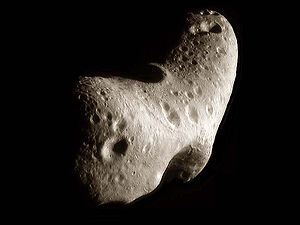
Asteroid
Asteroids are a class of small Solar System bodies in orbit around the Sun. They have also been called planetoids, especially the larger ones...
s are of this type, making it the second most common after the C-type
C-type asteroid
C-type asteroids are carbonaceous asteroids. They are the most common variety, forming around 75% of known asteroids, and an even higher percentage in the outer part of the asteroid belt beyond 2.7 AU, which is dominated by this asteroid type...
.
Characteristics
S-types are moderately bright (with an albedoAlbedo
Albedo , or reflection coefficient, is the diffuse reflectivity or reflecting power of a surface. It is defined as the ratio of reflected radiation from the surface to incident radiation upon it...
of 0.10 to 0.22) and consist mainly of iron- and magnesium
Magnesium
Magnesium is a chemical element with the symbol Mg, atomic number 12, and common oxidation number +2. It is an alkaline earth metal and the eighth most abundant element in the Earth's crust and ninth in the known universe as a whole...
-silicate
Silicate
A silicate is a compound containing a silicon bearing anion. The great majority of silicates are oxides, but hexafluorosilicate and other anions are also included. This article focuses mainly on the Si-O anions. Silicates comprise the majority of the earth's crust, as well as the other...
s. They are dominant in the inner asteroid belt
Asteroid belt
The asteroid belt is the region of the Solar System located roughly between the orbits of the planets Mars and Jupiter. It is occupied by numerous irregularly shaped bodies called asteroids or minor planets...
within 2.2 AU
Astronomical unit
An astronomical unit is a unit of length equal to about or approximately the mean Earth–Sun distance....
, common in the central belt within about 3 AU
Astronomical unit
An astronomical unit is a unit of length equal to about or approximately the mean Earth–Sun distance....
, but become rare farther out. The largest is 15 Eunomia
15 Eunomia
15 Eunomia is a very large asteroid in the inner asteroid belt. It is the largest of the stony asteroids, and somewhere between the 8th-to-12th-largest main-belt asteroid overall...
(about 330 km wide across its longest dimension), with the next largest members by diameter being 3 Juno
3 Juno
Juno , formal designation 3 Juno in the Minor Planet Center catalogue system, was the third asteroid to be discovered and is one of the larger main-belt asteroids, being one of the two largest stony asteroids, along with 15 Eunomia. Juno is estimated to contain 1% of the total mass of the asteroid...
, 29 Amphitrite
29 Amphitrite
29 Amphitrite is one of the largest S-type asteroids, probably third in diameter after Eunomia and Juno, although Iris and Herculina are similar in size.-Discovery:...
, 532 Herculina
532 Herculina
- Discovery :It was discovered on April 20, 1904, by Max Wolf in Heidelberg, and initially catalogued as 1904 NY. The origin of its name is not known; it may be named after the mythical Hercules, or after an unknown woman of that name...
and 7 Iris
7 Iris
7 Iris is a large main-belt asteroid. Among the S-type asteroids, it ranks fifth in geometric mean diameter after Eunomia, Juno, Amphitrite and Herculina....
. These largest S-types are visible in 10x50 binoculars
Binoculars
Binoculars, field glasses or binocular telescopes are a pair of identical or mirror-symmetrical telescopes mounted side-by-side and aligned to point accurately in the same direction, allowing the viewer to use both eyes when viewing distant objects...
at most oppositions; the brightest, 7 Iris, can occasionally become brighter than +7.0, which is a higher magnitude than any asteroid except the unusually reflective 4 Vesta
4 Vesta
Vesta, formally designated 4 Vesta, is one of the largest asteroids, with a mean diameter of about . It was discovered by Heinrich Wilhelm Olbers on March 29, 1807, and is named after the Roman virgin goddess of home and hearth, Vesta....
.
Their spectrum has a moderately steep slope at wavelengths shorter than 0.7 µm, and has moderate to weak absorption features around 1 µm and 2 µm. The 1 µm absorption is indicative of the presence of silicate
Silicate
A silicate is a compound containing a silicon bearing anion. The great majority of silicates are oxides, but hexafluorosilicate and other anions are also included. This article focuses mainly on the Si-O anions. Silicates comprise the majority of the earth's crust, as well as the other...
s (stony minerals). Often there is also a broad but shallow absorption feature centered near 0.63 µm. The composition of these asteroids is similar to a variety of stony meteorites which share similar spectral characteristics.
SMASS classification
In the SMASS classification, several generally "stony" types of asteroids are brought together into a wider S-group which contains the following types:- A-typeA-type asteroidA-type asteroids are relatively uncommon inner-belt asteroids that have a strong, broad 1 µm olivine feature and a very reddish spectrum shortwards of 0.7 µm. They are thought to come from the completely differentiated mantle of an asteroid....
- K-typeK-type asteroidK-type asteroids are relatively uncommon asteroids with a moderately reddish spectrum shortwards of 0.75 μm, and a slight bluish trend longwards of this. They have a low albedo. Their spectrum resembles that of CV and CO meteorites....
- L-typeL-type asteroidL-type asteroids are relatively uncommon asteroids with a strongly reddish spectrum shortwards of 0.75 μm, and a featureless flat spectrum longwards of this. In comparison with the K-type, they exhibit a more reddish spectrum at visible wavelengths and a flat spectrum in the infrared.These...
- Q-typeQ-type asteroidQ-type asteroids are relatively uncommon inner-belt asteroids with a strong, broad 1 micrometre olivine and pyroxene feature, and a spectral slope that indiciates the presence of metal...
- R-typeR-type asteroidR-type asteroids are moderately bright, relatively uncommon inner-belt asteroids that are spectrally intermediate between the V and A-type asteroids. The spectrum shows distinct olivine and pyroxene features at 1 and 2 micrometres, with a possibility of plagioclase...
- a core S-type for asteroids having the most "typical" spectra for the S-group
- Sa, Sk, Sl, Sq, and Sr-types containing transition objects between the core S-type and the A, K, L, Q, and R-types, respectively.
This whole "S" assemblage of asteroids is spectrally quite distinct from the carbonaceous C-group and the mostly metallic X-group
X-type asteroid
The X-group of asteroids collects together several types with similar spectra, but probably quite different compositions.-Tholen classification:In the Tholen classification the X-group contains the types:* E-type* M-type, the largest grouping* P-type...
.
Tholen classification
In the Tholen classification the S-type is a very broad grouping which includes all the types in the SMASS S-group except for the AA-type asteroid
A-type asteroids are relatively uncommon inner-belt asteroids that have a strong, broad 1 µm olivine feature and a very reddish spectrum shortwards of 0.7 µm. They are thought to come from the completely differentiated mantle of an asteroid....
, Q
Q-type asteroid
Q-type asteroids are relatively uncommon inner-belt asteroids with a strong, broad 1 micrometre olivine and pyroxene feature, and a spectral slope that indiciates the presence of metal...
, and R
R-type asteroid
R-type asteroids are moderately bright, relatively uncommon inner-belt asteroids that are spectrally intermediate between the V and A-type asteroids. The spectrum shows distinct olivine and pyroxene features at 1 and 2 micrometres, with a possibility of plagioclase...
, which have particularly strong "stony" absorption features around 1 μm.
See also
- Asteroid spectral typesAsteroid spectral typesAsteroids are assigned a type based on spectral shape, color, and sometimes albedo. These types are thought to correspond to an asteroid's surface composition...
- L-type asteroidL-type asteroidL-type asteroids are relatively uncommon asteroids with a strongly reddish spectrum shortwards of 0.75 μm, and a featureless flat spectrum longwards of this. In comparison with the K-type, they exhibit a more reddish spectrum at visible wavelengths and a flat spectrum in the infrared.These...
- K-type asteroidK-type asteroidK-type asteroids are relatively uncommon asteroids with a moderately reddish spectrum shortwards of 0.75 μm, and a slight bluish trend longwards of this. They have a low albedo. Their spectrum resembles that of CV and CO meteorites....
- X-type asteroidX-type asteroidThe X-group of asteroids collects together several types with similar spectra, but probably quite different compositions.-Tholen classification:In the Tholen classification the X-group contains the types:* E-type* M-type, the largest grouping* P-type...