
All Topics  
Resistor


   Email Print
   Bookmark   Link


Resistor


|- align = "center" | |width = "25"| | |- align = "center" | | | Potentiometer
Potentiometer

A potentiometer is a three-terminal resistor with a sliding contact that forms an adjustable voltage divider. If only two terminals are used , it acts as a variable resistor or Rheostat....
|- align = "center" | | | |- align = "top" | Resistor | | Variable
resistor

|- align = "center" | |width = "25"| | |- align = "center" | | | Potentiometer
Potentiometer

A potentiometer is a three-terminal resistor with a sliding contact that forms an adjustable voltage divider. If only two terminals are used , it acts as a variable resistor or Rheostat....
|- align = "center" | | | |- align = "center" | Resistor | | Variable
Resistor

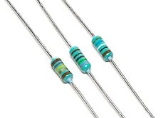
A resistor is a two-terminal
Terminal (electronics)

A terminal is a conductive device for joining electrical circuits together. The connection may be temporary, as for portable equipment, or may require a tool for assembly and removal, or may be a permanent electrical joint between two wires or devices....
 electronic component
Electronic component

An electronic component is a basic Electronics element usually packaged in a discrete form with two or more connecting leads or metallic pads....
 designed to oppose an electric current
Electric current

Electric current is the flow of electric charge. The electric charge may be either electrons or ions.The International System of Units unit of electric current intensity is the ampere....
 by producing a voltage drop between its terminals in proportion to the current, that is, in accordance with Ohm's law
Ohm's law

Ohm's law applies to electrical circuits; it states that the electric current through a conductor between two points is directly Proportionality to the potential difference or voltage across the two points, and inversely proportional to the Electrical resistance between them....
:

Resistors are used as part of electrical networks and electronic circuits.


Discussion
Ask a question about 'Resistor'
Start a new discussion about 'Resistor'
Answer questions from other users
Full Discussion Forum


Recent Posts


Encyclopedia


|- align = "center" | |width = "25"| |
Potentiometer Symbol Europe
|- align = "center" | | | Potentiometer
Potentiometer

A potentiometer is a three-terminal resistor with a sliding contact that forms an adjustable voltage divider. If only two terminals are used , it acts as a variable resistor or Rheostat....
|- align = "center" |
Resistor Symbol Europe
| |
Variable Resistor Symbol Europe
|- align = "top" | Resistor | | Variable
resistor

|- align = "center" | |width = "25"| | |- align = "center" | | | Potentiometer
Potentiometer

A potentiometer is a three-terminal resistor with a sliding contact that forms an adjustable voltage divider. If only two terminals are used , it acts as a variable resistor or Rheostat....
|- align = "center" | | | |- align = "center" | Resistor | | Variable
Resistor

A resistor is a two-terminal
Terminal (electronics)

A terminal is a conductive device for joining electrical circuits together. The connection may be temporary, as for portable equipment, or may require a tool for assembly and removal, or may be a permanent electrical joint between two wires or devices....
 electronic component
Electronic component

An electronic component is a basic Electronics element usually packaged in a discrete form with two or more connecting leads or metallic pads....
 designed to oppose an electric current
Electric current

Electric current is the flow of electric charge. The electric charge may be either electrons or ions.The International System of Units unit of electric current intensity is the ampere....
 by producing a voltage drop between its terminals in proportion to the current, that is, in accordance with Ohm's law
Ohm's law

Ohm's law applies to electrical circuits; it states that the electric current through a conductor between two points is directly Proportionality to the potential difference or voltage across the two points, and inversely proportional to the Electrical resistance between them....
:

Resistors are used as part of electrical networks and electronic circuits. They are extremely commonplace in most electronic equipment. Practical resistors can be made of various compounds and films, as well as resistance wire
Resistance wire

Resistance wire is electrical wire used for its resistance. It is routinely used at high temperatures, so normally also has high melting point....
 (wire made of a high-resistivity alloy, such as nickel/chrome).

The primary characteristics of resistors are their resistance and the power
Electric power

Electric power is defined as the rate at which electrical energy is transferred by an electric circuit. The SI unit of power is the watt .When electric current flows in a circuit, it can transfer energy to do mechanical work or work ....
 they can dissipate. Other characteristics include temperature coefficient
Temperature coefficient

The temperature coefficient is the relative change of a physical property when the temperature is changed by 1 Kelvin.In the following formula, let R be the physical property to be measured and T be the temperature at which the property is measured....
, noise, and inductance
Inductance

Inductance is the property in an electrical circuit where a change in the current flowing through that circuit induces an Electromotive force that opposes the change in current ....
. Less well-known is critical resistance
Critical Resistance

Critical Resistance is a national, member-based grassroots organization that works to build a mass movement to dismantle what it calls '"the prison-industrial complex"'....
, the value below which power dissipation limits the maximum permitted current flow, and above which the limit is applied voltage. Critical resistance depends upon the materials constituting the resistor as well as its physical dimensions; it's determined by design.

Resistors can be integrated into hybrid
Hybrid circuit

A hybrid integrated circuit, HIC, hybrid microcircuit, or simply hybrid is a miniaturized electronic circuit constructed of individual devices, such as semiconductor devices and passive components , bonded to a substrate or printed circuit board ....
 and printed circuit
Printed circuit board

A printed circuit board, or PCB, is used to mechanically support and electrically connect electronic components using Conductor pathways, or signal traces, industrial etchinged from copper sheets laminated onto a non-conductive substrate....
s, as well as integrated circuits. Size, and position of leads (or terminals) are relevant to equipment designers; resistors must be physically large enough not to overheat when dissipating their power.

Adjustable resistors

Variable resistors are adjustable by changing the position of a contact on the resistive element, such as with a movable sliding contact, known as a potentiometer
Potentiometer

A potentiometer is a three-terminal resistor with a sliding contact that forms an adjustable voltage divider. If only two terminals are used , it acts as a variable resistor or Rheostat....
.

Accurate, high-resolution panel-mounted pots. have resistance elements typically wirewound on a mandrel that's formed into a helix, although some include a conductive-plastic resistance coating over the wire to improve resolution. These typically offer ten turns of their shafts to cover their full range. They are usually set with dials that include a simple turns counter and a graduated dial. Electronic analog computers used them in quantity for setting coefficients, and delayed-sweep oscilloscopes of recent decades included one on their panels.

Special varieties


There are special types of resistor whose resistance changes with various quantities, most of which have names, and articles, of their own: the resistance of thermistor
Thermistor

A thermistor is a type of resistor with electrical resistance proportional to its temperature. The word is a portmanteau of Thermal and resistor....
s varies greatly with temperature, whether external or due to dissipation, so they can be used for temperature or current sensing; metal oxide varistors drop to a very low resistance when a high voltage is applied, making them suitable for over-voltage protection; the resistance of a strain gauge
Strain gauge

A strain gauge is a device used to measure the Strain of an object. Invented by Edward E. Simmons and Arthur C. Ruge in 1938, the most common type of strain gauge consists of an Electrical insulation flexible backing which supports a metallic foil pattern....
 varies with mechanical load; the resistance of photoresistor
Photoresistor

A photoresistor or light dependent resistor or cadmium sulfide cell is a resistor whose electrical resistance decreases with increasing incident light intensity....
s varies with illumination; the resistance of a Quantum Tunnelling Composite can vary by a factor of 1012 with mechanical pressure applied; and so on.

Units


The ohm (symbol: O
O

O is the fifteenth letter of the modern Latin alphabet. Its name in English language is spelled o , plural oes ....
) is a SI
Si

Si, si, or SI may refer to :...
-driven unit of electrical resistance
Electrical resistance

The electrical resistance of an object is a measure of its opposition to the passage of a steady electrical current. An object of uniform cross section will have a resistance proportional to its length and inversely proportional to its cross-sectional area, and proportional to the resistivity of the material....
, named after Georg Simon Ohm. Commonly used multiples and submultiples in electrical and electronic usage are the milliohm, kilohm, and megohm.

Examples
R47 0.47 ohms
4R7 4.7 ohms
470R 470 ohms
4K7 4.7K ohms
47K 47K ohms
47K3 47.3K ohms
470K 470K ohms
4M7 4.7M ohms


Construction


Lead arrangements


Some composition resistors have leads coming off their body radially instead of parallel to the resistor axis (axially). These radial-lead resistors are color coded with the same colors. However, the color of the body is the first significant figure of the resistance, the color of the end is the second significant figure, and a dot or band of paint around the middle of the resistor indicates the number of zeros to be added. for example, a radial-lead resistor with a red (2) body, green (5) end, and yellow (4) dot has a resistance of 250,000 ohms.

Carbon composition


Carbon composition resistors consist of a solid cylindrical resistive element with embedded wire leads or metal end caps to which the lead wires are attached. The body of the resistor is protected with paint or plastic. Early 20th-century carbon composition resistors had uninsulated bodies; the lead wires were wrapped around the ends of the resistance element rod and soldered. The completed resistor was painted for color coding of its value.

The resistive element is made from a mixture of finely ground (powdered) carbon and an insulating material (usually ceramic). A resin holds the mixture together. The resistance is determined by the ratio of the fill material (the powdered ceramic) to the carbon. Higher concentrations of carbon, a weak conductor, result in lower resistance. Carbon composition resistors were commonly used in the 1960s and earlier, but are not so popular for general use now as other types have better specifications, such as tolerance, voltage dependence, and stress (carbon composition resistors will change value when stressed with over-voltages). Moreover, if internal moisture content (from exposure for some length of time to a humid environment) is significant, soldering heat will create a non-reversible change in resistance value. These resistors, however, if never subjected to overvoltage nor overheating were remarkably reliable.

They are still available, but comparatively quite costly. Values ranged from fractions of an ohm to 22 megohms.

Carbon film


A carbon film is deposited on an insulating substrate, and a helix cut in it to create a long, narrow resistive path. Varying shapes, coupled with the resistivity
Resistivity

Electrical resistivity is a measure of how strongly a material opposes the flow of electric current. A low resistivity indicates a material that readily allows the movement of electrical charge....
 of carbon, (ranging from 9 to 40 µO-cm) can provide a variety of resistances. Carbon film resistors feature a power rating range of 1/6 W to 5 W at 70°C. Resistances available range from 1 ohm to 10 megohm. The carbon film resistor can operate between temperatures of -55°C to 155°C. It has 200 to 600 volts maximum working voltage range.

Thick and thin film


Thick film resistors became popular during the 1970s, and most SMD (surface mount [device]) resistors today are of this type. The principal difference between thin film and thick film resistors is not the actual thickness of the film, but rather how the film is applied to the cylinder (axial resistors) or the surface (SMD resistors).

Thin film resistors are made by sputtering
Sputtering

Sputtering is a process whereby atoms are ejected from a solid target material due to bombardment of the target by energetic ions. It is commonly used for thin-film deposition, etching and analytical techniques ....
 (a method of vacuum deposition
Vacuum deposition

Vacuum deposition or vacuum coating is a family of processes used to deposit layers atom-by-atom or molecule-by-molecule at sub-atmospheric pressure on a solid surface....
) the resistive material onto an insulating substrate. The film is then etched in a similar manner to the old (subtractive) process for making printed circuit boards; that is, the surface is coated with a photo-sensitive material
Photoresist

Photoresist is a light-sensitive material used in several industrial processes, such as photolithography and photoengraving to form a patterned coating on a surface....
, then covered by a pattern film, irradiated with ultraviolet
Ultraviolet

Ultraviolet light is electromagnetic radiation with a wavelength shorter than that of visible light, but longer than x-rays, in the range 400 nanometer to 10 nm, and energies from 3 Electron volt to 124 eV....
 light, and then the exposed photo-sensitive coating is developed, and underlying thin film is etched away.

Because the time during which the sputtering is performed can be controlled, the thickness of the thin film can be accurately controlled. The type of material is also usually different consisting of one or more ceramic (cermet
Cermet

A cermet is a composite material composed of ceramic and metallic materials. A cermet is ideally designed to have the optimal properties of both a ceramic, such as high temperature resistance and hardness, and those of a metal, such as the ability to undergo plastic deformation....
) conductors such as tantalum nitride (TaN), ruthenium dioxide (RuO2), lead oxide
Lead oxide

Lead oxide may refer to:* Lead oxide, PbO, litharge, massicot* Lead oxide, Pb3O4, minium, red lead* Lead dioxide , PbO2...
 (PbO), bismuth ruthenate (Bi2Ru2O7), nickel chromium
Chromel

Chromel is an alloy made of approximately 90 percent nickel and 10 percent chromium that is used to make the positive conductors of ANSI Type E and K thermocouples....
 (NiCr), and/or bismuth iridate (Bi2Ir2O7).

The resistance of both thin and thick film resistors after manufacture is not highly accurate; they are usually trimmed to an accurate value by abrasive or laser trimming
Laser trimming

Laser trimming describes the manufacturing process of using a laser to adjust the operating parameters of an electronic circuit.The usual approach is to use a laser to burn away small portions of resistors, raising their value ....
. Thin film resistors are usually specified with tolerances of 0.1, 0.2, 0.5, or 1%, and with temperature coefficients of 5 to 25 ppm/K.

Thick film resistors may use the same conductive ceramics, but they are mixed with sintered (powdered) glass and some kind of liquid so that the composite can be screen-printed
Screen-printing

Screen printing 1. A printing technique that uses a woven mesh to support an ink blocking stencil. The attached stencil forms open areas of mesh that transfer ink as a sharp-edged image onto a Substrate ....
. This composite of glass and conductive ceramic (cermet) material is then fused (baked) in an oven at about 850 °C.

Thick film resistors, when first manufactured, had tolerances of 5%, but standard tolerances have improved to 2% or 1% in the last few decades. Temperature coefficients of thick film resistors are high, typically ±200 or ±250 ppm/K; a 40 kelvin
Kelvin

The kelvin is a Units of measurement of temperature and is one of the seven SI base units. The Kelvin scale is a Thermodynamic temperature scale where absolute zero, the theoretical absence of all thermal energy, is zero ....
 (70°F) temperature change can change the resistance by 1%.

Thin film resistors are usually far more expensive than thick film resistors, although, for example, SMD thin film resistors, with 0.5% tolerances, and with 25 ppm/K temperature coefficients, when bought in full size reel quantities, are about twice the cost of 1%, 250 ppm/K thick film resistors.

Metal film


A common type of axial resistor today is referred to as a metal-film resistor. MELF (Metal Electrode Leadless Face) resistors often use the same technology, but are a cylindrically shaped resistor designed for surface mounting. [Note that other types of resistors, e.g. carbon composition, are also available in "MELF" packages].

Metal film resistors are usually coated with nickel chromium (NiCr), but might be coated with any of the cermet materials listed above for thin film resistors. Unlike thin film resistors, the material may be applied using different techniques than sputtering (though that is one such technique). Also, unlike thin-film resistors, the resistance value is determined by cutting a helix through the coating rather than by etching. [This is similar to the way carbon resistors are made.] The result is a reasonable tolerance (0.5, 1, or 2%) and a temperature coefficient of (usually) 25 or 50 ppm/K.

Wirewound


Wirewound resistors are commonly made by winding a metal wire around a ceramic, plastic, or fiberglass core. The ends of the wire are soldered or welded to two caps, attached to the ends of the core. The assembly is protected with a layer of paint, molded plastic, or an enamel
Vitreous enamel

In a discussion of material science, enamel is the colorful result of fusing powdered glass to a substrate by firing, usually between 750 and 850 degrees Celsius....
 coating baked at high temperature. The wire leads are usually between 0.6 and 0.8 mm in diameter and tinned for ease of soldering. For higher power wirewound resistors, either a ceramic outer case or an aluminum outer case on top of an insulating layer is used. The aluminum-cased types are designed to be attached to a heatsink to dissipate the heat; the rated power is dependent on being used with a suitable heatsink, e.g., a 50 W power rated resistor will overheat at around one fifth of the power dissipation if not used with a heatsink.

Because wirewound resistors are coils
Electromagnetic coil

An electromagnetic coil is formed when a conductor is wound around a core or form to create an inductor or electromagnet. One loop of wire is usually referred to as a turn, and a coil consists of one or more turns....
 they have more undesirable inductance than other types of resistor, although winding the wire in sections with alternately reversed direction can minimize inductance.

Foil resistor


The primary resistance element of foil resistors is a special alloy foil several micrometre
Micrometre

A micrometre or micron is one Micro- of a metre, or equivalently one thousandth of a millimetre. It is also commonly known as a micron....
s thick. Foil resistors have had the best precision and stability ever since they were introduced in the 1960s. One of the important parameters influencing stability is the temperature coefficient of resistance (TCR). The TCR of foil resistors is extremely low, and has been further improved over the years. One range of ultra-precision foil resistors offers a TCR of 0.14ppm/°C, tolerance ±0.005%, long-term stability 25ppm/year, 50ppm/3 years (further improved 5-fold by hermetic sealing), stability under load 0.03%/2000 hours, thermal EMF 0.1µvolt/°C, noise -42dB, voltage coefficient 0.1ppm/V, inductance 0.08µH, capacitance 0.5pF.
Ammeter shunts

An ammeter shunt
Shunt (electrical)

In electronics, a shunt is a device which allows electric current to pass around another point in the electrical network. The term is also widely used in photovoltaics to describe an unwanted short circuit between the front and back surface contacts of a solar cell, usually caused by wafer damage....
 is a special type of current-sensing resistor, having four terminals and a value in milliohms or even micro-ohms. Current-measuring instruments, by themselves, can usually accept only limited currents. To measure high currents, the current passes through the shunt, where the voltage drop is measured and interpreted as current. A typical shunt consists of two solid metal blocks, sometimes brass, mounted on to an insulating base. Between the blocks, and soldered or brazed to them, are one or more strips of low TCR
Temperature coefficient

The temperature coefficient is the relative change of a physical property when the temperature is changed by 1 Kelvin.In the following formula, let R be the physical property to be measured and T be the temperature at which the property is measured....
 (temp. coefficient of resistance) manganin
Manganin

Manganin is a trademarked name for an alloy of typically 86% copper, 12% manganese, and 2% nickel. It was first developed by Edward Weston .Manganin foil and wire is used in the manufacture of resistors, particularly Shunt #Use in current measuring, because of its virtually zero temperature coefficient#Temperature coefficient of electrical...
 alloy. Large bolts threaded into the blocks make the current connections, while much-smaller screws provide voltage connections. Shunts are rated by full-scale current, and often have a voltage drop of 50 mV at rated current.

Grid resistor


In heavy-duty industrial high-current applications, a grid resistor is a large convection-cooled lattice of stamped metal alloy strips connected in rows between two electrodes. Such industrial grade resistors can be as large as a refrigerator; some designs can handle over 500 amperes of current, with a range of resistances extending lower than 0.04 Ohms. They are used in applications such as dynamic braking
Dynamic braking

Dynamic braking is the use of the electric traction motors of a railroad vehicle as generators when slowing the vehicle. It is termed rheostatic if the generated electrical power is dissipated as heat in brake grid resistors and regenerative brake if the power is returned to the supply line....
 and load banking
Load bank

A load bank is a device which develops an External electric load, applies the load to an electrical power source and converts or dissipates the resultant power output of the source....
 for locomotives
Diesel locomotive

A Diesel locomotive is a type of railroad locomotive in which the prime mover is a Diesel engine. Several types of Diesel locomotive have been developed, the principal distinction being in the means by which the prime mover's mechanical power is conveyed to the driving wheels ....
 and trams, neutral grounding for industrial AC distribution, control loads for cranes and heavy equipment, load testing of generators and harmonic filtering for electric substations.

The term "grid resistor" is sometimes used to describe a resistor of any type connected to the control grid
Control grid

The control grid is an electrode used in vacuum tube used to modulate the flow of electrons in the cathode to anode or plate electrode circuit....
 of a vacuum tube
Vacuum tube

In electronics, a vacuum tube, electron tube , thermionic valve, or just valve is a device used to amplifier, switch, otherwise modify, or create an Electricity signal by controlling the movement of electrons in a low-pressure space....
. This is not a resistor technology; it is an electronic circuit topology.

Strain gauges


The strain gauge, invented by Edward E. Simmons
Edward E. Simmons

Edward E. Simmons Jr. was an Electrical engineering and the inventor of the bonded wire resistance strain gauge.Simmons attended the California Institute of Technology, where he received a B.S....
 and Arthur C. Ruge in 1938, is a type of resistor that changes value with applied strain. A single resistor may be used, or a pair (half bridge), or four resistors connected in a Wheatstone bridge
Wheatstone bridge

A Wheatstone bridge is a measuring instrument invented by Samuel Hunter Christie in 1833 and improved and popularized by Sir Charles Wheatstone in 1843....
 configuration. The strain resistor is bonded with adhesive to an object that will be subjected to mechanical strain. With the strain gauge and a filter, amplifier, and analog/digital converter, the strain on an object can be measured.

Negative resistors

A device exhibiting negative resistance over part of its characteristic curve
Characteristic curve

Characteristic curve may refer to:* In electronics, a representation of certain electrical characteristics of a device or component.** Semiconductor curve tracer, a device for displaying the above curve...
 can be made with active circuit components.

Other types


  • Metal-oxide resistor
  • Cermet
    Cermet

    A cermet is a composite material composed of ceramic and metallic materials. A cermet is ideally designed to have the optimal properties of both a ceramic, such as high temperature resistance and hardness, and those of a metal, such as the ability to undergo plastic deformation....
  • Phenolic
    Phenolic

    Phenolic may refer to*Polyphenol, a large class of natural compounds found in colorful plants and with laboratory evidence of antioxidant activity...
  • Tantalum
    Tantalum

    Tantalum is a chemical element with the symbol Ta and atomic number 73. A rare, hard, blue-grey, lustre transition metal, tantalum is highly corrosion-resistant and occurs naturally in the mineral tantalite, always together with the chemically similar niobium....
  • Water resistor


Power dissipation


The power dissipated by a resistor is the voltage across the resistor multiplied by the current through the resistor:

All three equations are equivalent. The first is derived from Joule's law
Joule's law

Joule's laws are a pair of laws concerning the heat produced by a current and the energy dependence of an ideal gas to that of pressure, volume, and temperature, respectively....
, and Ohm’s Law derives the other two from that.

The total amount of heat energy released is the integral of the power over time:

If the average power dissipated is more than the resistor can safely dissipate, the resistor may depart from its nominal resistance, and may be damaged by overheating. Excessive power dissipation may raise the temperature of the resistor to a point where it burns out, which could cause a fire in adjacent components and materials. There are flameproof resistors that fail (open circuit) before they overheat dangerously.

Note that the nominal power rating of a resistor is not the same as the power that it can safely dissipate in practical use. Air circulation and proximity to a circuit board, ambient temperature, and other factors can reduce acceptable dissipation very significantly. Rated power dissipation may be given for an ambient temperature of 25°C in free air. Inside an equipment case at 60°C, rated dissipation will be significantly less; if we are dissipating a bit less than the maximum figure given by the manufacturer we may still be outside the safe operating area
Safe operating area

For power semiconductor device a safe operating area is defined as the voltage and current conditions over which the device can be expected to operate without self-damage....
, and courting premature failure.

Measurement


Nearly always, the resistance value is of interest. The value of a resistor can be measured with an ohmmeter
Ohmmeter

An ohmmeter is an electricity measuring instrument that measures electrical resistance, the opposition to an electric current. Micro-ohmmeters make low resistance measurements....
, which may be one function of a multimeter
Multimeter

A multimeter or a multitester, also known as a volt/ohm meter or VOM, is an Electronics measuring instrument that combines several functions in one unit....
. Usually, probes on the ends of test leads connect to the resistor.

Measuring low-value resistors, such as fractional-ohm resistors, with acceptable accuracy requires four-terminal connections. One pair of terminals applies a known, calibrated current to the resistor, while the other pair senses the voltage drop across the resistor. Some laboratory test instruments have spring-loaded pairs of contacts, with neighboring contacts electrically isolated from each other. Better digital multimeters have four terminals on their panels, generally used with special test leads. These comprise four wires in all, and have special test clips with jaws insulated from each other. One jaw provides the measuring current, while the other senses the voltage drop.

Series and parallel resistors


Resistors in a parallel
Series and parallel circuits

In electronics, components of an electronic circuit can be connected in series or in parallel. Components connected in series are connected along a single path, so the same electric current flows through all of the components....
 configuration each have the same potential difference (voltage). To find their total equivalent resistance (Req):


The parallel property can be represented in equations by two vertical lines "||" (as in geometry) to simplify equations. For two resistors,

The current through resistors in series
Series and parallel circuits

In electronics, components of an electronic circuit can be connected in series or in parallel. Components connected in series are connected along a single path, so the same electric current flows through all of the components....
 stays the same, but the voltage across each resistor can be different. The sum of the potential differences (voltage) is equal to the total voltage. To find their total resistance:


A resistor network that is a combination of parallel and series can sometimes be broken up into smaller parts that are either one or the other. For instance,


However, many resistor networks cannot be split up in this way. Consider a cube
Cube

A cube is a three-dimensional space solid object bounded by six square faces, facets or sides, with three meeting at each wikt:vertex. The cube can also be called a Regular polyhedron hexahedron and is one of the five Platonic solids....
, each edge of which has been replaced by a resistor. For example, determining the resistance between two opposite vertices requires matrix methods for the general case. However, if all twelve resistors are equal, the corner-to-corner resistance is 5/6 of any one of them.

The practical application to resistors is that a resistance of any non-standard value can be obtained by connecting standard values in series or in parallel.

Resistor standards


Production resistors

There are various standards specifying properties of resistors for use in equipment:
  • BS 1852
    BS 1852

    The British standard BS 1852 and its replacement, BS EN 60062, comprises a colour code for fixed resistors; letter and digit code for resistance and capacitance values; letter code for resistance and capacitance tolerances and a data code for capacitors and resistors....
  • EIA-RS-279
  • MIL-PRF-26
  • MIL-PRF-39007 (Fixed Power, established reliability)
  • MIL-PRF-55342 (Surface-mount thick and thin film)
  • MIL-PRF-914
  • MIL-R-11
  • MIL-R-39017 (Fixed, General Purpose, Established Reliability)
  • MIL-PRF-32159 (zero ohm jumpers)


There are other United States military procurement MIL-R- standards.

Resistance standards

Resistors of extremely high precision are manufactured as substandards of resistance for calibration
Calibration

Calibration is the validation of specific measurement techniques and equipment. At the simplest level, calibration is a comparison between measurements-one of known magnitude or correctness made or set with one device and another measurement made in as similar a way as possible with a second device....
 and laboratory
Laboratory

A laboratory is a facility that provides controlled conditions in which science research, experiments, and measurement may be performed. The title of laboratory is also used for certain other facilities where the processes or equipment used are similar to those in scientific laboratories....
 use. They may have 4 terminals, using one pair to carry an operating current, and the other pair to measure the voltage drop; this minimizes temperature coefficients and thermal EMFs. The data sheet for a resistance standard used for calibration is

Resistance decade boxes

A resistance decade box is a box containing resistors of many values and two (or four) terminals, with a mechanical switch that allows a resistance of any value allowed by the box to be dialed. Usually the resistance is accurate to high precision, ranging from laboratory/calibration grade accurate to within 20 parts per million, to field grade at 1%. Inexpensive boxes with lesser accuracy are also available. All types offer a convenient way of selecting and quickly changing a resistance in laboratory, experimental and development work without having to stock and seek individual resistors of the required value. The range of resistance provided, the maximum resolution, and the accuracy characterize the box. For example, one box offers resistances from 0 to 24 megohms, maximum resolution 0.1 ohm, accuracy 0.1%

Resistor marking


Most axial resistors use a pattern of colored stripes to indicate resistance. Surface-mount resistors are marked numerically, if they are big enough to permit marking; more-recent small sizes are impractical to mark. Cases are usually tan, brown, blue, or green, though other colors are occasionally found such as dark red or dark gray.

Early 20th century resistors, essentially uninsulated, were dipped in paint to cover their entire body for color coding. A second color of paint was applied to one end of the element, and a color dot (or band) in the middle provided the third digit. The rule was "body, tip, dot", providing two significant digits for value and the decimal multiplier, in that sequence. Default tolerance was ±20%. Closer-tolerance resistors had silver (±10%) or gold-colored (±5%) paint on the other end.

Four-band resistors


Four-band identification is the most commonly used color-coding scheme on all resistors. It consists of four colored bands that are painted around the body of the resistor. The first two bands encode the first two significant digits of the resistance value, the third is a power-of-ten multiplier or number-of-zeroes, and the fourth is the tolerance accuracy, or acceptable error, of the value. Sometimes a fifth band identifies the thermal coefficient, but this must be distinguished from the true 5-color system, with 3 significant digits.

For example, green-blue-yellow-red is 56×104 O = 560 kO ± 2%. An easier description can be as followed: the first band, green, has a value of 5 and the second band, blue, has a value of 6, and is counted as 56. The third band, yellow, has a value of 104, which adds four 0's to the end, creating 560,000O at ±2% tolerance accuracy. 560,000O changes to 560 kO ±2% (as a kilo- is 103).

Each color corresponds to a certain digit, progressing from darker to lighter colors, as shown in the chart below.

Color1st band2nd band3rd band (multiplier)4th band (tolerance)Temp. Coefficient
Black 00×100  
Brown 11×101 ±1% (F) 100 ppm
Red 22×102 ±2% (G) 50 ppm
Orange 33×103 15 ppm
Yellow 44×104 25 ppm
Green 55×105 ±0.5% (D)  
Blue 66×106 ±0.25% (C) 
Violet 77×107 ±0.1% (B)  
Gray 88×108 ±0.05% (A) 
White 99×109  
Gold ×10-1±5% (J)  
Silver ×10-2±10% (K)  
None ±20% (M)  


Preferred values


Early resistors were made in more or less arbitrary round numbers; a series might have 100, 125, 150, 200, 300, etc. Resistors as manufactured are subject to a certain percentage tolerance, and it makes sense to manufacture values that correlate with the tolerance, so that the actual value of a resistor overlaps slightly with its neighbors. Wider spacing leaves gaps; narrower spacing increases manufacturing and inventory costs to provide resistors that are more or less interchangeable.

A logical scheme is to produce resistors in a range of values which increase in a geometrical progression, so that each value is greater than its predecessor by a fixed multiplier or percentage, chosen to match the tolerance of the range. For example, for a tolerance of ±20% it makes sense to have each resistor about 1.5 times its predecessor, covering a decade in 6 values. In practice the factor used is 1.4678, giving values of 1.47, 2.15, 3.16, 4.64, 6.81, 10 for the 1-10 decade (a decade is a range increasing by a factor of 10; 0.1-1 and 10-100 are other examples); these are rounded in practice to 1.5, 2.2, 3.3, 4.7, 6.8, 10; followed, of course by 15, 22, 33, … and preceded by … 0.47, 0.68, 1. This scheme has been adopted as the E6 range of the IEC
International Electrotechnical Commission

The International Electrotechnical Commission is a Non-profit organization, non-governmental international standards organization that prepares and publishes International Standards for all electrical, electronic and related technologies ? collectively known as "electrotechnology"....
 60063 preferred number
Preferred number

In industrial design, preferred numbers are standard guidelines for choosing exact product dimensions within a given set of constraints.Product developers must choose numerous lengths, distances, diameters, volumes, and other characteristic quantity....
 series. There are also E12, E24, E48, E96 and E192 ranges for components of ever tighter tolerance, with 12, 24, 96, and 192 different values within each decade. The actual values used are in the IEC
International Electrotechnical Commission

The International Electrotechnical Commission is a Non-profit organization, non-governmental international standards organization that prepares and publishes International Standards for all electrical, electronic and related technologies ? collectively known as "electrotechnology"....
 60063 lists of preferred numbers
Preferred number

In industrial design, preferred numbers are standard guidelines for choosing exact product dimensions within a given set of constraints.Product developers must choose numerous lengths, distances, diameters, volumes, and other characteristic quantity....
.

A resistor of 100 ohms ±20% would be expected to have a value between 80 and 120 ohms; its E6 neighbors are 68 (54-82) and 150 (120-180) ohms. A sensible spacing, E6 is used for ±20% components; E12 for ±10%; E24 for ±5%; E48 for ±2%, E96 for ±1%; E192 for ±0.5% or better. Resistors are manufactured in values from a few milliohms to about a gigaohm in IEC60063 ranges appropriate for their tolerance.

Earlier power wirewound resistors, such as brown vitreous-enameled types, however, were made with a different system of preferred values, such as some of those mentioned in the first sentence of this section.

5-band axial resistors


5-band identification is used for higher precision
Accuracy and precision

In the fields of science, engineering, industry and statistics, accuracy is the degree of closeness of a Measure d or calculated quantity to its actual Value ....
 (lower tolerance) resistors (1%, 0.5%, 0.25%, 0.1%), to specify a third significant digit. The first three bands represent the significant digits, the fourth is the multiplier, and the fifth is the tolerance. Five-band resistors with a gold or silver 4th band are sometimes encountered, generally on older or specialized resistors. The 4th band is the tolerance and the 5th the temperature coefficient.

SMT resistors


Zero Ohm Resistors Cropped
Surface mounted
Surface-mount technology

Surface-mount technology is a method for constructing Electronics circuits in which the components are mounted directly onto the surface of printed circuit boards ....
 resistors are printed with numerical values in a code related to that used on axial resistors. Standard-tolerance Surface Mount Technology (SMT)
Surface-mount technology

Surface-mount technology is a method for constructing Electronics circuits in which the components are mounted directly onto the surface of printed circuit boards ....
 resistors are marked with a three-digit code, in which the first two digits are the first two significant digits of the value and the third digit is the power of ten (the number of zeroes). For example:
"334"= 33 × 10,000 ohms = 330 kilohms
"222"= 22 × 100 ohms = 2.2 kilohms
"473"= 47 × 1,000 ohms = 47 kilohms
"105"= 10 × 100,000 ohms = 1 megohm


Resistances less than 100 ohms are written: 100, 220, 470. The final zero represents ten to the power zero, which is 1. For example:
"100"= 10 × 1 ohm = 10 ohms
"220"= 22 × 1 ohm = 22 ohms


Sometimes these values are marked as "10" or "22" to prevent a mistake.

Resistances less than 10 ohms have 'R' to indicate the position of the decimal point (radix point
Radix point

In mathematics and computing, a radix point is the symbol used in numerical representations to separate the integer part of a number from its fraction part ....
). For example:
"4R7"= 4.7 ohms
"0R22"= 0.22 ohms
"0R01"= 0.01 ohms


Precision resistors are marked with a four-digit code, in which the first three digits are the significant figures and the fourth is the power of ten. For example:
"1001"= 100 × 10 ohms = 1 kilohm
"4992"= 499 × 100 ohms = 49.9 kilohm
"1000"= 100 × 1 ohm = 100 ohms


"000" and "0000" sometimes appear as values on surface-mount zero-ohm link
Zero-ohm link

A zero-ohm link or zero-ohm resistor is a wire used to connect traces on a printed circuit board that is packaged in the same format as a resistor....
s, since these have (approximately) zero resistance.

More-recent surface-mount resistors are too small, physically, to permit practical markings to be applied.

Industrial type designation


Format: [two letters][resistance value (three digit)][tolerance code(numerical - one digit)]
Power Rating at 70 °C
Type No.Power
rating
(watts)
MIL-R-11
Style
MIL-R-39008
Style
BB?RC05RCR05
CBĽRC07RCR07
EB˝RC20RCR20
GB1RC32RCR32
HB2RC42RCR42
GM3
HM4


Tolerance Code
Industrial type designationToleranceMIL Designation
5±5%J
2±20%M
1±10%K
-±2%G
-±1%F
-±0.5%D
-±0.25%C
-±0.1%B


The operational temperature
Temperature

In physics, temperature is a physical property of a Physical system that underlies the common notions of hot and cold; something that feels hotter generally has the greater temperature....
 range distinguishes commercial
Commerce

Commerce is a division of trade or production, costs, and pricing which deals with the Trade of goods and service from production, costs, and pricing to final consumer....
 grade, industrial grade and military grade components.
  • Commercial grade: 0 °C to 70 °C
  • Industrial grade: -40 °C to 85 °C (sometimes -25 °C to 85 °C)
  • Military grade: -55 °C to 125 °C (sometimes -65 °C to 275 °C)
  • Standard Grade -5°C to 60°C


Electrical noise


In precision circuits it is often necessary to minimize electronic noise
Electronic noise

Electronic noise is an unwanted signal characteristic of all electronics electrical circuit. Depending on the circuit, the noise put out by electronic devices can vary greatly....
. As dissipative elements, even ideal resistors will naturally produce a fluctuating "noise" voltage across their terminals. This Johnson–Nyquist noise
Johnson–Nyquist noise

Johnson?Nyquist noise is the electronic noise noise generated by the thermal agitation of the charge carriers inside an electrical conductor at equilibrium, which happens regardless of any applied voltage....
 is a fundamental noise source which depends only upon the temperature and resistance of the resistor, and is predicted by the fluctuation–dissipation theorem. For example, the gain in a simple (non-) inverting amplifier is set using a voltage divider. Noise considerations dictate that the smallest practical resistance should be used, since the Johnson–Nyquist noise voltage scales with resistance, and any resistor noise in the voltage divider will be impressed upon the amplifier's output.

In addition to this intrinsic noise, practical resistors frequently exhibit other, "non-fundamental", sources of noise, usually called "excess noise." Thick-film and carbon composition resistors generate more noise than other types at low frequencies; wire-wound and thin-film resistors, though much more expensive, are often utilized for their better noise characteristics.

Thin film surface mount resistors typically have lower noise and better thermal stability than thick film surface mount resistors. However, the design engineer must read the data sheets for the family of devices to weigh the various device tradeoffs.

Precautions required in high-precision applications


Various effects become important in high-precision applications. Small voltage differentials may appear on the resistors due to thermoelectric effect
Thermoelectric effect

The thermoelectric effect is the direct conversion of temperature differences to electric voltage and vice versa. On the measurement scale of everyday life, a thermoelectric device creates a voltage when there is a different temperature on each side....
 if their ends are not kept at the same temperature. The voltages appear in the junctions of the resistor leads with the circuit board and with the resistor body. Common metal film resistors show such an effect at a magnitude of about 20 µV/°C. Some carbon composition resistors can go as high as 400 µV/°C, and specially constructed resistors can go as low as 0.05 µV/°C. In applications where thermoelectric effects may become important, care has to be taken (for example) to mount the resistors horizontally to avoid temperature gradients and to mind the air flow over the board.

Failure modes


Like every part, resistors can fail in normal use. Thermal and mechanical stress, humidity, etc., can play a part. Carbon composition resistors and metal film resistors typically fail as open circuits. Carbon-film resistors may decrease or increase in resistance. Carbon film and composition resistors can open if running close to their maximum dissipation. This is also possible but less likely with metal film and wirewound resistors. If not enclosed, wirewound resistors can corrode. Carbon composition resistors are prone to drifting
Drift (telecommunication)

In telecommunication, a drift is a comparatively long-term change in an attribute, value, or operational parameter of a system or equipment.The drift should be characterized, such as "diurnal frequency drift" and "output level drift."...
 over time and are easily damaged by excessive heat in soldering (the binder evaporates). Variable resistors become electrically noisy as they wear.

All resistors can be destroyed, usually by going open-circuit, if subjected to excessive current due to failure of other components or accident.

See also

  • Circuit design
    Circuit design

    The process of circuit design can cover systems ranging from complex electronic systems all the way down to the individual transistors within an integrated circuit....
  • Electrical resistance
    Electrical resistance

    The electrical resistance of an object is a measure of its opposition to the passage of a steady electrical current. An object of uniform cross section will have a resistance proportional to its length and inversely proportional to its cross-sectional area, and proportional to the resistivity of the material....
  • Electrical impedance
    Electrical impedance

    Electrical impedance, or simply impedance, describes a measure of opposition to a sinusoidal alternating current . Electrical impedance extends the concept of Electrical resistance to AC circuits, describing not only the relative amplitudes of the voltage and Electric current, but also the relative Phase ....
  • Iron-hydrogen resistor
    Iron-hydrogen resistor

    An iron-hydrogen resistor is a Positive temperature coefficient and consists of a hydrogen-filled glass bulb like a light bulb, in which an iron wire is located....
  • Memristor
    Memristor

    Memristors are a class of Passive circuit element two-terminal circuit elements that maintain a function al relationship between the time integrals of electric current and voltage....
  • Photoresistor
    Photoresistor

    A photoresistor or light dependent resistor or cadmium sulfide cell is a resistor whose electrical resistance decreases with increasing incident light intensity....
  • Potentiometer
    Potentiometer

    A potentiometer is a three-terminal resistor with a sliding contact that forms an adjustable voltage divider. If only two terminals are used , it acts as a variable resistor or Rheostat....
  • Resistivity
    Resistivity

    Electrical resistivity is a measure of how strongly a material opposes the flow of electric current. A low resistivity indicates a material that readily allows the movement of electrical charge....
  • Shot noise
    Shot noise

    Shot noise is a type of electronic noise that occurs when the finite number of particles that carry energy, such as electrons in an electronic circuit or photons in an optical device, is small enough to give rise to detectable statistical fluctuations in a measurement....
  • Thermistor
    Thermistor

    A thermistor is a type of resistor with electrical resistance proportional to its temperature. The word is a portmanteau of Thermal and resistor....
  • Varistor
    Varistor

    A varistor is an electronic component with a significant non-Ohm current?voltage characteristic. The name is a portmanteau of resistor#Variable resistors....


External links