


Capernaum

Encyclopedia
Capernaum was a fishing village in the time of the Hasmoneans. Located on the northern shore of the Sea of Galilee
. It had a population of about 1,500. Archaeological excavations have revealed two ancient synagogues built one over the other. A church near Capernaum is said to be the home of Saint Peter
.
's village" in Hebrew
, apparently there is no connection with the prophet
named Nahum. In the writings of Josephus, the name is rendered in Greek
as (Kapharnaum) and in the New Testament as (Kapharnaum) in some manuscripts and as (Kapernaum) in others. In Arabic
, it is called Talhum, and it is assumed that this refers to the ruin (Tell) of Hum (perhaps an abbreviated form of Nahum) (Tzaferis, 1989).
where it was reported to have been the home of the apostles Simon Peter
, Andrew
, James and John
, as well as the tax
collector Matthew
. In Matthew
4:13 the town was reported to have been the home of Jesus
. According to Luke 4:31-44, Jesus taught in the synagogue in Capernaum on Sabbath
. Jesus then healed a man who had the spirit of an unclean devil
and healed a fever in Simon Peter's mother-in-law. According to , it is also the place where a Roman Centurion
asked Jesus
to heal his servant. Capernaum is also mentioned in the Gospel of Mark
(2:1), it is the location of the famous healing of the paralytic lowered through the roof to reach Jesus. According to the Synoptic Gospels
, Jesus selected this town as the center of his public ministry in the Galilee after he left the small mountainous hamlet of Nazareth
(Matthew 4:12-17). Capernaum has no obvious advantages over any other city in the area, so he probably chose it because it was the home of his first disciples, Simon (Peter) and Andrew.
period. The site had no defensive wall and extended along the shore of the nearby lake (from east to west). The cemetery zone is found 200 meters north of the synagogue, which places it beyond the inhabited area of the town. It extended 3 kilometers to Tabgha
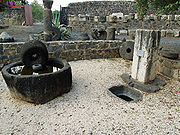
, an area which appears to have been used for agricultural purposes, judging by the many oil and grain mills which were discovered in the excavation. Fishing was also a source of income; the remains of another harbor were found to the west of that built by the Franciscans.
No sources have been found for the belief that Capernaum was involved in the bloody Jewish revolts against the Romans, the First Jewish-Roman War
(AD 66–73) or Bar Kokhba's revolt
(132–135), although there is reason to believe that Josephus
, one of the Jewish generals during the earlier revolt, was taken to Capernaum (which he called "Kapharnakos") after a fall from his horse in nearby Bethsaida
(Josephus, Vita, 72).
Josephus referred to Capernaum as a fertile spring. He stayed the night there after spraining his ankle. During the first Jewish revolt of 66-70 Capernaum was spared as it was never occupied by the Romans
.
 In 1838, the American
explorer, Edward Robinson
discovered the ruins of the ancient Capernaum. In 1866, British
Captain Charles William Wilson
identified the remains of the synagogue, and in 1894, Franciscan
Friar Giuseppe Baldi of Naples
, the Custodian of the Holy Land
, was able to recover a good part of the ruins from the Bedouins. The Franciscans raised a fence
to protect the ruins from frequent vandalism
, and planted palms
and eucalyptus
trees brought from Australia
to create a small oasis
for pilgrim
s. They also built a small harbor
. These labors were directed by the Franciscan Virgilio Corbo.
The most important excavations began in 1905 under the direction of the Germans
Heinrich Kohl and Carl Watzinger. They were continued by the Franciscans Fathers Vendelin von Benden (1905–1915) and Gaudenzio Orfali (1921–1926). The excavations resulted in the discovery of two public buildings, the synagogue (which was partially restored by Fr Orfali), and an octagonal church. Later, in 1968, excavation of the western portion of the site—the portion owned by the Franciscans—was restarted by Corbo and Stanislao Loffreda, with the financial assistance of the Italian government
. During this phase, the major discovery was of a house which is claimed to be St. Peter's house, in a neighborhood of the town from the 1st century AD. These excavations have been ongoing, with some publication on the Internet as recently as 2003.
The excavations revealed that the site was established at the beginning of the Hasmonean Dynasty, roughly in the 2nd century BC, and abandoned in the 11th century.
The eastern half of the site, where the Church of the Seven Apostles
stands and owned by an Orthodox monastery, was surveyed and partially excavated under the direction of Vasilios Tzaferis. This section has uncovered the village from the Byzantine and Arab periods. Features include a pool apparently used for the processing of fish and a hoard of gold coins. (Tzaferis, 1989).
The layout of the town was quite regular. On both sides of an ample north-south main street arose small districts bordered by small cross-sectional streets and no-exit side-streets. The walls were constructed with coarse basalt
blocks and reinforced with stone and mud, but the stones (except for the thresholds) were not dressed and mortar was not used.
The most extensive part of the typical house was the courtyard, where there was a circular furnace made of refractory earth, as well as grain mills and a set of stone stairs that led to the roof. The floors of the houses were cobbled. Around the open courtyard, modest cells were arranged which received light through a series of openings or low windows (Loffreda, 1984).
Given the coarse construction of the walls, there was no second story to a typical home, and the roof would have been constructed of light wooden beams and thatch mixed with mud. This, along with the discovery of the stairs to the roof, recalls the biblical story of the Healing of the Paralytic: "And when they could not come nigh unto him for the press, they uncovered the roof where he was: and when they had broken it up, let down the bed wherein the sick of the palsy lay." (Mark
2:4) With the type of construction seen in Capernaum, it would not have been difficult to raise the ceiling by the courtyard stairs and to remove a part to allow the bed to be brought down to where Jesus stood.
A study of the district located between the synagogue and the octagonal church showed that several families lived together in the patriarchal style, communally using the same courtyards and doorless internal passages. The houses had no hygienic facilities or drainage; the rooms were narrow. Most objects found were made of clay: pots, plates, amphoras and lamps. Fish hooks, weights for fish nets, striker pins, weaving bobbins, and basalt mills for milling grain and pressing olives were also found (Loffreda, 1974).
As of the 4th century, the houses were constructed with good quality mortar
and fine ceramics. This was about the time that the synagogue now visible was built. Differences in social class were not noticeable. Buildings constructed at the founding of the town continued to be in use until the time of the abandonment of the town.
The excavators concluded that one house in the village was venerated as the house of Peter the fisherman as early as the mid-1st century, with two churches having been constructed over it (Lofreda, 1984).
Beginning in the latter half of the 1st century AD, this house displayed markedly different characteristics than the other excavated houses. The rough walls were reworked with care and were covered with inscriptions; the floor was covered with a fine layer of plaster. Furthermore, almost no domestic ceramics are recovered, but lamps abound. One explanation suggested for this treatment is that the room was venerated as a religious gathering place, a domus-ecclesia or house church, for the Christian community. (Loffreda, 1984) This suggestion has been critiqued by several scholars, however. In particular, where excavators had claimed to find graffiti including the name of Peter, others have found very little legible writing (Strange and Shanks, 1982). Others have questioned whether the space is actually a room; the paved floor, the large space without supports, and the presence of a cooking space have prompted some to note that these are more consistent with yet another courtyard (Freyne, 2001).
, upon constructing the new church, placed the central octagon directly on top of the walls of St. Peter's house with the aim of preserving its exact location, although none of the original house was visible any longer, as the walls had been torn down and the floor covered in mosaics.
In the portico, the pattern of the mosaic was purely geometric, with four rows of contiguous circles and small crosses. In the zone of the external octagon, the mosaics represented plants and animals in a style similar to that found in the Basilica of the Feeding of the Five Thousand, in Taghba. In the central octagon, the mosaic was composed of a strip of calcified flowers, of a field of schools of fish with small flowers, and of a great circle with a peacock in the center.
were identified by Charles William Wilson. The large, ornately carved, white building stones of the synagogue stood out prominently among the smaller, plain blocks of local black basalt
used for the towns other buildings, almost all residential. The synagogue was built almost entirely of white blocks of calcareous stone brought from distant quarries
.
The building consists of four parts: the praying hall, the western patio
, a southern balustrade and a small room at the northwest of the building. The praying hall measured 24.40 ms by 18.65 m, with the southern face looking toward Jerusalem.
The internal walls were covered with painted plaster and fine stucco work found during the excavations. Watzinger, like Orfali, believed that there had been an upper floor reserved for women, with access by means of an external staircase located in the small room. But this opinion was not substantiated by the later excavations of the site.
The synagogue appears to have been built around the fourth or 5th century. Beneath the foundation of this synagogue lies another foundation made of basalt, and Loffreda suggests that this is the foundation of a synagogue from the 1st century, perhaps the one mentioned in the Gospels (Loffreda, 1974). Later excavation work was attempted underneath the synagogue floor, but while Loffreda claimed to have found a paved surface, others are of the opinion that this was an open, paved market area. http://198.62.75.1/www1/ofm/sites/TScpsyn1.html
The ancient synagogue has two inscriptions, one in Greek
and the other in Aramaic
, that remember the benefactors that helped in the construction of the building. There are also carvings of five- and six-pointed stars and of palm trees.
In 1926, the Franciscan Orfali began the restoration of the synagogue. After his death, this work was continued by Virgilio Corbo beginning in 1976.
A mosaic uncovered in 1991 shows an image of the Woman and Dragon motif mentioned in the Christian biblical book Revelation of St.John. It shows a woman about to give birth to a child as a dragon waits to devour it. The mosaic is not mentioned in any articles to date. Two possibilities seem possible: the mosaic is a Christian addition at some point when the synagogue became a Christian church, or that this was a Jewish motif indicating the dangers facing any Messiah who might come in those dangerous times of Christian predominance in Roman-ruled Palestine. The Egged tour guide who led a tour of the area dismissed it as a "pagan" theme. Bruce Cassler, 7/21/2011
boat was discovered that has been claimed to date from the 1st century AD. The vessel was 8 meters long and was preserved in the mud of the lake. After a difficult unearthing process that had to be completed before the water rose again, the excavated boat was put on display in its modern-day position near the kibbutz
Ginosar
as The Sea of Galilee Boat
.
.
Sea of Galilee
The Sea of Galilee, also Kinneret, Lake of Gennesaret, or Lake Tiberias , is the largest freshwater lake in Israel, and it is approximately in circumference, about long, and wide. The lake has a total area of , and a maximum depth of approximately 43 m...
. It had a population of about 1,500. Archaeological excavations have revealed two ancient synagogues built one over the other. A church near Capernaum is said to be the home of Saint Peter
Saint Peter
Saint Peter or Simon Peter was an early Christian leader, who is featured prominently in the New Testament Gospels and the Acts of the Apostles. The son of John or of Jonah and from the village of Bethsaida in the province of Galilee, his brother Andrew was also an apostle...
.
Etymology
Although Kfar Nahum, the original name of the small town, means "NahumNahum
Nahum was a minor prophet whose prophecy is recorded in the Hebrew Bible. His book comes in chronological order between Micah and Habakkuk in the Bible. He wrote about the end of the Assyrian Empire, and its capital city, Nineveh, in a vivid poetic style....
's village" in Hebrew
Hebrew language
Hebrew is a Semitic language of the Afroasiatic language family. Culturally, is it considered by Jews and other religious groups as the language of the Jewish people, though other Jewish languages had originated among diaspora Jews, and the Hebrew language is also used by non-Jewish groups, such...
, apparently there is no connection with the prophet
Prophet
In religion, a prophet, from the Greek word προφήτης profitis meaning "foreteller", is an individual who is claimed to have been contacted by the supernatural or the divine, and serves as an intermediary with humanity, delivering this newfound knowledge from the supernatural entity to other people...
named Nahum. In the writings of Josephus, the name is rendered in Greek
Greek language
Greek is an independent branch of the Indo-European family of languages. Native to the southern Balkans, it has the longest documented history of any Indo-European language, spanning 34 centuries of written records. Its writing system has been the Greek alphabet for the majority of its history;...
as (Kapharnaum) and in the New Testament as (Kapharnaum) in some manuscripts and as (Kapernaum) in others. In Arabic
Arabic language
Arabic is a name applied to the descendants of the Classical Arabic language of the 6th century AD, used most prominently in the Quran, the Islamic Holy Book...
, it is called Talhum, and it is assumed that this refers to the ruin (Tell) of Hum (perhaps an abbreviated form of Nahum) (Tzaferis, 1989).
New Testament traditions
The town is cited in the Gospel of LukeGospel of Luke
The Gospel According to Luke , commonly shortened to the Gospel of Luke or simply Luke, is the third and longest of the four canonical Gospels. This synoptic gospel is an account of the life and ministry of Jesus of Nazareth. It details his story from the events of his birth to his Ascension.The...
where it was reported to have been the home of the apostles Simon Peter
Saint Peter
Saint Peter or Simon Peter was an early Christian leader, who is featured prominently in the New Testament Gospels and the Acts of the Apostles. The son of John or of Jonah and from the village of Bethsaida in the province of Galilee, his brother Andrew was also an apostle...
, Andrew
Saint Andrew
Saint Andrew , called in the Orthodox tradition Prōtoklētos, or the First-called, is a Christian Apostle and the brother of Saint Peter. The name "Andrew" , like other Greek names, appears to have been common among the Jews from the 3rd or 2nd century BC. No Hebrew or Aramaic name is recorded for him...
, James and John
John the Apostle
John the Apostle, John the Apostle, John the Apostle, (Aramaic Yoħanna, (c. 6 - c. 100) was one of the Twelve Apostles of Jesus. He was the son of Zebedee and Salome, and brother of James, another of the Twelve Apostles...
, as well as the tax
Tax
To tax is to impose a financial charge or other levy upon a taxpayer by a state or the functional equivalent of a state such that failure to pay is punishable by law. Taxes are also imposed by many subnational entities...
collector Matthew
Matthew the Evangelist
Matthew the Evangelist was, according to the Bible, one of the twelve Apostles of Jesus and one of the four Evangelists.-Identity:...
. In Matthew
Gospel of Matthew
The Gospel According to Matthew is one of the four canonical gospels, one of the three synoptic gospels, and the first book of the New Testament. It tells of the life, ministry, death, and resurrection of Jesus of Nazareth...
4:13 the town was reported to have been the home of Jesus
Jesus
Jesus of Nazareth , commonly referred to as Jesus Christ or simply as Jesus or Christ, is the central figure of Christianity...
. According to Luke 4:31-44, Jesus taught in the synagogue in Capernaum on Sabbath
Biblical Sabbath
Sabbath in the Bible is usually a weekly day of rest and time of worship. The Sabbath is first mentioned in the Genesis creation narrative. The seventh day is there set aside as a day of rest—the Sabbath. It is observed differently in Judaism and Christianity and informs a similar occasion in...
. Jesus then healed a man who had the spirit of an unclean devil
Devil
The Devil is believed in many religions and cultures to be a powerful, supernatural entity that is the personification of evil and the enemy of God and humankind. The nature of the role varies greatly...
and healed a fever in Simon Peter's mother-in-law. According to , it is also the place where a Roman Centurion
Centurion (Roman army)
A centurion , also hekatontarch in Greek sources, or, in Byzantine times, kentarch was a professional officer of the Roman army after the Marian reforms of 107 BC...
asked Jesus
Jesus
Jesus of Nazareth , commonly referred to as Jesus Christ or simply as Jesus or Christ, is the central figure of Christianity...
to heal his servant. Capernaum is also mentioned in the Gospel of Mark
Gospel of Mark
The Gospel According to Mark , commonly shortened to the Gospel of Mark or simply Mark, is the second book of the New Testament. This canonical account of the life of Jesus of Nazareth is one of the three synoptic gospels. It was thought to be an epitome, which accounts for its place as the second...
(2:1), it is the location of the famous healing of the paralytic lowered through the roof to reach Jesus. According to the Synoptic Gospels
Synoptic Gospels
The gospels of Matthew, Mark, and Luke are known as the Synoptic Gospels because they include many of the same stories, often in the same sequence, and sometimes exactly the same wording. This degree of parallelism in content, narrative arrangement, language, and sentence structures can only be...
, Jesus selected this town as the center of his public ministry in the Galilee after he left the small mountainous hamlet of Nazareth
Nazareth
Nazareth is the largest city in the North District of Israel. Known as "the Arab capital of Israel," the population is made up predominantly of Palestinian Arab citizens of Israel...
(Matthew 4:12-17). Capernaum has no obvious advantages over any other city in the area, so he probably chose it because it was the home of his first disciples, Simon (Peter) and Andrew.
History
Archaeological evidence demonstrates that the town was established in the 2nd century BC during the HasmoneanHasmonean
The Hasmonean dynasty , was the ruling dynasty of Judea and surrounding regions during classical antiquity. Between c. 140 and c. 116 BCE, the dynasty ruled semi-autonomously from the Seleucids in the region of Judea...
period. The site had no defensive wall and extended along the shore of the nearby lake (from east to west). The cemetery zone is found 200 meters north of the synagogue, which places it beyond the inhabited area of the town. It extended 3 kilometers to Tabgha
Tabgha
Tabgha is an area situated on the north-western shore of the Sea of Galilee in Israel. It is the traditional site of the miracle of the multiplication of the loaves and fishes and the fourth resurrection appearance of Jesus in Christianity. Until 1948, it was the site of an Arab village.The...
, an area which appears to have been used for agricultural purposes, judging by the many oil and grain mills which were discovered in the excavation. Fishing was also a source of income; the remains of another harbor were found to the west of that built by the Franciscans.
No sources have been found for the belief that Capernaum was involved in the bloody Jewish revolts against the Romans, the First Jewish-Roman War
First Jewish-Roman War
The First Jewish–Roman War , sometimes called The Great Revolt , was the first of three major rebellions by the Jews of Judaea Province , against the Roman Empire...
(AD 66–73) or Bar Kokhba's revolt
Bar Kokhba's revolt
The Bar Kokhba revolt 132–136 CE; or mered bar kokhba) against the Roman Empire, was the third major rebellion by the Jews of Judaea Province being the last of the Jewish-Roman Wars. Simon bar Kokhba, the commander of the revolt, was acclaimed as a Messiah, a heroic figure who could restore Israel...
(132–135), although there is reason to believe that Josephus
Josephus
Titus Flavius Josephus , also called Joseph ben Matityahu , was a 1st-century Romano-Jewish historian and hagiographer of priestly and royal ancestry who recorded Jewish history, with special emphasis on the 1st century AD and the First Jewish–Roman War, which resulted in the Destruction of...
, one of the Jewish generals during the earlier revolt, was taken to Capernaum (which he called "Kapharnakos") after a fall from his horse in nearby Bethsaida
Bethsaida
Bethsaida is a place mentioned in the New Testament.- Bethsaida Julias :...
(Josephus, Vita, 72).
Josephus referred to Capernaum as a fertile spring. He stayed the night there after spraining his ankle. During the first Jewish revolt of 66-70 Capernaum was spared as it was never occupied by the Romans
Roman Empire
The Roman Empire was the post-Republican period of the ancient Roman civilization, characterised by an autocratic form of government and large territorial holdings in Europe and around the Mediterranean....
.
Archaeology
United States
The United States of America is a federal constitutional republic comprising fifty states and a federal district...
explorer, Edward Robinson
Edward Robinson (scholar)
Edward Robinson was an American biblical scholar, known as the “Father of Biblical Geography.” He has been referred to as the “founder of modern Palestinology.” -Biography:...
discovered the ruins of the ancient Capernaum. In 1866, British
United Kingdom
The United Kingdom of Great Britain and Northern IrelandIn the United Kingdom and Dependencies, other languages have been officially recognised as legitimate autochthonous languages under the European Charter for Regional or Minority Languages...
Captain Charles William Wilson
Charles William Wilson
Sir Charles William Wilson K.C.B., K.C.M.G., F.R.S., D.C.L., LL.D., M.E. was a British military officer and geographer.-Biography:...
identified the remains of the synagogue, and in 1894, Franciscan
Franciscan
Most Franciscans are members of Roman Catholic religious orders founded by Saint Francis of Assisi. Besides Roman Catholic communities, there are also Old Catholic, Anglican, Lutheran, ecumenical and Non-denominational Franciscan communities....
Friar Giuseppe Baldi of Naples
Naples
Naples is a city in Southern Italy, situated on the country's west coast by the Gulf of Naples. Lying between two notable volcanic regions, Mount Vesuvius and the Phlegraean Fields, it is the capital of the region of Campania and of the province of Naples...
, the Custodian of the Holy Land
Custodian of the Holy Land
The Custodian of the Holy Land is an officer of the Franciscan order, appointed by the General Definitorium of the Franciscan Order of Friars Minor, with the approval of the Vatican. The Custodian, or Custos, is the head of all Franciscans in the Holy Land...
, was able to recover a good part of the ruins from the Bedouins. The Franciscans raised a fence
Fence
A fence is a freestanding structure designed to restrict or prevent movement across a boundary. It is generally distinguished from a wall by the lightness of its construction: a wall is usually restricted to such barriers made from solid brick or concrete, blocking vision as well as passage .Fences...
to protect the ruins from frequent vandalism
Vandalism
Vandalism is the behaviour attributed originally to the Vandals, by the Romans, in respect of culture: ruthless destruction or spoiling of anything beautiful or venerable...
, and planted palms
Arecaceae
Arecaceae or Palmae , are a family of flowering plants, the only family in the monocot order Arecales. There are roughly 202 currently known genera with around 2600 species, most of which are restricted to tropical, subtropical, and warm temperate climates...
and eucalyptus
Eucalyptus
Eucalyptus is a diverse genus of flowering trees in the myrtle family, Myrtaceae. Members of the genus dominate the tree flora of Australia...
trees brought from Australia
Australia
Australia , officially the Commonwealth of Australia, is a country in the Southern Hemisphere comprising the mainland of the Australian continent, the island of Tasmania, and numerous smaller islands in the Indian and Pacific Oceans. It is the world's sixth-largest country by total area...
to create a small oasis
Oasis
In geography, an oasis or cienega is an isolated area of vegetation in a desert, typically surrounding a spring or similar water source...
for pilgrim
Pilgrim
A pilgrim is a traveler who is on a journey to a holy place. Typically, this is a physical journeying to some place of special significance to the adherent of a particular religious belief system...
s. They also built a small harbor
Harbor
A harbor or harbour , or haven, is a place where ships, boats, and barges can seek shelter from stormy weather, or else are stored for future use. Harbors can be natural or artificial...
. These labors were directed by the Franciscan Virgilio Corbo.
The most important excavations began in 1905 under the direction of the Germans
Germany
Germany , officially the Federal Republic of Germany , is a federal parliamentary republic in Europe. The country consists of 16 states while the capital and largest city is Berlin. Germany covers an area of 357,021 km2 and has a largely temperate seasonal climate...
Heinrich Kohl and Carl Watzinger. They were continued by the Franciscans Fathers Vendelin von Benden (1905–1915) and Gaudenzio Orfali (1921–1926). The excavations resulted in the discovery of two public buildings, the synagogue (which was partially restored by Fr Orfali), and an octagonal church. Later, in 1968, excavation of the western portion of the site—the portion owned by the Franciscans—was restarted by Corbo and Stanislao Loffreda, with the financial assistance of the Italian government
Italy
Italy , officially the Italian Republic languages]] under the European Charter for Regional or Minority Languages. In each of these, Italy's official name is as follows:;;;;;;;;), is a unitary parliamentary republic in South-Central Europe. To the north it borders France, Switzerland, Austria and...
. During this phase, the major discovery was of a house which is claimed to be St. Peter's house, in a neighborhood of the town from the 1st century AD. These excavations have been ongoing, with some publication on the Internet as recently as 2003.
The excavations revealed that the site was established at the beginning of the Hasmonean Dynasty, roughly in the 2nd century BC, and abandoned in the 11th century.
The eastern half of the site, where the Church of the Seven Apostles
Church of the Seven Apostles
The Church of the Seven Apostles is a Greek Orthodox church located at the shore of the Sea of Galilee near Capernaum in Israel.-Significance:...
stands and owned by an Orthodox monastery, was surveyed and partially excavated under the direction of Vasilios Tzaferis. This section has uncovered the village from the Byzantine and Arab periods. Features include a pool apparently used for the processing of fish and a hoard of gold coins. (Tzaferis, 1989).
The layout of the town was quite regular. On both sides of an ample north-south main street arose small districts bordered by small cross-sectional streets and no-exit side-streets. The walls were constructed with coarse basalt
Basalt
Basalt is a common extrusive volcanic rock. It is usually grey to black and fine-grained due to rapid cooling of lava at the surface of a planet. It may be porphyritic containing larger crystals in a fine matrix, or vesicular, or frothy scoria. Unweathered basalt is black or grey...
blocks and reinforced with stone and mud, but the stones (except for the thresholds) were not dressed and mortar was not used.
The most extensive part of the typical house was the courtyard, where there was a circular furnace made of refractory earth, as well as grain mills and a set of stone stairs that led to the roof. The floors of the houses were cobbled. Around the open courtyard, modest cells were arranged which received light through a series of openings or low windows (Loffreda, 1984).
Given the coarse construction of the walls, there was no second story to a typical home, and the roof would have been constructed of light wooden beams and thatch mixed with mud. This, along with the discovery of the stairs to the roof, recalls the biblical story of the Healing of the Paralytic: "And when they could not come nigh unto him for the press, they uncovered the roof where he was: and when they had broken it up, let down the bed wherein the sick of the palsy lay." (Mark
Gospel of Mark
The Gospel According to Mark , commonly shortened to the Gospel of Mark or simply Mark, is the second book of the New Testament. This canonical account of the life of Jesus of Nazareth is one of the three synoptic gospels. It was thought to be an epitome, which accounts for its place as the second...
2:4) With the type of construction seen in Capernaum, it would not have been difficult to raise the ceiling by the courtyard stairs and to remove a part to allow the bed to be brought down to where Jesus stood.
A study of the district located between the synagogue and the octagonal church showed that several families lived together in the patriarchal style, communally using the same courtyards and doorless internal passages. The houses had no hygienic facilities or drainage; the rooms were narrow. Most objects found were made of clay: pots, plates, amphoras and lamps. Fish hooks, weights for fish nets, striker pins, weaving bobbins, and basalt mills for milling grain and pressing olives were also found (Loffreda, 1974).
As of the 4th century, the houses were constructed with good quality mortar
Mortar (masonry)
Mortar is a workable paste used to bind construction blocks together and fill the gaps between them. The blocks may be stone, brick, cinder blocks, etc. Mortar becomes hard when it sets, resulting in a rigid aggregate structure. Modern mortars are typically made from a mixture of sand, a binder...
and fine ceramics. This was about the time that the synagogue now visible was built. Differences in social class were not noticeable. Buildings constructed at the founding of the town continued to be in use until the time of the abandonment of the town.
House of Peter
One block of homes, called by the Franciscan excavators the sacra insula or "holy insula" ("insula" refers to a block of homes around a courtyard) was found to have a complex history. Located between the synagogue and the lakeshore, it was found near the front of a labyrinth of houses from many different periods. Three principal layers have been identified:- A group of private houses built around the 1st century BC which remained in use until the early 4th century.
- The great transformation of one of the homes in the 4th century.
- The octagonal church in the middle of the 5th century.
The excavators concluded that one house in the village was venerated as the house of Peter the fisherman as early as the mid-1st century, with two churches having been constructed over it (Lofreda, 1984).
First century
The city's basalt houses are grouped around two large courtyards, one to the north and the other to the south. One large room in particular, near the east side and joining both courtyards, was especially large (sides about 7.5 meters long) and roughly square. An open space on the eastern side contained a brick oven. A threshold which allowed crossing between the two courtyards remains well-preserved to this day.Beginning in the latter half of the 1st century AD, this house displayed markedly different characteristics than the other excavated houses. The rough walls were reworked with care and were covered with inscriptions; the floor was covered with a fine layer of plaster. Furthermore, almost no domestic ceramics are recovered, but lamps abound. One explanation suggested for this treatment is that the room was venerated as a religious gathering place, a domus-ecclesia or house church, for the Christian community. (Loffreda, 1984) This suggestion has been critiqued by several scholars, however. In particular, where excavators had claimed to find graffiti including the name of Peter, others have found very little legible writing (Strange and Shanks, 1982). Others have questioned whether the space is actually a room; the paved floor, the large space without supports, and the presence of a cooking space have prompted some to note that these are more consistent with yet another courtyard (Freyne, 2001).
Fourth-century transformation
In this period, the sacra insula acquired a new appearance. First, a thick-walled, slightly trapezoidal enclosure was built surrounding the entire insula; its sides were 27–30 meters long. Made of plaster, they reached a height of 2.3 meters on the north side. It had two doors, one in the southwest corner and the other in the northeast corner. Next, although there is evidence that the private houses remained in use after the transformation, the one particular room that had before been treated differently was profoundly altered and expanded. A central archway was added to support a roof and the north wall was strengthened with mortar. New pavement was installed, and the walls and floor were plastered. (Loffreda, 1974) This structure remained until the middle of the 5th century when the sacra insula was dismantled and replaced with a larger basilica.Octagonal Church
The 5th-century church consists of a central octagon with eight pillars, an exterior octagon with thresholds still in situ, and a gallery or portico that leads both into the interior of the church as well as into a complex of associated buildings to the East, a linkage achieved via a short passageway. Later, this passage was blocked and an apse with a pool for baptism was constructed in the middle of the east wall. From this wall ascended two stairs on either side of the baptistry, and the excess water from the rite would have escaped along this path. The ByzantinesByzantine Empire
The Byzantine Empire was the Eastern Roman Empire during the periods of Late Antiquity and the Middle Ages, centred on the capital of Constantinople. Known simply as the Roman Empire or Romania to its inhabitants and neighbours, the Empire was the direct continuation of the Ancient Roman State...
, upon constructing the new church, placed the central octagon directly on top of the walls of St. Peter's house with the aim of preserving its exact location, although none of the original house was visible any longer, as the walls had been torn down and the floor covered in mosaics.
In the portico, the pattern of the mosaic was purely geometric, with four rows of contiguous circles and small crosses. In the zone of the external octagon, the mosaics represented plants and animals in a style similar to that found in the Basilica of the Feeding of the Five Thousand, in Taghba. In the central octagon, the mosaic was composed of a strip of calcified flowers, of a field of schools of fish with small flowers, and of a great circle with a peacock in the center.
Synagogue
The ruins of this building, among the Oldest synagogues in the worldOldest synagogues in the world
The designation oldest synagogue in the world requires careful definition. Many very old synagogues have been discovered in archaeological digs. Some synagogues have been destroyed and rebuilt several times on the same site, so, while the site or congregation may be ancient, the building may be...
were identified by Charles William Wilson. The large, ornately carved, white building stones of the synagogue stood out prominently among the smaller, plain blocks of local black basalt
Basalt
Basalt is a common extrusive volcanic rock. It is usually grey to black and fine-grained due to rapid cooling of lava at the surface of a planet. It may be porphyritic containing larger crystals in a fine matrix, or vesicular, or frothy scoria. Unweathered basalt is black or grey...
used for the towns other buildings, almost all residential. The synagogue was built almost entirely of white blocks of calcareous stone brought from distant quarries
Quarry
A quarry is a type of open-pit mine from which rock or minerals are extracted. Quarries are generally used for extracting building materials, such as dimension stone, construction aggregate, riprap, sand, and gravel. They are often collocated with concrete and asphalt plants due to the requirement...
.
The building consists of four parts: the praying hall, the western patio
Patio
A patio is an outdoor space generally used for dining or recreation that adjoins a residence and is typically paved. It may refer to a roofless inner courtyard of the sort found in Spanish-style dwellings or a paved area between a residence and a garden....
, a southern balustrade and a small room at the northwest of the building. The praying hall measured 24.40 ms by 18.65 m, with the southern face looking toward Jerusalem.
The internal walls were covered with painted plaster and fine stucco work found during the excavations. Watzinger, like Orfali, believed that there had been an upper floor reserved for women, with access by means of an external staircase located in the small room. But this opinion was not substantiated by the later excavations of the site.
The synagogue appears to have been built around the fourth or 5th century. Beneath the foundation of this synagogue lies another foundation made of basalt, and Loffreda suggests that this is the foundation of a synagogue from the 1st century, perhaps the one mentioned in the Gospels (Loffreda, 1974). Later excavation work was attempted underneath the synagogue floor, but while Loffreda claimed to have found a paved surface, others are of the opinion that this was an open, paved market area. http://198.62.75.1/www1/ofm/sites/TScpsyn1.html
The ancient synagogue has two inscriptions, one in Greek
Greek language
Greek is an independent branch of the Indo-European family of languages. Native to the southern Balkans, it has the longest documented history of any Indo-European language, spanning 34 centuries of written records. Its writing system has been the Greek alphabet for the majority of its history;...
and the other in Aramaic
Aramaic language
Aramaic is a group of languages belonging to the Afroasiatic language phylum. The name of the language is based on the name of Aram, an ancient region in central Syria. Within this family, Aramaic belongs to the Semitic family, and more specifically, is a part of the Northwest Semitic subfamily,...
, that remember the benefactors that helped in the construction of the building. There are also carvings of five- and six-pointed stars and of palm trees.
In 1926, the Franciscan Orfali began the restoration of the synagogue. After his death, this work was continued by Virgilio Corbo beginning in 1976.
A mosaic uncovered in 1991 shows an image of the Woman and Dragon motif mentioned in the Christian biblical book Revelation of St.John. It shows a woman about to give birth to a child as a dragon waits to devour it. The mosaic is not mentioned in any articles to date. Two possibilities seem possible: the mosaic is a Christian addition at some point when the synagogue became a Christian church, or that this was a Jewish motif indicating the dangers facing any Messiah who might come in those dangerous times of Christian predominance in Roman-ruled Palestine. The Egged tour guide who led a tour of the area dismissed it as a "pagan" theme. Bruce Cassler, 7/21/2011
Fishing vessel
In 1986 the water of the lake reached an unusually low point. At that time, an ancient fishingFishing
Fishing is the activity of trying to catch wild fish. Fish are normally caught in the wild. Techniques for catching fish include hand gathering, spearing, netting, angling and trapping....
boat was discovered that has been claimed to date from the 1st century AD. The vessel was 8 meters long and was preserved in the mud of the lake. After a difficult unearthing process that had to be completed before the water rose again, the excavated boat was put on display in its modern-day position near the kibbutz
Kibbutz
A kibbutz is a collective community in Israel that was traditionally based on agriculture. Today, farming has been partly supplanted by other economic branches, including industrial plants and high-tech enterprises. Kibbutzim began as utopian communities, a combination of socialism and Zionism...
Ginosar
Ginosar
Ginosar , , is a kibbutz on the western banks of the Sea of Galilee in Israel. Located north of Tiberias on Highway 90, it falls under the jurisdiction of Emek HaYarden Regional Council...
as The Sea of Galilee Boat
The Sea of Galilee Boat
The Sea of Galilee Boat also known as the was an ancient fishing boat from the 1st century CE , discovered in 1986 on the north-west shore of the Sea of Galilee in Israel...
.
Papal visit
In March 2000, John Paul II visited the ruins of Capernaum during his visit to IsraelIsrael
The State of Israel is a parliamentary republic located in the Middle East, along the eastern shore of the Mediterranean Sea...
.
See also
- Oldest synagogues in the worldOldest synagogues in the worldThe designation oldest synagogue in the world requires careful definition. Many very old synagogues have been discovered in archaeological digs. Some synagogues have been destroyed and rebuilt several times on the same site, so, while the site or congregation may be ancient, the building may be...
- Archaeology of IsraelArchaeology of IsraelThe archaeology of Israel is the study of the archaeology of Israel, stretching from prehistory through three millennia of documented history. The ancient Land of Israel was a geographical bridge between the political and cultural centers of Mesopotamia and Egypt...
- Tourism in IsraelTourism in IsraelTourism in Israel is one of the country's major sources of income, with 3.45 million tourist arrivals in 2010. Israel offers a plethora of historical and religious sites, beach resorts, archaeological tourism, heritage tourism and ecotourism. Israel has the highest number of museums per capita in...
- National parks of Israel
Further reading
- Sean Freyne, "A Galilean Messiah?," Studia Theologica 55 (2001), 198-218. Contains an analysis of the singled-out 1st century AD house as a courtyard rather than a room or house.
- Loffreda, Stanislao. Cafarnao. Vol. II. La Ceramica. Jerusalem: Franciscan Printing Press, 1974. Technical publication (in original Italian) of the western site.
- Loffreda, Stanislao. Recovering Capharnaum. Jerusalem: Edizioni Custodia Terra Santa, 1984. ASIN B0007BOTZY. Non-technical English summary of the excavations on the western (Franciscan) portion of the site.
- Jerome Murphy-O'ConnorJerome Murphy-O'ConnorReverend Dr Jerome Murphy-O'Connor O.P., is a Dominican priest, a leading authority on St...
, Oxford Archaeological Guides: The Holy Land (Oxford, 1998), 217-220. ASIN 0192880136. - James F. Strange and Hershel Shanks, "Has the House Where Jesus Stayed in Capernaum Been Found?," Biblical Archaeology Review 8, 6 (Nov./Dec., 1982), 26-37. Critique of the domus-ecclesia claims.
- Tzaferis, Vassilios. Excavations at Capernaum, 1978-1982. Winona Lake, Indiana: Eisenbrauns, 1989. ISBN 0-931464-48-X. Overview publication of the dig on the eastern portion of the site.
External links
- Strong's G2584
- Capharnaum - The town of Jesus - Franciscan Cyberspot
- Capernaum - information from the Israeli government
- Capernaum - Sacred Destinations (includes 38 photos)
- Images of Capernaum
- Article by Dr. Zeev Goldmann