
All Topics  
Edward the Elder


   Email Print
   Bookmark   Link


Edward the Elder


Edward the Elder (Old English
Old English language

Old English is an early form of the English language that was spoken and written in parts of what are now England and south-eastern Scotland between the mid-5th century and the mid-12th century....
: Eadweard se Ieldra) (c. 870 – 17 July 924) was King of England
Kingdom of England

The Kingdom of England was, from 927 to 1707, a state in North-West Europe. The Kingdom of England spanned the southern two-thirds of the island of Great Britain and a number of smaller outlying islands?what is today the legal unit of England and Wales....
 (899 – 924). He was the son of Alfred the Great
Alfred the Great

Alfred the Great , also spelled ?lfred, was king of the southern Anglo-Saxons kingdom of Wessex from 871 to 899. Alfred is noted for his defence of the kingdom against the Danish people Vikings, becoming the only English people king to be awarded the epithet "the Great"....
 (Ælfred se Greata) and Alfred's wife, Ealhswith
Ealhswith

Ealhswith, or Ealswitha, of the Gaini was the daughter of ?thelred Mucil, Ealdorman of the Gaini. She was married in 868, to Alfred the Great, king of Wessex....
, and became King upon his father's death in 899.

He was king at a time when the Kingdom of Wessex
Wessex

West Saxon redirects here. For other meanings of Wessex or West Saxon see Wessex .Wessex , from the Old English Westseaxe , was an Anglo-Saxon kingdom of the West Saxons, in South West England, from the 6th century, until the emergence of the English state in the 9th century, under the Wessex dynasty....
 was becoming transformed into the Kingdom of England
Kingdom of England

The Kingdom of England was, from 927 to 1707, a state in North-West Europe. The Kingdom of England spanned the southern two-thirds of the island of Great Britain and a number of smaller outlying islands?what is today the legal unit of England and Wales....
. The title he normally used was "King of the Anglo-Saxons"; most authorities do regard him as a king of England, although the territory he ruled over was significantly smaller than the present borders of England.

he five children born to Alfred and Eahlswith who survived infancy, Edward was the second-born and the elder son.


Discussion
Ask a question about 'Edward the Elder'
Start a new discussion about 'Edward the Elder'
Answer questions from other users
Full Discussion Forum


Recent Posts


Encyclopedia


Edward the Elder (Old English
Old English language

Old English is an early form of the English language that was spoken and written in parts of what are now England and south-eastern Scotland between the mid-5th century and the mid-12th century....
: Eadweard se Ieldra) (c. 870 – 17 July 924) was King of England
Kingdom of England

The Kingdom of England was, from 927 to 1707, a state in North-West Europe. The Kingdom of England spanned the southern two-thirds of the island of Great Britain and a number of smaller outlying islands?what is today the legal unit of England and Wales....
 (899 – 924). He was the son of Alfred the Great
Alfred the Great

Alfred the Great , also spelled ?lfred, was king of the southern Anglo-Saxons kingdom of Wessex from 871 to 899. Alfred is noted for his defence of the kingdom against the Danish people Vikings, becoming the only English people king to be awarded the epithet "the Great"....
 (Ælfred se Greata) and Alfred's wife, Ealhswith
Ealhswith

Ealhswith, or Ealswitha, of the Gaini was the daughter of ?thelred Mucil, Ealdorman of the Gaini. She was married in 868, to Alfred the Great, king of Wessex....
, and became King upon his father's death in 899.

He was king at a time when the Kingdom of Wessex
Wessex

West Saxon redirects here. For other meanings of Wessex or West Saxon see Wessex .Wessex , from the Old English Westseaxe , was an Anglo-Saxon kingdom of the West Saxons, in South West England, from the 6th century, until the emergence of the English state in the 9th century, under the Wessex dynasty....
 was becoming transformed into the Kingdom of England
Kingdom of England

The Kingdom of England was, from 927 to 1707, a state in North-West Europe. The Kingdom of England spanned the southern two-thirds of the island of Great Britain and a number of smaller outlying islands?what is today the legal unit of England and Wales....
. The title he normally used was "King of the Anglo-Saxons"; most authorities do regard him as a king of England, although the territory he ruled over was significantly smaller than the present borders of England.

Ætheling

Of the five children born to Alfred and Eahlswith who survived infancy, Edward was the second-born and the elder son. Edward's name was a new one among the West Saxon ruling family. His siblings were named for their father and other previous kings, but Edward was perhaps named for his maternal grandmother Eadburh, of Mercian origin and possibly a kinswoman of Mercian kings Coenwulf
Coenwulf of Mercia

Coenwulf was King of Mercia from December 796 to 821. He was a descendant of a brother of King Penda of Mercia, who had ruled Mercia in the middle of the 7th century....
 and Ceolwulf
Ceolwulf I of Mercia

Ceolwulf I was King of Mercia and Kent, from 821 to 823. He was the brother of Coenwulf of Mercia, his predecessor, and was deposed by Beornwulf of Mercia....
. Edward's birth cannot be certainly dated. His parents married in 868 and his eldest sibling Æthelflæd was born soon afterwards as she was herself married in 883. Edward was probably born rather later, in the 870s, and probably between 874 and 877.

Asser's Life of King Alfred reports that Edward was educated at court together with his youngest sister Ælfthryth. His second sister, Æthelgifu, was intended for a life in religion from an early age, perhaps due to ill health, and was later abbess of Shaftesbury. The youngest sibling, Æthelweard, was educated at a court school where he learned Latin, which suggests that he too was intended for a religious life. Edward and Ælfthryth, however, while they learned Old English, received a courtly education, and Asser refers to their taking part in the "pursuits of this present life which are appropriate to the nobility".

The first appearance of Edward, called filius regis, the king's son in the sources is in 892, in a charter granting land at North Newnton, near Pewsey
Pewsey

Pewsey is a large village in Wiltshire with a population of 3,237 people located approximately 80 miles west of London. It is well connected for London, the West Country and Wales being close to the M4 motorway and the A303....
 in Wiltshire
Wiltshire

Wiltshire is a Ceremonial counties of England in the South West England of England. It is landlocked and borders the counties of Dorset, Somerset, Hampshire, Gloucestershire, Oxfordshire and Berkshire....
, to ealdorman
Ealdorman

An ealdorman is the term used for a high-ranking royal official and prior magistrate of an Anglo-Saxons shire from about the ninth century to the time of King Cnut....
 Æthelhelm, where he is called filius regis, the king's son. Although he was the reigning king's elder son, Edward was not certain to succeed his father. Until the 890s, the obvious heirs to the throne were Edward's cousins Æthelwold
Æthelwold of Wessex

?thelwald was the eldest son of ?thelred of Wessex. He was also the cousin of Edward the Elder of Wessex. Aethelwald fought his cousin during much of his early reign because he felt that he had more right to inherit the throne....
 and Æthelhelm, sons of Æthelred, Alfred's older brother and predecessor as king. Æthelwold and Æthelhelm were around ten years older than Edward. Æthelhelm disappears from view in the 890s, seemingly dead, but a charter probably from that decade shows Æthelwold witnessing before Edward, and the order of witnesses is generally believed to relate to their status. As well as his greater age and experience, Æthelwold may have had another advantage over Edward where the succession was concerned. While Alfred's wife Eahlswith is never described as queen and was never crowned, Æthelwold and Æthelhelm's mother Wulfthryth was called queen.

Succession and early reign

.]] When Alfred died, Edward's cousin Aethelwold
Æthelwold of Wessex

?thelwald was the eldest son of ?thelred of Wessex. He was also the cousin of Edward the Elder of Wessex. Aethelwald fought his cousin during much of his early reign because he felt that he had more right to inherit the throne....
, the son of King Ethelred of Wessex
Ethelred of Wessex

King Ethelred of Wessex was the fourth son of King Ethelwulf of Wessex, and an older brother of Alfred the Great. He is sometimes referred to as King Ethelred I of Kingdom of England, but it is open to question whether he should be regarded as a king of England, since in his time the English were still divided into a number of kingdoms, no...
, rose up to claim the throne and began Æthelwold's Revolt
Æthelwold's Revolt

?thelwold's Revolt was an attempt by ?thelwold of Wessex to seize the throne from Edward the Elder after the death of Alfred the Great....
. He seized Wimborne, in Dorset
Dorset

Dorset , is a Counties of England in South West England on the English Channel coast. The county town is Dorchester, Dorset, situated in the south of the county at ....
, where his father was buried, and Christchurch
Christchurch, Dorset

Christchurch is a borough and town in Dorset on the English Channel coast, adjoining Bournemouth in the west, with the New Forest to the east. Formerly in Hampshire, it is the most easterly borough in Dorset....
 (then in Hampshire
Hampshire

Hampshire , sometimes historically Southamptonshire, Hamptonshire, , or the County of Southampton, is a Counties of England on the south coast of England....
, now in Dorset). Edward marched to Badbury
Badbury (hundred)

Badbury Hundred was a hundred in the county of Dorset, England, containing the following parishes:*Chalbury*Gussage St Michael*Hinton Martell...
 and offered battle, but Aethelwold refused to leave Wimborne. Just when it looked as if Edward was going to attack Wimborne, Aethelwold left in the night, and joined the Danes in Northumbria
Northumbria

Northumbria is primarily the name of both a medieval petty kingdom of the Angles people, in what is now north east England and southern Scotland, and of the earldom which succeeded it when a united Anglo-Saxon kingdom became England....
, where he was announced as King. In the meantime, Edward is alleged to have been crowned at Kingston upon Thames
Kingston upon Thames

Kingston upon Thames is the principal settlement of the Royal Borough of Kingston upon Thames in south-west London.It was the ancient market town where Anglo-Saxons kings were crowned and is now a suburb situated south west of Charing Cross....
 on 8 June 900
900

Sorry, no overview for this topic
 

In 901, Aethelwold came with a fleet to Essex
Essex

Essex is a counties of England in the East of England England. The county town is Chelmsford, and the highest point of the county is Chrishall Common near the village of Langley, Essex, close to the Hertfordshire border, which reaches ....
, and encouraged the Danes in East Anglia
East Anglia

East Anglia is a region of eastern England. It was named after one of the ancient Heptarchy, the Kingdom of the East Angles, which was in turn named after the homeland of the Angles, Angeln, in northern Germany....
 to rise up. In the following year, he attacked Cricklade
Cricklade

Cricklade is a small town in north Wiltshire in England, on the River Thames, situated midway between Swindon and Cirencester.Cricklade is twinned with Suc?-sur-Erdre in France....
 and Braydon. Edward arrived with an army, and after several marches, the two sides met at the Battle of Holme. Aethelwold and King Eohric of the East Anglian Danes were killed in the battle.

Relations with the North proved problematic for Edward for several more years. The Anglo-Saxon Chronicle
Anglo-Saxon Chronicle

The Anglo-Saxon Chronicle is a collection of annals in Old English language chronicling the history of the Anglo-Saxons. The annals were created late in the 9th century, probably in Wessex, during the reign of Alfred the Great....
 mentions that he made peace with the East Anglian and Northumbrian Danes "of necessity". There is also a mention of the regaining of Chester
Chester

Chester is the county town of Cheshire, England. Lying on the River Dee, Wales, close to the border with Wales, it is home to 77,040 inhabitants, and is the largest and most populous settlement of the wider local government district of the Chester , which had a population of 118,210 according to the United Kingdom Census 2001....
 in 907, which may be an indication that the city was taken in battle.

In 909, Edward sent an army to harass Northumbria
Northumbria

Northumbria is primarily the name of both a medieval petty kingdom of the Angles people, in what is now north east England and southern Scotland, and of the earldom which succeeded it when a united Anglo-Saxon kingdom became England....
. In the following year, the Northumbrians retaliated by attacking Mercia, but they were met by the combined Mercian and West Saxon army at the Battle of Tettenhall
Battle of Tettenhall

The Battle of Tettenhall took place on the 5 August 910. The allied forces of Mercia and Wessex met an army of Northumbrian Vikings in Mercia. The allied army scored a great victory over the Viking force, the last major army sent by the Danes to ravage England....
, where the Northumbrian Danes were destroyed. From that point, they never raided south of the River Humber
Humber

The Humber is a large tidal estuary on the east coast of northern England.The Humber is an estuary formed at Trent Falls, Faxfleet, by the confluence of the tidal River Ouse, Yorkshire and the tidal River Trent....
.

Edward then began the construction of a number of fortresses (burhs), at Hertford
Hertford

Hertford is the affluent county town of Hertfordshire, England, and is in the East Hertfordshire district of the county. Forming a civil parish, it has a population today of about 24,180 and boasts a wide selection of boutiques, bars and cafes....
, Witham
Witham

Witham is a town in the Counties of England of Essex, England, in the south east of England. The population is 22,500. It is part of the District of Braintree ....
 and Bridgnorth
Bridgnorth

Bridgnorth is a town in Shropshire, England, along the Severn Valley . It is split into Low Town and High Town, named on account of their elevations relative to the River Severn, which separates the upper town on the right bank from the lower on the left....
. He is also said to have built a fortress at Scergeat, but that location has not been identified. This series of fortresses kept the Danes at bay. Other forts were built at Tamworth
Tamworth

Tamworth is a town and Non-metropolitan district in Staffordshire, England, located 14 miles north-east of Birmingham city centre and 103 miles north-west of London....
, Stafford
Stafford

Stafford is the county town of Staffordshire in England. It lies in the north of the West Midlands , between Wolverhampton and Stoke-on-Trent. The population of Stafford was given in the 2001 census as 63,681, with that of the wider Stafford as 124,531....
, Eddisbury
Eddisbury

Eddisbury could be*the Eddisbury in Cheshire, England*the ancient Eddisbury in Cheshire...
 and Warwick
Warwick

Warwick is the county town of Warwickshire, England. The town lies upon the River Avon, Warwickshire, 18 km south of Coventry and 4 km west of Leamington Spa , with a population of 25,434 .....
.

Achievements


Edward extended the control of Wessex over the whole of Mercia
Mercia

Mercia was one of the kingdoms of the Anglo-Saxons Heptarchy. It was centred on the valley of the River Trent and its tributaries in the region now known as the English Midlands....
, East Anglia
East Anglia

East Anglia is a region of eastern England. It was named after one of the ancient Heptarchy, the Kingdom of the East Angles, which was in turn named after the homeland of the Angles, Angeln, in northern Germany....
 and Essex
Essex

Essex is a counties of England in the East of England England. The county town is Chelmsford, and the highest point of the county is Chrishall Common near the village of Langley, Essex, close to the Hertfordshire border, which reaches ....
, conquering lands occupied by the Danes and bringing the residual autonomy of Mercia to an end in 918, after the death of his sister, Ethelfleda
Ethelfleda

Ethelfleda , also spelled Ethelfled, was the eldest daughter of King Alfred the Great of Wessex and his wife Ealhswith. She was born around AD 872....
 (Æðelfl?d). Ethelfleda's daughter, Ælfwynn, was named as her successor, but Edward deposed her, bringing Mercia under his direct control. He had already annexed the cities of London
London

London is the capital of both England and the United Kingdom, and the most populous municipality in the European Union. An important settlement for two millennia, History of London goes back to its founding by the Roman Empire....
 and Oxford
Oxford

Oxford is a City status in the United Kingdom, and the county town of Oxfordshire, in South East England. It has a population of 151,000. The rivers River Cherwell and River Thames run through Oxford and meet south of the city centre....
 and the surrounding lands of Oxfordshire
Oxfordshire

Oxfordshire is a county in the South East England region, bordering on Northamptonshire, Buckinghamshire, Berkshire, Wiltshire, Gloucestershire, and Warwickshire....
 and Middlesex
Middlesex

Middlesex , from the Old English Middelseaxe , is one of the 39 Historic counties of England of England and the List of counties of England by area in 1831....
 in 911. By 918, all of the Danes south of the Humber had submitted to him. By the end of his reign, the Norse, the Scots and the Welsh had acknowledged him as "father and lord". This recognition of Edward's overlordship in Scotland
Scotland

conventional_long_name = ScotlandAlba|common_name= Scotland|image_flag = Flag of Scotland.svg|flag_width = 130px...
 led to his successors' claims of suzerainty
Suzerainty

Suzerainty is a situation in which a region or nation is a tributary state to a more powerful entity which allows the tributary some limited domestic Wiktionary:autonomy to control its foreign affairs....
 over that Kingdom.

Edward reorganized the Church
Roman Catholic Church

The Roman Catholic Church, officially known as the Catholic Church is the world's largest Christianity Ecclesia , representing over half of all Christians and one-sixth of the world population....
 in Wessex, creating new bishoprics at Ramsbury and Sonning, Wells and Crediton. Despite this, there is little indication that Edward was particularly religious. In fact, the Pope delivered a reprimand to him to pay more attention to his religious responsibilities.

He died leading an army against a Welsh-Mercian rebellion, on 17 July 924
924

For the automobile, see Porsche 924....
 at Farndon-Upon-Dee
Farndon, Cheshire

Farndon is a village and civil parish in Chester , Cheshire, England. It is located on the banks of the River Dee, Wales, south of Chester, and close to the border with Wales....
 and was buried in the New Minster
New Minster, Winchester

The New Minster, Winchester was a royal Benedictine abbey founded in 901 in Winchester in the England county of Hampshire.Alfred the Great had intended to build the monastery, but only got around to buying the land....
 in Winchester, Hampshire
Hampshire

Hampshire , sometimes historically Southamptonshire, Hamptonshire, , or the County of Southampton, is a Counties of England on the south coast of England....
, which he himself had established in 901. After the Norman Conquest
Norman conquest of England

The Norman conquest of England began in 1066 AD with the invasion of the Kingdom of England by the troops of William I of England, Duke of Normandy , and his victory at the Battle of Hastings....
, the minster was replaced by Hyde Abbey
Hyde Abbey

Hyde Abbey was a Benedictine monastery just outside the walls of Winchester, Hampshire, dissolved and demolished in 1538.At the time Alfred the Great refounded the royal city of Winchester about 880 AD, the Saxon cathedral and the royal palace stood at the heart of the city....
 to the north of the city and Edward's body was transferred there. His last resting place is currently marked by a cross-inscribed stone slab within the outline of the old abbey marked out in a public park.

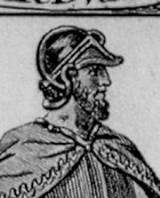
The portrait included here is imaginary and was drawn together with portraits of other Anglo-Saxon monarchs by an unknown artist in the 18th century. Edward's eponym the Elder was first used in the 10th century, in Wulfstan
Wulfstan

Wulfstan may refer to:*Wulfstan of Hedeby, 9th century merchantman and traveller*Wulfstan I, Archbishop of York *Wulfstan II, Archbishop of York , Bishop of Worcester and Bishop of London...
's Life of St Æthelwold, to distinguish him from the later King Edward the Martyr
Edward the Martyr

Edward the Martyr or Eadweard II was king of England from 975 until he was murdered in 978. Edward was the eldest son of King Edgar of England, but not his father's acknowledged heir apparent....
.

Family

Edward had four siblings, including Ethelfleda
Ethelfleda

Ethelfleda , also spelled Ethelfled, was the eldest daughter of King Alfred the Great of Wessex and his wife Ealhswith. She was born around AD 872....
, Queen of the Mercians and Ælfthryth, Countess of Flanders.

King Edward had about fourteen children from three marriages, and may have had illegitimate children too.

Edward married (although the exact status of the union is uncertain) a young woman of low birth called Ecgwynn
Ecgwynn

Ecgwynn or Egwina was an English woman who was the first wife of Edward the Elder, king of the English.Very little is known about her, even her name is only recorded after the Norman Conquest....
 around 893, and they became the parents of the future King Athelstan
Athelstan of England

Athelstan , called the Glorious, was the List of English monarchs from 924/925 to 939. He was the son of King Edward the Elder, and nephew of Ethelfleda of Mercia....
 and a daughter who married Sihtric, King of Dublin and York in 926. Nothing is known about Ecgwynn other than her name, which was not even recorded until after the Conquest.

When he became king in 899, Edward set Ecgwynn aside and married Ælfflæd
Ælfflæd, wife of Edward the Elder

?lffl?d was the second wife of Edward the Elder, king of the English.She was the daughter of an ealdorman Ethelhelm, perhaps the ?thelhelm of that name....
, a daughter of Æthelhelm, the ealdorman
Ealdorman

An ealdorman is the term used for a high-ranking royal official and prior magistrate of an Anglo-Saxons shire from about the ninth century to the time of King Cnut....
 of Wiltshire
Wiltshire

Wiltshire is a Ceremonial counties of England in the South West England of England. It is landlocked and borders the counties of Dorset, Somerset, Hampshire, Gloucestershire, Oxfordshire and Berkshire....
. Their son Ælfweard
Ælfweard of Wessex

?lfweard was the second son of Edward the Elder, the eldest born to ?lffl?d, wife of Edward the Elder. The only contemporary source, the Anglo Saxon Chronicle, simply states that he died just weeks after his father's death on 17 July 924 and that they were buried together at Winchester Cathedral....
 may have briefly succeeded his father, but died just over two weeks later and the two were buried together. Edward and Ælfflæd had six daughters: Eadgyth
Eadgyth

Edith of England , also spelt Eadgyth or ?dgyth, was the daughter of Edward the Elder, List of English monarchs and ?lffl?d, and the wife of Otto I, Holy Roman Emperor....
 who married Otto I, Holy Roman Emperor
Otto I, Holy Roman Emperor

Otto I the Great , son of Henry I the Fowler and Matilda of Ringelheim, was Duchy of Saxony, King of Germany, King of Italy, and "the first of the Germans to be called the emperor of Italy" according to Arnulf of Milan....
; Edgiva
Eadgifu of England

Eadgifu or Edgifu was a daughter of Edward the Elder, King of Wessex and England, and his second wife ?lffl?d, wife of Edward the Elder. She was born in Wessex....
 aka Edgifu, whose first marriage was to Charles the Simple; Eadhild, who married Hugh the Great
Hugh the Great

Hugh the Great was duke of the Franks and count of Paris, France, son of King Robert I of France and nephew of King Odo, Count of Paris. He was born in Paris, Ile-de-France, France....
, Duke of Paris; Ælfgifu who married "a prince near the Alps
Alps

The Alps is the name for one of the great mountain range systems of Europe, stretching from Austria and Slovenia in the east; through Italy, Switzerland, Liechtenstein and Germany; to France in the west....
", sometimes identified with Conrad of Burgundy
Conrad of Burgundy

Conrad the Peaceful was the king of Burgundy from 937 until his death. He was the son of King Rudolph II of Burgundy, the first king of a united Burgundy and Bertha of Swabia....
 or Boleslaus II of Bohemia
Boleslaus II of Bohemia

Boleslaus II the Pious was the duke of Bohemia from 972, a member of the Premyslid dynasty.The son of Boleslaw also called Boleslav I of Bohemia and Biagota, Boleslaus II became Duke in on his father's death....
; and two nuns Eadflæd and Eadhild. A son, Edwin Ætheling who drowned in 933 was possibly Ælfflæd's child, but that is not clear.

Edward married for a third time, about 919, to Edgiva
Edgiva of Kent

Edgiva of Kent, or also Eadgifu was the third wife of Edward the Elder, List of British monarchs of England. Edgiva was the daughter of Sigehelm, Ealdorman of Kent....
, aka Eadgifu, the daughter of Sigehelm, the ealdorman of Kent
Kent

Kent is a Counties of England in southeast England, and is one of the home counties. It borders East Sussex, Surrey and Greater London and has a defined boundary with Essex in the middle of the River Thames estuary....
. They had two sons who survived infancy, Edmund
Edmund I of England

Edmund I , called the Elder, the Deed-Doer, the Just or the Magnificent, was King of England from 939 until his death. He was a son of Edward the Elder and half-brother of Athelstan of England....
 and Edred
Edred of England

Eadred was the King of England from 946 until his death in 955. He was a son of Edward the Elder by his third marriage, to Edgiva of Kent, daughter of Sigehelm, ealdorman of Kent....
, and two daughters, one of whom was Saint Edburga of Winchester
Edburga of Winchester

Saint Eadburh or Edburga was the daughter of King Edward the Elder of England and his third wife, Edgiva of Kent. There is little contemporary information for her life, but in a Winchester Anglo-Saxon Charters dated 939, she appears as the beneficiary of land in Hampshire granted by her brother King Athelstan....
 the other daughter, Eadgifu, married Louis l'Aveugle.

Eadgifu outlived her husband and her sons, and was alive during the reign of her grandson, King Edgar
Edgar of England

Edgar I the Peaceful or the Peaceable was a king of England.Edgar was the younger son of Edmund I of England. His cognomen, "The Peaceable", was not necessarily a comment on the deeds of his life, for he was a strong leader, shown by his seizure of the Northumbrian and Mercian kingdoms from his older brother, Edwy, in 958....
. William of Malmsbury's history De antiquitate Glastonie ecclesiae claims that Edward's second wife, Aelffaed, was also alive after Edward's death, but this is the only known source for that claim.

Genealogy

For a more complete genealogy including ancestors and descendants, see House of Wessex family tree
House of Wessex family tree

The following chart is a family tree of the kings of the House of Wessex, a dynasty whose members were Kings of Wessex, and then, from Athelstan onwards, King of England....
.

Genealogy England Bis 1000

Ancestry


Sources

  • *
  • Higham, N.J. Edward the Elder, 899-924, 2001 ISBN 0-415-21497-1

External links