

Saxony-Anhalt

Encyclopedia
Saxony-Anhalt is a landlocked state
of Germany
. Its capital is Magdeburg
and it is surrounded by the German states of Lower Saxony
, Brandenburg
, Saxony
, and Thuringia
.
Saxony-Anhalt covers an area of 20447.7 square kilometres (7,894.9 sq mi). It has a population of 2.34 million (more than 2.8 million in 1990).
Saxony-Anhalt should not be confused with Saxony
or Lower Saxony
, also German states.
In the north, the Saxony-Anhalt landscape is dominated by plain
(North German Plain
). The old Hanseatic
towns Salzwedel
, Gardelegen
, Stendal
, or Tangermünde
are located in the sparsely populated Altmark
. The Colbitz-Letzlingen Heath and the Drömling
near Wolfsburg
mark the transition between the Altmark region and the Elbe-Börde-Heath region with its fertile, sparsely wooded Magdeburg Börde
. Notable towns in the Magdeburg Börde are Haldensleben
, Oschersleben (Bode), Wanzleben
, Schönebeck (Elbe), Aschersleben
and the capital Magdeburg
, from which the Börde derives its name.
The Harz mountains are located in the south-west, comprising the Harz National Park
, the Harz foreland and the Mansfeld Land. The highest mountain of the Harz (and of Northern Germany
) is Brocken, with an elevation of 1,141 meters (3,735 ft). In this area, one can find the towns of Halberstadt
, Wernigerode
, Thale
, Eisleben
, and Quedlinburg
.
The wine-growing area Saale-Unstrut and the towns of Zeitz
, Naumburg (Saale), Weißenfels
, and Freyburg (Unstrut) are located on the rivers Saale
and Unstrut
in the south of the state.
The metropolitan area of Halle (Saale) forms an agglomeration with Leipzig
in Saxony
. This area is known for its highly developed chemical industry (the Chemiedreieck - chemical triangle), with major production plants at Leuna
, Schkopau
(Buna-Werke) and Bitterfeld
. Finally, in the east, Dessau-Roßlau
is situated on the Elbe (as is the Magdeburg) in the Anhalt-Wittenberg region.
The capital of Saxony-Anhalt is Magdeburg
. It is the largest city in the state, head-to-head with Halle.
Saxony-Anhalt is subdivided into eleven rural districts
and three urban districts. The current state was created by two districts reforms. By the first one in 1994, 37 districts were reformed into 21 new districts. The last reform took place on January 1, 2004, when the 21 districts were reordered into now eleven districts.
From 1994 to 2003, Saxony-Anhalt was divided into 21 rural districts
("Landkreise"). Above this level, there were three governmental districts (Regierungsbezirk
e): Dessau
, Halle
and Magdeburg
. On 1 January 2004 these three governmental districts were abolished.
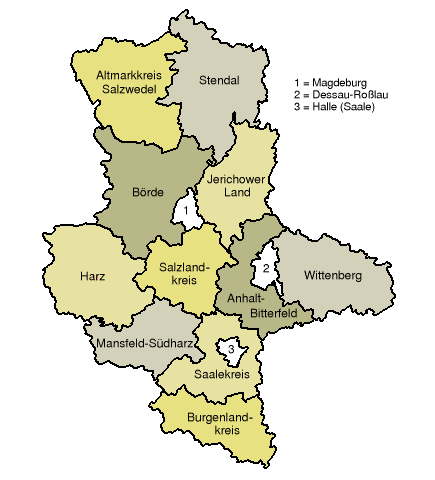 The rural districts are
and the three urban districts
) appointed the first non-Nazi officials in leading positions in the area. So Erhard Hübener
, furloughed by the Nazis, was reappointed Saxon Landeshauptmann (land-captain). By early July the US Army retired in order to allow the Red Army
taking Prussian Saxony as part of its Soviet occupation zone, as agreed by the London Protocol in 1944.
On July 9 the Soviet SVAG
ordered to merge the Free State of Anhalt
, Halle-Merseburg
, the governorate of Magdeburg
(in its then borders), Allstedt
(before Thuringia) and some Brunswickian
eastern exclaves and salients (Calvörde
and the eastern part of the former Blankenburg
district) into the Prussian Province of Saxony
. While the prior Saxon Erfurt governorate had become a part of Thuringia
.
For the earlier history see the respective articles of these entities before 1945. Anhalt takes its name from Anhalt Castle
near Harzgerode
; the origin of the name of the castle remains unknown.
The SVAG appointed Hübener as president of the provincial Saxon administration, a newly created function. The administration was seated in Halle upon Saale, which became the capital, also of later Saxony-Anhalt until 1952. On 3 September 1945 the new administration enacted by Soviet-inspired ordinance the mass expropriations, mostly hitting holders of large real estates, often of noble descent.
On the occasion of the first as well as one and only election in the Soviet zone, allowing parties to really compete for seats in provincial and state parliaments, on 20 October 1946, the Province of Saxony was renamed into Province of Saxony-Anhalt (Provinz Sachsen-Anhalt), accounting for the prior merger. On 3 December 1946 the members of the new provincial parliament elected Hübener the first minister-president
of Saxony-Anhalt with the votes of CDU
and Liberal Democratic Party of Germany (LDPD)
. So he became the only governor
in the Soviet zone, who was no member of the communist Socialist Unity Party of Germany (SED)
. He was an unconvenient governor for the Soviet rulers.
After the official Allied decision to dissolve the Free State of Prussia, which had remained in agony since the Prussian coup of 1932
, its former provinces
, in as far as they still existed, achieved statehood, thus the province emerged into the State of Saxony-Anhalt on 6 October 1947. It became part of the German Democratic Republic
(East Germany) in 1949. From 1952 to 1990 the East German states had been suppressed and Saxony-Anhalt's territory was divided into the East German districts of Halle
and of Magdeburg
. In 1990, in the course of German reunification
, the districts were reintegrated as a state.
(CDU) did not run for re-election.
These are the official election results (secondary votes):
in 1990, the break down of non competitive former GDR industries caused severe economic and social problems. In 2000, Saxony-Anhalt had the highest unemployment rate of all German states, with 20.2 percent.
However, the process of economic transformation seems to be completed. Massive investments in modern infrastructure have taken place since 1990, and the remaining and newly created businesses are highly competitive. For example, the industry has doubled its share of international revenue from 13 percent in 1995 to 26 percent in 2008. Meanwhile, the unemployment rate has fallen considerably. By 2010 the GDP of Saxony-Anhalt was almost two and a half times higher than it was in 1991.
Even though part of this recovery was induced by the quite good performance of the Germany economy, Saxony-Anhalt did not only follow the national trend, but clearly outperformed other German states. For example, it got ahead of three German states in terms of unemployment (10,8 percent, as of September 2011): the German capital and city-state
of Berlin
(12.7 percent), the city-state of Bremen
(11.3 percent), and Mecklenburg-Western Pomerania
(11.1 percent).
States of Germany
Germany is made up of sixteen which are partly sovereign constituent states of the Federal Republic of Germany. Land literally translates as "country", and constitutionally speaking, they are constituent countries...
of Germany
Germany
Germany , officially the Federal Republic of Germany , is a federal parliamentary republic in Europe. The country consists of 16 states while the capital and largest city is Berlin. Germany covers an area of 357,021 km2 and has a largely temperate seasonal climate...
. Its capital is Magdeburg
Magdeburg
Magdeburg , is the largest city and the capital city of the Bundesland of Saxony-Anhalt, Germany. Magdeburg is situated on the Elbe River and was one of the most important medieval cities of Europe....
and it is surrounded by the German states of Lower Saxony
Lower Saxony
Lower Saxony is a German state situated in north-western Germany and is second in area and fourth in population among the sixteen states of Germany...
, Brandenburg
Brandenburg
Brandenburg is one of the sixteen federal-states of Germany. It lies in the east of the country and is one of the new federal states that were re-created in 1990 upon the reunification of the former West Germany and East Germany. The capital is Potsdam...
, Saxony
Saxony
The Free State of Saxony is a landlocked state of Germany, contingent with Brandenburg, Saxony Anhalt, Thuringia, Bavaria, the Czech Republic and Poland. It is the tenth-largest German state in area, with of Germany's sixteen states....
, and Thuringia
Thuringia
The Free State of Thuringia is a state of Germany, located in the central part of the country.It has an area of and 2.29 million inhabitants, making it the sixth smallest by area and the fifth smallest by population of Germany's sixteen states....
.
Saxony-Anhalt covers an area of 20447.7 square kilometres (7,894.9 sq mi). It has a population of 2.34 million (more than 2.8 million in 1990).
Saxony-Anhalt should not be confused with Saxony
Saxony
The Free State of Saxony is a landlocked state of Germany, contingent with Brandenburg, Saxony Anhalt, Thuringia, Bavaria, the Czech Republic and Poland. It is the tenth-largest German state in area, with of Germany's sixteen states....
or Lower Saxony
Lower Saxony
Lower Saxony is a German state situated in north-western Germany and is second in area and fourth in population among the sixteen states of Germany...
, also German states.
Geography
Saxony-Anhalt is one of 16 states of Germany. It is located in the western part of eastern Germany. By size, it is the 8th largest state in Germany, and by population, the 10th largest.In the north, the Saxony-Anhalt landscape is dominated by plain
Plain
In geography, a plain is land with relatively low relief, that is flat or gently rolling. Prairies and steppes are types of plains, and the archetype for a plain is often thought of as a grassland, but plains in their natural state may also be covered in shrublands, woodland and forest, or...
(North German Plain
North German plain
The North German Plain or Northern Lowland is one of the major geographical regions of Germany. It is the German part of the North European Plain...
). The old Hanseatic
Hanseatic League
The Hanseatic League was an economic alliance of trading cities and their merchant guilds that dominated trade along the coast of Northern Europe...
towns Salzwedel
Salzwedel
Salzwedel of Altmarkkreis Salzwedel, and has a population of approximately 21,500. Salzwedel is located on the German Framework Road.-Geography:...
, Gardelegen
Gardelegen
Gardelegen is a town in Saxony-Anhalt, Germany. It is situated on the right bank of the Milde, 20 m. W. from Stendal, on the main line of railway Berlin-Hanover....
, Stendal
Stendal
Stendal is a town in Saxony-Anhalt, Germany. It is the capital of Stendal District and unofficial capital of the Altmark. Its population in 2001 was 38,900. It is located some west of Berlin and around east of Hanover...
, or Tangermünde
Tangermünde
Tangermünde is a town in the district of Stendal, in the northeastern part of Saxony-Anhalt, Germany. It is situated on the Elbe river in the Altmark region.-History:Tangermünde can look back at an 1000-year history...
are located in the sparsely populated Altmark
Altmark
The Altmark is a historic region in Germany, comprising the northern third of Saxony-Anhalt. As the initial territory of the Brandenburg margraves, it is sometimes referred to as the "Cradle of Prussia", as by Otto von Bismarck, a native from Schönhausen near Stendal.- Geography :The Altmark is...
. The Colbitz-Letzlingen Heath and the Drömling
Drömling
The Drömling is a sparsely populated depression on the border of Lower Saxony and Saxony-Anhalt in Germany with an area of about . The larger part belonging to Saxony-Anhalt in the east has been a nature park since 1990. The former swampland was transformed by drainaged from a natural into a...
near Wolfsburg
Wolfsburg
Wolfsburg is a town in Lower Saxony, Germany. It is located on the River Aller northeast of Braunschweig , and is mainly notable as the headquarters of Volkswagen AG...
mark the transition between the Altmark region and the Elbe-Börde-Heath region with its fertile, sparsely wooded Magdeburg Börde
Magdeburg Börde
The Magdeburg Börde is the central landscape unit of the state of Saxony-Anhalt and lies to the West and South of the eponymous state capital Magdeburg. It is noted for its very fertile soils.- Boundaries :...
. Notable towns in the Magdeburg Börde are Haldensleben
Haldensleben
Haldensleben is a town in Saxony-Anhalt, Germany. It is situated on the Ohre river, approx. 30 km northwest from Magdeburg. It is connected by railway to Magdeburg, Oebisfelde and Eilsleben. It is the capital of the district Börde. It has a Protestant and a Catholic church. An old equestrian...
, Oschersleben (Bode), Wanzleben
Wanzleben
Wanzleben is a town and a former municipality in the Börde district, in Saxony-Anhalt, Germany. Since 1 January 2010, it is part of the town Wanzleben-Börde. It is situated approx. 15 km southwest of Magdeburg....
, Schönebeck (Elbe), Aschersleben
Aschersleben
Aschersleben is a town in the Salzlandkreis district, in Saxony-Anhalt, Germany. It is situated approx. 22 km east of Quedlinburg, and 45 km northwest of Halle .-Pre-20th century:...
and the capital Magdeburg
Magdeburg
Magdeburg , is the largest city and the capital city of the Bundesland of Saxony-Anhalt, Germany. Magdeburg is situated on the Elbe River and was one of the most important medieval cities of Europe....
, from which the Börde derives its name.
The Harz mountains are located in the south-west, comprising the Harz National Park
Harz National Park
The Harz National Park is a nature reserve in the German federal states of Lower Saxony and Saxony-Anhalt. It comprises large portions of the western Harz mountain range, extending from Herzberg and Bad Lauterberg at the southern edge to Bad Harzburg and Ilsenburg on the northern slopes...
, the Harz foreland and the Mansfeld Land. The highest mountain of the Harz (and of Northern Germany
Northern Germany
- Geography :The key terrain features of North Germany are the marshes along the coastline of the North Sea and Baltic Sea, and the geest and heaths inland. Also prominent are the low hills of the Baltic Uplands, the ground moraines, end moraines, sandur, glacial valleys, bogs, and Luch...
) is Brocken, with an elevation of 1,141 meters (3,735 ft). In this area, one can find the towns of Halberstadt
Halberstadt
Halberstadt is a town in the German state of Saxony-Anhalt and the capital of the district of Harz. It is located on the German Half-Timbered House Road and the Magdeburg–Thale railway....
, Wernigerode
Wernigerode
Wernigerode is a town in the district of Harz, Saxony-Anhalt, Germany. Until 2007, it was the capital of the district of Wernigerode. Its population was 35,500 in 1999....
, Thale
Thale
Thale is a town in the Harz district in Saxony-Anhalt in central Germany.-Geography:It is situated on the river Bode, approximately 8 km west of Quedlinburg. It is the terminus of the Magdeburg–Thale railway.- History :...
, Eisleben
Eisleben
Eisleben is a town in Saxony-Anhalt, Germany. It is famous as the hometown of Martin Luther, hence its official name is Lutherstadt Eisleben. As of 2005, Eisleben had a population of 24,552...
, and Quedlinburg
Quedlinburg
Quedlinburg is a town located north of the Harz mountains, in the district of Harz in the west of Saxony-Anhalt, Germany. In 1994 the medieval court and the old town was set on the UNESCO world heritage list....
.
The wine-growing area Saale-Unstrut and the towns of Zeitz
Zeitz
Zeitz is a town in the Burgenlandkreis district, in Saxony-Anhalt, Germany. It is situated on the river Weiße Elster, in the middle of the triangle of the federal states Saxony-Anhalt, Thuringia and Saxony.-History:...
, Naumburg (Saale), Weißenfels
Weißenfels
Weißenfels is the largest town of the Burgenlandkreis district, in southern Saxony-Anhalt, Germany. It is situated on the river Saale, approximately south of Halle.-History:...
, and Freyburg (Unstrut) are located on the rivers Saale
Saale
The Saale, also known as the Saxon Saale and Thuringian Saale , is a river in Germany and a left-bank tributary of the Elbe. It is not to be confused with the smaller Franconian Saale, a right-bank tributary of the Main, or the Saale in Lower Saxony, a tributary of the Leine.-Course:The Saale...
and Unstrut
Unstrut
The Unstrut is a river in Germany and a left tributary of the Saale. It originates in northern Thuringia near Dingelstädt and its catchment area is the whole of the Thuringian Basin...
in the south of the state.
The metropolitan area of Halle (Saale) forms an agglomeration with Leipzig
Leipzig
Leipzig Leipzig has always been a trade city, situated during the time of the Holy Roman Empire at the intersection of the Via Regia and Via Imperii, two important trade routes. At one time, Leipzig was one of the major European centres of learning and culture in fields such as music and publishing...
in Saxony
Saxony
The Free State of Saxony is a landlocked state of Germany, contingent with Brandenburg, Saxony Anhalt, Thuringia, Bavaria, the Czech Republic and Poland. It is the tenth-largest German state in area, with of Germany's sixteen states....
. This area is known for its highly developed chemical industry (the Chemiedreieck - chemical triangle), with major production plants at Leuna
Leuna
Leuna is a town in the Saalekreis, Saxony-Anhalt, eastern Germany, south of Merseburg and Halle. It is known for the Leunawerke , at 13 km2 one of the biggest chemical industrial complexes in Germany, where a very wide range of chemicals and plastics is produced...
, Schkopau
Schkopau
Schkopau is a municipality in the Saalekreis district, in Saxony-Anhalt, Germany. It is situated on the river Saale, approx. 4 km north of Merseburg, and 10 km south of Halle . During World War II, the Schkopau plant was the greatest producer of Axis synthetic rubber ....
(Buna-Werke) and Bitterfeld
Bitterfeld
Bitterfeld is a town in the district Anhalt-Bitterfeld, Saxony-Anhalt, Germany. Since 1 July 2007 it has been part of the town Bitterfeld-Wolfen. It is situated approx. 25 km south of Dessau, and 30 km northeast of Halle...
. Finally, in the east, Dessau-Roßlau
Dessau-Roßlau
' is an independent city and urban district in the German state of Saxony-Anhalt. It is situated at the confluence of the rivers Elbe and Mulde. The town was formed by merger of the independent city of Dessau with the town of Roßlau in the course of the Kreisreform Sachsen-Anhalt on 1 July 2007...
is situated on the Elbe (as is the Magdeburg) in the Anhalt-Wittenberg region.
Administrative subdivision
The capital of Saxony-Anhalt is Magdeburg
Magdeburg
Magdeburg , is the largest city and the capital city of the Bundesland of Saxony-Anhalt, Germany. Magdeburg is situated on the Elbe River and was one of the most important medieval cities of Europe....
. It is the largest city in the state, head-to-head with Halle.
Saxony-Anhalt is subdivided into eleven rural districts
Districts of Germany
The districts of Germany are known as , except in the states of North Rhine-Westphalia and Schleswig-Holstein where they are known simply as ....
and three urban districts. The current state was created by two districts reforms. By the first one in 1994, 37 districts were reformed into 21 new districts. The last reform took place on January 1, 2004, when the 21 districts were reordered into now eleven districts.
From 1994 to 2003, Saxony-Anhalt was divided into 21 rural districts
Districts of Germany
The districts of Germany are known as , except in the states of North Rhine-Westphalia and Schleswig-Holstein where they are known simply as ....
("Landkreise"). Above this level, there were three governmental districts (Regierungsbezirk
Regierungsbezirk
In Germany, a Government District, in German: Regierungsbezirk – is a subdivision of certain federal states .They are above the Kreise, Landkreise, and kreisfreie Städte...
e): Dessau
Dessau (region)
Dessau was one of the three Regierungsbezirke of Saxony-Anhalt, Germany, located in the east of the country.-History:Founded in 1990 from parts of Regierungsbezirk Halle, the Dessau government region was disbanded on January 1, 2004...
, Halle
Halle (region)
Halle was one of the three Regierungsbezirke of Saxony-Anhalt, Germany, located in the south of the country.-History:It was founded in 1952 while part of East Germany. Becoming effective on January 1, 2004 the Regierungsbezirk was disbanded...
and Magdeburg
Magdeburg (region)
Magdeburg was one of the three Regierungsbezirke of Saxony-Anhalt, Germany, located in the north of the country.-History:The region was formed in 1815 as a subdivision of the Kingdom of Prussia's Province of Saxony, becoming part of Saxony-Anhalt after World War II. The Regierungsbezirk was...
. On 1 January 2004 these three governmental districts were abolished.
- Altmarkkreis SalzwedelAltmarkkreis SalzwedelAltmarkkreis Salzwedel is a district in Saxony-Anhalt, Germany. It is bounded by the districts Gifhorn, Uelzen, Lüchow-Dannenberg in Lower Saxony, and the districts of Stendal and Ohrekreis.- History :...
- Anhalt-BitterfeldAnhalt-BitterfeldAnhalt-Bitterfeld is a district in Saxony-Anhalt, Germany. Its capital is Köthen . - History :This district was established by merging the former districts of Bitterfeld, Köthen and a large part of Anhalt-Zerbst as part of the reform of 2007....
- BördeBördeBörde, a district in Saxony-Anhalt in Germany, is arguably best known as the area of the former repository for radioactive waste Morsleben. The disposal of waste into the facility ended in 1998.- History :...
- BurgenlandkreisBurgenlandkreisThe Burgenlandkreis was a district in the south of Saxony-Anhalt, Germany. Neighboring districts are Merseburg-Querfurt, Weißenfels, Leipziger Land, Aschersleben-Staßfurt, Altenburger Land, Greiz, district-free Gera, Saale-Holzland, Weimarer Land, Sömmerda and the Kyffhäuserkreis.- History :The...
- HarzHarz (district)- History :The district was established by merging the former districts of Halberstadt, Wernigerode and Quedlinburg as well as the city of Falkenstein as part of the reform of 2007.-Towns and municipalities:...
- Jerichower LandJerichower LandJerichower Land is a district in the north-east of Saxony-Anhalt, Germany. Neighboring districts are Anhalt-Bitterfeld, Salzlandkreis, the district-free city Magdeburg, Börde, Stendal, and the districts Havelland and Potsdam-Mittelmark in Brandenburg.- History :In 1816, the area of the district...
- Mansfeld-SüdharzMansfeld-Südharz- History :The district was established by merging the former districts of Sangerhausen and Mansfelder Land as part of the reform of 2007.- Towns and municipalities :The district Mansfeld-Südharz consists of the following subdivisions:-References:...
- SaalekreisSaalekreisSaalekreis is a district in Saxony-Anhalt, Germany. The district seat is Merseburg. It is bounded by the districts Kyffhäuserkreis , Mansfeld-Südharz, Salzlandkreis, Anhalt-Bitterfeld, Nordsachsen, Leipzig and Burgenlandkreis. The district-free city of Halle is completely surrounded by the...
- SalzlandkreisSalzlandkreisSalzland is a district in the middle of Saxony-Anhalt, Germany. It is bounded by the districts Harz, Börde, Magdeburg, Jerichower Land, Anhalt-Bitterfeld, Mansfeld-Südharz and Saalekreis.- History :...
- StendalStendal (district)Stendal is a district in the north-east of Saxony-Anhalt, Germany. Neighboring districts are Jerichower Land, Börde, Altmarkkreis Salzwedel, the district Lüchow-Dannenberg in Lower Saxony, and the districts Prignitz, Ostprignitz-Ruppin and Havelland in Brandenburg.- History :In the...
- WittenbergWittenberg (district)Wittenberg is a district in the east of Saxony-Anhalt, Germany. Neighboring districts are Anhalt-Bitterfeld, the district-free city of Dessau-Roßlau, the districts of Potsdam-Mittelmark, Teltow-Fläming and Elbe-Elster in Brandenburg, and the district of Nordsachsen in the Free State of Saxony.-...
and the three urban districts
- Dessau-RoßlauDessau-Roßlau' is an independent city and urban district in the German state of Saxony-Anhalt. It is situated at the confluence of the rivers Elbe and Mulde. The town was formed by merger of the independent city of Dessau with the town of Roßlau in the course of the Kreisreform Sachsen-Anhalt on 1 July 2007...
- Halle (Saale)Halle, Saxony-AnhaltHalle is the largest city in the German state of Saxony-Anhalt. It is also called Halle an der Saale in order to distinguish it from the town of Halle in North Rhine-Westphalia...
- MagdeburgMagdeburgMagdeburg , is the largest city and the capital city of the Bundesland of Saxony-Anhalt, Germany. Magdeburg is situated on the Elbe River and was one of the most important medieval cities of Europe....
History
In April 1945 the US Army liberated most of the western and northern area of future Saxony-Anhalt. The U.S. Group Control Council, Germany (a precursor of the OMGUSOffice of Military Government, United States
The Office of Military Government, United States was the United States military-established government created shortly after the end of hostilities in occupied Germany in World War II. Under General Lucius D...
) appointed the first non-Nazi officials in leading positions in the area. So Erhard Hübener
Erhard Hübener
Dr. Erhard Hübener was a German politician and member of the German Democratic Party until 1933, after World War II he engaged in rebuilding structures of self-rule in the Soviet occupation zone and was co-founder and member of the Liberal Democratic Party of Germany .-Early years:Hübener was...
, furloughed by the Nazis, was reappointed Saxon Landeshauptmann (land-captain). By early July the US Army retired in order to allow the Red Army
Red Army
The Workers' and Peasants' Red Army started out as the Soviet Union's revolutionary communist combat groups during the Russian Civil War of 1918-1922. It grew into the national army of the Soviet Union. By the 1930s the Red Army was among the largest armies in history.The "Red Army" name refers to...
taking Prussian Saxony as part of its Soviet occupation zone, as agreed by the London Protocol in 1944.
On July 9 the Soviet SVAG
Soviet Military Administration in Germany
The Soviet Military Administration in Germany was the Soviet military government, headquartered in Berlin-Karlshorst, that directly ruled the Soviet occupation zone of Germany from the German surrender in May 1945 until after the establishment of the German Democratic Republic in October...
ordered to merge the Free State of Anhalt
Free State of Anhalt
The Free State of Anhalt was formed after Joachim Ernst, Duke of Anhalt abdicated on 12 November 1918, ending the Duchy of Anhalt. It was a state of Germany during the time of the Weimar Republic...
, Halle-Merseburg
Halle-Merseburg
The Province of Halle-Merseburg was a province of the Free State of Prussia from 1944-45. The provincial capital was the city Merseburg.Halle-Merseburg was created on 1 July 1944, out of Regierungsbezirk Merseburg, an administrative region from the former Province of Saxony. The governor of the...
, the governorate of Magdeburg
Magdeburg (region)
Magdeburg was one of the three Regierungsbezirke of Saxony-Anhalt, Germany, located in the north of the country.-History:The region was formed in 1815 as a subdivision of the Kingdom of Prussia's Province of Saxony, becoming part of Saxony-Anhalt after World War II. The Regierungsbezirk was...
(in its then borders), Allstedt
Allstedt
Allstedt is a town the district of Mansfeld-Südharz, in Saxony-Anhalt, Germany. It is situated approximatively 10 km southeast of Sangerhausen.- References :...
(before Thuringia) and some Brunswickian
Free State of Brunswick
The Free State of Brunswick was the republic formed after the abolition of the Duchy of Brunswick in the course of the German Revolution of 1918–19. It was a state of the German Reich in the time of the Weimar Republic and Nazi Germany.-History:...
eastern exclaves and salients (Calvörde
Calvörde
Calvörde is a municipality in the Börde district in Saxony-Anhalt, Germany. It is situated approx. 15 km northwest from Haldensleben between the Ohre river and the Midland Canal...
and the eastern part of the former Blankenburg
Blankenburg am Harz
Blankenburg is a town and health resort in the district of Harz, in Saxony-Anhalt, Germany, at the north foot of the Harz Mountains, southwest of Halberstadt....
district) into the Prussian Province of Saxony
Province of Saxony
The Province of Saxony was a province of the Kingdom of Prussia and later the Free State of Prussia from 1816 until 1945. Its capital was Magdeburg.-History:The province was created in 1816 out of the following territories:...
. While the prior Saxon Erfurt governorate had become a part of Thuringia
Thuringia
The Free State of Thuringia is a state of Germany, located in the central part of the country.It has an area of and 2.29 million inhabitants, making it the sixth smallest by area and the fifth smallest by population of Germany's sixteen states....
.
For the earlier history see the respective articles of these entities before 1945. Anhalt takes its name from Anhalt Castle
Anhalt Castle
Anhalt Castle is a ruined medieval fortification near Harzgerode, in Saxony-Anhalt, Germany. It is sited on a hill, the Großer Hausberg, between Meisdorf and Mägdesprung in the Selke valley within the Harz mountains. It was built by Otto the Rich from nearby Ballenstedt around 1123...
near Harzgerode
Harzgerode
Harzgerode is a town in the district of Harz in Saxony-Anhalt, Germany.-Geography:Its localities include:*Harzgerode*Alexisbad*Dankerode*Güntersberge*Königerode*Mägdesprung*Neudorf*Schielo*Silberhütte*Siptenfelde*Straßberg...
; the origin of the name of the castle remains unknown.
The SVAG appointed Hübener as president of the provincial Saxon administration, a newly created function. The administration was seated in Halle upon Saale, which became the capital, also of later Saxony-Anhalt until 1952. On 3 September 1945 the new administration enacted by Soviet-inspired ordinance the mass expropriations, mostly hitting holders of large real estates, often of noble descent.
On the occasion of the first as well as one and only election in the Soviet zone, allowing parties to really compete for seats in provincial and state parliaments, on 20 October 1946, the Province of Saxony was renamed into Province of Saxony-Anhalt (Provinz Sachsen-Anhalt), accounting for the prior merger. On 3 December 1946 the members of the new provincial parliament elected Hübener the first minister-president
Minister-President
A minister-president is the head of government in a number of European countries or subnational governments, in which a parliamentary or semi-presidential system of government prevails, who presides over the council of ministers...
of Saxony-Anhalt with the votes of CDU
Christian Democratic Union (East Germany)
The Christian Democratic Union of Germany ) was an East German political party founded in 1945. It was part of the National Front with the Socialist Unity Party of Germany until 1989....
and Liberal Democratic Party of Germany (LDPD)
Liberal Democratic Party of Germany
The Liberal Democratic Party of Germany ) was a political party in East Germany. Like the other allied parties of the SED in the National Front it had 52 representatives in the Volkskammer.-Foundation:...
. So he became the only governor
Governor
A governor is a governing official, usually the executive of a non-sovereign level of government, ranking under the head of state...
in the Soviet zone, who was no member of the communist Socialist Unity Party of Germany (SED)
Socialist Unity Party of Germany
The Socialist Unity Party of Germany was the governing party of the German Democratic Republic from its formation on 7 October 1949 until the elections of March 1990. The SED was a communist political party with a Marxist-Leninist ideology...
. He was an unconvenient governor for the Soviet rulers.
After the official Allied decision to dissolve the Free State of Prussia, which had remained in agony since the Prussian coup of 1932
Preußenschlag
In 1932, the Preußenschlag, or "Prussian coup", was one of the major steps towards the end of the German inter-war democracy, which would later greatly facilitate the "Gleichschaltung" of Germany after Adolf Hitler's rise to power...
, its former provinces
Provinces of Prussia
The Provinces of Prussia constituted the main administrative divisions of Prussia. Following the dissolution of the Holy Roman Empire in 1806 and the Congress of Vienna in 1815 the various princely states in Germany gained their nominal sovereignty, but the reunification process that culminated in...
, in as far as they still existed, achieved statehood, thus the province emerged into the State of Saxony-Anhalt on 6 October 1947. It became part of the German Democratic Republic
German Democratic Republic
The German Democratic Republic , informally called East Germany by West Germany and other countries, was a socialist state established in 1949 in the Soviet zone of occupied Germany, including East Berlin of the Allied-occupied capital city...
(East Germany) in 1949. From 1952 to 1990 the East German states had been suppressed and Saxony-Anhalt's territory was divided into the East German districts of Halle
Halle (Bezirk)
The Bezirk Halle was a district of East Germany. The administrative seat and the main town was Halle.-History:The district was established, with the other 13, on July 25, 1952, substituting the old German states...
and of Magdeburg
Magdeburg (Bezirk)
The Bezirk Magdeburg was a district of East Germany. The administrative seat and the main town was Magdeburg.-History:The district was established, with the other 13, on July 25, 1952, substituting the old German states...
. In 1990, in the course of German reunification
German reunification
German reunification was the process in 1990 in which the German Democratic Republic joined the Federal Republic of Germany , and when Berlin reunited into a single city, as provided by its then Grundgesetz constitution Article 23. The start of this process is commonly referred by Germans as die...
, the districts were reintegrated as a state.
List of minister presidents of Saxony-Anhalt
20 March 2011 state election
Former Minister-president Wolfgang BöhmerWolfgang Böhmer
Prof. Dr. Wolfgang Böhmer is a German politician and former Minister-President of Saxony-Anhalt from 16 May 2002 to 19 April 2011. He served as President of the Bundesrat in 2002/03....
(CDU) did not run for re-election.
These are the official election results (secondary votes):
| Party | Party List votes | Vote percentage | Total Seats | Seat percentage |
|---|---|---|---|---|
| Christian Democratic Union (CDU) | 322,897 | 32.5% | 41 | 39.0 |
| The Left Party Left Party (Germany) The Party of Democratic Socialism was a democratic socialist political party active in Germany from 1989 to 2007. It was the legal successor to the Socialist Unity Party , which ruled the German Democratic Republic until 1990. From 1990 through to 2005, the PDS had been seen as the left-wing... (Die LINKE(PDS/WASG)) |
234,917 | 23.7% | 29 | 27.6 |
| Social Democratic Party Social Democratic Party of Germany The Social Democratic Party of Germany is a social-democratic political party in Germany... (SPD) |
213,586 | 21.5% | 26 | 24.8 |
| Alliance '90/The Greens Alliance '90/The Greens Alliance '90/The Greens is a green political party in Germany, formed from the merger of the German Green Party and Alliance 90 in 1993. Its leaders are Claudia Roth and Cem Özdemir... |
70,906 | 7.1% | 9 | 8.6 |
| National Democratic Party of Germany National Democratic Party of Germany The National Democratic Party of Germany – The People's Union , is a far right German nationalist party. It was founded in 1964 a successor to the German Reich Party . Party statements self-identify as Germany's "only significant patriotic force"... (NPD) |
45,697 | 4.6% | 0 | 0.0% |
| Free Democratic Party Free Democratic Party (Germany) The Free Democratic Party , abbreviated to FDP, is a centre-right classical liberal political party in Germany. It is led by Philipp Rösler and currently serves as the junior coalition partner to the Union in the German federal government... (FDP) |
38,172 | 3.8% | 0 | 0.0% |
| All Others | 67 000 | 6.8% | 0 | 0.0% |
| Totals | 993,175 | 100.0% | 105 | 100.0% |
Development of the economy
After German reunificationGerman reunification
German reunification was the process in 1990 in which the German Democratic Republic joined the Federal Republic of Germany , and when Berlin reunited into a single city, as provided by its then Grundgesetz constitution Article 23. The start of this process is commonly referred by Germans as die...
in 1990, the break down of non competitive former GDR industries caused severe economic and social problems. In 2000, Saxony-Anhalt had the highest unemployment rate of all German states, with 20.2 percent.
However, the process of economic transformation seems to be completed. Massive investments in modern infrastructure have taken place since 1990, and the remaining and newly created businesses are highly competitive. For example, the industry has doubled its share of international revenue from 13 percent in 1995 to 26 percent in 2008. Meanwhile, the unemployment rate has fallen considerably. By 2010 the GDP of Saxony-Anhalt was almost two and a half times higher than it was in 1991.
Even though part of this recovery was induced by the quite good performance of the Germany economy, Saxony-Anhalt did not only follow the national trend, but clearly outperformed other German states. For example, it got ahead of three German states in terms of unemployment (10,8 percent, as of September 2011): the German capital and city-state
City-state
A city-state is an independent or autonomous entity whose territory consists of a city which is not administered as a part of another local government.-Historical city-states:...
of Berlin
Berlin
Berlin is the capital city of Germany and is one of the 16 states of Germany. With a population of 3.45 million people, Berlin is Germany's largest city. It is the second most populous city proper and the seventh most populous urban area in the European Union...
(12.7 percent), the city-state of Bremen
Bremen (state)
The Free Hanseatic City of Bremen is the smallest of Germany's 16 states. A more informal name, but used in some official contexts, is Land Bremen .-Geography:...
(11.3 percent), and Mecklenburg-Western Pomerania
Mecklenburg-Western Pomerania
Mecklenburg-Vorpommern is a federal state in northern Germany. The capital city is Schwerin...
(11.1 percent).
Structure of the economy
- The chemical industryChemical industryThe chemical industry comprises the companies that produce industrial chemicals. Central to the modern world economy, it converts raw materials into more than 70,000 different products.-Products:...
is quite important, with almost 25,500 employees across 214 plants in 2010. One of the biggest chemical producing areas can be found around the city of Bitterfeld-WolfenBitterfeld-WolfenBitterfeld-Wolfen is a town in the district Anhalt-Bitterfeld, Saxony-Anhalt, Germany. It is situated in south-eastern Saxony-Anhalt, west of the river Mulde, in an area that is dominated by heavy industry and lignite mining...
. Because of the chemical industry, Saxony-Anhalt attracts more foreign direct investmentForeign direct investmentForeign direct investment or foreign investment refers to the net inflows of investment to acquire a lasting management interest in an enterprise operating in an economy other than that of the investor.. It is the sum of equity capital,other long-term capital, and short-term capital as shown in...
s than any other state in eastern Germany.
- The state is the location of numerous wind farmWind farmA wind farm is a group of wind turbines in the same location used to produce electric power. A large wind farm may consist of several hundred individual wind turbines, and cover an extended area of hundreds of square miles, but the land between the turbines may be used for agricultural or other...
s producing wind-turbine energy.
- Saxony-Anhalt is also famous for its good soil. Hence, the food industryFood industryThe food production is a complex, global collective of diverse businesses that together supply much of the food energy consumed by the world population...
has an important role with almost 19,500 employees across 190 plants in 2010. Some of the best known products are BaumkuchenBaumkuchenBaumkuchen is a kind of layered cake. It is a traditional dessert in many countries throughout Europe and is also a popular snack and dessert in Japan...
from SalzwedelSalzwedelSalzwedel of Altmarkkreis Salzwedel, and has a population of approximately 21,500. Salzwedel is located on the German Framework Road.-Geography:...
and Halloren chocolate globesHalloren Chocolate FactoryThe Halloren Chocolate Factory is the oldest German chocolate factory. The first mention of the firm is recorded in 1804. The firm was founded in Halle, Saxony-Anhalt where its headquarters are today....
from Germany’s oldest chocolate factory in HalleHalle, Saxony-AnhaltHalle is the largest city in the German state of Saxony-Anhalt. It is also called Halle an der Saale in order to distinguish it from the town of Halle in North Rhine-Westphalia...
.
Religion
In 2010, the majority of citizens in Saxony-Anhalt were non-denominational and more were leaving the churches than entering them.- Not member of a church or religious denominationChristian denominationA Christian denomination is an identifiable religious body under a common name, structure, and doctrine within Christianity. In the Orthodox tradition, Churches are divided often along ethnic and linguistic lines, into separate churches and traditions. Technically, divisions between one group and...
: 80%, - Evangelical Church in GermanyEvangelical Church in GermanyThe Evangelical Church in Germany is a federation of 22 Lutheran, Unified and Reformed Protestant regional church bodies in Germany. The EKD is not a church in a theological understanding because of the denominational differences. However, the member churches share full pulpit and altar...
: 15%,
- Roman Catholic ChurchRoman Catholic ChurchThe Catholic Church, also known as the Roman Catholic Church, is the world's largest Christian church, with over a billion members. Led by the Pope, it defines its mission as spreading the gospel of Jesus Christ, administering the sacraments and exercising charity...
: 3,6%. - Others (JudaismJudaismJudaism ) is the "religion, philosophy, and way of life" of the Jewish people...
, New Apostolic ChurchNew Apostolic ChurchThe New Apostolic Church is a chiliastic church, converted to Protestantism as a free church from the Catholic Apostolic Church. The church has existed since 1879 in Germany and since 1897 in the Netherlands...
, IslamIslamIslam . The most common are and . : Arabic pronunciation varies regionally. The first vowel ranges from ~~. The second vowel ranges from ~~~...
, Mandeism): 2%.
Anthem
- Lied für Sachsen-AnhaltLied für Sachsen-AnhaltThe Lied für Sachsen-Anhalt is a regional anthem of the German land of Saxony-Anhalt. The use of this anthem was encouraged by the first minister-president of the country to strengthen the feeling of cultural identity in the new-founded land.- German version :Ein Lied für Sachsen-Anhalt1...
("Song for Saxony-Anhalt") - Motto: Land of the Early Risers
See also
- Outline of Germany