

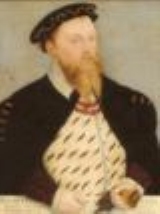
Maurice, Elector of Saxony

Encyclopedia
Maurice was Duke (1541–47) and later Elector
(1547–53) of Saxony
. His clever manipulation of alliances and disputes gained the Albertine branch of the Wettin dynasty extensive lands and the electoral dignity.
and the Protestant Catherine of Mecklenburg
-Schwerin.
In December 1532, Maurice, aged 11, came to live at the castle of his godfather Albert of Brandenburg
, cardinal, archbishop of Magdeburg and archbishop of Mainz. For two years, he lived the contemplative life of a cardinal until his uncle, the Duke George
, demanded his return to his homeland and began the training of the later Saxonian Duke and educated him as a catholic. After 1536 Maurice's father was converted to the Protestant faith, the entire Duchy followed him. Henry and Catherine again took the education of their son into their hands. When Maurice was 18 years old, he left his parents and moved to live with his older cousin John Frederick I, who resided in Torgau
and was despised by Maurice; this led to a strong hatred between them both. With another cousin, however, the Landgrave Philip I of Hesse
, whom he met in Dresden
, Maurice struck up a lifelong friendship.
After Maurice came of age, in 1539, his parents began to look for a wife for him. The favorite was Philip's eldest daughter, Agnes
. The marriage plans threatened to fail, however, because of the illegal double marriage of the Landgrave. Without the knowledge of his parents, Maurice remained committed to his engagement with Agnes. The wedding, particularly disapproved of by his mother, took place in Marburg
on 9 January 1541. Letters from that time illustrate the strong mutual devotion of the couple. Together they had two children:
, at the same time King of the Romans
and his neighbour as King of Bohemia) not to endanger the survival of the Protestant Movement.
Thus he participated in the emperor's army in the war against the forces of the Sultan Suleiman the Magnificent
of the Ottoman Empire
(1542), Duke William of Jülich-Cleves-Berg (1543), and King Francis I
of France
(1544). However, on the other hand, the Duke confiscated the properties of the Catholic Church in his lands. From the wealth of dissolved monasteries in his country Maurice donated the prince's schools (Fürstenschulen) of Schulpforta
(100 places), Meissen
(60 places) and Grimma
(70 places). The legal basis for this was the "New National Order" (Neue Landesordnung) of 1543.
Later, Maurice refused to join the Protestant Schmalkaldic League
, although the Landgrave Philip of Hesse, his friend and father-in-law, was its leader. The principal reason for his refusal to do so is generally regarded as his hate for his Ernestine cousin John Frederick I and the Imperial
promise of the Saxon electorship, then held by John Frederick
. In the Holy Week
of 1542, in the process of the Wurzener Feud (Wurzener Fehde) it nearly came to a fratricidal war, because John Frederick occupied the jointly administered "Wurzener Country". There had previously been a controversy between Maurice and John Frederick over the use of tax funds from this area. The intervention of the Landgrave Philip of Hesse and Martin Luther
prevented the war.
 Due to the energetic persistence of the Elector John Frederick in establishing the Protestant Faith, the Emperor Charles V, on 20 July 1546, imposed the Imperial Ban (Reichsacht) on him, with the agreement of the Catholic Imperial Estates, the enforcement of which was laid on Maurice after the Wurzener Feud. The emperor tried in this way to drive a still deeper wedge into the Protestant camp in order to prevent a further propagation of the Protestant Faith. In the case of a successful enforcement, Maurice hoped to be invested by the emperor with the Electorship. Maurice hesitated for a long time, since by this punitive action his father-in-law Philip of Hesse would have been affected also. But when the brother of the emperor, Ferdinand I, himself wanted to initiate a campaign against Electoral Saxony, he had to call it off, in order not to lose the initiative in his own lands to the Habsburgs.
Maurice returned to Charles's camp. After initial successes — he occupied Electoral Saxony nearly without a fight — Maurice with his army was driven back by the Schmalkaldic League and retreated towards Bohemia. In the crucial Battle of Mühlberg
on the Elbe, the Emperor and his brother Ferdinand, as well as Maurice, were able to defeat the Schmalkaldic League by capturing Landgrave Philip and John Frederick. According to contemporary chronicles, all of this happened on the same day, 24 April 1547. In order to escape being beheaded, John Frederick ceded the Electorate and sizable lands to Maurice in the Surrender of Wittemberg. In a brief ceremony in the field camp after the battle on 4 June 1547 Duke Maurice of Saxony was raised to the dignified position of Elector of Saxony. The official appointment took place later, but at a high price: He had betrayed the Protestant Faith and had brought his father-in-law, Philip of Hesse, into a hopeless situation. Maurice assured him that he would not be imprisoned, if he would surrender to the emperor. However, Philip was taken prisoner and exiled, after he had fallen on his knees before Charles V.
on 25 February 1548, where the ceremony of the formal inauguration of Maurice as Elector of Saxony took place. Charles V hoped that, with Maurice's appointment as the Elector of Saxony, with the signing of the agreement known as the Augsburg Interim
, and with his own assistance, they could put an end to the religious strife that was splitting his empire.
When commissioned to capture the rebellious Lutheran city of Magdeburg
(1550), Maurice seized the opportunity to raise an army and signed anti-Habsburg
compacts with France and Germany's Protestant princes.
In the Treaty of Chambord
signed with the French King Henry II
in January 1552 Maurice promised the King money and weapons to assist him in his campaign against Charles V. In return, Henry was able to take four Imperial cities (Metz
, Toul
, Verdun
and Cambrai
) as well as their bishoprics, although Maurice had no right to them.
In March 1552 the rebels overran the southern German states, including parts of Austria
, forcing the Emperor to flee and release Philip of Hesse. While Henry advanced up to the Rhine and occupied the promised Imperial lands, the emperor surprised by the attack fled over the Alps to Villach
in the Austrian Duchy of Carinthia
. In view of this success, Maurice abandoned his alliance with Henry II and negotiated a treaty with Charles's brother King Ferdinand I, to which Charles willingly agreed. When the Peace of Passau
, was signed in August 1552, the Lutheran position was provisionally guaranteed. As part of the Peace, his former opponents from the Schmalkaldic War, John Frederick I of Saxony and the Landgrave Philipp of Hesse were released. The war was terminated in 1556 by Ferdinand I; the Imperial cities remained in possession of the French.
When Maurice returned to Saxony after the Peace of Passau, he was no longer seen as a traitor; both Protestants and Catholics rendered him equal respect. In addition the emperor in correspondence to both parties exhorted them to maintain peace in his empire; shortly after, he campaigned against the Ottomans in Hungary
. The Margrave Albert Alcibiades of Brandenburg-Kulmbach
(who had rejected the Passau armistice) soon afterwards conquered the bishoprics of Würzburg
and Bamberg
— which had been under his control for eleven years previously, after their former owner, John Frederick had ceded them to him — as well as the Imperial city of Nuremberg
. This was the beginning of the Second Margrave War
, which only ended with the Peace of Augsburg
of 1555.
In 1552 Maurice with the army of the Holy Roman Empire (11,000 men) marched into Hungary
. The Ottomans besieged Eger
, but the Black Death
broke out in Hungary, and Maurice did not dare to move up his forces.
took place at Lehrte
. Maurice won this battle, but was badly wounded in the stomach by a shot from the rear and succumbed two days later in the field camp at the age of 32. He was buried in Freiberg Cathedral
. In 1853, 300 years after the battle, the place of his death was commemorated by a monument erected to his memory. The 7.5 ton heavy granite monument came from his native Saxony.
Because Maurice died without a surviving male heir, his brother Augustus
succeeded him as Elector. In Dresden
, shortly after the death of Maurice, he erected the Maurice Monument (Moritzmonument), the first historical monument to be erected in Saxony.
Prince-elector
The Prince-electors of the Holy Roman Empire were the members of the electoral college of the Holy Roman Empire, having the function of electing the Roman king or, from the middle of the 16th century onwards, directly the Holy Roman Emperor.The heir-apparent to a prince-elector was known as an...
(1547–53) of Saxony
Saxony
The Free State of Saxony is a landlocked state of Germany, contingent with Brandenburg, Saxony Anhalt, Thuringia, Bavaria, the Czech Republic and Poland. It is the tenth-largest German state in area, with of Germany's sixteen states....
. His clever manipulation of alliances and disputes gained the Albertine branch of the Wettin dynasty extensive lands and the electoral dignity.
1521-1541: Infancy and youth
Maurice was the fourth child but first son of the still-Catholic Duke Henry IVHenry IV, Duke of Saxony
Henry IV the Pious, Duke of Saxony was a Duke of Saxony from the House of Wettin.-Biography:Heinrich was the second son of Albert, Duke of Saxony and his wife Sidonie Podiebrad, princess of Bohemia...
and the Protestant Catherine of Mecklenburg
Catherine of Mecklenburg
Catherine of Mecklenburg , Duchess of Saxony, was the daughter of the Duke Magnus II of Mecklenburg and Sophie of Pomerania-Stettin. She married on 6 July 1512 in Freiberg Duke Henry the Pious of Saxony...
-Schwerin.
In December 1532, Maurice, aged 11, came to live at the castle of his godfather Albert of Brandenburg
Albert of Mainz
Cardinal Albert of Hohenzollern was Elector and Archbishop of Mainz from 1514 to 1545, and Archbishop of Magdeburg from 1513 to 1545.-Biography:...
, cardinal, archbishop of Magdeburg and archbishop of Mainz. For two years, he lived the contemplative life of a cardinal until his uncle, the Duke George
George, Duke of Saxony
George the Bearded, Duke of Saxony , was duke of Saxony from 1500 to 1539.Duke George was a member of the Order of the Golden Fleece.-Early life:...
, demanded his return to his homeland and began the training of the later Saxonian Duke and educated him as a catholic. After 1536 Maurice's father was converted to the Protestant faith, the entire Duchy followed him. Henry and Catherine again took the education of their son into their hands. When Maurice was 18 years old, he left his parents and moved to live with his older cousin John Frederick I, who resided in Torgau
Torgau
Torgau is a town on the banks of the Elbe in northwestern Saxony, Germany. It is the capital of the district Nordsachsen.Outside Germany, the town is most well known as the place where during the Second World War, United States Army forces coming from the west met with forces of the Soviet Union...
and was despised by Maurice; this led to a strong hatred between them both. With another cousin, however, the Landgrave Philip I of Hesse
Philip I, Landgrave of Hesse
Philip I of Hesse, , nicknamed der Großmütige was a leading champion of the Protestant Reformation and one of the most important of the early Protestant rulers in Germany....
, whom he met in Dresden
Dresden
Dresden is the capital city of the Free State of Saxony in Germany. It is situated in a valley on the River Elbe, near the Czech border. The Dresden conurbation is part of the Saxon Triangle metropolitan area....
, Maurice struck up a lifelong friendship.
After Maurice came of age, in 1539, his parents began to look for a wife for him. The favorite was Philip's eldest daughter, Agnes
Agnes of Hesse
Agnes of Hesse was a princess of Hesse by birth and by marriage Electress of Saxony.- Life :...
. The marriage plans threatened to fail, however, because of the illegal double marriage of the Landgrave. Without the knowledge of his parents, Maurice remained committed to his engagement with Agnes. The wedding, particularly disapproved of by his mother, took place in Marburg
Marburg
Marburg is a city in the state of Hesse, Germany, on the River Lahn. It is the main town of the Marburg-Biedenkopf district and its population, as of March 2010, was 79,911.- Founding and early history :...
on 9 January 1541. Letters from that time illustrate the strong mutual devotion of the couple. Together they had two children:
- AnnaAnna of SaxonyAnna of Saxony was the only child and heiress of Maurice, Elector of Saxony, and Agnes, eldest daughter of Philip I, Landgrave of Hesse. She was the second wife of William the Silent.Anna was born and died in Dresden...
(b. Dresden, 23 December 1544 – d. Dresden, 18 December 1577), married on 24 August 1561 to Prince William I of Orange-NassauWilliam the SilentWilliam I, Prince of Orange , also widely known as William the Silent , or simply William of Orange , was the main leader of the Dutch revolt against the Spanish that set off the Eighty Years' War and resulted in the formal independence of the United Provinces in 1648. He was born in the House of...
. They divorced in 1574. - Albert (b. Dresden, 28 November 1545 – d. Dresden, 12 April 1546).
1541-1548: The Wurzener Feud and the Schmalkaldic War
On 18 August 1541 Duke Henry died, and Maurice, as the eldest son, succeeded him as Duke of Saxony and Head of the Albertine Line. He replaced most of his advisors, because they had been opposed to his marriage with Agnes from the very start. George von Carlowitz, one of the new confidants of the Duke, advised Maurice (in order to prevent a war with Emperor Charles V and his brother FerdinandFerdinand I, Holy Roman Emperor
Ferdinand I was Holy Roman Emperor from 1558 and king of Bohemia and Hungary from 1526 until his death. Before his accession, he ruled the Austrian hereditary lands of the Habsburgs in the name of his elder brother, Charles V, Holy Roman Emperor.The key events during his reign were the contest...
, at the same time King of the Romans
King of the Romans
King of the Romans was the title used by the ruler of the Holy Roman Empire following his election to the office by the princes of the Kingdom of Germany...
and his neighbour as King of Bohemia) not to endanger the survival of the Protestant Movement.
Thus he participated in the emperor's army in the war against the forces of the Sultan Suleiman the Magnificent
Suleiman the Magnificent
Suleiman I was the tenth and longest-reigning Sultan of the Ottoman Empire, from 1520 to his death in 1566. He is known in the West as Suleiman the Magnificent and in the East, as "The Lawgiver" , for his complete reconstruction of the Ottoman legal system...
of the Ottoman Empire
Ottoman Empire
The Ottoman EmpireIt was usually referred to as the "Ottoman Empire", the "Turkish Empire", the "Ottoman Caliphate" or more commonly "Turkey" by its contemporaries...
(1542), Duke William of Jülich-Cleves-Berg (1543), and King Francis I
Francis I of France
Francis I was King of France from 1515 until his death. During his reign, huge cultural changes took place in France and he has been called France's original Renaissance monarch...
of France
France
The French Republic , The French Republic , The French Republic , (commonly known as France , is a unitary semi-presidential republic in Western Europe with several overseas territories and islands located on other continents and in the Indian, Pacific, and Atlantic oceans. Metropolitan France...
(1544). However, on the other hand, the Duke confiscated the properties of the Catholic Church in his lands. From the wealth of dissolved monasteries in his country Maurice donated the prince's schools (Fürstenschulen) of Schulpforta
Pforta
Pforta, or Schulpforta, is a former Cistercian monastery, Pforta Abbey , near Naumburg on the Saale River in the German state of Saxony-Anhalt. It is now a celebrated German public boarding school, called Landesschule Pforta...
(100 places), Meissen
Meissen
Meissen is a town of approximately 30,000 about northwest of Dresden on both banks of the Elbe river in the Free State of Saxony, in eastern Germany. Meissen is the home of Meissen porcelain, the Albrechtsburg castle, the Gothic Meissen Cathedral and the Meissen Frauenkirche...
(60 places) and Grimma
Grimma
Grimma is a town in the Free State of Saxony, Germany on the left bank of the Mulde, southeast of Leipzig. Founded in c. 1170, it is part of the Leipzig district.- Location :...
(70 places). The legal basis for this was the "New National Order" (Neue Landesordnung) of 1543.
Later, Maurice refused to join the Protestant Schmalkaldic League
Schmalkaldic League
The Schmalkaldic League was a defensive alliance of Lutheran princes within the Holy Roman Empire during the mid-16th century. Although originally started for religious motives soon after the start of the Protestant Reformation, its members eventually intended for the League to replace the Holy...
, although the Landgrave Philip of Hesse, his friend and father-in-law, was its leader. The principal reason for his refusal to do so is generally regarded as his hate for his Ernestine cousin John Frederick I and the Imperial
Holy Roman Empire
The Holy Roman Empire was a realm that existed from 962 to 1806 in Central Europe.It was ruled by the Holy Roman Emperor. Its character changed during the Middle Ages and the Early Modern period, when the power of the emperor gradually weakened in favour of the princes...
promise of the Saxon electorship, then held by John Frederick
John Frederick, Elector of Saxony
John Frederick I of Saxony , called John the Magnanimous, was Elector of Saxony and Head of the Protestant Confederation of Germany , "Champion of the Reformation".-Early years:...
. In the Holy Week
Holy Week
Holy Week in Christianity is the last week of Lent and the week before Easter...
of 1542, in the process of the Wurzener Feud (Wurzener Fehde) it nearly came to a fratricidal war, because John Frederick occupied the jointly administered "Wurzener Country". There had previously been a controversy between Maurice and John Frederick over the use of tax funds from this area. The intervention of the Landgrave Philip of Hesse and Martin Luther
Martin Luther
Martin Luther was a German priest, professor of theology and iconic figure of the Protestant Reformation. He strongly disputed the claim that freedom from God's punishment for sin could be purchased with money. He confronted indulgence salesman Johann Tetzel with his Ninety-Five Theses in 1517...
prevented the war.
Maurice returned to Charles's camp. After initial successes — he occupied Electoral Saxony nearly without a fight — Maurice with his army was driven back by the Schmalkaldic League and retreated towards Bohemia. In the crucial Battle of Mühlberg
Battle of Mühlberg
The Battle of Mühlberg was a large battle at Mühlberg in the Electorate of Saxony during the Protestant Reformation at which the Catholic princes of the Holy Roman Empire led by the Emperor Charles I of Spain and V of the Holy Roman Empire decisively defeated the Lutheran Schmalkaldic League of...
on the Elbe, the Emperor and his brother Ferdinand, as well as Maurice, were able to defeat the Schmalkaldic League by capturing Landgrave Philip and John Frederick. According to contemporary chronicles, all of this happened on the same day, 24 April 1547. In order to escape being beheaded, John Frederick ceded the Electorate and sizable lands to Maurice in the Surrender of Wittemberg. In a brief ceremony in the field camp after the battle on 4 June 1547 Duke Maurice of Saxony was raised to the dignified position of Elector of Saxony. The official appointment took place later, but at a high price: He had betrayed the Protestant Faith and had brought his father-in-law, Philip of Hesse, into a hopeless situation. Maurice assured him that he would not be imprisoned, if he would surrender to the emperor. However, Philip was taken prisoner and exiled, after he had fallen on his knees before Charles V.
1548-1553: The Diet of Augsburg and the Peace of Passau
Maurice, insulted after these incidents by his compatriots and called a "Judas", was also disappointed by the emperor's attitude (because now Charles V tried to reintroduce Catholicism into the Empire's Protestant territories and the continued imprisonment of his father-in-law, Landgrave Philip of Hesse, whose freedom Charles V had guaranteed), he hid his feelings from him up to the Diet of AugsburgDiet of Augsburg
The Diet of Augsburg were the meetings of the Imperial Diet of the Holy Roman Empire in the German city of Augsburg. There were many such sessions, but the three meetings during the Reformation and the ensuing religious wars between the Roman Catholic emperor Charles V and the Protestant...
on 25 February 1548, where the ceremony of the formal inauguration of Maurice as Elector of Saxony took place. Charles V hoped that, with Maurice's appointment as the Elector of Saxony, with the signing of the agreement known as the Augsburg Interim
Augsburg Interim
The Augsburg Interim is the general term given to an imperial decree ordered on May 15, 1548, at the 1548 Diet of Augsburg, after Charles V, Holy Roman Emperor, had defeated the forces of the Schmalkaldic League in the Schmalkaldic War of 1546/47...
, and with his own assistance, they could put an end to the religious strife that was splitting his empire.
When commissioned to capture the rebellious Lutheran city of Magdeburg
Magdeburg
Magdeburg , is the largest city and the capital city of the Bundesland of Saxony-Anhalt, Germany. Magdeburg is situated on the Elbe River and was one of the most important medieval cities of Europe....
(1550), Maurice seized the opportunity to raise an army and signed anti-Habsburg
Habsburg
The House of Habsburg , also found as Hapsburg, and also known as House of Austria is one of the most important royal houses of Europe and is best known for being an origin of all of the formally elected Holy Roman Emperors between 1438 and 1740, as well as rulers of the Austrian Empire and...
compacts with France and Germany's Protestant princes.
In the Treaty of Chambord
Treaty of Chambord
The Treaty of Chambord was an agreement signed on 15 January 1552 at the Château de Chambord between the Catholic King Henry II of France and three Protestant princes of the Holy Roman Empire led by Elector Maurice of Saxony. Based on the terms of the treaty, Maurice ceded the vicariate over the...
signed with the French King Henry II
Henry II of France
Henry II was King of France from 31 March 1547 until his death in 1559.-Early years:Henry was born in the royal Château de Saint-Germain-en-Laye, near Paris, the son of Francis I and Claude, Duchess of Brittany .His father was captured at the Battle of Pavia in 1525 by his sworn enemy,...
in January 1552 Maurice promised the King money and weapons to assist him in his campaign against Charles V. In return, Henry was able to take four Imperial cities (Metz
Metz
Metz is a city in the northeast of France located at the confluence of the Moselle and the Seille rivers.Metz is the capital of the Lorraine region and prefecture of the Moselle department. Located near the tripoint along the junction of France, Germany, and Luxembourg, Metz forms a central place...
, Toul
Toul
Toul is a commune in the Meurthe-et-Moselle department in north-eastern France.It is a sub-prefecture of the department.-Geography:Toul is located between Commercy and Nancy, and situated between the Moselle River and the Canal de la Marne au Rhin....
, Verdun
Verdun
Verdun is a city in the Meuse department in Lorraine in north-eastern France. It is a sub-prefecture of the department.Verdun is the biggest city in Meuse, although the capital of the department is the slightly smaller city of Bar-le-Duc.- History :...
and Cambrai
Cambrai
Cambrai is a commune in the Nord department in northern France. It is a sub-prefecture of the department.Cambrai is the seat of an archdiocese whose jurisdiction was immense during the Middle Ages. The territory of the Bishopric of Cambrai, roughly coinciding with the shire of Brabant, included...
) as well as their bishoprics, although Maurice had no right to them.
In March 1552 the rebels overran the southern German states, including parts of Austria
Austria
Austria , officially the Republic of Austria , is a landlocked country of roughly 8.4 million people in Central Europe. It is bordered by the Czech Republic and Germany to the north, Slovakia and Hungary to the east, Slovenia and Italy to the south, and Switzerland and Liechtenstein to the...
, forcing the Emperor to flee and release Philip of Hesse. While Henry advanced up to the Rhine and occupied the promised Imperial lands, the emperor surprised by the attack fled over the Alps to Villach
Villach
Villach is the second largest city in the Carinthia state in the southern Austria, at the Drava River and represents an important traffic junction for Austria and the whole Alpe-Adria region. , the population is 58,480.-History:...
in the Austrian Duchy of Carinthia
Duchy of Carinthia
The Duchy of Carinthia was a duchy located in southern Austria and parts of northern Slovenia. It was separated from the Duchy of Bavaria in 976, then the first newly created Imperial State beside the original German stem duchies....
. In view of this success, Maurice abandoned his alliance with Henry II and negotiated a treaty with Charles's brother King Ferdinand I, to which Charles willingly agreed. When the Peace of Passau
Peace of Passau
Holy Roman Emperor Charles V had won a victory against Protestantism in the Schmalkaldic War of 1547. Many Protestant princes were unhappy with the religious terms of the Augsburg Interim imposed after this victory. In January 1552, led by Maurice of Saxony, many formed an alliance with Henry II of...
, was signed in August 1552, the Lutheran position was provisionally guaranteed. As part of the Peace, his former opponents from the Schmalkaldic War, John Frederick I of Saxony and the Landgrave Philipp of Hesse were released. The war was terminated in 1556 by Ferdinand I; the Imperial cities remained in possession of the French.
When Maurice returned to Saxony after the Peace of Passau, he was no longer seen as a traitor; both Protestants and Catholics rendered him equal respect. In addition the emperor in correspondence to both parties exhorted them to maintain peace in his empire; shortly after, he campaigned against the Ottomans in Hungary
Hungary
Hungary , officially the Republic of Hungary , is a landlocked country in Central Europe. It is situated in the Carpathian Basin and is bordered by Slovakia to the north, Ukraine and Romania to the east, Serbia and Croatia to the south, Slovenia to the southwest and Austria to the west. The...
. The Margrave Albert Alcibiades of Brandenburg-Kulmbach
Albert Alcibiades, Margrave of Brandenburg-Kulmbach
Albert Alcibiades was a Margrave of Brandenburg-Kulmbach, also known as Brandenburg-Bayreuth.Because of his bellicose nature Albert received the cognomen Alcibiades after his death; during his lifetime Albert was known as Bellator .He was a member of the Franconian branch of the House of...
(who had rejected the Passau armistice) soon afterwards conquered the bishoprics of Würzburg
Würzburg
Würzburg is a city in the region of Franconia which lies in the northern tip of Bavaria, Germany. Located at the Main River, it is the capital of the Regierungsbezirk Lower Franconia. The regional dialect is Franconian....
and Bamberg
Bamberg
Bamberg is a city in Bavaria, Germany. It is located in Upper Franconia on the river Regnitz, close to its confluence with the river Main. Bamberg is one of the few cities in Germany that was not destroyed by World War II bombings because of a nearby Artillery Factory that prevented planes from...
— which had been under his control for eleven years previously, after their former owner, John Frederick had ceded them to him — as well as the Imperial city of Nuremberg
Nuremberg
Nuremberg[p] is a city in the German state of Bavaria, in the administrative region of Middle Franconia. Situated on the Pegnitz river and the Rhine–Main–Danube Canal, it is located about north of Munich and is Franconia's largest city. The population is 505,664...
. This was the beginning of the Second Margrave War
Second Margrave War
The Second Margrave War was a conflict in the Holy Roman Empire between 1552 and 1555. Instigated by Albert Alcibiades, Margrave of Brandenburg-Kulmbach and Brandenburg-Bayreuth, it involved numerous raids, plunderings and the destruction of many towns and castles in the empire, especially in...
, which only ended with the Peace of Augsburg
Peace of Augsburg
The Peace of Augsburg, also called the Augsburg Settlement, was a treaty between Charles V and the forces of the Schmalkaldic League, an alliance of Lutheran princes, on September 25, 1555, at the imperial city of Augsburg, now in present-day Bavaria, Germany.It officially ended the religious...
of 1555.
In 1552 Maurice with the army of the Holy Roman Empire (11,000 men) marched into Hungary
Hungary
Hungary , officially the Republic of Hungary , is a landlocked country in Central Europe. It is situated in the Carpathian Basin and is bordered by Slovakia to the north, Ukraine and Romania to the east, Serbia and Croatia to the south, Slovenia to the southwest and Austria to the west. The...
. The Ottomans besieged Eger
Eger
Eger is the second largest city in Northern Hungary, the county seat of Heves, east of the Mátra Mountains. Eger is best known for its castle, thermal baths, historic buildings , and red and white wines.- Name :...
, but the Black Death
Black Death
The Black Death was one of the most devastating pandemics in human history, peaking in Europe between 1348 and 1350. Of several competing theories, the dominant explanation for the Black Death is the plague theory, which attributes the outbreak to the bacterium Yersinia pestis. Thought to have...
broke out in Hungary, and Maurice did not dare to move up his forces.
Death
Albert Alcibiades was a former ally of Maurice, who had fought in the Schmalkaldic War on his side. But now Maurice, involved in an alliance of princes, with Ferdinand I amongst others, was compelled to fight against Albert Alicibiades. On 9 July 1553 the Battle of SievershausenBattle of Sievershausen
The Battle of Sievershausen occurred on 9 July 1553 in Sievershausen , between the Catholic Imperial troops and those of the Protestant Schmalkaldic League. 4,000 soldiers were killed, including Maurice, Elector of Saxony, the Protestant commander of the Catholic side...
took place at Lehrte
Lehrte
Lehrte is a town in the district of Hanover, in Lower Saxony, Germany. It is situated approximately 17 km east of Hanover. Lehrte is a picturesque town with a population of 45,000 and a modern infrastructure, combined with local culture and an interesting history.-History:The first documented...
. Maurice won this battle, but was badly wounded in the stomach by a shot from the rear and succumbed two days later in the field camp at the age of 32. He was buried in Freiberg Cathedral
Freiberg Cathedral
The Freiberg Cathedral or Cathedral of St Mary is a Lutheran church in Freiberg, Saxony. It is called a cathedral in English even though it has never been the seat of a bishop.-History:...
. In 1853, 300 years after the battle, the place of his death was commemorated by a monument erected to his memory. The 7.5 ton heavy granite monument came from his native Saxony.
Because Maurice died without a surviving male heir, his brother Augustus
Augustus, Elector of Saxony
Augustus was Elector of Saxony from 1553 to 1586.-First years:Augustus was born in Freiberg, the youngest child and third son of Henry IV, Duke of Saxony, and Catherine of Mecklenburg. He consequently belonged to the Albertine branch of the Wettin family...
succeeded him as Elector. In Dresden
Dresden
Dresden is the capital city of the Free State of Saxony in Germany. It is situated in a valley on the River Elbe, near the Czech border. The Dresden conurbation is part of the Saxon Triangle metropolitan area....
, shortly after the death of Maurice, he erected the Maurice Monument (Moritzmonument), the first historical monument to be erected in Saxony.
Ancestors
Literature
- Georg Voigt, Moritz von Sachsen, Leipzig 1876.
- Erich Brandenburg, Moritz von Sachsen, Bd. I, Leipzig 1899.
- Günther, Wartenberg, Landesherrschaft und Reformation. Moritz von Sachsen und die albertinische Kirchenpolitik bis 1546. Weimar 1988.
- Karlheinz Blaschke, Moritz von Sachsen. Ein Reformationsfürst der zweiten Generation. Göttingen 1983.
- Johannes Herrmann, Moritz von Sachsen. Beucha 2003.
- Hans Baumgarten, Moritz von Sachsen, Berlin 1941.
- Hof und Hofkultur unter Moritz von Sachsen (1521–1553), hrsg. von André Thieme und Jochen Vötsch, unter Mitarbeit von Ingolf Gräßler im Auftrag des Vereins für sächsische Landesgeschichte, Beucha 2004.