

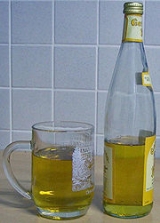
Mead

Encyclopedia
Mead also called honey wine, is an alcoholic beverage
that is produced by fermenting
a solution of honey
and water. It may also be produced by fermenting a solution of water and honey with grain mash
, which is strained immediately after fermentation. Depending on local traditions and specific recipes, it may be flavored with spices, fruit, or hops
(which produce a bitter, beer
-like flavor). The alcoholic content of mead may range from about 8% ABV
to 18%. It may be still, carbonated, or sparkling, and it may be dry, semi-sweet, or sweet.
Mead is known from many sources of ancient history throughout Europe, Africa, and Asia, although archaeological evidence of it is ambiguous. Its origins are lost in prehistory. "It can be regarded as the ancestor of all fermented drinks," Maguelonne Toussaint-Samat has observed, "antedating the cultivation of the soil."
Claude Lévi-Strauss
makes a case for the invention of mead as a marker of the passage "from nature to culture." Mead has played an important role in the beliefs and mythology of some peoples. One such example is the Mead of Poetry
, a mead of Norse mythology
crafted from the blood of the wise being Kvasir
which turns the drinker into a poet or scholar.
.
The earliest surviving description of mead is in the hymns of the Rigveda
, one of the sacred books of the historical Vedic religion
and (later) Hinduism
dated around 1700–1100 BC. During the Golden Age
of Ancient Greece
, mead was said to be the preferred drink. Aristotle
(384–322 BC) discussed mead in his Meteorologica
and elsewhere, while Pliny the Elder
(AD 23–79) called mead militites in his Naturalis Historia and differentiated wine sweetened with honey or "honey-wine" from mead. The Spanish-Roman naturalist Columella
gave a recipe for mead in De re rustica, about AD 60.
Around AD 550, the Brythonic-speaking
bard
Taliesin
wrote the or "Song of Mead." The legendary drinking, feasting and boasting of warriors in the mead hall
is echoed in the mead hall Dyn Eidyn (modern day Edinburgh
), and in the epic poem Y Gododdin
, both dated around AD 700. In the Old English epic poem Beowulf
, the Danish warriors drank mead.
Mead was the historical beverage par excellence and commonly brewed by the Germanic tribes in Northern Europe
. Later, heavy taxation and regulations governing the ingredients of alcoholic beverages led to commercial mead becoming a more obscure beverage until recently. Some monasteries
kept up the old traditions of mead-making as a by-product of beekeeping
, especially in areas where grape
s could not be grown.
*médʰu (honey, fermented honey drink). Slavic
med / miod , which means both "honey" and "mead", (Czech, Slovak, Serbian, Bosnian, Bulgarian, Macedonian, Croatian: med vs. medovina, Polish 'miód' pronounce [mju:t] - honey, mead) and Baltic
medus "honey"/midus "mead", also derive from the same Proto-Indo-European root (cf. Welsh
medd, Old Irish mid, and Sanskrit
madhu
).
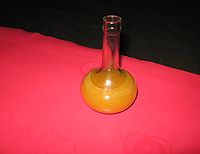 Mead was also popular in Central Europe
and in the Baltic states
. In the Polish
language mead is called ('), meaning "drinkable honey". In Russia
mead remained popular as medovukha
and sbiten
long after its decline in the West. Sbiten is often mentioned in the works of 19th-century Russian writers, including Gogol
, Dostoevsky
and Tolstoy
.
In Finland
, a sweet mead called (cognate
with the root
of zymurgy) is still an essential seasonal brew connected with the Finnish Vappu
(May Day
) festival. It is usually spiced by adding both the pulp and rind of a lemon
. During secondary fermentation, raisin
s are added to control the amount of sugars and to act as an indicator of readiness for consumption; they will rise to the top of the bottle when the drink is ready.
Ethiopia
n mead is called tej
Mead also called honey wine, is an alcoholic beverage
that is produced by fermenting
a solution of honey
and water. It may also be produced by fermenting a solution of water and honey with grain mash
, which is strained immediately after fermentation. Depending on local traditions and specific recipes, it may be flavored with spices, fruit, or hops
(which produce a bitter, beer
-like flavor). The alcoholic content of mead may range from about 8% ABV
to 18%. It may be still, carbonated, or sparkling, and it may be dry, semi-sweet, or sweet.
Mead is known from many sources of ancient history throughout Europe, Africa, and Asia, although archaeological evidence of it is ambiguous. Its origins are lost in prehistory. "It can be regarded as the ancestor of all fermented drinks," Maguelonne Toussaint-Samat has observed, "antedating the cultivation of the soil."
Claude Lévi-Strauss
makes a case for the invention of mead as a marker of the passage "from nature to culture." Mead has played an important role in the beliefs and mythology of some peoples. One such example is the Mead of Poetry
, a mead of Norse mythology
crafted from the blood of the wise being Kvasir
which turns the drinker into a poet or scholar.
.
The earliest surviving description of mead is in the hymns of the Rigveda
, one of the sacred books of the historical Vedic religion
and (later) Hinduism
dated around 1700–1100 BC. During the Golden Age
of Ancient Greece
, mead was said to be the preferred drink. Aristotle
(384–322 BC) discussed mead in his Meteorologica
and elsewhere, while Pliny the Elder
(AD 23–79) called mead militites in his Naturalis Historia and differentiated wine sweetened with honey or "honey-wine" from mead. The Spanish-Roman naturalist Columella
gave a recipe for mead in De re rustica, about AD 60.
Around AD 550, the Brythonic-speaking
bard
Taliesin
wrote the or "Song of Mead." The legendary drinking, feasting and boasting of warriors in the mead hall
is echoed in the mead hall Dyn Eidyn (modern day Edinburgh
), and in the epic poem Y Gododdin
, both dated around AD 700. In the Old English epic poem Beowulf
, the Danish warriors drank mead.
Mead was the historical beverage par excellence and commonly brewed by the Germanic tribes in Northern Europe
. Later, heavy taxation and regulations governing the ingredients of alcoholic beverages led to commercial mead becoming a more obscure beverage until recently. Some monasteries
kept up the old traditions of mead-making as a by-product of beekeeping
, especially in areas where grape
s could not be grown.
*médʰu (honey, fermented honey drink). Slavic
med / miod , which means both "honey" and "mead", (Czech, Slovak, Serbian, Bosnian, Bulgarian, Macedonian, Croatian: med vs. medovina, Polish 'miód' pronounce [mju:t] - honey, mead) and Baltic
medus "honey"/midus "mead", also derive from the same Proto-Indo-European root (cf. Welsh
medd, Old Irish mid, and Sanskrit
madhu
).
Mead was also popular in Central Europe
and in the Baltic states
. In the Polish
language mead is called ('), meaning "drinkable honey". In Russia
mead remained popular as medovukha
and sbiten
long after its decline in the West. Sbiten is often mentioned in the works of 19th-century Russian writers, including Gogol
, Dostoevsky
and Tolstoy
.
In Finland
, a sweet mead called (cognate
with the root
of zymurgy) is still an essential seasonal brew connected with the Finnish Vappu
(May Day
) festival. It is usually spiced by adding both the pulp and rind of a lemon
. During secondary fermentation, raisin
s are added to control the amount of sugars and to act as an indicator of readiness for consumption; they will rise to the top of the bottle when the drink is ready.
Ethiopia
n mead is called tej
Mead also called honey wine, is an alcoholic beverage
that is produced by fermenting
a solution of honey
and water. It may also be produced by fermenting a solution of water and honey with grain mash
, which is strained immediately after fermentation. Depending on local traditions and specific recipes, it may be flavored with spices, fruit, or hops
(which produce a bitter, beer
-like flavor). The alcoholic content of mead may range from about 8% ABV
to 18%. It may be still, carbonated, or sparkling, and it may be dry, semi-sweet, or sweet.
Mead is known from many sources of ancient history throughout Europe, Africa, and Asia, although archaeological evidence of it is ambiguous. Its origins are lost in prehistory. "It can be regarded as the ancestor of all fermented drinks," Maguelonne Toussaint-Samat has observed, "antedating the cultivation of the soil."
Claude Lévi-Strauss
makes a case for the invention of mead as a marker of the passage "from nature to culture." Mead has played an important role in the beliefs and mythology of some peoples. One such example is the Mead of Poetry
, a mead of Norse mythology
crafted from the blood of the wise being Kvasir
which turns the drinker into a poet or scholar.
.
The earliest surviving description of mead is in the hymns of the Rigveda
, one of the sacred books of the historical Vedic religion
and (later) Hinduism
dated around 1700–1100 BC. During the Golden Age
of Ancient Greece
, mead was said to be the preferred drink. Aristotle
(384–322 BC) discussed mead in his Meteorologica
and elsewhere, while Pliny the Elder
(AD 23–79) called mead militites in his Naturalis Historia and differentiated wine sweetened with honey or "honey-wine" from mead. The Spanish-Roman naturalist Columella
gave a recipe for mead in De re rustica, about AD 60.
Around AD 550, the Brythonic-speaking
bard
Taliesin
wrote the or "Song of Mead." The legendary drinking, feasting and boasting of warriors in the mead hall
is echoed in the mead hall Dyn Eidyn (modern day Edinburgh
), and in the epic poem Y Gododdin
, both dated around AD 700. In the Old English epic poem Beowulf
, the Danish warriors drank mead.
Mead was the historical beverage par excellence and commonly brewed by the Germanic tribes in Northern Europe
. Later, heavy taxation and regulations governing the ingredients of alcoholic beverages led to commercial mead becoming a more obscure beverage until recently. Some monasteries
kept up the old traditions of mead-making as a by-product of beekeeping
, especially in areas where grape
s could not be grown.
*médʰu (honey, fermented honey drink). Slavic
med / miod , which means both "honey" and "mead", (Czech, Slovak, Serbian, Bosnian, Bulgarian, Macedonian, Croatian: med vs. medovina, Polish 'miód' pronounce [mju:t] - honey, mead) and Baltic
medus "honey"/midus "mead", also derive from the same Proto-Indo-European root (cf. Welsh
medd, Old Irish mid, and Sanskrit
madhu
).
Mead was also popular in Central Europe
and in the Baltic states
. In the Polish
language mead is called ('), meaning "drinkable honey". In Russia
mead remained popular as medovukha
and sbiten
long after its decline in the West. Sbiten is often mentioned in the works of 19th-century Russian writers, including Gogol
, Dostoevsky
and Tolstoy
.
In Finland
, a sweet mead called (cognate
with the root
of zymurgy) is still an essential seasonal brew connected with the Finnish Vappu
(May Day
) festival. It is usually spiced by adding both the pulp and rind of a lemon
. During secondary fermentation, raisin
s are added to control the amount of sugars and to act as an indicator of readiness for consumption; they will rise to the top of the bottle when the drink is ready.
Ethiopia
n mead is called tej
(ጠጅ, ˈtʼədʒ) and is usually home-made. It is flavored with the powdered leaves and bark of gesho, a hop-like
bittering agent which is a species of buckthorn
. A sweeter, less-alcoholic version called berz, aged for a shorter time, is also made. The traditional vessel for drinking tej is a rounded vase-shaped container called a berele.
Mead known as iQhilika is traditionally prepared by the Xhosa of South Africa
.
 Mead can have a wide range of flavors depending on; the source of the honey, additives (also known as "adjuncts" or "gruit
"), including fruit and spices, the yeast employed during fermentation, and aging procedure. Mead can be difficult to find commercially. Some producers have marketed white wine with added honey as mead, often spelling it "meade." This is closer in style to a Hypocras
. Blended varieties of mead may be known by either style represented. For instance, a mead made with cinnamon and apples may be referred to as either a cinnamon cyser or an apple metheglin.
A mead that also contains spices (such as clove
s, cinnamon
or nutmeg
), or herb
s (such as oregano
, hops
, or even lavender
or chamomile
), is called a metheglin (m).
A mead that contains fruit (such as raspberry
, blackberry
or strawberry
) is called a melomel, which was also used as a means of food preservation
, keeping summer produce for the winter. A mead that is fermented with grape juice is called a pyment.
Mulled
mead is a popular drink at Christmas time, where mead is flavored with spices (and sometimes various fruits) and warmed, traditionally by having a hot poker plunged into it.
Some meads retain some measure of the sweetness of the original honey, and some may even be considered as dessert wines. Drier meads are also available, and some producers offer sparkling meads. There are a number of faux-meads, which are actually cheap wines with large amounts of honey added, to produce a cloyingly sweet liqueur.
Historically, meads were fermented by wild yeast
s and bacteria
(as noted in the below quoted recipe) residing on the skins of the fruit or within the honey itself. Wild yeasts generally provide inconsistent results, and in modern times various brewing interests have isolated the strains now in use. Certain strains have gradually become associated with certain styles of mead. Mostly, these are strains that are also used in beer or wine production. However, several commercial labs, such as White Labs, WYeast, Vierka, have developed yeast strains specifically for mead. Mead yeasts are better suited to preserve the delicate honey flavors than a wine or beer yeast.
Mead can be distilled to a brandy or liqueur strength. A version of this called "honey jack" can be made by partly freezing a quantity of mead and pouring off the liquid without the ice crystals (a process known as freeze distillation), in the same way that applejack
is made from cider
.
, as well as in other popular works that draw on these myths. Notable examples include books by Tolkien and Neil Gaiman
. It is often featured in books using a historical Germanic setting, such as the Viking
era. Mead is mentioned many times in Neil Gaiman's 2001 novel, American Gods
; it is referred to as the drink of the gods. Also, in the books of the Inheritance Cycle
by Christopher Paolini
, it is often drunk by Eragon Shadeslayer
at feasts in honor of him. Mead is also referenced in The Kingkiller Chronicle
novel series by Patrick Rothfuss
. The protagonist Kvothe is known to drink metheglin. The non-existent "Greysdale Mead" is also drunk, although it is merely water.
Alcoholic beverage
An alcoholic beverage is a drink containing ethanol, commonly known as alcohol. Alcoholic beverages are divided into three general classes: beers, wines, and spirits. They are legally consumed in most countries, and over 100 countries have laws regulating their production, sale, and consumption...
that is produced by fermenting
Ethanol fermentation
Ethanol fermentation, also referred to as alcoholic fermentation, is a biological process in which sugars such as glucose, fructose, and sucrose are converted into cellular energy and thereby produce ethanol and carbon dioxide as metabolic waste products...
a solution of honey
Honey
Honey is a sweet food made by bees using nectar from flowers. The variety produced by honey bees is the one most commonly referred to and is the type of honey collected by beekeepers and consumed by humans...
and water. It may also be produced by fermenting a solution of water and honey with grain mash
Mashing
In brewing and distilling, mashing is the process of combining a mix of milled grain , known as the "grain bill", and water, known as "liquor", and heating this mixture...
, which is strained immediately after fermentation. Depending on local traditions and specific recipes, it may be flavored with spices, fruit, or hops
Hops
Hops are the female flower clusters , of a hop species, Humulus lupulus. They are used primarily as a flavoring and stability agent in beer, to which they impart a bitter, tangy flavor, though hops are also used for various purposes in other beverages and herbal medicine...
(which produce a bitter, beer
Beer
Beer is the world's most widely consumed andprobably oldest alcoholic beverage; it is the third most popular drink overall, after water and tea. It is produced by the brewing and fermentation of sugars, mainly derived from malted cereal grains, most commonly malted barley and malted wheat...
-like flavor). The alcoholic content of mead may range from about 8% ABV
ABV
ABV is a three-letter acronym that may refer to:* Alcohol by volume, a measure of the alcohol content of alcoholic drinks* Nnamdi Azikiwe International Airport, Abuja, Nigeria, from its IATA airport code...
to 18%. It may be still, carbonated, or sparkling, and it may be dry, semi-sweet, or sweet.
Mead is known from many sources of ancient history throughout Europe, Africa, and Asia, although archaeological evidence of it is ambiguous. Its origins are lost in prehistory. "It can be regarded as the ancestor of all fermented drinks," Maguelonne Toussaint-Samat has observed, "antedating the cultivation of the soil."
Claude Lévi-Strauss
Claude Lévi-Strauss
Claude Lévi-Strauss was a French anthropologist and ethnologist, and has been called, along with James George Frazer, the "father of modern anthropology"....
makes a case for the invention of mead as a marker of the passage "from nature to culture." Mead has played an important role in the beliefs and mythology of some peoples. One such example is the Mead of Poetry
Mead of poetry
In Norse mythology, the Poetic Mead or Mead of Poetry , also known as Mead of Suttungr , is a mythical beverage that whoever "drinks becomes a skald or scholar" to recite any information and solve any question. This myth was reported by Snorri Sturluson...
, a mead of Norse mythology
Norse mythology
Norse mythology, a subset of Germanic mythology, is the overall term for the myths, legends and beliefs about supernatural beings of Norse pagans. It flourished prior to the Christianization of Scandinavia, during the Early Middle Ages, and passed into Nordic folklore, with some aspects surviving...
crafted from the blood of the wise being Kvasir
Kvasir
In Norse mythology, Kvasir was a being born of the saliva of the Æsir and the Vanir, two groups of gods. Extremely wise, Kvasir traveled far and wide, teaching and spreading knowledge. This continued until the dwarfs Fjalar and Galar killed Kvasir and drained him of his blood...
which turns the drinker into a poet or scholar.
History
The earliest archaeological evidence for the production of mead dates to around 7000 BC. Pottery vessels containing a mixture of mead, rice and other fruits along with organic compounds of fermentation were found in Northern China. In Europe, it is first attested in residual samples found in the characteristic ceramics of the Bell Beaker CultureBeaker culture
The Bell-Beaker culture , ca. 2400 – 1800 BC, is the term for a widely scattered cultural phenomenon of prehistoric western Europe starting in the late Neolithic or Chalcolithic running into the early Bronze Age...
.
The earliest surviving description of mead is in the hymns of the Rigveda
Rigveda
The Rigveda is an ancient Indian sacred collection of Vedic Sanskrit hymns...
, one of the sacred books of the historical Vedic religion
Historical Vedic religion
The religion of the Vedic period is a historical predecessor of Hinduism. Its liturgy is reflected in the mantra portion of the four Vedas, which are compiled in Sanskrit. The religious practices centered on a clergy administering rites...
and (later) Hinduism
Hinduism
Hinduism is the predominant and indigenous religious tradition of the Indian Subcontinent. Hinduism is known to its followers as , amongst many other expressions...
dated around 1700–1100 BC. During the Golden Age
Golden Age
The term Golden Age comes from Greek mythology and legend and refers to the first in a sequence of four or five Ages of Man, in which the Golden Age is first, followed in sequence, by the Silver, Bronze, and Iron Ages, and then the present, a period of decline...
of Ancient Greece
Ancient Greece
Ancient Greece is a civilization belonging to a period of Greek history that lasted from the Archaic period of the 8th to 6th centuries BC to the end of antiquity. Immediately following this period was the beginning of the Early Middle Ages and the Byzantine era. Included in Ancient Greece is the...
, mead was said to be the preferred drink. Aristotle
Aristotle
Aristotle was a Greek philosopher and polymath, a student of Plato and teacher of Alexander the Great. His writings cover many subjects, including physics, metaphysics, poetry, theater, music, logic, rhetoric, linguistics, politics, government, ethics, biology, and zoology...
(384–322 BC) discussed mead in his Meteorologica
Meteorology (Aristotle)
Meteorology is a treatise by Aristotle which contains his theories about the earth sciences. These include early accounts of water evaporation, weather phenomena, and earthquakes....
and elsewhere, while Pliny the Elder
Pliny the Elder
Gaius Plinius Secundus , better known as Pliny the Elder, was a Roman author, naturalist, and natural philosopher, as well as naval and army commander of the early Roman Empire, and personal friend of the emperor Vespasian...
(AD 23–79) called mead militites in his Naturalis Historia and differentiated wine sweetened with honey or "honey-wine" from mead. The Spanish-Roman naturalist Columella
Columella
Lucius Junius Moderatus Columella is the most important writer on agriculture of the Roman empire. Little is known of his life. He was probably born in Gades , possibly of Roman parents. After a career in the army , he took up farming...
gave a recipe for mead in De re rustica, about AD 60.
Around AD 550, the Brythonic-speaking
Brythonic languages
The Brythonic or Brittonic languages form one of the two branches of the Insular Celtic language family, the other being Goidelic. The name Brythonic was derived by Welsh Celticist John Rhys from the Welsh word Brython, meaning an indigenous Briton as opposed to an Anglo-Saxon or Gael...
bard
Bard
In medieval Gaelic and British culture a bard was a professional poet, employed by a patron, such as a monarch or nobleman, to commemorate the patron's ancestors and to praise the patron's own activities.Originally a specific class of poet, contrasting with another class known as fili in Ireland...
Taliesin
Taliesin
Taliesin was an early British poet of the post-Roman period whose work has possibly survived in a Middle Welsh manuscript, the Book of Taliesin...
wrote the or "Song of Mead." The legendary drinking, feasting and boasting of warriors in the mead hall
Mead hall
In ancient Scandinavia and Germanic Europe a mead hall or feasting hall was initially simply a large building with a single room. From the fifth century to early medieval times such a building was the residence of a lord and his retainers. The mead hall was generally the great hall of the king...
is echoed in the mead hall Dyn Eidyn (modern day Edinburgh
Edinburgh
Edinburgh is the capital city of Scotland, the second largest city in Scotland, and the eighth most populous in the United Kingdom. The City of Edinburgh Council governs one of Scotland's 32 local government council areas. The council area includes urban Edinburgh and a rural area...
), and in the epic poem Y Gododdin
Y Gododdin
Y Gododdin is a medieval Welsh poem consisting of a series of elegies to the men of the Britonnic kingdom of Gododdin and its allies who, according to the conventional interpretation, died fighting the Angles of Deira and Bernicia at a place named Catraeth...
, both dated around AD 700. In the Old English epic poem Beowulf
Beowulf
Beowulf , but modern scholars agree in naming it after the hero whose life is its subject." of an Old English heroic epic poem consisting of 3182 alliterative long lines, set in Scandinavia, commonly cited as one of the most important works of Anglo-Saxon literature.It survives in a single...
, the Danish warriors drank mead.
Mead was the historical beverage par excellence and commonly brewed by the Germanic tribes in Northern Europe
Northern Europe
Northern Europe is the northern part or region of Europe. Northern Europe typically refers to the seven countries in the northern part of the European subcontinent which includes Denmark, Estonia, Latvia, Lithuania, Norway, Finland and Sweden...
. Later, heavy taxation and regulations governing the ingredients of alcoholic beverages led to commercial mead becoming a more obscure beverage until recently. Some monasteries
Monastery
Monastery denotes the building, or complex of buildings, that houses a room reserved for prayer as well as the domestic quarters and workplace of monastics, whether monks or nuns, and whether living in community or alone .Monasteries may vary greatly in size – a small dwelling accommodating only...
kept up the old traditions of mead-making as a by-product of beekeeping
Beekeeping
Beekeeping is the maintenance of honey bee colonies, commonly in hives, by humans. A beekeeper keeps bees in order to collect honey and other products of the hive , to pollinate crops, or to produce bees for sale to other beekeepers...
, especially in areas where grape
Grape
A grape is a non-climacteric fruit, specifically a berry, that grows on the perennial and deciduous woody vines of the genus Vitis. Grapes can be eaten raw or they can be used for making jam, juice, jelly, vinegar, wine, grape seed extracts, raisins, molasses and grape seed oil. Grapes are also...
s could not be grown.
Etymology
The English word mead derives from the Old English meodu, from Proto-Germanic meduz, from Proto-Indo-EuropeanProto-Indo-European language
The Proto-Indo-European language is the reconstructed common ancestor of the Indo-European languages, spoken by the Proto-Indo-Europeans...
*médʰu (honey, fermented honey drink). Slavic
Slavic languages
The Slavic languages , a group of closely related languages of the Slavic peoples and a subgroup of Indo-European languages, have speakers in most of Eastern Europe, in much of the Balkans, in parts of Central Europe, and in the northern part of Asia.-Branches:Scholars traditionally divide Slavic...
med / miod , which means both "honey" and "mead", (Czech, Slovak, Serbian, Bosnian, Bulgarian, Macedonian, Croatian: med vs. medovina, Polish 'miód' pronounce [mju:t] - honey, mead) and Baltic
Baltic languages
The Baltic languages are a group of related languages belonging to the Balto-Slavic branch of the Indo-European language family and spoken mainly in areas extending east and southeast of the Baltic Sea in Northern Europe...
medus "honey"/midus "mead", also derive from the same Proto-Indo-European root (cf. Welsh
Welsh language
Welsh is a member of the Brythonic branch of the Celtic languages spoken natively in Wales, by some along the Welsh border in England, and in Y Wladfa...
medd, Old Irish mid, and Sanskrit
Sanskrit
Sanskrit , is a historical Indo-Aryan language and the primary liturgical language of Hinduism, Jainism and Buddhism.Buddhism: besides Pali, see Buddhist Hybrid Sanskrit Today, it is listed as one of the 22 scheduled languages of India and is an official language of the state of Uttarakhand...
madhu
Madhu
Madhu may refer to:* Madhu, a term in Hindi-Urdu, Sanskrit, and other languages for honey and alcohol * Madhu, in Hindu mythology, one of the asura brothers Madhu-Kaitabh, killed by Lord Vishnu...
).
Distribution
Central Europe
Central Europe or alternatively Middle Europe is a region of the European continent lying between the variously defined areas of Eastern and Western Europe...
and in the Baltic states
Baltic states
The term Baltic states refers to the Baltic territories which gained independence from the Russian Empire in the wake of World War I: primarily the contiguous trio of Estonia, Latvia, Lithuania ; Finland also fell within the scope of the term after initially gaining independence in the 1920s.The...
. In the Polish
Polish language
Polish is a language of the Lechitic subgroup of West Slavic languages, used throughout Poland and by Polish minorities in other countries...
language mead is called ('), meaning "drinkable honey". In Russia
Russia
Russia or , officially known as both Russia and the Russian Federation , is a country in northern Eurasia. It is a federal semi-presidential republic, comprising 83 federal subjects...
mead remained popular as medovukha
Medovukha
Medovukha is an Old Balto-Slavic honey-based alcoholic beverage very similar to mead. These two words are related and go back to the Proto-Indo-European meddhe...
and sbiten
Sbiten
Sbiten, also sbiten' is a hot winter Russian traditional drink.- History :First mentioned in Slavonic chronicles in 1128, it remained popular with all strata of Russian society until the 19th century when it was replaced by coffee and tea...
long after its decline in the West. Sbiten is often mentioned in the works of 19th-century Russian writers, including Gogol
Nikolai Gogol
Nikolai Vasilievich Gogol was a Ukrainian-born Russian dramatist and novelist.Considered by his contemporaries one of the preeminent figures of the natural school of Russian literary realism, later critics have found in Gogol's work a fundamentally romantic sensibility, with strains of Surrealism...
, Dostoevsky
Fyodor Dostoevsky
Fyodor Mikhaylovich Dostoyevsky was a Russian writer of novels, short stories and essays. He is best known for his novels Crime and Punishment, The Idiot and The Brothers Karamazov....
and Tolstoy
Leo Tolstoy
Lev Nikolayevich Tolstoy was a Russian writer who primarily wrote novels and short stories. Later in life, he also wrote plays and essays. His two most famous works, the novels War and Peace and Anna Karenina, are acknowledged as two of the greatest novels of all time and a pinnacle of realist...
.
In Finland
Finland
Finland , officially the Republic of Finland, is a Nordic country situated in the Fennoscandian region of Northern Europe. It is bordered by Sweden in the west, Norway in the north and Russia in the east, while Estonia lies to its south across the Gulf of Finland.Around 5.4 million people reside...
, a sweet mead called (cognate
Cognate
In linguistics, cognates are words that have a common etymological origin. This learned term derives from the Latin cognatus . Cognates within the same language are called doublets. Strictly speaking, loanwords from another language are usually not meant by the term, e.g...
with the root
Root (linguistics)
The root word is the primary lexical unit of a word, and of a word family , which carries the most significant aspects of semantic content and cannot be reduced into smaller constituents....
of zymurgy) is still an essential seasonal brew connected with the Finnish Vappu
Walpurgis Night
Walpurgis Night is a traditional spring festival on 30 April or 1 May in large parts of Central and Northern Europe. It is often celebrated with dancing and with bonfires. It is exactly six months from All Hallows' Eve.-Name:...
(May Day
May Day
May Day on May 1 is an ancient northern hemisphere spring festival and usually a public holiday; it is also a traditional spring holiday in many cultures....
) festival. It is usually spiced by adding both the pulp and rind of a lemon
Lemon
The lemon is both a small evergreen tree native to Asia, and the tree's ellipsoidal yellow fruit. The fruit is used for culinary and non-culinary purposes throughout the world – primarily for its juice, though the pulp and rind are also used, mainly in cooking and baking...
. During secondary fermentation, raisin
Raisin
Raisins are dried grapes. They are produced in many regions of the world. Raisins may be eaten raw or used in cooking, baking and brewing...
s are added to control the amount of sugars and to act as an indicator of readiness for consumption; they will rise to the top of the bottle when the drink is ready.
Ethiopia
Ethiopia
Ethiopia , officially known as the Federal Democratic Republic of Ethiopia, is a country located in the Horn of Africa. It is the second-most populous nation in Africa, with over 82 million inhabitants, and the tenth-largest by area, occupying 1,100,000 km2...
n mead is called tej
Tej
Tej is a mead or honey wine that is brewed and consumed in Ethiopia. It is flavored with the powdered leaves and twigs of gesho , a hops-like bittering agent that is a species of buckthorn...
Mead also called honey wine, is an alcoholic beverage
Alcoholic beverage
An alcoholic beverage is a drink containing ethanol, commonly known as alcohol. Alcoholic beverages are divided into three general classes: beers, wines, and spirits. They are legally consumed in most countries, and over 100 countries have laws regulating their production, sale, and consumption...
that is produced by fermenting
Ethanol fermentation
Ethanol fermentation, also referred to as alcoholic fermentation, is a biological process in which sugars such as glucose, fructose, and sucrose are converted into cellular energy and thereby produce ethanol and carbon dioxide as metabolic waste products...
a solution of honey
Honey
Honey is a sweet food made by bees using nectar from flowers. The variety produced by honey bees is the one most commonly referred to and is the type of honey collected by beekeepers and consumed by humans...
and water. It may also be produced by fermenting a solution of water and honey with grain mash
Mashing
In brewing and distilling, mashing is the process of combining a mix of milled grain , known as the "grain bill", and water, known as "liquor", and heating this mixture...
, which is strained immediately after fermentation. Depending on local traditions and specific recipes, it may be flavored with spices, fruit, or hops
Hops
Hops are the female flower clusters , of a hop species, Humulus lupulus. They are used primarily as a flavoring and stability agent in beer, to which they impart a bitter, tangy flavor, though hops are also used for various purposes in other beverages and herbal medicine...
(which produce a bitter, beer
Beer
Beer is the world's most widely consumed andprobably oldest alcoholic beverage; it is the third most popular drink overall, after water and tea. It is produced by the brewing and fermentation of sugars, mainly derived from malted cereal grains, most commonly malted barley and malted wheat...
-like flavor). The alcoholic content of mead may range from about 8% ABV
ABV
ABV is a three-letter acronym that may refer to:* Alcohol by volume, a measure of the alcohol content of alcoholic drinks* Nnamdi Azikiwe International Airport, Abuja, Nigeria, from its IATA airport code...
to 18%. It may be still, carbonated, or sparkling, and it may be dry, semi-sweet, or sweet.
Mead is known from many sources of ancient history throughout Europe, Africa, and Asia, although archaeological evidence of it is ambiguous. Its origins are lost in prehistory. "It can be regarded as the ancestor of all fermented drinks," Maguelonne Toussaint-Samat has observed, "antedating the cultivation of the soil."
Claude Lévi-Strauss
Claude Lévi-Strauss
Claude Lévi-Strauss was a French anthropologist and ethnologist, and has been called, along with James George Frazer, the "father of modern anthropology"....
makes a case for the invention of mead as a marker of the passage "from nature to culture." Mead has played an important role in the beliefs and mythology of some peoples. One such example is the Mead of Poetry
Mead of poetry
In Norse mythology, the Poetic Mead or Mead of Poetry , also known as Mead of Suttungr , is a mythical beverage that whoever "drinks becomes a skald or scholar" to recite any information and solve any question. This myth was reported by Snorri Sturluson...
, a mead of Norse mythology
Norse mythology
Norse mythology, a subset of Germanic mythology, is the overall term for the myths, legends and beliefs about supernatural beings of Norse pagans. It flourished prior to the Christianization of Scandinavia, during the Early Middle Ages, and passed into Nordic folklore, with some aspects surviving...
crafted from the blood of the wise being Kvasir
Kvasir
In Norse mythology, Kvasir was a being born of the saliva of the Æsir and the Vanir, two groups of gods. Extremely wise, Kvasir traveled far and wide, teaching and spreading knowledge. This continued until the dwarfs Fjalar and Galar killed Kvasir and drained him of his blood...
which turns the drinker into a poet or scholar.
History
The earliest archaeological evidence for the production of mead dates to around 7000 BC. Pottery vessels containing a mixture of mead, rice and other fruits along with organic compounds of fermentation were found in Northern China. In Europe, it is first attested in residual samples found in the characteristic ceramics of the Bell Beaker CultureBeaker culture
The Bell-Beaker culture , ca. 2400 – 1800 BC, is the term for a widely scattered cultural phenomenon of prehistoric western Europe starting in the late Neolithic or Chalcolithic running into the early Bronze Age...
.
The earliest surviving description of mead is in the hymns of the Rigveda
Rigveda
The Rigveda is an ancient Indian sacred collection of Vedic Sanskrit hymns...
, one of the sacred books of the historical Vedic religion
Historical Vedic religion
The religion of the Vedic period is a historical predecessor of Hinduism. Its liturgy is reflected in the mantra portion of the four Vedas, which are compiled in Sanskrit. The religious practices centered on a clergy administering rites...
and (later) Hinduism
Hinduism
Hinduism is the predominant and indigenous religious tradition of the Indian Subcontinent. Hinduism is known to its followers as , amongst many other expressions...
dated around 1700–1100 BC. During the Golden Age
Golden Age
The term Golden Age comes from Greek mythology and legend and refers to the first in a sequence of four or five Ages of Man, in which the Golden Age is first, followed in sequence, by the Silver, Bronze, and Iron Ages, and then the present, a period of decline...
of Ancient Greece
Ancient Greece
Ancient Greece is a civilization belonging to a period of Greek history that lasted from the Archaic period of the 8th to 6th centuries BC to the end of antiquity. Immediately following this period was the beginning of the Early Middle Ages and the Byzantine era. Included in Ancient Greece is the...
, mead was said to be the preferred drink. Aristotle
Aristotle
Aristotle was a Greek philosopher and polymath, a student of Plato and teacher of Alexander the Great. His writings cover many subjects, including physics, metaphysics, poetry, theater, music, logic, rhetoric, linguistics, politics, government, ethics, biology, and zoology...
(384–322 BC) discussed mead in his Meteorologica
Meteorology (Aristotle)
Meteorology is a treatise by Aristotle which contains his theories about the earth sciences. These include early accounts of water evaporation, weather phenomena, and earthquakes....
and elsewhere, while Pliny the Elder
Pliny the Elder
Gaius Plinius Secundus , better known as Pliny the Elder, was a Roman author, naturalist, and natural philosopher, as well as naval and army commander of the early Roman Empire, and personal friend of the emperor Vespasian...
(AD 23–79) called mead militites in his Naturalis Historia and differentiated wine sweetened with honey or "honey-wine" from mead. The Spanish-Roman naturalist Columella
Columella
Lucius Junius Moderatus Columella is the most important writer on agriculture of the Roman empire. Little is known of his life. He was probably born in Gades , possibly of Roman parents. After a career in the army , he took up farming...
gave a recipe for mead in De re rustica, about AD 60.
Around AD 550, the Brythonic-speaking
Brythonic languages
The Brythonic or Brittonic languages form one of the two branches of the Insular Celtic language family, the other being Goidelic. The name Brythonic was derived by Welsh Celticist John Rhys from the Welsh word Brython, meaning an indigenous Briton as opposed to an Anglo-Saxon or Gael...
bard
Bard
In medieval Gaelic and British culture a bard was a professional poet, employed by a patron, such as a monarch or nobleman, to commemorate the patron's ancestors and to praise the patron's own activities.Originally a specific class of poet, contrasting with another class known as fili in Ireland...
Taliesin
Taliesin
Taliesin was an early British poet of the post-Roman period whose work has possibly survived in a Middle Welsh manuscript, the Book of Taliesin...
wrote the or "Song of Mead." The legendary drinking, feasting and boasting of warriors in the mead hall
Mead hall
In ancient Scandinavia and Germanic Europe a mead hall or feasting hall was initially simply a large building with a single room. From the fifth century to early medieval times such a building was the residence of a lord and his retainers. The mead hall was generally the great hall of the king...
is echoed in the mead hall Dyn Eidyn (modern day Edinburgh
Edinburgh
Edinburgh is the capital city of Scotland, the second largest city in Scotland, and the eighth most populous in the United Kingdom. The City of Edinburgh Council governs one of Scotland's 32 local government council areas. The council area includes urban Edinburgh and a rural area...
), and in the epic poem Y Gododdin
Y Gododdin
Y Gododdin is a medieval Welsh poem consisting of a series of elegies to the men of the Britonnic kingdom of Gododdin and its allies who, according to the conventional interpretation, died fighting the Angles of Deira and Bernicia at a place named Catraeth...
, both dated around AD 700. In the Old English epic poem Beowulf
Beowulf
Beowulf , but modern scholars agree in naming it after the hero whose life is its subject." of an Old English heroic epic poem consisting of 3182 alliterative long lines, set in Scandinavia, commonly cited as one of the most important works of Anglo-Saxon literature.It survives in a single...
, the Danish warriors drank mead.
Mead was the historical beverage par excellence and commonly brewed by the Germanic tribes in Northern Europe
Northern Europe
Northern Europe is the northern part or region of Europe. Northern Europe typically refers to the seven countries in the northern part of the European subcontinent which includes Denmark, Estonia, Latvia, Lithuania, Norway, Finland and Sweden...
. Later, heavy taxation and regulations governing the ingredients of alcoholic beverages led to commercial mead becoming a more obscure beverage until recently. Some monasteries
Monastery
Monastery denotes the building, or complex of buildings, that houses a room reserved for prayer as well as the domestic quarters and workplace of monastics, whether monks or nuns, and whether living in community or alone .Monasteries may vary greatly in size – a small dwelling accommodating only...
kept up the old traditions of mead-making as a by-product of beekeeping
Beekeeping
Beekeeping is the maintenance of honey bee colonies, commonly in hives, by humans. A beekeeper keeps bees in order to collect honey and other products of the hive , to pollinate crops, or to produce bees for sale to other beekeepers...
, especially in areas where grape
Grape
A grape is a non-climacteric fruit, specifically a berry, that grows on the perennial and deciduous woody vines of the genus Vitis. Grapes can be eaten raw or they can be used for making jam, juice, jelly, vinegar, wine, grape seed extracts, raisins, molasses and grape seed oil. Grapes are also...
s could not be grown.
Etymology
The English word mead derives from the Old English meodu, from Proto-Germanic meduz, from Proto-Indo-EuropeanProto-Indo-European language
The Proto-Indo-European language is the reconstructed common ancestor of the Indo-European languages, spoken by the Proto-Indo-Europeans...
*médʰu (honey, fermented honey drink). Slavic
Slavic languages
The Slavic languages , a group of closely related languages of the Slavic peoples and a subgroup of Indo-European languages, have speakers in most of Eastern Europe, in much of the Balkans, in parts of Central Europe, and in the northern part of Asia.-Branches:Scholars traditionally divide Slavic...
med / miod , which means both "honey" and "mead", (Czech, Slovak, Serbian, Bosnian, Bulgarian, Macedonian, Croatian: med vs. medovina, Polish 'miód' pronounce [mju:t] - honey, mead) and Baltic
Baltic languages
The Baltic languages are a group of related languages belonging to the Balto-Slavic branch of the Indo-European language family and spoken mainly in areas extending east and southeast of the Baltic Sea in Northern Europe...
medus "honey"/midus "mead", also derive from the same Proto-Indo-European root (cf. Welsh
Welsh language
Welsh is a member of the Brythonic branch of the Celtic languages spoken natively in Wales, by some along the Welsh border in England, and in Y Wladfa...
medd, Old Irish mid, and Sanskrit
Sanskrit
Sanskrit , is a historical Indo-Aryan language and the primary liturgical language of Hinduism, Jainism and Buddhism.Buddhism: besides Pali, see Buddhist Hybrid Sanskrit Today, it is listed as one of the 22 scheduled languages of India and is an official language of the state of Uttarakhand...
madhu
Madhu
Madhu may refer to:* Madhu, a term in Hindi-Urdu, Sanskrit, and other languages for honey and alcohol * Madhu, in Hindu mythology, one of the asura brothers Madhu-Kaitabh, killed by Lord Vishnu...
).
Distribution
Central Europe
Central Europe or alternatively Middle Europe is a region of the European continent lying between the variously defined areas of Eastern and Western Europe...
and in the Baltic states
Baltic states
The term Baltic states refers to the Baltic territories which gained independence from the Russian Empire in the wake of World War I: primarily the contiguous trio of Estonia, Latvia, Lithuania ; Finland also fell within the scope of the term after initially gaining independence in the 1920s.The...
. In the Polish
Polish language
Polish is a language of the Lechitic subgroup of West Slavic languages, used throughout Poland and by Polish minorities in other countries...
language mead is called ('), meaning "drinkable honey". In Russia
Russia
Russia or , officially known as both Russia and the Russian Federation , is a country in northern Eurasia. It is a federal semi-presidential republic, comprising 83 federal subjects...
mead remained popular as medovukha
Medovukha
Medovukha is an Old Balto-Slavic honey-based alcoholic beverage very similar to mead. These two words are related and go back to the Proto-Indo-European meddhe...
and sbiten
Sbiten
Sbiten, also sbiten' is a hot winter Russian traditional drink.- History :First mentioned in Slavonic chronicles in 1128, it remained popular with all strata of Russian society until the 19th century when it was replaced by coffee and tea...
long after its decline in the West. Sbiten is often mentioned in the works of 19th-century Russian writers, including Gogol
Nikolai Gogol
Nikolai Vasilievich Gogol was a Ukrainian-born Russian dramatist and novelist.Considered by his contemporaries one of the preeminent figures of the natural school of Russian literary realism, later critics have found in Gogol's work a fundamentally romantic sensibility, with strains of Surrealism...
, Dostoevsky
Fyodor Dostoevsky
Fyodor Mikhaylovich Dostoyevsky was a Russian writer of novels, short stories and essays. He is best known for his novels Crime and Punishment, The Idiot and The Brothers Karamazov....
and Tolstoy
Leo Tolstoy
Lev Nikolayevich Tolstoy was a Russian writer who primarily wrote novels and short stories. Later in life, he also wrote plays and essays. His two most famous works, the novels War and Peace and Anna Karenina, are acknowledged as two of the greatest novels of all time and a pinnacle of realist...
.
In Finland
Finland
Finland , officially the Republic of Finland, is a Nordic country situated in the Fennoscandian region of Northern Europe. It is bordered by Sweden in the west, Norway in the north and Russia in the east, while Estonia lies to its south across the Gulf of Finland.Around 5.4 million people reside...
, a sweet mead called (cognate
Cognate
In linguistics, cognates are words that have a common etymological origin. This learned term derives from the Latin cognatus . Cognates within the same language are called doublets. Strictly speaking, loanwords from another language are usually not meant by the term, e.g...
with the root
Root (linguistics)
The root word is the primary lexical unit of a word, and of a word family , which carries the most significant aspects of semantic content and cannot be reduced into smaller constituents....
of zymurgy) is still an essential seasonal brew connected with the Finnish Vappu
Walpurgis Night
Walpurgis Night is a traditional spring festival on 30 April or 1 May in large parts of Central and Northern Europe. It is often celebrated with dancing and with bonfires. It is exactly six months from All Hallows' Eve.-Name:...
(May Day
May Day
May Day on May 1 is an ancient northern hemisphere spring festival and usually a public holiday; it is also a traditional spring holiday in many cultures....
) festival. It is usually spiced by adding both the pulp and rind of a lemon
Lemon
The lemon is both a small evergreen tree native to Asia, and the tree's ellipsoidal yellow fruit. The fruit is used for culinary and non-culinary purposes throughout the world – primarily for its juice, though the pulp and rind are also used, mainly in cooking and baking...
. During secondary fermentation, raisin
Raisin
Raisins are dried grapes. They are produced in many regions of the world. Raisins may be eaten raw or used in cooking, baking and brewing...
s are added to control the amount of sugars and to act as an indicator of readiness for consumption; they will rise to the top of the bottle when the drink is ready.
Ethiopia
Ethiopia
Ethiopia , officially known as the Federal Democratic Republic of Ethiopia, is a country located in the Horn of Africa. It is the second-most populous nation in Africa, with over 82 million inhabitants, and the tenth-largest by area, occupying 1,100,000 km2...
n mead is called tej
Tej
Tej is a mead or honey wine that is brewed and consumed in Ethiopia. It is flavored with the powdered leaves and twigs of gesho , a hops-like bittering agent that is a species of buckthorn...
Mead also called honey wine, is an alcoholic beverage
Alcoholic beverage
An alcoholic beverage is a drink containing ethanol, commonly known as alcohol. Alcoholic beverages are divided into three general classes: beers, wines, and spirits. They are legally consumed in most countries, and over 100 countries have laws regulating their production, sale, and consumption...
that is produced by fermenting
Ethanol fermentation
Ethanol fermentation, also referred to as alcoholic fermentation, is a biological process in which sugars such as glucose, fructose, and sucrose are converted into cellular energy and thereby produce ethanol and carbon dioxide as metabolic waste products...
a solution of honey
Honey
Honey is a sweet food made by bees using nectar from flowers. The variety produced by honey bees is the one most commonly referred to and is the type of honey collected by beekeepers and consumed by humans...
and water. It may also be produced by fermenting a solution of water and honey with grain mash
Mashing
In brewing and distilling, mashing is the process of combining a mix of milled grain , known as the "grain bill", and water, known as "liquor", and heating this mixture...
, which is strained immediately after fermentation. Depending on local traditions and specific recipes, it may be flavored with spices, fruit, or hops
Hops
Hops are the female flower clusters , of a hop species, Humulus lupulus. They are used primarily as a flavoring and stability agent in beer, to which they impart a bitter, tangy flavor, though hops are also used for various purposes in other beverages and herbal medicine...
(which produce a bitter, beer
Beer
Beer is the world's most widely consumed andprobably oldest alcoholic beverage; it is the third most popular drink overall, after water and tea. It is produced by the brewing and fermentation of sugars, mainly derived from malted cereal grains, most commonly malted barley and malted wheat...
-like flavor). The alcoholic content of mead may range from about 8% ABV
ABV
ABV is a three-letter acronym that may refer to:* Alcohol by volume, a measure of the alcohol content of alcoholic drinks* Nnamdi Azikiwe International Airport, Abuja, Nigeria, from its IATA airport code...
to 18%. It may be still, carbonated, or sparkling, and it may be dry, semi-sweet, or sweet.
Mead is known from many sources of ancient history throughout Europe, Africa, and Asia, although archaeological evidence of it is ambiguous. Its origins are lost in prehistory. "It can be regarded as the ancestor of all fermented drinks," Maguelonne Toussaint-Samat has observed, "antedating the cultivation of the soil."
Claude Lévi-Strauss
Claude Lévi-Strauss
Claude Lévi-Strauss was a French anthropologist and ethnologist, and has been called, along with James George Frazer, the "father of modern anthropology"....
makes a case for the invention of mead as a marker of the passage "from nature to culture." Mead has played an important role in the beliefs and mythology of some peoples. One such example is the Mead of Poetry
Mead of poetry
In Norse mythology, the Poetic Mead or Mead of Poetry , also known as Mead of Suttungr , is a mythical beverage that whoever "drinks becomes a skald or scholar" to recite any information and solve any question. This myth was reported by Snorri Sturluson...
, a mead of Norse mythology
Norse mythology
Norse mythology, a subset of Germanic mythology, is the overall term for the myths, legends and beliefs about supernatural beings of Norse pagans. It flourished prior to the Christianization of Scandinavia, during the Early Middle Ages, and passed into Nordic folklore, with some aspects surviving...
crafted from the blood of the wise being Kvasir
Kvasir
In Norse mythology, Kvasir was a being born of the saliva of the Æsir and the Vanir, two groups of gods. Extremely wise, Kvasir traveled far and wide, teaching and spreading knowledge. This continued until the dwarfs Fjalar and Galar killed Kvasir and drained him of his blood...
which turns the drinker into a poet or scholar.
History
The earliest archaeological evidence for the production of mead dates to around 7000 BC. Pottery vessels containing a mixture of mead, rice and other fruits along with organic compounds of fermentation were found in Northern China. In Europe, it is first attested in residual samples found in the characteristic ceramics of the Bell Beaker CultureBeaker culture
The Bell-Beaker culture , ca. 2400 – 1800 BC, is the term for a widely scattered cultural phenomenon of prehistoric western Europe starting in the late Neolithic or Chalcolithic running into the early Bronze Age...
.
The earliest surviving description of mead is in the hymns of the Rigveda
Rigveda
The Rigveda is an ancient Indian sacred collection of Vedic Sanskrit hymns...
, one of the sacred books of the historical Vedic religion
Historical Vedic religion
The religion of the Vedic period is a historical predecessor of Hinduism. Its liturgy is reflected in the mantra portion of the four Vedas, which are compiled in Sanskrit. The religious practices centered on a clergy administering rites...
and (later) Hinduism
Hinduism
Hinduism is the predominant and indigenous religious tradition of the Indian Subcontinent. Hinduism is known to its followers as , amongst many other expressions...
dated around 1700–1100 BC. During the Golden Age
Golden Age
The term Golden Age comes from Greek mythology and legend and refers to the first in a sequence of four or five Ages of Man, in which the Golden Age is first, followed in sequence, by the Silver, Bronze, and Iron Ages, and then the present, a period of decline...
of Ancient Greece
Ancient Greece
Ancient Greece is a civilization belonging to a period of Greek history that lasted from the Archaic period of the 8th to 6th centuries BC to the end of antiquity. Immediately following this period was the beginning of the Early Middle Ages and the Byzantine era. Included in Ancient Greece is the...
, mead was said to be the preferred drink. Aristotle
Aristotle
Aristotle was a Greek philosopher and polymath, a student of Plato and teacher of Alexander the Great. His writings cover many subjects, including physics, metaphysics, poetry, theater, music, logic, rhetoric, linguistics, politics, government, ethics, biology, and zoology...
(384–322 BC) discussed mead in his Meteorologica
Meteorology (Aristotle)
Meteorology is a treatise by Aristotle which contains his theories about the earth sciences. These include early accounts of water evaporation, weather phenomena, and earthquakes....
and elsewhere, while Pliny the Elder
Pliny the Elder
Gaius Plinius Secundus , better known as Pliny the Elder, was a Roman author, naturalist, and natural philosopher, as well as naval and army commander of the early Roman Empire, and personal friend of the emperor Vespasian...
(AD 23–79) called mead militites in his Naturalis Historia and differentiated wine sweetened with honey or "honey-wine" from mead. The Spanish-Roman naturalist Columella
Columella
Lucius Junius Moderatus Columella is the most important writer on agriculture of the Roman empire. Little is known of his life. He was probably born in Gades , possibly of Roman parents. After a career in the army , he took up farming...
gave a recipe for mead in De re rustica, about AD 60.
Around AD 550, the Brythonic-speaking
Brythonic languages
The Brythonic or Brittonic languages form one of the two branches of the Insular Celtic language family, the other being Goidelic. The name Brythonic was derived by Welsh Celticist John Rhys from the Welsh word Brython, meaning an indigenous Briton as opposed to an Anglo-Saxon or Gael...
bard
Bard
In medieval Gaelic and British culture a bard was a professional poet, employed by a patron, such as a monarch or nobleman, to commemorate the patron's ancestors and to praise the patron's own activities.Originally a specific class of poet, contrasting with another class known as fili in Ireland...
Taliesin
Taliesin
Taliesin was an early British poet of the post-Roman period whose work has possibly survived in a Middle Welsh manuscript, the Book of Taliesin...
wrote the or "Song of Mead." The legendary drinking, feasting and boasting of warriors in the mead hall
Mead hall
In ancient Scandinavia and Germanic Europe a mead hall or feasting hall was initially simply a large building with a single room. From the fifth century to early medieval times such a building was the residence of a lord and his retainers. The mead hall was generally the great hall of the king...
is echoed in the mead hall Dyn Eidyn (modern day Edinburgh
Edinburgh
Edinburgh is the capital city of Scotland, the second largest city in Scotland, and the eighth most populous in the United Kingdom. The City of Edinburgh Council governs one of Scotland's 32 local government council areas. The council area includes urban Edinburgh and a rural area...
), and in the epic poem Y Gododdin
Y Gododdin
Y Gododdin is a medieval Welsh poem consisting of a series of elegies to the men of the Britonnic kingdom of Gododdin and its allies who, according to the conventional interpretation, died fighting the Angles of Deira and Bernicia at a place named Catraeth...
, both dated around AD 700. In the Old English epic poem Beowulf
Beowulf
Beowulf , but modern scholars agree in naming it after the hero whose life is its subject." of an Old English heroic epic poem consisting of 3182 alliterative long lines, set in Scandinavia, commonly cited as one of the most important works of Anglo-Saxon literature.It survives in a single...
, the Danish warriors drank mead.
Mead was the historical beverage par excellence and commonly brewed by the Germanic tribes in Northern Europe
Northern Europe
Northern Europe is the northern part or region of Europe. Northern Europe typically refers to the seven countries in the northern part of the European subcontinent which includes Denmark, Estonia, Latvia, Lithuania, Norway, Finland and Sweden...
. Later, heavy taxation and regulations governing the ingredients of alcoholic beverages led to commercial mead becoming a more obscure beverage until recently. Some monasteries
Monastery
Monastery denotes the building, or complex of buildings, that houses a room reserved for prayer as well as the domestic quarters and workplace of monastics, whether monks or nuns, and whether living in community or alone .Monasteries may vary greatly in size – a small dwelling accommodating only...
kept up the old traditions of mead-making as a by-product of beekeeping
Beekeeping
Beekeeping is the maintenance of honey bee colonies, commonly in hives, by humans. A beekeeper keeps bees in order to collect honey and other products of the hive , to pollinate crops, or to produce bees for sale to other beekeepers...
, especially in areas where grape
Grape
A grape is a non-climacteric fruit, specifically a berry, that grows on the perennial and deciduous woody vines of the genus Vitis. Grapes can be eaten raw or they can be used for making jam, juice, jelly, vinegar, wine, grape seed extracts, raisins, molasses and grape seed oil. Grapes are also...
s could not be grown.
Etymology
The English word mead derives from the Old English meodu, from Proto-Germanic meduz, from Proto-Indo-EuropeanProto-Indo-European language
The Proto-Indo-European language is the reconstructed common ancestor of the Indo-European languages, spoken by the Proto-Indo-Europeans...
*médʰu (honey, fermented honey drink). Slavic
Slavic languages
The Slavic languages , a group of closely related languages of the Slavic peoples and a subgroup of Indo-European languages, have speakers in most of Eastern Europe, in much of the Balkans, in parts of Central Europe, and in the northern part of Asia.-Branches:Scholars traditionally divide Slavic...
med / miod , which means both "honey" and "mead", (Czech, Slovak, Serbian, Bosnian, Bulgarian, Macedonian, Croatian: med vs. medovina, Polish 'miód' pronounce [mju:t] - honey, mead) and Baltic
Baltic languages
The Baltic languages are a group of related languages belonging to the Balto-Slavic branch of the Indo-European language family and spoken mainly in areas extending east and southeast of the Baltic Sea in Northern Europe...
medus "honey"/midus "mead", also derive from the same Proto-Indo-European root (cf. Welsh
Welsh language
Welsh is a member of the Brythonic branch of the Celtic languages spoken natively in Wales, by some along the Welsh border in England, and in Y Wladfa...
medd, Old Irish mid, and Sanskrit
Sanskrit
Sanskrit , is a historical Indo-Aryan language and the primary liturgical language of Hinduism, Jainism and Buddhism.Buddhism: besides Pali, see Buddhist Hybrid Sanskrit Today, it is listed as one of the 22 scheduled languages of India and is an official language of the state of Uttarakhand...
madhu
Madhu
Madhu may refer to:* Madhu, a term in Hindi-Urdu, Sanskrit, and other languages for honey and alcohol * Madhu, in Hindu mythology, one of the asura brothers Madhu-Kaitabh, killed by Lord Vishnu...
).
Distribution
Central Europe
Central Europe or alternatively Middle Europe is a region of the European continent lying between the variously defined areas of Eastern and Western Europe...
and in the Baltic states
Baltic states
The term Baltic states refers to the Baltic territories which gained independence from the Russian Empire in the wake of World War I: primarily the contiguous trio of Estonia, Latvia, Lithuania ; Finland also fell within the scope of the term after initially gaining independence in the 1920s.The...
. In the Polish
Polish language
Polish is a language of the Lechitic subgroup of West Slavic languages, used throughout Poland and by Polish minorities in other countries...
language mead is called ('), meaning "drinkable honey". In Russia
Russia
Russia or , officially known as both Russia and the Russian Federation , is a country in northern Eurasia. It is a federal semi-presidential republic, comprising 83 federal subjects...
mead remained popular as medovukha
Medovukha
Medovukha is an Old Balto-Slavic honey-based alcoholic beverage very similar to mead. These two words are related and go back to the Proto-Indo-European meddhe...
and sbiten
Sbiten
Sbiten, also sbiten' is a hot winter Russian traditional drink.- History :First mentioned in Slavonic chronicles in 1128, it remained popular with all strata of Russian society until the 19th century when it was replaced by coffee and tea...
long after its decline in the West. Sbiten is often mentioned in the works of 19th-century Russian writers, including Gogol
Nikolai Gogol
Nikolai Vasilievich Gogol was a Ukrainian-born Russian dramatist and novelist.Considered by his contemporaries one of the preeminent figures of the natural school of Russian literary realism, later critics have found in Gogol's work a fundamentally romantic sensibility, with strains of Surrealism...
, Dostoevsky
Fyodor Dostoevsky
Fyodor Mikhaylovich Dostoyevsky was a Russian writer of novels, short stories and essays. He is best known for his novels Crime and Punishment, The Idiot and The Brothers Karamazov....
and Tolstoy
Leo Tolstoy
Lev Nikolayevich Tolstoy was a Russian writer who primarily wrote novels and short stories. Later in life, he also wrote plays and essays. His two most famous works, the novels War and Peace and Anna Karenina, are acknowledged as two of the greatest novels of all time and a pinnacle of realist...
.
In Finland
Finland
Finland , officially the Republic of Finland, is a Nordic country situated in the Fennoscandian region of Northern Europe. It is bordered by Sweden in the west, Norway in the north and Russia in the east, while Estonia lies to its south across the Gulf of Finland.Around 5.4 million people reside...
, a sweet mead called (cognate
Cognate
In linguistics, cognates are words that have a common etymological origin. This learned term derives from the Latin cognatus . Cognates within the same language are called doublets. Strictly speaking, loanwords from another language are usually not meant by the term, e.g...
with the root
Root (linguistics)
The root word is the primary lexical unit of a word, and of a word family , which carries the most significant aspects of semantic content and cannot be reduced into smaller constituents....
of zymurgy) is still an essential seasonal brew connected with the Finnish Vappu
Walpurgis Night
Walpurgis Night is a traditional spring festival on 30 April or 1 May in large parts of Central and Northern Europe. It is often celebrated with dancing and with bonfires. It is exactly six months from All Hallows' Eve.-Name:...
(May Day
May Day
May Day on May 1 is an ancient northern hemisphere spring festival and usually a public holiday; it is also a traditional spring holiday in many cultures....
) festival. It is usually spiced by adding both the pulp and rind of a lemon
Lemon
The lemon is both a small evergreen tree native to Asia, and the tree's ellipsoidal yellow fruit. The fruit is used for culinary and non-culinary purposes throughout the world – primarily for its juice, though the pulp and rind are also used, mainly in cooking and baking...
. During secondary fermentation, raisin
Raisin
Raisins are dried grapes. They are produced in many regions of the world. Raisins may be eaten raw or used in cooking, baking and brewing...
s are added to control the amount of sugars and to act as an indicator of readiness for consumption; they will rise to the top of the bottle when the drink is ready.
Ethiopia
Ethiopia
Ethiopia , officially known as the Federal Democratic Republic of Ethiopia, is a country located in the Horn of Africa. It is the second-most populous nation in Africa, with over 82 million inhabitants, and the tenth-largest by area, occupying 1,100,000 km2...
n mead is called tej
Tej
Tej is a mead or honey wine that is brewed and consumed in Ethiopia. It is flavored with the powdered leaves and twigs of gesho , a hops-like bittering agent that is a species of buckthorn...
(ጠጅ, ˈtʼədʒ) and is usually home-made. It is flavored with the powdered leaves and bark of gesho, a hop-like
Hop (plant)
Humulus, Hop, is a small genus of flowering plants native to temperate regions of the Northern Hemisphere. The female flowers of H. lupulus are known as hops, and are used as a culinary flavoring and stabilizer, especially in the brewing of beer...
bittering agent which is a species of buckthorn
Buckthorn
The Buckthorns are a genus of about 100 species of shrubs or small trees from 1-10 m tall , in the buckthorn family Rhamnaceae...
. A sweeter, less-alcoholic version called berz, aged for a shorter time, is also made. The traditional vessel for drinking tej is a rounded vase-shaped container called a berele.
Mead known as iQhilika is traditionally prepared by the Xhosa of South Africa
South Africa
The Republic of South Africa is a country in southern Africa. Located at the southern tip of Africa, it is divided into nine provinces, with of coastline on the Atlantic and Indian oceans...
.
Varieties
Gruit
Gruit is an old-fashioned herb mixture used for bittering and flavoring beer, popular before the extensive use of hops. Gruit or grut ale may also refer to the beverage produced using gruit....
"), including fruit and spices, the yeast employed during fermentation, and aging procedure. Mead can be difficult to find commercially. Some producers have marketed white wine with added honey as mead, often spelling it "meade." This is closer in style to a Hypocras
Hypocras
Hippocras , sometimes spelled hipocras or hypocras, is a drink made from wine mixed with sugar and spices, most notably cinnamon, and possibly heated...
. Blended varieties of mead may be known by either style represented. For instance, a mead made with cinnamon and apples may be referred to as either a cinnamon cyser or an apple metheglin.
A mead that also contains spices (such as clove
Clove
Cloves are the aromatic dried flower buds of a tree in the family Myrtaceae. Cloves are native to the Maluku islands in Indonesia and used as a spice in cuisines all over the world...
s, cinnamon
Cinnamon
Cinnamon is a spice obtained from the inner bark of several trees from the genus Cinnamomum that is used in both sweet and savoury foods...
or nutmeg
Nutmeg
The nutmeg tree is any of several species of trees in genus Myristica. The most important commercial species is Myristica fragrans, an evergreen tree indigenous to the Banda Islands in the Moluccas of Indonesia...
), or herb
Herb
Except in botanical usage, an herb is "any plant with leaves, seeds, or flowers used for flavoring, food, medicine, or perfume" or "a part of such a plant as used in cooking"...
s (such as oregano
Oregano
Oregano – scientifically named Origanum vulgare by Carolus Linnaeus – is a common species of Origanum, a genus of the mint family . It is native to warm-temperate western and southwestern Eurasia and the Mediterranean region.Oregano is a perennial herb, growing from 20–80 cm tall,...
, hops
Hops
Hops are the female flower clusters , of a hop species, Humulus lupulus. They are used primarily as a flavoring and stability agent in beer, to which they impart a bitter, tangy flavor, though hops are also used for various purposes in other beverages and herbal medicine...
, or even lavender
Lavender
The lavenders are a genus of 39 species of flowering plants in the mint family, Lamiaceae. An Old World genus, distributed from Macaronesia across Africa, the Mediterranean, South-West Asia, Arabia, Western Iran and South-East India...
or chamomile
Chamomile
Chamomile or camomile is a common name for several daisy-like plants of the family Asteraceae. These plants are best known for their ability to be made into an infusion which is commonly used to help with sleep and is often served with either honey or lemon. Because chamomile can cause uterine...
), is called a metheglin (m).
A mead that contains fruit (such as raspberry
Raspberry
The raspberry or hindberry is the edible fruit of a multitude of plant species in the genus Rubus, most of which are in the subgenus Idaeobatus; the name also applies to these plants themselves...
, blackberry
Blackberry
The blackberry is an edible fruit produced by any of several species in the Rubus genus of the Rosaceae family. The fruit is not a true berry; botanically it is termed an aggregate fruit, composed of small drupelets. The plants typically have biennial canes and perennial roots. Blackberries and...
or strawberry
Strawberry
Fragaria is a genus of flowering plants in the rose family, Rosaceae, commonly known as strawberries for their edible fruits. Although it is commonly thought that strawberries get their name from straw being used as a mulch in cultivating the plants, the etymology of the word is uncertain. There...
) is called a melomel, which was also used as a means of food preservation
Food preservation
Food preservation is the process of treating and handling food to stop or slow down spoilage and thus allow for longer storage....
, keeping summer produce for the winter. A mead that is fermented with grape juice is called a pyment.
Mulled
Mulled wine
Mulled wine, variations of which are popular in Europe, is wine, usually red, combined with spices and typically served warm. It is a traditional drink during winter, especially around Christmas and Halloween.-Glühwein:...
mead is a popular drink at Christmas time, where mead is flavored with spices (and sometimes various fruits) and warmed, traditionally by having a hot poker plunged into it.
Some meads retain some measure of the sweetness of the original honey, and some may even be considered as dessert wines. Drier meads are also available, and some producers offer sparkling meads. There are a number of faux-meads, which are actually cheap wines with large amounts of honey added, to produce a cloyingly sweet liqueur.
Historically, meads were fermented by wild yeast
Yeast
Yeasts are eukaryotic micro-organisms classified in the kingdom Fungi, with 1,500 species currently described estimated to be only 1% of all fungal species. Most reproduce asexually by mitosis, and many do so by an asymmetric division process called budding...
s and bacteria
Bacteria
Bacteria are a large domain of prokaryotic microorganisms. Typically a few micrometres in length, bacteria have a wide range of shapes, ranging from spheres to rods and spirals...
(as noted in the below quoted recipe) residing on the skins of the fruit or within the honey itself. Wild yeasts generally provide inconsistent results, and in modern times various brewing interests have isolated the strains now in use. Certain strains have gradually become associated with certain styles of mead. Mostly, these are strains that are also used in beer or wine production. However, several commercial labs, such as White Labs, WYeast, Vierka, have developed yeast strains specifically for mead. Mead yeasts are better suited to preserve the delicate honey flavors than a wine or beer yeast.
Mead can be distilled to a brandy or liqueur strength. A version of this called "honey jack" can be made by partly freezing a quantity of mead and pouring off the liquid without the ice crystals (a process known as freeze distillation), in the same way that applejack
Applejack (beverage)
Applejack is a strong alcoholic beverage produced from apples, popular in the American colonial period.Applejack was historically made by concentrating hard cider, either by the traditional method of freeze distillation or by true evaporative distillation. The term applejack derives from jacking, a...
is made from cider
Cider
Cider or cyder is a fermented alcoholic beverage made from apple juice. Cider varies in alcohol content from 2% abv to 8.5% abv or more in traditional English ciders. In some regions, such as Germany and America, cider may be termed "apple wine"...
.
Mead variants
- Acerglyn — A mead made with honey and maple syrup.
- BalcheBalchéBalché is a mildly intoxicating beverage common among ancient and indigenous cultures in areas of what is now Mexico and upper Central America. Today the drink is still common among the Yucatec Maya, and is made from the bark of a leguminous tree , which is soaked in honey and water, and fermented...
— A Native Mexican version of mead. - Bochet — A mead where the honey is caramelized or burned separately before adding the water. Gives toffee, chocolate, marshmallow flavors.
- Braggot — Also called bracket or brackett. Originally brewed with honey and hops, later with honey and malt — with or without hops added. Welsh origin (bragawd).
- Black mead — A name sometimes given to the blend of honey and blackcurrantBlackcurrantBlackcurrant, Ribes nigrum, is a species of Ribes berry native to central and northern Europe and northern Asia, and is a perennial....
s. - Capsicumel — A mead flavored with chili peppers.
- ChouchenChouchenChouchen is an alcoholic beverage popular in Brittany, France. A form of mead, it is made from the fermentation of honey in water. Chouchen normally contains 14% alcohol by volume...
n — A kind of mead made in BrittanyBrittanyBrittany is a cultural and administrative region in the north-west of France. Previously a kingdom and then a duchy, Brittany was united to the Kingdom of France in 1532 as a province. Brittany has also been referred to as Less, Lesser or Little Britain...
. - Cyser — A blend of honey and appleAppleThe apple is the pomaceous fruit of the apple tree, species Malus domestica in the rose family . It is one of the most widely cultivated tree fruits, and the most widely known of the many members of genus Malus that are used by humans. Apple grow on small, deciduous trees that blossom in the spring...
juice fermented together; see also ciderCiderCider or cyder is a fermented alcoholic beverage made from apple juice. Cider varies in alcohol content from 2% abv to 8.5% abv or more in traditional English ciders. In some regions, such as Germany and America, cider may be termed "apple wine"...
. - Czwórniak (TSGProtected Geographical StatusProtected Geographical Status is a legal framework defined in European Union law to protect the names of regional foods. Protected Designation of Origin , Protected Geographical Indication and Traditional Speciality Guaranteed are distinct regimes of geographical indications within the framework...
) — A Polish mead, made using three units of water for each unit of honey - Dandaghare — A mead from NepalNepalNepal , officially the Federal Democratic Republic of Nepal, is a landlocked sovereign state located in South Asia. It is located in the Himalayas and bordered to the north by the People's Republic of China, and to the south, east, and west by the Republic of India...
, combines honey with Himalayan herbs and spices. It has been brewed since 1972 in the city of PokharaPokharaPokhara Sub-Metropolitan City is the second largest city of Nepal. Pokhara is city of close to 350,000 inhabitants in central Nepal located at 28.25°N, 83.99°E, which is the centre of the country from east to west or from north to south, 198 km west of Kathmandu or 90 km west of Mugling, and...
. - Dwójniak(TSG) — A Polish mead, made using equal amounts of water and honey
- Great mead — Any mead that is intended to be aged several years. The designation is meant to distinguish this type of mead from "short mead" (see below).
- Gverc or Medovina — CroatiaCroatiaCroatia , officially the Republic of Croatia , is a unitary democratic parliamentary republic in Europe at the crossroads of the Mitteleuropa, the Balkans, and the Mediterranean. Its capital and largest city is Zagreb. The country is divided into 20 counties and the city of Zagreb. Croatia covers ...
n mead prepared in SamoborSamoborSamobor is a town in the Zagreb County, Croatia. It is part of the Zagreb metropolitan area.-Geography:Samobor is located west of Zagreb, between the eastern slopes of the Samoborsko gorje , in the Sava River valley.-Population:...
and many other places. The word “gverc” or “gvirc” is from the GermanGerman languageGerman is a West Germanic language, related to and classified alongside English and Dutch. With an estimated 90 – 98 million native speakers, German is one of the world's major languages and is the most widely-spoken first language in the European Union....
"" and refers to various spices added to mead. - Hydromel — Hydromel literally means "water-honey" in GreekGreek languageGreek is an independent branch of the Indo-European family of languages. Native to the southern Balkans, it has the longest documented history of any Indo-European language, spanning 34 centuries of written records. Its writing system has been the Greek alphabet for the majority of its history;...
. It is also the FrenchFrench languageFrench is a Romance language spoken as a first language in France, the Romandy region in Switzerland, Wallonia and Brussels in Belgium, Monaco, the regions of Quebec and Acadia in Canada, and by various communities elsewhere. Second-language speakers of French are distributed throughout many parts...
name for mead. (Compare with the CatalanCatalan languageCatalan is a Romance language, the national and only official language of Andorra and a co-official language in the Spanish autonomous communities of Catalonia, the Balearic Islands and Valencian Community, where it is known as Valencian , as well as in the city of Alghero, on the Italian island...
hidromel and aiguamel, GalicianGalician languageGalician is a language of the Western Ibero-Romance branch, spoken in Galicia, an autonomous community located in northwestern Spain, where it is co-official with Castilian Spanish, as well as in border zones of the neighbouring territories of Asturias and Castile and León.Modern Galician and...
and PortuguesePortuguese languagePortuguese is a Romance language that arose in the medieval Kingdom of Galicia, nowadays Galicia and Northern Portugal. The southern part of the Kingdom of Galicia became independent as the County of Portugal in 1095...
hidromel, ItalianItalian languageItalian is a Romance language spoken mainly in Europe: Italy, Switzerland, San Marino, Vatican City, by minorities in Malta, Monaco, Croatia, Slovenia, France, Libya, Eritrea, and Somalia, and by immigrant communities in the Americas and Australia...
idromele and SpanishSpanish languageSpanish , also known as Castilian , is a Romance language in the Ibero-Romance group that evolved from several languages and dialects in central-northern Iberia around the 9th century and gradually spread with the expansion of the Kingdom of Castile into central and southern Iberia during the...
hidromiel and aguamiel). It is also used as a name for a very light or low-alcohol mead. - Medica — SloveniaSloveniaSlovenia , officially the Republic of Slovenia , is a country in Central and Southeastern Europe touching the Alps and bordering the Mediterranean. Slovenia borders Italy to the west, Croatia to the south and east, Hungary to the northeast, and Austria to the north, and also has a small portion of...
n, CroatiaCroatiaCroatia , officially the Republic of Croatia , is a unitary democratic parliamentary republic in Europe at the crossroads of the Mitteleuropa, the Balkans, and the Mediterranean. Its capital and largest city is Zagreb. The country is divided into 20 counties and the city of Zagreb. Croatia covers ...
n, variety of Mead. - Medovina — CzechCzech RepublicThe Czech Republic is a landlocked country in Central Europe. The country is bordered by Poland to the northeast, Slovakia to the east, Austria to the south, and Germany to the west and northwest....
, CroatiaCroatiaCroatia , officially the Republic of Croatia , is a unitary democratic parliamentary republic in Europe at the crossroads of the Mitteleuropa, the Balkans, and the Mediterranean. Its capital and largest city is Zagreb. The country is divided into 20 counties and the city of Zagreb. Croatia covers ...
n, SerbiaSerbiaSerbia , officially the Republic of Serbia , is a landlocked country located at the crossroads of Central and Southeast Europe, covering the southern part of the Carpathian basin and the central part of the Balkans...
n, BulgariaBulgariaBulgaria , officially the Republic of Bulgaria , is a parliamentary democracy within a unitary constitutional republic in Southeast Europe. The country borders Romania to the north, Serbia and Macedonia to the west, Greece and Turkey to the south, as well as the Black Sea to the east...
n, Bosnian and SlovakSlovakiaThe Slovak Republic is a landlocked state in Central Europe. It has a population of over five million and an area of about . Slovakia is bordered by the Czech Republic and Austria to the west, Poland to the north, Ukraine to the east and Hungary to the south...
for mead. Commercially available in Czech Republic, Slovakia and presumably other Central and Eastern European countries. - MedovukhaMedovukhaMedovukha is an Old Balto-Slavic honey-based alcoholic beverage very similar to mead. These two words are related and go back to the Proto-Indo-European meddhe...
— Eastern Slavic variant (honey-based fermented drink). - Myod — Traditional Russian mead, historically available in three major varieties: aged mead ("мёд ставленный") — a mixture of honey and water and/or berry juices, subject to a very slow (12–50 years) anaerobic fermentation in airtight vessels in a process similar to the traditional balsamic vinegarBalsamic vinegarBalsamic vinegar is a condiment originating from Italy.The original traditional product , made from a reduction of cooked white Trebbiano grape juice and not a vinegar in the usual sense, has been made in Modena and Reggio Emilia since the Middle Ages: the production of the balsamic vinegar is...
, similarly creating very rich and complex, much praised, but extremely expensive product; drinking mead ("мёд питный") — a kind of honey wine made from diluted honey by traditional fermentation; and boiled mead ("мёд варёный") — a drink closer to beer, brewed from boiled wort of diluted honey and herbs, very similar to modern medovukhaMedovukhaMedovukha is an Old Balto-Slavic honey-based alcoholic beverage very similar to mead. These two words are related and go back to the Proto-Indo-European meddhe...
. - Melomel — Melomel is made from honey and any fruit. Depending on the fruit-base used, certain melomels may also be known by more specific names (see cyser, pyment, morat for examples).
- Metheglin — Metheglin starts with traditional mead but has herbs and/or spices added. Some of the most common metheglins are gingerGingerGinger is the rhizome of the plant Zingiber officinale, consumed as a delicacy, medicine, or spice. It lends its name to its genus and family . Other notable members of this plant family are turmeric, cardamom, and galangal....
, teaTeaTea is an aromatic beverage prepared by adding cured leaves of the Camellia sinensis plant to hot water. The term also refers to the plant itself. After water, tea is the most widely consumed beverage in the world...
, orangeOrange (fruit)An orange—specifically, the sweet orange—is the citrus Citrus × sinensis and its fruit. It is the most commonly grown tree fruit in the world....
peel, nutmegNutmegThe nutmeg tree is any of several species of trees in genus Myristica. The most important commercial species is Myristica fragrans, an evergreen tree indigenous to the Banda Islands in the Moluccas of Indonesia...
, corianderCorianderCoriander is an annual herb in the family Apiaceae. Coriander is native to southern Europe and North Africa to southwestern Asia. It is a soft, hairless plant growing to tall. The leaves are variable in shape, broadly lobed at the base of the plant, and slender and feathery higher on the...
, cinnamon, cloves or vanillaVanillaVanilla is a flavoring derived from orchids of the genus Vanilla, primarily from the Mexican species, Flat-leaved Vanilla . The word vanilla derives from the Spanish word "", little pod...
. Its name indicates that many metheglins were originally employed as folk medicineFolk medicine-Description:Refers to healing practices and ideas of body physiology and health preservation known to a limited segment of the population in a culture, transmitted informally as general knowledge, and practiced or applied by anyone in the culture having prior experience.All cultures and societies...
s. The WelshWelsh languageWelsh is a member of the Brythonic branch of the Celtic languages spoken natively in Wales, by some along the Welsh border in England, and in Y Wladfa...
word for mead is , and the word "metheglin" derives from , a compound of , "healing" + , "liquor." - MidusMidusMidus is a type of Lithuanian mead, an alcoholic beverage distilled from grain, honey and water. Lithuanian ancestors were using mead for thousands of years....
— LithuaniaLithuaniaLithuania , officially the Republic of Lithuania is a country in Northern Europe, the biggest of the three Baltic states. It is situated along the southeastern shore of the Baltic Sea, whereby to the west lie Sweden and Denmark...
n for mead, made of natural bee honey and berry juice. Infused with carnation blossom, acorn, poplar buds, juniper berries and other herbs, it is often made as a mead distillate or mead nectar, some of the varieties having as much as 75% of alcohol. - MoratMoratMorat can refer to:* a type of mead made from honey and mulberries* Rose Morat of New York City, the victim of a high profile muggingIt is also the name given to:* the town of Morat, also known as Murten, in Switzerland...
— Morat blends honey and mulberriesMulberryMorus is a genus of flowering plants in the family Moraceae. The 10–16 species of deciduous trees it contains are commonly known as Mulberries....
. - Mulsum — Mulsum is not a true mead, but is unfermented honey blended with a high-alcohol wine.
- Omphacomel — A medieval mead recipe that blends honey with verjuiceVerjuiceVerjuice is a very acidic juice made by pressing unripe grapes, crab-apples or other sour fruit. Sometimes lemon or sorrel juice, herbs or spices are added to change the flavour. In the Middle Ages, it was widely used all over Western Europe as an ingredient in sauces, as a condiment, or to...
; could therefore be considered a variety of pyment (qv). - Oxymel — Another historical mead recipe, blending honey with wineWineWine is an alcoholic beverage, made of fermented fruit juice, usually from grapes. The natural chemical balance of grapes lets them ferment without the addition of sugars, acids, enzymes, or other nutrients. Grape wine is produced by fermenting crushed grapes using various types of yeast. Yeast...
vinegarVinegarVinegar is a liquid substance consisting mainly of acetic acid and water, the acetic acid being produced through the fermentation of ethanol by acetic acid bacteria. Commercial vinegar is produced either by fast or slow fermentation processes. Slow methods generally are used with traditional...
. - Pitarrilla — MayanMaya peoplesThe Maya people constitute a diverse range of the Native American people of southern Mexico and northern Central America. The overarching term "Maya" is a collective designation to include the peoples of the region who share some degree of cultural and linguistic heritage; however, the term...
drink made from a fermented mixture of wild honey, balché treeLonchocarpusLonchocarpus is a plant genus in the legume family . The species are called lancepods due to their fruit resembling an ornate lance tip or a few beads on a string....
bark and fresh water. - Pyment — Pyment blends honey and red or white grapes. Pyment made with white grape juice is sometimes called "white mead."
- Półtorak(TSG) — A Polish great mead, made using two units of honey for each unit of water
- Rhodomel — Rhodomel is made from honey, rose hipRose hipThe rose hip, or rose haw, is the fruit of the rose plant, that typically is red-to-orange, but ranges from dark purple to black in some species. Rose hips begin to form in spring, and ripen in late summer through autumn.-Usage:...
s, petals or rose attarRose oilRose oil, meaning either rose otto or rose absolute, is the essential oil extracted from the petals of various types of rose...
and water. - Sack mead — This refers to mead that is made with more honey than is typically used. The finished product contains a higher than average ethanol concentration (meads at or above 14% ABV are generally considered to be sack strength) and often retains a high specific gravitySpecific gravitySpecific gravity is the ratio of the density of a substance to the density of a reference substance. Apparent specific gravity is the ratio of the weight of a volume of the substance to the weight of an equal volume of the reference substance. The reference substance is nearly always water for...
and elevated levels of sweetness, although it is possible to have dry (no residual sweetness) sack meads. It derives its name, according to one theory, from the fortifiedFortified wineFortified wine is wine to which a distilled beverage has been added. Fortified wine is distinguished from spirits made from wine in that spirits are produced by means of distillation, while fortified wine is simply wine that has had a spirit added to it...
dessert wineDessert wineDessert wines are sweet wines typically served with dessert.There is no simple definition of a dessert wine. In the UK, a dessert wine is considered to be any sweet wine drunk with a meal, as opposed to the white fortified wines drunk before the meal, and the red fortified wines drunk after it...
SherrySherrySherry is a fortified wine made from white grapes that are grown near the town of Jerez , Spain. In Spanish, it is called vino de Jerez....
(which is sometimes sweetened after fermentation and in England once bore the nickname of "sack"); another theory is that the term derived from the Japanese drink sake, being introduced by Spanish and Portuguese traders. - Short mead — Also called "quick mead." A type of mead recipe that is meant to age quickly, for immediate consumption. Because of the techniques used in its creation, short mead shares some qualities found in cider (or even light ale): primarily that it is effervescentCarbonationCarbonation is the process of dissolving carbon dioxide in water. The process usually involves carbon dioxide under high pressure. When the pressure is reduced, the carbon dioxide is released from the solution as small bubbles, which cause the solution to "fizz." This effect is seen in carbonated...
, and often has a cidery taste. It can also be champagne-like. - Show mead — A term which has come to mean "plain" mead: that which has honey and water as a base, with no fruits, spices or extra flavorings. Since honey alone often does not provide enough nourishment for the yeast to carry on its lifecycle, a mead that is devoid of fruit, etc. will sometimes require a special yeast nutrient and other enzymeEnzymeEnzymes are proteins that catalyze chemical reactions. In enzymatic reactions, the molecules at the beginning of the process, called substrates, are converted into different molecules, called products. Almost all chemical reactions in a biological cell need enzymes in order to occur at rates...
s to produce an acceptable finished product. In most competitions including all those using the BJCP style guidelines as well as the International Mead Fest, the term "traditional mead" is used for this variety. It should be considered, however, that since mead is historically a very variable product, such recent (and artificial) guidelines apply mainly to competition judging as a means of providing a common language; style guidelines, per se, do not really apply to commercial and historical examples of this or any type of mead. - SimaSima (mead)Sima is a sweet mead, still an essential seasonal, sparkling brew connected with the Finnish Vappu festival. It is usually spiced by adding both the flesh and rind of a lemon...
- a quickly fermented low-alcoholic Finnish variety, seasoned with lemon and associated with the festival of vappu. - TejTejTej is a mead or honey wine that is brewed and consumed in Ethiopia. It is flavored with the powdered leaves and twigs of gesho , a hops-like bittering agent that is a species of buckthorn...
— Tej is an Ethiopian mead, fermented with wild yeasts (and bacteria), and with the addition of gesho. Recipes vary from family to family, with some recipes leaning towards braggot with the inclusion of grains. - Trójniak(TSG) — A Polish mead, made using two units of water for each unit of honey.
- White mead — A mead that is colored white, either from herbs or fruit used or sometimes egg whites.
Festivals
- Mazer Cup International Mead Competition and Tasting Event -- Sponsored by Gotmead.com, this event is held every year in March in BoulderBoulder, ColoradoBoulder is the county seat and most populous city of Boulder County and the 11th most populous city in the U.S. state of Colorado. Boulder is located at the base of the foothills of the Rocky Mountains at an elevation of...
, ColoradoColoradoColorado is a U.S. state that encompasses much of the Rocky Mountains as well as the northeastern portion of the Colorado Plateau and the western edge of the Great Plains...
. It is the largest mead event in the world, with over 300 home meads and over 200 commercial meads in competition. There is a Friday tasting event with the gold medal winning commercial meads from the previous year, plus feature meads from around the world. - Real Ale Festival in ChicagoChicagoChicago is the largest city in the US state of Illinois. With nearly 2.7 million residents, it is the most populous city in the Midwestern United States and the third most populous in the US, after New York City and Los Angeles...
, Illinois, includes categories for mead as well as ciderCiderCider or cyder is a fermented alcoholic beverage made from apple juice. Cider varies in alcohol content from 2% abv to 8.5% abv or more in traditional English ciders. In some regions, such as Germany and America, cider may be termed "apple wine"...
and perryPerryPerry is an alcoholic beverage made from fermented pears. Perry has been common for centuries in Britain, particularly in the Three Counties of Gloucestershire, Herefordshire and Worcestershire, and in parts of south Wales; and France, especially Normandy and Anjou.In more recent years, commercial...
. - Woodbridge International Mead Festival - Sponsored by local residents, it claims to be the only mead festival east of the Mississippi. While there are relatively few types of mead available, all are home-brewed and go through a rigorous judging process.
In literature
Mead features prominently in many Germanic myths and folktales such as BeowulfBeowulf
Beowulf , but modern scholars agree in naming it after the hero whose life is its subject." of an Old English heroic epic poem consisting of 3182 alliterative long lines, set in Scandinavia, commonly cited as one of the most important works of Anglo-Saxon literature.It survives in a single...
, as well as in other popular works that draw on these myths. Notable examples include books by Tolkien and Neil Gaiman
Neil Gaiman
Neil Richard Gaiman born 10 November 1960)is an English author of short fiction, novels, comic books, graphic novels, audio theatre and films. His notable works include the comic book series The Sandman and novels Stardust, American Gods, Coraline, and The Graveyard Book...
. It is often featured in books using a historical Germanic setting, such as the Viking
Viking
The term Viking is customarily used to refer to the Norse explorers, warriors, merchants, and pirates who raided, traded, explored and settled in wide areas of Europe, Asia and the North Atlantic islands from the late 8th to the mid-11th century.These Norsemen used their famed longships to...
era. Mead is mentioned many times in Neil Gaiman's 2001 novel, American Gods
American Gods
American Gods is a Hugo and Nebula Award-winning novel by Neil Gaiman. The novel is a blend of Americana, fantasy, and various strands of ancient and modern mythology, all centering on a mysterious and taciturn protagonist, Shadow. It is Gaiman's fourth prose novel, being preceded by Good Omens ,...
; it is referred to as the drink of the gods. Also, in the books of the Inheritance Cycle
Inheritance Cycle
The Inheritance Cycle is a series of fantasy novels by Christopher Paolini. It was previously titled the Inheritance Trilogy until Paolini's announcement on October 30, 2007 that there would be a fourth book...
by Christopher Paolini
Christopher Paolini
Christopher Paolini is an American author. He is best known as the author of the Inheritance Cycle, which consists of the books Eragon, Eldest, Brisingr, and Inheritance...
, it is often drunk by Eragon Shadeslayer
Eragon (character)
Eragon is the main protagonist of the Inheritance Cycle, written by Christopher Paolini. Eragon is a male, the first in a new generation of Dragon Riders...
at feasts in honor of him. Mead is also referenced in The Kingkiller Chronicle
The Kingkiller Chronicle
The Kingkiller Chronicle is a fantasy trilogy by Patrick Rothfuss , telling the biography of "Kvothe" , an adventurer, arcanist and famous musician...
novel series by Patrick Rothfuss
Patrick Rothfuss
Patrick James Rothfuss is an American fantasy writer and college lecturer. He is the author of the projected three-volume series The Kingkiller Chronicle.- Biography :...
. The protagonist Kvothe is known to drink metheglin. The non-existent "Greysdale Mead" is also drunk, although it is merely water.
See also
- History of alcoholic beverages
- KiljuKiljuKilju , in English also known as sugar wine, is a Finnish home-made alcoholic beverage made from sugar, yeast, and water. Its alcohol content is usually 15%–17% ABV....
- Mead hallMead hallIn ancient Scandinavia and Germanic Europe a mead hall or feasting hall was initially simply a large building with a single room. From the fifth century to early medieval times such a building was the residence of a lord and his retainers. The mead hall was generally the great hall of the king...