

Lithuanian press ban

Encyclopedia
The Lithuanian press ban was a ban on all Lithuanian language
publications printed in the Latin alphabet
within the Russian Empire
, which controlled Lithuania
at the time. Lithuanian-language publications that used the Cyrillic alphabet
were allowed and even encouraged. The concept arose after the failed January Uprising
of 1863, taking the form of an administrative order in 1864, and was not lifted until April 24, 1904. The Russian courts reversed two convictions in press ban cases in 1902 and 1903, and the setbacks of the Russo-Japanese War
in early 1904 brought about a loosened Russian policy towards minorities.
It was illegal to print, import, distribute, or possess any publications in the Latin alphabet. Tsar
ist authorities hoped that this measure, part of a larger Russification
plan, would decrease Polish influence on Lithuanians and would return them to what were considered their ancient historical ties with Russia. However, Lithuanians organized printing outside the Empire, largely in the Lithuania Minor
(East Prussia
), and in the United States. Knygnešiai
smuggled illegal books and periodicals through the border. The number of such publications kept increasing despite strict sanctions and persecutions against the activists. The ban created a well-defined and organized opposition to Russian rule and culture - the opposite of its original intent. The Lithuanian historian Edvardas Gudavičius
has described the ban as a test of the concept of Lithuania: Had there been no resistance, the language would have become a historical footnote, and the modern nation would never have been created.
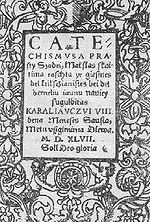 The first book published in the Lithuanian language was Martynas Mažvydas
's 1547 Lutheran Catechism
. Other milestone publications included Daniel Klein's Grammar in 1653, a publication of the Bible
in 1735, and the first work of imaginative literature, Kristijonas Donelaitis
' Metai (The Seasons), in 1818. During the years of the Polish-Lithuanian Commonwealth
, which lasted from 1569 to 1781, the Polish language
gained ground as the written lingua franca
of greater Lithuania, although the Prussian areas of Lithuania Minor
continued to issue publications in Lithuanian.
At the beginning of the nineteenth century, use of the Lithuanian language
was largely limited to Lithuanian rural areas, apart from its use in Prussia; it was, however, retained by some members of the minor nobility, especially in the Samogitia
n region. Several factors contributed to its subsequent revival: the language drew attention from scholars of the emerging science of comparative linguistics
; after the abolition of serfdom in the Russian Empire in 1861
, social mobility
increased, and Lithuanian intellectuals arose from the ranks of the rural populace; and language became associated with identity in Lithuania, as elsewhere across Europe. Within the Catholic Church, the barriers that had earlier prevented commoners from entering the priesthood were eased. A closer relationship developed between the educated clergy, who were increasingly of ethnic Lithuanian stock, and their parishioners, including a sympathy with their wish to use the Lithuanian language. The emerging national movement sought to distance itself from both Polish and Russian influences, and the use of the Lithuanian language was seen as an important aspect of this movement.
According to the bibliographer
Vaclovas Biržiška
, between 1800 and 1864, when the press ban was enacted, 926 book titles were published in the Lithuanian language using its Latin alphabet. The orthography
of the language was not standardized; this problem was used by the Russian authorities as a rationale for the change to Cyrillic.
in the late 18th century, Lithuania and Poland were incorporated into the Russian Empire
. The uprising of 1863, seeking to re-establish the Commonwealth, convinced many Russian politicians that Polish cultural and political influence was the main obstacle hindering the Russification of Lithuania. They believed that if the Lithuanian peasantry were distanced from the Polonized nobility
and the Catholic Church, Lithuanians would naturally come under Russian cultural influence, as they had allegedly been during previous eras. The Russian politician Nikolai Miliutin wrote that "Russian letters will finish that which was begun with the Russian sword."
On May 13, 1863 Tsar Alexander II of Russia
appointed Mikhail Nikolayevich Muravyov
as the Governor General of the Vilna Governorate
. His duties included suppression of the uprising and implementation of the Russification policy. Because the situation was perceived as critical, Muravyov was temporarily granted extremely wide powers. Muravyov and Ivan Petrovich Kornilov, the newly appointed director of the Vilnius
educational district, prepared a radical long-term Russification program that became known as the Program of Restoration of Russian Beginnings (Lithuanian: Rusų pradų atkūrimo programa). Its stated goals were to:
On May 22, 1864 Tsar Alexander II approved this program. A few days later Muravyov issued an administrative order that forbade printing Lithuanian language textbooks written in the Latin alphabet. This order was developed into a comprehensive ban on September 6, 1865 by Konstantin Petrovich von Kaufman
, Muravyov's successor. Kaufman issued an order to six neighboring governorates declaring a full ban on all publications and demanding that censorship committees enforce it without hesitation. A week later the order was extended to the entire Empire by Pyotr Valuev
, Minister of the Interior. In 1866 the ban was further extended to include all academic books.
Despite its strict and widespread enforcement, none of the ban's supporting measures were ever actually codified into law. The ban was enforced based solely on administrative orders and the tsar's approval. When the special temporary powers of the Governor General were revoked in 1871, these administrative orders lost any legal value. From that point on the ban had no legal basis, but it was still strictly enforced.
Alexander Hilferding in his 1863 book Lithuania and Samogitia.
The first experiments with the conversion of Lithuanian writings into Cyrillic were conducted by a Lithuanian linguist, Jonas Juška. He showed some samples of adapted texts to both Muravyov and Kornilov in February 1864. However, Juška discontinued his work and Kornilov formed a committee to work on publishing Lithuanian books in Cyrillic. The committee had four members: the Polish librarian Stanisław Mikucki from Warsaw
, Russian Jonas Kerčinskis, a Lithuanian Catholic
priest who had converted to Eastern Orthodoxy, Antanas Petkevičius, and the well-known Lithuanian educator and publisher Laurynas Ivinskis
. Ivinskis soon withdrew from the committee. The first such book was a primer intended for use in the new Russian schools that were replacing the Lithuanian parish schools. It appeared during the summer of 1864. The committee also published a prayer book
, a calendar, and other religious literature.
About 55 Lithuanian-Cyrillic titles were published during the 40 years of the ban; about half of these were published during its first decade. Seeing that the Lithuanian people were unwilling to accept these books, even when they were offered for free, the Russian government shifted its attention to eliminating the illegal publications.
The Russian Ministry of Education issued a report in May 1898 recommending that the press ban be repealed. The report stated that the ban had produced adverse and unforeseen results, including the development of Lithuanian nationalism. Other Russian officials had opined that the interests of the Russian state would be better served by the presence of a legal Lithuanian press that could be censored.
During the years of the ban, 3,047 people (829 smugglers
, 859 distributors, and 1,359 persons possessing banned books) were arrested in connection with the ban.
 Anti-Russian sentiment and distrust of the tsarist authorities had arisen after the 1863 revolt. The ban was also perceived as a threat to the Catholic Church; the Eastern Orthodox Church used the Cyrillic alphabet, and loyalty to the Latin alphabet was also a symbolic loyalty to Catholicism. Attempts were made to circumvent the ban by using Gothic script
. However, that was also banned in 1872. A number of problems arose with the various Lithuanian-Cyrillic orthographies, which were all criticized as ill-adapted to the Lithuanian language. Within Russia, the ban was opposed by scholarly, liberal, and pro-democratic groups, which served to mitigate the punishments.
The organized resistance to the ban, both legal and illegal, was largely initiated by bishop Motiejus Valančius
, who petitioned the government to exempt prayer books from the ban. He then moved towards sponsoring the illegal flow of books from outside Lithuania
. Valančius died in 1875. The period from 1875 to 1883 saw the establishment of the Lithuanian-language newspaper Auszra (The Dawn), and the resistance at this time is associated with bishop Antanas Baranauskas
. The resistance intensified towards the end of the 19th century, after another major newspaper, Varpas
(The Bell), edited by Vincas Kudirka
, was established in 1889. Between 1891 and 1893, 31,718 publications were confiscated and destroyed; between 1900 and 1902 this number increased to 56,182, reflecting their increased flow.
The period from 1890 to 1904 saw the publication of about 2,500 book titles in the Lithuanian Latin alphabet. The majority of these were published in Tilsit, a city in East Prussia
, although some publications reached Lithuania from the United States
. A largely standardized written version of the language was achieved by the turn of the twentieth century, based on historical and Aukštaitija
n (highland) usages; the letters -č- and -š- were taken from Czech
orthography. The widely-accepted Lithuanian Grammar, by Jonas Jablonskis
, appeared in 1901.
A number of challenges to the ban's legal basis were made, and the use of this venue intensified at the end of the 19th century, along with an increasing number of letters, petitions, and protests from Lithuanians. In 1902 and 1903 the Russian Supreme Court reversed two press ban convictions that had been brought against Antanas Macijauskas and Povilas Višinskis
. The court's decisions stated that the original executive decree creating the ban was illegal. The outbreak of the Russo-Japanese War
in February 1904 contributed to the Russian government's perception that its minorities needed to be accommodated. The ban was officially lifted on April 24, 1904.
area; between 1853 and 1863, just before the ban, the number of literate persons rose from 11,296 to 24,330. The subsequent ban is thought to have contributed to illiteracy in 19th-century Lithuania.
In the wake of the ruling, parish schools were closed. A shortage of teachers led to the closure of a number of state schools as well, in spite of population growth. Parents began to withdraw their children from the state schools, since they were associated with the policy of Russification; students were not allowed to speak Lithuanian among themselves, and a discouraging atmosphere was created by the system of searches, inspections, and spying. Many students were schooled at home or in small secret groups instead, although this practice also resulted in sanctions.
A census of the Kovno Governorate
in 1897 showed that a higher proportion of older people than younger had received formal education: of persons age 30 to 39, 61.87% had experienced some level of formal education, compared to only 54.68% of persons aged 10 to 19.
, appeared on December 23, 1904; the Great Seimas of Vilnius
, which took place in November 1905, was now able to issue its announcements and publications in Lithuanian.
The publishing houses of Martynas Kukta, Saliamonas Banaitis
, and the Society of St. Casimir in Kaunas
were responsible for many of the publications issued between the end of the ban in 1904 and the restoration of Lithuanian independence in 1918. The businessman Petras Vileišis
installed a printing press at his palace
, commissioned in 1904. During this period 4,734 Lithuanian-language titles in the Latin alphabet were published in Lithuania and abroad. After Lithuanian independence was established, the rate of publication increased steadily; 16,721 book titles were printed from 1918 to 1939. Between 1925 and 1939 about 800 to 900 book titles were printed annually.
A standard Lithuanian othography and grammar were established during the ban, despite the fact that the co-ordination of this process, involving competing dialects, was forced to take place in several countries. The ban is widely felt to have stimulated the Lithuanian national movement, rather than discouraging it. In 2004, the 100th anniversary of the ban's end was noted in UNESCO
's events calendar, and the Lithuanian Seimas
declared the "Year of the Lithuanian Language and Book."
Lithuanian language
Lithuanian is the official state language of Lithuania and is recognized as one of the official languages of the European Union. There are about 2.96 million native Lithuanian speakers in Lithuania and about 170,000 abroad. Lithuanian is a Baltic language, closely related to Latvian, although they...
publications printed in the Latin alphabet
Latin alphabet
The Latin alphabet, also called the Roman alphabet, is the most recognized alphabet used in the world today. It evolved from a western variety of the Greek alphabet called the Cumaean alphabet, which was adopted and modified by the Etruscans who ruled early Rome...
within the Russian Empire
Russian Empire
The Russian Empire was a state that existed from 1721 until the Russian Revolution of 1917. It was the successor to the Tsardom of Russia and the predecessor of the Soviet Union...
, which controlled Lithuania
Lithuania
Lithuania , officially the Republic of Lithuania is a country in Northern Europe, the biggest of the three Baltic states. It is situated along the southeastern shore of the Baltic Sea, whereby to the west lie Sweden and Denmark...
at the time. Lithuanian-language publications that used the Cyrillic alphabet
Cyrillic alphabet
The Cyrillic script or azbuka is an alphabetic writing system developed in the First Bulgarian Empire during the 10th century AD at the Preslav Literary School...
were allowed and even encouraged. The concept arose after the failed January Uprising
January Uprising
The January Uprising was an uprising in the former Polish-Lithuanian Commonwealth against the Russian Empire...
of 1863, taking the form of an administrative order in 1864, and was not lifted until April 24, 1904. The Russian courts reversed two convictions in press ban cases in 1902 and 1903, and the setbacks of the Russo-Japanese War
Russo-Japanese War
The Russo-Japanese War was "the first great war of the 20th century." It grew out of rival imperial ambitions of the Russian Empire and Japanese Empire over Manchuria and Korea...
in early 1904 brought about a loosened Russian policy towards minorities.
It was illegal to print, import, distribute, or possess any publications in the Latin alphabet. Tsar
Tsar
Tsar is a title used to designate certain European Slavic monarchs or supreme rulers. As a system of government in the Tsardom of Russia and Russian Empire, it is known as Tsarist autocracy, or Tsarism...
ist authorities hoped that this measure, part of a larger Russification
Russification
Russification is an adoption of the Russian language or some other Russian attributes by non-Russian communities...
plan, would decrease Polish influence on Lithuanians and would return them to what were considered their ancient historical ties with Russia. However, Lithuanians organized printing outside the Empire, largely in the Lithuania Minor
Lithuania Minor
Lithuania Minor or Prussian Lithuania is a historical ethnographic region of Prussia, later East Prussia in Germany, where Prussian Lithuanians or Lietuvininkai lived. Lithuania Minor enclosed the northern part of this province and got its name due to the territory's substantial...
(East Prussia
East Prussia
East Prussia is the main part of the region of Prussia along the southeastern Baltic Coast from the 13th century to the end of World War II in May 1945. From 1772–1829 and 1878–1945, the Province of East Prussia was part of the German state of Prussia. The capital city was Königsberg.East Prussia...
), and in the United States. Knygnešiai
Knygnešiai
Book smugglers were people who transported Lithuanian language books printed in the Latin alphabet into Lithuanian-speaking areas of the Russian Empire, defying a ban on such materials in force from 1866 to 1904...
smuggled illegal books and periodicals through the border. The number of such publications kept increasing despite strict sanctions and persecutions against the activists. The ban created a well-defined and organized opposition to Russian rule and culture - the opposite of its original intent. The Lithuanian historian Edvardas Gudavičius
Edvardas Gudavicius
Edvardas Gudavičius is one of the best known historians in modern Lithuania specializing in early history of Grand Duchy of Lithuania. In 1953 he graduated from Kaunas Polytechnic Institute with a degree in engineering. Gudavičius started his career as a mechanic at one of the factories in Kaunas,...
has described the ban as a test of the concept of Lithuania: Had there been no resistance, the language would have become a historical footnote, and the modern nation would never have been created.
Background
Martynas Mažvydas
Martynas Mažvydas Martynas Mažvydas Martynas Mažvydas (1510 near Žemaičių Naumiestis (now in Šilutė district municipality) - May 21, 1563 in Königsberg (now Kaliningrad) was the author and the editor of the first printed book in the Lithuanian language....
's 1547 Lutheran Catechism
Catechism
A catechism , i.e. to indoctrinate) is a summary or exposition of doctrine, traditionally used in Christian religious teaching from New Testament times to the present...
. Other milestone publications included Daniel Klein's Grammar in 1653, a publication of the Bible
Bible
The Bible refers to any one of the collections of the primary religious texts of Judaism and Christianity. There is no common version of the Bible, as the individual books , their contents and their order vary among denominations...
in 1735, and the first work of imaginative literature, Kristijonas Donelaitis
Kristijonas Donelaitis
Kristijonas Donelaitis was a Prussian Lithuanian Lutheran pastor and poet. He lived and worked in Lithuania Minor, a territory in the Kingdom of Prussia, that had a sizable minority of ethnic Lithuanians...
' Metai (The Seasons), in 1818. During the years of the Polish-Lithuanian Commonwealth
Polish-Lithuanian Commonwealth
The Polish–Lithuanian Commonwealth was a dualistic state of Poland and Lithuania ruled by a common monarch. It was the largest and one of the most populous countries of 16th- and 17th‑century Europe with some and a multi-ethnic population of 11 million at its peak in the early 17th century...
, which lasted from 1569 to 1781, the Polish language
Polish language
Polish is a language of the Lechitic subgroup of West Slavic languages, used throughout Poland and by Polish minorities in other countries...
gained ground as the written lingua franca
Lingua franca
A lingua franca is a language systematically used to make communication possible between people not sharing a mother tongue, in particular when it is a third language, distinct from both mother tongues.-Characteristics:"Lingua franca" is a functionally defined term, independent of the linguistic...
of greater Lithuania, although the Prussian areas of Lithuania Minor
Lithuania Minor
Lithuania Minor or Prussian Lithuania is a historical ethnographic region of Prussia, later East Prussia in Germany, where Prussian Lithuanians or Lietuvininkai lived. Lithuania Minor enclosed the northern part of this province and got its name due to the territory's substantial...
continued to issue publications in Lithuanian.
At the beginning of the nineteenth century, use of the Lithuanian language
Lithuanian language
Lithuanian is the official state language of Lithuania and is recognized as one of the official languages of the European Union. There are about 2.96 million native Lithuanian speakers in Lithuania and about 170,000 abroad. Lithuanian is a Baltic language, closely related to Latvian, although they...
was largely limited to Lithuanian rural areas, apart from its use in Prussia; it was, however, retained by some members of the minor nobility, especially in the Samogitia
Samogitia
Samogitia is one of the five ethnographic regions of Lithuania. It is located in northwestern Lithuania. Its largest city is Šiauliai/Šiaulē. The region has a long and distinct cultural history, reflected in the existence of the Samogitian dialect...
n region. Several factors contributed to its subsequent revival: the language drew attention from scholars of the emerging science of comparative linguistics
Comparative linguistics
Comparative linguistics is a branch of historical linguistics that is concerned with comparing languages to establish their historical relatedness....
; after the abolition of serfdom in the Russian Empire in 1861
Emancipation reform of 1861
The Emancipation Reform of 1861 in Russia was the first and most important of liberal reforms effected during the reign of Alexander II of Russia. The reform, together with a related reform in 1861, amounted to the liquidation of serf dependence previously suffered by peasants of the Russian Empire...
, social mobility
Social mobility
Social mobility refers to the movement of people in a population from one social class or economic level to another. It typically refers to vertical mobility -- movement of individuals or groups up from one socio-economic level to another, often by changing jobs or marrying; but can also refer to...
increased, and Lithuanian intellectuals arose from the ranks of the rural populace; and language became associated with identity in Lithuania, as elsewhere across Europe. Within the Catholic Church, the barriers that had earlier prevented commoners from entering the priesthood were eased. A closer relationship developed between the educated clergy, who were increasingly of ethnic Lithuanian stock, and their parishioners, including a sympathy with their wish to use the Lithuanian language. The emerging national movement sought to distance itself from both Polish and Russian influences, and the use of the Lithuanian language was seen as an important aspect of this movement.
According to the bibliographer
Bibliographer
"A bibliographer is a person who describes and lists books and other publications, with particular attention to such characteristics as authorship, publication date, edition, typography, etc. The result of this endeavor is a bibliography...
Vaclovas Biržiška
Vaclovas Biržiška
Vaclovas Biržiška was a Lithuanian attorney, bibliographer, and educator.He was a member of a notable Lithuanian family; his great-grandfather Mykolas Biržiška was a representative in the Sejm when the Constitution of 3 May was accepted in 1791; his grandfather Leonardas Biržiška was an active...
, between 1800 and 1864, when the press ban was enacted, 926 book titles were published in the Lithuanian language using its Latin alphabet. The orthography
Orthography
The orthography of a language specifies a standardized way of using a specific writing system to write the language. Where more than one writing system is used for a language, for example Kurdish, Uyghur, Serbian or Inuktitut, there can be more than one orthography...
of the language was not standardized; this problem was used by the Russian authorities as a rationale for the change to Cyrillic.
Origins and legal basis
After the partitions of the Polish-Lithuanian CommonwealthPartitions of Poland
The Partitions of Poland or Partitions of the Polish–Lithuanian Commonwealth took place in the second half of the 18th century and ended the existence of the Polish–Lithuanian Commonwealth, resulting in the elimination of sovereign Poland for 123 years...
in the late 18th century, Lithuania and Poland were incorporated into the Russian Empire
Russian Empire
The Russian Empire was a state that existed from 1721 until the Russian Revolution of 1917. It was the successor to the Tsardom of Russia and the predecessor of the Soviet Union...
. The uprising of 1863, seeking to re-establish the Commonwealth, convinced many Russian politicians that Polish cultural and political influence was the main obstacle hindering the Russification of Lithuania. They believed that if the Lithuanian peasantry were distanced from the Polonized nobility
Szlachta
The szlachta was a legally privileged noble class with origins in the Kingdom of Poland. It gained considerable institutional privileges during the 1333-1370 reign of Casimir the Great. In 1413, following a series of tentative personal unions between the Grand Duchy of Lithuania and the Kingdom of...
and the Catholic Church, Lithuanians would naturally come under Russian cultural influence, as they had allegedly been during previous eras. The Russian politician Nikolai Miliutin wrote that "Russian letters will finish that which was begun with the Russian sword."
On May 13, 1863 Tsar Alexander II of Russia
Alexander II of Russia
Alexander II , also known as Alexander the Liberator was the Emperor of the Russian Empire from 3 March 1855 until his assassination in 1881...
appointed Mikhail Nikolayevich Muravyov
Mikhail Nikolayevich Muravyov-Vilensky
Count Mikhail Nikolayevich Muravyov was one of the most reactionary Russian imperial statesmen of the 19th century...
as the Governor General of the Vilna Governorate
Vilna Governorate
The Vilna Governorate or Government of Vilna was a governorate of the Russian Empire created after the Third Partition of the Polish-Lithuanian Commonwealth in 1795...
. His duties included suppression of the uprising and implementation of the Russification policy. Because the situation was perceived as critical, Muravyov was temporarily granted extremely wide powers. Muravyov and Ivan Petrovich Kornilov, the newly appointed director of the Vilnius
Vilnius
Vilnius is the capital of Lithuania, and its largest city, with a population of 560,190 as of 2010. It is the seat of the Vilnius city municipality and of the Vilnius district municipality. It is also the capital of Vilnius County...
educational district, prepared a radical long-term Russification program that became known as the Program of Restoration of Russian Beginnings (Lithuanian: Rusų pradų atkūrimo programa). Its stated goals were to:
- Eliminate the Polish langugage from public life
- Prevent the employment of Catholics in government institutions
- Control and restrict the Catholic Church
- Create favorable conditions for the spread of Eastern Orthodoxy
- Replace Lithuanian parish schools with Russian grammar schools
- Encourage ethnic Russians to resettle in Lithuanian lands
- Replace the Latin alphabet with the Cyrillic alphabet
- Ban any Lithuanian-language publications in the Latin alphabet
On May 22, 1864 Tsar Alexander II approved this program. A few days later Muravyov issued an administrative order that forbade printing Lithuanian language textbooks written in the Latin alphabet. This order was developed into a comprehensive ban on September 6, 1865 by Konstantin Petrovich von Kaufman
Konstantin Petrovich Von Kaufman
Konstantin Petrovich von Kaufman was the first Governor-General of Russian Turkestan.-Early life:His family was Austrian in origin, but had been in the service of the Tsars for over 100 years, and had long since converted to Orthodoxy...
, Muravyov's successor. Kaufman issued an order to six neighboring governorates declaring a full ban on all publications and demanding that censorship committees enforce it without hesitation. A week later the order was extended to the entire Empire by Pyotr Valuev
Pyotr Valuev
Count Pyotr Aleksandrovich Valuev , was a Russian statesman and writer.-Political career:...
, Minister of the Interior. In 1866 the ban was further extended to include all academic books.
Despite its strict and widespread enforcement, none of the ban's supporting measures were ever actually codified into law. The ban was enforced based solely on administrative orders and the tsar's approval. When the special temporary powers of the Governor General were revoked in 1871, these administrative orders lost any legal value. From that point on the ban had no legal basis, but it was still strictly enforced.
Enforcement
At first the Russian authorities encouraged and sponsored the publication of Lithuanian-language works in the Cyrillic alphabet. The idea of replacing the Latin alphabet with Cyrillic was first elaborated by the well-known Pan-SlavistPan-Slavism
Pan-Slavism was a movement in the mid-19th century aimed at unity of all the Slavic peoples. The main focus was in the Balkans where the South Slavs had been ruled for centuries by other empires, Byzantine Empire, Austria-Hungary, the Ottoman Empire, and Venice...
Alexander Hilferding in his 1863 book Lithuania and Samogitia.
The first experiments with the conversion of Lithuanian writings into Cyrillic were conducted by a Lithuanian linguist, Jonas Juška. He showed some samples of adapted texts to both Muravyov and Kornilov in February 1864. However, Juška discontinued his work and Kornilov formed a committee to work on publishing Lithuanian books in Cyrillic. The committee had four members: the Polish librarian Stanisław Mikucki from Warsaw
Warsaw
Warsaw is the capital and largest city of Poland. It is located on the Vistula River, roughly from the Baltic Sea and from the Carpathian Mountains. Its population in 2010 was estimated at 1,716,855 residents with a greater metropolitan area of 2,631,902 residents, making Warsaw the 10th most...
, Russian Jonas Kerčinskis, a Lithuanian Catholic
Catholic
The word catholic comes from the Greek phrase , meaning "on the whole," "according to the whole" or "in general", and is a combination of the Greek words meaning "about" and meaning "whole"...
priest who had converted to Eastern Orthodoxy, Antanas Petkevičius, and the well-known Lithuanian educator and publisher Laurynas Ivinskis
Laurynas Ivinskis
Laurynas Ivinskis was a Lithuanian teacher, publisher, translator and lexicographer, from a Samogitian noble family. He is notable for a series of annual calendars published between 1847 and 1877, in which he summarized the daily life of Samogitian peasantry, Laurynas Ivinski also published...
. Ivinskis soon withdrew from the committee. The first such book was a primer intended for use in the new Russian schools that were replacing the Lithuanian parish schools. It appeared during the summer of 1864. The committee also published a prayer book
Breviary
A breviary is a liturgical book of the Latin liturgical rites of the Catholic Church containing the public or canonical prayers, hymns, the Psalms, readings, and notations for everyday use, especially by bishops, priests, and deacons in the Divine Office...
, a calendar, and other religious literature.
About 55 Lithuanian-Cyrillic titles were published during the 40 years of the ban; about half of these were published during its first decade. Seeing that the Lithuanian people were unwilling to accept these books, even when they were offered for free, the Russian government shifted its attention to eliminating the illegal publications.
The Russian Ministry of Education issued a report in May 1898 recommending that the press ban be repealed. The report stated that the ban had produced adverse and unforeseen results, including the development of Lithuanian nationalism. Other Russian officials had opined that the interests of the Russian state would be better served by the presence of a legal Lithuanian press that could be censored.
During the years of the ban, 3,047 people (829 smugglers
Knygnešiai
Book smugglers were people who transported Lithuanian language books printed in the Latin alphabet into Lithuanian-speaking areas of the Russian Empire, defying a ban on such materials in force from 1866 to 1904...
, 859 distributors, and 1,359 persons possessing banned books) were arrested in connection with the ban.
Resistance
| Period | Number of titles |
|---|---|
| 1865–1874 | 345 |
| 1875–1884 | 501 |
| 1885–1894 | 1,076 |
| 1895–1904 | 2,031 |
| Total | 3,953 |
Gothic script
Gothic script may refer to:* Blackletter* Gothic alphabet* Schwabacher...
. However, that was also banned in 1872. A number of problems arose with the various Lithuanian-Cyrillic orthographies, which were all criticized as ill-adapted to the Lithuanian language. Within Russia, the ban was opposed by scholarly, liberal, and pro-democratic groups, which served to mitigate the punishments.
The organized resistance to the ban, both legal and illegal, was largely initiated by bishop Motiejus Valančius
Motiejus Valancius
Motiejus Valančius was a Catholic bishop of Samogitia, historian and one of the best known Lithuanian writers of the 19th century.-Biography:...
, who petitioned the government to exempt prayer books from the ban. He then moved towards sponsoring the illegal flow of books from outside Lithuania
Knygnešiai
Book smugglers were people who transported Lithuanian language books printed in the Latin alphabet into Lithuanian-speaking areas of the Russian Empire, defying a ban on such materials in force from 1866 to 1904...
. Valančius died in 1875. The period from 1875 to 1883 saw the establishment of the Lithuanian-language newspaper Auszra (The Dawn), and the resistance at this time is associated with bishop Antanas Baranauskas
Antanas Baranauskas
Antanas Baranauskas was a Lithuanian poet, mathematician and a catholic bishop of Polish town Sejny. Baranauskas is best known as the author of the Lithuanian language poem Anykščių šilelis. He used various pseudonyms, including A.B., Bangputys, Jurksztas Smalaūsis, Jurkštas Smalaūsis, and Baronas...
. The resistance intensified towards the end of the 19th century, after another major newspaper, Varpas
Varpas
Varpas was a monthly Lithuanian-language newspaper published during the Lithuanian press ban from January 1889 to December 1905...
(The Bell), edited by Vincas Kudirka
Vincas Kudirka
Vincas Kudirka was a Lithuanian poet and physician, and the author of both the music and lyrics of the Lithuanian National Anthem, Tautiška giesmė. He is regarded in Lithuania as a National Hero. Kudirka used pen names - V...
, was established in 1889. Between 1891 and 1893, 31,718 publications were confiscated and destroyed; between 1900 and 1902 this number increased to 56,182, reflecting their increased flow.
The period from 1890 to 1904 saw the publication of about 2,500 book titles in the Lithuanian Latin alphabet. The majority of these were published in Tilsit, a city in East Prussia
East Prussia
East Prussia is the main part of the region of Prussia along the southeastern Baltic Coast from the 13th century to the end of World War II in May 1945. From 1772–1829 and 1878–1945, the Province of East Prussia was part of the German state of Prussia. The capital city was Königsberg.East Prussia...
, although some publications reached Lithuania from the United States
United States
The United States of America is a federal constitutional republic comprising fifty states and a federal district...
. A largely standardized written version of the language was achieved by the turn of the twentieth century, based on historical and Aukštaitija
Aukštaitija
Aukštaitija is the name of one of five ethnographic regions of Lithuania. The name comes from the relatively high elevation of the region, particularly the eastern parts.-Geography:...
n (highland) usages; the letters -č- and -š- were taken from Czech
Czech language
Czech is a West Slavic language with about 12 million native speakers; it is the majority language in the Czech Republic and spoken by Czechs worldwide. The language was known as Bohemian in English until the late 19th century...
orthography. The widely-accepted Lithuanian Grammar, by Jonas Jablonskis
Jonas Jablonskis
Jonas Jablonskis was a distinguished Lithuanian linguist and one of the founders of the standard Lithuanian language...
, appeared in 1901.
A number of challenges to the ban's legal basis were made, and the use of this venue intensified at the end of the 19th century, along with an increasing number of letters, petitions, and protests from Lithuanians. In 1902 and 1903 the Russian Supreme Court reversed two press ban convictions that had been brought against Antanas Macijauskas and Povilas Višinskis
Povilas Višinskis
Povilas Višinskis was a Lithuanian writer, journalist, theatre director, and politician. His pen names include A. – s, Blinda, P – V, P. A., Apaštalas, P. Šiaulietis. He was one of the founders of the Lithuanian Democratic Party...
. The court's decisions stated that the original executive decree creating the ban was illegal. The outbreak of the Russo-Japanese War
Russo-Japanese War
The Russo-Japanese War was "the first great war of the 20th century." It grew out of rival imperial ambitions of the Russian Empire and Japanese Empire over Manchuria and Korea...
in February 1904 contributed to the Russian government's perception that its minorities needed to be accommodated. The ban was officially lifted on April 24, 1904.
Effect on education
Public and private education in Lithuanian was adversely affected by the press ban. The level of pent-up demand for schooling in the 19th century is illustrated by the increase in literacy in the RietavasRietavas
Rietavas is a city in Lithuania on the Jūra River. According to the 2001 census it had a population of 3,979. It is the capital of Rietavas municipality.The city is famous for building the first power station to produce electricity in Lithuania in 1892...
area; between 1853 and 1863, just before the ban, the number of literate persons rose from 11,296 to 24,330. The subsequent ban is thought to have contributed to illiteracy in 19th-century Lithuania.
In the wake of the ruling, parish schools were closed. A shortage of teachers led to the closure of a number of state schools as well, in spite of population growth. Parents began to withdraw their children from the state schools, since they were associated with the policy of Russification; students were not allowed to speak Lithuanian among themselves, and a discouraging atmosphere was created by the system of searches, inspections, and spying. Many students were schooled at home or in small secret groups instead, although this practice also resulted in sanctions.
A census of the Kovno Governorate
Kovno Governorate
The Kovno Governorate or Government of Kovno was a governorate of the Russian Empire. Its capital was Kovno . It was formed on 18 December 1842 by tsar Nicholas I from the western part of the Vilna Governorate, and the order was carried out on 1 July 1843. It used to be a part of Northwestern Krai...
in 1897 showed that a higher proportion of older people than younger had received formal education: of persons age 30 to 39, 61.87% had experienced some level of formal education, compared to only 54.68% of persons aged 10 to 19.
Aftermath
After the ban was lifted, printing presses and their supporting social and cultural infrastructure needed to be established. The first issue of a Lithuanian newspaper after the ban, Vilniaus žiniosVilniaus žinios
Vilniaus žinios was a short-lived newspaper published in Vilnius, Lithuania. It was the first legal Lithuanian-language daily newspaper to appear after the Lithuanian press ban was lifted on May 7, 1904.-History:...
, appeared on December 23, 1904; the Great Seimas of Vilnius
Great Seimas of Vilnius
The Great Seimas of Vilnius , was a major assembly held on December 4 and 5, 1905 in Vilnius, Lithuania, then part of the Russian Empire, largely inspired by the Russian Revolution of 1905. It was the first modern national congress in Lithuania and dealt primarily not with the social issues that...
, which took place in November 1905, was now able to issue its announcements and publications in Lithuanian.
The publishing houses of Martynas Kukta, Saliamonas Banaitis
Saliamonas Banaitis
Saliamonas Banaitis was a Lithuanian printer, educator, and banker. He was one of the twenty signatories of the Act of Independence of Lithuania in 1918....
, and the Society of St. Casimir in Kaunas
Kaunas
Kaunas is the second-largest city in Lithuania and has historically been a leading centre of Lithuanian economic, academic, and cultural life. Kaunas was the biggest city and the center of a powiat in Trakai Voivodeship of the Grand Duchy of Lithuania since 1413. During Russian Empire occupation...
were responsible for many of the publications issued between the end of the ban in 1904 and the restoration of Lithuanian independence in 1918. The businessman Petras Vileišis
Petras Vileišis
Petras Vileišis was a prominent Lithuanian engineer, political activist, and philanthropist.His early schooling took place in Panevežys. He then completed his secondary education at the Šiauliai Gymnasium, graduating with honors. In 1874, he completed his studies at St. Petersburg University, with...
installed a printing press at his palace
Vileišis Palace
Vileišis Palace is a Neo-baroque style architectural ensemble in Vilnius, Lithuania, built for Petras Vileišis. Vileišis was a prominent Lithuanian engineer, political activist, publisher, and philanthropist who commissioned the palace in 1904 and supervised its construction. The ensemble consists...
, commissioned in 1904. During this period 4,734 Lithuanian-language titles in the Latin alphabet were published in Lithuania and abroad. After Lithuanian independence was established, the rate of publication increased steadily; 16,721 book titles were printed from 1918 to 1939. Between 1925 and 1939 about 800 to 900 book titles were printed annually.
A standard Lithuanian othography and grammar were established during the ban, despite the fact that the co-ordination of this process, involving competing dialects, was forced to take place in several countries. The ban is widely felt to have stimulated the Lithuanian national movement, rather than discouraging it. In 2004, the 100th anniversary of the ban's end was noted in UNESCO
UNESCO
The United Nations Educational, Scientific and Cultural Organization is a specialized agency of the United Nations...
's events calendar, and the Lithuanian Seimas
Seimas
The Seimas is the unicameral Lithuanian parliament. It has 141 members that are elected for a four-year term. About half of the members of this legislative body are elected in individual constituencies , and the other half are elected by nationwide vote according to proportional representation...
declared the "Year of the Lithuanian Language and Book."