


Finnish people

Encyclopedia
The terms Finns and Finnish people are used in English to mean "a native or inhabitant of Finland". They are also used to refer to the ethnic group
historically associated with Finland
or Fennoscandia
, and they are only used in that sense here.
As with most ethnic groups, the definition of Finns may vary. In every definition, the term includes the Finnish-speaking population of Finland. The group can also be seen to include the Finnish-speaking population of Sweden
and the traditionally Swedish-speaking population of Finland, although the inclusion of the latter into the Finnish ethnicity is a subject of discussion. Smaller populations that may or may not be seen to fall under the term Finns include the Kvens in Norway
, the Tornedalians
of Sweden and the Ingrian Finns
of Russia. Finns can be divided according to dialect into subgroups sometimes called heimo (lit. tribe), but such divisions have become less important with internal migration.
Linguistically, Finnish, spoken by most Finns, is part of the Uralic
language family and is most closely related to other Finnic languages such as Karelian
and Estonian
, while Swedish, spoken by Swedish-speaking Finns, is unrelated to the Finnish language and a member of the Indo-European
language family. Finnish has loanwords from Swedish, other Germanic and broader Indo-European languages in different chronological layers while Swedish has few loan words from the Finnic languages. Genetically, Finns "have been shown to differ strikingly from other European populations".
. Language—both active and lost—has traditionally been seen as a key element when defining a people or its descendants.
, of the country's total population of 5,300,484 at the end of 2007, 91.2% (or 4,836,183) considered Finnish as their native language. It is not known how many of the ethnic Finns living outside Finland speak Finnish as their first language.
In addition to the Finnish-speaking
inhabitants of Finland, also Kvens (people of Finnish descent in Norway
), Tornedalians
(people of Finnish descent in northernmost Sweden), and Karelians
in the historic Finnish province of Karelia
and Evangelical Lutheran Ingrian Finns
(both in the northwestern Russian Federation), as well as Finnish expatriates in various countries are usually considered as Finnish people.
Finns have been traditionally divided in sub-groups (heimot in Finnish) on regional, dialectical and ethnographical grounds. These include the people of Finland Proper
(varsinaissuomalaiset), Satakunta (satakuntalaiset), Tavastia
(hämäläiset), Savo
(savolaiset), Karelia (karjalaiset) and Ostrobothnia
(pohjalaiset). These sub-groups express regional self-identity with varying frequency and significance.
There is a number of distinct dialect
s (murre s. murteet pl. in Finnish) of the Finnish language
spoken in Finland
, although the use of only the standard Finnish
(yleiskieli) both in its formal written (kirjakieli) and more casual spoken (puhekieli) form at the Finnish school system and within media and popular culture, as well as internal migration and urbanization, have all contributed to the subduing of the regional varieties considerably, especially in the latter half of the 20th century. The first three historical dialects were the South-Western (Lounaismurteet), Tavastia
n (Hämeen murre), and Karelian
(Karjalan murre), which were later mixed up with each other and/or neighboring languages as the population expanded geographically to form the Southern Ostrobothnia
n (Etelä-Pohjanmaan murre), Central Ostrobothnia
n (Keski-Pohjanmaan murre), Northern Ostrobothnia
n (Pohjois-Pohjanmaan murre), Far-Northern (Peräpohjolan murre), Savo
nian (Savon murre), and South-Eastern (Kaakkois-Suomen murteet) aka South Karelia
n (Karjalan murre) dialects.
for several hundred years, and about 360,000 present-day individuals with Finlands citizenship speak Swedish as their mother tongue. In Finland, language is typically considered the basic, but not the only criterion that distinguishes the Finnish-speakers and the Swedish-speakers from each other. In general, Finland swedes consider themselves to be just as much Finnish as the Finnish-speaking majority, but they have their own special identity distinct from that of the majority, and they wish to be recognized as such. In a 2005 survey by Svenska Finlands Folkting carried out among the Swedish speakers, when asked about the meaning of their identity, 82% of the respondents answered: "Both to belong to an own culture but also to be Finnish amongst the rest."
On the other hand, the Finland-Swedish minority have been seen to fulfill the major criteria for a separate ethnic group: self-identification, language, social structure, and ancestry. It is also sometimes suggested that the Swedish-speaking Finns have a special relationship with Sweden, constituted of shared language and culture.
(Torne Valley
Finns) and the Finns of Dalecarlia. As a result, the Finnish language has an official status as one of five minority languages in Sweden.
, including Izhorians
in Ingria
, Karelians
and Veps.
In Russia, where most Finns (Karelians not counted) are Ingrians
, the 2002 Census demonstrates that they have refused their distinct Ingrian identities and now identify themselves as ethnic Finns.
The Finnish and Swedish terms for the Swedish-speaking population of Finland are the expressions suomenruotsalaiset and finlandssvenskar respectively, which translate literally with regard to each other. In Finland Swedish usage and mindset the following distinctions are usually made: The nation (people) consists of Finnish speakers (Finland Swedish: finnar) and Swedish speakers (Finland Swedish: finlandssvenskar) who together with smaller minorities constitute the people of Finland (Finland Swedish: finländare). In Swedish spoken outside of Finland, in particular in Sweden, the term finländare is less known, and these distinctions are not always made.
Translating this terminology accurately into foreign languages, including Sweden's Swedish
, is a tricky matter because the terminology closely reflects the nation's entire language issue, which played an intricate part in the process of the crystallisation of the nation's self-perception and in the interpretation of its history, and because it still affects these. Indeed, one of the very first domestic matters addressed during the process of national awakening in the 19th century was the language question
.
It is therefore debatable which English terms best match the Finnish and (Finland-)Swedish terms suomalaiset (finländare, finnar) and finlandssvenskar (suomenruotsalaiset). Nevertheless, Swedish-speaking Finns seems to be the English term most commonly used today for and by the Swedish-speaking population of Finland, although the term Finland Swedes is in wide use too, at least in English written by non-native speakers in Scandinavia.
Similarly debatable is how to best designate the people living in Sweden who are current Finnish speakers or have Finnish or Finnish-speaking ancestors. The terms used include the traditional Sweden Finns
and the more modern Finnish Swedes, instead of which it may be preferable to differentiate between (recent) Finnish immigrants and the indigenous Finnish ethnic minority in Sweden.
As the meanings of these terms have changed in time, these terms may well be used with other meanings than those given above, particularly in foreign and older works.
, Phinnoi
, Finnum, and Skrithfinni / Scridefinnum appear in a few written texts starting from about two millennia ago in association with peoples located in a northern part of Europe, but the real meaning of these terms is debatable. The earliest mentions of this kind are usually interpreted to have meant Fennoscandia
n hunter-gatherer
s whose closest successors in modern terms would be the Sami people
. It has been suggested that this non-Uralic
ethnonym is of Germanic language origin and related to such words as finthan (Old High German
) 'find', 'notice'; fanthian (Old High German) 'check', 'try'; and fendo (Old High German) and vende (Old Middle German) 'pedestrian', 'wanderer'. Another etymological interpretation associates this ethnonym with fen in a more toponymical approach. Yet another theory postulates that the words finn and kven are cognates
. The Icelandic Eddas and Norse sagas (11th to 14th centuries), some of the oldest written sources probably originating from the closest proximity, use words like finnr and finnas inconsistently. However, most of the time they seem to mean northern dwellers with a mobile life style.
An etymological link between the Sami and the Finns exists in modern Uralic languages
as well. It has been proposed that e.g. the toponyms Sapmi (Sami for Lapland), Suomi (Finnish for Finland), and Häme (Finnish for Tavastia
) are of the same origin, the source of which might be related to the proto-Baltic
word *žeme / Slavic
земля (zemlja) meaning 'land'. It has been proposed that these designations started to mean specifically people in Southwestern Finland (Finland Proper
, Varsinais-Suomi) and later the whole area of modern Finland. But it is not known how, why, and when this occurred.
Petri Kallio has suggested that the name 'Suomi' may bear even earlier Indo-European echoes with the original meaning of either ’land’ or ’human’.
Among the first written documents possibly designating western Finland as the land of Finns are two rune stones. One of these is in Söderby, Sweden, with the inscription finlont (U 582 †
), and the other is in Gotland
, a Swedish island
in the Baltic Sea
, with the inscription finlandi (G 319 M) dating from the 11th century.
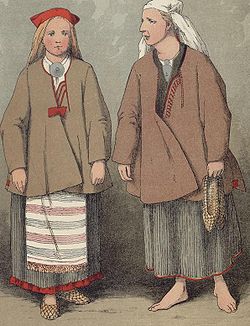 With regard to the ancestry of the Finnish people, the modern view emphasizes the overall continuity in Finland's archeological finds and (earlier more obvious) linguistic surroundings. Archeological data suggest the spreading of at least cultural influences from many sources ranging from the south-east to the south-west following gradual developments rather than clear-cut migrations.
Just as uncertain are the possible mediators and the timelines for the development of the Uralic majority language of the Finns. On the basis of comparative linguistics, it has been suggested that the separation of the Finnic
and the Sami languages
took place during the 2nd millennium BC, and that the proto-Uralic roots of the entire language group date from about the 6th to the 8th millennium BC. When the Uralic languages
were first spoken in the area of contemporary Finland is debated but current opinion leans towards the Stone Age
.
Because the Finnish language itself reached a written form only in the 16th century, little primary data remains of early Finnish life. For example, the origins of such cultural icons as the sauna
, the kantele
(an instrument of the zither family), and the Kalevala
(national epic) have remained rather obscure.
Finland's Swedish speakers descend from peasants and fishermen who settled coastal Finland ca. 1000–1250, from the subsequent immigration during Swedish sovereignty over Finland, and from Finns and immigrants who adopted the Swedish language. Fennomania in the 19th and early 20th century led to some minor language change into Finnish, but this was of little consequence in comparison to ordinary demographic trends, which reduced the proportion of Swedish-speakers during the entire 20th century from 12.9% (1900) to 5.6% (2003).
The historical provinces of Finland
and Sweden
can be seen to approximate some of these divisions. The regions of Finland
, another remnant of a past governing system, can be seen to reflect a further manifestation of a local identity.
Today's (urbanized) Finns are not usually aware of the concept of 'heimo' nor do they typically identify with one, although the use of dialects has experienced a recent revival. Urbanized Finns do not necessarily know a particular dialect and tend to use standard Finnish or city slang but they may switch to a dialect when visiting their native area.
(male lineage) DNA-markers in tracing back the history of human populations has been started . For the paternal and maternal genetic lineages of Finnish people and other peoples, see, e.g., the National Geographic Genographic Project and the Suomi DNA-projekti.
In essence, the types of mtDNA markers of Finnish people do not differ from those of other European ethnicities. For example, Haplogroup U5
is estimated to be the oldest mtDNA haplogroup in Europe and is found in the whole of Europe at a low frequency, but seems to be found in significantly higher levels among Finns, Estonians
and the Sami. Of modern nationalities, Finns are closest to Cro-Magnon
s in terms of anthropological measurements.
With regard to the Y-chromosome, the most common haplogroups of the Finns are N1c (58%), I
(29%), R1a
(7.5%) and R1b
(3.5%). Haplogroup N1c, which is found only in a few countries in Europe (Latvia
, Lithuania
, Estonia
, Sweden
and Russia
), is a subgroup of the haplogroup N (Y-DNA)
distributed across northern Eurasia and estimated in a recent study to be 10,000–20,000 years old and suggested to have entered Europe about 12,000–14,000 years ago from Asia.
According to an earlier study conducted by four scientists, including Cavalli-Sforza LL:
According to recent autosomal (genomewide, 10,000 markers instead of few looked at Y-DNA and MtDNA-studies) give distinct picture of Finnish genes. It could be said that all other Europeans have Finnish genes but Finns don't have all the genes found in other Europeans. Finns show very little if any Mediterranean and African genes but on the other hand almost 10% of Finnish genes seem to be shared with some Siberian populations. Nevertheless more than 80% of Finnish genes are from a single ancient North-European population, while most Europeans are a mixture of 3 or more principal components.
Variation within Finns is, according to the FST values, greater than anywhere else in Europe. Greatest intra-Finnish FST distance is about 60, greatest intra-Swedish FST distance about 25. FST distances between for example Germans, French and Hungarians is only 10, and between Estonians, Russians and Poles it is also 10. Thus Finns from different parts of the country are more remote from each other genetically than are many European peoples from each other. The closest genetic relatives for Finns are Estonians (FST to Helsinki 40 and to Kuusamo 90) and Swedes (FST to Helsinki 50 and to Kuusamo 100).
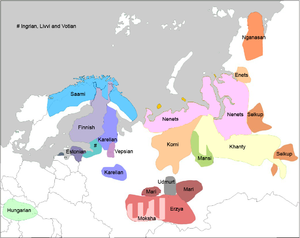 In the 19th century, the Finnish researcher Matthias Castrén
prevailed with the theory that "the original home of Finns" was in west-central Siberia
. But later, it was considered more credible that an ancient homeland of all Finno-Ugric speaking peoples situated in a region between the Volga and Kama
rivers in the European part of Russia
. Grouping Altaic with Finnic ("Turanian") was popular in the 19th century, and much serious research was made by Finnish researchers in an attempt to link Finns with Altaic-speaking peoples such as Mongolians.
Until the 1970s, most linguists believed that Finns arrived in Finland as late as the first centuries AD. But accumulating archaeological data suggested that the area of contemporary Finland had been inhabited continuously since the ice-age, contrary to the earlier idea that the area had experienced long uninhabited intervals. However, there's no certainty to which ethno-linguistic culture the first dwellers within the borders of contemporary Finland belonged. hunting-gathering
Sami
were pushed into the more remote northern regions.
A recent and controversial theory is that the ancestors of the Finns lived during the Ice Age
in one of three habitable areas of southern Europe, so-called refugia, while the other two habitable areas were occupied by the speakers of Indo-European
and Basque language
s. This was proposed in the 1990s by Kalevi Wiik
, a professor emeritus of phonetics
at the University of Turku
. According to this theory, Finno-Ugric speakers spread north as the ice melted. They populated central
and northern Europe
, while Basque
speakers populated western Europe
. As agriculture
spread from the south-east into Europe, the Indo-European languages spread among the hunter-gatherers. In this process, both the hunter-gatherers speaking Finno-Ugric and those speaking Basque learned how to cultivate land and became Indo-Europeanized. According to Wiik, this is how the Celtic
, Germanic
, Slavic
, and Baltic languages
were formed. The linguistic ancestors of modern Finns did not switch their language due to their isolated location. The main supporters of Wiik's theory are Professor Ago Künnap (Univ. of Tartu), Professor Kyösti Julku (Univ. of Oulu) and Associate Professor Angela Marcantonio (Univ. of Rome). Wiik has not presented his theories in peer-reviewed scientific publications. Many scholars in fenno-ugrian studies have strongly criticized the theory. Especially Professor Raimo Anttila, Petri Kallio and brothers Ante and Aslak Aikio have renounced Wiik's theory with strong words, hinting stronly to pseudoscience and even at right-wing political biases among Wiik's supporters. Moreover, some dismissed the entire idea of refugia, due to the existence even today of arctic and subarctic peoples. The most heated debate took place in the Finnish journal Kaltio during autumn 2002. Since then, the debate has calmed, each side retaining their positions.
Ethnic group
An ethnic group is a group of people whose members identify with each other, through a common heritage, often consisting of a common language, a common culture and/or an ideology that stresses common ancestry or endogamy...
historically associated with Finland
Finland
Finland , officially the Republic of Finland, is a Nordic country situated in the Fennoscandian region of Northern Europe. It is bordered by Sweden in the west, Norway in the north and Russia in the east, while Estonia lies to its south across the Gulf of Finland.Around 5.4 million people reside...
or Fennoscandia
Fennoscandia
Fennoscandia and Fenno-Scandinavia are geographic and geological terms used to describe the Scandinavian Peninsula, the Kola Peninsula, Karelia and Finland...
, and they are only used in that sense here.
As with most ethnic groups, the definition of Finns may vary. In every definition, the term includes the Finnish-speaking population of Finland. The group can also be seen to include the Finnish-speaking population of Sweden
Sweden Finns
Sweden Finns are a Finnish speaking minority in Sweden. The Finnish-speaking Swedes are not to be confused with the Swedish speaking Finland-Swedes in Finland . In 2008 there were over 675 000 people in Sweden who were either born in Finland or have at least one parent or grandparent who was born...
and the traditionally Swedish-speaking population of Finland, although the inclusion of the latter into the Finnish ethnicity is a subject of discussion. Smaller populations that may or may not be seen to fall under the term Finns include the Kvens in Norway
Norway
Norway , officially the Kingdom of Norway, is a Nordic unitary constitutional monarchy whose territory comprises the western portion of the Scandinavian Peninsula, Jan Mayen, and the Arctic archipelago of Svalbard and Bouvet Island. Norway has a total area of and a population of about 4.9 million...
, the Tornedalians
Tornedalians
The Tornedalians are descendants of Finns who in some point in history settled to the areas of today's Northern Sweden near the Torne Valley district and west from there.-History:...
of Sweden and the Ingrian Finns
Ingrian Finns
The Ingrian Finns are the Finnish population of Ingria descending from Lutheran Finnish immigrants introduced to the area in the 17th century, when Finland and Ingria were both part of the Swedish Empire...
of Russia. Finns can be divided according to dialect into subgroups sometimes called heimo (lit. tribe), but such divisions have become less important with internal migration.
Linguistically, Finnish, spoken by most Finns, is part of the Uralic
Uralic languages
The Uralic languages constitute a language family of some three dozen languages spoken by approximately 25 million people. The healthiest Uralic languages in terms of the number of native speakers are Hungarian, Finnish, Estonian, Mari and Udmurt...
language family and is most closely related to other Finnic languages such as Karelian
Karelian
Karelian refers to something from or related to the region of Karelia, in present-day Russia and FInland*Karelians*Karelian language*Karelian foods* Karelian pasties* Karelian hot pot* Karelian Birch, a cultivar of Betula pendula...
and Estonian
Estonian language
Estonian is the official language of Estonia, spoken by about 1.1 million people in Estonia and tens of thousands in various émigré communities...
, while Swedish, spoken by Swedish-speaking Finns, is unrelated to the Finnish language and a member of the Indo-European
Indo-European languages
The Indo-European languages are a family of several hundred related languages and dialects, including most major current languages of Europe, the Iranian plateau, and South Asia and also historically predominant in Anatolia...
language family. Finnish has loanwords from Swedish, other Germanic and broader Indo-European languages in different chronological layers while Swedish has few loan words from the Finnic languages. Genetically, Finns "have been shown to differ strikingly from other European populations".
Definition
The Finnish Population Registry Center maintains information on the place of birth, citizenship and mother tongue of the people living in Finland, but does not specifically categorize any as Finns by ethnicity. Like all ethnicities, Finns are subject to ethnogenesisEthnogenesis
Ethnogenesis is the process by which a group of human beings comes to be understood or to understand themselves as ethnically distinct from the wider social landscape from which their grouping emerges...
. Language—both active and lost—has traditionally been seen as a key element when defining a people or its descendants.
Finnish-speaking Finns
The majority of people living in the Republic of Finland consider Finnish as their first language. According to Statistics FinlandStatistics Finland
Statistics Finland is the national statistical institution in Finland, established on 4 November 1865 to serve as an information service and to provide statistics and expertise in the statistical sciences. The institution employes over 1000 experts from varying fields....
, of the country's total population of 5,300,484 at the end of 2007, 91.2% (or 4,836,183) considered Finnish as their native language. It is not known how many of the ethnic Finns living outside Finland speak Finnish as their first language.
In addition to the Finnish-speaking
Finnish language
Finnish is the language spoken by the majority of the population in Finland Primarily for use by restaurant menus and by ethnic Finns outside Finland. It is one of the two official languages of Finland and an official minority language in Sweden. In Sweden, both standard Finnish and Meänkieli, a...
inhabitants of Finland, also Kvens (people of Finnish descent in Norway
Norway
Norway , officially the Kingdom of Norway, is a Nordic unitary constitutional monarchy whose territory comprises the western portion of the Scandinavian Peninsula, Jan Mayen, and the Arctic archipelago of Svalbard and Bouvet Island. Norway has a total area of and a population of about 4.9 million...
), Tornedalians
Tornedalians
The Tornedalians are descendants of Finns who in some point in history settled to the areas of today's Northern Sweden near the Torne Valley district and west from there.-History:...
(people of Finnish descent in northernmost Sweden), and Karelians
Karelians
The Karelians are a Baltic-Finnic ethnic group living mostly in the Republic of Karelia and in other north-western parts of the Russian Federation. The historic homeland of Karelians includes also parts of present-day Eastern Finland and the formerly Finnish territory of Ladoga Karelia...
in the historic Finnish province of Karelia
Karelia
Karelia , the land of the Karelian peoples, is an area in Northern Europe of historical significance for Finland, Russia, and Sweden...
and Evangelical Lutheran Ingrian Finns
Ingrian Finns
The Ingrian Finns are the Finnish population of Ingria descending from Lutheran Finnish immigrants introduced to the area in the 17th century, when Finland and Ingria were both part of the Swedish Empire...
(both in the northwestern Russian Federation), as well as Finnish expatriates in various countries are usually considered as Finnish people.
Finns have been traditionally divided in sub-groups (heimot in Finnish) on regional, dialectical and ethnographical grounds. These include the people of Finland Proper
Finland Proper
Finland Proper or Southwest Finland , is a region in south-western Finland. It borders the regions of Satakunta, Tavastia Proper, Ahvenanmaa and Uusimaa.- Municipalities :...
(varsinaissuomalaiset), Satakunta (satakuntalaiset), Tavastia
Tavastia
Tavastia may refer to:* Tavastia , a historical province of the kingdom of Sweden, located in modern-day Finland* Tavastia Proper, a modern region of Finland* Päijänne Tavastia, another region of Finland...
(hämäläiset), Savo
Savo
Savo may refer to:* Savo Island near Guadalcanal in the Solomon Islands* Battle of Savo Island, 9 August 1942* Savonian dialects of the Finnish language* Savonia or , a historical province of Finland* Savo - a main-belt asteroid...
(savolaiset), Karelia (karjalaiset) and Ostrobothnia
Ostrobothnia (region)
Ostrobothnia is a region of Finland. It is located in Western Finland. It borders the regions Central Ostrobothnia, Southern Ostrobothnia, and Satakunta and is one of the four regions making up the historical province of Ostrobothnia....
(pohjalaiset). These sub-groups express regional self-identity with varying frequency and significance.
There is a number of distinct dialect
Dialect
The term dialect is used in two distinct ways, even by linguists. One usage refers to a variety of a language that is a characteristic of a particular group of the language's speakers. The term is applied most often to regional speech patterns, but a dialect may also be defined by other factors,...
s (murre s. murteet pl. in Finnish) of the Finnish language
Finnish language
Finnish is the language spoken by the majority of the population in Finland Primarily for use by restaurant menus and by ethnic Finns outside Finland. It is one of the two official languages of Finland and an official minority language in Sweden. In Sweden, both standard Finnish and Meänkieli, a...
spoken in Finland
Finland
Finland , officially the Republic of Finland, is a Nordic country situated in the Fennoscandian region of Northern Europe. It is bordered by Sweden in the west, Norway in the north and Russia in the east, while Estonia lies to its south across the Gulf of Finland.Around 5.4 million people reside...
, although the use of only the standard Finnish
Finnish language
Finnish is the language spoken by the majority of the population in Finland Primarily for use by restaurant menus and by ethnic Finns outside Finland. It is one of the two official languages of Finland and an official minority language in Sweden. In Sweden, both standard Finnish and Meänkieli, a...
(yleiskieli) both in its formal written (kirjakieli) and more casual spoken (puhekieli) form at the Finnish school system and within media and popular culture, as well as internal migration and urbanization, have all contributed to the subduing of the regional varieties considerably, especially in the latter half of the 20th century. The first three historical dialects were the South-Western (Lounaismurteet), Tavastia
Tavastia
Tavastia may refer to:* Tavastia , a historical province of the kingdom of Sweden, located in modern-day Finland* Tavastia Proper, a modern region of Finland* Päijänne Tavastia, another region of Finland...
n (Hämeen murre), and Karelian
Karelian
Karelian refers to something from or related to the region of Karelia, in present-day Russia and FInland*Karelians*Karelian language*Karelian foods* Karelian pasties* Karelian hot pot* Karelian Birch, a cultivar of Betula pendula...
(Karjalan murre), which were later mixed up with each other and/or neighboring languages as the population expanded geographically to form the Southern Ostrobothnia
Southern Ostrobothnia
Southern Ostrobothnia is one of the 20 regions of Finland.Seinäjoki is the regional centre and by far the largest city in the area.- Historical provinces :For History, Geography and Culture see: Ostrobothnia- Municipalities :...
n (Etelä-Pohjanmaan murre), Central Ostrobothnia
Central Ostrobothnia
Central Ostrobothnia is a region in Finland. It borders to the regions Ostrobothnia, Northern Ostrobothnia, Central Finland, Southern Ostrobothnia.- Historical provinces :For History, Geography and Culture see: Ostrobothnia- Municipalities :...
n (Keski-Pohjanmaan murre), Northern Ostrobothnia
Northern Ostrobothnia
Northern Ostrobothnia is a region of Finland. It borders to the regions Lapland, Kainuu, Northern Savonia, Central Finland and Central Ostrobothnia.- Municipalities :Main article: Municipalities of Northern Ostrobothnia...
n (Pohjois-Pohjanmaan murre), Far-Northern (Peräpohjolan murre), Savo
Savo
Savo may refer to:* Savo Island near Guadalcanal in the Solomon Islands* Battle of Savo Island, 9 August 1942* Savonian dialects of the Finnish language* Savonia or , a historical province of Finland* Savo - a main-belt asteroid...
nian (Savon murre), and South-Eastern (Kaakkois-Suomen murteet) aka South Karelia
South Karelia
South Karelia is a region of Finland. It borders to the regions of Kymenlaakso, Southern Savonia, North Karelia and to Russia. The term "South Karelia" might also be used to refer to the southern parts of the entire Karelia — the Region of South Karelia is termed "South" because it is the...
n (Karjalan murre) dialects.
Finland swedes
The area of modern Finland was part of the Swedish kingdomSweden
Sweden , officially the Kingdom of Sweden , is a Nordic country on the Scandinavian Peninsula in Northern Europe. Sweden borders with Norway and Finland and is connected to Denmark by a bridge-tunnel across the Öresund....
for several hundred years, and about 360,000 present-day individuals with Finlands citizenship speak Swedish as their mother tongue. In Finland, language is typically considered the basic, but not the only criterion that distinguishes the Finnish-speakers and the Swedish-speakers from each other. In general, Finland swedes consider themselves to be just as much Finnish as the Finnish-speaking majority, but they have their own special identity distinct from that of the majority, and they wish to be recognized as such. In a 2005 survey by Svenska Finlands Folkting carried out among the Swedish speakers, when asked about the meaning of their identity, 82% of the respondents answered: "Both to belong to an own culture but also to be Finnish amongst the rest."
On the other hand, the Finland-Swedish minority have been seen to fulfill the major criteria for a separate ethnic group: self-identification, language, social structure, and ancestry. It is also sometimes suggested that the Swedish-speaking Finns have a special relationship with Sweden, constituted of shared language and culture.
Sweden Finns
These include recent immigrants from Finland and (at least originally) Finnish-speaking people that have lived in Sweden for centuries. An estimated 450,000 first- or second-generation Finns live in Sweden, of which approximately half speak Finnish. The majority moved from Finland to Sweden following the Second World War, with a peak in 1970 and declining thereafter. There are also historical Finnish-speaking minorities in Sweden, for example the TornedalingarTornedalians
The Tornedalians are descendants of Finns who in some point in history settled to the areas of today's Northern Sweden near the Torne Valley district and west from there.-History:...
(Torne Valley
Torne Valley
The Torne Valley or Torne River Valley lies at the border of Sweden and Finland. In 2009 it became one of the Sub-regions of Finland. It is named after the Torne River flowing through the valley and into the Gulf of Bothnia...
Finns) and the Finns of Dalecarlia. As a result, the Finnish language has an official status as one of five minority languages in Sweden.
Other groups
In some texts in the past, the term 'Finns' may have also been employed generally for other Finnic peoplesFinnic peoples
The Finnic or Fennic peoples were historic ethnic groups who spoke various languages traditionally classified as Finno-Permic...
, including Izhorians
Izhorians
The Izhorians , along with the Votes are an indigenous people of Ingria. Small numbers can still be found in the Western part of Ingria, between the Narva and Neva rivers in northwestern Russia.- History :The history of the Izhorians is bound to the history of Ingria...
in Ingria
Ingria
Ingria is a historical region in the eastern Baltic, now part of Russia, comprising the southern bank of the river Neva, between the Gulf of Finland, the Narva River, Lake Peipus in the west, and Lake Ladoga and the western bank of the Volkhov river in the east...
, Karelians
Karelians
The Karelians are a Baltic-Finnic ethnic group living mostly in the Republic of Karelia and in other north-western parts of the Russian Federation. The historic homeland of Karelians includes also parts of present-day Eastern Finland and the formerly Finnish territory of Ladoga Karelia...
and Veps.
In Russia, where most Finns (Karelians not counted) are Ingrians
Ingrian Finns
The Ingrian Finns are the Finnish population of Ingria descending from Lutheran Finnish immigrants introduced to the area in the 17th century, when Finland and Ingria were both part of the Swedish Empire...
, the 2002 Census demonstrates that they have refused their distinct Ingrian identities and now identify themselves as ethnic Finns.
Terminology
The Finnish term for Finns is suomalaiset (sing. suomalainen).The Finnish and Swedish terms for the Swedish-speaking population of Finland are the expressions suomenruotsalaiset and finlandssvenskar respectively, which translate literally with regard to each other. In Finland Swedish usage and mindset the following distinctions are usually made: The nation (people) consists of Finnish speakers (Finland Swedish: finnar) and Swedish speakers (Finland Swedish: finlandssvenskar) who together with smaller minorities constitute the people of Finland (Finland Swedish: finländare). In Swedish spoken outside of Finland, in particular in Sweden, the term finländare is less known, and these distinctions are not always made.
Translating this terminology accurately into foreign languages, including Sweden's Swedish
Swedish language
Swedish is a North Germanic language, spoken by approximately 10 million people, predominantly in Sweden and parts of Finland, especially along its coast and on the Åland islands. It is largely mutually intelligible with Norwegian and Danish...
, is a tricky matter because the terminology closely reflects the nation's entire language issue, which played an intricate part in the process of the crystallisation of the nation's self-perception and in the interpretation of its history, and because it still affects these. Indeed, one of the very first domestic matters addressed during the process of national awakening in the 19th century was the language question
Finland's language strife
The language strife was one of the major conflicts of Finland's national history and domestic politics. It revolved around the question of what status Swedish—the language which since the Middle Ages had been the main language of administration and high culture in Finland—and, on the other hand,...
.
It is therefore debatable which English terms best match the Finnish and (Finland-)Swedish terms suomalaiset (finländare, finnar) and finlandssvenskar (suomenruotsalaiset). Nevertheless, Swedish-speaking Finns seems to be the English term most commonly used today for and by the Swedish-speaking population of Finland, although the term Finland Swedes is in wide use too, at least in English written by non-native speakers in Scandinavia.
Similarly debatable is how to best designate the people living in Sweden who are current Finnish speakers or have Finnish or Finnish-speaking ancestors. The terms used include the traditional Sweden Finns
Sweden Finns
Sweden Finns are a Finnish speaking minority in Sweden. The Finnish-speaking Swedes are not to be confused with the Swedish speaking Finland-Swedes in Finland . In 2008 there were over 675 000 people in Sweden who were either born in Finland or have at least one parent or grandparent who was born...
and the more modern Finnish Swedes, instead of which it may be preferable to differentiate between (recent) Finnish immigrants and the indigenous Finnish ethnic minority in Sweden.
As the meanings of these terms have changed in time, these terms may well be used with other meanings than those given above, particularly in foreign and older works.
Etymology
Historical references to Northern Europe are scarce, and the names given to its peoples and geographic regions are obscure. Therefore, the etymologies of the names remain equally sketchy. Such names as FenniFenni
The Fenni were an ancient people of northeastern Europe first described by Cornelius Tacitus in Germania in AD 98.- Ancient accounts :The Fenni are first mentioned by Cornelius Tacitus in Germania in 98 A.D...
, Phinnoi
Phinnoi
Phinnoi were one of the people living in Scandinavia , mentioned by a Greek scientist Ptolemy in his Geographia around 150 CE. Ptolemy mentions them twice, but provides no other information on them....
, Finnum, and Skrithfinni / Scridefinnum appear in a few written texts starting from about two millennia ago in association with peoples located in a northern part of Europe, but the real meaning of these terms is debatable. The earliest mentions of this kind are usually interpreted to have meant Fennoscandia
Fennoscandia
Fennoscandia and Fenno-Scandinavia are geographic and geological terms used to describe the Scandinavian Peninsula, the Kola Peninsula, Karelia and Finland...
n hunter-gatherer
Hunter-gatherer
A hunter-gatherer or forage society is one in which most or all food is obtained from wild plants and animals, in contrast to agricultural societies which rely mainly on domesticated species. Hunting and gathering was the ancestral subsistence mode of Homo, and all modern humans were...
s whose closest successors in modern terms would be the Sami people
Sami people
The Sami people, also spelled Sámi, or Saami, are the arctic indigenous people inhabiting Sápmi, which today encompasses parts of far northern Sweden, Norway, Finland, the Kola Peninsula of Russia, and the border area between south and middle Sweden and Norway. The Sámi are Europe’s northernmost...
. It has been suggested that this non-Uralic
Uralic languages
The Uralic languages constitute a language family of some three dozen languages spoken by approximately 25 million people. The healthiest Uralic languages in terms of the number of native speakers are Hungarian, Finnish, Estonian, Mari and Udmurt...
ethnonym is of Germanic language origin and related to such words as finthan (Old High German
Old High German
The term Old High German refers to the earliest stage of the German language and it conventionally covers the period from around 500 to 1050. Coherent written texts do not appear until the second half of the 8th century, and some treat the period before 750 as 'prehistoric' and date the start of...
) 'find', 'notice'; fanthian (Old High German) 'check', 'try'; and fendo (Old High German) and vende (Old Middle German) 'pedestrian', 'wanderer'. Another etymological interpretation associates this ethnonym with fen in a more toponymical approach. Yet another theory postulates that the words finn and kven are cognates
Origin of the name Kven
The origin of the name "Kven" is unclear. The name appears for the first time in a 9th century Old English version, written by King Alfred of Wessex, of a work by the Roman author Orosius, in the plural form "Cwenas"...
. The Icelandic Eddas and Norse sagas (11th to 14th centuries), some of the oldest written sources probably originating from the closest proximity, use words like finnr and finnas inconsistently. However, most of the time they seem to mean northern dwellers with a mobile life style.
An etymological link between the Sami and the Finns exists in modern Uralic languages
Uralic languages
The Uralic languages constitute a language family of some three dozen languages spoken by approximately 25 million people. The healthiest Uralic languages in terms of the number of native speakers are Hungarian, Finnish, Estonian, Mari and Udmurt...
as well. It has been proposed that e.g. the toponyms Sapmi (Sami for Lapland), Suomi (Finnish for Finland), and Häme (Finnish for Tavastia
Tavastia (historical province)
Tavastia, Tavastland or Häme, Russian Emi or Yemi, is a historical province in the south of Finland. It borders Finland Proper, Satakunta, Ostrobothnia, Savonia and Uusimaa.- Administration :...
) are of the same origin, the source of which might be related to the proto-Baltic
Baltic languages
The Baltic languages are a group of related languages belonging to the Balto-Slavic branch of the Indo-European language family and spoken mainly in areas extending east and southeast of the Baltic Sea in Northern Europe...
word *žeme / Slavic
Slavic languages
The Slavic languages , a group of closely related languages of the Slavic peoples and a subgroup of Indo-European languages, have speakers in most of Eastern Europe, in much of the Balkans, in parts of Central Europe, and in the northern part of Asia.-Branches:Scholars traditionally divide Slavic...
земля (zemlja) meaning 'land'. It has been proposed that these designations started to mean specifically people in Southwestern Finland (Finland Proper
Finland Proper
Finland Proper or Southwest Finland , is a region in south-western Finland. It borders the regions of Satakunta, Tavastia Proper, Ahvenanmaa and Uusimaa.- Municipalities :...
, Varsinais-Suomi) and later the whole area of modern Finland. But it is not known how, why, and when this occurred.
Petri Kallio has suggested that the name 'Suomi' may bear even earlier Indo-European echoes with the original meaning of either ’land’ or ’human’.
Among the first written documents possibly designating western Finland as the land of Finns are two rune stones. One of these is in Söderby, Sweden, with the inscription finlont (U 582 †
Rundata
The Scandinavian Runic-text Data Base is a project involving the creation and maintenance of a database of runic inscriptions. The project's goal is to comprehensively catalog runestones in a machine-readable way for future research...
), and the other is in Gotland
Gotland
Gotland is a county, province, municipality and diocese of Sweden; it is Sweden's largest island and the largest island in the Baltic Sea. At 3,140 square kilometers in area, the region makes up less than one percent of Sweden's total land area...
, a Swedish island
Island
An island or isle is any piece of sub-continental land that is surrounded by water. Very small islands such as emergent land features on atolls can be called islets, cays or keys. An island in a river or lake may be called an eyot , or holm...
in the Baltic Sea
Baltic Sea
The Baltic Sea is a brackish mediterranean sea located in Northern Europe, from 53°N to 66°N latitude and from 20°E to 26°E longitude. It is bounded by the Scandinavian Peninsula, the mainland of Europe, and the Danish islands. It drains into the Kattegat by way of the Øresund, the Great Belt and...
, with the inscription finlandi (G 319 M) dating from the 11th century.
History
Just as uncertain are the possible mediators and the timelines for the development of the Uralic majority language of the Finns. On the basis of comparative linguistics, it has been suggested that the separation of the Finnic
Finnic languages
The term Finnic languages often means the Baltic-Finnic languages, an undisputed branch of the Uralic languages. However, it is also commonly used to mean the Finno-Permic languages, a hypothetical intermediate branch that includes Baltic Finnic, or the more disputed Finno-Volgaic languages....
and the Sami languages
Sami languages
Sami or Saami is a general name for a group of Uralic languages spoken by the Sami people in parts of northern Finland, Norway, Sweden and extreme northwestern Russia, in Northern Europe. Sami is frequently and erroneously believed to be a single language. Several names are used for the Sami...
took place during the 2nd millennium BC, and that the proto-Uralic roots of the entire language group date from about the 6th to the 8th millennium BC. When the Uralic languages
Uralic languages
The Uralic languages constitute a language family of some three dozen languages spoken by approximately 25 million people. The healthiest Uralic languages in terms of the number of native speakers are Hungarian, Finnish, Estonian, Mari and Udmurt...
were first spoken in the area of contemporary Finland is debated but current opinion leans towards the Stone Age
Stone Age
The Stone Age is a broad prehistoric period, lasting about 2.5 million years , during which humans and their predecessor species in the genus Homo, as well as the earlier partly contemporary genera Australopithecus and Paranthropus, widely used exclusively stone as their hard material in the...
.
Because the Finnish language itself reached a written form only in the 16th century, little primary data remains of early Finnish life. For example, the origins of such cultural icons as the sauna
Sauna
A sauna is a small room or house designed as a place to experience dry or wet heat sessions, or an establishment with one or more of these and auxiliary facilities....
, the kantele
Kantele
A kantele or kannel is a traditional plucked string instrument of the zither family native to Finland, Estonia, and Karelia. It is related to the Russian gusli, the Latvian kokle and the Lithuanian kanklės. Together these instruments make up the family known as Baltic psalteries...
(an instrument of the zither family), and the Kalevala
Kalevala
The Kalevala is a 19th century work of epic poetry compiled by Elias Lönnrot from Finnish and Karelian oral folklore and mythology.It is regarded as the national epic of Finland and is one of the most significant works of Finnish literature...
(national epic) have remained rather obscure.
Finland's Swedish speakers descend from peasants and fishermen who settled coastal Finland ca. 1000–1250, from the subsequent immigration during Swedish sovereignty over Finland, and from Finns and immigrants who adopted the Swedish language. Fennomania in the 19th and early 20th century led to some minor language change into Finnish, but this was of little consequence in comparison to ordinary demographic trends, which reduced the proportion of Swedish-speakers during the entire 20th century from 12.9% (1900) to 5.6% (2003).
Subdivisions
Finns are traditionally assumed to originate from two different populations speaking different dialects of Proto-Finnic (kantasuomi). Thus, a division into West Finnish and East Finnish is made. Further, there are subgroups, traditionally called heimo, according to dialects and local culture. Although ostensibly based on late Iron Age settlement patterns, the heimos have been constructed according to dialect during the rise of nationalism in the 19th century.- Western
- HämeHämeHäme is the name of a geographical region in Finland. It is an ancient Finnish word, etymologically related to sápmi, the endonym of the Sami people...
: TavastiansTavastiansTavastians are a historic people and a modern subgroup of the Finnish people. They live in areas of the historical province of Tavastia and speak Tavastian dialects....
or Häme people (hämäläiset) - OstrobothniaOstrobothnia (region)Ostrobothnia is a region of Finland. It is located in Western Finland. It borders the regions Central Ostrobothnia, Southern Ostrobothnia, and Satakunta and is one of the four regions making up the historical province of Ostrobothnia....
: Ostrobothnians (pohjalaiset)- Southern Ostrobothnians (eteläpohjalaiset) have a particularly distinct identity and dialect
- Central Ostrobothnians (keskipohjalaiset)
- Northern Ostrobothnians (pohjoispohjalaiset)
- NorrbottenNorrbottenNorrbotten is a Swedish province in northernmost Sweden. It borders south to Västerbotten, west to Swedish Lapland, and east to Finland.- Administration :...
, Sweden: speakers of MeänkieliMeänkieliMeänkieli is the name used in Sweden for Finnish dialects spoken in the northernmost parts of the country, around the valley of the Torne River....
, a Far Northern dialect of Finnish
- Norrbotten
- Southwestern Finland: varsinaissuomalaiset
- Häme
- Eastern
- Ingria: Ingrian FinnsIngrian FinnsThe Ingrian Finns are the Finnish population of Ingria descending from Lutheran Finnish immigrants introduced to the area in the 17th century, when Finland and Ingria were both part of the Swedish Empire...
(inkerinsuomalaiset) - Karelia: Karelian Finns (karjalaiset); Karelian dialects of Finnish are distinct from the Karelian languageKarelian languageKarelian language is a Finnic language spoken mainly in the Russian Republic of Karelia. Linguistically Karelian is closely related to the Finnish dialects spoken in eastern Finland and some Finnish linguists even classified Karelian as a dialect of Finnish...
spoken in Russia, and most of Northern Karelia actually speak Savonian dialects - Savo: Savonian peopleSavonian peopleSavonians are Finnish people descending from the inhabitants of historical province of Savonia. Savonians differ from other Finnish tribes by their dialect and cultural tradition. Originally they are descendants of the historical Finnish Karelians and the Tavastians...
(savolaiset), speak the Savo dialect
- Ingria: Ingrian Finns
- Emigrants
- Forest FinnsForest FinnsForest Finns are people of Finnish descent in the forest areas of Eastern Norway and Central Sweden...
(Metsäsuomalaiset) of Sweden - Finnish immigrants to Sweden (ruotsinsuomalaiset)
- Kvens (kveenit) of Finnmark, Norway
- Other emigrant Finns (ulkosuomalaiset)
- Forest Finns
- Swedish-speakers also have several dialectal subdivisions.
The historical provinces of Finland
Historical provinces of Finland
The historical provinces of Finland are a legacy of the country's joint history with Sweden. The provinces ceased to be administrative entities in 1634 when they were superseded by the counties, a reform which remained in force in Finland until 1997. The provinces remain as a tradition, but have...
and Sweden
Provinces of Sweden
The provinces of Sweden, landskap, are historical, geographical and cultural regions. Sweden has 25 provinces and they have no administrative function, but remain historical legacies and the means of cultural identification....
can be seen to approximate some of these divisions. The regions of Finland
Regions of Finland
Finland consists of 19 regions called in Finnish and in Swedish. The regions are governed by regional councils, which serve as forums of cooperation for the municipalities of a region. The main tasks of the regions are regional planning and development of enterprise and education. In addition,...
, another remnant of a past governing system, can be seen to reflect a further manifestation of a local identity.
Today's (urbanized) Finns are not usually aware of the concept of 'heimo' nor do they typically identify with one, although the use of dialects has experienced a recent revival. Urbanized Finns do not necessarily know a particular dialect and tend to use standard Finnish or city slang but they may switch to a dialect when visiting their native area.
Genetics
Recently, the use of mitochondrial (female lineage) and Y-chromosomalHuman Y-chromosome DNA haplogroups
In human genetics, a Human Y-chromosome DNA haplogroup is a haplogroup defined by differences in the non-recombining portions of DNA from the Y chromosome ....
(male lineage) DNA-markers in tracing back the history of human populations has been started . For the paternal and maternal genetic lineages of Finnish people and other peoples, see, e.g., the National Geographic Genographic Project and the Suomi DNA-projekti.
In essence, the types of mtDNA markers of Finnish people do not differ from those of other European ethnicities. For example, Haplogroup U5
Haplogroup U (mtDNA)
In human mitochondrial genetics, Haplogroup U is a human mitochondrial DNA haplogroup.-Origins:Haplogroup U descends from a woman in the Haplogroup R branch of the phylogenetic tree, who lived around 55,000 years ago...
is estimated to be the oldest mtDNA haplogroup in Europe and is found in the whole of Europe at a low frequency, but seems to be found in significantly higher levels among Finns, Estonians
Estonians
Estonians are a Finnic people closely related to the Finns and inhabiting, primarily, the country of Estonia. They speak a Finnic language known as Estonian...
and the Sami. Of modern nationalities, Finns are closest to Cro-Magnon
Cro-Magnon
The Cro-Magnon were the first early modern humans of the European Upper Paleolithic. The earliest known remains of Cro-Magnon-like humans are radiometrically dated to 35,000 years before present....
s in terms of anthropological measurements.
With regard to the Y-chromosome, the most common haplogroups of the Finns are N1c (58%), I
Haplogroup I (Y-DNA)
In human genetics, Haplogroup I is a Y-chromosome DNA haplogroup, a subgroup of haplogroup IJ, itself a derivative of Haplogroup IJK....
(29%), R1a
Haplogroup R1a (Y-DNA)
Haplogroup R1a is the phylogenetic name of a major clade of Human Y-chromosome DNA haplogroups. In other words, it is a way of grouping a significant part of all modern men according to a shared male-line ancestor. It is common in many parts of Eurasia and is frequently discussed in human...
(7.5%) and R1b
Haplogroup R1b (Y-DNA)
The point of origin of R1b is thought to lie in Eurasia, most likely in Western Asia. T. Karafet et al. estimated the age of R1, the parent of R1b, as 18,500 years before present....
(3.5%). Haplogroup N1c, which is found only in a few countries in Europe (Latvia
Latvia
Latvia , officially the Republic of Latvia , is a country in the Baltic region of Northern Europe. It is bordered to the north by Estonia , to the south by Lithuania , to the east by the Russian Federation , to the southeast by Belarus and shares maritime borders to the west with Sweden...
, Lithuania
Lithuania
Lithuania , officially the Republic of Lithuania is a country in Northern Europe, the biggest of the three Baltic states. It is situated along the southeastern shore of the Baltic Sea, whereby to the west lie Sweden and Denmark...
, Estonia
Estonia
Estonia , officially the Republic of Estonia , is a state in the Baltic region of Northern Europe. It is bordered to the north by the Gulf of Finland, to the west by the Baltic Sea, to the south by Latvia , and to the east by Lake Peipsi and the Russian Federation . Across the Baltic Sea lies...
, Sweden
Sweden
Sweden , officially the Kingdom of Sweden , is a Nordic country on the Scandinavian Peninsula in Northern Europe. Sweden borders with Norway and Finland and is connected to Denmark by a bridge-tunnel across the Öresund....
and Russia
Russia
Russia or , officially known as both Russia and the Russian Federation , is a country in northern Eurasia. It is a federal semi-presidential republic, comprising 83 federal subjects...
), is a subgroup of the haplogroup N (Y-DNA)
Haplogroup N (Y-DNA)
In human genetics, Haplogroup N is a Y-chromosome DNA haplogroup, defined by the presence of the marker M231. The b2/b3 deletion in the AZFc region of the human Y-chromosome is a characteristic of Haplogroup N haplotypes. This deletion, however, appears to have occurred independently on four...
distributed across northern Eurasia and estimated in a recent study to be 10,000–20,000 years old and suggested to have entered Europe about 12,000–14,000 years ago from Asia.
According to an earlier study conducted by four scientists, including Cavalli-Sforza LL:
Principal coordinate analysis shows that Lapps/SamiSami peopleThe Sami people, also spelled Sámi, or Saami, are the arctic indigenous people inhabiting Sápmi, which today encompasses parts of far northern Sweden, Norway, Finland, the Kola Peninsula of Russia, and the border area between south and middle Sweden and Norway. The Sámi are Europe’s northernmost...
are almost exactly intermediate between people located geographically near the Ural mountains and speaking Uralic languages, and central and northern Europeans. Hungarians and Finns are definitely closer to EuropeanEuropean ethnic groupsThe ethnic groups in Europe are the various ethnic groups that reside in the nations of Europe. European ethnology is the field of anthropology focusing on Europe....
s. An analysis of genetic admixture between Uralic and European ancestors shows that Lapps/Sami are slightly more than 50% European, Hungarians are 87% European, and Finns are 90% European. There is basic agreement between these conclusions and historical data on Hungary. Less is known about Finns and very little about Lapps/Sami.
According to recent autosomal (genomewide, 10,000 markers instead of few looked at Y-DNA and MtDNA-studies) give distinct picture of Finnish genes. It could be said that all other Europeans have Finnish genes but Finns don't have all the genes found in other Europeans. Finns show very little if any Mediterranean and African genes but on the other hand almost 10% of Finnish genes seem to be shared with some Siberian populations. Nevertheless more than 80% of Finnish genes are from a single ancient North-European population, while most Europeans are a mixture of 3 or more principal components.
Variation within Finns is, according to the FST values, greater than anywhere else in Europe. Greatest intra-Finnish FST distance is about 60, greatest intra-Swedish FST distance about 25. FST distances between for example Germans, French and Hungarians is only 10, and between Estonians, Russians and Poles it is also 10. Thus Finns from different parts of the country are more remote from each other genetically than are many European peoples from each other. The closest genetic relatives for Finns are Estonians (FST to Helsinki 40 and to Kuusamo 90) and Swedes (FST to Helsinki 50 and to Kuusamo 100).
Genetics of the Swedish-speaking Finns
In a recent study (2008) a joint analysis was performed for the first time on Swedish and Finnish autosomal genotypes. Swedish-speakers from Ostrobothnia (reference population of the study representing 50% of all Swedish-speakers in Finland) did not differ significantly from the Finnish-speaking population of western Finland, but when Swedish samples were used as reference the Swedish-speaking Finns' samples clustered with the Swedes. Moreover, according to a recent Y-DNA study (2008) Swedish-speaking reference group from Larsmo, Ostrobotnia, differed significantly from the Finnish-speaking sub-populations in the country in terms of Y-STR variation.Theories of the origin of Finns
Matthias Castrén
Matthias Alexander Castrén was a Finnish ethnologist and philologist.Castrén was born at Tervola, in Northern Finland, on the 20th of November...
prevailed with the theory that "the original home of Finns" was in west-central Siberia
Siberia
Siberia is an extensive region constituting almost all of Northern Asia. Comprising the central and eastern portion of the Russian Federation, it was part of the Soviet Union from its beginning, as its predecessor states, the Tsardom of Russia and the Russian Empire, conquered it during the 16th...
. But later, it was considered more credible that an ancient homeland of all Finno-Ugric speaking peoples situated in a region between the Volga and Kama
Kama River
Kama is a major river in Russia, the longest left tributary of the Volga and the largest one in discharge; in fact, it is larger than the Volga before junction....
rivers in the European part of Russia
Russia
Russia or , officially known as both Russia and the Russian Federation , is a country in northern Eurasia. It is a federal semi-presidential republic, comprising 83 federal subjects...
. Grouping Altaic with Finnic ("Turanian") was popular in the 19th century, and much serious research was made by Finnish researchers in an attempt to link Finns with Altaic-speaking peoples such as Mongolians.
Until the 1970s, most linguists believed that Finns arrived in Finland as late as the first centuries AD. But accumulating archaeological data suggested that the area of contemporary Finland had been inhabited continuously since the ice-age, contrary to the earlier idea that the area had experienced long uninhabited intervals. However, there's no certainty to which ethno-linguistic culture the first dwellers within the borders of contemporary Finland belonged. hunting-gathering
Hunter-gatherer
A hunter-gatherer or forage society is one in which most or all food is obtained from wild plants and animals, in contrast to agricultural societies which rely mainly on domesticated species. Hunting and gathering was the ancestral subsistence mode of Homo, and all modern humans were...
Sami
Sami people
The Sami people, also spelled Sámi, or Saami, are the arctic indigenous people inhabiting Sápmi, which today encompasses parts of far northern Sweden, Norway, Finland, the Kola Peninsula of Russia, and the border area between south and middle Sweden and Norway. The Sámi are Europe’s northernmost...
were pushed into the more remote northern regions.
A recent and controversial theory is that the ancestors of the Finns lived during the Ice Age
Ice age
An ice age or, more precisely, glacial age, is a generic geological period of long-term reduction in the temperature of the Earth's surface and atmosphere, resulting in the presence or expansion of continental ice sheets, polar ice sheets and alpine glaciers...
in one of three habitable areas of southern Europe, so-called refugia, while the other two habitable areas were occupied by the speakers of Indo-European
Indo-European languages
The Indo-European languages are a family of several hundred related languages and dialects, including most major current languages of Europe, the Iranian plateau, and South Asia and also historically predominant in Anatolia...
and Basque language
Basque language
Basque is the ancestral language of the Basque people, who inhabit the Basque Country, a region spanning an area in northeastern Spain and southwestern France. It is spoken by 25.7% of Basques in all territories...
s. This was proposed in the 1990s by Kalevi Wiik
Kalevi Wiik
Kalevi Wiik is a professor emeritus of phonetics at the University of Turku, Finland. He is best known for his controversial hypotheses about the effect of the Uralic languages on creation of various Indo-European languages in northern Europe, such as Germanic, Slavic, and Baltic languages...
, a professor emeritus of phonetics
Phonetics
Phonetics is a branch of linguistics that comprises the study of the sounds of human speech, or—in the case of sign languages—the equivalent aspects of sign. It is concerned with the physical properties of speech sounds or signs : their physiological production, acoustic properties, auditory...
at the University of Turku
University of Turku
The University of Turku , located in Turku in southwestern Finland, is the second largest university in the country as measured by student enrollment, after University of Helsinki. It was established in 1920 and also has faculties at Rauma, Pori and Salo...
. According to this theory, Finno-Ugric speakers spread north as the ice melted. They populated central
Central Europe
Central Europe or alternatively Middle Europe is a region of the European continent lying between the variously defined areas of Eastern and Western Europe...
and northern Europe
Northern Europe
Northern Europe is the northern part or region of Europe. Northern Europe typically refers to the seven countries in the northern part of the European subcontinent which includes Denmark, Estonia, Latvia, Lithuania, Norway, Finland and Sweden...
, while Basque
Basque people
The Basques as an ethnic group, primarily inhabit an area traditionally known as the Basque Country , a region that is located around the western end of the Pyrenees on the coast of the Bay of Biscay and straddles parts of north-central Spain and south-western France.The Basques are known in the...
speakers populated western Europe
Western Europe
Western Europe is a loose term for the collection of countries in the western most region of the European continents, though this definition is context-dependent and carries cultural and political connotations. One definition describes Western Europe as a geographic entity—the region lying in the...
. As agriculture
Agriculture
Agriculture is the cultivation of animals, plants, fungi and other life forms for food, fiber, and other products used to sustain life. Agriculture was the key implement in the rise of sedentary human civilization, whereby farming of domesticated species created food surpluses that nurtured the...
spread from the south-east into Europe, the Indo-European languages spread among the hunter-gatherers. In this process, both the hunter-gatherers speaking Finno-Ugric and those speaking Basque learned how to cultivate land and became Indo-Europeanized. According to Wiik, this is how the Celtic
Celtic languages
The Celtic languages are descended from Proto-Celtic, or "Common Celtic"; a branch of the greater Indo-European language family...
, Germanic
Germanic languages
The Germanic languages constitute a sub-branch of the Indo-European language family. The common ancestor of all of the languages in this branch is called Proto-Germanic , which was spoken in approximately the mid-1st millennium BC in Iron Age northern Europe...
, Slavic
Slavic languages
The Slavic languages , a group of closely related languages of the Slavic peoples and a subgroup of Indo-European languages, have speakers in most of Eastern Europe, in much of the Balkans, in parts of Central Europe, and in the northern part of Asia.-Branches:Scholars traditionally divide Slavic...
, and Baltic languages
Baltic languages
The Baltic languages are a group of related languages belonging to the Balto-Slavic branch of the Indo-European language family and spoken mainly in areas extending east and southeast of the Baltic Sea in Northern Europe...
were formed. The linguistic ancestors of modern Finns did not switch their language due to their isolated location. The main supporters of Wiik's theory are Professor Ago Künnap (Univ. of Tartu), Professor Kyösti Julku (Univ. of Oulu) and Associate Professor Angela Marcantonio (Univ. of Rome). Wiik has not presented his theories in peer-reviewed scientific publications. Many scholars in fenno-ugrian studies have strongly criticized the theory. Especially Professor Raimo Anttila, Petri Kallio and brothers Ante and Aslak Aikio have renounced Wiik's theory with strong words, hinting stronly to pseudoscience and even at right-wing political biases among Wiik's supporters. Moreover, some dismissed the entire idea of refugia, due to the existence even today of arctic and subarctic peoples. The most heated debate took place in the Finnish journal Kaltio during autumn 2002. Since then, the debate has calmed, each side retaining their positions.
See also
- Finnic (disambiguation)
- Finnish (disambiguation)
- Finnish languageFinnish languageFinnish is the language spoken by the majority of the population in Finland Primarily for use by restaurant menus and by ethnic Finns outside Finland. It is one of the two official languages of Finland and an official minority language in Sweden. In Sweden, both standard Finnish and Meänkieli, a...
- Finnish Americans
- Finnish immigration to North America
- List of Finns
- Mandatory SwedishMandatory SwedishIn Finland, Swedish is a mandatory school subject for Finnish-speaking pupils in the last three years of the primary education . It is also mandatory in high schools, vocational schools, and vocational universities. Furthermore, all Finnish-speaking university graduates must demonstrate a certain...
- Swedish-speaking Finns