

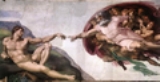
Adam

Encyclopedia
Adam is a figure in the Book of Genesis. According to the creation myth of Abrahamic religions
, he is the first human. In the Genesis creation narratives, he was created by Yahweh
-Elohim ("Yahweh-God", the god of Israel), and the first woman, Eve
(meaning "living") was formed from his rib. He is also mentioned in the Islamic scripture, Qur'an
.
in chapters 2-5. As a masculine noun, 'adam means "man", "mankind" usually in a collective context as in humankind, and may also refer to the individual human. The noun 'adam is also the masculine form of the word adamah which means "ground" or "earth". It is related to the words: adom (red), admoni (ruddy), and dam (blood).
In Genesis 1:27 "adam" is used in the collective sense, whereby not only the individual Adam, but all humans, are created on the sixth day. The interplay between the individual "Adam" and the collective “humankind” is a main literary component to the events that occur in the Garden of Eden
, the ambiguous meanings embedded throughout the moral, sexual, and spiritual terms of the narrative reflecting the complexity of the human condition. Genesis 2:7 is the first verse where "Adam" takes on the sense of an individual man (the first man): the context of sex and gender, prior to these verses, is absent. The gender distinction of "adam" is then reiterated in Genesis 5:1-2 by defining "male and female".
A recurring literary motif that occurs in Gen. 1-8, is the bond between Adam and the earth ("adamah"). Adam is made from the earth, and it is from this "adamah" that Adam gets his name. God's cursing of Adam also results in the earth being cursed,[3:17] and Adam returns to the earth from which he was taken.[3:19] This “earthly” aspect is a component of Adam’s identity, and Adam’s curse of estrangement from the earth seems to render humankind’s divided identity of being earthly yet separated from nature.[8:21]
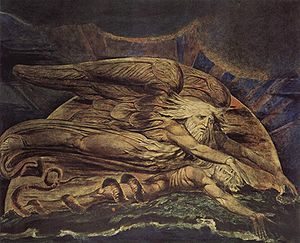 According to Genesis 1, God (Elohim
) created human beings. "Male and female created He them; and blessed them, and called their name Adam..." . Here "Adam" is a general term for "mankind" and refers to the whole of humankind. God blesses "mankind" to "be fruitful and multiply" and ordains that they should have "dominion" (but the exact meaning of the Hebrew is uncertain and disputed) "over the fish of the sea, and over the fowl of the air, and over the cattle, and over all the earth, and over every creeping thing that creepeth upon the earth" .
In God forms "Adam" (this time meaning a single male human) out of "the dust of the ground" and then "breathed into his nostrils the breath of life", causing him to "become a living soul" . God then placed Adam in the Garden of Eden
, giving him the commandment that "Of every tree of the garden thou mayest freely eat: But of the tree of the knowledge of good and evil, thou shalt not eat of it: for in the day that thou eatest thereof thou shalt surely die" .
God then noted that "It is not good that the man should be alone" . He then brought every "beast of the field and every fowl of the air" before Adam and had Adam name all the animals. However, among all the animals, there was not found "a helper suitable for" Adam , so God caused "a deep sleep to fall upon Adam" and took one of his ribs, and from that rib, formed a woman , subsequently named Eve
.
were subsequently expelled from the Garden of Eden, were ceremonially separated from God, and lost their innocence after they broke God's law about not eating of the fruit of the tree of the knowledge of good and evil. This occurred after the serpent
(understood to be Satan
in many Christian traditions) told Eve that eating of the tree would result not in death, but in Adam and Eve's eyes being opened, resulting in their being "as gods, knowing good and evil" (Gen. 3.4-5). Convinced by the serpent's argument, Eve eats of the tree and has Adam do likewise (Gen. 3.6).
As a result, both immediately become aware of the fact that they are naked, and thus cover themselves with garments made of fig
leaves
(Gen. 3.7). Then, finding God walking in the Garden of Eden, Adam and Eve hide themselves from God's presence (Gen. 3.8). God calls to Adam "Where art thou?" (Gen. 3.9, KJV) and Adam responds "I heard thy voice in the garden, and I was afraid, because I was naked; and I hid myself" (Gen. 3.10, KJV). When God then asks Adam if he had eaten of the tree of the knowledge of good and evil, Adam responds that his wife had told him to (Gen. 3.11-12).
As a result of their breaking God's law, the couple were removed from the garden (Gen. 3.23) (the Fall of Man
according to Christian doctrine) and both receive a curse. Adam's curse is contained in Gen. 3.17-19: "Because thou hast hearkened unto the voice of thy wife, and hast eaten of the tree, of which I commanded thee, saying, Thou shalt not eat of it: cursed is the ground for thy sake; in sorrow shalt thou eat of it all the days of thy life; Thorns also and thistles shall it bring forth to thee; and thou shalt eat the herb
of the field: In the sweat of thy face shalt thou eat bread, till thou return unto the ground; for out of it wast thou taken: for dust thou art, and unto dust shalt thou return" (KJV).
. The Book of Jubilees, a second century BC text which is not considered canonical by most Abrahamic faiths, gives Adam the daughters Azura and Awan, who married Seth and Cain, respectively, in incestuous unions.
According to the Genealogies of Genesis
, Adam died at the age of 930. With such numbers, calculations such as those of Archbishop Ussher would suggest that Adam would have died only about 127 years before the birth of Noah
, nine generations after Adam. In other words, Adam's lifespan would have overlapped that of Lamech (father of Noah)
, at least fifty years. Ussher and a group of theologians and scholars in 1630 performed calculations and created a study that reported the creation of Adam on October 23, 4004 BC at 9:00 am and lived until 3074 BC. There was controversy over the fact that Ussher believed the whole creation process occurred on that day.
. The Book of Joshua
mentions a "City of Adam
" at the time that the Israelites crossed the Jordan River on entering Canaan
, but doesn't suggest any relationship between this city and the "first man" of Genesis.
According to some Jewish mystical traditions, the original glory of Adam can be regained through mystical contemplation of God.
In Jewish folklore
, Lilith
is the name of Adam's first wife, who was created at the same time and from the same earth as Adam. She left Adam after she refused to become subservient to Adam and then would not return to the Garden of Eden
after she mated with archangel
Samael
. Her story was greatly developed, during the Middle Ages
, in the tradition of Aggadic midrashim, the Zohar
and Jewish mysticism. The resulting Lilith legend is still commonly used as source material in modern culture, literature, occultism, fantasy and horror.
) to each descending generation. This contrasts with Christ who was conceived without sin by immaculate conception
.
view Adam and Eve as the ones who brought sin, and thus death, into the world by committing the original sin, by disobeying Jehovah's clear command not to eat of the fruit of knowledge of good and evil.
Eve's sin is counted as deliberate disobedience, as she did know that Jehovah had commanded them not to eat, but she is held to have been deceived by the Serpent. (She was deceived only about the effect of their disobedience, not about the will of God on the matter.) Adam's sin is considered even more reproachable, as he had not been deceived. Rather, when confronted with his sin, he attempted to blame both his wife Eve, and Jehovah himself. Genesis 3:12 NWT - "The woman who you gave to be with me, she gave me fruit from the tree and so I ate.". By his sin, he forfeited human perfection and was therefore unable to pass it on to his offspring.
holds that Adam and Michael
the archangel
are the same individual. Michael the archangel fought against and cast out Lucifer
(who became Satan
) and his followers at the conclusion of the War of Heaven
during the pre-mortal existence
(see Book of Revelation
). Michael was born into this mortal existence as the man "Adam, the father of all, the prince of all, the Ancient of Days
" (see Doctrine and Covenants
and ). Mormons also consider Adam to be the first among all the prophets
on earth. Brigham Young
and other early leaders spoke favorably about the Adam–God theory, the idea that Adam and God the Father
were the same person, but it did not become church doctrine and has since been repudiated by the church.
The Latter Day Saints hold the belief that the "Fall" was not a tragedy, but a necessary part of God's plan. They believe that Adam and Eve had to partake of the forbidden fruit in order to fulfill God's will, and that it is good that they did so.
(arabic - Hauwwa) who was also created by the will of God. Allah created Adam from earth (arabic - turaab). Allah commanded "Iblīs", to prostrate in front of Adam but he refused, whereby he was banished from heaven and assumed the role of Satan. Satan (Iblīs
) had lured Adam and Eve into disobeying God by tasting from the forbidden tree (although no reference is necessary as to what he may have tasted, popular culture assumes it was an apple). This was the first act of revenge from Satan for being banished from heaven due to mankind. According to the Qur'an
, Adam and Eve were both tempted by Satan and therefore equally guilty:
Both Adam and Eve were separated and also thrown out of heaven and onto Earth. Adam is said to have landed in Lanka
(modern day Sri Lanka
) where his footprint (Sri Pada) has been preserved (though it is disputed to be authentic). After much repentance, Adam was forgiven and re-united with Eve in Arafat in Saudi Arab. The Qur'an also mentions that Adam was forgiven by God after much repentance..
Adam and Eve are believed to be the source of Humankind in Islam. They produced children in pairs of males and females. One pair was born in the morning whereas the other was born in the evening. Human race started through the incestuous marriages of Adam's children (but the pair born together never married each other).
According to hadith another islamic source The Prophet said, "Allah created Adam, making him 60 cubits tall.(Sahih al-Bukhari, Volume 4, Book 55, Number 543)and Adam long lived as 930 years.
view, Adam was the first Manifestation of God
in recorded history. He is believed by Bahá'ís to have started the Adamic cycle 6000 years ago, which has culminated with Bahá'u'lláh
. The Biblical story of Adam and Eve, according to Bahá'í belief, is allegorical and is explained by `Abdu'l-Bahá
in Some Answered Questions
.
religion, Adam and Eve are seen as dualistic cosmic forces and are complementary to one another. Adam represents the universal mind
and Eve, the universal soul.
Abrahamic religions
Abrahamic religions are the monotheistic faiths emphasizing and tracing their common origin to Abraham or recognizing a spiritual tradition identified with him...
, he is the first human. In the Genesis creation narratives, he was created by Yahweh
Yahweh
Yahweh is the name of God in the Bible, the God of Abraham, Isaac, Jacob, Jews and Christians.The word Yahweh is a modern scholarly convention for the Hebrew , transcribed into Roman letters as YHWH and known as the Tetragrammaton, for which the original pronunciation is unknown...
-Elohim ("Yahweh-God", the god of Israel), and the first woman, Eve
Eve
Eve is the first woman created by God in the Book of Genesis.Eve may also refer to:-People:*Eve , a common given name and surname*Eve , American recording artist and actress-Places:...
(meaning "living") was formed from his rib. He is also mentioned in the Islamic scripture, Qur'an
Qur'an
The Quran , also transliterated Qur'an, Koran, Alcoran, Qur’ān, Coran, Kuran, and al-Qur’ān, is the central religious text of Islam, which Muslims consider the verbatim word of God . It is regarded widely as the finest piece of literature in the Arabic language...
.
Etymology
"Adam" (Hebrew אָדָם comes from the trilateral root אָדַם ( 'ADM ), meaning "red", "fair", "handsome". In the Book of Genesis, Adam occurs as a proper nameProper name
"A proper name [is] a word that answers the purpose of showing what thing it is that we are talking about" writes John Stuart Mill in A System of Logic , "but not of telling anything about it"...
in chapters 2-5. As a masculine noun, 'adam means "man", "mankind" usually in a collective context as in humankind, and may also refer to the individual human. The noun 'adam is also the masculine form of the word adamah which means "ground" or "earth". It is related to the words: adom (red), admoni (ruddy), and dam (blood).
Genesis narrative
In the first five chapters of Genesis the word אָדָם ( 'adam ) is used in all of its senses: collectively ("mankind"),[1:27] individually (a "man"),[2:7] gender nonspecific, ("man and woman")[5:1,2] and male.[2:23-24]In Genesis 1:27 "adam" is used in the collective sense, whereby not only the individual Adam, but all humans, are created on the sixth day. The interplay between the individual "Adam" and the collective “humankind” is a main literary component to the events that occur in the Garden of Eden
Garden of Eden
The Garden of Eden is in the Bible's Book of Genesis as being the place where the first man, Adam, and his wife, Eve, lived after they were created by God. Literally, the Bible speaks about a garden in Eden...
, the ambiguous meanings embedded throughout the moral, sexual, and spiritual terms of the narrative reflecting the complexity of the human condition. Genesis 2:7 is the first verse where "Adam" takes on the sense of an individual man (the first man): the context of sex and gender, prior to these verses, is absent. The gender distinction of "adam" is then reiterated in Genesis 5:1-2 by defining "male and female".
A recurring literary motif that occurs in Gen. 1-8, is the bond between Adam and the earth ("adamah"). Adam is made from the earth, and it is from this "adamah" that Adam gets his name. God's cursing of Adam also results in the earth being cursed,[3:17] and Adam returns to the earth from which he was taken.[3:19] This “earthly” aspect is a component of Adam’s identity, and Adam’s curse of estrangement from the earth seems to render humankind’s divided identity of being earthly yet separated from nature.[8:21]
Creation
Elohim
Elohim is a grammatically singular or plural noun for "god" or "gods" in both modern and ancient Hebrew language. When used with singular verbs and adjectives elohim is usually singular, "god" or especially, the God. When used with plural verbs and adjectives elohim is usually plural, "gods" or...
) created human beings. "Male and female created He them; and blessed them, and called their name Adam..." . Here "Adam" is a general term for "mankind" and refers to the whole of humankind. God blesses "mankind" to "be fruitful and multiply" and ordains that they should have "dominion" (but the exact meaning of the Hebrew is uncertain and disputed) "over the fish of the sea, and over the fowl of the air, and over the cattle, and over all the earth, and over every creeping thing that creepeth upon the earth" .
In God forms "Adam" (this time meaning a single male human) out of "the dust of the ground" and then "breathed into his nostrils the breath of life", causing him to "become a living soul" . God then placed Adam in the Garden of Eden
Garden of Eden
The Garden of Eden is in the Bible's Book of Genesis as being the place where the first man, Adam, and his wife, Eve, lived after they were created by God. Literally, the Bible speaks about a garden in Eden...
, giving him the commandment that "Of every tree of the garden thou mayest freely eat: But of the tree of the knowledge of good and evil, thou shalt not eat of it: for in the day that thou eatest thereof thou shalt surely die" .
God then noted that "It is not good that the man should be alone" . He then brought every "beast of the field and every fowl of the air" before Adam and had Adam name all the animals. However, among all the animals, there was not found "a helper suitable for" Adam , so God caused "a deep sleep to fall upon Adam" and took one of his ribs, and from that rib, formed a woman , subsequently named Eve
Eve (Bible)
Eve was, according to the creation of Abrahamic religions, the first woman created by God...
.
Fall of Man
Adam and EveAdam and Eve
Adam and Eve were, according to the Genesis creation narratives, the first human couple to inhabit Earth, created by YHWH, the God of the ancient Hebrews...
were subsequently expelled from the Garden of Eden, were ceremonially separated from God, and lost their innocence after they broke God's law about not eating of the fruit of the tree of the knowledge of good and evil. This occurred after the serpent
Serpent (Bible)
Serpent is the term used to translate a variety of words in the Hebrew bible, the most common being , , the generic word for "snake"....
(understood to be Satan
Satan
Satan , "the opposer", is the title of various entities, both human and divine, who challenge the faith of humans in the Hebrew Bible...
in many Christian traditions) told Eve that eating of the tree would result not in death, but in Adam and Eve's eyes being opened, resulting in their being "as gods, knowing good and evil" (Gen. 3.4-5). Convinced by the serpent's argument, Eve eats of the tree and has Adam do likewise (Gen. 3.6).
As a result, both immediately become aware of the fact that they are naked, and thus cover themselves with garments made of fig
Ficus
Ficus is a genus of about 850 species of woody trees, shrubs, vines, epiphytes, and hemiepiphyte in the family Moraceae. Collectively known as fig trees or figs, they are native throughout the tropics with a few species extending into the semi-warm temperate zone. The Common Fig Ficus is a genus of...
leaves
Leaf
A leaf is an organ of a vascular plant, as defined in botanical terms, and in particular in plant morphology. Foliage is a mass noun that refers to leaves as a feature of plants....
(Gen. 3.7). Then, finding God walking in the Garden of Eden, Adam and Eve hide themselves from God's presence (Gen. 3.8). God calls to Adam "Where art thou?" (Gen. 3.9, KJV) and Adam responds "I heard thy voice in the garden, and I was afraid, because I was naked; and I hid myself" (Gen. 3.10, KJV). When God then asks Adam if he had eaten of the tree of the knowledge of good and evil, Adam responds that his wife had told him to (Gen. 3.11-12).
As a result of their breaking God's law, the couple were removed from the garden (Gen. 3.23) (the Fall of Man
The Fall of Man
In Christian doctrine, the Fall of Man, or simply the Fall, refers to the transition of the first humans from a state of innocent obedience to God to a state of guilty disobedience to God. In Genesis chapter 2, Adam and Eve live at first with God in a paradise, but the serpent tempts them into...
according to Christian doctrine) and both receive a curse. Adam's curse is contained in Gen. 3.17-19: "Because thou hast hearkened unto the voice of thy wife, and hast eaten of the tree, of which I commanded thee, saying, Thou shalt not eat of it: cursed is the ground for thy sake; in sorrow shalt thou eat of it all the days of thy life; Thorns also and thistles shall it bring forth to thee; and thou shalt eat the herb
Herb
Except in botanical usage, an herb is "any plant with leaves, seeds, or flowers used for flavoring, food, medicine, or perfume" or "a part of such a plant as used in cooking"...
of the field: In the sweat of thy face shalt thou eat bread, till thou return unto the ground; for out of it wast thou taken: for dust thou art, and unto dust shalt thou return" (KJV).
Post-expulsion
After his expulsion from Eden, Adam was forced to work hard for his food for the first time. According to the Book of Genesis, he bore three children with Eve named as Cain, Abel, and SethSeth
Seth , in Judaism, Christianity and Islam, is the third listed son of Adam and Eve and brother of Cain and Abel, who are the only other of their children mentioned by name...
. The Book of Jubilees, a second century BC text which is not considered canonical by most Abrahamic faiths, gives Adam the daughters Azura and Awan, who married Seth and Cain, respectively, in incestuous unions.
According to the Genealogies of Genesis
Genealogies of Genesis
The genealogies of Genesis record the descendants of Adam and Eve to Abraham, including the age at which each patriarch fathered his named son and the number of years he lived thereafter. The genealogy contains two branches: for Cain, given in Chapter 4, and for Seth in Chapter 5...
, Adam died at the age of 930. With such numbers, calculations such as those of Archbishop Ussher would suggest that Adam would have died only about 127 years before the birth of Noah
Noah
Noah was, according to the Hebrew Bible, the tenth and last of the antediluvian Patriarchs. The biblical story of Noah is contained in chapters 6–9 of the book of Genesis, where he saves his family and representatives of all animals from the flood by constructing an ark...
, nine generations after Adam. In other words, Adam's lifespan would have overlapped that of Lamech (father of Noah)
Lamech (father of Noah)
Lamech is a character in the genealogies of Adam in the Book of Genesis.- Family :Lamech is the eighth generation descendant of Seth , the son of Methuselah and the father of Noah , in the genealogy of Seth in Genesis 5. In Genesis 5:12-25, Lamech was a son of Methuselah who was a grandson of...
, at least fifty years. Ussher and a group of theologians and scholars in 1630 performed calculations and created a study that reported the creation of Adam on October 23, 4004 BC at 9:00 am and lived until 3074 BC. There was controversy over the fact that Ussher believed the whole creation process occurred on that day.
Jewish traditions
In rabbinic writings and the Dead Sea Scrolls, Adam is a perfect human before his exile from Eden, but is diminished in stature when exiled. A traditional Jewish belief is that after Adam died, he was buried in the Cave of Machpelah in HebronHebron
Hebron , is located in the southern West Bank, south of Jerusalem. Nestled in the Judean Mountains, it lies 930 meters above sea level. It is the largest city in the West Bank and home to around 165,000 Palestinians, and over 500 Jewish settlers concentrated in and around the old quarter...
. The Book of Joshua
Book of Joshua
The Book of Joshua is the sixth book in the Hebrew Bible and of the Old Testament. Its 24 chapters tell of the entry of the Israelites into Canaan, their conquest and division of the land under the leadership of Joshua, and of serving God in the land....
mentions a "City of Adam
City of Adam
The City of Adam stood "beside Zarethan" on the east bank of the Jordan, it is called also "Damia". According to the Book of Joshua, the flow of the water was arrested, and rose up "upon an heap" at the time of the Israelites' passing over....
" at the time that the Israelites crossed the Jordan River on entering Canaan
Canaan
Canaan is a historical region roughly corresponding to modern-day Israel, Palestine, Lebanon, and the western parts of Jordan...
, but doesn't suggest any relationship between this city and the "first man" of Genesis.
According to some Jewish mystical traditions, the original glory of Adam can be regained through mystical contemplation of God.
In Jewish folklore
Jewish mythology
Jewish mythology is generally the sacred and traditional narratives that help explain and symbolize the Jewish religion, whereas Jewish folklore consists of the folk tales and legends that existed in the general Jewish culture. There is very little early folklore distinct from the aggadah literature...
, Lilith
Lilith
Lilith is a character in Jewish mythology, found earliest in the Babylonian Talmud, who is generally thought to be related to a class of female demons Līlīṯu in Mesopotamian texts. However, Lowell K. Handy notes, "Very little information has been found relating to the Akkadian and Babylonian view...
is the name of Adam's first wife, who was created at the same time and from the same earth as Adam. She left Adam after she refused to become subservient to Adam and then would not return to the Garden of Eden
Garden of Eden
The Garden of Eden is in the Bible's Book of Genesis as being the place where the first man, Adam, and his wife, Eve, lived after they were created by God. Literally, the Bible speaks about a garden in Eden...
after she mated with archangel
Archangel
An archangel is an angel of high rank. Archangels are found in a number of religious traditions, including Judaism, Christianity and Islam. Michael and Gabriel are recognized as archangels in Judaism and by most Christians. Michael is the only archangel specifically named in the Protestant Bible...
Samael
Samael
Samael is an important archangel in Talmudic and post-Talmudic lore, a figure who is accuser, seducer and destroyer, and has been regarded as both good and evil...
. Her story was greatly developed, during the Middle Ages
Middle Ages
The Middle Ages is a periodization of European history from the 5th century to the 15th century. The Middle Ages follows the fall of the Western Roman Empire in 476 and precedes the Early Modern Era. It is the middle period of a three-period division of Western history: Classic, Medieval and Modern...
, in the tradition of Aggadic midrashim, the Zohar
Zohar
The Zohar is the foundational work in the literature of Jewish mystical thought known as Kabbalah. It is a group of books including commentary on the mystical aspects of the Torah and scriptural interpretations as well as material on Mysticism, mythical cosmogony, and mystical psychology...
and Jewish mysticism. The resulting Lilith legend is still commonly used as source material in modern culture, literature, occultism, fantasy and horror.
Early Christian views
In Augustine’s reinterpretation of Pauline theology, Adam’s sin is transmitted by sexual relations (specifically by semenSemen
Semen is an organic fluid, also known as seminal fluid, that may contain spermatozoa. It is secreted by the gonads and other sexual organs of male or hermaphroditic animals and can fertilize female ova...
) to each descending generation. This contrasts with Christ who was conceived without sin by immaculate conception
Immaculate Conception
The Immaculate Conception of Mary is a dogma of the Roman Catholic Church, according to which the Virgin Mary was conceived without any stain of original sin. It is one of the four dogmata in Roman Catholic Mariology...
.
Jehovah's Witnesses
Jehovah's WitnessesJehovah's Witnesses
Jehovah's Witnesses is a millenarian restorationist Christian denomination with nontrinitarian beliefs distinct from mainstream Christianity. The religion reports worldwide membership of over 7 million adherents involved in evangelism, convention attendance of over 12 million, and annual...
view Adam and Eve as the ones who brought sin, and thus death, into the world by committing the original sin, by disobeying Jehovah's clear command not to eat of the fruit of knowledge of good and evil.
Eve's sin is counted as deliberate disobedience, as she did know that Jehovah had commanded them not to eat, but she is held to have been deceived by the Serpent. (She was deceived only about the effect of their disobedience, not about the will of God on the matter.) Adam's sin is considered even more reproachable, as he had not been deceived. Rather, when confronted with his sin, he attempted to blame both his wife Eve, and Jehovah himself. Genesis 3:12 NWT - "The woman who you gave to be with me, she gave me fruit from the tree and so I ate.". By his sin, he forfeited human perfection and was therefore unable to pass it on to his offspring.
Latter Day Saints
The Latter Day Saint movementLatter Day Saint movement
The Latter Day Saint movement is a group of independent churches tracing their origin to a Christian primitivist movement founded by Joseph Smith, Jr. in the late 1820s. Collectively, these churches have over 14 million members...
holds that Adam and Michael
Michael (archangel)
Michael , Micha'el or Mîkhā'ēl; , Mikhaḗl; or Míchaël; , Mīkhā'īl) is an archangel in Jewish, Christian, and Islamic teachings. Roman Catholics, Anglicans, and Lutherans refer to him as Saint Michael the Archangel and also simply as Saint Michael...
the archangel
Archangel
An archangel is an angel of high rank. Archangels are found in a number of religious traditions, including Judaism, Christianity and Islam. Michael and Gabriel are recognized as archangels in Judaism and by most Christians. Michael is the only archangel specifically named in the Protestant Bible...
are the same individual. Michael the archangel fought against and cast out Lucifer
Lucifer
Traditionally, Lucifer is a name that in English generally refers to the devil or Satan before being cast from Heaven, although this is not the original meaning of the term. In Latin, from which the English word is derived, Lucifer means "light-bearer"...
(who became Satan
Satan
Satan , "the opposer", is the title of various entities, both human and divine, who challenge the faith of humans in the Hebrew Bible...
) and his followers at the conclusion of the War of Heaven
War of Heaven
War in Heaven is a concept in Christian eschatology. The term occurs only once in the New Testament at . Though the term does not occur in the Hebrew Bible, parallels have been drawn from various passages regarding Fallen angels in the Book of Genesis, and the Book of Isaiah. Some also suggest...
during the pre-mortal existence
Pre-existence
Pre-existence , beforelife, or pre-mortal existence refers to the belief that each individual human soul existed before conception, and at conception one of these pre-existent souls enters, or is placed by God, in the body...
(see Book of Revelation
Book of Revelation
The Book of Revelation is the final book of the New Testament. The title came into usage from the first word of the book in Koine Greek: apokalupsis, meaning "unveiling" or "revelation"...
). Michael was born into this mortal existence as the man "Adam, the father of all, the prince of all, the Ancient of Days
Ancient of Days
Ancient of Days is a name for God in Aramaic: Atik Yomin; in the Greek Septuagint: Palaios Hemeron; and in the Vulgate: Antiquus Dierum....
" (see Doctrine and Covenants
Doctrine and Covenants
The Doctrine and Covenants is a part of the open scriptural canon of several denominations of the Latter Day Saint movement...
and ). Mormons also consider Adam to be the first among all the prophets
Prophet, seer, and revelator
Prophet, seer, and revelator is an ecclesiastical title used in The Church of Jesus Christ of Latter-day Saints that is currently applied to the members of the First Presidency and the Quorum of the Twelve Apostles...
on earth. Brigham Young
Brigham Young
Brigham Young was an American leader in the Latter Day Saint movement and a settler of the Western United States. He was the President of The Church of Jesus Christ of Latter-day Saints from 1847 until his death in 1877, he founded Salt Lake City, and he served as the first governor of the Utah...
and other early leaders spoke favorably about the Adam–God theory, the idea that Adam and God the Father
God the Father
God the Father is a gendered title given to God in many monotheistic religions, particularly patriarchal, Abrahamic ones. In Judaism, God is called Father because he is the creator, life-giver, law-giver, and protector...
were the same person, but it did not become church doctrine and has since been repudiated by the church.
The Latter Day Saints hold the belief that the "Fall" was not a tragedy, but a necessary part of God's plan. They believe that Adam and Eve had to partake of the forbidden fruit in order to fulfill God's will, and that it is good that they did so.
Seventh-day Adventists
Seventh-day Adventist believe that the importance of the literal creation time-line is pivotal to the story of humanity, their relationship to God, and the plan of salvation and atonement for Adam and Eve’s transgression (fall), by which all their descendants are under subjugation. The Bible states, “Since by man (Adam) came death, by man (Jesus the Christ) came also the resurrection... (I Cor. 15:21).” To disavow a literal creation and our first parents (Adam and Eve) nearly 6,000 years ago negates a fundamental, orthodox doctrine and the supremacy of the Holy Bible that the sovereign, triune God --“Let Us make man in Our image, according to Our likeness; and let them rule over the fish of the sea and over the birds of the sky and over the cattle and over all the earth, and over every creeping thing that creeps on the earth,” (Genesis 1:26 NASB)—according to His own purpose and counsel and for His own glory, created humanity in the Biblical/Torah account.Islamic view
In Islam, Adam is considered the first Prophet of God (Allah) and the husband of EveEve
Eve is the first woman created by God in the Book of Genesis.Eve may also refer to:-People:*Eve , a common given name and surname*Eve , American recording artist and actress-Places:...
(arabic - Hauwwa) who was also created by the will of God. Allah created Adam from earth (arabic - turaab). Allah commanded "Iblīs", to prostrate in front of Adam but he refused, whereby he was banished from heaven and assumed the role of Satan. Satan (Iblīs
Devil (Islam)
In Islam, the Devil is known as or . According to the Qurʾān, God created Iblis out of "smokeless fire or from the pure flame of fire" and created man out of clay...
) had lured Adam and Eve into disobeying God by tasting from the forbidden tree (although no reference is necessary as to what he may have tasted, popular culture assumes it was an apple). This was the first act of revenge from Satan for being banished from heaven due to mankind. According to the Qur'an
Qur'an
The Quran , also transliterated Qur'an, Koran, Alcoran, Qur’ān, Coran, Kuran, and al-Qur’ān, is the central religious text of Islam, which Muslims consider the verbatim word of God . It is regarded widely as the finest piece of literature in the Arabic language...
, Adam and Eve were both tempted by Satan and therefore equally guilty:
"Then began Satan to whisper suggestions to them, bringing openly before their minds all their shame that was hidden from them (before): he said: 'Your Lord only forbade you this tree, lest ye should become angels or such beings as live for ever.' And he swore to them both, that he was their sincere adviser. So by deceit he brought about their fall: when they tasted of the tree, their shame became manifest to them, and they began to sew together the leaves of the garden over their bodies. And their Lord called unto them: Did I not forbid you that tree, and tell you that Satan was an avowed enemy unto you?"
Both Adam and Eve were separated and also thrown out of heaven and onto Earth. Adam is said to have landed in Lanka
Lanka
Sri Lanka is the name given in Hindu mythology to the island fortress capital of the legendary king Ravana in the great Hindu epics, the Ramayana and the Mahabharata...
(modern day Sri Lanka
Sri Lanka
Sri Lanka, officially the Democratic Socialist Republic of Sri Lanka is a country off the southern coast of the Indian subcontinent. Known until 1972 as Ceylon , Sri Lanka is an island surrounded by the Indian Ocean, the Gulf of Mannar and the Palk Strait, and lies in the vicinity of India and the...
) where his footprint (Sri Pada) has been preserved (though it is disputed to be authentic). After much repentance, Adam was forgiven and re-united with Eve in Arafat in Saudi Arab. The Qur'an also mentions that Adam was forgiven by God after much repentance..
Adam and Eve are believed to be the source of Humankind in Islam. They produced children in pairs of males and females. One pair was born in the morning whereas the other was born in the evening. Human race started through the incestuous marriages of Adam's children (but the pair born together never married each other).
According to hadith another islamic source The Prophet said, "Allah created Adam, making him 60 cubits tall.(Sahih al-Bukhari, Volume 4, Book 55, Number 543)and Adam long lived as 930 years.
Bahá'í view
In the Bahá'íBahá'í Faith
The Bahá'í Faith is a monotheistic religion founded by Bahá'u'lláh in 19th-century Persia, emphasizing the spiritual unity of all humankind. There are an estimated five to six million Bahá'ís around the world in more than 200 countries and territories....
view, Adam was the first Manifestation of God
Manifestation of God
The Manifestation of God is a concept in the Bahá'í Faith that refers to what are commonly called prophets. The Manifestations of God are a series of personages who reflect the attributes of the divine into the human world for the progress and advancement of human morals and civilization...
in recorded history. He is believed by Bahá'ís to have started the Adamic cycle 6000 years ago, which has culminated with Bahá'u'lláh
Bahá'u'lláh
Bahá'u'lláh , born ' , was the founder of the Bahá'í Faith. He claimed to be the prophetic fulfilment of Bábism, a 19th-century outgrowth of Shí‘ism, but in a broader sense claimed to be a messenger from God referring to the fulfilment of the eschatological expectations of Islam, Christianity, and...
. The Biblical story of Adam and Eve, according to Bahá'í belief, is allegorical and is explained by `Abdu'l-Bahá
`Abdu'l-Bahá
‘Abdu’l-Bahá , born ‘Abbás Effendí, was the eldest son of Bahá'u'lláh, the founder of the Bahá'í Faith. In 1892, `Abdu'l-Bahá was appointed in his father's will to be his successor and head of the Bahá'í Faith. `Abdu'l-Bahá was born in Tehran to an aristocratic family of the realm...
in Some Answered Questions
Some Answered Questions
Some Answered Questions was first published in 1908. It contains questions asked to `Abdu'l-Bahá, son of the founder of the Bahá'í Faith, by Laura Clifford Barney, during several of her visits to Haifa between 1904 and 1906, and `Abdu'l-Bahá's answers to these questions.Prominent among the topics...
.
Druze belief
In the DruzeDruze
The Druze are an esoteric, monotheistic religious community, found primarily in Syria, Lebanon, Israel, and Jordan, which emerged during the 11th century from Ismailism. The Druze have an eclectic set of beliefs that incorporate several elements from Abrahamic religions, Gnosticism, Neoplatonism...
religion, Adam and Eve are seen as dualistic cosmic forces and are complementary to one another. Adam represents the universal mind
Universal mind
One Universal Mind, Universal Mind, is a generic term for the universal Higher consciousness or source of being in some forms of esoteric or New Thought and spiritual philosophy. It may be considered synonymous with the Subjective Mind or it may be referred to in the context of creative...
and Eve, the universal soul.
See also
- Adam and EveAdam and EveAdam and Eve were, according to the Genesis creation narratives, the first human couple to inhabit Earth, created by YHWH, the God of the ancient Hebrews...
- Adam KadmonAdam KadmonIn the religious writings of Kabbalah, Adam Kadmon is a phrase meaning "Primal Man". The oldest rabbinical source for the term "Adam ha-Ḳadmoni" is Num. R. x., where Adam is styled, not as usually, "Ha-Rishon" , "Ha-Kadmoni" ....
- Banu (Arabic)Banu (Arabic)Banu is Arabic for "the sons of" or "children of" and appears before the name of a tribal progenitor. The English counterpart would be "House of", for example the House of Saud...
- Paradise LostParadise LostParadise Lost is an epic poem in blank verse by the 17th-century English poet John Milton. It was originally published in 1667 in ten books, with a total of over ten thousand individual lines of verse...
- Table of prophets of Abrahamic religionsTable of prophets of Abrahamic religionsThis is a table containing prophets of the modern Abrahamic religions.NOTE: In Judaism the classification of some people as prophets includes those who are not explicitly called so in the Hebrew Bible. Judaism also uses religious texts other than the Hebrew Bible to define prophets. Moreover,...
- Y-chromosomal AdamY-chromosomal AdamIn human genetics, Y-chromosomal Adam is the theoretical most recent common ancestor from whom all living people are descended patrilineally . Many studies report that Y-chromosomal Adam lived as early as around 142,000 years ago and possibly as recently as 60,000 years ago...
- Mahabad (prophet)Mahabad (Prophet)Mahabad is believed to be a pre-Zoroastrian Prophet and may be an alternative name for Adam. He is also called "Azar Hooshang" ....