

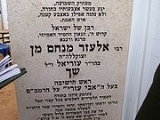
Elazar Shach

Encyclopedia
Elazar Menachem Man Shach also spelt Eliezer Schach, (January 1, 1899 O.S.
– November 2, 2001) was a leading Lithuanian
-born and educated Haredi
rabbi
in Bnei Brak, Israel
. He also served as one of three co-deans of the Ponevezh yeshiva
in Bnei Brak along with Rabbis Shmuel Rozovsky
and Dovid Povarsky
. He founded the Degel HaTorah
political party representing Lithuanian
Ashkenazi Jews
in the Israeli Knesset
, many of whom considered him to be the greatest scholar of the generation and used the honorific Maran ("[our] master") when referring to him.
He was recognized as a Talmud
ic scholar par excellence by both Rabbi Yitzchak Zev Soloveitchik
(the Brisker Rav) and Rabbi Isser Zalman Meltzer
(his wife's uncle) in their approbations to his Avi Ezri, a commentary on the Mishneh Torah
. Soloveitchik made efforts to help with the distribution of the (first edition of the) Avi Ezri among Torah scholars.
Shach served as head of the Moetzes Gedolei HaTorah
, chairman of Chinuch Atzmai
and Va'ad HaYeshivos, as well as the honorary president of hundreds of yeshivos and organizations worldwide.
, pronounced Vaboilnik in Yiddish), a rural village in northern Lithuania
to Rabbi Ezriel and Batsheva Shach. The Shach family had been merchants for generations, but Batsheva's family, the Levitans, were religious scholars who served various Lithuanian communities. Batsheva's brother, Rabbi Osher Nisan Levitan, later became an important figure in the Union of Orthodox Rabbis
. Elazar was a child prodigy, and was sent to study in the Ponevezh yeshiva
at age seven.
When World War I
began in 1914, many of the Slabodka yeshiva students were dispersed across Europe. Shach initially returned to his family but then began traveling across Lithuania from town to town, sleeping and eating wherever he could while continuing to study Torah. After the war Shach rejoined Meltzer and his son-in-law, Rabbi Aharon Kotler
, in Kletsk
, Poland. When Meltzer returned to Slutsk, Shach followed him (the Slutsk yeshiva later gained fame as the Lakewood yeshiva in America).
Meltzer became both a father figure and patron to the young Shach, even arranging his marriage with his niece, Guttel, in 1923. Shach received rabbinical ordination
from Meltzer, and from 1927 to 1932 taught in the Kletsk yeshiva. After the passing of Rabbi Meir Shapiro
, head of the Chachmei Lublin Yeshiva
, Rabbi Chaim Ozer Grodzinski
sent the yeshivah's administrators a letter, recommending Shach for the position. After delivering a discourse at the Chachmei Lublin Yeshiva, Shach traveled to Vilna to consult with Grodzinski about the wisdom of taking on the new position, and upon hearing the various aspects of the question, Grodzinski advised Shach to turn down the offer. Shach then taught Talmud at the Novardok yeshiva
. In 1936 he became rosh yeshiva at the Karlin
yeshiva in Luninets.
and the Holocaust
, several yeshivas began considering evacuating their rabbis, students and families. Kotler eventually left for America, traveling across Siberia
and arriving in the United States during the war. In 1939 Shach first went to Vilna, where he stayed with Rabbi Chaim Ozer Grodzinski
. Later that year both Shach's mother and his eldest daughter fell ill and died. In early 1940 the Shach family decided to leave Lithuania. Shach's maternal uncle, Rabbi Aron Levitan, had helped Kotler get emigration visas, but Shach decided instead to go to Palestine, where Meltzer was serving as Rosh Yeshiva at Etz Chaim Yeshiva
in Jerusalem, (Shach would later serve as the Rosh Yeshiva there as well). His uncle helped him and his family get immigration certificates and took them in after they arrived at his doorstep, destitute.
Several years after the re-establishment of the Ponevezh yeshiva in Bnei Brak, he was asked to be one of its deans. He served in that capacity until his passing. At this yeshiva, Shach taught thousands of students, some of whom eventually assumed prominent positions as rosh yeshivas and rabbis in both Israel and abroad.
s and kollel
s full-time gained popularity. Although this type of setup had been comparatively rare in Europe before World War II, it became the norm in some Haredi communities in Israel and the United States, with some financial backing from Haredi communities, as well as subsidies to young families with many children from the Israeli government. At the same time, however, Shach said on many occasions that the Jewish people consists of both Torah scholars and balabatim (lay people) who support Torah learning. “Everyone is required to serve Hashem,” he said, “but not everyone can do so by means of learning all day.” Shach is also quoted as saying that although the yeshivas are the heart of the Jewish people, it is the ba'alei teshuvah who will be the one's to bring Mashiach. Shach's position as magid shiur in the Novardok yeshiva
in Jerusalem came about as a result of the recommendation of the Chazon Ish to one of the Yeshiva's founders, Rabbi Bentzion Brook. Whenever it would come to signing a public proclamation or letter on behalf of Klal Yisrael (the Jewish community), the Steipler insisted that Shach's signature appear before his. It was not uncommon for the Steipler to come to Shach unannounced in order to consult with him on a matter of vital concern for the Jewish people.
When Shach was asked about opening a yeshiva exclusively for gifted boys, he said that it is impossible to know beforehand who will grow in Torah knowledge and who will not, and that all boys should therefore be given equal opportunities.
Shach was a member of the Moetzes Gedolei HaTorah
of Israel beginning the 1970s, having been appointed to that body by the Chazon Ish. Shach had been instrumental in the formation of the Sephardi Shas
party, which is now under the sole spiritual leadership of his one-time ally, Rabbi Ovadia Yosef
.
Shas ran for the 11th Knesset in 1984, and Shach called upon his "Lithuanian
" followers to vote for it in the polls, a move that many saw as key political and religious move in Shach's split with the Hasidic-controlled Agudat Israel
. While initially Shas was largely under the aegis of Shach, Yosef gradually exerted control over the party, culminating in Shas' decision to support the Labor
party in the 13th Knesset in 1992, something both Degel HaTorah and Agudat Israel opposed.
On the eve of the November 1988 election
, Shach officially broke away from Agudat Israel in protest at Hamodia
publishing, as paid advertisements, a series of articles based on the teachings of the Lubavitcher Rebbe, Rabbi Menachem Mendel Schneerson
. Shach criticized Schneerson for his presumed messianic aspirations. Shach wanted the Aguda party to oppose Lubavitch, however all but one (Belz
) of the Hasidic sects within the party refused to back him. Shach and his followers then formed the Degel HaTorah
("Flag of Torah") party to represent the non-Hasidic Ashkenazi
Haredim. Schneerson mobilized his followers to support the Agudat Israel party. While Aguda secured nearly three times the amount of votes it had in 1984, and increased its Knesset representation from two seats to five, Degel HaTorah won only two seats. After the bitter contest in the 1988 elections, Degel HaTorah agreed to work together with Agudat Israel and combine forces in the 1992 elections, under the name of United Torah Judaism
, an agreement which has continued to the present.
Around 1995 Shach's political activity diminished, following deterioration in his health, before later ceasing altogether. Since then, the two main leaders of the Degel HaTorah
party have been Rabbis Yosef Shalom Eliashiv and Aharon Leib Shteinman.
Shach was deeply opposed to Zionism
, both secular and religious. He was fiercely dismissive of secular Israel
is and their culture. For example, during a 1990 speech he lambasted kibbutz
niks as "breeders of rabbits and pigs" who did not "know what Yom Kippur is". In the same speech he said that the Labor Party had cut themselves off from their Jewish past and wished to "seek a new Torah". Shach never seemed concerned over the discord his harsh statements might cause, saying that "There is no need to worry about machlokes [dispute]...one is obligated to be a baal-machlokes [disputant]. It is no feat to be in agreement with everybody!" Shach was also critical of democracy, once referring to it as a "cancer", adding that "only the sacred Torah is the true democracy."
Shach supported the withdrawal from land under Israeli control, basing it upon the Halakhic principle of Pikuach Nefesh
("[the] saving [of a] life"), in which the preservation of lives takes precedence over nearly all other obligations in the Torah, including those pertaining to the sanctity of land. He also criticized Israeli settlements in the West Bank
and Gaza Strip
(at that time mainly settled by secular and Religious Zionist
Jews) as "a blatant attempt to provoke the international community", and called on Haredim to avoid moving to such communities.
Approximately 200,000 people attended Shach's funeral, and after his death, Prime Minister Ariel Sharon
noted appreciation for his work, saying "There is no doubt that we have lost an important person who made his mark over many years. I express condolences on behalf of all of us; we share in the mourning and sorrow of his family and the haredi community."
Rebbe, Rabbi Menachem Mendel Schneerson
, from the 1970s through Schneerson's death in 1994. He accused Schneerson's followers of false Messianism, and Schneerson of fomenting a cult of crypto-messianism around himself. He objected to Schneerson's call for "demanding" the Messiah's appearance. When some of Schneerson's followers proclaimed him the Messiah, Shach called for a complete boycott of Chabad, its institutions and projects by its constituents. In 1988 Shach explicitly denounced Schneerson as a meshiach sheker (false messiah). Shach also compared Chabad and Schneerson to the followers of the 17th century false messiah Sabbatai Zevi
.
Pointing to a statement by Schneerson that a rebbe is "the Essence and Being [of God] clothed a body", Shach described this as nothing short of idolatry. His followers refused to eat meat slaughtered by Lubavitch shochetim or to recognize Chabad Hasidim as adherents of authentic Judaism. Shach once described Schneerson as "the madman who sits in New York and drives the whole world crazy.".
In addition to Shach's objections to certain Chabad members proclaiming Schneerson to be the Messiah, he also argued against the Chabad position on many other issues. Chabad strongly opposed both peace talks with the Palestinians and relinquishing territory to them under any circumstances, while Shach supported the land-for-peace approach. During the 1988 elections, Schneerson endorsed Agudat Yisrael over Shach's newly-formed Degel HaTorah
party, and instructed Israeli Chabad to campaign for it. Shach is quoted as saying: "I have heard claims made in my name that at a gathering connected with the upcoming elections, I said the people of Chabad are not Jews. I publicly announce that in malice do they distort my words! I spoke in Hebrew, and this is what I said: what they [Chabad] do is not the "Jewish" way. They distorted my words on purpose to damage and libel me for they think that from this they will derive some benefit and gather more votes in these elections. And when they claimed that I called them the children of an impure woman, I testify before heaven and earth that I never said words such as these but only criticized their effort to build a ritual bath that was not in line with the standards of the Chazon Ish, may the memory of this righteous man be a blessing... I do not forgive anyone who fabricates words on his own and then says that I said them. And with this I request that each and every one will pass these words to his fellow."
Rav Joseph B. Soloveitchik
In a lengthy attack on Rav Joseph B. Soloveitchik, Shach accused him of writing "things that are forbidden to hear" as well as "...endangering the survival of Torah-true Judaism by indoctrinating the masses with actual words of heresy".
The Gerer Rebbe
Shach resigned from the Council of Torah Greats following tensions between him and the Gerer Rebbe, Rabbi Simcha Bunim Alter. In the Eleventh Knesset elections, Shach had already told his supporters to vote for Shas instead of Agudat Israel. Some perceive the schism as the reemergence of the dissent between Hassidim and Mitnagdim, as Shach represents the Lithuanian Torah world while the Gerer Rebbe is among the most important Hassidic rebbes and represents the most significant Hassidic sect in Agudat Israel. However, it is grossly inaccurate to base the entire conflict on a renewal of the historic dispute between Hassidim and Mitnagdim which began in the latter half of the eighteenth century
Rav Adin Steinsaltz
Rav Adin Steinsaltz
(Even-Yisrael), was likewise accused of heresy by Shach, who, in a letter written September 10, 1988, wrote that "…and similarly all his other works contain heresy. It is forbidden to debate with Steinsaltz, because, as a heretic, all the debates will only cause him to degenerate more. He is not a genuine person (ein tocho ke-baro) and everyone is obliged to distance themselves from him. This is the duty of the hour (mitzvah be-sha’atah). It will generate merit for the forthcoming Day of Judgement." In the summer of 1989, a group of rabbis including Shach placed a ban on all of Steinsaltz's works.
He was also critical of Rabbi Yehuda (Leo) Levi
.
The Modern Orthodox and Yeshiva University
Shach wrote that YU type institutions are an entirely negative phenomenon posing a threat to the very endurance of authentic Judaism. When opposing having such an institution in Israel, Shach said that these modern conceptions were "an absolute disaster, causing the destruction of our Holy Torah. Even the so-called ‘Touro College’ in the USA is a terrible disaster, a 'churban ha-das' (destruction of the Jewish religion)..."
Shach further writes that the success of those people who were able to achieve greatness in Torah despite their involvement in secular studies are "ma'aseh satan" (the work of the satanic forces) for the existence of such role models will entice others to follow suit, only to be doomed
In a conversation that he had with an American rabbi in the 1980s, Shach stated, "The Americans think that I am too controversial and divisive. But in a time when no one else is willing to speak up on behalf of our true tradition, I feel myself impelled to do so."
Regarding his opposition to the present day Chabad movement, someone mentioned to Shach that "after 120 years, when you go to Heaven, you will merit a warm handshake from the Vilna Gaon
." Shach responded, "The Vilna Gaon will shake my hand!? The Baal HaTanya will be the one to shake my hand!"
, Shimon Schwab
, Mordechai Gifter
, Shneur Kotler
, Avraham Yaakov Pam
, Aharon Schechter, Henoch Leibowitz
, Yaakov Yitzchok Ruderman, and Elya Svei
) decided that a public protest for the honor of Shach was necessary. One protest was held at Kaminetz Yeshiva in New York, and another at Ner Yisrael in Baltimore.
. Devorah married Rabbi Meir Tzvi Bergman, and had 9 children. Ephraim was unsatisfied with the Haredi lifestyle and eventually joined the Religious Zionist camp. He served in the Israel Defense Forces
, received a doctorate
in history
and philosophy
, and worked as a supervisor for the Israel Ministry of Education. Ephraim married Tamara Yarlicht-Kowalsky and had 2 children. He passed away October 17, 2011, at the age of 81.
His wife, Guttel Schach died in 1969 from complications relating to diabetes.
Audio:
Videos:
Misc.:
Old Style and New Style dates
Old Style and New Style are used in English language historical studies either to indicate that the start of the Julian year has been adjusted to start on 1 January even though documents written at the time use a different start of year ; or to indicate that a date conforms to the Julian...
– November 2, 2001) was a leading Lithuanian
Lithuanian Jews
Lithuanian Jews or Litvaks are Jews with roots in the Grand Duchy of Lithuania:...
-born and educated Haredi
Haredi Judaism
Haredi or Charedi/Chareidi Judaism is the most conservative form of Orthodox Judaism, often referred to as ultra-Orthodox. A follower of Haredi Judaism is called a Haredi ....
rabbi
Rabbi
In Judaism, a rabbi is a teacher of Torah. This title derives from the Hebrew word רבי , meaning "My Master" , which is the way a student would address a master of Torah...
in Bnei Brak, Israel
Israel
The State of Israel is a parliamentary republic located in the Middle East, along the eastern shore of the Mediterranean Sea...
. He also served as one of three co-deans of the Ponevezh yeshiva
Ponevezh yeshiva
Ponevezh Yeshiva, often pronounced Ponevitch Yeshiva, is a world renowned yeshiva located in Bnei Brak, Israel. Donated by Henry Krausher, it was originally established in the town of Panevėžys, Lithuania...
in Bnei Brak along with Rabbis Shmuel Rozovsky
Shmuel Rozovsky
Rabbi Shmuel Rozovsky is known as a Talmudic lecturer at Ponevezh Yeshiva and is counted amongst the great rabbis of his generation. During his heyday, Reb Shmuel was known as the king of the yeshivah world. Hundreds attended his lectures...
and Dovid Povarsky
Dovid Povarsky
Rabbi Dovid Povarsky is known for his erudite Talmudic lectures and his deanship as Rosh Yeshiva of Ponevezh Yeshiva. He was asked by Rabbi Yosef Shlomo Kahaneman to join the previous two heads of the institute, Rabbi Elazar Menachem Shach and Rabbi Shmuel Rozovsky to create a triumvirate in...
. He founded the Degel HaTorah
Degel HaTorah
Degel HaTorah is an Ashkenazi Haredi political party in Israel. For much of its existence it has been allied to Agudat Yisrael under the name United Torah Judaism.-Ideology:...
political party representing Lithuanian
Lithuanian Jews
Lithuanian Jews or Litvaks are Jews with roots in the Grand Duchy of Lithuania:...
Ashkenazi Jews
Ashkenazi Jews
Ashkenazi Jews, also known as Ashkenazic Jews or Ashkenazim , are the Jews descended from the medieval Jewish communities along the Rhine in Germany from Alsace in the south to the Rhineland in the north. Ashkenaz is the medieval Hebrew name for this region and thus for Germany...
in the Israeli Knesset
Knesset
The Knesset is the unicameral legislature of Israel, located in Givat Ram, Jerusalem.-Role in Israeli Government :The legislative branch of the Israeli government, the Knesset passes all laws, elects the President and Prime Minister , approves the cabinet, and supervises the work of the government...
, many of whom considered him to be the greatest scholar of the generation and used the honorific Maran ("[our] master") when referring to him.
He was recognized as a Talmud
Talmud
The Talmud is a central text of mainstream Judaism. It takes the form of a record of rabbinic discussions pertaining to Jewish law, ethics, philosophy, customs and history....
ic scholar par excellence by both Rabbi Yitzchak Zev Soloveitchik
Yitzchak Zev Soloveitchik
Yitzchok Zev Halevi Soloveitchik , also known as Velvel Soloveitchik or as the Brisker Rov Yitzchok Zev Halevi Soloveitchik (Hebrew: יצחק זאב הלוי סולובייצ'יק), also known as Velvel Soloveitchik ("Zev" means "wolf" in Hebrew, and "Velvel" is the diminutive of "wolf" in Yiddish) or as the Brisker...
(the Brisker Rav) and Rabbi Isser Zalman Meltzer
Isser Zalman Meltzer
Isser Zalman Meltzer, , was a famous Lithuanian Orthodox rabbi, rosh yeshiva and posek. He is also known as the "Even HaEzel" - the title of his commentary on Rambam's Mishne Torah....
(his wife's uncle) in their approbations to his Avi Ezri, a commentary on the Mishneh Torah
Mishneh Torah
The Mishneh Torah subtitled Sefer Yad ha-Hazaka is a code of Jewish religious law authored by Maimonides , one of history's foremost rabbis...
. Soloveitchik made efforts to help with the distribution of the (first edition of the) Avi Ezri among Torah scholars.
Shach served as head of the Moetzes Gedolei HaTorah
Moetzes Gedolei HaTorah
Moetzes Gedolei HaTorah refers to the supreme rabbinical policy-making council of any of several related Haredi Jewish organizations....
, chairman of Chinuch Atzmai
Chinuch Atzmai
Chinuch Atzmai was founded in 1953 by the Moetzes Gedolei HaTorah to serve as an alternate school system for Orthodox children in Israel. It was initially led by Rabbi Zalman Sorotzkin....
and Va'ad HaYeshivos, as well as the honorary president of hundreds of yeshivos and organizations worldwide.
Life in Europe
Shach was born in Wabolninkas (VabalninkasVabalninkas
Vabalninkas is a city in the Biržai district municipality, Lithuania. It is located south of Biržai.-Notable residents:*Rabbi Elazar Shach, born and raised in Vabalninkas....
, pronounced Vaboilnik in Yiddish), a rural village in northern Lithuania
Lithuania
Lithuania , officially the Republic of Lithuania is a country in Northern Europe, the biggest of the three Baltic states. It is situated along the southeastern shore of the Baltic Sea, whereby to the west lie Sweden and Denmark...
to Rabbi Ezriel and Batsheva Shach. The Shach family had been merchants for generations, but Batsheva's family, the Levitans, were religious scholars who served various Lithuanian communities. Batsheva's brother, Rabbi Osher Nisan Levitan, later became an important figure in the Union of Orthodox Rabbis
Union of Orthodox Rabbis
The Union of Orthodox Rabbis of the United States and Canada also known as the Agudath Harabonim , and sometimes as the UOR, was established in 1901 in the United States and is among the oldest organizations of Orthodox rabbis which could be described as having a Haredi worldview...
. Elazar was a child prodigy, and was sent to study in the Ponevezh yeshiva
Ponevezh yeshiva
Ponevezh Yeshiva, often pronounced Ponevitch Yeshiva, is a world renowned yeshiva located in Bnei Brak, Israel. Donated by Henry Krausher, it was originally established in the town of Panevėžys, Lithuania...
at age seven.
When World War I
World War I
World War I , which was predominantly called the World War or the Great War from its occurrence until 1939, and the First World War or World War I thereafter, was a major war centred in Europe that began on 28 July 1914 and lasted until 11 November 1918...
began in 1914, many of the Slabodka yeshiva students were dispersed across Europe. Shach initially returned to his family but then began traveling across Lithuania from town to town, sleeping and eating wherever he could while continuing to study Torah. After the war Shach rejoined Meltzer and his son-in-law, Rabbi Aharon Kotler
Aharon Kotler
Aharon Kotler was an Orthodox Jewish rabbi and a prominent leader of Orthodox Judaism in Lithuania, and later the United States, where he built Beth Medrash Govoha in Lakewood Township, New Jersey.- Early life :...
, in Kletsk
Kletsk
Kletsk is a city in the Minsk voblast of Belarus, located on the Lan river. , it had ca. 10,000 inhabitants.- History :The town was founded in 11th century by the Dregovichs, who erected a large fort and a tribal centre there...
, Poland. When Meltzer returned to Slutsk, Shach followed him (the Slutsk yeshiva later gained fame as the Lakewood yeshiva in America).
Meltzer became both a father figure and patron to the young Shach, even arranging his marriage with his niece, Guttel, in 1923. Shach received rabbinical ordination
Semicha
, also , or is derived from a Hebrew word which means to "rely on" or "to be authorized". It generally refers to the ordination of a rabbi within Judaism. In this sense it is the "transmission" of rabbinic authority to give advice or judgment in Jewish law...
from Meltzer, and from 1927 to 1932 taught in the Kletsk yeshiva. After the passing of Rabbi Meir Shapiro
Meir Shapiro
Yehuda Meir Shapiro , , was a prominent Hasidic rabbi and rosh yeshiva, also known as the Lubliner Rav...
, head of the Chachmei Lublin Yeshiva
Chachmei Lublin Yeshiva
Founded by Rabbi Meir Shapiro, the Chachmei Lublin Yeshiva, , was an important centre for Torah study in Poland.-History:On May 22–28, 1924, the cornerstone laying ceremony took place for the construction of the yeshiva building. Approximately 20,000 people participated in the event.The opening...
, Rabbi Chaim Ozer Grodzinski
Chaim Ozer Grodzinski
Chaim Ozer Grodzinski was a pre-eminent Av beis din , posek , and Talmudic scholar in Vilnius, Lithuania in the late 19th and early 20th centuries...
sent the yeshivah's administrators a letter, recommending Shach for the position. After delivering a discourse at the Chachmei Lublin Yeshiva, Shach traveled to Vilna to consult with Grodzinski about the wisdom of taking on the new position, and upon hearing the various aspects of the question, Grodzinski advised Shach to turn down the offer. Shach then taught Talmud at the Novardok yeshiva
Novardok yeshiva
The Novardok yeshiva in Navahrudak, then the Russian Empire, was one of the biggest and most important yeshivas in pre-World War II Europe, and a powerful force within the Mussar movement. The yeshiva was established in 1896, together with a Kollel for married men, under the direction of Rabbi...
. In 1936 he became rosh yeshiva at the Karlin
Karlin (Hasidic Dynasty)
Karlin-Stolin is a Hasidic dynasty originating with Rebbe Aaron the Great of Karlin in present-day Belarus. Karlin was one of the first centres of Hasidim to be set up in Lithuania....
yeshiva in Luninets.
Escaping to the British Mandate of Palestine
Shortly before the start of World War IIWorld War II
World War II, or the Second World War , was a global conflict lasting from 1939 to 1945, involving most of the world's nations—including all of the great powers—eventually forming two opposing military alliances: the Allies and the Axis...
and the Holocaust
The Holocaust
The Holocaust , also known as the Shoah , was the genocide of approximately six million European Jews and millions of others during World War II, a programme of systematic state-sponsored murder by Nazi...
, several yeshivas began considering evacuating their rabbis, students and families. Kotler eventually left for America, traveling across Siberia
Siberia
Siberia is an extensive region constituting almost all of Northern Asia. Comprising the central and eastern portion of the Russian Federation, it was part of the Soviet Union from its beginning, as its predecessor states, the Tsardom of Russia and the Russian Empire, conquered it during the 16th...
and arriving in the United States during the war. In 1939 Shach first went to Vilna, where he stayed with Rabbi Chaim Ozer Grodzinski
Chaim Ozer Grodzinski
Chaim Ozer Grodzinski was a pre-eminent Av beis din , posek , and Talmudic scholar in Vilnius, Lithuania in the late 19th and early 20th centuries...
. Later that year both Shach's mother and his eldest daughter fell ill and died. In early 1940 the Shach family decided to leave Lithuania. Shach's maternal uncle, Rabbi Aron Levitan, had helped Kotler get emigration visas, but Shach decided instead to go to Palestine, where Meltzer was serving as Rosh Yeshiva at Etz Chaim Yeshiva
Etz Chaim Yeshiva
Etz Chaim Yeshiva is an orthodox yeshiva located on Jaffa Road close to the Mahane Yehuda Market in downtown Jerusalem.-History:Etz Chaim Yeshiva was originally a Talmud Torah which was established in 1841 by the Chief Rabbi of Jerusalem, Shmuel Salant. For the first two years classes were held in...
in Jerusalem, (Shach would later serve as the Rosh Yeshiva there as well). His uncle helped him and his family get immigration certificates and took them in after they arrived at his doorstep, destitute.
Several years after the re-establishment of the Ponevezh yeshiva in Bnei Brak, he was asked to be one of its deans. He served in that capacity until his passing. At this yeshiva, Shach taught thousands of students, some of whom eventually assumed prominent positions as rosh yeshivas and rabbis in both Israel and abroad.
Rabbinical career
Shach, was a revered spiritual mentor of more than 100,000 rigorously Orthodox Jews, and was credited by many with promoting the concept of the "society of learners" in the post-war Haredi world. With his strong encouragement, the phenomenon of Haredi men studying in yeshivaYeshiva
Yeshiva is a Jewish educational institution that focuses on the study of traditional religious texts, primarily the Talmud and Torah study. Study is usually done through daily shiurim and in study pairs called chavrutas...
s and kollel
Kollel
A kollel is an institute for full-time, advanced study of the Talmud and rabbinic literature. Like a yeshiva, a kollel features shiurim and learning sedarim ; unlike a yeshiva, the student body of a kollel are all married men...
s full-time gained popularity. Although this type of setup had been comparatively rare in Europe before World War II, it became the norm in some Haredi communities in Israel and the United States, with some financial backing from Haredi communities, as well as subsidies to young families with many children from the Israeli government. At the same time, however, Shach said on many occasions that the Jewish people consists of both Torah scholars and balabatim (lay people) who support Torah learning. “Everyone is required to serve Hashem,” he said, “but not everyone can do so by means of learning all day.” Shach is also quoted as saying that although the yeshivas are the heart of the Jewish people, it is the ba'alei teshuvah who will be the one's to bring Mashiach. Shach's position as magid shiur in the Novardok yeshiva
Novardok yeshiva
The Novardok yeshiva in Navahrudak, then the Russian Empire, was one of the biggest and most important yeshivas in pre-World War II Europe, and a powerful force within the Mussar movement. The yeshiva was established in 1896, together with a Kollel for married men, under the direction of Rabbi...
in Jerusalem came about as a result of the recommendation of the Chazon Ish to one of the Yeshiva's founders, Rabbi Bentzion Brook. Whenever it would come to signing a public proclamation or letter on behalf of Klal Yisrael (the Jewish community), the Steipler insisted that Shach's signature appear before his. It was not uncommon for the Steipler to come to Shach unannounced in order to consult with him on a matter of vital concern for the Jewish people.
View of the Holocaust
Shach taught that events like the holocaust occurred whenever the sins of the Jewish people accumulated, and they needed to be punished. He said that "God kept count of each and every sin, in a running count over hundreds of years, until the count amounted to six million Jews, and that is how the holocaust occurred. So must a Jew believe, and if a Jew does not completely believe this, he is a heretic, and if we do not accept this as a punishment then it is as if we don't believe in The Holy One, Blessed be He..."Views on education
Shach held that any secular education, at any level whatsoever, including high-school, was absolutely forbidden by the Torah. He wrote that any secular studies were banned by the sages of the talmud, and that specially the study of psychology and history is pure heresy. He also wrote that learning a trade before it became an immediate need, is forbidden.When Shach was asked about opening a yeshiva exclusively for gifted boys, he said that it is impossible to know beforehand who will grow in Torah knowledge and who will not, and that all boys should therefore be given equal opportunities.
Political life
For Shach, battling secularism and Zionism was not enough. During the years of his leadership, he also waged bitter wars against anybody he suspected of deviation from the classic Haredi path.Shach was a member of the Moetzes Gedolei HaTorah
Moetzes Gedolei HaTorah
Moetzes Gedolei HaTorah refers to the supreme rabbinical policy-making council of any of several related Haredi Jewish organizations....
of Israel beginning the 1970s, having been appointed to that body by the Chazon Ish. Shach had been instrumental in the formation of the Sephardi Shas
Shas
Shas is an ultra-orthodox religious political party in Israel, primarily representing Sephardic and Mizrahi Haredi Judaism.Shas was founded in 1984 by dissident members of the Ashkenazi dominated Agudat Israel, to represent the interests of religiously observant Sephardic and Mizrahi ...
party, which is now under the sole spiritual leadership of his one-time ally, Rabbi Ovadia Yosef
Ovadia Yosef
Ovadia Yosef is the former Sephardi Chief Rabbi of Israel, a recognised Talmudic scholar and foremost halakhic authority.He currently serves as the spiritual leader of the Shas political party in the Israeli parliament...
.
Shas ran for the 11th Knesset in 1984, and Shach called upon his "Lithuanian
Lithuanian Jews
Lithuanian Jews or Litvaks are Jews with roots in the Grand Duchy of Lithuania:...
" followers to vote for it in the polls, a move that many saw as key political and religious move in Shach's split with the Hasidic-controlled Agudat Israel
Agudat Israel
Agudat Yisrael began as the original political party representing the ultra-Orthodox population of Israel. It was the umbrella party for almost all ultra-Orthodox Jews in Israel, and before that in the British Mandate of Palestine...
. While initially Shas was largely under the aegis of Shach, Yosef gradually exerted control over the party, culminating in Shas' decision to support the Labor
Labor (Israel)
The Israeli Labor Party , commonly known as HaAvoda , is a social-democratic and labour Zionist political party in Israel. The party is an observer member of both Socialist International and the Party of European Socialists. The Israeli Labor Party was established in 1968 by a merger of Mapai,...
party in the 13th Knesset in 1992, something both Degel HaTorah and Agudat Israel opposed.
On the eve of the November 1988 election
Israeli legislative election, 1988
Elections for the twelfth Knesset were held in Israel on 1 November 1988. Voter turnout was 79.7%.-Results:1 Five members of the Likud left to form the Party for the Advancement of the Zionist Idea; after two returned, the party was renamed the New Liberal Party...
, Shach officially broke away from Agudat Israel in protest at Hamodia
Hamodia
Hamodia is a Hebrew language daily newspaper, published in Jerusalem, Israel. A daily English language edition is also published in the United States, and weekly English-language editions in England and Israel. A weekly edition for French readers debuted in 2008. The U.S. version is the first...
publishing, as paid advertisements, a series of articles based on the teachings of the Lubavitcher Rebbe, Rabbi Menachem Mendel Schneerson
Menachem Mendel Schneerson
Menachem Mendel Schneerson , known as the Lubavitcher Rebbe or just the Rebbe among his followers, was a prominent Hasidic rabbi who was the seventh and last Rebbe of the Chabad-Lubavitch movement. He was fifth in a direct paternal line to the third Chabad-Lubavitch Rebbe, Menachem Mendel...
. Shach criticized Schneerson for his presumed messianic aspirations. Shach wanted the Aguda party to oppose Lubavitch, however all but one (Belz
Belz (Hasidic dynasty)
Belz is a Hasidic dynasty named for the town of Belz in Western Ukraine, near the Polish border. The town has existed since at least the 10th century, with the Jewish community being established during the 14th century. The town became home to Hasidic Judaism in the early 19th century...
) of the Hasidic sects within the party refused to back him. Shach and his followers then formed the Degel HaTorah
Degel HaTorah
Degel HaTorah is an Ashkenazi Haredi political party in Israel. For much of its existence it has been allied to Agudat Yisrael under the name United Torah Judaism.-Ideology:...
("Flag of Torah") party to represent the non-Hasidic Ashkenazi
Ashkenazi Jews
Ashkenazi Jews, also known as Ashkenazic Jews or Ashkenazim , are the Jews descended from the medieval Jewish communities along the Rhine in Germany from Alsace in the south to the Rhineland in the north. Ashkenaz is the medieval Hebrew name for this region and thus for Germany...
Haredim. Schneerson mobilized his followers to support the Agudat Israel party. While Aguda secured nearly three times the amount of votes it had in 1984, and increased its Knesset representation from two seats to five, Degel HaTorah won only two seats. After the bitter contest in the 1988 elections, Degel HaTorah agreed to work together with Agudat Israel and combine forces in the 1992 elections, under the name of United Torah Judaism
United Torah Judaism
United Torah Judaism is an alliance of Degel HaTorah and Agudat Israel, two small Israeli Haredi political parties in the Knesset. It was first formed in 1992.The two parties have not always agreed with each other about policy matters...
, an agreement which has continued to the present.
Around 1995 Shach's political activity diminished, following deterioration in his health, before later ceasing altogether. Since then, the two main leaders of the Degel HaTorah
Degel HaTorah
Degel HaTorah is an Ashkenazi Haredi political party in Israel. For much of its existence it has been allied to Agudat Yisrael under the name United Torah Judaism.-Ideology:...
party have been Rabbis Yosef Shalom Eliashiv and Aharon Leib Shteinman.
Shach was deeply opposed to Zionism
Zionism
Zionism is a Jewish political movement that, in its broadest sense, has supported the self-determination of the Jewish people in a sovereign Jewish national homeland. Since the establishment of the State of Israel, the Zionist movement continues primarily to advocate on behalf of the Jewish state...
, both secular and religious. He was fiercely dismissive of secular Israel
Israel
The State of Israel is a parliamentary republic located in the Middle East, along the eastern shore of the Mediterranean Sea...
is and their culture. For example, during a 1990 speech he lambasted kibbutz
Kibbutz
A kibbutz is a collective community in Israel that was traditionally based on agriculture. Today, farming has been partly supplanted by other economic branches, including industrial plants and high-tech enterprises. Kibbutzim began as utopian communities, a combination of socialism and Zionism...
niks as "breeders of rabbits and pigs" who did not "know what Yom Kippur is". In the same speech he said that the Labor Party had cut themselves off from their Jewish past and wished to "seek a new Torah". Shach never seemed concerned over the discord his harsh statements might cause, saying that "There is no need to worry about machlokes [dispute]...one is obligated to be a baal-machlokes [disputant]. It is no feat to be in agreement with everybody!" Shach was also critical of democracy, once referring to it as a "cancer", adding that "only the sacred Torah is the true democracy."
Shach supported the withdrawal from land under Israeli control, basing it upon the Halakhic principle of Pikuach Nefesh
Pikuach Nefesh
The Hebrew term pikuakh nefesh describes the principle in Jewish law that the preservation of human life overrides virtually any other religious consideration...
("[the] saving [of a] life"), in which the preservation of lives takes precedence over nearly all other obligations in the Torah, including those pertaining to the sanctity of land. He also criticized Israeli settlements in the West Bank
West Bank
The West Bank ) of the Jordan River is the landlocked geographical eastern part of the Palestinian territories located in Western Asia. To the west, north, and south, the West Bank shares borders with the state of Israel. To the east, across the Jordan River, lies the Hashemite Kingdom of Jordan...
and Gaza Strip
Gaza Strip
thumb|Gaza city skylineThe Gaza Strip lies on the Eastern coast of the Mediterranean Sea. The Strip borders Egypt on the southwest and Israel on the south, east and north. It is about long, and between 6 and 12 kilometres wide, with a total area of...
(at that time mainly settled by secular and Religious Zionist
Religious Zionism
Religious Zionism is an ideology that combines Zionism and Jewish religious faith...
Jews) as "a blatant attempt to provoke the international community", and called on Haredim to avoid moving to such communities.
Approximately 200,000 people attended Shach's funeral, and after his death, Prime Minister Ariel Sharon
Ariel Sharon
Ariel Sharon is an Israeli statesman and retired general, who served as Israel’s 11th Prime Minister. He has been in a permanent vegetative state since suffering a stroke on 4 January 2006....
noted appreciation for his work, saying "There is no doubt that we have lost an important person who made his mark over many years. I express condolences on behalf of all of us; we share in the mourning and sorrow of his family and the haredi community."
Opposition to the Lubavitcher Rebbe
Shach launched a number of public attacks against the LubavitcherChabad
Chabad or Chabad-Lubavitch is a major branch of Hasidic Judaism.Chabad may also refer to:*Chabad-Strashelye, a defunct branch of the Chabad school of Hasidic Judaism*Chabad-Kapust or Kapust, a defunct branch of the Chabad school of Hasidic Judaism...
Rebbe, Rabbi Menachem Mendel Schneerson
Menachem Mendel Schneerson
Menachem Mendel Schneerson , known as the Lubavitcher Rebbe or just the Rebbe among his followers, was a prominent Hasidic rabbi who was the seventh and last Rebbe of the Chabad-Lubavitch movement. He was fifth in a direct paternal line to the third Chabad-Lubavitch Rebbe, Menachem Mendel...
, from the 1970s through Schneerson's death in 1994. He accused Schneerson's followers of false Messianism, and Schneerson of fomenting a cult of crypto-messianism around himself. He objected to Schneerson's call for "demanding" the Messiah's appearance. When some of Schneerson's followers proclaimed him the Messiah, Shach called for a complete boycott of Chabad, its institutions and projects by its constituents. In 1988 Shach explicitly denounced Schneerson as a meshiach sheker (false messiah). Shach also compared Chabad and Schneerson to the followers of the 17th century false messiah Sabbatai Zevi
Sabbatai Zevi
Sabbatai Zevi, , was a Sephardic Rabbi and kabbalist who claimed to be the long-awaited Jewish Messiah. He was the founder of the Jewish Sabbatean movement...
.
Pointing to a statement by Schneerson that a rebbe is "the Essence and Being [of God] clothed a body", Shach described this as nothing short of idolatry. His followers refused to eat meat slaughtered by Lubavitch shochetim or to recognize Chabad Hasidim as adherents of authentic Judaism. Shach once described Schneerson as "the madman who sits in New York and drives the whole world crazy.".
In addition to Shach's objections to certain Chabad members proclaiming Schneerson to be the Messiah, he also argued against the Chabad position on many other issues. Chabad strongly opposed both peace talks with the Palestinians and relinquishing territory to them under any circumstances, while Shach supported the land-for-peace approach. During the 1988 elections, Schneerson endorsed Agudat Yisrael over Shach's newly-formed Degel HaTorah
Degel HaTorah
Degel HaTorah is an Ashkenazi Haredi political party in Israel. For much of its existence it has been allied to Agudat Yisrael under the name United Torah Judaism.-Ideology:...
party, and instructed Israeli Chabad to campaign for it. Shach is quoted as saying: "I have heard claims made in my name that at a gathering connected with the upcoming elections, I said the people of Chabad are not Jews. I publicly announce that in malice do they distort my words! I spoke in Hebrew, and this is what I said: what they [Chabad] do is not the "Jewish" way. They distorted my words on purpose to damage and libel me for they think that from this they will derive some benefit and gather more votes in these elections. And when they claimed that I called them the children of an impure woman, I testify before heaven and earth that I never said words such as these but only criticized their effort to build a ritual bath that was not in line with the standards of the Chazon Ish, may the memory of this righteous man be a blessing... I do not forgive anyone who fabricates words on his own and then says that I said them. And with this I request that each and every one will pass these words to his fellow."
Opposition to other Orthodox rabbis and groups
In addition to his criticism of Schneerson, Shach was critical of the following rabbis:Rav Joseph B. Soloveitchik
In a lengthy attack on Rav Joseph B. Soloveitchik, Shach accused him of writing "things that are forbidden to hear" as well as "...endangering the survival of Torah-true Judaism by indoctrinating the masses with actual words of heresy".
The Gerer Rebbe
Shach resigned from the Council of Torah Greats following tensions between him and the Gerer Rebbe, Rabbi Simcha Bunim Alter. In the Eleventh Knesset elections, Shach had already told his supporters to vote for Shas instead of Agudat Israel. Some perceive the schism as the reemergence of the dissent between Hassidim and Mitnagdim, as Shach represents the Lithuanian Torah world while the Gerer Rebbe is among the most important Hassidic rebbes and represents the most significant Hassidic sect in Agudat Israel. However, it is grossly inaccurate to base the entire conflict on a renewal of the historic dispute between Hassidim and Mitnagdim which began in the latter half of the eighteenth century
Rav Adin Steinsaltz
Rav Adin Steinsaltz
Adin Steinsaltz
Rabbi Adin Steinsaltz or Adin Even Yisrael is a teacher, philosopher, social critic, and spiritual mentor, who has been hailed by Time magazine as a "once-in-a-millennium scholar". He has devoted his life to making the Talmud accessible to all Jews...
(Even-Yisrael), was likewise accused of heresy by Shach, who, in a letter written September 10, 1988, wrote that "…and similarly all his other works contain heresy. It is forbidden to debate with Steinsaltz, because, as a heretic, all the debates will only cause him to degenerate more. He is not a genuine person (ein tocho ke-baro) and everyone is obliged to distance themselves from him. This is the duty of the hour (mitzvah be-sha’atah). It will generate merit for the forthcoming Day of Judgement." In the summer of 1989, a group of rabbis including Shach placed a ban on all of Steinsaltz's works.
He was also critical of Rabbi Yehuda (Leo) Levi
Yehuda (Leo) Levi
Yehuda Levi was Rector and Professor of Electro-optics at the Jerusalem College of Technology. He is best known as the author of several books on Science and Judaism, and Judaism in contemporary society, as well as on physics.-Biography:...
.
The Modern Orthodox and Yeshiva University
Shach wrote that YU type institutions are an entirely negative phenomenon posing a threat to the very endurance of authentic Judaism. When opposing having such an institution in Israel, Shach said that these modern conceptions were "an absolute disaster, causing the destruction of our Holy Torah. Even the so-called ‘Touro College’ in the USA is a terrible disaster, a 'churban ha-das' (destruction of the Jewish religion)..."
Shach further writes that the success of those people who were able to achieve greatness in Torah despite their involvement in secular studies are "ma'aseh satan" (the work of the satanic forces) for the existence of such role models will entice others to follow suit, only to be doomed
In a conversation that he had with an American rabbi in the 1980s, Shach stated, "The Americans think that I am too controversial and divisive. But in a time when no one else is willing to speak up on behalf of our true tradition, I feel myself impelled to do so."
Position regarding Hasidim and Hasidism in general
Shach wrote that he was not at all opposed to chassidim and chassidus (including Chassidus Chabad from the previous generations); he said he recognized them as "yera'im" and "shlaymim" (God-fearing and wholesome) and full of Torah and Mitzvos and fear of heaven.Regarding his opposition to the present day Chabad movement, someone mentioned to Shach that "after 120 years, when you go to Heaven, you will merit a warm handshake from the Vilna Gaon
Vilna Gaon
Elijah ben Shlomo Zalman Kramer, known as the Vilna Gaon or Elijah of Vilna and simply by his Hebrew acronym Gra or Elijah Ben Solomon, , was a Talmudist, halachist, kabbalist, and the foremost leader of non-hasidic Jewry of the past few centuries...
." Shach responded, "The Vilna Gaon will shake my hand!? The Baal HaTanya will be the one to shake my hand!"
Support from Haredi leaders
In 1982, the honor and standing of Rabbi Shach were challenged by various segments of the Orthodox press. A group of leading Rabbis (Yaakov KamenetskyYaakov Kamenetsky
Rabbi Yaakov Kamenetsky , was a prominent rosh yeshiva, posek and Talmudist in the post-World War II American Jewish community....
, Shimon Schwab
Shimon Schwab
Shimon Schwab was an Orthodox rabbi and communal leader in Germany and the United States. Educated in Frankfurt am Main and in the yeshivot of Lithuania, he was rabbi in Ichenhausen, Bavaria, after immigration to the United States in Baltimore, and from 1958 until his death at Khal Adath Jeshurun...
, Mordechai Gifter
Mordechai Gifter
Rabbi Mordechai Gifter was the rosh yeshiva of the Telz Yeshiva in Cleveland and among the foremost religious leaders of Orthodox Jewry in the late 20th century. He studied in yeshivas in Lithuania and held several rabbinical positions in the United States of America.-Biography:Mordechai Gifter...
, Shneur Kotler
Shneur Kotler
Yosef Chaim Shneur Kotler was an Orthodox rabbi and rosh yeshiva of Beth Medrash Govoha in Lakewood, New Jersey from 1962 to 1982. During his tenure, he developed the Lithuanian-style, Haredi but non-Hasidic yeshiva into the largest post-graduate Torah institution in the world...
, Avraham Yaakov Pam
Avraham Yaakov Pam
Rabbi Avraham Yaakov Hakohen Pam was the rosh yeshiva of Yeshiva Torah Vodaas in Brooklyn, New York.-Biography:...
, Aharon Schechter, Henoch Leibowitz
Henoch Leibowitz
Alter Chanoch Henoch Leibowitz was an Orthodox rabbi who was rosh yeshiva of Yeshivas Rabbeinu Yisrael Meir HaKohen, which was founded by his father Rabbi Dovid Leibowitz in 1933.- Life :...
, Yaakov Yitzchok Ruderman, and Elya Svei
Elya Svei
Rabbi Elya Svei was the Rosh Yeshiva of the Talmudical Yeshiva of Philadelphia together with Rabbi Shmuel Kamenetsky, and was internationally known for his incisive, brilliant and clear shiurim , and his ability to offer sage advice to thousands of Jews worldwide...
) decided that a public protest for the honor of Shach was necessary. One protest was held at Kaminetz Yeshiva in New York, and another at Ner Yisrael in Baltimore.
Family
Shach had three children, all born in Kletsk in the 1920s: Miriam Raisel, Devorah, and Ephraim. Miriam Raisel died as a teenager in 1939 of pneumoniaPneumonia
Pneumonia is an inflammatory condition of the lung—especially affecting the microscopic air sacs —associated with fever, chest symptoms, and a lack of air space on a chest X-ray. Pneumonia is typically caused by an infection but there are a number of other causes...
. Devorah married Rabbi Meir Tzvi Bergman, and had 9 children. Ephraim was unsatisfied with the Haredi lifestyle and eventually joined the Religious Zionist camp. He served in the Israel Defense Forces
Israel Defense Forces
The Israel Defense Forces , commonly known in Israel by the Hebrew acronym Tzahal , are the military forces of the State of Israel. They consist of the ground forces, air force and navy. It is the sole military wing of the Israeli security forces, and has no civilian jurisdiction within Israel...
, received a doctorate
Doctorate
A doctorate is an academic degree or professional degree that in most countries refers to a class of degrees which qualify the holder to teach in a specific field, A doctorate is an academic degree or professional degree that in most countries refers to a class of degrees which qualify the holder...
in history
History
History is the discovery, collection, organization, and presentation of information about past events. History can also mean the period of time after writing was invented. Scholars who write about history are called historians...
and philosophy
Philosophy
Philosophy is the study of general and fundamental problems, such as those connected with existence, knowledge, values, reason, mind, and language. Philosophy is distinguished from other ways of addressing such problems by its critical, generally systematic approach and its reliance on rational...
, and worked as a supervisor for the Israel Ministry of Education. Ephraim married Tamara Yarlicht-Kowalsky and had 2 children. He passed away October 17, 2011, at the age of 81.
His wife, Guttel Schach died in 1969 from complications relating to diabetes.
External links
Eulogies and Articles about Rabbi Shach:- It Was Torah by Rabbi Avi ShafranAvi ShafranAbraham Shafran is a Haredi rabbi who serves as the Director of Public Affairs for Agudath Israel of America and who is Editor-at-Large of Ami . Agudath Israel was established to meet the needs and viewpoint of many Haredi Jews, while Ami, launched on November 24, 2010, promises to serve a broader...
- (Hebrew) Interview with Dr. Ephraim Shach about his father, Rabbi Elazar Shach
- Tzava'a of Rabbi Shach (in Hebrew)
- We have to Recognize and Acknowledge what America has Done for Us English translation of a speech of Rabbi Shach of special interest to Americans
Audio:
Videos:
- Video of Rabbi Shach speaking at Degel Hatorah convention at Binyanei HaUma, and convention at Yad Eliyahu Arena (17 minutes into video) on March 26, 1990.
Misc.: