


Yeshiva

Encyclopedia
Yeshiva is a Jewish
educational institution that focuses on the study of traditional religious texts, primarily the Talmud
and Torah study
. Study is usually done through daily shiurim (lectures or classes) and in study pairs called chavrutas
(Aramaic
for "friendship" or "companionship"). Chavruta-style learning is one of the unique features of the yeshiva.
In the United States and Israel, the different levels of yeshiva education have different names. In the United States, elementary-school students are enrolled in a yeshiva, post-bar mitzvah-age students learn in a mesivta
, and undergraduate-level students learn in a beis medrash
or yeshiva gedola . In Israel, elementary-school students are enrolled in a Talmud Torah
or cheder
, post-bar mitzvah-age students learn in a yeshiva ketana , and high-school-age students learn in a yeshiva gedola. A kollel
is a yeshiva for married men which pays stipends to its students.
Until the late 20th century, yeshivas were attended by males only. Many Modern Orthodox yeshivas have opened since then for girls and women.
: מתיבתא methivta); Beth midrash
, Talmudical Academy, Rabbinical Academy; and Rabbinical School. The word yeshiva, lit. "sitting", is applied to the activity of learning in class, and hence to a learning "session."
The transference in meaning of the term from the learning session to the institution itself appears to have occurred by the time of the great Talmudic Academies in Babylonia
, Sura
and Pumbedita
, which were known as shte ha-yeshivot, "the two colleges."
tractate Megillah
mentions the law that a town can only be called a "city" if it supports ten men (batlanim) to make up the required quorum
for communal prayers. Likewise, every beth din
("rabbinical court") was attended by a number of pupils up to three times the size of the court (Mishnah
, tractate Sanhedrin
). These might be indications of the historicity of the classical yeshiva. As indicated by the Talmud
, adults generally took off two months a year (Elul and Adar, the months preceding the harvest, called Yarchay Kalla) to study, the rest of the year they worked.
, which was the title bestowed on the heads of the three yeshivas in existence from the 3rd century to the 13th century. These gaons acted as schoolmaster to their individual yeshivot, and as a spiritual leader and high judge for the wider communities tied to them. All official business of the yeshiva was conducted in the name of its gaon, and all correspondence to or from the yeshiva was addressed directly to the gaon.
Throughout the gaonic period there were three yeshivot. These were named for the cities in which they were located, Jerusalem, Sura
, and Pumbedita
; the yeshiva of Jerusalem would later relocate to Cairo
, and the yeshivot of Sura and Pumbedita to Baghdad
, but retain their original names. Each Jewish community would associate itself with one of the three yeshivot; Jews living around the Mediterranean
typically followed the yeshiva in Jerusalem, while those living in the Arabian Peninsula
and modern-day Iraq
and Iran
typically followed one of the two yeshivot in Baghdad. There was however, no requirement for this, and each community could choose to associate with any of the yeshivot.
The yeshiva served as the highest educational institution for the Rabbinites
of this period. In addition to this, the yeshiva wielded immense power as the principle body for interpreting Jewish religious law
. In this regard, the gaon of a yeshiva was seen as the highest judge on all matters of Jewish law. Each yeshiva ruled differently on matters of ritual and law, these divisions were accepted by the other yeshivot, and all three were considered equally orthodox. The yeshiva also served as an administrative authority; in conjunction with local communities, the yeshiva would appoint members to serve as the head of local congregations. These would serve as a go-between for the local congregation, and the larger yeshiva it was attached to. These local leaders would submit questions to the yeshiva to obtain final rulings on issues of dogma, ritual, or law. Each congregation was expected to follow only one yeshiva to prevent conflict with different rulings issued by different yeshivot.
The yeshivot were financially supported through a number of means. First, there were fixed, but voluntary, yearly contributions made to the yeshivas, these were collected and handled by the local leaders appointed by the yeshiva. Private gifts from individuals were also common and could consist of money or goods. Private donations were also regularly submitted on holidays. Finally, fines were assigned for the maintenance of the yeshivas.
The yeshiva of Jerusalem was finally forced into exile in Cairo in 1127, and eventually dispersed entirely. Likewise, the yeshivot of Sura and Pumbedita were dispersed following the Mongol
invasions of the 13th century. After the yeshiva were scattered, education in Jewish religious studies became the responsibility of individual synagogues. No organization ever came to replace the three great yeshivot of Jerusalem, Sura and Pumbedita.
had the right to maintain a number of full-time or part-time pupils in the town's beth midrash
(study hall, usually adjacent to the synagogue
). Their cost of living was covered by community taxation. After a number of years, these young people would either take up a vacant rabbinical position elsewhere (after obtaining semicha
, rabbinical ordination) or join the workforce.
 Organised Torah study was revolutionised by Rabbi Chaim Volozhin
, a disciple of the Vilna Gaon
(an influential 18th century leader of Judaism). In his view, the traditional arrangement did not cater for those who were looking for more intensive study.
With the support of his teacher, Rabbi Volozhin gathered a large number of interested students and started a yeshiva in the (now Belarus
ian) town of Volozhin. Although the Volozhin yeshiva
was closed some 60 years later in response to demands by the Russian government, a number of yeshivot opened in other towns and cities, most notably Slabodka, Ponevezh
, Mir
, Brisk, and Telz
. Many prominent contemporary yeshivot in the United States and Israel
are continuations of these institutions and often bear the same name.
In the 19th Century, Rabbi Israel Salanter initiated the Mussar movement
in non-Hasidic Lithuanian Jewry, that sought to encourage yeshiva students and the wider community to spend regular times devoted to the study of Jewish ethical works. Concerned by the new social and religious changes of the Haskalah
(secularising movement), and emerging political ideologies such as Zionism
, that often opposed traditional Judaism, the masters of Mussar saw a need to augment Talmudic study with more personal works. These comprised earlier classic Jewish ethical texts (mussar literature), as well as a new literature for the movement. By focusing the student on self understanding and introspection, often with profound psychological insight, the spiritual aims of Judaism could be internalised. After early opposition, the Lithuanian yeshivah world saw the need for this new component in their curriculum, and set aside times for individual mussar study and mussar talks ("mussar shmues"). A spiritual mentor (Mashgiach Ruchani
) encouraged the personal development of each student. To some degree also, this Lithuanian movement arose in response, and as an alternative, to the separate mystical study of the Hasidic Judaism
world. Hasidism began previously, in the 18th Century, within traditional Jewish life in the Ukraine, and spread to Hungary, Poland and Russia. As the 19th Century brought upheavals and threats to traditional Judaism, the Mussar teachers saw the benefit of the new spiritual focus in Hasidism, and developed their alternative ethical approach to spirituality.
Some variety developed within Lithuanian yeshivas to methods of studying Talmud and mussar, for example the contrast between breadth (beki'ut) and depth (iyyun), or the place given to pilpul
(the type of casuistic argumentation popular from the 16th to 18th centuries). The new analytical approach of the Brisker method
, developed by Rabbi Chaim Soloveitchik
of Brisk, has become widely popular, though there are other approaches such as those of Mir
, Chofetz Chaim, and Telz
. In mussar different schools developed, such as Slabodka and Novhardok, though today a decline in devoted spiritual self-development from its earlier intensity has to some extent levelled out the differences.
ic literature that is central to Rabbinic Judaism, augmented by study of Hasidic philosophy
(Hasidus). Examples of these Hasidic yeshivas are the Chabad Lubavitch yeshiva system of Tomchei Temimim
, founded by Sholom Dovber Schneersohn
in Russia in 1897, and the Chachmei Lublin Yeshiva
established in Poland in 1930 by Meir Shapiro
, who is renowned across Hasidic and Lithuanian Judaism for initiating the Daf Yomi
daily study cycle of Talmud.
In many Hasidic yeshivas study of Hasidic texts is a secondary activity, similar to the additional mussar curriculum in Lithuanian yeshivas. These paths see Hasidus as a means to the end purpose of inspiring emotional dveikus and mystical enthusiasm. In this context, the personal pilgrimage of a Hasid to their Rebbe
is a central feature of spiritual life, in order to awaken spiritual fervour. Often, such paths will reserve the Sabbath in the yeshiva for the sweeter teachings of the classic texts of Hasidism. In contrast, Habad and Breslav, in their different ways, place daily study of their dynasties' Hasidic texts in central importance. Illustrative of this is Sholom Dovber Schneersohn's wish in establishing the Habad yeshiva system, that the students should spend a part of the daily curriculum learning Habad Hasidic texts "with pilpul
". Pilpul is the in-depth analytical investigation of a topic, traditionally reserved for the profound nuances of Talmudic study. The idea to learn Hasidic mystical texts with similar logical profundity, derives from the unique approach in the works of the Rebbes of Habad, initiated by its founder Schneur Zalman of Liadi, to systematically investigate and articulate the "Torah of the Baal Shem Tov" in intellectual forms. Further illustrative of this is the differentiation in Habad thought (such as the "Tract on Ecstacy" by Dovber Schneuri
) between general Hasidism's emphasis on emotional enthusiasm and the Habad ideal of intellectually reserved ecstacy. In Breslav, by contrast, the daily study of works from the imaginative, creative radicalism of Rabbi Nachman of Breslov
awakens the necessary soulfulness with which to approach other Jewish study and observance.
, large scale educational institutions of this kind were not characteristic of the North African and Middle Eastern Sephardi Jewish world in pre-modern times: education typically took place in a more informal setting in the synagogue or in the entourage of a famous rabbi. In medieval Spain and immediately following the expulsion in 1492 there were some schools which combined Jewish studies with sciences such as logic and astronomy, similar to the contemporary Islamic madrasas. In 19th-century Jerusalem a college was typically an endowment for supporting ten adult scholars rather than an educational institution in the modern sense; towards the end of the century a school for orphans was founded providing for some rabbinic studies. Early educational institutions on the European model were Beth Zilkha founded in 1870s Iraq and Porat Yosef Yeshiva
founded in Jerusalem in 1914. Also notable is the Bet El yeshiva
founded in 1737 in Jerusalem for advanced Kabbalistic studies. Later Sephardic yeshivot are usually on the model either of Porat Yosef or of the Ashkenazi institutions.
The Sephardic world has traditionally placed the study of esoteric Jewish mysticism (Kabbalah
) in a more mainstream position that in the European Ashkenazi world. This difference of emphasis arose in reaction to the historical events of the Sabbatean heresy in the 17th Century, that suppressed widespead study of Kabbalah in Europe in favour of the strenghth of Rabbinic Talmudic study. In Eastern European Lithuanian life, Kabbalah was reserved for an intellectual elite, while the mystical revival of Hasidism articulated Kabbalistic theology through Hasidic thought. These factors did not affect the Sephardi Jewish world, which retained a wider connection to Kabbalah in its traditionally observant communities. With the establishment of Sephardi yeshivas in Israel, after the immigration of the Arabic Jewish communities there, some Sephardi yeshivas incorporated study of more accessible Kabbalistic texts into their curriculum. Nonetheless, the European prescriptions to reserve advanced Kabbalistic study to mature and elite students also influence the choice of texts in such yeshivas.
was founded. It was headed by Zecharias Frankel
, and was eventually viewed as the first yeshiva associated with Conservative Judaism
. In subsequent years, Conservative Judaism
established a number of other institutions of higher learning (such as the Jewish Theological Seminary of America
in New York City) that emulate the style of traditional yeshivas in significant ways. However, many do not officially refer to themselves as "yeshivas", and all are open to both women and men, who study in the same classrooms and follow the same curriculum. Students may study part-time, as in a kollel, or full-time, and they may study lishmah (for the sake of studying itself) or towards earning semichah, rabbinic ordination.
include Yeshivat Hadar in New York, the leaders of whom include Rabbinical Assembly
members Eli Kaunfer and Shai Held. The rabbinical school of the Academy for Jewish Religion in California (AJR-CA) is led by Conservative rabbi Mel Gottlieb. The faculty of the Academy for Jewish Religion in New York and of the Rabbinical School of Hebrew College
in Newton Centre, Massachusetts also includes a large number of Conservative rabbis.
The Canadian Yeshiva & Rabbinical School
is a yeshiva dedicated to the reestablishment of what it describes as "Classic Judaism". This school, scheduled to accept its first students in September 2012, is led by Rosh Yeshiva, Rav Roy Tanenbaum and Chancellor Rabbi Daniel Sperber
. Rav Tanenbaum is a member of the Conservative rabbinate and Rabbi Sperber is associated with Modern Orthodoxy. However, the school affiliates with neither movement.
(HUC), affiliated with Reform Judaism
, was founded in 1875 under the leadership of Rabbi Isaac Mayer Wise in Cincinnati, Ohio. HUC later opened additional locations in New York, Los Angeles, and Jerusalem. It is a rabbinical seminary or college mostly geared for the training of rabbis and clergy specifically. Similarly, the Reconstructionist Rabbinical College
of Reconstructionist Judaism
, founded in Pennsylvania
in 1968, functions to train its future clergy. Some Reform and Reconstructionist teachers also teach at non-denominational seminaries like the Academy for Jewish Religion in New York, the Academy for Jewish Religion in California, and the Rabbinical School of Hebrew College
.
Traditionally, religious girls' schools are not called "yeshiva." The Beis Yaakov system was started in 1918 under the guidance of Sarah Schenirer
. This system provided girls with a Torah education, using a curriculum that skewed more toward practical halakha
and the study of Tanakh
, rather than Talmud
. Beis Yaakovs are strictly Haredi
schools. Non-Haredi girls' schools' curricula often includes the study of Mishna and sometimes Talmud
. They are also sometimes called "yeshiva" (e.g., Prospect Park Yeshiva). Post-high schools for women are generally called "seminary" or "midrasha".
; the study of Rabbinic literature
, especially the Talmud
(Rabbinic Judaism's central work); and the study of Responsa
for Jewish observance, and alternatively ethical (Musar
) or mystical (Hasidic philosophy
) texts. In some institutions, classical Jewish philosophy
(Hakira) texts or Kabbalah
are studied, or the works of individual thinkers (such as Abraham Isaac Kook
).
Non-Orthodox institutions offer a synthesis of traditional and critical methods, allowing Jewish texts and tradition to encounter social change and modern scholarship. The curriculum focuses on classical Jewish subjects, including Talmud, Tanakh, Midrash, Halacha, and Philosophy, with an openness to modern scholarship.
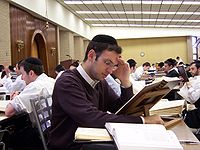
. In contrast to conventional classroom learning, in which a teacher lectures to the student and the student repeats the information back in tests, chavruta-style learning challenges the student to analyze and explain the material, point out the errors in his partner's reasoning, and question and sharpen each other's ideas, often arriving at entirely new insights of the meaning of the text. A chavruta helps a student keep his mind focused on the learning, sharpen his reasoning powers, develop his thoughts into words, organize his thoughts into logical arguments, and understand another person's viewpoint.
Chavruta-style learning tends to be loud and animated, as the study partners read the Talmudic text and the commentaries aloud to each other and then analyze, question, debate, and even argue their points of view to arrive at an understanding of the text. In the heat of discussion, they may even wave their hands, pound the table, or shout at each other. Depending on the size of the yeshiva, dozens or even hundreds of pairs of chavrutas can be heard discussing and debating each other's viewpoints. One of the skills of chavruta-style learning is the ability to block out all other discussions in the study hall and focus on one's chavruta alone.
zman starts from the beginning of the Hebrew month of Elul
and extends until the end of Yom Kippur
. This is the shortest (approx. six weeks), but most intense semester as it comes before the High Holidays of Rosh Hashanah
and Yom Kippur
. Winter zman starts after Sukkot
and lasts until just before Passover
, a duration of five months (six in a Jewish leap year). Summer semester starts after Passover
and lasts until either the middle of the month of Tammuz or Tisha B'Av
, a duration of about three months.
In the yeshiva system of talmudic study the first area to be mastered are eight mesechtohs (volumes that deal with a given subject which are divided into chapters that deal with sub-topics relating to the general subject) that deal with civil jurisprudence. These are the mesechtohs that are studied in undergraduate yeshivohs. These eight volumes are mastered first because it is with these subjects that a student can best master the technique of proper analysis of the talmud. Only after this technique is mastered is a student ready to go on to other areas of the talmud and develop a scholorship in all areas of the talmud.
Works generally studied to clarify the Talmudic text are the commentary by Rashi
and the analyses of the Tosafists
and other rishonim
(commentators from the 11th to 14th centuries). There are two schools of rishonim, one from France and the other from Spain who will sometimes hold different interpretations and understandings of the talmud. Various other mefarshim (commentators), from later generations are also used.
written by Rabbi Yisrael Meir Kagan
, the Chofetz Chaim. The Mishnah Berurah is a compilation of halachic opinions rendered after the time of the writing of the Shulchan Aruch
. In Sephardic Yeshivot the Shulchan Aruch itself is more commonly studied.
studied in yeshivot is the Mesillat Yesharim
("Path [of the] Just") by Rabbi Moshe Chaim Luzzatto
. Other works of mussar literature studied include:
Hasidic yeshivot study the mystical, spiritual works of Hasidic philosophy
(Chassidus). This draws on the earlier esoteric theology of Kabbalah
, but articulates it in terms of inner psychological awareness and personal analogies. This makes Jewish mysticism accessible and tangible, so that it inspires emotional dveikus (cleaving to God) and spiritual contribution to daily Jewish life. This serves some similar purposes to mussar, but through different means and with different contributions to intellectual and emotional life. Chabad
yeshivot, for example, study the Tanya
, the Likutei Torah, and the voluminous works of the Rebbes of Chabad for an hour and a half each morning, before prayers, and an hour and a half in the evening. (See Tomchei Temimim
.) Many Yeshivot in Israel belonging to the Religious Zionism study the writings of Rav Kook, who articulated a unique personal blend of mysticism, creative exegesis and philosophy.
(Genesis, Exodus, Leviticus
, Numbers
and Deuteronomy
with the commentary of Rashi
(Rabbi Shlomo Yitzhaqi 1040 - 1105) is stressed and taught in all elementary grades, often with Yiddish translations and more notes in Haredi
yeshivas.
The teaching of Tanakh
, Hebrew Bible, is usually only done on the high school level, and students read the Weekly Torah portion by themselves (known as the obligation of Shnayim mikra ve-echad targum
, "Hebrew Bible twice and Aramaic Targum
once"). Exceptions are the five Megilloth and Tehillim
. Since their inception, Modern Orthodox
yeshivot in Israel, offer courses in many, if not most, of the books of Nevi'im
and Ketuvim
.
, also "Frumspeak", is a combination of English, Yiddish and Hebrew used in Orthodox yeshivas in America.
Jews
The Jews , also known as the Jewish people, are a nation and ethnoreligious group originating in the Israelites or Hebrews of the Ancient Near East. The Jewish ethnicity, nationality, and religion are strongly interrelated, as Judaism is the traditional faith of the Jewish nation...
educational institution that focuses on the study of traditional religious texts, primarily the Talmud
Talmud
The Talmud is a central text of mainstream Judaism. It takes the form of a record of rabbinic discussions pertaining to Jewish law, ethics, philosophy, customs and history....
and Torah study
Torah study
Torah study is the study by Jewish people of the Torah, Hebrew Bible, Talmud, responsa, rabbinic literature and similar works, all of which are Judaism's religious texts...
. Study is usually done through daily shiurim (lectures or classes) and in study pairs called chavrutas
Chavruta
Chavruta, also spelled chavrusa , is a traditional Rabbinic approach to Talmudic study in which a pair of students independently learn, discuss, and debate a shared text. It is a primary learning method in yeshivas and kollels, where students often engage regular study partners of similar knowledge...
(Aramaic
Aramaic language
Aramaic is a group of languages belonging to the Afroasiatic language phylum. The name of the language is based on the name of Aram, an ancient region in central Syria. Within this family, Aramaic belongs to the Semitic family, and more specifically, is a part of the Northwest Semitic subfamily,...
for "friendship" or "companionship"). Chavruta-style learning is one of the unique features of the yeshiva.
In the United States and Israel, the different levels of yeshiva education have different names. In the United States, elementary-school students are enrolled in a yeshiva, post-bar mitzvah-age students learn in a mesivta
Mesivta
Mesivta is an Orthodox Jewish yeshiva high school for boys. The term is commonly used in the United States to describe a yeshiva that emphasizes Talmudic studies for boys in grades 9 through 11 or 12; alternately, it refers to the religious studies track in a yeshiva high school that offers both...
, and undergraduate-level students learn in a beis medrash
Beth midrash
Beth Midrash refers to a study hall, whether in a synagogue, yeshiva, kollel, or other building. It is distinct from a synagogue, although many synagogues are also used as batei midrash and vice versa....
or yeshiva gedola . In Israel, elementary-school students are enrolled in a Talmud Torah
Talmud Torah
Talmud Torah schools were created in the Jewish world, both Ashkenazic and Sephardic, as a form of public primary school for boys of modest backgrounds, where they were given an elementary education in Hebrew, the Scriptures , and the Talmud...
or cheder
Cheder
A Cheder is a traditional elementary school teaching the basics of Judaism and the Hebrew language.-History:...
, post-bar mitzvah-age students learn in a yeshiva ketana , and high-school-age students learn in a yeshiva gedola. A kollel
Kollel
A kollel is an institute for full-time, advanced study of the Talmud and rabbinic literature. Like a yeshiva, a kollel features shiurim and learning sedarim ; unlike a yeshiva, the student body of a kollel are all married men...
is a yeshiva for married men which pays stipends to its students.
Until the late 20th century, yeshivas were attended by males only. Many Modern Orthodox yeshivas have opened since then for girls and women.
Etymology
Alternate spellings and names include yeshivah (jəˈʃiːvə; , "sitting" (noun); metivta and mesivta (AramaicAramaic language
Aramaic is a group of languages belonging to the Afroasiatic language phylum. The name of the language is based on the name of Aram, an ancient region in central Syria. Within this family, Aramaic belongs to the Semitic family, and more specifically, is a part of the Northwest Semitic subfamily,...
: מתיבתא methivta); Beth midrash
Beth midrash
Beth Midrash refers to a study hall, whether in a synagogue, yeshiva, kollel, or other building. It is distinct from a synagogue, although many synagogues are also used as batei midrash and vice versa....
, Talmudical Academy, Rabbinical Academy; and Rabbinical School. The word yeshiva, lit. "sitting", is applied to the activity of learning in class, and hence to a learning "session."
The transference in meaning of the term from the learning session to the institution itself appears to have occurred by the time of the great Talmudic Academies in Babylonia
Talmudic Academies in Babylonia
The Talmudic Academies in Babylonia, also known as the Geonic Academies, were the center for Jewish scholarship and the development of Jewish law in Mesopotamia from roughly 589 CE to 1038 CE...
, Sura
Sura (city)
Sura was a city in the southern part of ancient Babylonia, located west of the Euphrates River. It was well-known for its agricultural produce, which included grapes, wheat, and barley...
and Pumbedita
Pumbedita
Pumbedita was the name of a city in ancient Babylonia close to the modern-day city of Fallujah....
, which were known as shte ha-yeshivot, "the two colleges."
Origins
The MishnahMishnah
The Mishnah or Mishna is the first major written redaction of the Jewish oral traditions called the "Oral Torah". It is also the first major work of Rabbinic Judaism. It was redacted c...
tractate Megillah
Megillah (Talmud)
Megillah is the tenth Tractate of Mishnah in the Order Moed. It and its Gemara deal with the laws of Purim and offers exegetical understandings to the Book of Esther. It also includes laws concerning the public reading of the Torah and other communal synagogue practices...
mentions the law that a town can only be called a "city" if it supports ten men (batlanim) to make up the required quorum
Minyan
A minyan in Judaism refers to the quorum of ten Jewish adults required for certain religious obligations. According to many non-Orthodox streams of Judaism adult females count in the minyan....
for communal prayers. Likewise, every beth din
Beth din
A beth din, bet din, beit din or beis din is a rabbinical court of Judaism. In ancient times, it was the building block of the legal system in the Biblical Land of Israel...
("rabbinical court") was attended by a number of pupils up to three times the size of the court (Mishnah
Mishnah
The Mishnah or Mishna is the first major written redaction of the Jewish oral traditions called the "Oral Torah". It is also the first major work of Rabbinic Judaism. It was redacted c...
, tractate Sanhedrin
Sanhedrin (Talmud)
Sanhedrin is one of ten tractates of Seder Nezikin . It originally formed one tractate with Makkot, which also deals with criminal law...
). These might be indications of the historicity of the classical yeshiva. As indicated by the Talmud
Talmud
The Talmud is a central text of mainstream Judaism. It takes the form of a record of rabbinic discussions pertaining to Jewish law, ethics, philosophy, customs and history....
, adults generally took off two months a year (Elul and Adar, the months preceding the harvest, called Yarchay Kalla) to study, the rest of the year they worked.
Gaonic Period
The gaonic period is named after the gaonGaon (Hebrew)
Gaon originally referred in Ancient Hebrew to arrogance and haughty pride . Later became known as pride in general: whether good or bad . Today it may refer to:...
, which was the title bestowed on the heads of the three yeshivas in existence from the 3rd century to the 13th century. These gaons acted as schoolmaster to their individual yeshivot, and as a spiritual leader and high judge for the wider communities tied to them. All official business of the yeshiva was conducted in the name of its gaon, and all correspondence to or from the yeshiva was addressed directly to the gaon.
Throughout the gaonic period there were three yeshivot. These were named for the cities in which they were located, Jerusalem, Sura
Sura (city)
Sura was a city in the southern part of ancient Babylonia, located west of the Euphrates River. It was well-known for its agricultural produce, which included grapes, wheat, and barley...
, and Pumbedita
Pumbedita
Pumbedita was the name of a city in ancient Babylonia close to the modern-day city of Fallujah....
; the yeshiva of Jerusalem would later relocate to Cairo
Cairo
Cairo , is the capital of Egypt and the largest city in the Arab world and Africa, and the 16th largest metropolitan area in the world. Nicknamed "The City of a Thousand Minarets" for its preponderance of Islamic architecture, Cairo has long been a centre of the region's political and cultural life...
, and the yeshivot of Sura and Pumbedita to Baghdad
Baghdad
Baghdad is the capital of Iraq, as well as the coterminous Baghdad Governorate. The population of Baghdad in 2011 is approximately 7,216,040...
, but retain their original names. Each Jewish community would associate itself with one of the three yeshivot; Jews living around the Mediterranean
Mediterranean Sea
The Mediterranean Sea is a sea connected to the Atlantic Ocean surrounded by the Mediterranean region and almost completely enclosed by land: on the north by Anatolia and Europe, on the south by North Africa, and on the east by the Levant...
typically followed the yeshiva in Jerusalem, while those living in the Arabian Peninsula
Arabian Peninsula
The Arabian Peninsula is a land mass situated north-east of Africa. Also known as Arabia or the Arabian subcontinent, it is the world's largest peninsula and covers 3,237,500 km2...
and modern-day Iraq
Iraq
Iraq ; officially the Republic of Iraq is a country in Western Asia spanning most of the northwestern end of the Zagros mountain range, the eastern part of the Syrian Desert and the northern part of the Arabian Desert....
and Iran
Iran
Iran , officially the Islamic Republic of Iran , is a country in Southern and Western Asia. The name "Iran" has been in use natively since the Sassanian era and came into use internationally in 1935, before which the country was known to the Western world as Persia...
typically followed one of the two yeshivot in Baghdad. There was however, no requirement for this, and each community could choose to associate with any of the yeshivot.
The yeshiva served as the highest educational institution for the Rabbinites
Rabbinic Judaism
Rabbinic Judaism or Rabbinism has been the mainstream form of Judaism since the 6th century CE, after the codification of the Talmud...
of this period. In addition to this, the yeshiva wielded immense power as the principle body for interpreting Jewish religious law
Halakha
Halakha — also transliterated Halocho , or Halacha — is the collective body of Jewish law, including biblical law and later talmudic and rabbinic law, as well as customs and traditions.Judaism classically draws no distinction in its laws between religious and ostensibly non-religious life; Jewish...
. In this regard, the gaon of a yeshiva was seen as the highest judge on all matters of Jewish law. Each yeshiva ruled differently on matters of ritual and law, these divisions were accepted by the other yeshivot, and all three were considered equally orthodox. The yeshiva also served as an administrative authority; in conjunction with local communities, the yeshiva would appoint members to serve as the head of local congregations. These would serve as a go-between for the local congregation, and the larger yeshiva it was attached to. These local leaders would submit questions to the yeshiva to obtain final rulings on issues of dogma, ritual, or law. Each congregation was expected to follow only one yeshiva to prevent conflict with different rulings issued by different yeshivot.
The yeshivot were financially supported through a number of means. First, there were fixed, but voluntary, yearly contributions made to the yeshivas, these were collected and handled by the local leaders appointed by the yeshiva. Private gifts from individuals were also common and could consist of money or goods. Private donations were also regularly submitted on holidays. Finally, fines were assigned for the maintenance of the yeshivas.
The yeshiva of Jerusalem was finally forced into exile in Cairo in 1127, and eventually dispersed entirely. Likewise, the yeshivot of Sura and Pumbedita were dispersed following the Mongol
Mongols
Mongols ) are a Central-East Asian ethnic group that lives mainly in the countries of Mongolia, China, and Russia. In China, ethnic Mongols can be found mainly in the central north region of China such as Inner Mongolia...
invasions of the 13th century. After the yeshiva were scattered, education in Jewish religious studies became the responsibility of individual synagogues. No organization ever came to replace the three great yeshivot of Jerusalem, Sura and Pumbedita.
Post-Gaonic to 19th Century
Traditionally, every town rabbiRabbi
In Judaism, a rabbi is a teacher of Torah. This title derives from the Hebrew word רבי , meaning "My Master" , which is the way a student would address a master of Torah...
had the right to maintain a number of full-time or part-time pupils in the town's beth midrash
Beth midrash
Beth Midrash refers to a study hall, whether in a synagogue, yeshiva, kollel, or other building. It is distinct from a synagogue, although many synagogues are also used as batei midrash and vice versa....
(study hall, usually adjacent to the synagogue
Synagogue
A synagogue is a Jewish house of prayer. This use of the Greek term synagogue originates in the Septuagint where it sometimes translates the Hebrew word for assembly, kahal...
). Their cost of living was covered by community taxation. After a number of years, these young people would either take up a vacant rabbinical position elsewhere (after obtaining semicha
Semicha
, also , or is derived from a Hebrew word which means to "rely on" or "to be authorized". It generally refers to the ordination of a rabbi within Judaism. In this sense it is the "transmission" of rabbinic authority to give advice or judgment in Jewish law...
, rabbinical ordination) or join the workforce.
Lithuanian yeshivas
Chaim Volozhin
Chaim Volozhin was an Orthodox rabbi, Talmudist, and ethicist. Popularly known as "Reb Chaim Volozhiner" or simply as "Reb Chaim", he was born in Volozhin when it was a part of the Polish-Lithuanian Commonwealth...
, a disciple of the Vilna Gaon
Vilna Gaon
Elijah ben Shlomo Zalman Kramer, known as the Vilna Gaon or Elijah of Vilna and simply by his Hebrew acronym Gra or Elijah Ben Solomon, , was a Talmudist, halachist, kabbalist, and the foremost leader of non-hasidic Jewry of the past few centuries...
(an influential 18th century leader of Judaism). In his view, the traditional arrangement did not cater for those who were looking for more intensive study.
With the support of his teacher, Rabbi Volozhin gathered a large number of interested students and started a yeshiva in the (now Belarus
Belarus
Belarus , officially the Republic of Belarus, is a landlocked country in Eastern Europe, bordered clockwise by Russia to the northeast, Ukraine to the south, Poland to the west, and Lithuania and Latvia to the northwest. Its capital is Minsk; other major cities include Brest, Grodno , Gomel ,...
ian) town of Volozhin. Although the Volozhin yeshiva
Volozhin yeshiva
The Volozhin Yeshiva, also known as Etz Chaim Yeshiva, was a prestigious Lithuanian yeshiva located in the town of Volozhin, Russia, . It was founded by Rabbi Chaim Itzkovitz, a student of the famed Vilna Gaon, and trained several generations of scholars, rabbis, and leaders...
was closed some 60 years later in response to demands by the Russian government, a number of yeshivot opened in other towns and cities, most notably Slabodka, Ponevezh
Panevežys
Panevėžys see also other names, is the fifth largest city in Lithuania. As of 2008, it occupied 50 square kilometers with 113,653 inhabitants. The largest multifunctional arena in Panevėžys is the Cido Arena...
, Mir
Mir yeshiva (Poland)
The Mir yeshiva , commonly known as the Mirrer Yeshiva or The Mir, was a Haredi yeshiva located in the town of Mir, Russian Empire...
, Brisk, and Telz
Telshe yeshiva
Telshe yeshiva was a famous Eastern European yeshiva founded in the Lithuanian town of Telšiai. After World War II the yeshiva relocated to Wickliffe, Ohio, in the United States and is currently known as the Rabbinical College of Telshe, It is one of the most prominent Haredi institutions of Torah...
. Many prominent contemporary yeshivot in the United States and Israel
Israel
The State of Israel is a parliamentary republic located in the Middle East, along the eastern shore of the Mediterranean Sea...
are continuations of these institutions and often bear the same name.
In the 19th Century, Rabbi Israel Salanter initiated the Mussar movement
Mussar movement
The Musar movement is a Jewish ethical, educational and cultural movement that developed in 19th century Eastern Europe, particularly among Orthodox Lithuanian Jews. The Hebrew term Musar , is from the book of Proverbs 1:2 meaning instruction, discipline, or conduct...
in non-Hasidic Lithuanian Jewry, that sought to encourage yeshiva students and the wider community to spend regular times devoted to the study of Jewish ethical works. Concerned by the new social and religious changes of the Haskalah
Haskalah
Haskalah , the Jewish Enlightenment, was a movement among European Jews in the 18th–19th centuries that advocated adopting enlightenment values, pressing for better integration into European society, and increasing education in secular studies, Hebrew language, and Jewish history...
(secularising movement), and emerging political ideologies such as Zionism
Zionism
Zionism is a Jewish political movement that, in its broadest sense, has supported the self-determination of the Jewish people in a sovereign Jewish national homeland. Since the establishment of the State of Israel, the Zionist movement continues primarily to advocate on behalf of the Jewish state...
, that often opposed traditional Judaism, the masters of Mussar saw a need to augment Talmudic study with more personal works. These comprised earlier classic Jewish ethical texts (mussar literature), as well as a new literature for the movement. By focusing the student on self understanding and introspection, often with profound psychological insight, the spiritual aims of Judaism could be internalised. After early opposition, the Lithuanian yeshivah world saw the need for this new component in their curriculum, and set aside times for individual mussar study and mussar talks ("mussar shmues"). A spiritual mentor (Mashgiach Ruchani
Mashgiach ruchani
Mashgiach ruchani or mashgiach for short, means a spiritual supervisor or guide. It is a title which usually refers to a rabbi who has an official position within a yeshiva and is responsible for the non-academic areas of yeshiva students' lives.The position of mashgiach ruchani arose with the...
) encouraged the personal development of each student. To some degree also, this Lithuanian movement arose in response, and as an alternative, to the separate mystical study of the Hasidic Judaism
Hasidic Judaism
Hasidic Judaism or Hasidism, from the Hebrew —Ḥasidut in Sephardi, Chasidus in Ashkenazi, meaning "piety" , is a branch of Orthodox Judaism that promotes spirituality and joy through the popularisation and internalisation of Jewish mysticism as the fundamental aspects of the Jewish faith...
world. Hasidism began previously, in the 18th Century, within traditional Jewish life in the Ukraine, and spread to Hungary, Poland and Russia. As the 19th Century brought upheavals and threats to traditional Judaism, the Mussar teachers saw the benefit of the new spiritual focus in Hasidism, and developed their alternative ethical approach to spirituality.
Some variety developed within Lithuanian yeshivas to methods of studying Talmud and mussar, for example the contrast between breadth (beki'ut) and depth (iyyun), or the place given to pilpul
Pilpul
Pilpul refers to a method of studying the Talmud through intense textual analysis in attempts to either explain conceptual differences between various halakhic rulings or to reconcile any apparent contradictions presented from various readings of different texts.Pilpul has entered English as a...
(the type of casuistic argumentation popular from the 16th to 18th centuries). The new analytical approach of the Brisker method
Brisker method
The Brisker method, or Brisker derech, is a reductionistic approach to Talmud study innovated by Rabbi Chaim Soloveitchik of Brisk, as opposed to the traditional approach which was rather holistic. It has since become popular and spread to yeshivas around the world...
, developed by Rabbi Chaim Soloveitchik
Chaim Soloveitchik
Chaim Soloveitchik , also known as Reb Chaim Brisker, was a rabbi and Talmudic scholar credited as the founder of the popular Brisker approach to Talmudic study within Judaism. He was born in Volozhin in 1853, where his father, Rabbi Yosef Dov Soloveitchik served as a lecturer in the famous...
of Brisk, has become widely popular, though there are other approaches such as those of Mir
Mir yeshiva (Poland)
The Mir yeshiva , commonly known as the Mirrer Yeshiva or The Mir, was a Haredi yeshiva located in the town of Mir, Russian Empire...
, Chofetz Chaim, and Telz
Telshe yeshiva
Telshe yeshiva was a famous Eastern European yeshiva founded in the Lithuanian town of Telšiai. After World War II the yeshiva relocated to Wickliffe, Ohio, in the United States and is currently known as the Rabbinical College of Telshe, It is one of the most prominent Haredi institutions of Torah...
. In mussar different schools developed, such as Slabodka and Novhardok, though today a decline in devoted spiritual self-development from its earlier intensity has to some extent levelled out the differences.
Hasidic yeshivas
With the success of the yeshiva institution in Lithuanian Jewry, the Hasidic world developed their own yeshivas, in their areas of Eastern Europe. These comprised the traditional Jewish focus on TalmudTalmud
The Talmud is a central text of mainstream Judaism. It takes the form of a record of rabbinic discussions pertaining to Jewish law, ethics, philosophy, customs and history....
ic literature that is central to Rabbinic Judaism, augmented by study of Hasidic philosophy
Hasidic philosophy
Hasidic philosophy or Hasidus , alternatively transliterated as Hassidism, Chassidism, Chassidut etc. is the teachings, interpretations of Judaism, and mysticism articulated by the modern Hasidic movement...
(Hasidus). Examples of these Hasidic yeshivas are the Chabad Lubavitch yeshiva system of Tomchei Temimim
Tomchei Temimim
Tomchei Temimim is the central Yeshiva of the Chabad-Lubavitch Hasidic movement...
, founded by Sholom Dovber Schneersohn
Sholom Dovber Schneersohn
Sholom Dovber Schneersohn was an Orthodox rabbi and the fifth Rebbe of the Chabad Lubavitch chasidic movement. He is also known as "the Rebbe nishmosei eiden" and as "the Rebbe Rashab" .His teachings represent the emergence of an emphasis on outreach that later Chabad Rebbes would develop...
in Russia in 1897, and the Chachmei Lublin Yeshiva
Chachmei Lublin Yeshiva
Founded by Rabbi Meir Shapiro, the Chachmei Lublin Yeshiva, , was an important centre for Torah study in Poland.-History:On May 22–28, 1924, the cornerstone laying ceremony took place for the construction of the yeshiva building. Approximately 20,000 people participated in the event.The opening...
established in Poland in 1930 by Meir Shapiro
Meir Shapiro
Yehuda Meir Shapiro , , was a prominent Hasidic rabbi and rosh yeshiva, also known as the Lubliner Rav...
, who is renowned across Hasidic and Lithuanian Judaism for initiating the Daf Yomi
Daf Yomi
Daf Yomi "page [of the] day" or "daily folio") is a daily regimen undertaken to study the Babylonian Talmud one folio each day...
daily study cycle of Talmud.
In many Hasidic yeshivas study of Hasidic texts is a secondary activity, similar to the additional mussar curriculum in Lithuanian yeshivas. These paths see Hasidus as a means to the end purpose of inspiring emotional dveikus and mystical enthusiasm. In this context, the personal pilgrimage of a Hasid to their Rebbe
Rebbe
Rebbe , which means master, teacher, or mentor, is a Yiddish word derived from the Hebrew word Rabbi. It often refers to the leader of a Hasidic Jewish movement...
is a central feature of spiritual life, in order to awaken spiritual fervour. Often, such paths will reserve the Sabbath in the yeshiva for the sweeter teachings of the classic texts of Hasidism. In contrast, Habad and Breslav, in their different ways, place daily study of their dynasties' Hasidic texts in central importance. Illustrative of this is Sholom Dovber Schneersohn's wish in establishing the Habad yeshiva system, that the students should spend a part of the daily curriculum learning Habad Hasidic texts "with pilpul
Pilpul
Pilpul refers to a method of studying the Talmud through intense textual analysis in attempts to either explain conceptual differences between various halakhic rulings or to reconcile any apparent contradictions presented from various readings of different texts.Pilpul has entered English as a...
". Pilpul is the in-depth analytical investigation of a topic, traditionally reserved for the profound nuances of Talmudic study. The idea to learn Hasidic mystical texts with similar logical profundity, derives from the unique approach in the works of the Rebbes of Habad, initiated by its founder Schneur Zalman of Liadi, to systematically investigate and articulate the "Torah of the Baal Shem Tov" in intellectual forms. Further illustrative of this is the differentiation in Habad thought (such as the "Tract on Ecstacy" by Dovber Schneuri
Dovber Schneuri
Dovber Schneuri was the second Rebbe of the Chabad Lubavitch Chasidic movement. Rabbi Dovber was the first Chabad rebbe to live in the town of Lyubavichi , the town for which this Hasidic dynasty is named...
) between general Hasidism's emphasis on emotional enthusiasm and the Habad ideal of intellectually reserved ecstacy. In Breslav, by contrast, the daily study of works from the imaginative, creative radicalism of Rabbi Nachman of Breslov
Nachman of Breslov
Nachman of Breslov , also known as Reb Nachman of Bratslav, Reb Nachman Breslover , Nachman from Uman , was the founder of the Breslov Hasidic movement....
awakens the necessary soulfulness with which to approach other Jewish study and observance.
Sephardi yeshivas
Although the yeshiva as an institution is in some ways a continuation of the Talmudic Academies in BabyloniaTalmudic Academies in Babylonia
The Talmudic Academies in Babylonia, also known as the Geonic Academies, were the center for Jewish scholarship and the development of Jewish law in Mesopotamia from roughly 589 CE to 1038 CE...
, large scale educational institutions of this kind were not characteristic of the North African and Middle Eastern Sephardi Jewish world in pre-modern times: education typically took place in a more informal setting in the synagogue or in the entourage of a famous rabbi. In medieval Spain and immediately following the expulsion in 1492 there were some schools which combined Jewish studies with sciences such as logic and astronomy, similar to the contemporary Islamic madrasas. In 19th-century Jerusalem a college was typically an endowment for supporting ten adult scholars rather than an educational institution in the modern sense; towards the end of the century a school for orphans was founded providing for some rabbinic studies. Early educational institutions on the European model were Beth Zilkha founded in 1870s Iraq and Porat Yosef Yeshiva
Porat Yosef Yeshiva
Porat Yosef Yeshiva is a leading Sephardic yeshiva in Jerusalem, Israel, with locations in both the Old City and the Geula neighborhood.-History:...
founded in Jerusalem in 1914. Also notable is the Bet El yeshiva
Beit El Synagogue
The Beit El Synagogue , has been the center of kabbalistic study in Jerusalem for over 250 years.-History of the Yeshivat HaMekubalim:The yeshiva was founded in 1737 by Rabbi Gedaliah Hayon, originally from...
founded in 1737 in Jerusalem for advanced Kabbalistic studies. Later Sephardic yeshivot are usually on the model either of Porat Yosef or of the Ashkenazi institutions.
The Sephardic world has traditionally placed the study of esoteric Jewish mysticism (Kabbalah
Kabbalah
Kabbalah/Kabala is a discipline and school of thought concerned with the esoteric aspect of Rabbinic Judaism. It was systematized in 11th-13th century Hachmei Provence and Spain, and again after the Expulsion from Spain, in 16th century Ottoman Palestine...
) in a more mainstream position that in the European Ashkenazi world. This difference of emphasis arose in reaction to the historical events of the Sabbatean heresy in the 17th Century, that suppressed widespead study of Kabbalah in Europe in favour of the strenghth of Rabbinic Talmudic study. In Eastern European Lithuanian life, Kabbalah was reserved for an intellectual elite, while the mystical revival of Hasidism articulated Kabbalistic theology through Hasidic thought. These factors did not affect the Sephardi Jewish world, which retained a wider connection to Kabbalah in its traditionally observant communities. With the establishment of Sephardi yeshivas in Israel, after the immigration of the Arabic Jewish communities there, some Sephardi yeshivas incorporated study of more accessible Kabbalistic texts into their curriculum. Nonetheless, the European prescriptions to reserve advanced Kabbalistic study to mature and elite students also influence the choice of texts in such yeshivas.
Conservative movement yeshivas
In 1854, the Jewish Theological Seminary of BreslauJewish Theological Seminary of Breslau
Das Jüdisch-Theologische Seminar , The Jewish Theological Seminary of BreslauInstitution in Breslau for the training of rabbis, founded under the will of Jonas Fränckel, and opened in 1854...
was founded. It was headed by Zecharias Frankel
Zecharias Frankel
Zecharias Frankel was a Bohemian-German rabbi and a historian who studied the historical development of Judaism. He was born in Prague and died in Breslau...
, and was eventually viewed as the first yeshiva associated with Conservative Judaism
Conservative Judaism
Conservative Judaism is a modern stream of Judaism that arose out of intellectual currents in Germany in the mid-19th century and took institutional form in the United States in the early 1900s.Conservative Judaism has its roots in the school of thought known as Positive-Historical Judaism,...
. In subsequent years, Conservative Judaism
Conservative Judaism
Conservative Judaism is a modern stream of Judaism that arose out of intellectual currents in Germany in the mid-19th century and took institutional form in the United States in the early 1900s.Conservative Judaism has its roots in the school of thought known as Positive-Historical Judaism,...
established a number of other institutions of higher learning (such as the Jewish Theological Seminary of America
Jewish Theological Seminary of America
The Jewish Theological Seminary of America is one of the academic and spiritual centers of Conservative Judaism, and a major center for academic scholarship in Jewish studies.JTS operates five schools: Albert A...
in New York City) that emulate the style of traditional yeshivas in significant ways. However, many do not officially refer to themselves as "yeshivas", and all are open to both women and men, who study in the same classrooms and follow the same curriculum. Students may study part-time, as in a kollel, or full-time, and they may study lishmah (for the sake of studying itself) or towards earning semichah, rabbinic ordination.
Nondenominational or mixed yeshivas
Non-denominational yeshivas and kollels with connections to Conservative JudaismConservative Judaism
Conservative Judaism is a modern stream of Judaism that arose out of intellectual currents in Germany in the mid-19th century and took institutional form in the United States in the early 1900s.Conservative Judaism has its roots in the school of thought known as Positive-Historical Judaism,...
include Yeshivat Hadar in New York, the leaders of whom include Rabbinical Assembly
Rabbinical Assembly
The Rabbinical Assembly is the international association of Conservative rabbis. The RA was founded in 1901 to shape the ideology, programs, and practices of the Conservative movement. It publishes prayerbooks and books of Jewish interest, and oversees the work of the Committee on Jewish Law and...
members Eli Kaunfer and Shai Held. The rabbinical school of the Academy for Jewish Religion in California (AJR-CA) is led by Conservative rabbi Mel Gottlieb. The faculty of the Academy for Jewish Religion in New York and of the Rabbinical School of Hebrew College
Hebrew College
Hebrew College is an accredited college of Jewish studies in Newton Centre, near Boston, Massachusetts. Founded in 1921, Hebrew College is committed to Jewish scholarship in a transdenominational academic environment. The president of the college is Rabbi Daniel Lehmann...
in Newton Centre, Massachusetts also includes a large number of Conservative rabbis.
The Canadian Yeshiva & Rabbinical School
Canadian Yeshiva & Rabbinical School
The Canadian Yeshiva & Rabbinical School is a Jewish yeshiva located on the campus of the University of Toronto. Rabbi Roy Tanenbaum is both the founder and the Rosh Yeshiva. Rabbi Daniel Sperber serves as the Chancellor...
is a yeshiva dedicated to the reestablishment of what it describes as "Classic Judaism". This school, scheduled to accept its first students in September 2012, is led by Rosh Yeshiva, Rav Roy Tanenbaum and Chancellor Rabbi Daniel Sperber
Daniel Sperber
Daniel Sperber is a professor of Talmud at Bar-Ilan University in Israel, and an expert in classical philology, history of Jewish customs, Jewish art history, Jewish education and Talmudic studies.-Biography:...
. Rav Tanenbaum is a member of the Conservative rabbinate and Rabbi Sperber is associated with Modern Orthodoxy. However, the school affiliates with neither movement.
Reform and Reconstructionist yeshivas
Hebrew Union CollegeHebrew Union College
The Hebrew Union College-Jewish Institute of Religion is the oldest extant Jewish seminary in the Americas and the main seminary for training rabbis, cantors, educators and communal workers in Reform Judaism.HUC-JIR has campuses in Cincinnati, New York, Los Angeles and Jerusalem.The Jerusalem...
(HUC), affiliated with Reform Judaism
Reform Judaism
Reform Judaism refers to various beliefs, practices and organizations associated with the Reform Jewish movement in North America, the United Kingdom and elsewhere. In general, it maintains that Judaism and Jewish traditions should be modernized and should be compatible with participation in the...
, was founded in 1875 under the leadership of Rabbi Isaac Mayer Wise in Cincinnati, Ohio. HUC later opened additional locations in New York, Los Angeles, and Jerusalem. It is a rabbinical seminary or college mostly geared for the training of rabbis and clergy specifically. Similarly, the Reconstructionist Rabbinical College
Reconstructionist Rabbinical College
The Reconstructionist Rabbinical College , is located in Wyncote, Pennsylvania, about 10 miles north of central Philadelphia. RRC is the only seminary affiliated with Reconstructionist Judaism. It is accredited by the Commission on Higher Education of the Middle States Association of Colleges and...
of Reconstructionist Judaism
Reconstructionist Judaism
Reconstructionist Judaism is a modern American-based Jewish movement based on the ideas of Mordecai Kaplan . The movement views Judaism as a progressively evolving civilization. It originated as a branch of Conservative Judaism, before it splintered...
, founded in Pennsylvania
Pennsylvania
The Commonwealth of Pennsylvania is a U.S. state that is located in the Northeastern and Mid-Atlantic regions of the United States. The state borders Delaware and Maryland to the south, West Virginia to the southwest, Ohio to the west, New York and Ontario, Canada, to the north, and New Jersey to...
in 1968, functions to train its future clergy. Some Reform and Reconstructionist teachers also teach at non-denominational seminaries like the Academy for Jewish Religion in New York, the Academy for Jewish Religion in California, and the Rabbinical School of Hebrew College
Hebrew College
Hebrew College is an accredited college of Jewish studies in Newton Centre, near Boston, Massachusetts. Founded in 1921, Hebrew College is committed to Jewish scholarship in a transdenominational academic environment. The president of the college is Rabbi Daniel Lehmann...
.
Types of yeshivot
- Yeshiva ketana ("junior yeshiva") - Many yeshivot ketanot in Israel and some in the Diaspora do not have a secular course of studies and all students learn Judaic Torah studies full time.
- Yeshiva High School - Also called MesivtaMesivtaMesivta is an Orthodox Jewish yeshiva high school for boys. The term is commonly used in the United States to describe a yeshiva that emphasizes Talmudic studies for boys in grades 9 through 11 or 12; alternately, it refers to the religious studies track in a yeshiva high school that offers both...
or Mechina or Yeshiva Ketana, combines the intensive Jewish religious education with a secular high school education. The dual curriculum was pioneered by the Manhattan Talmudical Academy of Yeshiva UniversityYeshiva UniversityYeshiva University is a private university in New York City, with six campuses in New York and one in Israel. Founded in 1886, it is a research university ranked as 45th in the US among national universities by U.S. News & World Report in 2012...
(now known as Marsha Stern Talmudical AcademyMarsha Stern Talmudical AcademyThe Marsha Stern Talmudical Academy, also known as Yeshiva University High School for Boys , MTA or TMSTA , is an Orthodox Jewish day school , the boys' high school of Yeshiva University in the Washington Heights neighborhood in the New York City borough of Manhattan.-History:The Talmudical...
) in 1916. - MechinaMechinaA Mechina is an Israeli educational program that prepares high school graduates for serving in the Israeli Army or study at an institution of higher learning in Israel...
- For Israeli high-school graduates who wish to study for one year before entering the army. - Beth Medrash - For high school graduates, and is attended from one year to many years, dependent on the career plans and affiliation of the student.
- Yeshivat HesderHesderHesder is an Israeli yeshiva program which combines advanced Talmudic studies with military service in the Israel Defense Forces, usually within a Religious Zionist framework...
- Yeshiva that has an arrangement with the Israel Defence Forces by which the students enlist together in the same unit and, as much as is possible serve in the same unit in the army. Over a period of about 5 years there will be a period of service starting in the second year of about 16 months. There are different variations. The rest of the time will be spent in compulsory study in the yeshiva. - KollelKollelA kollel is an institute for full-time, advanced study of the Talmud and rabbinic literature. Like a yeshiva, a kollel features shiurim and learning sedarim ; unlike a yeshiva, the student body of a kollel are all married men...
- Yeshiva for married men. The kollel idea, though having its intellectual roots traced to the Torah, is a relatively modern innovation of 19th century Europe. Often, a kollel will be in the same location as the yeshiva. - Baal teshuvaBaal teshuvaBaal teshuva or ba'al teshuvah , sometimes abbreviated to BT, is a term referring to a Jew who turns to embrace Orthodox Judaism. Baal teshuva literally means, "repentant", i.e., one who has repented or "returned" to God...
yeshivot catering to the needs of the newly OrthodoxOrthodox JudaismOrthodox Judaism , is the approach to Judaism which adheres to the traditional interpretation and application of the laws and ethics of the Torah as legislated in the Talmudic texts by the Sanhedrin and subsequently developed and applied by the later authorities known as the Gaonim, Rishonim, and...
.
Traditionally, religious girls' schools are not called "yeshiva." The Beis Yaakov system was started in 1918 under the guidance of Sarah Schenirer
Sarah Schenirer
Sarah Schenirer was a pioneer of Jewish education for girls. In 1917, she established the Beis Yaakov school network in Poland.-Biography:...
. This system provided girls with a Torah education, using a curriculum that skewed more toward practical halakha
Halakha
Halakha — also transliterated Halocho , or Halacha — is the collective body of Jewish law, including biblical law and later talmudic and rabbinic law, as well as customs and traditions.Judaism classically draws no distinction in its laws between religious and ostensibly non-religious life; Jewish...
and the study of Tanakh
Tanakh
The Tanakh is a name used in Judaism for the canon of the Hebrew Bible. The Tanakh is also known as the Masoretic Text or the Miqra. The name is an acronym formed from the initial Hebrew letters of the Masoretic Text's three traditional subdivisions: The Torah , Nevi'im and Ketuvim —hence...
, rather than Talmud
Talmud
The Talmud is a central text of mainstream Judaism. It takes the form of a record of rabbinic discussions pertaining to Jewish law, ethics, philosophy, customs and history....
. Beis Yaakovs are strictly Haredi
Haredi Judaism
Haredi or Charedi/Chareidi Judaism is the most conservative form of Orthodox Judaism, often referred to as ultra-Orthodox. A follower of Haredi Judaism is called a Haredi ....
schools. Non-Haredi girls' schools' curricula often includes the study of Mishna and sometimes Talmud
Talmud
The Talmud is a central text of mainstream Judaism. It takes the form of a record of rabbinic discussions pertaining to Jewish law, ethics, philosophy, customs and history....
. They are also sometimes called "yeshiva" (e.g., Prospect Park Yeshiva). Post-high schools for women are generally called "seminary" or "midrasha".
Curriculum
Learning at an Orthodox yeshiva includes Torah studyTorah study
Torah study is the study by Jewish people of the Torah, Hebrew Bible, Talmud, responsa, rabbinic literature and similar works, all of which are Judaism's religious texts...
; the study of Rabbinic literature
Rabbinic literature
Rabbinic literature, in its broadest sense, can mean the entire spectrum of rabbinic writings throughout Jewish history. However, the term often refers specifically to literature from the Talmudic era, as opposed to medieval and modern rabbinic writing, and thus corresponds with the Hebrew term...
, especially the Talmud
Talmud
The Talmud is a central text of mainstream Judaism. It takes the form of a record of rabbinic discussions pertaining to Jewish law, ethics, philosophy, customs and history....
(Rabbinic Judaism's central work); and the study of Responsa
History of Responsa
History of responsa in Judaism spans a period of 1,700 years. Responsa constitute a special class of rabbinic literature, differing in form, but not necessarily in content, from Rabbinic commentaries devoted to the exegesis of the Bible, the Mishnah, the Talmud, and halakha...
for Jewish observance, and alternatively ethical (Musar
Musar literature
Musar literature is the term used for didactic Jewish ethical literature which describes virtues and vices and the path towards perfection in a methodical way.- Definition of Musar literature :...
) or mystical (Hasidic philosophy
Hasidic philosophy
Hasidic philosophy or Hasidus , alternatively transliterated as Hassidism, Chassidism, Chassidut etc. is the teachings, interpretations of Judaism, and mysticism articulated by the modern Hasidic movement...
) texts. In some institutions, classical Jewish philosophy
Jewish philosophy
Jewish philosophy , includes all philosophy carried out by Jews, or, in relation to the religion of Judaism. Jewish philosophy, until modern Enlightenment and Emancipation, was pre-occupied with attempts to reconcile coherent new ideas into the tradition of Rabbinic Judaism; thus organizing...
(Hakira) texts or Kabbalah
Kabbalah
Kabbalah/Kabala is a discipline and school of thought concerned with the esoteric aspect of Rabbinic Judaism. It was systematized in 11th-13th century Hachmei Provence and Spain, and again after the Expulsion from Spain, in 16th century Ottoman Palestine...
are studied, or the works of individual thinkers (such as Abraham Isaac Kook
Abraham Isaac Kook
Abraham Isaac Kook was the first Ashkenazi chief rabbi of the British Mandate for Palestine, the founder of the Religious Zionist Yeshiva Merkaz HaRav, Jewish thinker, Halachist, Kabbalist and a renowned Torah scholar...
).
Non-Orthodox institutions offer a synthesis of traditional and critical methods, allowing Jewish texts and tradition to encounter social change and modern scholarship. The curriculum focuses on classical Jewish subjects, including Talmud, Tanakh, Midrash, Halacha, and Philosophy, with an openness to modern scholarship.
Chavruta-style learning
Yeshiva students prepare for and review the shiur with their chavruta during a study session known as a sederSeder
Seder is a Hebrew word meaning "order" or "sequence", and can have any of the following meanings:For Jewish holidays*Passover Seder, a ritualized dinner observed during Passover...
. In contrast to conventional classroom learning, in which a teacher lectures to the student and the student repeats the information back in tests, chavruta-style learning challenges the student to analyze and explain the material, point out the errors in his partner's reasoning, and question and sharpen each other's ideas, often arriving at entirely new insights of the meaning of the text. A chavruta helps a student keep his mind focused on the learning, sharpen his reasoning powers, develop his thoughts into words, organize his thoughts into logical arguments, and understand another person's viewpoint.
Chavruta-style learning tends to be loud and animated, as the study partners read the Talmudic text and the commentaries aloud to each other and then analyze, question, debate, and even argue their points of view to arrive at an understanding of the text. In the heat of discussion, they may even wave their hands, pound the table, or shout at each other. Depending on the size of the yeshiva, dozens or even hundreds of pairs of chavrutas can be heard discussing and debating each other's viewpoints. One of the skills of chavruta-style learning is the ability to block out all other discussions in the study hall and focus on one's chavruta alone.
Academic year
In most yeshivot, the year is divided into three periods (terms) called zmanim. ElulElul
Elul is the twelfth month of the Jewish civil year and the sixth month of the ecclesiastical year on the Hebrew calendar. It is a summer month of 29 days...
zman starts from the beginning of the Hebrew month of Elul
Elul
Elul is the twelfth month of the Jewish civil year and the sixth month of the ecclesiastical year on the Hebrew calendar. It is a summer month of 29 days...
and extends until the end of Yom Kippur
Yom Kippur
Yom Kippur , also known as Day of Atonement, is the holiest and most solemn day of the year for the Jews. Its central themes are atonement and repentance. Jews traditionally observe this holy day with a 25-hour period of fasting and intensive prayer, often spending most of the day in synagogue...
. This is the shortest (approx. six weeks), but most intense semester as it comes before the High Holidays of Rosh Hashanah
Rosh Hashanah
Rosh Hashanah , , is the Jewish New Year. It is the first of the High Holy Days or Yamim Nora'im which occur in the autumn...
and Yom Kippur
Yom Kippur
Yom Kippur , also known as Day of Atonement, is the holiest and most solemn day of the year for the Jews. Its central themes are atonement and repentance. Jews traditionally observe this holy day with a 25-hour period of fasting and intensive prayer, often spending most of the day in synagogue...
. Winter zman starts after Sukkot
Sukkot
Sukkot is a Biblical holiday celebrated on the 15th day of the month of Tishrei . It is one of the three biblically mandated festivals Shalosh regalim on which Hebrews were commanded to make a pilgrimage to the Temple in Jerusalem.The holiday lasts seven days...
and lasts until just before Passover
Passover
Passover is a Jewish holiday and festival. It commemorates the story of the Exodus, in which the ancient Israelites were freed from slavery in Egypt...
, a duration of five months (six in a Jewish leap year). Summer semester starts after Passover
Passover
Passover is a Jewish holiday and festival. It commemorates the story of the Exodus, in which the ancient Israelites were freed from slavery in Egypt...
and lasts until either the middle of the month of Tammuz or Tisha B'Av
Tisha B'Av
|Av]],") is an annual fast day in Judaism, named for the ninth day of the month of Av in the Hebrew calendar. The fast commemorates the destruction of both the First Temple and Second Temple in Jerusalem, which occurred about 655 years apart, but on the same Hebrew calendar date...
, a duration of about three months.
Talmud study
In the typical Orthodox yeshiva, the main emphasis is on Talmud study and analysis. Generally, two parallel Talmud streams are covered during a zman (trimester). The first is study in-depth (iyyun), often confined to selected legally focused tractates, with an emphasis on analytical skills and close reference to the classical commentators; the second seeks to cover ground more speedily, to build general knowledge (beki'ut) of the Talmud; see the Talmud in modern-day Judaism.In the yeshiva system of talmudic study the first area to be mastered are eight mesechtohs (volumes that deal with a given subject which are divided into chapters that deal with sub-topics relating to the general subject) that deal with civil jurisprudence. These are the mesechtohs that are studied in undergraduate yeshivohs. These eight volumes are mastered first because it is with these subjects that a student can best master the technique of proper analysis of the talmud. Only after this technique is mastered is a student ready to go on to other areas of the talmud and develop a scholorship in all areas of the talmud.
Works generally studied to clarify the Talmudic text are the commentary by Rashi
Rashi
Shlomo Yitzhaki , or in Latin Salomon Isaacides, and today generally known by the acronym Rashi , was a medieval French rabbi famed as the author of a comprehensive commentary on the Talmud, as well as a comprehensive commentary on the Tanakh...
and the analyses of the Tosafists
Tosafists
Tosafists were medieval rabbis from France and Germany who are among those known in Talmudical scholarship as Rishonim who created critical and explanatory glosses on the Talmud. These were collectively called Tosafot , because they were additions on the commentary of Rashi...
and other rishonim
Rishonim
"Rishon" redirects here. For the preon model in particle physics, see Harari Rishon Model. For the Israeli town, see Rishon LeZion.Rishonim were the leading Rabbis and Poskim who lived approximately during the 11th to 15th centuries, in the era before the writing of the Shulkhan Arukh and...
(commentators from the 11th to 14th centuries). There are two schools of rishonim, one from France and the other from Spain who will sometimes hold different interpretations and understandings of the talmud. Various other mefarshim (commentators), from later generations are also used.
Jewish law
Generally, a period is devoted to the study of practical halacha (Jewish law). The text most commonly studied in Ashkenazic Yeshivot is the Mishnah BerurahMishnah Berurah
The Mishnah Berurah is a work of halakha by Rabbi Yisrael Meir Kagan , also colloquially known by the name of another of his books, Chofetz Chaim "Desirer of Life."...
written by Rabbi Yisrael Meir Kagan
Yisrael Meir Kagan
Yisrael Meir Poupko , known popularly as The Chofetz Chaim, was an influential Eastern European rabbi, Halakhist, posek, and ethicist whose works continue to be widely influential in Jewish life...
, the Chofetz Chaim. The Mishnah Berurah is a compilation of halachic opinions rendered after the time of the writing of the Shulchan Aruch
Shulchan Aruch
The Shulchan Aruch also known as the Code of Jewish Law, is the most authoritative legal code of Judaism. It was authored in Safed, Israel, by Yosef Karo in 1563 and published in Venice two years later...
. In Sephardic Yeshivot the Shulchan Aruch itself is more commonly studied.
Ethics, mysticism and philosophy
The preeminent mussar (ethical) textMusar literature
Musar literature is the term used for didactic Jewish ethical literature which describes virtues and vices and the path towards perfection in a methodical way.- Definition of Musar literature :...
studied in yeshivot is the Mesillat Yesharim
Mesillat Yesharim
The Mesillat Yesharim is an ethical text composed by the influential Rabbi Moshe Chaim Luzzatto . It is quite different from Luzzato's other writings, which are more philosophical....
("Path [of the] Just") by Rabbi Moshe Chaim Luzzatto
Moshe Chaim Luzzatto
Moshe Chaim Luzzatto , also known by the Hebrew acronym RaMCHaL , was a prominent Italian Jewish rabbi, kabbalist, and philosopher.-Padua:Born in Padua at night, he received classical Jewish and Italian educations, showing a...
. Other works of mussar literature studied include:
- Orchot TzaddikimOrchot TzaddikimOrchot Tzaddikim is a book on Jewish ethics written in Germany in the 15th century, entitled Sefer ha-Middot by the author, but called Orḥot Ẓaddiḳim by a later copyist...
("Paths [of the] Righteous") Its authorship and time of writing is uncertain, but as it quotes MaimonidesMaimonidesMoses ben-Maimon, called Maimonides and also known as Mūsā ibn Maymūn in Arabic, or Rambam , was a preeminent medieval Jewish philosopher and one of the greatest Torah scholars and physicians of the Middle Ages...
, it was written some time after his works were disseminated. - Chovot ha-LevavotChovot ha-LevavotChovot HaLevavot or Ḥovot HaLebabot, , is the primary work of the Jewish philosopher Bahya ibn Paquda, full name Bahya ben Joseph ibn Pakuda...
, by Bahya ibn PaqudaBahya ibn PaqudaBahya ben Joseph ibn Paquda was a Jewish philosopher and rabbi who lived at Zaragoza, Spain, in the first half of the eleventh century...
. - Ma'alot ha-Middot ("Benefit [of good character] traits")
- Mishnat R' Aharon Mussar Lectures on many topics by Rabbi Aharon KotlerAharon KotlerAharon Kotler was an Orthodox Jewish rabbi and a prominent leader of Orthodox Judaism in Lithuania, and later the United States, where he built Beth Medrash Govoha in Lakewood Township, New Jersey.- Early life :...
. - Mikhtav me-Eliyahu, the works of Rabbi Eliyahu Eliezer DesslerEliyahu Eliezer DesslerEliyahu Eliezer Dessler was an Orthodox rabbi, Talmudic scholar, and Jewish philosopher of the 20th century. He is known as mashgiach ruchani of the Ponevezh yeshiva in Israel and through collections of his writings published posthumously by his pupils.-Lithuania:Eliyahu Dessler Eliyahu Eliezer...
.
Hasidic yeshivot study the mystical, spiritual works of Hasidic philosophy
Hasidic philosophy
Hasidic philosophy or Hasidus , alternatively transliterated as Hassidism, Chassidism, Chassidut etc. is the teachings, interpretations of Judaism, and mysticism articulated by the modern Hasidic movement...
(Chassidus). This draws on the earlier esoteric theology of Kabbalah
Kabbalah
Kabbalah/Kabala is a discipline and school of thought concerned with the esoteric aspect of Rabbinic Judaism. It was systematized in 11th-13th century Hachmei Provence and Spain, and again after the Expulsion from Spain, in 16th century Ottoman Palestine...
, but articulates it in terms of inner psychological awareness and personal analogies. This makes Jewish mysticism accessible and tangible, so that it inspires emotional dveikus (cleaving to God) and spiritual contribution to daily Jewish life. This serves some similar purposes to mussar, but through different means and with different contributions to intellectual and emotional life. Chabad
Chabad-Lubavitch
Chabad-Lubavitch is a Chasidic movement in Orthodox Judaism. One of the world's larger and best-known Chasidic movements, its official headquarters is in the Crown Heights section of Brooklyn, New York...
yeshivot, for example, study the Tanya
Tanya
The Tanya is an early work of Hasidic philosophy, by Rabbi Shneur Zalman of Liadi, the founder of Chabad Hasidism, first published in 1797. Its formal title is Likkutei Amarim , but is more commonly known by its opening word, Tanya, which means "it was taught in a beraita"...
, the Likutei Torah, and the voluminous works of the Rebbes of Chabad for an hour and a half each morning, before prayers, and an hour and a half in the evening. (See Tomchei Temimim
Tomchei Temimim
Tomchei Temimim is the central Yeshiva of the Chabad-Lubavitch Hasidic movement...
.) Many Yeshivot in Israel belonging to the Religious Zionism study the writings of Rav Kook, who articulated a unique personal blend of mysticism, creative exegesis and philosophy.
Torah and Bible study
Intensive study of the TorahTorah
Torah- A scroll containing the first five books of the BibleThe Torah , is name given by Jews to the first five books of the bible—Genesis , Exodus , Leviticus , Numbers and Deuteronomy Torah- A scroll containing the first five books of the BibleThe Torah , is name given by Jews to the first five...
(Genesis, Exodus, Leviticus
Leviticus
The Book of Leviticus is the third book of the Hebrew Bible, and the third of five books of the Torah ....
, Numbers
Book of Numbers
The Book of Numbers is the fourth book of the Hebrew Bible, and the fourth of five books of the Jewish Torah/Pentateuch....
and Deuteronomy
Deuteronomy
The Book of Deuteronomy is the fifth book of the Hebrew Bible, and of the Jewish Torah/Pentateuch...
with the commentary of Rashi
Rashi
Shlomo Yitzhaki , or in Latin Salomon Isaacides, and today generally known by the acronym Rashi , was a medieval French rabbi famed as the author of a comprehensive commentary on the Talmud, as well as a comprehensive commentary on the Tanakh...
(Rabbi Shlomo Yitzhaqi 1040 - 1105) is stressed and taught in all elementary grades, often with Yiddish translations and more notes in Haredi
Haredi Judaism
Haredi or Charedi/Chareidi Judaism is the most conservative form of Orthodox Judaism, often referred to as ultra-Orthodox. A follower of Haredi Judaism is called a Haredi ....
yeshivas.
The teaching of Tanakh
Tanakh
The Tanakh is a name used in Judaism for the canon of the Hebrew Bible. The Tanakh is also known as the Masoretic Text or the Miqra. The name is an acronym formed from the initial Hebrew letters of the Masoretic Text's three traditional subdivisions: The Torah , Nevi'im and Ketuvim —hence...
, Hebrew Bible, is usually only done on the high school level, and students read the Weekly Torah portion by themselves (known as the obligation of Shnayim mikra ve-echad targum
Shnayim mikra ve-echad targum
Shnayim mikra ve-echad targum , translated as "Twice Torah and once Targum " is the Jewish practice of reading the weekly Torah portion in a prescribed manner.- Source :...
, "Hebrew Bible twice and Aramaic Targum
Targum
Taekwondo is a Korean martial art and the national sport of South Korea. In Korean, tae means "to strike or break with foot"; kwon means "to strike or break with fist"; and do means "way", "method", or "path"...
once"). Exceptions are the five Megilloth and Tehillim
Tehillim
Tehillim is:*The Hebrew name of the biblical Book of Psalms*A piece of music by Steve Reich, see Tehillim...
. Since their inception, Modern Orthodox
Modern Orthodox Judaism
Modern Orthodox Judaism is a movement within Orthodox Judaism that attempts to synthesize Jewish values and the observance of Jewish law, with the secular, modern world....
yeshivot in Israel, offer courses in many, if not most, of the books of Nevi'im
Nevi'im
Nevi'im is the second of the three major sections in the Hebrew Bible, the Tanakh. It falls between the Torah and Ketuvim .Nevi'im is traditionally divided into two parts:...
and Ketuvim
Ketuvim
Ketuvim or Kəṯûḇîm in actual Biblical Hebrew is the third and final section of the Tanak , after Torah and Nevi'im . In English translations of the Hebrew Bible, this section is usually entitled "Writings" or "Hagiographa"...
.
College credit
Some Yeshivas permit students to attend college on a limited basis, and this is facilitated by arrangements for the above study to receive credit towards a degree.Yeshivish
YeshivishYeshivish
Yeshivish , refers to a sociolect of English spoken by yeshiva students and other Jews with a strong connection to the Orthodox yeshiva world.-Research:Only a few serious studies have been written about Yeshivish...
, also "Frumspeak", is a combination of English, Yiddish and Hebrew used in Orthodox yeshivas in America.
See also
- Center for Jewish HistoryCenter for Jewish HistoryThe Center for Jewish History is a partnership, or consortium, of five Jewish organizations based in Manhattan. It is a partnership of five organizations of Jewish history, scholarship, and art: the American Jewish Historical Society, the American Sephardi Federation, the Leo Baeck Institute, the...
- List of yeshivas
- Mashgiach ruchaniMashgiach ruchaniMashgiach ruchani or mashgiach for short, means a spiritual supervisor or guide. It is a title which usually refers to a rabbi who has an official position within a yeshiva and is responsible for the non-academic areas of yeshiva students' lives.The position of mashgiach ruchani arose with the...
- Rosh yeshivaRosh yeshivaRosh yeshiva, , , is the title given to the dean of a Talmudical academy . It is made up of the Hebrew words rosh — meaning head, and yeshiva — a school of religious Jewish education...
- Yeshiva University MuseumYeshiva University MuseumThe Yeshiva University Museum is a teaching museum and the cultural arm of Yeshiva University. Along with the American Jewish Historical Society, the American Sephardi Foundation, the Leo Baeck Institute, and the YIVO Institute for Jewish Research, it is a member organization of the Center for...