Pale of Settlement

Encyclopedia
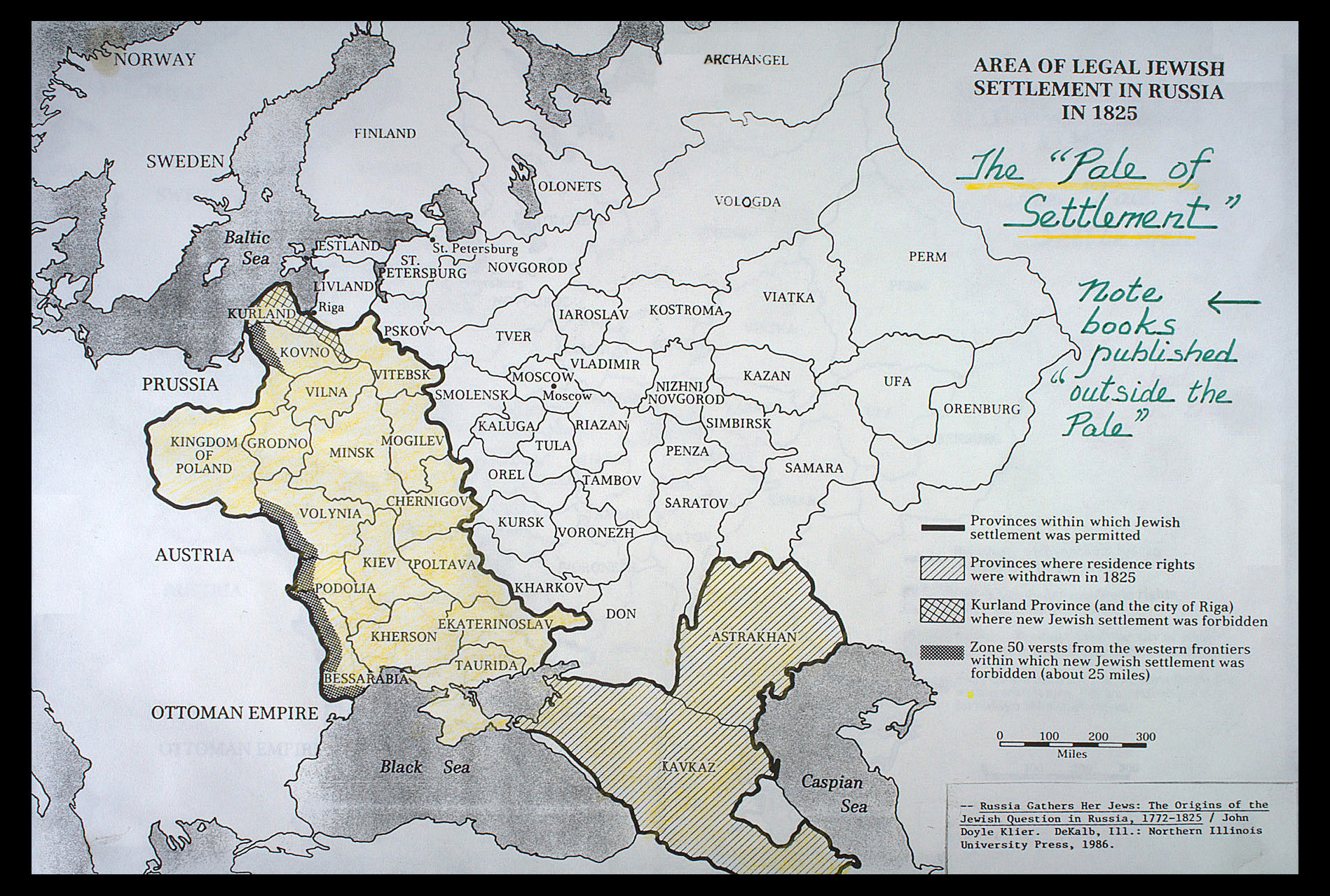
The Pale of Settlement was the term given to a region of Imperial Russia
, in which permanent residency by Jew
s was allowed, and beyond which Jewish permanent residency was generally prohibited. It extended from the eastern pale, or demarcation line, to the western Russian border with the Kingdom of Prussia
(later the German Empire
) and with Austria-Hungary
.
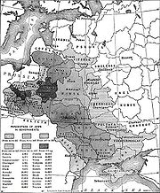
The Pale comprised about 20% of the territory of European Russia, and largely corresponded to historical borders of the former Polish-Lithuanian Commonwealth
; it included much of present-day Lithuania
, Belarus
, Poland
, Moldova
, Ukraine
, and parts of western Russia
. At a number of cities within the pale also, Jews were excluded from residency. A limited number of categories of Jews were allowed to live outside the pale.
The word pale derives ultimately from the Latin word palus, meaning stake (palisade
is derived from the same root). From this derivation came the figurative meaning of "boundary", and the concept of a pale as an area within which local laws were valid.
The Pale, with its largely Catholic and Jewish populations, was acquired by the Russian Orthodox Czarist Empire in a series of military conquests and diplomatic manoeuvres between 1791 and 1835, and lasted until the fall of the Russian Empire in 1917.
The Pale was first created by Catherine the Great
in 1791, after several failed attempts by her predecessors, notably the Empress Elizabeth, to remove Jews from Russia entirely, unless they converted to Russian Orthodoxy
, the state religion. The reasons for its creation were primarily economic and nationalist. While Russian society traditionally had been divided mainly into nobles
, serf
s, and clergy
, industrial progress led to the emergence of a middle class, which was rapidly being filled by Jews, who did not belong to any of these. By limiting the areas of Jewish residency, the imperial powers attempted to ensure the growth of a middle class for the non-Jewish majority.
The institution of the Pale became more significant following the Second Partition of Poland
in 1793, since until then, Russia's Jewish population had been rather limited; the dramatic westward expansion of the Czarist Empire through the annexation of Polish-Lithuanian territory increased the Jewish population substantially. At its height, the Pale, including the new Polish and Lithuanian territories, had a Jewish population of over 5 million, and represented the largest component (40 percent) of world Jewish population at that time.
From 1791 to 1835, and until 1917, there were differing reconfigurations of the boundaries of the Pale, such that certain areas were variously open or shut to Jewish residency, such as the Caucasus
. At times, Jews were forbidden to live in agricultural communities, or certain cities, as in Kiev
, Sevastopol
and Yalta
, and forced to move to small provincial towns, thus fostering the rise of the shtetl
s. Jewish merchants of the 1st guild
, people with higher or special education, artisan
s, soldiers, drafted in accordance with the Recruit Charter of 1810, and their descendants
had the right to live outside the Pale of Settlement. In some periods, special dispensations were given for Jews to live in the major imperial cities, but these were tenuous, and several thousand Jews were expelled to the Pale from Saint Petersburg and Moscow as late as 1891.
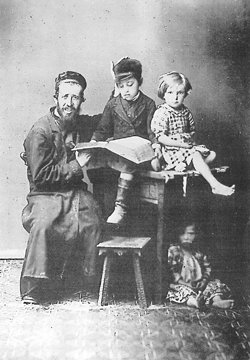
s (Yiddish
שטעטלעך shtetlekh "little towns") of the Pale of Settlement was hard and poverty-stricken. Following the time-honored Jewish religious tradition of tzedakah
(charity), a sophisticated system of volunteer Jewish social welfare organizations developed to meet the needs of the population. Various organizations supplied clothes to poor students, provided kosher food to Jewish soldiers conscripted into the Tsar's army
, dispensed free medical treatment for the poor, offered dowries and household gifts to destitute brides, and arranged for technical education for orphans. According to historian Martin Gilbert's Atlas of Jewish History, no province in the Pale had less than 14% of Jews on relief; Lithuanian and Ukrainian Jews supported as much as 22% of their poor populations.
The concentration of Jews in the Pale made them easy targets for pogrom
s and anti-Jewish riots by the masses. These, along with the repressive May Laws
, often devastated whole communities. Though pogroms were staged throughout the existence of the Pale, particularly devastating attacks occurred from 1881–1883 and from 1903–1906, targeting hundreds of communities, killing thousands of Jews, and causing considerable property damage. Anti-Russian riots by the Jews also occurred, for example in Gomel.
 One outgrowth of the concentration of Jews in a circumscribed area was the development of the modern yeshiva
system. Until the beginning of the 19th century, each town supported its own advanced students who learned in the local synagogue
with the rabbinical head of the community. Each student would eat his meals in a different home each day, a system known as "essen teg" ("eating days").
After 1886, the Jewish quota
was applied to education, with the percentage of Jewish students limited to no more than 10% within the Pale, 5% outside the Pale and 3% in the capitals of Moscow, St. Petersburg, and Kiev. The quotas in the capitals however, were increased slightly in 1908 and 1915.
Despite the difficult conditions under which the Jewish population lived and worked, the courts of Hasidic dynasties flourished in the Pale. Thousands of followers of rebbe
s such as the Gerrer Rebbe Yehudah Aryeh Leib Alter
(known as the Sfas Emes), the Chernobyler Rebbe, and the Vizhnitzer Rebbe flocked to their towns for the Jewish holiday
s and followed their rebbes' minhagim
(Jewish practices) in their own homes.
The tribulations of Jewish life in the Pale of Settlement were immortalized in the writings of Yiddish
authors such as humorist Sholom Aleichem
, whose stories of Tevye der Milchiger (Tevye the Milkman) in the fictional shtetl of Anatevka form the basis of Fiddler on the Roof
. Because of the harsh conditions of day-to-day life in the Pale, some 2 million Jews emigrated from there between 1881 and 1914, mainly to the United States
. However, this exodus did not affect the stability of the Jewish population of the Pale, which remained at 5 million people due to the high birthrate.
During World War I, the Pale lost its rigid hold on the Jewish population when large numbers of Jews fled into the Russian interior to escape the invading German army. On March 20 (April 2), 1917, the Pale was abolished by the Provisional Government decree
, On abolition of confessional and national restrictions (Об отмене вероисповедных и национальных ограничений). A large portion of the Pale, together with its Jewish population, became part of Poland
.
of Catherine II of December 23, 1791 limited the Pale to:
, the ukase of June 23, 1794, the following areas were added:
, the following areas were added:
Rural areas for 50 verst
(kilometers) from the western border were closed from new settlement.
Others:
In 1882 it was forbidden for Jews to settle in rural areas.
The following cities within the Pale were excluded from it:
Russian Empire
The Russian Empire was a state that existed from 1721 until the Russian Revolution of 1917. It was the successor to the Tsardom of Russia and the predecessor of the Soviet Union...
, in which permanent residency by Jew
Ashkenazi Jews
Ashkenazi Jews, also known as Ashkenazic Jews or Ashkenazim , are the Jews descended from the medieval Jewish communities along the Rhine in Germany from Alsace in the south to the Rhineland in the north. Ashkenaz is the medieval Hebrew name for this region and thus for Germany...
s was allowed, and beyond which Jewish permanent residency was generally prohibited. It extended from the eastern pale, or demarcation line, to the western Russian border with the Kingdom of Prussia
Kingdom of Prussia
The Kingdom of Prussia was a German kingdom from 1701 to 1918. Until the defeat of Germany in World War I, it comprised almost two-thirds of the area of the German Empire...
(later the German Empire
German Empire
The German Empire refers to Germany during the "Second Reich" period from the unification of Germany and proclamation of Wilhelm I as German Emperor on 18 January 1871, to 1918, when it became a federal republic after defeat in World War I and the abdication of the Emperor, Wilhelm II.The German...
) and with Austria-Hungary
Austria-Hungary
Austria-Hungary , more formally known as the Kingdoms and Lands Represented in the Imperial Council and the Lands of the Holy Hungarian Crown of Saint Stephen, was a constitutional monarchic union between the crowns of the Austrian Empire and the Kingdom of Hungary in...
.
The Pale comprised about 20% of the territory of European Russia, and largely corresponded to historical borders of the former Polish-Lithuanian Commonwealth
Polish-Lithuanian Commonwealth
The Polish–Lithuanian Commonwealth was a dualistic state of Poland and Lithuania ruled by a common monarch. It was the largest and one of the most populous countries of 16th- and 17th‑century Europe with some and a multi-ethnic population of 11 million at its peak in the early 17th century...
; it included much of present-day Lithuania
Lithuania
Lithuania , officially the Republic of Lithuania is a country in Northern Europe, the biggest of the three Baltic states. It is situated along the southeastern shore of the Baltic Sea, whereby to the west lie Sweden and Denmark...
, Belarus
Belarus
Belarus , officially the Republic of Belarus, is a landlocked country in Eastern Europe, bordered clockwise by Russia to the northeast, Ukraine to the south, Poland to the west, and Lithuania and Latvia to the northwest. Its capital is Minsk; other major cities include Brest, Grodno , Gomel ,...
, Poland
Poland
Poland , officially the Republic of Poland , is a country in Central Europe bordered by Germany to the west; the Czech Republic and Slovakia to the south; Ukraine, Belarus and Lithuania to the east; and the Baltic Sea and Kaliningrad Oblast, a Russian exclave, to the north...
, Moldova
Moldova
Moldova , officially the Republic of Moldova is a landlocked state in Eastern Europe, located between Romania to the West and Ukraine to the North, East and South. It declared itself an independent state with the same boundaries as the preceding Moldavian Soviet Socialist Republic in 1991, as part...
, Ukraine
Ukraine
Ukraine is a country in Eastern Europe. It has an area of 603,628 km², making it the second largest contiguous country on the European continent, after Russia...
, and parts of western Russia
Russia
Russia or , officially known as both Russia and the Russian Federation , is a country in northern Eurasia. It is a federal semi-presidential republic, comprising 83 federal subjects...
. At a number of cities within the pale also, Jews were excluded from residency. A limited number of categories of Jews were allowed to live outside the pale.
The word pale derives ultimately from the Latin word palus, meaning stake (palisade
Palisade
A palisade is a steel or wooden fence or wall of variable height, usually used as a defensive structure.- Typical construction :Typical construction consisted of small or mid sized tree trunks aligned vertically, with no spacing in between. The trunks were sharpened or pointed at the top, and were...
is derived from the same root). From this derivation came the figurative meaning of "boundary", and the concept of a pale as an area within which local laws were valid.
The Pale, with its largely Catholic and Jewish populations, was acquired by the Russian Orthodox Czarist Empire in a series of military conquests and diplomatic manoeuvres between 1791 and 1835, and lasted until the fall of the Russian Empire in 1917.
History
- For more information about life in the Pale, see: History of the Jews in PolandHistory of the Jews in PolandThe history of the Jews in Poland dates back over a millennium. For centuries, Poland was home to the largest and most significant Jewish community in the world. Poland was the centre of Jewish culture thanks to a long period of statutory religious tolerance and social autonomy. This ended with the...
and History of the Jews in Russia
The Pale was first created by Catherine the Great
Catherine II of Russia
Catherine II, also known as Catherine the Great , Empress of Russia, was born in Stettin, Pomerania, Prussia on as Sophie Friederike Auguste von Anhalt-Zerbst-Dornburg...
in 1791, after several failed attempts by her predecessors, notably the Empress Elizabeth, to remove Jews from Russia entirely, unless they converted to Russian Orthodoxy
Russian Orthodox Church
The Russian Orthodox Church or, alternatively, the Moscow Patriarchate The ROC is often said to be the largest of the Eastern Orthodox churches in the world; including all the autocephalous churches under its umbrella, its adherents number over 150 million worldwide—about half of the 300 million...
, the state religion. The reasons for its creation were primarily economic and nationalist. While Russian society traditionally had been divided mainly into nobles
Russian nobility
The Russian nobility arose in the 14th century and essentially governed Russia until the October Revolution of 1917.The Russian word for nobility, Dvoryanstvo , derives from the Russian word dvor , meaning the Court of a prince or duke and later, of the tsar. A nobleman is called dvoryanin...
, serf
SERF
A spin exchange relaxation-free magnetometer is a type of magnetometer developed at Princeton University in the early 2000s. SERF magnetometers measure magnetic fields by using lasers to detect the interaction between alkali metal atoms in a vapor and the magnetic field.The name for the technique...
s, and clergy
Clergy
Clergy is the generic term used to describe the formal religious leadership within a given religion. A clergyman, churchman or cleric is a member of the clergy, especially one who is a priest, preacher, pastor, or other religious professional....
, industrial progress led to the emergence of a middle class, which was rapidly being filled by Jews, who did not belong to any of these. By limiting the areas of Jewish residency, the imperial powers attempted to ensure the growth of a middle class for the non-Jewish majority.
The institution of the Pale became more significant following the Second Partition of Poland
Second Partition of Poland
The 1793 Second Partition of the Polish-Lithuanian Commonwealth was the second of three partitions that ended the existence of the Polish-Lithuanian Commonwealth by 1795. The second partition occurred in the aftermath of the War in Defense of the Constitution and the Targowica Confederation of 1792...
in 1793, since until then, Russia's Jewish population had been rather limited; the dramatic westward expansion of the Czarist Empire through the annexation of Polish-Lithuanian territory increased the Jewish population substantially. At its height, the Pale, including the new Polish and Lithuanian territories, had a Jewish population of over 5 million, and represented the largest component (40 percent) of world Jewish population at that time.
From 1791 to 1835, and until 1917, there were differing reconfigurations of the boundaries of the Pale, such that certain areas were variously open or shut to Jewish residency, such as the Caucasus
Caucasus
The Caucasus, also Caucas or Caucasia , is a geopolitical region at the border of Europe and Asia, and situated between the Black and the Caspian sea...
. At times, Jews were forbidden to live in agricultural communities, or certain cities, as in Kiev
Kiev
Kiev or Kyiv is the capital and the largest city of Ukraine, located in the north central part of the country on the Dnieper River. The population as of the 2001 census was 2,611,300. However, higher numbers have been cited in the press....
, Sevastopol
Sevastopol
Sevastopol is a city on rights of administrative division of Ukraine, located on the Black Sea coast of the Crimea peninsula. It has a population of 342,451 . Sevastopol is the second largest port in Ukraine, after the Port of Odessa....
and Yalta
Yalta
Yalta is a city in Crimea, southern Ukraine, on the north coast of the Black Sea.The city is located on the site of an ancient Greek colony, said to have been founded by Greek sailors who were looking for a safe shore on which to land. It is situated on a deep bay facing south towards the Black...
, and forced to move to small provincial towns, thus fostering the rise of the shtetl
Shtetl
A shtetl was typically a small town with a large Jewish population in Central and Eastern Europe until The Holocaust. Shtetls were mainly found in the areas which constituted the 19th century Pale of Settlement in the Russian Empire, the Congress Kingdom of Poland, Galicia and Romania...
s. Jewish merchants of the 1st guild
Guild
A guild is an association of craftsmen in a particular trade. The earliest types of guild were formed as confraternities of workers. They were organized in a manner something between a trade union, a cartel, and a secret society...
, people with higher or special education, artisan
Artisan
An artisan is a skilled manual worker who makes items that may be functional or strictly decorative, including furniture, clothing, jewellery, household items, and tools...
s, soldiers, drafted in accordance with the Recruit Charter of 1810, and their descendants
Kinship
Kinship is a relationship between any entities that share a genealogical origin, through either biological, cultural, or historical descent. And descent groups, lineages, etc. are treated in their own subsections....
had the right to live outside the Pale of Settlement. In some periods, special dispensations were given for Jews to live in the major imperial cities, but these were tenuous, and several thousand Jews were expelled to the Pale from Saint Petersburg and Moscow as late as 1891.
Jewish life in the Pale
Jewish life in the shtetlShtetl
A shtetl was typically a small town with a large Jewish population in Central and Eastern Europe until The Holocaust. Shtetls were mainly found in the areas which constituted the 19th century Pale of Settlement in the Russian Empire, the Congress Kingdom of Poland, Galicia and Romania...
s (Yiddish
Yiddish language
Yiddish is a High German language of Ashkenazi Jewish origin, spoken throughout the world. It developed as a fusion of German dialects with Hebrew, Aramaic, Slavic languages and traces of Romance languages...
שטעטלעך shtetlekh "little towns") of the Pale of Settlement was hard and poverty-stricken. Following the time-honored Jewish religious tradition of tzedakah
Tzedakah
Tzedakah or Ṣ'daqah in Classical Hebrew is a Hebrew word commonly translated as charity, though it is based on the Hebrew word meaning righteousness, fairness or justice...
(charity), a sophisticated system of volunteer Jewish social welfare organizations developed to meet the needs of the population. Various organizations supplied clothes to poor students, provided kosher food to Jewish soldiers conscripted into the Tsar's army
Imperial Russian Army
The Imperial Russian Army was the land armed force of the Russian Empire, active from around 1721 to the Russian Revolution of 1917. In the early 1850s, the Russian army consisted of around 938,731 regular soldiers and 245,850 irregulars . Until the time of military reform of Dmitry Milyutin in...
, dispensed free medical treatment for the poor, offered dowries and household gifts to destitute brides, and arranged for technical education for orphans. According to historian Martin Gilbert's Atlas of Jewish History, no province in the Pale had less than 14% of Jews on relief; Lithuanian and Ukrainian Jews supported as much as 22% of their poor populations.
The concentration of Jews in the Pale made them easy targets for pogrom
Pogrom
A pogrom is a form of violent riot, a mob attack directed against a minority group, and characterized by killings and destruction of their homes and properties, businesses, and religious centres...
s and anti-Jewish riots by the masses. These, along with the repressive May Laws
May Laws
Temporary regulations regarding the Jews were proposed by minister of internal affairs Nikolai Ignatyev and enacted on May 15 , 1882, by Tsar Alexander III of Russia...
, often devastated whole communities. Though pogroms were staged throughout the existence of the Pale, particularly devastating attacks occurred from 1881–1883 and from 1903–1906, targeting hundreds of communities, killing thousands of Jews, and causing considerable property damage. Anti-Russian riots by the Jews also occurred, for example in Gomel.
Yeshiva
Yeshiva is a Jewish educational institution that focuses on the study of traditional religious texts, primarily the Talmud and Torah study. Study is usually done through daily shiurim and in study pairs called chavrutas...
system. Until the beginning of the 19th century, each town supported its own advanced students who learned in the local synagogue
Synagogue
A synagogue is a Jewish house of prayer. This use of the Greek term synagogue originates in the Septuagint where it sometimes translates the Hebrew word for assembly, kahal...
with the rabbinical head of the community. Each student would eat his meals in a different home each day, a system known as "essen teg" ("eating days").
After 1886, the Jewish quota
Jewish quota
Jewish quota was a percentage that limited the number of Jews in various establishments. In particular, in 19th and 20th centuries some countries had Jewish quotas for higher education, a special case of Numerus clausus....
was applied to education, with the percentage of Jewish students limited to no more than 10% within the Pale, 5% outside the Pale and 3% in the capitals of Moscow, St. Petersburg, and Kiev. The quotas in the capitals however, were increased slightly in 1908 and 1915.
Despite the difficult conditions under which the Jewish population lived and worked, the courts of Hasidic dynasties flourished in the Pale. Thousands of followers of rebbe
Rebbe
Rebbe , which means master, teacher, or mentor, is a Yiddish word derived from the Hebrew word Rabbi. It often refers to the leader of a Hasidic Jewish movement...
s such as the Gerrer Rebbe Yehudah Aryeh Leib Alter
Yehudah Aryeh Leib Alter
Yehudah Aryeh Leib Alter , also known by the title of his main work, the Sfas Emes, was a Hasidic rabbi who succeeded his grandfather, Rabbi Yitzchak Meir Alter, as the av beis din and Rav of Góra Kalwaria, Poland , and succeeded the Rebbe, Reb Heynekh of Alexander, as Rebbe of the Gerrer...
(known as the Sfas Emes), the Chernobyler Rebbe, and the Vizhnitzer Rebbe flocked to their towns for the Jewish holiday
Jewish holiday
Jewish holidays are days observed by Jews as holy or secular commemorations of important events in Jewish history. In Hebrew, Jewish holidays and festivals, depending on their nature, may be called yom tov or chag or ta'anit...
s and followed their rebbes' minhagim
Minhag
Minhag is an accepted tradition or group of traditions in Judaism. A related concept, Nusach , refers to the traditional order and form of the prayers...
(Jewish practices) in their own homes.
The tribulations of Jewish life in the Pale of Settlement were immortalized in the writings of Yiddish
Yiddish language
Yiddish is a High German language of Ashkenazi Jewish origin, spoken throughout the world. It developed as a fusion of German dialects with Hebrew, Aramaic, Slavic languages and traces of Romance languages...
authors such as humorist Sholom Aleichem
Sholom Aleichem
Sholem Aleichem was the pen name of Solomon Naumovich Rabinovich, a leading Yiddish author and playwright...
, whose stories of Tevye der Milchiger (Tevye the Milkman) in the fictional shtetl of Anatevka form the basis of Fiddler on the Roof
Fiddler on the Roof
Fiddler on the Roof is a musical with music by Jerry Bock, lyrics by Sheldon Harnick, and book by Joseph Stein, set in Tsarist Russia in 1905. It is based on Tevye and his Daughters by Sholem Aleichem...
. Because of the harsh conditions of day-to-day life in the Pale, some 2 million Jews emigrated from there between 1881 and 1914, mainly to the United States
History of the Jews in the United States
The history of the Jews in the United States , has been part of the American national fabric since colonial times.Until the 1830s the Jewish community of Charleston, South Carolina was the most numerous in North America. With the large scale immigration of Jews from Germany in the 19th century,...
. However, this exodus did not affect the stability of the Jewish population of the Pale, which remained at 5 million people due to the high birthrate.
During World War I, the Pale lost its rigid hold on the Jewish population when large numbers of Jews fled into the Russian interior to escape the invading German army. On March 20 (April 2), 1917, the Pale was abolished by the Provisional Government decree
Decree
A decree is a rule of law issued by a head of state , according to certain procedures . It has the force of law...
, On abolition of confessional and national restrictions (Об отмене вероисповедных и национальных ограничений). A large portion of the Pale, together with its Jewish population, became part of Poland
History of the Jews in Poland
The history of the Jews in Poland dates back over a millennium. For centuries, Poland was home to the largest and most significant Jewish community in the world. Poland was the centre of Jewish culture thanks to a long period of statutory religious tolerance and social autonomy. This ended with the...
.
1791
The UkaseUkase
A ukase , in Imperial Russia, was a proclamation of the tsar, government, or a religious leader that had the force of law...
of Catherine II of December 23, 1791 limited the Pale to:
- BelarusBelarusBelarus , officially the Republic of Belarus, is a landlocked country in Eastern Europe, bordered clockwise by Russia to the northeast, Ukraine to the south, Poland to the west, and Lithuania and Latvia to the northwest. Its capital is Minsk; other major cities include Brest, Grodno , Gomel ,...
:- MogilevMogilevMogilev is a city in eastern Belarus, about 76 km from the border with Russia's Smolensk Oblast and 105 km from the border with Russia's Bryansk Oblast. It has more than 367,788 inhabitants...
guberniyaGuberniyaA guberniya was a major administrative subdivision of the Russian Empire usually translated as government, governorate, or province. Such administrative division was preserved for sometime upon the collapse of the empire in 1917. A guberniya was ruled by a governor , a word borrowed from Latin ,... - Polotsk guberniya (was later reorganized into VitebskVitebskVitebsk, also known as Viciebsk or Vitsyebsk , is a city in Belarus, near the border with Russia. The capital of the Vitebsk Oblast, in 2004 it had 342,381 inhabitants, making it the country's fourth largest city...
guberniya)
- Mogilev
- UkraineUkraineUkraine is a country in Eastern Europe. It has an area of 603,628 km², making it the second largest contiguous country on the European continent, after Russia...
:- Yekaterinoslav namestnichestvo (viceroyalty)
- Taurida Oblast (CrimeaCrimeaCrimea , or the Autonomous Republic of Crimea , is a sub-national unit, an autonomous republic, of Ukraine. It is located on the northern coast of the Black Sea, occupying a peninsula of the same name...
)
1794
After the Second partition of PolandPartitions of Poland
The Partitions of Poland or Partitions of the Polish–Lithuanian Commonwealth took place in the second half of the 18th century and ended the existence of the Polish–Lithuanian Commonwealth, resulting in the elimination of sovereign Poland for 123 years...
, the ukase of June 23, 1794, the following areas were added:
- MinskMinsk GovernorateThe Minsk Governorate or Government of Minsk was a governorate of the Russian Empire. The seat was in Minsk. It was created in 1793 from the land acquired in the partitions of Poland, and lasted until 1921.- Administrative structure :...
guberniya - MogilevMogilevMogilev is a city in eastern Belarus, about 76 km from the border with Russia's Smolensk Oblast and 105 km from the border with Russia's Bryansk Oblast. It has more than 367,788 inhabitants...
guberniyaGuberniyaA guberniya was a major administrative subdivision of the Russian Empire usually translated as government, governorate, or province. Such administrative division was preserved for sometime upon the collapse of the empire in 1917. A guberniya was ruled by a governor , a word borrowed from Latin ,... - Polotsk guberniya
- Malorossiya:
- major part of KievKievKiev or Kyiv is the capital and the largest city of Ukraine, located in the north central part of the country on the Dnieper River. The population as of the 2001 census was 2,611,300. However, higher numbers have been cited in the press....
guberniya - VolhyniaVolhyniaVolhynia, Volynia, or Volyn is a historic region in western Ukraine located between the rivers Prypiat and Southern Bug River, to the north of Galicia and Podolia; the region is named for the former city of Volyn or Velyn, said to have been located on the Southern Bug River, whose name may come...
(IziaslavIziaslavIziaslav can refer to:* Iziaslav of Kiev * Iziaslav, Ukraine, city...
guberniya) - PodoliaPodoliaThe region of Podolia is an historical region in the west-central and south-west portions of present-day Ukraine, corresponding to Khmelnytskyi Oblast and Vinnytsia Oblast. Northern Transnistria, in Moldova, is also a part of Podolia...
(BratslavBratslavBratslav |Breslov]] as the name of a Hasidic group, which originated from this town) is a townlet in Ukraine, located in the Nemyriv Raion of Vinnytsia Oblast, by the Southern Bug river. It is a medieval European city having dramatically lost its importance during 19th-20th centuries...
guberniya)
- major part of Kiev
- Chernigov guberniya
- Novgorod-Seversk gubernia (later became PoltavaPoltavaPoltava is a city in located on the Vorskla River in central Ukraine. It is the administrative center of the Poltava Oblast , as well as the surrounding Poltava Raion of the oblast. Poltava's estimated population is 298,652 ....
guberniya)
1795
After the Third Partition of PolandThird Partition of Poland
The Third Partition of Poland or Third Partition of the Polish-Lithuanian Commonwealth took place in 1795 as the third and last of three partitions that ended the existence of the Polish-Lithuanian Commonwealth.-Background:...
, the following areas were added:
- Vilna guberniya
- Grodno GovernorateGrodno GovernorateThe Grodno Governorate, was a governorate of the Russian Empire.-Overview:Grodno: a western province or government of Europe lying between 52 and 54 N lat 23 and E long and bounded N by Vilna E by Minsk S Volhynia and W by the former kingdom of Poland The country was a wide plain in parts very...
1805–1835
After 1805 the Pale gradually shrinks, by the exclusion of the following areas:- LithuaniaLithuaniaLithuania , officially the Republic of Lithuania is a country in Northern Europe, the biggest of the three Baltic states. It is situated along the southeastern shore of the Baltic Sea, whereby to the west lie Sweden and Denmark...
n guberniyas - Southwestern KraiSouthwestern KraiSouthwestern Krai , also known as Kiev General Governorate or Kiev, Podolia, and Volhynia General Governorate was a subdivision of the Russian Empire that included much of the territory of modern-day Ukraine covering both banks of the Dnieper River.The Governorate General consisted of several...
- BelarusBelarusBelarus , officially the Republic of Belarus, is a landlocked country in Eastern Europe, bordered clockwise by Russia to the northeast, Ukraine to the south, Poland to the west, and Lithuania and Latvia to the northwest. Its capital is Minsk; other major cities include Brest, Grodno , Gomel ,...
without rural areas - Malorossiya without rural areas
- Chernigov guberniya
- NovorossiyaNovorossiyaNovorossiya is a historic area of lands which established itself solidly after the annexation of the Crimean Khanate by the Russian Empire, but was introduced with the establishment of Novorossiysk Governorate with the capital in Kremenchuk in the mid 18th century. Until that time in both Polish...
without Nikolaev and SevastopolSevastopolSevastopol is a city on rights of administrative division of Ukraine, located on the Black Sea coast of the Crimea peninsula. It has a population of 342,451 . Sevastopol is the second largest port in Ukraine, after the Port of Odessa.... - KievKievKiev or Kyiv is the capital and the largest city of Ukraine, located in the north central part of the country on the Dnieper River. The population as of the 2001 census was 2,611,300. However, higher numbers have been cited in the press....
guberniya without Kiev - Baltic guberniyas closed for newcoming Jews
- Congress PolandCongress PolandThe Kingdom of Poland , informally known as Congress Poland , created in 1815 by the Congress of Vienna, was a personal union of the Russian parcel of Poland with the Russian Empire...
Rural areas for 50 verst
Verst
A verst or werst is an obsolete Russian unit of length. It is defined as being 500 sazhen long, which makes a verst equal to 1.0668 kilometres ....
(kilometers) from the western border were closed from new settlement.
Final [% Jewish according to the 1897 census]
- Northwestern KraiNorthwestern KraiNorthwestern Krai was a subdivision of Imperial Russia in the territories of the present day Belarus and Lithuania. Together with the Southwestern Krai it formed the Western Krai...
(whole; LithuaniaLithuaniaLithuania , officially the Republic of Lithuania is a country in Northern Europe, the biggest of the three Baltic states. It is situated along the southeastern shore of the Baltic Sea, whereby to the west lie Sweden and Denmark...
, BelarusBelarusBelarus , officially the Republic of Belarus, is a landlocked country in Eastern Europe, bordered clockwise by Russia to the northeast, Ukraine to the south, Poland to the west, and Lithuania and Latvia to the northwest. Its capital is Minsk; other major cities include Brest, Grodno , Gomel ,...
):
- Vilna guberniyaVilna GovernorateThe Vilna Governorate or Government of Vilna was a governorate of the Russian Empire created after the Third Partition of the Polish-Lithuanian Commonwealth in 1795...
[12.86%] - Kovno guberniyaKovno GovernorateThe Kovno Governorate or Government of Kovno was a governorate of the Russian Empire. Its capital was Kovno . It was formed on 18 December 1842 by tsar Nicholas I from the western part of the Vilna Governorate, and the order was carried out on 1 July 1843. It used to be a part of Northwestern Krai...
[13.77%] - Grodno guberniyaGrodno GovernorateThe Grodno Governorate, was a governorate of the Russian Empire.-Overview:Grodno: a western province or government of Europe lying between 52 and 54 N lat 23 and E long and bounded N by Vilna E by Minsk S Volhynia and W by the former kingdom of Poland The country was a wide plain in parts very...
[17.49%] - MinskMinsk- Ecological situation :The ecological situation is monitored by Republican Center of Radioactive and Environmental Control .During 2003–2008 the overall weight of contaminants increased from 186,000 to 247,400 tons. The change of gas as industrial fuel to mazut for financial reasons has worsened...
guberniya [16.06%] - MogilevMogilevMogilev is a city in eastern Belarus, about 76 km from the border with Russia's Smolensk Oblast and 105 km from the border with Russia's Bryansk Oblast. It has more than 367,788 inhabitants...
guberniya [12.09%] - VitebskVitebskVitebsk, also known as Viciebsk or Vitsyebsk , is a city in Belarus, near the border with Russia. The capital of the Vitebsk Oblast, in 2004 it had 342,381 inhabitants, making it the country's fourth largest city...
guberniya (some parts of it are in Pskov OblastPskov OblastPskov Oblast is a federal subject of Russia . Pskov Oblast borders the countries of Estonia and Latvia, as well as Belarus. It is the westernmost federal subject of contiguous Russia . Its major cities are the administrative center Pskov and Velikiye Luki . Area: 55,300 km²...
and Smolensk OblastSmolensk OblastSmolensk Oblast is a federal subject of Russia . Its area is . Population: -Geography:The administrative center of Smolensk Oblast is the city of Smolensk. Other ancient towns include Vyazma and Dorogobuzh....
now) [11.79%]
- Southwestern KraiSouthwestern KraiSouthwestern Krai , also known as Kiev General Governorate or Kiev, Podolia, and Volhynia General Governorate was a subdivision of the Russian Empire that included much of the territory of modern-day Ukraine covering both banks of the Dnieper River.The Governorate General consisted of several...
(part; now in UkraineUkraineUkraine is a country in Eastern Europe. It has an area of 603,628 km², making it the second largest contiguous country on the European continent, after Russia...
):
- KievKievKiev or Kyiv is the capital and the largest city of Ukraine, located in the north central part of the country on the Dnieper River. The population as of the 2001 census was 2,611,300. However, higher numbers have been cited in the press....
guberniya [12.19%] - VolhyniaVolhyniaVolhynia, Volynia, or Volyn is a historic region in western Ukraine located between the rivers Prypiat and Southern Bug River, to the north of Galicia and Podolia; the region is named for the former city of Volyn or Velyn, said to have been located on the Southern Bug River, whose name may come...
guberniya [13.24%] - PodoliaPodoliaThe region of Podolia is an historical region in the west-central and south-west portions of present-day Ukraine, corresponding to Khmelnytskyi Oblast and Vinnytsia Oblast. Northern Transnistria, in Moldova, is also a part of Podolia...
guberniya [12.28%]
- PolishHistory of Poland (1795–1918)In 1795, the Third and the last of three partitions of Poland ended the existence of the Polish-Lithuanian Commonwealth. Nevertheless, hopes for restoration of Polish independence were kept alive throughout the 19th century by events within and outside the Polish lands...
guberniyas (lands of Congress PolandCongress PolandThe Kingdom of Poland , informally known as Congress Poland , created in 1815 by the Congress of Vienna, was a personal union of the Russian parcel of Poland with the Russian Empire...
):
- WarsawWarsawWarsaw is the capital and largest city of Poland. It is located on the Vistula River, roughly from the Baltic Sea and from the Carpathian Mountains. Its population in 2010 was estimated at 1,716,855 residents with a greater metropolitan area of 2,631,902 residents, making Warsaw the 10th most...
guberniya (Варшавская губерния (Мазовецкая губерния 1837-1844)) [18.22%] - LublinLublinLublin is the ninth largest city in Poland. It is the capital of Lublin Voivodeship with a population of 350,392 . Lublin is also the largest Polish city east of the Vistula river...
guberniya (Люблинская губерния) [13.46%] - Płock guberniya (Плоцкая губерния) [9.29%]
- KaliszKaliszKalisz is a city in central Poland with 106,857 inhabitants , the capital city of the Kalisz Region. Situated on the Prosna river in the southeastern part of the Greater Poland Voivodeship, the city forms a conurbation with the nearby towns of Ostrów Wielkopolski and Nowe Skalmierzyce...
guberniya (Калишская губерния) [8.52%] - PiotrkowPiotrków TrybunalskiPiotrków Trybunalski is a city in central Poland with 80,738 inhabitants . It is situated in the Łódź Voivodeship , and previously was the capital of Piotrków Voivodeship...
guberniya (Пётроковская губерния) [15.85%] - KielceKielceKielce ) is a city in central Poland with 204,891 inhabitants . It is also the capital city of the Świętokrzyskie Voivodeship since 1999, previously in Kielce Voivodeship...
guberniya (Келецкая губерния (Краковская губерния 1837-1844)) [10.92%] - RadomRadomRadom is a city in central Poland with 223,397 inhabitants . It is located on the Mleczna River in the Masovian Voivodeship , having previously been the capital of Radom Voivodeship ; 100 km south of Poland's capital, Warsaw.It is home to the biennial Radom Air Show, the largest and...
guberniya (Радомская губерния) [13.78%] - SiedlceSiedlceSiedlce ) is a city in eastern Poland with 77,392 inhabitants . Situated in the Masovian Voivodeship , previously the city was the capital of a separate Siedlce Voivodeship ....
guberniya (Седлецкая губерния (Подлясская губерния 1837-1844)) [15.69%] - AugustówAugustówAugustów is a town in north-eastern Poland with 29,600 inhabitants . It lies on the Netta River and the Augustów Canal. It is situated in the Podlaskie Voivodeship , having previously been in Suwałki Voivodeship . It is the seat of Augustów County and of Gmina Augustów.In 1970 Augustów became...
guberniya (Августовская губерния 1837–1867), split into:
-
- Suwałki guberniya (Сувалкская губерния) [10.16%]
- Łomża guberniya (Ломжинская губерния) [15.77%]
Others:
- Chernigov guberniyaChernigov GovernorateThe Chernigov Governorate , also known as the Government of Chernigov, was a guberniya in the historical Left-bank Ukraine region of the Russian Empire, which was officially created in 1802 from the disbanded Malorossiya Governorate with an administrative centre of Chernigov...
(some parts of it are in Bryansk OblastBryansk OblastBryansk Oblast is a federal subject of Russia . Its administrative center is the city of Bryansk. Population: 1,278,087 .-History:...
now) [4.98%] - PoltavaPoltavaPoltava is a city in located on the Vorskla River in central Ukraine. It is the administrative center of the Poltava Oblast , as well as the surrounding Poltava Raion of the oblast. Poltava's estimated population is 298,652 ....
guberniya [3.99%] - Tavrida guberniyaTaurida GovernorateThe Taurida Governorate or Government of Taurida was a historical governorate of the Russian Empire. It included the Crimean peninsula and the mainland between the lower Dnieper River and the coasts of the Black Sea and Sea of Azov It was formed after the defunct Taurida Oblast in was abolished in...
(CrimeaCrimeaCrimea , or the Autonomous Republic of Crimea , is a sub-national unit, an autonomous republic, of Ukraine. It is located on the northern coast of the Black Sea, occupying a peninsula of the same name...
) [Jewish 4.20% + Karaite 0.43%] - Kherson guberniyaKherson GovernorateThe Kherson Governorate or Government of Kherson was a guberniya, or administrative territorial unit, in the Southern Ukrainian region, between the Dnieper and Dniester Rivers, of the Russian Empire. It was one of three governorates created in 1802 when the Novorossiya guberniya was abolished...
[12.43%] - BessarabiaBessarabiaBessarabia is a historical term for the geographic region in Eastern Europe bounded by the Dniester River on the east and the Prut River on the west....
guberniya [11.81%] - Ekaterinoslav guberniya [4.78%]
In 1882 it was forbidden for Jews to settle in rural areas.
The following cities within the Pale were excluded from it:
- KievKievKiev or Kyiv is the capital and the largest city of Ukraine, located in the north central part of the country on the Dnieper River. The population as of the 2001 census was 2,611,300. However, higher numbers have been cited in the press....
(the ukase of December 2, 1827: eviction of Jews from Kiev) - Nikolaev
- SevastopolSevastopolSevastopol is a city on rights of administrative division of Ukraine, located on the Black Sea coast of the Crimea peninsula. It has a population of 342,451 . Sevastopol is the second largest port in Ukraine, after the Port of Odessa....
- YaltaYaltaYalta is a city in Crimea, southern Ukraine, on the north coast of the Black Sea.The city is located on the site of an ancient Greek colony, said to have been founded by Greek sailors who were looking for a safe shore on which to land. It is situated on a deep bay facing south towards the Black...
See also
- English PaleThe PaleThe Pale or the English Pale , was the part of Ireland that was directly under the control of the English government in the late Middle Ages. It had reduced by the late 15th century to an area along the east coast stretching from Dalkey, south of Dublin, to the garrison town of Dundalk...
around Dublin in Ireland - May LawsMay LawsTemporary regulations regarding the Jews were proposed by minister of internal affairs Nikolai Ignatyev and enacted on May 15 , 1882, by Tsar Alexander III of Russia...
- PogromPogromA pogrom is a form of violent riot, a mob attack directed against a minority group, and characterized by killings and destruction of their homes and properties, businesses, and religious centres...
- History of the Jews in Russia and the Soviet UnionHistory of the Jews in Russia and the Soviet UnionThe vast territories of the Russian Empire at one time hosted the largest populations of Jews in the diaspora. Within these territories the Jewish community flourished and developed many of modern Judaism's most distinctive theological and cultural traditions, while also facing periods of...
- History of the Jews in PolandHistory of the Jews in PolandThe history of the Jews in Poland dates back over a millennium. For centuries, Poland was home to the largest and most significant Jewish community in the world. Poland was the centre of Jewish culture thanks to a long period of statutory religious tolerance and social autonomy. This ended with the...
External links
- The Pale of Settlement (with a map) at Jewish Virtual LibraryJewish Virtual LibraryJewish Virtual Library is an online encyclopedia published by the American-Israeli Cooperative Enterprise . Established in 1993, it is a comprehensive website covering Israel, the Jewish people, and Jewish culture.-History:...
- The Pale of Settlement (with map and additional documents) at The YIVO Encyclopedia of Jews in Eastern EuropeThe YIVO Encyclopedia of Jews in Eastern EuropeThe YIVO Encyclopedia of Jews in Eastern Europe is a two-volume, English-language reference work on the history and culture of Eastern Europe Jewry in this region, prepared by the YIVO Institute for Jewish Research and published by Yale University Press in 2008.The Encyclopedia, 2,400 pages in...
- friends-partners.org (with map)
- Life in the Pale of Settlement (with photos)
- Jewish Encyclopedia - Jewish EncyclopediaJewish EncyclopediaThe Jewish Encyclopedia is an encyclopedia originally published in New York between 1901 and 1906 by Funk and Wagnalls. It contained over 15,000 articles in 12 volumes on the history and then-current state of Judaism and the Jews as of 1901...
- aish.com
- britannica.com
- digital.library.mcgill.ca (with map)
- http://www.portcities.org.uk/london/server/show/ConNarrative.134/chapterId/2732/The-Jewish-community-and-the-port.html (with map of Polish era)
- The decree "On abolition of confessional and national restrictions", passed by the Provisional Government on March 20, 1917 (in Russian)