

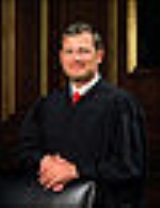
Chief Justice of the United States

Encyclopedia
The Chief Justice of the United States is the head of the United States federal court system
(the judicial branch
of the federal government of the United States
) and the chief judge
of the Supreme Court of the United States
. The Chief Justice is one of nine Supreme Court justices; the other eight are the Associate Justices of the Supreme Court of the United States
. From 1789 until 1866, the office was known as the Chief Justice of the Supreme Court.
The Chief Justice is the highest judicial officer in the country, and acts as a chief administrative officer
for the federal courts and appoints the director of the Administrative Office of the United States Courts
. The Chief Justice also serves as a spokesperson for the judicial branch.
The Chief Justice leads the business of the Supreme Court. He or she presides over oral arguments before the Court. When the Court renders an opinion, the Chief Justice—when in the majority—decides who writes the Court's opinion. Finally, the Chief Justice has significant agenda-setting power over the Court's meetings. In the case of an impeachment
of a President of the United States
, which has occurred twice, the Chief Justice presides over the trial in the Senate. In modern tradition, the Chief Justice also has the ceremonial duty of administering the oath of office of the President of the United States.
The first Chief Justice was John Jay
. The 17th and current Chief Justice is John G. Roberts, Jr.
.jpg) The United States Constitution does not explicitly establish the office of Chief Justice, but presupposes its existence with a single reference in Article I, Section 3, Clause 6: "When the President of the United States is tried, the Chief Justice shall preside." Nothing more is said in the Constitution regarding the office, including any further distinction between the Chief Justice and Associate Justices of the Supreme Court, who are never mentioned as such in the Constitution.
The United States Constitution does not explicitly establish the office of Chief Justice, but presupposes its existence with a single reference in Article I, Section 3, Clause 6: "When the President of the United States is tried, the Chief Justice shall preside." Nothing more is said in the Constitution regarding the office, including any further distinction between the Chief Justice and Associate Justices of the Supreme Court, who are never mentioned as such in the Constitution.
The office was originally known as "Chief Justice of the Supreme Court" and is still often informally referred to using that title. However, specifies the official title as "Chief Justice of the United States." The title was changed from Chief Justice of the Supreme Court by Congress in 1866 at the suggestion of the sixth Chief Justice, Salmon P. Chase
. Chase wished to emphasize the Court's role as a co-equal branch of government. The first Chief Justice commissioned using the new title was Melville Fuller
in 1888. Use of the previous title when referring to Chief Justices John Jay
through Roger B. Taney
is technically correct, as that was the official title during their time on the Court, but the newer title is frequently used retroactively for all Chief Justices.
The other eight members of the Court are officially Associate Justices of the Supreme Court of the United States, not "Associate Justices of the United States." In fact, the Chief Justice is the only member of the Court to whom the Constitution refers as a "Justice," and only in Article I. Article III
of the Constitution refers to all members of the Supreme Court (and of other federal courts) simply as "Judges."
The Chief Justice, like all other federal judges, is nominated by the President of the United States
and confirmed to sit on the Court by the Senate. The U.S. Constitution states that all justices of the Court "shall hold their offices during good behavior," meaning that the appointments only end when a justice dies in office, resigns, or is impeached by the House of Representatives and convicted by the Senate. The salary of the Chief Justice is set by Congress; the Constitution prohibits Congress from lowering the Chief Justice's salary during the Chief Justice's tenure on the Court. , the salary is set at $223,500 per year, which is slightly higher than that of the Associate Justices.
Traditionally, the Chief Justice is appointed by the President of the United States
. However, there is no express constitutional prohibition against using another method to select the Chief Justice from among those Justices properly appointed and confirmed, and at least one scholar has proposed that presidential appointment should be done away with, and replaced by permitting the Justices to select their own Chief Justice.
Some Chief Justices, like William Rehnquist
, were elevated by the President while serving on the bench as an Associate Justice. Justices who are elevated to the position of Chief Justice from that of an Associate Justice must again be confirmed by the Senate (a rejection by the Senate, however, does not end their tenure as an Associate Justice). Most Chief Justices, including John Roberts, have been nominated to the highest position on the Court without any previous experience on the Court; indeed some, like Earl Warren
, were selected without any prior judicial experience.
Eighteen people have been nominated for Chief Justice and confirmed by the Senate—seventeen have served. William Cushing
was chosen in January 1796 but declined the office. Oliver Ellsworth
served instead. The Senate subsequently confirmed John Jay
to replace Ellsworth, though Jay declined to resume his former office, citing both the burden of riding circuit and its impact on his health, and his perception of the Court's lack of prestige. John Marshall
was nominated and confirmed shortly afterward.
Where the Chief Justice dies in office or is otherwise unwilling or unable to serve, the duties of the Chief Justice pass to the most senior sitting Justice, who serves as Acting Chief Justice until a new Chief Justice is confirmed.
and William Rehnquist
, have presided over the trial in the Senate that follows an impeachment
of the President – Chase in 1868 over the proceedings against President Andrew Johnson
and Rehnquist in 1999 over the proceedings against President Bill Clinton
.
, independent of the number of years of service in the Court. As a result, the Chief Justice chairs the conferences where cases are discussed and voted on by the justices. The Chief Justice normally speaks first, and so has influence in framing the discussion.
The Chief Justice sets the agenda for the weekly meetings where the justices review the petitions for certiorari
, to decide whether to hear or deny each case. The Supreme Court agrees to hear less than one percent of the cases petitioned to it. While Associate Justices may append items to the weekly agenda, in practice this initial agenda-setting power of the Chief Justice has significant influence over the direction of the court.
Despite the seniority and added prestige, the Chief Justice's vote carries the same legal weight as each of the other eight justices. In any decision, he has no legal authority to overrule the verdicts or interpretations of the other eight judges or tamper with them. However, in any vote, the most senior justice in the majority decides who will write the Opinion of the Court. Being the most senior member, the Chief Justice—when in the majority—decides who writes the Court's opinion. This power to determine the opinion author (including the option to select oneself) allows a Chief Justice in the majority to influence the historical record. Two justices in the same majority, given the opportunity, might write very different majority opinions (as evidenced by many concurring opinions); being assigned the opinion may also cement the vote of an Associate who is viewed as only marginally in the majority (a tactic that was reportedly used to some effect by Earl Warren
). A Chief Justice who knows the Associate Justices can therefore do much—by the simple act of selecting the justice who writes the Opinion of the Court—to affect the "flavor" of the opinion, which in turn can affect the interpretation of that opinion in cases before lower courts in the years to come. It is said that some chief justices, notably Earl Warren and Warren Burger, sometimes switched votes to a majority they disagreed with to be able to use this prerogative of the Chief Justice to dictate who would write the opinion.
at the inauguration of the President of the United States. This is a traditional rather than constitutional responsibility of the Chief Justice; the Constitution does not require that the oath be administered by anyone in particular, simply that it be taken by the President. Law empowers any federal and state judge, as well as notaries public
, to administer oath
s and affirmations
.
If the Chief Justice is ill or incapacitated, the oath is usually administered by the next senior member of the Supreme Court. Seven times, someone other than the Chief Justice of the United States administered the oath of office to the President. Robert Livingston
, as Chancellor of the State of New York (the state's highest ranking judicial office), administered the oath of office to George Washington
at his first inauguration; there was no Chief Justice of the United States, nor any other federal judge prior to their appointments by President Washington in the months following his inauguration. William Cushing
, an Associate Justice of the Supreme Court, administered Washington's second oath of office in 1793. Calvin Coolidge
's father, a notary public, administered the oath to his son after the death of Warren Harding. This, however, was contested upon Coolidge's return to Washington and his oath was re-administered by Judge Adolph A. Hoehling, Jr.
of the District of Columbia Supreme Court. United States District Court
Judge Sarah T. Hughes
administered the oath to Lyndon Johnson after the John F. Kennedy assassination. Vice Presidents John Tyler
and Millard Fillmore
were both sworn in on the death of their predecessors by Chief Justice William Cranch of the Circuit Court of the District of Columbia. Chester A. Arthur
and Theodore Roosevelt
's initial oaths reflected the unexpected nature of their taking office.
In addition, the Chief Justice ordinarily administers the oath of office to newly appointed and confirmed Associate Justices, whereas the Senior Associate Justice will normally swear in a new Chief Justice.
Unlike Senators and Representatives who are constitutionally prohibited from holding any other "office of trust or profit" of the United States or of any state while holding their congressional seats, the Chief Justice and the other members of the federal judiciary are not barred from serving in other positions. Chief Justice John Jay served as a diplomat to negotiate the so-called Jay Treaty
(aka The Treaty of London of 1794), and Chief Justice Earl Warren
chaired The President's Commission on the Assassination of President Kennedy
. As described above, the Chief Justice holds office in the Smithsonian Institution and the Library of Congress.
3, when the Chief Justice is unable to discharge his functions, or that office is vacant, his duties are carried out by the most senior associate justice who is able to act, until the disability or vacancy ends.
United States federal courts
The United States federal courts make up the judiciary branch of federal government of the United States organized under the United States Constitution and laws of the federal government.-Categories:...
(the judicial branch
Judiciary
The judiciary is the system of courts that interprets and applies the law in the name of the state. The judiciary also provides a mechanism for the resolution of disputes...
of the federal government of the United States
Federal government of the United States
The federal government of the United States is the national government of the constitutional republic of fifty states that is the United States of America. The federal government comprises three distinct branches of government: a legislative, an executive and a judiciary. These branches and...
) and the chief judge
Chief judge
Chief Judge is a title that can refer to the highest-ranking judge of a court that has more than one judge. The meaning and usage of the term vary from one court system to another...
of the Supreme Court of the United States
Supreme Court of the United States
The Supreme Court of the United States is the highest court in the United States. It has ultimate appellate jurisdiction over all state and federal courts, and original jurisdiction over a small range of cases...
. The Chief Justice is one of nine Supreme Court justices; the other eight are the Associate Justices of the Supreme Court of the United States
Associate Justice of the Supreme Court of the United States
Associate Justices of the Supreme Court of the United States are the members of the Supreme Court of the United States other than the Chief Justice of the United States...
. From 1789 until 1866, the office was known as the Chief Justice of the Supreme Court.
The Chief Justice is the highest judicial officer in the country, and acts as a chief administrative officer
Chief administrative officer
A chief administrative officer is responsible for administrative management of private, public or governmental corporations. The CAO is one of the highest ranking members of an organization, managing daily operations and usually reporting directly to the chief executive officer. In some companies,...
for the federal courts and appoints the director of the Administrative Office of the United States Courts
Administrative Office of the United States Courts
The Administrative Office of the United States Courts is the administrative agency of the United States federal court system. It was established in 1939.The AO is the central support entity for the federal judicial branch...
. The Chief Justice also serves as a spokesperson for the judicial branch.
The Chief Justice leads the business of the Supreme Court. He or she presides over oral arguments before the Court. When the Court renders an opinion, the Chief Justice—when in the majority—decides who writes the Court's opinion. Finally, the Chief Justice has significant agenda-setting power over the Court's meetings. In the case of an impeachment
Impeachment in the United States
Impeachment in the United States is an expressed power of the legislature that allows for formal charges against a civil officer of government for crimes committed in office...
of a President of the United States
President of the United States
The President of the United States of America is the head of state and head of government of the United States. The president leads the executive branch of the federal government and is the commander-in-chief of the United States Armed Forces....
, which has occurred twice, the Chief Justice presides over the trial in the Senate. In modern tradition, the Chief Justice also has the ceremonial duty of administering the oath of office of the President of the United States.
The first Chief Justice was John Jay
John Jay
John Jay was an American politician, statesman, revolutionary, diplomat, a Founding Father of the United States, and the first Chief Justice of the United States ....
. The 17th and current Chief Justice is John G. Roberts, Jr.
Origin, title, and appointment to the post
The office was originally known as "Chief Justice of the Supreme Court" and is still often informally referred to using that title. However, specifies the official title as "Chief Justice of the United States." The title was changed from Chief Justice of the Supreme Court by Congress in 1866 at the suggestion of the sixth Chief Justice, Salmon P. Chase
Salmon P. Chase
Salmon Portland Chase was an American politician and jurist who served as U.S. Senator from Ohio and the 23rd Governor of Ohio; as U.S. Treasury Secretary under President Abraham Lincoln; and as the sixth Chief Justice of the United States Supreme Court.Chase was one of the most prominent members...
. Chase wished to emphasize the Court's role as a co-equal branch of government. The first Chief Justice commissioned using the new title was Melville Fuller
Melville Fuller
Melville Weston Fuller was the eighth Chief Justice of the United States between 1888 and 1910.-Early life and education:...
in 1888. Use of the previous title when referring to Chief Justices John Jay
John Jay
John Jay was an American politician, statesman, revolutionary, diplomat, a Founding Father of the United States, and the first Chief Justice of the United States ....
through Roger B. Taney
Roger B. Taney
Roger Brooke Taney was the fifth Chief Justice of the United States, holding that office from 1836 until his death in 1864. He was the first Roman Catholic to hold that office or sit on the Supreme Court of the United States. He was also the eleventh United States Attorney General. He is most...
is technically correct, as that was the official title during their time on the Court, but the newer title is frequently used retroactively for all Chief Justices.
The other eight members of the Court are officially Associate Justices of the Supreme Court of the United States, not "Associate Justices of the United States." In fact, the Chief Justice is the only member of the Court to whom the Constitution refers as a "Justice," and only in Article I. Article III
Article Three of the United States Constitution
Article Three of the United States Constitution establishes the judicial branch of the federal government. The judicial branch comprises the Supreme Court of the United States and lower courts as created by Congress.-Section 1: Federal courts:...
of the Constitution refers to all members of the Supreme Court (and of other federal courts) simply as "Judges."
The Chief Justice, like all other federal judges, is nominated by the President of the United States
President of the United States
The President of the United States of America is the head of state and head of government of the United States. The president leads the executive branch of the federal government and is the commander-in-chief of the United States Armed Forces....
and confirmed to sit on the Court by the Senate. The U.S. Constitution states that all justices of the Court "shall hold their offices during good behavior," meaning that the appointments only end when a justice dies in office, resigns, or is impeached by the House of Representatives and convicted by the Senate. The salary of the Chief Justice is set by Congress; the Constitution prohibits Congress from lowering the Chief Justice's salary during the Chief Justice's tenure on the Court. , the salary is set at $223,500 per year, which is slightly higher than that of the Associate Justices.
Traditionally, the Chief Justice is appointed by the President of the United States
President of the United States
The President of the United States of America is the head of state and head of government of the United States. The president leads the executive branch of the federal government and is the commander-in-chief of the United States Armed Forces....
. However, there is no express constitutional prohibition against using another method to select the Chief Justice from among those Justices properly appointed and confirmed, and at least one scholar has proposed that presidential appointment should be done away with, and replaced by permitting the Justices to select their own Chief Justice.
Some Chief Justices, like William Rehnquist
William Rehnquist
William Hubbs Rehnquist was an American lawyer, jurist, and political figure who served as an Associate Justice on the Supreme Court of the United States and later as the 16th Chief Justice of the United States...
, were elevated by the President while serving on the bench as an Associate Justice. Justices who are elevated to the position of Chief Justice from that of an Associate Justice must again be confirmed by the Senate (a rejection by the Senate, however, does not end their tenure as an Associate Justice). Most Chief Justices, including John Roberts, have been nominated to the highest position on the Court without any previous experience on the Court; indeed some, like Earl Warren
Earl Warren
Earl Warren was the 14th Chief Justice of the United States.He is known for the sweeping decisions of the Warren Court, which ended school segregation and transformed many areas of American law, especially regarding the rights of the accused, ending public-school-sponsored prayer, and requiring...
, were selected without any prior judicial experience.
Eighteen people have been nominated for Chief Justice and confirmed by the Senate—seventeen have served. William Cushing
William Cushing
William Cushing was an early Associate Justice of the United States Supreme Court, from its inception to his death. He was the longest-serving of the Court's original members, sitting on the bench for 21 years...
was chosen in January 1796 but declined the office. Oliver Ellsworth
Oliver Ellsworth
Oliver Ellsworth was an American lawyer and politician, a revolutionary against British rule, a drafter of the United States Constitution, and the third Chief Justice of the United States. While at the Federal Convention, Ellsworth moved to strike the word National from the motion made by Edmund...
served instead. The Senate subsequently confirmed John Jay
John Jay
John Jay was an American politician, statesman, revolutionary, diplomat, a Founding Father of the United States, and the first Chief Justice of the United States ....
to replace Ellsworth, though Jay declined to resume his former office, citing both the burden of riding circuit and its impact on his health, and his perception of the Court's lack of prestige. John Marshall
John Marshall
John Marshall was the Chief Justice of the United States whose court opinions helped lay the basis for American constitutional law and made the Supreme Court of the United States a coequal branch of government along with the legislative and executive branches...
was nominated and confirmed shortly afterward.
Where the Chief Justice dies in office or is otherwise unwilling or unable to serve, the duties of the Chief Justice pass to the most senior sitting Justice, who serves as Acting Chief Justice until a new Chief Justice is confirmed.
Duties
Along with the duties of the associate justices, the Chief Justice has several unique duties.Impeachment trials
Article I, section 3 of the U.S. Constitution stipulates that the Chief Justice shall preside over impeachment trials of the President of the United States in the U.S. Senate. Two Chief Justices, Salmon P. ChaseSalmon P. Chase
Salmon Portland Chase was an American politician and jurist who served as U.S. Senator from Ohio and the 23rd Governor of Ohio; as U.S. Treasury Secretary under President Abraham Lincoln; and as the sixth Chief Justice of the United States Supreme Court.Chase was one of the most prominent members...
and William Rehnquist
William Rehnquist
William Hubbs Rehnquist was an American lawyer, jurist, and political figure who served as an Associate Justice on the Supreme Court of the United States and later as the 16th Chief Justice of the United States...
, have presided over the trial in the Senate that follows an impeachment
Impeachment
Impeachment is a formal process in which an official is accused of unlawful activity, the outcome of which, depending on the country, may include the removal of that official from office as well as other punishment....
of the President – Chase in 1868 over the proceedings against President Andrew Johnson
Andrew Johnson
Andrew Johnson was the 17th President of the United States . As Vice-President of the United States in 1865, he succeeded Abraham Lincoln following the latter's assassination. Johnson then presided over the initial and contentious Reconstruction era of the United States following the American...
and Rehnquist in 1999 over the proceedings against President Bill Clinton
Bill Clinton
William Jefferson "Bill" Clinton is an American politician who served as the 42nd President of the United States from 1993 to 2001. Inaugurated at age 46, he was the third-youngest president. He took office at the end of the Cold War, and was the first president of the baby boomer generation...
.
Seniority
The Chief Justice is considered to be the justice with most senioritySeniority
Seniority is the concept of a person or group of people being in charge or in command of another person or group. This control is often granted to the senior person due to experience or length of service in a given position, but it is not uncommon for a senior person to have less experience or...
, independent of the number of years of service in the Court. As a result, the Chief Justice chairs the conferences where cases are discussed and voted on by the justices. The Chief Justice normally speaks first, and so has influence in framing the discussion.
The Chief Justice sets the agenda for the weekly meetings where the justices review the petitions for certiorari
Certiorari
Certiorari is a type of writ seeking judicial review, recognized in U.S., Roman, English, Philippine, and other law. Certiorari is the present passive infinitive of the Latin certiorare...
, to decide whether to hear or deny each case. The Supreme Court agrees to hear less than one percent of the cases petitioned to it. While Associate Justices may append items to the weekly agenda, in practice this initial agenda-setting power of the Chief Justice has significant influence over the direction of the court.
Despite the seniority and added prestige, the Chief Justice's vote carries the same legal weight as each of the other eight justices. In any decision, he has no legal authority to overrule the verdicts or interpretations of the other eight judges or tamper with them. However, in any vote, the most senior justice in the majority decides who will write the Opinion of the Court. Being the most senior member, the Chief Justice—when in the majority—decides who writes the Court's opinion. This power to determine the opinion author (including the option to select oneself) allows a Chief Justice in the majority to influence the historical record. Two justices in the same majority, given the opportunity, might write very different majority opinions (as evidenced by many concurring opinions); being assigned the opinion may also cement the vote of an Associate who is viewed as only marginally in the majority (a tactic that was reportedly used to some effect by Earl Warren
Earl Warren
Earl Warren was the 14th Chief Justice of the United States.He is known for the sweeping decisions of the Warren Court, which ended school segregation and transformed many areas of American law, especially regarding the rights of the accused, ending public-school-sponsored prayer, and requiring...
). A Chief Justice who knows the Associate Justices can therefore do much—by the simple act of selecting the justice who writes the Opinion of the Court—to affect the "flavor" of the opinion, which in turn can affect the interpretation of that opinion in cases before lower courts in the years to come. It is said that some chief justices, notably Earl Warren and Warren Burger, sometimes switched votes to a majority they disagreed with to be able to use this prerogative of the Chief Justice to dictate who would write the opinion.
Oath of office
The Chief Justice typically administers the oath of officeOath of office
An oath of office is an oath or affirmation a person takes before undertaking the duties of an office, usually a position in government or within a religious body, although such oaths are sometimes required of officers of other organizations...
at the inauguration of the President of the United States. This is a traditional rather than constitutional responsibility of the Chief Justice; the Constitution does not require that the oath be administered by anyone in particular, simply that it be taken by the President. Law empowers any federal and state judge, as well as notaries public
Notary public
A notary public in the common law world is a public officer constituted by law to serve the public in non-contentious matters usually concerned with estates, deeds, powers-of-attorney, and foreign and international business...
, to administer oath
Oath
An oath is either a statement of fact or a promise calling upon something or someone that the oath maker considers sacred, usually God, as a witness to the binding nature of the promise or the truth of the statement of fact. To swear is to take an oath, to make a solemn vow...
s and affirmations
Affirmation in law
In law, an affirmation is a solemn declaration allowed to those who conscientiously object to taking an oath. An affirmation has exactly the same legal effect as an oath, but is usually taken to avoid the religious implications of an oath...
.
If the Chief Justice is ill or incapacitated, the oath is usually administered by the next senior member of the Supreme Court. Seven times, someone other than the Chief Justice of the United States administered the oath of office to the President. Robert Livingston
Robert Livingston (1746-1813)
Robert R Livingston was an American lawyer, politician, diplomat from New York, and a Founding Father of the United States. He was known as "The Chancellor," after the office he held for 25 years....
, as Chancellor of the State of New York (the state's highest ranking judicial office), administered the oath of office to George Washington
George Washington
George Washington was the dominant military and political leader of the new United States of America from 1775 to 1799. He led the American victory over Great Britain in the American Revolutionary War as commander-in-chief of the Continental Army from 1775 to 1783, and presided over the writing of...
at his first inauguration; there was no Chief Justice of the United States, nor any other federal judge prior to their appointments by President Washington in the months following his inauguration. William Cushing
William Cushing
William Cushing was an early Associate Justice of the United States Supreme Court, from its inception to his death. He was the longest-serving of the Court's original members, sitting on the bench for 21 years...
, an Associate Justice of the Supreme Court, administered Washington's second oath of office in 1793. Calvin Coolidge
Calvin Coolidge
John Calvin Coolidge, Jr. was the 30th President of the United States . A Republican lawyer from Vermont, Coolidge worked his way up the ladder of Massachusetts state politics, eventually becoming governor of that state...
's father, a notary public, administered the oath to his son after the death of Warren Harding. This, however, was contested upon Coolidge's return to Washington and his oath was re-administered by Judge Adolph A. Hoehling, Jr.
Adolph A. Hoehling, Jr.
Adolph A. Hoehling, Jr. was a United States federal judge.Born in Philadelphia, Pennsylvania, Hoehling received an LL.B. from Columbian University in 1889 and an LL.M. from Columbian University in 1890. He was in private practice in Washington, D.C...
of the District of Columbia Supreme Court. United States District Court
United States district court
The United States district courts are the general trial courts of the United States federal court system. Both civil and criminal cases are filed in the district court, which is a court of law, equity, and admiralty. There is a United States bankruptcy court associated with each United States...
Judge Sarah T. Hughes
Sarah T. Hughes
Sarah Tilghman Hughes was an American lawyer and federal judge who swore in Lyndon B. Johnson as President of the United States on Air Force One after the Kennedy assassination. She is the only woman in U.S...
administered the oath to Lyndon Johnson after the John F. Kennedy assassination. Vice Presidents John Tyler
John Tyler
John Tyler was the tenth President of the United States . A native of Virginia, Tyler served as a state legislator, governor, U.S. representative, and U.S. senator before being elected Vice President . He was the first to succeed to the office of President following the death of a predecessor...
and Millard Fillmore
Millard Fillmore
Millard Fillmore was the 13th President of the United States and the last member of the Whig Party to hold the office of president...
were both sworn in on the death of their predecessors by Chief Justice William Cranch of the Circuit Court of the District of Columbia. Chester A. Arthur
Chester A. Arthur
Chester Alan Arthur was the 21st President of the United States . Becoming President after the assassination of President James A. Garfield, Arthur struggled to overcome suspicions of his beginnings as a politician from the New York City Republican machine, succeeding at that task by embracing...
and Theodore Roosevelt
Theodore Roosevelt
Theodore "Teddy" Roosevelt was the 26th President of the United States . He is noted for his exuberant personality, range of interests and achievements, and his leadership of the Progressive Movement, as well as his "cowboy" persona and robust masculinity...
's initial oaths reflected the unexpected nature of their taking office.
In addition, the Chief Justice ordinarily administers the oath of office to newly appointed and confirmed Associate Justices, whereas the Senior Associate Justice will normally swear in a new Chief Justice.
Other duties
The Chief Justice also:- Serves as the head of the federal judiciary.
- Serves as the head of the Judicial Conference of the United StatesJudicial Conference of the United StatesThe Judicial Conference of the United States, formerly known as Conference of Senior Circuit Judges, was created by the United States Congress in 1922 with the principal objective of framing policy guidelines for administration of judicial courts in the United States...
, the chief administrative body of the United States federal courtsUnited States federal courtsThe United States federal courts make up the judiciary branch of federal government of the United States organized under the United States Constitution and laws of the federal government.-Categories:...
. The Judicial Conference is empowered by the Rules Enabling ActRules Enabling ActThe Rules Enabling Act is an Act of Congress that gave the judicial branch the power to promulgate the Federal Rules of Civil Procedure. Amendments to the Act allowed for the creation of the Federal Rules of Criminal Procedure and other procedural court rules...
to propose rules, which are then promulgated by the Supreme Court subject to a veto by Congress, to ensure the smooth operation of the federal courts. Major portions of the Federal Rules of Civil ProcedureFederal Rules of Civil ProcedureThe Federal Rules of Civil Procedure govern civil procedure in United States district courts. The FRCP are promulgated by the United States Supreme Court pursuant to the Rules Enabling Act, and then the United States Congress has 7 months to veto the rules promulgated or they become part of the...
and Federal Rules of EvidenceFederal Rules of EvidenceThe is a code of evidence law governing the admission of facts by which parties in the United States federal court system may prove their cases, both civil and criminal. The Rules were enacted in 1975, with subsequent amendments....
have been adopted by most state legislatures and are considered canonical by American law schoolLaw schoolA law school is an institution specializing in legal education.- Law degrees :- Canada :...
s. - Appoints sitting federal judges to the membership of the United States Foreign Intelligence Surveillance CourtUnited States Foreign Intelligence Surveillance CourtThe United States Foreign Intelligence Surveillance Court is a U.S. federal court authorized under , . It was established by the Foreign Intelligence Surveillance Act of 1978 . The FISC oversees requests for surveillance warrants against suspected foreign intelligence agents inside the United...
(FISC), a "secret court" which oversees requests for surveillance warrants by federal police agencies (primarily the F.B.I.Federal Bureau of InvestigationThe Federal Bureau of Investigation is an agency of the United States Department of Justice that serves as both a federal criminal investigative body and an internal intelligence agency . The FBI has investigative jurisdiction over violations of more than 200 categories of federal crime...
) against suspected foreign intelligence agents inside the United States. (see ). - Appoints the members of the Judicial Panel on Multidistrict LitigationJudicial Panel on Multidistrict LitigationThe United States Judicial Panel on Multidistrict Litigation is a special body within the United States federal court system which manages multidistrict litigation. It was established by Congress in 1968 under 28 U.S.C...
, a special tribunal of seven sitting federal judges responsible for selecting the venue for coordinated pretrial proceedings in situations where multiple related federal actions have been filed in different judicial districts. - Serves ex officio as a member of the Board of Regents, and by custom as the ChancellorChancellor (education)A chancellor or vice-chancellor is the chief executive of a university. Other titles are sometimes used, such as president or rector....
of the Smithsonian InstitutionSmithsonian InstitutionThe Smithsonian Institution is an educational and research institute and associated museum complex, administered and funded by the government of the United States and by funds from its endowment, contributions, and profits from its retail operations, concessions, licensing activities, and magazines...
. - Supervises the acquisition of books for the Law libraryLaw Library of CongressThe Law Library of the United States Congress was established in 1832.-Mission statement:From the Law Library of Congress website:"The mission of the Law Library of Congress is to provide research and legal information to the U.S. Congress as well as to U.S. Federal Courts and Executive Agencies,...
of the Library of CongressLibrary of CongressThe Library of Congress is the research library of the United States Congress, de facto national library of the United States, and the oldest federal cultural institution in the United States. Located in three buildings in Washington, D.C., it is the largest library in the world by shelf space and...
.
Unlike Senators and Representatives who are constitutionally prohibited from holding any other "office of trust or profit" of the United States or of any state while holding their congressional seats, the Chief Justice and the other members of the federal judiciary are not barred from serving in other positions. Chief Justice John Jay served as a diplomat to negotiate the so-called Jay Treaty
Jay Treaty
Jay's Treaty, , also known as Jay's Treaty, The British Treaty, and the Treaty of London of 1794, was a treaty between the United States and Great Britain that is credited with averting war,, resolving issues remaining since the Treaty of Paris of 1783, which ended the American Revolution,, and...
(aka The Treaty of London of 1794), and Chief Justice Earl Warren
Earl Warren
Earl Warren was the 14th Chief Justice of the United States.He is known for the sweeping decisions of the Warren Court, which ended school segregation and transformed many areas of American law, especially regarding the rights of the accused, ending public-school-sponsored prayer, and requiring...
chaired The President's Commission on the Assassination of President Kennedy
Warren Commission
The President's Commission on the Assassination of President Kennedy, known unofficially as the Warren Commission, was established on November 27, 1963, by Lyndon B. Johnson to investigate the assassination of United States President John F. Kennedy on November 22, 1963...
. As described above, the Chief Justice holds office in the Smithsonian Institution and the Library of Congress.
Disability or vacancy
Under 28 USCTitle 28 of the United States Code
Title 28 is the portion of the United States Code that governs the federal judicial system.It is divided into six parts:* Part I: Organization of Courts* Part II: Department of Justice...
3, when the Chief Justice is unable to discharge his functions, or that office is vacant, his duties are carried out by the most senior associate justice who is able to act, until the disability or vacancy ends.
List of Chief Justices
| No. | Chief Justice | Image | Term of Office | Nominated by President |
|---|---|---|---|---|
| 1 | John Jay John Jay John Jay was an American politician, statesman, revolutionary, diplomat, a Founding Father of the United States, and the first Chief Justice of the United States .... |
September 26, 1789–June 29, 1795 | George Washington George Washington George Washington was the dominant military and political leader of the new United States of America from 1775 to 1799. He led the American victory over Great Britain in the American Revolutionary War as commander-in-chief of the Continental Army from 1775 to 1783, and presided over the writing of... |
|
| 2 | John Rutledge John Rutledge John Rutledge was an American statesman and judge. He was the first Governor of South Carolina following the signing of the Declaration of Independence, the 31st overall... §, ¤ |
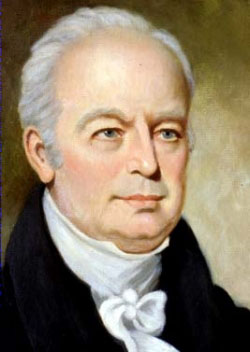 |
July 1, 1795–December 28, 1795 | |
| 3 | Oliver Ellsworth Oliver Ellsworth Oliver Ellsworth was an American lawyer and politician, a revolutionary against British rule, a drafter of the United States Constitution, and the third Chief Justice of the United States. While at the Federal Convention, Ellsworth moved to strike the word National from the motion made by Edmund... |
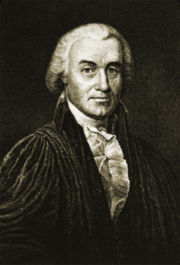 |
March 4, 1796–September 30, 1800 | |
| 4 | John Marshall John Marshall John Marshall was the Chief Justice of the United States whose court opinions helped lay the basis for American constitutional law and made the Supreme Court of the United States a coequal branch of government along with the legislative and executive branches... |
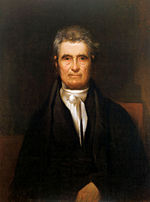 |
January 31, 1801–July 6, 1835† | John Adams John Adams John Adams was an American lawyer, statesman, diplomat and political theorist. A leading champion of independence in 1776, he was the second President of the United States... (F Federalist Party (United States) The Federalist Party was the first American political party, from the early 1790s to 1816, the era of the First Party System, with remnants lasting into the 1820s. The Federalists controlled the federal government until 1801... ) |
| 5 | Roger B. Taney Roger B. Taney Roger Brooke Taney was the fifth Chief Justice of the United States, holding that office from 1836 until his death in 1864. He was the first Roman Catholic to hold that office or sit on the Supreme Court of the United States. He was also the eleventh United States Attorney General. He is most... |
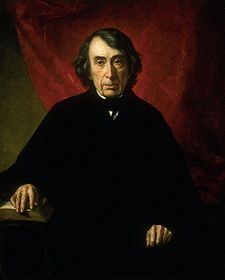 |
March 15, 1836–October 12, 1864† | Andrew Jackson Andrew Jackson Andrew Jackson was the seventh President of the United States . Based in frontier Tennessee, Jackson was a politician and army general who defeated the Creek Indians at the Battle of Horseshoe Bend , and the British at the Battle of New Orleans... (D Democratic Party (United States) The Democratic Party is one of two major contemporary political parties in the United States, along with the Republican Party. The party's socially liberal and progressive platform is largely considered center-left in the U.S. political spectrum. The party has the lengthiest record of continuous... ) |
| 6 | Salmon P. Chase Salmon P. Chase Salmon Portland Chase was an American politician and jurist who served as U.S. Senator from Ohio and the 23rd Governor of Ohio; as U.S. Treasury Secretary under President Abraham Lincoln; and as the sixth Chief Justice of the United States Supreme Court.Chase was one of the most prominent members... |
December 6, 1864–May 7, 1873† | Abraham Lincoln Abraham Lincoln Abraham Lincoln was the 16th President of the United States, serving from March 1861 until his assassination in April 1865. He successfully led his country through a great constitutional, military and moral crisis – the American Civil War – preserving the Union, while ending slavery, and... (R Republican Party (United States) The Republican Party is one of the two major contemporary political parties in the United States, along with the Democratic Party. Founded by anti-slavery expansion activists in 1854, it is often called the GOP . The party's platform generally reflects American conservatism in the U.S... ) |
|
| 7 | Morrison Waite Morrison Waite Morrison Remick Waite, nicknamed "Mott" was the seventh Chief Justice of the United States from 1874 to 1888.-Early life and education:... |
March 4, 1874–March 23, 1888† | Ulysses S. Grant Ulysses S. Grant Ulysses S. Grant was the 18th President of the United States as well as military commander during the Civil War and post-war Reconstruction periods. Under Grant's command, the Union Army defeated the Confederate military and ended the Confederate States of America... (R Republican Party (United States) The Republican Party is one of the two major contemporary political parties in the United States, along with the Democratic Party. Founded by anti-slavery expansion activists in 1854, it is often called the GOP . The party's platform generally reflects American conservatism in the U.S... ) |
|
| 8 | Melville Fuller Melville Fuller Melville Weston Fuller was the eighth Chief Justice of the United States between 1888 and 1910.-Early life and education:... |
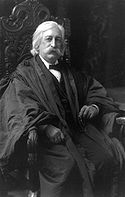 |
October 8, 1888–July 4, 1910† | Grover Cleveland Grover Cleveland Stephen Grover Cleveland was the 22nd and 24th president of the United States. Cleveland is the only president to serve two non-consecutive terms and therefore is the only individual to be counted twice in the numbering of the presidents... (D Democratic Party (United States) The Democratic Party is one of two major contemporary political parties in the United States, along with the Republican Party. The party's socially liberal and progressive platform is largely considered center-left in the U.S. political spectrum. The party has the lengthiest record of continuous... ) |
| 9 | Edward Douglass White Edward Douglass White Edward Douglass White, Jr. , American politician and jurist, was a United States senator, Associate Justice of the United States Supreme Court and the ninth Chief Justice of the United States. He was best known for formulating the Rule of Reason standard of antitrust law. He also sided with the... ° |
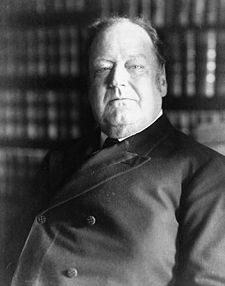 |
December 19, 1910–May 19, 1921† | William Howard Taft William Howard Taft William Howard Taft was the 27th President of the United States and later the tenth Chief Justice of the United States... (R Republican Party (United States) The Republican Party is one of the two major contemporary political parties in the United States, along with the Democratic Party. Founded by anti-slavery expansion activists in 1854, it is often called the GOP . The party's platform generally reflects American conservatism in the U.S... ) |
| 10 | William Howard Taft William Howard Taft William Howard Taft was the 27th President of the United States and later the tenth Chief Justice of the United States... ♦ |
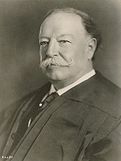 |
July 11, 1921–February 3, 1930 | Warren G. Harding Warren G. Harding Warren Gamaliel Harding was the 29th President of the United States . A Republican from Ohio, Harding was an influential self-made newspaper publisher. He served in the Ohio Senate , as the 28th Lieutenant Governor of Ohio and as a U.S. Senator... (R Republican Party (United States) The Republican Party is one of the two major contemporary political parties in the United States, along with the Democratic Party. Founded by anti-slavery expansion activists in 1854, it is often called the GOP . The party's platform generally reflects American conservatism in the U.S... ) |
| 11 | Charles Evans Hughes Charles Evans Hughes Charles Evans Hughes, Sr. was an American statesman, lawyer and Republican politician from New York. He served as the 36th Governor of New York , Associate Justice of the Supreme Court of the United States , United States Secretary of State , a judge on the Court of International Justice , and... ¤ |
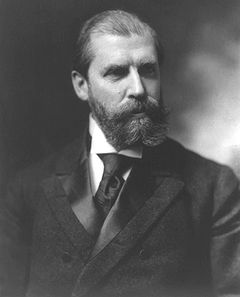 |
February 24, 1930–June 30, 1941 | Herbert Hoover Herbert Hoover Herbert Clark Hoover was the 31st President of the United States . Hoover was originally a professional mining engineer and author. As the United States Secretary of Commerce in the 1920s under Presidents Warren Harding and Calvin Coolidge, he promoted partnerships between government and business... (R Republican Party (United States) The Republican Party is one of the two major contemporary political parties in the United States, along with the Democratic Party. Founded by anti-slavery expansion activists in 1854, it is often called the GOP . The party's platform generally reflects American conservatism in the U.S... ) |
| 12 | Harlan Fiske Stone Harlan Fiske Stone Harlan Fiske Stone was an American lawyer and jurist. A native of New Hampshire, he served as the dean of Columbia Law School, his alma mater, in the early 20th century. As a member of the Republican Party, he was appointed as the 52nd Attorney General of the United States before becoming an... ° |
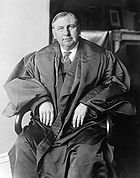 |
July 3, 1941–April 22, 1946† | Franklin D. Roosevelt Franklin D. Roosevelt Franklin Delano Roosevelt , also known by his initials, FDR, was the 32nd President of the United States and a central figure in world events during the mid-20th century, leading the United States during a time of worldwide economic crisis and world war... (D Democratic Party (United States) The Democratic Party is one of two major contemporary political parties in the United States, along with the Republican Party. The party's socially liberal and progressive platform is largely considered center-left in the U.S. political spectrum. The party has the lengthiest record of continuous... ) |
| 13 | Fred M. Vinson Fred M. Vinson Frederick Moore Vinson served the United States in all three branches of government and was the most prominent member of the Vinson political family. In the legislative branch, he was an elected member of the United States House of Representatives from Louisa, Kentucky, for twelve years... |
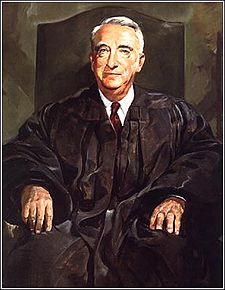 |
June 24, 1946–September 8, 1953† | Harry S. Truman Harry S. Truman Harry S. Truman was the 33rd President of the United States . As President Franklin D. Roosevelt's third vice president and the 34th Vice President of the United States , he succeeded to the presidency on April 12, 1945, when President Roosevelt died less than three months after beginning his... (D Democratic Party (United States) The Democratic Party is one of two major contemporary political parties in the United States, along with the Republican Party. The party's socially liberal and progressive platform is largely considered center-left in the U.S. political spectrum. The party has the lengthiest record of continuous... ) |
| 14 | Earl Warren Earl Warren Earl Warren was the 14th Chief Justice of the United States.He is known for the sweeping decisions of the Warren Court, which ended school segregation and transformed many areas of American law, especially regarding the rights of the accused, ending public-school-sponsored prayer, and requiring... |
 |
October 5, 1953–June 23, 1969 | Dwight D. Eisenhower Dwight D. Eisenhower Dwight David "Ike" Eisenhower was the 34th President of the United States, from 1953 until 1961. He was a five-star general in the United States Army... (R Republican Party (United States) The Republican Party is one of the two major contemporary political parties in the United States, along with the Democratic Party. Founded by anti-slavery expansion activists in 1854, it is often called the GOP . The party's platform generally reflects American conservatism in the U.S... ) |
| 15 | Warren E. Burger Warren E. Burger Warren Earl Burger was the 15th Chief Justice of the United States from 1969 to 1986. Although Burger had conservative leanings, the U.S... |
 |
June 23, 1969–September 26, 1986 | Richard Nixon Richard Nixon Richard Milhous Nixon was the 37th President of the United States, serving from 1969 to 1974. The only president to resign the office, Nixon had previously served as a US representative and senator from California and as the 36th Vice President of the United States from 1953 to 1961 under... (R Republican Party (United States) The Republican Party is one of the two major contemporary political parties in the United States, along with the Democratic Party. Founded by anti-slavery expansion activists in 1854, it is often called the GOP . The party's platform generally reflects American conservatism in the U.S... ) |
| 16 | William Rehnquist William Rehnquist William Hubbs Rehnquist was an American lawyer, jurist, and political figure who served as an Associate Justice on the Supreme Court of the United States and later as the 16th Chief Justice of the United States... ° |
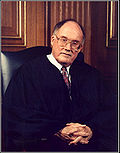 |
September 26, 1986–September 3, 2005† | Ronald Reagan Ronald Reagan Ronald Wilson Reagan was the 40th President of the United States , the 33rd Governor of California and, prior to that, a radio, film and television actor.... (R Republican Party (United States) The Republican Party is one of the two major contemporary political parties in the United States, along with the Democratic Party. Founded by anti-slavery expansion activists in 1854, it is often called the GOP . The party's platform generally reflects American conservatism in the U.S... ) |
| 17 | John G. Roberts |  |
September 29, 2005–present | George W. Bush George W. Bush George Walker Bush is an American politician who served as the 43rd President of the United States, from 2001 to 2009. Before that, he was the 46th Governor of Texas, having served from 1995 to 2000.... (R Republican Party (United States) The Republican Party is one of the two major contemporary political parties in the United States, along with the Democratic Party. Founded by anti-slavery expansion activists in 1854, it is often called the GOP . The party's platform generally reflects American conservatism in the U.S... ) |
Further reading
- Flanders, Henry. http://books.google.com/books?id=eEQEAAAAYAAJ&printsec=frontcover&dq=Flanders,+Henry.+The+Lives+and+Times+of+the+Chief+Justices+of+the+United+States+Supreme+Court&source=bl&ots=TlVq46f3l1&sig=xFW-bezy_iOIcXW3X8l-bbzddk8&hl=en&ei=kh1TS5atOIzkNc3DuYkJ&sa=X&oi=book_result&ct=result&resnum=1&ved=0CAcQ6AEwAA#v=onepage&q=&f=falseThe Lives and Times of the Chief Justices of the United States Supreme Court]. Philadelphia: J. B. Lippincott & Co., 1874 at Google Books.