


Operetta

Encyclopedia
Opera
Opera is an art form in which singers and musicians perform a dramatic work combining text and musical score, usually in a theatrical setting. Opera incorporates many of the elements of spoken theatre, such as acting, scenery, and costumes and sometimes includes dance...
, light in terms both of music and subject matter. It is also closely related, in English-language works, to forms of musical theatre
Musical theatre
Musical theatre is a form of theatre combining songs, spoken dialogue, acting, and dance. The emotional content of the piece – humor, pathos, love, anger – as well as the story itself, is communicated through the words, music, movement and technical aspects of the entertainment as an...
.
Origins
Operetta grew out of the French opéra comiqueOpéra comique
Opéra comique is a genre of French opera that contains spoken dialogue and arias. It emerged out of the popular opéra comiques en vaudevilles of the Fair Theatres of St Germain and St Laurent , which combined existing popular tunes with spoken sections...
around the middle of the 19th century, to satisfy a need for short, light works in contrast to the full-length entertainment of the increasingly serious opéra comique. By this time, the "comique" part of the genre name had become misleading: Carmen
Carmen
Carmen is a French opéra comique by Georges Bizet. The libretto is by Henri Meilhac and Ludovic Halévy, based on the novella of the same title by Prosper Mérimée, first published in 1845, itself possibly influenced by the narrative poem The Gypsies by Alexander Pushkin...
(1875) is an example of an opéra comique with a tragic plot. The definition of "comique" meant something closer to "humanistic," meant to portray "real life" in a more realistic way, representing tragedy and comedy next to each other, as Shakespeare had done centuries earlier. With this new connotation, Opéra comique had dominated the French operatic stage since the decline of tragédie lyrique.
Most researchers acknowledge that the credit for creating the operetta form should go to Hervé (1825–1892), a singer, composer, librettist, conductor, and scene painter. In 1842 he wrote the little opérette, L'Ours et le pacha, based on the popular vaudeville
Vaudeville
Vaudeville was a theatrical genre of variety entertainment in the United States and Canada from the early 1880s until the early 1930s. Each performance was made up of a series of separate, unrelated acts grouped together on a common bill...
show by Scribe and Saintine. In 1848, Hervé made his first notable appearance on the Parisian stage, with Don Quichotte et Sancho Pança, which can be considered the starting point for the new French musical theatre tradition. Hervé's most famous works are the Gounod-parody Le Petit Faust (1869) and Mam'zelle Nitouche
Mam'zelle Nitouche
Mam'zelle Nitouche is a vaudeville-opérette by Hervé. The libretto was by Henri Meilhac and Albert Millaud.-Performance history:It was first performed at the Théâtre des Variétés, Paris on 26 January 1883.- Roles :-Synopsis:...
(1883).
Offenbach
Jacques OffenbachJacques Offenbach
Jacques Offenbach was a Prussian-born French composer, cellist and impresario. He is remembered for his nearly 100 operettas of the 1850s–1870s and his uncompleted opera The Tales of Hoffmann. He was a powerful influence on later composers of the operetta genre, particularly Johann Strauss, Jr....
further developed and popularized operetta, giving it its enormous vogue during the Second Empire and afterwards. Offenbach's earliest one-act pieces included Les deux aveugles
Les deux aveugles
Les deux aveugles is a one-act bouffonerie musicale, in the style of an operetta, by Jacques Offenbach to a French libretto by Jules Moinaux...
, Le violoneux
Le violoneux
Le violoneux is a one-act operetta by Jacques Offenbach to a French libretto by Eugène Mestépès and Émile Chevalet, first performed in 1855.-Performance history:...
and Ba-ta-clan
Ba-ta-clan
Ba-ta-clan is a "chinoiserie musicale", or operetta, in one act by Jacques Offenbach to an original French libretto by Ludovic Halévy. It was first performed at Théâtre des Bouffes Parisiens, Paris, on 29 December 1855. The operetta uses set numbers and spoken dialogue and runs about one...
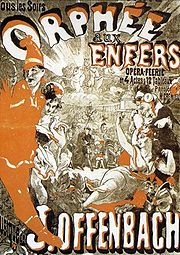
(all 1855), and his first full-length operetta success was Orphée aux enfers (1858). These led to the so-called "Offenbachiade": works including Geneviève de Brabant
Geneviève de Brabant
Geneviève de Brabant is an opéra bouffe, or operetta, by Jacques Offenbach, first performed in Paris in 1859. The plot is based on the medieval legend of Genevieve of Brabant....
1859, Le pont des soupirs
Le pont des soupirs
Le pont des soupirs is an opéra bouffe, or operetta, by Jacques Offenbach. The French libretto was written by Hector-Jonathan Cremieux and Ludovic Halévy.-Performance history:...
1861, La belle Hélène
La belle Hélène
La belle Hélène , opéra bouffe in three acts, is an operetta by Jacques Offenbach to an original French libretto by Henri Meilhac and Ludovic Halévy...
1864, Barbe-bleue and La Vie parisienne both 1866, La Grande-Duchesse de Gérolstein
La Grande-Duchesse de Gérolstein
La Grande-Duchesse de Gérolstein is an opéra bouffe , in three acts and four tableaux by Jacques Offenbach to an original French libretto by Henri Meilhac and Ludovic Halévy...
1867, La Périchole
La Périchole
La Périchole is an opéra bouffe in three acts by Jacques Offenbach. Henri Meilhac and Ludovic Halévy wrote the French-language libretto based on the 1829 one act play Le carrosse du Saint-Sacrement by Prosper Mérimée, which was revived on 13 March 1850 at the Théâtre-Français...
1868 and Les brigands
Les brigands
Les brigands is an opéra bouffe, or operetta, by Jacques Offenbach to a French libretto by Henri Meilhac and Ludovic Halévy....
1869. Offenbach's tradition was then carried on by Robert Planquette
Robert Planquette
Jean Robert Planquette was a French composer of songs and operettas.Several of Planquette's operettas were extraordinarily successful in Britain, including Les cloches de Corneville , the length of whose initial London run broke all records for any piece of musical theatre up to that time, and Rip...
, André Messager
André Messager
André Charles Prosper Messager , was a French composer, organist, pianist, conductor and administrator. His stage compositions included ballets and 30 opéra comiques and operettas, among which Véronique, had lasting success, with Les p'tites Michu and Monsieur Beaucaire also enjoying international...
, and others.
Grotesque
The word grotesque comes from the same Latin root as "Grotto", meaning a small cave or hollow. The original meaning was restricted to an extravagant style of Ancient Roman decorative art rediscovered and then copied in Rome at the end of the 15th century...
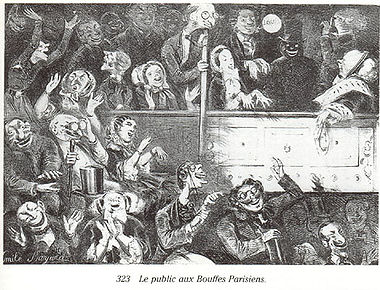
way they portray life, and the extremely frivolous way this is done, often bordering on the pornographic. Émile Zola describes the back-stage and on-stage situation in the Théâtre des Variétés
Théâtre des Variétés
The Théâtre des Variétés is a theatre and "salle de spectacles" at 7, boulevard Montmartre, 2nd arrondissement, in Paris. It was declared a monument historique in 1975.-History:...
during the Second Empire in his novel Nana
Nana (novel)
Nana is a novel by the French naturalist author Émile Zola. Completed in 1880, Nana is the ninth installment in the 20-volume Les Rougon-Macquart series, the object of which was to tell "The Natural and Social History of a Family under the Second Empire", the subtitle of the series.-Origins:A year...
, which takes place in late 1860s and describes the career of operetta diva/courtesan Nana. The character was closely modeled after Offenbach's female star Hortense Schneider
Hortense Schneider
Hortense Catherine Schneider, La Snédèr, was a French soprano, one of the greatest operetta stars of the 19th century, particularly associated with the works of composer Jacques Offenbach.-Biography:...
, and Offenbach's librettist Ludovic Halévy
Ludovic Halévy
Ludovic Halévy was a French author and playwright. He was half Jewish : his Jewish father had converted to Christianity prior to his birth, to marry his mother, née Alexandrine Lebas.-Biography:Ludovic Halévy was born in Paris...
gave Émile Zola the details. Considering how Zola's Nana describes an Offenbach-style operetta performance in Paris, it is not surprising that the mostly male, upper-class audience crowded the various theaters every evening. Upper-class audiences in other cities like Vienna
Vienna
Vienna is the capital and largest city of the Republic of Austria and one of the nine states of Austria. Vienna is Austria's primary city, with a population of about 1.723 million , and is by far the largest city in Austria, as well as its cultural, economic, and political centre...
and Berlin
Berlin
Berlin is the capital city of Germany and is one of the 16 states of Germany. With a population of 3.45 million people, Berlin is Germany's largest city. It is the second most populous city proper and the seventh most populous urban area in the European Union...
longed to see these shows in their home towns as well, which inspired worldwide performance of Offenbach's works.
The highly erotic way Offenbach's operettas were originally played, with stars like Hortense Schneider — or the legendary courtesan Cora Pearl
Cora Pearl
Cora Pearl was a famous courtesan of the 19th century French demimonde, born Emma Elizabeth Crouch.- Early life :Her date and place of birth are disputed, as she was believed to have forged her birth certificate, giving the date as 23 February 1842, and the place as Caroline Place, East...
, who appeared in a revival of Offenbach's Orphée aux Enfers in 1867 completely covered in diamonds and little else — created a scandalized reaction from certain parts of the general public. Operetta was considered a "frivolous" art form. Indeed, together with its grotesque qualities, frivolity is one of the defining elements of "authentic" operetta à la Offenbach and Hervé.
It was only later, when audiences widened and became more middle and lower class, that operetta became more "serious" and "nostalgic". Many of the originally pornographic French (and Viennese) operettas were later played in a toned-down, "classical" version, which is how audiences today are mostly presented with the genre — in an opera house with opera singers, rather than in a private theatre with courtesans in the lead roles.
Austria
.jpg)
German language
German is a West Germanic language, related to and classified alongside English and Dutch. With an estimated 90 – 98 million native speakers, German is one of the world's major languages and is the most widely-spoken first language in the European Union....
was the Austria
Austria
Austria , officially the Republic of Austria , is a landlocked country of roughly 8.4 million people in Central Europe. It is bordered by the Czech Republic and Germany to the north, Slovakia and Hungary to the east, Slovenia and Italy to the south, and Switzerland and Liechtenstein to the...
n Johann Strauss, Jr. (1825–1899). His first operetta was Indigo und die vierzig Räuber
Indigo und die vierzig Räuber
Indigo und die vierzig Räuber is an operetta composed by Johann Strauss II, with a German libretto by Maximilian Steiner based on the tale "Ali Baba and the Forty Thieves" from The Book of One Thousand and One Nights....
(1871). His third operetta, Die Fledermaus
Die Fledermaus
Die Fledermaus is an operetta composed by Johann Strauss II to a German libretto by Karl Haffner and Richard Genée.- Literary sources :...
(1874), became the most performed operetta in the world, and remains his most popular stage work. Its libretto was based on a comedy written by Offenbach's librettists. In all, Strauss wrote 16 operettas and one opera, most with great success when first premiered. Many of his lesser operettas are now largely forgotten, since his later librettists were less talented and he often composed independently of the plot.
Strauss's operettas, waltzes, polkas, and marches often have a strongly Viennese
Vienna
Vienna is the capital and largest city of the Republic of Austria and one of the nine states of Austria. Vienna is Austria's primary city, with a population of about 1.723 million , and is by far the largest city in Austria, as well as its cultural, economic, and political centre...
style, and his popularity causes many to think of him as the national composer of Austria. In fact, when his stage works were first performed, the Theater an der Wien
Theater an der Wien
The Theater an der Wien is a historic theatre on the Left Wienzeile in the Mariahilf district of Vienna. Completed in 1801, it has seen the premieres of many celebrated works of theatre, opera, and symphonic music...
never failed to draw huge crowds, and after many of the numbers the audience would call noisily for encores.
Franz von Suppé
Franz von Suppé
Franz von Suppé or Francesco Suppé Demelli was an Austrian composer of light operas who was born in what is now Croatia during the time his father was working in this outpost of the Austro-Hungarian Empire...
, a contemporary of Strauss, closely modeled his operettas after Offenbach. The Viennese tradition was carried on by Franz Lehár
Franz Lehár
Franz Lehár was an Austrian-Hungarian composer. He is mainly known for his operettas of which the most successful and best known is The Merry Widow .-Biography:...
, Oscar Straus
Oscar Straus (composer)
Oscar Nathan Straus was a Viennese composer of operettas and film scores and songs. He also wrote about 500 cabaret songs, chamber music, and orchestral and choral works...
, Carl Zeller
Carl Zeller
Carl Adam Johann Nepomuk Zeller was an Austrian composer of operettas.Zeller was born in Sankt Peter in der Au, the only child of physician Johann Zeller and Maria Anna Elizabeth. Zeller's father died before his first birthday, after which his mother remarried Ernest Friedinger...
, Karl Millöcker
Karl Millöcker
Carl Joseph Millöcker , was an Austrian composer of operettas and a conductor.He was born in Vienna, where he studied the flute at the Vienna Conservatory. While holding various conducting posts in the city, he began to compose operettas...
, Leo Fall
Leo Fall
Leo Fall was an Austrian composer of operettas.-Life:Born in Olmütz , Leo Fall was taught by his father Moritz Fall , a bandmaster and composer, who settled in Berlin. The younger Fall studied at the Vienna Conservatory before rejoining his father in Berlin...
, Richard Heuberger
Richard Heuberger
Richard Franz Joseph Heuberger was an Austrian composer of operas and operettas, a music critic, and teacher....
, Edmund Eysler
Edmund Eysler
Edmund Samuel Eysler , was an Austrian composer.-Biography:Edmund Eysler was born in Vienna to a merchant family...
, Ralph Benatzky
Ralph Benatzky
Ralph Benatzky , Moravia, Austrian Empire – 16 October 1957), born in Moravské Budějovice as Rudolf Josef František Benatzki, was an Austrian composer of Czech origin...
, Robert Stolz
Robert Stolz
Robert Elisabeth Stolz was an Austrian songwriter and conductor as well as a composer of operettas and film music.- Biography :...
, Emmerich Kálmán
Emmerich Kalman
Emmerich Kálmán was a Hungarian-born composer of operettas.- Biography :Kálmán was born Imre Koppstein in Siófok, on the southern shore of Lake Balaton, Hungary in a Jewish family.Kálmán initially intended to become a concert pianist, but because of early-onset arthritis, he focused on composition...
and Nico Dostal
Nico Dostal
Nico Dostal was an Austrian operetta and film music composer.-Life:Dostal was born in Korneuburg, Lower Austria, and was the nephew of composer Hermann Dostal...
in the 20th century.
Germany
In the same way that Vienna was the center of Austrian operetta, BerlinBerlin
Berlin is the capital city of Germany and is one of the 16 states of Germany. With a population of 3.45 million people, Berlin is Germany's largest city. It is the second most populous city proper and the seventh most populous urban area in the European Union...
was the center of German operetta. Berlin operetta often had its own style, including, especially after World War I
World War I
World War I , which was predominantly called the World War or the Great War from its occurrence until 1939, and the First World War or World War I thereafter, was a major war centred in Europe that began on 28 July 1914 and lasted until 11 November 1918...
, elements of jazz and other syncopated dance rhythms, a transatlantic style, and the presence of ragged marching tunes. Berlin operettas also sometimes included aspects of burlesque
Burlesque
Burlesque is a literary, dramatic or musical work intended to cause laughter by caricaturing the manner or spirit of serious works, or by ludicrous treatment of their subjects...
, revue
Revue
A revue is a type of multi-act popular theatrical entertainment that combines music, dance and sketches. The revue has its roots in 19th century American popular entertainment and melodrama but grew into a substantial cultural presence of its own during its golden years from 1916 to 1932...
, farce
Farce
In theatre, a farce is a comedy which aims at entertaining the audience by means of unlikely, extravagant, and improbable situations, disguise and mistaken identity, verbal humour of varying degrees of sophistication, which may include word play, and a fast-paced plot whose speed usually increases,...
, or cabaret
Cabaret
Cabaret is a form, or place, of entertainment featuring comedy, song, dance, and theatre, distinguished mainly by the performance venue: a restaurant or nightclub with a stage for performances and the audience sitting at tables watching the performance, as introduced by a master of ceremonies or...
.
.jpg)
Paul Lincke
Carl Emil Paul Lincke was a German composer and theater conductor. He is considered the "father" of the Berlin opera and holds the same significance for Berlin as does Johann Strauss for Vienna and Jacques Offenbach for Paris.He was the son of magistrate August Lincke and and wife Emilie...
pioneered the Berlin operetta in 1899 with Frau Luna, which includes "Berliner Luft" ("Berlin Air"), which became the unofficial anthem of Berlin. His Lysistrata (1902) includes the song and tune "The Glow-Worm
The Glow-Worm
"Das Glühwürmchen", known in English as "The Glow-Worm", is an aria from Paul Lincke's 1902 operetta Lysistrata, with German lyrics by Heinz Bolten-Backers...
", which remains quite popular internationally. Much later, in the 1920s and 1930s, Kurt Weill
Kurt Weill
Kurt Julian Weill was a German-Jewish composer, active from the 1920s, and in his later years in the United States. He was a leading composer for the stage who was best known for his fruitful collaborations with Bertolt Brecht...
took a more extreme form of the Berlin operetta style and used it in his operas, operettas, and musicals.
The Berlin-style operetta coexisted with more bourgeois, charming, home-loving, and nationalistic German operettas — some of which were called Volksoperetten (folk operettas). A prime example is Leon Jessel
Leon Jessel
Leon Jessel, or Léon Jessel was a German composer of operettas and light classical music pieces. Today he is best known internationally as the composer of the popular jaunty march "The Parade of the Tin Soldiers," also known as "The Parade of the Wooden Soldiers." Jessel was a prolific composer...
's extremely popular 1917 Schwarzwaldmädel
Schwarzwaldmädel
Schwarzwaldmädel is a 1917 operetta in three acts by German composer Leon Jessel. The libretto is by August Neidhart, and the operetta premiered on 25 August 1917 at the Alte Komische Oper Berlin in Berlin...
(Black Forest Girl). These bucolic, nostalgic, home-loving operettas were officially preferred over Berlin-style operettas after 1933, when the Nazis came to power and instituted the Reichsmusikkammer
Reichsmusikkammer
The Reichsmusikkammer was a Nazi institution. It promoted "good German music" which was composed by Aryans and seen as consistent with Nazi ideals, while suppressing other, "degenerate" music, which included atonal music, jazz, and music by Jewish composers...
(State Music Institute), which deprecated and banned "decadent" music like jazz and similar "foreign" musical forms.
Notable German operetta composers include Paul Lincke
Paul Lincke
Carl Emil Paul Lincke was a German composer and theater conductor. He is considered the "father" of the Berlin opera and holds the same significance for Berlin as does Johann Strauss for Vienna and Jacques Offenbach for Paris.He was the son of magistrate August Lincke and and wife Emilie...
, Eduard Künneke
Eduard Künneke
Eduard Künneke was a German composer of operettas, operas and theatre music. He was born in Emmerich. His daughter was the actress and singer Evelyn Künneke....
, Walter Kollo
Walter Kollo
Walter Kollo was a German composer of operettas, Possen mit Gesang, and Singspiele as well as popular songs. He was also a conductor and a music publisher.Kollo was born in Neidenburg, East Prussia...
, Jean Gilbert
Jean Gilbert
Jean Gilbert was a German operetta composer and conductor. His real name was Max Winterfeld. He adopted the name of Jean Gilbert for the production of his first operetta in 1901.Gilbert was born in Hamburg...
, Leon Jessel
Leon Jessel
Leon Jessel, or Léon Jessel was a German composer of operettas and light classical music pieces. Today he is best known internationally as the composer of the popular jaunty march "The Parade of the Tin Soldiers," also known as "The Parade of the Wooden Soldiers." Jessel was a prolific composer...
, Rudolf Dellinger
Rudolf Dellinger
Rudolf Dellinger was a Bohemian German composer and Kapellmeister. He almost exclusively composed operettas and was considered to be among the most outstanding composers of his time....
, and Walter Goetze
Walter Goetze
Walter Wilhelm Goetze [sometimes Götze] was a German composer of operettas and revues.Goetze began as composer of songs; the first of his many works for the stage was the revue Nur nicht drängeln in 1912, followed by his first operetta Der liebe Pepi in 1913...
.
Operetta in English
Cox and Box
Cox and Box; or, The Long-Lost Brothers, is a one-act comic opera with a libretto by F. C. Burnand and music by Arthur Sullivan, based on the 1847 farce Box and Cox by John Maddison Morton. It was Sullivan's first successful comic opera. The story concerns a landlord who lets a room to two...
(1866). They were soon known as comic opera
Comic opera
Comic opera denotes a sung dramatic work of a light or comic nature, usually with a happy ending.Forms of comic opera first developed in late 17th-century Italy. By the 1730s, a new operatic genre, opera buffa, emerged as an alternative to opera seria...
s, to distinguish this family-friendly fare from the risqué French operettas of the 1850s and 1860s.
The height of the form was reached by Gilbert and Sullivan
Gilbert and Sullivan
Gilbert and Sullivan refers to the Victorian-era theatrical partnership of the librettist W. S. Gilbert and the composer Arthur Sullivan . The two men collaborated on fourteen comic operas between 1871 and 1896, of which H.M.S...
, who had a long-running collaboration during the Victorian era
Victorian era
The Victorian era of British history was the period of Queen Victoria's reign from 20 June 1837 until her death on 22 January 1901. It was a long period of peace, prosperity, refined sensibilities and national self-confidence...
. With W. S. Gilbert
W. S. Gilbert
Sir William Schwenck Gilbert was an English dramatist, librettist, poet and illustrator best known for his fourteen comic operas produced in collaboration with the composer Sir Arthur Sullivan, of which the most famous include H.M.S...
writing the libretti and Arthur Sullivan
Arthur Sullivan
Sir Arthur Seymour Sullivan MVO was an English composer of Irish and Italian ancestry. He is best known for his series of 14 operatic collaborations with the dramatist W. S. Gilbert, including such enduring works as H.M.S. Pinafore, The Pirates of Penzance and The Mikado...
composing the music, the pair produced 14 comic operas, sometimes called Savoy Opera
Savoy opera
The Savoy Operas denote a style of comic opera that developed in Victorian England in the late 19th century, with W. S. Gilbert and Arthur Sullivan as the original and most successful practitioners. The name is derived from the Savoy Theatre, which impresario Richard D'Oyly Carte built to house...
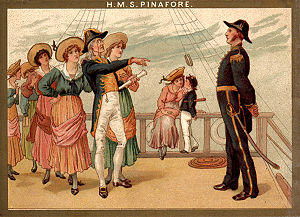
s. Most were enormously popular in Britain, the U.S., and elsewhere. Their works, such as H.M.S. Pinafore
H.M.S. Pinafore
H.M.S. Pinafore; or, The Lass That Loved a Sailor is a comic opera in two acts, with music by Arthur Sullivan and a libretto by W. S. Gilbert. It opened at the Opera Comique in London, England, on 25 May 1878 and ran for 571 performances, which was the second-longest run of any musical...
, The Pirates of Penzance
The Pirates of Penzance
The Pirates of Penzance; or, The Slave of Duty is a comic opera in two acts, with music by Arthur Sullivan and libretto by W. S. Gilbert. The opera's official premiere was at the Fifth Avenue Theatre in New York City on 31 December 1879, where the show was well received by both audiences...
, and The Mikado
The Mikado
The Mikado; or, The Town of Titipu is a comic opera in two acts, with music by Arthur Sullivan and libretto by W. S. Gilbert, their ninth of fourteen operatic collaborations...
, continue to enjoy regular performances throughout the English-speaking world.
English operetta continued into the 20th century, with works by composers such as Edward German
Edward German
Sir Edward German was an English musician and composer of Welsh descent, best remembered for his extensive output of incidental music for the stage and as a successor to Arthur Sullivan in the field of English comic opera.As a youth, German played the violin and led the town orchestra, also...
, Lionel Monckton
Lionel Monckton
Lionel John Alexander Monckton was an English writer and composer of musical theatre. He was Britain's most popular musical theatre composer of the early years of the 20th century.-Early life:...
, and Harold Fraser-Simson
Harold Fraser-Simson
Harold Fraser-Simson , was an English composer of light music, including songs and the scores to musical comedies. His most famous musical was the World War I hit, The Maid of the Mountains, and he later set numerous children's poems to music, especially those of A. A...
. Increasingly, these took on features of musical comedy
Musical theatre
Musical theatre is a form of theatre combining songs, spoken dialogue, acting, and dance. The emotional content of the piece – humor, pathos, love, anger – as well as the story itself, is communicated through the words, music, movement and technical aspects of the entertainment as an...
, until the distinction between an "old-fashioned musical" and a "modern operetta" became blurred. Old-fashioned musicals in Britain, in particular, retained an "operetta-ish" flavour into the 1950s.
American operetta composers included Victor Herbert
Victor Herbert
Victor August Herbert was an Irish-born, German-raised American composer, cellist and conductor. Although Herbert enjoyed important careers as a cello soloist and conductor, he is best known for composing many successful operettas that premiered on Broadway from the 1890s to World War I...
, whose works at the beginning of the 20th century were influenced by both Viennese operetta and Gilbert and Sullivan. He was followed by Sigmund Romberg
Sigmund Romberg
Sigmund Romberg was a Hungarian-born American composer, best known for his operettas.-Biography:Romberg was born as Siegmund Rosenberg to a Jewish family in Gross-Kanizsa during the Austro-Hungarian kaiserlich und königlich monarchy period...
and Rudolph Friml. More modern American operettas include Leonard Bernstein
Leonard Bernstein
Leonard Bernstein August 25, 1918 – October 14, 1990) was an American conductor, composer, author, music lecturer and pianist. He was among the first conductors born and educated in the United States of America to receive worldwide acclaim...
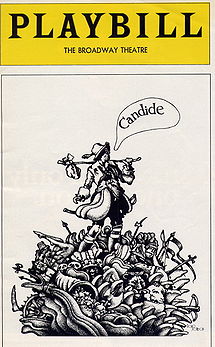
's Candide
Candide (operetta)
Candide is an operetta with music composed by Leonard Bernstein, based on the novella of the same name by Voltaire. The operetta was first performed in 1956 with a libretto by Lillian Hellman; but since 1974 it has been generally performed with a book by Hugh Wheeler which is more faithful to...
. Nevertheless, by 1930, English-language operetta had largely given way to musical
Musical theatre
Musical theatre is a form of theatre combining songs, spoken dialogue, acting, and dance. The emotional content of the piece – humor, pathos, love, anger – as well as the story itself, is communicated through the words, music, movement and technical aspects of the entertainment as an...
s, such as Show Boat
Show Boat
Show Boat is a musical in two acts with music by Jerome Kern and book and lyrics by Oscar Hammerstein II. It was originally produced in New York in 1927 and in London in 1928, and was based on the 1926 novel of the same name by Edna Ferber. The plot chronicles the lives of those living and working...
, Oklahoma!
Oklahoma!
Oklahoma! is the first musical written by composer Richard Rodgers and librettist Oscar Hammerstein II. The musical is based on Lynn Riggs' 1931 play, Green Grow the Lilacs. Set in Oklahoma Territory outside the town of Claremore in 1906, it tells the story of cowboy Curly McLain and his romance...
, etc.
Definitions
Opera
Opera is an art form in which singers and musicians perform a dramatic work combining text and musical score, usually in a theatrical setting. Opera incorporates many of the elements of spoken theatre, such as acting, scenery, and costumes and sometimes includes dance...
s and musicals
Musical theatre
Musical theatre is a form of theatre combining songs, spoken dialogue, acting, and dance. The emotional content of the piece – humor, pathos, love, anger – as well as the story itself, is communicated through the words, music, movement and technical aspects of the entertainment as an...
, and the boundaries between the genres are sometimes blurred. For instance, American composer Scott Joplin
Scott Joplin
Scott Joplin was an American composer and pianist. Joplin achieved fame for his ragtime compositions, and was later dubbed "The King of Ragtime". During his brief career, Joplin wrote 44 original ragtime pieces, one ragtime ballet, and two operas...
insisted that his serious but ragtime
Ragtime
Ragtime is an original musical genre which enjoyed its peak popularity between 1897 and 1918. Its main characteristic trait is its syncopated, or "ragged," rhythm. It began as dance music in the red-light districts of American cities such as St. Louis and New Orleans years before being published...
-influenced work Treemonisha
Treemonisha
Treemonisha is an opera composed by the famed African-American ragtime composer Scott Joplin. Though it encompasses a wide range of musical styles other than ragtime, and Joplin did not refer to it as such, it is sometimes incorrectly referred to as a "ragtime opera"...
(1911) was an opera, but some reference works characterize it as an operetta. Likewise, some of Leonard Bernstein
Leonard Bernstein
Leonard Bernstein August 25, 1918 – October 14, 1990) was an American conductor, composer, author, music lecturer and pianist. He was among the first conductors born and educated in the United States of America to receive worldwide acclaim...
's works he designated as operas (e.g., Trouble in Tahiti
Trouble in Tahiti
Trouble in Tahiti is a one-act opera in seven scenes composed by Leonard Bernstein with an English libretto by the composer. The opera received its first performance on 12 June 1952 at Berstein's Festival of the Creative Arts on the campus of Brandeis University in Waltham, Massachusetts to an...
) are categorized as operettas, and his operetta Candide
Candide (operetta)
Candide is an operetta with music composed by Leonard Bernstein, based on the novella of the same name by Voltaire. The operetta was first performed in 1956 with a libretto by Lillian Hellman; but since 1974 it has been generally performed with a book by Hugh Wheeler which is more faithful to...
is sometimes considered a musical.
Operettas and operas
Operettas are usually shorter than operas, and are usually of a light and amusing character. Operettas are often considered less "serious" than operas.Topical satire
Satire
Satire is primarily a literary genre or form, although in practice it can also be found in the graphic and performing arts. In satire, vices, follies, abuses, and shortcomings are held up to ridicule, ideally with the intent of shaming individuals, and society itself, into improvement...
is a feature common to many operettas. However, satire is used in some "serious" operas as well: Formerly, in countries such as France, operas expressed politics in code — for example, the circumstances of the title character in the opera Robert le diable
Robert le diable (opera)
Robert le diable is an opera by Giacomo Meyerbeer, often regarded as the first grand opera. The libretto was written by Eugène Scribe and Casimir Delavigne and has little connection to the medieval legend of Robert the Devil. Originally planned as a three-act opéra comique, "Meyerbeer persuaded...
referred, at its first performance, to the French king's parental conflict and its resolution.
Normally some of the libretto
Libretto
A libretto is the text used in an extended musical work such as an opera, operetta, masque, oratorio, cantata, or musical. The term "libretto" is also sometimes used to refer to the text of major liturgical works, such as mass, requiem, and sacred cantata, or even the story line of a...
of an operetta is spoken rather than sung. Instead of moving from one musical number to another, the musical segments — e.g. aria
Aria
An aria in music was originally any expressive melody, usually, but not always, performed by a singer. The term is now used almost exclusively to describe a self-contained piece for one voice usually with orchestral accompaniment...
, recitative
Recitative
Recitative , also known by its Italian name "recitativo" , is a style of delivery in which a singer is allowed to adopt the rhythms of ordinary speech...
, chorus
Choir
A choir, chorale or chorus is a musical ensemble of singers. Choral music, in turn, is the music written specifically for such an ensemble to perform.A body of singers who perform together as a group is called a choir or chorus...
— are interspersed with periods of dialogue
Dialogue
Dialogue is a literary and theatrical form consisting of a written or spoken conversational exchange between two or more people....
. There is usually no musical accompaniment to the dialogue, although sometimes some musical themes are played quietly under it. Short passages of recitative are, however, sometimes used in operetta, especially as an introduction to a song.
Operettas and musicals
The operetta is a precursor of the modern musical theatreMusical theatre
Musical theatre is a form of theatre combining songs, spoken dialogue, acting, and dance. The emotional content of the piece – humor, pathos, love, anger – as well as the story itself, is communicated through the words, music, movement and technical aspects of the entertainment as an...
or "musical". In the early decades of the 20th century, the operetta continued to exist alongside the newer musical, with each influencing the other.
The main difference between the two genres is that most operettas can be described as light operas with acting, whereas most musicals are play
Play (theatre)
A play is a form of literature written by a playwright, usually consisting of scripted dialogue between characters, intended for theatrical performance rather than just reading. There are rare dramatists, notably George Bernard Shaw, who have had little preference whether their plays were performed...
s with singing. This can be seen in the performers chosen in the two forms. An operetta's cast will normally be classically-trained opera singers. A musical uses actors who sing, but usually not in an operatic style. These distinctions can be blurred: W.S. Gilbert, for example, said that he preferred to use actors who could sing for his productions, while Ezio Pinza
Ezio Pinza
Ezio Pinza was an Italian basso opera singer with a rich, smooth and sonorous voice. He spent 22 seasons at New York's Metropolitan Opera, appearing in more than 750 performances of 50 operas...
, and other opera singers have appeared on Broadway. There are features of operetta in Kern and Hammerstein's Show Boat
Show Boat
Show Boat is a musical in two acts with music by Jerome Kern and book and lyrics by Oscar Hammerstein II. It was originally produced in New York in 1927 and in London in 1928, and was based on the 1926 novel of the same name by Edna Ferber. The plot chronicles the lives of those living and working...
(1927), among others.
The characters in a musical may be more complex than those in an operetta, given the generally larger amount of dialogue. For example, the characters in Lerner and Loewe's musical My Fair Lady
My Fair Lady
My Fair Lady is a musical based upon George Bernard Shaw's Pygmalion and with book and lyrics by Alan Jay Lerner and music by Frederick Loewe...
, which is based on George Bernard Shaw
George Bernard Shaw
George Bernard Shaw was an Irish playwright and a co-founder of the London School of Economics. Although his first profitable writing was music and literary criticism, in which capacity he wrote many highly articulate pieces of journalism, his main talent was for drama, and he wrote more than 60...
's 1914 play Pygmalion
Pygmalion (play)
Pygmalion: A Romance in Five Acts is a play by Irish playwright George Bernard Shaw. Professor of phonetics Henry Higgins makes a bet that he can train a bedraggled Cockney flower girl, Eliza Doolittle, to pass for a duchess at an ambassador's garden party by teaching her to assume a veneer of...
, are essentially unchanged from those in Shaw's stage work, because the musical version is quite faithful to the original (except for the changed ending, which is pessimistic in the play), even to the point of retaining most of Shaw's dialogue. Man of la Mancha
Man of La Mancha
Man of La Mancha is a musical with a book by Dale Wasserman, lyrics by Joe Darion and music by Mitch Leigh. It is adapted from Wasserman's non-musical 1959 teleplay I, Don Quixote, which was in turn inspired by Miguel de Cervantes's seventeenth century masterpiece Don Quixote...
, adapted by Dale Wasserman
Dale Wasserman
Dale Wasserman was an American playwright. -Early life:Dale Wasserman was born in Rhinelander, Wisconsin, and was orphaned at the age of nine. He lived in a state orphanage and with an older brother in South Dakota before he "hit the rails". He later said:-Career:Wasserman worked in various...
from his own ninety-minute television play I, Don Quixote
I, Don Quixote
I, Don Quixote is a non-musical play written for television, and broadcast on the CBS anthology series DuPont Show of the Month on the evening of November 9, 1959. Written by Dale Wasserman, the play was converted by him ca. 1964 into the libretto for the stage musical Man of La Mancha, with songs...
, retains much of the dialogue in that play, cutting only enough to make room for the musical numbers which were added when the play was converted into a stage musical.
See also
- List of operetta composers
- The opera corpusThe opera corpusThe opera corpus is a list of nearly 2,500 works by more than 775 individual opera composers.Some of the works listed below are still being performed today — but many are not...
which includes operettas - OperaOperaOpera is an art form in which singers and musicians perform a dramatic work combining text and musical score, usually in a theatrical setting. Opera incorporates many of the elements of spoken theatre, such as acting, scenery, and costumes and sometimes includes dance...
- ZarzuelaZarzuelaZarzuela is a Spanish lyric-dramatic genre that alternates between spoken and sung scenes, the latter incorporating operatic and popular song, as well as dance...
- Comic operaComic operaComic opera denotes a sung dramatic work of a light or comic nature, usually with a happy ending.Forms of comic opera first developed in late 17th-century Italy. By the 1730s, a new operatic genre, opera buffa, emerged as an alternative to opera seria...
- Savoy operaSavoy operaThe Savoy Operas denote a style of comic opera that developed in Victorian England in the late 19th century, with W. S. Gilbert and Arthur Sullivan as the original and most successful practitioners. The name is derived from the Savoy Theatre, which impresario Richard D'Oyly Carte built to house...
- Musical theatreMusical theatreMusical theatre is a form of theatre combining songs, spoken dialogue, acting, and dance. The emotional content of the piece – humor, pathos, love, anger – as well as the story itself, is communicated through the words, music, movement and technical aspects of the entertainment as an...