

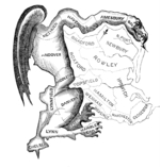
Gerrymandering

Encyclopedia
In the process of setting electoral districts, gerrymandering is a practice that attempts to establish a political advantage for a particular party or group by manipulating geographic boundaries to create partisan, incumbent-protected districts. The resulting district is known as a gerrymander (ˈ); however, that word can also refer to the process.
Gerrymandering may be used to achieve desired electoral results for a particular party, or may be used to help or hinder a particular demographic, such as a political, racial, linguistic, religious or class group.
When used to allege that a given party is gaining disproportionate power, the term gerrymandering has negative connotations. However, a gerrymander may also be used for purposes that some perceive as positive, such as in US federal voting district boundaries that produce a majority of constituents representative of African-American or other racial minorities (these are thus called "minority-majority districts").
" in South Australia
and the "Bjelkemander
" in Queensland
. Sometimes political representatives use both gerrymandering and malapportionment to try to maintain power.
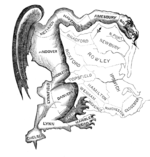 The word gerrymander (originally written Gerry-mander) was used for the first time in the Boston Gazette
on March 26, 1812. The word was created in reaction to a redrawing of Massachusetts
state senate election districts under the then-governor Elbridge Gerry
. In 1812, Governor Gerry signed a bill that redistricted Massachusetts to benefit his Democratic-Republican Party. When mapped, one of the contorted districts in the Boston area was said to resemble the shape of a salamander
. The exact author of the term gerrymander may never be definitively established. It is widely believed by historians that Federalist newspaper editors Nathan Hale
, Benjamin and John Russell were the instigators, but the historical record gives no definitive evidence as to who created or uttered the word for the first time. The term was a portmanteau of the governor's last name and the word salamander.
Appearing with the term, and helping to spread and sustain its popularity, was a political cartoon depicting a strange animal with claws, wings and a dragon-like head satirising the map of the odd-shaped district. This cartoon was most likely drawn by Elkanah Tisdale, an early 19th century painter, designer, and engraver who was living in Boston at the time.
Tisdale also had the engraving skills to cut the woodblocks that printed the original cartoon. These woodblocks survive and are preserved in the Library of Congress
.
The word gerrymander was reprinted numerous times in Federalist newspapers in Massachusetts, New England, and nationwide during the remainder of 1812. This suggests some organised activity of the Federalists to disparage Governor Gerry in particular and the growing Democratic-Republican party in general. Gerrymandering soon began to be used to describe not only the original Massachusetts example but also other cases of district-shape manipulation for partisan gain in other states. According to the Oxford English Dictionary
, institutionalisation of the word became complete with its first appearance in a dictionary (1848) and first appearance in an encyclopedia (1868).
Although the letter g of the eponymous Gerry is pronounced /ɡ/ as in go, the word gerrymander is most commonly pronounced ˈdʒɛrimændər, with a /dʒ/ as in gentle.
are the most likely to have political parties that gerrymander for advantage. Most notably, gerrymandering is particularly effective in non-proportional systems that tend towards fewer parties, such as first past the post.
Most democracies have partly proportional electoral systems, where several political parties are proportionally represented in the national parliaments, in proportion to the total numbers of votes of the parties in the regional or national elections. In these more or less proportional representation
systems, gerrymandering has little or less significance.
Some countries, such as the UK
and Canada
, authorize non-partisan organizations to set constituency boundaries in an attempt to prevent gerrymandering. Gerrymandering is most common in countries where elected politicians are responsible for defining constituency boundaries. They have obvious self interest in determining boundaries to their and their party's interest.
in any particular district. The strategies are typically combined, creating a few "forfeit" seats for packed voters of one type in order to secure even greater representation for voters of another type.
Gerrymandering is effective because of the wasted vote effect. By packing opposition voters into districts they will already win (increasing excess votes for winners) and by cracking the remainder among districts where they are moved into the minority (increasing votes for eventual losers), the number of wasted votes among the opposition can be maximized. Similarly, with supporters holding narrow margins in the unpacked districts, the number of wasted votes among supporters is minimized.
While the wasted vote effect is strongest when a party wins by narrow margins across multiple districts, gerrymandering narrow margins can be risky when voters are less predictable. To minimize the risk of demographic or political shifts swinging a district to the opposition, politicians can instead create more packed districts, leading to more comfortable margins in unpacked ones.
As the chance of influencing electoral results by voting is reduced, voter turnout
is likely to decrease. Correspondingly, political campaigns are less likely to expend resources to encourage turnout. With a reduction in competition, a candidate puts more effort into securing party nomination
for a given district rather than gaining approval of the general electorate. In an effectively gerrymandered district, the candidate is virtually assured of a win once nominated. In 2004, for example, when California's 3rd congressional district
became an open seat after Republican Congressman Doug Ose
ran for higher office, the state's three strongest Republican congressional candidates campaigned vigorously against one another for nomination in the district's primary election
. Several other districts were uncontested, with no Republican nominees making even a token campaign effort.
, only four challengers were able to defeat incumbent members of the US Congress, the lowest number in modern American history. Incumbents are likely to be of the majority party orchestrating a gerrymander, and incumbents are usually easily renominated in subsequent elections, including incumbents among the minority.
This demonstrates that gerrymandering can have a deleterious effect on the principle of democratic accountability. With uncompetitive seats/districts reducing the fear that incumbent politicians may lose office, they have less incentive to represent the interests of their constituents, even when those interests conform to majority support for an issue across the electorate as a whole. Incumbent politicians may look out more for their party's interests than for those of their constituents.
Gerrymandering can have an impact on campaign costs for district elections. If districts become increasingly stretched out, candidates must pay increased costs for transportation and trying to develop and present campaign advertising
across a district. The incumbent's advantage in securing campaign funds is another benefit of his or her having a gerrymandered secure seat.
received by voters in gerrymandered districts. Because gerrymandering can be designed to increase the number of wasted votes among the electorate, the relative representation of particular groups can be drastically altered from their actual share of the voting population. This effect can significantly prevent a gerrymandered system from achieving proportional and descriptive representation, as the winners of elections are increasingly determined by who is drawing the districts rather than the preferences of the voters.
Gerrymandering may be advocated to improve representation within the legislature among otherwise underrepresented minority groups by packing them into a single district. This can be controversial, as it may lead to those groups' remaining marginalised in the government as they become confined to a single district. Candidates outside that district no longer need to represent them to win election.
As an example, much of the redistricting conducted in the United States in the early 1990s involved the intentional creation of additional "majority-minority" districts where racial minorities such as African Americans were packed into the majority. This "maximisation policy" drew support by both the Republican Party (who had limited support among African Americans and could concentrate their power elsewhere) and by minority representatives elected as Democrats from these constituencies, who then had safe seats.
In an unusual occurrence in 2000, for example, the two dominant parties in the state of California cooperatively redrew both state and Federal legislative districts to preserve the status quo, ensuring the electoral safety of the politicians from unpredictable voting by the electorate. This move proved completely effective, as no State or Federal legislative office changed party in the 2004 election, although 53 congressional, 20 state senate, and 80 state assembly seats were potentially at risk.
In 2006, the term "70/30 District" came to signify the equitable split of two evenly split (i.e. 50/50) districts. The resulting districts gave each party a guaranteed seat and retained their respective power base.
argues that although many prisoners come from (and return to) urban communities, they are counted as "residents" of the rural districts that contain large prisons, artificially inflating the political representation in districts with prisons at the expense of voters in all other districts without prisons. Others contend that prisoners should not be counted as residents of their original districts when they do not reside there and are not legally eligible to vote.
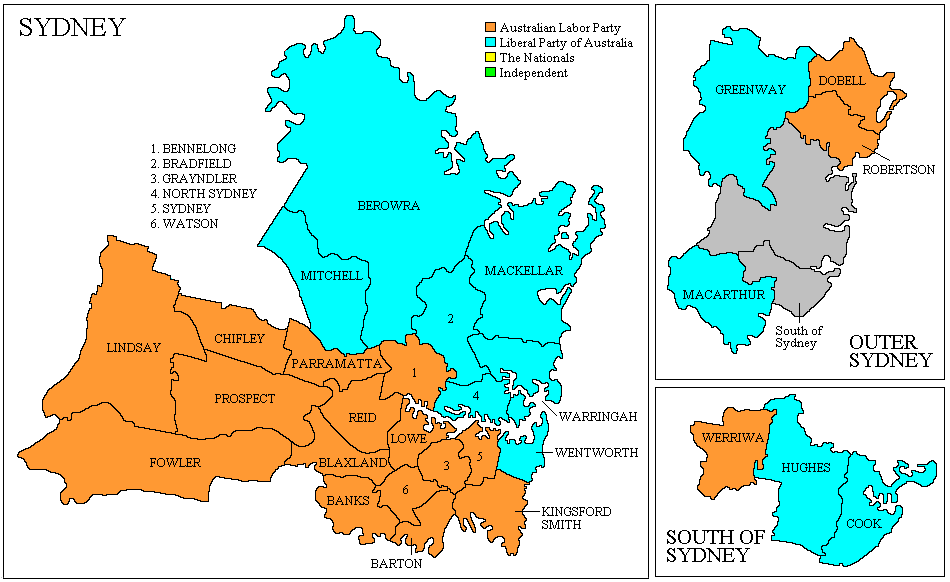 Due to many issues associated with gerrymandering and its impact on competitive elections and democratic accountability, numerous countries have enacted reforms making the practice either more difficult or less effective. Countries such as the UK, Australia, Canada and most of those in Europe have transferred responsibility for defining constituency boundaries to neutral or cross-party bodies.
In the United States, however, such reforms are controversial and frequently meet particularly strong opposition from groups that benefit from gerrymandering. In a more neutral system, they might lose considerable influence.
in the House of Commons
and regional legislatures, subject to ratification by the body in question (almost always granted without debate). A similar situation exists in Australia where the independent Australian Electoral Commission, and its state based counterparts, determines electoral boundaries for federal, state and local jurisdictions.
To help ensure neutrality, members of a redistricting agency may be appointed from relatively apolitical sources such as retired judges or longstanding members of the civil service, possibly with requirements for adequate representation among competing political parties. Additionally, members of the board can be denied access to information that might aid in gerrymandering, such as the demographic makeup or voting patterns of the population. As a further constraint, consensus requirements can be imposed to ensure that the resulting district map reflects a wider perception of fairness, such as a requirement for a supermajority approval of the commission for any district proposal. Consensus requirements, however, can lead to deadlock, such as occurred in Missouri
following the 2000 census. There, the equally numbered partisan appointees were unable to reach consensus in a reasonable time, and consequently the courts had to determine district lines.
In the US state of Iowa
, the nonpartisan Legislative Services Bureau (LSB, akin to the US Congressional Research Service
) determines boundaries of electoral districts. Aside from satisfying federally mandated contiguity and population equality criteria, the LSB mandates unity of counties and cities. Consideration of political factors such as location of incumbents, previous boundary locations, and political party proportions is specifically forbidden. Since Iowa's counties are chiefly regularly shaped polygons, the LSB process has led to districts that follow county lines.
In 2005, the US state of Ohio
had a ballot measure to create an independent commission whose first priority was competitive districts, a sort of "reverse gerrymander". A complex mathematical formula was to be used to determine the competitiveness of a district. The measure failed voter approval chiefly due to voter concerns that communities of interest would be broken up.
effect, the use of a different voting system with fewer wasted votes can help reduce gerrymandering. In particular, the use of multimember districts alongside voting systems establishing proportional representation such as Single Transferable Voting can reduce wasted votes and gerrymandering. Semi-proportional voting systems such as single non-transferable vote
or cumulative voting
are relatively simple and similar to first past the post and can also reduce the proportion of wasted votes and thus potential gerrymandering. Electoral reformers have advocated all three as replacement systems.
Electoral systems with different forms of proportional representation are now found in nearly all European countries. In this way, they have multi-party systems (with many parties represented in the parliaments) with higher voter attendance in the elections, fewer wasted votes, and a wider variety of political opinions represented.
Electoral systems with election of just one winner in each district (i.e., "winner-take-all" electoral systems), and no proportional distribution of extra mandates to smaller parties, tend to create two-party systems (Duverger's Law
). In these, just two parties effectively compete in the national elections and thus the national political discussions are forced into a narrow two-party frame, where loyalty and forced statements inside the two parties distort the political debate.
In contrast to proportional methods, if a nonproportional voting system with multiple winners (such as block voting
) is used, then increasing the size of the elected body while keeping the number of districts constant will not reduce the amount of wasted votes, leaving the potential for gerrymandering the same. While merging districts together under such a system can reduce the potential for gerrymandering, doing so also amplifies the tendency of block voting to produce landslide victories
, creating a similar effect to gerrymandering by concentrating wasted votes among the opposition and denying them representation.
If a system of single-winner elections is used, then increasing the size of the elected body will implicitly increase the number of districts to be created. This change can actually make gerrymandering easier when raising the number of single-winner elections, as opposition groups can be more efficiently packed into smaller districts without accidentally including supporters, further increasing the number of wasted votes amongst the opposition.
, for instance, has more competitive elections than the House of Representatives due to the use of existing state borders rather than gerrymandered districts—Senators are elected by their entire state, while Representatives are elected in legislatively drawn districts.
The use of fixed districts creates an additional problem, however, in that fixed districts do not take into account changes in population. Individual voters can come to have very different degrees of influence on the legislative process. This malapportionment can greatly affect representation after long periods of time or large population movements. In the United Kingdom during the Industrial Revolution
, several constituencies that had been fixed since they gained representation in the Parliament of England became so small that they could be won with only a handful of voters (rotten borough
s). Similarly, in the US the state legislature of Alabama refused to redistrict for more than 60 years, despite major changes in population patterns. By 1960 less than a quarter of the state's population controlled the majority of seats in the legislature. However, this practice of using fixed districts for state legislatures was effectively banned in the United States after the Reynolds v. Sims
Supreme Court decision, establishing a rule of one man, one vote.
ratio. To use this method, every proposed district is circumscribed by the smallest possible convex polygon (similar to the concept of a convex hull
, think of stretching a rubberband around the outline of the district). Then, the area of the district is divided by the area of the polygon; or, if at the edge of the state, by the portion of the area of the polygon within state boundaries. The advantages of this method are that it allows a certain amount of human intervention to take place (thus solving the Colorado problem of splitline districting); it allows the borders of the district to follow existing jagged subdivisions, such as neighbourhoods or voting districts (something isoperimetric rules would discourage); and it allows concave coastline districts, such as the Florida gulf coast area. It would mostly eliminate bent districts, but still permit long, straight ones. However, since human intervention is still allowed, the gerrymandering issues of packing and cracking would still occur, just to a lesser extent. Also, it would not allow convex coastline districts, although this could be remedied by a secondary calculation using a "polygon" with a border being a defined distance from the shore.
. The algorithm uses only the shape of the state, the number N of districts wanted, and the population distribution as inputs. The algorithm (slightly simplified) is:
This district-drawing algorithm has the advantages of simplicity, ultra-low cost, lack of intentional bias, and it produces simple boundaries that do not meander needlessly. It has the disadvantage of ignoring geographic features such as rivers, cliffs, and highways and cultural features such as tribal boundaries. This landscape oversight causes it to produce districts differently than those an unbiased human would produce. Ignoring geographic features can induce very simple boundaries.
Another criticism of the system is that splitline districts sometimes divide and diffuse the voters in a large metropolitan area. This condition is most likely to occur when one of the first splitlines cuts through the metropolitan area. It is often considered a drawback of the system because residents of the same city are assumed to be a community of common interest. This is most evident in the splitline allocation of Colorado
.
As of July 2007, shortest-splitline redistricting pictures are now available for all 50 states.
s and special districting software has made gerrymandering a far more precise science. Using such databases, political parties can obtain detailed information about every household including political party registration, previous campaign donations, and the number of times residents voted in previous elections and combine it with other predictors of voting behaviour such as age, income, race, or education level. With this data, gerrymandering politicians can predict the voting behaviour of each potential district with an astonishing degree of precision, leaving little chance for creating an accidentally competitive district.
and the Netherlands
employ electoral systems with only one (nationwide) voting district for election of national representatives. This virtually precludes gerrymandering.
has adopted the proportional system for the National, State, and local legislative elections, with some variations. However, it is said that during the military dictatorship (1964–1985), especially in the General Ernesto Geisel Presidency, States were incorporated (Guanabara State into Rio de Janeiro State - 1975) or split (Mato Grosso/Mato Grosso do Sul - 1979), both without popular referendum, in order to prevent the rising of the opposition party (MDB).
history, both the federal and provincial levels used gerrymandering to try to maximise partisan power. When Alberta
and Saskatchewan
were admitted to Confederation in 1905, their original district boundaries were set forth in the respective Alberta
and Saskatchewan Acts. These boundaries had been devised by federal Liberal
cabinet
members to ensure the election of provincial Liberal governments.
Since responsibility for drawing federal and provincial electoral boundaries was handed over to independent agencies, this problem has largely been eliminated at these levels of government. Manitoba was the first province to authorise a non-partisan group to define constituency boundaries in the 1950s. In 1964, the federal government delegated the drawing of boundaries for national seats to the "arm's length" Elections Canada
.
As a result, gerrymandering is not generally a major issue in Canada except at the civic level. Although city wards are recommended by independent agencies, city councils occasionally overrule them. This is much more likely where the city is not homogenous and different neighbourhoods have sharply different opinions about city policy direction.
In 2006, a controversy arose on Prince Edward Island
over the provincial government's decision to throw out an electoral map drawn by an independent commission. Instead they created two new maps. The government adopted the second of these, designed by the caucus
of the governing party. Opposition parties and the media attacked Premier Pat Binns
for what they saw as gerrymandering of districts. Among other things, the government adopted a map that ensured that every current Member of the Legislative Assembly
from the premier's party had a district to run in for re-election, whereas in the original map, several had been redistricted. Despite this, in the 2007 provincial election
only seven of 20 incumbent Members of the Legislative Assembly were re-elected (seven did not run for re-election), and the government was defeated.
The current federal electoral district boundaries in Saskatchewan
have also been labelled as gerrymandered—the province's two major cities, Saskatoon
and Regina
, are both "cracked" into four districts each when the populations of the cities proper would justify about three and two and a half all-urban (or mostly urban) districts respectively; the map instead groups parts of the New Democratic Party
-friendly cities with large Conservative
-leaning rural areas.
At that time, the districts were created in their largely present form in the mid-1990s, it was alleged that they were intended to give the NDP and Liberals a fair chance of winning additional seats that included large sections of the province's rural hinterlands at the expense of the Reform Party
. In 1997, the Reform Party won three of the four Saskatoon seats despite their failure to earn a plurality of the city vote in any of the three ridings. In 2000, its successor, the Canadian Alliance
, added the remaining Saskatoon seat plus one in Regina, and, in 2004, the Canadian Alliance's successor, the Conservative Party of Canada
, added the NDP's two remaining Regina seats to shut the NDP out of the province. Since then, the Conservatives have held the seven districts in question, while the NDP holds no seats in the province despite a strong proportion of the vote especially in the cities. Polling data shows the Conservatives could probably not have swept either of these cities had they contained either completely or mostly urban constituencies. In 2011, the NDP again failed to win a seat in Saskatchewan, despite polling nearly a third of the popular vote in the province (above the national average) and winning 103 seats elsewhere in the country.
from 1973 to 1990 was ousted in a national plebiscite
in October 1988. Opponents of General Augusto Pinochet
voted NO to remove him from power and to trigger democratic elections, while supporters (mostly from the right-wing) voted YES to keep him in office for another eight years.
Five months prior to the plebiscite, the regime published a law regulating future elections and referendums, but electoral districts and the way Congress seats would be awarded were only added to the law seven months after the referendum, raising suspicions of gerrymandering.
For the Chamber of Deputies
(lower house) 60 districts
were drawn by grouping neighboring communes (the smallest administrative subdivision in the country) belonging to the same region (the largest administrative division). It was established that only two deputies would be elected per district and that the most voted coalition would need to outpoll its closest rival by a margin of more than 2-to-1 to take both seats. Thus, it is alleged, the electoral map was drawn in such a way that —with the results of the 1988 plebiscite at hand— in no district would the NO votes outpoll the YES votes by more than two to one. In spite of this, at the 1989 parliamentary election, the center-left opposition was able to capture both seats (the so-called doblaje) in twelve out of 60 districts, winning control of 60% of the Chamber.
Senate
constituencies were created by grouping all lower-chamber districts in a region, or by dividing a region into two constituencies of contiguous lower-chamber districts. The 1980 Constitution
had envisioned the little effect of gerrymandering in the upper house by allocating a number of seats to appointed senators. This would ensure that neither coalition would have the necessary votes to change the Constitution by themselves. The opposition won 22 senate seats in the 1989 election, taking both seats in three out of 19 constituencies, controlling 58% of the elected Senate, but only 47% of the full Senate.
The unelected senators were eliminated in the 2005 constitutional reforms, but the electoral map has remained largely untouched. (Two new regions were created in 2007, one of which altered the composition of two senatorial constituencies. The first election to be affected by this minor change will take place in 2013.)
were redrawn in 2000, the ruling Social Democratic Party (SPD
) was accused of gerrymandering to marginalise the socialist PDS
party. The SPD combined traditional PDS strongholds in eastern Berlin with new districts made up of more populous areas of western Berlin, where the PDS had very limited following.
After having won four seats in Berlin in the 1998 national election, the PDS was able to retain only two seats altogether in the 2002 elections. Under German electoral law, a political party has to win either more than five percent of the votes, or at least three directly elected seats, to qualify for top-up seats under the Additional Member System
. The PDS vote fell below five percent thus they failed to qualify for top-up seats and were confined to just two members of the Bundestag
, the German federal parliament (elected representatives are always allowed to hold their seats as individuals). Had they won a third constituency, the PDS would have gained at least 25 additional seats, which would have been enough to hold the balance of power
in the Bundestag.
In the election of 2005, the Left Party (successor of the PDS) gained 8.7% of the votes and thus qualified for top-up seats.
However, the number of Bundestag seats of parties which traditionally get over 5% of the votes cannot be affected very much by gerrymandering, because seats are awarded to these parties on a proportional basis. Only when a party wins so many districts in any one of the 16 federal states that those seats alone count for more than its proportional share of the vote in that same state does the districting have some influence on larger parties—those extra seats, called "Überhangmandate
", remain.
history since organised parties with national ballots only appeared after the 1926 Constitution. The only case before that was the creation of the Piraeus electoral district in 1906, in order to give the Theotokis party a safe district. The most infamous case of gerrymandering was in the 1956 elections, which was incidentally the first election where women voted. While in all other post World War II national elections the districts were based on the prefecture
(νομός) for 1956 the country was split in districts of varying sizes, others being the size of prefectures, others the size of sub-prefectures (επαρχία) and others somewhere in between. In small districts the winning party would take all seats, in intermediate size it would take most and there was proportional representation in the largest districts. The districts though were chosen in such a way that small districts were those that traditionally voted for the right while large districts were those that voted against the right. This system has become known as the three-phase (τριφασικό) system or the baklava system (because, as baklava is split into full pieces and corner pieces, the country was also split into disproportionate pieces). The opposition, being composed of the center and the left, formed a coalition with the sole intent to change the electoral law to be more representative and call new elections, despite the fact that only seven years earlier the center and the left had fought each other in the Greek Civil War
. Despite the opposition winning the popular vote (1,620,007 votes against 1,594,992), the right wing ERE
won the majority of seats (165 to 135) and was to lead the country for the next two years.
, although constituencies of district councils, the Urban Council, the Regional Council and the geographical constituencies of the Legislative Council have always been demarcated by the Boundary and Election Commission or its successor Electoral Affairs Commission, which is chaired by a judge, functional constituencies are demarcated by the government and defined in statutes, making them prone to gerrymandering. The functional constituency for the information technology sector was particular criticised for gerrymandering and voteplanting.
boundaries in the state of Ireland
were drawn not by an independent commission but by government ministers. Successive arrangements by governments of all political characters have been attacked as gerrymandering. Ireland uses the Single Transferable Vote
and as well as the actual boundaries drawn the main tool of gerrymandering has been the number of seats per constituency used, with three-seat constituencies normally benefiting the strongest parties in an area, whereas four-seat constituencies normally helped the second strongest party.
In 1947 the rapid rise of new party Clann na Poblachta
threatened the position of the governing party Fianna Fáil
. The government of Éamon de Valera
introduced the Electoral Amendment Act, 1947, which increased the size of the Dáil from 138 to 147 and increased the number of three-seat constituencies from fifteen to twenty-two. The result has been described as "a blatant attempt at gerrymander which no Six County
Unionist could have bettered." The following February the 1948 general election
was held and Clann na Poblachta secured ten seats instead of the nineteen they would have received proportional to their vote.
In the mid-1970s, the Minister for Local Government, James Tully, attempted to arrange the constituencies to ensure that the governing Fine Gael
–Labour Party
National Coalition
would win a parliamentary majority. The Electoral (Amendment) Act 1974
was planned as a major reversal of previous gerrymandering by Fianna Fáil (then in opposition). Tully ensured that there were as many as possible three-seat constituencies where the governing parties were strong, in the expectation that the governing parties would each win a seat in many constituencies, relegating Fianna Fáil to one out of three. In areas where the governing parties were weak, four-seat constituencies were used so that the governing parties had a strong chance of still winning two. The election results created substantial change, as there was a larger than expected collapse in the vote. Fianna Fáil won a landslide victory in the Irish general election, 1977
, two out of three seats in many cases, relegating the National Coalition parties to fight for the last seat. Consequently, the term Tullymandering was used to describe the phenomenon of a failed attempt at gerrymandering.
(PFL) of gerrymandering in favour of ethnic Latvians. For example, in 1990 the nearly pure Latvian-ethnic Ventspils district
(with about 0.6% of population) was awarded three constituencies out of 201 (1.5%), with two of PFL candidates running unopposed. In 1991, most native Russians were non-citizens
and so had no voting rights. In 1993, the country returned to proportional representation.
to reduce the influence of the Polish majority
in the area. That was done by connecting the majority-Polish areas in the Vilnius, Trakai and Šalčininkai municipalities to municipalities without major Polish populations, such as Elektrėnai, Ukmergė and Širvintos. The result is that Vilnius County
has a total Polish minority of 29.01%, which contain municipalities like Vilnius and Šalčininkai, which have a much larger percentage of the population (61.3% and 80% respectively).
, which remained in power in most of the time. Learning from this, the reshaping of constituency was done for constituent assembly and the oppositin now wins elections.
in 1921, favouring Unionists who tended to be Protestant, to the detriment of Nationalists
who were mostly Catholic. However Stephen Gwynn had noted as early as 1911 that since the introduction of the Local Government (Ireland) Act 1898
:
In the 1920s and 1930s, the Ulster Unionist Party
created new electoral boundaries for the Londonderry County Borough Council to ensure election of a Unionist council in a city where Nationalists
had a large majority and had won previous elections. Initially local parties drew the boundaries, but in the 1930s the province-wide government
redrew them to reinforce the gerrymander. Some critics and supporters spoke at the time of "A Protestant Parliament for a Protestant People
".
In 1929, the Parliament of Northern Ireland
passed a bill shifting the Parliament's electoral system from the relatively proportional single transferable vote
(STV) to the less proportional first past the post or plurality voting system. The only exception was for the election of four Stormont MPs to represent the Queen's University of Belfast. Many scholars believe that the boundaries were gerrymandered to underrepresent Nationalists. Some geographers and historians, for instance Professor John H. Whyte, disagree. They have argued that the electoral boundaries for the Parliament of Northern Ireland
were not gerrymandered to a greater level than that produced by any single-winner election system, and that the actual number of Nationalist MPs barely changed under the revised system (it went from 12 to 11 and later went back up to 12). Most observers have acknowledged that the change to a single-winner system was a key factor, however, in stifling the growth of smaller political parties, such as the Northern Ireland Labour Party
and Independent Unionist
s.
The United Kingdom suspended the Parliament of Northern Ireland and its government in 1972. It restored the single transferable vote (STV) for elections to the Northern Ireland Assembly in the following year, using the same definitions of constituencies as for the Westminster Parliament. Currently in Northern Ireland, all elections use the STV except those for positions in the Westminster Parliament, which follow the pattern in the rest of the United Kingdom by using "first past the post."
(PAP) of unfair electoral practices to maintain significant majorities in the Parliament of Singapore
. Among the complaints are that the government uses gerrymandering.
The Elections Department
was established as part of the executive branch under the Prime Minister of Singapore
, rather than as an independent body. Critics have accused it of giving the ruling party the power to decide polling districts and polling sites through electoral engineering, based on poll results in previous election. Opposition parties have alleged that the Elections Department decisions have given unfair advantage to the ruling party and have affected the outcome of some electoral battles.
Critics point out the dissolution of the Group Representation Constituencies (GRC) of Cheng San GRC
and Eunos GRC
. Each was dissolved by the Elections Department with voters redistributed to other constituencies after opposition parties gained ground in elections. Such action was controversial.
PAP strongholds, such as Tanjong Pagar GRC
and Ang Mo Kio GRC
, where Minister Mentor Lee Kuan Yew and Prime Minister Lee Hsien Loong respectively contest, have seldom been contested by the opposition. When Ang Mo Kio GRC was last contested in 2006, the PAP has won 66% of the votes.
The electoral boundaries map as of 2010 shows a large variation in size of districts and the number of citizens represented on average by each MP.
. A report from the Rift Valley Institute uncovered violations of Sudan's electoral law, where constituencies were created that were well below and above the required limit. According to Sudan's National Elections Act of 2008, no constituency can have a population that is 15% greater or less than the average constituency size. The Rift Valley Report uncovered a number of constituencies that are in violation of this rule. Examples include constituencies in Jonglei, Warrap, South Darfur, and several other states.
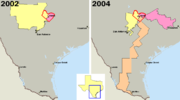 The United States has a long tradition of gerrymandering that precedes the 1789 election of the First U.S. Congress
. In 1788, Patrick Henry
and his Anti-Federalist
allies were in control of the Virginia
House of Delegates
. They drew the boundaries of Virginia's 5th congressional district
in an unsuccessful attempt to keep James Madison
out of the U.S. House of Representatives.
Historically, each state legislature has used gerrymandering to try to control the political makeup of its delegation to the U.S. House of Representatives. Partisan legislators typically try to maximise the number of congressional delegation seats under the control of the legislature's majority party.
The practice of gerrymandering the borders of new states continued past the Civil War and into the late 19th century. The Republican Party used its control of Congress to secure the admission of more states in territories friendly to their party - the admission of Dakota Territory
as two states instead of one being a notable example. By the rules for representation in the Electoral College
, each new state carried at least three electoral votes regardless of its population.
All redistricting in the United States has been contentious because it has been controlled by political parties vying for power. As a consequence of the decennial census
required by the United States Constitution
, districts for members of the House of Representatives
typically need to be redrawn. In many states, state legislatures have redrawn boundaries for state legislative districts at the same time.
 When faced with losing power, however, members of some legislatures simply refused to redistrict. Early struggles for power were between rural and urban interests, as well as between political parties. The state legislature of Alabama, for instance, refused to redistrict from 1901 to the 1960s, despite changing conditions in a state that was industrialising and where population was rapidly moving to cities. This allowed state politics to heavily favour rural interests. In 1960, approximately a quarter of the state's population controlled the state legislature. When the state legislature could not agree on boundaries, a federal court worked with a new non-partisan body to conclude defining new districts in 1972.
Intense political battles over contentious redistricting typically take place within state legislatures responsible for creating the electoral maps. Since passage of the Voting Rights Act of 1965, federal courts may be involved to ensure that historical patterns of discrimination are not perpetuated.
This process can create strange bedfellows interested in securing reelection; in some states, Republicans have cut deals with opposing black Democratic state legislators to create majority-black districts. By packing black Democratic voters into a single district, they can essentially ensure the election of a black Congressman or reelection of a black state legislator due to the packed concentration of Democratic voters—however, the surrounding districts are more safely Republican in areas like the South, where white conservatives have increasingly shifted from the Democratic to the Republican Party in national elections in the last four decades.
In Pennsylvania, the Republican-dominated state legislature used gerrymandering to help defeat Democratic representative Frank Mascara
. Mascara was elected to Congress in 1994. In 2002, the Republican Party altered the boundaries of his original district so much that he was pitted against fellow Democratic candidate John Murtha
in the election. The shape of Mascara's newly drawn district formed a finger that stopped at his street, encompassing his house, but not the spot where he parked his car. Murtha won the election in the newly formed district.
State legislatures have used gerrymandering along racial or ethnic lines both to decrease and increase minority representation in state governments and congressional delegations. In the state of Ohio, a conversation between Republican officials was recorded that demonstrated that redistricting was being done to aid their political candidates. Furthermore, the discussions assessed race of voters as a factor in redistricting, because African-Americans had backed Democratic candidates. Republicans apparently removed approximately 13,000 African American voters from the district of Jim Raussen, a Republican candidate for the House of Representatives, in an attempt to tip the scales in what was once a competitive district for Democratic candidates.
In some states, bipartisan gerrymandering is the norm. State legislators from both parties sometimes agree to draw congressional district boundaries in a way that ensures the re-election of most or all incumbent representatives from both parties.
International election observers from the OSCE Office for Democratic Institutions and Human Rights, who were invited to observe and report on the 2004 national elections
, expressed criticism of the U.S. congressional redistricting process and made a recommendation that the procedures be reviewed to ensure genuine competitiveness of Congressional election contests.
s. These were designed for and effectively succeeded in disfranchising most African Americans and many poor whites in southern states. In areas where African American and other minorities succeeded in registering, some states created districts that were gerrymandered to reduce the voting impact of minorities.
With the Civil Rights Movement and passage of the Voting Rights Act of 1965, additional federal enforcement and protections of suffrage for all citizens were enacted. Gerrymandering for the purpose of reducing the political influence of a racial or ethnic minority group was prohibited. Poll taxes for federal elections were prohibited by ratification of the Twenty-fourth Amendment
in 1964, and a later Supreme Court case struck down poll taxes as a prerequisite for any election. Gerrymandering for political gain has remained possible under the Constitution.
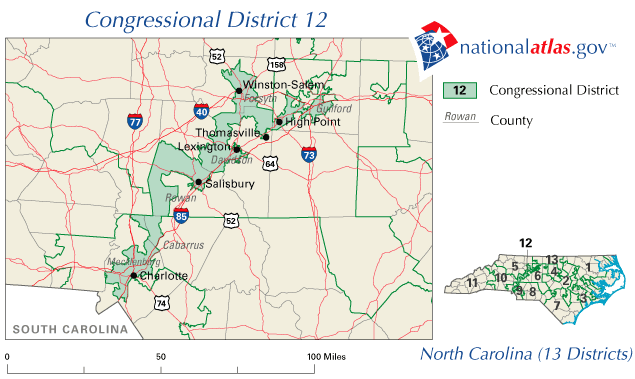 After the Voting Rights Act of 1965 was passed, some states created "majority-minority" districts. This practice, also called "affirmative gerrymandering", was supposed to redress historic discrimination and ensure that ethnic minorities would gain some seats in government. Since the 1990s, however, gerrymandering based solely on racial data has been ruled unconstitutional by the United States Supreme Court
under the Fourteenth Amendment
, first in Shaw v. Reno
(1993) and subsequently in Miller v. Johnson
(1995).
The constitutionality of using racial considerations to create districts remains difficult to assess, despite past injustices. In Hunt v. Cromartie
(1999), the Supreme Court approved a racially focused gerrymandering of a congressional district on the grounds that the definition was not pure racial gerrymandering but instead partisan gerrymandering, which is constitutionally permissible. With the increasing racial polarisation of parties in the South in the U.S. as conservative whites move from the Democratic to the Republican Party, gerrymandering may become partisan and also achieve goals for ethnic representation.
In a few circumstances the use of goal-driven district boundaries may be used for positive social goals. When the state legislature considered representation for Arizona
's Native American reservations, they thought each needed their own House member, because of historic conflicts between the Hopi
and Navajo
nations. Since the Hopi reservation is completely surrounded by the Navajo reservation, the legislature created an unusual district configuration that features a fine filament along a river course several hundred miles in length to attach two Navajo regions, Arizona's 2nd congressional district
.
The California state legislature
created a congressional district
that extends over a narrow coastal strip for several miles. It ensures that a common community of interest will be represented, rather than the coastal areas being dominated by inland concerns.
on June 28, 2006, the United States Supreme Court
upheld most of a Texas congressional map engineered in 2003 by former House Majority Leader
Tom DeLay
. The 7–2 decision allows state legislatures to redraw and gerrymander districts as often as they like (not just after the decennial census). Thus they may work to protect their political parties' standing and number of seats, so long as they do not harm racial and ethnic minority groups. A 5–4 majority declared one Congressional district
unconstitutional in the case because of harm to an ethnic minority.
Rather than allowing more political influence, some states' citizens are considering shifting redistricting authority from politicians and giving it to non-partisan commissions. The states of Washington, Arizona, and California have created standing committee
s for the redistricting following the 2010 census. Rhode Island and New Jersey have developed ad hoc
committees, but developed the past two decennial reapportionments tied to new census data. Florida's amendments 5 and 6, meanwhile, established rules for the creation of districts but did not mandate an independent commission.
a few months before, in an adendum to the electoral law). Hugo Chávez
's political party, the United Socialist Party of Venezuela
drew 48% of the votes, but his opponents (the Coalition for Democratic Unity and the Fatherland for All) drew 52% of the votes.
Because of the recent and, by some accounts illegal, gerrymandering of electoral legislative districts, Chávez's United Socialist Party of Venezuela was awarded over 60% of the spots in the National Assembly (98 deputies), but those two parties of his opponents got a total of only 67 deputies.
has been termed "jurymandering".
Gerrymandering may be used to achieve desired electoral results for a particular party, or may be used to help or hinder a particular demographic, such as a political, racial, linguistic, religious or class group.
When used to allege that a given party is gaining disproportionate power, the term gerrymandering has negative connotations. However, a gerrymander may also be used for purposes that some perceive as positive, such as in US federal voting district boundaries that produce a majority of constituents representative of African-American or other racial minorities (these are thus called "minority-majority districts").
Difference from malapportionment
Gerrymandering should not be confused with malapportionment, whereby the number of eligible voters per elected representative can vary widely without relation to how the boundaries are drawn. Nevertheless the ~mander suffix has been applied to particular malapportionments, such as the "PlaymanderPlaymander
The Playmander was a form of electoral malapportionment in the Australian state of South Australia, in place from 1936 to 1968. It consisted of rural districts enjoying a 2-to-1 advantage in the state parliament, even though they contained less than half of the population, as well as a change from...
" in South Australia
South Australia
South Australia is a state of Australia in the southern central part of the country. It covers some of the most arid parts of the continent; with a total land area of , it is the fourth largest of Australia's six states and two territories.South Australia shares borders with all of the mainland...
and the "Bjelkemander
Bjelkemander
The Bjelkemander was the term given to a system of malapportionment in the Australian State of Queensland in the 1970s and 1980s. Under the system, electorates were allocated to zones such as rural or metropolitan and electoral boundaries drawn so that rural electorates had about half as many...
" in Queensland
Queensland
Queensland is a state of Australia, occupying the north-eastern section of the mainland continent. It is bordered by the Northern Territory, South Australia and New South Wales to the west, south-west and south respectively. To the east, Queensland is bordered by the Coral Sea and Pacific Ocean...
. Sometimes political representatives use both gerrymandering and malapportionment to try to maintain power.
Etymology
Boston Gazette
The Boston Gazette was a newspaper published in Boston, Massachusetts, in the British North American colonies. It began publication December 21, 1719 and appeared weekly.-Brief history:...
on March 26, 1812. The word was created in reaction to a redrawing of Massachusetts
Massachusetts
The Commonwealth of Massachusetts is a state in the New England region of the northeastern United States of America. It is bordered by Rhode Island and Connecticut to the south, New York to the west, and Vermont and New Hampshire to the north; at its east lies the Atlantic Ocean. As of the 2010...
state senate election districts under the then-governor Elbridge Gerry
Elbridge Gerry
Elbridge Thomas Gerry was an American statesman and diplomat. As a Democratic-Republican he was selected as the fifth Vice President of the United States , serving under James Madison, until his death a year and a half into his term...
. In 1812, Governor Gerry signed a bill that redistricted Massachusetts to benefit his Democratic-Republican Party. When mapped, one of the contorted districts in the Boston area was said to resemble the shape of a salamander
Salamander (legendary creature)
The salamander is an amphibian of the order Urodela. As with many real creatures, pre-modern authors often ascribed fantastic qualities to it , and in recent times some have come to identify a legendary salamander as a distinct concept from the real organism. This idea is most highly developed in...
. The exact author of the term gerrymander may never be definitively established. It is widely believed by historians that Federalist newspaper editors Nathan Hale
Nathan Hale (journalist)
Nathan Hale was an American journalist and newspaper publisher who introduced regular editorial comment as a newspaper feature.-Life and career:...
, Benjamin and John Russell were the instigators, but the historical record gives no definitive evidence as to who created or uttered the word for the first time. The term was a portmanteau of the governor's last name and the word salamander.
Appearing with the term, and helping to spread and sustain its popularity, was a political cartoon depicting a strange animal with claws, wings and a dragon-like head satirising the map of the odd-shaped district. This cartoon was most likely drawn by Elkanah Tisdale, an early 19th century painter, designer, and engraver who was living in Boston at the time.
Tisdale also had the engraving skills to cut the woodblocks that printed the original cartoon. These woodblocks survive and are preserved in the Library of Congress
Library of Congress
The Library of Congress is the research library of the United States Congress, de facto national library of the United States, and the oldest federal cultural institution in the United States. Located in three buildings in Washington, D.C., it is the largest library in the world by shelf space and...
.
The word gerrymander was reprinted numerous times in Federalist newspapers in Massachusetts, New England, and nationwide during the remainder of 1812. This suggests some organised activity of the Federalists to disparage Governor Gerry in particular and the growing Democratic-Republican party in general. Gerrymandering soon began to be used to describe not only the original Massachusetts example but also other cases of district-shape manipulation for partisan gain in other states. According to the Oxford English Dictionary
Oxford English Dictionary
The Oxford English Dictionary , published by the Oxford University Press, is the self-styled premier dictionary of the English language. Two fully bound print editions of the OED have been published under its current name, in 1928 and 1989. The first edition was published in twelve volumes , and...
, institutionalisation of the word became complete with its first appearance in a dictionary (1848) and first appearance in an encyclopedia (1868).
Although the letter g of the eponymous Gerry is pronounced /ɡ/ as in go, the word gerrymander is most commonly pronounced ˈdʒɛrimændər, with a /dʒ/ as in gentle.
Voting systems
Gerrymandering is used most often in favor of ruling incumbents or a specific political party. Societies whose legislatures use a single-winner voting systemVoting system
A voting system or electoral system is a method by which voters make a choice between options, often in an election or on a policy referendum....
are the most likely to have political parties that gerrymander for advantage. Most notably, gerrymandering is particularly effective in non-proportional systems that tend towards fewer parties, such as first past the post.
Most democracies have partly proportional electoral systems, where several political parties are proportionally represented in the national parliaments, in proportion to the total numbers of votes of the parties in the regional or national elections. In these more or less proportional representation
Proportional representation
Proportional representation is a concept in voting systems used to elect an assembly or council. PR means that the number of seats won by a party or group of candidates is proportionate to the number of votes received. For example, under a PR voting system if 30% of voters support a particular...
systems, gerrymandering has little or less significance.
Some countries, such as the UK
United Kingdom
The United Kingdom of Great Britain and Northern IrelandIn the United Kingdom and Dependencies, other languages have been officially recognised as legitimate autochthonous languages under the European Charter for Regional or Minority Languages...
and Canada
Canada
Canada is a North American country consisting of ten provinces and three territories. Located in the northern part of the continent, it extends from the Atlantic Ocean in the east to the Pacific Ocean in the west, and northward into the Arctic Ocean...
, authorize non-partisan organizations to set constituency boundaries in an attempt to prevent gerrymandering. Gerrymandering is most common in countries where elected politicians are responsible for defining constituency boundaries. They have obvious self interest in determining boundaries to their and their party's interest.
Packing and cracking
The two aims of gerrymandering are to maximize the effect of supporters' votes and to minimize the effect of opponents' votes. One strategy, packing, is to concentrate as many voters of one type into a single electoral district to reduce their influence in other districts. In some cases this may be done to obtain representation for a community of common interest, rather than to dilute that interest over several districts to a point of ineffectiveness. A second strategy, cracking, involves spreading out voters of a particular type among many districts in order to deny them a sufficiently large voting blocVoting bloc
A voting bloc is a group of voters that are so motivated by a specific concern or group of concerns that it helps determine how they vote in elections. The divisions between voting blocs are known as cleavage...
in any particular district. The strategies are typically combined, creating a few "forfeit" seats for packed voters of one type in order to secure even greater representation for voters of another type.
Gerrymandering is effective because of the wasted vote effect. By packing opposition voters into districts they will already win (increasing excess votes for winners) and by cracking the remainder among districts where they are moved into the minority (increasing votes for eventual losers), the number of wasted votes among the opposition can be maximized. Similarly, with supporters holding narrow margins in the unpacked districts, the number of wasted votes among supporters is minimized.
While the wasted vote effect is strongest when a party wins by narrow margins across multiple districts, gerrymandering narrow margins can be risky when voters are less predictable. To minimize the risk of demographic or political shifts swinging a district to the opposition, politicians can instead create more packed districts, leading to more comfortable margins in unpacked ones.
Effects of gerrymandering
Reduction in electoral competition and voter turnout
The most immediate and obvious effect of gerrymandering is that elections become less competitive in all districts, particularly packed ones. As electoral margins of victory become significantly greater and politicians have safe seats, the incentive for meaningful campaigning is reduced.As the chance of influencing electoral results by voting is reduced, voter turnout
Voter turnout
Voter turnout is the percentage of eligible voters who cast a ballot in an election . After increasing for many decades, there has been a trend of decreasing voter turnout in most established democracies since the 1960s...
is likely to decrease. Correspondingly, political campaigns are less likely to expend resources to encourage turnout. With a reduction in competition, a candidate puts more effort into securing party nomination
Nomination
Nomination is part of the process of selecting a candidate for either election to an office, or the bestowing of an honor or award.In the context of elections for public office, a candidate who has been selected by a political party is normally said to be the nominee of that party...
for a given district rather than gaining approval of the general electorate. In an effectively gerrymandered district, the candidate is virtually assured of a win once nominated. In 2004, for example, when California's 3rd congressional district
California's 3rd congressional district
California's 3rd congressional district is a congressional district located in the U.S. state of California. It covers most of Sacramento County and part of Solano County, as well as all of Alpine, Amador and Calaveras counties...
became an open seat after Republican Congressman Doug Ose
Doug Ose
Douglas Arlo "Doug" Ose is a former California congressman who served in the U.S. House of Representatives from 1999 to 2005, representing California's 3rd Congressional District...
ran for higher office, the state's three strongest Republican congressional candidates campaigned vigorously against one another for nomination in the district's primary election
Primary election
A primary election is an election in which party members or voters select candidates for a subsequent election. Primary elections are one means by which a political party nominates candidates for the next general election....
. Several other districts were uncontested, with no Republican nominees making even a token campaign effort.
Increased incumbent advantage and campaign costs
The effect of gerrymandering for incumbents is particularly advantageous, as incumbents are far more likely to be reelected under conditions of gerrymandering. For example, in 2002, according to political scientists Norman Ornstein and Thomas MannThomas E. Mann
Thomas E. Mann is a political scientist, author, and pundit who works at the Brookings Institution. He primarily studies and speaks on elections in the United States, especially campaign finance reform...
, only four challengers were able to defeat incumbent members of the US Congress, the lowest number in modern American history. Incumbents are likely to be of the majority party orchestrating a gerrymander, and incumbents are usually easily renominated in subsequent elections, including incumbents among the minority.
This demonstrates that gerrymandering can have a deleterious effect on the principle of democratic accountability. With uncompetitive seats/districts reducing the fear that incumbent politicians may lose office, they have less incentive to represent the interests of their constituents, even when those interests conform to majority support for an issue across the electorate as a whole. Incumbent politicians may look out more for their party's interests than for those of their constituents.
Gerrymandering can have an impact on campaign costs for district elections. If districts become increasingly stretched out, candidates must pay increased costs for transportation and trying to develop and present campaign advertising
Campaign advertising
'In politics, campaign advertising is the use of an advertising campaign through newspapers, radio commercials, television commercials, etc.) to influence the decisions made for and by groups. These ads are designed by political consultants and the political campaign staff...
across a district. The incumbent's advantage in securing campaign funds is another benefit of his or her having a gerrymandered secure seat.
Less descriptive representation
Gerrymandering also has significant effects on the representationRepresentation (politics)
In politics, representation describes how some individuals stand in for others or a group of others, for a certain time period. Representation usually refers to representative democracies, where elected officials nominally speak for their constituents in the legislature...
received by voters in gerrymandered districts. Because gerrymandering can be designed to increase the number of wasted votes among the electorate, the relative representation of particular groups can be drastically altered from their actual share of the voting population. This effect can significantly prevent a gerrymandered system from achieving proportional and descriptive representation, as the winners of elections are increasingly determined by who is drawing the districts rather than the preferences of the voters.
Gerrymandering may be advocated to improve representation within the legislature among otherwise underrepresented minority groups by packing them into a single district. This can be controversial, as it may lead to those groups' remaining marginalised in the government as they become confined to a single district. Candidates outside that district no longer need to represent them to win election.
As an example, much of the redistricting conducted in the United States in the early 1990s involved the intentional creation of additional "majority-minority" districts where racial minorities such as African Americans were packed into the majority. This "maximisation policy" drew support by both the Republican Party (who had limited support among African Americans and could concentrate their power elsewhere) and by minority representatives elected as Democrats from these constituencies, who then had safe seats.
Incumbent gerrymandering
Gerrymandering can also be done to help incumbents as a whole, effectively turning every district into a packed one and greatly reducing the potential for competitive elections. This is particularly likely to occur when the minority party has significant obstruction power—unable to enact a partisan gerrymander, the legislature instead agrees on ensuring their own mutual reelection.In an unusual occurrence in 2000, for example, the two dominant parties in the state of California cooperatively redrew both state and Federal legislative districts to preserve the status quo, ensuring the electoral safety of the politicians from unpredictable voting by the electorate. This move proved completely effective, as no State or Federal legislative office changed party in the 2004 election, although 53 congressional, 20 state senate, and 80 state assembly seats were potentially at risk.
In 2006, the term "70/30 District" came to signify the equitable split of two evenly split (i.e. 50/50) districts. The resulting districts gave each party a guaranteed seat and retained their respective power base.
Prison-based gerrymandering
Prison-based gerrymandering occurs when prisoners are counted as residents of a particular district increasing the district's population with non-voters when assigning political apportionment. This phenomenon, according to prisoners' rights organization, violates the principle of one person, one vote. Prison Policy InitiativePrison Policy Initiative
The Prison Policy Initiative is a criminal justice oriented public policy think tank based in Easthampton, Massachusetts. It is a non-profit organization, designated 501 by the IRS...
argues that although many prisoners come from (and return to) urban communities, they are counted as "residents" of the rural districts that contain large prisons, artificially inflating the political representation in districts with prisons at the expense of voters in all other districts without prisons. Others contend that prisoners should not be counted as residents of their original districts when they do not reside there and are not legally eligible to vote.
Changes to achieve competitive elections
In the United States, however, such reforms are controversial and frequently meet particularly strong opposition from groups that benefit from gerrymandering. In a more neutral system, they might lose considerable influence.
Redistricting by neutral or cross-party agency
The most commonly advocated electoral reform proposal targeted at gerrymandering is to change the redistricting process. Under these proposals, an independent and presumably objective commission is created specifically for redistricting, rather than having the legislature do it. This is the system used in the United Kingdom, where the independent Boundary Commissions determine the boundaries for constituenciesUnited Kingdom constituencies
In the United Kingdom , each of the electoral areas or divisions called constituencies elects one or more members to a parliament or assembly.Within the United Kingdom there are now five bodies with members elected by constituencies:...
in the House of Commons
British House of Commons
The House of Commons is the lower house of the Parliament of the United Kingdom, which also comprises the Sovereign and the House of Lords . Both Commons and Lords meet in the Palace of Westminster. The Commons is a democratically elected body, consisting of 650 members , who are known as Members...
and regional legislatures, subject to ratification by the body in question (almost always granted without debate). A similar situation exists in Australia where the independent Australian Electoral Commission, and its state based counterparts, determines electoral boundaries for federal, state and local jurisdictions.
To help ensure neutrality, members of a redistricting agency may be appointed from relatively apolitical sources such as retired judges or longstanding members of the civil service, possibly with requirements for adequate representation among competing political parties. Additionally, members of the board can be denied access to information that might aid in gerrymandering, such as the demographic makeup or voting patterns of the population. As a further constraint, consensus requirements can be imposed to ensure that the resulting district map reflects a wider perception of fairness, such as a requirement for a supermajority approval of the commission for any district proposal. Consensus requirements, however, can lead to deadlock, such as occurred in Missouri
Missouri
Missouri is a US state located in the Midwestern United States, bordered by Iowa, Illinois, Kentucky, Tennessee, Arkansas, Oklahoma, Kansas and Nebraska. With a 2010 population of 5,988,927, Missouri is the 18th most populous state in the nation and the fifth most populous in the Midwest. It...
following the 2000 census. There, the equally numbered partisan appointees were unable to reach consensus in a reasonable time, and consequently the courts had to determine district lines.
In the US state of Iowa
Iowa
Iowa is a state located in the Midwestern United States, an area often referred to as the "American Heartland". It derives its name from the Ioway people, one of the many American Indian tribes that occupied the state at the time of European exploration. Iowa was a part of the French colony of New...
, the nonpartisan Legislative Services Bureau (LSB, akin to the US Congressional Research Service
Congressional Research Service
The Congressional Research Service , known as "Congress's think tank", is the public policy research arm of the United States Congress. As a legislative branch agency within the Library of Congress, CRS works exclusively and directly for Members of Congress, their Committees and staff on a...
) determines boundaries of electoral districts. Aside from satisfying federally mandated contiguity and population equality criteria, the LSB mandates unity of counties and cities. Consideration of political factors such as location of incumbents, previous boundary locations, and political party proportions is specifically forbidden. Since Iowa's counties are chiefly regularly shaped polygons, the LSB process has led to districts that follow county lines.
In 2005, the US state of Ohio
Ohio
Ohio is a Midwestern state in the United States. The 34th largest state by area in the U.S.,it is the 7th‑most populous with over 11.5 million residents, containing several major American cities and seven metropolitan areas with populations of 500,000 or more.The state's capital is Columbus...
had a ballot measure to create an independent commission whose first priority was competitive districts, a sort of "reverse gerrymander". A complex mathematical formula was to be used to determine the competitiveness of a district. The measure failed voter approval chiefly due to voter concerns that communities of interest would be broken up.
Changing the voting system
Because gerrymandering relies on the wasted voteWasted vote
In the study of electoral systems, a wasted vote may be defined in two different ways:# Any vote which is not for an elected candidate.# Any vote which does not help to elect a candidate....
effect, the use of a different voting system with fewer wasted votes can help reduce gerrymandering. In particular, the use of multimember districts alongside voting systems establishing proportional representation such as Single Transferable Voting can reduce wasted votes and gerrymandering. Semi-proportional voting systems such as single non-transferable vote
Single non-transferable vote
The single non-transferable vote or SNTV is an electoral system used in multi-member constituency elections.- Voting :In any election, each voter casts one vote for one candidate in a multi-candidate race for multiple offices. Posts are filled by the candidates with the most votes...
or cumulative voting
Cumulative voting
Cumulative voting is a multiple-winner voting system intended to promote more proportional representation than winner-take-all elections.- History :...
are relatively simple and similar to first past the post and can also reduce the proportion of wasted votes and thus potential gerrymandering. Electoral reformers have advocated all three as replacement systems.
Electoral systems with different forms of proportional representation are now found in nearly all European countries. In this way, they have multi-party systems (with many parties represented in the parliaments) with higher voter attendance in the elections, fewer wasted votes, and a wider variety of political opinions represented.
Electoral systems with election of just one winner in each district (i.e., "winner-take-all" electoral systems), and no proportional distribution of extra mandates to smaller parties, tend to create two-party systems (Duverger's Law
Duverger's law
In political science, Duverger's law is a principle which asserts that a plurality rule election system tends to favor a two-party system. This is one of two hypotheses proposed by Duverger, the second stating that “the double ballot majority system and proportional representation tend to...
). In these, just two parties effectively compete in the national elections and thus the national political discussions are forced into a narrow two-party frame, where loyalty and forced statements inside the two parties distort the political debate.
Changing the size of districts and the elected body
If a proportional or semi-proportional voting system is used then increasing the number of winners in any given district will reduce the number of wasted votes. This can be accomplished both by merging separate districts together and by increasing the total size of the body to be elected. Since gerrymandering relies on exploiting the wasted vote effect, increasing the number of winners per district can reduce the potential for gerrymandering in proportional systems. Unless all districts are merged, however, this method cannot eliminate gerrymandering entirely.In contrast to proportional methods, if a nonproportional voting system with multiple winners (such as block voting
Plurality-at-large voting
Plurality-at-large voting is a non-proportional voting system for electing several representatives from a single multimember electoral district using a series of check boxes and tallying votes similar to a plurality election...
) is used, then increasing the size of the elected body while keeping the number of districts constant will not reduce the amount of wasted votes, leaving the potential for gerrymandering the same. While merging districts together under such a system can reduce the potential for gerrymandering, doing so also amplifies the tendency of block voting to produce landslide victories
Landslide victory
In politics, a landslide victory is the victory of a candidate or political party by an overwhelming margin in an election...
, creating a similar effect to gerrymandering by concentrating wasted votes among the opposition and denying them representation.
If a system of single-winner elections is used, then increasing the size of the elected body will implicitly increase the number of districts to be created. This change can actually make gerrymandering easier when raising the number of single-winner elections, as opposition groups can be more efficiently packed into smaller districts without accidentally including supporters, further increasing the number of wasted votes amongst the opposition.
Using fixed districts
Another way to avoid gerrymandering is simply to stop redistricting altogether and use existing political boundaries such as state, county, or provincial lines. While this prevents future gerrymandering, any existing advantage may become deeply ingrained. The United States SenateUnited States Senate
The United States Senate is the upper house of the bicameral legislature of the United States, and together with the United States House of Representatives comprises the United States Congress. The composition and powers of the Senate are established in Article One of the U.S. Constitution. Each...
, for instance, has more competitive elections than the House of Representatives due to the use of existing state borders rather than gerrymandered districts—Senators are elected by their entire state, while Representatives are elected in legislatively drawn districts.
The use of fixed districts creates an additional problem, however, in that fixed districts do not take into account changes in population. Individual voters can come to have very different degrees of influence on the legislative process. This malapportionment can greatly affect representation after long periods of time or large population movements. In the United Kingdom during the Industrial Revolution
Industrial Revolution
The Industrial Revolution was a period from the 18th to the 19th century where major changes in agriculture, manufacturing, mining, transportation, and technology had a profound effect on the social, economic and cultural conditions of the times...
, several constituencies that had been fixed since they gained representation in the Parliament of England became so small that they could be won with only a handful of voters (rotten borough
Rotten borough
A "rotten", "decayed" or pocket borough was a parliamentary borough or constituency in the United Kingdom that had a very small electorate and could be used by a patron to gain undue and unrepresentative influence within Parliament....
s). Similarly, in the US the state legislature of Alabama refused to redistrict for more than 60 years, despite major changes in population patterns. By 1960 less than a quarter of the state's population controlled the majority of seats in the legislature. However, this practice of using fixed districts for state legislatures was effectively banned in the United States after the Reynolds v. Sims
Reynolds v. Sims
Reynolds v. Sims, 377 U.S. 533 was a United States Supreme Court case that ruled that state legislature districts had to be roughly equal in population.-Facts:...
Supreme Court decision, establishing a rule of one man, one vote.
Objective rules to create districts
Another means to reduce gerrymandering is to create objective, precise criteria to which any district map must comply. Courts in the United States, for instance, have ruled that congressional districts must be contiguous in order to be constitutional. This, however, is not a particularly binding constraint, as very narrow strips of land with few or no voters in them may be used to connect separate regions for inclusion in one district.Minimum district to convex polygon ratio
One method is to define a minimum district to convex polygonConvex polygon
In geometry, a polygon can be either convex or concave .- Convex polygons :A convex polygon is a simple polygon whose interior is a convex set...
ratio. To use this method, every proposed district is circumscribed by the smallest possible convex polygon (similar to the concept of a convex hull
Convex hull
In mathematics, the convex hull or convex envelope for a set of points X in a real vector space V is the minimal convex set containing X....
, think of stretching a rubberband around the outline of the district). Then, the area of the district is divided by the area of the polygon; or, if at the edge of the state, by the portion of the area of the polygon within state boundaries. The advantages of this method are that it allows a certain amount of human intervention to take place (thus solving the Colorado problem of splitline districting); it allows the borders of the district to follow existing jagged subdivisions, such as neighbourhoods or voting districts (something isoperimetric rules would discourage); and it allows concave coastline districts, such as the Florida gulf coast area. It would mostly eliminate bent districts, but still permit long, straight ones. However, since human intervention is still allowed, the gerrymandering issues of packing and cracking would still occur, just to a lesser extent. Also, it would not allow convex coastline districts, although this could be remedied by a secondary calculation using a "polygon" with a border being a defined distance from the shore.
Shortest splitline algorithm
The Center for Range Voting has proposed a way to draw districts by a simple algorithmAlgorithm
In mathematics and computer science, an algorithm is an effective method expressed as a finite list of well-defined instructions for calculating a function. Algorithms are used for calculation, data processing, and automated reasoning...
. The algorithm uses only the shape of the state, the number N of districts wanted, and the population distribution as inputs. The algorithm (slightly simplified) is:
- Start with the boundary outline of the state.
- Let N=A+B where A and B are as nearly equal whole numbers as possible. (For example, 7=4+3.)
- Among all possible dividing lines that split the state into two parts with population ratio A:B, choose the shortest.
- We now have two hemi-states, each to contain a specified number (namely A and B) of districts. Handle them recursively via the same splitting procedure.
This district-drawing algorithm has the advantages of simplicity, ultra-low cost, lack of intentional bias, and it produces simple boundaries that do not meander needlessly. It has the disadvantage of ignoring geographic features such as rivers, cliffs, and highways and cultural features such as tribal boundaries. This landscape oversight causes it to produce districts differently than those an unbiased human would produce. Ignoring geographic features can induce very simple boundaries.
Another criticism of the system is that splitline districts sometimes divide and diffuse the voters in a large metropolitan area. This condition is most likely to occur when one of the first splitlines cuts through the metropolitan area. It is often considered a drawback of the system because residents of the same city are assumed to be a community of common interest. This is most evident in the splitline allocation of Colorado
Colorado
Colorado is a U.S. state that encompasses much of the Rocky Mountains as well as the northeastern portion of the Colorado Plateau and the western edge of the Great Plains...
.
As of July 2007, shortest-splitline redistricting pictures are now available for all 50 states.
Minimum isoperimetric quotient
It is possible to define a specific minimum isoperimetric quotient, proportional to the ratio between the area and the square of the perimeter of any given congressional voting district. Although technologies presently exist to define districts in this manner, there are no rules in place mandating their use, and no national movement to implement such a policy. Such rules would prevent incorporation of jagged natural boundaries, such as rivers or mountains. When such boundaries are required (such as at the edge of a state), certain districts may not be able to meet the required minima. Enforcing a minimum isoperimetric quotient, would encourage districts with a high ratio between area and perimeter.Use of databases and computer technology
The introduction of modern computers alongside the development of elaborate voter databaseVoter database
A voter database is a database containing information on voters for the purpose of assisting a political party or an individual politician, in their Get out the vote efforts and other areas of the campaign....
s and special districting software has made gerrymandering a far more precise science. Using such databases, political parties can obtain detailed information about every household including political party registration, previous campaign donations, and the number of times residents voted in previous elections and combine it with other predictors of voting behaviour such as age, income, race, or education level. With this data, gerrymandering politicians can predict the voting behaviour of each potential district with an astonishing degree of precision, leaving little chance for creating an accidentally competitive district.
National examples of gerrymandering
Among western democracies, IsraelIsrael
The State of Israel is a parliamentary republic located in the Middle East, along the eastern shore of the Mediterranean Sea...
and the Netherlands
Netherlands
The Netherlands is a constituent country of the Kingdom of the Netherlands, located mainly in North-West Europe and with several islands in the Caribbean. Mainland Netherlands borders the North Sea to the north and west, Belgium to the south, and Germany to the east, and shares maritime borders...
employ electoral systems with only one (nationwide) voting district for election of national representatives. This virtually precludes gerrymandering.
Brazil
Since the end of the Empire Era (1822–1889), BrazilBrazil
Brazil , officially the Federative Republic of Brazil , is the largest country in South America. It is the world's fifth largest country, both by geographical area and by population with over 192 million people...
has adopted the proportional system for the National, State, and local legislative elections, with some variations. However, it is said that during the military dictatorship (1964–1985), especially in the General Ernesto Geisel Presidency, States were incorporated (Guanabara State into Rio de Janeiro State - 1975) or split (Mato Grosso/Mato Grosso do Sul - 1979), both without popular referendum, in order to prevent the rising of the opposition party (MDB).
Canada
Early in CanadianCanada
Canada is a North American country consisting of ten provinces and three territories. Located in the northern part of the continent, it extends from the Atlantic Ocean in the east to the Pacific Ocean in the west, and northward into the Arctic Ocean...
history, both the federal and provincial levels used gerrymandering to try to maximise partisan power. When Alberta
Alberta
Alberta is a province of Canada. It had an estimated population of 3.7 million in 2010 making it the most populous of Canada's three prairie provinces...
and Saskatchewan
Saskatchewan
Saskatchewan is a prairie province in Canada, which has an area of . Saskatchewan is bordered on the west by Alberta, on the north by the Northwest Territories, on the east by Manitoba, and on the south by the U.S. states of Montana and North Dakota....
were admitted to Confederation in 1905, their original district boundaries were set forth in the respective Alberta
Alberta Act
The Alberta Act, effective September 1, 1905, was the act of the Parliament of Canada that created the province of Alberta. The act is similar in nature to The Saskatchewan Act, which established the province of Saskatchewan at the same time...
and Saskatchewan Acts. These boundaries had been devised by federal Liberal
Liberal Party of Canada
The Liberal Party of Canada , colloquially known as the Grits, is the oldest federally registered party in Canada. In the conventional political spectrum, the party sits between the centre and the centre-left. Historically the Liberal Party has positioned itself to the left of the Conservative...
cabinet
Cabinet (government)
A Cabinet is a body of high ranking government officials, typically representing the executive branch. It can also sometimes be referred to as the Council of Ministers, an Executive Council, or an Executive Committee.- Overview :...
members to ensure the election of provincial Liberal governments.
Since responsibility for drawing federal and provincial electoral boundaries was handed over to independent agencies, this problem has largely been eliminated at these levels of government. Manitoba was the first province to authorise a non-partisan group to define constituency boundaries in the 1950s. In 1964, the federal government delegated the drawing of boundaries for national seats to the "arm's length" Elections Canada
Elections Canada
Elections Canada is an independent, non-partisan agency reporting directly to the Parliament of Canada. Its ongoing responsibility is to ensure that Canadians can exercise their choices in federal elections and referenda through an open and impartial process...
.
As a result, gerrymandering is not generally a major issue in Canada except at the civic level. Although city wards are recommended by independent agencies, city councils occasionally overrule them. This is much more likely where the city is not homogenous and different neighbourhoods have sharply different opinions about city policy direction.
In 2006, a controversy arose on Prince Edward Island
Prince Edward Island
Prince Edward Island is a Canadian province consisting of an island of the same name, as well as other islands. The maritime province is the smallest in the nation in both land area and population...
over the provincial government's decision to throw out an electoral map drawn by an independent commission. Instead they created two new maps. The government adopted the second of these, designed by the caucus
Caucus
A caucus is a meeting of supporters or members of a political party or movement, especially in the United States and Canada. As the use of the term has been expanded the exact definition has come to vary among political cultures.-Origin of the term:...
of the governing party. Opposition parties and the media attacked Premier Pat Binns
Pat Binns
Patrick George Binns , is a Canadian diplomat who was named Ambassador to Ireland on August 30, 2007.Binns has a long history of public service, most notably being the 30th Premier of Prince Edward Island, holding office from 1996 to 2007, during which time he was the leader of the Prince Edward...
for what they saw as gerrymandering of districts. Among other things, the government adopted a map that ensured that every current Member of the Legislative Assembly
Member of the Legislative Assembly
A Member of the Legislative Assembly or a Member of the Legislature , is a representative elected by the voters of a constituency to the legislature or legislative assembly of a sub-national jurisdiction....
from the premier's party had a district to run in for re-election, whereas in the original map, several had been redistricted. Despite this, in the 2007 provincial election
Prince Edward Island general election, 2007
The 63rd Prince Edward Island general election was held on May 28, 2007. It elected members of the Legislative Assembly of the Province of Prince Edward Island, Canada...
only seven of 20 incumbent Members of the Legislative Assembly were re-elected (seven did not run for re-election), and the government was defeated.
The current federal electoral district boundaries in Saskatchewan
Saskatchewan
Saskatchewan is a prairie province in Canada, which has an area of . Saskatchewan is bordered on the west by Alberta, on the north by the Northwest Territories, on the east by Manitoba, and on the south by the U.S. states of Montana and North Dakota....
have also been labelled as gerrymandered—the province's two major cities, Saskatoon
Saskatoon
Saskatoon is a city in central Saskatchewan, Canada, on the South Saskatchewan River. Residents of the city of Saskatoon are called Saskatonians. The city is surrounded by the Rural Municipality of Corman Park No. 344....
and Regina
Regina, Saskatchewan
Regina is the capital city of the Canadian province of Saskatchewan. The city is the second-largest in the province and a cultural and commercial centre for southern Saskatchewan. It is governed by Regina City Council. Regina is the cathedral city of the Roman Catholic and Romanian Orthodox...
, are both "cracked" into four districts each when the populations of the cities proper would justify about three and two and a half all-urban (or mostly urban) districts respectively; the map instead groups parts of the New Democratic Party
New Democratic Party
The New Democratic Party , commonly referred to as the NDP, is a federal social-democratic political party in Canada. The interim leader of the NDP is Nycole Turmel who was appointed to the position due to the illness of Jack Layton, who died on August 22, 2011. The provincial wings of the NDP in...
-friendly cities with large Conservative
Conservative Party of Canada
The Conservative Party of Canada , is a political party in Canada which was formed by the merger of the Canadian Alliance and the Progressive Conservative Party of Canada in 2003. It is positioned on the right of the Canadian political spectrum...
-leaning rural areas.
At that time, the districts were created in their largely present form in the mid-1990s, it was alleged that they were intended to give the NDP and Liberals a fair chance of winning additional seats that included large sections of the province's rural hinterlands at the expense of the Reform Party
Reform Party of Canada
The Reform Party of Canada was a Canadian federal political party that existed from 1987 to 2000. It was originally founded as a Western Canada-based protest party, but attempted to expand eastward in the 1990s. It viewed itself as a populist party....
. In 1997, the Reform Party won three of the four Saskatoon seats despite their failure to earn a plurality of the city vote in any of the three ridings. In 2000, its successor, the Canadian Alliance
Canadian Alliance
The Canadian Alliance , formally the Canadian Reform Conservative Alliance , was a Canadian conservative political party that existed from 2000 to 2003. The party was the successor to the Reform Party of Canada and inherited its position as the Official Opposition in the House of Commons and held...
, added the remaining Saskatoon seat plus one in Regina, and, in 2004, the Canadian Alliance's successor, the Conservative Party of Canada
Conservative Party of Canada
The Conservative Party of Canada , is a political party in Canada which was formed by the merger of the Canadian Alliance and the Progressive Conservative Party of Canada in 2003. It is positioned on the right of the Canadian political spectrum...
, added the NDP's two remaining Regina seats to shut the NDP out of the province. Since then, the Conservatives have held the seven districts in question, while the NDP holds no seats in the province despite a strong proportion of the vote especially in the cities. Polling data shows the Conservatives could probably not have swept either of these cities had they contained either completely or mostly urban constituencies. In 2011, the NDP again failed to win a seat in Saskatchewan, despite polling nearly a third of the popular vote in the province (above the national average) and winning 103 seats elsewhere in the country.
Chile
The military government which ruled ChileChile
Chile ,officially the Republic of Chile , is a country in South America occupying a long, narrow coastal strip between the Andes mountains to the east and the Pacific Ocean to the west. It borders Peru to the north, Bolivia to the northeast, Argentina to the east, and the Drake Passage in the far...
from 1973 to 1990 was ousted in a national plebiscite
Chilean national plebiscite, 1988
The 1988 Chilean national plebiscite was a national referendum held to determine whether or not dictator Augusto Pinochet would extend his rule for another eight-year term in office. It was held on October 5, 1988...
in October 1988. Opponents of General Augusto Pinochet
Augusto Pinochet
Augusto José Ramón Pinochet Ugarte, more commonly known as Augusto Pinochet , was a Chilean army general and dictator who assumed power in a coup d'état on 11 September 1973...
voted NO to remove him from power and to trigger democratic elections, while supporters (mostly from the right-wing) voted YES to keep him in office for another eight years.
Five months prior to the plebiscite, the regime published a law regulating future elections and referendums, but electoral districts and the way Congress seats would be awarded were only added to the law seven months after the referendum, raising suspicions of gerrymandering.
For the Chamber of Deputies
Chamber of Deputies of Chile
The Chamber of Deputies of the Republic of Chile is the lower house of Chile's bicameral Congress. Its organisation and its powers and duties are defined in articles 42 to 59 of Chile's current constitution....
(lower house) 60 districts
Electoral division of Chile
To elect members of the Chamber of Deputies and of the Senate, Chile is divided into several electoral divisions, namely electoral districts and senatorial constituencies.-Electoral districts:...
were drawn by grouping neighboring communes (the smallest administrative subdivision in the country) belonging to the same region (the largest administrative division). It was established that only two deputies would be elected per district and that the most voted coalition would need to outpoll its closest rival by a margin of more than 2-to-1 to take both seats. Thus, it is alleged, the electoral map was drawn in such a way that —with the results of the 1988 plebiscite at hand— in no district would the NO votes outpoll the YES votes by more than two to one. In spite of this, at the 1989 parliamentary election, the center-left opposition was able to capture both seats (the so-called doblaje) in twelve out of 60 districts, winning control of 60% of the Chamber.
Senate
Senate of Chile
The Senate of the Republic of Chile is the upper house of Chile's bicameral National Congress, as established in the current Constitution of Chile.-Composition:...
constituencies were created by grouping all lower-chamber districts in a region, or by dividing a region into two constituencies of contiguous lower-chamber districts. The 1980 Constitution
Constitution of Chile
In its temporary dispositions, the document ordered the transition from the former military government, with Augusto Pinochet as President of the Republic, and the Legislative Power of the Military Junta , to a civil one, with a time frame of eight...
had envisioned the little effect of gerrymandering in the upper house by allocating a number of seats to appointed senators. This would ensure that neither coalition would have the necessary votes to change the Constitution by themselves. The opposition won 22 senate seats in the 1989 election, taking both seats in three out of 19 constituencies, controlling 58% of the elected Senate, but only 47% of the full Senate.
The unelected senators were eliminated in the 2005 constitutional reforms, but the electoral map has remained largely untouched. (Two new regions were created in 2007, one of which altered the composition of two senatorial constituencies. The first election to be affected by this minor change will take place in 2013.)
Germany
When the electoral districts in GermanyGermany
Germany , officially the Federal Republic of Germany , is a federal parliamentary republic in Europe. The country consists of 16 states while the capital and largest city is Berlin. Germany covers an area of 357,021 km2 and has a largely temperate seasonal climate...
were redrawn in 2000, the ruling Social Democratic Party (SPD
Social Democratic Party of Germany
The Social Democratic Party of Germany is a social-democratic political party in Germany...
) was accused of gerrymandering to marginalise the socialist PDS
Left Party (Germany)
The Party of Democratic Socialism was a democratic socialist political party active in Germany from 1989 to 2007. It was the legal successor to the Socialist Unity Party , which ruled the German Democratic Republic until 1990. From 1990 through to 2005, the PDS had been seen as the left-wing...
party. The SPD combined traditional PDS strongholds in eastern Berlin with new districts made up of more populous areas of western Berlin, where the PDS had very limited following.
After having won four seats in Berlin in the 1998 national election, the PDS was able to retain only two seats altogether in the 2002 elections. Under German electoral law, a political party has to win either more than five percent of the votes, or at least three directly elected seats, to qualify for top-up seats under the Additional Member System
Additional Member System
The Additional Member System is the term used in the United Kingdom for the mixed member proportional representation voting system used in Scotland, Wales and the London Assembly....
. The PDS vote fell below five percent thus they failed to qualify for top-up seats and were confined to just two members of the Bundestag
Bundestag
The Bundestag is a federal legislative body in Germany. In practice Germany is governed by a bicameral legislature, of which the Bundestag serves as the lower house and the Bundesrat the upper house. The Bundestag is established by the German Basic Law of 1949, as the successor to the earlier...
, the German federal parliament (elected representatives are always allowed to hold their seats as individuals). Had they won a third constituency, the PDS would have gained at least 25 additional seats, which would have been enough to hold the balance of power
Balance of power (parliament)
In parliamentary politics, the term balance of power sometimes describes the pragmatic mechanism exercised by a minor political party or other grouping whose guaranteed support may enable an otherwise minority government to obtain and hold office...
in the Bundestag.
In the election of 2005, the Left Party (successor of the PDS) gained 8.7% of the votes and thus qualified for top-up seats.
However, the number of Bundestag seats of parties which traditionally get over 5% of the votes cannot be affected very much by gerrymandering, because seats are awarded to these parties on a proportional basis. Only when a party wins so many districts in any one of the 16 federal states that those seats alone count for more than its proportional share of the vote in that same state does the districting have some influence on larger parties—those extra seats, called "Überhangmandate
Overhang seat
Overhang seats can arise in elections under the traditional mixed member proportional system, when a party is entitled to fewer seats as a result of party votes than it has won constituencies.-How overhang seats arise:...
", remain.
Greece
Gerrymandering has been rather common in GreekGreece
Greece , officially the Hellenic Republic , and historically Hellas or the Republic of Greece in English, is a country in southeastern Europe....
history since organised parties with national ballots only appeared after the 1926 Constitution. The only case before that was the creation of the Piraeus electoral district in 1906, in order to give the Theotokis party a safe district. The most infamous case of gerrymandering was in the 1956 elections, which was incidentally the first election where women voted. While in all other post World War II national elections the districts were based on the prefecture
Prefecture
A prefecture is an administrative jurisdiction or subdivision in any of various countries and within some international church structures, and in antiquity a Roman district governed by an appointed prefect.-Antiquity:...
(νομός) for 1956 the country was split in districts of varying sizes, others being the size of prefectures, others the size of sub-prefectures (επαρχία) and others somewhere in between. In small districts the winning party would take all seats, in intermediate size it would take most and there was proportional representation in the largest districts. The districts though were chosen in such a way that small districts were those that traditionally voted for the right while large districts were those that voted against the right. This system has become known as the three-phase (τριφασικό) system or the baklava system (because, as baklava is split into full pieces and corner pieces, the country was also split into disproportionate pieces). The opposition, being composed of the center and the left, formed a coalition with the sole intent to change the electoral law to be more representative and call new elections, despite the fact that only seven years earlier the center and the left had fought each other in the Greek Civil War
Greek Civil War
The Greek Civil War was fought from 1946 to 1949 between the Greek governmental army, backed by the United Kingdom and United States, and the Democratic Army of Greece , the military branch of the Greek Communist Party , backed by Bulgaria, Yugoslavia and Albania...
. Despite the opposition winning the popular vote (1,620,007 votes against 1,594,992), the right wing ERE
National Radical Union
The National Radical Union was a Greek political party formed in 1955 by Konstantinos Karamanlis out of the Greek Rally party....
won the majority of seats (165 to 135) and was to lead the country for the next two years.
Hong Kong
In Hong KongHong Kong
Hong Kong is one of two Special Administrative Regions of the People's Republic of China , the other being Macau. A city-state situated on China's south coast and enclosed by the Pearl River Delta and South China Sea, it is renowned for its expansive skyline and deep natural harbour...
, although constituencies of district councils, the Urban Council, the Regional Council and the geographical constituencies of the Legislative Council have always been demarcated by the Boundary and Election Commission or its successor Electoral Affairs Commission, which is chaired by a judge, functional constituencies are demarcated by the government and defined in statutes, making them prone to gerrymandering. The functional constituency for the information technology sector was particular criticised for gerrymandering and voteplanting.
Ireland
Until the 1980s DáilDáil Éireann
Dáil Éireann is the lower house, but principal chamber, of the Oireachtas , which also includes the President of Ireland and Seanad Éireann . It is directly elected at least once in every five years under the system of proportional representation by means of the single transferable vote...
boundaries in the state of Ireland
Ireland
Ireland is an island to the northwest of continental Europe. It is the third-largest island in Europe and the twentieth-largest island on Earth...
were drawn not by an independent commission but by government ministers. Successive arrangements by governments of all political characters have been attacked as gerrymandering. Ireland uses the Single Transferable Vote
Single transferable vote
The single transferable vote is a voting system designed to achieve proportional representation through preferential voting. Under STV, an elector's vote is initially allocated to his or her most preferred candidate, and then, after candidates have been either elected or eliminated, any surplus or...
and as well as the actual boundaries drawn the main tool of gerrymandering has been the number of seats per constituency used, with three-seat constituencies normally benefiting the strongest parties in an area, whereas four-seat constituencies normally helped the second strongest party.
In 1947 the rapid rise of new party Clann na Poblachta
Clann na Poblachta
Clann na Poblachta , abbreviated CnaP, was an Irish republican and social democratic political party founded by former Irish Republican Army Chief of Staff Seán MacBride in 1946.-Foundation:...
threatened the position of the governing party Fianna Fáil
Fianna Fáil
Fianna Fáil – The Republican Party , more commonly known as Fianna Fáil is a centrist political party in the Republic of Ireland, founded on 23 March 1926. Fianna Fáil's name is traditionally translated into English as Soldiers of Destiny, although a more accurate rendition would be Warriors of Fál...
. The government of Éamon de Valera
Éamon de Valera
Éamon de Valera was one of the dominant political figures in twentieth century Ireland, serving as head of government of the Irish Free State and head of government and head of state of Ireland...
introduced the Electoral Amendment Act, 1947, which increased the size of the Dáil from 138 to 147 and increased the number of three-seat constituencies from fifteen to twenty-two. The result has been described as "a blatant attempt at gerrymander which no Six County
Northern Ireland
Northern Ireland is one of the four countries of the United Kingdom. Situated in the north-east of the island of Ireland, it shares a border with the Republic of Ireland to the south and west...
Unionist could have bettered." The following February the 1948 general election
Irish general election, 1948
The Irish general election of 1948 was held on 4 February 1948. The 147 newly elected members of the 13th Dáil assembled on 18 February when the First Inter-Party government in the history of the Irish state was appointed....
was held and Clann na Poblachta secured ten seats instead of the nineteen they would have received proportional to their vote.
In the mid-1970s, the Minister for Local Government, James Tully, attempted to arrange the constituencies to ensure that the governing Fine Gael
Fine Gael
Fine Gael is a centre-right to centrist political party in the Republic of Ireland. It is the single largest party in Ireland in the Oireachtas, in local government, and in terms of Members of the European Parliament. The party has a membership of over 35,000...
–Labour Party
Labour Party (Ireland)
The Labour Party is a social-democratic political party in the Republic of Ireland. The Labour Party was founded in 1912 in Clonmel, County Tipperary, by James Connolly, James Larkin and William X. O'Brien as the political wing of the Irish Trade Union Congress. Unlike the other main Irish...
National Coalition
Government of the 20th Dáil
The 20th Dáil was elected at the 1973 general election on 28 February 1973 and first met on 14 March when the 14th Government of Ireland was appointed...
would win a parliamentary majority. The Electoral (Amendment) Act 1974
Electoral (Amendment) Act 1974
The Electoral Act 1974 was a review of parliamentary constituencies passed in the Republic of Ireland by the governing Fine Gael–Labour Party National Coalition. It was intended to secure their re-election, but instead backfired disastrously resulting in a landslide victory for their main...
was planned as a major reversal of previous gerrymandering by Fianna Fáil (then in opposition). Tully ensured that there were as many as possible three-seat constituencies where the governing parties were strong, in the expectation that the governing parties would each win a seat in many constituencies, relegating Fianna Fáil to one out of three. In areas where the governing parties were weak, four-seat constituencies were used so that the governing parties had a strong chance of still winning two. The election results created substantial change, as there was a larger than expected collapse in the vote. Fianna Fáil won a landslide victory in the Irish general election, 1977
Irish general election, 1977
The Irish general election of 1977 was held on 16 June 1977 and is regarded as a pivotal point in twentieth century Irish politics. The general election took place in 42 parliamentary constituencies throughout Ireland for 148 seats in the lower house of parliament, Dáil Éireann. The number of...
, two out of three seats in many cases, relegating the National Coalition parties to fight for the last seat. Consequently, the term Tullymandering was used to describe the phenomenon of a failed attempt at gerrymandering.
Latvia
In 1989 and 1990 elections, some accused the Popular Front of LatviaPopular Front of Latvia
The Popular Front of Latvia was a political organization in Latvia in late 1980s and early 1990s which led Latvia to its independence from the Soviet Union. It was similar to the Popular Front of Estonia and the Sąjūdis movement in Lithuania....
(PFL) of gerrymandering in favour of ethnic Latvians. For example, in 1990 the nearly pure Latvian-ethnic Ventspils district
Ventspils District
The Ventspils District was an administrative division of Latvia, located in the Courland region, in the country's west.The district consisted of 11 parishes - Ance, Jūrkalne, Pope, Puze, Targale, Ugale, Usma, Uzava, Varve, Ziras, Zlekas parish and Piltene town's rural territory.Districts were...
(with about 0.6% of population) was awarded three constituencies out of 201 (1.5%), with two of PFL candidates running unopposed. In 1991, most native Russians were non-citizens
Non-citizens (Latvia)
Non-citizens in Latvian law are individuals who are not citizens of Latvia or any other country but, who, in accordance with the Latvian law "Regarding the status of citizens of the former USSR who possess neither Latvian nor other citizenship", have the right to a non-citizen passport issued by...
and so had no voting rights. In 1993, the country returned to proportional representation.
Lithuania
After declaring independence from the USSR in 1990, in 1994, the government reorganised the county and municipal boundaries in the Vilnius regionVilnius region
Vilnius Region , refers to the territory in the present day Lithuania, that was originally inhabited by ethnic Baltic tribes and was a part of Lithuania proper, but came under East Slavic and Polish cultural influences over time,...
to reduce the influence of the Polish majority
Polish minority in Lithuania
The Polish minority in Lithuania numbered 234,989 persons, according to the Lithuanian census of 2001, or 6.74% of the total population of Lithuania. It is the largest ethnic minority in the country and the second largest Polish diaspora group among the post-Soviet states...
in the area. That was done by connecting the majority-Polish areas in the Vilnius, Trakai and Šalčininkai municipalities to municipalities without major Polish populations, such as Elektrėnai, Ukmergė and Širvintos. The result is that Vilnius County
Vilnius County
Vilnius County is the largest of the 10 counties of Lithuania, located in the east of the country around the city Vilnius. On 1 July 2010, the county administration was abolished, and since that date, Vilnius County remains as the territorial and statistical unit.-History:Until the Partitions of...
has a total Polish minority of 29.01%, which contain municipalities like Vilnius and Šalčininkai, which have a much larger percentage of the population (61.3% and 80% respectively).
Malaysia
The practice of gerrymandering had been around in the country since its independence, the ruling coalition (National Front) was accused of controlling the election commission by revising the borders of the area of constituents, the general election results shown clearly that the ruling coalition needed only 40% of total votes to stay in power.Malta
Allegedly, the Labour Party that won in 1981 even though the Nationalist Party got the most votes had done so because of its gerrymandering. A 1987 constitutional amendment prevented that situation from reoccurring.Nepal
After the restoration of democracy in 1990, Nepali politics has well exercised the practice of gerrymandering with the view to take advantage in the election. It was often practised by Nepali CongressNepali Congress
The Nepali Congress is a Nepalese political party. Nepali Congress led the 1950 Democratic Movement which successfully ended the Rana dynasty and allowed commoners to take part in the polity. It again led a democratic movement in 1990, in partnership with leftist forces, to end monarchy and...
, which remained in power in most of the time. Learning from this, the reshaping of constituency was done for constituent assembly and the oppositin now wins elections.
Northern Ireland
Gerrymandering is widely considered to have been introduced after the establishment of Home Rule in Northern IrelandNorthern Ireland
Northern Ireland is one of the four countries of the United Kingdom. Situated in the north-east of the island of Ireland, it shares a border with the Republic of Ireland to the south and west...
in 1921, favouring Unionists who tended to be Protestant, to the detriment of Nationalists
Irish nationalism
Irish nationalism manifests itself in political and social movements and in sentiment inspired by a love for Irish culture, language and history, and as a sense of pride in Ireland and in the Irish people...
who were mostly Catholic. However Stephen Gwynn had noted as early as 1911 that since the introduction of the Local Government (Ireland) Act 1898
Local Government (Ireland) Act 1898
The Local Government Act 1898 was an Act of the Parliament of the United Kingdom that established a system of local government in Ireland similar to that already created for England, Wales and Scotland by legislation in 1888 and 1889...
:
- "In ArmaghCounty Armagh-History:Ancient Armagh was the territory of the Ulaid before the fourth century AD. It was ruled by the Red Branch, whose capital was Emain Macha near Armagh. The site, and subsequently the city, were named after the goddess Macha...
there are 68,000 Protestants, 56,000 Catholics. The County Council has twenty-two Protestants and eight Catholics. In TyroneCounty TyroneHistorically Tyrone stretched as far north as Lough Foyle, and comprised part of modern day County Londonderry east of the River Foyle. The majority of County Londonderry was carved out of Tyrone between 1610-1620 when that land went to the Guilds of London to set up profit making schemes based on...
, Catholics are a majority of the population, 82,000 against 68,000; but the electoral districts have been so arranged that Unionists return sixteen as against thirteen Nationalists (one a Protestant). This Council gives to the Unionists two to one majority on its Committees, and out of fifty-two officials employs only five Catholics. In AntrimCounty AntrimCounty Antrim is one of six counties that form Northern Ireland, situated in the north-east of the island of Ireland. Adjoined to the north-east shore of Lough Neagh, the county covers an area of 2,844 km², with a population of approximately 616,000...
, which has the largest Protestant majority (196,000 to 40,000), twenty-six Unionists and three Catholics are returned. Sixty officers out of sixty-five are good Unionists and Protestants."
In the 1920s and 1930s, the Ulster Unionist Party
Ulster Unionist Party
The Ulster Unionist Party – sometimes referred to as the Official Unionist Party or, in a historic sense, simply the Unionist Party – is the more moderate of the two main unionist political parties in Northern Ireland...
created new electoral boundaries for the Londonderry County Borough Council to ensure election of a Unionist council in a city where Nationalists
Irish nationalism
Irish nationalism manifests itself in political and social movements and in sentiment inspired by a love for Irish culture, language and history, and as a sense of pride in Ireland and in the Irish people...
had a large majority and had won previous elections. Initially local parties drew the boundaries, but in the 1930s the province-wide government
Parliament of Northern Ireland
The Parliament of Northern Ireland was the home rule legislature of Northern Ireland, created under the Government of Ireland Act 1920, which sat from 7 June 1921 to 30 March 1972, when it was suspended...
redrew them to reinforce the gerrymander. Some critics and supporters spoke at the time of "A Protestant Parliament for a Protestant People
A Protestant Parliament for a Protestant People
A Protestant parliament for a Protestant people is a term that has been applied to the political institutions in Northern Ireland between 1921 and 1972. The term has been documented as early as February 1939, when Bishop Daniel Mageean, in his Lenten pastoral, stated that prime minister, Lord...
".
In 1929, the Parliament of Northern Ireland
Parliament of Northern Ireland
The Parliament of Northern Ireland was the home rule legislature of Northern Ireland, created under the Government of Ireland Act 1920, which sat from 7 June 1921 to 30 March 1972, when it was suspended...
passed a bill shifting the Parliament's electoral system from the relatively proportional single transferable vote
Single transferable vote
The single transferable vote is a voting system designed to achieve proportional representation through preferential voting. Under STV, an elector's vote is initially allocated to his or her most preferred candidate, and then, after candidates have been either elected or eliminated, any surplus or...
(STV) to the less proportional first past the post or plurality voting system. The only exception was for the election of four Stormont MPs to represent the Queen's University of Belfast. Many scholars believe that the boundaries were gerrymandered to underrepresent Nationalists. Some geographers and historians, for instance Professor John H. Whyte, disagree. They have argued that the electoral boundaries for the Parliament of Northern Ireland
Parliament of Northern Ireland
The Parliament of Northern Ireland was the home rule legislature of Northern Ireland, created under the Government of Ireland Act 1920, which sat from 7 June 1921 to 30 March 1972, when it was suspended...
were not gerrymandered to a greater level than that produced by any single-winner election system, and that the actual number of Nationalist MPs barely changed under the revised system (it went from 12 to 11 and later went back up to 12). Most observers have acknowledged that the change to a single-winner system was a key factor, however, in stifling the growth of smaller political parties, such as the Northern Ireland Labour Party
Northern Ireland Labour Party
The Northern Ireland Labour Party was an Irish political party which operated from 1924 until 1987.In 1913 the British Labour Party resolved to give the recently formed Irish Labour Party exclusive organising rights in Ireland...
and Independent Unionist
Independent Unionist
See also Independent .Independent Unionist has been a label sometimes used by candidates in elections in the United Kingdom, indicating a support for Unionism, retaining the unity of the British state....
s.
The United Kingdom suspended the Parliament of Northern Ireland and its government in 1972. It restored the single transferable vote (STV) for elections to the Northern Ireland Assembly in the following year, using the same definitions of constituencies as for the Westminster Parliament. Currently in Northern Ireland, all elections use the STV except those for positions in the Westminster Parliament, which follow the pattern in the rest of the United Kingdom by using "first past the post."
Singapore
In recent decades, critics have accused the ruling People's Action PartyPeople's Action Party
The People's Action Party is the leading political party in Singapore. It has been the city-state's ruling political party since 1959....
(PAP) of unfair electoral practices to maintain significant majorities in the Parliament of Singapore
Parliament of Singapore
The Parliament of the Republic of Singapore and the President jointly make up the legislature of Singapore. Parliament is unicameral and is made up of Members of Parliament who are elected, as well as Non-constituency Members of Parliament and Nominated Members of Parliament who are appointed...
. Among the complaints are that the government uses gerrymandering.
The Elections Department
Elections Department
The Elections Department is a department of the government of Singapore that oversees the procedure for elections in Singapore, including parliamentary elections and presidential elections. It sees that elections are fairly carried out and has a supervisory role to safeguard against electoral fraud...
was established as part of the executive branch under the Prime Minister of Singapore
Prime Minister's Office (Singapore)
The Prime Minister's Office is a ministry of the Government of Singapore that handles the ministries and other political matters that are of great importance to the nation, such as corruption and elections. It is headed by the Prime Minister and his top political staff...
, rather than as an independent body. Critics have accused it of giving the ruling party the power to decide polling districts and polling sites through electoral engineering, based on poll results in previous election. Opposition parties have alleged that the Elections Department decisions have given unfair advantage to the ruling party and have affected the outcome of some electoral battles.
Critics point out the dissolution of the Group Representation Constituencies (GRC) of Cheng San GRC
Cheng San Group Representation Constituency
Cheng San Group Representation Constituency is a now defunct Group Representation Constituency in the north-eastern region in Singapore...
and Eunos GRC
Eunos Group Representation Constituency
Eunos Group Representation Constituency is a defunct Group Representation Constituency in the north-eastern region of Singapore...
. Each was dissolved by the Elections Department with voters redistributed to other constituencies after opposition parties gained ground in elections. Such action was controversial.
PAP strongholds, such as Tanjong Pagar GRC
Tanjong Pagar Group Representation Constituency
Tanjong Pagar Group Representation Constituency is currently a five-member Group Representation Constituency in central Singapore....
and Ang Mo Kio GRC
Ang Mo Kio Group Representation Constituency
Ang Mo Kio Group Representation Constituency is a six-member Group Representation Constituency in the north eastern region of Singapore...
, where Minister Mentor Lee Kuan Yew and Prime Minister Lee Hsien Loong respectively contest, have seldom been contested by the opposition. When Ang Mo Kio GRC was last contested in 2006, the PAP has won 66% of the votes.
The electoral boundaries map as of 2010 shows a large variation in size of districts and the number of citizens represented on average by each MP.
Sudan
In the most recent election of 2010, there were numerous examples of gerrymandering throughout the entire country of SudanSudan
Sudan , officially the Republic of the Sudan , is a country in North Africa, sometimes considered part of the Middle East politically. It is bordered by Egypt to the north, the Red Sea to the northeast, Eritrea and Ethiopia to the east, South Sudan to the south, the Central African Republic to the...
. A report from the Rift Valley Institute uncovered violations of Sudan's electoral law, where constituencies were created that were well below and above the required limit. According to Sudan's National Elections Act of 2008, no constituency can have a population that is 15% greater or less than the average constituency size. The Rift Valley Report uncovered a number of constituencies that are in violation of this rule. Examples include constituencies in Jonglei, Warrap, South Darfur, and several other states.
United States
1st United States Congress
-House of Representatives:During this congress, five House seats were added for North Carolina and one House seat was added for Rhode Island when they ratified the Constitution.-Senate:* President: John Adams * President pro tempore: John Langdon...
. In 1788, Patrick Henry
Patrick Henry
Patrick Henry was an orator and politician who led the movement for independence in Virginia in the 1770s. A Founding Father, he served as the first and sixth post-colonial Governor of Virginia from 1776 to 1779 and subsequently, from 1784 to 1786...
and his Anti-Federalist
Anti-Federalism
Anti-Federalism refers to a movement that opposed the creation of a stronger U.S. federal government and which later opposed the ratification of the Constitution of 1787. The previous constitution, called the Articles of Confederation, gave state governments more authority...
allies were in control of the Virginia
Virginia
The Commonwealth of Virginia , is a U.S. state on the Atlantic Coast of the Southern United States. Virginia is nicknamed the "Old Dominion" and sometimes the "Mother of Presidents" after the eight U.S. presidents born there...
House of Delegates
Virginia House of Delegates
The Virginia House of Delegates is the lower house of the Virginia General Assembly. It has 100 members elected for terms of two years; unlike most states, these elections take place during odd-numbered years. The House is presided over by the Speaker of the House, who is elected from among the...
. They drew the boundaries of Virginia's 5th congressional district
Virginia's 5th congressional district
Virginia's fifth congressional district is a United States congressional district in the commonwealth of Virginia. It covers all or part of Greene, Campbell, Bedford, Albermarle, Nelson, Fluvanna, Buckingham, Cumberland, Appomattox, Prince Edward, Charlotte, Lunenburg, Franklin, Henry,...
in an unsuccessful attempt to keep James Madison
James Madison
James Madison, Jr. was an American statesman and political theorist. He was the fourth President of the United States and is hailed as the “Father of the Constitution” for being the primary author of the United States Constitution and at first an opponent of, and then a key author of the United...
out of the U.S. House of Representatives.
Historically, each state legislature has used gerrymandering to try to control the political makeup of its delegation to the U.S. House of Representatives. Partisan legislators typically try to maximise the number of congressional delegation seats under the control of the legislature's majority party.
The practice of gerrymandering the borders of new states continued past the Civil War and into the late 19th century. The Republican Party used its control of Congress to secure the admission of more states in territories friendly to their party - the admission of Dakota Territory
Dakota Territory
The Territory of Dakota was an organized incorporated territory of the United States that existed from March 2, 1861, until November 2, 1889, when the final extent of the reduced territory was split and admitted to the Union as the states of North and South Dakota.The Dakota Territory consisted of...
as two states instead of one being a notable example. By the rules for representation in the Electoral College
United States Electoral College
The Electoral College consists of the electors appointed by each state who formally elect the President and Vice President of the United States. Since 1964, there have been 538 electors in each presidential election...
, each new state carried at least three electoral votes regardless of its population.
All redistricting in the United States has been contentious because it has been controlled by political parties vying for power. As a consequence of the decennial census
Census
A census is the procedure of systematically acquiring and recording information about the members of a given population. It is a regularly occurring and official count of a particular population. The term is used mostly in connection with national population and housing censuses; other common...
required by the United States Constitution
United States Constitution
The Constitution of the United States is the supreme law of the United States of America. It is the framework for the organization of the United States government and for the relationship of the federal government with the states, citizens, and all people within the United States.The first three...
, districts for members of the House of Representatives
United States House of Representatives
The United States House of Representatives is one of the two Houses of the United States Congress, the bicameral legislature which also includes the Senate.The composition and powers of the House are established in Article One of the Constitution...
typically need to be redrawn. In many states, state legislatures have redrawn boundaries for state legislative districts at the same time.
Intense political battles over contentious redistricting typically take place within state legislatures responsible for creating the electoral maps. Since passage of the Voting Rights Act of 1965, federal courts may be involved to ensure that historical patterns of discrimination are not perpetuated.
This process can create strange bedfellows interested in securing reelection; in some states, Republicans have cut deals with opposing black Democratic state legislators to create majority-black districts. By packing black Democratic voters into a single district, they can essentially ensure the election of a black Congressman or reelection of a black state legislator due to the packed concentration of Democratic voters—however, the surrounding districts are more safely Republican in areas like the South, where white conservatives have increasingly shifted from the Democratic to the Republican Party in national elections in the last four decades.
In Pennsylvania, the Republican-dominated state legislature used gerrymandering to help defeat Democratic representative Frank Mascara
Frank Mascara
Frank Robert Mascara was a Democratic politician from Pennsylvania who served four terms in the United States House of Representatives from 1995 to 2003. He was the uncle of St...
. Mascara was elected to Congress in 1994. In 2002, the Republican Party altered the boundaries of his original district so much that he was pitted against fellow Democratic candidate John Murtha
John Murtha
John Patrick "Jack" Murtha, Jr. was an American politician from the U.S. state of Pennsylvania. Murtha, a Democrat, represented Pennsylvania's 12th congressional district in the United States House of Representatives from 1974 until his death in 2010....
in the election. The shape of Mascara's newly drawn district formed a finger that stopped at his street, encompassing his house, but not the spot where he parked his car. Murtha won the election in the newly formed district.
State legislatures have used gerrymandering along racial or ethnic lines both to decrease and increase minority representation in state governments and congressional delegations. In the state of Ohio, a conversation between Republican officials was recorded that demonstrated that redistricting was being done to aid their political candidates. Furthermore, the discussions assessed race of voters as a factor in redistricting, because African-Americans had backed Democratic candidates. Republicans apparently removed approximately 13,000 African American voters from the district of Jim Raussen, a Republican candidate for the House of Representatives, in an attempt to tip the scales in what was once a competitive district for Democratic candidates.
In some states, bipartisan gerrymandering is the norm. State legislators from both parties sometimes agree to draw congressional district boundaries in a way that ensures the re-election of most or all incumbent representatives from both parties.
International election observers from the OSCE Office for Democratic Institutions and Human Rights, who were invited to observe and report on the 2004 national elections
United States presidential election, 2004
The United States presidential election of 2004 was the United States' 55th quadrennial presidential election. It was held on Tuesday, November 2, 2004. Republican Party candidate and incumbent President George W. Bush defeated Democratic Party candidate John Kerry, the then-junior U.S. Senator...
, expressed criticism of the U.S. congressional redistricting process and made a recommendation that the procedures be reviewed to ensure genuine competitiveness of Congressional election contests.
Voting Rights Act of 1965
After Reconstruction and the granting of citizenship and suffrage to freedmen, state legislatures developed new constitutions with provisions to make voter registration and elections more complicated, such as poll taxes, residency requirements, literacy tests and grandfather clauseGrandfather clause
Grandfather clause is a legal term used to describe a situation in which an old rule continues to apply to some existing situations, while a new rule will apply to all future situations. It is often used as a verb: to grandfather means to grant such an exemption...
s. These were designed for and effectively succeeded in disfranchising most African Americans and many poor whites in southern states. In areas where African American and other minorities succeeded in registering, some states created districts that were gerrymandered to reduce the voting impact of minorities.
With the Civil Rights Movement and passage of the Voting Rights Act of 1965, additional federal enforcement and protections of suffrage for all citizens were enacted. Gerrymandering for the purpose of reducing the political influence of a racial or ethnic minority group was prohibited. Poll taxes for federal elections were prohibited by ratification of the Twenty-fourth Amendment
Twenty-fourth Amendment to the United States Constitution
The Twenty-fourth Amendment prohibits both Congress and the states from conditioning the right to vote in federal elections on payment of a poll tax or other types of tax...
in 1964, and a later Supreme Court case struck down poll taxes as a prerequisite for any election. Gerrymandering for political gain has remained possible under the Constitution.
Supreme Court of the United States
The Supreme Court of the United States is the highest court in the United States. It has ultimate appellate jurisdiction over all state and federal courts, and original jurisdiction over a small range of cases...
under the Fourteenth Amendment
Fourteenth Amendment to the United States Constitution
The Fourteenth Amendment to the United States Constitution was adopted on July 9, 1868, as one of the Reconstruction Amendments.Its Citizenship Clause provides a broad definition of citizenship that overruled the Dred Scott v...
, first in Shaw v. Reno
Shaw v. Reno
Shaw v. Reno, 509 U.S. 630 , was a United States Supreme Court case argued on April 20, 1993. The ruling was significant in the area of redistricting and racial gerrymandering. The court ruled in a 5-4 decision that redistricting based on race must be held to a standard of strict scrutiny under the...
(1993) and subsequently in Miller v. Johnson
Miller v. Johnson
Miller v. Johnson, 515 U.S. 900 , was a United States Supreme Court case concerning "affirmative gerrymandering/racial gerrymandering", where racial minority majority electoral districts are created during redistricting to increase minority Congressional representation.The case was brought to court...
(1995).
The constitutionality of using racial considerations to create districts remains difficult to assess, despite past injustices. In Hunt v. Cromartie
Hunt v. Cromartie
Hunt v. Cromartie, 526 U.S. 541 , was a United States Supreme Court case regarding the contentious 12th district of North Carolina. In an earlier case, Shaw v. Reno, 517 U.S...
(1999), the Supreme Court approved a racially focused gerrymandering of a congressional district on the grounds that the definition was not pure racial gerrymandering but instead partisan gerrymandering, which is constitutionally permissible. With the increasing racial polarisation of parties in the South in the U.S. as conservative whites move from the Democratic to the Republican Party, gerrymandering may become partisan and also achieve goals for ethnic representation.
In a few circumstances the use of goal-driven district boundaries may be used for positive social goals. When the state legislature considered representation for Arizona
Arizona
Arizona ; is a state located in the southwestern region of the United States. It is also part of the western United States and the mountain west. The capital and largest city is Phoenix...
's Native American reservations, they thought each needed their own House member, because of historic conflicts between the Hopi
Hopi
The Hopi are a federally recognized tribe of indigenous Native American people, who primarily live on the Hopi Reservation in northeastern Arizona. The Hopi area according to the 2000 census has a population of 6,946 people. Their Hopi language is one of the 30 of the Uto-Aztecan language...
and Navajo
Navajo Nation
The Navajo Nation is a semi-autonomous Native American-governed territory covering , occupying all of northeastern Arizona, the southeastern portion of Utah, and northwestern New Mexico...
nations. Since the Hopi reservation is completely surrounded by the Navajo reservation, the legislature created an unusual district configuration that features a fine filament along a river course several hundred miles in length to attach two Navajo regions, Arizona's 2nd congressional district
Arizona's 2nd congressional district
Arizona's 2nd congressional district is a congressional district located in the U.S. state of Arizona. It contains the northwestern corner of the state and most of the western suburbs of Phoenix as well as a small portion of the city itself....
.
The California state legislature
California State Legislature
The California State Legislature is the state legislature of the U.S. state of California. It is a bicameral body consisting of the lower house, the California State Assembly, with 80 members, and the upper house, the California State Senate, with 40 members...
created a congressional district
California's 23rd congressional district
California's 23rd congressional district is a congressional district in the U.S. state of California that runs along the Pacific coasts of Ventura, Santa Barbara and San Luis Obispo counties...
that extends over a narrow coastal strip for several miles. It ensures that a common community of interest will be represented, rather than the coastal areas being dominated by inland concerns.
Recent steps
In a decisionLeague of United Latin American Citizens v. Perry
League of United Latin American Citizens v. Perry, 548 U. S. 399 , is a Supreme Court of the United States case in which the Court ruled that only District 23 of the 2003 Texas redistricting violated the Voting Rights Act. The Court refused to throw out the entire plan, ruling that the plaintiffs...
on June 28, 2006, the United States Supreme Court
Supreme Court of the United States
The Supreme Court of the United States is the highest court in the United States. It has ultimate appellate jurisdiction over all state and federal courts, and original jurisdiction over a small range of cases...
upheld most of a Texas congressional map engineered in 2003 by former House Majority Leader
Party leaders of the United States House of Representatives
Party leaders of the United States House of Representatives are elected by their respective parties in a closed-door caucus by secret ballot and are also known as floor leaders. The U.S. House of Representatives does not officially use the term "Minority Leader", although the media frequently does...
Tom DeLay
Tom DeLay
Thomas Dale "Tom" DeLay is a former member of the United States House of Representatives, representing Texas's 22nd congressional district from 1984 until 2006. He was Republican Party House Majority Leader from 2003 to 2005, when he resigned because of criminal money laundering charges in...
. The 7–2 decision allows state legislatures to redraw and gerrymander districts as often as they like (not just after the decennial census). Thus they may work to protect their political parties' standing and number of seats, so long as they do not harm racial and ethnic minority groups. A 5–4 majority declared one Congressional district
Texas's 23rd congressional district
Texas's 23rd congressional district is the 8th largest congressional district in the country not counting at-large districts, stretching across the southwestern portion of Texas. It is a Latino-majority district and its current Representative is Republican Quico Canseco...
unconstitutional in the case because of harm to an ethnic minority.
Rather than allowing more political influence, some states' citizens are considering shifting redistricting authority from politicians and giving it to non-partisan commissions. The states of Washington, Arizona, and California have created standing committee
Standing Committee
In the United States Congress, standing committees are permanent legislative panels established by the United States House of Representatives and United States Senate rules. . Because they have legislative jurisdiction, standing committees consider bills and issues and recommend measures for...
s for the redistricting following the 2010 census. Rhode Island and New Jersey have developed ad hoc
Ad hoc
Ad hoc is a Latin phrase meaning "for this". It generally signifies a solution designed for a specific problem or task, non-generalizable, and not intended to be able to be adapted to other purposes. Compare A priori....
committees, but developed the past two decennial reapportionments tied to new census data. Florida's amendments 5 and 6, meanwhile, established rules for the creation of districts but did not mandate an independent commission.
Venezuela
In the September 26, 2010 legislative elections, gerrymandering occurred by the single-party National Assembly of VenezuelaNational Assembly of Venezuela
The National Assembly is the legislative branch of the Venezuelan government. It is a unicameral body made up of a variable number of members, who are elected by "universal, direct, personal, and secret" vote partly by direct election in state-based voting districts, and partly on a state-based...
a few months before, in an adendum to the electoral law). Hugo Chávez
Hugo Chávez
Hugo Rafael Chávez Frías is the 56th and current President of Venezuela, having held that position since 1999. He was formerly the leader of the Fifth Republic Movement political party from its foundation in 1997 until 2007, when he became the leader of the United Socialist Party of Venezuela...
's political party, the United Socialist Party of Venezuela
United Socialist Party of Venezuela
The United Socialist Party of Venezuela is the name of a democratic socialist political party in Venezuela which resulted from the fusion of some of the political and social forces that support the Bolivarian Revolution led by incumbent President Hugo Chávez...
drew 48% of the votes, but his opponents (the Coalition for Democratic Unity and the Fatherland for All) drew 52% of the votes.
Because of the recent and, by some accounts illegal, gerrymandering of electoral legislative districts, Chávez's United Socialist Party of Venezuela was awarded over 60% of the spots in the National Assembly (98 deputies), but those two parties of his opponents got a total of only 67 deputies.
Related terms
In a play on words, the use of race-conscious procedures in jury selectionJury selection
Jury selection are many methods used to choose the people who will serve on a trial jury. The jury pool is first selected from among the community using a reasonably random method. The prospective jurors are then questioned in court by the judge and/or attorneys...
has been termed "jurymandering".
See also
- History of 19th century congressional redistricting in OhioHistory of 19th Century congressional redistricting in OhioThe redistricting of United States congressional districts is made by the legislatures of the states every 10 years, immediately following the official announcement of the federal census that serves as the basis of the apportionment...
- Election fraud
- Voter suppressionVoter suppressionVoter suppression is a strategy to influence the outcome of an election by discouraging or preventing people from exercising their right to vote. It is distinguished from political campaigning in that campaigning attempts to change likely voting behavior by changing the opinions of potential voters...
External links
- Articles from the ACE Project
- Alleged Gerrymandering in Malaysia: Over-representation of rural districts
- Alleged Gerrymandering in Singapore
- Reapportionment and Redistricting in the US
- The CommonCensus Map Project — draws internal US boundaries based on cultural affinities, not politics
- Egregious Cases an article from Mother Jones Magazine
- Gerryminder—An online redistricting simulation.
- A New Nation Votes: American Election Returns 1787-1825
- The Redistricting Game—An online game designed to teach about Gerrymandering
- Redistricting The Nation uses GIS and web technology to interactively explore redistricting
- Redrawing Lines of Power: Redistricting 2011 Making Contact, produced by National Radio Project. April 12, 2011.
- Polk, James. "Why your vote for Congress might not matter." CNNCNNCable News Network is a U.S. cable news channel founded in 1980 by Ted Turner. Upon its launch, CNN was the first channel to provide 24-hour television news coverage, and the first all-news television channel in the United States...
. Friday November 18, 2011.