
All Topics  
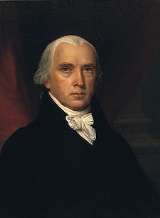
James Madison

 
James Madison

   Email Print
   Bookmark   Link


James Madison


James Madison (March 16, 1751–June 28, 1836) was an American politician
Politician

A politician is an individual who is involved in influencing public decision making through the influence of politics or a person who influences the way a society is governed....
 and political philosopher who served as the fourth
List of Presidents of the United States

File:WhiteHouseSouthFacade.JPGThe President of the United States is the head of state and the head of government of the United States. As chief of the executive branch and head of the Federal government of the United States as a whole, the presidency is the highest political office in the United States by influence and recognition....
 President of the United States
President of the United States

The President of the United States is the head of state and head of government of the United States and is the highest political official in the United States by influence and recognition....
 (1809–1817), and one of the Founding Fathers of the United States
Founding Fathers of the United States

The Founding Fathers of the United States were the political leaders who signed the United States Declaration of Independence or otherwise participated in the American Revolution as leaders of the Patriot s, or who participated in drafting the United States Constitution eleven years later....
. Considered to be the "Father of the Constitution", he was the principal author of the document. In 1788, he wrote over a third of the Federalist Papers
Federalist Papers

The Federalist Papers are a series of List of Federalist Papers advocating the History of the United States Constitution#Ratification of the United States United States Constitution....
, still the most influential commentary on the Constitution
United States Constitution

The Constitution of the United States of America is the supreme law of the United States. It is the foundation and source of the legal authority underlying the existence of the United States of America; the Federal Government of the United States; and all the State & local governments and Territorial Administrative bodies contained therein....
. The first President to have served in the United States Congress
United States Congress

The United States Congress is the Bicameralism legislature of the Federal government of the United States of the United States of America, consisting of two houses, the United States Senate and the United States House of Representatives....
, he was a leader in the 1st United States Congress
1st United States Congress

The 1st United States Congress, consisting of the United States Senate and the United States House of Representatives, met from March 4, 1789 to March 3, 1791, during the first two years of George Washington's President of the United States, first at Federal Hall at 26 Wall Street in New York City and later at Congress Hall in Philadelphia...
, drafted many basic laws and was responsible for the first ten amendments to the Constitution (said to be based on the Virginia Declaration of Rights
Virginia Declaration of Rights

The Virginia Declaration of Rights is a document drafted in 1776 to proclaim the inherent natural rights of men, including the right to rebel against "inadequate" government....
), and thus is also known as the "Father of the Bill of Rights
United States Bill of Rights

In the United States, the Bill of Rights is the name by which the first ten amendments to the United States Constitution are known. They were introduced by James Madison to the First United States Congress in 1789 as a series of constitutional amendments, and came into effect on December 15, 1791, when they had been United_States_Constitution...
".


Discussion
Ask a question about 'James Madison'
Start a new discussion about 'James Madison'
Answer questions from other users
Full Discussion Forum


Recent Posts


Quotations


I believe there are more instances of the abridgement of the freedom of the people by gradual and silent encroachments of those in power than by violent and sudden usurpations.

Speech in the Virginia Convention (1788-06-16)

Perhaps it is a universal truth that the loss of liberty at home is to be charged against provisions against danger, real or pretended from abroad.

Letter to Thomas Jefferson (1798-05-13); published in Letters and Other Writings of James Madison (1865), Vol. II, p. 141

It is moreover to weaken in those who profess this Religion a pious confidence in its innate excellence and the patronage of its Author; and to foster in those who still reject it, a suspicion that its friends are too conscious of its fallacies to trust it to its own merits.

To secure the public good and private rights against the danger of such a faction, and at the same time to preserve the spirit and the form of popular government, is then the great object to which our inquiries are directed.

Federalist No. 10


Encyclopedia


James Madison (March 16, 1751–June 28, 1836) was an American politician
Politician

A politician is an individual who is involved in influencing public decision making through the influence of politics or a person who influences the way a society is governed....
 and political philosopher who served as the fourth
List of Presidents of the United States

File:WhiteHouseSouthFacade.JPGThe President of the United States is the head of state and the head of government of the United States. As chief of the executive branch and head of the Federal government of the United States as a whole, the presidency is the highest political office in the United States by influence and recognition....
 President of the United States
President of the United States

The President of the United States is the head of state and head of government of the United States and is the highest political official in the United States by influence and recognition....
 (1809–1817), and one of the Founding Fathers of the United States
Founding Fathers of the United States

The Founding Fathers of the United States were the political leaders who signed the United States Declaration of Independence or otherwise participated in the American Revolution as leaders of the Patriot s, or who participated in drafting the United States Constitution eleven years later....
. Considered to be the "Father of the Constitution", he was the principal author of the document. In 1788, he wrote over a third of the Federalist Papers
Federalist Papers

The Federalist Papers are a series of List of Federalist Papers advocating the History of the United States Constitution#Ratification of the United States United States Constitution....
, still the most influential commentary on the Constitution
United States Constitution

The Constitution of the United States of America is the supreme law of the United States. It is the foundation and source of the legal authority underlying the existence of the United States of America; the Federal Government of the United States; and all the State & local governments and Territorial Administrative bodies contained therein....
. The first President to have served in the United States Congress
United States Congress

The United States Congress is the Bicameralism legislature of the Federal government of the United States of the United States of America, consisting of two houses, the United States Senate and the United States House of Representatives....
, he was a leader in the 1st United States Congress
1st United States Congress

The 1st United States Congress, consisting of the United States Senate and the United States House of Representatives, met from March 4, 1789 to March 3, 1791, during the first two years of George Washington's President of the United States, first at Federal Hall at 26 Wall Street in New York City and later at Congress Hall in Philadelphia...
, drafted many basic laws and was responsible for the first ten amendments to the Constitution (said to be based on the Virginia Declaration of Rights
Virginia Declaration of Rights

The Virginia Declaration of Rights is a document drafted in 1776 to proclaim the inherent natural rights of men, including the right to rebel against "inadequate" government....
), and thus is also known as the "Father of the Bill of Rights
United States Bill of Rights

In the United States, the Bill of Rights is the name by which the first ten amendments to the United States Constitution are known. They were introduced by James Madison to the First United States Congress in 1789 as a series of constitutional amendments, and came into effect on December 15, 1791, when they had been United_States_Constitution...
". As a political theorist, Madison's most distinctive belief was that the new republic needed checks and balances to protect individual rights from the tyranny of the majority.

As leader in the House of Representatives
United States House of Representatives

The United States House of Representatives, commonly referred to as "the House", is one of the bicameralism of the United States Congress; the other is the United States Senate....
, Madison worked closely with President George Washington
George Washington

George Washington was the leader of the Continental Army in the American Revolutionary War and served as the List of Presidents of the United States President of the United States of the United States of Americas ....
 to organize the new federal government. Breaking with Treasury Secretary Alexander Hamilton
Alexander Hamilton

Alexander Hamilton was the first Secretary of the Treasury, a Founding Fathers of the United States, economist, and political philosopher. He led calls for the Philadelphia Convention, was one of America's first Constitutional lawyers, and cowrote the Federalist Papers, a primary source for Constitutional interpretation....
 in 1791, Madison and Thomas Jefferson
Thomas Jefferson

Thomas Jefferson was the List of Presidents of the United States President of the United States , the principal author of the United States Declaration of Independence , and one of the most influential Founding Fathers of the United States for his promotion of the ideals of republicanism in the United States....
 organized what they called the Republican Party (later called the Democratic-Republican Party)* "The republican party, who wish to preserve the government in its present form, are fewer in number. They are fewer even when joined by the two, three, or half dozen anti-federalists,..."
* "The party called republican is steadily for the support of the present constitution" in opposition to key policies of the Federalists
Federalist Party (United States)

The Federalist Party was an American political party in the period 1792 to 1816, with remnants lasting into the 1820s. The Federalists controlled the federal government until 1801....
, especially the national bank and the Jay Treaty
Jay Treaty

The Jay Treaty, also known as Jay's Treaty and the Treaty of London of 1794, between the United States and Kingdom of Great Britain averted war, solved many issues left over from the American Revolution, and opened ten years of largely peaceful trade in the midst of the French Revolutionary Wars....
. He secretly co-authored, along with Thomas Jefferson, the Kentucky and Virginia Resolutions
Kentucky and Virginia Resolutions

The Kentucky and Virginia Resolutions were important political statements in favor of states' rights written secretly by Vice President Thomas Jefferson ,who would later become president, and James Madison in 1798, respectively....
 in 1798 to protest the Alien and Sedition Acts
Alien and Sedition Acts

The Alien and Sedition Acts were four bills passed in 1798. They were signed into law by President John Adams, and the Federalist Party in the United States Congress?who were waging an undeclared naval war with France, later known as the Quasi-War....
.

As Jefferson's Secretary of State (1801–1809), Madison supervised the Louisiana Purchase
Louisiana Purchase

The Louisiana Purchase was the acquisition by the United States of America of of the French territory Louisiana in 1803. The U.S. paid 60 million French franc plus cancellation of debts worth 18 million francs , a total cost of $15,000,000 for the Louisiana territory....
, doubling the nation's size, and sponsored the ill-fated Embargo Act of 1807
Embargo Act of 1807

BackgroundOn June 21, 1807, in an event known as the Chesapeake-Leopard Affair, the American frigate USS Chesapeake was fired upon and was boarded near Norfolk by the British warship HMS Leopard ....
. As president, he led the nation into the War of 1812
War of 1812

The War of 1812, between the United States of America and the British Empire , was fought from 1812 to 1815.There were several immediate stated causes for the U.S....
 against Great Britain
Great Britain

Great Britain is an island lying to the northwest of Continental Europe. It is the List of islands by area, and the largest in Europe. With a population of 58.9 million people it is List of islands by population....
 in order to protect the United States' economic rights. During and after the war, Madison reversed many of his positions. By 1815, he supported the creation of the second National Bank
Second Bank of the United States

The Second Bank of the United States was opened in January 1817, six years after the First Bank of the United States lost its charter. The Second Bank of the United States was headquartered in Carpenters' Hall, Philadelphia, the same as the First Bank, and had branches throughout the nation....
, a strong military, and a high tariff to protect the new factories opened during the war.

Early life

James Madison was the oldest of seven children to live to maturity. His father, James Madison, Sr.
James Madison, Sr.

James Madison, Sr. was the owner of a tobacco plantation in Orange County, Virginia. He was the son of Ambrose Madison and wife Frances Taylor, and the father of President James Madison....
 (1723–1801) was a planter who grew up on an estate in Orange County, Virginia, which he inherited on reaching maturity. He later acquired still more property and became the largest landowner and leading citizen of Orange County. His mother, Eleanor "Nelly" Rose Conway (1731–1829), was born at Port Conway, Virginia, the daughter of a prominent planter and tobacco merchant. Madison's parents married in 1743. Both parents had a significant influence over their most famous oldest son.

Madison had three brothers and three sisters to live to maturity (by whom he had more than 30 nieces and nephews):
  • Francis Madison (1753–1800) - planter of Orange County, Virginia
  • Ambrose Madison
    Ambrose Madison

    Ambrose Madison married Frances Taylor, and he was the father of James Madison, Sr. and the grandfather of U.S. President James Madison. His father was John Madison, and his mother was Isabella Minor Todd....
     (1755–1793) - planter and captain in the Virginia militia, looked after the family interests in Orange County; named after his paternal grandfather.
  • Catlett Madison (1758–1758) - died in infancy.
  • Nelly Madison Hite (1760–1802)
  • William Madison (1762–1843) - veteran of the Revolution and a lawyer, he served in the Virginia legislature
  • Sarah Catlett Madison Macon (1764–1843)
  • unnamed child (1766–1766)
  • Elizabeth Madison (1768–1775)
  • unnamed child (1770–1770)
  • Reuben Madison (1771–1775)
  • Frances "Fanny" Madison Rose (1774–1823


Education

From ages 11–16, Madison studied under Donald Robertson, an instructor at the Innes plantation in King and Queen County, Virginia. From Robertson, Madison learned math, geography, and modern and ancient languages. He became especially proficient in Latin.

At age 16, he began a two-year course of study under the Reverend Thomas Martin, who tutored Madison at Montpelier in preparation for college. Unlike most college-bound Virginians of his day, Madison did not choose William and Mary because the lowland climate of Williamsburg might have strained his delicate health. Instead, in 1769 he enrolled at the College of New Jersey (now Princeton University
Princeton University

Princeton University is a private university university located in Princeton, New Jersey, New Jersey, United States. The school is one of the eight universities of the Ivy League and has the largest per-student Financial endowment in the world....
).

Through diligence and long hours of study that at times robbed him of his sleep, he managed to graduate in two years. His studies there included Latin, Greek, science, geography, math, rhetoric, and philosophy. Great emphasis also was placed on speech and debate. After graduation, Madison remained at Princeton to study Hebrew and philosophy under university president John Witherspoon before returning to Montpelier in the spring of 1772. Madison studied law sporadically but never gained admission to the bar.

Marriage and family

James Madison married Dolley Madison
Dolley Madison

Dolley Payne Todd Madison was the spouse of the 4th President of the United States, James Madison, and was First Lady of the United States from 1809 to 1817....
, a widow with one son on September 15, 1794 in what is now Jefferson County, West Virginia. Dolley Payne Todd Madison was born on May 20, 1768 at the New Garden Quaker settlement in North Carolina, where her parents John Payne and Mary Coles Payne lived briefly. Dolley's sister (Lucy Payne) had married George Steptoe Washington, a nephew of President Washington.

As a member of Congress, Madison had doubtless met the widow Todd at social functions in Philadelphia, then the nation's capital. But in May 1797, he took formal notice of her by asking their mutual friend Aaron Burr
Aaron Burr

Aaron Burr, Jr. was an United States politician, American Revolutionary War hero, and adventurer. He served as the List of Vice Presidents of the United States Vice President of the United States , under Thomas Jefferson....
 to arrange a meeting. The encounter apparently went smoothly for a brisk courtship followed, and by August she had accepted his proposal of marriage. For marrying Madison, a non-Quaker, she was expelled from the Society of Friends.

The Madisons had no children; thus he has no direct descendants.

Early political career

As a young lawyer, Madison defended Baptist
Baptist

A Baptist is a member of a Christian denomination characterized by the rejection of infant baptism in favor of believer's baptism by Baptism#Immersion....
 preachers arrested for preaching without a license from the established Anglican Church. In addition, he worked with the preacher Elijah Craig
Elijah Craig

Rev. Elijah Craig was a pioneering Baptist Religious minister, educator and Christian capitalist entrepreneur in the state of Kentucky. He has been credited with the invention of bourbon whiskey, although this claim was later disputed by some historians....
 on constitutional guarantees for religious liberty in Virginia. Working on such cases helped form his ideas about religious freedom. Madison served in the Virginia state legislature (1776–79) and became known as a protégé of Thomas Jefferson. He attained prominence in Virginia politics, helping to draft the Virginia Statute for Religious Freedom
Virginia Statute for Religious Freedom

The Virginia Statute for Religious Freedom was written in 1779 by Thomas Jefferson. In 1786, the Virginia General Assembly enacted the statute into the state's law....
. It disestablished the Church of England
Church of England

The Church of England is the State religion Christianity Ecclesia in England, the Mother Church of the worldwide Anglican Communion and the oldest among the communion's thirty-eight independent national and regional churches....
, and disclaimed any power of state compulsion in religious matters. He excluded Patrick Henry
Patrick Henry

Patrick Henry was a prominent figure in the American Revolution, known and remembered for his "Give me Liberty, or give me Death!" speech. Along with Samuel Adams and Thomas Paine, he is remembered as one of the most influential advocates of the American Revolution and Republicanism in the United States, especially in his denunciations of c...
's plan to compel citizens to pay for a congregation of their own choice.

Madison's cousin, the Right Reverend James Madison
James Madison (Episcopal Bishop)

James Madison was the first bishop of the Episcopal Diocese of Virginia of Episcopal Church in the United States, one of the first bishops to be consecrated to the new church after the American Revolution....
 (1749–1812), became president of the College of William & Mary in 1777. Working closely with Madison and Jefferson, Reverend Madison helped lead the College through the difficult changes involving separation from both Great Britain and the Church of England. He also led college and state actions that resulted in the formation of the Episcopal Diocese of Virginia
Episcopal Diocese of Virginia

The Diocese of Virginia is a diocese of the Episcopal Church in the United States of America encompassing 38 counties in the northern and central parts of the state of Virginia....
 after the Revolution.

James Madison persuaded Virginia to give up its claims to northwestern territories - consisting of most of modern-day Ohio
Ohio

Ohio is a Midwestern United States U.S. state of the United States. As part of the Great Lakes region , Ohio has long been a cultural and geographical crossroads in North America....
, Indiana
Indiana

The State of Indiana was the 19th U.S. state admitted into the union. It is located in the Midwestern United States of the United States of America....
, Illinois
Illinois

The State of Illinois is a U.S. state of the United States, the 21st to be admitted to the United States. Illinois is the most populous and demographically diverse Midwestern United States state and the fifth most populous state in the nation....
, Michigan
Michigan

Michigan is a Midwestern United States U.S. state of the United States of America. It was named after Lake Michigan, whose name is a French adaptation of the Anishinaabe language term mishigama, meaning "large water" or "large lake"....
, and Wisconsin
Wisconsin

Wisconsin is one of the fifty U.S. state in the United States of America, located in the north central part of the United States. It borders two of the five Great Lakes and four U.S....
, and part of Minnesota
Minnesota

Minnesota is a U.S. state in the Midwestern United States of the United States. The twelfth largest state by area in the U.S., it is the twenty-first most populous, with just over five million residents....
 - to the Continental Congress
Continental Congress

The Continental Congress was a convention of delegates from the Thirteen Colonies that became the governing body of the United States during the American Revolution....
, which created the Northwest Territory
Northwest Territory

The Northwest Territory, formally known as the Territory Northwest of the River Ohio, was a governmental region within the early United States....
 in 1783. These land claims overlapped partially with other claims by Connecticut
Connecticut

Connecticut is a U.S. state located in the New England region of the northeastern United States. The state borders New York to the west and south , Massachusetts to the north, and Rhode Island to the east....
, Pennsylvania
Pennsylvania

The Commonwealth of Pennsylvania , often colloquially referred to as PA by natives and Northeasterners, is a U.S. state located in the Northeastern United States and Mid-Atlantic States regions of the United States....
, Maryland
Maryland

Maryland is a U.S. state located in the Mid Atlantic States of the United States, bordering Virginia, West Virginia and the Washington, D.C. to the south and west, Pennsylvania to the north, and Delaware to the east....
, and maybe others. All of these states ceded their westernmost lands, with the understanding that new states could be formed from the land, as they were. As a delegate to the Continental Congress (1780–83), Madison was considered a legislative workhorse and a master of parliamentary detail. He was elected to the Virginia House of Delegates
Virginia House of Delegates

The Virginia House of Delegates is the lower house of the Virginia General Assembly. It has 100 members elected for terms of two years; unlike most states, these elections take place during odd-numbered years....
 for a second time from 1784-1786.

Father of the Constitution

Madison returned to the Virginia state legislature at the close of the war. He soon grew alarmed at the fragility of the Articles of Confederation
Articles of Confederation

The Articles of Confederation and Perpetual Union was the constitution of the revolutionary wartime alliance of the thirteen United States. The Articles' ratification was completed in 1781, and legally federated several sovereign and independent states, allied under the Articles of Association into a new federation styled the "United States...
, especially in relation to the divisiveness of state governments, and strongly advocated a new constitution. At the Philadelphia Convention
Philadelphia Convention

The Philadelphia Convention took place from May 25 to September 17, 1787, in Philadelphia, Pennsylvania, to address problems in governing the United States of America, which had been operating under the Articles of Confederation following independence from Kingdom of Great Britain....
 in 1787, Madison's draft of the Virginia Plan
Virginia Plan

The Virginia Plan was a proposal by Virginia delegates, drafted by James Madison while he waited for a quorum to assemble at the Philadelphia Convention of 1787....
 and his revolutionary three-branch federal system became the basis for the American Constitution of today. Though Madison was a shy man, he was one of the more outspoken members of the Continental Congress. He envisioned a strong federal government that could overrule actions of the states when they were deemed mistaken; later in life he came to admire the US Supreme Court as it started filling that role.

The Federalist Papers

To encourage ratification of the Constitution, Madison joined Alexander Hamilton and John Jay
John Jay

John Jay was an United States politician, statesman, Patriot , diplomat, a Founding Fathers of the United States, President of the Continental Congress from 1778 to 1779 and, from 1789 to 1795, the first Chief Justice of the United States....
 to write the Federalist Papers
Federalist Papers

The Federalist Papers are a series of List of Federalist Papers advocating the History of the United States Constitution#Ratification of the United States United States Constitution....
 in 1787 and 1788. Among other contributions, Madison wrote paper #10, in which he explained how a large country with many different interests and factions could support republican values better than a small country dominated by a few special interests. His interpretation was largely ignored at the time, but in the 20th century became a central part of the pluralist
Pluralism (political theory)

The political theory of pluralism holds that political power in society does not lie with the electorate, nor with a small concentrated elite, but is distributed between a wide number of groups....
 interpretation of American politics.

In Virginia in 1788, Madison led the fight for ratification at the Virginia Ratifying Convention
Virginia Ratifying Convention

The Virginia Ratifying Convention was a Convention of 168 delegates from Virginia who met in 1788 to ratify or reject the United States Constitution, which had been drafted at the Philadelphia Convention the previous year....
, oratorically dueling with Patrick Henry
Patrick Henry

Patrick Henry was a prominent figure in the American Revolution, known and remembered for his "Give me Liberty, or give me Death!" speech. Along with Samuel Adams and Thomas Paine, he is remembered as one of the most influential advocates of the American Revolution and Republicanism in the United States, especially in his denunciations of c...
 and others who sought revisions (such as the United States Bill of Rights
United States Bill of Rights

In the United States, the Bill of Rights is the name by which the first ten amendments to the United States Constitution are known. They were introduced by James Madison to the First United States Congress in 1789 as a series of constitutional amendments, and came into effect on December 15, 1791, when they had been United_States_Constitution...
) before its ratification. Madison is often referred to as the "Father of the Constitution" for his role in its drafting and ratification. However, he protested the title as being "a credit to which I have no claim... The Constitution
Constitution

A constitution is a system for government — often codified as a written document — that establishes the rules and principles of an autonomous political entity....
 was not, like the fabled Goddess of Wisdom, the offspring of a single brain. It ought to be regarded as the work of many heads and many hands".

He wrote Hamilton at the New York ratifying convention, stating his opinion that "ratification was in toto and 'for ever'". The Virginia convention had considered conditional ratification worse than a rejection.

Author of Bill of Rights

Initially Madison "adamantly maintained ... that a specific bill of rights remained unnecessary because the Constitution itself was a bill of rights." Madison had three main objections to a specific bill of rights:
  1. it was unnecessary, since it purported to protect against powers that the federal government had not been granted;
  2. it was dangerous, since enumeration of some rights might be taken to imply the absence of other rights; and
  3. at the state level, bills of rights had proven to be useless paper barriers against government powers.
But the anti-Federalists demanded a bill of rights in exchange for their support for ratification.

Patrick Henry
Patrick Henry

Patrick Henry was a prominent figure in the American Revolution, known and remembered for his "Give me Liberty, or give me Death!" speech. Along with Samuel Adams and Thomas Paine, he is remembered as one of the most influential advocates of the American Revolution and Republicanism in the United States, especially in his denunciations of c...
 persuaded the Virginia legislature not to elect Madison as one of their first Senators; but Madison was directly elected to the new United States House of Representatives
United States House of Representatives

The United States House of Representatives, commonly referred to as "the House", is one of the bicameralism of the United States Congress; the other is the United States Senate....
 and became an important leader from the First Congress
1st United States Congress

The 1st United States Congress, consisting of the United States Senate and the United States House of Representatives, met from March 4, 1789 to March 3, 1791, during the first two years of George Washington's President of the United States, first at Federal Hall at 26 Wall Street in New York City and later at Congress Hall in Philadelphia...
 (1789) through the Fourth Congress
4th United States Congress

The Fourth United States Congress was a meeting of the legislative branch of the United States federal government, consisting of the United States Senate and the United States House of Representatives....
 (1797).

People submitted more than 200 proposals from across the new nation. Madison ignored proposals that called for structural change to the government and synthesized the remainder into a list for the protection of civil rights, such as free speech, right of the people to bear arms, and habeas corpus
Habeas corpus

For the Living Things CD, see Habeas Corpus Habeas corpus is a legal action, or writ, through which a person can seek justice from the unlawful detention of him or herself, or of another person....
. Still ambiguous as late as 1788 in his support for a bill of rights, in June 1789 Madison offered a package of twelve proposed amendments to the Constitution. Madison completed his change in position and "hounded his colleagues relentlessly" to accept the proposed amendments.

By 1791, the last ten of Madison's proposed amendments were ratified and became the Bill of Rights. Contrary to his wishes, the Bill of Rights was not integrated into the main body of the Constitution, and it did not apply to the states until the passages of Fourteenth
Fourteenth Amendment to the United States Constitution

The Fourteenth Amendment to the United States Constitution is one of the post-American Civil War Reconstruction Amendments that was first intended to secure the rights of former Slavery in the United States....
 and Fifteenth Amendments
Fifteenth Amendment to the United States Constitution

The Fifteenth Amendment to the United States Constitution prohibits each government in the United States from denying a citizen the right to vote based on that citizen's "race, colored or previous condition of servitude" ....
 restricted the powers of the states. The Second Amendment originally proposed by Madison (but not then ratified: see United States Bill of Rights
United States Bill of Rights

In the United States, the Bill of Rights is the name by which the first ten amendments to the United States Constitution are known. They were introduced by James Madison to the First United States Congress in 1789 as a series of constitutional amendments, and came into effect on December 15, 1791, when they had been United_States_Constitution...
) was later ratified in 1992 as the Twenty-seventh Amendment to the United States Constitution
Twenty-seventh Amendment to the United States Constitution

The Twenty-seventh Amendment is the most recent Article Five of the United States Constitution to the United States Constitution, having been ratified in 1992, more than 202 years after its initial submission in 1789....
. The remaining proposal
Article The First

Article the First is the first List of amendments to the United States Constitution#Unratified proposed amendments to the United States Constitution though it has not yet been ratified....
 was intended to accommodate future increase in members of the House of Representatives.

Opposition to Hamilton

The chief characteristic of Madison's time in Congress was his work to limit the power of the federal government
Federal government of the United States

The Federal Government of the United States is the central current reigning United States governmental body, established by the United States Constitution....
. Wood (2006a) argued that Madison never wanted a national government that took an active role. He was horrified to discover that Hamilton and Washington were creating "a real modern European type of government with a bureaucracy, a standing army, and a powerful independent executive".

When Britain and France went to war in 1793 the U.S. was caught in the middle. The 1778 treaty of alliance with France was still in effect, yet most of the new country's trade was with Britain. War with Britain seemed imminent in 1794, as the British seized hundreds of American ships that were trading with French colonies. Madison (in collaboration with Jefferson, who had temporarily returned to private life), believed that Britain was weak and America strong, and that a trade war with Britain, although risking retaliation by the British government, probably would succeed, and would allow Americans to assert their independence fully. Great Britain, he charged, "has bound us in commercial manacles, and very nearly defeated the object of our independence." As Varg explains, Madison had no fear of British recriminations for "her interests can be wounded almost mortally, while ours are invulnerable." The British West Indies, he maintained, could not live without American foodstuffs, but Americans could easily do without British manufactures. This same faith led him to the conclusion "that it is in our power, in a very short time, to supply all the tonnage necessary for our own commerce". However, George Washington avoided a trade war and instead secured friendly trade relations with Britain through the Jay Treaty of 1794, a treaty that Madison tried but failed to defeat. All across the country, voters divided for and against the Treaty and other key issues, and thus became either Federalists
Federalist Party (United States)

The Federalist Party was an American political party in the period 1792 to 1816, with remnants lasting into the 1820s. The Federalists controlled the federal government until 1801....
 or Democratic-Republicans.

Treasury Secretary Alexander Hamilton built a nationwide network of supporters that became the Federalist Party and promoted a strong central government with a national bank. To oppose the Federalists, Madison and Jefferson organized the Democratic-Republican Party. Madison led the unsuccessful attempt to block Hamilton's proposed Bank of the United States
First Bank of the United States

The First Bank of the United States was a bank chartered by the United States Congress on February 25, 1791. The charter was for 20 years. The Bank was created to handle the financial needs and requirements of the central government of the newly formed United States, which had previously been thirteen individual colonies with their own ban...
, arguing the new Constitution did not explicitly allow the federal government to form a bank.

Many historians argue that Madison changed radically from a nationally-oriented ally of Hamilton in 1787–88 to a states'-rights–oriented opponent of a strong national government by 1795 and then back to his original view while president. Madison started the first transition by opposing Hamilton; by 1793 he was opposing Washington as well. Madison usually lost and Hamilton usually achieved passage of his legislation, including the National Bank, funding of state and national debts, and support of the Jay Treaty. (Madison did block the proposal for high tariffs.)

Madison's politics remained closely aligned with Jefferson's until the experience of a weak national government during the War of 1812 caused Madison to appreciate the need for a strong central government to aid national defense. He then began to support a national bank, a stronger navy, and a standing army. However, other historians, led by Lance Banning and Gordon S. Wood
Gordon S. Wood

Gordon S. Wood is Alva O. Way University Professor and Professor of History at Brown University and the recipient of the 1993 Pulitzer Prize for History for The Radicalism of the American Revolution....
, see more continuity in Madison's views and do not see a sharp break in 1792.

United States Secretary of State 1801–1809

Jamesmadison
The main challenge which faced the Jefferson Administration was navigating between the two great empires of Britain and France, which were almost constantly at war. The first great triumph was the Louisiana Purchase in 1803, made possible when Napoleon
Napoleon I of France

Napoleon Bonaparte later known as Emperor Napoleon I, was a military and political leader of France whose actions shaped European politics in the early 19th century....
 realized he could not defend that vast territory, and it was to France's advantage that Britain not seize it. Madison and President Jefferson reversed party policy to negotiate for the Purchase and then win Congressional approval. Madison tried to maintain neutrality between Britain and France, but at the same time insisted on the legal rights of the U.S. under international law. Neither London nor Paris showed much respect, however. Madison and Jefferson decided on an embargo to punish Britain and France, forbidding Americans to trade with any foreign nation. The embargo failed as foreign policy, and instead caused massive hardships in the southern seaboard, which depended on foreign trade.

During his term as Secretary of State he was a party to the Supreme Court case Marbury v. Madison
Marbury v. Madison

Marbury v. Madison, is a landmark case in United States law. It formed thebasis for the exercise of judicial review in the United States under Article Three of the United States Constitution of the United States Constitution....
, in which the doctrine of judicial review
Judicial review

Judicial review is the power of the courts to annul the acts of the executive and/or the legislative power where it finds them incompatible with a higher norm....
 was asserted by the high Court.

The party's Congressional Caucus
Caucus

A caucus is a meeting of supporters or members of a political party or movement, especially in the United States. The exact definition varies among political cultures....
 chose presidential candidates, and Madison was selected in the election of 1808
United States presidential election, 1808

In the United States presidential election of 1808, the Democratic-Republican Party candidate James Madison defeated United States Federalist Party candidate Charles Cotesworth Pinckney....
, easily defeating Charles Cotesworth Pinckney
Charles Cotesworth Pinckney

Charles Cotesworth Pinckney , was an early American statesman of South Carolina, Revolutionary War veteran, and delegate to the Constitutional Convention....
, riding on the coattails of Jefferson's popularity. Congress repealed the failed embargo as Madison took office.

Presidency 1809–1817


The Bank of the United States

The twenty year charter of the first Bank of the United States
First Bank of the United States

The First Bank of the United States was a bank chartered by the United States Congress on February 25, 1791. The charter was for 20 years. The Bank was created to handle the financial needs and requirements of the central government of the newly formed United States, which had previously been thirteen individual colonies with their own ban...
 was scheduled to expire in 1811, the second year of Madison's administration. Madison failed in blocking the Bank in 1791, and waited for its charter to expire. Secretary of the Treasury Gallatin wanted the bank rechartered, and when the War of 1812 broke out, he discovered how difficult it was to finance the war without the Bank. Gallatin's successor as Treasury Secretary Alexander J. Dallas
Alexander J. Dallas (statesman)

Alexander James Dallas was an United States statesman who served as the United States Secretary of the Treasury under President of the United States James Madison....
 proposed a replacement in 1814, but Madison vetoed the bill in 1815. By late 1815, however, Madison asked Congress for a new bank, which had strong support from the younger, nationalistic republicans such as John C. Calhoun
John C. Calhoun

John Caldwell Calhoun was the List of Vice Presidents of the United States Vice President of the United States. He was a leading United States Southern politician from South Carolina during the first half of the 19th century....
 and Henry Clay
Henry Clay

Henry Clay, Sr. was a nineteenth-century United States statesman and orator who represented Kentucky in both the United States House of Representatives and United States Senate....
, as well as Federalist Daniel Webster
Daniel Webster

Daniel Webster was a leading American statesman during the nation's antebellum. He first rose to regional prominence through his defense of New England shipping interests....
. Madison signed it into law in 1816 and appointed William Jones
William Jones (statesman)

William Jones was an United States politician.Jones was born in Philadelphia in 1760. Apprenticed in a shipyard, during the American War of Independence he saw combat in the battles of Trenton and Princeton and later served at sea....
 as its president.

War of 1812

British insults continued, especially the practice of using the Royal Navy to intercept unarmed American merchant ships and "impress
Impressment

Impressment is the act of compelling people to serve in the military, usually by force and without notice. Unlike "shanghaiing", impressment is carried out by law, or under color #Color of law, and forces the impressed person into military rather than commercial sea service....
" (conscript) all sailors who might be British subjects for service in the British navy. Madison's protests were ignored by the British, so he helped the nationalist Republicans to stir up public opinion in the west and south for war. One argument by the so-called "war hawks" was that an American invasion of British Canada
Canada

Canada is a country occupying most of northern North America, extending from the Atlantic Ocean in the east to the Pacific Ocean in the west and northward into the Arctic Ocean....
 would be easy and would provide a good bargaining chip. Madison carefully prepared public opinion for what everyone at the time called "Mr. Madison's War", but much less time and money was spent building up the army, navy, forts, and state militias. After he convinced Congress to declare war, Madison was re-elected President over DeWitt Clinton
DeWitt Clinton

DeWitt Clinton was an early American politician who served as United States Senator and Governor of New York. In this last capacity he was largely responsible for the construction of the Erie Canal....
 but by a smaller margin than in 1808 (see U.S. presidential election, 1812). Some historians in 2006 ranked Madison's failure to avoid war as the sixth worst presidential mistake ever made.

In the ensuing War of 1812, the British, Canadians, and First Nations
First Nations

First Nations is a term of ethnicity that refers to the Aboriginal peoples in Canada who are neither Inuit nor M?tis people....
 allies won numerous victories, including the capture of Detroit after the American general there surrendered to a smaller force without a fight, and the occupation of Washington, D.C.
Burning of Washington

The Burning of Washington took place in August 1814, during the continental North-American War of 1812 between the British Empire and the United States of America....
 which forced Madison to flee the city and watch as the White House
White House

The White House is the official residence and principal workplace of the President of the United States. Located at 1600 Pennsylvania Avenue in Washington, D.C., it was built between 1792 and 1800 of white-painted Aquia sandstone in the late Georgian architecture and has been the executive residence of every U.S....
 was set on fire by British troops. The attack was in retaliation for a U.S. invasion of York, Upper Canada
York, Upper Canada

York was the name of Toronto, Ontario, between 1793 and 1834 and second capital of Upper Canada....
 (now Toronto, Ontario), in which U.S. forces twice occupied the city, burning the Parliament Buildings of Upper Canada. The British also armed American Indians in the West, most notably followers of Tecumseh
Tecumseh

Tecumseh , also Tecumtha or Tekamthi, was a famous Native Americans in the United States leader of the Shawnee. He spent much of his life attempting to rally various native American tribes in a mutual defense of their lands, which eventually led to his death in the War of 1812....
 who met defeat at the Battle of the Thames
Battle of the Thames

The Battle of the Thames, also known as the Battle of Moraviantown, was a decisive United States victory in the War of 1812. It took place on October 5, 1813, near present-day Chatham, Ontario in Upper Canada....
. The Americans built warships on the Great Lakes
Great Lakes

The St. Lawrence River Great Lakes are a chain of fresh water lakes located in eastern North America, on the Canada ? United States border. Consisting of Lakes Lake Superior, Lake Michigan, Lake Huron, Lake Erie, and Lake Ontario, they form the largest group of freshwater lakes on Earth....
 faster than the British and Oliver Hazard Perry
Oliver Hazard Perry

Commodore Oliver Hazard Perry was an officer in the United States Navy. He served in the War of 1812 against United Kingdom and earned the sobriquet "Hero of Lake Erie" for leading American forces in a decisive naval victory at the Battle of Lake Erie....
 defeated the British fleet to avert a major invasion of New York in 1814. At sea, the British blockaded the entire coastline, cutting off both foreign trade and domestic trade between ports. Economic hardship was severe in New England, but entrepreneurs built factories that soon became the basis of the industrial revolution in America.

Madison faced formidable obstacles—a divided cabinet, a factious party, a recalcitrant Congress, obstructionist governors, and incompetent generals, together with militia who refused to fight outside their states. Most serious was lack of unified popular support. There were serious threats of disunion from New England, which engaged in massive smuggling to Canada and refused to provide financial support or soldiers. However Andrew Jackson
Andrew Jackson

Andrew Jackson was the List of Presidents of the United States President of the United States . He was List of governors of Florida of Florida , commander of the American forces at the Battle of New Orleans , and eponym of the era of Jacksonian democracy....
 in the South and William Henry Harrison
William Henry Harrison

William Henry Harrison was an Military history of the United States and Politics of the United States, the List of Presidents of the United States President of the United States, and the first president to die in office....
 in the West destroyed the main Indian threats by 1813.

War-weariness led to the end of conflict after the apparent defeat of Napoleon in 1814. Both the British and American will to continue were exhausted, the causes of the absurd war were forgotten, the Indian issue was resolved for the time being, and it was time for peace. New England Federalists, however, set up a defeatist Hartford Convention
Hartford Convention

The Hartford Convention was an event in 1814–1815 in the United States during the War of 1812 in which New England's opposition to the war reached the point where secession from the United States was discussed....
 that discussed secession. The Treaty of Ghent
Treaty of Ghent

The Treaty of Ghent , signed on December 24, 1814, in Ghent, currently in Belgium, was the peace treaty that ended the War of 1812 between the United States of America and the United Kingdom of Great Britain and Ireland....
 ended the war in 1815. There were no territorial gains on either side as both sides returned to status quo ante bellum
Status quo ante bellum

The term status quo ante bellum comes from Latin meaning literally, the state in which things were before the war.The term was originally used in treaty to refer to the withdrawal of enemy troops and the restoration of prewar leadership....
, that is, the previous boundaries. The Battle of New Orleans
Battle of New Orleans

The Battle of New Orleans took place on January 8, 1815, and was the final major battle of the War of 1812. United States forces, with General Andrew Jackson in command, defeated an invading British Army intent on seizing New Orleans and America's vast western lands....
, in which Andrew Jackson defeated the British regulars, was fought fifteen days after the treaty was signed but before the news of the signing reached New Orleans.

With peace finally established, the U.S. was swept by a sense of euphoria and national achievement in finally securing solid independence from Britain. In Canada, the war and its conclusion represented a successful defense of the country, and a defining era in the formation of an independent national identity. This, coupled with ongoing suspicion of a U.S. desire to again invade the country, would culminate in creation of the Dominion of Canada in 1867. In the U.S., the Federalist Party collapsed and eventually disappeared from politics, as an Era of Good Feeling emerged with a much lower level of political fear and vituperation, although political contention certainly continued.

Postwar

Although Madison had accepted the necessity of a Hamiltonian national bank, an effective taxation system based on tariffs, a standing professional army and a strong navy, he drew the line at internal improvements as advocated by his Treasury Secretary Albert Gallatin
Albert Gallatin

Abraham Alfonse Albert Gallatin was a Swiss-American ethnologist, linguistics, Politics of the United States, diplomat, United States Representative, and the longest-serving United States Secretary of the Treasury....
. In his last act before leaving office, Madison vetoed on states' rights grounds a bill for "internal improvements", including roads, bridges, and canals:

Madison rejected the view of Congress that the General Welfare provision of the Taxing and Spending Clause
Taxing and Spending Clause

Article One of the United States Constitution, Article One of the United States Constitution#Section 8: Powers of Congress, Clause 1 of the United States Constitution, is known as the Taxing and Spending Clause....
 justified the bill, stating:

Madison urged a variety of measures that he felt were "best executed under the national authority", including federal support for roads and canals that would "bind more closely together the various parts of our extended confederacy".

Administration and cabinet


  • Madison is the only president to have had two vice-presidents die while in office.


Judicial appointments


Supreme Court
Madison appointed the following Justices to the Supreme Court of the United States
Supreme Court of the United States

The Supreme Court of the United States is the highest judicial body in the United States, and leads the federal United States federal courts. It consists of the Chief Justice of the United States and eight Associate Justice of the Supreme Court of the United States, who are nominated by the President of the United States and confirmed with th...
:
  • Gabriel Duvall
    Gabriel Duvall

    Gabriel Duvall was a United States of America jurist. He was a United States House of Representatives from the United States House of Representatives, Maryland District 2 of Maryland from November 11, 1794, to March 28, 1796, Chief Justice of the General Court of Maryland from 1796 to 1802, and First Comptroller of the U.S....
     1811
  • Joseph Story
    Joseph Story

    'Joseph Story' was an United States lawyer and jurist who served on the Supreme Court of the United States from 1811 to 1845. He is most remembered today for his opinions in Martin v....
     1812


Other courts
Madison appointed eleven other federal judges, two to the United States Circuit Court of the District of Columbia
United States Circuit Court of the District of Columbia

The United States Circuit Court of the District of Columbia is a former United States federal court, which existed from 1801 to 1863....
, and nine to the various United States district court
United States district court

The United States district courts are the general trial courts of the United States federal court system. Both Civil law and Criminal law cases are filed in the district court, which is a court of law, Equity , and admiralty....
s. One of those judges was appointed twice, to different seats on the same court.

States admitted to the Union

  • Louisiana
    Louisiana

    The State of Louisiana is a U.S. state located in the U.S. Southern States of the United States of America. Its capital is Baton Rouge and largest city is New Orleans....
     April 30, 1812
  • Indiana
    Indiana

    The State of Indiana was the 19th U.S. state admitted into the union. It is located in the Midwestern United States of the United States of America....
     December 11, 1816


Later life

When Madison left office in 1817, he retired to Montpelier
Montpelier (James Madison)

Montpelier was the estate of James Madison, fourth President of the United States. It is four miles south of Orange, Virginia, and covers some ....
, his tobacco plantation in Virginia; not far from Jefferson's Monticello
Monticello

Monticello , located near Charlottesville, Virginia, Virginia, was the estate of Thomas Jefferson, the principal author of the United States Declaration of Independence, the third President of the United States, and founder of the University of Virginia....
. Madison was then 65 years old. Dolley, who thought they would finally have a chance to travel to Paris, was 49. But as with both Washington and Jefferson, Madison left the presidency a poorer man than when he entered, due to the steady financial collapse of his plantation. Some historians speculate that his mounting debt was one of the chief reasons why he refused to allow his notes on the Constitution Convention, or its official records which he possessed, to be published in his lifetime "He knew the value of his notes, and wanted them to bring money to his estate for Dolley's use as his plantation failed—he was hoping for one hundred thousand dollars from the sale of his papers, of which the notes were the gem." Madison's financial troubles and deteriorating mental and physical health would continue to consume him.

In his later years Madison also became extremely concerned about his legacy. He took to modifying letters and other documents in his possessions: changing days and dates, adding and deleting words and sentences, and shifting characters. By the time he had reached his late seventies, this "straightening out" had become almost an obsession. This can be seen by his editing of a letter he had written to Jefferson criticizing Lafayette: Madison not only inked out original passages, but went so far as to imitate Jefferson's handwriting as well. In Madison's mind, this may have represented an effort to make himself clear, to justify his actions both to history and to himself.

In 1829, at the age of seventy-eight, Madison was chosen as a representative to the constitutional convention in Richmond for the revising of the Virginia state constitution; this was to be Madison's last appearance as a legislator and constitutional draftsman. The issue of greatest importance at this convention was apportionment
Apportionment

The legal term apportionment means distribution or allotment in proper shares.It is a term used in law in a variety of senses. Sometimes it is employed roughly and has no technical meaning; this indicates the distribution of a benefit , or liability , or the incidence of a duty ....
. The western districts of Virginia complained that they were under-represented because the state constitution apportioned voting districts by population, and the count included slaves even though slaves could not vote. Westerners had few slaves, while the Eastern planters had many, and thus the vote of a white easterner outweighed the vote of a white westerner. Madison, who in his prime was known as "the Great Legislator", tried to effect a compromise, such as the 3/5 ratio for a slave then used by the U.S. Constitution, but to no avail. Eventually, the eastern planters prevailed. Slaves would continue to be counted toward their masters' districts. Madison was crushed at the failure of Virginians to resolve the issue more equably. "The Convention of 1829, we might say, pushed Madison steadily to the brink of self-delusion, if not despair. The dilemma of slavery undid him."

Although his health had now almost failed, he managed to produce several memoranda on political subjects, including an essay against the appointment of chaplain
Chaplain

A chaplain is typically a priest, pastor, ordained deacon, rabbi, imam or other member of the clergy serving a group of people who are not organized as a mission or church , or who are unable to attend church for various reasons; such as health, confinement, or military or civil duties; Laity chaplains are also found in other settings such...
s for Congress and the armed forces, on the grounds that this produced religious exclusion, but not political harmony.

Madison lived on until 1836, increasingly ignored by the new leaders of the American polity. He died at Montpelier on June 28, the last Founding Father to die. He is buried in the Madison Family Cemetery at Montpelier.

Legacy

As historian Garry Wills wrote:
  • Many counties, several towns, cities, educational institutions, a mountain range and a river are named after Madison
    Madison

    Madison may refer to:*Madison , a given name and a surname...
    .
    • Madison County
      Madison County

      Madison County may refer to:* Madison County, Alabama* Madison County, Arkansas* Madison County, Florida* Madison County, Georgia* Madison County, Idaho...
       - lists counties named for him
    • Cities: e.g. Madison, Wisconsin
      Madison, Wisconsin

      Madison is the List of U.S. state capitals of the U.S. state of Wisconsin and the county seat of Dane County, Wisconsin. It is also home to the University of Wisconsin–Madison....
    • The James Madison College
      James Madison College

      This article is about the public-policy college at Michigan State University. For the similarly-named institution in Virginia, see James Madison University....
       of public policy at Michigan State University
      Michigan State University

      Michigan State University is a public university research university in East Lansing, Michigan, Michigan United States. Founded in 1855, it was the pioneer land-grant institution and served as a model for future land-grant colleges in the United States under the 1862 Morrill Land-Grant Colleges Act....
      ; James Madison University
      James Madison University

      James Madison University is a public university coeducational research university located in Harrisonburg, Virginia, Virginia, United States Founded in 1908 as the State Normal and Industrial School for Women at Harrisonburg, the university has undergone four name changes until settling with James Madison University....
       in Harrisonburg, Virginia
      Harrisonburg, Virginia

      Harrisonburg is an independent city in the Shenandoah Valley region of Virginia in the United States. Its population was 40,468 at the United States Census 2000 and 44,039 according to 2007 estimates....
       - its athletic teams are called the James Madison Dukes
      James Madison Dukes

      The James Madison University Dukes are the athletics teams of James Madison University. The name "Dukes" is derived from Samuel Page Duke, the university's second president....
      ; the James Madison Institute
      James Madison Institute

      The James Madison Institute is a free-market think tank headquartered in Tallahassee, Florida in the United States. It is a member of the State Policy Network....
       was named in honor of his contributions to the Constitution.
    • The Madison Range
      Madison Range

      The Madison Range is a mountain range located in the Rocky Mountains of Montana and Idaho, U.S. The range was named in honor of future President of the United States, then U.S....
       was named in honor of the future President then U.S. Secretary of State by Meriwether Lewis
      Meriwether Lewis

      Meriwether Lewis was an United States explorer, soldier, and public administrator, best known for his role as the leader of the Lewis and Clark Expedition also known as the Corps of Discovery, with William Clark , whose mission was to explore the territory of the Louisiana Purchase....
       as the Lewis and Clark Expedition
      Lewis and Clark Expedition

      The Lewis and Clark Expedition , headed by Meriwether Lewis and William Clark , was the first United States overland expedition to the Pacific coast and back....
       traveled through Montana in 1805. The Madison River
      Madison River

      The Madison River is a headwater tributary of the Missouri River, approximately 183 miles long, in Wyoming and Montana. Its confluence with the Jefferson River and Gallatin River rivers near Three Forks, Montana form the Missouri River....
       in southwestern Montana, named in 1805 by Lewis & Clark.
    • Two U.S. Navy ships have been named USS James Madison
      USS James Madison

      Two ships of the United States Navy have been named USS James Madison, after James Madison the fourth President of the United States:*USRC James Madison , was a revenue cutter launched in 1807 and captured by the Royal Navy 24 November 1812...
       and three USS Madison
      USS Madison

      USS Madison may refer to:*, was a 14 gun schooner launched in 1812 on Lake Ontario and served in the War of 1812*, was a Van Buren-class schooner built in 1832 for United States Revenue Service and was returned to the Treasury Department and later to the United States Coastal Survey....
      .
    • Madison's portrait was on the U.S. $5000 bill
      Large denominations of United States currency

      Today, the currency of the United States is the United States dollar, printed bills in Denomination of United States one-dollar bill, United States two-dollar bill, United States five-dollar bill, United States ten-dollar bill, United States twenty-dollar bill, United States fifty-dollar bill, and United States one hundred-dollar bill....
      .

Madison Square Gardens and Madison Cycle Racing

A lodge was built three years after Madison's death in a critical spot at the then-northernmost departure and arrival point in New York City
New York City

The City of New York is the List of United States cities by population in the United States, while the New York metropolitan area ranks among the List of urban areas by population....
 — and named Madison Cottage
Madison Square

Madison Square is formed by the intersection of Fifth Avenue and Broadway at 23rd Street in the New York City borough of Manhattan. The square was named for James Madison, fourth President of the United States and the principal author of the American Constitution of the United States....
 in honor of the recently deceased fourth president. The site of Madison Cottage would remain a critical crossroads throughout the city's history — after its demise the site gave rise to a park, in turn named Madison Square
Madison Square

Madison Square is formed by the intersection of Fifth Avenue and Broadway at 23rd Street in the New York City borough of Manhattan. The square was named for James Madison, fourth President of the United States and the principal author of the American Constitution of the United States....
, which remains today. Madison Square in turn, gave rise to the names of Madison Avenue and Madison Square Gardens, the latter taking the name of its original location: adjacent to Madison Square. Madison Square Gardens, a prominent cycling venue, gave rise to a form of track cycle racing, Madison Racing
Madison (cycling)

The madison is a team event in track cycling, named after Madison Square Garden in New York City, and known as the "American race" in French language and in Italian language and Spanish language as Americana....
, which remains an Olympic Sport
Olympic sports

The Olympic sports comprise all the sports contested in the Summer Olympic Games and Winter Olympic Games Olympic Games. As of 2008, the Summer Olympics include 26 sports with 36 disciplines and about 300 events, and the Winter Olympics include 7 sports with 15 disciplines and about 80 events....
 today.

See also

  • Religious affiliations of United States Presidents
  • Report of 1800
    Report of 1800

    The Report of 1800 was a resolution drafted by James Madison arguing for the sovereignty of the individual U.S. State under the United States Constitution and against the Alien and Sedition Acts....
    , produced by Madison to support the Virginia Resolutions


External links

  • from the Library of Congress
  • at Liberty-Tree.ca
  • About 12,000 items captured in 72,000 images
  • from the Avalon Project
    Avalon Project

    The Avalon Project is the name of Yale Law School's digital library of Documents relating to Law, History and Diplomacy.The project contains online electronic copies of documents dating back over the past two thousand years and so it possible to study the original text of not only very famous documents such as Magna Carta, The English Bill...