
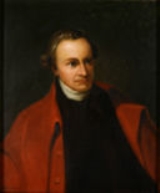
Patrick Henry was an orator and politician who led the movement for independence in Virginia in the 1770s. A
Founding FatherThe Founding Fathers of the United States of America were political leaders and statesmen who participated in the American Revolution by signing the United States Declaration of Independence, taking part in the American Revolutionary War, establishing the United States Constitution, or by some...
, he served as the
first and sixth post-colonial
Governor of VirginiaThe governor of Virginia serves as the chief executive of the Commonwealth of Virginia for a four-year term. The position is currently held by Republican Bob McDonnell, who was inaugurated on January 16, 2010, as the 71st governor of Virginia....
from 1776 to 1779 and subsequently, from 1784 to 1786. Henry led the opposition to the Stamp Act of 1765 and is well remembered for his "
Give me Liberty, or give me Death!"Give me Liberty, or Give me Death!" is a quotation attributed to Patrick Henry from a speech he made to the Virginia Convention. It was given on March 23, 1775, at St. John's Church in Richmond, Virginia, and is credited with having swung the balance in convincing the Virginia House of Burgesses...
" speech. Along with
Samuel AdamsSamuel Adams was an American statesman, political philosopher, and one of the Founding Fathers of the United States. As a politician in colonial Massachusetts, Adams was a leader of the movement that became the American Revolution, and was one of the architects of the principles of American...
and
Thomas PaineThomas "Tom" Paine was an English author, pamphleteer, radical, inventor, intellectual, revolutionary, and one of the Founding Fathers of the United States...
, he is remembered as one of the most influential exponents of
RepublicanismRepublicanism is the political value system that has been a major part of American civic thought since the American Revolution. It stresses liberty and inalienable rights as central values, makes the people as a whole sovereign, supports activist government to promote the common good, rejects...
, promoters of the American Revolution and Independence, especially in his denunciations of corruption in government officials and his defense of historic rights. After the Revolution, Henry was a leader of the
anti-federalistsAnti-Federalism refers to a movement that opposed the creation of a stronger U.S. federal government and which later opposed the ratification of the Constitution of 1787. The previous constitution, called the Articles of Confederation, gave state governments more authority...
in Virginia who opposed the
United States ConstitutionThe Constitution of the United States is the supreme law of the United States of America. It is the framework for the organization of the United States government and for the relationship of the federal government with the states, citizens, and all people within the United States.The first three...
, fearing that it endangered the rights of the States, as well as the freedoms of individuals.
Early years
Henry was born in Studley,
Hanover County, VirginiaAs of the census of 2000, there were 86,320 people, 31,121 households, and 24,461 families residing in the county. The population density was 183 people per square mile . There were 32,196 housing units at an average density of 68 per square mile...
on May 29, 1736. His father was John Henry, an immigrant from
AberdeenshireAberdeenshire is one of the 32 unitary council areas in Scotland and a lieutenancy area.The present day Aberdeenshire council area does not include the City of Aberdeen, now a separate council area, from which its name derives. Together, the modern council area and the city formed historic...
, Scotland, who had attended
King's College, AberdeenKing's College in Old Aberdeen, Scotland is a formerly independent university founded in 1495 and an integral part of the University of Aberdeen...
before immigrating to the Colony of Virginia in the 1720s. Settling in Hanover County, about 1732 John Henry married Sarah Winston Syme, a wealthy widow from a prominent Hanover County family of English ancestry. Patrick Henry was once thought to have been of humble origins, but he was actually born into the middle rank of the Virginia
gentryGentry denotes "well-born and well-bred people" of high social class, especially in the past....
.
Henry attended local schools for a few years, and then was tutored by his father. After failing in business, in 1754 he married Sarah Shelton, with whom he would have six children. As a wedding gift his father-in-law gave the couple six slaves and the 300 acres (1.2 km²) Pine Slash Farm. Henry began a career as a planter, but their home was destroyed by fire in 1757. Henry made another attempt at business,which also failed, before deciding to become a lawyer in 1760.
Henry first made a name for himself in a case dubbed the "
Parson's CauseThe "Parson's Cause" was an important legal and political dispute in the Colony of Virginia often viewed as an important event leading up to the American Revolution...
" (1763), which was an argument about whether the price of tobacco paid to clergy for their services should be set by the colonial government or by the Crown. After the
British ParliamentThe Parliament of Great Britain was formed in 1707 following the ratification of the Acts of Union by both the Parliament of England and Parliament of Scotland...
overruled Virginia's
Two Penny ActThe Two Penny Act, enacted in 1758 by the Virginia Assembly, is the act in which the Parson's Cause trial surrounded. The act was issued after three years of drought which produced a low yielding of tobacco crop....
that had limited the clergy's salaries, the Reverend
James MauryThe Reverend James Maury was a prominent Virginia educator and minister during the American Colonial period.He was the son of Matthew Maury, a French Huguenot, who was born in Castel Mauron, in Gascony, and his wife, Mary Anne Fontaine, daughter of Rev. James Fontaine and Anne Elizabeth...
filed suit against the vestry of
Louisa CountyLouisa County is a county located in the Commonwealth of Virginia. As of 2010, the population was 33,153. The county seat is Louisa.- History :...
for payment of back wages. When Maury won the suit, a jury was called in
Hanover CountyAs of the census of 2000, there were 86,320 people, 31,121 households, and 24,461 families residing in the county. The population density was 183 people per square mile . There were 32,196 housing units at an average density of 68 per square mile...
to determine how much Maury should be paid. Henry was brought in at the last minute to argue on behalf of Louisa County. Ignoring legal niceties, Henry delivered an impassioned speech that denounced clerics who challenged Virginia's laws as "enemies of the community" and any king who annulled good laws like the Two Penny Act as a "tyrant" who "forfeits all right to his subject's obedience". Henry urged the jury to make an example of Maury. After less than five minutes of deliberation, they awarded Maury one penny. The
Hanover County CourthouseHanover County Courthouse, built in 1735, is an historic courthouse located in Hanover Court House, Virginia. In 1763, Patrick Henry, who lived and practiced law in Hanover County, argued the case of the Parson's Cause, a case involving King George III's requirement that Virginians pay taxes to...
where Patrick Henry argued the Parson's Cause still remains an active courthouse; located along historic
U.S. Route 301U.S. Route 301 is a spur of U.S. Route 1 running through the South Atlantic States. It currently runs 1,099 miles from Glasgow, Delaware at U.S. Route 40 to Sarasota, Florida. It passes through the states of Delaware, Maryland, Virginia, North Carolina, South Carolina, Georgia, and Florida...
, the courthouse sits adjacent
Hanover TavernThe Hanover Tavern in Hanover Courthouse, Virginia and Hanover County, Virginia, is one of the oldest taverns in the United States. The first tavern was licensed at the site beginning in 1733....
(rebuilt in 1791 after burning) where Patrick Henry lodged amid arguing the Parson's Cause. The courthouse is the third oldest courthouse still in use in the United States.
Stamp Act
Patrick Henry was elected from Louisa County to the
House of BurgessesThe House of Burgesses was the first assembly of elected representatives of English colonists in North America. The House was established by the Virginia Company, who created the body as part of an effort to encourage English craftsmen to settle in North America...
, the legislative body of the Virginia colony, in 1765 to fill a vacated seat in the assembly. When he arrived in Williamsburg the legislature was already in session. Only nine days after being sworn in, Henry introduced the Virginia Stamp Act Resolutions, "in language so extreme that some Virginians said it smacked of treason".
The new representative waited for an opportunity where the mostly conservative members of the House were away (only 24% was considered sufficient for a quorum). In this atmosphere, he succeeded, through much debate and persuasion, in getting his proposal passed.
It was possibly the most anti-British American political action to that point, and some credit the Resolutions with being one of the main catalysts of the Revolution. The proposals were based on principles that were well-established British rights, such as the right to be taxed by one's own representatives. They went further, however, to assert that the colonial assemblies had the exclusive right to impose taxes on the colonies and could not assign that right.
The imputation of treason is due to his inflammatory words, "Caesar had his Brutus; Charles the First his Cromwell; and George the Third ....may he profit by their example. If
this be treason, make the most of it!" According to biographer Richard Beeman, the legend of this speech grew more dramatic over the years. Henry probably did not say "If this be treason, make the most of it." The only account of the speech written down at the time by an eyewitness (which came to light many years later) records that Henry actually apologized after being accused of uttering treasonable words, assuring the House that he was still loyal to the king. Nevertheless, Henry's passionate, radical speech was cause for notable interest at the time–even if his exact words are unknown.
Sarah's illness
In 1771 Patrick and his wife Sarah moved into their Scotchtown estate along with their children: Martha ("Patsy"), Anne, Elizabeth ("Betsy"), John, William, and Edmund ("Neddy"). Sarah "started to manifest disturbing behaviors which could not at that time be diagnosed or treated. ...her mental condition deteriorated rapidly, and when she became dangerous to herself and others, she was clothed in a 'Quaker shirt,' an early form of strait jacket."
Following the general practice of the time, Patrick's friends and his physician, Dr. Thomas Hinde, advocated she be moved to the public hospital in Williamsburg. But after inspecting the facilities Patrick "saw that if he agreed, his wife would be locked into a windowless brick cell containing only a filthy mattress on the floor and a chamber pot. There she would be chained to the wall with a leg iron. Appalled by what he saw, he instead prepared a private, two-room apartment for her in the basement of Scotchtown. Each room had a window, providing light, air circulation, and a pleasant view of the grounds. The apartment also had a fireplace, which provided good heat in the winter, and a comfortable bed to sleep in."
Patrick himself (or a slave when he was away on business) took care of Sarah and "watched over her, fed her, bathed her, clothed her, and prevented her from harming herself." Sarah died in the spring of 1775 "Because of her illness-then thought to have been caused by being 'possessed by the devil' - she was denied a religious funeral service or a Christian burial. Her grieving husband, 'bowed down and bleeding under the heaviest sorrows and personal distresses,' buried her thirty feet from the home they shared and planted a lilac tree next to her grave to remember her. The tree still stands there, a few steps from the door to her basement."
American Revolution
Responding to pleas from Massachusetts that the colonies create committees of correspondence to coordinate their reaction to the British, Henry took the lead in Virginia. In March 1773, along with
Thomas JeffersonThomas Jefferson was the principal author of the United States Declaration of Independence and the Statute of Virginia for Religious Freedom , the third President of the United States and founder of the University of Virginia...
and
Richard Henry LeeRichard Henry Lee was an American statesman from Virginia best known for the motion in the Second Continental Congress calling for the colonies' independence from Great Britain. He was a signatory to the Articles of Confederation and his famous resolution of June 1776 led to the United States...
, Henry led the Virginia House of Burgesses to adopt resolutions providing for a standing committee of correspondents. Each colony set up such committees, and they led to the formation of the First Continental Congress in 1774, to which Henry was elected.
Patrick Henry is best known for the speech he made in the House of Burgesses on March 23, 1775, in
Saint John's ChurchSt. John's is an Episcopal church located at 2401 East Broad Street in Richmond, Virginia. Formed from several earlier churches, St. John's is the oldest church in Richmond, built by Col. Richard Randolph in 1741 and giving its name to the Church Hill district...
in
Richmond, VirginiaRichmond is the capital of the Commonwealth of Virginia, in the United States. It is an independent city and not part of any county. Richmond is the center of the Richmond Metropolitan Statistical Area and the Greater Richmond area...
. The House was undecided on whether to mobilize for military action against the encroaching British military force, and Henry argued in favor of mobilization. Forty-two years later, Henry's first biographer,
William WirtWilliam Wirt was an American author and statesman who is credited with turning the position of United States Attorney General into one of influence.-History:...
, working from oral testimony, attempted to reconstruct what Henry said. According to Wirt, Henry ended his speech with words that have since become immortalized:
-
"Is life so dear, or peace so sweet, as to be purchased at the price of chains and slavery? Forbid it, Almighty God! I know not what course others may take; but as for me, Give me Liberty, or give me Death!"Give me Liberty, or Give me Death!" is a quotation attributed to Patrick Henry from a speech he made to the Virginia Convention. It was given on March 23, 1775, at St. John's Church in Richmond, Virginia, and is credited with having swung the balance in convincing the Virginia House of Burgesses...
"
The crowd, by Wirt's account, jumped up and shouted "To Arms! To Arms!". For 160 years Wirt's account was taken at face value, but in the 1970s historians began to question the authenticity of Wirt's reconstruction. Historians today observe that Henry was known to have used fear of Indian and slave revolts in promoting military action against the British, and that according to the only written first-hand account of the speech, Henry used some graphic name-calling that failed to appear in Wirt's heroic rendition.
In August 1775, Henry became colonel of the
1st Virginia RegimentThe 1st Virginia Regiment was raised, on July 17, 1775, at Williamsburg, Virginia as a state militia unit and later for service with the Continental Army. Its origins go back to the Charles City-Henrico County Regiment of Militia founded in 1652. During the French and Indian War it was the...
. At the outset of the
Revolutionary WarThe American Revolutionary War , the American War of Independence, or simply the Revolutionary War, began as a war between the Kingdom of Great Britain and thirteen British colonies in North America, and ended in a global war between several European great powers.The war was the result of the...
, Henry led militia against Royal Governor
Lord DunmoreJohn Murray, 4th Earl of Dunmore was a British peer and colonial governor. He was the son of William Murray, 3rd Earl of Dunmore, and his wife Catherine . He is best remembered as the last royal governor of the Colony of Virginia.John was the eldest son of William and Catherine Murray, and nephew...
in defense of some disputed gunpowder, an event known as the
Gunpowder IncidentThe Gunpowder Incident was a conflict early in the American Revolutionary War between Lord Dunmore, the Royal Governor of the Colony of Virginia, and militia led by Patrick Henry...
. During the war he served as the first post-colonial Governor of Virginia and presided over several expeditions against the Cherokee Indians, who were allied with the British.
Henry lived during part of the War at his 10000 acres (40.5 km²) Leatherwood Plantation in
Henry County, VirginiaAs of the census of 2000, there were 57,930 people, 23,910 households, and 16,952 families residing in the county. The population density was 152 people per square mile . There were 25,921 housing units at an average density of 68 per square mile...
, where he, his first cousin Ann Winston Carr and her husband Col. George Waller had settled. During the five years Henry lived at Leatherwood, from 1779 to 1784, he owned 75 slaves, and grew tobacco. During this time, he kept in close touch with his friend the explorer
Joseph MartinJoseph Martin was a brigadier general in the Virginia militia during the American Revolutionary War, in which Martin's frontier diplomacy with the Cherokee people is credited with averting Indian attacks on the Scotch-Irish settlers who helped win the battles of Kings Mountain and Cowpens...
, whom Henry had appointed agent to the
Cherokee nationThe Cherokee Nation is the largest of three Cherokee federally recognized tribes in the United States. It was established in the 20th century, and includes people descended from members of the old Cherokee Nation who relocated voluntarily from the Southeast to Indian Territory and Cherokees who...
, and with whom Henry sometimes invested in real estate, and for whom the county seat of
Henry CountyAs of the census of 2000, there were 57,930 people, 23,910 households, and 16,952 families residing in the county. The population density was 152 people per square mile . There were 25,921 housing units at an average density of 68 per square mile...
was later named.
In early November 1775 Henry and
James MadisonJames Madison, Jr. was an American statesman and political theorist. He was the fourth President of the United States and is hailed as the “Father of the Constitution” for being the primary author of the United States Constitution and at first an opponent of, and then a key author of the United...
were elected founding trustees of
Hampden-Sydney CollegeHampden–Sydney College is a liberal arts college for men located in Hampden Sydney, Virginia, United States. Founded in 1775, Hampden–Sydney is the oldest private charter college in the Southern U.S., the last college founded before the American Revolution, and one of only three four-year,...
, which opened for classes on November 10. He remained a trustee until his death in 1799. Henry was instrumental in achieving passage of the College's Charter of 1783, an action delayed because of the war. He is probably the author of the Oath of Loyalty to the new Republic included in that charter. Seven of his sons attended the new college.
On October 25, 1777, Patrick Henry married his second wife, Dorothea Dandridge (1755–1831). From this marriage came eleven children.
Later years
After the Revolution, Henry again served as governor of Virginia from 1784 to 1786, but declined to attend the Constitutional Convention of 1787 saying that he "smelt a rat in Philadelphia, tending toward the monarchy." An ardent supporter of state rights, Henry was an outspoken critic of the
United States ConstitutionThe Constitution of the United States is the supreme law of the United States of America. It is the framework for the organization of the United States government and for the relationship of the federal government with the states, citizens, and all people within the United States.The first three...
and led the Virginia opposition to its ratification arguing that it gave the federal government too much power and that the untested office of the presidency could devolve into a monarchy. As a leading Antifederalist, he was instrumental in forcing the adoption of the
Bill of RightsThe Bill of Rights is the collective name for the first ten amendments to the United States Constitution. These limitations serve to protect the natural rights of liberty and property. They guarantee a number of personal freedoms, limit the government's power in judicial and other proceedings, and...
to amend the new Constitution and became a leading opponent of
James MadisonJames Madison, Jr. was an American statesman and political theorist. He was the fourth President of the United States and is hailed as the “Father of the Constitution” for being the primary author of the United States Constitution and at first an opponent of, and then a key author of the United...
.
Henry served as a representative to the Virginia convention of 1788 that ratified the U. S. Constitution. He voted against ratification. He was chosen as an elector for the 1789 election from Campbell District. That District consisted of
Bedford CountyAs of the census of 2000, there were 60,371 people, 23,838 households, and 18,164 families residing in the county. The population density was 80 people per square mile . There were 26,841 housing units at an average density of 36 per square mile...
,
Campbell CountyAs of the census of 2000, there were 51,078 people, 20,639 households, and 14,694 families residing in the county. The population density was 101 people per square mile . There were 22,088 housing units at an average density of 44 per square mile...
,
Charlotte CountyAs of the census of 2000, there were 12,472 people, 4,951 households, and 3,435 families residing in the county. The population density was 26 people per square mile . There were 5,734 housing units at an average density of 12 per square mile...
,
Franklin CountyAs of the census of 2000, there were 47,286 people, 18,963 households, and 13,918 families residing in the county. The population density was 68 people per square mile . There were 22,717 housing units at an average density of 33 per square mile...
,
Halifax County,
Henry CountyAs of the census of 2000, there were 57,930 people, 23,910 households, and 16,952 families residing in the county. The population density was 152 people per square mile . There were 25,921 housing units at an average density of 68 per square mile...
, Pittsylvania County, and
Prince Edward CountyPrince Edward County is a county located in the Commonwealth of Virginia. As of 2010, the population was 23,368. Its county seat is Farmville.-Formation and County Seats:...
, which cover the area between
DanvilleDanville is an independent city in Virginia, United States, bounded by Pittsylvania County, Virginia and Caswell County, North Carolina. It was the last capital of the Confederate States of America. The Bureau of Economic Analysis combines the city of Danville with Pittsylvania county for...
and
LynchburgLynchburg is an independent city in the Commonwealth of Virginia. The population was 75,568 as of 2010. Located in the foothills of the Blue Ridge Mountains along the banks of the James River, Lynchburg is known as the "City of Seven Hills" or "The Hill City." Lynchburg was the only major city in...
in the south of Virginia
All of the 10 electors who voted cast one of their two votes for George Washington. Five of them cast their other vote for
John AdamsJohn Adams was an American lawyer, statesman, diplomat and political theorist. A leading champion of independence in 1776, he was the second President of the United States...
. Three cast theirs for
George ClintonGeorge Clinton was an American soldier and politician, considered one of the Founding Fathers of the United States. He was the first Governor of New York, and then the fourth Vice President of the United States , serving under Presidents Thomas Jefferson and James Madison. He and John C...
. One cast his for
John HancockJohn Hancock was a merchant, statesman, and prominent Patriot of the American Revolution. He served as president of the Second Continental Congress and was the first and third Governor of the Commonwealth of Massachusetts...
. One cast his for
John JayJohn Jay was an American politician, statesman, revolutionary, diplomat, a Founding Father of the United States, and the first Chief Justice of the United States ....
. Clinton was a leading Antifederalist, a view which he shared with Henry.
President
George WashingtonGeorge Washington was the dominant military and political leader of the new United States of America from 1775 to 1799. He led the American victory over Great Britain in the American Revolutionary War as commander-in-chief of the Continental Army from 1775 to 1783, and presided over the writing of...
offered Henry the post of Secretary of State in 1795, which he declined out of opposition to Washington's Federalist policies. However, following the radicalism of the
French RevolutionThe French Revolution , sometimes distinguished as the 'Great French Revolution' , was a period of radical social and political upheaval in France and Europe. The absolute monarchy that had ruled France for centuries collapsed in three years...
Henry's views changed as he began to fear a similar fate could befall America and by the late 1790s, Henry was in support of the Federalist policies of Washington and Adams. He especially denounced the Virginia and Kentucky Resolutions, which had been secretly written by Jefferson and Madison, and approved by the legislatures of those two states.
Henry warned that civil war was threatened because Virginia, "had quit the sphere in which she had been placed by the Constitution, and, in daring to pronounce upon the validity of federal laws, had gone out of her jurisdiction in a manner not warranted by any authority, and in the highest degree alarming to every considerate man; that such opposition, on the part of Virginia, to the acts of the general government, must beget their enforcement by military power; that this would probably produce civil war, civil war foreign alliances, and that foreign alliances must necessarily end in subjugation to the powers called in."
In 1798 President
John AdamsJohn Adams was an American lawyer, statesman, diplomat and political theorist. A leading champion of independence in 1776, he was the second President of the United States...
nominated Henry special emissary to France, but he had to decline because of failing health. He strongly supported
John MarshallJohn Marshall was the Chief Justice of the United States whose court opinions helped lay the basis for American constitutional law and made the Supreme Court of the United States a coequal branch of government along with the legislative and executive branches...
and at the urging of Washington stood for and was elected to the Virginia House of Delegates as a Federalist. However, three months prior to taking his seat in the state legislature, he died of
stomach cancerGastric cancer, commonly referred to as stomach cancer, can develop in any part of the stomach and may spread throughout the stomach and to other organs; particularly the esophagus, lungs, lymph nodes, and the liver...
on June 6, 1799, while at
Red HillRed Hill Patrick Henry National Memorial in Charlotte County, Virginia near the Town of Brookneal, honors Patrick Henry, the fiery legislator and orator of the American Revolution...
, his family's large plantation. Following his death, Henry's widow married the Virginia governor's first cousin and executor, Judge Edmund Winston.
Honored on US Postage
- Few people in early American history other than American Presidents have been honored on US postage stamps, and Patrick Henry is prominent among them.
-
-
- On October 7, 1955, the US Post Office issued a 1-dollar postage stamp honoring the famous orator and long time Governor of Virginia. It was one in a series of twenty seven stamps in the Liberty issue. A painting of Henry by American artist Alonzo Chappel (1828-1887) was used as the inspiration and as the model by the engraver for this issue.
-
-
- In 1960, the US Post Office issued the CREDO Issue, a series of six stamps with famous quotes engraved on the face of each one. Patrick Henry's most famous words are inscribed on the front of this 4-cent issue, first released in Richmond, Virginia, on January 11, 1961. -- See also: US Presidents on US postage stamps
Monuments and memorials
Monuments are located at his home and grave site, designated
Red Hill Patrick Henry National MemorialRed Hill Patrick Henry National Memorial in Charlotte County, Virginia near the Town of Brookneal, honors Patrick Henry, the fiery legislator and orator of the American Revolution...
.
At least three ships have been named in his honor: the Civil War Confederate Navy
steamboatA steamboat or steamship, sometimes called a steamer, is a ship in which the primary method of propulsion is steam power, typically driving propellers or paddlewheels...
, the first
World War IIWorld War II, or the Second World War , was a global conflict lasting from 1939 to 1945, involving most of the world's nations—including all of the great powers—eventually forming two opposing military alliances: the Allies and the Axis...
Liberty shipLiberty ships were cargo ships built in the United States during World War II. Though British in conception, they were adapted by the U.S. as they were cheap and quick to build, and came to symbolize U.S. wartime industrial output. Based on vessels ordered by Britain to replace ships torpedoed by...
launched, , and
ballistic missile submarineA ballistic missile submarine is a submarine equipped to launch ballistic missiles .-Description:Ballistic missile submarines are larger than any other type of submarine, in order to accommodate SLBMs such as the Russian R-29 or the American Trident...
. Also named in his honor, Emory & Henry College in
Emory, VirginiaEmory is a census-designated place in Washington County, Virginia, United States. The population was 1,251 at the 2010 census. It is part of the Kingsport–Bristol –Bristol Metropolitan Statistical Area, which is a component of the Johnson City–Kingsport–Bristol, TN-VA...
, eight high schools (including three in Virginia, more than for any other person in the Commonwealth),
Patrick Henry Community CollegePatrick Henry Community College is a community college located at 645 Patriot Avenue in unincorporated Henry County, Virginia, United States, north of the City of Martinsville....
in
Martinsville, VirginiaMartinsville is an independent city which is surrounded by Henry County, Virginia, United States. The population was 13,821 in 2010. The Bureau of Economic Analysis combines the city of Martinsville with Henry County for statistical purposes...
, and
Patrick Henry CollegePatrick Henry College is a private, independent college with Evangelical Christian basis that focuses on teaching classical liberal arts and government, located in Purcellville, Virginia, United States The first college in the United States founded specifically for Christian home-schooled...
in
Purcellville, VirginiaPurcellville is a town in the Loudoun Valley of Loudoun County, Virginia, United States. The population was 3,584 at the 2000 census, but has undergone considerable growth since then. Purcellville is the major population center for western Loudoun and the Loudoun Valley...
. The Patrick Henry Boys and Girls Plantation was established as a living legacy to Patrick Henry on property near his grave site donated by the Red Hill Patrick Henry National Memorial. It is a Christian residential facility for
at-risk youthThe term at-risk students is used to describe students who are "at risk" of failing academically, for one or more of any several reasons. The term can be used to describe a wide variety of students, including ones who belong to ethnic minorities, those who are academically disadvantaged, those who...
. Henry helped to establish the
Hampden-Sydney CollegeHampden–Sydney College is a liberal arts college for men located in Hampden Sydney, Virginia, United States. Founded in 1775, Hampden–Sydney is the oldest private charter college in the Southern U.S., the last college founded before the American Revolution, and one of only three four-year,...
in Virginia. It is the 10th-oldest institution of higher education in the United States. Six of Patrick Henry's sons graduated from Hampden-Sydney. The Patrick Henry Scholars are named for him. Future United States president
William Henry HarrisonWilliam Henry Harrison was the ninth President of the United States , an American military officer and politician, and the first president to die in office. He was 68 years, 23 days old when elected, the oldest president elected until Ronald Reagan in 1980, and last President to be born before the...
also graduated from the College in 1791.
Fort Patrick Henry was a colonial fort built during the
American Revolutionary WarThe American Revolutionary War , the American War of Independence, or simply the Revolutionary War, began as a war between the Kingdom of Great Britain and thirteen British colonies in North America, and ended in a global war between several European great powers.The war was the result of the...
along the South Fork Holston River at the present-day site of
Kingsport, TennesseeKingsport is a city located mainly in Sullivan County with some western portions in Hawkins County in the US state of Tennessee. The majority of the city lies in Sullivan County...
. This fort serves as the namesake of
Fort Patrick Henry DamFort Patrick Henry Dam is a hydroelectric dam on the South Fork Holston River within the city of Kingsport, in Sullivan County in the U.S. state of Tennessee...
and the reservoir that it forms on the river.
Camp Patrick HenryCamp Patrick Henry is a decommissioned United States Army base which was located in Warwick County, Virginia. After World War II, the site was redeveloped as a commercial airport, and became part of City of Newport News in 1958 when the former City of Warwick and Newport News were politically...
was a United States Army base from late 1942 to the late 1960s and was a 1700 acres (6.9 km²) complex in
Newport News, VirginiaNewport News is an independent city located in the Hampton Roads metropolitan area of Virginia. It is at the southeastern end of the Virginia Peninsula, on the north shore of the James River extending southeast from Skiffe's Creek along many miles of waterfront to the river's mouth at Newport News...
. Since decommissioned, it is the site of the
Newport News/Williamsburg International AirportNewport News/Williamsburg International Airport is an airport located 9 mi northwest of downtown Newport News, Virginia, and serves the entire Hampton Roads metropolitan area along with Norfolk International Airport in Norfolk...
on 925 acres (3.7 km²) of the old location. The airport opened in 1949 and was originally called Patrick Henry Field. The airport code is still PHF for the beginning letters of the old name.
Other places named in honor of Patrick Henry include
Henry County, VirginiaAs of the census of 2000, there were 57,930 people, 23,910 households, and 16,952 families residing in the county. The population density was 152 people per square mile . There were 25,921 housing units at an average density of 68 per square mile...
,
Henry County, KentuckyAs of the census of 2000, there were 15,060 people, 5,844 households, and 4,330 families residing in the county. The population density was . There were 6,381 housing units at an average density of...
,
Patrick County, VirginiaPatrick County is a county located in the Commonwealth of Virginia. As of 2010, the population was 18,490. Its county seat is Stuart. It is located within both the rolling hills and valleys of the Piedmont Region of Virginia and mountainous Southwest Virginia....
,
Henry County, GeorgiaHenry County is a growing suburban county located in the U.S. state of Georgia. As of the 2000 census, the population was 119,341. As of 2010, the county's population swelled to 203,922, up 70.9% from the previous census and becoming Georgia's 8th most populous county and the 10th fastest growing...
,
Henry County, OhioHenry County is a county located in the state of Ohio, United States. As of the 2010 census, the population was 28,215. Its county seat is Napoleon and is named for Patrick Henry, the Virginian famous for his "give me liberty or give me death" speech....
,
Henry County, Tennessee,
Henry County, AlabamaHenry County is a county of the U.S. state of Alabama. Its name is in honor of Patrick Henry, famous orator and Governor of Virginia. As of 2010, its population was 17,302...
,
Henry County, IllinoisHenry County is a county located in the U.S. state of Illinois. According to the 2010 census, it has a population of 50,486, which is a decrease of 1.0% from 51,020 in 2000. Its county seat is Cambridge...
,
Henry County, MissouriHenry County is a county located in the U.S. state of Missouri. As of 2000, the population was 21,997. Its county seat is Clinton. The county was organized in 1835 as Rives County, and renamed in 1841 after the American patriot Patrick Henry, of Virginia. The county was originally named after...
after an 1841 name change, and
Patrick Henry VillagePatrick Henry Village, also called PHV, is a United States Army installation at Heidelberg, Germany. It opened in 1947 after World War II and was named after Patrick Henry, first and sixth Governor of Virginia.-General information:...
in
Heidelberg-Early history:Between 600,000 and 200,000 years ago, "Heidelberg Man" died at nearby Mauer. His jaw bone was discovered in 1907; with scientific dating, his remains were determined to be the earliest evidence of human life in Europe. In the 5th century BC, a Celtic fortress of refuge and place of...
, Germany.
See also
- Founding Fathers of the United States
The Founding Fathers of the United States of America were political leaders and statesmen who participated in the American Revolution by signing the United States Declaration of Independence, taking part in the American Revolutionary War, establishing the United States Constitution, or by some...
- American Revolution
The American Revolution was the political upheaval during the last half of the 18th century in which thirteen colonies in North America joined together to break free from the British Empire, combining to become the United States of America...
- History of Virginia
The history of Virginia began with settlement of the geographic region now known as the Commonwealth of Virginia in the United States thousands of years ago by Native Americans. Permanent European settlement began with the establishment of Jamestown in 1607, by English colonists. As tobacco emerged...
- Parson's Cause
The "Parson's Cause" was an important legal and political dispute in the Colony of Virginia often viewed as an important event leading up to the American Revolution...
- U.S. Constitution, ratification debates
External links
- Henry's Early Life and Times from Patrick Henry National Memorial
- Patrick Henry, Voice of the American Revolution, patrickhenry.com
- Quotations by Patrick Henry at Liberty-Tree.ca
- Text of 1775 "Liberty or death" speech
- Address opposing US Constitution
- Patrick Henry at Find-A-Grave
- Patrick Henry Letters
- Patrick Henry Monument, Henry County, Virginia, virginia.org Scotchtown Plantation
Scotchtown is a plantation located in Hanover County, Virginia, that was once owned and used as a residence by Patrick Henry, revolutionary and first Governor of Virginia. It is located in Beaverdam, Virginia, northwest of Ashland, Virginia on VA 685...
, Henry family home from 1771–1778
Archival Records