

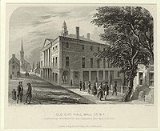
1st United States Congress

Encyclopedia
House of Representatives
During this congress, five House seats were added for North Carolina and one House seat was added for Rhode Island when they ratified the Constitution.Senate
- President: John AdamsJohn AdamsJohn Adams was an American lawyer, statesman, diplomat and political theorist. A leading champion of independence in 1776, he was the second President of the United States...
(P) - President pro temporePresident pro tempore of the United States SenateThe President pro tempore is the second-highest-ranking official of the United States Senate. The United States Constitution states that the Vice President of the United States is the President of the Senate and the highest-ranking official of the Senate despite not being a member of the body...
: John LangdonJohn LangdonJohn Langdon was a politician from Portsmouth, New Hampshire, and one of the first two United States senators from that state. Langdon was an early supporter of the Revolutionary War and later served in the Continental Congress...
(P)
House of Representatives
- SpeakerSpeaker of the United States House of RepresentativesThe Speaker of the United States House of Representatives, or Speaker of the House, is the presiding officer of the United States House of Representatives...
: Frederick MuhlenbergFrederick MuhlenbergFrederick Augustus Conrad Muhlenberg was an American minister and politician who was the first Speaker of the United States House of Representatives. A delegate and a member of the U.S...
(P)
Members
This list is arranged by chamber, then by state. Senators are listed in order of seniority, and Representatives are listed by district.Senate
Senators were elected by the state legislatures every two years, with one-third beginning new six year terms with each Congress. Preceding the names in the list below are Senate class numbersClasses of United States Senators
The three classes of United States Senators are currently made up of 33 or 34 Senate seats. The purpose of the classes is to determine which Senate seats will be up for election in a given year. The three groups are staggered so that one of them is up for election every two years.A senator's...
, which indicate the cycle of their election. In this Congress, all Senators were newly elected, and Class 1 meant their term ended with this Congress, requiring reelection in 1790; Class 2 meant their term ended with the next Congress, requiring reelection in 1792; and Class 3 meant their term lasted through the next two Congresses, requiring reelection in 1794.
Connecticut
- 1. Oliver EllsworthOliver EllsworthOliver Ellsworth was an American lawyer and politician, a revolutionary against British rule, a drafter of the United States Constitution, and the third Chief Justice of the United States. While at the Federal Convention, Ellsworth moved to strike the word National from the motion made by Edmund...
(P) - 3. William S. JohnsonWilliam Samuel JohnsonWilliam Samuel Johnson was an early American statesman who was notable for signing the United States Constitution, for representing Connecticut in the United States Senate, and for serving as president of Columbia University.-Early career:...
(P)
Delaware
- 2. Richard BassettRichard BassettRichard Bassett was an American lawyer and politician from Dover, in Kent County, Delaware. He was a veteran of the American Revolution, a delegate to the Constitutional Convention of 1787, and a member of the Federalist Party, who served in the Delaware General Assembly, as Governor of Delaware,...
(A) - 1. George ReadGeorge Read (signer)George Read was an American lawyer and politician from New Castle in New Castle County, Delaware. He was a signer of the Declaration of Independence, a Continental Congressman from Delaware, a delegate to the U.S. Constitutional Convention of 1787, President of Delaware, and a member of the...
(P)
Georgia
- 2. William FewWilliam FewWilliam Few, Jr. was an American politician and a farmer, and a businessman and a Founding Father of the United States. William represented the U.S. state of Georgia at the Constitutional Convention....
(A) - 3. James GunnJames Gunn (senator)James Gunn was a delegate to the Continental Congress and United States Senate for Georgia.Gunn was born in Virginia to John and Mary Gunn. After being educated to the law, he moved and began the practice of law in Savannah, Georgia...
(A)
Maryland
- 3. John HenryJohn Henry (senator)John Henry was the eighth Governor of Maryland and member of the United States Senate. He was born near Vienna in Dorchester County, Maryland....
(P) - 1. Charles CarrollCharles Carroll of CarrolltonCharles Carroll of Carrollton was a wealthy Maryland planter and an early advocate of independence from Great Britain. He served as a delegate to the Continental Congress and later as United States Senator for Maryland...
(P)
Massachusetts
- 1. Tristram DaltonTristram DaltonTristram Dalton was an American politician who served as a Senator from Massachusetts.-Early life:Dalton was born in Newburyport, Massachusetts. He attended Dummer Academy in Byfield, Massachusetts, and graduated from Harvard College in 1755...
(P) - 2. Caleb StrongCaleb StrongCaleb Strong was Massachusetts lawyer and politician who served as the sixth and tenth Governor of Massachusetts between 1800 and 1807, and again from 1812 until 1816.-Biography:...
(P)
New Hampshire
- 3. John LangdonJohn LangdonJohn Langdon was a politician from Portsmouth, New Hampshire, and one of the first two United States senators from that state. Langdon was an early supporter of the Revolutionary War and later served in the Continental Congress...
(P) - 2. Paine WingatePaine WingatePaine Wingate was an American preacher, farmer, and statesman from Stratham, New Hampshire. He served New Hampshire in the Continental Congress and both the United States Senate and House of Representatives....
(A)
New Jersey
- 1. Jonathan ElmerJonathan ElmerJonathan Elmer was an American politician, of the Pro-Administration Party.Elmer was born in Cedarville, New Jersey in 1745. He was graduated from the University of Pennsylvania in 1769 after studying medicine. He practiced medicine in Bridgeton, New Jersey until he became sheriff of Cumberland...
(P) - 2. William Paterson (P), until November 13, 1790
- Philemon DickinsonPhilemon DickinsonPhilemon Dickinson was an American lawyer and politician from Trenton, New Jersey. As a brigadier general of the New Jersey militia, he was one of the most effective militia officers of the American Revolutionary War. He was also a Continental Congressman from Delaware and a United States Senator...
(P), from November 13, 1790
- Philemon Dickinson
New York
- 3. Rufus KingRufus KingRufus King was an American lawyer, politician, and diplomat. He was a delegate for Massachusetts to the Continental Congress. He also attended the Constitutional Convention and was one of the signers of the United States Constitution on September 17, 1787, in Philadelphia, Pennsylvania...
(P), from July 25, 1789 - 1. Philip SchuylerPhilip SchuylerPhilip John Schuyler was a general in the American Revolution and a United States Senator from New York. He is usually known as Philip Schuyler, while his son is usually known as Philip J. Schuyler.-Early life:...
(P), from July 27, 1789
North Carolina
- 3. Benjamin HawkinsBenjamin HawkinsBenjamin Hawkins was an American planter, statesman, and United States Indian agent . He was a delegate to the Continental Congress and a United States Senator from North Carolina, having grown up among the planter elite...
(P), from November 27, 1789 - 2. Samuel JohnstonSamuel JohnstonSamuel Johnston was an American planter, lawyer, and statesman from Chowan County, North Carolina. He represented North Carolina in both the Continental Congress and the United States Senate, and was the sixth Governor of North Carolina.-Early Life and Revolutionary Politics:Johnston was born in...
(P), from November 27, 1789
Pennsylvania
- 1. William Maclay (A)
- 3. Robert MorrisRobert Morris (merchant)Robert Morris, Jr. was a British-born American merchant, and signer of the Declaration of Independence, the Articles of Confederation, and the United States Constitution...
(P)
Rhode Island
- 1. Theodore FosterTheodore FosterTheodore Foster was an American politician. He was a member of the Federalist Party and later the National Republican Party. He served as one of the first two United States Senators from Rhode Island and, following John Langdon, served as dean of the Senate...
(P), from June 7, 1790 - 2. Joseph Stanton, Jr.Joseph Stanton, Jr.Joseph Stanton, Jr. was an American politician of the Anti-Federalist faction.Stanton was born in Charlestown, Rhode Island in 1739. He served in the state legislature from 1768 to 1774....
(A), from June 7, 1790
South Carolina
- 2. Pierce ButlerPierce ButlerPierce Butler was a soldier, planter, and statesman, recognized as one of United States' Founding Fathers. He represented South Carolina in the Continental Congress, the 1787 Constitutional Convention, and the U.S. Senate...
(P) - 3. Ralph IzardRalph IzardRalph Izard was a U.S. politician. He served as President pro tempore of the United States Senate in 1794.-Early life:...
(P)
Virginia
- 1. William GraysonWilliam GraysonWilliam Grayson was a soldier, lawyer, and statesman from Virginia. He was one of the first two U.S. Senators from Virginia, and belonged to the Anti-Federalist faction.-Biography:...
(A), until March 12, 1790- John WalkerJohn Walker (politician)John Walker was a public official from Virginia.Walker was born in Virginia, the son of Dr. Thomas Walker. He received private education before attending the College of William and Mary, which he graduated from in 1764...
(P), March 31, 1790 – November 9, 1790 - James MonroeJames MonroeJames Monroe was the fifth President of the United States . Monroe was the last president who was a Founding Father of the United States, and the last president from the Virginia dynasty and the Republican Generation...
(A), from November 9, 1790
- John Walker
- 2. Richard Henry LeeRichard Henry LeeRichard Henry Lee was an American statesman from Virginia best known for the motion in the Second Continental Congress calling for the colonies' independence from Great Britain. He was a signatory to the Articles of Confederation and his famous resolution of June 1776 led to the United States...
(A)

House of Representatives
The names of members of the House of Representatives are listed by their districts.Connecticut
All representatives were elected statewide on a general ticketGeneral ticket
General ticket representation is a term used to describe a particular method of electing members of a multi-member state delegation to the United States House of Representatives...
.. Benjamin Huntington
Benjamin Huntington
Benjamin Huntington was an American lawyer, jurist and politician from Norwich, Connecticut. He served in the Revolutionary War with the rank of General. He later served Connecticut as a delegate to the Second Continental Congress and as a member of the U.S...
(P). Roger Sherman
Roger Sherman
Roger Sherman was an early American lawyer and politician, as well as a founding father. He served as the first mayor of New Haven, Connecticut, and served on the Committee of Five that drafted the Declaration of Independence, and was also a representative and senator in the new republic...
(P). Jonathan Sturges
Jonathan Sturges
Jonathan Sturges was an American lawyer and jurist from Fairfield, Connecticut. He represented Connecticut as a delegate to the Continental Congress and in the United States House of Representatives....
(P). Jonathan Trumbull, Jr.
Jonathan Trumbull, Jr.
Jonathan Trumbull, Jr. was an American politician who served as the second Speaker of the United States House of Representatives....
(P). Jeremiah Wadsworth
Jeremiah Wadsworth
Jeremiah Wadsworth was an American sea captain, merchant, and statesman from Hartford, Connecticut who profited from his position as a government official charged with supplying the Continental Army...
(P)
Delaware
. John ViningJohn M. Vining
John Middleton "Jack" Vining was an American lawyer and politician from Dover, in Kent County, Delaware. He was a Continental Congressman from Delaware, and a member of the Federalist Party, who served in the Delaware General Assembly and as U.S. Representative and U.S...
(P)
Georgia
. James JacksonJames Jackson (politician)
James "Left Eye" Jackson was an early Georgia politician of the Democratic-Republican Party. He was a member of the U.S. House of Representatives from 1789 until 1791. He was also a U.S. Senator from Georgia from 1793 to 1795, and from 1801 until his death...
(A). Abraham Baldwin
Abraham Baldwin
Abraham Baldwin was an American politician, Patriot, and Founding Father from the U.S. state of Georgia. Baldwin was a Georgia representative in the Continental Congress and served in the United States House of Representatives and Senate after the adoption of the Constitution.-Minister:After...
(A). George Mathews
George Mathews (Georgia)
George Mathews was an United States planter, merchant, and pioneer from Virginia and western Georgia. He served in the Continental Army during the Revolutionary War then settled in Georgia. He served as the 20th Governor of Georgia, one term in the U.S...
(A)
Maryland
. Michael J. StoneMichael J. Stone
Michael Jenifer Stone was an American planter and statesman from Charles County, Maryland. He represented Maryland in the U.S. House.Michael was born to David and Elizabeth Stone at Poynton Manor in Charles County...
(A). Joshua Seney
Joshua Seney
Joshua Seney was an American farmer and lawyer from Queen Anne's County, Maryland. He represented the state of Maryland in the Continental Congress, and the second district of Maryland in the House of Representatives....
(A). Benjamin Contee
Benjamin Contee
Benjamin Contee was an American Episcopal priest and statesman from Maryland. He was an officer in the American Revolutionary War, a delegate to the Confederation Congress, and member of the first United States House of Representatives.-Early life:Contee was the son of Col. Thomas Contee and...
(A). William Smith
William Smith (Maryland)
William Smith was an American politician and representative of the fourth congressional district of Maryland in the United States House of Representatives....
(A). George Gale
George Gale (congressman)
George Gale was an American politician and the first representative of the fifth congressional district of Maryland....
(P). Daniel Carroll
Daniel Carroll
Daniel Carroll was a politician and one of the Founding Fathers of the United States. He was a prominent member of one of the United States' great colonial Catholic families, whose members included his younger brother Archbishop John Carroll, the first Catholic bishop in the United States and...
(P)
Massachusetts
. Fisher AmesFisher Ames
Fisher Ames was a Representative in the United States Congress from the 1st Congressional District of Massachusetts.-Life and political career:...
(P). Benjamin Goodhue
Benjamin Goodhue
Benjamin Goodhue was a Representative and a Senator from Massachusetts.Goodhue was born in Salem, Massachusetts and graduated from Harvard College in 1766. He worked as a merchant and became a member of the State house of representatives 1780-1782 and later a State senator in 1783 and 1786-1788...
(P). Elbridge Gerry
Elbridge Gerry
Elbridge Thomas Gerry was an American statesman and diplomat. As a Democratic-Republican he was selected as the fifth Vice President of the United States , serving under James Madison, until his death a year and a half into his term...
(A). Theodore Sedgwick
Theodore Sedgwick
Theodore Sedgwick was an attorney, politician and jurist, who served in elected state government and as a Delegate to the Continental Congress, a US Representative, and a United States Senator from Massachusetts. He served as the fifth Speaker of the United States House of Representatives...
(P). George Partridge
George Partridge
George Partridge was an American teacher and politician. He represented Massachusetts as a delegate to the Continental Congress and as a Representative in the U.S. House.-Background:...
(P), until August 14, 1790, vacant thereafter. George Thatcher
George Thatcher
George Thatcher was an American lawyer, jurist, and statesman from the Maine district of Massachusetts. His name sometimes appears as George Thacher. He was a delegate for Massachusetts to the Continental Congress in 1787 and 1788...
(P). George Leonard (P). Jonathan Grout
Jonathan Grout
Jonathan Grout was a member of the United States House of Representatives from Massachusetts. He served in the First United States Congress, representing the area around Bristol County, Massachusetts....
(A)
New Hampshire
All representatives were elected statewide on a general ticketGeneral ticket
General ticket representation is a term used to describe a particular method of electing members of a multi-member state delegation to the United States House of Representatives...
.. Abiel Foster
Abiel Foster
Abiel Foster was an American clergyman and statesman from Canterbury, New Hampshire. He represented New Hampshire in the Continental Congress and the U.S. Congress....
(P). Nicholas Gilman
Nicholas Gilman
Nicholas Gilman, Jr. was a soldier in the Continental Army during the American Revolutionary War, a delegate to the Continental Congress, and a signer of the U.S. Constitution, representing New Hampshire. He was a member of the United States House of Representatives during the first four...
(P). Samuel Livermore
Samuel Livermore
Samuel Livermore was a U.S. politician. He was a U.S. Senator from New Hampshire from 1793 to 1801 and served as President pro tempore of the United States Senate in 1796 and again in 1799....
(A)
New Jersey
All representatives were elected statewide on a general ticketGeneral ticket
General ticket representation is a term used to describe a particular method of electing members of a multi-member state delegation to the United States House of Representatives...
.. Elias Boudinot
Elias Boudinot
Elias Boudinot was a lawyer and statesman from Elizabeth, New Jersey who was a delegate to the Continental Congress and a U.S. Congressman for New Jersey...
(P). Lambert Cadwalader
Lambert Cadwalader
Lambert Cadwalader was an American merchant and leader in New Jersey and Pennsylvania. He fought in the Revolutionary War, then represented New Jersey in the Continental Congress and the U.S. Congress.-Early life:...
(P). James Schureman
James Schureman
James Schureman was an American merchant and statesman from New Brunswick, New Jersey. He represented New Jersey in the Continental Congress as well as the United States House of Representatives and United States Senate....
(P). Thomas Sinnickson
Thomas Sinnickson (merchant)
Thomas Sinnickson was an American merchant and statesman from Salem, New Jersey. He represented in the U.S. House in 1789–1791 and again in 1797–1799....
(P)
New York
. William FloydWilliam Floyd
William Floyd was a signer of the United States Declaration of Independence as a U.S. Representative from New York.-Biography:...
(A). John Laurance
John Laurance
John Laurance was an American lawyer and politician from New York.-Life:He emigrated to the United States in 1767 and settled in New York City where he read law and entered private practice in 1772. At the outbreak of the American Revolutionary War, he was a warm adherent of the revolutionaries...
(P). Egbert Benson
Egbert Benson
Egbert Benson was a lawyer, jurist, politician from Upper Red Hook, New York, and a Founding Father of the United States who represented New York in the Continental Congress, Annapolis Convention, and the United States House of Representatives, and who served as a member of the New York State...
(P). John Hathorn
John Hathorn
John Hathorn was an American politician who was a member of the United States House of Representatives from New York.-Life:...
(A). Peter Silvester
Peter Silvester
Peter Silvester was an American politician who was a member of the United States House of Representatives from New York...
(P). Jeremiah Van Rensselaer
Jeremiah Van Rensselaer
Jeremiah Van Rensselaer was a Representative from New York to the United States Congress. He was the cousin of Killian K...
(A)
North Carolina
. John Baptista AsheJohn Baptista Ashe (delegate)
John Baptista Ashe was an American planter, soldier, and statesman from North Carolina. He was born in Rocky Point township of Pender County, North Carolina in 1748, the son of Samuel Ashe. During the American Revolutionary War, he served in the North Carolina Line of the Continental Army, rising...
(A), from March 23, 1790. Hugh Williamson
Hugh Williamson
Hugh Williamson was an American politician. He is best known for representing North Carolina at the Constitutional Convention.Williamson was a scholar of international renown...
(A), from March 19, 1790. Timothy Bloodworth
Timothy Bloodworth
Timothy Bloodworth was an American teacher and statesman from North Carolina.He was born in North Carolina in 1736 and spent most of his life before the American Revolutionary War as a teacher. In 1776, he began making arms including muskets and bayonets for the Continental Army. In 1778 and...
(A), from April 6, 1790. John Steele (P), from April 19, 1790. John Sevier
John Sevier
John Sevier served four years as the only governor of the State of Franklin and twelve years as Governor of Tennessee. As a U.S. Representative from Tennessee from 1811 until his death...
(P), from June 16, 1790
Pennsylvania
All representatives were elected statewide on a general ticketGeneral ticket
General ticket representation is a term used to describe a particular method of electing members of a multi-member state delegation to the United States House of Representatives...
.. George Clymer
George Clymer
George Clymer was an American politician and founding father. He was one of the first Patriots to advocate complete independence from Britain. As a Pennsylvania representative, Clymer was, along with five others, a signatory of both the Declaration of Independence and the U.S. Constitution...
(P). Thomas Fitzsimons
Thomas Fitzsimons
Thomas FitzSimons was an American merchant and statesman of Philadelphia, Pennsylvania. He represented Pennsylvania in the Continental Congress, the Constitutional Convention, and the U.S. Congress.-Biography:...
(P). Thomas Hartley
Thomas Hartley
Thomas Hartley was an American lawyer, soldier, and politician from York, Pennsylvania.He was born in Reading, Pennsylvania and practiced law in York...
(P). Daniel Hiester
Daniel Hiester
Daniel Hiester was an American political and military leader from the Revolutionary War period to the early 19th Century. Born in Berks County, Pennsylvania, he was a member of the Hiester Family political dynasty. He was the brother of John Hiester and Gabriel Hiester, cousin of Joseph Hiester,...
(A). Frederick Muhlenberg
Frederick Muhlenberg
Frederick Augustus Conrad Muhlenberg was an American minister and politician who was the first Speaker of the United States House of Representatives. A delegate and a member of the U.S...
(P). Peter Muhlenberg
Peter Muhlenberg
John Peter Gabriel Muhlenberg was an American clergyman, Continental Army soldier during the American Revolutionary War, and political figure in the newly-independent United States...
(A). Thomas Scott
Thomas Scott (politician)
Thomas Scott was an American lawyer and politician who was born in Chester County in the Commonwealth of Pennsylvania.As he grew up and matured, he opted law as his subject of study which led to his role in the fledgling United States...
(P). Henry Wynkoop
Henry Wynkoop
Henry Wynkoop was a member of the Continental Congress and later a United States Representative for the state of Pennsylvania during the First United States Congress, 1789 to 1791....
(P)
Rhode Island
. Benjamin BourneBenjamin Bourne
Benjamin Bourne was an American jurist and politician from Bristol, Rhode Island. He represented Rhode Island in the U.S. House of Representatives and served as a judge in both the federal district and federal appellate courts.Borurne was born in Bristol and graduated from Harvard College in 1775...
(P), from December 17, 1790
South Carolina
. William L. SmithWilliam Loughton Smith
William Loughton Smith was an American lawyer from Charleston, South Carolina. He represented South Carolina in the U.S. House from 1789 until 1797 and served as the U.S...
(P). Aedanus Burke
Aedanus Burke
Aedanus Burke was a soldier, judge, and United States Representative from South Carolina. Born in Galway, Ireland, he attended the theological college at Saint-Omer, France, visited the West Indies, and immigrated to the American Colonies, settling in Charles Town, South Carolina He served in the...
(A). Daniel Huger
Daniel Huger
Daniel Huger was an American planter and statesman from Berkeley County, South Carolina. His grandfather was Daniel Huger Sr , a French Huguenot who was born in Loudun, France and settled in Charleston, South Carolina...
(P). Thomas Sumter
Thomas Sumter
Thomas Sumter nicknamed the "Carolina Gamecock" , was a hero of the American Revolution and went on to become a longtime member of the Congress of the United States.-Early life:Thomas Sumter was born near Charlottesville in Hanover County, Virginia in 1734...
(A). Thomas Tudor Tucker
Thomas Tudor Tucker
Thomas Tudor Tucker was an American physician and politician from Charleston, South Carolina. He represented South Carolina in both the Continental Congress and the U.S. House. He later served as Treasurer of the United States.-Biography:Thomas was born in St...
(A)
Virginia
. Alexander WhiteAlexander White (Virginia)
Alexander White was an American planter, lawyer, and politician from Frederick County, Virginia. He was a delegate to the Virginia Convention in 1788 that ratified the U.S. Constitution and represented Virginia in the U.S. House from 1789 to 1793...
(P). John Brown
John Brown (Kentucky)
John Brown was an American lawyer and statesman heavily involved with creating the State of Kentucky.Brown represented Virginia in the Continental Congress and the U.S. Congress . While in Congress, he introduced the bill granting Statehood to Kentucky. Once that was accomplished, he was elected...
(A). Andrew Moore (A). Richard Bland Lee (P). James Madison
James Madison
James Madison, Jr. was an American statesman and political theorist. He was the fourth President of the United States and is hailed as the “Father of the Constitution” for being the primary author of the United States Constitution and at first an opponent of, and then a key author of the United...
(A). Isaac Coles
Isaac Coles
Isaac Coles was an American planter and statesman from Virginia.Coles was born in Richmond, Virginia in 1747. He was educated at the College of William and Mary in Williamsburg. During the American Revolutionary War, he served as a colonel in the Virginia militia...
(A). John Page (A). Josiah Parker
Josiah Parker
Josiah Parker was an American politician who was a member of the United States House of Representatives from Virginia in the First through Sixth United States Congresses.-Life:...
(A). Theodorick Bland
Theodorick Bland (congressman)
Theodorick Bland , also known as Theodorick Bland, Jr., was a physician, soldier, and statesman from Prince George County, Virginia...
(A), until June 1, 1790
-
- William B. GilesWilliam Branch GilesWilliam Branch Giles ; the name is pronounced jyles) was an American statesman, long-term Senator from Virginia, and the 24th Governor of Virginia...
(A), from December 7, 1790. Samuel GriffinSamuel GriffinSamuel Griffin was a lawyer and politician from Virginia. He represented Virginia in the U.S. House of Representatives.-Biography:...
(P)
- William B. Giles
Changes in membership
There were no political parties in this Congress. Members are informally grouped into factions of similar interest, based on an analysis of their voting record.New York
New York
New York is a state in the Northeastern region of the United States. It is the nation's third most populous state. New York is bordered by New Jersey and Pennsylvania to the south, and by Connecticut, Massachusetts and Vermont to the east...
, North Carolina
North Carolina
North Carolina is a state located in the southeastern United States. The state borders South Carolina and Georgia to the south, Tennessee to the west and Virginia to the north. North Carolina contains 100 counties. Its capital is Raleigh, and its largest city is Charlotte...
, and Rhode Island
Rhode Island
The state of Rhode Island and Providence Plantations, more commonly referred to as Rhode Island , is a state in the New England region of the United States. It is the smallest U.S. state by area...
, were the last states to ratify the U.S. Constitution
United States Constitution
The Constitution of the United States is the supreme law of the United States of America. It is the framework for the organization of the United States government and for the relationship of the federal government with the states, citizens, and all people within the United States.The first three...
, and because of their late ratification, were unable to send full representation at the beginning of this Congress. Five Senators
United States Senate
The United States Senate is the upper house of the bicameral legislature of the United States, and together with the United States House of Representatives comprises the United States Congress. The composition and powers of the Senate are established in Article One of the U.S. Constitution. Each...
and nine Representatives
United States House of Representatives
The United States House of Representatives is one of the two Houses of the United States Congress, the bicameral legislature which also includes the Senate.The composition and powers of the House are established in Article One of the Constitution...
were subsequently seated from these states during the sessions as noted.
Senate
There was 1 resignation, 1 death, 1 replacement of a temporary appointee, and 6 new seats. The Anti-Administration Senators picked up a 1 seat net gain and the Pro-Administration Senators picked up 4 seats.|-
| New York (3)
| rowspan=4 | New seats
| rowspan=2 style="font-size:80%" | State legislature failed to pick Senator until after Congress began.
| | Rufus King
Rufus King
Rufus King was an American lawyer, politician, and diplomat. He was a delegate for Massachusetts to the Continental Congress. He also attended the Constitutional Convention and was one of the signers of the United States Constitution on September 17, 1787, in Philadelphia, Pennsylvania...
(P)
| July 25, 1789
|-
| New York (1)
| | Philip John Schuyler (P)
| July 27, 1789
|-
| North Carolina (3)
| rowspan=2 style="font-size:80%" | North Carolina ratified the constitution on November 21, 1789.
| | Benjamin Hawkins
Benjamin Hawkins
Benjamin Hawkins was an American planter, statesman, and United States Indian agent . He was a delegate to the Continental Congress and a United States Senator from North Carolina, having grown up among the planter elite...
(P)
| rowspan=2 | Elected November 27, 1789
|-
| North Carolina (2)
| | Samuel Johnston
Samuel Johnston
Samuel Johnston was an American planter, lawyer, and statesman from Chowan County, North Carolina. He represented North Carolina in both the Continental Congress and the United States Senate, and was the sixth Governor of North Carolina.-Early Life and Revolutionary Politics:Johnston was born in...
(P)
|-
| Virginia
(1)
| | William Grayson
William Grayson
William Grayson was a soldier, lawyer, and statesman from Virginia. He was one of the first two U.S. Senators from Virginia, and belonged to the Anti-Federalist faction.-Biography:...
(A)
| style="font-size:80%" | Died March 12, 1790.
| | John Walker
John Walker (politician)
John Walker was a public official from Virginia.Walker was born in Virginia, the son of Dr. Thomas Walker. He received private education before attending the College of William and Mary, which he graduated from in 1764...
(P)
| Appointed March 31, 1790
|-
| Rhode Island (1)
| rowspan=2 | New seats
| rowspan=2 style="font-size:80%" | Rhode Island ratified the constitution on May 29, 1790.
| | Theodore Foster
Theodore Foster
Theodore Foster was an American politician. He was a member of the Federalist Party and later the National Republican Party. He served as one of the first two United States Senators from Rhode Island and, following John Langdon, served as dean of the Senate...
(P)
| rowspan=2 | Elected June 7, 1790
|-
| Rhode Island (2)
| | Joseph Stanton, Jr.
Joseph Stanton, Jr.
Joseph Stanton, Jr. was an American politician of the Anti-Federalist faction.Stanton was born in Charlestown, Rhode Island in 1739. He served in the state legislature from 1768 to 1774....
(A)
|-
| Virginia
(1)
| | John Walker
John Walker (politician)
John Walker was a public official from Virginia.Walker was born in Virginia, the son of Dr. Thomas Walker. He received private education before attending the College of William and Mary, which he graduated from in 1764...
(P)
| style="font-size:80%" | James Monroe
James Monroe
James Monroe was the fifth President of the United States . Monroe was the last president who was a Founding Father of the United States, and the last president from the Virginia dynasty and the Republican Generation...
was elected to the seat of Senator William Grayson
William Grayson
William Grayson was a soldier, lawyer, and statesman from Virginia. He was one of the first two U.S. Senators from Virginia, and belonged to the Anti-Federalist faction.-Biography:...
.
| | James Monroe
James Monroe
James Monroe was the fifth President of the United States . Monroe was the last president who was a Founding Father of the United States, and the last president from the Virginia dynasty and the Republican Generation...
(A)
| Elected November 9, 1790
|-
| New Jersey (2)
| | William Paterson (P)
| style="font-size:80%" | Resigned November 13, 1790,
having been elected Governor of New Jersey
Governor of New Jersey
The Office of the Governor of New Jersey is the executive branch for the U.S. state of New Jersey. The office of Governor is an elected position, for which elected officials serve four year terms. While individual politicians may serve as many terms as they can be elected to, Governors cannot be...
.
| | Philemon Dickinson
Philemon Dickinson
Philemon Dickinson was an American lawyer and politician from Trenton, New Jersey. As a brigadier general of the New Jersey militia, he was one of the most effective militia officers of the American Revolutionary War. He was also a Continental Congressman from Delaware and a United States Senator...
(P)
| Elected November 23, 1790
|}
House of Representatives
There was 1 resignation, 1 death, and 6 new seats. Anti-Administration members picked up 3 seats and Pro-Administration members picked up 2 seats.|-
|
| rowspan=5 | New seats
| rowspan=5 style="font-size:80%" | North Carolina ratified the constitution on November 21, 1789.
| | John Baptista Ashe
John Baptista Ashe (delegate)
John Baptista Ashe was an American planter, soldier, and statesman from North Carolina. He was born in Rocky Point township of Pender County, North Carolina in 1748, the son of Samuel Ashe. During the American Revolutionary War, he served in the North Carolina Line of the Continental Army, rising...
(A)
| March 24, 1790
|-
|
| | Hugh Williamson
Hugh Williamson
Hugh Williamson was an American politician. He is best known for representing North Carolina at the Constitutional Convention.Williamson was a scholar of international renown...
(A)
| March 19, 1790
|-
|
| | Timothy Bloodworth
Timothy Bloodworth
Timothy Bloodworth was an American teacher and statesman from North Carolina.He was born in North Carolina in 1736 and spent most of his life before the American Revolutionary War as a teacher. In 1776, he began making arms including muskets and bayonets for the Continental Army. In 1778 and...
(A)
| April 6, 1790
|-
|
| | John Steele
John Steele (US Congressman)
John Steele was a member of the United States House of Representatives from the state of North Carolina between 1790 and 1793....
(P)
| April 19, 1790
|-
|
| | John Sevier
John Sevier
John Sevier served four years as the only governor of the State of Franklin and twelve years as Governor of Tennessee. As a U.S. Representative from Tennessee from 1811 until his death...
(P)
| June 16, 1790
|-
|
| New seat
| style="font-size:80%" | Rhode Island ratified the constitution on May 29, 1790.
| | Benjamin Bourne
Benjamin Bourne
Benjamin Bourne was an American jurist and politician from Bristol, Rhode Island. He represented Rhode Island in the U.S. House of Representatives and served as a judge in both the federal district and federal appellate courts.Borurne was born in Bristol and graduated from Harvard College in 1775...
(P)
| December 17, 1790
|-
|
| | Theodorick Bland
Theodorick Bland (congressman)
Theodorick Bland , also known as Theodorick Bland, Jr., was a physician, soldier, and statesman from Prince George County, Virginia...
(A)
| style="font-size:80%" | Died June 1, 1790.
| | William B. Giles
William Branch Giles
William Branch Giles ; the name is pronounced jyles) was an American statesman, long-term Senator from Virginia, and the 24th Governor of Virginia...
(A)
| December 7, 1790
|-
|
| | George Partridge
George Partridge
George Partridge was an American teacher and politician. He represented Massachusetts as a delegate to the Continental Congress and as a Representative in the U.S. House.-Background:...
(P)
| style="font-size:80%" | Resigned August 14, 1790.
| colspan=2 | Remained vacant until next Congress
2nd United States Congress
-House of Representatives:During this congress, two new House seats were added for each of the new states of Vermont and Kentucky. -Leadership:-Senate:*President: John Adams *President pro tempore:** Richard Henry Lee...
|}
Senate
- SecretarySecretary of the United States SenateThe Secretary of the Senate is an elected officer of the United States Senate. The Secretary supervises an extensive array of offices and services to expedite the day-to-day operations of that body...
: Samuel A. OtisSamuel Allyne OtisSamuel A. Otis , a Delegate from Massachusetts; born in Barnstable, Barnstable County, Mass., November 24, 1740; was graduated from Harvard College in 1759; engaged in mercantile pursuits in Boston; member of the state house...
of MassachusettsMassachusettsThe Commonwealth of Massachusetts is a state in the New England region of the northeastern United States of America. It is bordered by Rhode Island and Connecticut to the south, New York to the west, and Vermont and New Hampshire to the north; at its east lies the Atlantic Ocean. As of the 2010...
, elected April 8, 1789 - DoorkeeperSergeant at Arms of the United States SenateThe Sergeant at Arms and Doorkeeper of the Senate is the law enforcer for the United States Senate. One of the chief roles of the Sergeant is to hold the gavel used at every session...
: James MathersJames Mathers-Early life:Born in Ireland, he migrated with his family to New York City some years before the American Revolutionary War. He married Mary Maxwell and the couple had a daughter Effa baptized on 12 December, 1770 at a Presbyterian church in New York City. In the war's earliest days, Mathers joined...
of New YorkNew YorkNew York is a state in the Northeastern region of the United States. It is the nation's third most populous state. New York is bordered by New Jersey and Pennsylvania to the south, and by Connecticut, Massachusetts and Vermont to the east...
, elected April 7, 1789 - ChaplainChaplain of the United States SenateThe Chaplain of the United States Senate opens each session of the United States Senate with a prayer, and provides and coordinates religious programs and pastoral care support for Senators, their staffs, and their families. The Chaplain is appointed by a majority vote of the members of the Senate...
:- Samuel ProvoostSamuel ProvoostSamuel Provoost was the third Presiding Bishop of the Episcopal Church, USA, as well as the first Bishop of the Episcopal Diocese of New York. He was consecrated as bishop of New York in 1787 with Bishop William White. He was born in New York City, of Huguenot descent, in 1742, and educated at...
, Episcopalian, elected April 25, 1789 - William WhiteWilliam White (Bishop of Pennsylvania)The Most Reverend William White was the first and fourth Presiding Bishop of the Episcopal Church, USA , the first Bishop of the Diocese of Pennsylvania , and the second United States Senate Chaplain...
, Episcopalian, elected December 9, 1790
- Samuel Provoost
House of Representatives
- ClerkClerk of the United States House of RepresentativesThe Clerk of the United States House of Representatives is an officer of the United States House of Representatives, whose primary duty is to act as the chief record-keeper for the House....
: John J. BeckleyJohn J. BeckleyJohn James Beckley was an American political campaign manager and the first Librarian of the United States Congress, from 1802 to 1807...
of VirginiaVirginiaThe Commonwealth of Virginia , is a U.S. state on the Atlantic Coast of the Southern United States. Virginia is nicknamed the "Old Dominion" and sometimes the "Mother of Presidents" after the eight U.S. presidents born there... - Sergeant at ArmsSergeant at Arms of the United States House of RepresentativesThe United States House of Representatives Sergeant at Arms is an officer of the House with law enforcement, protocol, and administrative responsibilities. The Sergeant at Arms is elected at the beginning of each Congress by the membership of the chamber...
: Joseph WheatonJoseph WheatonJoseph Wheaton was an elected United States House of Representatives officer from 1789 to 1809. He served as the House Sergeant at Arms for the First, through Tenth United States Congresses.-External links:*...
of Rhode IslandRhode IslandThe state of Rhode Island and Providence Plantations, more commonly referred to as Rhode Island , is a state in the New England region of the United States. It is the smallest U.S. state by area... - DoorkeeperDoorkeeper of the United States House of RepresentativesAn appointed officer of the United States House of Representatives from 1789 to 1995, the Doorkeeper of the United States House of Representatives was chosen by a resolution at the opening of each United States Congress. The Office of the Doorkeeper was based on precedent from the Continental...
: Gifford DalleyGifford DalleyGifford Dalley was a United States House of Representatives officer from 1789 to 1795. He served as the House Doorkeeper for the First, Second, and Third United States Congresses... - ChaplainChaplain of the United States House of RepresentativesThe election of William Linn as Chaplain of the House on May 1, 1789, continued the tradition established by the Continental Congresses of each day's proceedings opening with a prayer by a chaplain. The early Chaplains alternated duties with their Senate counterparts on a weekly basis, covering the...
:- William LinnWilliam LinnThe Reverend William Linn was the second President of Queen's College , serving in a pro tempore capacity from 1791 to 1795...
, PresbyterianPresbyterianismPresbyterianism refers to a number of Christian churches adhering to the Calvinist theological tradition within Protestantism, which are organized according to a characteristic Presbyterian polity. Presbyterian theology typically emphasizes the sovereignty of God, the authority of the Scriptures,...
, elected May 1, 1789 - Samuel Blair, PresbyterianPresbyterianismPresbyterianism refers to a number of Christian churches adhering to the Calvinist theological tradition within Protestantism, which are organized according to a characteristic Presbyterian polity. Presbyterian theology typically emphasizes the sovereignty of God, the authority of the Scriptures,...
, elected January 4, 1790
- William Linn
External links
- 1st Federal Congress Project
- Statutes at Large, 1789-1875
- Senate Journal, First Forty-three Sessions of Congress
- House Journal, First Forty-three Sessions of Congress
- Biographical Directory of the United States Congress
- House History from the U.S. House of Representatives
- Statistics & Lists from the U.S. Senate